-
ARCHIVE TV ADVENT CALENDAR DAY FIVE: 5 December 1978
Get It Together (Granada)
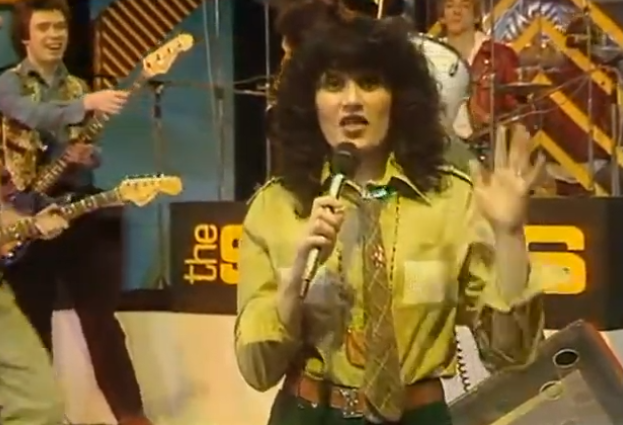
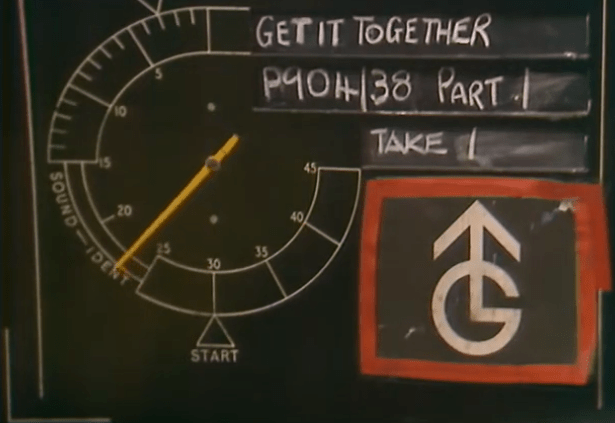
Afternoon pop show for YOUNG ADULTS hosted by Roy North and Linda Fletcher, joined by The Jets, The Smirks and Suzi Quatro. First sight of a VT clock at the start of a video so far.

-
ARCHIVE TV ADVENT CALENDAR DAY FOUR: 4 December 1980
Cowboys (Thames). Roy Kinnear and company in the builder-based sitcom. This episode sees Joe and his lackeys protect a colleague from the tax collector.
-
ARCHIVE TV ADVENT CALENDAR DAY THREE: 3 December 1969: My World and Welcome To It (BBC2/NBC)
William Windon stars as New Yorkerish satirical cartoonist John Monroe in this US sitcom. This episode involves a rejection, a seal and a psychotic hallucination.
This imported NBC sitcom first aired on BBC2 on 12 November 1969, going out on Wednesday nights at around 10pm. From 21 June 1970, it made the move to BBC1, with a repeat run of the series going out on Sundays just after 11pm. Despite gathering positive reviews, moderate viewing figures led NBC to cancel the series after a single 26-episode season. In a final hurrah, it went on to win the Emmy Award for Outstanding Comedy Series, and the single season subsequently got a 1972 repeat run on NBC.


-
ARCHIVE TV ADVENT CALENDAR DAY TWO: 2nd December 1980
Europe’s Strongest Man (Thames). Derek Hobson hosts, flanked by ‘Enry Cooper, as ‘mighty’ contestants from five countries chase the titular title, plus a cash prize and a silver meat salver. Mean not necessarily included.

-
ARCHIVE TV ADVENT CALENDAR DAY ONE: 1st December 1969
The first episode of Broaden Your Mind’s (BBC2) second series, the sketch-based encyclopaedia of the air by The Goodies before they became The Goodies. Wiped after original broadcast, but here’s a full audio-only recording of the episode.

UPDATE 2 DECEMBER: Spotter’s badge to Daniel James Webb for noting that the episode I’d posted was from… not the date I’d meant. Thanks to me rushing to put the Archive TV Advent Calendar into action before I got distracted by an interesting stain on the ceiling or something, I failed to notice the great big “1969-11-17” on the video. The correct video now just up there. If you want to see the episode I’d originally linked to (s2e1), it’s here. And, as a bonus, here’s the original RT listing for that:

And, because it’s nearly Christmas, here’s a summary of the broadcast history. That BBC1 showing: at 17:25 on Mon 25 May 1970.

-
Twelve Surprising Windows 95/98 Desktop Themes for British TV Programmes

YES. Back in the dial-up days of technology, there was Windows 95 and a bit later, there was Windows 98. Groundbreaking at the time, nowadays a curious glimpse into the technological past. People used to survive using a 800×600 resolution? But one of the best things about Windows 95 (and a bit later, Windows 98) was a hitherto unimaginable level of customisation. You could have great big BMP files as your Windows background. You could change icons. You could even change your startup music (and I know, I briefly changed mine to the entirety of Kandy Pop by Bis). And, if you couldn’t be bothered changing all those things by yourself, you could just ‘down’ ‘load’ custom themes someone else had made, using the ‘inter’ ‘net’. For free!*
(*£14.99 per month to an ISP for net access, a further 1p to your ISP for each minute you’re online, and the cost of the phone calls. So, not free. But it was the future.)
When it came to user-made desktop themes, there were lots to pick from if you knew where to look. And, looking at them now, it’s interesting how much of a mid-to-late-90s snapshot they really are. You could find desktop themes based on the cool new music acts of the day (and previous days), the latest hip films, the coolest new videogames, and obviously the happening-est US TV series. But you could also get desktop themes inspired by parts of the British TV landscape at the time. Some of them will be wholly expected. Some others, not so much.
Join me now, as I squeeze myself through the fibre pipes of today’s internet and crawl back to a more innocent age. An age of paid-for web browsers, of USRobotics 14400 modems and your mum shouting at you for hogging the phone line. It’s time for Twelve Surprising Windows 95/98 Desktop Themes For British TV Programmes.
Bob and Margaret (originally uploaded March 1999)

An incredibly rare example of an animated British sitcom (for grown-ups) that actually lasted more than a couple of series. A few things were in its favour here. Firstly, it was good (that’s the trick Stressed Eric missed). Secondly, it was based on the Academy Award-winning short film Bob’s Birthday. Thirdly, and possibly most crucially, it was partly a Canadian production, with the latter two of the programme’s four series going as far as to be set in Toronto. In both phases of the show’s run, the premise of the show highlighted the mundane as much as high farce, as the titular twosome coped with topics from dinner party etiquette to a patient dropping dead in Bob’s dentist’s chair.
I’ll grant you, very little of this comes across in this Windows theme.
Hustle (July 2006)

I’m probably on my own here, but when BBC One – especially early noughties BBC One – goes out of their way to tell you their new drama series is cool, it basically comes across like your mum or dad telling you about this cool new band you really should check out. “Well, now I’m not going to like it on principle.”
That’s how I always felt about this series, which seemed to come with a hastily-applied level of gloss that the content beneath really didn’t deserve. A by-product of those early days of Telly Trying To Be More Like Film, perhaps, or maybe just that everyone seems so bloody smug. Anyway, if you’re less cynical than me, here’s a theme you might like. With it arriving in 2006, well into the Windows XP era upon release, but each to their own.
(Postscript: the BBC Three pseudo-spinoff programme The Real Hustle, where undercover con artists showed common tactics used by real-life scammers, was much better. Even if they really phoned in the content by the end – such as in the episode where Jess goes into PC World with an external hard drive up her sleeve, with which to connect to a laptop’s USB port and ‘steal’ all the software on it. Oh no, that poor 90-day trial of Norton Antivirus, ripped from the teat like that.)
Fireball XL-5 (January 2005)
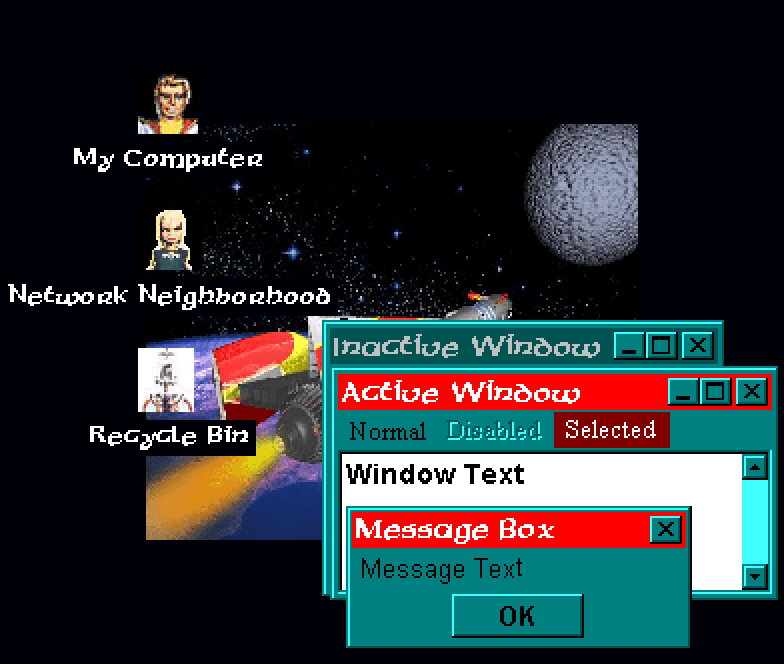
That font. Ouch. I assume the hands controlling the mouse that selected the font were being controlled by strings.
Yes, Minister (August 1999)
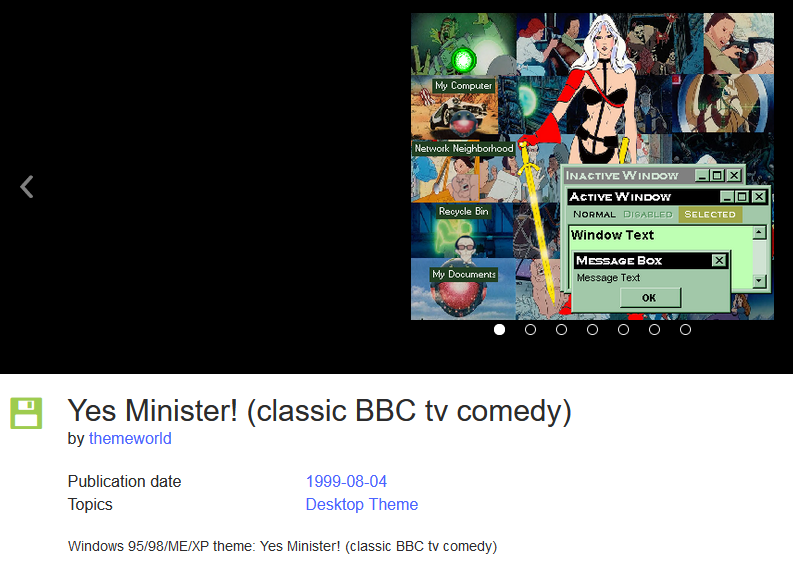
I mean, I’m 99% sure either the upload or the title is wrong on this one, but I can’t discount the possibility all of the above actually happened in one of the later Yes, Prime Minister episodes. A misplaced memo means Bernard has to get involved in a clinical trial of hallucinogenic drugs, perhaps?
Rab C Nesbitt (August 1998)

Govan’s foremost street philosopher may have sent middle-England scrabbling for their writing sets to inform Anne Robinson that they need to page 888 when watching it, but that definitely didn’t hamper the sitcom’s longevity. Running as a standalone sitcom from 1988 to 2014 (and as a recurring character in sketch comedy Naked Video from 1986), this must surely take the crown of BBC2’s longest-running sitcom from a certain space-based sitcom. Mark the occasion with this background featuring not one, but two screencaps from a .mov clip of the series.
Black Books (March 2003)

How black? None more black. A decidedly low-energy effort by this fan of the Dylan Moran bookcom.
Rex the Runt (August 2002)

Aardman’s forgotten project. Rex the Runt – along with Big Bob, Wendy and Vince – was a frequent visitor to BBC2 between 1998 and 2001, and with good cause – Rex’s short episodes were packed with winsome whimsy, great gags and captivating cameos (ranging from Bob Holness to Eddie Izzard). I seem to recall they were even used as promotional mascots for Rowntree sweets for a spell. Beyond that, a future of increasingly sporadic repeats on digital channels beckoned, but at least there’s the opportunity to relive the series with this Windows 98 theme.
Coronation Street (August 1998)

Granada’s main export. And bravely, the person behind this particular theme held no truck with (then-) modern day Corrie. Snubbing the likes of Bettabuys (or even The Kabin), Nick Tilsley secretly marrying Leanne Battersby or the endless bickering of the McDonald clan, this theme went with the classics: a cat in a nook, and Hilda Ogden guarding the Network Neighbourhood. 10/10, no notes.
Waiting for God (September 1998)

This pre-watershed old-age sitcom, where Graham Crowden and (a 48-year old) Stephanie Cole play a pair of elderly residents of a care home, having as much fun as they can before being summoned to the choir invisible, isn’t the most likely to choices for a Windows backdrop. But hey, it was a primetime BBC1 hit that appealed to generations across the age spectrum, so who are we to judge?
Robin of Sherwood (October 1999)
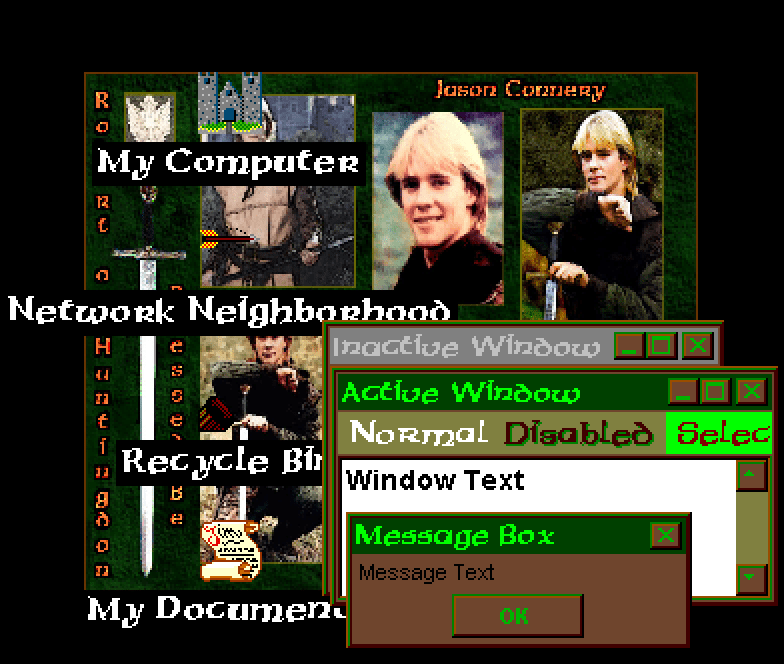
Again, that font. Good lord.
Tweenies (April 2002)
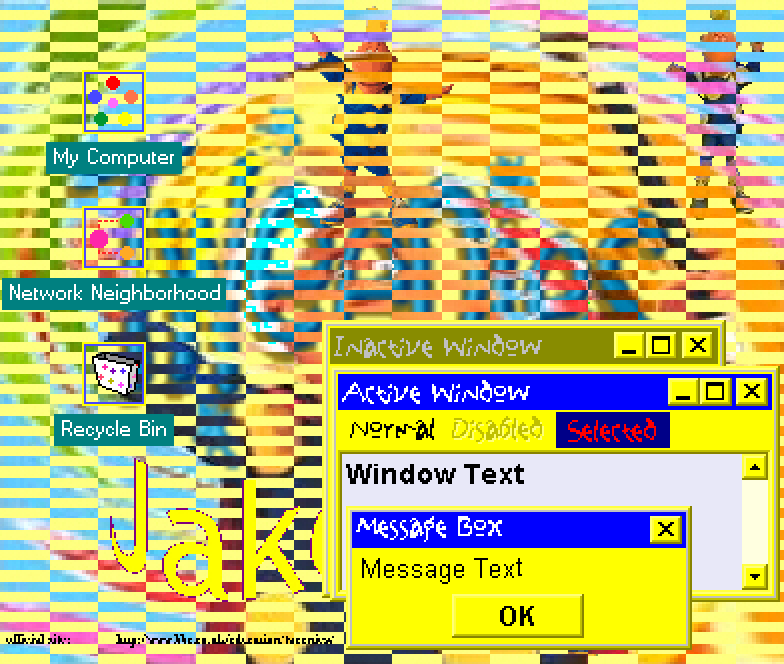
One for anyone fitting into both of two categories.
- CATEGORY ONE: You like the CBeebies television programme Tweenies.
- CATEGORY TWO: You hate your eyes.
As Time Goes By (November 2000)

You can keep your Stargate, your Sliders, your Ally McBeal and your Buffy. If I’m having any TV programme greeting me each time I power up my Gateway Performance 600 it’s the autumnal romantic comedy starring pre-Dame Judi Dench and Geoffrey Palmer. Whose heart wouldn’t soar like an eagle being greeted by the above each boot? Each BSOD would make you chuckle on this inside, knowing you’re about to get an extra added glimpse of the above. Perfect.
And there we go. Thanks to Ben Baker for putting the idea for an update in my head with a Discord post about the Windows theme for One Foot in the Grave. If you like this update (or my other, better updates), you’ll almost certainly enjoy Ben’s latest Live Repeat on Noisebox Radio looking at the forty best TV themes of ALL TIME.

-
BBC100: The 100 Most-Broadcast BBC Programmes Of All Time (45-41)
Hello, everybody. Sorry it’s been a while since the last update to this list, but (amongst ploughing through forty years of Channel 4 viewing figures), this selection has required a little more research than most.
Before hitting the list, a two bits of minor admin. Firstly: most people seem to be coming to the site via my Tweets on The Twitter. That’s good. Except Musky Burns seems determined to pull all of the Kerplunk straws from Twitter’s infrastructure (for the lulz, I assume), so it’s hard to gauge how long it’ll last in its current state. That’s bad. So there are a couple of alternative ways to get updates.
WAY ONE: I’m on the Mastodon. I’ll be posting each time there’s a new update on there as well as Twitter. Follows and boosts appreciated (say hi if you’re there from this blog so I can follow back, as a lot of people seem to be doing mass-follows to inflate their numbers at present).
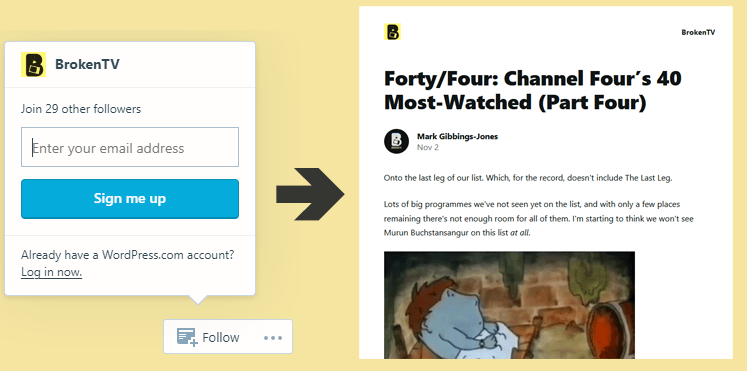
WAY TWO: At the bottom of the screen, you should see a ‘follow’ button. If you click it and enter your email address, you’ll get each update automatically emailed to you. In full, not just the first bit and ‘Click here’, the full lovely update. Which is nice.
Okay, second bit of admin. Unless you’ve got an adblocker, you may well be seeing banner ads on the site. They… aren’t meant to be there. I’m paying for WordPress hosting, meaning the site shouldn’t have them. All being well, they’ll be disappearing soon. (That makes a nice change from sites saying ‘your Adblocker is killing my children’, doesn’t it?)
Okay. Admin done. Let’s crack on with…
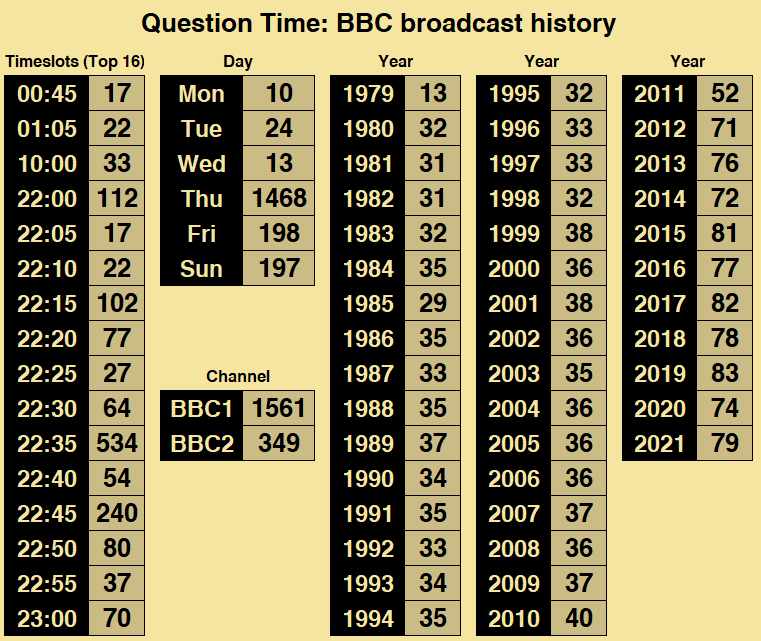
45: Question Time
(Shown 1910 times, 1979-2021)
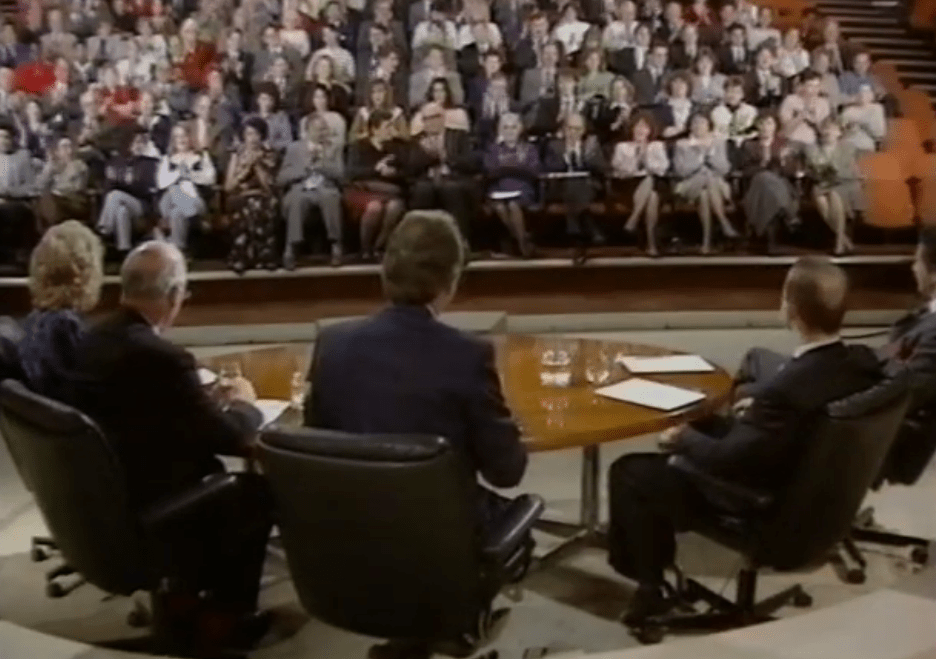
Here’s one that was a safe bet for inclusion. But firstly, a few things that aren’t Question Time. Starting with…
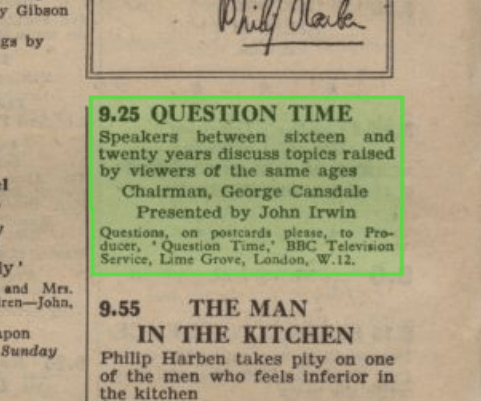
QUESTION TIME (2 October 1952)
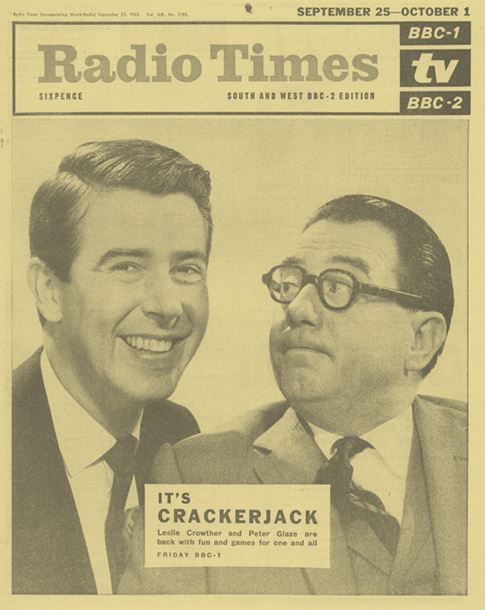
Not the version we know and… love(?), but rather a one-off discussion programme where Young Adults of the era discuss topics raised by viewers of the same age. So, an early proto version of Twitter (except, as I say, populated by young adults). Despite the appeal in the Radio Times at the time to send in questions (“on postcards, please”), this doesn’t seem to have returned to the Television Service, at least not under the same name.
GARDENERS’ QUESTION TIME (4 June 1955)
“This is the first time that this popular programme from the North of England has been televised”, proclaimed the Radio Times listing. And indeed it was, a rare audiovisual outing for the Home Service mainstay. For whatever reason, the experiment wasn’t repeated, and it has remained an audio-only endeavour ever since. At least nationally – the RT listings for 1973 include three episodes of regional TV programme ‘Northern Gardeners Question Time’, because Northern Gardeners don’t want to share any of their secrets with those soft southern shandy-drinking bastard gardeners.

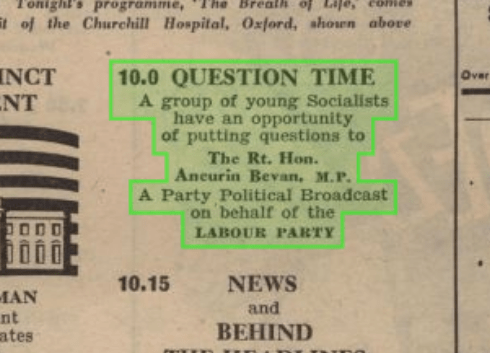
QUESTION TIME (11 Feb 1958, 6 May 1968)
QUESTION TIME FOR YOUTH (5 March 1960)To think, certain corners of the internet get all het up about rampant BBC lefty bias if a QT panel somehow contains participants from Labour, the Greens AND a fashionable stand-up comedian. These two offerings would likely have them putting their foot through the screen and sending the bill to the remains of Harold Wilson.
Firstly, in 1958, an event that certainly has all the hallmarks of QT as we know it. A politician is asked to face a series of questions from an invited audience. The politician in question: the sainted Nye Bevan. The audience in question: “a group of young Socialists”. The reason? This is actually a Party Political Broadcast on behalf of the Labour Party.
Then, just over ten years later, almost exactly the same thing again. This time, it’s much larger in scale, with Labour MPs Barbara Castle, William Ross and George Thomas in the hot seats, and questions coming from audiences in Glasgow, Manchester and Cardiff. Simulcast on BBC-1 and BBC-2 at 9pm, just in case you thought you could escape it.
In between those two, 1960 saw Question Time for Youth, though this seems to have been on a much smaller scale – only on BBC1, shoved out just before closedown at 11pm, and the Radio Times couldn’t even be bothered listing the names of the MP questionees.
Did the tactics work? Well, the closest political poll to the 1958 broadcast was the Rochdale By-Election, called following the death on 16 December 1957 of the sitting Conservative Member of Parliament, Wentworth Schofield, and if that’s any metric it was a big success. Labour’s Jack McCann won the seat, beating Liberal candidate (and at the time, writer and radio presenter) Ludovic Kennedy and Conservative candidate John E. Parkinson.
No big national election in 1968 either, but there were by-elections in Nelson and Colne, Oldham West and Sheffield Brightside the following month. Not quite as successful this time, with results respectively being CON GAIN, CON GAIN and LAB HOLD. Thus the Question Time moniker was relinquished by the party, and never used again. As for the 1960 Youth effort – the closest contests to the transmission date were the Harrow West by-election and the Brighouse and Spenborough by-election the following month. The results? CON HOLD and NATIONAL LIBERAL GAIN. So, yeah. Not a huge success.
QUESTION TIME! (5 March 1960)
At least, something different. No politics, but at least there’s a sense of urgency to the programme title as anyone still up at 10.55pm tuned in to see… “a talk by the Rev. W. D. Cattanach.”
ELECTION 70: QUESTION TIME (9 Jun 1970, 11 Jun 1970)
This time a more open-ended political discussion, and one with a real General Election set to happen the following week. Harold Wilson’s Labour up against Ted Heath’s Tories. Bob Wellings chaired a debate between a group of journalists and representatives of the main political parties on the issues surrounding the election. Getting closer to the canon, but not quite there.
COMMON MARKET QUESTION TIME (2 Sept 1971-23 Sept 1971)
So close to the real thing now. This was a series of four programmes from regional centres where questions from members of the public regarding Britain’s membership of the Common Market could be addressed by policy-makers of the day. This ticks off quite a few of the key criteria: each episode from a different town? TICK (County Durham, Port Talbot, Glasgow and Coventry). Members of the public? TICK. A round table of political thinkers expected to provide answers? TICK. And crucially, Robin Day as chairman? TICK. In fact, it’s only the fact these went out under the umbrella of news magazine show 24 Hours that prevents me from including these in the overall total. Similarly, in 1974 Nationwide included an Election Question Time strand that followed much the same format, minus the future Sir Robin.
QUESTION TIME (25 September 1979)
At last, the real deal. The Beeb finally offers us a whole hour to question the ideas and decisions of today. Robin Day takes the chair on stage at the Greenwood Theatre, South London, as public personalities face questions and reactions from the general public. With him tonight: The Rt Hon Michael Foot, MP, Edna O’Brien, Teddy Taylor, The Most Rev Derek Worlock, Archbishop of Liverpool.
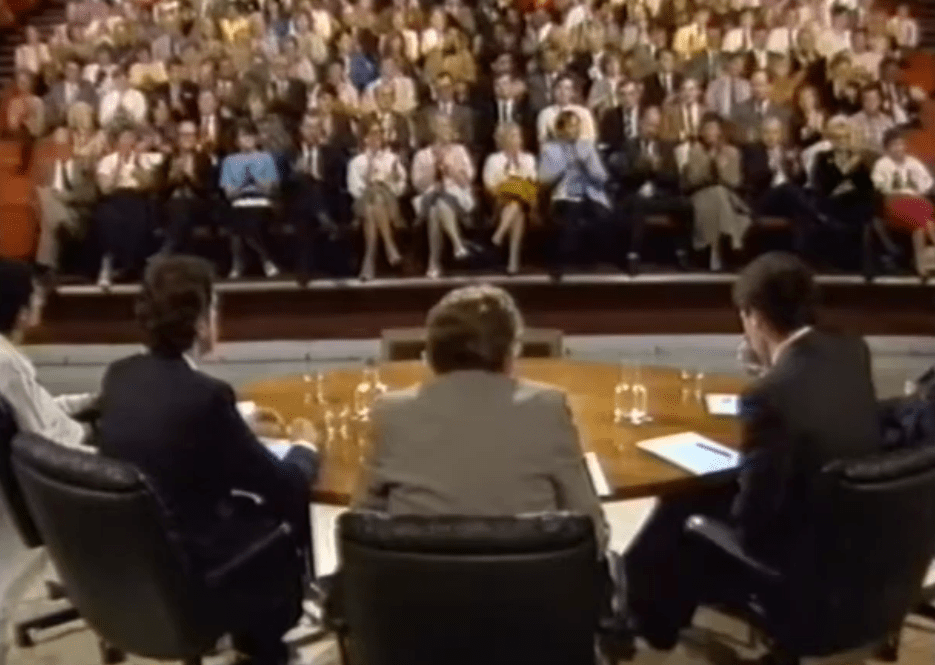
FINALLY. But… you know what Question Time is. An excuse for all of Twitter to get really angry at each other. Well, not all of Twitter.
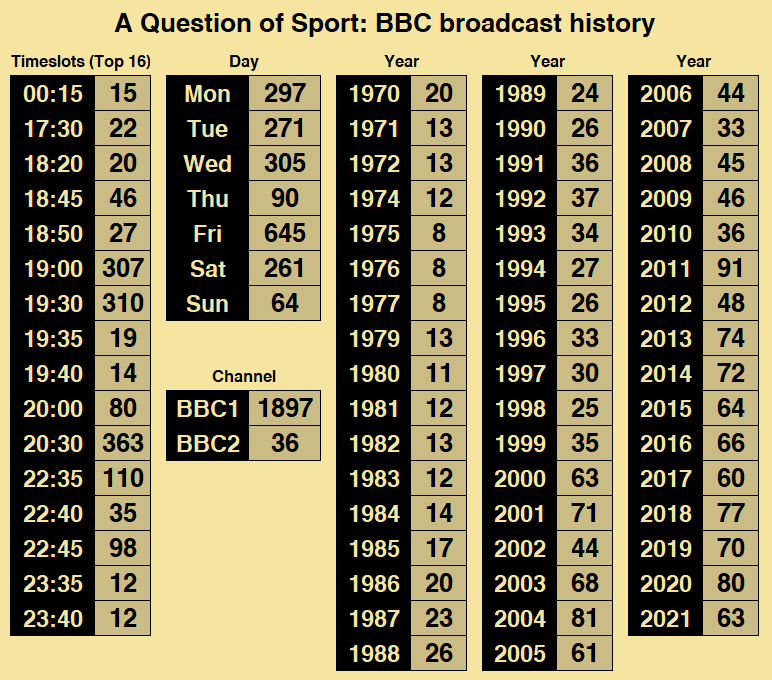
44: A Question of Sport
(Shown 1933 times, 1970-2021)
So, from Question Time to a Question of Sport. For some of the quiz programmes in this list there’s a feeling they’re pretty much a constant. Mastermind has remained largely the same, no matter who the questionmaster might be. Ditto University Challenge, ditto Call My Bluff. However, when it comes to QoS, it feels (at least to me) that there are decidedly distinct eras, immediately identifiable from each other
Those of a certain age will instantly think of the Coleman-era, with faux-stadium trimmings, small-firstname-BIG-LASTNAME nameplates, all that. It’s okay, people who remember that, we’re not old. We liked the Wet Leg album, so we can’t be.

“Actually David, I feel that their promise dropped off substantially following Wet Dream.” Those of a more recent generation may find their minds immediately drift to the latter-era, the Sue Barker years, the larger set, the audience sat behind the participants (which is great if you want spend an evening looking at the back of Ally McCoist’s head, I guess), the bantz-heavy dialogue, the desperate need to be more like They Think It’s All Over.

Each generational grouping thinks theirs is the ‘correct’ QoS epoch, and that all members of the other are nought but fooles. Apart from a tiny, embittered third grouping that thought Sporting Triangles was best. The two larger generation groups decide to join forces, take on that third generation, and beat them up. With good cause. And now, nobody ever mentions Sporting Triangles. Until me, just then. But anyway.

My meanderings do, of course, wholly discount a whole period of the show from before I started watching it. Hey, I’ve spent ages researching hosts of a programme I can’t even settle on a consistent naming convention for, cut me some slack. The series proper began (following a BBC North-only pilot in 1968) as a Monday teatime offering in 1970, with viewers settling down to their sausage, spuds and sport greeted by original host David Vine, along with team captains ‘Enry Cooper and Cliff Morgan. The first ever episode came with a suitable special line-up: ‘Enry joined by footballer George Best (at least according to the RT listing – I assume he turned up) and cricketer Ray Illingworth, while Cliff teamed up with athlete Lillian Board and footballer-of-a-very-different-generation Tom Finney.
Monday evenings was where the programme would stay until 1981, save for a special Sunday World Cup edition at the end of May 1970, featuring captain Bobby Moore, Geoff Hurst and Alan Mullery versus captain Johnny Haynes, Tom Finney and Stan Mortensen, and a brief flirtation with Thursday evenings in 1975.
By the time of 1981’s new Friday night peak 7pm slot, David Coleman had taken on hosting duties, with Emlyn Hughes and Gareth Edwards serving as team captains (and future captain Bill Beaumont in a guest spot in the first episode of the series). It then spent the next few years being booted about the schedules wherever there was a spare pre-watershed spot to fill, the programme appearing in Tuesdays in 1982, Wednesdays in 1983, back to Tuesdays in 1984, before landing in a regular Thursday night home from 1985 for a few years. From 1988, it was back to Tuesday nights, where it would stay until the mid-90s.
There’s a case for arguing that the 1980s marked the height of the series’ popularity (and not just because it was popular enough to be lampooned by A Bit of Fry & Laurie). From 1983, one-off Christmas specials of the series started to appear, starting with a tantalising line-up on 29 December that year: original captains ‘Enry Cooper and Cliff Morgan made a return, with showbiz guests Max Boyce, Georgie Fame, Lennie Bennett and Anita Harris.
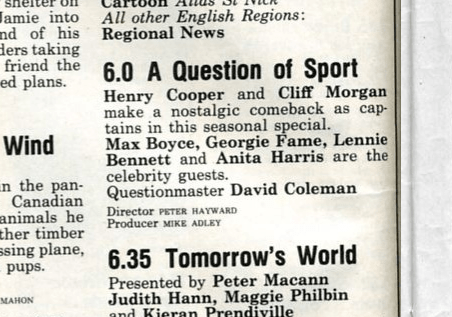
The 1984 Christmas Radio Times marked an episode of the series going out on New Year’s Eve, tucked into the early evening schedules between Blue Peter Review of the Year and film Treasure of the Yankee Zephyr, though it seems this may well have been closer to a regular episode, with the series returning less than two weeks into the new year. QoS had a higher profile the following Christmas, airing in a peak 8:30pm slot on Christmas Eve, sandwiched between Kenny Everett’s Christmas Carol and a festive episode of Terry and June. On top of the prime scheduling, celeb guests reappeared on the programme, with actors John Nettles and Ray Brooks joined by comedian Eddie Large and ‘comedian’ Stan Boardman.

Another celebrity line-up appeared in 1986’s Christmas special (between peak-era ‘Stenders and another new Kenny Everett special), with Les Dawson, Leo Sayer, Su Pollard and Leslie Grantham, who I really hope walked on set in the same outfit he’d just been wearing behind the bar in the Queen Vic. You know, for continuity purposes.
That’s certainly a much better line-up than the one that appeared in 1987’s Christmas Special. In descending order of merit, Roy Castle, Peter Howitt, ‘controversial cricket writer’ Frances Edmonds, every single speck of dirt in the studio, and Bernard Manning. I know, bloody hell, eh? You’d think they’d learn, wouldn’t you? And yet, in 1988 – on Boxing Day, no less – Manning returned to the QoS studio, along with Tim Rice, Frank Carson and Bread’s Gilly Coman.
And with that line-up, Celebrity Christmas editions of A Question of Sport would be no more, until quite a few years into the 21st Century. Which is probably for the best. But hey, at least it means that incoming new QoS host Paddy McGuinness won’t be the worst comedian to appear on the series, so that’s something.
43: Late Night Line-Up
(Shown 1992 times, 1964-1989)
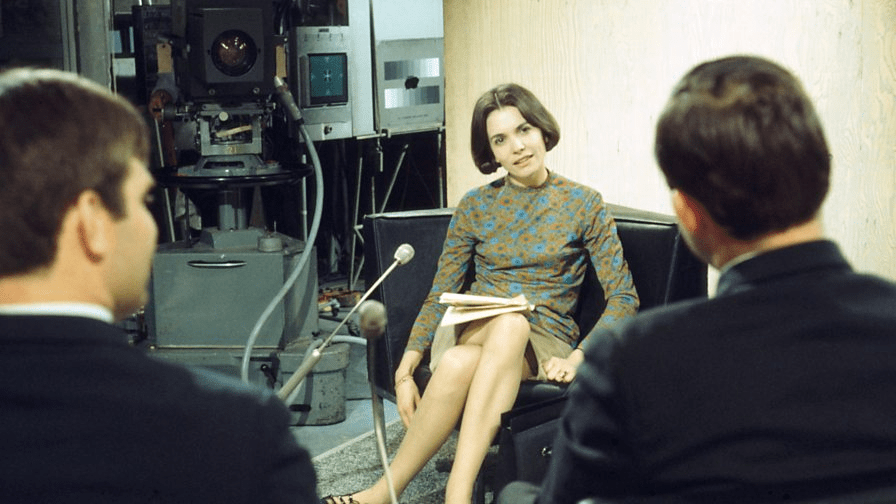
Right from BBC-2’s (slightly belated) launch night in April 1964, the decision was made to open each evening with broadcaster Denis Tuohy offering those awaiting a televisual feast a ten minute glimpse at that night’s BBC-2 menu. This strand would be known by the gently unassuming title of ‘Line-Up’.
The intent was to showcase the rich variety of original programming on offer by the new channel. After all, this was an age where you’d have to get up, walk across the room and change the channel on the TV itself, meaning that many viewers just sat back and let a single channel entertain them for the evening. The actual effect was that viewers may realise there’s nothing they liked the look of until later on, and took the trouble to get up and change to another channel. And so, not for the first time, the lofty ideals of a new channel were to be cast aside for something less highbrow but more popular. It’s like ITV4’s launch including a full repeat run of The Larry Sanders Show.
But that wasn’t the end for Line-Up. Add a more intellectual edge to it, change it from a glorified programme menu to a discussion programme, and put it out live. Of course, this would need to go out after the 9pm watershed, in case discussions got a bit too feisty for tea time. And not just bang on 9pm, where the runway would need to be kept clear for big flagship programmes. Late at night, that’s best. Who doesn’t like seeing a great big argument while supping up your Horlicks and getting into your 1960s pyjamas?
Plus, with nothing following it in the schedule, if a discussion was getting really riveting, the channel could stick with it until it wraps up naturally. Within the confines of Postmaster General’s broadcasting regulations, anyway – BBC2 was only permitted a certain total amount of airtime per day, but it seems there weren’t any instances of the Late Night Line-Up plug being yanked out of the socket by a furious Postmaster General in dressing gown and curlers at 1.29am. Which is a bit of a pity, frankly.

This had the added benefit of letting BBC2 stay up later than both BBC1 and ITV, who generally went to bed at about 11.45pm. 100% audience share of 2,076 viewers is still 100% audience share, after all. And so, from Saturday 12 September 1964, late night viewers were invited to “Round off the day with Denis Tuohy and Michael Dean” for the first time. As time went on, Joan Bakewell and Tony Bilbow would also go on to be key hosts of the programme.
Initially, discussion focused on one or two interviewees, but that remit soon drifted. Wikipedia has a splendidly comprehensive list of topics and interviewees featured on the programme year-by-year, and dipping into episode descriptions for those first few years highlights how Late Night Line-Up soon evolved:
In 1965, a chat with an individual figure appears to have been the norm, such as Robert Morley (18 March), Douglas Bader (17 September) and Tony Hancock (5 October). By 1966, the remit had opened up to take in particular topics alongside guests of interest. Episodes included: Line Up Rugby / Yugoslav TV Film / Shirley Abicair (1 January), Ivor Cutler / Clifford Davis Conjuring Tricks / TV Critics (13 January), and N. F. Simpson Interview / Jimmy Edwards’s Moustache / Breakfast TV / Donald Campbell Interview / Tonia Bern Interview (7 May)
When 1967 came along, the toe-tippingly popular music of the day became too big for the programme to ignore, though there was still room for discussion on other topics. So, episodes covered things such as: Discussion on building industry / Gladys Aylward (1 February), Jimi Hendrix Experience / Psychedelic Happening / Pierre Schoendoerffer (17 May) or Electronics And TV / The Rolling Stones / Discussion on the Canadian Film Industry (24 August)
By 1968, the theme seems to have navigated back toward single interviewees, though not exclusively. Episodes included: Lotte Reiniger / girls from Hammersmith County School give their views on public schools (9 March), John Peel (18 September) and Alfred Hitchcock (27 September)

By 1969, Line-Up episodes airing on Sundays offered “Late Night Line-Up’s weekly look at the cinema”, airing (and billed) under the banner Film Night, and featured stars of the screen such as Vincent Price (23 March) or Peter Finch (30 March), or individual films of interest, such as The Illustrated Man (22 June) or topical Hammer flick Moon Zero Two (13 July).
1970 saw an interesting mix of topics and interviewees, one standout in particular showing how daring this live, late-night programme could be. Episodes including Playgrounds (25 September), The Man Who Almost Won The National (29 October) and (yes, this is the standout one) Lenny Bruce Stand Up Routine (18 December). 1971 saw Saturday nights handed over to individual contributors in episodes branded One Man’s Week (or, much less often, One Woman’s Week). Weekday editions still found time to discuss other matters of the day, such as 22 October’s discussion regarding “A 4th TV Channel”.
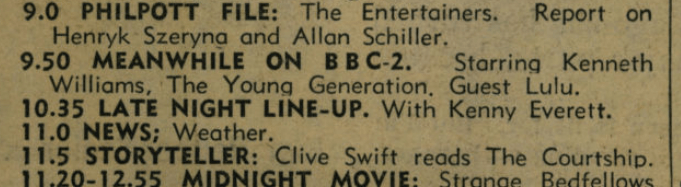
The tape of that’s not going to survive, is it? Boo. 1972 saw the (regular) series draw to a close, but not without packing a lot into those final months. Including: Welcome Little Kangaroo – Eight Years of BBC2 (21 April), Cable Vision (9 August) and Sir Hugh Carleton Greene (18 October). Plus, as a grand finale on 14 December, a discussion of BBC2 in general, with Michael Dean, Tony Bilbow, Sheridan Morley And David Attenborough
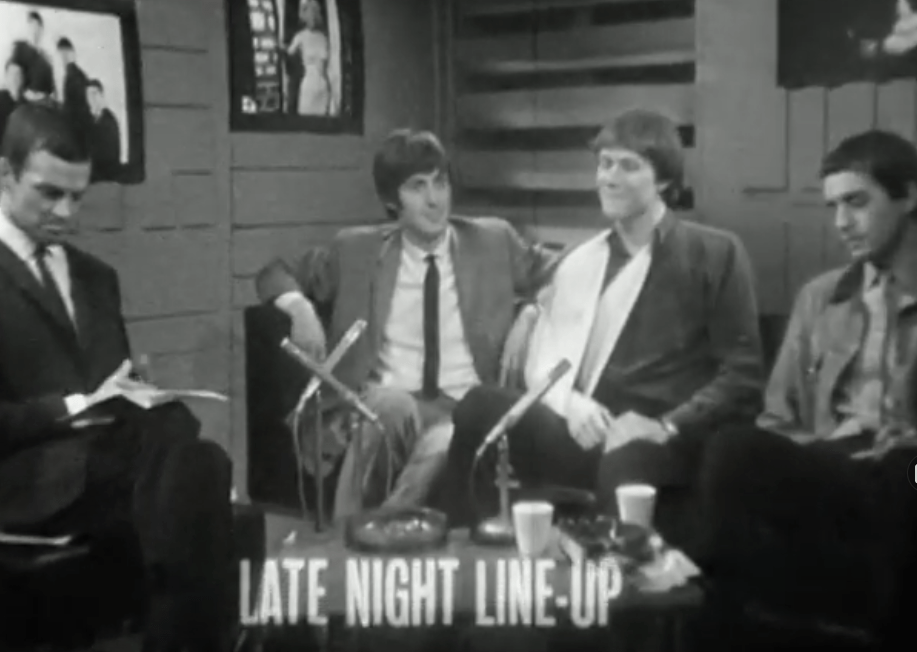
As might be expected from a live, late-night, free-range discussion show from the late 1960s/early 70s, not much of it still exists in the BBC’s library, and even less of it is available to view. A few clips are up on iPlayer, but it’s YouTube that really delivers, offering several entire episodes. For instance, here’s an interview with Paul Jones of Manfred Mann and Spencer Davis (19 Jan 1966), an interview with Magic Roundabout creator Serge Danot (13 Dec 1966), a discussion about the two-part ‘Man Alive’ report on homosexuality in Britain (14 Jun 1967).
Arguably the most infamous Late Night Line-Up discussion of all, A Serious Talk About Comedy (7 Jan 1966) is also on YouTube, thanks to the ever-excellent BBC Archive account. The panel includes comedy writers Marty Feldman, Ian La Frenais, Johnny Speight, John Chapman, Richard Waring and comedy producer Duncan Wood. The clip however starts with an intervention by comedy writer and playwright John Antrobus, who… clearly wasn’t invited. But that wasn’t about to stop the writer of the The Bed-Sitting Room having a good old go at getting involved. The remainder of the discussion is no less spirited, aided by it being a noticeably smoke-filled and drink-fuelled one.

That wasn’t the end of the Line-Up, however. A new live episode of the programme aired as part of the Festival 77 season on 1 August 1977, with guests David Frost, Dennis Potter and Christopher Morahan. The programme returned for a full week as part of BBC TV’s 50th anniversary celebrations in 1986, with Michael Dean, Tony Bilbow, Joan Bakewell and Sheridan Morley as guests. In 1989, a package of series highlights was screened as part of BBC2’s 25th anniversary hullabaloo*. Finally, and not qualifying for the total here, BBC Parliament’s Permissive Night (26 May 2008) included a one-off comeback episode, with Margaret Drabble, Peter Hitchens, Michael Howard MP and Lord Robert Winston discussing the liberalising legislation of the 1960s.
(*First person to leave a comment saying “no, that’s the other kangaroo” wins a shiny shilling.)

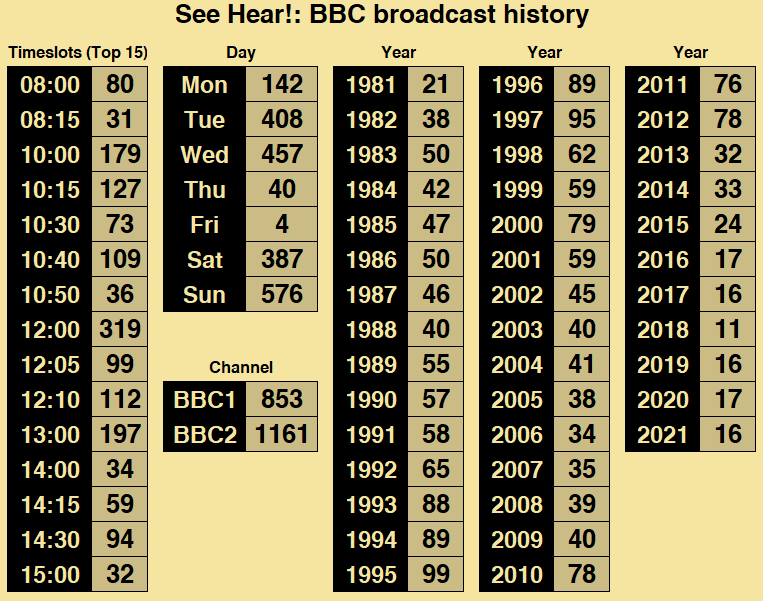
42: See Hear!
(Shown 2014 times, 1981-2021)
Right at the start of the Moving Pictures era of the entertainment industry, deaf people were on an even footing with everybody else. Picture houses showing the latest flicks by Chaplin, Keaton or Lloyd could be enjoyed by hearing and hard-of-hearing alike, with inter-title caption cards explaining dialogue to the entire audience.
Then, The Jazz Singer came along. Al Jolson’s “You ain’t heard nothing yet” signalled the start of the end of that equal footing, where deaf audiences would start to need a strong lip-reading game to enjoy the latest cinematic hits.
The situation for deaf people hoping to take part in popular culture didn’t improve with the advent of television. For those early pioneers of the tube, it was enough of a challenge throwing hours of live content into thousands of cathode-ray tubes each day, providing verbiage to match would have proved an insurmountable task. And, for the most part, it would continue that way for several decades.
Not that there was nothing. Starting in 1952, Jasmine Bligh introduced For Deaf Children, where sign language was used to include deaf children in the fun and games. But, it was hardly a regular helping of fun, totalling just a single twenty-minute programme per month. In January 1955, monthly children’s programme Monday Magazine launched, with the RT listing highlighting the programme’s suitability for deaf children. That at least meant there was now only a two-week gap between programmes for deaf children, but still very little for them once they left childhood.
There were also occasional one-off or short run programmes catering for deaf viewers. January 1963 saw a production of The Magic Shoes featuring members of the Royal National Institute for the Deaf Mime Group, a programme arranged in co-operation with the Royal National Institute for the Deaf. Later that year, a couple of multi-part Sunday Stories included “interpretations for the deaf” by Joan Turner as Cyril Fletcher read for viewers – ‘The Childhood of Helen Keller’ ran from 17 March until 14 April 1963, while ‘Ambassador in Bonds’, a story of blind missionary to Burma William Jackson, ran from 24 November to 8 December of the same year.
For Deaf Children certainly had a good innings, running until 7 February 1964, but a month later came a key change in the way programming for deaf children was presented. Vision On arrived in the slot vacated by For Deaf Children – 5.35pm on Fridays – but now aired fortnightly. And that wasn’t the only change. Surveys had shown that one of the favourite BBC-tv programmes for deaf viewers was Top of the Pops. Pops’ fast-moving format made it feel like viewers were part of the coolest party in town, and deaf viewers were still able to enjoy the lower frequency notes of those swinging sounds of the sixties. That livelier approach was at odds with the sedate pace used in For Deaf Children, and producers Ursula Eason and Patrick Dowling set about making things a bit livelier with Vision On.
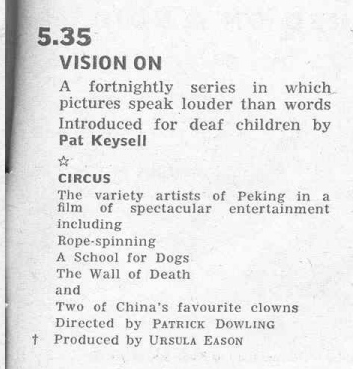
The new programme’s remit was entertainment over education – hey, it’s Friday evening, after all – and the need for subtitles or sign language was drastically reduced by making the action within the new programme almost entirely visual. Noises were, to all intents and purposes, off. The new programme would encourage viewers to dive into their imagination by serving up sequences both sensible and silly, and while the approach was likely to attract the attention of a wider audience, the goal was always to serve deaf viewers.

The programme was a major success, running until 1976, hoovering up awards, and helping introduce a number of names that would become key to children’s television over the next few decades, such as Tony Hart, eccentric inventor Wilf Lunn, Silvester (then ‘Silveste’) McCoy and the work of a certain company later known as Aardman Animations.
And yet – despite the wider (and likely more cross-generational) appeal of Vision On, deaf adults were left wanting (aside from Saturday evening News Reviews on BBC2, which “for the deaf and hard of hearing” were afforded “a commentary [that] appears visually”. Y’know, subtitles.
For those with deep enough pockets to procure an early teletext-capable set, subtitles were already a common option for deaf viewers. The birth of Ceefax in 1974 allowed for text-based accompaniment alongside TV programmes, though it took until 1975 for the first Ceefax-subtitled programme to appear. Appropriately enough, that first-ever subtitled programme was This is Ceefax, a late-night documentary presented by Angela Rippon, looking into the new service that remains an amazing innovation for the time.
Initial audiences for Ceefax subtitles were limited. Indeed, that initial audience for those inaugural subtitles: one household. Specifically the household of Ceefax editor Colin McIntyre, location of the country’s only privately-owned teletext set at the time. That kind of limited launch may well have been for the best – at this early stage, subtitles had to be keyed in live, transmitted at each punch of the enter key, which combined with the far-from-comfortable keyboards at Ceefax HQ, made for very hard, unforgiving work. Much more information about those early days in this entertaining post by Adrian Robson, part of the initial editorial team of Ceefax, and the person who’d put out those first ever subtitles.
Then, eventually, 1981 happened. And so did See Hear!, a new weekly (weekly!) programme for people with hearing issues. And it was set to run for at least twenty weeks. No wonder the programme’s title felt the need to append itself with an exclamation mark – this was big news for the underserved community.
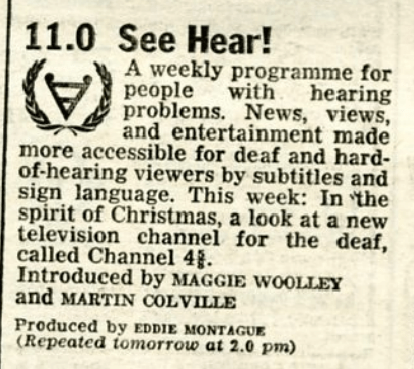
From this point on, while there’s certainly no real scope for criticising the BBC’s earlier output for people with hearing problems (save for their lack of frequency), See Hear! really did offer a fresh perspective. Broadcast with open subtitles and in BSL (by Martin Colville), and hosted by deaf presenter Maggie Woolley, promising to cover news, views and entertainment, and generally cramming in as many genres as the budget would permit. Well, to be fair, the team behind the programme had a lot of time to make up for.
The format proved to be a success, leading to special editions of the show coming from the nations and regions, plus topical specials themed around the 1983 General Election, technology and education. In 1984, the line-up was bolstered by the introduction of Clive Mason, who would go on to be the programme’s longer-serving presenter, and who would become a major part of the programme’s regular Christmas and pantomime specials.
By 1990, the brand had even grown beyond the main programme, with each morning’s signed-and-subbed BBC2 rebroadcast of the previous hour’s BBC1 Breakfast News bulletin going out under the title See Hear Breakfast News. This also proved a success, with the practice becoming a true simulcast of the BBC1 7am bulletin from 1995.
In later years, the provision of programming for people with hearing problems was greatly expanded, providing viewers were willing to record overnight Sign Zone broadcasts. However, that did little to dampen the success of See Hear!, with the programme currently (at the time of writing) in its 42nd series. That said, perhaps as a result of Sign Zone’s longevity (plus iPlayer allowing for more user-friendly scheduling of signed content), See Hear! output has fallen since 2013, and the series is now back to going out on a monthly basis. That’s a shame, but See Hear! really did so much show how much more television can do to help keep the hard-of-hearing community informed, entertained and included. Long may it continue.
41: Town and Around
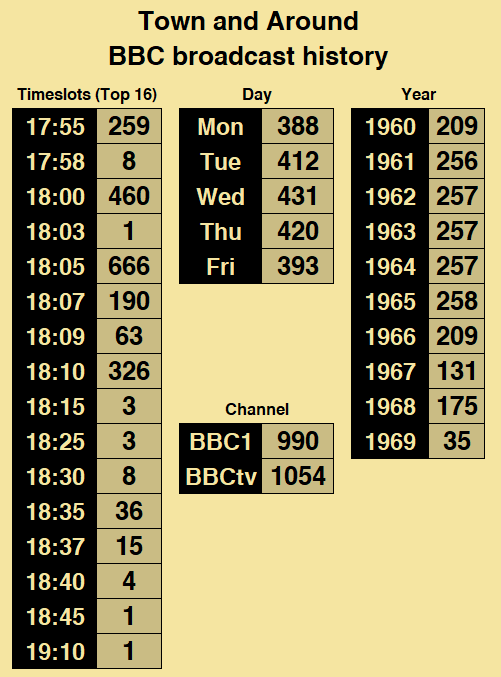
(Shown 2044 times, 1960-1969)
Nominally “a daily presentation of news and views from London and the South-East”, but this was more than just local news. Thankfully, or I’d have to remove it and renumber the entire list. This is more of a magazine programme, and therefore CAN be included in the rundown. Phew.
So, what was Town and Around? Well, other than the standard write-up in the Radio Times – “a news magazine for South-East England” – it’s not especially easy to find out. In fact, of all the programmes I’ve covered so far, it’s been the hardest to find any information on. It doesn’t help that the cruel hand of fate placed my birth several years after the programme finished, so I’ve no personal memory to draw on.
Here’s what I have been able to find out, accompanied by some best-guesses that will be disproved in the comments within an hour of this post going live.
What with it going out in the regional news slot in London and the South-East (it making the list because, at the time of pulling all the data, that was the region used for the listings in Genome), it makes a kind-of sense that it would be less newsy than the regional news in other parts of the UK. After all, with That London being the focal point of the majority of current events going on in the UK, all of the capital’s newsworthy events had just been covered in the national news bulletin. And so, despite only needing to full a short ten- or fifteen- minute slot, it seems there was room for other non-news content.
What sort of content? Well…

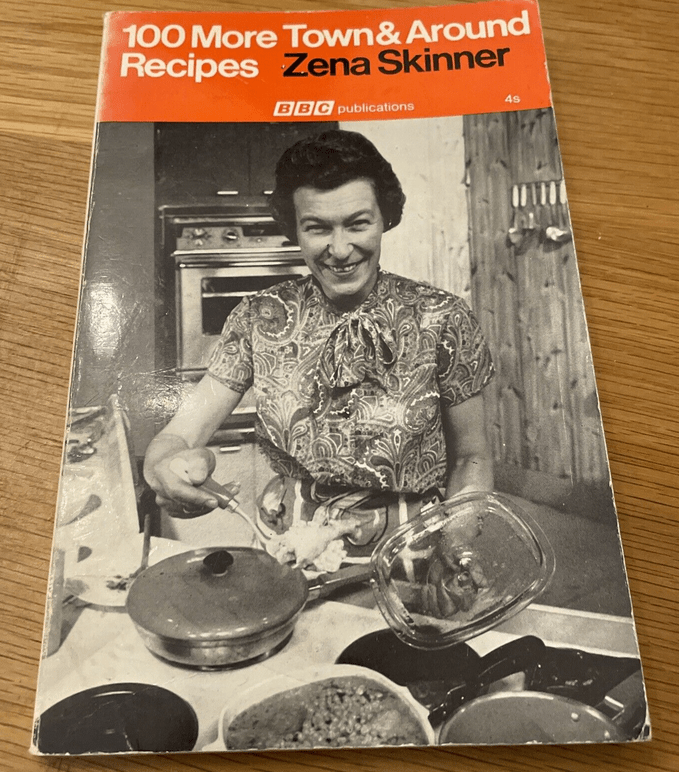
Cooking was certainly one of the topics covered. Enough cooking to generate not just one cookbook containing 100 recipes, but a follow-up containing a further hundred. And it wasn’t even billed as a cookery programme.
When it comes to compiling these entries, there are a few sources I consult for some added information. No, not Wikipedia. Only sometimes Wikipedia. The obvious starting point is the BBC Genome website. But also, the scans I’ve accumulated of elderly Radio Times issues, a variety of books on television history, several newspaper archives and a collection of BBC Yearbooks. Here’s the net sum of what I’ve gleaned from those sources for Town and Around:

From the BBC Yearbook 1960: “The year saw two notable developments in regional broadcasting – the introduction of Television News for north-east England from the Newcastle studio and ‘Town and Around’ the magazine programme for London and south-east England.”
A good start in a section on regional broadcasting. With it being a daily programme focused on the capital of Britain, it’ll surely get regular mentions each year, right? Right?
Yes. By which I mean: no. The next reference to it comes in the BBC Yearbook 1965.


And again in the 1966 yearbook:
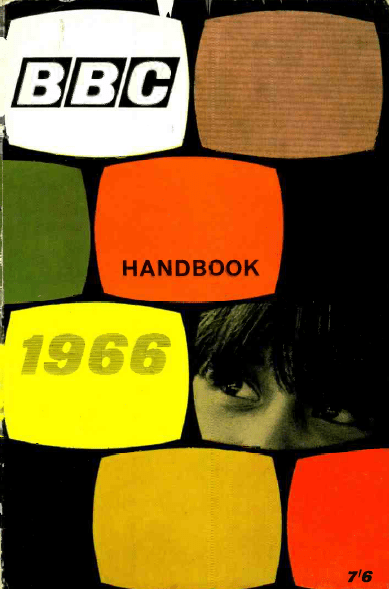

But, in the 1968 yearbook – a reference to the series isn’t about cooking!


…admittedly, it’s not about much at all. But wait, in the BBC Yearbook 1969, a bit of a revelation:


A fifth book containing a hundred recipes by Zena Skinner? Fair dues, she was carrying that show.
Other than that, there’s very little out there. My hopes were raised when a Google search threw up an article in America’s Journal of Marketing Research (Vol 6 No 2, May, 1969). Sure, I needed to register with ‘digital library for the intellectually curious’ JSTOR to take a peek, but this would be worth the trouble.
Here you go, stats fans.

Yeah, good luck picking the bones out of that. So, what have we learned? Well, for one thing, I really should have tried to claim this programme was too news-adjacent to include in the rundown. That would have saved me a lot of trouble. But mainly, an appreciation for the work ethic of Zena Skinner.
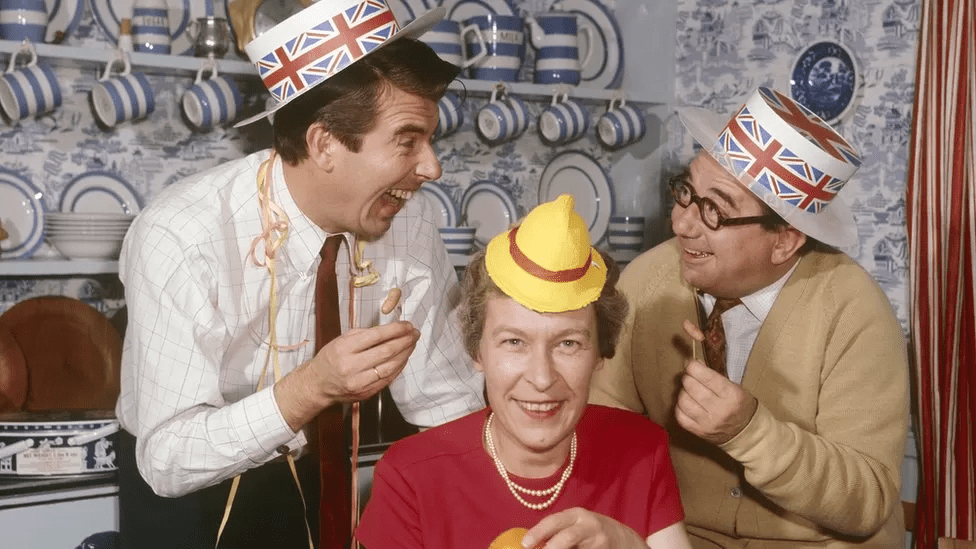
Well done, that lady.
Oh, also Nigel Kennedy appeared on it when he was seven. Thanks, Radio Times 16-22 July 2022.

And – here’s one out of left field – thanks to the Mustard Project website, a “TELLEX Transcript of interview with Pro-Vice-Chancellor, ‘TOWN & AROUND’ Monday 20 May 1968: 5.55pm”. So, one extreme to another. Starting with photos of some cookbooks from eBay, ending up with actual internal BBC documents. Full document here if you’re curious.

So, in short – nobody reading this is about to pick Town and Around as their specialist subject on Mastermind, but at least you got to see some covers of BBC Yearbooks. So, that’s not nothing.
Phew, that took a long time to research and write. Hope you enjoyed it, and let’s hope the next bunch of programmes don’t include any that haven’t aired within the last fifty years. Toodles!
Until that next update, if you want to take a peek at some BBC Yearbooks, the World Radio History website has got you thoroughly covered.
-
Forty/Four: Channel Four’s 40 Most-Watched (Part Four)

Onto the last leg of our list. Which, for the record, doesn’t include The Last Leg.
Lots of big programmes we’ve not seen yet on the list, and with only a few places remaining there’s not enough room for all of them. I’m starting to think we won’t see Murun Buchstansangur on this list at all.
The list thus far:
- 40: THE NICK (21:00 Monday 3 Oct 1994, 6.5m viewers)
- 39: FILM: BRIDGET JONES’S DIARY (21:25 Saturday 13 Nov 2004, 6.54m viewers)
- 38: IT’LL BE ALRIGHT LATE AT NIGHT (23:10 Thursday 11 Jul 1985, 6.55m viewers)
- 37: FILM: STAND BY YOUR MAN (21:00 Tuesday 14 May 1985, 6.6m viewers)
- 36: FILM: CASTAWAY (21:00 Monday 26 Nov 1990, 6.63m viewers)
- 35: FILM: COAST TO COAST (21:00 Tuesday 5 Feb 1985, 6.65m viewers)
- 34: FILM: WISH YOU WERE HERE (21:30 Thursday 15 Feb 1990, 6.67m viewers)
- 33: GOGGLEBOX (22:00 Friday 12 Mar 2021, 6.74m viewers)
- 31: FILM: GOOD MORNING VIETNAM (21:00 Sunday 25 Apr 1993, 6.75m viewers)
- 31: LOST (20:30 Wednesday 10 Aug 2005, 6.75m viewers)
- 30: FILM: NIGHTMARE ON ELM STREET (22:00 Tuesday 31 Mar 1992, 6.8m viewers)
- 29: WIFE SWAP (21:00 Tuesday 21 Oct 2003, 6.9m viewers)
- 28: FILM: NOWHERE TO RUN (21:00 Tuesday 9 Apr 1985, 6.95m viewers)
- 27: FILM: THE ABYSS (21:00 Sunday 24 Jan 1993, 7.01m viewers)
- =25: FILM: MOTHER, JUGS AND SPEED (21:00 Tuesday 12 Mar 1985, 7.05m viewers)
- =25: ATHLETICS: THE KODAK CLASSIC (21:00 Friday 9 Aug 1985, 7.05m viewers)
- 24: FEMALE PARTS: RUDE WOMAN (21:00 Monday 11 May 1992, 7.06m viewers)
- 23: PETER KAY LIVE (21:30 Wednesday 4 Aug 2004, 7.197m viewers)
- 22: IT’S NEVER TOO LATE (20:30 Monday 3 Dec 1984, 7.2m viewers)
- 21: FILM: BILL AND TED’S EXCELLENT ADVENTURE (21:00 Sunday 11 Apr 1993, 7.29m viewers)
- 20: SHE’LL BE WEARING PINK PYJAMAS (21:00 Thursday 12 Mar 1987, 7.6m viewers)
- 19: RELATIVE STRANGERS (20:30 Monday 28 Jan 1985, 7.75m viewers)
- 18: PARALYMPICS 2012: OPENING CEREMONY (20:00 Wednesday 29 Aug 2012, 7.78m viewers)
- 17: FILM: MONA LISA (21:30 Thursday 23 Feb 1989, 7.82m viewers)
- 16: TREASURE HUNT (20:30 Thursday 24 Mar 1988, 7.85m viewers)
- =14: INTERNATIONAL SNOOKER (21:45 Sunday 16 Dec 1984, 8.25m viewers)
- =14: FILM: DARK NIGHT OF THE SCARECROW (21:00 Tuesday 21 May 1985, 8.25m viewers)
- 13: BROOKSIDE (20:00 Wednesday 3 Nov 1993, 8.27m viewers)
- 12: THE MIRACLE OF KATHY MILLER (21:00 Tuesday 21 Apr 1987, 8.3m viewers)
Anyway, here they are, that final, um, eleven. Yes, eleven. Definitely didn’t uncover another high-rating broadcast at the last minute, no. Starting with…
11: CELEBRITY BIG BROTHER
(20:30 Friday 19 Jan 2007, 8.78m viewers)
A franchise always likely to feature here, the question is… which series attracted the highest viewing figures? Here’s a clue: it was the one where the phrase “the values of the Carphone Warehouse” entered the public lexicon. The one that led to a diplomatic row between the UK and India. The one that led to a Prime Ministerial statement. And it wasn’t just to point out that Donny Tourette was a bit of a bellend.
Given how easily ignored Celebrity Big Brother was during those final years on Channel Five (if you have to explain in an intro video what you’re “most famous for”, you’re not famous), it’s remarkable how high the calibre of guests was during this period of the show’s history. For the series in question here, you had Leo Sayer, Ken Russell, Cleo Rocos, Dirk Benedict and actual bloody Jackson Five member Jermaine Jackson. And yes, the laws of the universe also dictate that you’d get some stunt casting to offset that, people whose lofty level of celebrity status existed only within their egos, but it was part of the formula. Rough with the smooth. And at least Donny Tourette’s presence was enlivened by his introductory encounter with a butter-smooth Dirk Benedict (“Oh my God, it’s Dirk fucking Benedict!” “Well, I don’t normally use my middle name, but hi.”).
Anyway, I’m pretty sure you all know the details of The Event here, even if it’s only from the Stewart Lee routine. Bollywood star Shilpa Shetty was one of the celebrity housemates, and arrived with a clear air of Girl Awkwardly Trying To Fit In At A New School. A group of the other participants – glamour model Danielle Lloyd, pop star Jo O’Meara, previous Big Brother contestant Jade Goody, along with boyfriend Jack Tweed and mother Jackiey Budden – decided they didn’t like her (for… whatever reason), and the end result was one of the most unedifying weeks in the history of television. Unedifying for the individuals involved, for the production company, for the channel that gleefully pumped it out night after night, and ultimately (hands held up here) for the viewers who may have been disgusted, but who weren’t about to switch off.
There was a lot to unpack from the whole affair. The most overt display of racism coming from the mouth of Danielle Lloyd, followed by an “ooh, aren’t I naughty” giggle, was probably to go-to example, but there were several more distasteful moments of note. The one that springs to mine for me was the programme producers Endemol addressing rumours that Jack Tweed had used the word P*** to refer to the (perfectly pleasant) Shetty, by releasing (partly) unbleeped audio confirming it was fine, he was just referring to her with the word c***. So, um, that’s still not exactly great, is it?
Ultimately, Endemol seemed to realise that throwing more kindling on their bonfire of dignity wasn’t helping anyone – not least when lead sponsor Carphone Warehouse demanded to be disassociated with the show, and agents of the main culprits saw lucrative contracts suddenly cancelled – and Jade Goody was duly evicted. The usual eviction night crowd may have been absent, but the TV audience were certainly present, in huge numbers. But, from this point on, the Celebrity Big Brother brand was irrevocably tainted, and I’m saying the affair definitely directly resulted in a ‘Leave’ vote in the EU referendum. Still, maybe next year’s ITV2 reboot will undo all that? Yeah, I know.
WHAT WAS ON THE OTHER SIDE?
Nothing else stood a chance, really. BBC1 offered sitcom After You’ve Gone followed by WWI-era drama Lilies. BBC2 dug up an episode of Grow Your Own Veg, followed by Timewatch episode Killer Cloud. ITV threw on a Midsomer Murders and went to the pub, while Five followed Nick Baker’s Weird Creatures with an NCIS off the shelf.
10: BIG FAT GYPSY WEDDINGS
(21:00 Tuesday 8 Feb 2011, 8.8m viewers)
Span out of warmly-received 2010 Cutting Edge episode My Big Fat Gypsy Wedding, this series dipped into the lives and traditions of families from the Traveller community as preparations were made for a family wedding. While the original was awarded ‘Most Groundbreaking Show’ in the ‘Cultural Diversity Awards’ (which were possibly invented specifically to annoy your uncle on Facebook), the full series was criticised by many from Britain’s Traveller and Romani community for playing up the quirkiest, most outrageous examples of life within the featured families.
This highest-rating episode came from the first series, with an episode looking into the community’s weddings and christenings from a purely male perspective, but most episodes from that opening series rated north of eight million viewers. It’s only in later series where the programme’s popularity began to slide, with many of the standalone ‘event’ episodes from 2013 falling outside BARB’s published ratings, putting their figures below two million viewers.
WHAT WAS ON THE OTHER SIDE?
BBC1 broadcast poorly-received sci-fi drama Outcasts, while BBC2‘s The Chinese are Coming explored China’s role as an emerging economic superpower. ITV were still pushing out episodes of Taggart, with tonight’s tale tackling the world of cage fighting. Five threw on a bunch of CSI episodes for the night and went to bed early. The Viacom takeover couldn’t happen soon enough.
9: THE PRICE
(21:30 Thursday 14 Feb 1985, 8.9m viewers)
COME ON DOWoh wait, it’s not that. But rather the concluding episode of a tense six-part thriller starring Peter Barkworth and Harriet Walter. The tale of Geoffrey, a millionaire trapped in an unhappy marriage to a wife twenty years his junior, but his devotion to his wife and her mardy-arse daughter is soon tested as they’re kidnapped by the IRA. With his assets far from liquid, he struggles to raise the required ransom, and his attempts to free capital cause the share price of his firm to tumble. Ah, the priorities of television characters from the eighties.
In this final episode, “Geoffrey enlists the aid of computers to track down his wife and step-daughter. But the police close in while the gang still hold his family”. Given the computers of that era, fingers crossed for no R:Tape Loading Errors, eh?
WHAT WAS ON THE OTHER SIDE?
Final episode of amateur sleuth-em-up Charters and Caldicott on BBC1, followed by Question Time. ITV had an episode of TV Eye looking at the rise of lawlessness on the New York subway systems, and the groups of vigilantes who formed to tackle them. Over on BBC2, a Forty Minutes episode looking at two stories of young love (Feb 14th, of course) followed by The Rockford Files. Meanwhile, later the same night on Channel Four, an episode of Cinemax-C4 collaboration Assaulted Nuts, a pretty much made-for-export sketch comedy series starring Tim Brooke-Taylor, Barry Cryer and Cleo Rocos. It’s worth looking up details on that series, as it’s a deliciously off-piste piece of British comedy history. Even if it’s not exactly brilliant.
8: NUNS ON THE RUN (1990)
(21:00 Sunday 18 Apr 1993, 9.2m viewers)
There have been quite a lot of films on this list, haven’t there? Some big budget American ones (The Abyss, Good Morning Vietnam), some more modestly-budgeted but well-reviewed homegrown movies (Wish You Were Here, Mona Lisa). And, besting all of them in the ratings battle… this.
Eric Idle and the late Robbie Coltrane play inept gangsters Brian and Charlie, whose attempt to rob a gang of Triads results in them ripping off the rest of their gang to escape to a life of Brazilian bliss. Things don’t quite go to plan during their getaway, meaning the duo are forced to flee and seek refuge at a nearby nunnery. Brian’s love interest Faith (Doctor Who’s Camille Coduri) spots the cackhanded crims attempt to flee, and also joins the nunnery posing as a student.
Cruelly overlooked by the Academy Awards judging panel, the whole affair was a diverting enough romp if you ask me. Yeah, there was no intellectual nourishment on offer here, but sometimes you just feel like a tube of Pringles, yeah? Mind you, Roger Ebert stated that when it comes to Nuns on the Run, “your laughter may reveal more about you than about this particularly dreary film.” It’s still better than Splitting Heirs, I counter.
WHAT WAS ON THE OTHER SIDE?
Sunday night treats on offer elsewhere were an episode of A Year in Provence followed by Mastermind on BBC1 (PD James, the Napoleonic Wars, the Cornish clay industry and medieval castles on the latter, the Mayles have a go at French sport in the former). BBC2 dealt out an Arena special on the career of South African pop megastar Brenda Fassie followed by Peggy Sue Got Married (1986). ITV finished off a Maigret before welcoming a textbook Aspel & Company line-up (Mary Tyler Moore, Brian Conley and Sting) and News from ITN.
7: FRIENDS
(21:00 Friday 28 May 2004, 9.64m viewers)
Ah, here it is.
One the one hand, Friends was always bound to appear on this list. But on the other hand, you’d have thought the same about Cheers, Frasier, Ugly Betty, The Cosby Show, Ellen, The Golden Girls, Desperate Housewives, A Handmaid’s Tale or Will & Grace, and you’ll notice there’s not enough room left for many of them. Or possibly any of them.
After the reliably popular Cheers came to an end in May 1993, it left a big hole in Four’s Friday night schedule. While the channel had seen quite a few similarly well-received Friday night comedy imports – The Golden Girls enjoyed a lengthy run on the channel, but that had already run its course, and spin-off The Golden Palace had been and gone by the time Cheers came to a close. What was the channel to do? Other options such as Roseanne weren’t as popular as they had been, and new acquisitions such as Susan Harris’ post-Golden Palace project Nurses or HBO sexcom Dream On had failed to draw much attention.
On 28 April 1995, their prayers were answered, with a programme debuting – as it happens – just after the second ever episode of Father Ted. Nestled between the latest from Craggy Island and one-off spoof Jack and Jeremy’s Police 4 (or pilot for Jack and Jeremy’s Real Lives, if you prefer) came the first episode of NBC’s hot new sitcom hope, starring (as The Times had it at the time) “NYPD Blue’s David Schwimmer” in (as The Mirror had it) “half a dozen single twentysomethings fighting on the battlefield known as life”.
You know the rest, I’m sure. This high point of the series viewing figures comes for the final episode, at a point where Channel Four had expensively wrangled the rights back from Sky, and where it served as a lead-in to a brand new series of Big Brother.
WHAT WAS ON THE OTHER SIDE?
BBC1 fought comedy with comedy, offering an episode of The Lenny Henry Show featuring guest star Harry Enfield. BBC2 offered a clear alternative with Art of the Garden, while a bullish ITV went big with a heady mixture of celebrities, kitchens and bollockings with a ninety-minute episode of Gordon Ramsey’s Hell’s Kitchen. Five merely admitted defeat and farted out a showing of Jean-Claude Van Damme’s Double Impact.
6: CUTTING EDGE
(21:00 Monday 14 Feb 1994, 9.78m viewers)
Here’s one out of left-field.
Not necessarily that Cutting Edge would make an appearance in this top ten – it’s a very long-running topical documentary strand, basically the channel’s answer to Panorama. But rather the episode that happens to have been the most-watched of them all.
It could have been 1994’s Graham Taylor: An Impossible Job, a groundbreaking sports documentary where the levels of access granted to the film crew capturing the working life of beleaguered England manager Taylor was rivalled only by the levels of swearing throughout. After all, I can’t think of any Panorama episodes that led to a phrase that would capture the imagination of a nation like “Do I not like that?” did.
It could have been Bafta-nominated episode Katie: My Beautiful Face from 2009, which followed the recovery of ex-model Katie Piper following a malicious acid attack. Or even 2010 episode My Big Fat Gypsy Wedding, which span-off into a full, very popular series of its own.
Instead, it was 1994 episode Shops and Robbers that drew the largest audience. Far from a scintillating takedown of a notorious figure, or capturing a slice of life that simultaneously captured the nation’s hearts, it investigated the battle between Marks & Spencer and shoplifters. On the part of M&S, there’s a look at the company’s security hub, and at their futile attempt to nab a gang of professional pilferers. On the part of shoplifters, there’s an encounter with a serial shoplifter who routinely lifts clothes from the store, deliberately damages them, and then attempts to return them for a no-quibble refund. No wonder they subsequently changed that policy.
WHAT WAS ON THE OTHER SIDE?
Speaking of Panorama, that was BBC1‘s alternate offering following the Nine O’Clock News that night, with reporter Roger Harrabin investigating the claim that air pollution was causing a rise in the rates of asthma. BBC2 also offered up a documentary alternative, with a Horizon episode dissecting the aftermath of the 1992 Columbia air crash. Lighter fare on ITV, with Under the Hammer, an episode of the Richard Wilson/Jan Francis comedy drama featuring a guest turn by Thora Hird. Not a lot of light relief for anyone under thirty finding themselves dateless at home that particular Valentine’s Night, really.
5: GREGORY’S GIRL (1980)
(21:00 Tuesday 8 Jan 1985, 10.75m viewers)
Bill Forsyth’s film takes a look at adolescent sexuality through the filter of life in early 1980s Cumbernauld. Gawky teen Gregory Underwood is the hapless striker of his hopeless school football team, until the team manager takes a gamble on keenly talented but controversially female Dorothy in his place. Gregory couldn’t care less about regaining his place up front, of course. He’d much prefer to form a striking relationship with Dorothy off the pitch.
A brilliantly funny film that’s no less enjoyable in a world where girls playing football is the norm, and I say that as someone made to cringe myself inside out appearing in a GCSE English dramatic performance of it (I was brought up not to swear in front of adults, so having to joyfully utter the word “tits” in front of a bunch of them failed to provide the subversive thrill you’d expect).
A British film that still makes best-of lists now – even Entertainment Weekly placed it in their ‘50 Best High School Movies‘ list some 34 years after initial release.
WHAT ELSE WAS ON?
The News followed by play The Last Evensong on BBC1, an gritty-era episode of The Bill (“Det Insp Galloway on the trail of a pornographer”) followed by News at Ten on ITV, and a niche triumvirate on BBC2: Pot Black ’85, followed by Doctor’s Dilemmas (“exploring the ethical dilemmas facing doctors”, reasonably enough) and World Darts.
4: THE GREAT BRITISH BAKE OFF
(21:00 Tuesday 24 Nov 2020, 11.74m viewers)
Often when popular programmes get gazumped by other channels, it doesn’t work as well as hoped. Sky One did this quite a lot, snatching the rights to Friends, Lost, The X-Files, 24 and sundry others, the net result generally being each show immediately lost about 70% of its audience. Thames famously coaxed Morecambe and Wise over to ITV in the late 1970s, and their magic soon began to fade – ditto after The Goodies decamped to LWT. In fact, it’s harder to think of success stories: Men Behaving Badly became huge after being picked up by the BBC, but that mainly happened because ITV had given up on it. So, we’re left with a list that has the name ‘Kenny Everett’ on it and little else.
Aside, that is, from Bake-Off. The odds seemed stacked against it – one of the BBC’s biggest shows being seized by a smaller channel, three of the four main hosts declining to make the move, a programme everyone was used to viewing without interruption suddenly having to make room for ad breaks. It doesn’t stand a chance.
And yet… all of those obstacles did the series very little harm at all. At the programme’s high point on BBC1, it drew a total of 15.9m viewers. That fell by a relatively minor amount following the channel switch, with 11.74 million viewers tuning in for the pox-era finale. Yes, the C4 figure is smaller than the BBC1 figure, but that still made it a sixth-most watched programme of the year for any channel. And in a year when we were legally forced to remain indoors, that’s pretty good.
WHAT WAS ON THE OTHER SIDE?
It was 2020, so a perpetual chronicle of doom on The News, or – as before – Netflix.
3: FOUR WEDDINGS AND A FUNERAL (1994)
(21:00 Monday 28 Apr 1997, 12.38m viewers)
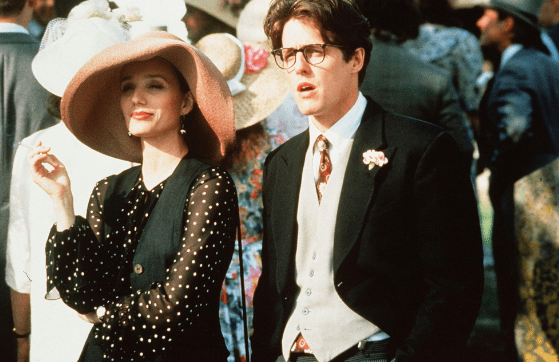
In 1994, director Mike Newell single-handedly (okay, Richard Curtis helped) gave the British romantic comedy genre the firm, hard boot up the arse it sorely needed.
Not that the genre hadn’t existed before then, nor that Curtis hadn’t previously had a hand in it. Indeed, Richard Curtis’ previous film for cinemas, The Tall Guy (starring Jeff Goldblum, Emma Thompson and Rowan Atkinson) was a firmly enjoyable romp, but it seemed destined for little more than limited domestic success, maybe a weekend showing or two at 10pm on ITV, and little else. Having enjoyed his directorial work on Jack Rosenthal’s Ready When You Are, Mr. McGill (Granada, 1976), Curtis picked Newell to work with on his next project, and it’s fair to say it was quite a success: Four Weddings became the (then) top-grossing British film in history at that time, Hugh Grant was catapulted to superstardom, Curtis was nominated for a Best Screenplay Oscar and Wet Wet Wet clamped themselves to the top of the pop charts on the back of the soundtrack single.
WHAT WAS ON THE OTHER SIDE?
An extended Nine O’Clock News, followed by a Labour Party Election Broadcast and ‘scientific thriller’ Breakout on BBC1, the reboot of The Outer Limits and This Life on BBC2, while ITV plumped for an episode of Bramwell and News at Ten.
2: BIG BROTHER
(22:30 Friday 27 Jul 2001, 13.74m viewers)
Another inevitable entry near the top of the list. Despite the format fizzling out by the time it’d moved to Five (and a certain amount of eye rolling when news broke ITV2 are reviving it next year), there was a time when the vanilla version of Big Brother was a national talking point.
One slightly curious thing about that original series of Big Brother UK – while several routes were used to try and attract participants, the main televised call for contestants that I remember went out immediately after a repeat of BrassEye (with some online commentators subsequently assuming the whole premise was a Chris Morris spoof). As a result, those involved in that original series seemed far less like those in later series, they were more akin what might be considered a set of stereotypical don’t-just-watch-the-sitcoms Channel Four viewers. As it was, the initial series seemed more like an Orwellian social experiment than an easy route to fame (or at least short-term notoriety). Indeed, the BBC News story for that early casting call mentioned how “a nominal fee, equivalent to the amount paid for jury service” was on offer. Nobody was about to put a down-payment on a Mercedes with that line in the contract.
As time would soon tell, not least to the antics of Nasty Nick, it quickly became a national talking point, and the show’s success was sealed. (Aside: from that first series finale, when winner Craig Phillips – who had only entered to try and win some money for a charity – was briefly reunited with Nasty Nick, the latter joking-not-jokingly uttered “Let’s go halves! Let’s go halves!”)
This ratings high arrived at the conclusion of the second series, where the audience that grew as the first series progressed were on board from the start. As it turned out, it was a relatively controversy-free series (certainly no overt racism from someone who’d scored themselves 10 out of 10 for intelligence), and not too many of the participants rekindle memories now – aside from the series winner, the only one I remember is Bubble, and that’s partly because he cropped up in the finale of The Office. Basically, it’s quite nice that a series that didn’t generate any heated headlines or controversy turned out to be most popular, and in series winner (and future BB host) Brian Dowling, one of the people to have justifiably left the house with an elevated reputation to boot.
WHAT WAS ON THE OTHER SIDE?
In contrast to the unfolding reality show drama on Four, BBC1 offered actual drama with a repeat of Casualty and a new episode of The Cazalets. BBC2 dug in with Gardener’s World followed by a repeat of WWII documentary The War Behind the Wire, while ITV foisted forth Family Fortunes followed by a repeat of Taggart. Channel Five offered up an episode of Fort Boyard followed by movie choice Pink Cadillac, neither of which were repeats, so credit to them for that.
So, what’s at number one? After all, this is the channel that brought us Creature Comforts, The Snowman and was the first channel to broadcast Wallace and Gromit in A Grand Day Out. It served us a Big Breakfast and a Friday Night Dinner. It made us laugh with comedy from Cheers to Chelmsford 123, from Absolutely to Adam and Joe, from Phoenix Nights to Frasier. It brought us Traffik, Black Mirror, The Manageress and GBH. It took us from Countdown to the Crystal Maze, from Gamesmaster to the Girlie Show, from Richard & Judy to Rude Tube, from The Tube to TFI Friday, from Max Headroom to Married at First Sight. Surely one of those will be in the top spot? Surely?
Well, nope. Surprisingly, it’s this:
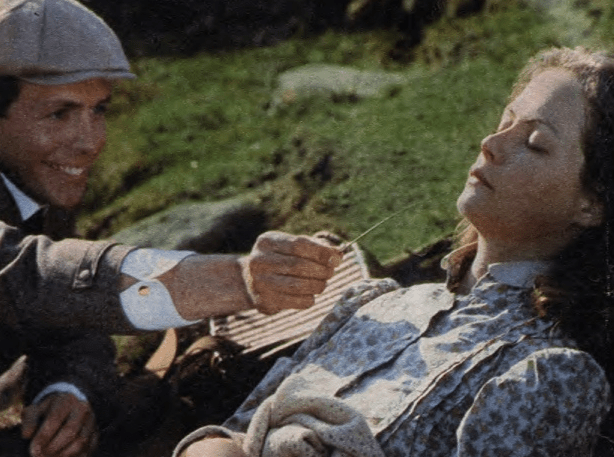
1: A WOMAN OF SUBSTANCE
(21:00 Friday 4 Jan 1985, 13.85m viewers)Yep. I would have said at this point “I bet you weren’t expecting that”, but given someone else has tweeted this bit of information out today, there’s a good chance you were. But for those who are a bit surprised by this turn of events: blimey, eh?
This series was a three-part adaptation of the 800-page novel by Barbara Taylor Bradford, originally published in 1979. The story opens with a battle for control of a vast business empire controlled by seventysomething Business Woman (of Substance) Emma Harte, who discovers that her duplicitous offspring are scheming to carve it up for themselves. A far cry from Emma’s own upbringing, as a downtrodden servant girl.
The focus of the three-parter falls on Emma’s modest rise to power, a Yorkshire village girl taking a job at the local squire’s home, Fairley Hall. From there, a tale unfolds of her rise to power, but no material gains can ever dilute her burning hatred and lust to to enact vengeance on the Fairley family that treated her so unfairly in those formative years.
Jenny Seagrove played the younger Emma Harte, with Deborah Kerr tackling the character’s modern-day persona. And with a decidedly weighty novel to cover, a similarly solid heft of airtime was needed to tell the tale – three consecutive nights, with a two-hour runtime on each.
It was a lengthy yarn that entangled a sizeable audience, with this 13m+ high coming for the conclusion of the initial story. But that wasn’t the end of the tale – May 1987 saw a sequel miniseries, Hold the Dream, which saw Jenny Seagrove and Deborah Kerr return as respective Emma Hartes. While not as colossal a smash at the original, it still attracted a high of 8.1 million viewers. Not too shabby.
WHAT WAS ON THE OTHER SIDE?
News, spy drama Wynne & Penkovsky and cop actioner Starsky & Hutch entertained any viewers left watching BBC1, while Shirley MacLaine and Michael Caine (you gotta have a system) starred in film Gambit (1966) on BBC2. ITV showed the end of Superman II, followed by US not-as-good-as-Alright-on-the-Night cockup compilation Bloopers, hosted by Dick “Not as good as our Denis” Clark.
–

So, There you go. A few things to unpack from that entire list.
- Nuns on the Run was the third-most popular film ever shown on Four.
- The most-watched sitcom in the channel’s history wasn’t Father Ted, The IT Crowd or Phoenix Nights, but a mostly-forgotten Matthew Kelly vehicle.
- There was no room in the list for any Jamie Oliver or Gordon Ramsey vehicles, no Supernanny, Grand Designs, or England matches. All popular, just not popular enough to make this final forty.
- But a repeat of Man About the House came closer to final forty than any of them.
Anyway, thanks for everything, Channel Four. Long may you continue, hopefully free from privatisation, free to entertain or annoy us as you see fit for a long time to come.
-
Forty/Four: Channel Four’s 40 Most-Watched (Part Three)
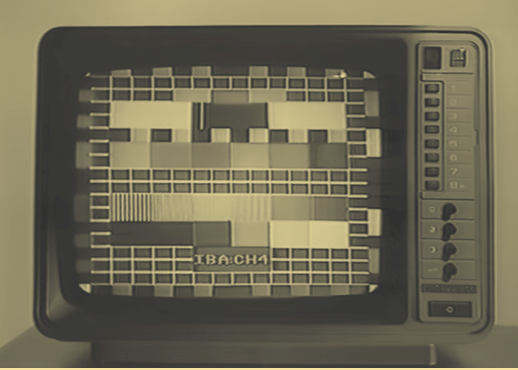
Into the top half we tumble. But first, here’s a rundown of the list so far:
- 41: AUF WIEDERSEHEN, PET (21:00 Saturday 11 Mar 1995, 6.44m viewers)
- 41: THE SNOWMAN AND THE SNOWDOG (20:00 Monday 24 Dec 2012, 6.44m viewers)
- 40: THE NICK (21:00 Monday 3 Oct 1994, 6.5m viewers)
- 39: FILM: BRIDGET JONES’S DIARY (21:25 Saturday 13 Nov 2004, 6.54m viewers)
- 38: IT’LL BE ALRIGHT LATE AT NIGHT (23:10 Thursday 11 Jul 1985, 6.55m viewers)
- 37: FILM: STAND BY YOUR MAN (21:00 Tuesday 14 May 1985, 6.6m viewers)
- 36: FILM: CASTAWAY (21:00 Monday 26 Nov 1990, 6.63m viewers)
- 35: FILM: COAST TO COAST (21:00 Tuesday 5 Feb 1985, 6.65m viewers)
- 34: FILM: WISH YOU WERE HERE (21:30 Thursday 15 Feb 1990, 6.67m viewers)
- 33: GOGGLEBOX (22:00 Friday 12 Mar 2021, 6.74m viewers)
- 31: FILM: GOOD MORNING VIETNAM (21:00 Sunday 25 Apr 1993, 6.75m viewers)
- 31: LOST (20:30 Wednesday 10 Aug 2005, 6.75m viewers)
- 30: FILM: NIGHTMARE ON ELM STREET (22:00 Tuesday 31 Mar 1992, 6.8m viewers)
- 29: WIFE SWAP (21:00 Tuesday 21 Oct 2003, 6.9m viewers)
- 28: FILM: NOWHERE TO RUN (21:00 Tuesday 9 Apr 1985, 6.95m viewers)
- 27: FILM: THE ABYSS (21:00 Sunday 24 Jan 1993, 7.01m viewers)
- 25: FILM: MOTHER, JUGS AND SPEED (21:00 Tuesday 12 Mar 1985, 7.05m viewers)
- 25: ATHLETICS: THE KODAK CLASSIC (21:00 Friday 9 Aug 1985, 7.05m viewers)
- 24: FEMALE PARTS: RUDE WOMAN (21:00 Monday 11 May 1992, 7.06m viewers)
- 23: PETER KAY LIVE (21:30 Wednesday 4 Aug 2004, 7.197m viewers)
- 22: IT’S NEVER TOO LATE (20:30 Monday 3 Dec 1984, 7.2m viewers)
Right, into that top twenty-one. Dudes.
21: BILL AND TED’S EXCELLENT ADVENTURE (1989)
(21:00 Sunday 11 Apr 1993, 7.29m viewers)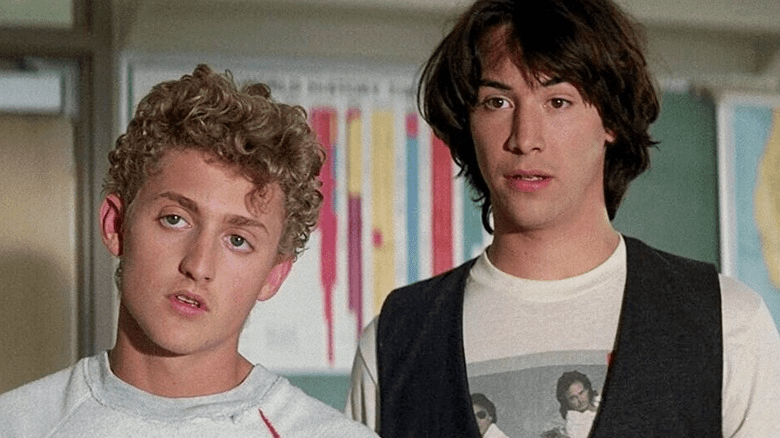
To be fair, any film that includes George “Seven Words” Carlin, Tony “Wolfie Smith’s Dad-in-Law After Peter Vaughan” Steedman and Jane “Rush Hour” Wiedlin is automatically great, and it’d be frankly stupid not to watch it. SAN DIMAS HIGH SCHOOL FOOTBALL RULES.
WHAT ELSE WAS ON?
Final episode of Andrew Payne’s conception-themed drama series You, Me and It on BBC1, followed by Mastermind and religious documentary strand Everyman. On BBC2 there’s live coverage of US Masters Golf from Augusta. ITV offer up an episode of Gambon-era Maigret followed by Aspel & Company, said company being, as The Times’ weekend TV guide had it “former hostage John McCarthy and his girlfriend Jill Morrell, who just happen to have written a book”. Yeah, bloody former hostages, always banging on about it.
20: SHE’LL BE WEARING PINK PYJAMAS (1985)
(21:00 Thursday 12 Mar 1987, 7.6m viewers)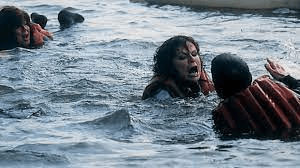
A Film on Four offering directed by John Goldschmidt starring Britfilm perennial Julie Walters as one of eight women attending a week-long Outward Bound course. Along the way they’ll learn secrets about each other… and themselves. Yeah, you know the drill.
WHAT ELSE WAS ON?
It’s 1987, so obviously LA Law was on ITV, followed by News at Ten. Over on BBC1, it’s the Nine O’Clock News followed by middle-classcom Life Without George and Question Time. Over on Two, the second part of Foreign Bodies, a Belfast-set series exploring the romantic relationship between a Roman Catholic nurse and a Protestant car mechanic, followed by 40 Minutes: The Quest for Sergeant Miller and a surprisingly pre-Newsnight airing for The Phil Silvers Show.
19: RELATIVE STRANGERS
(20:30 Monday 28 Jan 1985, 7.75m viewers)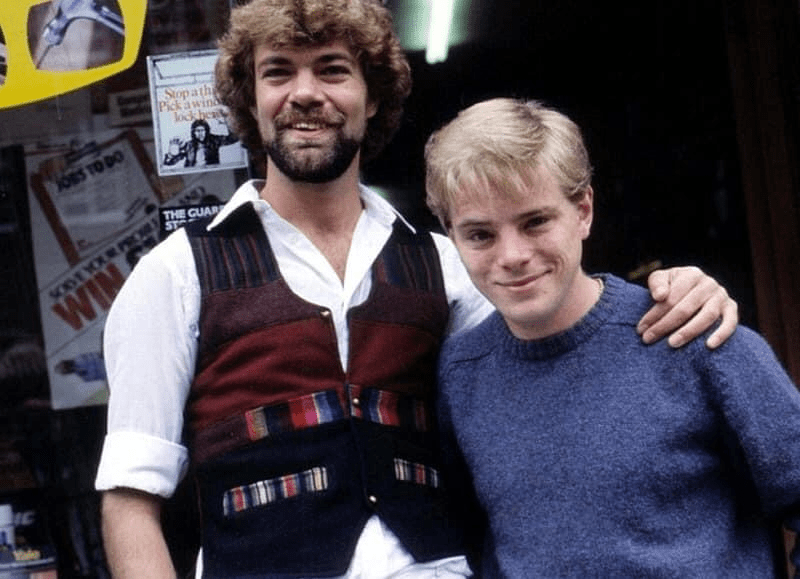
For anyone wondering where all the classic Channel Four sitcoms are on this list, here’s one. Well, I liked it when I was 10 anyway. The premise behind Relative Strangers was that happy-go-lucky thritysomething Fitz (Matthew Kelly) was happy with his bachelor’s lot in life. Free to do as he pleased, go where he wants and with whom he chooses. That’s until John (Mark Farmer) – the end product of a dimly-remembered dalliance seventeen years earlier – arrives at his front door, seeking to connect with a father who hadn’t known he existed.
Written by Maurice Gran and Laurence Marks, this was a perfect vehicle for Channel Four – a premise maybe a bit too grown-up for pre-watershed ITV, but suited perfectly to such a slot on Four. And better still, it was a perfect fit for the Mondays-opposite-Panorama-and-World-in-Action slot – easily the peak audience slot for BBC2 and C4 at the time, where viewers seeking entertainment flocked away from the main two channels. And given the bulk of his appearances on TV have been as a presenter, it’s a good opportunity to remember how good a sitcom actor Matthew Kelly was.
WHAT ELSE WAS ON?
As mentioned, Panorama on BBC1 (“Richard Lindlay examines the financial cuts leading to reduced student numbers in universities”) and World in Action on ITV (“a documentary illustrating the impact of the miners’ strike to a community in Northumbria”). Much lighter fare on BBC2, with The Bob Monkhouse Show welcoming completely uncontroversial comedians Michael Barrymore, Peter Cook and Bill Maher to his big sofa.
18: PARALYMPICS 2012: OPENING CEREMONY
(20:00 Wednesday 29 Aug 2012, 7.78m viewers)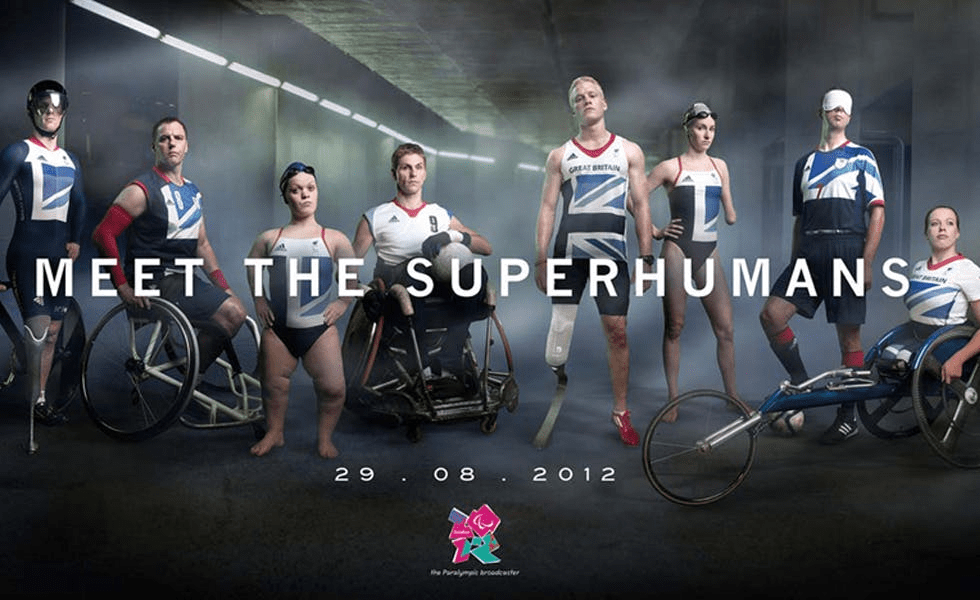
So far on this list, we’ve seen a lot of films, programmes and events that were very popular, but not too much that could be deemed Important Television. This is where that changes. Prior to 2012, coverage of Paralympic Games’ had been on the BBC. Usually at this stage, BBC Sport would be at the point where they’d just exhausted themselves covering the preceding Olympic Games, and seemed to have little energy (or schedule space) left to cover the Paralympics.
For an international event borne out of the International Stoke Mandeville Games in the 1950s, it’s on a scale somewhere between ‘a pity’ and ‘downright insulting’ that so little attention was historically afforded the event in the UK, not least because Great Britain performed brilliantly in those early games. In 1960, 1964 and 1968 Great Britain finished second in the medals table, as did the British team in 1984 and 2000, with third-place finishes coming in 1972, 1988 and 1992. And yet – kind of hoping someone proves me wrong here – it took until 1984 for any television coverage of note to appear, with Channel 4 broadcasting hour-long highlight packages of the 1984 Games, albeit several weeks after the actual conclusion of the event.
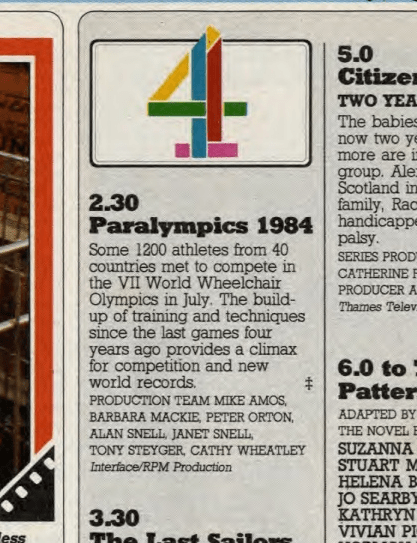
The earliest instance I can find of the BBC dipping into the Paralympic pool came in 1988, with similar highlight packages from Seoul ’88, again only appearing a couple of months after the conclusion of the Games. For some reason, the highlights were given the weird title of The ‘Olympic’ Challenge (with inverted commas right there, see?), as opposed to the more correct Paralympic Challenge.
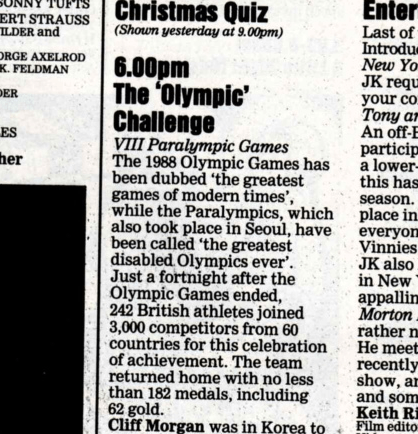
The level of coverage improved for the 1992 Winter Paralympics, with BBC2 hosting a pair of highlight programmes from Tignes in the French Alps, just a few weeks after the conclusion of the Games. That was followed by the Barcelona Summer Paralympics being covered, this time while the event was in progress, as part of Grandstand and Sunday Grandstand.
By 1996, Paralympic coverage on the BBC expanded into a series of ten standalone highlight packages. A further improvement in the level of coverage, but still restricted to forty-minute highlight packages going out on BBC2, in a slot opposite Neighbours. The practice was repeated for the 2000 Sydney Games, with daily highlight programmes, but seemingly still no live coverage. For 2004, BBC2’s daily Paralympics coverage was extended to ninety minutes, but it was the Beijing Games in 2008 that saw Paralympic coverage finally breaking onto BBC1. Here, it seemed the Corporation might finally go all-in on their treatment, with the opening ceremony broadcast live in a four-and-a-half hour programme on the flagship channel. Sadly, it wasn’t to last, with main channel coverage restricted to nightly highlight shows and live coverage hidden under the red button (or on the BBC HD channel if your telly was so endowed).

For the 2012 London Paralympics, things would be different. Very different. Channel Four had been awarded the rights to broadcast the games, and set about promoting the event in a way that would reshape the public’s perception of the Paralympics. Preceding the games with an all-out marketing blitz, adverts cheekily and brilliantly nodded toward the preceding London 2012 Olympics with “Thanks for the warm-up”, while Tom Tagholm’s two-minute-long ‘Meet the Superhumans’ trailer (screenshot above) was as captivating an advert as any pre-World Cup sportswear promo. And to make absolutely sure as many people were aware of the coverage as possible, on on 17 July 2012 Meet the Superhumans aired simultaneously on 78 different TV channels around Britain’s digital diaspora.
All of which would count for nought if Four’s coverage was restricted to the same highlights hell. Far from it. Unencumbered by not having just covered an entire Olympic fortnight, Channel Four had boundless energy to pull out all the proverbials. A Paralympic Games Breakfast Show at 7am kicked things off each day, with live coverage dominating each day’s schedule (pausing only for News and a few immovable feasts like Hollyoaks and The Simpsons). Live coverage continued right through primetime, with each day’s events summarised during nightly comedy discussion show The Last Leg.
Did it work? Hugely, as the viewing figures for a wonderful opening ceremony proved.

Things were finally different. How different? Well, some parts of the British press now felt comfortable in attacking US broadcasters for not showing enough of it. Plus ça change, eh?
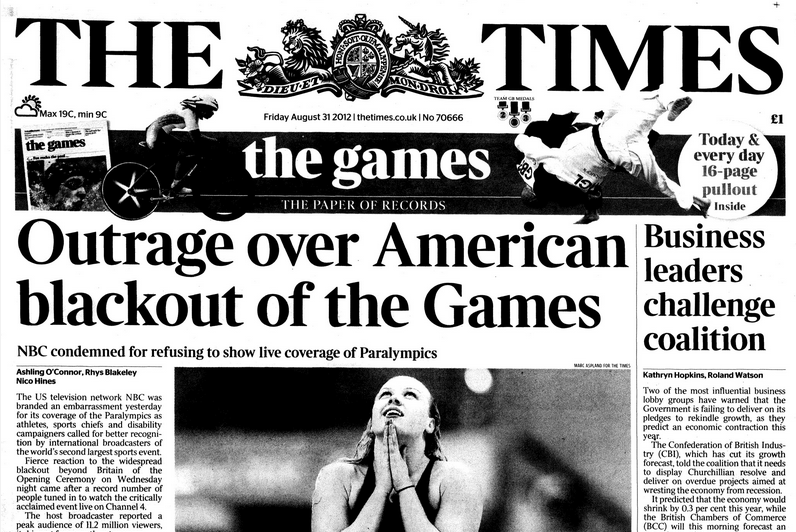
WHAT ELSE WAS ON?
Loads of things – it was a three-hour-plus programme – but most notably: Patrick Stewart on Who Do You Think You Are? on BBC1, not-as-good-after-Lucy-Punch-left comedy cop drama Vexed on BBC2, Britain Then and Now on ITV, and zombie Big Brother on Five.
17: MONA LISA (1986)
(21:30 Thursday 23 Feb 1989, 7.82m viewers)
On getting released from prison, it can be hard to find yourself gainful employment. Good news for paroled low-level hoodlum George, then – he’s just landed a job working for underworld boss Denny Mortwell, and all he’d needed to do was take the rap (and prison term) on his behalf. Now he’s working at a driver-slash-minder for high-class call girl Simone. Not that Mortwell is especially keen to make amends with George – he also wants him to extract some handy blackmail fuel from one of Simone’s clients. George’s attention is torn between carrying out his mission and his feelings for Simone, who wants his help to find her missing friend Cathy.
Definitely from the grittier end of the Handmade Films stable, powerful performances from Bob Hoskins, Cathy Tyson and Michael Caine help make this a compelling if not always comfortable feature.
WHAT ELSE WAS ON?
Another outing for Life Without George at 9.30pm on BBC1, followed by Sir Robin-era Question Time. BBC2 offered up splendidly-titled 40 Minutes documentary Knickerbockers in Knightsbridge (except it seems to be breathlessly celebrating a high-end prep school, so knickers to that), followed by an episode of The Tracey Ullman show with The Simpsons surgically removed (d’oh, indeed) and Newsnight. ITV dished up an episode of imported cop show In the Heat of the Night to take viewers to News at Ten, before some Regional News-Based Programming. And, just for a change, Sky Channel offered drama series The Paper Chase, followed by WWF Main Event.
16: TREASURE HUNT
(20:30 Thursday 24 Mar 1988, 7.85m viewers)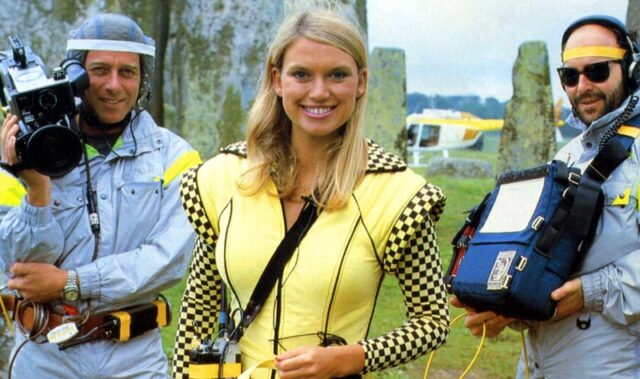
One of the big hits for the channel in its first decade on air, it’s a bit of a surprise that Treasure Hunt is one the classic C4 properties never to have received the reboot treatment*. For anyone too young to be aware of the premise, this was a game show basically aimed at people with leather-bound encyclopedias in their living room. Two contestants take part in a command centre alongside host Kenneth Kendall and guide Wincey Willis, who together must solve a series of geographical clues to determine the location of further clues and ultimately, the titular treasure.
[EDIT: *Reboot treatment… by Channel Four. With thanks to @ChinnyVision and @Simon_Tyers on Twitter plus James in the comments for highlighting this, it did receive a reboot on BBC2 following the departure of The Simpsons to C4. It went out on weekdays at 6pm in December 2002 (for a week), before returning for a second series (again, on each weekday evening for a week) starting in April 2003. It didn’t fare too well – not least because they decided to set each Hunt in places like Tucson or Mexico City, which must have cost a fortune. And as such, the final six episodes of the second series were shoved into a Saturday teatime on BBC2 slot, with almost a month between airings of the last few episodes.]
But that’s not the exciting part. The main participant in all this, and the undoubted star of the series, was Anneka Rice – the person tasked with physically uncovering each clue at the actual locations portrayed on Wincey’s map. To get from place to place, she had a helicopter, and the whole thing had to be done and dusted within 45 minutes, broadcast in real-time.
Basically, it was speed geocaching.
This particular episode came from the Chilterns, with contestants Robin Strand and Ian Taylor hoping to win big. And if you wanted to play along at home, the TV Times kindly provided you with an OS Map reference.

See?
WHAT ELSE WAS ON?
Mastermind (the history of English costume 1789-1945, Portuguese explorations and discoveries 1415-1815, the history of mathematics, the films of Laurel & Hardy) followed by the News on BBC1. BBC2 had Nature (an examination of the latest developments in genetics) followed by Blackadder II (the executioner one). ITV had This Week: Private Health – Too High a Price? followed by LA Law.
=14: INTERNATIONAL SNOOKER
(21:45 Sunday 16 Dec 1984, 8.25m viewers)Siri, name a sport that doesn’t belong on Channel Four.
Might just be me, but… snooker’s very much a BBC2 thing, isn’t it? I know it’s been on BBC1 quite a lot, and at the peak of the snooker craze in the 1980s even ITV made a regular go of it, but the closest you’d expect the sport to get to Channel Four is a screening of Billy the Kid and the Green Baize Vampire. And yet, here it is.
Four being Four, it’s not quite your usual Fagbrand World Matchplay tournament, however. This was the final of the Hofmeister World Doubles Championships (coverage Four actually shared with ITV, as was the style at the time) a tournament that in theory should have provided double the fun for snooker fans, with greats of the game teaming up to do battle. In practice however, it wasn’t quite the draw organisers had hoped – the tournament only ran from 1982 to 1987. That said, if any doubles match was going to draw an audience, it was this final: Alex “Hurricane” Higgins and Jimmy “Whirlwind” White against Cliff “Magnum PI” Thorburn and Willie “Best of Friends” Thorne.
WHAT ELSE WAS ON?
The News, followed by Perry Como’s Christmas in Paris on BBC1, Harold Pinter play A Kind of Alaska was on BBC Tw… wait, ITV (yeah, look impressed – it wasn’t superseded in the regional variations, either) and Hinge/Brackett sitcom Dear Ladies on actual BBC2.
=14: DARK NIGHT OF THE SCARECROW (1981)
(21:00 Tuesday 21 May 1985, 8.25m viewers)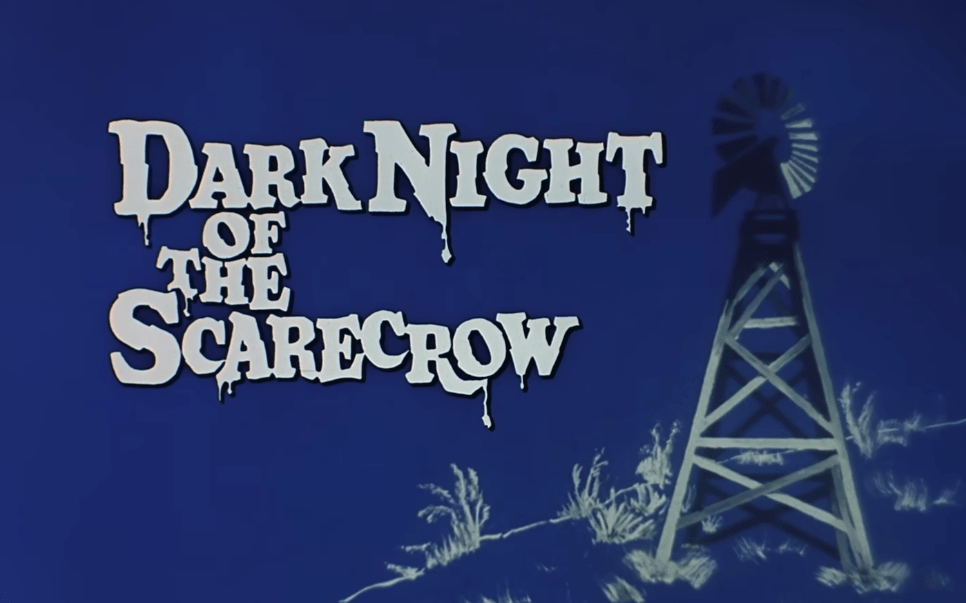
Despite the TV Movie genre being as unstoppable as ever – just look at the Movie Channels You Don’t Have To Pay Extra For section on Sky – I’m pretty sure nobody bothers making TV Horror Movies any more. It certainly used to be a thing, the original version of Stephen King’s It was made for TV, but nowadays it’s all variations of (to badly paraphrase TV Go Home) ‘The Courts Are Letting My Ex-Husband Attack My Children With Hammers’ or Christmas films.
Back when Horror TVMs were a thing, very likely with one eye on the blossoming video retail market, fare such as Dark Night of the Scarecrow could be seen. It’s hardly the most edifying fare, going by the plot synopsis on IMDB: “In a small Southern town, four vigilantes wrongfully execute a mentally-challenged man, but after the court sets them free mysterious ‘accidents’ begin to kill them off one by one.” And yet, commissioned and brought to television by CBS.

Must admit, I’m a bit mystified why this picked up such a colossal audience, but I do note that the full movie is available on YouTube for free (in HD, and seemingly legally to boot), so if you’re curious enough to want to see it, fill your boots.
WHAT ELSE WAS ON?
News and Miami Vice on BBC1, Francis Ford Coppola flick The Escape Artist (1982) on BBC2, and Mr Palfrey of Westminster followed by News at Ten on ITV.
13: BROOKSIDE
(20:00 Wednesday 3 Nov 1993, 8.27m viewers)
Let’s face it, it was a matter of when not if this was going to show up. The only question was which era of the programme would be represented here? The Damon and Debbie years? The kiss between Beth Jordache and Margaret Clemence? The body under the patio? Sinbad’s lodger turning out not to be a serial killer but a Wrexham supporter?
Not quite that, no. How about “Frank and Lyn’s wedding“? Yep. That was the episode that outranked all those other famous Brookie moments. Of course, this being soapland, it wasn’t as straightforward as that – look away now if you’re working your way through a box of Brookside offairs – a drug-fuelled Jimmy Corkhill led to Frank’s car crashing en route to the wedding reception, meaning he didn’t survive to taste the wedding cake.
But why that particular episode? What tipped the viewing figures for that episode above all the others? I should point out that viewing figures were generally hovering around 8m for this spell of the programme’s run, but it must have taken something for this episode to have nudged just above the others. What could it have been?
WHAT ELSE WAS ON?
The answer is very likely located here. BBC2 were showing Bookmark: The Quest for A.J., where crime writer Julian Symons investigates the life of his elder brother (the titular AJ), who died in 1941. ITV had live football, with Arsenal taking a 3-0 first leg lead to Standard Liege in the UEFA Cup Winners’ Cup. Meanwhile BBC1 had… live football, this time coverage of Norwich City attempting to protect their shock 2-1 UEFA Cup away lead as they hosted Bayern Munich. Both good matches – Arsenal notched up a 7-0 away win en route to a win over Parma in the final of the tournament, while Norwich clung onto that lead and ensured Jeremy Goss will never need to pay for another drink within North Norfolk – but for people who don’t like football, there really wasn’t too much else on.
12: THE MIRACLE OF KATHY MILLER (1981)
(21:00 Tuesday 21 Apr 1987, 8.3m viewers)
Nowdays, you’d have to suspect this would be getting pumped out to 3000 viewers during one of the few months Movies 24 aren’t pretending it’s Christmas, but in 1987 imported TV Movies could still draw a big crowd. And few bigger than for The Miracle of Kathy Miller, starring big TV name Sharon Gless and a tyro Helen Hunt. The story here focused on the true tale of an Arizona teen (Hunt) who overcame disabilities to be awarded the title of the World’s Most Courageous Athlete. Sounds a lot like a parody to cynical modern eyes, but this was a much-acclaimed movie at the time. And, of course, the 11th most popular thing on Channel Four ever. So, you know, stick that in your VHS broadcast copy of Brass Eye.
WHAT ELSE WAS ON?
ITV offered up Lost Belongings, looking at the attempt of IRA wrongun Hugh MacBraill to escape from The Maze. BBC2 offered up Live Snooker and The World of UB40, while their big brother offered up The Nine O’Clock News, drama Strike It Rich and broadcasting discussion show Network, where presumably hosts Anna Ford and David Jessel were mad as hell about, dunno, Pages from Ceefax?
That’s it for another instalment. A lot of big C4 programmes we’ve not seen yet, and there probably isn’t room in that final Top Eleven for all of them. Which will make the cut? Tune in tomorrow to find out. On Four’s actual fortieth birthday! I don’t just throw this together, you know. (Aside: no, I do.)
-
Forty/Four: Channel Four’s 40 Most-Watched (Part Two)

More Four. Here’s the next tranche, starting with two entries at joint-30th.
=31: GOOD MORNING VIETNAM (1987)
(21:00 Sunday 25 Apr 1993, 6.75m viewers)
Kicking off a Robin Williams season on Four, this well-received comedy drama about a boisterous US Forces Jock who eschews the anodyne in favour of the raucous, much to the delight of troops stationed in Saigon, and to the dismay of their higher-ups.
WHAT WAS ON THE OTHER SIDE?
Offering the polar opposite to Robin Williams at his Robin Williamsest on Four, BBC1 served up A Year In Provence, followed by News and Mastermind (the fall of the Western Roman Empire, the Manhatten Project, Damon Runyon and Joseph Chamberlain). BBC2 countered that with coverage of the World Snooker Championships in Sheffield, followed by feature-length LA riot documentary LA: Stories from the Eye of the Storm. A new thriller by Lynda La Plante – who briefly passive-aggressive followed me on Twitter after I’d criticised her provably wrong opinions on the BBC’s equalities policy (also Killer Net), rubbish showbiz anecdote fans – on ITV, with Seekers following the fortunes of two women finding they’re both married to the same man.
=31: LOST
(20:30 Wednesday 10 Aug 2005, 6.75m viewers)
Forget about the disappointing ending, Lost was good when it first arrived. Really good. And that was reflected in those initial audience figures.
An expensive promotional push for the imported series by Channel Four certainly didn’t hurt matters – the channel spent a cool million pounds just promoting the series via everything from cinema advertising to in-game adverts within Anarchy Online. They didn’t even use a standard trailer-of-clips-from-the-thing advert either, but had a specially-shot and hugely expensive scene featuring the entire cast dancing next to the flaming wreckage of Oceanic Flight 815 to a background voiceover of enigmatic statements about their identities (“One of us is a killer, one of us is an addict, one of us used to be in Hetty Wainthrop Investigates” etc). The whole thing resembled a Calvin Klein One advert more than a promo for a new drama series, but it undoubtedly piqued the interest of many viewers, leading to a colossal audience for the series opener.
The viewing figures may well have been higher as the series progressed, were it not for first runs of each episode going out on E4 to promote the new digital service, alongside a flurry of impatient torrenters streaming episodes instead of waiting for them. Either way, Lost was a huge hit for the channel, right until the point Sky One threw a big bag of money at the producers to nab the rights to it.
WHAT WAS ON THE OTHER SIDE?
Second half of Holby City and the first half of Silent Witness on BBC1, Britain’s Best Buildings followed by docudrama The Slavery Business on BBC2, back end of The Bill followed by The Mummy Returns (2001) on ITV, and the last half-hour of Killer Swarms followed by the start of Steven Seagal ‘thriller’ Belly of the Beast (2003) on Five. Interesting to note that C4 scheduled Lost to start partway through three of those four programmes, very much anticipating the bulk of the audience to come from their own preceding programme (an episode of Big Brother) rather than rival broadcasters.
30: A NIGHTMARE ON ELM STREET (1984)
(22:00 Tuesday 31 Mar 1992, 6.8m viewers)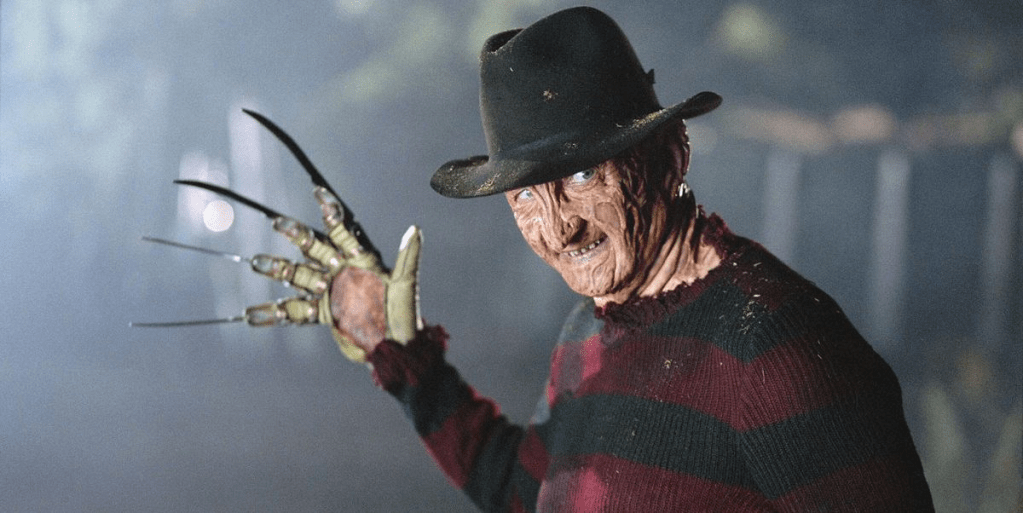
Remember the 1980s? Where a fictional child murderer became a cult hero, and ended up plastered all over t-shirts, magazines, posters et al? That was a bit weird, wasn’t it? Even when the Saw films were huge (and they were very much the FIFA franchise of the horror genre), nobody was walking around in a T-shirt with a picture of Ian Jigsaw on it. Anyway.
Here’s the film that kicked it all off, starting the cult of (arguably) the only one of the Big Franchise Horror Stars of the 1980s to genuinely become a household name. Robert Englund dons the mask and gloves of F Krueger Esquire, and sets about haunting/hunting teens in their dreams. Would go on to spawn a raft of identikit sequels, and was certainly a big enough draw to get an audience worthy of inclusion here, despite being eight years old at the time.
WHAT WAS ON THE OTHER SIDE?
Tom Wilkinson played unconventional (he really likes jazz and sandwiches) detective Charlie Resnick in the first of a three-part adaptation of the John Harvey novel, Resnick: Lonely Hearts on BBC1 at 10, followed by a Liberal Democrats Party Election Broadcast and Film 92. BBC2 served up 40 Minutes: Soldier’s Diary, the story of Yishai Shuster, an Israeli reservist reluctantly policing the Palestinian border. That’s followed by a Conservative Party Election Broadcast and Newsnight. ITV being ITV, had News at Ten, followed by (at least in That London) episode of Extraordinary People: Across the Jade Divide, looking at the life of Keith Huxley as he follows in the footsteps of his father who’d been sentenced to a Shanghai internment camp fifty years earlier.
In short: that the horror film about the child murderer murdering some children? Probably the lightest relief on offer here.
29: WIFE SWAP
(21:00 Tuesday 21 Oct 2003, 6.9m viewers)
A format big enough at the time to have been used as the basis of a Simpsons episode (not a good one, the Gervais one), it’s no surprise to see Wife Swap here. This was in the original phase of the series, so there’s no danger of having to see John McCririck in his pants. This particular episode saw a fastidious husband temporary change his similarly pernickety partner for a free-spirited wife, and vice versa. Must admit, I’d have spent that whole hour thinking about the scene in The Simpsons where jury duty results in Homer sharing a hotel room with Seymour Skinner.

“We’re kind of like the original Odd Couple. You’re the messy one, and I’m–“
“Shut up! “
“Oh, yes. Very well.”WHAT WAS ON THE OTHER SIDE?
BBC1‘s The Secret Policeman peeked into the findings of undercover journalist Mark Daly during his stint as a trainee policeman in Manchester, while BBC2 examined the Mind of a Millionaire (and also, for some reason, the story of B&Q). ITV took us all back to the time when live Champions League football could be watched for free (no, legally) with the group B tussle betwixt Dynamo Kiev and Arsenal, while Five scooped a spoonful of CSI: Miami out of their Dick Wolf Economy Bucket.
28: NOWHERE TO RUN (1978)
(21:00 Tuesday 9 Apr 1985, 6.95m viewers)Not to be confused with any of the other films sharing the title, this particular Nowhere is based on the 1976 novel The Blackjack Hijack by Charles Einstein, and sees San Francisco engineer Harry Adams pottering about New York at the time of the Kennedy assassination. Seeing the uncaring reaction of his wife (Stefanie Powers, yes it’s a made-for-TV movie) to the news, he decides to do what anyone would… design an entirely new life for himself using a system to predict the outcome of blackjack hands. It’s a tale as old as time.
WHAT WAS ON THE OTHER SIDE?
The News and Miami Vice on BBC1, an episode of superb documentary series Television on ITV (this one tracking the growth of gameshows), and Pot Black 85 followed by Amazing Bass on BBC2. That latter one is a profile of bassist Gary Karr rather than some really, really brilliant fish, slightly disappointingly.
27: THE ABYSS (1989)
(21:00 Sunday 24 Jan 1993, 7.01m viewers)
The James Cameron Film Where Something Sinks That People Don’t Mention As Much. This time it’s an American submarine that sinks (sinks… more?) in the Caribbean, leading a US search and recovery team to embark on a rescue mission. Working with a team of oil rig roughnecks, they’re busily racing against a team of pesky Russkies to be first to reach the stricken sub, when they encounter something unexpected.
This showing coming in the lengthy wake of Terminator 2, interest was high in anything bearing the Cameron stamp of approval, and The Abyss also featuring T2-esque special effect trickery by Industrial Light & Magic certainly helped it stick in the minds of anyone seeing the trailers. Hey, all that was impressive at the time.
WHAT WAS ON THE OTHER SIDE?
A Sunday night, so it’s a textbook lineup on ITV, with Poirot followed by Hale & Pace and The South Bank Show. BBC2 picked out documentary Dancing: Lord of the Dance followed by Did You See… and a Derek Jarman production of Edward II. Over on One, it’s the final part of Ruth Rendell’s Gallowglass, followed by Mastermind and Heart of the Matter.
=25: MOTHER, JUGS AND SPEED (1976)
(21:00 Tuesday 12 Mar 1985, 7.05m viewers)
There’s a film title that sticks in the memory. 1976 black comedy fillum MJ&S starred Bill Cosby (Mother), Raquel Welch (Jugs), Harvey Keitel (Speed), and Larry Hagman (And) (oh, okay: John) as employees of an independent ambulance service trying to survive in Los Angeles. Also home to one of the great Someone Who’d Later Become More Famous In A Minor Early Role credits in cinema history: “Toni Basil as Junkie Who Kills Leroy”. Oops, spoilers.
WHAT ELSE WAS ON?
Causing a conflict for high-energy US crime action, the News on BBC1 was followed by an episode of imperial phase Miami Vice, followed by Film 85 (reviews of 2010, Wetherby and A Soldier’s Story). ITV had (just after a repeat of ace C4 sitcom Chance in a Million at 8.30pm) an episode of documentary series Television looking at history of TV’s news coverage. Viewers of BBC2 could expect to see Inside Out (“Two female ex-convicts try to set up an employment agency”, co-starring Only Fools’ Gwyneth Strong as scatty Polish prostitute Beverly Grabowski), Pot Black 85 and a Maestro episode looking at the career (and presumably downfall) of George Best.
=25: ATHLETICS: THE KODAK CLASSIC
(21:00 Friday 9 Aug 1985, 7.05m viewers)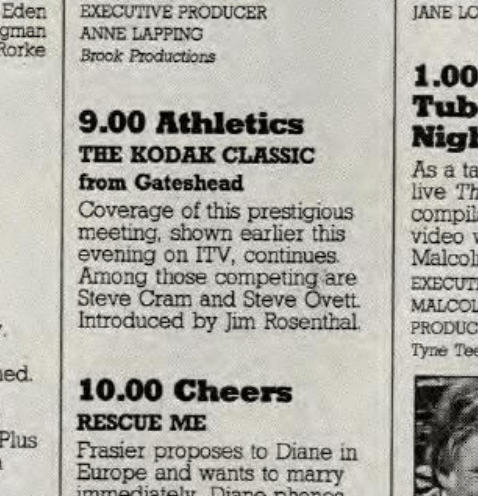
Long before Channel Four was rightly lauded for their coverage of the 2012 Paralympics, the channel would often cover athletic events, but mainly when ITV had been in the middle of showing something and they needed to start showing something else. BBC1 had BBC2 for those very occasions, but what did ITV have? No ITVs 2, 3 or 4 in those days, but at least they had Channel Four, pretty much a smaller sibling of the two in those days, rather than the wholly independent media group it would later become.
And so, on occasions such as the one on 9 August 1985, ITV’s willingness to hand airtime over to athletics only went so far. I mean, they did have an episode of Shine On Harvey Moon that couldn’t wait a week. And so, at 9pm, the action immediately shifted over to Channel Four, even if it did mean that week’s episode of Cheers got bumped back to 10pm.
It wasn’t all bad. As proved here, a sizeable chunk of an ITV Friday Night audience immediately decamped to Four to see the continuation of the action from Gateshead. So, that’s nice.
WHAT WAS ON THE OTHER SIDE?
As mentioned, ITV had Shine on Harvey Moon (the one where Frieda has to come with a sudden death in the family). BBC1 have News followed by snooker management drama Give Us a Break, while BBC2 run with lighthearted music panel show My Music, followed by an episode of Commercial Breaks (not the Imagine Software one, sadly. This one’s about a shoe-making business).
24: FEMALE PARTS: RUDE WOMEN
(21:00 Monday 11 May 1992, 7.06m viewers)First of a six-part documentary series promising to reflect the disparate lives of contemporary women (well, six of them, presumably), starting with a film by Anne Parisio. The focus falls on a series of women of all ages who refuse to be timorous when it comes to sexual activity. Jo Brand is on hand to chat with a grandmother as she prepares an aphrodisiac for her younger lover, and there’s a look at the launch of a new magazine aimed to redress the gender balance when it comes to nudity.
The write-up in The Times warns that “viewers who find frank studies on the nude male off-putting are hereby warned”, but that doesn’t seem to have dented the viewing figures too much.
WHAT WAS ON THE OTHER SIDE?
The News and a Panorama about house prices on BBC1, while John Lithgow flick Resting Place (1986) entertained BBC2 viewers (presumably). ITV also took a trip to the movies, with (pre-Sir) Tom Courtenay and Brigitte Fossey starring in WWII drama The Last Butterfly (1989).
23: PETER KAY LIVE
(21:30 Wednesday 4 Aug 2004, 7.2m viewers)
One thing you can definitely say about Peter Kay – he certainly knows how to maximise a revenue stream from his audience.
In November 2003, he released a DVD of a performance from his Mum Wants a New Bungalow Tour, recorded at The Bolton Albert Halls. It sold in huge numbers, as might be expected, given he was hugely popular at the time, and it was arguably the strongest stand-up set he ever did.
And then, the following year, a recording of the same set – this time performed at Manchester Arena – was aired on Channel Four. Arena comedy never works as well as a theatre setting, so it all felt a little soulless compared to the Bolton gig, but y’know, it was on telly. For free. And all his fans had already seen the DVD of the Bolton gig, so it’s good that there was something slightly different, even if all the jokes were the same.
And then that got released on DVD anyway, billed as “a special farewell performance” of his Bungalow set. Oh, Peter.
WHAT WAS ON THE OTHER SIDE?
Back end of a Panorama (investigating the antics of the IoC in advance of the 2012 Olympic decision) and the 10 O’Clock News on BBC1, sixtysomething drama When I’m 64 on BBC2. ITV had job-swap reality show Poor Little Rich Girls at 9pm, and documentary Dirtbusters at 10pm, while Five served up Samuel L Jackson teach-em-up 187 (1997).
22: IT’S NEVER TOO LATE
(20:30 Monday 3 Dec 1984, 7.2m viewers)For a channel so well known for commissioning sitcoms so beloved of comedy fans – Father Ted, Stath Lets Flats, Friday Night Dinner, Spaced, Derry Girls, take your pick (as long as you don’t pick Derek) – it’s a shame they all failed to reach truly large audiences. But here’s one that did, and it’s one that isn’t likely to get a repeat on E4 any time soon.
Two pairs of pensioners – Win and May, Jimmy and Geoffrey – all belong to the same bowling club, but neither pair had ever met – until one fateful evening at the Social Club. From that point on, following initial mutual distrust, they soon realise that they can achieve far more as a team. And that’s pretty much it – a slow-burn pre-watershed sitcom from the mind and biro of Ian Masters.
I can’t vouch for the quality of the programme, as I’ve no recollection of it, though it seems to be Masters’ only writing credit, his main calling coming as jobbing actor in series such as Terry and June, Hale and Pace, and The Piglet Files. One main draw of the programme may well have been the supergroup of actors therein – Peggy Mount, Pat Coombs, Hugh Lloyd and Harold Goodwin. Whatever the case, it was part of a pilot season for the channel (handily placed in the schedules as you’ll see in a moment) and never progressed to a full series.
WHAT WAS ON THE OTHER SIDE?
BBC1 had Panorama, while ITV had World in Action (ah, there’s your inflated audience figure), while BBC2 had ‘The New Statesman’ (not that one – a sitcom about a museum curator unexpectedly inheriting land and a title, starring Colin Blakely and Gwen Taylor).
That’s it for now. Tune in tomorrow to see which Four morsels have made the Top Twenty. Going by what we’ve seen here, it could contain anything.


BrokenTV
Welcome, welcome, welcome home
 BrokenTV


