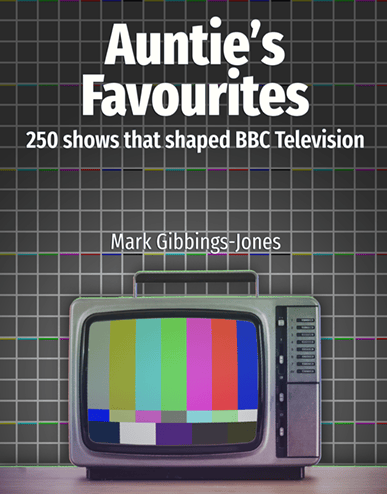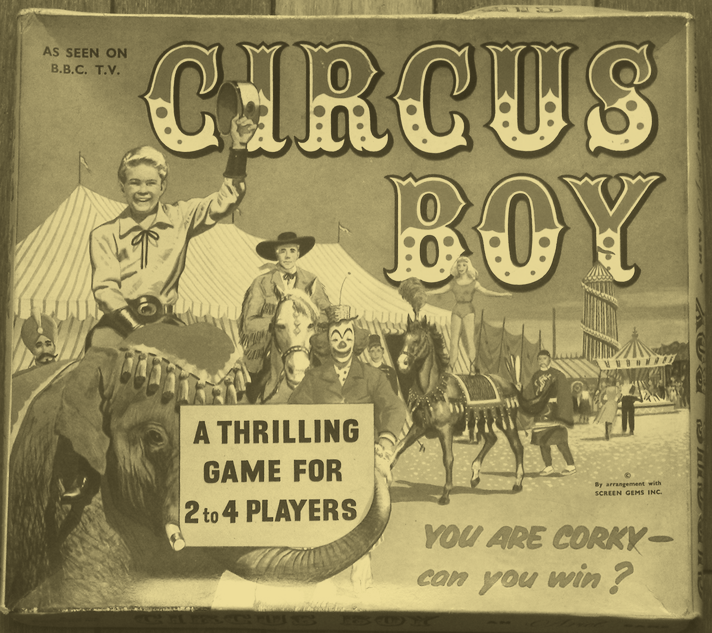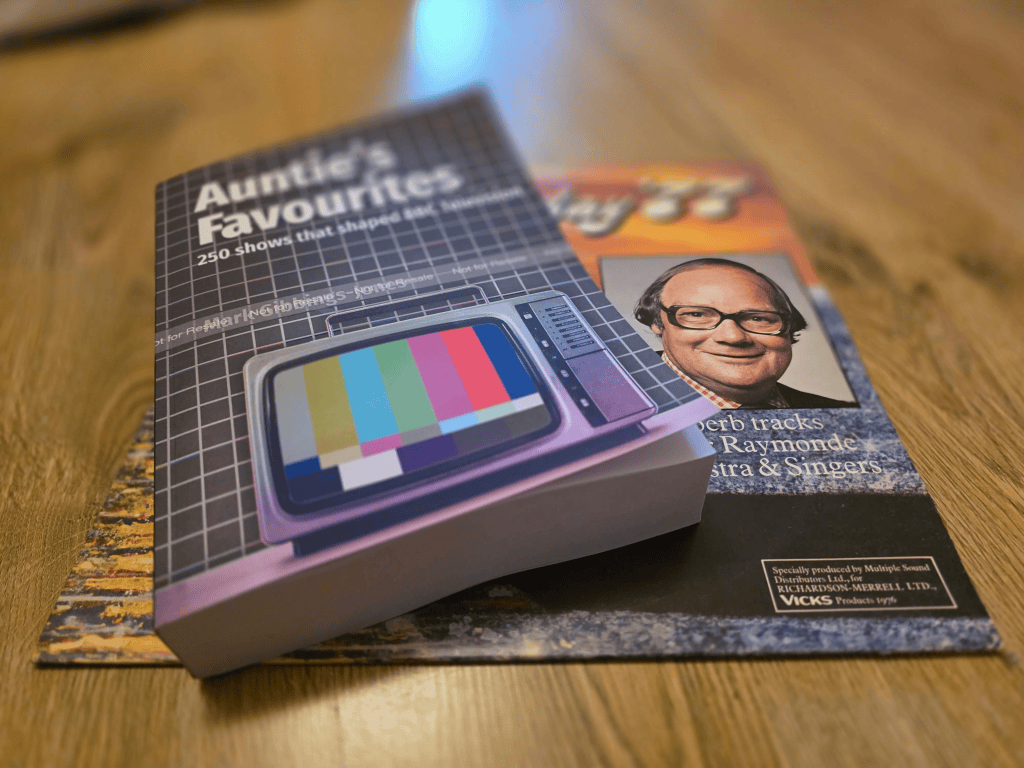
Firstly, big book news. And it’s important to note that both the news and the book are big. The book is the fully featured, 622-page, 10-by-7-inchAuntie’s Favourites, a full rundown of the 250 Most-Broadcast Programmes in the Entire History of BBC Television. This differs from the rundown previously published on this site, as it contains:
- 150 additional entries compared to the original’s hundred
- Covers every single broadcast up to 31 December 2025
- Every broadcast on BBC Three, BBC Four, BBC Choice and BBC Knowledge alongside the main BBC channels
- Added detail and complete rewrites on many of the original entries
- Newsnight is now in the list. But where?
- Definitive confirmation of the most-repeated sitcom in BBC Television history – it’s possibly not the one you’re expecting
- Precisely one bar chart
Also, critically, everything has been reviewed and properly proof-read. It’s the strangest thing. When going through the original proof edition of the book (pictured above, with a copy of the Holiday ‘77 vinyl record for scale), there were a lot of weird typos, put there, it seems logical to conclude, by North Korean hackers who had installed a virus on my PC in an attempt to discredit the book. A very clever virus that placed corresponding typos in the original blog entries, almost as if to make me look like a fool.
All those typographical tykes have now been chased away, meaning the book is finally available to buy on Amazon. In the UK, it’s just £19.99 for the lovely paperback edition or £5.99 for the DRM-free Kindle edition (so you should be able to throw it at anything that’ll handle an .epub file). If you’re in the USA, you’re looking at just $26.99 for the paperback or $7.99 for the ebook, while if you find yourself in Canada it’s $36.99 for the book in paper form or $10.99 for it in digi-bits. If you’re in Australia and you want to see whether Neighbours is still at number one in the rundown (spoilers: it isn’t), it’s the oddly specific price of $41.87 for a copy you can hug at night, or just $11.69 for a copy that lives on your phone (or Kindle, or Kobo or whatever).
It’s also available in other countries with an Amazon store and will be popping up on various other shopfronts (that don’t have the dread hand of Bezos on them) soon. I’ll post a further update once those have gone live.
(It’ll be brilliant if you can spread the word about the book. It’s a project that has taken years to complete, so it would be nice to see it in as many hands, bookcases and digital devices as possible.)
–
Okay, let’s crack on with a sample entry from the book itself. It’s the programme in 225th place in the list and it’s one with a fun history. Let’s go to…
Dallas
1978-1995, broadcast 554 times
BBC1 (480 times, 1978-1995)
BBC2 (74 times, 1980-1987)
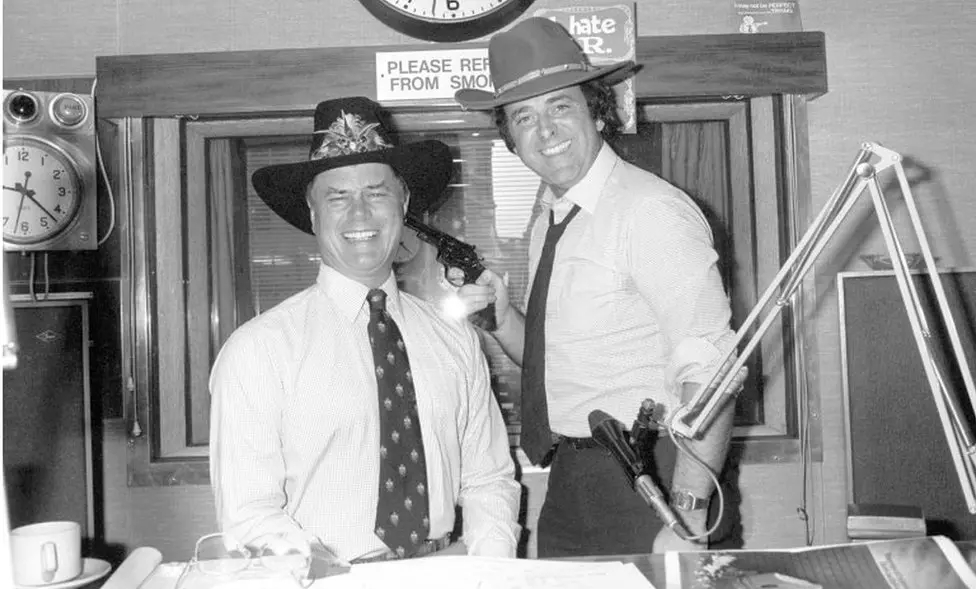
The majority of television programmes are ephemeral. They’re on, then they’re not, and you’re lucky if many people noticed them. But then there are television programmes that reach escape velocity and break free into the national zeitgeist, meaning everyone everywhere knows all about them whether they’d watched the damn thing or not. For most of the 1980s, as remembered by anyone who recalls all the references to ten-gallon hats, an entire season of a TV show turning out to have been a dream, or the joke where J.R. has a drink of water only for the liquid to pour out of bullet holes all over his body, Dallas was the latter. But here’s a thing: Dallas – that most American of American soap operas – may never have existed were it not for Coronation Street.
Let’s explain by whizzing back to the 1930s. Yes, the 1930s.
As you may well know, the phrase ‘soap opera’ came about when such serial drama programmes on the radio in 1930s America were commonly sponsored by soap and detergent manufacturers. When television started to grow in popularity in the 1940s, these soap operas would make the transition from radiogram to picturegram, starting with the boarding house-based These Are My Children (NBC, January-March 1949), with short fifteen-minute episodes airing on late weekday afternoons.
While These Are My Children didn’t prove to be an immediate smash with viewers, it provided a cheap and cheerful way to fill some of those daytime hours, and it was soon joined in the schedules by A Woman to Remember (DuMont, February-July 1949) and The First Hundred Years (CBS, December 1950-June 1952). However, the following year’s Hawkins Falls, Population 6200 (NBC, April 1951-July 1955) could be considered the first truly popular daytime soap – with just a slight caveat, given it’d actually started as an hour-long primetime comedy drama in June 1950, before regenerating into a fifteen-minute daytime soap the following year. From that point on, the floodgates were pretty much flung open by US TV schedulers, with (at least) 27 more daytime soaps bubbling up during the remainder of the decade. For the sake of your sanity and mine, I’m not going to list them all here.
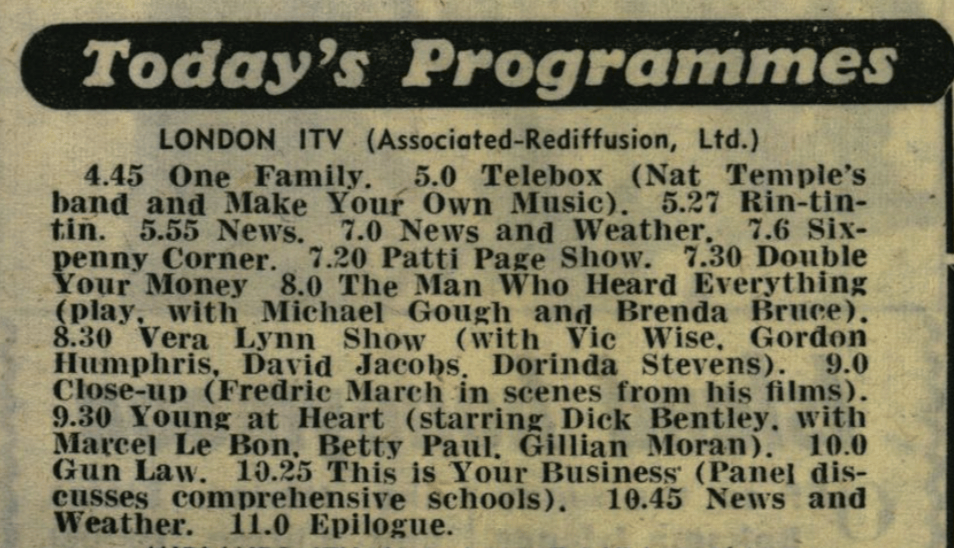
Whatever American telly does, British TV soon starts sniffing around. Continuing drama serials in the UK had previously been the sole domain of radio, with The Archers airing for the first time on 29 May 1950 (as a pilot episode, going full-time on 1 January 1951), but when television attempted the genre, there weren’t really any daytime hours that needed filling – the short amount of pre-teatime broadcasting hours were reserved for children’s TV and news. And so, when some British TV soaps did appear, like The Grove Family (BBC-tv, April 1954-June 1957) or Emergency Ward 10 (ATV, February 1957-June 1967), they were mainly primetime prospects – ITV’s first attempt to put such a programme in a short afternoon slot – One Family (Associated-Rediffusion, April-May 1956) – all but proved British TV wasn’t really ready for such a series.
I’m not going to shock anyone here by pointing out that it was Coronation Street (Granada, December 1960 to the end of recorded time) that became soap’s first bona fide smash in the UK. While Emergency Ward 10 had hardly shied away from realism where warranted, Coronation Street became something that a large amount of the viewing public could truly relate to – ordinary working-class folk, in an ordinary working-class street, and a clear focus on lives rather than events. And Tony Warren’s series wasn’t just becoming big in Blighty – it was attracting the interest of television bigwigs in the USA, too.
Depending on which source you’re looking at, the success of Corrie led to one of the “ABC top brass” (as per LIFE magazine, 25 April 1969), “officials of 20th Century Fox” (according to The Serials: Suspense and Drama by Instalment, Raymond William Stedman, 1977) or TV producer Paul Monash (going by Television Genres, The OU Course Team, 2003) to have the idea of making a primetime soap for the USA in 1963. The latter source claims Monash even considered broadcasting episodes of Coronation Street in the USA, but sensibly decided US audiences would have trouble understanding northern English accents. And so, with Coronation Street in mind, the TV rights were secured to Grace Metalious’ 1956 book Peyton Place – previously the subject of a successful 1957 film for Fox – and the series duly aired in 1964. Dealing with the lives and secrets of people in a small New England town, Peyton Place was a success – attracting tens of millions of viewers at its peak, and helping kickstart the careers of cast members Ryan O’Neal and Mia Farrow.
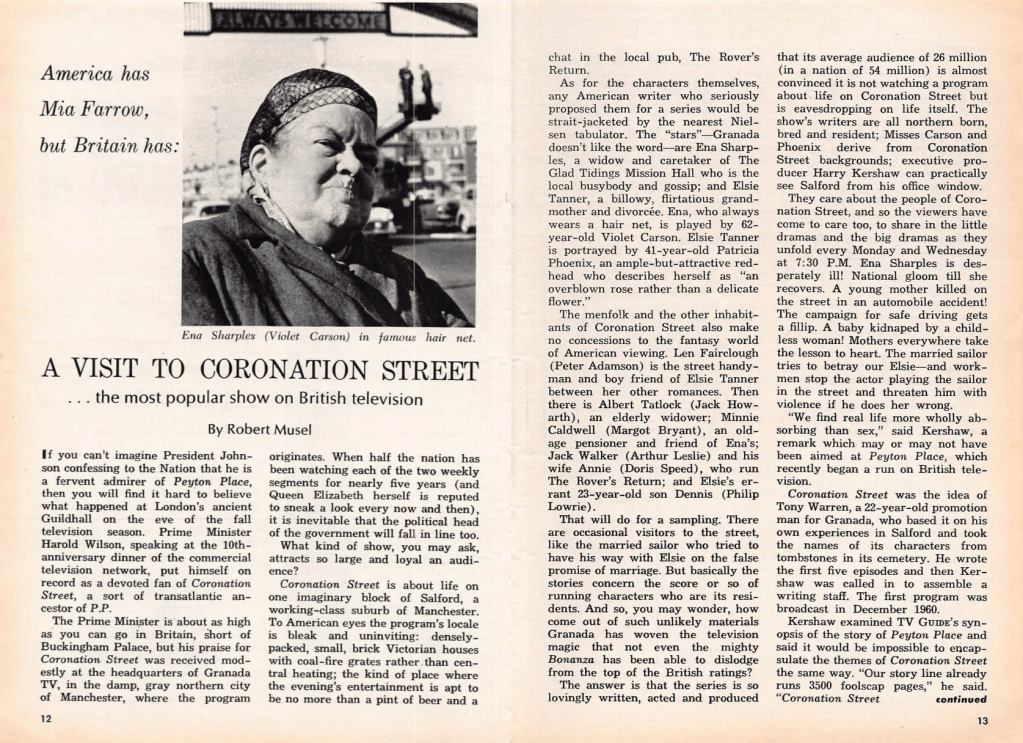
The Weatherfield influence on Peyton Place was certainly recognised in the USA – the 20 November 1965 edition of TV Guide carried a three-page feature on Coronation Street, alongside a nice big photo of Ena Sharples – snappily noting that for all of its qualities, “any American writer who seriously proposed [the Coronation Street characters] for a series would be strait-jacketed by the nearest Nielsen tabulator”. By translating what made Corrie work so well over here into something that worked over there, Monash had proved that American TV could make continuing dramas attractive to huge audiences. As such, from January 1965, some of the smaller ITV regions began broadcasting Peyton Place. In primetime slots, too.
Then, in 1978, Dallas arrived. But – in a way befitting the long, rambling nature of this entry – not as a primetime soap. Sigh. The original plan by producer Leonard Katzman and writer David Jacobs, when it came to their tale about a family of Dallas oil tycoons, was for it to be a miniseries. Each hour-long episode would, despite some ongoing storylines running throughout the series, be a self-contained narrative that would neatly tie together. And so, that’s how it initially aired – a short season of five episodes airing on CBS throughout April 1978, airing at 10pm on Sunday nights, opening with an episode where “the youngest son in an oil and cattle-rich family shocks the entire clan when he brings home as his bride the daughter of his father’s long-time enemy”.
Viewing figures were modest – Nielsen ratings for that initial series put it in joint-44th place for the 1977-78 season, sharing a position with CBS sitcom Baby, I’m Back. The latter – a vehicle for Desmond “Sanford’s & Son” Wilson, who played a compulsive gambler trying to win his wife back – was duly cancelled. Dallas was given a second shot, with an extended run of 24 episodes set to air from September of the same year, with a greater emphasis on cliffhanger plotlines. It would initially air in a Saturday night slot, but soon moved to Friday nights where it would reign supreme.
Once Dallas had been effectively retooled as a grand comeback for the primetime US soap – because that’s what it had become by this point – it wouldn’t be too long before British viewers got to enjoy it. The first episode of the (mini-)series went out on 5 September 1978, in an 8.10pm Tuesday BBC1 evening slot, with the second US season immediately following the first – meaning episodes of Dallas’ second series aired in the UK just ten days after their US debut. Handily for the Beeb, the more self-contained nature of those early episodes afforded them an opportunity to skip the fourth episode, Winds of Vengeance, which contained a pretty uncomfortable plotline involving sexual assault.
Even then, while Dallas was a familiar presence on Tuesday evening BBC1 throughout 1978 and early 1979, the first two seasons hardly pulled in huge audiences. Even at the start of the third season in November 1979, at a time when ITV were just getting back into operation following almost three months off air due to industrial action, Dallas failed to make the weekly Jictar Top 20 ratings. That means it was officially attracting fewer viewers than Go with Noakes. In January 1980, it made the ratings chart for the first time, in 13th place with 15.1 million viewers. By 12 April of the same year, the viewer count had swelled to 16.7m viewers, making it the most-watched TV series in Britain, as the nation became gripped with the dastardly deeds of arch heel J.R. Ewing. His rampant villainy was coming to a head as the third season neared its conclusion, word reaching the British press that the season finale would see J.R. receive what’s coming to him (Clue: small, metal and is fired from a gun). If the penultimate episode of the season on 12 April topped the ratings, surely the following week’s season finale would attract even more viewers?
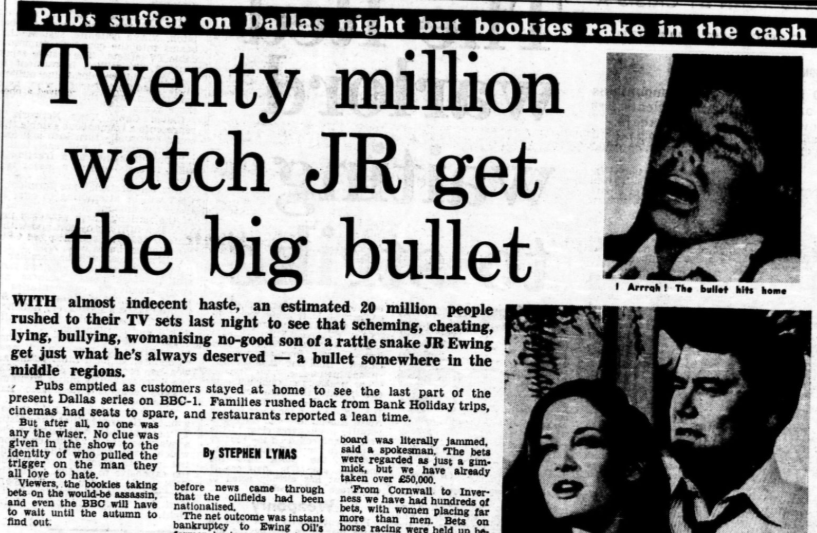
No, it wouldn’t. The BBC schedulers had their own bit of villainy up their sleeves – postponing the broadcast of the season finale for six weeks to maximise the attention it would get. It worked – on the week that episode went out (in May 1980), the only TV broadcast attracting a bigger audience was Brian Clough’s Nottingham Forest beating SV Hamburg in the European Cup Final. The episode concluded with one of television’s most famous cliffhangers, the mystery of just who pulled the trigger that propelled hot lead towards Ewing. Bookmakers William Hill took more than £50,000 in bets on who the culprit would be, while Las Vegas lawmakers had to intervene to prevent the same happening in the USA. As the nation busied itself with Who Shot J.R. discourse, BBC2 broadcast “a special selection of programmes from the series” on six evenings each week from 7 July, allowing newcomers a chance to catch up before the new series aired in November 1980.
The identity of the would-be murderer was so closely guarded that the broadcast tape of the subsequent series opener was transferred from Heathrow to BBC Television Centre in a bulletproof van, flanked by a motorcycle escort. With the BBC airing the episode just three days after CBS in the States, there was little chance of the secret hitting the press, and the fourth season of Dallas opened with a UK audience figure of 20.25m. The producers of Dallas not being a bunch of mugs, the culprit wouldn’t be revealed in the first episode of the series – or second, or third. To further confound any crew member hoping to leak the big revelation to the press, multiple versions of scenes were shot, with only the ‘real’ reveal being sent out to broadcasters.
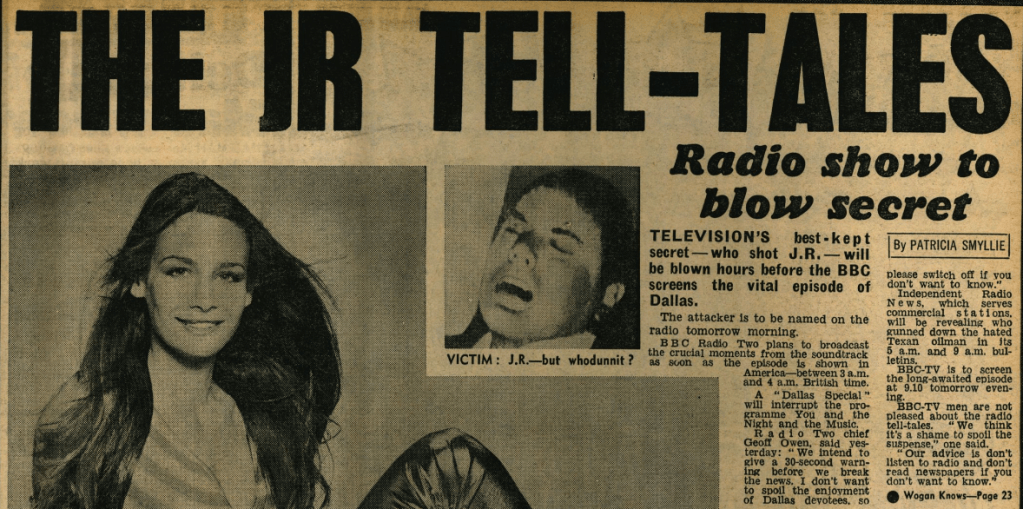
When it came to the big day – the all-important S04E04 that would finally reveal Who Shot J.R. – BBC Television were taking no chances. The reveal was to air on US TV between 3am and 4am UK time on Saturday 22 November 1980. It would air on BBC1 at 9.10pm that same day (the day after the previous episode on BBC1). That would prevent national newspapers from having time to learn the big news and get it onto Britain’s breakfast tables, but there was an even more surprising culprit at large: BBC Radio. Much to the chagrin of their audiovisual counterparts, BBC Radio 2 interrupted their overnight music programme You and the Night and the Music moments after the reveal on CBS Television, offering thirty seconds of spoiler space before naming the shooter, with Two bigwig Geoff Owen stating “I don’t want to spoil the enjoyment of Dallas devotees”. Despite, you know, doing precisely that.
Of course – spoiler alert – the shooter herself was much less of a surprise than that Radio 2 exposé. J.R.’s scorned mistress Kristin owned the finger that pulled the trigger, her position as 4-1 second favourite with William Hill reportedly costing the bookmaker £160,000. More importantly, with that week’s two episodes of Dallas topping the ratings, more than 21 million tuned in for the unmasking. Dallas was very officially A Big Deal. Which would come to a head just over four years later.
Over the next few years, Dallas would remain a major draw for the BBC. Opening episodes of each season would usually top the viewing figure charts for BBC1, even if numbers weren’t quite at the peak of Who Shot J.R. fever. Even when new episodes weren’t at the top of the BARBs, they were pulling in respectable figures north of 14 million. But, on 17 January 1985 – with the BBC halfway through screening season eight of the series – news hit the nation of a boardroom coup that could’ve been wrestled from the Dallas writers’ room.
“ITV GRAB DALLAS” screamed the Daily Mirror. “ITV POACHES DALLAS” roared the Daily Mail. “BBC LOSES DALLAS IN SOAP OPERA WAR” tutted the Daily Telegraph. “SOAP OPERA SPILLS OFF THE SCREEN” intoned The Guardian. “DALLAS POACHED FROM THE BBC” spluttered The Times. In each case, this was front page news (though you can guess which of those afforded it space below the fold).
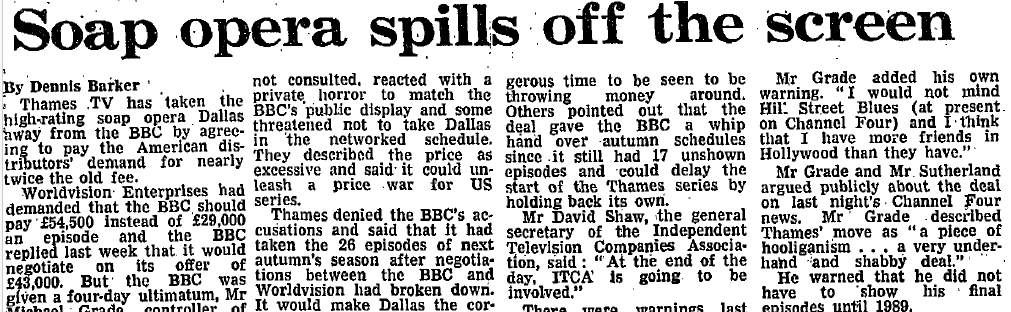
Indeed, the show’s distributors Worldvision had raised the price-per-episode for the ninth season to a level the BBC weren’t willing to pay. But, while the Beeb – at the time waiting on a consultation about the future of the licence fee – baulked at the idea of paying £1.4m for a 26-episode run of popular television (plus a 10% annual rise, and a commitment to buy every future episode of the series), Thames were more than happy to. ITV’s London weekday franchise gleefully swooped in to meet the higher fee, a fee that seems quaint in an era where Disney-fuelled Doctor Who episodes reportedly cost £10m a pop.
To modern eyes, such a gazumping doesn’t seem much of a surprise – it’s nothing that didn’t happen when Friends, 24, Lost and the like got snapped up by Sky. But back in the 1980s, a gentleman’s agreement had been in place between the BBC and ITV franchises not to partake in such unseemly bidding wars – mainly to avoid the price of imported shows getting overinflated. To highlight how unpopular a move it was, some of the other ITV franchises (most notably big guns Granada, Central and Yorkshire) criticised the deal, went as far as to announce they would refuse to air Dallas in their own regions when Thames planned to start showing it that autumn. After all, it was one thing waving a fat cheque at Morecambe & Wise or Mike Yarwood to make original programmes for ITV, but this was unseemly. Thames tried to argue that the inflated price of a Dallas episode was still around a quarter the cost of making a new episode of Minder, though nobody in particular was listening.
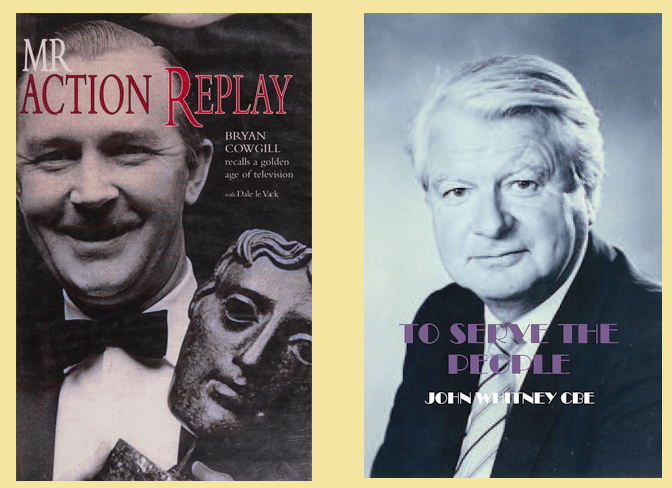
It didn’t take long for Thames to get a carpeting from the Independent Broadcasting Authority. Thames MD (and former Controller of BBC1) Bryan Cowgill was called in for ‘talks’ at the IBA, though the outcome of those talks differs between the autobiographies of Cowgill (Mr Action Replay, Sports Masters International 2006) and John Whitney, director-general of the IBA (To Serve the People, John Libbey Publishing 2013). Whitney’s telling of the meeting suggests a one-way telling-off, with Cowgill being ‘reminded’ that the IBA can block Dallas from being broadcast if it fell afoul of broadcasting policy guidelines. Cowgill’s telling of the story has it that Worldvision had flatly refused to continue speaking to the Beeb “in light of the treatment they received from the BBC”. Cowgill, a former Head of Sport at the BBC, countered Whitney’s argument that snatching the Beeb’s top US import “just isn’t cricket” with his opinion that he knew a good deal more about cricket than Whitney.
To compound matters, BBC1 controller Michael Grade announced that the Beeb’s existing Dallas episode reserves would be yanked off the schedules and held in storage until Thames started broadcasting their season nine episodes, at which point BBC1 would run season eight episodes against them. Or, as Grade said at the time “we have 17 episodes of Dallas left to show in the current series, and Thames can’t put on the next series until they’ve finished. But who knows how long it might take us to finish screening them?”, probably whilst twirling a stick-on moustache.
It was one hell of a power move, and further stoked the media narrative over the row (“These [BBC] executives betray themselves. In reacting thus to the loss of an elderly, mediocre soap opera they demonstrate how, despite assurances to the contrary, BBC television has sunk so low as to be indistinguishable from ITV” – The Daily Telegraph, predictably). And so, on 6 February 1985[1], it seemed the last episode of Dallas to be seen on the BBC for a good long time went to air. The Daily Mirror’s TV listings billed it as “the saga sinks slowly in the West for a while. It’ll be back in the autumn on the BBC – AND on some ITV stations too!”.
A week later, the slot was filled by the first episode from a new series of The Two Ronnies (“Sandra Dickinson guest-stars in a parody of Sunset Boulevard”). That’s pretty Premier League as filler programmes go. Bryan Cowgill refused to be cowed by Grade’s hardball, stating that “I’ve got it and I’m keeping it – it’s my baby. I’m in business to win. If that upsets other people, it’s hard luck.” But could there be any way of it returning to the Beeb, given many ITV franchises were also miffed by his tactics? “The only way we could return it to the BBC is if they bought it off us for the same price we paid for it.”
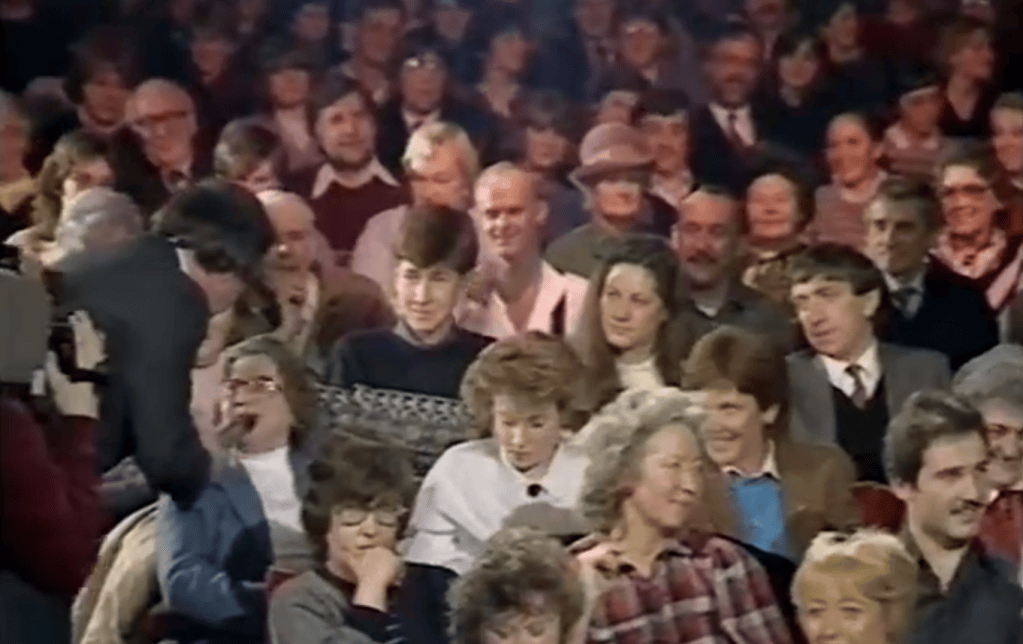
The impasse lasted until 18 February, when the BBC announced the return of Dallas to BBC1 from 27 March, with managing director Bill Cotton revealing the Corporation was “taken aback by the strength of viewer reaction”. The news itself had been revealed as part of another new era for the BBC – the first weekday episode of Wogan featuring a (soon ditched) audience participation segment where Tel revealed the news to a grateful nation, with the following day seeing the debut of new BBC soap EastEnders. However, the wave of audience demand may not have been the sole reason behind the Beeb backing down – the BBC’s announcement coincided with an announcement from Guild Home Video that the remaining Dallas season eight episodes placed on ice by Grade would be rushed out on VHS, with tapes containing three new episodes arriving at fortnightly intervals.
Brighter news was on the horizon for BBC bosses in June. Many ITV franchise holders were still frosty about the whole debacle and unlikely to broadcast any episodes. As a result, the prospect of paying over the odds for what would now be a “regional variation” in the TV listings led the management and legal team of Thames to visit New York for a meeting with programme distributors Worldvision. Their reluctant goal was to sheepishly sell Dallas back to the Beeb at a reduced fee and forget all about the Thames offer. In a move that surprised few, the large American company announced it would rather keep the larger amount of money.
In an attempt to resolve the matter, Thames sent letters to all other ITV franchise holders inviting them to state categorically whether they’d be willing to transmit Dallas or not – and if not, why not. As per John Whitney’s memoirs, Thames chairman Hugh Dundas claimed this was a ploy to get a bunch of negative responses that could be waved under Worldvision’s nose, as part of a negotiation to give the rights back to the BBC. Whitney’s suspicion was that it may have been a ploy to demonstrate how other ITV regions had softened on their original stance, and that there was now a certain amount of unspoken enthusiasm for putting the ratings smash on ITV. Tellingly, the recipients of the letters included London weekend franchise holders LWT, heavily suggesting the goal was purely collecting as many ‘no’ votes as possible.
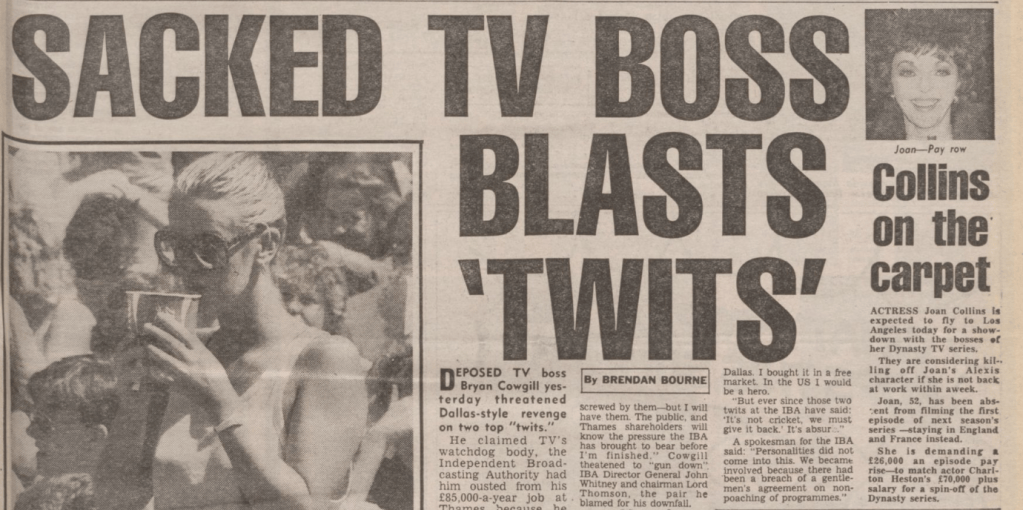
With all manner of bickering between Thames, the IBA and other ITV franchise holders continuing into the summer, Bryan Cowgill left Thames in July 1985. The mechanics of his departure differ between the Cowgill Version Timeline and the Whitney Version Timeline (“I didn’t wish to spend one more day of my life in the company of such hypocrisy and petty authority … I tendered my resignation” versus “I was telephoned by Hugh Dundas to say that the Board had decided Bryan Cowgill should go”), but either way Cowgill left with a £400,000 handshake. Why, that’s enough to buy 7.4 episodes of Dallas. In his post-job presser, Cowgill railed against the IBA (“I’ve been screwed by them – but I will have them.”), singling out IBA Director General John Whitney and chairman Lord Thomson as the individuals behind his defenestration (“if it goes back, those two damned idiots will have handed it back”). At least according to Thames chairman Hugh Dundas, Cowgill failed to do himself any favours by carrying out the entire deal without notifying the Thames board. It certainly didn’t help that the ‘agreeing-to-pay-a-steadily-rising-price-for-as-long-as-Dallas-is-made’ clause remained in the Thames version of the contract.
As it was, Dundas felt compelled to take to the pages of trade newspaper Television Today to address commonly quipped concerns about the whole affair. He shot down suggestions that the future of the Thames franchise might be put in jeopardy by the Dallas affair – it wasn’t, though that reckoning was only a few years away. The most telling part came at the end of Dundas’ piece – “the board had to choose between digging in and holding onto the programmes, or trying to negotiate their disposal. The latter course was adopted and has been pursued ever since”. The fact was that, in the BARB ratings released just after Cowgill’s departure, broadcasts of Dallas were now just 50,000 viewers ahead of Crossroads in the ratings. This declining audience may very well have had an impact on this stance. The ball was back in the BBC’s court, and with nobody else competing for the rights to the series, the next season of the soap could continue where viewers had come to expect it.
The agreement to hand it back to the Beeb finally came in August 1985. The climbdown from Thames was notable – with Worldvision refusing to budge on the increased price, Thames agreed to pay an undisclosed lump sum to the BBC, allowing the Corporation to re-purchase the series. Where Thames had agreed a fee of $60,000 per episode, the settlement meant the BBC were paying the figure they’d originally offered to retain the series, with Thames picking up the slack – a sum of either $10,000 (according to Whitney) or $12,500 per episode (according to Cowgill). And so, the whole affair would be resolved in time for the publication of the autumn schedules in early September. Wouldn’t it?
Nope. The whole sorry affair rumbled on well into the autumn, leaving a conspicuous Dallas-sized hole in the TV schedules while US viewers were enjoying a ninth season of Ewing antics. In October, the matter was even raised in the House of Commons, with Junior Minister of Trade and Industry Michael Howard being asked to outline the steps Her Majesty’s Government had taken to sort out the whole sorry oil slick. The Office of Fair Trading even got involved, contacting Worldvision to try and break the impasse.
Then – finally – in December came a breakthrough: Thames lawyers had finally agreed the small print with the BBC. February 1986 saw the announcement that the matter had finally been resolved, with the new series set to begin on BBC1 on Wednesday 5 March. Bryan Cowgill took time out from his new role as Deputy Chairman of the Mirror Group to comment “I am glad the OFT has confirmed the existence of a no-poaching agreement.” Meow. The belated return to Britain’s screens saw viewing figures for Dallas remain buoyant – season nine attracted 14m viewers, only slightly down from the figure for the end of the previous season (14.95m), though it would soon become evident that even with brand-new episodes – and real-life boardroom battling aside – the British public were starting to lose interest in the Ewings.
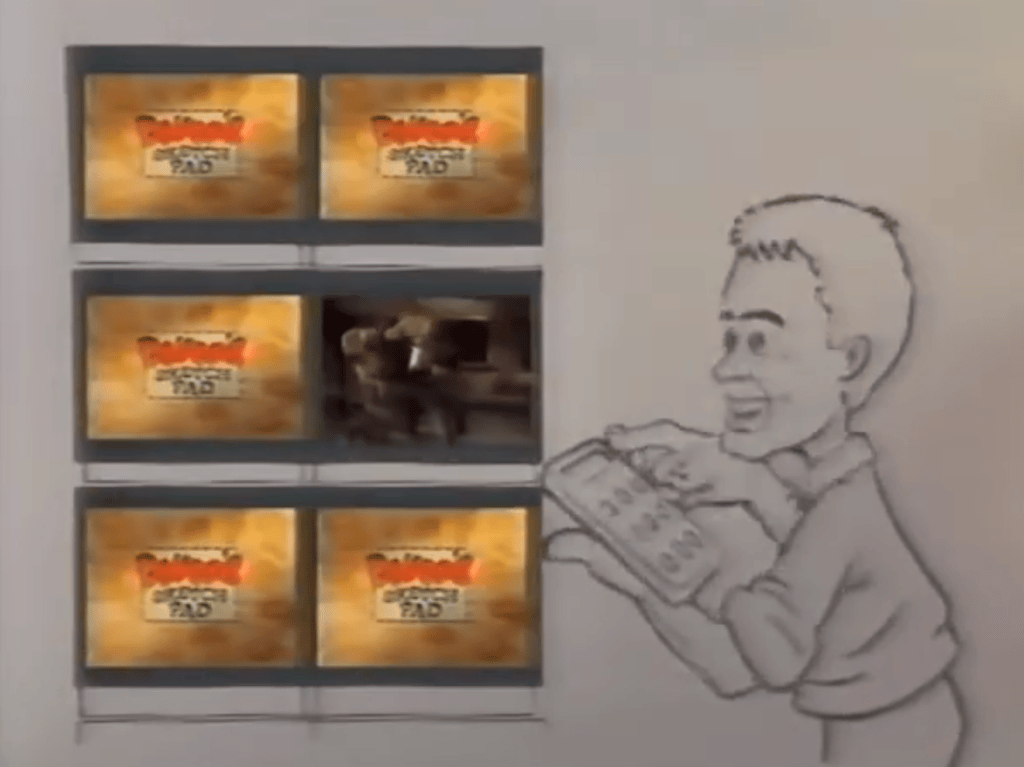
Audience figures soon started to dip further, with more down-to-earth drama serials like EastEnders and Neighbours becoming the main draw for BBC1. By 1989’s twelfth season, first-run episodes of Dallas on primetime BBC1 – previously the most-watched show on British television – struggled to appear at the scrag-end of the channel’s top thirty programmes. When it did appear, it would be gathering audiences between seven and nine million – not much of an achievement when several million more viewers were tuning into well-worn repeats of The Good Life and Columbo (or, if you’re feeling especially uncharitable, episodes of Davro’s Sketch Pad on ITV). But with the BBC locked into a contract tying them to the series for as long as it was being made, they had to keep showing it.
By the time the final series (of original flavour Dallas, at least) rolled around in May 1991, it was no longer a primetime proposition for the BBC. From this point on, new episodes would air at 3pm on Sunday afternoon, the once-mighty colossus now hanging around to pick up viewers from the EastEnders omnibus. Thankfully for the BBC, ratings had also dipped notably in the USA, from a high point of 33.4m viewers and being US TV’s most-watched show during the (first) outing of a bullet-riddled J.R., down to a low of 12.9m in the final season, failing to make the top sixty programmes. And that – a repeat run of the series on daytime TV in the mid-90s aside – was that.
Or, was it all a dream?
[1] Blott on the Landscape started on BBC2 that same evening, which I’m saying should be regarded as Britain’s answer to Dallas.
–
There we go! Remember, for this and 249 more entries (not all as long as this one, I feel duty-bound to add) buy a copy of Auntie’s Favourites now.
Or later, if it’s more convenient.