Category: Ratings

  • Big Book Update, North Korean Hackers, Coronation Street on ABC and Dallas (Mainly Dallas)

    Big Book Update, North Korean Hackers, Coronation Street on ABC and Dallas (Mainly Dallas)

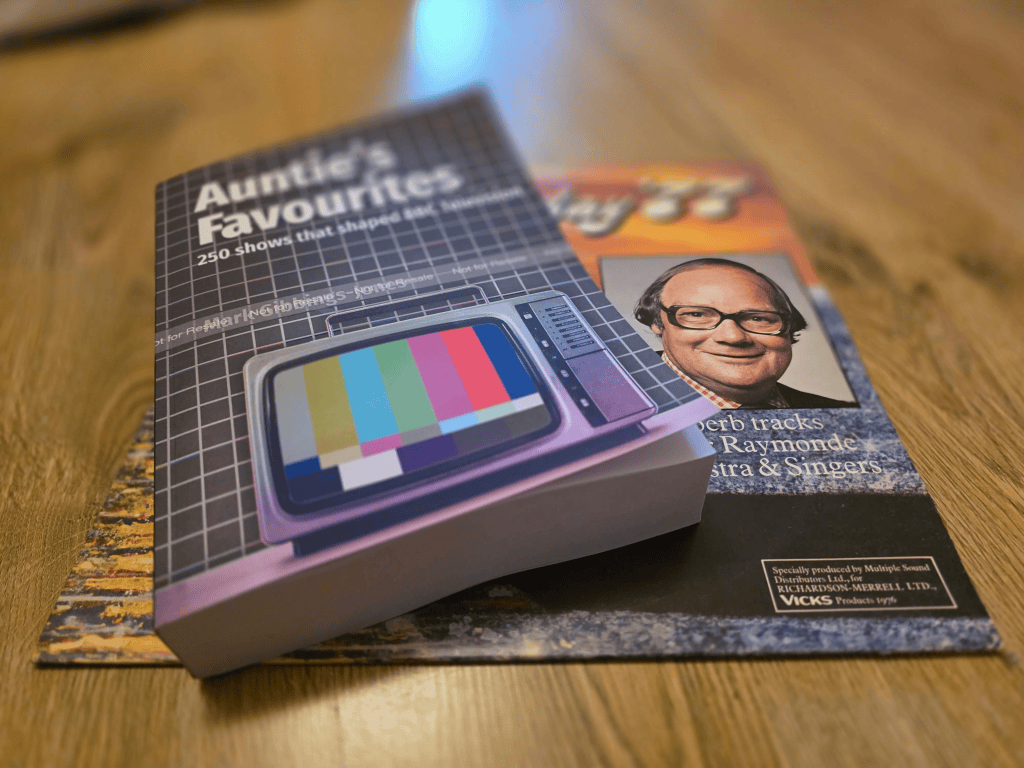
    A copy of the award-winning (citation needed) book Auntie's Favourites, on top of the Holiday '77 album.

    Firstly, big book news. And it’s important to note that both the news and the book are big. The book is the fully featured, 622-page, 10-by-7-inchAuntie’s Favourites, a full rundown of the 250 Most-Broadcast Programmes in the Entire History of BBC Television. This differs from the rundown previously published on this site, as it contains:

    • 150 additional entries compared to the original’s hundred
    • Covers every single broadcast up to 31 December 2025
    • Every broadcast on BBC Three, BBC Four, BBC Choice and BBC Knowledge alongside the main BBC channels
    • Added detail and complete rewrites on many of the original entries
    • Newsnight is now in the list. But where?
    • Definitive confirmation of the most-repeated sitcom in BBC Television history – it’s possibly not the one you’re expecting
    • Precisely one bar chart

    Also, critically, everything has been reviewed and properly proof-read. It’s the strangest thing. When going through the original proof edition of the book (pictured above, with a copy of the Holiday ‘77 vinyl record for scale), there were a lot of weird typos, put there, it seems logical to conclude, by North Korean hackers who had installed a virus on my PC in an attempt to discredit the book. A very clever virus that placed corresponding typos in the original blog entries, almost as if to make me look like a fool.

    All those typographical tykes have now been chased away, meaning the book is finally available to buy on Amazon. In the UK, it’s just £19.99 for the lovely paperback edition or £5.99 for the DRM-free Kindle edition (so you should be able to throw it at anything that’ll handle an .epub file). If you’re in the USA, you’re looking at just $26.99 for the paperback or $7.99 for the ebook, while if you find yourself in Canada it’s $36.99 for the book in paper form or $10.99 for it in digi-bits. If you’re in Australia and you want to see whether Neighbours is still at number one in the rundown (spoilers: it isn’t), it’s the oddly specific price of $41.87 for a copy you can hug at night, or just $11.69 for a copy that lives on your phone (or Kindle, or Kobo or whatever).

    It’s also available in other countries with an Amazon store and will be popping up on various other shopfronts (that don’t have the dread hand of Bezos on them) soon. I’ll post a further update once those have gone live.

    (It’ll be brilliant if you can spread the word about the book. It’s a project that has taken years to complete, so it would be nice to see it in as many hands, bookcases and digital devices as possible.)

    –

    Okay, let’s crack on with a sample entry from the book itself. It’s the programme in 225th place in the list and it’s one with a fun history. Let’s go to…

    Dallas

    1978-1995, broadcast 554 times

    BBC1 (480 times, 1978-1995)
    BBC2 (74 times, 1980-1987)
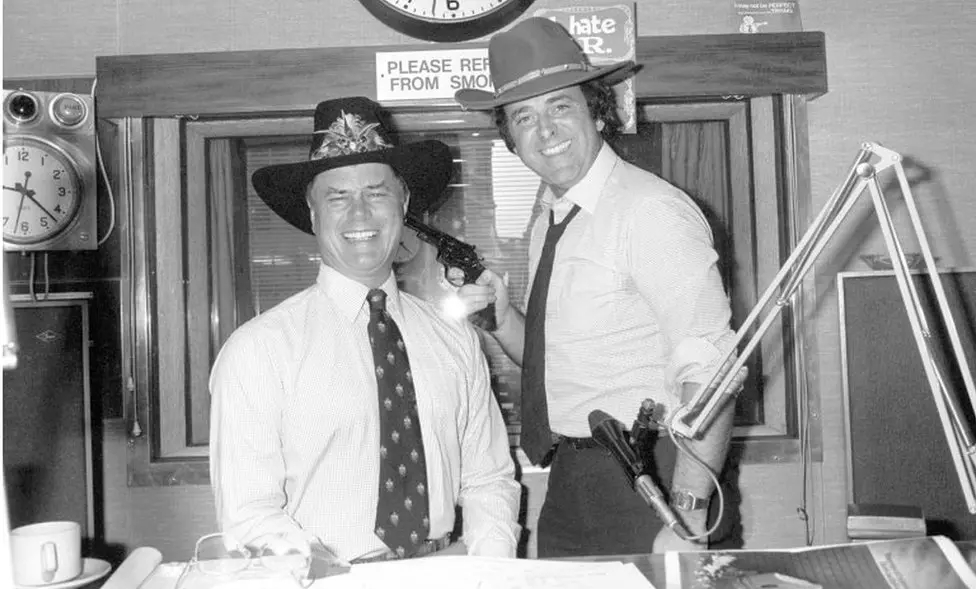
    Terry Wogan holding a gun to Larry Hagman's head in a BBC Radio studio.

    The majority of television programmes are ephemeral. They’re on, then they’re not, and you’re lucky if many people noticed them. But then there are television programmes that reach escape velocity and break free into the national zeitgeist, meaning everyone everywhere knows all about them whether they’d watched the damn thing or not. For most of the 1980s, as remembered by anyone who recalls all the references to ten-gallon hats, an entire season of a TV show turning out to have been a dream, or the joke where J.R. has a drink of water only for the liquid to pour out of bullet holes all over his body, Dallas was the latter. But here’s a thing: Dallas – that most American of American soap operas – may never have existed were it not for Coronation Street.

    Let’s explain by whizzing back to the 1930s. Yes, the 1930s.

    As you may well know, the phrase ‘soap opera’ came about when such serial drama programmes on the radio in 1930s America were commonly sponsored by soap and detergent manufacturers. When television started to grow in popularity in the 1940s, these soap operas would make the transition from radiogram to picturegram, starting with the boarding house-based These Are My Children (NBC, January-March 1949), with short fifteen-minute episodes airing on late weekday afternoons.

    While These Are My Children didn’t prove to be an immediate smash with viewers, it provided a cheap and cheerful way to fill some of those daytime hours, and it was soon joined in the schedules by A Woman to Remember (DuMont, February-July 1949) and The First Hundred Years (CBS, December 1950-June 1952). However, the following year’s Hawkins Falls, Population 6200 (NBC, April 1951-July 1955) could be considered the first truly popular daytime soap – with just a slight caveat, given it’d actually started as an hour-long primetime comedy drama in June 1950, before regenerating into a fifteen-minute daytime soap the following year. From that point on, the floodgates were pretty much flung open by US TV schedulers, with (at least) 27 more daytime soaps bubbling up during the remainder of the decade. For the sake of your sanity and mine, I’m not going to list them all here.

    Whatever American telly does, British TV soon starts sniffing around. Continuing drama serials in the UK had previously been the sole domain of radio, with The Archers airing for the first time on 29 May 1950 (as a pilot episode, going full-time on 1 January 1951), but when television attempted the genre, there weren’t really any daytime hours that needed filling – the short amount of pre-teatime broadcasting hours were reserved for children’s TV and news. And so, when some British TV soaps did appear, like The Grove Family (BBC-tv, April 1954-June 1957) or Emergency Ward 10 (ATV, February 1957-June 1967), they were mainly primetime prospects – ITV’s first attempt to put such a programme in a short afternoon slot – One Family (Associated-Rediffusion, April-May 1956) – all but proved British TV wasn’t really ready for such a series.
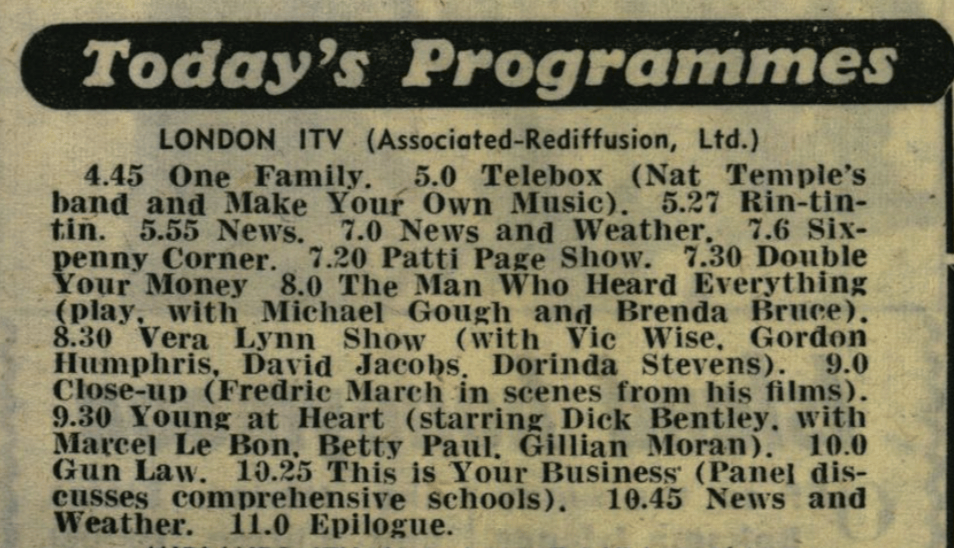
    London ITV schedule, 25 April 1956 (Daily Mirror)

    I’m not going to shock anyone here by pointing out that it was Coronation Street (Granada, December 1960 to the end of recorded time) that became soap’s first bona fide smash in the UK. While Emergency Ward 10 had hardly shied away from realism where warranted, Coronation Street became something that a large amount of the viewing public could truly relate to – ordinary working-class folk, in an ordinary working-class street, and a clear focus on lives rather than events. And Tony Warren’s series wasn’t just becoming big in Blighty – it was attracting the interest of television bigwigs in the USA, too.

    Depending on which source you’re looking at, the success of Corrie led to one of the “ABC top brass” (as per LIFE magazine, 25 April 1969), “officials of 20th Century Fox” (according to The Serials: Suspense and Drama by Instalment, Raymond William Stedman, 1977) or TV producer Paul Monash (going by Television Genres, The OU Course Team, 2003) to have the idea of making a primetime soap for the USA in 1963. The latter source claims Monash even considered broadcasting episodes of Coronation Street in the USA, but sensibly decided US audiences would have trouble understanding northern English accents. And so, with Coronation Street in mind, the TV rights were secured to Grace Metalious’ 1956 book Peyton Place – previously the subject of a successful 1957 film for Fox – and the series duly aired in 1964. Dealing with the lives and secrets of people in a small New England town, Peyton Place was a success – attracting tens of millions of viewers at its peak, and helping kickstart the careers of cast members Ryan O’Neal and Mia Farrow.
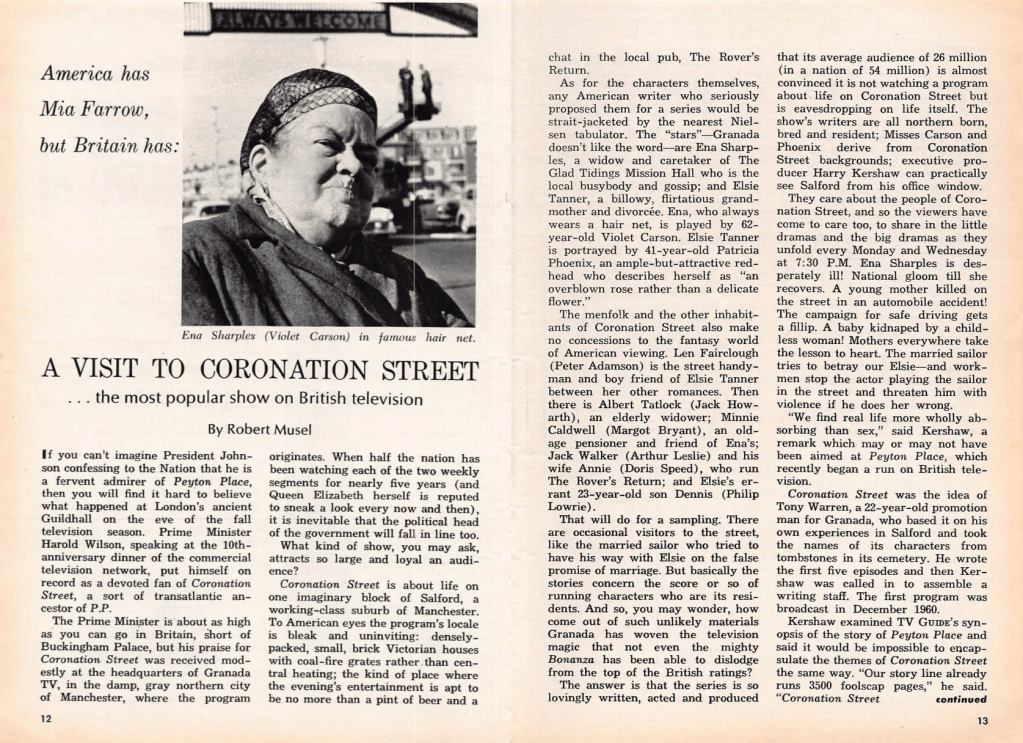
    TV Guide article, "America has Mia Farrow, but Britain has..." [Photo of Ena Sharples] "A Visit to Coronation Street"
    TV Guide, 20 November 1965

    The Weatherfield influence on Peyton Place was certainly recognised in the USA – the 20 November 1965 edition of TV Guide carried a three-page feature on Coronation Street, alongside a nice big photo of Ena Sharples – snappily noting that for all of its qualities, “any American writer who seriously proposed [the Coronation Street characters] for a series would be strait-jacketed by the nearest Nielsen tabulator”. By translating what made Corrie work so well over here into something that worked over there, Monash had proved that American TV could make continuing dramas attractive to huge audiences. As such, from January 1965, some of the smaller ITV regions began broadcasting Peyton Place. In primetime slots, too.

    Then, in 1978, Dallas arrived. But – in a way befitting the long, rambling nature of this entry – not as a primetime soap. Sigh. The original plan by producer Leonard Katzman and writer David Jacobs, when it came to their tale about a family of Dallas oil tycoons, was for it to be a miniseries. Each hour-long episode would, despite some ongoing storylines running throughout the series, be a self-contained narrative that would neatly tie together. And so, that’s how it initially aired – a short season of five episodes airing on CBS throughout April 1978, airing at 10pm on Sunday nights, opening with an episode where “the youngest son in an oil and cattle-rich family shocks the entire clan when he brings home as his bride the daughter of his father’s long-time enemy”.

    Viewing figures were modest – Nielsen ratings for that initial series put it in joint-44th place for the 1977-78 season, sharing a position with CBS sitcom Baby, I’m Back. The latter – a vehicle for Desmond “Sanford’s & Son” Wilson, who played a compulsive gambler trying to win his wife back – was duly cancelled. Dallas was given a second shot, with an extended run of 24 episodes set to air from September of the same year, with a greater emphasis on cliffhanger plotlines. It would initially air in a Saturday night slot, but soon moved to Friday nights where it would reign supreme.
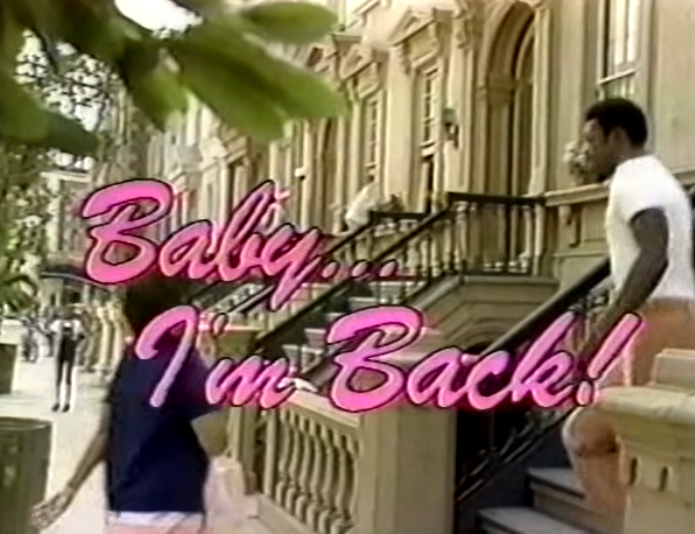
    Title card for "Baby, I'm Back", the programme title overlaid on footage of a residential street.

    Once Dallas had been effectively retooled as a grand comeback for the primetime US soap – because that’s what it had become by this point – it wouldn’t be too long before British viewers got to enjoy it. The first episode of the (mini-)series went out on 5 September 1978, in an 8.10pm Tuesday BBC1 evening slot, with the second US season immediately following the first – meaning episodes of Dallas’ second series aired in the UK just ten days after their US debut. Handily for the Beeb, the more self-contained nature of those early episodes afforded them an opportunity to skip the fourth episode, Winds of Vengeance, which contained a pretty uncomfortable plotline involving sexual assault.

    Even then, while Dallas was a familiar presence on Tuesday evening BBC1 throughout 1978 and early 1979, the first two seasons hardly pulled in huge audiences. Even at the start of the third season in November 1979, at a time when ITV were just getting back into operation following almost three months off air due to industrial action, Dallas failed to make the weekly Jictar Top 20 ratings. That means it was officially attracting fewer viewers than Go with Noakes. In January 1980, it made the ratings chart for the first time, in 13th place with 15.1 million viewers. By 12 April of the same year, the viewer count had swelled to 16.7m viewers, making it the most-watched TV series in Britain, as the nation became gripped with the dastardly deeds of arch heel J.R. Ewing. His rampant villainy was coming to a head as the third season neared its conclusion, word reaching the British press that the season finale would see J.R. receive what’s coming to him (Clue: small, metal and is fired from a gun). If the penultimate episode of the season on 12 April topped the ratings, surely the following week’s season finale would attract even more viewers?

    No, it wouldn’t. The BBC schedulers had their own bit of villainy up their sleeves – postponing the broadcast of the season finale for six weeks to maximise the attention it would get. It worked – on the week that episode went out (in May 1980), the only TV broadcast attracting a bigger audience was Brian Clough’s Nottingham Forest beating SV Hamburg in the European Cup Final. The episode concluded with one of television’s most famous cliffhangers, the mystery of just who pulled the trigger that propelled hot lead towards Ewing. Bookmakers William Hill took more than £50,000 in bets on who the culprit would be, while Las Vegas lawmakers had to intervene to prevent the same happening in the USA. As the nation busied itself with Who Shot J.R. discourse, BBC2 broadcast “a special selection of programmes from the series” on six evenings each week from 7 July, allowing newcomers a chance to catch up before the new series aired in November 1980.

    The identity of the would-be murderer was so closely guarded that the broadcast tape of the subsequent series opener was transferred from Heathrow to BBC Television Centre in a bulletproof van, flanked by a motorcycle escort. With the BBC airing the episode just three days after CBS in the States, there was little chance of the secret hitting the press, and the fourth season of Dallas opened with a UK audience figure of 20.25m. The producers of Dallas not being a bunch of mugs, the culprit wouldn’t be revealed in the first episode of the series – or second, or third. To further confound any crew member hoping to leak the big revelation to the press, multiple versions of scenes were shot, with only the ‘real’ reveal being sent out to broadcasters.
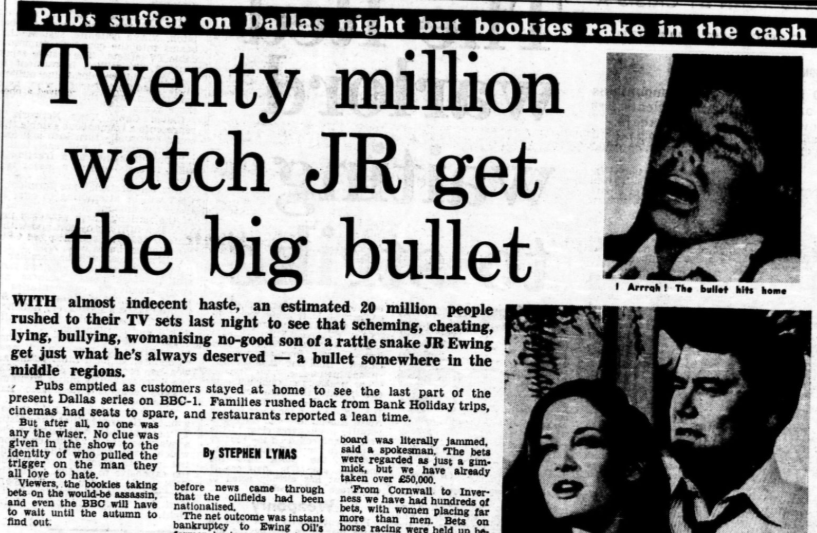
    Newspaper headline: "Twenty Million Wath JR Get the Big Bullet"
    Daily Mail, 27 May 1980

    When it came to the big day – the all-important S04E04 that would finally reveal Who Shot J.R. – BBC Television were taking no chances. The reveal was to air on US TV between 3am and 4am UK time on Saturday 22 November 1980. It would air on BBC1 at 9.10pm that same day (the day after the previous episode on BBC1). That would prevent national newspapers from having time to learn the big news and get it onto Britain’s breakfast tables, but there was an even more surprising culprit at large: BBC Radio. Much to the chagrin of their audiovisual counterparts, BBC Radio 2 interrupted their overnight music programme You and the Night and the Music moments after the reveal on CBS Television, offering thirty seconds of spoiler space before naming the shooter, with Two bigwig Geoff Owen stating “I don’t want to spoil the enjoyment of Dallas devotees”. Despite, you know, doing precisely that.
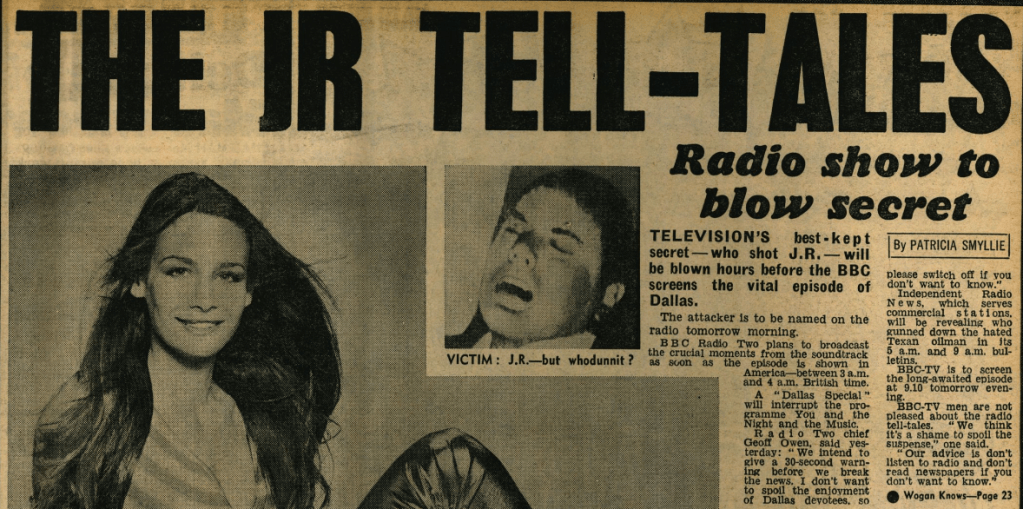
    Newspaper headline: "The JR Tell-Tales. Radio Show to Blow Secret"
    Daily Mirror, 21 November 1980

    Of course – spoiler alert – the shooter herself was much less of a surprise than that Radio 2 exposé. J.R.’s scorned mistress Kristin owned the finger that pulled the trigger, her position as 4-1 second favourite with William Hill reportedly costing the bookmaker £160,000. More importantly, with that week’s two episodes of Dallas topping the ratings, more than 21 million tuned in for the unmasking. Dallas was very officially A Big Deal. Which would come to a head just over four years later.

    Over the next few years, Dallas would remain a major draw for the BBC. Opening episodes of each season would usually top the viewing figure charts for BBC1, even if numbers weren’t quite at the peak of Who Shot J.R. fever. Even when new episodes weren’t at the top of the BARBs, they were pulling in respectable figures north of 14 million. But, on 17 January 1985 – with the BBC halfway through screening season eight of the series – news hit the nation of a boardroom coup that could’ve been wrestled from the Dallas writers’ room.

    “ITV GRAB DALLAS” screamed the Daily Mirror. “ITV POACHES DALLAS” roared the Daily Mail. “BBC LOSES DALLAS IN SOAP OPERA WAR” tutted the Daily Telegraph. “SOAP OPERA SPILLS OFF THE SCREEN” intoned The Guardian. “DALLAS POACHED FROM THE BBC” spluttered The Times. In each case, this was front page news (though you can guess which of those afforded it space below the fold).
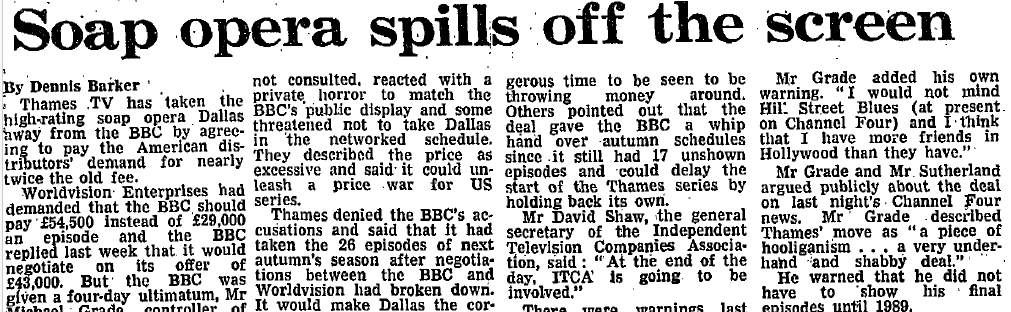
    Guardian, 17 January 1985

    Indeed, the show’s distributors Worldvision had raised the price-per-episode for the ninth season to a level the BBC weren’t willing to pay. But, while the Beeb – at the time waiting on a consultation about the future of the licence fee – baulked at the idea of paying £1.4m for a 26-episode run of popular television (plus a 10% annual rise, and a commitment to buy every future episode of the series), Thames were more than happy to. ITV’s London weekday franchise gleefully swooped in to meet the higher fee, a fee that seems quaint in an era where Disney-fuelled Doctor Who episodes reportedly cost £10m a pop.

    To modern eyes, such a gazumping doesn’t seem much of a surprise – it’s nothing that didn’t happen when Friends, 24, Lost and the like got snapped up by Sky. But back in the 1980s, a gentleman’s agreement had been in place between the BBC and ITV franchises not to partake in such unseemly bidding wars – mainly to avoid the price of imported shows getting overinflated. To highlight how unpopular a move it was, some of the other ITV franchises (most notably big guns Granada, Central and Yorkshire) criticised the deal, went as far as to announce they would refuse to air Dallas in their own regions when Thames planned to start showing it that autumn. After all, it was one thing waving a fat cheque at Morecambe & Wise or Mike Yarwood to make original programmes for ITV, but this was unseemly. Thames tried to argue that the inflated price of a Dallas episode was still around a quarter the cost of making a new episode of Minder, though nobody in particular was listening.

    It didn’t take long for Thames to get a carpeting from the Independent Broadcasting Authority. Thames MD (and former Controller of BBC1) Bryan Cowgill was called in for ‘talks’ at the IBA, though the outcome of those talks differs between the autobiographies of Cowgill (Mr Action Replay, Sports Masters International 2006) and John Whitney, director-general of the IBA (To Serve the People, John Libbey Publishing 2013). Whitney’s telling of the meeting suggests a one-way telling-off, with Cowgill being ‘reminded’ that the IBA can block Dallas from being broadcast if it fell afoul of broadcasting policy guidelines. Cowgill’s telling of the story has it that Worldvision had flatly refused to continue speaking to the Beeb “in light of the treatment they received from the BBC”. Cowgill, a former Head of Sport at the BBC, countered Whitney’s argument that snatching the Beeb’s top US import “just isn’t cricket” with his opinion that he knew a good deal more about cricket than Whitney.
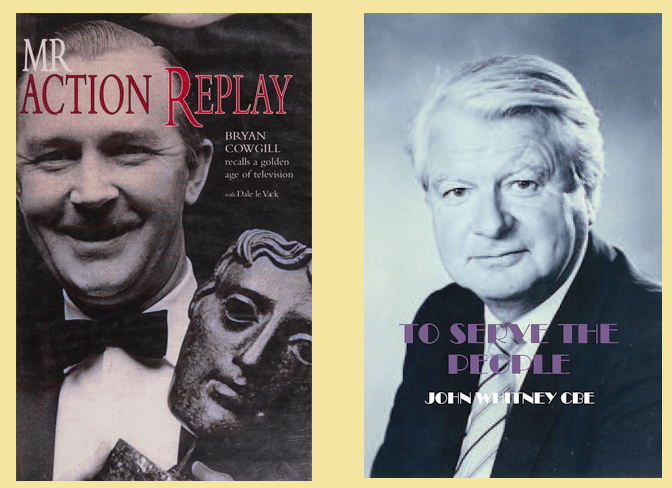
    Book covers for Bryan Cowgill and John Whitney's autobiographies
    Fight! Fight! Fight!

    To compound matters, BBC1 controller Michael Grade announced that the Beeb’s existing Dallas episode reserves would be yanked off the schedules and held in storage until Thames started broadcasting their season nine episodes, at which point BBC1 would run season eight episodes against them. Or, as Grade said at the time “we have 17 episodes of Dallas left to show in the current series, and Thames can’t put on the next series until they’ve finished. But who knows how long it might take us to finish screening them?”, probably whilst twirling a stick-on moustache.

    It was one hell of a power move, and further stoked the media narrative over the row (“These [BBC] executives betray themselves. In reacting thus to the loss of an elderly, mediocre soap opera they demonstrate how, despite assurances to the contrary, BBC television has sunk so low as to be indistinguishable from ITV” – The Daily Telegraph, predictably). And so, on 6 February 1985[1], it seemed the last episode of Dallas to be seen on the BBC for a good long time went to air. The Daily Mirror’s TV listings billed it as “the saga sinks slowly in the West for a while. It’ll be back in the autumn on the BBC – AND on some ITV stations too!”.

    A week later, the slot was filled by the first episode from a new series of The Two Ronnies (“Sandra Dickinson guest-stars in a parody of Sunset Boulevard”). That’s pretty Premier League as filler programmes go. Bryan Cowgill refused to be cowed by Grade’s hardball, stating that “I’ve got it and I’m keeping it – it’s my baby. I’m in business to win. If that upsets other people, it’s hard luck.” But could there be any way of it returning to the Beeb, given many ITV franchises were also miffed by his tactics? “The only way we could return it to the BBC is if they bought it off us for the same price we paid for it.”

    The impasse lasted until 18 February, when the BBC announced the return of Dallas to BBC1 from 27 March, with managing director Bill Cotton revealing the Corporation was “taken aback by the strength of viewer reaction”. The news itself had been revealed as part of another new era for the BBC – the first weekday episode of Wogan featuring a (soon ditched) audience participation segment where Tel revealed the news to a grateful nation, with the following day seeing the debut of new BBC soap EastEnders. However, the wave of audience demand may not have been the sole reason behind the Beeb backing down – the BBC’s announcement coincided with an announcement from Guild Home Video that the remaining Dallas season eight episodes placed on ice by Grade would be rushed out on VHS, with tapes containing three new episodes arriving at fortnightly intervals.
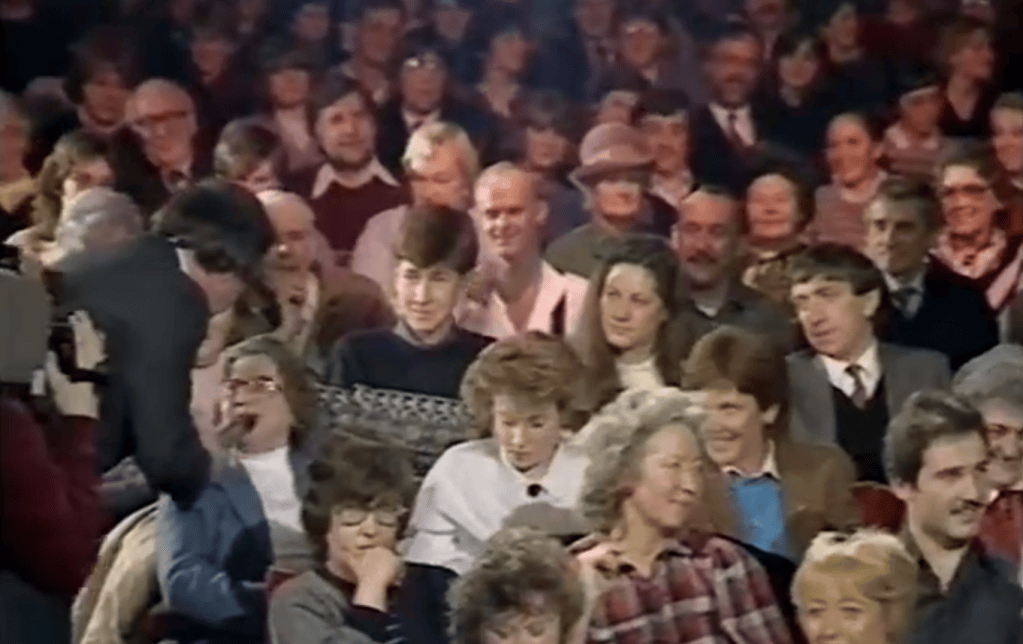
    Screengrab of the audience participation slot from the first 1985 edition of Wogan
    “Talk to the audience? Oh, God, this is always death.”

    Brighter news was on the horizon for BBC bosses in June. Many ITV franchise holders were still frosty about the whole debacle and unlikely to broadcast any episodes. As a result, the prospect of paying over the odds for what would now be a “regional variation” in the TV listings led the management and legal team of Thames to visit New York for a meeting with programme distributors Worldvision. Their reluctant goal was to sheepishly sell Dallas back to the Beeb at a reduced fee and forget all about the Thames offer. In a move that surprised few, the large American company announced it would rather keep the larger amount of money.

    In an attempt to resolve the matter, Thames sent letters to all other ITV franchise holders inviting them to state categorically whether they’d be willing to transmit Dallas or not – and if not, why not. As per John Whitney’s memoirs, Thames chairman Hugh Dundas claimed this was a ploy to get a bunch of negative responses that could be waved under Worldvision’s nose, as part of a negotiation to give the rights back to the BBC. Whitney’s suspicion was that it may have been a ploy to demonstrate how other ITV regions had softened on their original stance, and that there was now a certain amount of unspoken enthusiasm for putting the ratings smash on ITV. Tellingly, the recipients of the letters included London weekend franchise holders LWT, heavily suggesting the goal was purely collecting as many ‘no’ votes as possible.

    With all manner of bickering between Thames, the IBA and other ITV franchise holders continuing into the summer, Bryan Cowgill left Thames in July 1985. The mechanics of his departure differ between the Cowgill Version Timeline and the Whitney Version Timeline (“I didn’t wish to spend one more day of my life in the company of such hypocrisy and petty authority … I tendered my resignation” versus “I was telephoned by Hugh Dundas to say that the Board had decided Bryan Cowgill should go”), but either way Cowgill left with a £400,000 handshake. Why, that’s enough to buy 7.4 episodes of Dallas. In his post-job presser, Cowgill railed against the IBA (“I’ve been screwed by them – but I will have them.”), singling out IBA Director General John Whitney and chairman Lord Thomson as the individuals behind his defenestration (“if it goes back, those two damned idiots will have handed it back”). At least according to Thames chairman Hugh Dundas, Cowgill failed to do himself any favours by carrying out the entire deal without notifying the Thames board. It certainly didn’t help that the ‘agreeing-to-pay-a-steadily-rising-price-for-as-long-as-Dallas-is-made’ clause remained in the Thames version of the contract.
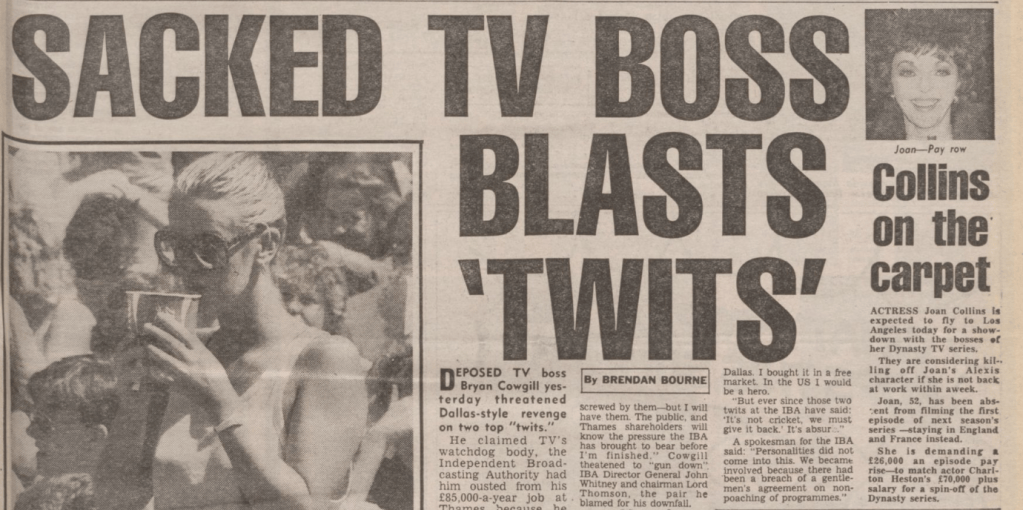
    Newspaper headline: "Sacked TV boss blasts 'Twits'"
    Daily Mirror, 14 July 1985

    As it was, Dundas felt compelled to take to the pages of trade newspaper Television Today to address commonly quipped concerns about the whole affair. He shot down suggestions that the future of the Thames franchise might be put in jeopardy by the Dallas affair – it wasn’t, though that reckoning was only a few years away. The most telling part came at the end of Dundas’ piece – “the board had to choose between digging in and holding onto the programmes, or trying to negotiate their disposal. The latter course was adopted and has been pursued ever since”. The fact was that, in the BARB ratings released just after Cowgill’s departure, broadcasts of Dallas were now just 50,000 viewers ahead of Crossroads in the ratings. This declining audience may very well have had an impact on this stance. The ball was back in the BBC’s court, and with nobody else competing for the rights to the series, the next season of the soap could continue where viewers had come to expect it.

    The agreement to hand it back to the Beeb finally came in August 1985. The climbdown from Thames was notable – with Worldvision refusing to budge on the increased price, Thames agreed to pay an undisclosed lump sum to the BBC, allowing the Corporation to re-purchase the series. Where Thames had agreed a fee of $60,000 per episode, the settlement meant the BBC were paying the figure they’d originally offered to retain the series, with Thames picking up the slack – a sum of either $10,000 (according to Whitney) or $12,500 per episode (according to Cowgill). And so, the whole affair would be resolved in time for the publication of the autumn schedules in early September. Wouldn’t it?

    Nope. The whole sorry affair rumbled on well into the autumn, leaving a conspicuous Dallas-sized hole in the TV schedules while US viewers were enjoying a ninth season of Ewing antics. In October, the matter was even raised in the House of Commons, with Junior Minister of Trade and Industry Michael Howard being asked to outline the steps Her Majesty’s Government had taken to sort out the whole sorry oil slick. The Office of Fair Trading even got involved, contacting Worldvision to try and break the impasse.

    Then – finally – in December came a breakthrough: Thames lawyers had finally agreed the small print with the BBC. February 1986 saw the announcement that the matter had finally been resolved, with the new series set to begin on BBC1 on Wednesday 5 March. Bryan Cowgill took time out from his new role as Deputy Chairman of the Mirror Group to comment “I am glad the OFT has confirmed the existence of a no-poaching agreement.” Meow. The belated return to Britain’s screens saw viewing figures for Dallas remain buoyant – season nine attracted 14m viewers, only slightly down from the figure for the end of the previous season (14.95m), though it would soon become evident that even with brand-new episodes – and real-life boardroom battling aside – the British public were starting to lose interest in the Ewings.

    Audience figures soon started to dip further, with more down-to-earth drama serials like EastEnders and Neighbours becoming the main draw for BBC1. By 1989’s twelfth season, first-run episodes of Dallas on primetime BBC1 – previously the most-watched show on British television – struggled to appear at the scrag-end of the channel’s top thirty programmes. When it did appear, it would be gathering audiences between seven and nine million – not much of an achievement when several million more viewers were tuning into well-worn repeats of The Good Life and Columbo (or, if you’re feeling especially uncharitable, episodes of Davro’s Sketch Pad on ITV). But with the BBC locked into a contract tying them to the series for as long as it was being made, they had to keep showing it.
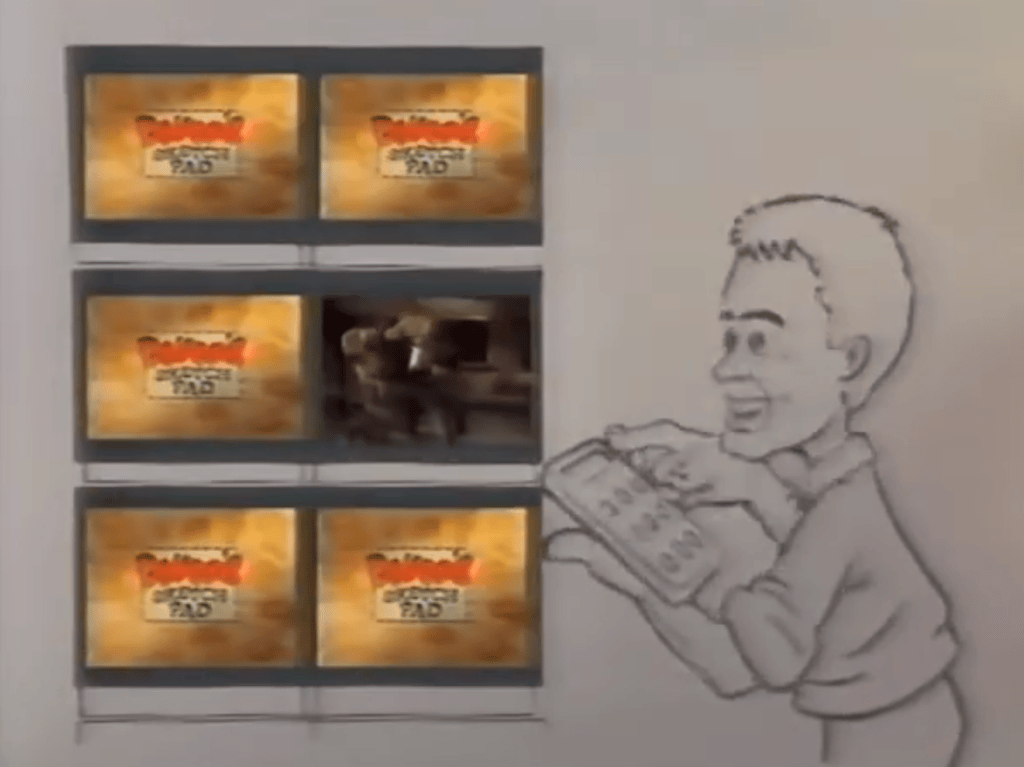
    Title screen for Davro's Sketch Pad. A cartoon Bobby Davro paws at a remote control and a bank of six televisions
    Davro’s Sketch Pad: Bigger than Dallas

    By the time the final series (of original flavour Dallas, at least) rolled around in May 1991, it was no longer a primetime proposition for the BBC. From this point on, new episodes would air at 3pm on Sunday afternoon, the once-mighty colossus now hanging around to pick up viewers from the EastEnders omnibus. Thankfully for the BBC, ratings had also dipped notably in the USA, from a high point of 33.4m viewers and being US TV’s most-watched show during the (first) outing of a bullet-riddled J.R., down to a low of 12.9m in the final season, failing to make the top sixty programmes. And that – a repeat run of the series on daytime TV in the mid-90s aside – was that.

    Or, was it all a dream?
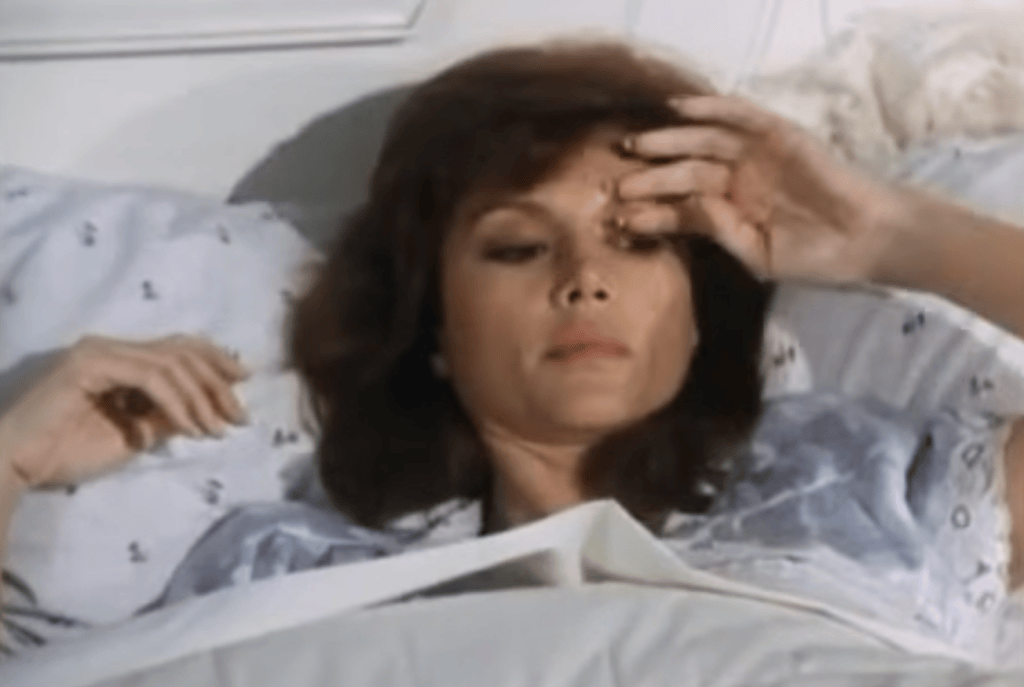
    Screencap: Pam (Victoria Principal) wakes up from her terrible months-long dream

    [1] Blott on the Landscape started on BBC2 that same evening, which I’m saying should be regarded as Britain’s answer to Dallas.

    –

    There we go! Remember, for this and 249 more entries (not all as long as this one, I feel duty-bound to add) buy a copy of Auntie’s Favourites now.

    Or later, if it’s more convenient.
  • Forty/Four: Channel Four’s 40 Most-Watched (Part Four)

    Forty/Four: Channel Four’s 40 Most-Watched (Part Four)

    Onto the last leg of our list. Which, for the record, doesn’t include The Last Leg.

    Lots of big programmes we’ve not seen yet on the list, and with only a few places remaining there’s not enough room for all of them. I’m starting to think we won’t see Murun Buchstansangur on this list at all.

    The list thus far:

    • 40: THE NICK (21:00 Monday 3 Oct 1994, 6.5m viewers)
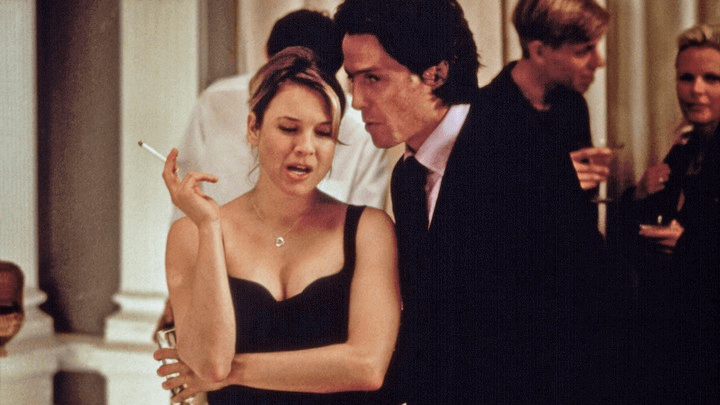
    • 39: FILM: BRIDGET JONES’S DIARY (21:25 Saturday 13 Nov 2004, 6.54m viewers)
    • 38: IT’LL BE ALRIGHT LATE AT NIGHT (23:10 Thursday 11 Jul 1985, 6.55m viewers)
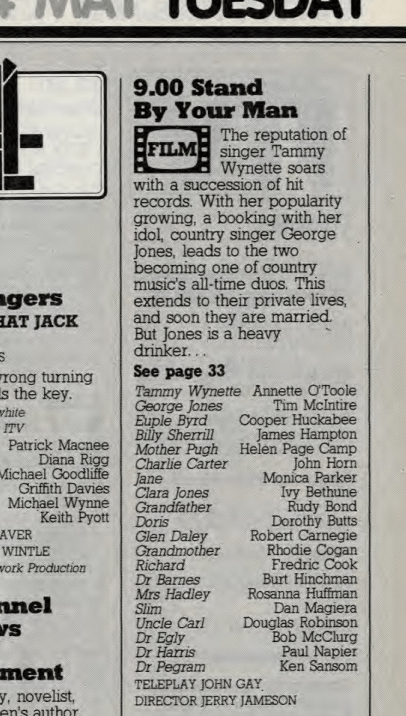
    • 37: FILM: STAND BY YOUR MAN (21:00 Tuesday 14 May 1985, 6.6m viewers)
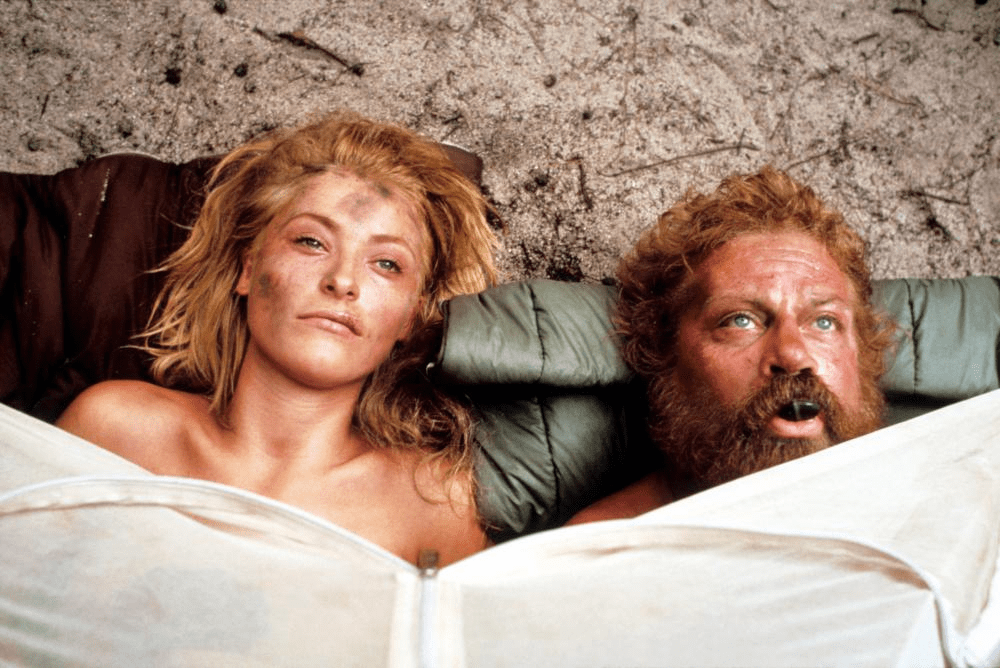
    • 36: FILM: CASTAWAY (21:00 Monday 26 Nov 1990, 6.63m viewers)
    • 35: FILM: COAST TO COAST (21:00 Tuesday 5 Feb 1985, 6.65m viewers)
    • 34: FILM: WISH YOU WERE HERE (21:30 Thursday 15 Feb 1990, 6.67m viewers)
    • 33: GOGGLEBOX (22:00 Friday 12 Mar 2021, 6.74m viewers)
    • 31: FILM: GOOD MORNING VIETNAM (21:00 Sunday 25 Apr 1993, 6.75m viewers)
    • 31: LOST (20:30 Wednesday 10 Aug 2005, 6.75m viewers)
    • 30: FILM: NIGHTMARE ON ELM STREET (22:00 Tuesday 31 Mar 1992, 6.8m viewers)
    • 29: WIFE SWAP (21:00 Tuesday 21 Oct 2003, 6.9m viewers)
    • 28: FILM: NOWHERE TO RUN (21:00 Tuesday 9 Apr 1985, 6.95m viewers)
    • 27: FILM: THE ABYSS (21:00 Sunday 24 Jan 1993, 7.01m viewers)
    • =25: FILM: MOTHER, JUGS AND SPEED (21:00 Tuesday 12 Mar 1985, 7.05m viewers)
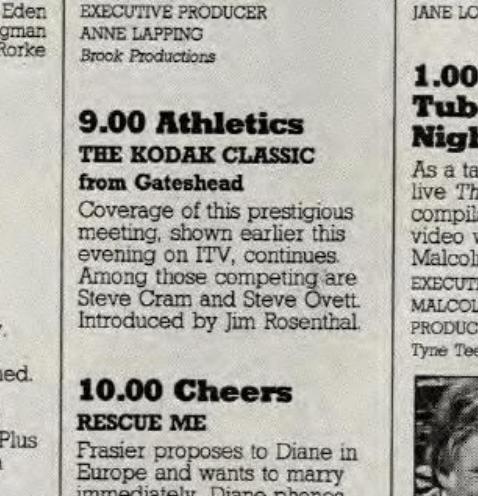
    • =25: ATHLETICS: THE KODAK CLASSIC (21:00 Friday 9 Aug 1985, 7.05m viewers)
    • 24: FEMALE PARTS: RUDE WOMAN (21:00 Monday 11 May 1992, 7.06m viewers)
    • 23: PETER KAY LIVE (21:30 Wednesday 4 Aug 2004, 7.197m viewers)
    • 22: IT’S NEVER TOO LATE (20:30 Monday 3 Dec 1984, 7.2m viewers)
    • 21: FILM: BILL AND TED’S EXCELLENT ADVENTURE (21:00 Sunday 11 Apr 1993, 7.29m viewers)
    • 20: SHE’LL BE WEARING PINK PYJAMAS (21:00 Thursday 12 Mar 1987, 7.6m viewers)
    • 19: RELATIVE STRANGERS (20:30 Monday 28 Jan 1985, 7.75m viewers)
    • 18: PARALYMPICS 2012: OPENING CEREMONY (20:00 Wednesday 29 Aug 2012, 7.78m viewers)
    • 17: FILM: MONA LISA (21:30 Thursday 23 Feb 1989, 7.82m viewers)
    • 16: TREASURE HUNT (20:30 Thursday 24 Mar 1988, 7.85m viewers)
    • =14: INTERNATIONAL SNOOKER (21:45 Sunday 16 Dec 1984, 8.25m viewers)
    • =14: FILM: DARK NIGHT OF THE SCARECROW (21:00 Tuesday 21 May 1985, 8.25m viewers)
    • 13: BROOKSIDE (20:00 Wednesday 3 Nov 1993, 8.27m viewers)
    • 12: THE MIRACLE OF KATHY MILLER (21:00 Tuesday 21 Apr 1987, 8.3m viewers)

    Anyway, here they are, that final, um, eleven. Yes, eleven. Definitely didn’t uncover another high-rating broadcast at the last minute, no. Starting with…


    11: CELEBRITY BIG BROTHER
    (20:30 Friday 19 Jan 2007, 8.78m viewers)

    A franchise always likely to feature here, the question is… which series attracted the highest viewing figures? Here’s a clue: it was the one where the phrase “the values of the Carphone Warehouse” entered the public lexicon. The one that led to a diplomatic row between the UK and India. The one that led to a Prime Ministerial statement. And it wasn’t just to point out that Donny Tourette was a bit of a bellend.
    Given how easily ignored Celebrity Big Brother was during those final years on Channel Five (if you have to explain in an intro video what you’re “most famous for”, you’re not famous), it’s remarkable how high the calibre of guests was during this period of the show’s history. For the series in question here, you had Leo Sayer, Ken Russell, Cleo Rocos, Dirk Benedict and actual bloody Jackson Five member Jermaine Jackson. And yes, the laws of the universe also dictate that you’d get some stunt casting to offset that, people whose lofty level of celebrity status existed only within their egos, but it was part of the formula. Rough with the smooth. And at least Donny Tourette’s presence was enlivened by his introductory encounter with a butter-smooth Dirk Benedict (“Oh my God, it’s Dirk fucking Benedict!” “Well, I don’t normally use my middle name, but hi.”).

    Anyway, I’m pretty sure you all know the details of The Event here, even if it’s only from the Stewart Lee routine. Bollywood star Shilpa Shetty was one of the celebrity housemates, and arrived with a clear air of Girl Awkwardly Trying To Fit In At A New School. A group of the other participants – glamour model Danielle Lloyd, pop star Jo O’Meara, previous Big Brother contestant Jade Goody, along with boyfriend Jack Tweed and mother Jackiey Budden – decided they didn’t like her (for… whatever reason), and the end result was one of the most unedifying weeks in the history of television. Unedifying for the individuals involved, for the production company, for the channel that gleefully pumped it out night after night, and ultimately (hands held up here) for the viewers who may have been disgusted, but who weren’t about to switch off.

    There was a lot to unpack from the whole affair. The most overt display of racism coming from the mouth of Danielle Lloyd, followed by an “ooh, aren’t I naughty” giggle, was probably to go-to example, but there were several more distasteful moments of note. The one that springs to mine for me was the programme producers Endemol addressing rumours that Jack Tweed had used the word P*** to refer to the (perfectly pleasant) Shetty, by releasing (partly) unbleeped audio confirming it was fine, he was just referring to her with the word c***. So, um, that’s still not exactly great, is it?

    Ultimately, Endemol seemed to realise that throwing more kindling on their bonfire of dignity wasn’t helping anyone – not least when lead sponsor Carphone Warehouse demanded to be disassociated with the show, and agents of the main culprits saw lucrative contracts suddenly cancelled – and Jade Goody was duly evicted. The usual eviction night crowd may have been absent, but the TV audience were certainly present, in huge numbers. But, from this point on, the Celebrity Big Brother brand was irrevocably tainted, and I’m saying the affair definitely directly resulted in a ‘Leave’ vote in the EU referendum. Still, maybe next year’s ITV2 reboot will undo all that? Yeah, I know.

    WHAT WAS ON THE OTHER SIDE?

    Nothing else stood a chance, really. BBC1 offered sitcom After You’ve Gone followed by WWI-era drama Lilies. BBC2 dug up an episode of Grow Your Own Veg, followed by Timewatch episode Killer Cloud. ITV threw on a Midsomer Murders and went to the pub, while Five followed Nick Baker’s Weird Creatures with an NCIS off the shelf.


    10: BIG FAT GYPSY WEDDINGS
    (21:00 Tuesday 8 Feb 2011, 8.8m viewers)

    Span out of warmly-received 2010 Cutting Edge episode My Big Fat Gypsy Wedding, this series dipped into the lives and traditions of families from the Traveller community as preparations were made for a family wedding. While the original was awarded ‘Most Groundbreaking Show’ in the ‘Cultural Diversity Awards’ (which were possibly invented specifically to annoy your uncle on Facebook), the full series was criticised by many from Britain’s Traveller and Romani community for playing up the quirkiest, most outrageous examples of life within the featured families.

    This highest-rating episode came from the first series, with an episode looking into the community’s weddings and christenings from a purely male perspective, but most episodes from that opening series rated north of eight million viewers. It’s only in later series where the programme’s popularity began to slide, with many of the standalone ‘event’ episodes from 2013 falling outside BARB’s published ratings, putting their figures below two million viewers.

    WHAT WAS ON THE OTHER SIDE?

    BBC1 broadcast poorly-received sci-fi drama Outcasts, while BBC2‘s The Chinese are Coming explored China’s role as an emerging economic superpower. ITV were still pushing out episodes of Taggart, with tonight’s tale tackling the world of cage fighting. Five threw on a bunch of CSI episodes for the night and went to bed early. The Viacom takeover couldn’t happen soon enough.


    9: THE PRICE
    (21:30 Thursday 14 Feb 1985, 8.9m viewers)

    COME ON DOWoh wait, it’s not that. But rather the concluding episode of a tense six-part thriller starring Peter Barkworth and Harriet Walter. The tale of Geoffrey, a millionaire trapped in an unhappy marriage to a wife twenty years his junior, but his devotion to his wife and her mardy-arse daughter is soon tested as they’re kidnapped by the IRA. With his assets far from liquid, he struggles to raise the required ransom, and his attempts to free capital cause the share price of his firm to tumble. Ah, the priorities of television characters from the eighties.

    In this final episode, “Geoffrey enlists the aid of computers to track down his wife and step-daughter. But the police close in while the gang still hold his family”. Given the computers of that era, fingers crossed for no R:Tape Loading Errors, eh?

    WHAT WAS ON THE OTHER SIDE?

    Final episode of amateur sleuth-em-up Charters and Caldicott on BBC1, followed by Question Time. ITV had an episode of TV Eye looking at the rise of lawlessness on the New York subway systems, and the groups of vigilantes who formed to tackle them. Over on BBC2, a Forty Minutes episode looking at two stories of young love (Feb 14th, of course) followed by The Rockford Files. Meanwhile, later the same night on Channel Four, an episode of Cinemax-C4 collaboration Assaulted Nuts, a pretty much made-for-export sketch comedy series starring Tim Brooke-Taylor, Barry Cryer and Cleo Rocos. It’s worth looking up details on that series, as it’s a deliciously off-piste piece of British comedy history. Even if it’s not exactly brilliant.


    8: NUNS ON THE RUN (1990)
    (21:00 Sunday 18 Apr 1993, 9.2m viewers)

    There have been quite a lot of films on this list, haven’t there? Some big budget American ones (The Abyss, Good Morning Vietnam), some more modestly-budgeted but well-reviewed homegrown movies (Wish You Were Here, Mona Lisa). And, besting all of them in the ratings battle… this.

    Eric Idle and the late Robbie Coltrane play inept gangsters Brian and Charlie, whose attempt to rob a gang of Triads results in them ripping off the rest of their gang to escape to a life of Brazilian bliss. Things don’t quite go to plan during their getaway, meaning the duo are forced to flee and seek refuge at a nearby nunnery. Brian’s love interest Faith (Doctor Who’s Camille Coduri) spots the cackhanded crims attempt to flee, and also joins the nunnery posing as a student.

    Cruelly overlooked by the Academy Awards judging panel, the whole affair was a diverting enough romp if you ask me. Yeah, there was no intellectual nourishment on offer here, but sometimes you just feel like a tube of Pringles, yeah? Mind you, Roger Ebert stated that when it comes to Nuns on the Run, “your laughter may reveal more about you than about this particularly dreary film.” It’s still better than Splitting Heirs, I counter.

    WHAT WAS ON THE OTHER SIDE?

    Sunday night treats on offer elsewhere were an episode of A Year in Provence followed by Mastermind on BBC1 (PD James, the Napoleonic Wars, the Cornish clay industry and medieval castles on the latter, the Mayles have a go at French sport in the former). BBC2 dealt out an Arena special on the career of South African pop megastar Brenda Fassie followed by Peggy Sue Got Married (1986). ITV finished off a Maigret before welcoming a textbook Aspel & Company line-up (Mary Tyler Moore, Brian Conley and Sting) and News from ITN.


    7: FRIENDS
    (21:00 Friday 28 May 2004, 9.64m viewers)

    Ah, here it is.

    One the one hand, Friends was always bound to appear on this list. But on the other hand, you’d have thought the same about Cheers, Frasier, Ugly Betty, The Cosby Show, Ellen, The Golden Girls, Desperate Housewives, A Handmaid’s Tale or Will & Grace, and you’ll notice there’s not enough room left for many of them. Or possibly any of them.

    After the reliably popular Cheers came to an end in May 1993, it left a big hole in Four’s Friday night schedule. While the channel had seen quite a few similarly well-received Friday night comedy imports – The Golden Girls enjoyed a lengthy run on the channel, but that had already run its course, and spin-off The Golden Palace had been and gone by the time Cheers came to a close. What was the channel to do? Other options such as Roseanne weren’t as popular as they had been, and new acquisitions such as Susan Harris’ post-Golden Palace project Nurses or HBO sexcom Dream On had failed to draw much attention.

    On 28 April 1995, their prayers were answered, with a programme debuting – as it happens – just after the second ever episode of Father Ted. Nestled between the latest from Craggy Island and one-off spoof Jack and Jeremy’s Police 4 (or pilot for Jack and Jeremy’s Real Lives, if you prefer) came the first episode of NBC’s hot new sitcom hope, starring (as The Times had it at the time) “NYPD Blue’s David Schwimmer” in (as The Mirror had it) “half a dozen single twentysomethings fighting on the battlefield known as life”.

    You know the rest, I’m sure. This high point of the series viewing figures comes for the final episode, at a point where Channel Four had expensively wrangled the rights back from Sky, and where it served as a lead-in to a brand new series of Big Brother.

    WHAT WAS ON THE OTHER SIDE?

    BBC1 fought comedy with comedy, offering an episode of The Lenny Henry Show featuring guest star Harry Enfield. BBC2 offered a clear alternative with Art of the Garden, while a bullish ITV went big with a heady mixture of celebrities, kitchens and bollockings with a ninety-minute episode of Gordon Ramsey’s Hell’s Kitchen. Five merely admitted defeat and farted out a showing of Jean-Claude Van Damme’s Double Impact.


    6: CUTTING EDGE
    (21:00 Monday 14 Feb 1994, 9.78m viewers)

    Here’s one out of left-field.

    Not necessarily that Cutting Edge would make an appearance in this top ten – it’s a very long-running topical documentary strand, basically the channel’s answer to Panorama. But rather the episode that happens to have been the most-watched of them all.

    It could have been 1994’s Graham Taylor: An Impossible Job, a groundbreaking sports documentary where the levels of access granted to the film crew capturing the working life of beleaguered England manager Taylor was rivalled only by the levels of swearing throughout. After all, I can’t think of any Panorama episodes that led to a phrase that would capture the imagination of a nation like “Do I not like that?” did.

    It could have been Bafta-nominated episode Katie: My Beautiful Face from 2009, which followed the recovery of ex-model Katie Piper following a malicious acid attack. Or even 2010 episode My Big Fat Gypsy Wedding, which span-off into a full, very popular series of its own.

    Instead, it was 1994 episode Shops and Robbers that drew the largest audience. Far from a scintillating takedown of a notorious figure, or capturing a slice of life that simultaneously captured the nation’s hearts, it investigated the battle between Marks & Spencer and shoplifters. On the part of M&S, there’s a look at the company’s security hub, and at their futile attempt to nab a gang of professional pilferers. On the part of shoplifters, there’s an encounter with a serial shoplifter who routinely lifts clothes from the store, deliberately damages them, and then attempts to return them for a no-quibble refund. No wonder they subsequently changed that policy.

    WHAT WAS ON THE OTHER SIDE?

    Speaking of Panorama, that was BBC1‘s alternate offering following the Nine O’Clock News that night, with reporter Roger Harrabin investigating the claim that air pollution was causing a rise in the rates of asthma. BBC2 also offered up a documentary alternative, with a Horizon episode dissecting the aftermath of the 1992 Columbia air crash. Lighter fare on ITV, with Under the Hammer, an episode of the Richard Wilson/Jan Francis comedy drama featuring a guest turn by Thora Hird. Not a lot of light relief for anyone under thirty finding themselves dateless at home that particular Valentine’s Night, really.


    5: GREGORY’S GIRL (1980)
    (21:00 Tuesday 8 Jan 1985, 10.75m viewers)

    Bill Forsyth’s film takes a look at adolescent sexuality through the filter of life in early 1980s Cumbernauld. Gawky teen Gregory Underwood is the hapless striker of his hopeless school football team, until the team manager takes a gamble on keenly talented but controversially female Dorothy in his place. Gregory couldn’t care less about regaining his place up front, of course. He’d much prefer to form a striking relationship with Dorothy off the pitch.

    A brilliantly funny film that’s no less enjoyable in a world where girls playing football is the norm, and I say that as someone made to cringe myself inside out appearing in a GCSE English dramatic performance of it (I was brought up not to swear in front of adults, so having to joyfully utter the word “tits” in front of a bunch of them failed to provide the subversive thrill you’d expect).

    A British film that still makes best-of lists now – even Entertainment Weekly placed it in their ‘50 Best High School Movies‘ list some 34 years after initial release.

    WHAT ELSE WAS ON?

    The News followed by play The Last Evensong on BBC1, an gritty-era episode of The Bill (“Det Insp Galloway on the trail of a pornographer”) followed by News at Ten on ITV, and a niche triumvirate on BBC2: Pot Black ’85, followed by Doctor’s Dilemmas (“exploring the ethical dilemmas facing doctors”, reasonably enough) and World Darts.


    4: THE GREAT BRITISH BAKE OFF
    (21:00 Tuesday 24 Nov 2020, 11.74m viewers)

    Often when popular programmes get gazumped by other channels, it doesn’t work as well as hoped. Sky One did this quite a lot, snatching the rights to Friends, Lost, The X-Files, 24 and sundry others, the net result generally being each show immediately lost about 70% of its audience. Thames famously coaxed Morecambe and Wise over to ITV in the late 1970s, and their magic soon began to fade – ditto after The Goodies decamped to LWT. In fact, it’s harder to think of success stories: Men Behaving Badly became huge after being picked up by the BBC, but that mainly happened because ITV had given up on it. So, we’re left with a list that has the name ‘Kenny Everett’ on it and little else.

    Aside, that is, from Bake-Off. The odds seemed stacked against it – one of the BBC’s biggest shows being seized by a smaller channel, three of the four main hosts declining to make the move, a programme everyone was used to viewing without interruption suddenly having to make room for ad breaks. It doesn’t stand a chance.

    And yet… all of those obstacles did the series very little harm at all. At the programme’s high point on BBC1, it drew a total of 15.9m viewers. That fell by a relatively minor amount following the channel switch, with 11.74 million viewers tuning in for the pox-era finale. Yes, the C4 figure is smaller than the BBC1 figure, but that still made it a sixth-most watched programme of the year for any channel. And in a year when we were legally forced to remain indoors, that’s pretty good.

    WHAT WAS ON THE OTHER SIDE?

    It was 2020, so a perpetual chronicle of doom on The News, or – as before – Netflix.


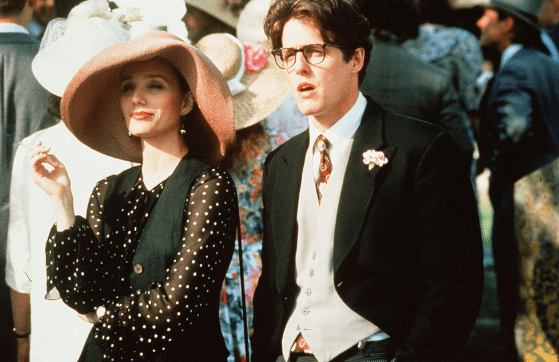
    3: FOUR WEDDINGS AND A FUNERAL (1994)

    (21:00 Monday 28 Apr 1997, 12.38m viewers)

    In 1994, director Mike Newell single-handedly (okay, Richard Curtis helped) gave the British romantic comedy genre the firm, hard boot up the arse it sorely needed.

    Not that the genre hadn’t existed before then, nor that Curtis hadn’t previously had a hand in it. Indeed, Richard Curtis’ previous film for cinemas, The Tall Guy (starring Jeff Goldblum, Emma Thompson and Rowan Atkinson) was a firmly enjoyable romp, but it seemed destined for little more than limited domestic success, maybe a weekend showing or two at 10pm on ITV, and little else. Having enjoyed his directorial work on Jack Rosenthal’s Ready When You Are, Mr. McGill (Granada, 1976), Curtis picked Newell to work with on his next project, and it’s fair to say it was quite a success: Four Weddings became the (then) top-grossing British film in history at that time, Hugh Grant was catapulted to superstardom, Curtis was nominated for a Best Screenplay Oscar and Wet Wet Wet clamped themselves to the top of the pop charts on the back of the soundtrack single.

    WHAT WAS ON THE OTHER SIDE?

    An extended Nine O’Clock News, followed by a Labour Party Election Broadcast and ‘scientific thriller’ Breakout on BBC1, the reboot of The Outer Limits and This Life on BBC2, while ITV plumped for an episode of Bramwell and News at Ten.


    2: BIG BROTHER
    (22:30 Friday 27 Jul 2001, 13.74m viewers)

    Another inevitable entry near the top of the list. Despite the format fizzling out by the time it’d moved to Five (and a certain amount of eye rolling when news broke ITV2 are reviving it next year), there was a time when the vanilla version of Big Brother was a national talking point.

    One slightly curious thing about that original series of Big Brother UK – while several routes were used to try and attract participants, the main televised call for contestants that I remember went out immediately after a repeat of BrassEye (with some online commentators subsequently assuming the whole premise was a Chris Morris spoof). As a result, those involved in that original series seemed far less like those in later series, they were more akin what might be considered a set of stereotypical don’t-just-watch-the-sitcoms Channel Four viewers. As it was, the initial series seemed more like an Orwellian social experiment than an easy route to fame (or at least short-term notoriety). Indeed, the BBC News story for that early casting call mentioned how “a nominal fee, equivalent to the amount paid for jury service” was on offer. Nobody was about to put a down-payment on a Mercedes with that line in the contract.

    As time would soon tell, not least to the antics of Nasty Nick, it quickly became a national talking point, and the show’s success was sealed. (Aside: from that first series finale, when winner Craig Phillips – who had only entered to try and win some money for a charity – was briefly reunited with Nasty Nick, the latter joking-not-jokingly uttered “Let’s go halves! Let’s go halves!”)

    This ratings high arrived at the conclusion of the second series, where the audience that grew as the first series progressed were on board from the start. As it turned out, it was a relatively controversy-free series (certainly no overt racism from someone who’d scored themselves 10 out of 10 for intelligence), and not too many of the participants rekindle memories now – aside from the series winner, the only one I remember is Bubble, and that’s partly because he cropped up in the finale of The Office. Basically, it’s quite nice that a series that didn’t generate any heated headlines or controversy turned out to be most popular, and in series winner (and future BB host) Brian Dowling, one of the people to have justifiably left the house with an elevated reputation to boot.

    WHAT WAS ON THE OTHER SIDE?

    In contrast to the unfolding reality show drama on Four, BBC1 offered actual drama with a repeat of Casualty and a new episode of The Cazalets. BBC2 dug in with Gardener’s World followed by a repeat of WWII documentary The War Behind the Wire, while ITV foisted forth Family Fortunes followed by a repeat of Taggart. Channel Five offered up an episode of Fort Boyard followed by movie choice Pink Cadillac, neither of which were repeats, so credit to them for that.


    So, what’s at number one? After all, this is the channel that brought us Creature Comforts, The Snowman and was the first channel to broadcast Wallace and Gromit in A Grand Day Out. It served us a Big Breakfast and a Friday Night Dinner. It made us laugh with comedy from Cheers to Chelmsford 123, from Absolutely to Adam and Joe, from Phoenix Nights to Frasier. It brought us Traffik, Black Mirror, The Manageress and GBH. It took us from Countdown to the Crystal Maze, from Gamesmaster to the Girlie Show, from Richard & Judy to Rude Tube, from The Tube to TFI Friday, from Max Headroom to Married at First Sight. Surely one of those will be in the top spot? Surely?

    Well, nope. Surprisingly, it’s this:

    1: A WOMAN OF SUBSTANCE
    (21:00 Friday 4 Jan 1985, 13.85m viewers)

    Yep. I would have said at this point “I bet you weren’t expecting that”, but given someone else has tweeted this bit of information out today, there’s a good chance you were. But for those who are a bit surprised by this turn of events: blimey, eh?

    This series was a three-part adaptation of the 800-page novel by Barbara Taylor Bradford, originally published in 1979. The story opens with a battle for control of a vast business empire controlled by seventysomething Business Woman (of Substance) Emma Harte, who discovers that her duplicitous offspring are scheming to carve it up for themselves. A far cry from Emma’s own upbringing, as a downtrodden servant girl.

    The focus of the three-parter falls on Emma’s modest rise to power, a Yorkshire village girl taking a job at the local squire’s home, Fairley Hall. From there, a tale unfolds of her rise to power, but no material gains can ever dilute her burning hatred and lust to to enact vengeance on the Fairley family that treated her so unfairly in those formative years.

    Jenny Seagrove played the younger Emma Harte, with Deborah Kerr tackling the character’s modern-day persona. And with a decidedly weighty novel to cover, a similarly solid heft of airtime was needed to tell the tale – three consecutive nights, with a two-hour runtime on each.

    It was a lengthy yarn that entangled a sizeable audience, with this 13m+ high coming for the conclusion of the initial story. But that wasn’t the end of the tale – May 1987 saw a sequel miniseries, Hold the Dream, which saw Jenny Seagrove and Deborah Kerr return as respective Emma Hartes. While not as colossal a smash at the original, it still attracted a high of 8.1 million viewers. Not too shabby.

    WHAT WAS ON THE OTHER SIDE?

    News, spy drama Wynne & Penkovsky and cop actioner Starsky & Hutch entertained any viewers left watching BBC1, while Shirley MacLaine and Michael Caine (you gotta have a system) starred in film Gambit (1966) on BBC2. ITV showed the end of Superman II, followed by US not-as-good-as-Alright-on-the-Night cockup compilation Bloopers, hosted by Dick “Not as good as our Denis” Clark.

    –

    So, There you go. A few things to unpack from that entire list.

    • Nuns on the Run was the third-most popular film ever shown on Four.
    • The most-watched sitcom in the channel’s history wasn’t Father Ted, The IT Crowd or Phoenix Nights, but a mostly-forgotten Matthew Kelly vehicle.
    • There was no room in the list for any Jamie Oliver or Gordon Ramsey vehicles, no Supernanny, Grand Designs, or England matches. All popular, just not popular enough to make this final forty.
    • But a repeat of Man About the House came closer to final forty than any of them.

    Anyway, thanks for everything, Channel Four. Long may you continue, hopefully free from privatisation, free to entertain or annoy us as you see fit for a long time to come.

  • Forty/Four: Channel Four’s 40 Most-Watched (Part Three)

    Forty/Four: Channel Four’s 40 Most-Watched (Part Three)

    Into the top half we tumble. But first, here’s a rundown of the list so far:

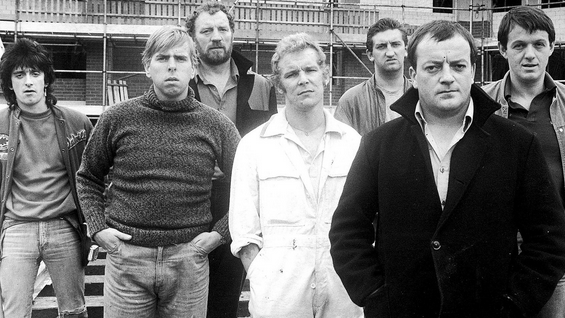
    • 41: AUF WIEDERSEHEN, PET (21:00 Saturday 11 Mar 1995, 6.44m viewers)
    • 41: THE SNOWMAN AND THE SNOWDOG (20:00 Monday 24 Dec 2012, 6.44m viewers)
    • 40: THE NICK (21:00 Monday 3 Oct 1994, 6.5m viewers)
    • 39: FILM: BRIDGET JONES’S DIARY (21:25 Saturday 13 Nov 2004, 6.54m viewers)
    • 38: IT’LL BE ALRIGHT LATE AT NIGHT (23:10 Thursday 11 Jul 1985, 6.55m viewers)
    • 37: FILM: STAND BY YOUR MAN (21:00 Tuesday 14 May 1985, 6.6m viewers)
    • 36: FILM: CASTAWAY (21:00 Monday 26 Nov 1990, 6.63m viewers)
    • 35: FILM: COAST TO COAST (21:00 Tuesday 5 Feb 1985, 6.65m viewers)
    • 34: FILM: WISH YOU WERE HERE (21:30 Thursday 15 Feb 1990, 6.67m viewers)
    • 33: GOGGLEBOX (22:00 Friday 12 Mar 2021, 6.74m viewers)
    • 31: FILM: GOOD MORNING VIETNAM (21:00 Sunday 25 Apr 1993, 6.75m viewers)
    • 31: LOST (20:30 Wednesday 10 Aug 2005, 6.75m viewers)
    • 30: FILM: NIGHTMARE ON ELM STREET (22:00 Tuesday 31 Mar 1992, 6.8m viewers)
    • 29: WIFE SWAP (21:00 Tuesday 21 Oct 2003, 6.9m viewers)
    • 28: FILM: NOWHERE TO RUN (21:00 Tuesday 9 Apr 1985, 6.95m viewers)
    • 27: FILM: THE ABYSS (21:00 Sunday 24 Jan 1993, 7.01m viewers)
    • 25: FILM: MOTHER, JUGS AND SPEED (21:00 Tuesday 12 Mar 1985, 7.05m viewers)
    • 25: ATHLETICS: THE KODAK CLASSIC (21:00 Friday 9 Aug 1985, 7.05m viewers)
    • 24: FEMALE PARTS: RUDE WOMAN (21:00 Monday 11 May 1992, 7.06m viewers)
    • 23: PETER KAY LIVE (21:30 Wednesday 4 Aug 2004, 7.197m viewers)
    • 22: IT’S NEVER TOO LATE (20:30 Monday 3 Dec 1984, 7.2m viewers)

    Right, into that top twenty-one. Dudes.


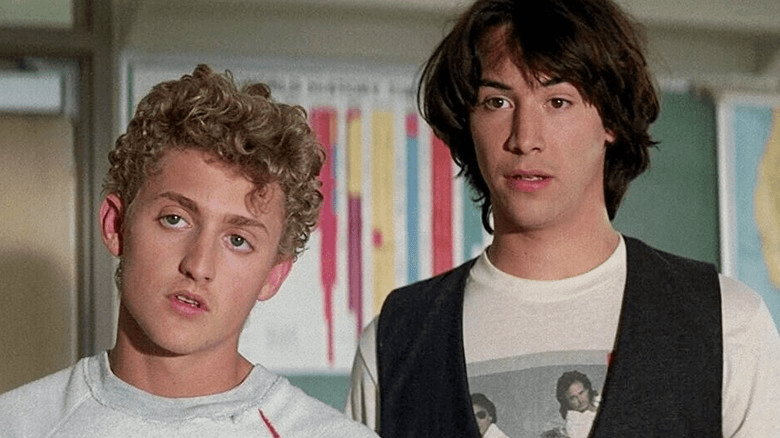
    21: BILL AND TED’S EXCELLENT ADVENTURE (1989)
    (21:00 Sunday 11 Apr 1993, 7.29m viewers)

    Photo: Bill and Ted (Alex Winter, Keanu Reeves)

    To be fair, any film that includes George “Seven Words” Carlin, Tony “Wolfie Smith’s Dad-in-Law After Peter Vaughan” Steedman and Jane “Rush Hour” Wiedlin is automatically great, and it’d be frankly stupid not to watch it. SAN DIMAS HIGH SCHOOL FOOTBALL RULES.

    WHAT ELSE WAS ON?

    Final episode of Andrew Payne’s conception-themed drama series You, Me and It on BBC1, followed by Mastermind and religious documentary strand Everyman. On BBC2 there’s live coverage of US Masters Golf from Augusta. ITV offer up an episode of Gambon-era Maigret followed by Aspel & Company, said company being, as The Times’ weekend TV guide had it “former hostage John McCarthy and his girlfriend Jill Morrell, who just happen to have written a book”. Yeah, bloody former hostages, always banging on about it.


    20: SHE’LL BE WEARING PINK PYJAMAS (1985)
    (21:00 Thursday 12 Mar 1987, 7.6m viewers)

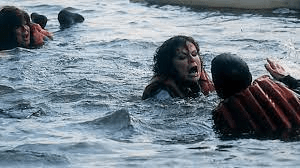
    Photo: Image from the film, Julie Walters' character in a life vest having a bad time in a river.

    A Film on Four offering directed by John Goldschmidt starring Britfilm perennial Julie Walters as one of eight women attending a week-long Outward Bound course. Along the way they’ll learn secrets about each other… and themselves. Yeah, you know the drill.

    WHAT ELSE WAS ON?

    It’s 1987, so obviously LA Law was on ITV, followed by News at Ten. Over on BBC1, it’s the Nine O’Clock News followed by middle-classcom Life Without George and Question Time. Over on Two, the second part of Foreign Bodies, a Belfast-set series exploring the romantic relationship between a Roman Catholic nurse and a Protestant car mechanic, followed by 40 Minutes: The Quest for Sergeant Miller and a surprisingly pre-Newsnight airing for The Phil Silvers Show.


    19: RELATIVE STRANGERS
    (20:30 Monday 28 Jan 1985, 7.75m viewers)

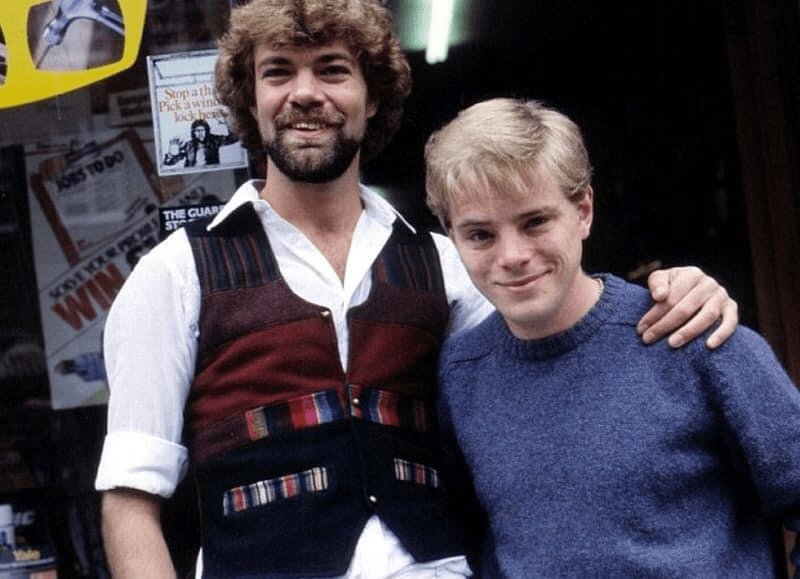
    Photo: Main characters Fitz and John standing outside a shop.

    For anyone wondering where all the classic Channel Four sitcoms are on this list, here’s one. Well, I liked it when I was 10 anyway. The premise behind Relative Strangers was that happy-go-lucky thritysomething Fitz (Matthew Kelly) was happy with his bachelor’s lot in life. Free to do as he pleased, go where he wants and with whom he chooses. That’s until John (Mark Farmer) – the end product of a dimly-remembered dalliance seventeen years earlier – arrives at his front door, seeking to connect with a father who hadn’t known he existed.

    Written by Maurice Gran and Laurence Marks, this was a perfect vehicle for Channel Four – a premise maybe a bit too grown-up for pre-watershed ITV, but suited perfectly to such a slot on Four. And better still, it was a perfect fit for the Mondays-opposite-Panorama-and-World-in-Action slot – easily the peak audience slot for BBC2 and C4 at the time, where viewers seeking entertainment flocked away from the main two channels. And given the bulk of his appearances on TV have been as a presenter, it’s a good opportunity to remember how good a sitcom actor Matthew Kelly was.

    WHAT ELSE WAS ON?

    As mentioned, Panorama on BBC1 (“Richard Lindlay examines the financial cuts leading to reduced student numbers in universities”) and World in Action on ITV (“a documentary illustrating the impact of the miners’ strike to a community in Northumbria”). Much lighter fare on BBC2, with The Bob Monkhouse Show welcoming completely uncontroversial comedians Michael Barrymore, Peter Cook and Bill Maher to his big sofa.


    18: PARALYMPICS 2012: OPENING CEREMONY
    (20:00 Wednesday 29 Aug 2012, 7.78m viewers)

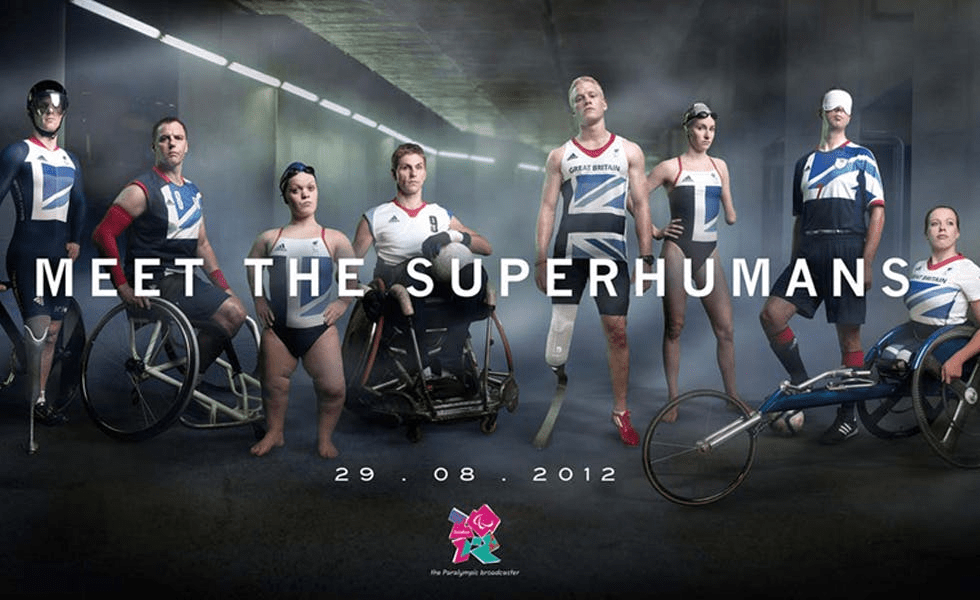
    Photo: Promo image for C4's Paralympic coverage. Several Paralympians are posing, with the caption MEET THE SUPERHUMANS.

    So far on this list, we’ve seen a lot of films, programmes and events that were very popular, but not too much that could be deemed Important Television. This is where that changes. Prior to 2012, coverage of Paralympic Games’ had been on the BBC. Usually at this stage, BBC Sport would be at the point where they’d just exhausted themselves covering the preceding Olympic Games, and seemed to have little energy (or schedule space) left to cover the Paralympics.

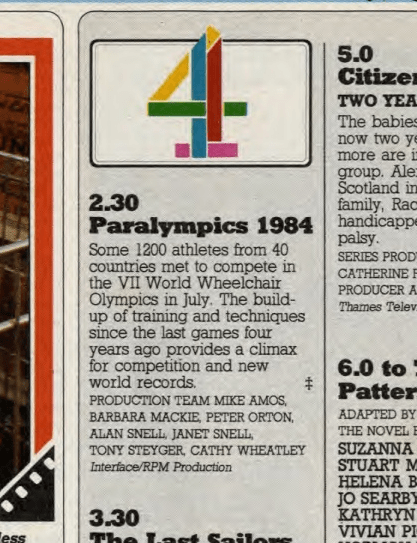
    For an international event borne out of the International Stoke Mandeville Games in the 1950s, it’s on a scale somewhere between ‘a pity’ and ‘downright insulting’ that so little attention was historically afforded the event in the UK, not least because Great Britain performed brilliantly in those early games. In 1960, 1964 and 1968 Great Britain finished second in the medals table, as did the British team in 1984 and 2000, with third-place finishes coming in 1972, 1988 and 1992. And yet – kind of hoping someone proves me wrong here – it took until 1984 for any television coverage of note to appear, with Channel 4 broadcasting hour-long highlight packages of the 1984 Games, albeit several weeks after the actual conclusion of the event.
    SCAN: TV Times listing for highlights of Paralympics 1984. "Some 1200 athletes from 40 countries met to compete in the VII World Wheelchair Olympics in July. The build-up of training and techniques since the last games four years ago provides a climax for competition and new world records."

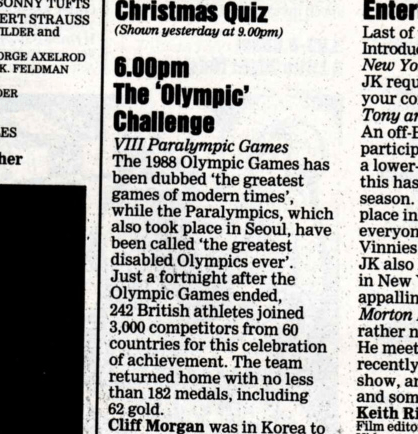
    The earliest instance I can find of the BBC dipping into the Paralympic pool came in 1988, with similar highlight packages from Seoul ’88, again only appearing a couple of months after the conclusion of the Games. For some reason, the highlights were given the weird title of The ‘Olympic’ Challenge (with inverted commas right there, see?), as opposed to the more correct Paralympic Challenge.

    SCAN: Radio Times listing: "6.00pm The 'Olympic' Challenge.

    The level of coverage improved for the 1992 Winter Paralympics, with BBC2 hosting a pair of highlight programmes from Tignes in the French Alps, just a few weeks after the conclusion of the Games. That was followed by the Barcelona Summer Paralympics being covered, this time while the event was in progress, as part of Grandstand and Sunday Grandstand.

    By 1996, Paralympic coverage on the BBC expanded into a series of ten standalone highlight packages. A further improvement in the level of coverage, but still restricted to forty-minute highlight packages going out on BBC2, in a slot opposite Neighbours. The practice was repeated for the 2000 Sydney Games, with daily highlight programmes, but seemingly still no live coverage. For 2004, BBC2’s daily Paralympics coverage was extended to ninety minutes, but it was the Beijing Games in 2008 that saw Paralympic coverage finally breaking onto BBC1. Here, it seemed the Corporation might finally go all-in on their treatment, with the opening ceremony broadcast live in a four-and-a-half hour programme on the flagship channel. Sadly, it wasn’t to last, with main channel coverage restricted to nightly highlight shows and live coverage hidden under the red button (or on the BBC HD channel if your telly was so endowed).

    Photo: Two competitors playing wheelchair rugby clash.

    For the 2012 London Paralympics, things would be different. Very different. Channel Four had been awarded the rights to broadcast the games, and set about promoting the event in a way that would reshape the public’s perception of the Paralympics. Preceding the games with an all-out marketing blitz, adverts cheekily and brilliantly nodded toward the preceding London 2012 Olympics with “Thanks for the warm-up”, while Tom Tagholm’s two-minute-long ‘Meet the Superhumans’ trailer (screenshot above) was as captivating an advert as any pre-World Cup sportswear promo. And to make absolutely sure as many people were aware of the coverage as possible, on on 17 July 2012 Meet the Superhumans aired simultaneously on 78 different TV channels around Britain’s digital diaspora.
    All of which would count for nought if Four’s coverage was restricted to the same highlights hell. Far from it. Unencumbered by not having just covered an entire Olympic fortnight, Channel Four had boundless energy to pull out all the proverbials. A Paralympic Games Breakfast Show at 7am kicked things off each day, with live coverage dominating each day’s schedule (pausing only for News and a few immovable feasts like Hollyoaks and The Simpsons). Live coverage continued right through primetime, with each day’s events summarised during nightly comedy discussion show The Last Leg.

    Did it work? Hugely, as the viewing figures for a wonderful opening ceremony proved.

    SCAN: Front page of The Independent newspaper, with a photo from the Opening Ceremony. Several people holding umbrellas are suspended mid-air.

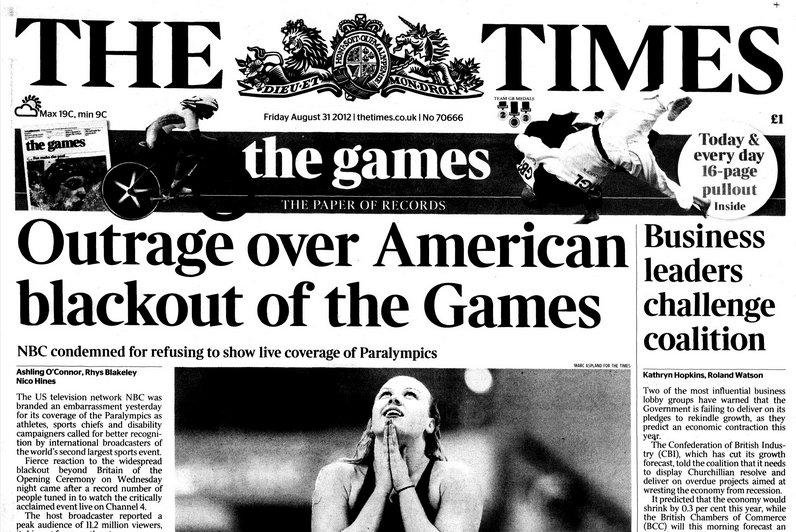
    Things were finally different. How different? Well, some parts of the British press now felt comfortable in attacking US broadcasters for not showing enough of it. Plus ça change, eh?

    SCAN: Front page of The Times. Headline - Outrage over American blackout of the Games.

    WHAT ELSE WAS ON?

    Loads of things – it was a three-hour-plus programme – but most notably: Patrick Stewart on Who Do You Think You Are? on BBC1, not-as-good-after-Lucy-Punch-left comedy cop drama Vexed on BBC2, Britain Then and Now on ITV, and zombie Big Brother on Five.


    17: MONA LISA (1986)
    (21:30 Thursday 23 Feb 1989, 7.82m viewers)

    Photo: Cathy Tyson, Michael Caine and Bob Hoskins post as their characters from the film

    On getting released from prison, it can be hard to find yourself gainful employment. Good news for paroled low-level hoodlum George, then – he’s just landed a job working for underworld boss Denny Mortwell, and all he’d needed to do was take the rap (and prison term) on his behalf. Now he’s working at a driver-slash-minder for high-class call girl Simone. Not that Mortwell is especially keen to make amends with George – he also wants him to extract some handy blackmail fuel from one of Simone’s clients. George’s attention is torn between carrying out his mission and his feelings for Simone, who wants his help to find her missing friend Cathy.

    Definitely from the grittier end of the Handmade Films stable, powerful performances from Bob Hoskins, Cathy Tyson and Michael Caine help make this a compelling if not always comfortable feature.

    WHAT ELSE WAS ON?

    Another outing for Life Without George at 9.30pm on BBC1, followed by Sir Robin-era Question Time. BBC2 offered up splendidly-titled 40 Minutes documentary Knickerbockers in Knightsbridge (except it seems to be breathlessly celebrating a high-end prep school, so knickers to that), followed by an episode of The Tracey Ullman show with The Simpsons surgically removed (d’oh, indeed) and Newsnight. ITV dished up an episode of imported cop show In the Heat of the Night to take viewers to News at Ten, before some Regional News-Based Programming. And, just for a change, Sky Channel offered drama series The Paper Chase, followed by WWF Main Event.


    16: TREASURE HUNT
    (20:30 Thursday 24 Mar 1988, 7.85m viewers)

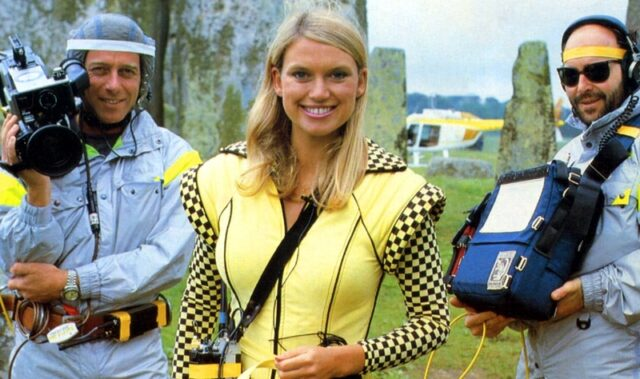
    Photo: Anneka Rice poses alongside her cameraman and sound engineer.

    One of the big hits for the channel in its first decade on air, it’s a bit of a surprise that Treasure Hunt is one the classic C4 properties never to have received the reboot treatment*. For anyone too young to be aware of the premise, this was a game show basically aimed at people with leather-bound encyclopedias in their living room. Two contestants take part in a command centre alongside host Kenneth Kendall and guide Wincey Willis, who together must solve a series of geographical clues to determine the location of further clues and ultimately, the titular treasure.

    [EDIT: *Reboot treatment… by Channel Four. With thanks to @ChinnyVision and @Simon_Tyers on Twitter plus James in the comments for highlighting this, it did receive a reboot on BBC2 following the departure of The Simpsons to C4. It went out on weekdays at 6pm in December 2002 (for a week), before returning for a second series (again, on each weekday evening for a week) starting in April 2003. It didn’t fare too well – not least because they decided to set each Hunt in places like Tucson or Mexico City, which must have cost a fortune. And as such, the final six episodes of the second series were shoved into a Saturday teatime on BBC2 slot, with almost a month between airings of the last few episodes.]

    But that’s not the exciting part. The main participant in all this, and the undoubted star of the series, was Anneka Rice – the person tasked with physically uncovering each clue at the actual locations portrayed on Wincey’s map. To get from place to place, she had a helicopter, and the whole thing had to be done and dusted within 45 minutes, broadcast in real-time.

    Basically, it was speed geocaching.

    This particular episode came from the Chilterns, with contestants Robin Strand and Ian Taylor hoping to win big. And if you wanted to play along at home, the TV Times kindly provided you with an OS Map reference.

    Scan: TV Times listing, 8.30 to 9.30pm Treasure Hunt. Details as per the previous paragraph.

    See?

    WHAT ELSE WAS ON?

    Mastermind (the history of English costume 1789-1945, Portuguese explorations and discoveries 1415-1815, the history of mathematics, the films of Laurel & Hardy) followed by the News on BBC1. BBC2 had Nature (an examination of the latest developments in genetics) followed by Blackadder II (the executioner one). ITV had This Week: Private Health – Too High a Price? followed by LA Law.


    =14: INTERNATIONAL SNOOKER
    (21:45 Sunday 16 Dec 1984, 8.25m viewers)

    Siri, name a sport that doesn’t belong on Channel Four.

    Might just be me, but… snooker’s very much a BBC2 thing, isn’t it? I know it’s been on BBC1 quite a lot, and at the peak of the snooker craze in the 1980s even ITV made a regular go of it, but the closest you’d expect the sport to get to Channel Four is a screening of Billy the Kid and the Green Baize Vampire. And yet, here it is.

    Four being Four, it’s not quite your usual Fagbrand World Matchplay tournament, however. This was the final of the Hofmeister World Doubles Championships (coverage Four actually shared with ITV, as was the style at the time) a tournament that in theory should have provided double the fun for snooker fans, with greats of the game teaming up to do battle. In practice however, it wasn’t quite the draw organisers had hoped – the tournament only ran from 1982 to 1987. That said, if any doubles match was going to draw an audience, it was this final: Alex “Hurricane” Higgins and Jimmy “Whirlwind” White against Cliff “Magnum PI” Thorburn and Willie “Best of Friends” Thorne.

    WHAT ELSE WAS ON?

    The News, followed by Perry Como’s Christmas in Paris on BBC1, Harold Pinter play A Kind of Alaska was on BBC Tw… wait, ITV (yeah, look impressed – it wasn’t superseded in the regional variations, either) and Hinge/Brackett sitcom Dear Ladies on actual BBC2.


    =14: DARK NIGHT OF THE SCARECROW (1981)
    (21:00 Tuesday 21 May 1985, 8.25m viewers)

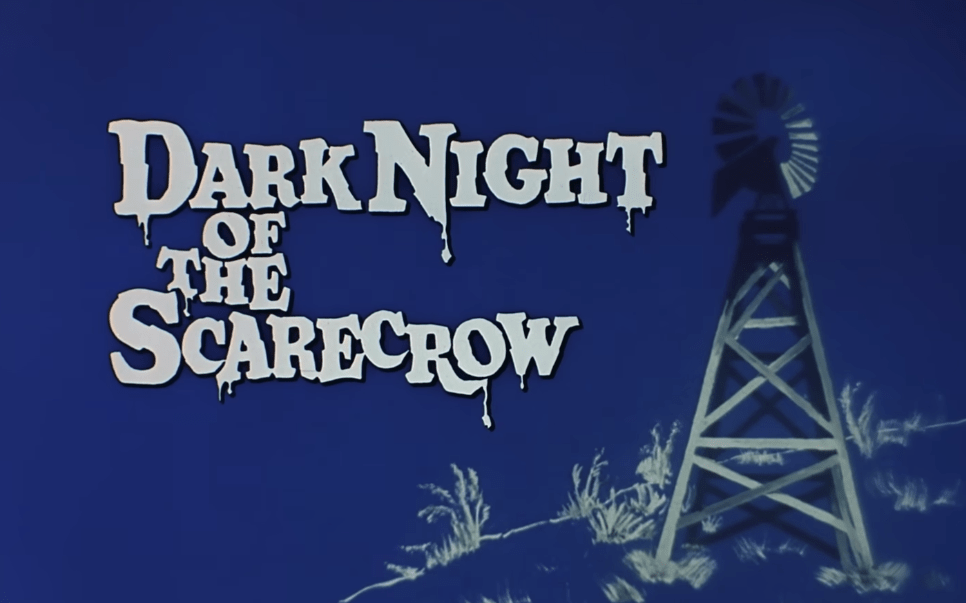
    Photo: Title card from Dark Night of the Scarecrow.

    Despite the TV Movie genre being as unstoppable as ever – just look at the Movie Channels You Don’t Have To Pay Extra For section on Sky – I’m pretty sure nobody bothers making TV Horror Movies any more. It certainly used to be a thing, the original version of Stephen King’s It was made for TV, but nowadays it’s all variations of (to badly paraphrase TV Go Home) ‘The Courts Are Letting My Ex-Husband Attack My Children With Hammers’ or Christmas films.

    Back when Horror TVMs were a thing, very likely with one eye on the blossoming video retail market, fare such as Dark Night of the Scarecrow could be seen. It’s hardly the most edifying fare, going by the plot synopsis on IMDB: “In a small Southern town, four vigilantes wrongfully execute a mentally-challenged man, but after the court sets them free mysterious ‘accidents’ begin to kill them off one by one.” And yet, commissioned and brought to television by CBS.

    SCAN: TV Times listing - 9.00 Dark Night of the Scarecrow

    Must admit, I’m a bit mystified why this picked up such a colossal audience, but I do note that the full movie is available on YouTube for free (in HD, and seemingly legally to boot), so if you’re curious enough to want to see it, fill your boots.

    WHAT ELSE WAS ON?

    News and Miami Vice on BBC1, Francis Ford Coppola flick The Escape Artist (1982) on BBC2, and Mr Palfrey of Westminster followed by News at Ten on ITV.


    13: BROOKSIDE
    (20:00 Wednesday 3 Nov 1993, 8.27m viewers)

    Photo: A wedding scene from Brookside

    Let’s face it, it was a matter of when not if this was going to show up. The only question was which era of the programme would be represented here? The Damon and Debbie years? The kiss between Beth Jordache and Margaret Clemence? The body under the patio? Sinbad’s lodger turning out not to be a serial killer but a Wrexham supporter?

    Not quite that, no. How about “Frank and Lyn’s wedding“? Yep. That was the episode that outranked all those other famous Brookie moments. Of course, this being soapland, it wasn’t as straightforward as that – look away now if you’re working your way through a box of Brookside offairs – a drug-fuelled Jimmy Corkhill led to Frank’s car crashing en route to the wedding reception, meaning he didn’t survive to taste the wedding cake.

    But why that particular episode? What tipped the viewing figures for that episode above all the others? I should point out that viewing figures were generally hovering around 8m for this spell of the programme’s run, but it must have taken something for this episode to have nudged just above the others. What could it have been?

    WHAT ELSE WAS ON?

    The answer is very likely located here. BBC2 were showing Bookmark: The Quest for A.J., where crime writer Julian Symons investigates the life of his elder brother (the titular AJ), who died in 1941. ITV had live football, with Arsenal taking a 3-0 first leg lead to Standard Liege in the UEFA Cup Winners’ Cup. Meanwhile BBC1 had… live football, this time coverage of Norwich City attempting to protect their shock 2-1 UEFA Cup away lead as they hosted Bayern Munich. Both good matches – Arsenal notched up a 7-0 away win en route to a win over Parma in the final of the tournament, while Norwich clung onto that lead and ensured Jeremy Goss will never need to pay for another drink within North Norfolk – but for people who don’t like football, there really wasn’t too much else on.


    12: THE MIRACLE OF KATHY MILLER (1981)
    (21:00 Tuesday 21 Apr 1987, 8.3m viewers)

    Photo: Title card for The Miracle of Kathy Miller.

    Nowdays, you’d have to suspect this would be getting pumped out to 3000 viewers during one of the few months Movies 24 aren’t pretending it’s Christmas, but in 1987 imported TV Movies could still draw a big crowd. And few bigger than for The Miracle of Kathy Miller, starring big TV name Sharon Gless and a tyro Helen Hunt. The story here focused on the true tale of an Arizona teen (Hunt) who overcame disabilities to be awarded the title of the World’s Most Courageous Athlete. Sounds a lot like a parody to cynical modern eyes, but this was a much-acclaimed movie at the time. And, of course, the 11th most popular thing on Channel Four ever. So, you know, stick that in your VHS broadcast copy of Brass Eye.

    WHAT ELSE WAS ON?

    ITV offered up Lost Belongings, looking at the attempt of IRA wrongun Hugh MacBraill to escape from The Maze. BBC2 offered up Live Snooker and The World of UB40, while their big brother offered up The Nine O’Clock News, drama Strike It Rich and broadcasting discussion show Network, where presumably hosts Anna Ford and David Jessel were mad as hell about, dunno, Pages from Ceefax?


    Screencapture: An engineering announcement caption card for Channel 4: "Carnmoney Hill, Keighley - Due in about a fortnight".

    That’s it for another instalment. A lot of big C4 programmes we’ve not seen yet, and there probably isn’t room in that final Top Eleven for all of them. Which will make the cut? Tune in tomorrow to find out. On Four’s actual fortieth birthday! I don’t just throw this together, you know. (Aside: no, I do.)

  • Forty/Four: Channel Four’s 40 Most-Watched (Part Two)

    Forty/Four: Channel Four’s 40 Most-Watched (Part Two)

    More Four. Here’s the next tranche, starting with two entries at joint-30th.


    =31: GOOD MORNING VIETNAM (1987)
    (21:00 Sunday 25 Apr 1993, 6.75m viewers)

    Kicking off a Robin Williams season on Four, this well-received comedy drama about a boisterous US Forces Jock who eschews the anodyne in favour of the raucous, much to the delight of troops stationed in Saigon, and to the dismay of their higher-ups.

    WHAT WAS ON THE OTHER SIDE?

    Offering the polar opposite to Robin Williams at his Robin Williamsest on Four, BBC1 served up A Year In Provence, followed by News and Mastermind (the fall of the Western Roman Empire, the Manhatten Project, Damon Runyon and Joseph Chamberlain). BBC2 countered that with coverage of the World Snooker Championships in Sheffield, followed by feature-length LA riot documentary LA: Stories from the Eye of the Storm. A new thriller by Lynda La Plante – who briefly passive-aggressive followed me on Twitter after I’d criticised her provably wrong opinions on the BBC’s equalities policy (also Killer Net), rubbish showbiz anecdote fans – on ITV, with Seekers following the fortunes of two women finding they’re both married to the same man.


    =31: LOST
    (20:30 Wednesday 10 Aug 2005, 6.75m viewers)

    Forget about the disappointing ending, Lost was good when it first arrived. Really good. And that was reflected in those initial audience figures.

    An expensive promotional push for the imported series by Channel Four certainly didn’t hurt matters – the channel spent a cool million pounds just promoting the series via everything from cinema advertising to in-game adverts within Anarchy Online. They didn’t even use a standard trailer-of-clips-from-the-thing advert either, but had a specially-shot and hugely expensive scene featuring the entire cast dancing next to the flaming wreckage of Oceanic Flight 815 to a background voiceover of enigmatic statements about their identities (“One of us is a killer, one of us is an addict, one of us used to be in Hetty Wainthrop Investigates” etc). The whole thing resembled a Calvin Klein One advert more than a promo for a new drama series, but it undoubtedly piqued the interest of many viewers, leading to a colossal audience for the series opener.

    The viewing figures may well have been higher as the series progressed, were it not for first runs of each episode going out on E4 to promote the new digital service, alongside a flurry of impatient torrenters streaming episodes instead of waiting for them. Either way, Lost was a huge hit for the channel, right until the point Sky One threw a big bag of money at the producers to nab the rights to it.

    WHAT WAS ON THE OTHER SIDE?

    Second half of Holby City and the first half of Silent Witness on BBC1, Britain’s Best Buildings followed by docudrama The Slavery Business on BBC2, back end of The Bill followed by The Mummy Returns (2001) on ITV, and the last half-hour of Killer Swarms followed by the start of Steven Seagal ‘thriller’ Belly of the Beast (2003) on Five. Interesting to note that C4 scheduled Lost to start partway through three of those four programmes, very much anticipating the bulk of the audience to come from their own preceding programme (an episode of Big Brother) rather than rival broadcasters.


    30: A NIGHTMARE ON ELM STREET (1984)
    (22:00 Tuesday 31 Mar 1992, 6.8m viewers)

    Remember the 1980s? Where a fictional child murderer became a cult hero, and ended up plastered all over t-shirts, magazines, posters et al? That was a bit weird, wasn’t it? Even when the Saw films were huge (and they were very much the FIFA franchise of the horror genre), nobody was walking around in a T-shirt with a picture of Ian Jigsaw on it. Anyway.

    Here’s the film that kicked it all off, starting the cult of (arguably) the only one of the Big Franchise Horror Stars of the 1980s to genuinely become a household name. Robert Englund dons the mask and gloves of F Krueger Esquire, and sets about haunting/hunting teens in their dreams. Would go on to spawn a raft of identikit sequels, and was certainly a big enough draw to get an audience worthy of inclusion here, despite being eight years old at the time.

    WHAT WAS ON THE OTHER SIDE?

    Tom Wilkinson played unconventional (he really likes jazz and sandwiches) detective Charlie Resnick in the first of a three-part adaptation of the John Harvey novel, Resnick: Lonely Hearts on BBC1 at 10, followed by a Liberal Democrats Party Election Broadcast and Film 92. BBC2 served up 40 Minutes: Soldier’s Diary, the story of Yishai Shuster, an Israeli reservist reluctantly policing the Palestinian border. That’s followed by a Conservative Party Election Broadcast and Newsnight. ITV being ITV, had News at Ten, followed by (at least in That London) episode of Extraordinary People: Across the Jade Divide, looking at the life of Keith Huxley as he follows in the footsteps of his father who’d been sentenced to a Shanghai internment camp fifty years earlier.

    In short: that the horror film about the child murderer murdering some children? Probably the lightest relief on offer here.


    29: WIFE SWAP
    (21:00 Tuesday 21 Oct 2003, 6.9m viewers)

    A format big enough at the time to have been used as the basis of a Simpsons episode (not a good one, the Gervais one), it’s no surprise to see Wife Swap here. This was in the original phase of the series, so there’s no danger of having to see John McCririck in his pants. This particular episode saw a fastidious husband temporary change his similarly pernickety partner for a free-spirited wife, and vice versa. Must admit, I’d have spent that whole hour thinking about the scene in The Simpsons where jury duty results in Homer sharing a hotel room with Seymour Skinner.

    “We’re kind of like the original Odd Couple. You’re the messy one, and I’m–“
    “Shut up! “
    “Oh, yes. Very well.”

    WHAT WAS ON THE OTHER SIDE?

    BBC1‘s The Secret Policeman peeked into the findings of undercover journalist Mark Daly during his stint as a trainee policeman in Manchester, while BBC2 examined the Mind of a Millionaire (and also, for some reason, the story of B&Q). ITV took us all back to the time when live Champions League football could be watched for free (no, legally) with the group B tussle betwixt Dynamo Kiev and Arsenal, while Five scooped a spoonful of CSI: Miami out of their Dick Wolf Economy Bucket.


    28: NOWHERE TO RUN (1978)
    (21:00 Tuesday 9 Apr 1985, 6.95m viewers)

    Not to be confused with any of the other films sharing the title, this particular Nowhere is based on the 1976 novel The Blackjack Hijack by Charles Einstein, and sees San Francisco engineer Harry Adams pottering about New York at the time of the Kennedy assassination. Seeing the uncaring reaction of his wife (Stefanie Powers, yes it’s a made-for-TV movie) to the news, he decides to do what anyone would… design an entirely new life for himself using a system to predict the outcome of blackjack hands. It’s a tale as old as time.

    WHAT WAS ON THE OTHER SIDE?

    The News and Miami Vice on BBC1, an episode of superb documentary series Television on ITV (this one tracking the growth of gameshows), and Pot Black 85 followed by Amazing Bass on BBC2. That latter one is a profile of bassist Gary Karr rather than some really, really brilliant fish, slightly disappointingly.


    27: THE ABYSS (1989)
    (21:00 Sunday 24 Jan 1993, 7.01m viewers)

    The James Cameron Film Where Something Sinks That People Don’t Mention As Much. This time it’s an American submarine that sinks (sinks… more?) in the Caribbean, leading a US search and recovery team to embark on a rescue mission. Working with a team of oil rig roughnecks, they’re busily racing against a team of pesky Russkies to be first to reach the stricken sub, when they encounter something unexpected.

    This showing coming in the lengthy wake of Terminator 2, interest was high in anything bearing the Cameron stamp of approval, and The Abyss also featuring T2-esque special effect trickery by Industrial Light & Magic certainly helped it stick in the minds of anyone seeing the trailers. Hey, all that was impressive at the time.

    WHAT WAS ON THE OTHER SIDE?

    A Sunday night, so it’s a textbook lineup on ITV, with Poirot followed by Hale & Pace and The South Bank Show. BBC2 picked out documentary Dancing: Lord of the Dance followed by Did You See… and a Derek Jarman production of Edward II. Over on One, it’s the final part of Ruth Rendell’s Gallowglass, followed by Mastermind and Heart of the Matter.


    =25: MOTHER, JUGS AND SPEED (1976)
    (21:00 Tuesday 12 Mar 1985, 7.05m viewers)

    There’s a film title that sticks in the memory. 1976 black comedy fillum MJ&S starred Bill Cosby (Mother), Raquel Welch (Jugs), Harvey Keitel (Speed), and Larry Hagman (And) (oh, okay: John) as employees of an independent ambulance service trying to survive in Los Angeles. Also home to one of the great Someone Who’d Later Become More Famous In A Minor Early Role credits in cinema history: “Toni Basil as Junkie Who Kills Leroy”. Oops, spoilers.

    WHAT ELSE WAS ON?

    Causing a conflict for high-energy US crime action, the News on BBC1 was followed by an episode of imperial phase Miami Vice, followed by Film 85 (reviews of 2010, Wetherby and A Soldier’s Story). ITV had (just after a repeat of ace C4 sitcom Chance in a Million at 8.30pm) an episode of documentary series Television looking at history of TV’s news coverage. Viewers of BBC2 could expect to see Inside Out (“Two female ex-convicts try to set up an employment agency”, co-starring Only Fools’ Gwyneth Strong as scatty Polish prostitute Beverly Grabowski), Pot Black 85 and a Maestro episode looking at the career (and presumably downfall) of George Best.


    =25: ATHLETICS: THE KODAK CLASSIC
    (21:00 Friday 9 Aug 1985, 7.05m viewers)

    Long before Channel Four was rightly lauded for their coverage of the 2012 Paralympics, the channel would often cover athletic events, but mainly when ITV had been in the middle of showing something and they needed to start showing something else. BBC1 had BBC2 for those very occasions, but what did ITV have? No ITVs 2, 3 or 4 in those days, but at least they had Channel Four, pretty much a smaller sibling of the two in those days, rather than the wholly independent media group it would later become.

    And so, on occasions such as the one on 9 August 1985, ITV’s willingness to hand airtime over to athletics only went so far. I mean, they did have an episode of Shine On Harvey Moon that couldn’t wait a week. And so, at 9pm, the action immediately shifted over to Channel Four, even if it did mean that week’s episode of Cheers got bumped back to 10pm.

    It wasn’t all bad. As proved here, a sizeable chunk of an ITV Friday Night audience immediately decamped to Four to see the continuation of the action from Gateshead. So, that’s nice.

    WHAT WAS ON THE OTHER SIDE?

    As mentioned, ITV had Shine on Harvey Moon (the one where Frieda has to come with a sudden death in the family). BBC1 have News followed by snooker management drama Give Us a Break, while BBC2 run with lighthearted music panel show My Music, followed by an episode of Commercial Breaks (not the Imagine Software one, sadly. This one’s about a shoe-making business).


    24: FEMALE PARTS: RUDE WOMEN
    (21:00 Monday 11 May 1992, 7.06m viewers)

    First of a six-part documentary series promising to reflect the disparate lives of contemporary women (well, six of them, presumably), starting with a film by Anne Parisio. The focus falls on a series of women of all ages who refuse to be timorous when it comes to sexual activity. Jo Brand is on hand to chat with a grandmother as she prepares an aphrodisiac for her younger lover, and there’s a look at the launch of a new magazine aimed to redress the gender balance when it comes to nudity.

    The write-up in The Times warns that “viewers who find frank studies on the nude male off-putting are hereby warned”, but that doesn’t seem to have dented the viewing figures too much.

    WHAT WAS ON THE OTHER SIDE?

    The News and a Panorama about house prices on BBC1, while John Lithgow flick Resting Place (1986) entertained BBC2 viewers (presumably). ITV also took a trip to the movies, with (pre-Sir) Tom Courtenay and Brigitte Fossey starring in WWII drama The Last Butterfly (1989).


    23: PETER KAY LIVE
    (21:30 Wednesday 4 Aug 2004, 7.2m viewers)

    One thing you can definitely say about Peter Kay – he certainly knows how to maximise a revenue stream from his audience.

    In November 2003, he released a DVD of a performance from his Mum Wants a New Bungalow Tour, recorded at The Bolton Albert Halls. It sold in huge numbers, as might be expected, given he was hugely popular at the time, and it was arguably the strongest stand-up set he ever did.

    And then, the following year, a recording of the same set – this time performed at Manchester Arena – was aired on Channel Four. Arena comedy never works as well as a theatre setting, so it all felt a little soulless compared to the Bolton gig, but y’know, it was on telly. For free. And all his fans had already seen the DVD of the Bolton gig, so it’s good that there was something slightly different, even if all the jokes were the same.

    And then that got released on DVD anyway, billed as “a special farewell performance” of his Bungalow set. Oh, Peter.

    WHAT WAS ON THE OTHER SIDE?

    Back end of a Panorama (investigating the antics of the IoC in advance of the 2012 Olympic decision) and the 10 O’Clock News on BBC1, sixtysomething drama When I’m 64 on BBC2. ITV had job-swap reality show Poor Little Rich Girls at 9pm, and documentary Dirtbusters at 10pm, while Five served up Samuel L Jackson teach-em-up 187 (1997).


    22: IT’S NEVER TOO LATE
    (20:30 Monday 3 Dec 1984, 7.2m viewers)

    For a channel so well known for commissioning sitcoms so beloved of comedy fans – Father Ted, Stath Lets Flats, Friday Night Dinner, Spaced, Derry Girls, take your pick (as long as you don’t pick Derek) – it’s a shame they all failed to reach truly large audiences. But here’s one that did, and it’s one that isn’t likely to get a repeat on E4 any time soon.

    Two pairs of pensioners – Win and May, Jimmy and Geoffrey – all belong to the same bowling club, but neither pair had ever met – until one fateful evening at the Social Club. From that point on, following initial mutual distrust, they soon realise that they can achieve far more as a team. And that’s pretty much it – a slow-burn pre-watershed sitcom from the mind and biro of Ian Masters.

    I can’t vouch for the quality of the programme, as I’ve no recollection of it, though it seems to be Masters’ only writing credit, his main calling coming as jobbing actor in series such as Terry and June, Hale and Pace, and The Piglet Files. One main draw of the programme may well have been the supergroup of actors therein – Peggy Mount, Pat Coombs, Hugh Lloyd and Harold Goodwin. Whatever the case, it was part of a pilot season for the channel (handily placed in the schedules as you’ll see in a moment) and never progressed to a full series.

    WHAT WAS ON THE OTHER SIDE?

    BBC1 had Panorama, while ITV had World in Action (ah, there’s your inflated audience figure), while BBC2 had ‘The New Statesman’ (not that one – a sitcom about a museum curator unexpectedly inheriting land and a title, starring Colin Blakely and Gwen Taylor).


    That’s it for now. Tune in tomorrow to see which Four morsels have made the Top Twenty. Going by what we’ve seen here, it could contain anything.

  • Forty/Four: Channel Four’s 40 Most-Watched (Part One)

    Forty/Four: Channel Four’s 40 Most-Watched (Part One)

    Yes, I know I’m only just over halfway through the list of the 100 Most-Shown Programmes On The BBC, but Channel Four is forty years old on Wednesday 2 November, and that’s an anniversary well worth marking. So, here we go with another ill-considered datagasm.

    Like in an instalment of the Terminator franchise directed by John Birt, I’ve used my non-giving-up-guy powers to trek through yet more numbers. This time, picking through BARB’s website, plus online archives of Television Today and The Times, to look at the highest viewing figures ever gleaned by Jeremy Isaac’s controversy machine. All the way from launch day on 1 November 1982, right through to last week. And do I have a list packed with surprises for you? Yes. Yes, I do. At least five of them.

    A few quick notes before I start the rundown:

    • I’d originally planned to release the whole list in one go, but (a) it’s not quick writing all this, at least not if you’re me, and (b) breaking it up into four parts is quite fitting. Don’t worry, there won’t be long between them:
      • Part One: today, i.e. now, i.e. you’re reading it
      • Part Two: Monday 31 October
      • Part Three: Tuesday 1 November
      • Part Four: Wednesday 2 November, which also happens to be Channel 4’s 40th birthday
    • Only one entry per programme on the list (the highest-rating episode, obviously), otherwise you’d just be trudging through loads of Brooksides and Bakes Off.
    • I’m including airdates, broadcast times, and (because I’m lovely) a peek at what each programme was up against in the listings. Partly because, hey, who doesn’t love more data that they’d been promised? But mainly because seeing the ‘opposition’ sometimes helps confirm why audiences may have been inflated.
    • Pretty much every week has been accounted for, but between various archive sources there were still a few I couldn’t source data for. The records given are as complete as possible (seriously, a lot of legwork went into this one), if you know of something that should’ve made the list, and you’ve details of a BARB Top Ten to back it up, let me know (don’t trust any quoted viewing figures in news stories or biographies, as they’re frequently apocryphal).
    • I was in two minds whether to include films and sport in the list. After all, a list of The 40 Most Something Programmes Ever is a bit of a misnomer if nineteen of them aren’t actually programmes. In the end, I’ve decided to include both. Channel 4 has done brilliantly in introducing British audiences to sporting events like American Football, Kabaddi and Sumo, and even moved into major sports like F1 and Horse Racing in more recent years. As for films, when it’s a channel that happens to have made some of the best and most successful British films in history, it’d be stupid not to include them. Plus, it’ll be interesting to see whether it’s mass market Hollywood films or homegrown fare that proved a bigger draw.

    Okay, all ready? Here we go!


    =41: AUF WIEDERSEHEN, PET
    (21:00 Saturday 11 Mar 1995, 6.44m viewers)

    Off to a roaring start with a repeat of an old ITV programme. And that’s more representative than you might think – the first decade of Four saw classic repeat runs employed as a draw quite frequently. Whole new audiences were able to discover past hits like The Prisoner and The Avengers via repeats on Four – heck, in the early stages of compiling this chart it looked like a repeat of Man About The House was going to take a place in the top twenty.

    For this particular repeat run, the primo 9pm Saturday night slot was used for a full repeat run of Clement and Le Frenais’ (based on an idea by Franc Roddam) building-site comedy drama. And as repeat runs go, it was a definite success – certainly more successful than ITV’s late-80s repeats that saw hour-long post-watershed episodes chopped in half and put out at 7pm.

    This peak audience figure arrived for the repeat of the first episode, where Oz, Dennis and Neville first arrive in Dusseldorf.

    WHAT WAS ON THE OTHER SIDE?

    BBC1 had the end of the News followed by Saturday night thrills in the shape of Screen One: Down Among the Big Boys, a Glasgow crim-thriller starring Billy Connolly, Douglas Henshall and Maggie Bell. A repeat of The Buccaneers was on BBC2, while ITV offered up Impulse (1990), a cop film that I suspect even stars Theresa Russell and Jeff Fahey have forgotten about.


    =41: THE SNOWMAN AND THE SNOWDOG
    (20:00 Monday 24 Dec 2012, 6.44m viewers)

    Much more traditional Four fare in co-fortieth place. Indeed, its a sequel to one of the channel’s most famous offerings of all-time, with The Snowman and the Snowdog released to mark the 30th anniversary of Dianne Jackson’s animated retelling of the 1978 Raymond Briggs book. The 1982 original has become every bit a Christmas TV staple as Dinner For One on German TV, and in latter years the 2012 sequel has become a similar institution on Christmas Eve telly. It’s the original screening of One Snowman and His Dog that saw the biggest audience.

    WHAT WAS ON THE OTHER SIDE?

    Last in the then-current series of Merlin on BBC1, a Song and Dance compilation of Morecambe & Wise on BBC2, second-half of an hour-long Corrie on ITV, and A Right Royal Year on Five. That was followed by ‘Eddie Stobart’s Christmas Cracker‘, which would have made this section a bit more interesting.


    40: THE NICK
    (21:00 Monday 3 Oct 1994, 6.5m viewers)

    While fly on the wall documentaries were hardly a new thing in 1994, Paul Berriff’s series chronicling events at Gipton Police Station at least achieved the feat of bagsying one of prime titles for such a programme. And that premise was enough to attract a sizeable Monday night audience for this first of five episodes.

    WHAT WAS ON THE OTHER SIDE?

    BBC1 had the Nine O’Clock News followed by Panorama: Blair’s Britain (“Tony Blair discusses his visions for the future”). BBC2 had the unlikely double-act of Rab C Nesbitt and The X-Files (a crossover we’d all like to see, I’m sure), plus Harry Hill’s Fruit Fancies at 10.15pm. ITV had thrown on a film, but sadly for fans of Young Guns II: Blaze of Glory (1990) the channel was still in the habit of slicing films in two to cram News at Ten in the middle.


    39: BRIDGET JONES’S DIARY (2001)
    (21:25 Saturday 13 Nov 2004, 6.54m viewers)

    Romantic cinematic retelling of Helen Fielding’s singleton journals, starring Renee Zellweger, Hugh Grant and Colin Firth. I think the time is right for a shot-for-shot remake that remains utterly faithful to the original save for Hugh Grant’s playing his character from Paddington 2.

    WHAT WAS ON THE OTHER SIDE?

    Peak “aw mam, can’t we have something else on” viewing on BBC1, with The Royal British Legion Festival of Remembrance. Things start off a little more rosily on BBC2, with an hour of Magic (that’s the programme’s name, just to ruin the day of anyone trying to Google it) that promised “some of the world’s most dangerous stunts”. Any excitement would soon evacuate your body on discovering it being followed by The 38th Country Music Association Awards at 10.25pm. ITV offered up The X Factor Result Show between 9pm and 9.45pm, followed by The Great British Pop Test. See, at least ITV realised it was a Saturday night.


    38: IT’LL BE ALRIGHT LATE AT NIGHT
    (23:10 Thursday 11 Jul 1985, 6.55m viewers)

    Look at that – one of the most-watched programmes in the channel’s history, and it aired in a post-11pm slot. On a school night! It’s Four’s equivalent of the Black Ball Final.

    Looking into this one, I felt sure there had been a mistake. It seemed like the sort of ITV repeat that would often get an airing on C4, but getting such a large audience this late at night? Turns out, this was the first run of this particular ‘Alright’ episode, and despite that ‘Late at Night’ tag, there was little to separate it from your regular primetime LWT version (well, aside from a slightly naughtier feel to some of the outtakes, such as a bed collapsing during a sex scene, or the occasional boob making an appearance). They didn’t even give in to the temptation of having Denis sitting in his pyjamas by a log fire, or tucked up in a comedy bed, or in tuxedoed up a faux-nightclub. Just your regular mid-80s LWT studio, replete with a mid-80s LWT studio audience.

    Not that this would forever be exclusive to Channel Four. The first repeat of the episode arrived on ITV on 28 June 1986, in a plum 9.15pm slot, right after the Maradona versus West Germany World Cup Final. Alright Late at Night did very well there too, picking up 12.35m viewers – a figure higher than ITV’s coverage of the World Cup final itself (a mere 10.75m, though 11.75m watched it on BBC1 – a near-miss ITV Sport would throttle their grandmother for nowadays).

    [EDIT] It also made an ITV appearance on Sunday 18 Jan 1992, in a 9.45pm slot, where it picked up a much bigger audience of 16.74m viewers. Not bad for a seven-year-old repeat.

    [With thanks to Steve Williams for the heads-up on that broadcast]

    WHAT WAS ON THE OTHER SIDE?

    On BBC1, a Forty Minutes documentary about Victorian toilets (no, really) followed by Crimewatch Update. BBC2 offers Newsnight followed by Cricket: Third Test Highlights. We’re into the post-News regionalia zone on ITV, but Thames are offering up an episode of Hammer House of Mystery and Suspense called “Last Video and Testament”. In that – because with an episode title like that you’ll be wanting to know – an electronics expert fakes his own death and makes his unfaithful wife believe he’s visiting her from beyond the grave, presumably via VHS.


    37: STAND BY YOUR MAN (1981)
    (21:00 Tuesday 14 May 1985, 6.6m viewers)

    A TVM tracking the rise of Tammy Wynette, starring Annette O’Toole as the famed country chanteuse. Sadly, it being from 1981, suggesting a limited presence at best for the KLF.

    WHAT WAS ON THE OTHER SIDE?

    BBC2 viewers were treated to a very different piece of Americana in Wim Wenders’ and Francis Ford Coppola’s depression-era neo-noir Hammett (1982). John Humphrys reads the News on BBC1, followed by Crockett and Tubbs reading the Miranda Rights to some hapless perp in Miami Vice. Leslie Philips Spy drama Mr Palfrey of Westminster was entertaining ITV audiences.


    36: CASTAWAY (1986)
    (21:00 Monday 26 Nov 1990, 6.63m viewers)

    Amanda Donohoe and Oliver Reed star in Nicolas Roeg’s loose adaptation of Lucy Irvine’s autobiographical book of the same name. In the film (as in the book), a middle-aged writer places an advert for a volunteer to live with him for a year on a tropical island, a calling answered by then-25 year old Lucy. The tropical paradise was, as you may expect, far from the promised idyll. Meanwhile, back in Britain, a teenager who’d grow up to become Channel Four’s Head of Reality Programming furiously scribbles down notes.

    WHAT WAS ON THE OTHER SIDE?

    News and Panorama (“Who Will the Tories Choose?”) on One, Kiwi road movie Shaker Run (1986) on Two, while landmark World in Action Special: Why Lockerbie? aired on ITV. Later that same night on ITV – World Chess Highlights. The past truly was a different country.


    35: COAST TO COAST (1980)
    (21:00 Tuesday 5 Feb 1985, 6.65m viewers)

    Romantic comedy about madcap couple Madie Levrington and Charles Callahan, who accidentally find themselves in a truckin’ road movie. Madie is on the run after her scheming wealthy scoundrel of a husband had her committed to an New York mental institution to prevent her divorcing him and taking some of his previous, precious Reaganite cash. Charles is on the run from the repo man who wants to seize his previous truck. Will they team up and achieve their real goal? Which is getting rented by people at the video shop who’d found Smokey and the Bandit is already out on loan.

    WHAT WAS ON THE OTHER SIDE?

    The News followed by Spanish Civil War drama Brigadista on BBC1, Pot Black 85 and Doctor’s Dilemmas on BBC2, and a repeat of the Sweeney on ITV. Not a huge surprise Four’s amiable truckin’ caper comedy attracted such an audience, really.


    34: WISH YOU WERE HERE (1987)
    (21:30 Thursday 15 Feb 1990, 6.67m viewers)

    Not to be confused with, a-ha-ha, the ITV holiday show off the same name. In fact, this premiere airing of David Leland’s comedy-drama film went out on the same day as an episode of the Judith Chalmers sunstravaganza. Wouldn’t be allowed nowadays, Sky Q boxes would go haywire.

    See? Not at the same time, thankfully.

    WHAT WAS ON THE OTHER SIDE?

    Topically enough, given his presence in the anniversary special Friday Night Live the other evening, Ben Elton – The Man From Auntie was going out on BBC1 at the start of the film, followed by Crimewatch and Question Time. ITV offered Regional Programming (such as ’01 for London’, ‘Central Lobby’ and ‘Calendar Commentary’ in ITV franchises you can probably work out from those programme titles, TSW just went straight to Prisoner Cell Block H). BBC2 served up a 40 Minutes film on the lives of exiled black South African musicians living in the UK, followed by a Late Show short and Newsnight.


    33: GOGGLEBOX
    (22:00 Friday 12 Mar 2021, 6.74m viewers)

    Ever been wrong in a very public way? For a spell in the 2010s, I found myself writing programme previews for The Guardian Guide. Look, I’m as surprised as you, it was probably part of some Trading Places-style bet. Anyway, while I was dutifully providing copy for the publication, I generally steered clear of pouring too much scorn on programmes I wasn’t keen on. Someone loves them, a lot of people went to the trouble of making them, and who was I to pass haughty judgement on their efforts? I was just some twonk staying up late to scribble tosh before getting up early the next morning to shovel spreadsheets for The Man.

    But, on being given a copy of the non-broadcast pilot of a new programme called Gogglebox, here was something I could safely have an opinion on. It’s just footage of people watching telly, saying stuff about the things that are on. “Aah, we’re holding up a mirror to the audience!”, the producers were probably thinking, but if I wanted to sit and look at a mirror for an hour I’d sell my telly and buy a bloody mirror. So, I wrote up my true feelings on the programme (either referring to it as “a disappointingly crowdsourced reimagining of TV Burp”, or just wishing I had two hours past the submission deadline. Probably the second one), confidently predicting it won’t be a success.

    Gogglebox is currently on its 25th series, and many of the participants have gone on to become celebrities in their own right. I’m at home, writing this when I should probably be popping to Screwfix to buy a new flush mechanism for my toilet.

    You win this round, Gogglebox.

    WHAT WAS ON THE OTHER SIDE?

    The top-rating episode is from 2021, so the answer here is ‘Netflix‘.


    And that’s it for now. Two entries share the Number 31 slot, so you’ll get to see those on SUNDAY, when the next part ‘drops’.

  • SKY (G)ONE: A History of Sky’s Flagship Channel

    SKY (G)ONE: A History of Sky’s Flagship Channel

    [NOTE: This article originally appeared on Medium last September. I’ve rewritten some of the following to bring things up to date a little.]

    It’s now just over twelve months* since Sky One was filed alongside Bravo, Carlton Select and U>Direct on Wikipedia’s list of defunct UK television channels. This is a suitable opportunity to reflect on what we waved goodbye to (or, at the very least, said ‘what the hell is Sky Showcase?’ around this time last year).

    (*Okay, “it’s now thirteen months.”)

    Sky themselves didn’t do anything to mark the passing of the channel itself, save for a passing comment by their continuity announcement at the close of Sky One’s last day on-air. On one level that’s understandable — putting together an hour-long tribute about how great the channel was could just make Sky seem like a bunch of heartless sods for killing off this beloved beacon of non-terrestrial broadcasting. Also, if they were to do a compilation of all the Sky One idents, it’d take about an hour as they kept rebranding the channel every other year. But the biggest elephant in the room would have been that for all Sky’s best efforts at producing a homegrown hit, many of the programmes their customers really wanted were Big American Franchises. Many of which were admittedly nabbed from under the noses of the terrestrial channels who’d put in the hard yards of building a loving audience — most notably 24 and The X-Files from the BBC, Lost and Friends from Channel Four.

    And, of course, there was The Simpsons. The family that did more than anyone else to draw audiences to Sky One. That’s probably why Sky Showcase, the channel taking One’s old slot and focused on prime picks from Sky’s genre-based channels, retained that scheduling lynchpin (even though – EXCITING FACT! – daily repeats of The Simpsons was a practice that actually began on short-lived analogue satellite channel Sky Two).

    Outside of their sporting and news coverage, Sky have never really seemed bothered about marking their own history. Sky Sports’ Premier League Years is happy to splash around in old footage, on-screen graphics and bad-suited punditry of years long gone, and Sky News made a point of celebrating 30 years on air in 2019. But you’ll never see any such hoo-ha from Sky’s entertainment portfolio. With that in mind, here’s a look back at many of the programmes that made Sky One what it was.

    Because it’s 2021 and Data Is Important, I’m going to take a look through twenty years of viewing figures for Sky One, and pick out some of the most popular shows — those that stayed popular, and those that audiences soon tired of. But — as those viewing figures are only available for 1998 onwards — here’s a quick scamper through some standout shows of Sky One’s first decade (or thereabouts) on air.

    THE DJ KAT SHOW (1986)

    After Roland Rat transformed the fortunes of early-morning ITV in the early 1980s, what better way to get your new channel up and running than to try something similar? So, replace a cocksure streetwise rat puppet with… a cocksure streetwise cat puppet. This at a time when the overwhelming majority of (what was then) Sky Channel’s output was affordable imported content, old films and pop videos, so at least having in-vision linking material between cartoons made for some original content. Initially a Dutch character — the show first appearing at a time when Sky Channel was watched much more widely on the continent — by the time a more UK/Ireland-focused Sky Channel became Sky One in 1989, DJ Kat was a much more British beast, with Tower Bridge and similar landmarks looming large in the opening titles, and original host Linda de Mol (sister of media titan John de Mol) replaced with Steffanie Pitt.

    JAMESON TONIGHT (1989)

    Does a British television channel truly exist unless it’s tried to make its own version of The Tonight Show or Late Night with David Letterman? All the terrestrial channels certainly took their shot at the format, and it was Sky One’s turn in 1989 when Jameson Tonight first stomped into the Astra footprint zone. Each episode being recorded at London’s Windmill Theatre, it made the same mistake as many of the British pretenders to the Carson/Letterman/Leno throne, eschewing the practice of having a quick-witted, well connected and storied stand-up taking the reins of the show, but plumping for Just Someone People Have Heard Of. And so it was that Derek Jameson, former Daily Mirror and News of the World editor, who’d become a well-known face on British TV following BBC2 series Do They Mean Us?, a weekly glance at how Britons are covered by foreign TV networks. His boisterous bluster was certainly something that seemed to stick in the collective psyche, with Jameson swiftly joining the ranks of Spencer, Bruno and Street Porter in The List of People Everyone Thinks They Can Do An Impression Of, which is likely the reason he was chosen for such a role. There’s a full edition of the show on YouTube, and it’s a perfect little time capsule of Early Sky — they’re definitely trying to wring everything they can out of a modest budget, even if (as Channel Five would later find out) all this is likely to be for nothing if you can’t get many famous bums on that guest couch.

    SALE OF THE CENTURY (1989)

    An early example of Sky blagging the rights to a popular format to lure viewers over with a little brand recognition, it certainly didn’t hurt that the Anglia TV original series from the 1970s came with a reputation as a homely low-cost format. Peter Marshall, a former announcer of the original series, came on board as host, and despite only lasting until 1991, the series clocked up an impressive 458 episodes. Especially impressive work from whoever rustled up the requisite number of contestants for that many shows.

    GAMES WORLD (1993)

    For something that famously Isn’t Worth Putting On Television, there were quite a lot of TV programmes about videogames in the 1990s*. First and definitely foremost was Channel 4’s Gamesmaster, which won over a nation’s youngsters by letting them finally confirm who was best at Street Racer out of PJ and Duncan. Producers Hewland International took that format and made it a twice-weekly event on Sky One, with MeDinner’s Bob Mills as host, along with (amongst others) a young David Walliams on comedy business duties.

    (*If you count ‘the 1990s’ as lasting until 2001 so we can include C4’s Thumb Bandits in the list, making it at least four different ones.)

    POLICE STOP! (1994)

    Every era seems to have a fleeting straight-to-video fad, be it football blooper videos, hack stand-up sets or those ‘Interactive Quiz’ games based on long-cancelled TV shows. Someone produces an unexpectedly popular offering during a pre-Christmas shopping season, the following year there’s a flood of them, then the number shrinks year on year until the next fad comes along.

    In the early 1990s, the big craze was for Car Accident videos. 75 minutes of people slamming motors into trees, hedges, each other — catnip for the kind of person who’ll cause a road accident by staring at someone else’s road accident. But it’s NOT exploitative, because there’s a policeman being interviewed near the end saying that you shouldn’t do that kind of thing yourself. See, educational.

    Anyway, one of the leading series of the Berks In Cars genre was ‘Police Stop!’, collating together footage of Berks both British and international from police cars and helicopters. Inspector David Rowland was on hand to provide the requisite amount of finger wagging, but the true inspiration came from picking Graham Cole (aka the stern but avuncular PC Stamp from The Bill) for voiceover duties.

    All those video sales soon attracted the attention of Sky, who sealed a deal with producer Bill Rudgard to premiere new feature-length episodes of the series on Sky each year. Not only that, but the rights to screen the existing video releases were also secured — a move that proved popular enough to last until 2001. The strand also attracted the attention of ITV, who’d launch their own take on the topic later in 1994, as the first episode of Police Camera Action! hit a nation’s screens. TV screens, not windscreens. Obviously.

    BEAT THE CRUSHER (1998)

    The reputation that Sky TV was nothing more than trash for Sun readers hung around the network for a number of years following their 1989 launch. Once that Murdoch stink is on you, it takes a lot to get it off. But any efforts to shake that reputation were shattered by this tawdry piece of late 90s tat. How late 90s was it? It was hosted by Melinda Messenger, who was ‘assisted’ by attention seeking missile Freddie Starr. And the big end game saw two couples purportedly gambling their family car in the hope of winning a new one. The losing couple’s car was duly dropped into a car crusher and… well, crushed. Because cruelty is hilarious, isn’t it? The look of malice in Starr’s eyes in the title sequence — there may as well be a thought bubble above his head saying “stop watching my programmes on ITV will you, The British Public? I’ll fucking show you.”

    If you feel the need to learn more about this offering, or even if you don’t, I definitely recommend Stuart Millard’s video covering the show. Because no matter how bad you’re thinking it may have been, it’s much worse.

    TOP TEN SKY ONE SHOWS PER YEAR, 1998–2018

    Okay, onto the numbers.

    Sky Digital launched in 1998, and with the oncoming digital-only future for British television, this was the point where Sky One certainly wanted to stake a claim to a part of the establishment. Could Sky One really become as beloved an institution as Auntie Beeb and Nation’s Favourite Button ITV? Or will that early history simply keep repeating itself? Luckily for us, BARB’s viewing figures go back all the way to 1998, so we can take a look at the top ten Sky One shows per year (at least up until 2018, as I’ll explain later). Let’s take a look:

    1998 (29 June — 31 Dec)

    Despite the channel having a solid foundation of imported American TV, it’s one of Sky’s homegrown efforts — Greece Uncovered — that proved to be the most popular programme of 2018. The third in the series of ‘Uncovered’ documentaries, following on from Ibiza Uncovered (probably the most infamous of the lot) and Caribbean Uncovered, the Hellenic variant of the booze-n-bonking strand proved as popular as ever with Sky One viewers. Little-remembered fact: the …Uncovered programmes were made for Sky by LWT. How the mighty etc. Mind you, for all the talk of it representing a new low for tacky television, it didn’t stop Channel Four giving Ibiza Uncovered a repeat run in 1999.

    HEAVY DISCLAIMER: figures aren’t available (or aren’t available to me, unless anyone reading this has PDFed up a huge trove of Broadcast Magazine) for viewing figures before the end of June, when the first run of Friends’ season four would have aired. It’s very likely that would have beaten the figure for Greece Uncovered.

    US imports make up much of the other spaces on the list, with Sky stalwarts The Simpsons, Friends and Deep Space Nine filling out the rest of the top four places. Perhaps unsurprisingly given what British telly was like in the late 90s, British Sex also made the top five (sidebar: the bits of Eurotrash capturing British sexual mores always underlined how everything is just that bit grimmer here, didn’t they?).

    1999

    As if to underline the contents of that heavy disclaimer above, Friends takes the top spot by miles, with the first run of season five bagging viewing figures around the 2m mark, with that 2.41m highpoint coming from the season premiere on 7 January. And I’ll wager the true figure may have been much higher, with keen Friends fans borrowing E180s from dish-owning pals and relatives rather than wait until the series reached Channel 4 in the summer.

    A stateside phenomenon that seemed almost as big at the tail-end of the 90s was definitely South Park, with the foul-mouthed Colorado quartet peeking out from magazine covers, merchandise and VHS boxes taken back to shops by angry parents who’ve little concept of BBFC ratings. Series one of South Park had aired in early 1998 (pre-dating available data for ’98 above), and the second series makes the top ten for 1999 in ninth place. It didn’t get as many viewers as Stargate SG-1, though. Which shows there’s no accounting for taste. There will be a lot of Stargate SG-1 on these lists, and this is the only paragraph where I’m going to mention it.

    Aside from the collection of must-see US entertainment up there (The X-Files, ER, DS9, Voyager — Sky really did hoover up everything back then), it’s a farewell to the ‘…Uncovered’ strand as an object of cultural curiosity. While the production team tried to go back to basics with 2000’s Ibiza Uncovered II, the sight of bronzed Brits trying to drink and shag their way through a fortnight somehow fell from favour. Astonishing, isn’t it?

    2000

    Another year at the top for Coffee Friends, with an episode broadcast on 13 July attracting one of Sky One’s highest ever viewing figures. However, Friends wouldn’t become as glued to the Sky One schedules as The Simpsons — by 2001, first run rights were comfortably back in the pockets of Channel 4 and E4.

    A real curio in second spot — Blackadder Back and Forth. Originally commissioned to be shown in the SkyScape Cinema at the Millennium Dome, that’s probably where it should have stayed, where it’s only likely to have troubled the few thousand fools who’d stepped into the risible rotunda. A watered-down version of the best sitcom of the 1980s, this missed the target on all fronts, not least the clumsy inclusion of product placement, Baldrick saying ‘cunning plan’ every thirteen seconds and Shakespeare being punched in the face because, hey, boring. While one can easily imagine that up against the ill-considered edutainments making up the rest of the Millennium Dome, a chance to go ‘yaaaay!’ at a joke about Baldrick’s pants would be a welcome relief when amongst a SkyScape audience. But at home, where you could be doing any of a dozen different things you enjoy, it’s much less welcome.

    Speaking of open goals shanked into the car park, this was a year where Sky made a concerted effort to ramp up its comedy output. I’m sure I wasn’t the only person keenly awaiting a Monday night double-bill of a brand new Harry Enfield sketch series, following by a Pub Landlord sitcom written by post-TMWRNJ Richard Herring. Sadly, and perhaps inevitably, both fell way below expectations, with Harry Enfield’s Brand Spanking New Show proving especially disappointing. With Enfield’s attention drawn by post-production work on Kevin and Perry Go Large, and the script packed with “same joke every week” characters (Rodney Bond, 007’s dull brother; a pair of Noel Coward types who subvert expectations by taking about then-new tropes; a footballer more concerned about his hair than football), enthusiasm and viewing figures swiftly declined. From the 12 episodes of the series, only the first two troubled a BARB weekly top ten for the channel.

    2001

    After their gamble on homegrown comedy in 2000 (which did continue into 2001, with David Baddiel’s stab at a Seinfeld Baddiel’s Syndrome and a Christmas special of Time Gentlemen Please, both of which failed to make a weekly top ten), it seemed like Sky One played it as safely as they could for 2001. Imported programmes make up the majority of the top ten, but they found a surprise hit with the second series of Kirsty’s Home Videos. Nothing more than a tackier copy of You’ve Been Framed (I mean, just look at the title sequence for it – even by 2001 standards, that was awful), and nothing the channel hadn’t tried before — the early years of the channel had seen Chris Tarrant’s Secret Video Show. It certainly helped that the original show on ITV was in the middle of the Riley-fronted doldrums at the time, about which the only positive thing was Davey Jones’ Viz strip Lisa Riley’s Ungainly Dancing Grandma Garrison and nothing else.

    Other than that, it’s all very generic early-2000s Sky One up there. Noteworthy that while the top ten for 2000 contained only one show attracting fewer than a million viewers, for 2001 there are six such programmes. And if you’re wondering The Bombmaker was shown several months before September.

    2002

    2002 and another year where an episode of The Simpsons is the most-watched thing on Sky One that year. Though for my money, it’s Dinotopia at number two that’s perhaps quintessential Sky One — big bollocks American ‘Event’ Television that got promoted like mad at the time and which pretty much nobody remembers now. For the record (and from the Wikipedia) it was an adaptation of James Gurney’s books about three Americans who’d crash-landed on a remote uncharted island inhabited by people and dinosaurs. Nope, me neither.

    2003

    Most popular programme of 2003 was an event kind of caught on the rebound from a much more popular event over on ITV. Martin Bashir’s infamous Tonight Special: Living with Michael Jackson was a phenomenon for the World in Action replacement, attracting 15.32m viewers. As a result of the fallout from Bashir’s show, Jackson himself worked with Fox to put forward his own side of the story, including scenes featured in Bashir’s documentary shown from alternate angles filmed by Jackson’s own entourage. Sky won the bidding war for the UK rights to the resultant two-hour documentary, with channel controller Dawn Airey proclaiming it “one of the must-see television events of the year”. It did indeed prove a ratings hit for the channel, with the only 2m-plus audience of the year. It’s notable how quick the turnaround was here — Bashir’s documentary was broadcast on ITV on 3 February 2003, while Jackson’s rebuttal was conceived, planned, filmed, sold and broadcast by Sky on 24 February 2003.

    That early noughties fascination with David Blaine reached critical mass this year, with the stupidly titled ‘Above the Below’ (i.e. in a clear box above the Thames) attracting just under two million viewers as the American illusionist emerged from his perspex prison on 19 October. Such was the weird fascination with Blaine’s stunt, Sky even offered live continuous Red Button coverage of the 44-day event. Forty-four days! Channel Four’s delayed coverage of Blaine’s exit, broadcast 24 hours after Sky’s live coverage, attracted a further 2.44 million viewers.

    2003 also saw the first (and only) appearance for football-based soap Dream Team in an annual top ten. The Ted Lasso of its day, in many ways. But by that, I only mean the Christmas special of Ted Lasso — i.e. it wasn’t very good.

    2004

    In a rare example of a ‘bigger’ channel seeing something on Sky and making their own version of it, The Match proved to be a winning format that (arguably, except no, I’m definitely correct) begat ITV’s long-running Soccer Aid charity match. It’s a formula that seems so obvious now, it’s a surprise Sky hadn’t done it much sooner — have a top football manager train up a team of celebrity wannabe footballers, film the training sessions, have poor performers voted out of the squad, and have it all culminate in a live match where the Celeb XI take on a team of Premiership legends. The corporate synergy between One and Sports made it a natural fit, and attracting celebrities to such an endeavour was hardly a hard sell. Get to play football, in a full St James’ Park, against the likes of Gazza, Beardsley and Waddle, and all for charity?

    A decidedly different kind of Celebrity-Based Programming made the number two spot, with Kay Burley interviewing alleged Beckham tryst participant Rebecca Loos. Going by the Daily Mirror’s review of the interview, one that was very much of the Princess Di school of interview (doleful glances, crash-course PR tutorship still heavy in the air), and very much one that Channel Five would have sown up before Sky One could open their chequebook these days.

    More poaching from Sky One saw Jack Bauer migrate from BBC2 in February. Though it didn’t seem to prove quite as popular as Sky presumably hoped — the BBC2 broadcasts of 24 saw nearly four million viewers tune in, but by the time series three debuted on Sky One, that figure was down to just over a million. And that was the high point for the series on Sky One — figures soon dropped to around the 600,000 mark, with only five episodes of S3 making the weekly top ten.

    Lastly, with so much going on in that top ten, there’s not much room left to mention There’s Something About Miriam. Probably for the best, eh? Aside from saying: next time Someone Who Used To Do A Famous Programme pops up to say “ooh, you couldn’t make a show like mine these days”, it’s always either (a) untrue, or (b) both true and A Good Thing. This is one of the latter.

    2005

    The second series of The Match culminated in another sell-out St James’ Park crowd, where ‘Sir Bobby Robson’s Football Legends XI’ (not easy to turn into a chant, that) beat a Celebrity XI 2–0, with goals from Nigel Winterburn and Ally McCoist. That wasn’t the only pro-celebrity football match to draw a big audience on the channel in 2005 — Easter Sunday saw a charity match where the likes of Ralf Little, Brian McFadden and Shane Richie tackled the likes of Robbie Fowler, Alan Hansen and Ian Rush to help provide aid of the victims of the Asian tsunami.

    Now part of the select genre ‘CGI-animated series that precede disaster’, Father Of The Pride followed a family white lions, fitting nicely into the standard template for a family-based sitcom, even down to Quirky Vocation For the Patriarch — on this occasion as star of Siegfried & Roy’s Vegas show. Despite Roy Horn’s near-death following an on-stage mauling by a white tiger, production on the show continued with the blessing of the German-American double act, but perhaps the unhappy coincidence tainted the finished product for NBC viewers, with far-from-magic viewing figures resulting in swift cancellation. The novelty wore off equally quickly on Sky One, with viewing figures dropping week-on-week.

    Category 6: Day Of Destruction was — and this will surprise nobody, given the title — an imported miniseries where the environment gets pissed off and decides to give Chicago a good kicking. But! There’s also a hacker-induced power outage hampering the rescue effort. In short, the kind of programme that wouldn’t get made today, but only because dystopian futures aren’t as much fun when you’re living in one.

    2006

    Perhaps a no-brainer that the first TV adaptation of a Pratchett novel, especially one starring National Treasure David Jason (to use his full name), would be a big hit. And a hit it was — one of the highest viewing figures ever recorded for the channel, in fact. While The Hogfather failed to meet critical expectations (mine if nobody else’s), that large audience ensured a future for Terry Pratchett adaptations on the channel, with later offerings being definite improvements.

    After the limp performance of 24 in the ratings battle for 2005 (it was actually 12th on the list for that year, if you’re wondering), it returns to the top ten for 2006, despite being one of the weaker seasons, the show very much in the ‘oh for fuck’s sake’ part of its life at this stage.

    Last appearance here for The Match, as despite those high viewing figures (and for the third year running, a sold-out St James’ Park crowd), the programme wasn’t renewed for a fourth year. The Legends XI winning every match hardly helped maintain suspense — in three years of the series, only one goal had been scored by the celebrity side, and that by Jonathan Wilkes, whose Wikipedia entry introduction genuinely contains the phrase “is famous due to being a close friend of Robbie Williams”. Meanwhile, ITV’s Soccer Aid drew much bigger names (the actual Robbie Williams, Diego Maradona and Ruud Gullit for 2006), and crucially had a mixture of celebrity and former professionals on each side, making for more exciting matches.

    2007

    Lost finds itself top of the list for 2007, with that high point reached just after the mid-season mini-hiatus for S3 (episode: “Flashes Before Your Eyes”, where a flashback showed Desmond’s time living in a version of London so bloody bad, one of the showrunners apologised for it. The one that had a British Army Recruitment office, in London, having a big poster featuring the word ‘Honor’. And Charlie appears as a busker doing ‘Wonderwall’ while someone sells chestnuts in the background. Yep, THAT bad. BUT ANYWAY). That it’s top of the tree here however says more about Sky One’s other offerings throughout 2007.

    Elsewhere in the chart, there was an unexpected renaissance for Noel Edmunds, with both Noel’s Christmas Presents and Are You Smarter Than a 10 Year Old. Already back in the big time (Partridge reference, there) thanks to Deal or No Deal, his return to Christmas week TV proved especially popular. A continuation of the BBC1 Christmas Day mainstay that ran from 1989 to 1999, Noel distributed gifts and goodwill to those in need, and it was lapped up by a nation of nans (and I can only assume, several non-nans). If that weren’t enough, Noel also fronted a UK remake of US game show ‘Are You Smarter than a 5th Grader?’. Plus, the following year he made Noel’s HQ, one of the most notorious programmes in the history of Sky. Which I can mention here, as it’s nowhere near the top ten for 2008. Or even any weekly top ten for that year.

    Elsewhere in the chart, Ross Kemp’s first series for Sky — Ross Kemp on Gangs — proved to be the start of a long relationship with the channel. Ross Kemp On [A Thing] would be a format so hardy it would attract sizeable audiences for the next eleven years.

    2008

    Two years after The Hogfather, a second big-budget Pratchett adaptation (this time in two parts) is the most-watched programme of the year, coaxed from the pages of both The Colour of Magic (well, obviously) and The Light Fantastic. Quite a cast — David Jason, Tim Curry, Jeremy Irons and Christopher Lee — and a concerted marketing campaign by Sky, including a premiere screening at London’s Curzon Cinema, helped attract that large audience, and a critical reception much warmer than that received by the Hogfather.

    In second spot, an reworking that was perhaps a little less keenly anticipated, as a rebooted Gladiators crashed onto the screen. No Ulrika or John Awooga Fashanu this time, with Kirsty Gallacher and Ian Wright taking on hosting duties, nor did any of the original Gladiators return — original referee John Anderson was the only returning participant from the ITV era. The reboot failed to capture the attention enjoyed by the original series, with viewing figures plummeting like a contestant whacked off a platform with a pugil stick — an opening audience of 1.56m falling to 558k within a month.

    Ross Kemp’s second series for the channel, this time spending time alongside British soldiers tackling the Taliban in Helmand Province, proved even more popular that his first. In a more sedate setting, Sky’s UK version of international hit Don’t Forget the Lyrics started in May, with Shane Richie accompanying contestants as they attempt to sing their way towards a £250, 000 jackpot. Hardly Mastermind, admittedly, but a sturdy format compared to Beat The Crusher — Sky are finally starting to engineer a lot of programming that the public are keen on. For the first time, the annual top ten most viewed programmes is split equally between UK-produced content and big name US imports.

    2009

    After a successful set of viewing figures for 2008, the following twelve months saw a short-term wobble for Sky One. 2008 had seen an announcement stating Sky’s investment in three major new UK-produced drama series, costing a total north of £10m, but two of the three wouldn’t be ready for air until 2010. The first to be completed was Skellig, an adaptation of David Almond’s children’s novel, which aired in April. Another notable cast were affixed to the production, including Tim Roth in the title role, alongside Kelly Macdonald and John Simm, but viewing figures perhaps fell a little short of expectations, with just over a million viewers.

    Another homegrown offering making the list was Martina Cole’s The Take, which followed the activities of sociopathic wrong ‘un Freddie Jackson following his release from prison. The presence of Tom Hardy in the leading role would likely result in viewing figures much higher than 900,000 were is broadcast nowadays.

    All things considered, not a landmark year for Sky One. The figure of 1.33m viewers for the most popular programme (episode two of Lost’s penultimate season) is the lowest we’ve seen in the top spot so far.

    2010

    The figures took a turn in an upwards trajectory in 2010, with debuts for what would become two of the channel’s breakout hits, and for the first time original commissions outnumber US imports in the top ten. An Idiot Abroad was an instant hit for the channel, with mardy-arsed Mancunian Karl Pilkington compelled to travel the world at the behest of cackling handers Ricky Gervais and Stephen Merchant. Whether the audience felt for homebody Pilkington as he complained his way across continents, or whether they just enjoyed seeing him suffer, this is a rare example of a heavily-promoted Sky One series growing an audience as it went on, with that 1.92m high point coming from the penultimate episode. Can’t help but suspect people were drawn to it after word went round that Ricky Gervais featured less heavily than the trailers implied.

    Elsewhere on the list, A League of Their Own appears for the first time, the series having started in March. While it’s not something I’ve ever bothered with — every bit of it that I’ve ever seen makes it look like a straight-to-VHS ‘special’ of They Think It’s All Over, which nobody needs more of — there’s no arguing with the longevity of the damn thing. Those viewers can’t all just be people who’d fallen asleep during The Simpsons.

    The third Terry Pratchett adaption also made it to air in 2010, with Going Postal the best of the bunch so far. Part of the aforementioned £10m investment into British drama — along with SAS drama Strike Back — ‘Terry Pratchett’s Going Postal’ (to use the full on-screen title, which unfairly suggests the famed author may have gone full D Fens, but then that’s probably the joke) saw Richard Coyle, Claire Foy, David Suchet and Charles Dance appear in the tale of thwarted conman Moist von Lipwig.

    2011

    By 2011, An Idiot Abroad was easily the most popular original commission in Sky One’s history — that figure (from 23 September at 9pm) almost a million higher than its competition on both BBC2 and C4 in the same slot (‘Digging For Britain’ and ‘Million Pound Drop’, if you’re wondering).

    A slight surprise in second place, with futuristic US import Terra Nova proving to be the first US import in years to become a huge hit for the channel (discounting the big hitters that’d built audiences elsewhere before being poached by Sky). And that’s not just down to a large audience for the series opener that swiftly tailed off, either — of the 13 episodes aired by Sky One, all but a couple were in the top-two most watched shows of the week. Unfortunately for space family Shannon — and Sky One — it didn’t prove quite as popular for stateside parent network Fox, meaning the series was cancelled after a single season.

    Domestic programming continued to increase in popularity elsewhere on the list, with supermarket sitcom Trollied and thriller Mad Dogs making their debuts to appreciative audiences. And SAS drama Strike Back returned, which I’m sure pleased the kind of people who enjoy SAS drama series’.

    2011 also saw a new threat to Sky One’s position as The Home of the Best US Drama — but this time from within its own Isleworth campus. Sky Atlantic arrived on the EPG of Sky customers, affixed to the tagline “Home of World Class Television”, and with it a promise to get all the prime cuts of HBO’s catalogue, along with top-class British drama and comedy. Might this mean that Sky One in restricted to any unwanted offcuts? Endless broadcasts of League of the Own? Noel’s Second HQ? Eep.

    2012

    The overseas adventures of K Pilkington continued to prove popular in 2012, with the final series of the travelogue again the most popular programme of the year. And Sky attracted a similarly sizeable audience for their big budget adaptation of Robert Louis Stevenson’s classic novel Treasure Island on New Year’s Day. Elsewhere on the list, south Walian comedy drama Stella made its debut. Co-written by and starring Ruth Jones, this would prove another long-running hit for the channel — it would last for a total of six series, and bow out with a feature length finale in 2017.

    First appearance on the list of Arrow, the US series focusing on DC’s costumed crimefighter of the same name. More of which later.

    2013

    An Idiot Abroad may be no more, but whine exporter Karl Pilkington still wants to traverse the globe, this time to places of his own choosing — a little more Palin than Cleese this time, if you will. Despite the lack of his celebrity handlers — you know, the tall one and the cackling one —The Moaning of Life still proved popular, bringing in a smaller but still sturdy audience each week. Elsewhere, Stella continues to attract viewers, but it’s another homegrown comedy that is the true highlight of the list. Yonderland saw the key players from CBBC’s Horrible Histories attempt a primetime- (and family-) friendly sitcom, and they succeeded splendidly. Especially considering that a successful British pre-watershed sitcom something that — much like the participants of the titular location — isn’t supposed to exist in the real-life 21st century. Indeed, a trick that Baynton, Farnaby, Howe-Douglas et al have managed to pull off again with BBC1’s Ghosts.

    Top of the chart for 2013 was — for the first time since 2009 — an American import, with post-apocalyptic sci-fi show Revolution proving an instant smash. Albeit only initially — within a few weeks, figures were half that of the season opener, and half of that by the end of the first season. All of which makes it barely a shock that the programme doesn’t feature at all in the top ten for 2014. Instead, it’s superhero series Arrow that has managed to maintain popularity, with figures slightly down from the previous year, but a placing in the top ten two spaces higher.

    2014

    Another DC superhero series proves to be a huge hit — this time it’s The Flash, the American remake of The Beano’s Billy Whizz (presumably, I’m not checking). A slight surprise in second place, the revived 24: Live Another Day returning to our screens. Despite theoretically being hampered by the original series fizzling out to a point where only a fraction of the original audience still cared about it by the end, and (perhaps most pertinently) the season not even being 24 episodes long, this actually brought in higher viewing figures than any of the original series for Sky One.

    Modern Family makes its first appearance in an annual top ten, five years after first arriving on the channel, while some Champions League overspill — perhaps Sky trying to score some goodwill by letting non-Sports subscribers enjoy some matches before BT Sport picked up rights to UEFA’s club competitions.

    This could be the point where the post-Atlantic focus of Sky One becomes much clearer, as there’s a huge drop-off in UK-produced entertainment on the list. Stella and football aside, it’s imported US network fare all the way — but not the critically acclaimed cable fare, which is all over on Sky Atlantic (such as Game of Thrones, Boardwalk Empire, The Leftovers, Last Week Tonight). So, Sky Atlantic had The Leftovers, while Sky One had the leftovers. Ha.

    2015

    Yet another DC superhero outing at the top for 2015, with Supergirl the most popular programme of the year. That means there’s a total of three programmes from the DC Comics canon in the list, though at least there’s an upswing in UK-created content, with Raymond Briggs adaptation Fungus the Bogeyman in second place, The Moaning of Life holding steady and Stella clinging on in tenth place. Plus, Sky-NBC co-production You, Me and the Apocalypse, a series which if nothing else, means there has now been a primetime NBC series starring Pauline Quirke.

    2016

    Getting towards the end of our twenty-year trek through the Sky One viewing figures, and a break from the new norm in 2016. Instead of yet another DC superhero series in the top spot, it’s… a Marvel superhero series. Except: no, not quite. Despite being co-created by Marvel’s own Übermensch, Stan Lee’s Lucky Man is actually a concept made for television without the involvement of the comic-book megacorp, and it’s an original British series to boot. James ‘Jimmy’ Nesbitt starred as ‘London Murder Squad’ DI Harry Clayton, a rusty copper suddenly given the power of supernatural luck.

    Further down the list, just below the (I may as well just CTRL+C this damn phrase) DC Comic Book Adaptations, A League of Their Own has grown enough in popularity to return to the annual top ten. Cinema spin-off Limitless arrives and joins the throng, but at least there’s something a bit different at the tail end of the list.

    The Five was a watchable miniseries mystery thriller from the pen (and brain) of crime author Harlan Coben — if you will, a self-contained Lost-style mystery that had the decency to know when it should wrap things up, while Delicious followed the misfortunes of those left behind by celebrity chef Leo in the wake of his passing.

    2017

    A second series of Delicious takes the top of the list for 2017, which affords a little more space to write about it. This amiable series made for a welcome break from the other fare on Sky One, which can be filed alongside Sky’s 2016 series Agatha Raisin as a spirited attempt at making drama equally suited to Sunday night ITV. Some great turns by the cast — most notably the two leads, Dawn French and Emilia Fox — make it little surprise why this became appointment viewing for so many.

    In second place, another original British drama series. Jamestown followed 17th century settlers they attempting to establish a community in the New World. The arrival of three women from England who are duty bound to marry the men who’d paid for their passage causes more than a little disquiet when it transpires that, hey, maybe they’d rather not do that. Far away from the standard type of UK-produced fare you’d expect to find on Sky One, and all the better for it.

    All might be considered to be going well for the channel, but over on Sky Atlantic, Game of Thrones was picking up as many as 3.5m viewers (plus a million more for the same-week repeat), suggesting that bigger audiences can be gathered on the digital diaspora — and that’s without Atlantic being available on as many platforms as Sky One.

    2018

    The last year under consideration now, and while there’s another new British drama at the top of the list — this time A Discovery of Witches, an adaptation of the All Souls Trilogy by Deborah Harkness — much of the list feels rather formulaic. The rest of that top ten in order: film, military, cops, cops, Jamestown, cops, quiz, cops and Delicious.

    2019-2021

    That’s where the available data runs out (BARB’s site uses a different format for displaying audience data from late 2018 onwards, and the layout makes it pretty clear they don’t want anyone datamining it). Since then, Sky have continued to commission new programming, such as family drama adaptation Moominvalley, crime drama Temple and comedy series’ such as Brassic, Code 404 and Frayed. But it was a major imported show that would be Sky One’s final big ratings success — Friends: The Reunion attracted a huge number of viewers in March 2021 — a total of 5.3m viewers. For comparison, the most-watched episode of EastEnders on BBC1 the same week drew just 4.3m viewers.

    Tellingly however, it seems the bulk of those viewers — 3.8m of them — caught the programme on demand rather than watching the show as it went out on Sky One. The number of viewers waiting until Sky One’s first broadcast of the special at 9pm numbered just 1,096,000.

    And perhaps that’s one of the reasons Sky felt emboldened in shuttering Sky One after so long — what’s on which channel when isn’t as much a concern when pullout programmes gain more prominance at the top of every Sky Q homescreen. Sky are now every bit as much about offering competition to Netflix and Prime (albeit a more expensive one) than traditional British broadcasters, and it’s the shows not the channels that really matter. That’s undoubtedly a shame for those of us who share a fascination with the television industry. We fear change. And that’s why it’s impossible to shake the feeling that Sky One’s retirement is a misstep.

    Will it return if the viewership for Sky Showcase isn’t as hoped? Hard to say, but for now, a fond farewell to a channel that for many was square one for the world of non-terrestrial TV. Sure, a lot of it wasn’t perfect, but as these annual rundowns show — there’s a lot more UK-produced fare than the channel was given credit for.

    Originally at the end of this article, I’d pondered if Sky One might return if viewing figures for Showcase aren’t as hoped, but in reality it’s not about that. As long as the subscriptions keep coming in – and with Sky now focusing on hardware like Sky Glass TV sets and the new Sky Stream box, they want more people than ever locked into their infrastructure – it seems increasingly clear that Sky aren’t massively fussed about how many people are watching their channels, as long as people are paying for them.

  • BBC100: The 100 Most-Broadcast BBC Programmes Of All Time (70-66)

    BBC100: The 100 Most-Broadcast BBC Programmes Of All Time (70-66)

    Welcome back, everybody. Exciting fact! When I started writing this update, three of the five entries were for completely different programmes. It’s only after writing them that, for various reasons, they’ll actually be appearing higher up the list. Still, at least that’ll save me some time later, eh?

    Before kicking off the next update, reader ‘Retro71‘ writes in to mention an episode of Tom and Jerry that received complaints about swearing, with the word ‘bloody’ being mild to American ears, less so to British ones. After a little digging, the scene in question is apparently one where a pirate yells “get off my bloody boat”, though the T&J filmography doesn’t include any classic episodes set on a pirate ship – more likely it’s 1952’s Cruise Cat, which sees Tom hired as mouser on a cruise ship. Rather than that particular episode being shown in full, the scene seems to have been aired during an episode of Tony Robinson’s superb toon history show Stay Tooned!, in an episode looking at censored toons. Unfortunately, while Genome has episode descriptions for most BBC One showings of Stay Tooned!, the banned episode isn’t one of them. Anyone know any more about this? Get in touch in the comments or hit me up on the Twitter.

    Anyone, on with the list. Starting with a programme where I *know* the format of the programme doesn’t fully align with the write-up, so there’s no need to write in (unless you just want to comment that I’m very handsome or something).


    70: Mastermind

    (Shown 1265 times, 1972-2021)

    “One’s a Trade Union leader, the other’s a member of the Cabinet.”

    You know, there can’t be too many quiz programmes based on their creator’s experiences of being interrogated by the Gestapo. But that’s precisely the inspiration television producer Bill Wright has given for the intimidating environment for British television’s longest-running (and most parodied) quiz programme.

    As we’ve seen a few times to far, it’s a format that really doesn’t need laying out here. Dark room, Magnus “Iceland’s Answer To Robert Robinson” Magnusson, black chair, specialist subject, I’ve Started So I’ll Finish. Originally airing in 1972, it didn’t became the nation’s favourite Serious Quiz Programme overnight. Initially going out at 10.45pm on Monday nights (with an afternoon repeat each Wednesday), it took the downfall of another series for Mastermind to get a wider audience.

    1969 saw upstart London channel LWT broadcast a new series of TV comedy plays by Ray Galton and Alan Simpson, which featured an impressive cast: Harry H Corbett, Stratford Johns, Bob Monkhouse, Pats Coombs and Hayes, plus Leslie Philips. The first episode of The Galton and Simpson Comedy – “The Suit” – saw Phillips play an adulterous scoundrel whose suit is stolen during a night at his mistress’s flat. As a result, he needs to find a way to make his way across London to his marital home sans underwear, dignity and excuses.

    This premise would provide the basis for a new Galton and Simpson sitcom on BBC-1 four years later. Casanova ’73 saw Leslie Phillips play duplicitous PR exec Henry Newhouse, whose happy marriage to wife Carol doesn’t stop him seeking freelance relationships at any given opportunity. While the programme itself wasn’t remotely as smut-packed as the premise might suggest (the first episode focuses on Newhouse repeatedly trying to disrupt postal deliveries to prevent Carol from seeing a love letter addressed to Henry), such pre-watershed displays of infidelity attracted a lot of negative attention for the Corporation, and the series was swiftly shunted to a 9.25pm slot.

    That left a gaping hole at 8pm each Thursday evening. What’s something so inoffensive, so sedate, so sober that nobody could complain? Not even Whitehouse? Step forward. Mastermind. By that point, it had been going out in a post-11pm slot each Monday night, and yet here it was – Magnus and his darkened interrogation chamber thrust unexpectedly into the spotlight. The irony.

    From there it became a television institution, not only clocking up a huge number of episodes, but also a variety of spinoff series:

    Celebrity Mastermind (247 eps, 2002-now, initially as ‘Mastermind Celebrity Special’)

    Des Lynam’s Sport Mastermind (18 eps, 2008, initially billed as just ‘Sport Mastermind’)

    Doctor Who Mastermind (1 ep, 2005)

    Junior Mastermind (24 eps, 2004-2007)

    Mastermind Champions (3 eps, 1982)

    Mastermind International (6 eps, 1979-1983)

    Mastermind Masters (4 eps, 1995)

    A note also has to be made of how widely parodied Mastermind is as a format, with everyone from Morecambe & Wise and Hey Duggee featuring scenes centred on the famous chair. But, of course, by far the best-known nod to Mastermind has to be David Renwick’s “Answer the Question Before Last” sketch for the Two Ronnies in  1980. Anyone resident in Britain for more than seven minutes is well aware of this superb routine (it’s playing on a loop on a big screen at Heathrow arrivals, you know), but did you know there’s a longer version of the sketch?

    In 1983, the Ronnies had a live residency at the London Palladium, performing many of their favourite routines to thousands of fans. And, as transcribed by the marvellous UK Gameshows website, that included an extended version of the famed Mastermind sketch, Renwick having written additional questions and answers to maximise the merriment. I’m not going to quote any of it here, it’s too lovely a thing to steal any clicks from the UKGS site, if you want to read it go here (and as an even more special super bonus, it also includes a transcript of the original version of the sketch from an episode of Radio 4’s The Burkiss Way).


    69: Athletics

    (Shown 1295 times, 1946-2021)

    Here’s the first of (SPOILER) several instances where an entry in the hundred is simply… the name of a sport. Some sports get a marquee programme name most times they appear on the Beeb (mainly ‘Match Of The Day’ – the last time a match was billed in the Radio Times as simply ‘Football’ was the 2005 World Club Cup final between Liverpool and Sao Paulo – but you’ve also got your Rugby Special), but for others the programme title is Name Of That Sport.

    Of course, there are a few caveats to that rule. Midweek-evening sporting round-ups would go out under the banner of Sportsnight and Saturday afternoons would see everything covered by the Grandstand umbrella, but outside of those two you’d usually see an uncompromising title for the particular sport you’re about to witness.

    A Grandstand umbrella, yesterday.

    Not that a programme would always be restricted to a particular sport, of course. Perhaps mindful of the British weather’s tendency to disrupt sporting events, more than one sporting discipline would be thrown together under a single listing, meaning the televised action could be batted between them as events dictated.

    A bit of a let down if you only like track events and you’re about to watch “Wimbledon, Cricket and Athletics” with little idea of how much athletic action you’re likely to see. But, it was a world before individual sporting rights demanded different events be clearly delineated, an era before Premier League highlights had to be stored in a separate programme from FA Cup highlights, even though they’re right next to each other in the Saturday night schedule.

    A Radio Times listing
"3.0 Athletics 
Viewers visit the White City Stadium to see some members of the British team who are to compete against France in tomorrow's International Athletic Meeting. Athletes appearing will include: D. L. Grigg (captain of the British team), A. S. Paterson, E. McDonald Bailey, A. S. Wint, and D. R. Ede. They will be introduced by Harold Abrahams, who will give his forecast of some of the major events to be decided tomorrow."
    Radio Times, Sun 4th Aug 1946

    For the purposes of accuracy and my mental wellbeing, we’re only going to include scheduled instances where Athletics were the sole concern of a scheduled slot. That’s still a heck of a lot of television, mind. But surprisingly, despite it being a premise as simple as pointing a camera at someone running, jumping or throwing stuff, it’s not something that ever featured in pre-war television (at least not using the term ‘athletics’ to describe it*). The earliest instance I can locate is from Sunday 4 August 1946, with the White City Stadium playing host to an international meet between representatives of Britain and France. And as an added attraction, there was also the premise of “Harold Abrahams, who will give his forecast of some of the major events to be decided tomorrow”.

    (*Unless you’re including one instance from TV’s pre-history: the listing for 21 November 1934’s “Television For The Baird Process” test schedule included ‘Penslow and Company’ offering ‘art in athletics’.)

    From those initial events (for which it’s likely ‘getting used to doing this sort of thing before the 1948 London Olympics’ was a factor), the sport has been pretty much ever-present on the BBC’s two flagship channels. There have been occasional dips in the number of scheduled broadcasts each year, generally coinciding with Olympic years, or spells of athletics having to share billings with cricket, showjumping, swimming or tennis. The BBC even put on a generous amount of athletics coverage in the mid- to late-1980s, a time when the broadcast rights to UK athletics meetings (and many European ones) were held by ITV.

    Along the way, all manner of descriptive individual billings have been used to describe the action. Generally nothing more exciting than ‘International Athletics’, but sometimes referring to specific events (such as the Diamond League) and on a few occasions giving special call-out attention to the sport’s most bankable star. So much so, in fact, that I had to search out the full programme details, in case “Usain Bolt Takes on the World” was a documentary rather than live coverage.

    As Britain’s Olympic renaissance has continued in the years since 2012, the volume of athletic broadcasting has increased, for several years at an average of more than one broadcast per week. And at a time where such output could easily have been hived off to BBC Three or the Red Button, it only proves how compelling the art of running, jumping and occasionally throwing stuff is to the Britain public.


    68: To Buy or Not to Buy

    (Shown 1313 times, 2003-2012)

    TITLE CAPTION: Coverage of People Buying a House and Then Living In it

    EXT. OUTSIDE OF A HOUSE. DAY. HOST is standing next to a man, JEFF.

    HOST: Hello and welcome back to Coverage of People Buying a House and Then Living In it. So, hello Jeff, you wanna buy a house, here’s a house. What do you think?

    JEFF: Yeah.

    HOST: D’you like the house?

    JEFF: Yeah, it’s fine.

    HOST: Will Jeff be able to buy the house that’s fine of his dreams? Yes, he will. It’s in budget, is it Jeff?

    JEFF: Yeah.

    HOST: That was not a close one.

    JEFF: Nah.

    HOST: We’ll be catching up with Jeff when he’s bought his house, which is

    CUT TO INSIDE OF HOUSE
    HOST: …now. Jeff, you’re now living in your house.

    JEFF: Yeah.

    HOST: What’s that like?

    JEFF: ‘s all right, doing a bit of DIY, putting some shelves up, but nothing major.

    HOST: We’ll be catching up with Jeff’s attempts to live his having things on shelves dream…

    CUT TO SAME SHOT BUT HOST IS STANDING ON THE OTHER SIDE OF JEFF. THERE IS ONE SHELF ON THE WALL. IT HAS A JAR ON IT.

    HOST: …now. How are the shelves?

    JEFF: Useful.

    HOST: That’s fascinating. So, to sum up: Jeff, who you don’t know, has bought a house and is now living in it having put up some shelves, and I think we can all agree that’s basically a good thing. Join me next week when I’ll be presenting coverage of people arranging to rent a flat and then going to the shop to buy some food to eat in it.

    CREDITS ROLL.

    That, times 1,313.


    67: Casualty

    (Shown 1336 times, 1986-2021)

    In the USA, television spin-offs are a Big Thing. Happy Days begat Laverne & Shirley, Mork & Mindy, Joanie Loves Chachi, Out of the Blue and Blansky’s Beauties, Star Trek begat The Next Generation, Deep Space Nine, Voyager, Enterprise, Discovery and others, while The Simpsons begat Wiggum PI, The Love-Matic Grandpa and The Simpson Family Smile-Time Variety Hour.

    In the UK, spin-offs are much less of a thing. Doctor Who led to K-9 and Company, Torchwood, The Sarah Jane Adventures, K-9 and Class, and Man About the House led to Robin’s Nest and George & Mildred, but other than those, it’s hard to think of many programmes that span-off into more than one programme. Well, it is for me, anyway. However, one other key example of a British programme spawning several children is very much Casualty. Springing forth from the wards of Holby’s A&E department came Holby City, mash-up Casualty@Holby City, mostly-forgotten cop show HolbyBlue, plus historical dramas Casualty 1906, Casualty 1907 and Casualty 1909 (nothing worthy of broadcast happened there in 1908, clearly).

    The original series is undoubtedly the daddy of the lot. Following the professional and personal lives of a constantly evolving line-up of medical and ancillary staff of Holby City Hospital’s emergency department, the series has been a mainstay of Saturday night BBC1 since 1986. That means, chronologically-speaking, the first episode of Casualty was closer to the events of Casualty 1909 than to today.

    (Now, that’s not remotely true, but the fact that you had to do some very quick mental arithmetic to confirm my blatant lie proves how old a programme Casualty is. Don’t write in.)

    In all that time, the series has notched up a total of 1,257 individual episodes to date. And, perhaps even more remarkably, editors on Wikipedia have written up episode summaries and synopses for the first 1,212 of them. How do I know that? Because I’ve been into them, and copied all the text from those summaries and synopses, and generated a list of every single word used therein. And as such, I’m now in a position to introduce the pilot episode of: Casualty Plot Synopsis Word Runaround.

    [Adopts Mike Reid voice]

    Oi oi oi, stop that screaming. Right, oo’s ready to play the first raahnd then? Which, from each of the following pairs of words, has been used most frequently when describing episodes of Casualty?

    Q1: Charlie, or Hospital?

    Q2: Ketamine, or Kettle?

    Q3: Duffy, or Dylan?

    Q4: Henchman, or Hepatitis?

    Q5: Kidney, or Kidnapped?

    Q6: Horses, or Hostage?

    Q7: Builder, or Businessman?

    Q8: Drugs, or Drunk?

    Answers after this screengrab from the 1999 Casualty Christmas special, “Peace on Earth”.

    Welcome ba… OI, HEADACHE! …welcome back to Casualty Plot Word Runaround. Here are the answers.

    Q1: Charlie, or Hospital? The ubiquitous Charlie features more frequently than the thing the whole series is about, winning by 750 instances to 717.

    Q2: Ketamine, or Kettle? Both things that might crop up at any time in the series, but which won out? A surprisingly low scoring match sees Ketamine win, four to three.

    Q3: Duffy, or Dylan? Two popular characters, but which cropped up most often in plot descriptions? The answer is: Dylan, by 328 to 285.

    Q4: Henchman, or Hepatitis? Two words you wouldn’t want to confuse, but which cropped up most commonly? The winner is Hepatitis, by 8 points to 4.

    Q5: Kidney, or Kidnapped? One is most often found in the human body, the other most often in long-running dramas that need to recycle ideas every now and then. And the winner is: Kidney, by 22 to 11.

    Q6: Horses, or Hostage? A similar take, but with a more equine feel. And the victor is: Hostage, by 47 to 15. Raise your game, horses.

    Q7: Builder, or Businessman? Ooh, a tricky shout. Likely to crop up in an early scene, allaying fears of a loved one by insisting that climbing that ladder with too many bricks, or driving their Mondeo to Aberdeen after an hour’s sleep, will be fine and they’re just being silly. Uh-oh. So, which featured more frequently? In a close match, it’s the Builder, by 13 to 12.

    Q8: Drugs, or Drunk? Ah, the eternal struggle of how to spend a Saturday night if you’re not going to stay in and watch Casualty (or even if you are). And the winner is: Drugs, shoving drunkenness into the gutter with 214 instances to 98.


    66: Pingu

    (Shown 1395 times, 1990-2013)

    “NOOT.”

    Here’s a proper little television curio. A programme tremendously popular in (amongst other places) Switzerland, Britain and Japan, and at various points it was produced in each of those three countries. Plus, it was one of the first characters ever played by Ben Whishaw (okay, that’s a half truth).

    The series tells the tale of the titular curious if occasionally short-tempered little penguin fella, and all the Antarctic antics he gets up to amongst all the other little penguin fellas. Generally, escapades would involve events relatable to the target audience – such as Pingu not wanting to eat lunch, acting like a little sod to his infant sibling, or playing so noisily the family’s neighbours get annoyed. So, like Bing, except less preachy and more good. Perhaps that’s one of the main reasons it proved so popular, but the key to Pingu’s success must be that – he’s just so damn charmingly expressive. And fun to impersonate. NOOT.

    Despite not appearing on British screens until Monday 12 November 1990, the genesis of Pingu goes back to 1984, when animator Otmar Gutmann pitched a stop-motion animation to snappily-titled Swiss broadcaster Schweizer Fernsehen der Deutschen und Rätoromanischen Schweiz. Initially, the action centred on a family of sea lions who generally flapped around in an amusing way, while other animals in their environment acted as background players. While receptive to the idea, SFDRS’s Erika Brueggemann was more taken with some of those minor characters in the pilot, specifically a family of penguins much more capable of acting in a human-like manner. After an amount of muttering “but I’ve made all these bloody sea lions now” (only in German), Gutmann agreed, and a seven-minute pilot “Pingu: Eine Geschichte Für Kinder Im Vorschulalter” was produced.

    The short was a success, picking up the 1987 Kleiner Baer award at the Berlin Film Festival, leading to a full series commissioned for Pingu, with Gutmann and Brueggemann credited as co-creators.

    From there, Pingu went on to be broadcast around the world – pretty much everywhere except the USA, it seems. Even a 1993 rap single by David Hasselhoff about Pingu (no, really) didn’t win over the stateside audience. Mainly because it was only released in Switzerland, but still. Over here, the series became especially popular between 2009 and 2011, with Pingu shown as many as three times per day in the BBC2 early morning CBBC slot.

    It’s real, and it’s spectacular.

    As a result of all that success, the rights to the series were picked up in 2001 by animation giants HIT Entertainment (for a reported £15.9 million), and production began on a further 52 episodes. For these new episodes, production of the series was moved to Manchester, with Hot Animation (under the supervision of co-creator Brueggemann) replicating the stop-motion process that made the initial run of the series such a success. Indeed, that’s where cult hero Chris Sievey briefly worked on the series, writing the episode ‘Pingu’s Bedtime Shadows’ under his more famous non-de-plume.

    The global popularity of the series even spread as far as Japan, the little penguin fella proving especially popular with teenage girls. As a result of this popularity, a full reboot of the series was announced in 2017, with the first episode (now rechristened ‘Pingu in the City’) airing on NHK-E that October. However, this is strictly NOT part of Pingu canon as it used CGI to simulate stop-motion animation. And also, it’s not called Pingu, but mainly it’s never been screened on BBCs One or Two, so we don’t need to be worrying ourselves about it.

    It’s truly impressive how popular a relatively simple character would become, with the name instantly recognisable to a generation of kids-turned-adults. And indeed, it’s a series that still works remarkably well – I recently showed an episode to my eldest son, who enjoyed it hugely for several minutes before asking if he could put videogame longplay videos back on. Hey, for his generation, that’s as high as praise gets.


    Phew. That’s it for now. Join me next time for the next installment of the series everyone is collectively being too nice to point out should probably be called ‘The 100 Programmes Broadcast Most Often On The Two Main BBC Channels… Of All Time’ instead.

    There’ll be an unrelated update on Thursday, y’all.

  • 20×4: Marking Twenty Years of BBC Four

    20×4: Marking Twenty Years of BBC Four

    Hi all, still sorting out some refinements of the 100 Most-Shown BBC Programmes Ever. In short, a total of 25,371 programmes have now been added to the mix (previously buried within other listings such as 90s/00s CBBC – where individual shows were listed in one big programme description on Genome – plus listings from the 1940s and 1950s previously missing from my Big Huge List), which will require rejigging previously listed programmes somewhat.

    While I’m continuing to sort all that out, here’s a long read to keep you ticking over. Previously published on unpopular-because-everyone-assumes-everything-is-paywalled-on-there-when-in-reality-only-95%-of-posts-are-paywalled* platform Medium, here’s a scamper through the history of BBC Four, and the most popular programmes therein.

    (*My posts were always free, of course. And only partially because nobody would ever want to pay to read them.)


    For some reason, many television channels prefer to celebrate their 21st anniversary, not their 20th. But, given the way the BBC is being used as a chew toy by Culture Secretary and Relative You’d Mute on Facebook Nadine Dorries, the odds of BBC Four being around that long seem a little on the slim side, so here’s a celebration of the channel’s first twenty years on air.

    Four was borne out of mostly-forgotten digital channel BBC Knowledge. That was launched on 1 July 1999, by Buzz Aldrin and Jamie Theakson, and I am not making that up, as “The first television-based multimedia learning service”, which basically meant that it had a website.

    It came with commendably lofty ideals, and (as seen in the channel’s launch programme) serves as a real time capsule of early-era digital TV. Bustling with ideas on how it can get people involved, get people of all ages scrabbling for more information, and generally just be the polar opposite of linear, couch-based TV. Problem was, all those ideals were let down by two things. Firstly, optimism alone can’t power such a project, and secondly, when everyone is still paying for dial-up internet by the minute, throwing a barrage of URLs at the audience during end credits (the ‘interactive’ aspect of the channel) was never going to really work. Plus, that ident was bloody unsettling.

    So, BBC Knowledge became BBC Four on 2 March 2002. Originally pitched as a new channel for thinkers, at various points it would become a hub for docudramas about beloved Light Entertainment figures, to a channel willing to put together an hour-long documentary on Tetris, to the UK’s capital of subtitled European drama, to it’s current cash-strapped incarnation as A UKTV Repeats Channel For People Who Play Variants of Wordle. And, of course, where Top Of The Pops repeats live.

    Join me now, so together we can celebrate twenty years of the Tristran Fourmile of British Television. Quickly now, before someone on there expresses a preferred pronoun and Dorries has it crushed.

    All viewing figures from BARB.co.uk, 28-day figures used where available, 7-day figures used where they weren’t.

    2002, international year of the palindrome and BBC Four’s launch year. Despite an early promotional push for Four, it took a while for viewing figures to grow. In the early months of the channel, a broadcast with viewing figures circa 30,000 could top the weekly chart. It took until a few months for those figures to grow, no doubt helped by an oft-used tactic from the dawn of the digital epoch: take a popular main channel programme, and debut new episodes on your new channel. This is something we’ll see quite a lot here.

    Sunday 8 December saw episode eight of Steven Spielberg and Tom Hanks’ ten-part WWII miniseries Band Of Brothers air on BBC2, followed by the final two episodes premiering on BBC4. The tactic proved a success, despite that double-bill finishing just before 1am. On a school night. And it’s the latter of those final two episodes that draws the bigger audience up there, starting at 11:55pm.

    Elsewhere on the list, Five Miles High looks at “how scientists are unravelling the mysteries of the jetstream”, a prime example of Peak BBC Four even at this early stage. Joint-fourth place goes to — and don’t worry, BARB’s listing as ‘David Attenborough Colon’ has nothing to do with the image now in your mind — “Life on Air: David Attenborough’s 50 Years in Television”, a landmark that now seems a little quaint now our most valued of National Treasures has clocked up a further two decades on air.

    Sharing seventh place are more good examples of Four’s staple diet at the time: in-depth nature documentary The Natural World (in this case, an insight into the life cycle of sperm whales) and Not Only… But Also.., a comedy repeat deemed too unfashionable (or at least, too monochrome) for Gold.

    Pete and Dud, enjoying that pint

    As if to underline the mission statement of the channel, at number 9: Business Secrets Of The Pharaohs (well, practically).

    Four’s first full year sees the ‘episode premiere on the new channel’ tactic deployed again for political thriller State of Play and historical drama Charles II: The Power and the Passion, with fresh new episodes given first airing on BBC4 immediately after episodes were broadcast on BBC1. And again, it worked very well for the digital-only outlet, with viewing figures very much growing — little surprise, as this was during the initial transition to digital TV for many people. Indeed, with the disastrous OnDigital project making way for what-they-should-have-been-doing-all-along Freeview in late 2002, it’s likely that keeping in the loop with new must-see shows like these was a key factor in people opting for the subscription-free service.

    Sneaking into tenth place on the list, a programme that would become an institution for Four before moving onto bigger things. Adopting same ‘see it a week early on BBC Four’ format again, QI’s modest format made it feel every bit at home on BBC Four as on BBC Two. While the sheer volume of QI episodes now makes it feel like acceptable background TV (at least to my mind, perhaps due to it being omnipresent on Dave), at the time each new episode felt like a treat, and certainly felt like a welcome alternative to BBC Two Comedy Zone offerings like Buzzcocks, Two Pints or Catherine Tate.

    Onto 2004, and QI is starting to spread throughout the chart, taking up four places on the list. However, the breakout hit of the year is The Alan Clark Diaries, a dramatisation of the late Tory MP starring John Hurt. Rather than using the ‘week early’ scheduling, the full run of the series debuted on Four a few months before finding a place on BBC Two, and it paid off with the first episode of the series attracting the new channel’s largest audience to date.

    In fourth place, an Arena special covering the twenty-fifth anniversary of the Secret Policeman’s Ball in aid of Amnesty International. Annoyingly, despite the BBC Programme Guide suggesting that’s currently on iPlayer for another four months at the time of writing, iPlayer says otherwise. Boo.

    [UPDATE: Thanks to @BarryHodge18 on The Twitter for pointing out that – at the time of writing this (i.e. 22/8/22), it’s currently on iPlayer for another seven days.]

    Making up the remainder of the list, in fifth place is the concluding part of He Knew He Was Right, Andrew Davies ‘s dramatisation of Anthony Trollope ‘s novel being broadcast on BBC One with new episodes a week early on Four, and in ninth place the repeat of Monty Python’s Flying Circus that followed the Arena documentary on the Secret Policeman’s Ball. Genome might well know which Flying Circus episode that was, but it’s not going to tell us.

    2005. QI’s victory is total.

    Much the same in 2006, to be quite honest, but at least a couple of shows makes inroads to QI’s dominance. Top of the chart is, in my correct opinion, the peak of BBC Four’s original programming. The centrepiece of a Kenneth Williams Night on the channel, preceded by Round The Horne Revisited and …in His Own Words, Michael Sheen portrayed the tortured actor-cum-diarist in Fantabulosa!, a feature-length docudrama that bagged two BAFTAs, kickstarted Four’s comedy-docudrama subgenre and helped accelerate the ascent of the chameleonic Welsh actor. All that, AND it was followed that evening by a repeat of Jackanory. This is what we want!

    Also sneaking into the top ten, The Chatterley Affair saw David Tennant star in Andrew Davies ‘s drama about jurors at the Lady Chatterley trial.

    2007 saw the final BBC Four premieres of QI, after which it would become a fully-fledged BBC Two series. Luckily, the growing popularity of other shows on the channel helped lessen that blow. The most notable example clearly being Fanny Hill, Andrew Davies’ two-part adaptation of John Cleland’s 18th-century novel. Starring Rebecca Night, Alison Steadman and Samantha Bond, the well-received miniseries brought in the first million-plus viewing figures for the channel.

    Arguably the most populist series to be afforded the ‘see the next episode a week early’ treatment on Four, series two of Life on Mars initially brought some big audiences to the channel, though it seemed by the end of the run many viewers were content to just wait a week for the BBC One broadcasts — by the time episode four hit the channel, the numbers had dropped to just over 300,000.

    A repeat of Blackadder Goes Forth made it to fourth place on the list. You know which episode. The BARB listing for that week erroneously lists it as ‘Blackadder Back and Forth’, but dear me, no. Seventh place goes to Miss Marie Lloyd: Queen of the Music Hall, a costume drama inspired by the life and loves of London’s East End music hall legend Marie Lloyd.

    2008 and a couple of years on from Fantabluosa!, the channel revisits what would rapidly becoming a winning formula for Fouir’s original drama — dramatic retellings of the stories behind British comedy legends. And, with no small irony, The Curse of Steptoe hits the top spot, nabbing BBC Four’s highest audience since launch. And it’s lucky it gathered such a large audience for its original broadcast, as it’s not about to be repeated any time soon, such was the lackadaisical approach to truth-adherence on the part of the programme makers.

    A piece of peak BBC Four in second place, Ian Hislop Goes Off The Rails explored the fall-out from 1963’s infamous Beeching Report, which led to a third of the nation’s railway lines being closed, forced thousands of people onto the road, and to the David Croft sitcom nobody talks about. And that wasn’t the only rail-based attraction for the channel that year — viewers cho-cho-chose to put four more documentaries on railways into that top ten.

    Gracie! What? Your tea’s ready! Yes, that wasn’t in the script of the feature-length docudrama exploring the life of Rochdale-based national treasure Gracie Fields, but perhaps it should have been. A big year for docudramas on women identifiable by their first names, with Enid and Margot* also proving popular (*Fonteyn rather than From The Good Life, if you were wondering. That one’s ‘Margo’).

    A landmark moment for original comedy on BBC Four here, with Jo Brand’s NHS sitcom Getting On taking fourth place on the list. And with good cause — a great series, and perhaps a peg too square for a BBC2 Comedy Zone then populated by Mock The Week and Krod Mandoon and the Flaming Sword of Fire. For the record, while the most well-known BBC Four sitcom was probably The Thick Of It, the highest that ever got in one of the yearly charts was sixteenth place, in 2005.

    Four’s docudrama juggernaut rumbled on, with the tale of Tony Warren grappling with production difficulties, a mercurial cast and Granada’s Bernstein brothers to bring the twice-weekly happenings of a certain cobbled Weatherfield street to our screens. The Road To Coronation Street is certainly a nice little cross-channel curio, it being an ITV Studios Production for the BBC, being subsequently repeated on… ITV.

    As if to underline that the digital diaspora could probably have room for an entire UKTV Trains channel, Indian Hill Railways proved to be a surprise smash, with an episode on the Nilgiri Mountain Railway beating some strong competition in second place. Not that there wasn’t room for original written content (that isn’t based on pre-existing TV properties), with solidly entertaining Douglas Adams adaptation Dirk Gently taking fourth place on the list (much more lo-fi than BBC America’s later remake, but certainly the better of the two) and On Expenses, a drama based on the true story of Heather Brooke’s attempt to expose spurious MP expense claims, in ninth.

    2011 saw a new landmark audience figure for the channel, with Ruth Jones portraying the private life of Hancock, Sykes and Carry On foil Hattie Jacques. Hattie also featured turns from Robert Bathurst as husband John Le Mesurier (a role he’d later reprise for Gold’s remounting of the missing Dad’s Army episodes) and Aidan Turner, then fresh from Being Human, as lover John Schofield. A one-off that proved to be the pinnacle of Four’s comedy docudrama subgenre, attracting more than two million viewers. As you may notice from the table above, it was so popular, the repeat of Jacques’ 1963 appearance on This Is Your Life would be the thirdmost watched thing on BBC Four that year. Which, if you’d like to see it, is currently on iPlayer.

    Elsewhere on the list, the start of the channel’s bravest and most brilliant scheduling move — handing over peak-time Saturday nights to subtitled Danish drama. Viewers were first introduced to Detective Sarah Lund in January of 2011, picking up a solid and appreciative audience of around half-a-million viewers as the mystery unfolded. By the time the second series of The Killing was aired in November of 2011, the buzz around the series saw audiences grow towards and beyond the million mark, the high point coming for the series opener as a newly rural Lund is recalled to Copenhagen Police HQ to help investigate the murder of a lawyer.

    The growth of the Nordic Noir strand continued into 2012, with the third series of The Killing joined by Hans Rosenfeldt’s cross-nation puzzler The Bridge. The Danish-Swedish series proved every bit as popular for Saturday night audiences, as they strove to decipher the mystery of the Øresund Bridge.

    Only Connect helped to break up the Danish duopoly, with the quiz taking third place on the list. Having ran on the channel since 2008, modest audiences of around a quarter-million steadily grew, until it was comfortably topping a million. A place on BBC Two would soon beckon. For the record, this top-rating episode isn’t a celebrity special or anything — a good old standard episode 13 from series six, ‘Footballers vs Draughtsmen’.

    After two years of ubiquity for European crime dramas on the channel, 2013 saw something that couldn’t be more BBC at the top of the viewing charts. As Wood Lane’s most famous building prepared to contribute to London’s unaffordable housing crisis, viewers were treated to a tour of an all-but vacated TVC (with some incongruous and decidedly spurious parkour failing to add much excitement) before a proper send-off, a live performance by Madness in the car park. Goodbye, Television Centre.

    “TV-See you later.”

    With only three appearances in the list from the latest Saturday night Scandi-noir epics, it’s safe to say the cultural obsession with the genre is now fading. People just don’t like having to read telly, and that’s the end of it.

    TRICKED YOU. There hadn’t been a series of The Bridge in 2013, and Four’s alternative offerings (Borgen, Spiral, Arne Dahl, Wallander and Young Montalbano) attracted big but not huge audiences (by BBC Four standards, of course). But in 2014 The Bridge was back back back, baby (I readily admit this sentence lacks the gravitas that should be afforded the series).

    By 2015, the BBC Four audience was truly transfixed by The Bridge, so much so that Four now had its second ever two-million plus viewing figure — a new record of 2,107,000 viewers for the first episode of series three. Indeed, by the end of 2015, of the channel’s twenty most-matched programmes since launch, sixteen of them were Saturday night subtitled dramas. And if that weren’t remarkable enough, all sixteen of those were episodes of The Bridge.

    By 2016, there were no more episodes of The Bridge to be shown on BBC Four. While the series itself would return for one last run in 2018, it was popular enough to move to BBC Two, where it would receive viewing figures largely identical to those it had enjoyed on BBC Four. Putting it out on Friday nights was probably an unwise decision there, in fairness.

    Not that this spelled the end of Saturday night subbed dramas, but now it was time to cast the commissioning net a bit wider. Specifically to Iceland, where a gritty drama fitting the post-Bridge gap in the schedules (“a dismembered body is found in the river at the same time a ferry arrives at a small fishing port”) could have been forged especially. Bruce’s Big Night it wasn’t. Trapped because another big hit for Four, and made household names of Olafur Darri Olafsson, Ingvar Eggert Sigurdsson, Nina Dogg Filippusdottir, Ilmur Kristjansdottir, Steinunn Olina Thorsteinsdottir, Thorsteinn Gunnarsson and Baltasar Breki Samper (okay, it didn’t, but it does make you hope whoever compiles the listings for Radio Times can just copy-paste cast lists).

    No, not that one.

    It was back to Nordic normality for the other European crime drama in the top ten, with Sweden’s Modus seeing psychologist and criminal profiler Inger’s autistic daughter Stina attending a wedding reception and returning as witness to a murder.

    No, we’ve moved onto the next programme now. Tsk.

    Taking up other spots on the list, what with BBC Three having ceased trading as a traditional channel earlier that year, it was left to Four to take on any Olympic overspill, the channel being granted the opportunity to open up at lunchtime for the first time ever to do so. Top spot of the year went to the channel’s Rio 2016 coverage from 11 August, and the men’s singles third round tennis clash between Italy’s Fabio Fognini and [checks result of match] Britain’s Andy Murray.

    While it’s nice to slap ourselves on the collective back and coo about how cultured we are that foreign-language drama is the most popular thing on one of our main TV channels, spare a thought for all those other shows. Home grown producers, grappling with decreasing budgets as the channel is repeatedly ordered to tighten its belt, trying their damnedest to get another QI or Thick Of It, then some Nordic upstarts waltz in and snaffle up all the viewers. It’s not even a trick that’s been working for other channels — Channel 4 tried to bottle some of that subtitled foreign drama magic for themselves, but it just never quite took off for them. Walter Resents, more like. (I am pleased with that joke. Shut your face.)

    So it’s a bit of a surprise to look at the top ten for 2017. A single solitary Saturday night showing up there — the opening episode of French series Witnesses, an uplifting tale where the spirits of a ragtag bunch of plucky orphans are lifted by the antics of talking poodle Mr Tickles who… nah, it’s about the frozen bodies of 15 men being discovered on an abandoned bus.

    The most-watched BBC Four offering of the year proved to be Roots, a retelling of the groundbreaking 1977 miniseries commissioned by USA’s History Channel, this time starring British actor Malachi Kirby as 18th century slave Kunta Kinte and Forest Whitaker as his mentor Fiddler/Henry.

    Perhaps to the relief of BBC Four commissioning editors, an actual homegrown series takes up the remaining places on that Top Ten. The third and final series of Detectorists arrived in 2017, following two earlier series on the channel that drew relatively modest audiences. Word of mouth around the series certainly helped build up demand (and those modest figures for previous series’ probably helped avoid it being pinched by BBC Two), meaning the last outings for Andy and Lance would be by far their most popular.

    Nothing lasts forever, not least a BBC Four with the budget to invest in new comedy, so it was back to Saturday night foreign drama taking up the lion’s share of the top ten for 2018. That’s except for a documentary that would become the most-watched broadcast to ever hit BBC Four. The Jeremy Thorpe Scandal was an edited and updated version of Tom Mangold’s original 1979 Panorama investigation into the trial of Liberal Party leader Jeremy Thorpe. Made on the assumption that that the trial would result in a guilty verdict, a special post-trial programme was prepared, and — following the trial’s not-guilty outcome — scrapped. The documentary itself remained unseen for almost 40 years, until this airing in June.

    That in itself, is fascinating enough to warrant a watch. But the timing of the broadcast was more than a little canny — it following the final episode of Russell T Davies’ smash hit miniseries A Very English Scandal on BBC One, bringing a whole heap of viewers with it.

    Ah, 2019. The last year of precedented times. So, what was popular with a populace not knowing how much time they’d be spending stuck inside twelve months hence? A slightly surprising cornucopia of content, topped by American History’s Biggest Fibs with Lucy Worsley. Can’t imagine why legendary levels of bullshit and America would be such a big draw? Than you’re more successful at blocking out memory of the Trump presidency than most. This opening episode saw Lucy Worsley question how much of America’s founding story was actually based on fact. Sadly though, not followed by a repeat of The Simpsons episode where Lisa uncovers the truth behind the myth of Jebediah Springfield.

    That was followed by 2019’s Gatiss-helmed Ghost Story for Christmas. Martin’s Close saw Peter Capaldi star in the latest adaptation of an MR James festive frightener. As was widely accepted at the time, the well of TV-friendly James’ stories was more than a little shallow by that point, but it certainly drew an audience.

    As if to further prove that Christmas telly isn’t quite the same as it used to be, late December also saw new Norwegian drama Wisting arrive on the channel. A premise “in which a body is found in snow underneath a Christmas tree”. And a Hap-py New Yeeeear.

    Onto Plague Year 2020, and as if to prove that things just weren’t going to be the same, the most popular thing on BBC Four that year was… Snooker. Not even part of a mid-1980s theme night or anything. Just snooker. Snooker.

    A strong roster of imported drama helping entertain a nation needing a little more than coloured balls being knocked around green baize, however. The Valhalla Murders saw “Katrin ‘Kata’ Gunnarsdottir, an ambitious detective with her eye on becoming the head of the Reykjavik police detective department” tackle the labyrinthine case of a murdered ex-drug dealer, Wisting continued to throw blood on the winter snow, while Norwegian drama Twin followed the fortunes of two very different identical twin brothers. I’m going to come out and admit that while I was fortunate enough not to be furloughed during lockdown, if I were ever going to stand a chance of catching up with all the BBC Four foreign dramas I want to see, that would have been my best chance.

    Okay, the last year we’re looking at here, and there’s a curious thing. You’ve got your usual Saturday night drama — Swedish crime drama The Hunt For a Killer — but that isn’t top of the list for the year.

    What does top of the chart for 2021 is part of a repeat run for the first series of Sharon Horgan, Holly Walsh, Helen Serafinowicz & Barunka O’Shaughnessy’s* parenting sitcom Motherland. Nothing especially surprising, you might think. After all, it’s a good series, and certainly very popular. But the scheduling of that repeat run… three episodes are on there, in first, third and fourth place on the list, all from the same night. And not in any remotely hospitable time of day — they went out at (going by the BARB listings) 11.50pm, 12.20am and 12.50am respectively. That’s a lot of parents pacing around with a squawking baby at that time of night deciding they might as well put something relatable on.

    (*And nobody else)

    It doesn’t end there — just outside that top ten are repeats of the same series going out even later that same night. 1.20am, 1.50am and 2.20am.

    Why? Well, there’s a reason. And it’s one that probably pre-empts what might well be the reason we won’t have a BBC Four for much longer.

    You see, as mentioned briefly right at the start, all these figures are from 28-day post-broadcast windows where the data is available. So, traditionally, that would include people watching recordings on VHS or PVR, more lately also including views on iPlayer. And it seems the majority of the views for Motherland up there are iPlayer-based — the figures for a 7-day window that week tell a different story.

    If you’re reading this on mobile and can’t make out the text on the image, it’s basically all snooker.

    If a mostly-gutted BBC Four is to be positioned as a repeats channel for people who solve a Wordle in three guesses, that job’s currently being fulfilled quite effectively by iPlayer. And as the BBC is being endlessly whittled away by an uncaring government, BBC Four is probably first to find itself under the penknife.

    Even factoring in those iPlayer view counts, offerings from BBC Four for 2021 are on the slide. Given the vastly reduced budget for the channel, that’s no surprise, but that doesn’t make it any less of a shame.

    We’re going to miss it. Heck, those yearly charts didn’t even have room for Charlie Brooker’s Screenwipe, Mad Men, The Mark Steel Lectures, Vic and Bob’s Big Night Out, Mark Kermode’s Secrets of Cinema, Flight of the Conchords, Rich Hall’s America documentaries, Paul Merton’s silent movie documentaries, The Thick Of It, The Slap, Newswipe, Gameswipe, Pop Britannia, Comics Britannia, The Falklands Play, In Search of Steve Ditko or going to the trouble of recreating the first ever BBC broadcast from 1936, using original 1930s equipment. In short,we’re damn lucky anyone ever thought we deserved it. At times, Four was a channel that might even have won Lord Reith round to the idea of tele-vision.

    BUT, this is meant to be a celebration. So, here are a few bonus charts I’ve scooped out of my number stew.

    06/01/77 — Sheer Elegance, Tina Charles, Gladys Knight and the Pips, Clodagh Rodgers, Boney M, Smokie, Jethro Tull, the Drifters and Johnny Mathis
    TOTP Christmas 1978 — Darts, Abba, Boney M, Brotherhood of Man, Father Abraham, Bee Gees, Brian and Michael, Brighouse and Rastrick Brass Band, Wings, Showaddywaddy, Rose Royce, Olivia Newton-John and John Travolta and Legs and Co
    Yes, I know, I’ve formatted the table differently. Don’t blame me, blame Timeshift’s long episode titles.

    God bless you BBC Four. And all who sailed in you.