Category: Schedules

  • Big Book Update, North Korean Hackers, Coronation Street on ABC and Dallas (Mainly Dallas)

    Big Book Update, North Korean Hackers, Coronation Street on ABC and Dallas (Mainly Dallas)

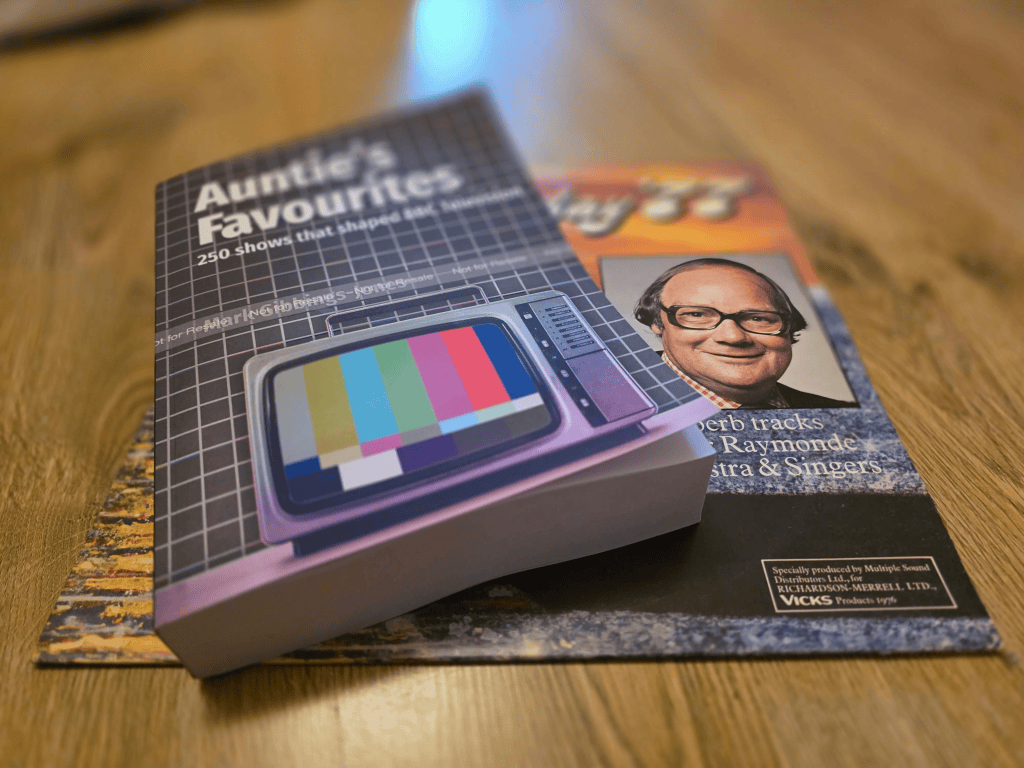
    A copy of the award-winning (citation needed) book Auntie's Favourites, on top of the Holiday '77 album.

    Firstly, big book news. And it’s important to note that both the news and the book are big. The book is the fully featured, 622-page, 10-by-7-inchAuntie’s Favourites, a full rundown of the 250 Most-Broadcast Programmes in the Entire History of BBC Television. This differs from the rundown previously published on this site, as it contains:

    • 150 additional entries compared to the original’s hundred
    • Covers every single broadcast up to 31 December 2025
    • Every broadcast on BBC Three, BBC Four, BBC Choice and BBC Knowledge alongside the main BBC channels
    • Added detail and complete rewrites on many of the original entries
    • Newsnight is now in the list. But where?
    • Definitive confirmation of the most-repeated sitcom in BBC Television history – it’s possibly not the one you’re expecting
    • Precisely one bar chart

    Also, critically, everything has been reviewed and properly proof-read. It’s the strangest thing. When going through the original proof edition of the book (pictured above, with a copy of the Holiday ‘77 vinyl record for scale), there were a lot of weird typos, put there, it seems logical to conclude, by North Korean hackers who had installed a virus on my PC in an attempt to discredit the book. A very clever virus that placed corresponding typos in the original blog entries, almost as if to make me look like a fool.

    All those typographical tykes have now been chased away, meaning the book is finally available to buy on Amazon. In the UK, it’s just £19.99 for the lovely paperback edition or £5.99 for the DRM-free Kindle edition (so you should be able to throw it at anything that’ll handle an .epub file). If you’re in the USA, you’re looking at just $26.99 for the paperback or $7.99 for the ebook, while if you find yourself in Canada it’s $36.99 for the book in paper form or $10.99 for it in digi-bits. If you’re in Australia and you want to see whether Neighbours is still at number one in the rundown (spoilers: it isn’t), it’s the oddly specific price of $41.87 for a copy you can hug at night, or just $11.69 for a copy that lives on your phone (or Kindle, or Kobo or whatever).

    It’s also available in other countries with an Amazon store and will be popping up on various other shopfronts (that don’t have the dread hand of Bezos on them) soon. I’ll post a further update once those have gone live.

    (It’ll be brilliant if you can spread the word about the book. It’s a project that has taken years to complete, so it would be nice to see it in as many hands, bookcases and digital devices as possible.)

    –

    Okay, let’s crack on with a sample entry from the book itself. It’s the programme in 225th place in the list and it’s one with a fun history. Let’s go to…

    Dallas

    1978-1995, broadcast 554 times

    BBC1 (480 times, 1978-1995)
    BBC2 (74 times, 1980-1987)
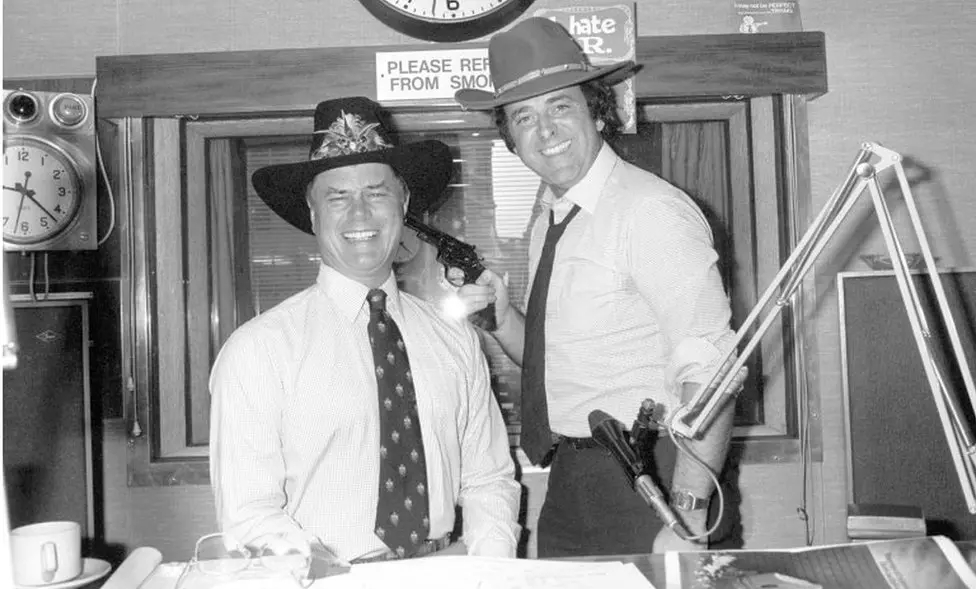
    Terry Wogan holding a gun to Larry Hagman's head in a BBC Radio studio.

    The majority of television programmes are ephemeral. They’re on, then they’re not, and you’re lucky if many people noticed them. But then there are television programmes that reach escape velocity and break free into the national zeitgeist, meaning everyone everywhere knows all about them whether they’d watched the damn thing or not. For most of the 1980s, as remembered by anyone who recalls all the references to ten-gallon hats, an entire season of a TV show turning out to have been a dream, or the joke where J.R. has a drink of water only for the liquid to pour out of bullet holes all over his body, Dallas was the latter. But here’s a thing: Dallas – that most American of American soap operas – may never have existed were it not for Coronation Street.

    Let’s explain by whizzing back to the 1930s. Yes, the 1930s.

    As you may well know, the phrase ‘soap opera’ came about when such serial drama programmes on the radio in 1930s America were commonly sponsored by soap and detergent manufacturers. When television started to grow in popularity in the 1940s, these soap operas would make the transition from radiogram to picturegram, starting with the boarding house-based These Are My Children (NBC, January-March 1949), with short fifteen-minute episodes airing on late weekday afternoons.

    While These Are My Children didn’t prove to be an immediate smash with viewers, it provided a cheap and cheerful way to fill some of those daytime hours, and it was soon joined in the schedules by A Woman to Remember (DuMont, February-July 1949) and The First Hundred Years (CBS, December 1950-June 1952). However, the following year’s Hawkins Falls, Population 6200 (NBC, April 1951-July 1955) could be considered the first truly popular daytime soap – with just a slight caveat, given it’d actually started as an hour-long primetime comedy drama in June 1950, before regenerating into a fifteen-minute daytime soap the following year. From that point on, the floodgates were pretty much flung open by US TV schedulers, with (at least) 27 more daytime soaps bubbling up during the remainder of the decade. For the sake of your sanity and mine, I’m not going to list them all here.

    Whatever American telly does, British TV soon starts sniffing around. Continuing drama serials in the UK had previously been the sole domain of radio, with The Archers airing for the first time on 29 May 1950 (as a pilot episode, going full-time on 1 January 1951), but when television attempted the genre, there weren’t really any daytime hours that needed filling – the short amount of pre-teatime broadcasting hours were reserved for children’s TV and news. And so, when some British TV soaps did appear, like The Grove Family (BBC-tv, April 1954-June 1957) or Emergency Ward 10 (ATV, February 1957-June 1967), they were mainly primetime prospects – ITV’s first attempt to put such a programme in a short afternoon slot – One Family (Associated-Rediffusion, April-May 1956) – all but proved British TV wasn’t really ready for such a series.
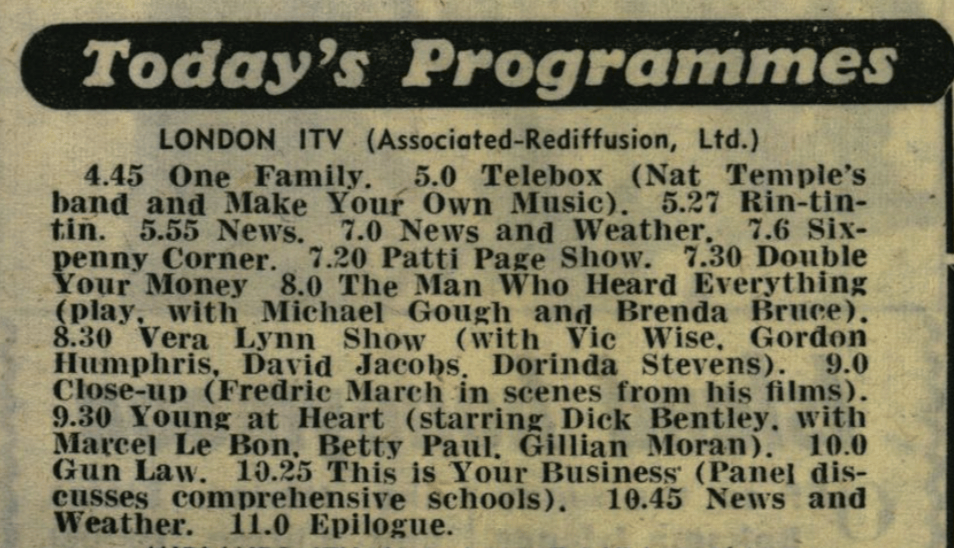
    London ITV schedule, 25 April 1956 (Daily Mirror)

    I’m not going to shock anyone here by pointing out that it was Coronation Street (Granada, December 1960 to the end of recorded time) that became soap’s first bona fide smash in the UK. While Emergency Ward 10 had hardly shied away from realism where warranted, Coronation Street became something that a large amount of the viewing public could truly relate to – ordinary working-class folk, in an ordinary working-class street, and a clear focus on lives rather than events. And Tony Warren’s series wasn’t just becoming big in Blighty – it was attracting the interest of television bigwigs in the USA, too.

    Depending on which source you’re looking at, the success of Corrie led to one of the “ABC top brass” (as per LIFE magazine, 25 April 1969), “officials of 20th Century Fox” (according to The Serials: Suspense and Drama by Instalment, Raymond William Stedman, 1977) or TV producer Paul Monash (going by Television Genres, The OU Course Team, 2003) to have the idea of making a primetime soap for the USA in 1963. The latter source claims Monash even considered broadcasting episodes of Coronation Street in the USA, but sensibly decided US audiences would have trouble understanding northern English accents. And so, with Coronation Street in mind, the TV rights were secured to Grace Metalious’ 1956 book Peyton Place – previously the subject of a successful 1957 film for Fox – and the series duly aired in 1964. Dealing with the lives and secrets of people in a small New England town, Peyton Place was a success – attracting tens of millions of viewers at its peak, and helping kickstart the careers of cast members Ryan O’Neal and Mia Farrow.
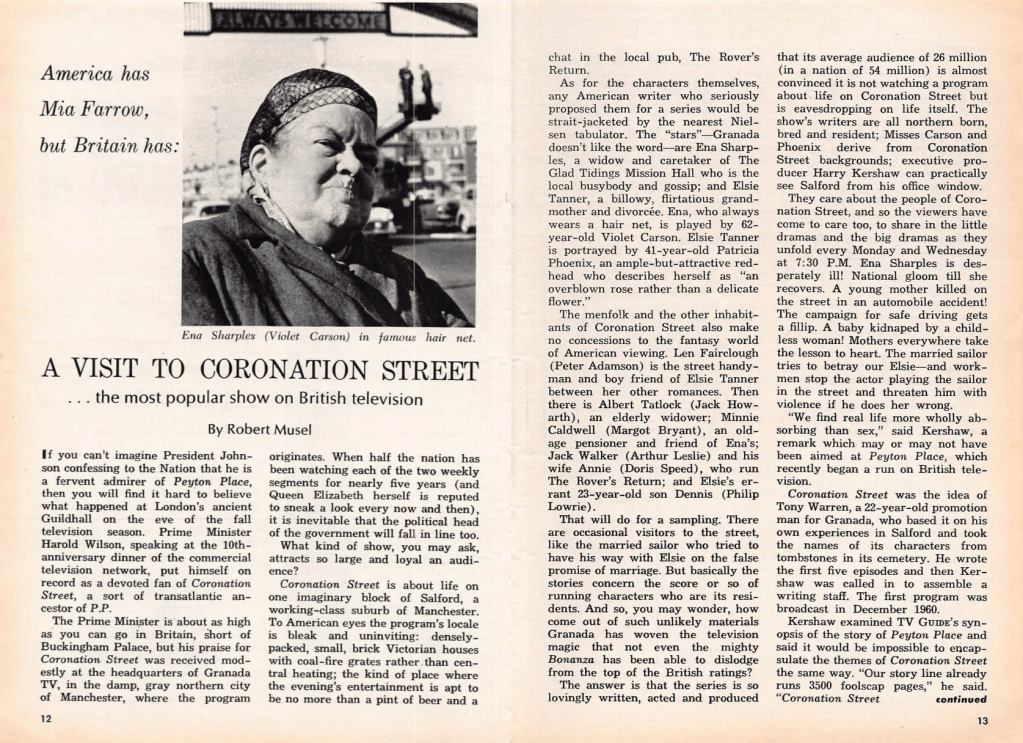
    TV Guide article, "America has Mia Farrow, but Britain has..." [Photo of Ena Sharples] "A Visit to Coronation Street"
    TV Guide, 20 November 1965

    The Weatherfield influence on Peyton Place was certainly recognised in the USA – the 20 November 1965 edition of TV Guide carried a three-page feature on Coronation Street, alongside a nice big photo of Ena Sharples – snappily noting that for all of its qualities, “any American writer who seriously proposed [the Coronation Street characters] for a series would be strait-jacketed by the nearest Nielsen tabulator”. By translating what made Corrie work so well over here into something that worked over there, Monash had proved that American TV could make continuing dramas attractive to huge audiences. As such, from January 1965, some of the smaller ITV regions began broadcasting Peyton Place. In primetime slots, too.

    Then, in 1978, Dallas arrived. But – in a way befitting the long, rambling nature of this entry – not as a primetime soap. Sigh. The original plan by producer Leonard Katzman and writer David Jacobs, when it came to their tale about a family of Dallas oil tycoons, was for it to be a miniseries. Each hour-long episode would, despite some ongoing storylines running throughout the series, be a self-contained narrative that would neatly tie together. And so, that’s how it initially aired – a short season of five episodes airing on CBS throughout April 1978, airing at 10pm on Sunday nights, opening with an episode where “the youngest son in an oil and cattle-rich family shocks the entire clan when he brings home as his bride the daughter of his father’s long-time enemy”.

    Viewing figures were modest – Nielsen ratings for that initial series put it in joint-44th place for the 1977-78 season, sharing a position with CBS sitcom Baby, I’m Back. The latter – a vehicle for Desmond “Sanford’s & Son” Wilson, who played a compulsive gambler trying to win his wife back – was duly cancelled. Dallas was given a second shot, with an extended run of 24 episodes set to air from September of the same year, with a greater emphasis on cliffhanger plotlines. It would initially air in a Saturday night slot, but soon moved to Friday nights where it would reign supreme.
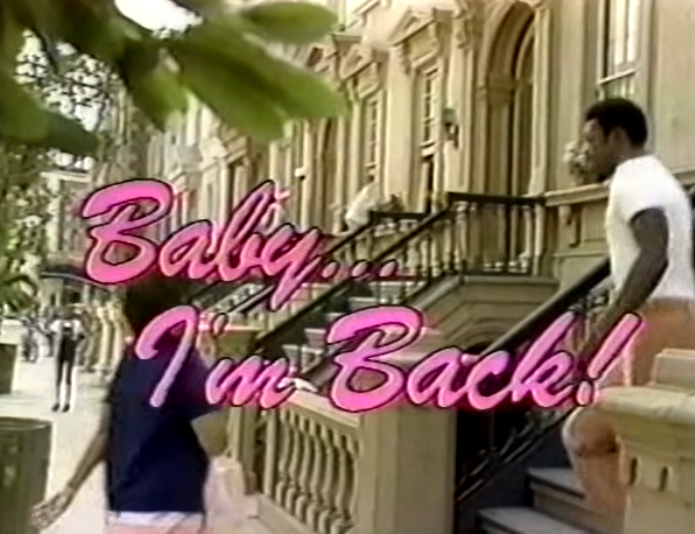
    Title card for "Baby, I'm Back", the programme title overlaid on footage of a residential street.

    Once Dallas had been effectively retooled as a grand comeback for the primetime US soap – because that’s what it had become by this point – it wouldn’t be too long before British viewers got to enjoy it. The first episode of the (mini-)series went out on 5 September 1978, in an 8.10pm Tuesday BBC1 evening slot, with the second US season immediately following the first – meaning episodes of Dallas’ second series aired in the UK just ten days after their US debut. Handily for the Beeb, the more self-contained nature of those early episodes afforded them an opportunity to skip the fourth episode, Winds of Vengeance, which contained a pretty uncomfortable plotline involving sexual assault.

    Even then, while Dallas was a familiar presence on Tuesday evening BBC1 throughout 1978 and early 1979, the first two seasons hardly pulled in huge audiences. Even at the start of the third season in November 1979, at a time when ITV were just getting back into operation following almost three months off air due to industrial action, Dallas failed to make the weekly Jictar Top 20 ratings. That means it was officially attracting fewer viewers than Go with Noakes. In January 1980, it made the ratings chart for the first time, in 13th place with 15.1 million viewers. By 12 April of the same year, the viewer count had swelled to 16.7m viewers, making it the most-watched TV series in Britain, as the nation became gripped with the dastardly deeds of arch heel J.R. Ewing. His rampant villainy was coming to a head as the third season neared its conclusion, word reaching the British press that the season finale would see J.R. receive what’s coming to him (Clue: small, metal and is fired from a gun). If the penultimate episode of the season on 12 April topped the ratings, surely the following week’s season finale would attract even more viewers?

    No, it wouldn’t. The BBC schedulers had their own bit of villainy up their sleeves – postponing the broadcast of the season finale for six weeks to maximise the attention it would get. It worked – on the week that episode went out (in May 1980), the only TV broadcast attracting a bigger audience was Brian Clough’s Nottingham Forest beating SV Hamburg in the European Cup Final. The episode concluded with one of television’s most famous cliffhangers, the mystery of just who pulled the trigger that propelled hot lead towards Ewing. Bookmakers William Hill took more than £50,000 in bets on who the culprit would be, while Las Vegas lawmakers had to intervene to prevent the same happening in the USA. As the nation busied itself with Who Shot J.R. discourse, BBC2 broadcast “a special selection of programmes from the series” on six evenings each week from 7 July, allowing newcomers a chance to catch up before the new series aired in November 1980.

    The identity of the would-be murderer was so closely guarded that the broadcast tape of the subsequent series opener was transferred from Heathrow to BBC Television Centre in a bulletproof van, flanked by a motorcycle escort. With the BBC airing the episode just three days after CBS in the States, there was little chance of the secret hitting the press, and the fourth season of Dallas opened with a UK audience figure of 20.25m. The producers of Dallas not being a bunch of mugs, the culprit wouldn’t be revealed in the first episode of the series – or second, or third. To further confound any crew member hoping to leak the big revelation to the press, multiple versions of scenes were shot, with only the ‘real’ reveal being sent out to broadcasters.
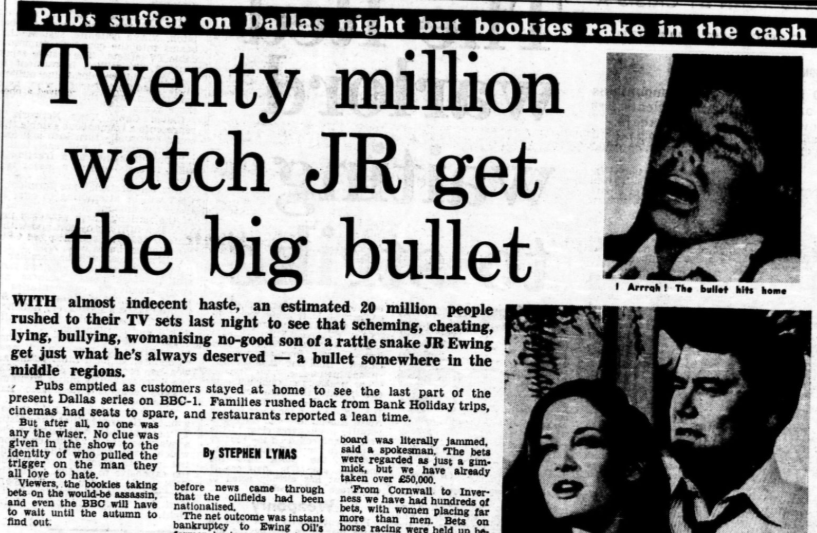
    Newspaper headline: "Twenty Million Wath JR Get the Big Bullet"
    Daily Mail, 27 May 1980

    When it came to the big day – the all-important S04E04 that would finally reveal Who Shot J.R. – BBC Television were taking no chances. The reveal was to air on US TV between 3am and 4am UK time on Saturday 22 November 1980. It would air on BBC1 at 9.10pm that same day (the day after the previous episode on BBC1). That would prevent national newspapers from having time to learn the big news and get it onto Britain’s breakfast tables, but there was an even more surprising culprit at large: BBC Radio. Much to the chagrin of their audiovisual counterparts, BBC Radio 2 interrupted their overnight music programme You and the Night and the Music moments after the reveal on CBS Television, offering thirty seconds of spoiler space before naming the shooter, with Two bigwig Geoff Owen stating “I don’t want to spoil the enjoyment of Dallas devotees”. Despite, you know, doing precisely that.
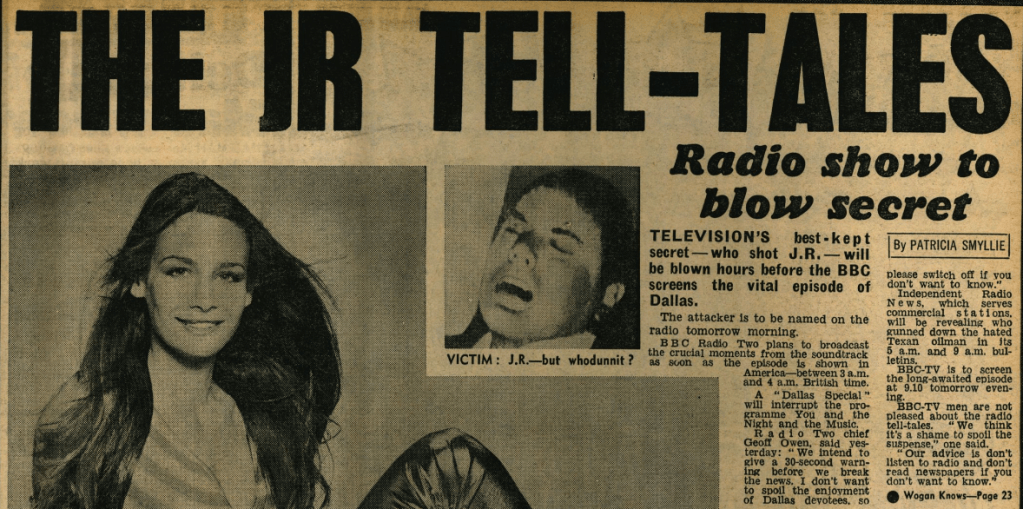
    Newspaper headline: "The JR Tell-Tales. Radio Show to Blow Secret"
    Daily Mirror, 21 November 1980

    Of course – spoiler alert – the shooter herself was much less of a surprise than that Radio 2 exposé. J.R.’s scorned mistress Kristin owned the finger that pulled the trigger, her position as 4-1 second favourite with William Hill reportedly costing the bookmaker £160,000. More importantly, with that week’s two episodes of Dallas topping the ratings, more than 21 million tuned in for the unmasking. Dallas was very officially A Big Deal. Which would come to a head just over four years later.

    Over the next few years, Dallas would remain a major draw for the BBC. Opening episodes of each season would usually top the viewing figure charts for BBC1, even if numbers weren’t quite at the peak of Who Shot J.R. fever. Even when new episodes weren’t at the top of the BARBs, they were pulling in respectable figures north of 14 million. But, on 17 January 1985 – with the BBC halfway through screening season eight of the series – news hit the nation of a boardroom coup that could’ve been wrestled from the Dallas writers’ room.

    “ITV GRAB DALLAS” screamed the Daily Mirror. “ITV POACHES DALLAS” roared the Daily Mail. “BBC LOSES DALLAS IN SOAP OPERA WAR” tutted the Daily Telegraph. “SOAP OPERA SPILLS OFF THE SCREEN” intoned The Guardian. “DALLAS POACHED FROM THE BBC” spluttered The Times. In each case, this was front page news (though you can guess which of those afforded it space below the fold).
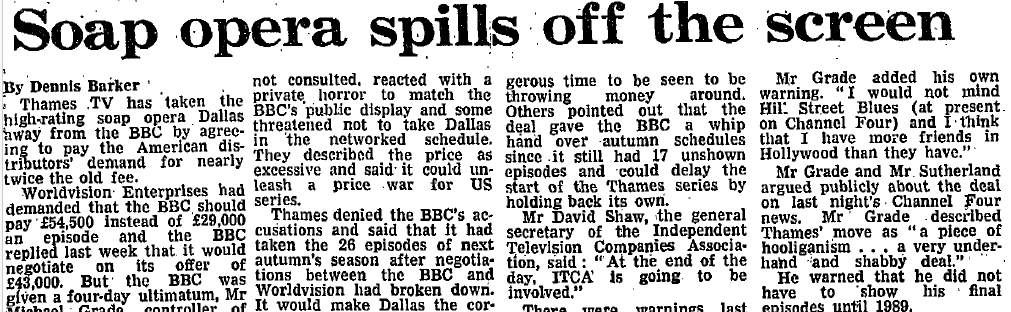
    Guardian, 17 January 1985

    Indeed, the show’s distributors Worldvision had raised the price-per-episode for the ninth season to a level the BBC weren’t willing to pay. But, while the Beeb – at the time waiting on a consultation about the future of the licence fee – baulked at the idea of paying £1.4m for a 26-episode run of popular television (plus a 10% annual rise, and a commitment to buy every future episode of the series), Thames were more than happy to. ITV’s London weekday franchise gleefully swooped in to meet the higher fee, a fee that seems quaint in an era where Disney-fuelled Doctor Who episodes reportedly cost £10m a pop.

    To modern eyes, such a gazumping doesn’t seem much of a surprise – it’s nothing that didn’t happen when Friends, 24, Lost and the like got snapped up by Sky. But back in the 1980s, a gentleman’s agreement had been in place between the BBC and ITV franchises not to partake in such unseemly bidding wars – mainly to avoid the price of imported shows getting overinflated. To highlight how unpopular a move it was, some of the other ITV franchises (most notably big guns Granada, Central and Yorkshire) criticised the deal, went as far as to announce they would refuse to air Dallas in their own regions when Thames planned to start showing it that autumn. After all, it was one thing waving a fat cheque at Morecambe & Wise or Mike Yarwood to make original programmes for ITV, but this was unseemly. Thames tried to argue that the inflated price of a Dallas episode was still around a quarter the cost of making a new episode of Minder, though nobody in particular was listening.

    It didn’t take long for Thames to get a carpeting from the Independent Broadcasting Authority. Thames MD (and former Controller of BBC1) Bryan Cowgill was called in for ‘talks’ at the IBA, though the outcome of those talks differs between the autobiographies of Cowgill (Mr Action Replay, Sports Masters International 2006) and John Whitney, director-general of the IBA (To Serve the People, John Libbey Publishing 2013). Whitney’s telling of the meeting suggests a one-way telling-off, with Cowgill being ‘reminded’ that the IBA can block Dallas from being broadcast if it fell afoul of broadcasting policy guidelines. Cowgill’s telling of the story has it that Worldvision had flatly refused to continue speaking to the Beeb “in light of the treatment they received from the BBC”. Cowgill, a former Head of Sport at the BBC, countered Whitney’s argument that snatching the Beeb’s top US import “just isn’t cricket” with his opinion that he knew a good deal more about cricket than Whitney.
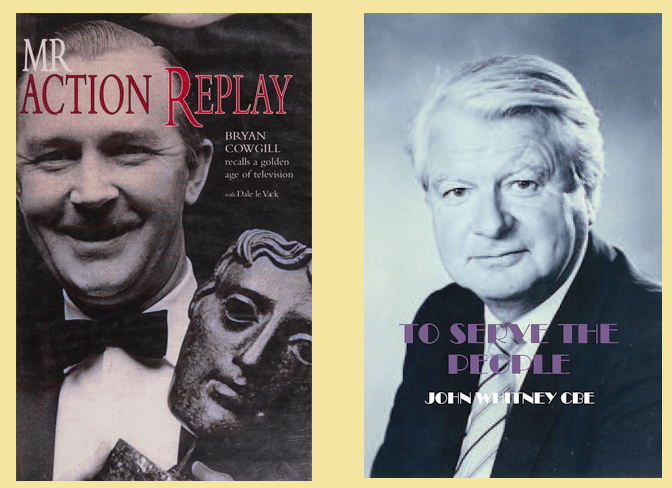
    Book covers for Bryan Cowgill and John Whitney's autobiographies
    Fight! Fight! Fight!

    To compound matters, BBC1 controller Michael Grade announced that the Beeb’s existing Dallas episode reserves would be yanked off the schedules and held in storage until Thames started broadcasting their season nine episodes, at which point BBC1 would run season eight episodes against them. Or, as Grade said at the time “we have 17 episodes of Dallas left to show in the current series, and Thames can’t put on the next series until they’ve finished. But who knows how long it might take us to finish screening them?”, probably whilst twirling a stick-on moustache.

    It was one hell of a power move, and further stoked the media narrative over the row (“These [BBC] executives betray themselves. In reacting thus to the loss of an elderly, mediocre soap opera they demonstrate how, despite assurances to the contrary, BBC television has sunk so low as to be indistinguishable from ITV” – The Daily Telegraph, predictably). And so, on 6 February 1985[1], it seemed the last episode of Dallas to be seen on the BBC for a good long time went to air. The Daily Mirror’s TV listings billed it as “the saga sinks slowly in the West for a while. It’ll be back in the autumn on the BBC – AND on some ITV stations too!”.

    A week later, the slot was filled by the first episode from a new series of The Two Ronnies (“Sandra Dickinson guest-stars in a parody of Sunset Boulevard”). That’s pretty Premier League as filler programmes go. Bryan Cowgill refused to be cowed by Grade’s hardball, stating that “I’ve got it and I’m keeping it – it’s my baby. I’m in business to win. If that upsets other people, it’s hard luck.” But could there be any way of it returning to the Beeb, given many ITV franchises were also miffed by his tactics? “The only way we could return it to the BBC is if they bought it off us for the same price we paid for it.”

    The impasse lasted until 18 February, when the BBC announced the return of Dallas to BBC1 from 27 March, with managing director Bill Cotton revealing the Corporation was “taken aback by the strength of viewer reaction”. The news itself had been revealed as part of another new era for the BBC – the first weekday episode of Wogan featuring a (soon ditched) audience participation segment where Tel revealed the news to a grateful nation, with the following day seeing the debut of new BBC soap EastEnders. However, the wave of audience demand may not have been the sole reason behind the Beeb backing down – the BBC’s announcement coincided with an announcement from Guild Home Video that the remaining Dallas season eight episodes placed on ice by Grade would be rushed out on VHS, with tapes containing three new episodes arriving at fortnightly intervals.
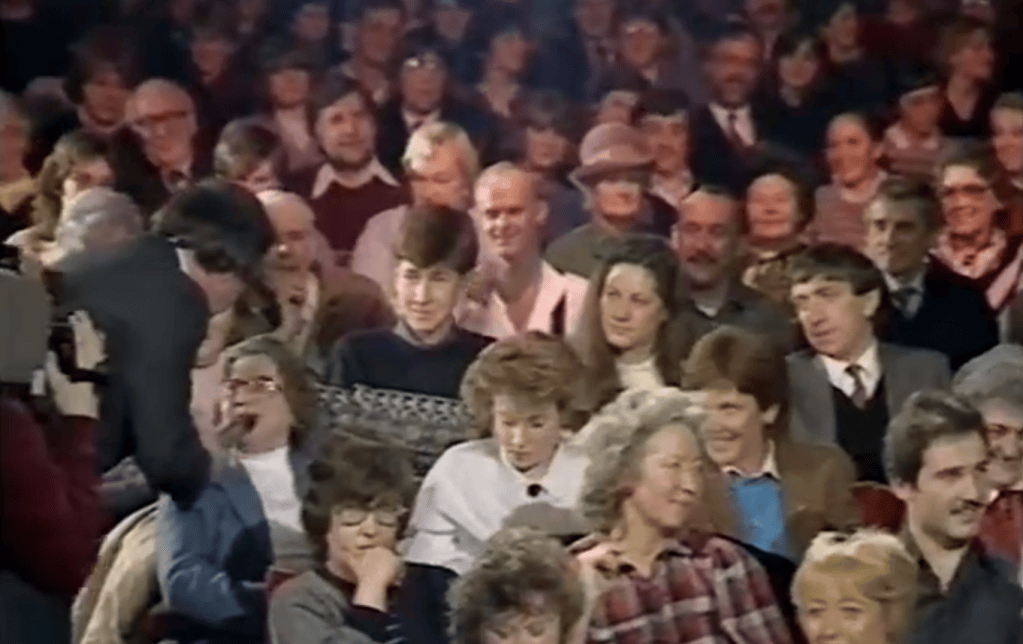
    Screengrab of the audience participation slot from the first 1985 edition of Wogan
    “Talk to the audience? Oh, God, this is always death.”

    Brighter news was on the horizon for BBC bosses in June. Many ITV franchise holders were still frosty about the whole debacle and unlikely to broadcast any episodes. As a result, the prospect of paying over the odds for what would now be a “regional variation” in the TV listings led the management and legal team of Thames to visit New York for a meeting with programme distributors Worldvision. Their reluctant goal was to sheepishly sell Dallas back to the Beeb at a reduced fee and forget all about the Thames offer. In a move that surprised few, the large American company announced it would rather keep the larger amount of money.

    In an attempt to resolve the matter, Thames sent letters to all other ITV franchise holders inviting them to state categorically whether they’d be willing to transmit Dallas or not – and if not, why not. As per John Whitney’s memoirs, Thames chairman Hugh Dundas claimed this was a ploy to get a bunch of negative responses that could be waved under Worldvision’s nose, as part of a negotiation to give the rights back to the BBC. Whitney’s suspicion was that it may have been a ploy to demonstrate how other ITV regions had softened on their original stance, and that there was now a certain amount of unspoken enthusiasm for putting the ratings smash on ITV. Tellingly, the recipients of the letters included London weekend franchise holders LWT, heavily suggesting the goal was purely collecting as many ‘no’ votes as possible.

    With all manner of bickering between Thames, the IBA and other ITV franchise holders continuing into the summer, Bryan Cowgill left Thames in July 1985. The mechanics of his departure differ between the Cowgill Version Timeline and the Whitney Version Timeline (“I didn’t wish to spend one more day of my life in the company of such hypocrisy and petty authority … I tendered my resignation” versus “I was telephoned by Hugh Dundas to say that the Board had decided Bryan Cowgill should go”), but either way Cowgill left with a £400,000 handshake. Why, that’s enough to buy 7.4 episodes of Dallas. In his post-job presser, Cowgill railed against the IBA (“I’ve been screwed by them – but I will have them.”), singling out IBA Director General John Whitney and chairman Lord Thomson as the individuals behind his defenestration (“if it goes back, those two damned idiots will have handed it back”). At least according to Thames chairman Hugh Dundas, Cowgill failed to do himself any favours by carrying out the entire deal without notifying the Thames board. It certainly didn’t help that the ‘agreeing-to-pay-a-steadily-rising-price-for-as-long-as-Dallas-is-made’ clause remained in the Thames version of the contract.
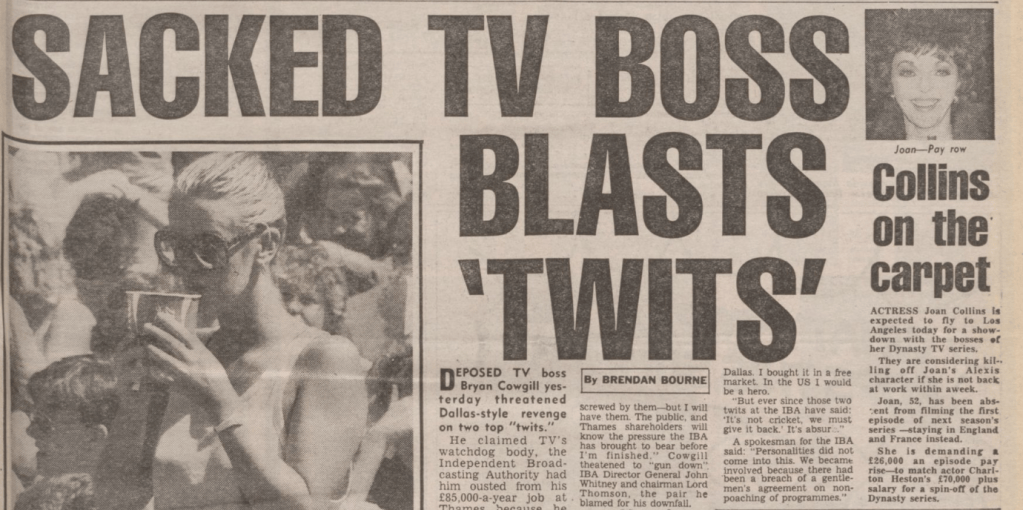
    Newspaper headline: "Sacked TV boss blasts 'Twits'"
    Daily Mirror, 14 July 1985

    As it was, Dundas felt compelled to take to the pages of trade newspaper Television Today to address commonly quipped concerns about the whole affair. He shot down suggestions that the future of the Thames franchise might be put in jeopardy by the Dallas affair – it wasn’t, though that reckoning was only a few years away. The most telling part came at the end of Dundas’ piece – “the board had to choose between digging in and holding onto the programmes, or trying to negotiate their disposal. The latter course was adopted and has been pursued ever since”. The fact was that, in the BARB ratings released just after Cowgill’s departure, broadcasts of Dallas were now just 50,000 viewers ahead of Crossroads in the ratings. This declining audience may very well have had an impact on this stance. The ball was back in the BBC’s court, and with nobody else competing for the rights to the series, the next season of the soap could continue where viewers had come to expect it.

    The agreement to hand it back to the Beeb finally came in August 1985. The climbdown from Thames was notable – with Worldvision refusing to budge on the increased price, Thames agreed to pay an undisclosed lump sum to the BBC, allowing the Corporation to re-purchase the series. Where Thames had agreed a fee of $60,000 per episode, the settlement meant the BBC were paying the figure they’d originally offered to retain the series, with Thames picking up the slack – a sum of either $10,000 (according to Whitney) or $12,500 per episode (according to Cowgill). And so, the whole affair would be resolved in time for the publication of the autumn schedules in early September. Wouldn’t it?

    Nope. The whole sorry affair rumbled on well into the autumn, leaving a conspicuous Dallas-sized hole in the TV schedules while US viewers were enjoying a ninth season of Ewing antics. In October, the matter was even raised in the House of Commons, with Junior Minister of Trade and Industry Michael Howard being asked to outline the steps Her Majesty’s Government had taken to sort out the whole sorry oil slick. The Office of Fair Trading even got involved, contacting Worldvision to try and break the impasse.

    Then – finally – in December came a breakthrough: Thames lawyers had finally agreed the small print with the BBC. February 1986 saw the announcement that the matter had finally been resolved, with the new series set to begin on BBC1 on Wednesday 5 March. Bryan Cowgill took time out from his new role as Deputy Chairman of the Mirror Group to comment “I am glad the OFT has confirmed the existence of a no-poaching agreement.” Meow. The belated return to Britain’s screens saw viewing figures for Dallas remain buoyant – season nine attracted 14m viewers, only slightly down from the figure for the end of the previous season (14.95m), though it would soon become evident that even with brand-new episodes – and real-life boardroom battling aside – the British public were starting to lose interest in the Ewings.

    Audience figures soon started to dip further, with more down-to-earth drama serials like EastEnders and Neighbours becoming the main draw for BBC1. By 1989’s twelfth season, first-run episodes of Dallas on primetime BBC1 – previously the most-watched show on British television – struggled to appear at the scrag-end of the channel’s top thirty programmes. When it did appear, it would be gathering audiences between seven and nine million – not much of an achievement when several million more viewers were tuning into well-worn repeats of The Good Life and Columbo (or, if you’re feeling especially uncharitable, episodes of Davro’s Sketch Pad on ITV). But with the BBC locked into a contract tying them to the series for as long as it was being made, they had to keep showing it.
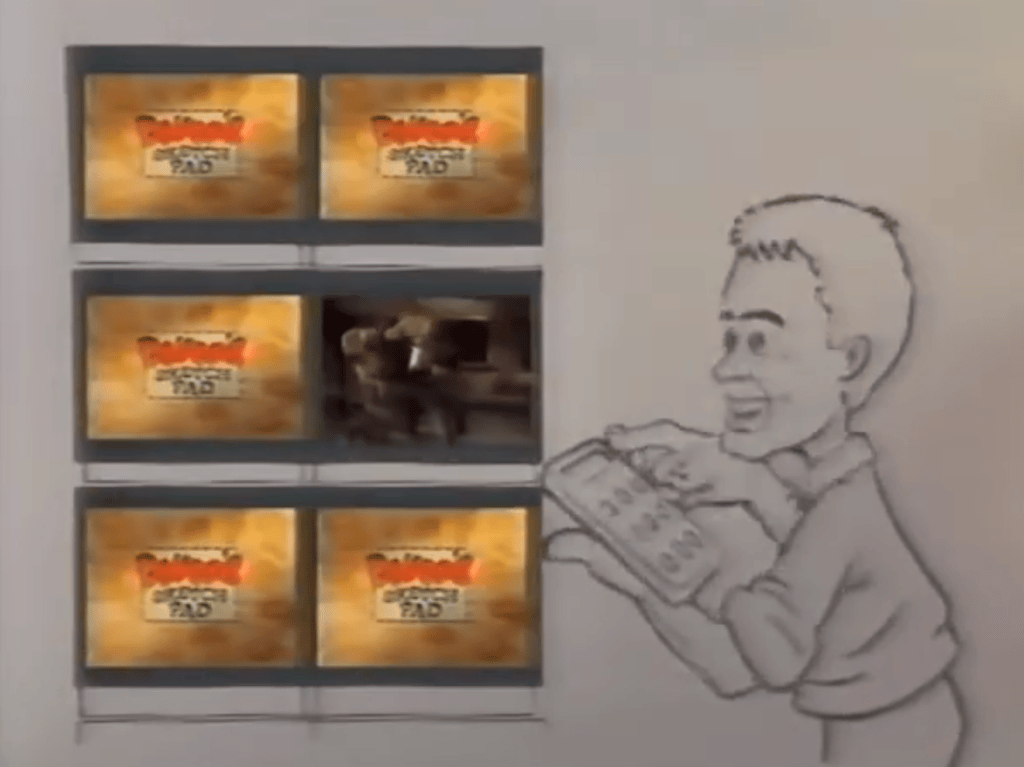
    Title screen for Davro's Sketch Pad. A cartoon Bobby Davro paws at a remote control and a bank of six televisions
    Davro’s Sketch Pad: Bigger than Dallas

    By the time the final series (of original flavour Dallas, at least) rolled around in May 1991, it was no longer a primetime proposition for the BBC. From this point on, new episodes would air at 3pm on Sunday afternoon, the once-mighty colossus now hanging around to pick up viewers from the EastEnders omnibus. Thankfully for the BBC, ratings had also dipped notably in the USA, from a high point of 33.4m viewers and being US TV’s most-watched show during the (first) outing of a bullet-riddled J.R., down to a low of 12.9m in the final season, failing to make the top sixty programmes. And that – a repeat run of the series on daytime TV in the mid-90s aside – was that.

    Or, was it all a dream?
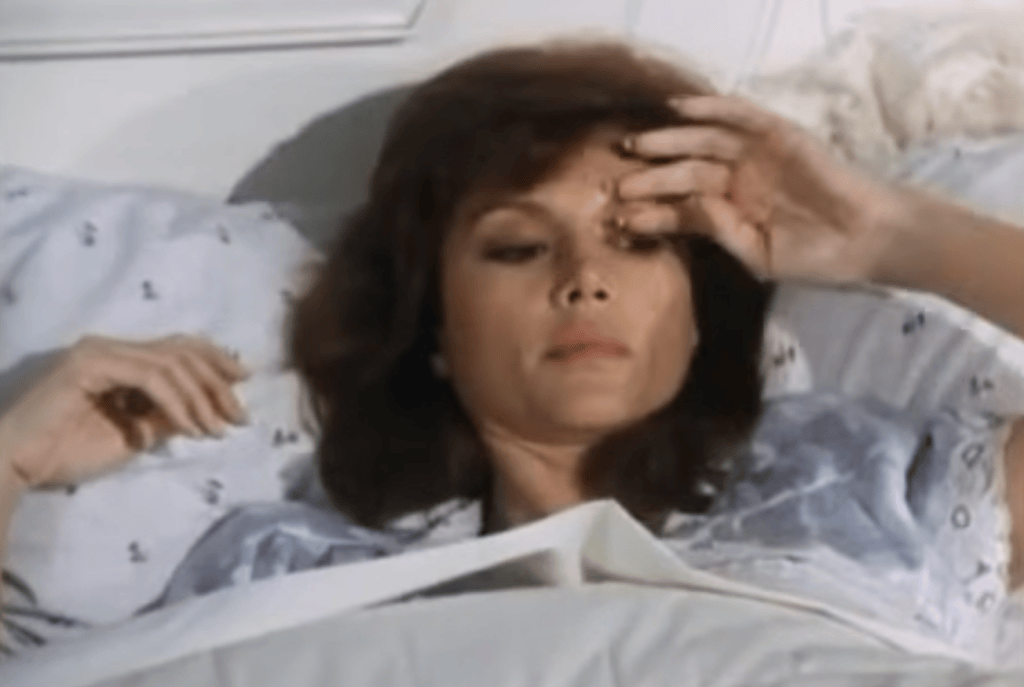
    Screencap: Pam (Victoria Principal) wakes up from her terrible months-long dream

    [1] Blott on the Landscape started on BBC2 that same evening, which I’m saying should be regarded as Britain’s answer to Dallas.

    –

    There we go! Remember, for this and 249 more entries (not all as long as this one, I feel duty-bound to add) buy a copy of Auntie’s Favourites now.

    Or later, if it’s more convenient.

  • The Eighty-Three Roads To Wembley: Part Three

    Hooray, my computer’s fixed! Bah, it’s no longer remotely timely writing about the FA Cup. Let’s get to the end of the 1960s anyway, after which I’ll come back to this series when it’s a bit more relevant, tentatively adding in one update for each round of next season’s FA Cup. But at least in this update I get to start keeping a count of how often the FA Cup Final airs on the same day as an episode of Doctor Who, which I’m sure will see the SEO scores for the blog rise sharply. Anyway, time to hop in a sports car driven by Simon Dee, we’re off to…


    ERA FIVE The BBC-1 Years


    2 May 1964: West Ham United 3 Preston North End 2

    BBC1
    11:30 to 17:15
    Grandstand

    A five goal thriller ends with Bobby Moore being handed the trophy by the Earl of Harewood, but before then Grandstand viewers are treated to diversions of golf from Wentworth, Boxing from a non-specific location in ‘America’ and Ice Hockey from Brighton.

    Anyone tuning into BBC-1 an hour before the start of Grandstand can find themselves treated to The Fabric of the Atom at 10.35 (“An introduction to Quantum Mechanics”), where Professor Philip Morrison looks at matter waves. The Radio Times pleasingly points out that the programme featured “special equipment loaned by Professor Harry Meiners Troy, USA”. We’re a long way from Saturday Superstore, aren’t we? That was followed at 11.05 by Parliamo Italiano, where “Giulia takes over the packing for their holiday”, and Public Service Announcements at 11.25.

    Some killer content follows the football, Grandstand being followed at 5.15 by The Telegoons (“Lurgi Strikes Britain”), and at 5.30 it’s Dr Who, a programme still new enough for the Daily Mirror TV guide to append it with “(science fiction series)”. Tonight’s episode: The Snows of Terror.

    CUP FINAL DAY DR WHO COUNT: One.

    ATV
    13:24 to 17:15
    Big Afternoon Out

    Over on ITV, we’re still some time away from a World of Sport, so enjoy another Big Afternoon Out at the very specific time of 1.24pm, with Professional Wrestling from Wembley Town Hall offering a grapplin’ support act for the big match.

    There’s nothing more exciting than a 1.15pm News Bulletin before the sporting action, but there’s a good line-up after it. Robert Shaw stars in The Buccaneers at 5.15 (episode: “The Decoy”), but that’s followed by Thank Your Lucky Stars at 5.50, with The Shadows and Roy Orbison. If you’re sticking around until 8.25pm, you can look forward to some Sid ‘n’ Dick era Morecambe and Wise.

    1 May 1965: Liverpool 2 Leeds United 1

    BBC1
    11:30 to 17:25
    Grandstand

    An all-Northern cup final for 1965, with Bill Shankley’s reds taking the title. Before that, alongside golf from Sandwich, racing from Ascot Heath, swimming from Portsmouth and rugby union from Twickers, there’s a screening of Sir Stanley Matthews’ testimonial match from Stoke, highlights of which are on YouTube. Appropriately enough, given Matthews’ own XI (featuring names such as Stan Mortenson, Nat Lofthouse, Tom Finney, Danny Blanchflower and Jimmy Hill) was taking on a World XI (including Lev Yashin, Aldredo di Stefano, Frerenc Puskas, Eusebio), the match was beamed around Europe via Eurovision, and on radio around the world.

    Before Grandstand, it was time for BBC Educational Broadcasts to shine in a time before the Open University, erm, opened. The Changing World (“an introduction to geology”) started things off at 10.15am, followed by Komm Mit!, the twenty-seventh of thirty lessons in German for beginners at 10.45am.

    Following the presentation of the cup (by The Queen, no less) it was time for Juke Box Jury at 5.25pm, with panellists including Dave Clark and Dora Bryan. That was followed by a new adventure in space and time at 5.50pm, with Dr Who in The Dimensions of Time.

    CUP FINAL DAY DR WHO COUNT: Two.

    ATV
    12:50 to 17:15
    World of Sport

    Over on the light channel, the Big Afternoon Out had been replaced by World of Sport, but little else had changed. Indeed, that coverage of the sporting world only stretched from Wembley Stadium to Wembley Town Hall for live wrestling.

    Anyone not feeling in the mood for geology or German on BBC-1 would have to make do with walking the dog if they were looking for alternative entertainment before World of Sport, with only a News update preceding the action at 12.45. The sporting action was followed at 5.15pm by The Forest Rangers (episode: The Dog) and more Thank Your Lucky Stars at 5.50pm, where Cilla Black, The Merseybeats, Sounds Incorporated and Julie Grant topped the bill.

    14 May 1966: Everton 3 Sheffield Wednesday 2

    BBC1
    11:15 to 17:25
    Grandstand

    A big year for domestic football, as a British team wearing red go on to lift the Jules Rimet trophy later in the summer. Sadly though, it’s not Wales. But that’s many weeks away. A low-scoring defensive cup final looks to be on the menu, as Everton reach the final without having conceded a goal en route to Wembley, and buoyed by the presence of a certain J Lennon and P McCartney amongst the 100,000 spectators, their name is surely on the cup.

    Except! It’s Wednesday the roar into a two-goal lead, only for Everton to roar back to take the cup in a thrilling 3-2 win. In the Radio Times, Kenneth Wolstenholme writes about the Cup now coming with a passport to Europe, with a place in the Cup Winners’ Cup, where “each home gate can mean another £20,000 in the bank”.

    For the audience at home, the build-up to the big kick-off is supported by the MCC taking on the West Indies at Lord’s and racing from Ayr.

    Viewers tuning early for a feast of football can enjoy some brain soup for starters, with the splendidly-titled Laws of Disorder (“An introduction to chemical change and thermodynamics by Professor George Porter FRS”) at 10.15 and Master Builders (“Ten lectures on evolution and change in architectural ideas. 4: The Villa”) at 10.45. Anyone sticking around after the cup presentation by Princess Margaret can look forward to Juke Box Jury at 5.20, with David Jacobs in the big chair and Helen Shapiro, Jimmy Witherspoon, Janice Whiteman and Frank de Vol on jury duty. Then, after the News at 5.45, it’s time for Dr Who at 5.55, today’s story being Donald Cotton’s Johnny Ringo (“The most dreaded killer in all the West, Johnny Ringo, rides into town”).

    CUP FINAL DAY DR WHO COUNT: Three


    ATV
    13:00 to 17:15
    Word of Sport

    Over on the ATV, there’s the usual serving of Professional Wrestling and some Racing Results to supplement the soccer in World of Sport, but at least there’s also some big brain knowledge to grapple with beforehand, with Say it in Russian at 11.50am, Les Trois Coups at 12.15 and The Anatomy of First Aid at 12.35. On the other side of the world (of Sport), there are some more Adventures of Robin Hood at 5.15. Elsewhere in the country, viewers in the Midlands and North instead get to enjoy a bonanza of Bob Monkhouse with Mad Movies, while viewers in Wales and Anglia get to see The Flintstones instead.

    20 May 1967: Tottenham Hotspur 2 Chelsea 1

    BBC1
    11:25 to 17:25
    Grandstand

    We’re just six weeks away from colour television hitting the UK, meaning this inaugural all-London FA Cup Final is the last to be screened exclusively in monochrome. Jimmy Robertson and Frank Saul put Spurs into a two-goal lead that Chelsea fail to match, meaning the trophy is taken back to Tottenham for the fifth time.

    The big match on Grandstand sees David Coleman presenting the now-standard tasters of The Wembley Scene, How They Got There and Meet the Teams, but for footballphobes there’s also the MCC versus India at Lord’s (or Glamorgan vs Gloucestershire for viewers in Wales) and Great Britain versus the USA in golf’s Walker Cup.

    Back to the football though, and the Radio Times have brought in the big guns to provide a preview of the match, with the write-up on Tottenham provided by novelist, playwright, creator of Dixon of Dock Green and socialist firebrand Lord Ted Willis (“Spurs: a team which has given me more thrills and pleasure over the years than almost anything else in my life”). For Chelsea, the summary was penned by actor, director and maniac who brought those dinosaurs back to life, Richard Attenborough (“In the spring of 1942 I first took a girlfriend to a spot called Stamford Bridge. My intentions proved absolutely honourable: without hesitation I married both the girl and Chelsea and no divorces have ever been contemplated”). Lovely stuff.

    Before the match, you’ve got a nice mix of content, with In Your Own Words at 10am, which vows to help you become more confident in your speech (“1. The Language of Social Occasions”), Management Techniques at 10.30 (“2. Control by Budgeting”) and Gardening Club at 11am, with Percy Thrower live at the Gardening Club Garden in Edgbaston. Suddenly the Mitchell and Webb joke about each programme on the BBC having it’s own garden feels a little more real.

    Following the match, 5.25pm has a Juke Box Jury line-up for the ages: Kenny Everett and Leslie Crowther joined by Julie Felix and (replacing Shirley Anne Field, as billed in the Radio Times) Kiki Dee. Then, on the other side of 5.50pm The News, at 6pm it’s Dr Who (Patrick Troughton, that’s Who) tackling the first part of The Evil of the Daleks.

    CUP FINAL DAY DR WHO COUNT: Four

    ATV
    12:30 to 17:15 World of Sport

    A helping of horse racing to accompany the wrestling alongside the cup final over on Your Weekend ITV (if you lived in London, of course). The action was preceded by En Route at 11.25, First Steps in Physics at 11.45 and The Food You Eat at 12.05. Elsewhere, viewers in both Midlands and the South-West of England opened the day with The ABC of Do-It-Yourself.

    Following the final whistle, viewers in London got a repeat episode of Adventures of Robin Hood at 5.15, with most other regions getting aquatic action from Adventures of the Seaspray instead.


    ERA SIX The Early Colour Years


    18 May 1968: West Bromwich Albion 1 Everton 0

    BBC1
    11:15 to 17:25
    Grandstand

    Here we go, a whole new landmark in football broadcasting. Not that you’d appreciate that if you were watching on BBC1, with the full colour spectrum on TV being the sole preserve of (a) poshos with brand new colour sets and (b) BBC2. If it’s any consolation, they’d need to be watching the bulk of the build-up in black and white, with The Wembley Scene, People at the Match and Meet the Teams all part of the regular Cup Final Grandstand line-up. And if you’d like a break from all that, you’ve got The MCC versus ‘The Australians’ (as the RT listing had it) from Lord’s for a full two hours near the start of this edition, along with boxing from Manchester.

    If you wanted to warm your brain up a bit beforehand, tune in at 9.30am for Komm Mit!, stick around at 10am for Bonjour Francoise and at 10.30am for Teaching Adults. Or stick around at the end of Grandstand to leap straight into Dr Who at a scheduled 5.25pm, with part four of The Wheel of Space (*The Cybermen step up their attack and the Doctor and Jamie are in deadly peril”). That was to be followed by 5.50pm News, at 6pm by Genome content warning favourite The Dick van Dyke Show and – providing we’re truly in the imperial phase of 60s television – Dee Time at 6.25pm.

    However! Jeff Astle’s winner for West Brom only arrived once the match had gone into extra time, pushing subsequent programming back by around 25 minutes. Thanks to the ever-splendid Paul Hayes for pointing out that the Doctor Who PasB details on the BBC website reveal the News remained at 5.50pm, and that episode of Who aired a tadge after 6pm. (It would make sense that the edition of The DvanD Show scheduled for that 6pm slot was postponed for a week, meaning everything else ran on time, but that’s speculation on my part.)

    CUP FINAL DAY DR WHO COUNT: Five

    BBC2
    14:30 to 17:00
    1968 FA Cup Final

    With colourvision not arriving on the main channels for another 18 months, it was up to BBC2 to broadcast that first ever colour coverage in glorious 625-line RGB.

    ATV
    12:30 to 17:15
    World of Sport

    The final chance for the ATV London weekend franchise to broadcast a Cup Final, and (happily for me) the first time there’s a detailed itinerary in the newspaper TV listings. It’s pretty much a facsimile of the Grandstand feature set, of course, with “How the Teams Got There” the WoS counter to Grandstand’s “How They Got There”, “Meet the Players” the alternative to “Meet the Teams”. Still, not long before we get the Light Entertainment infantry deployed on the light channel’s cup final coverage.

    Tune in early for 11.15 Face of the Earth, 11.40 Accueil and at noon for Working Weather. Stick around after the trophy lift for Sword of Freedom at 5.15 and Time for Blackburn at 5.45.

    26 April 1969: Manchester City 1 Leicester City 0

    Hoo, boy. Things are about to get a bit fisty. And not in the way you might expect. The players were perfectly well behaved during the match, as were the managers (aside from Man City manager Joe Mercer complaining that the Wembley pitch “used to be a bowling green, now it’s a cabbage patch”). The fans were well behaved, too. In the days following the final, the supporters of both teams were praised in the Commons for their good conduct during the final.

    So, then. What was the big deal? TO PAGE 163 OF JIMMY HILL’S AUTOBIOGRAPHY!

    You could’ve guessed he’d be pulling this pose on the cover, couldn’t you?

    This relates to Hill’s time working for a shiny new LWT franchise, ready to make a big name for themselves. The final was on their patch, and this was one of their first chances to really show the BBC they had some serious competition in the capital. Over to you, Jimmy:

    “Notwithstanding domestic confrontations at LWT, occasionally war broke out in full with the supposed real enemy, the BBC. I say supposed because at times, in endeavouring and often failing to reach an agreed competitive policy, we could be excused for believing we had more in common with the BBC than with other ITV companies. However, there was a distinct lack of any loving feeling at Wembley for the 1969 Cup final between Manchester City and Leicester City. The final was covered by both channels. The players behaved well but, claiming they had an exclusive contract for interviews, BBC staff attempted to break up an ITV interview with Mike Summerbee. An ITV outside broadcast manager, David Yallop, lost a tooth in the sudden switch from football to the noble art of lack of self-defence, and was obviously so disorientated by the whole experience he moved on to become a highly successful author.

    Fortunately for us the war subsided, but not the competition and since that incident the Wembley authorities have made sure that agreed lines of rights and demarcations are upheld.”

    (The Jimmy Hill Story, by Jimmy Hill)

    Oof, eh? For more details on this broadcasting brouhaha, and the subsequent carpeting by the FA, read this excellent Sports Journalists Association article from 2019.

    BBC1
    11:25 to 17:15
    Cup Final Grandstand

    After that, a bit of a comedown, but anyway. The last Cup Final of the decade, and where we’ll draw a line under proceedings for the time being. Another point of note here: the first official use of “Cup Final Grandstand” as the programme title in the Radio Times. That aside, the set menu for the day’s coverage on Grandstand was the same as previous years, with The Wembley Scene, People at the Match, How They Got There and Meet the Teams all present and correct. As was a supporting bill of Cricket (“The Duke of Norfolk’s XI vs The West Indies”) and Boxing (“Johnnie Famechon vs Giovanni Girgenti”).

    Before the final, you had an opportunity to watch Spanish language tutorial Vamos A Ver! (9.30am), Italian language tutorial Si Dice Cosi (10am) and French language tutorial Suivez La Piste (10.30am), before the antics of disappointing superhero (sub please check) The Weather Man at 11am and Deputy Dawg at 11.05am.

    Following the final whistle (and scrap over post-match interviewees) it was time for Dr Who at 5.15pm (The War Games: Part Two, by Terrance Dicks and Malcolm Hulke, “the trio are caught up in the turmoil of war”), the News at 5.40pm followed by Here’s Lucy at 5.50pm. But do stick around for The Dave Allen Show at 7.30pm, with guests Matt Monro, Ray Barrett and The George Mitchell Singers.

    CUP FINAL DAY DR WHO COUNT: Six

    BBC2
    14:30 to 17:00
    FA Cup Final (in colour!)

    Of course, while all the fighting between BBC1 and ITV was going on, the team working for BBC2 all stood aside, looking aloof, smoking French cigarettes and wondering if they should bring back Jazz 625. One can only assume.

    London Weekend
    12:00 to 17:15
    World of Sport

    Over on ITV, a not-yet-rebranded as ‘Dickie’ Richard Davies presented a World of Sport line-up that took in Football Highlights of the Sixties, Footballer of the Year and The Way to Wembley. There was also Racing from Sandown and (predictably) Wrestling.

    Before everything, erm, kicked off, you could enjoy your weekend Weetabix in front of RAC Road Report (10.10am), Discovering London (10.15), Deux Mondes (10.40), All About Riding (11am) and Joe 90 (11.30). The action was followed by Land of the Giants at 5.15pm, but up against Dave Allen at 7.30pm there’s Galton and Simpson Comedy episode Friends in High Places, starring Bob Monkhouse and Patricia Hayes.

    And that’s why the video recorders needed to be invented.


    Right, that’ll do for now. Back with something else – probably not about football – soon.

  • The Eighty-Three Roads To Wembley: Part Two

    A new player has joined the game.

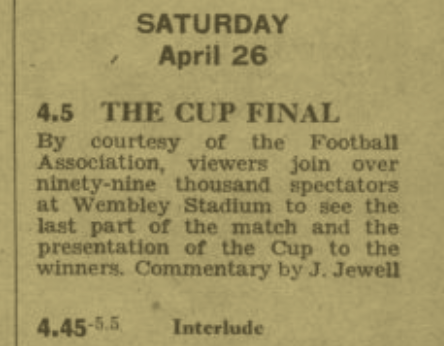
    Back with the next stage of our wander down Wembley Way (briefly taking in Westgate Street, Cardiff), but first a quick whip-pan back to the 1940s. In the last part, we looked at how the billing for the first televised post-war Cup Final was advertised as airing from 4.05pm to 4.45pm, the Radio Times promising that “the last part of the match” would be screened live.

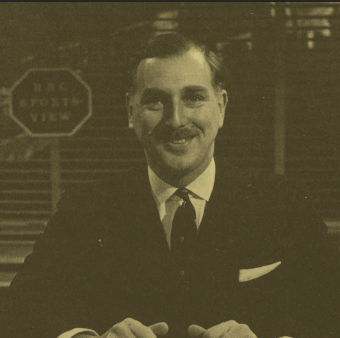
    Well. Since then, I’ve been contacted by Paul Hayes on BlueSky, who has some more background info on that broadcast, following his research into the life and career of Jimmy Jewell, for a BBC Radio documentary on the former Norwich manager. Jewell was a key figure in those early years of the televised cup, on both sides of the action. A World War I Air Force veteran turned former amateur footballer, Jewell became a Football League referee by 1932 and would be the man in black at the first televised Cup Final in 1938. It was Jewell who blew the whistle for the late penalty that led to Preston’s extra-time winner. The following year, Jewell became manager of Norwich City until the outbreak of war led to him rejoining the RAF.

    On returning from active duty, he turned his hand to sport commentary – including providing commentary for that 1947 Cup Final between Charlton and Burnley.

    Radio Times listings, 26 April 1947

    That’s where Paul Hayes’ research comes in. He has been able to confirm, from BBC paperwork of the time, that a late decision was made to broadcast the match in full, with the opening telecine film whirring into life at 2.45pm. To save Jewell from an exhausting two solid hours of solo chatter, former Corinthian footballer Norman Creek was brought in as co-commentator, though Creek’s forthright description of the match as dull didn’t prove popular with the producer. 

    Tellingly, Jewell was instead joined by England manager Walter Winterbottom in the commentary position for the 1948 final. 

    For the 1951 Cup Final, billed in the Radio Times as running from 3.45pm to 5pm due to Football Association huffiness, that’s almost exactly what happened, as confirmed by the Programme as Broadcast (PasB) notes for the day. Almost exactly, as coverage ended just over six minutes before 5pm, meaning there was room for Interlude film ‘Angel Fish‘, before Whirligig whirred into motion just after five. 

    [UPDATE: Courtesy of Paul Hayes again, there’s more on Whirligig here. which was BBC TV’s first Saturday teatime children’s programme, and not – as I’d completely misremembered – 1950s US kids drama series Whirlybirds]

    When it came to the 1952 final, which wasn’t broadcast live at all, the BBC’s Head of Outside Broadcasts Peter Dimmock did write to FA Bigwig Sir Stanley Rous asking for a change of heart a week before the match. Dimmock’s proposal was to keep the live broadcast under wraps until the morning of the match, or even not to publicise it at all – secretly broadcasting the biggest sporting occasion of the entire year. With the BBC’s Outside Broadcast base positioned just over from the Empire Stadium (as was), the Corporation were even prepared to secretly set up their camera positions at the last minute, to avoid giving the game away.

    Peter Dimmock, looking every bit as gentlemanly as you’d expect.

    Sadly, that ‘secret’ cup final coverage didn’t come to pass, meaning the 1951 final would be the last live cup final commentary from Jimmy Jewell, who died in Autumn 1952. Though at least his co-commentator for that 1951 final – one Kenneth Wolstenholme – does conjure up the image of a fitting (albeit theoretical) passing-the-baton moment.
    Lastly, Paul has shared some PasB details for the 1938 and 1939 finals, confirming that The Three Bears did indeed precede the Cup Final in 1938 – airing at 2.13pm instead of the RT-billed 4.40pm, and noting that the coverage of the 1939 final began slightly ahead of the billed time 2.40pm, before wrapping up at the later-than-billed time of 4.45pm.

    Absolutely lovely stuff, there. Many thanks to Paul for that information. His documentary on Jimmy Jewell – a special episode of Radio Norfolk’s Norwich City show The Scrimmage – is still available on BBC Sounds – and I can confirm is a very enjoyable way to spend 57 minutes. If only to learn how Jewell once managed to ruin Adolf Hitler’s day.


    Okay, onto the next series of Cup Final Day schedules. Now available with our without commercials, as it’s the start of…

    ERA THREE The Early ITV Years


    So, double the schedule info from now on. Just to point out at the start – I’ll use the ITV London listings for each year, so don’t expect to see Tiswas appear too soon. This is information overload as it is, I don’t want to make life even more difficult for myself by throwing Westward, Grampian and Tyne-Tees into the mix (when they come into being). Anyway, off to:

    5 May 1956: Manchester City 3 Birmingham City 1

    The first Cup Final Day where newspaper listings had to specify which channel things were on, instead of just putting listings under the word ‘Television’. This being a time when London weekend television was ran by a region-hopping ATV, here’s how they fared.

    BBC-tv
    14:30 to 17:00 The Cup Final

    Here’s a thought for you – remember The BBC Sports Personality of the Year 2007? Not the winner of the award itself, won by Italian-Welsh boxer Joe Calzaghe, but the furore over the event itself being sponsored for the first time. The deal with soft drink brand Robinsons led to the usual amount of Beeb-bashing in all the usual corners, the BBC Trust duly rapping those responsible on the knuckles and the event was never sponsored again.

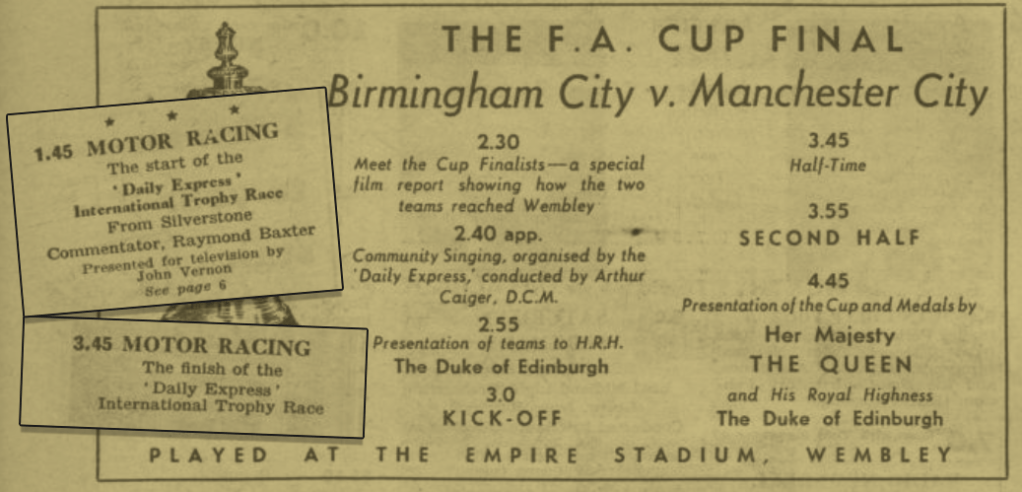
    Well, that didn’t seem to trouble anyone too much in the 1950s. “Community singing organised by the Daily Express” has been a fixture of the televised cup final coverage since it returned from the brief FA-enforced hiatus in 1953, and in 1956 it seemed especially egregious, with the tabloid sponsoring the Motor Racing immediately preceding the Cup Final at 1.45pm and being inserted into the half-time interval.

    Radio Times television listings, 5 May 1956

    With that in mind, it’s probably lucky to programme airing immediately following the final at 5pm was children’s programme Jack in the Box and not Rupert the Bear or Lord Beaverbrook’s Half Hour.

    ATV
    14:30 to 16:50 F.A. Cup Final

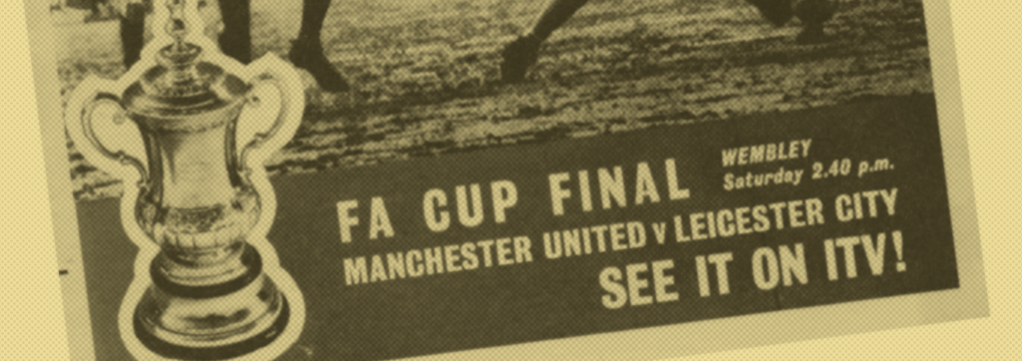
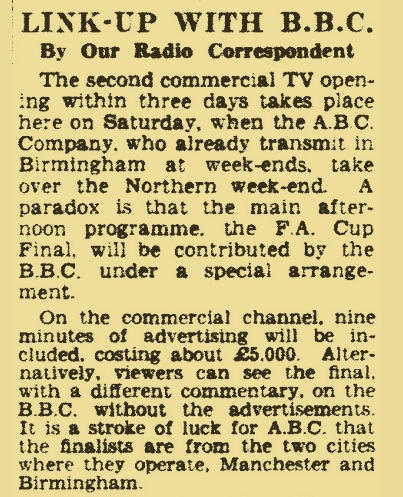
    Over on the Light Channel, quite ironically you wouldn’t get any such sponsorship hi-jinks due to the strict restrictions on advertising. Anyway, the channel’s inaugural Cup Final commentary was provided by Peter Lloyd, who’d previously worked alongside Jimmy Jewell to provide football commentary on the BBC since 1948, including the 1949 and 1950 Cup Finals. He was joined in the commentary box by England captain Billy Wright and former Manchester City stopper Frank Swift. Not a bad line-up for the first ever head-to-head Cup Final. Or, if you prefer, a bit impudent given the BBC are allowing them to broadcast the match and shove nine minutes of commercials around it.

    Granted, the actual reason was that it was a listed event, meaning no channel was allowed to have exclusivity to it.

    Daily Telegraph, Friday 4 May 1956

    London viewers had no lead-in programme for the final, but Midlands viewers tuning into their own weekend franchise ABC were treated to the pleasantly titled Introducing Ourselves at 2.15pm. The match was followed by a Superman cartoon at 4.50pm, then – joining Peter Lloyd as big name defector from the BBC – Muffin the Mule at 5.05pm. Don’t forget to stick around for Bernard Delfont presents The Winifred Atwell Show at 8.15pm, because regular guests Morecambe and Wise are in it.

    [UPDATE: Thanks again to Paul Hayes for noting Introducing Ourselves is most likely present because this was the first day that ABC was broadcasting to the North-West of England, having previously been broadcast only to the Midlands.]

    4 May 1957: Aston Villa 2 Manchester United 1

    BBC-tv
    14:15 to 17:00 The Cup Final

    With ITV companies declining the option of showing the match in 1957, it’s BBC all the way. The coverage was supplemented by highlights the previous night of an exhibition match between “Old England and Young England” at Highbury. The former: players over thirty who “have won their England cap” and a ragtag bunch of under-23s. This was the third such match since it had become a fixture in 1954, but the first to be won by Young England, who ran out 2-1 winners. A young chap with the surname ‘Clough’ was amongst their ranks that day. Wonder what became of him.

    The final – where Villa won their first final since 1924 – was followed at 5pm The Lone Ranger.

    ATV
    Viewing tuning in for an alternative view on the final hopefully weren’t confused by Variety Showtime appearing at 3pm, followed by Face the Mike at 4.15pm.

    3 May 1958: Bolton Wanderers 2 Manchester United 0

    BBC-tv
    14:15 to 16:50 The F.A. Cup Final

    A match-up that generated mixed feelings for Kenneth Wolstenholme – born in Manchester, schooled in Bolton – but as he wrote in the Radio Times before the match, at least nobody could accuse him of being biased. “But who will win on Saturday? How should I know. I’m supporting both teams!”

    Anyone tuning in before the match coverage started would just be treated to the test card, unless they found themselves in the transmission footprints of Wenvoe, Blaen-Plwyf, Holme Moss, or Sutton Coldfield transmitters. Those lucky few could tune in to Beunydd (“Bwrw golwg dros bynclau’r dydd mewn sgwrs a ffilm – a chyfle i gwrdd a rhai sy’n amlwg yn y newyddion”, or “take a look at the topics of the day in conversation and film – and a chance to meet some of the highlights in the news” if you prefer.)

    Following the lifting of the FA Cup, fans of motor racing could catch up with the latest new from The International Daily Express Trophy Meeting at Silverstone.

    ATV
    14:30 to 16:55 F.A. Cup Final

    The final returned to ITV in a year that proved to be a big one for football on the network. The following month would see the network broadcast live World Cup football for the first time, hosting seven live matches from Sweden. Then, in September, Scottish Television broadcast live football for the first time, with Hearts’ European Cup tie against Standard Liege.

    ITV London’s match coverage was preceded at 2pm by The Fox, an NBC Robin Hood-alike filmed in Britain. The match was followed at 4.55 by advertising magazine Saturday Showcase.


    ERA FOUR The Grandstand Years


    2 May 1959: Nottingham Forest 2 Luton Town 1

    BBC-tv
    11:30 to 17:05
    Grandstand

    Ah, here we go. I’ve covered the history of Grandstand when it was revealed as The 13th Most-Broadcast BBC Series Ever, but here’s where it first appears on cup final day. This was a gamechanger – now all live sport being broadcast on cup final day was listed under the umbrella title, meaning it’s not necessarily football all the way. However, from the programme menu for 2 May 1959, it’s football at least most of the way, with a Cup Final Preview at the start of the programme, highlights of the previous year’s final at 1.30pm and filmed reports from the Luton and Forest camps. Aside from the football there’s live swimming (North v South of England) and – shortly before kick-off – a “Keep Fit Demonstration by members of the Keep Fit Association of England and Wales, directed by Eileen Fowler of BBC Television Women’s programmes.”

    And so, the template for the next few decades is set – the variety of sports in an edition of Grandstand is slimmed down to make for as much cup final build-up as possible. This is basically the birth of Cup Final Day as we’d come to know it.

    Elsewhere on the BBC-tv schedule, Grandstand is preceded at 11.0 by Beunydd in the relevant regions, and followed at 5.05pm by Wheels and Wings, a Canadian cartoon film about the “Romance of Transportation”.

    ATV
    14:50 to 16:55
    Cup Final

    Over on ITV, there are also the first budding signs of Cup Final Worlds of Sport to come, with motor racing coverage (at 12.20 and 2.20pm) interrupted at 1.20pm by an exhibition match between Frankie Vaughan’s Boys’ Clubs versus a team of TV Stars. That was followed by admag Saturday Showcase at 4.55pm and Robin Hood at 5.10pm.

    7 May 1960: Wolverhampton Wanderers 3 Blackburn Rovers 0

    BBC-tv
    12:45 to 16:55 Grandstand

    The glorious Grandstand is now in full swing, and it’s football almost all the way. A day packed with filmed highlights of how each team got to the Empire Stadium (in previous rounds of the cup, rather than footage of their bus getting stuck in traffic, you understand), interviews with the players on each team, highlights of the 1959 final and the big match itself. In fact, the only billed diversion to the football in coverage of boxing from the USA, with Harold Johnson taking on Clarence Floyd.

    For those finding themselves near Wenvoe, Blaen-Plwyf, Holme Moss or Sutton Coldfield masts, the coverage is preceded by a Cymraeg coupling of Telewele (12.15pm) and Newyddion (12.40pm). Alternatively, stick around after the final whistle for Hide and Seek (5pm), a “film story about the adventures of five children on a Swedish island”, narrated by Frank Duncan.

    ATV
    With the light channel presumably keeping their powder dry while working on a deal with the Football League that would give them rights to screen live matches, the schedule for cup final Saturday was instead given to Amateur Boxing, International Wrestling, the Moscow State Circus and (an unspecified) Western, all under the umbrella title of “Let’s Go“.

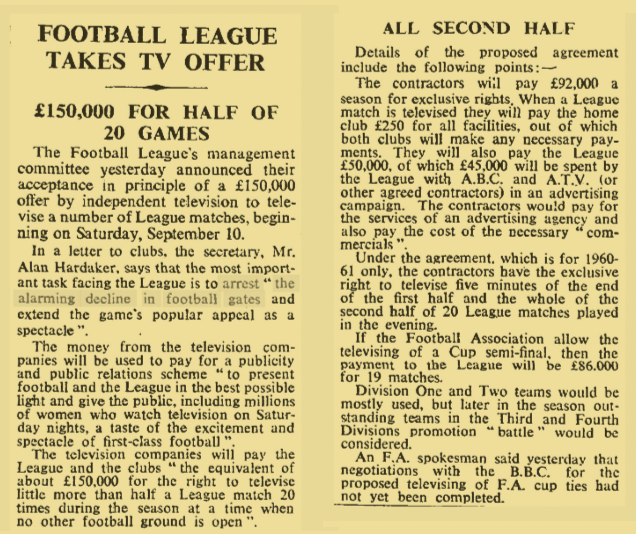
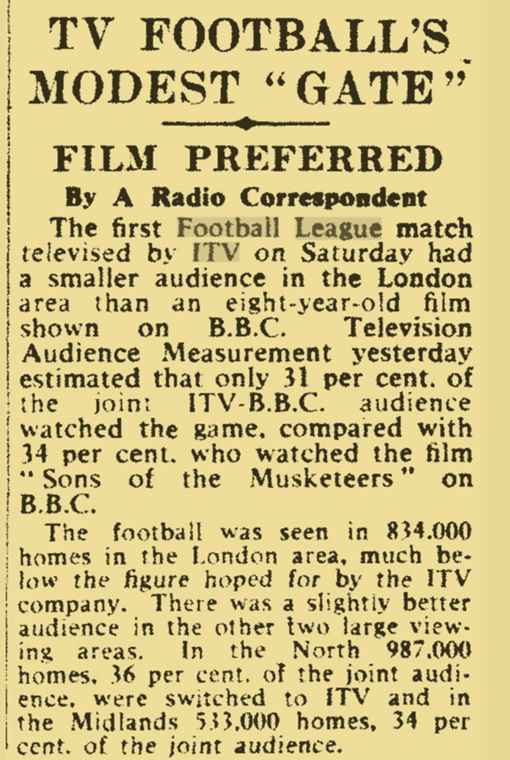
    The deal was ultimately signed in August, got off to a wobbly start in September, and was swiftly dropped when clubs refused to let cameras into their grounds and the Football League decided that ITV should do more to compensate players.

    The Times, 17 Aug 1960
    Daily Telegraph, 15 Sept 1960

    6 May 1961: Tottenham Hotspur 2 Leicester City 0

    BBC-tv
    11.15 to 16:55
    Grandstand

    A bit more variety to Grandstand this time around, with golf and swimming alongside the cup final fol-de-rol. Excitement elsewhere in the listings, as 9.30am (or 9.45am, depending on which newspaper you’re looking at) includes coverage of US space flight Operation Mercury, with Alan B Shepard Jr becoming the first American (and second person ever) to launch into space.

    The live match was followed by western Range Rider at 5pm, for those who just couldn’t wait for another western – Laramie – at 6.30pm. Don’t worry, only a few more years until we get Doctor Who.

    ATV
    13:05 to 17:00
    All-Star Afternoon: Cup Final and Wrestling

    Following the grand folly that was their live Football League coverage, ITV are returning to the Cup Final this year, with their afternoon devoted to the final and Live Wrestling.

    Following the sporting action at 5pm was Robin Hood starring Richard Greene in ‘The Black Patch’.

    5 May 1962: Tottenham Hotspur 3 Burnley 1

    BBC-tv
    11.15 to 17:00
    Grandstand

    David Coleman is on the pitch at Wembley Stadium to bring another day of football and sporting action, with the regular segments (Meet the Finalists et al still going strong) sharing space with golf from St Andrews, swimming from Blackpool and Boxing from Miami. For the match itself, the BBC had taken extra effort to upgrade their match coverage, their cameras now able to zoom in on the action where practical, giving viewers a much improved experience.

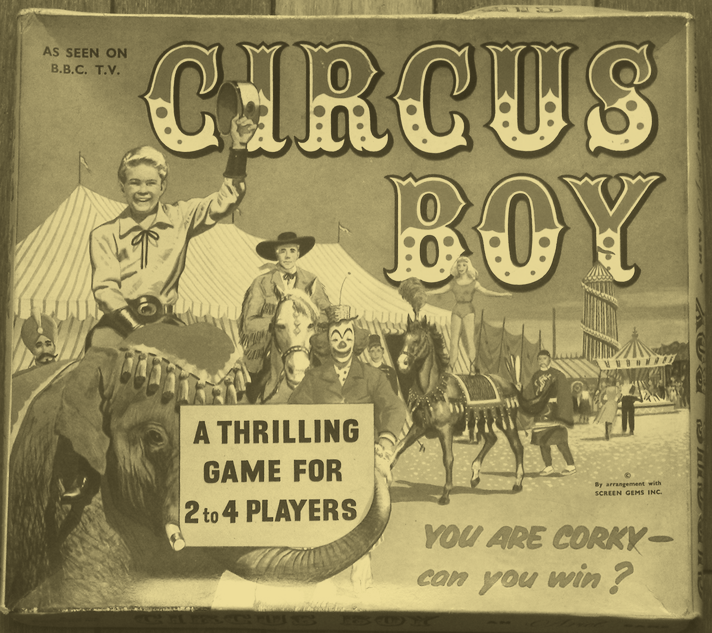
    Viewers tuning in before 11.15am could expect to see Telewele (10.40am) and Newyddion (11.05am) if they were in the relevant transmitter areas, or the tuning signal if not. Luckily, everyone would get to enjoy adventure series Circus Boy at 5pm, followed by Mr Pastry’s Progress at 5.25pm.

    Mr Pastry (right)

    ATV
    14:40 to 17:00
    FA Cup Final

    Pretty much by the numbers over on ITV this year, with coverage starting twenty minutes before kick-off, and finishing practically before Danny Blanchflower had reached the bottom of the Wembley steps with the cup.

    Before the coverage of the final, ITV viewers could enjoy Professional Wrestling from across town, over at Wembley Town Hall. Following the match, they were treated to Robin Hood episode “The Ghost That Failed”.

    25 May 1963: Manchester United 3 Leicester City 1

    BBC-tv
    12:00 to 17:00
    Grandstand

    A few weeks later in May than had been planned at the start of the season, all thanks to fixture congestion created by The Big Freeze of 1963, at was almost June by the time the 1963 final came around. A Manchester United team that had narrowly avoided relegation from Division One found form at the right time, despatching a theoretically superior Leicester side with a goal from Denis Law and two from David Herd.

    Elsewhere, viewers could enjoy Walker Cup golf from Tumberry, boxing from Madison Square Garden and show jumping from Wilmslow.

    The regular Telewele and Newyddion preceded the action, now followed by ‘Announcements‘. As was now traditional, Circus Boy followed the final whistle at 5pm.

    ATV
    13:20 to 17:15
    Saturday Sportstime

    Having cast an envious glance at Grandstand, ATV tried to bottle that magic by putting a Saturday Sportstime sticker over their Saturday afternoon sporting action. Though with it comprising the same mixture of the FA Cup Final and wrestling, there wasn’t too much of a difference from last year.

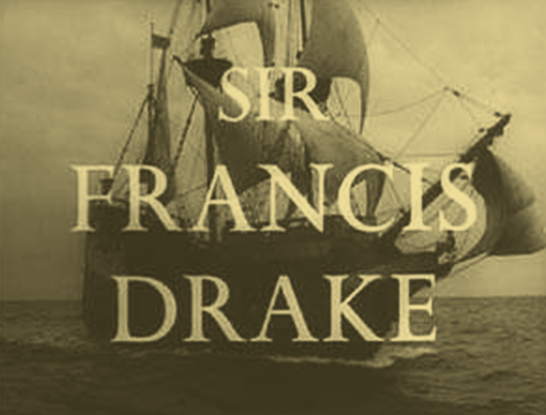
    For anyone not fancying Circus Boy on the Beeb, there was the option of seeing big budget drama Sir Francis Drake at 5.15pm.

    Fool your friends by claiming this was the working title for Blue Peter

    We’ll leave this there for now. Come back next time to see The BBC Television Service regenerate into two separate channels. There’ll be a lot of that going on.

  • The Eighty-Three Roads To Wembley: Part One

    With the FA Cup Final set to kick off soon (this year, Man City v Chelsea, or “The Neutrals’ Nightmare”), it’s time for bloggers, posters and podcasters to begin the annual pissing contest of How Early Cup Final Coverage Used To Begin. It started as early as 10am! No, 9am! Well, of course, I remember it starting at 8am!

    But did it? Did it really? Did it? Really?

    And is anyone bloody-minded enough to check? Are they really? If it ever really started, when did it start? Sadly, it’s very nearly a full 90 years since regular scheduled television began in the UK, so it’s not as if anyone’s about to check.

    Yeah, hello. 

    Predictably, I’ve just done that thing. So: join me now as we scamper back through time to the sepia-soaked past and explore The Complete Coverage Of FA Cup Final Day on British Television, seeing how that particular journey panned out.

    Starting with:


    ERA ONE The Pre-War TV Era


    30 April 1938: Preston North End 1 Huddersfield Town 0

    BBC-tv Billing: “2.25pm Cup Final”

    Preceded by: The Three Bears

    Followed by: Closedown

    While the BBC Television Service began in November 1936, by the time the first FA Cup Final of the television era came around – on 1 May, with Sunderland beating Preston 3-1 – the technology wasn’t quite up to beaming it all onto television screens. And so, as radio listeners settled down to “description by George F Allison and Ivan Sharpe” at 2.45pm, those early tele-adopters were treated to “Summer Gardening by C H Middleton”.

    That changed in 1938, with live coverage of the final beamed into the homes to viewers in the UK (well, some bits of the UK) for the first time. The Radio Times listings for the big day had coverage set to begin at the very specific time of 2.27pm, with the action coming direct from Wembley, followed by short ballet film The Three Bears. However, newspapers from the day itself reverse that order, with The Three Bears sitting down to their porridge at 2.10pm, with the cup final coverage starting at 2.25pm. That late switch was a canny move – the viewing hundreds sat through a goalless 90-minutes, leading to half an hour of extra time, the match ultimately settled by Preston inside-right George Mutch slotting home a 119th minute penalty.

    Even the Radio Times listing for the event had been uncertain about the whole affair: “By kind permission of the Football Association and Wembley Stadium, the Cup Final match between Preston North End and Huddersfield Town will be televised (conditions permitting) direct from Wembley.” Can’t imagine Matt Lorenzo excitedly proclaiming that on ITV, can you?

    23 April 1939: Portsmouth 4 Wolverhampton Wanderers 1

    BBC-tv Billing: “2.45pm F.A. Cup Final”

    Preceded by: Nothing

    Followed by: Closedown

    Here we go. A veritable bagful of goals? Check. A much less uncertain Radio Times billing? Check. A warning that no enterprising publican is to broadcast the match to their customers? Check and don’t even bloody think about getting your J. E. Jenkinson’s Steam-Powered Firestick out.

    "The match between Portsmouth and Wolverhampton Wanderers televised direct from Wembley Stadium.
In accordance with the agreement between the BBC and the Football Association, no rediffusion in places of public entertainment will be permitted."

    It even made the cover of the RT, with a map of the pitch to aid radio listeners and a pointer to where the TV cameras would be.

    The inside pages provided more detail, with the journal’s pseudonymous columnist The Scanner reporting how the trio of cameras – two just above the Royal Box and a third one on ground level – “should easily suffice to keep the whole of the game well in the picture”.

    In short: great. All up and running. The FA Cup Final is going to be a staple of TV sports coverage for every year from now on, and nothing is going to change that. Now to take a big drink of water and check what happened in the 1940 Cup Final.

    Hey, the telly’s stopped working. I was watching that cartoon.

    ERA TWO The Early Post-War Years


    26 April 1947: Charlton 1 Burnley 0

    BBC-tv Billing: “4.05pm The Cup Final”

    Preceded by: Nothing

    Followed by: “4.45pm Interlude”

    With television not quite ready to return in time for the 1946 final (27 April, Derby County 4 Charlton Athletic 1), it would be the following year before the final reappeared on TV screens. The reduced circumstances of the Television Service meant that full coverage couldn’t be provided for that year’s Charlton vs Burnley match, with just “the last part of the match” being screened from 4.05pm, along with the presentation of the cup to the winners, just in time for a twenty-minute interlude and the transmitters going to sleep until 8.30pm (Victorian operetta The Two Bouquets, if you were wondering).

    24 April 1948: Manchester United 4 Blackpool 2

    BBC-tv Billing: “2.30pm The Cup Final”

    Preceded by: Nothing

    Followed by: “4.50pm Closedown”

    Here we, in a very real sense, go. Back to full-match coverage and for the first time, a proper itinerary.

    2.30 Community singing and interviews with members of the crowd
    2.55 Presentation of the teams to His Majesty the King
    3.0 The kick-off
    3.45 Half-time
    3.55 The second half
    4.40 The final whistle
    4.45-4.50 Their Majesties the King and Queen present the F.A. Cup and medals to the two teams

    That’s what we want.

    30 April 1949: Leicester City 1 Wolverhampton Wanderers 3

    BBC-tv Billing: “2.30pm The Cup Final”

    Preceded by: “2.15pm In Our Garden”

    Followed by: “4.50pm Closedown”

    The same again, another full itemised breakdown of events in the Radio Times and a return to a lead-in programme before the big match. In Our Garden allowed horticulturalists a chance to enjoy “F. Streeter [giving] more practical hints” before Abide With Me.

    29 April 1950: Arsenal 2 Liverpool 0

    BBC-tv Billing: “2.30pm The Cup Final”

    Preceded by: “2pm In Our Garden”

    Followed by: “4.50pm Closedown”

    A repeat of the previous year’s coverage in 1950, this time with In Our Garden extended to a half-hour slot (“Frances Perry discusses the problem of chrysanthemum-stopping”). We could get used to this. Let’s hope nothing happens to (etc).

    28 April 1951: Newcastle United 2 Blackpool 0

    BBC-tv Billing: “3.45pm The Cup Final”

    Preceded by: Nothing

    Followed by: “5pm Whirligig”

    Oh dear. “This afternoon sees the climax of the Association Football season and you are invited to join the hundred thousand spectators during the second half of the match.” The Football Association, wary of the growing popularity of television, decide to restrict television coverage to just the second half, lest there be in impact on ticket sales – a fuzzy eight-inch monochrome screen being deemed a distinct rival to being at Wembley. Or, indeed, any of the Football League matches taking place that afternoon.

    3 May 1952: Newcastle United 1 Arsenal 0

    BBC-tv Billing: “3pm Cricket: Worcestershire v. India”

    Wait, what? September 1951 saw the FA Council proclaim that the Cup Final would not be televised until further notice. As such, televisually equipped fans of both teams were instead treated to cricket on their screens come kick-off time. That wasn’t the only grinchery being meted out by the Football Association – that year, only the second half of the match was broadcast on The Light Programme. Again, a total of eighteen Football League matches being played on the same day were to blame.

    Hopes had been high prior to the FA Council’s meeting that the whole sorry saga could have been avoided, with reports that the final could be moved back a week to 10 May, thus avoiding a programme of league matches on the third. But: it was not to be.

    2 May 1953: Blackpool 4 Bolton Wanderers 3

    BBC-tv Billing: “2.30pm The Cup Final”

    Preceded by: Nothing
    Followed by: “5pm The S.S. Saturday Special”

    With football missing from TV screens the previous May, the FA relented just a couple of months later, announcing in July 1952 that the final would return to TV screens, one unnamed delegate reporting to the press that it would do little harm to “show its goods in the shop window once a year”. That turned out to be splendid timing, meaning the television audience – boosted by a upswing in receiver sales in the run up to the Coronation – wouldn’t miss one of the most heralded cup finals in the competition’s history. Stanley Matthews, Stan Mortenson, Blackpool coming back from 3-1 down to win 4-3, cats and dogs living together, mass hysteria etc.

    As a cherry on that particular pudding, match coverage was followed by “The S.S. Saturday Special” with “Skipper Peter Butterworth and Porterhouse”, thereby making this an early holder of the record for Best Day Of Telly So Far.

    1 May 1954: West Bromwich Albion 3 Preston North End 2

    BBC-tv Billing: “2.30pm The Cup Final”

    Preceded by: Nothing
    Followed by: “5pm Whirligig”

    Another goalfest, with Kenneth Wolstenholme on the lip-mic and the Queen Mum presenting the trophy to the victorious Baggies at the end.

    7 May 1955: Newcastle United 3 Manchester City 1

    BBC-tv Billing: “2.30pm The Cup Final”

    Preceded by: Nothing
    Followed by: “5pm Jigsaw”

    The final year of the BBC’s uninterrupted monopoly of the big day, with the first Independent Television franchises gearing up for their big launch in September. The match was a memorable one, with Jackie Milburn slamming one home within the first minute as Newcastle roared to a 3-1 victory.

    Any viewers served by the Kirk o’ Shotts, Glencairn and Redmoss transmitters would have welcome an alternative viewing option, given they were served up live coverage of the cricket match between Poloc Cricket Club v. West Scotland. Still, any Newcastle fans finding themselves north of the border that day would only need to wait another 70 years to see their team lift a trophy at Wembley.


    We’ll leave it there for now, but look forward to the next few decades next time. ITV! Grandstand! And presumably the fabled Cup Final Coverage Starting At 9am!

    Daily Mirror, Thursday 22 September 1955.
  • The Most-Shown TV Shows of 2024 and It’s Slightly Different but Also Still The Most-Shown TV Shows of 2024

    The Most-Shown TV Shows of 2024 and It’s Slightly Different but Also Still The Most-Shown TV Shows of 2024

    Following this update the other day, of the most-broadcast TV shows of 2024, I felt compelled to consider programmes only broadcast on the ‘main’ traditional channels. So, without any additional commentary, here’s a similar list, but only looking at programmes broadcast on BBC One, BBC Two, ITV1, Channel 4 and Channel 5.

    PosProgrammeAiringsNetworkEpisodes per Day
    203rd Rock From the Sun292 timesC40.978
    19Flog It!302 timesBBC20.978
    18Escape to the Country313 timesBBC1 x 255, BBC2 x 580.986
    17Homes Under the Hammer333 timesBBC1 x 271, BBC2 x 620.992
    16A Place in the Sun353 timesC40.995
    15The Adventures of Paddington363 timesC51.038
    14The King of Queens364 timesC41.049
    13Come Dine with Me384 timesC41.104
    12Friends404 timesC51.107
    11Bargain Hunt405 timesBBC1 x 307, BBC2 x 981.161
    10Pip & Posy425 timesC51.303
    9Fireman Sam477 timesC51.355
    8Countdown496 timesC41.454
    7Four in a Bed532 timesC41.516
    6Cheers555 timesC41.781
    5Everybody Loves Raymond733 timesC42.003
    4PAW Patrol831 timesC52.27
    3The Simpsons962 timesC42.366
    2Frasier1485 timesC42.628
    1Peppa Pig2194 timesC54.057

    Merry Winterval, everyone! Hope you’re not getting an Everybody Loves Raymond box set for Christmas!

  • The Most 50 TV Shows of 2024

    The Most 50 TV Shows of 2024

    Yes, that’s not a typo. Or at least, not an accidental one.

    Lots of newspapers, magazines and websites are currently parading their list of The 50 Best TV Shows of 2024 (spoiler: you haven’t heard of at least 25 of them, and won’t have watched at least 40 of them). But sod the quality, we’re going to focus on quantity. The programmes you won’t need to subscribe to sixteen different streaming services to be aware of. The shows where, providing you own a television and a face, the two will have collided at least once during 2024.

    What if some idiot had pulled an entire year of TV listings for main channels? And then generated a list to see which programmes have been pumped out into the digital jungle most frequently? And made a reverse-order list of the fifty most oft-spotted shows? What then, eh?

    Hi, I’m that idiot.
    So, here we go. If nothing else, I can promise you:

    • It’ll be an end of year list of TV programmes where you’ve probably heard of them all.
    • We’ll learn which are the most uninspired of all the main UK TV channels.
    • Confirmation that, if broadcast TV is dying, the cause of death is definitely going to be drowning.

    Quick set of ground rules: I’m not including news, weather, teleshopping, Unwind with ITV, overnight gambling filler or pseudo-programmes like FYI Daily that purely exist to exploit ad-minutes-per-hour loopholes. I’m only looking at the main entertainment channels available on Freeview (BBC One, BBC Two, BBC Three, BBC Four, ITV1, ITV2, ITV3, ITV4, C4, E4, More4 and Five). There may very well be some omissions that have slipped through my datanet, but not too many.

    Okay. On with the show(s).

    –

    1. Flog It!, 302 times
      BBC2
      0.825 episodes per day

    Flog It! To Death, more like.

    1. A New Life in the Sun, 304 times
      C4 x 114, More4 x 190
      0.831 episodes per day

    A companion to a series we’ll definitely be seeing later in the list.

    1. Looney Tunes Cartoons, 304 times
      ITV2
      0.831 episodes per day

    Not the classic old Warner Bros cartoons of yore (many of which went out under the culturally memory-holed Merrie Melodies banner), but the HBO-funded and HBO-ignored modern versions. Which, as far as I’ve seen, are very good. But not good enough to have me putting the telly on at 6:50am each morning.

    1. Escape to the Country, 313 times
      BBC1 x 255, BBC2 x 58
      0.855 episodes per day

    The comforting feeling of following the journey of people who bought houses in London for 3/6 in the sixties, and as a result can now afford to buy Somerset.

    1. Two Pints of Lager and a Packet of Crisps, 320 times
      BBC2 x 1, BBC3 x 319
      0.874 episodes per day

    Yep, with the back-on-actual-telly Three coming with the stated mission of serving modern-day 16 to 34-year-olds, the most common sight on the channel is a programme that started 23 years ago. So, it probably satisfies any remit the channel has for historical content. Airing as often as eight times per night. Eight times!

    1. Food Unwrapped, 325 times
      C4 x 32, More4 x 293
      0.888 episodes per day

    One can’t help but feel this food-based consumer series should’ve kept the title of the Dutch original. Keuringsdienst van Waarde practically rolls off the tongue.

    1. Homes Under the Hammer, 333 times
      BBC1 x 271, BBC2 x 62
      0.91 episodes per day

    As mentioned previously, the practice of property developers buying up repossessed homes to remodel and resell for a fast buck is a pretty distasteful idea for a TV series. But also, a very popular one.

    1. Car S.O.S, 362 times
      C4 x 87, More4 x 275
      0.989 episodes per day

    Rebroadcast episodes of the Nat Geo series are proving suitable filler fodder for tea-time More, with episodes also featuring on lunchtime Channel Four. Most interesting to me is that one of the presenters is Fuzz Townshend from Pop Will Eat Itself, which must surely have led to a #CarPoppies hashtag on the socials. “Not Now James May, We’re Busy” etc.

    1. The Adventures of Paddington, 363 times
      C5
      0.992 episodes per day

    Also known as: The Animated Adventures of Modern Britain’s Angel of Death.

    1. Kojak, 364 times
      ITV4
      0.995 episodes per day

    Nominative determinism klaxons abound, as more than 50 years since his most famous character debuted, Telly Savalas is still never off the damn thing.

    1. The King of Queens, 364 times
      C4
      0.995 episodes per day

    The mid-table US network sitcom makes the list, albeit mainly as support act to the Simpsons-Frasier-3rd Rock triumvirate of breakfast A-listers on the fourth channel.

    1. Top of the Pops, 377 times
      BBC2 x 2, BBC4 x 375
      1.03 episodes per day

    Giving a BlueSky-toting Gen X a reason to watch live broadcast television each Friday night? Even if it’s thirty-year old repeats, the opportunity to join the pile-in on Robson, Jerome and Nicky Campbell is just tantalising enough to keep the licence fee payments coming from over-forties.

    1. First Dates, 381 times
      C4 x 55, E4 x 326
      1.041 episodes per day

    Letting the viewer act as unseen third wheel in this long-running dating series is a quirk that keeps drawing an audience. It even enjoyed a Reeves and Mortimer spoof, albeit in the (admit it) below par BBC Four Vic and Bob’s Big Night Out.

    1. The Royal, 389 times
      ITV3
      1.063 episodes per day

    The Jive Bunny version of Casualty – it’s not just there to provide fodder for TV Burp.

    1. Friends, 404 times
      C5
      1.104 episodes per day

    They’ll be there for you, until a time where the show suddenly becomes unprofitable. Which isn’t happening any time soon.

    1. Bargain Hunt, 405 times
      BBC1 x 307, BBC2 x 98
      1.107 episodes per day

    Another entry from BBC One’s stable of daytime perennials. Bring back Open Air, you cowards!

    1. Pip & Posy, 425 times
      C5
      1.161 episodes per day

    This list is going to contain more Milkshake than a vessel hurled at Nigel Farage, isn’t it? This adaptation of Axel Scheffler’s book series proving to be an integral part of Five’s pre-school strand on all seven days of the week.

    1. Bob’s Burgers, 448 times
      ITV2
      1.224 episodes per day

    Still the strongest string in Fox’s Sunday evening animated comedy line-up over there, even if 2024 saw it removed from ITV2’s primetime line-up and relegated to the midnight hour. Still, it was lovely to see The Bob Burgers Movie getting a teatime airing over the summer.

    1. Fireman Sam, 477 times
      C5
      1.303 episodes per day

    Sam Tân for viewers west of Offa’s Dyke, of course. It’s incredible that this has been running in various guises since 1987, generating over 300 episodes along the way. Less credible that Norman Price is still getting away with his nonsense. Bet he wouldn’t be so cocky if the Sam/Fire Engine Transformer that you can find in branches of Home Bargains were to feature in the programme.

    1. Find It, Fix It, Flog It, 479 times
      C4 x 189, More4 x 290
      1.309 episodes per day

    Commission it, film it, repeat it, more like. It’s The Repair Shop but with a profit and loss margin.

    1. Countdown, 496 times
      C4
      1.355 episodes per day

    Astonishing that this is still going strong, and still providing surprises along the way. Mainly when you look at the list of former presenters. Anne Robinson? Really? Wow. Forgot that.

    1. Mr Bean, 539 times
      ITV2 x 471, ITV4 x 68
      1.473 episodes per day

    The total for ITV2 broadcasts of the animated spin-off bolstered by ITV4 repeats of Live Action Bean, granted. But I’m not doing the spreadsheet again.

    1. The Goldbergs, 548 times
      E4
      1.497 episodes per day

    Fulfilling E4’s public service remit of showing a billion episodes of an American sitcom most people have never heard of, the antics of the titular 1980s Philadelphia family have happily filled many a mid-afternoon hour throughout the year.

    1. Agatha Christie’s Poirot, 549 times
      ITV3
      1.5 episodes per day

    Twirly-‘tached crime-confounding capers are pretty much ITV3’s comfort blanket, so it’s little surprise to see a surfeit of Suchet here.

    1. Cheers, 555 times
      C4
      1.516 episodes per day

    Normally, when a channel gives up on something big, it’ll spend about a decade and untold millions trying to find something else to fill the gap. In the case of Four’s quest to find a popular successor to The Big Breakfast, the stopgap solution of flinging on American Sitcom Repeats until something better than RI:SE came along proved to be the canniest move the station would make this century.

    1. Minder, 592 times
      ITV4
      1.617 episodes per day

    “Why don’t you just… Not go home? She’d be over the moon.”
    “That is very wounding, Terrence. Wounding and ungrateful.”

    1. Totally Bonkers Guinness World Records, 615 times
      ITV2
      1.68 episodes per day

    Ah, the 1980s scheduling staple of flinging on World Records footage to fill a half-hour or two is still going strong, though it really needs David Frost in NTSC for the full effect. And nobody has noticed that it’s putting a programme title that’s plugging alcohol in a kids’ slot, just after Scooby-Doo. Oh, you might disagree, but nobody would pick the suffix ‘Publishing’ if Guinness came up in a word association test.

    1. Dress to Impress, 656 times
      ITV2
      1.792 episodes per day

    A teatime staple for people who – somehow – avoid the whole teatime Pointless versus The Chase quandary. Basically people who heard about the Blur vs Oasis battle of the charts, and bought Everybody by Clock instead.

    1. Teen Titans Go!, 671 times
      ITV2
      1.833 episodes per day

    As far as superheroes go, here’s the Justice League’s Under-21 side, with ITV2 broadcasting every minute of their Bristol Street Motors Trophy group stage matches.

    1. Hollyoaks, 690 times
      E4
      1.885 episodes per day

    This is never going to end and when E4 finally get sick of it, it’ll just reappear on 4-Tel or something.

    1. Gogglebox, 708 times
      C4 x 173, E4 x 535
      1.934 episodes per day

    Gogglebox is nothing more than a less good remake of ParamountText’s Mailbox pages. Change my mind. (I really do stand by my original dismissal that it’s nothing more than a crowdsourced TV Burp.)

    1. Everybody Loves Raymond, 733 times
      C4
      2.003 episodes per day

    Channel Four certainly love Raymond, especially in a weekday early morning slot. It would’ve cost them a fortune to repurchase Lock-keeper Cottages for an ill-advised BB reboot, in fairness. Though one can’t help suspect that Chris Evans would now be a lot more willing to get involved.

    1. American Dad!, 747 times
      ITV2
      2.041 episodes per day

    One of the best jokes in American Dad! was Francine’s “No wonder the doctors in Scrubs don’t find time to be funny”. Mind you, that was a long time ago – don’t think it could afford to be that cocky nowadays. BONUS FACT: October 2025 will mark the 20th anniversary of American Dad debuting on BBC Two.

    1. Young Sheldon, 749 times
      E4
      2.046 episodes per day

    I don’t even like Old Sheldon tbh.

    1. Paw Patrol, 831 times
      C5
      2.27 episodes per day

    The cartoon canines show little sign of stopping. Rubble has even landed his own spin-off series, which makes him the Frasier of Adventure Bay.

    1. Heartbeat, 927 times
      ITV3
      2.533 episodes per day

    “Nick Berry had talent in a previous life
    Nick Berry had talent in a previous life
    Nick Berry had talent in a previous life
    Nick Berry had it all” – Mclusky, Random Celebrity Insult Generator.

    A bit harsh, lads. He was in The Box of Delights on BBC Four just the other day. They don’t cast just anyone as ‘Pirate Rat’.

    1. A Place in the Sun, 930 times
      C4 x 353, More4 x 577
      2.541 episodes per day

    [Adjusts Rory Bremner glasses while speaking in a Trevor MacDonald voice] Well, with old Keir Starmers stopping winter fuel payments, seeing coverage of people buying second homes in Gran Canaria will be the cheapest way pensioners can try to at least feel warm. [Pause for applause.]

    1. The Simpsons, 962 times
      C4
      2.628 episodes per day

    A cultural totem that completely transformed animated comedy it might be, but this week’s news that Four are going to shunt The Simpsons from a teatime slot on their main channel over to E4 means that Springfield now simply has to become a twin town of Chester.

    1. Family Guy, 994 times
      ITV2
      2.716 episodes per day

    Meanwhile, here’s the show that will forever be in the Simpsons’ shadow. Not as popular as it used to be, I’ll wager, but it seems certain that ITV would fly into a panic if someone else lost the rights. BBC Three would make a desperate bid for this if the master tapes of Two Pints of Lager ever snapped.

    1. Classic Coronation Street, 998 times
      ITV3
      2.727 episodes per day

    Followed by…

    1. Classic Emmerdale, 1000 times
      ITV3
      2.732 episodes per day

    A victory lap for ITV’s twin kings of soap. Once they run out, I’m hoping they’ll spin up Albion Market.

    1. 24 Hours in A&E, 1021 times
      C4 x 62, More4 x 959
      2.79 episodes per day

    Well, your nan might be been left there on a stretcher for 17 hours with her shattered hip, but at least More4 had something to show in a Saturday night double-bill all year. So, you know.

    1. Ramsay’s Kitchen Nightmares USA, 1025 times
      C4 x 228, E4 x 797
      2.801 episodes per day

    It’s really hard to get tired of seeing other people get a bollocking at work, isn’t it? Though, unlike the superior British original version, this has never had a man walking around shouting “BOLLOCKS TO BISTO” through a loudhailer at passers-by.

    1. Brooklyn Nine-Nine, 1148 times
      E4
      3.137 episodes per day

    The endlessly-quotable antics of New York’s fun blue line. A pity the endless cancellations and okay-one-more-seasons left the final episodes wobbling with disinterest towards the finish line, but remember it for all those lofty heights. “All of Planet Earth. With the British narrator.”

    1. Frasier, 1485 times
      C4
      4.057 episodes per day

    Here he is! If you ever want to annoy a fan of Frasier, simply point out that most episodes seem to involve Dr Crane getting handcuffed to a stripper ten minutes before an Important Dinner Party. Because, while that’s not true, that it tells us about Frasier is (etc).

    1. Modern Family, 1786 times
      E4
      4.88 episodes per day

    “The viewers look unhappy.” “Shovel on more episodes of Modern Family.” Showered with praise by the press, there must be something wrong with my telly, which only seems to show episodes where it’s far too busy being pleased with itself to, y’know, be good.

    1. Peppa Pig, 2194 times
      C5
      5.995 episodes per day

    Lovely as it is, imagine being in the part of the multiverse where Ben and Holly’s Little Kingdom is the Astley Baker Davies production that took global TV by storm. Nothing against Peppa per se, but Ben and Holly is that bit better. Peppa probably couldn’t get away with having an (unseen) character called Sharon the Totally Insane, for one thing.

    1. Come Dine with Me, 2199 times
      C4 x 384, E4 x 35, More4 x 1780
      6.008 episodes per day

    Plus…

    1. Four in a Bed, 2337 times
      C4 x 532, More4 x 1805
      6.385 episodes per day

    While there were lots (and lots) of bad things about having an overstuffed cartoon scarecrow as Prime Minister for a few years, one that stands out was him appointing Nadine Dorries as Minister of Culture, who was determined to attack Channel Four following their wheeze of putting an ice sculpture in one of the chairs for an election debate. The good people of social media took at arms (well, keyboards) to express their disgust at Dorries wanting to force unpopular changes to the fourth channel, until she scampered back off to her, well, obviously not constituency. And yet… SO much of it is just these two programmes on a seemingly endless loop. S4C makes much more of an effort, and that’s got a budget of 17p and some buttons. What would Murun Buchstansangur say?

    1. The Big Bang Theory, 3216 times
      E4
      8.787 episodes per day

    Remember when E4 was going to be Britain’s answer to HBO? That was the initial plan before it launched, with subscriptions driving previously unimaginable levels of creativity. Where are we at with it in 2024? On 257 calendar days of 2024, E4 showed at least TEN episodes of The Big Bang Theory. The glory days of Skins and Misfits are basically in a whole other era, aren’t they?

    –

    And there we go. Between the fifty, that makes for a total of 39,340 individual TV broadcasts, all of which would require an issue of the Radio Times stretching from Carlisle to Cornwall (okay, no it wouldn’t).

    But all these do tell us a lot about which are the least original TV channels currently kicking about your digibox. Indeed, there’s one channel that one might have expected to feature, but which was wholly absent from the list. Here’s the full breakdown by channel, ranked by ‘number of episodes in that top fifty’:

    E4 – 9,830 broadcasts in the list
    C4 – 6,804
    More4 – 6,169
    ITV2 – 4,906
    C5 – 4,694
    ITV3 – 3,863
    ITV4 – 1,024
    BBC1 – 833
    BBC2 – 523
    BBC4 – 375
    BBC3 – 319
    ITV1 – 0

    That’s right, not a single ITV1 programme made the cut. For the record, the most-spotted programmes that even appeared on that channel were: Celebrity Catchphase (51st place, shown 298 times, 26 on ITV1, 272 on ITV2), Family Fortunes (56th place, shown 272 times, 24 on ITV1, 250 on ITV2) and Midsomer Murders (57th place, shown 272 times, 11 on ITV1, 261 on ITV3). The highest ranking for an ITV1-exclusive show was joint-67th place for This Morning and Lorraine (both shown 260 times). The Chase only made number 78 on the list (shown 249 times). Fair dues.

    So, that’s it for the year. Hopefully, I shall be back on the blog soon. Hopefully with some exciting news. Ooh, the excitement.

  • The Joint-165th Most-Broadcast Programme on BBC TV (also 200th)

    What? Eh? Weren’t we done with this?

    Okay, the blog has been quieter than planned of late, and that’s because I’ve been stupidly doubling the number of entries in the book version of (now) The 200 Most-Broadcast BBC Programmes Ever (which also throws in full broadcast histories for BBCs Three, Four, Choice and Knowledge because why not?). And, who’d have thunk, writing another hundred programme entries while trying to find something interesting to say about each one isn’t quick. You try and dig up a bunch of hidden knowledge about The O-Zone, I dare you. Despite that, it’s currently at 344 pages. Several of which aren’t about The O-Zone.

    So, what’s going on here then? Well, on writing one such entry, I couldn’t help but notice we’re right on the 55th anniversary of the first time it was ever broadcast on the BBC. And as it’s a really well-known programme, it’d be nice to share the write-up for it. And so, without any further ado, here’s…
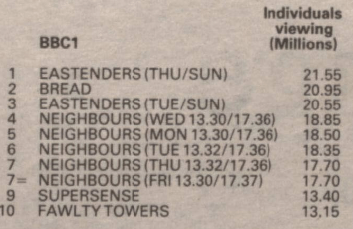
    Hang on, not that. This:

    =165. Star Trek

    1969-2007, broadcast 659 times

    BBC1 (329 times, 1969-1985), BBC2 (329 times, 1985-2007), BBC4 (once, 2006)

    The secret of getting a TV hit is getting the timing just right. Get your show on air right when people are going to go gangbusters for it, from Ninja Turtles on BBC1 in 1990, to Ninja Air Fryers on Five in 2023. And I’d say the all-time intergalactic champion of peak-interest scheduling is the BBC scheduling the first episode of Star Trek for 12 July 1969, just four days before the launch of the Apollo 11 mission that would soon see Neil Armstrong and Buzz Aldrin stomp about on the moon. Stick that in your air fryer.

    Wasn’t expecting a hit for “space themed air fryer” in all honesty, but there you go.

    Aside: That’s much cleverer scheduling than that of NBC, who’d pseudo-cancelled the underperforming series by shoving season three into the 10pm Friday ‘death slot’, ensuring that ratings would drop further, and the axe could finally be dropped. The last episode of the series set in space, a thing clearly nobody would care about, aired on 3 June 1969. Just a few weeks before the launch of… (checks notes) oh NBC, you idiots.

    Not that the moon landing was the BBC’s real impetus for luring Kirk and Co on British screens. With Doctor Who having been such an instant smash for the Beeb, and the sixth series wrapping up (with the last part of The War Games, detail fans) in late June 1969, a nation was hungry for more Saturday evening sci-fi, so it made perfect sense to bring in the big new American series. And the new series certainly drew a lot of attention.

    The Daily Mail – hardly a publication you’d expect to get excited about aliens invading Britannia’s living rooms – breathlessly hailed the incoming Trek as “the best science-fiction series produced for television”, while the Daily Mirror, who’d first flagged up the forthcoming series back in January that year, highlighted reports of Trek’s “imagination, technical accuracy and attention to detail”. A little later, the Daily Mail’s TV critic Peter Black would hail the series as “the most intelligent and literate of current fictional imports.”

    It’s not going to surprise anyone if I mention that Star Trek was a great big success for BBC1. Within a few months, newspapers could be seen running interviews with Fred Phillips (who, as everyone knows, was The Make-Up Man Who Made Spock’s Ears – “I make them with a rubber cast of Leonard’s real ears”), excited columns about Trek being one of the first programmes to be shown in colour on BBC1 (the day before the first episode of Monty Python’s Flying Circus joined that list – and still six weeks away from the ‘official’ launch of colour on the channel), and plenty of viewer letters (“Now Star Trek has moved to evening viewing, what can we expect next… Dr Who instead of the Wednesday Play?” – K. Barker, Dullardshire).

    While Star Trek (eventually) became a big hit through syndication over in America, the programme’s phaser still continued to stun British audiences through the 1970s and beyond. Between 1970 and 1985, it would air on primetime BBC1 a total of 266 times. During that same period, even Doctor Who only hit primetime BBC1 on 258 occasions.

    I know Tom, mad isn’t it?

    After that, Star Trek became an exclusively BBC2 property, airing on Thursday teatimes throughout 1986 before having a rest until a return to that slot in 1992, offering some companion content for Two’s popular broadcasts of The Next Generation.

    The Starship Enterprise had enough stamina to keep teleporting into the BBC2 schedules all the way until 2007 – though by that point, much as NBC had done to the series back in 1969, it was being relegated to less popular slots. And, as a result, the last episode of The Original Series on a BBC channel was Turnabout Intruder, going out at 2.20am in the wee small hours of Saturday 25 August 2007.

    See also: Star Trek Night (1996) from that year’s August Bank Holiday Monday, to mark 30 years of the series. Presented by Craig Charles (Patrick Stewart would return the favour two years later, when he presented BBC2’s Red Dwarf Night), this included one-off quiz To Boldly Go Where No Quiz Has Gone Before, a documentary where the likes of Stephen Hawking, Roger Penrose and Lawrence Krauss explore how plausible all that Trek tech really was, a compilation of Trek spoofs from TV history, a John Peel retrospective on the musical careers of the Enterprise actors, plus the pilot episode of Star Trek: Voyager. All grouted with tributes by celebrity Trek fans, including Josie Lawrence, Paul Boateng MP, Jonathan Ross, Damien Hirst, Patrick Moore and Camille Paglia.

    Also see also: another Star Trek Night on 16 September 2001, this time marking the (you guessed it) 35th anniversary of the programme. No mere repeat of last time, this time around Jonathan Ross was in the captain’s chair, hosting: a look at how the series became a huge franchise, a behind-the-scenes look at Trek’s SFX, a look at where the show might go next, a repeat of an episode voted “Captain’s Choice”, with a winning episode plucked from the stewardship of Kirk, Picard, Sisko or Janeway.

    SPOILER ALERT: The winning episode was Star Trek: Voyager episode Counterpoint. Recency bias, or a nation forever in love with Captain Kathryn Janeway? You decide.

    Additionally, also see also: Star Trek: The Animated Series (unhelpfully for me, also billed as ‘Star Trek’ in the RT), featuring the voices of the original cast, which aired on BBC1 on Saturday evenings for a spell from 31 August 1974, and within Children’s BBC hours through 1975, 1976 and 1977. It would later reappear on BBC2 during summer holiday mornings in 1995 and Easter holiday mornings in 1996.

    And led to one of the better peak-era Twitter accounts, of course.

    And, seeing as we’re here:

    200. Star Trek: The Next Generation

    1990-2008, broadcast 577 times

    BBC2 (576 times, 1990-2008), BBC4 (once, 2006)

    Some American TV programmes seem designed to be snaffled up by Sky before the BBC can even get the padlock off its chequebook, and if it had arrived just a few years later you can guarantee Star Trek: TNG would have been one of them. As luck would have it, by the time the long-awaited follow-up to Trek was being shopped around in the late 1980s, the BBC were able to pounce (though not before the series debuted in the UK as a retail video premiere, helping Paramount claw back some of that sizeable budget).

    And so, on 26 September 1990, BBC2 viewers were treated to the programme’s movie-length pilot, as the employees of the Enterprise headed for Deneb IV. The programme immediately skyrocketed to the top of the channel’s BARB ratings, and became a fixture on the channel until 1998. Though not exclusively so – from season four onwards, first-run UK rights had been snaffled up by, yep, Sky One. What’s Klingon for “damn you, Murdoch”?

    Okay, back to my desk. More nuggets from the expanded list soon, most likely.

  • The Most-Broadcast BBC Programmes of All-Time: Post-Match Statstravaganza

    The Most-Broadcast BBC Programmes of All-Time: Post-Match Statstravaganza

    Okay, now the Big Final Reveal is out of the way, and we’ve identified the two programmes broadcast more than any other on the main BBC channels, let’s get granular. After all, with so much lovely data to build statistical sandcastles with, we can pull that programme information into some other shapes too.

    For example, it’s one thing giving all that weight to programmes broadcast as daytime filler, but what about restricting the list to broadcasts going out to audiences sitting down for a proper evening’s televiewing? Or lists of most-shown shows from each decade, helping identify the changing face of BBC Television since 1936? Or just stuff shown on Sundays? And other things, too.

    Well, strap in, because here come some ordered lists, without any of that fusty old detail getting in the way. Starting off with a list of:

    PRIMETIME BROADCASTS ONLY

    Now, it’s arguable what constitutes ‘primetime’, but the most common categorisation I’ve seen suggests 7pm to 11pm. So, that’s what I’ve calculated and come up with the following list. And, despite being shorn of those Sunday omnibuses, the regulars at the Queen Vic still have enough in the tank to roar past all the other contenders.

    1. EastEnders
      Broadcast 6116 times
      BBC1 1985-2021, BBC2 2011-2021
    2. The One Show
      3333 times
      BBC1 2007-2021, BBC2 2011-2021
    3. Match of the Day
      2563 times
      BBC1 1966-2021, BBC2 1964-2020
    4. Panorama
      2124 times
      BBC-tv 1953-1964, BBC1 1964-2021, BBC2 2012
    5. Top of the Pops
      2097 times
      BBC1 1964-2012, BBC2 1996-2021
    6. Gardeners’ World
      1521 times
      BBC2 1968-2021
    7. Question Time
      1383 times
      BBC1 1979-2021
    8. A Question of Sport
      1380 times
      BBC1 1975-2021, BBC2 2011-2013
    9. Twenty-Four Hours / 24 Hours
      1360 times
      BBC1 1965-1972
    10. Wogan
      1107 times
      BBC1 1982-1993
    11. University Challenge
      1096 times
      BBC2 1994-2021
    12. Holby City
      1075 times
      BBC1 1999-2021, BBC2 2012-2021
    13. Top Gear
      1074 times
      BBC1 2020-2021, BBC2 1978-2020
    14. Points of View
      1035 times
      BBC-tv 1962-1964, BBC1 1964-1999
    15. Tomorrow’s World
      975 times
      BBC1 1965-2003
    16. Casualty
      935 times
      BBC1 1986-2021
    17. Watchdog
      881 times
      BBC1 1988-2019
    18. Mastermind
      881 times
      BBC1 1972-1997, BBC2 2003-2021
    19. The Money Programme
      833 times
      BBC1 1974-1974, BBC2 1966-2009
    20. Party Political Broadcast (etc)
      832 times
      BBC-tv 1950-1963, BBC1 1969-2021, BBC2 1969-2009
    21. QI
      755 times
      BBC1 2009-2011, BBC2 2003-2021
    22. Snooker
      728 times
      BBC-tv 1950-1955, BBC1 1978-1997, BBC2 1978-2020
    23. Omnibus
      720 times
      BBC1 1967-2001, BBC2 1967-2006
    24. Have I Got News for You
      700 times
      BBC1 2007-2021, BBC2 1990-2021
    25. Late Night Line-Up
      694 times
      BBC2 1964-1972
    26. The World About Us
      677 times
      BBC2 1967-1986
    27. Z Cars
      674 times
      BBC-tv 1962-1964, BBC1 1964-1978, BBC2 1993-1993
    28. Dad’s Army
      670 times
      BBC1 1968-2020, BBC2 1983-2021
    29. Tonight
      653 times
      BBC-tv 1957-1964, BBC1 1964-1979
    30. Sportsnight
      533 times
      BBC1 1968-1997, BBC2 1995-1995

    Onto lists of most broadcast things by decade…

    1930s/40s

    Starting off with a pseudo-decade collected together due to There Being No Telly Before 1936 and That Bloody War Ruining Things For Everybody. Which, as you’ll see, doesn’t make an especially illuminating list, due to most programme titles at the time being descriptive rather than snappy (“First Aid in the Home” or “In Your Garden: The Construction of a Small Lily Pond“), meaning there are some very low episode counts (often operating under vague titles like ‘Variety‘) making the cut here.

    [EDIT: Figures for Picture Page corrected, with thanks to Daniel James Webb for pointing out the lower-than-expected total there. And then corrected some of the other numbers, too.]

    1. Picture Page | 421 times, 1936-1949
    2. For the Children | 174 times, 1937-1949
    3. Starlight | 166 times, 1936-1949
    4. Cricket | 151 times, 1938-1949
    5. Music Makers | 144 times, 1936-1949
    6. Variety | 137 times, 1936-1949
    7. Cabaret | 123 times, 1936-1946
    8. Boxing | 92 times, 1936-1949
    9. In Our Garden | 71 times, 1937-1949
    10. Friends from the Zoo | 56 times, 1936-1947
    11. Wimbledon | 52 times, 1937-1949
    12. Stars in Your Eyes | 49 times, 1946-1949
    13. Racing | 49 times, 1946-1949
    14. Forecast of Fashion | 46 times, 1938-1947
    15. Kaleidoscope | 45 times, 1946-1949
    16. For the Housewife | 44 times, 1948-1949
    17. Interval, Time, Weather | 44 times, 1936-1936
    18. Designed for Women | 42 times, 1947-1949
    19. Cookery | 42 times, 1946-1948
    20. Pre-View | 33 times, 1937-1938
    21. Cartoonists’ Corner | 32 times, 1946-1948
    22. Gardening | 31 times, 1937-1948
    23. Theatre Parade | 30 times, 1937-1938
    24. The Zoo | 29 times, 1938-1949
    25. Fashion Forecast | 27 times, 1937-1946
    26. Vanity Fair | 27 times, 1939-1939
    27. Interval | 27 times, 1937-1939
    28. Composer at the Piano | 26 times, 1946-1947
    29. Speaking Personally | 25 times, 1937-1947
    30. Wrestling | 24 times, 1946-1947

    1950s

    Onto BBC Television’s first full decade, and things are starting to take shape. with some programmes that would go on to become very familiar to viewers for years to come. Also: “Schools Tuning Signal“.

    1. Cricket | 859 times, 1950-1959

    2. For the Children | 808 times, 1950-1952

    3. Mainly for Women | 765 times, 1955-1959

    4. Tonight | 624 times, 1957-1959

    5. For the Schools | 442 times, 1957-1959

    6. Racing | 371 times, 1950-1959

    7. Wimbledon | 313 times, 1950-1959

    8. For Women | 241 times, 1951-1955

    9. What’s My Line? | 227 times, 1951-1959

    10. Today’s Sport | 213 times, 1955-1959

    11. The Brains Trust | 199 times, 1956-1959

    12. Schools Tuning Signal | 193 times, 1957-1959

    13. Lunchtime Cricket Scores | 188 times, 1958-1959

    14. Gardening Club | 187 times, 1955-1959

    15. The Phil Silvers Show | 177 times, 1957-1959

    16. The Burns and Allen Show | 175 times, 1955-1959

    16. The Epilogue | 175 times, 1952-1959

    18. Sportsview | 174 times, 1954-1959

    19. Party Political Broadcast (etc) | 173 times, 1950-1959

    20. Andy Pandy | 170 times, 1950-1957

    21. In Town Tonight | 165 times, 1954-1956

    22. Meeting Point | 154 times, 1956-1959

    23. Sports Special | 149 times, 1955-1959

    24. About the Home | 144 times, 1952-1955

    25. Panorama | 142 times, 1953-1959

    26. The Grove Family | 141 times, 1954-1957

    27. Wells Fargo | 137 times, 1957-1959

    28. I Married Joan | 135 times, 1955-1959

    29. For the Very Young | 119 times, 1951-1953

    30. This Is Your Life | 116 times, 1955-1959

    1960s

    Onto the decade when London swang like a pendulum, and it’s nice to consider that lots of cool young things were finishing their tea watching Zena Skinner perfecting a bacon, onion and apple roll in that night’s Town and Around before swanning off down the Kings Road.

    1. Town and Around | 2044 times, 1960-1969

    2. Play School | 1772 times, 1964-1969

    3. Late Night Line-Up | 1530 times, 1964-1969

    4. Tonight | 1184 times, 1960-1965

    5. Cricket | 981 times, 1960-1969

    6. Jackanory | 934 times, 1965-1969

    7. Twenty-Four Hours / 24 Hours | 786 times, 1965-1969

    8. Blue Peter | 696 times, 1960-1969

    9. Grandstand | 664 times, 1960-1969

    10. Z Cars | 563 times, 1962-1969

    11. Meeting Point | 562 times, 1960-1968

    12. Farming | 486 times, 1960-1969

    13. The Newcomers | 430 times, 1964-1969

    14. Panorama | 398 times, 1960-1969

    14. Juke Box Jury | 398 times, 1960-1967

    16. Compact | 392 times, 1962-1965

    17. Songs of Praise | 384 times, 1961-1969

    18. The Magic Roundabout | 370 times, 1965-1969

    19. Points of View | 358 times, 1961-1969

    20. Gardening Club | 338 times, 1960-1967

    21. Top of the Pops | 312 times, 1964-1969

    22. Spotlight | 307 times, 1960-1965

    23. Apna Hi Ghar Samajhiye | 303 times, 1966-1969

    24. Seeing and Believing | 297 times, 1960-1969

    25. Signpost | 295 times, 1961-1965

    26. Junior Points of View | 290 times, 1963-1969

    27. Sunday Story | 271 times, 1961-1968

    28. Wimbledon | 270 times, 1960-1969

    29. Pure Mathematics | 261 times, 1962-1964

    30. Doctor Who | 259 times, 1963-1969

    1970s

    Into the decade where colour TV became a fixture in the brown and beige living rooms of the UK, and it’s good old Humpty & Co that are making the cathode ray tubes their own.

    1. Play School | 4998 times, 1970-1979

    2. Jackanory | 2140 times, 1970-1979

    3. Nationwide | 2037 times, 1970-1979

    4. Pebble Mill | 1305 times, 1972-1979

    5. Cricket | 1289 times, 1970-1979

    6. Nai Zindagi – Naya Jeevan | 857 times, 1970-1979

    7. Blue Peter | 843 times, 1970-1979

    8. Grandstand | 782 times, 1970-1979

    9. Tonight | 771 times, 1975-1979

    10. You and Me | 703 times, 1974-1979

    11. The Magic Roundabout | 632 times, 1970-1979

    12. Twenty-Four Hours / 24 Hours | 605 times, 1970-1972

    13. Tom and Jerry | 572 times, 1970-1979

    14. Top of the Pops | 524 times, 1970-1979

    15. Songs of Praise | 520 times, 1970-1979

    16. Farming | 474 times, 1970-1979

    17. The Money Programme | 461 times, 1970-1979

    18. Late Night Line-Up | 453 times, 1970-1977

    19. The World About Us | 452 times, 1970-1979

    20. Panorama | 434 times, 1970-1979

    21. Tomorrow’s World | 421 times, 1970-1979

    22. Match of the Day | 402 times, 1970-1979

    23. Golf | 379 times, 1970-1979

    24. Open Door | 373 times, 1973-1979

    25. The Old Grey Whistle Test | 370 times, 1971-1979

    26. On the Move | 355 times, 1975-1978

    27. Midweek | 354 times, 1972-1975

    28. Wimbledon | 353 times, 1970-1979

    29. Z Cars | 343 times, 1970-1978

    30. The Wombles | 338 times, 1973-1979

    1980s

    The 1980s saw the home computer revolution fronted by the homegrown likes of Acorn, Amstrad and Sinclair, making it quite fitting that much of the decade saw BBC Micro Mode 7 beamed into the homes of daytime Britain.

    1. Pages from Ceefax | 5634 times, 1983-1989

    2. Play School | 3805 times, 1980-1988

    3. Breakfast Time | 1727 times, 1983-1989

    4. Neighbours | 1633 times, 1986-1989

    5. Cricket | 1422 times, 1980-1989

    6. You and Me | 1181 times, 1980-1989

    7. Snooker | 1176 times, 1980-1989

    8. Jackanory | 1123 times, 1980-1989

    9. Pebble Mill | 1097 times, 1980-1986

    10. Grandstand | 957 times, 1980-1989

    11. Blue Peter | 865 times, 1980-1989

    12. Nationwide | 845 times, 1980-1983

    13. Songs of Praise | 793 times, 1980-1989

    14. Wogan | 768 times, 1982-1989

    15. EastEnders | 764 times, 1985-1989

    16. Five to Eleven | 745 times, 1986-1989

    17. Laurel and Hardy | 530 times, 1980-1989

    18. Top of the Pops | 526 times, 1980-1989

    18. Gardeners’ World | 526 times, 1980-1989

    20. Golf | 510 times, 1980-1989

    21. Film [xx] (The Film Programme) | 443 times, 1980-1989

    22. Farming | 436 times, 1980-1988

    23. The Flintstones | 430 times, 1985-1989

    24. Points of View | 424 times, 1980-1989

    25. Tomorrow’s World | 423 times, 1980-1989

    25. Kilroy | 423 times, 1986-1989

    27. Playdays | 394 times, 1988-1989

    28. See Hear! | 389 times, 1981-1989

    28. Grange Hill | 389 times, 1980-1989

    30. Dallas | 378 times, 1980-1989

    1990s

    Here come the nineties, decade of Britpop, Alcopop and antipodean domination of the TV listings, between Home & Away, Prisoner Cell Block H and the show at the top of the pile on BBC1.

    1. Neighbours | 5183 times, 1990-1999

    2. Playdays | 2989 times, 1990-1999

    3. EastEnders | 1981 times, 1990-1999

    4. Blue Peter | 1609 times, 1990-1999

    5. Kilroy | 1606 times, 1990-1999

    6. Westminster | 1236 times, 1990-1999

    7. Cricket | 1206 times, 1990-1999

    8. Teletubbies | 1180 times, 1997-1999

    9. Working Lunch | 1104 times, 1994-1999

    10. Grandstand | 1099 times, 1990-1999

    11. Snooker | 1048 times, 1990-1999

    12. Pages from Ceefax | 859 times, 1990-1996

    13. Ready Steady Cook | 774 times, 1994-1999

    14. See Hear! | 761 times, 1990-1999

    15. Today’s the Day | 741 times, 1993-1999

    16. Pebble Mill | 728 times, 1991-1996

    17. Can’t Cook Won’t Cook | 689 times, 1995-1999

    18. Top of the Pops | 688 times, 1990-1999

    19. CountryFile | 681 times, 1990-1999

    20. You and Me | 671 times, 1990-1995

    21. The Late Show | 643 times, 1990-1995

    22. Grange Hill | 638 times, 1990-1999

    23. Songs of Praise | 584 times, 1990-1999

    23. Good Morning … with Anne and Nick | 584 times, 1992-1996

    25. The O Zone | 581 times, 1990-1999

    26. BBC Select | 567 times, 1992-1995

    27. Match of the Day | 563 times, 1990-1999

    28. Film [xx] (The Film Programme) | 560 times, 1990-1999

    29. The Weather Show | 550 times, 1996-1999

    30. The Learning Zone | 549 times, 1995-1998

    2000s

    It’s the post-millennial cyberfuture! And the start of Anne Robinson’s rise to global domination.

    This is, of course, from Tomorrow’s World reporting on the worldwide web in 1994. But still.

    1. Neighbours | 3810 times, 2000-2008

    2. EastEnders | 2580 times, 2000-2009

    3. Tweenies | 2266 times, 2000-2009

    4. The Weakest Link | 2205 times, 2000-2009

    5. Working Lunch | 2064 times, 2000-2009

    6. Teletubbies | 1797 times, 2000-2009

    7. Bargain Hunt | 1761 times, 2000-2009

    8. Doctors | 1734 times, 2000-2009

    9. Ready Steady Cook | 1631 times, 2000-2009

    10. Blue Peter | 1561 times, 2000-2009

    11. Arthur | 1453 times, 2000-2009

    12. Cash in the Attic | 1375 times, 2002-2009

    13. Match of the Day | 1363 times, 2000-2009

    14. Flog It! | 1307 times, 2002-2009

    15. Snooker | 1305 times, 2000-2009

    16. Diagnosis Murder | 1141 times, 2000-2009

    17. The Daily Politics | 1134 times, 2003-2009

    18. Homes under the Hammer | 1070 times, 2003-2009

    19. Kilroy | 977 times, 2000-2004

    20. Animal Park | 965 times, 2000-2009

    21. To Buy or Not to Buy | 934 times, 2003-2009

    22. Murder, She Wrote | 917 times, 2002-2009

    23. Scooby-Doo | 908 times, 2002-2009

    24. Escape to the Country | 886 times, 2002-2009

    25. Grandstand | 879 times, 2000-2007

    26. Balamory | 858 times, 2003-2009

    27. Fimbles | 839 times, 2002-2009

    28. Eggheads | 828 times, 2003-2009

    29. Tikkabilla | 765 times, 2003-2009

    30. ChuckleVision | 699 times, 2000-2009

    2010s

    And so, onto the last full decade on the list, and television is drowning in daytime nan-fodder.

    1. Homes under the Hammer | 3513 times, 2010-2019

    2. Bargain Hunt | 3293 times, 2010-2019

    3. Escape to the Country | 2898 times, 2010-2019

    4. Flog It! | 2686 times, 2010-2019

    5. The ONE Show | 2324 times, 2010-2019

    6. EastEnders | 2222 times, 2010-2019

    7. Pointless | 2130 times, 2010-2019

    8. Doctors | 2078 times, 2010-2019

    9. Eggheads | 2022 times, 2010-2019

    10. The Daily Politics | 1650 times, 2010-2018

    11. Antiques Road Trip | 1229 times, 2010-2019

    12. CountryFile | 1195 times, 2010-2019

    13. Match of the Day | 1053 times, 2010-2019

    14. Holby City | 1043 times, 2010-2019

    15. Coast | 1042 times, 2010-2019

    16. Cash in the Attic | 856 times, 2010-2017

    17. Antiques Roadshow | 847 times, 2010-2019

    18. Great British Menu | 832 times, 2010-2019

    19. Panorama | 825 times, 2010-2019

    20. Put Your Money Where Your Mouth Is | 804 times, 2010-2019

    21. Rip Off Britain | 738 times, 2010-2019

    22. Heir Hunters | 719 times, 2010-2019

    23. Question Time | 710 times, 2010-2019

    24. The Weakest Link | 706 times, 2010-2013

    25. Gardeners’ World | 693 times, 2010-2019

    26. Wanted Down Under | 678 times, 2010-2019

    27. Great British Railway Journeys | 675 times, 2010-2019

    28. The Graham Norton Show | 658 times, 2010-2019

    28. A Question of Sport | 658 times, 2010-2019

    30. Waybuloo | 641 times, 2010-2012


    What about those weekend days, when telly is a very different beast. The full list was, predictably, dominated by weekday programming. So what went out most frequently at the weekend? And, as Saturday Telly is a distinctly different beast to Sunday Telly, here are lists for each:

    SATURDAYS

    1. Grandstand | 2627 times, 1958-2007

    2. Match of the Day | 1847 times, 1964-2021

    3. Cricket | 945 times, 1938-2021

    4. Saturday Kitchen | 886 times, 2001-2021

    5. Casualty | 869 times, 1986-2021

    6. Football Focus | 831 times, 1977-2021

    7. Final Score | 755 times, 1971-2021

    8. Snooker | 734 times, 1952-2021

    9. Doctor Who | 728 times, 1963-2017

    10. Dad’s Army | 701 times, 1969-2021

    11. Flog It! | 534 times, 2002-2021

    12. Top of the Pops | 469 times, 1965-2021

    13. Golf | 444 times, 1946-2021

    14. Weekend 24 | 414 times, 1998-2006

    15. Juke Box Jury | 408 times, 1959-1979

    16. Dixon of Dock Green | 395 times, 1955-1976

    17. Today’s Sport | 388 times, 1956-1980

    18. See Hear! | 387 times, 1998-2014

    19. The Sky at Night | 386 times, 1957-2013

    19. Rugby Special | 386 times, 1966-2005

    21. Pointless Celebrities | 375 times, 2012-2021

    22. Tennis | 302 times, 1939-2021

    23. Scooby-Doo | 301 times, 1976-2012

    24. Parkinson | 300 times, 1971-2021

    25. Athletics | 296 times, 1947-2021

    26. Escape to the Country | 287 times, 2005-2021

    27. Bargain Hunt | 279 times, 2008-2021

    28. What the Papers Say | 278 times, 1990-2008

    29. Arthur | 274 times, 2000-2011

    30. TOTP2 | 270 times, 1994-2021

    SUNDAYS

    Unsurprisingly, Songs of Praise tops the list. But surprisingly, no place in the thirty for That’s Life – while it aired 442 times, 140 of those broadcasts were on other days of the week (mainly Saturdays). That just doesn’t seem right, does it?

    1. Songs of Praise | 2790 times, 1961-2021

    2. CountryFile | 2083 times, 1988-2021

    3. EastEnders | 1538 times, 1985-2017

    4. Farming | 1438 times, 1958-1988

    5. Match of the Day | 1385 times, 1980-2021

    6. Antiques Roadshow | 1059 times, 1979-2021

    7. Grandstand | 1011 times, 1966-2007

    8. Meeting Point | 716 times, 1956-1968

    8. The Money Programme | 716 times, 1973-2007

    10. Nai Zindagi – Naya Jeevan | 659 times, 1968-1982

    11. The Andrew Marr Show | 644 times, 2007-2021

    12. The World About Us | 640 times, 1967-1986

    13. Snooker | 607 times, 1957-2021

    14. Holby City | 591 times, 2006-2021

    15. See Hear! | 576 times, 1981-2000

    16. Breakfast with Frost | 575 times, 1993-2005

    17. Rugby Special | 549 times, 1975-2005

    18. Natural World | 529 times, 1983-2021

    19. Cricket | 485 times, 1953-2021

    20. Saturday Kitchen Best Bites | 482 times, 2012-2021

    21. Escape to the Country | 479 times, 2005-2021

    22. Seeing and Believing | 470 times, 1960-1976

    23. Bargain Hunt | 459 times, 2005-2021

    24. Points of View | 454 times, 1999-2021

    25. Everyman | 450 times, 1977-2000

    26. Playdays | 449 times, 1988-1997

    27. The Sky at Night | 434 times, 1969-2013

    28. Lifeline | 416 times, 1986-2021

    29. Top Gear | 415 times, 1981-2021

    30. This is the Day | 402 times, 1980-1994


    POST-WATERSHED BROADCASTS

    Next up, how about a list of hot and steamy late-night programming definitely deemed unsuitable for children. Picking out broadcasts purely between 9pm and 5am, here’s a list of most-seen X-rated telly ethemera. Phwoar!

    This image might seem to disprove what I’d just said, but don’t forget the time Jimmy Hill accidentally advised viewers to “put their cocks back”

    1. Match of the Day | 2713 times, 1965-2021

    2. Late Night Line-Up | 1989 times, 1964-1989

    3. Question Time | 1834 times, 1979-2021

    4. Snooker | 1539 times, 1977-2021

    5. Twenty-Four Hours / 24 Hours | 1390 times, 1965-1972

    6. Film [xx] (The Film Programme) | 1335 times, 1971-2018

    7. Cricket | 1216 times, 1952-2021

    8. Party Political Broadcast (etc) | 891 times, 1950-2021

    9. Panorama | 869 times, 1954-2021

    10. Have I Got News for You | 856 times, 1990-2021

    11. The Graham Norton Show | 837 times, 2001-2021

    12. The Late Show | 802 times, 1966-1995

    13. Later… with Jools Holland | 794 times, 1992-2021

    14. Tonight | 772 times, 1975-1992

    15. QI | 734 times, 2003-2021

    16. Omnibus | 721 times, 1967-2021

    17. The Sky at Night | 717 times, 1957-2013

    18. Golf | 613 times, 1953-2021

    19. This Week | 610 times, 2003-2019

    19. Holby City | 610 times, 2006-2021

    21. A Question of Sport | 559 times, 1999-2021

    22. Despatch Box | 554 times, 1998-2002

    23. The Learning Zone | 547 times, 1995-1998

    24. Friday Night with Jonathan Ross | 522 times, 2001-2010

    25. Sportsnight | 517 times, 1968-1997

    26. BBC Select | 511 times, 1992-1995

    27. Mock the Week | 501 times, 2005-2021

    28. Top of the Pops | 467 times, 1965-2021

    29. Everyman | 466 times, 1977-2001

    30. Parkinson | 459 times, 1971-2021


    Finally, how about a list of:

    Children’s BBC Programmes

    Specifically programmes meeting the criteria “weekday BBC1, start time 3:50-5:55, programmes for grown-ups not counted”. Yes, I could have spent ages picking out summer holiday morning CBBC strands and the like, but even I’m not that bloody minded.

    1. Blue Peter | 4303 times, 1964-2012

    2. Jackanory | 4104 times, 1965-2006

    3. Play School | 3831 times, 1968-1985

    4. The Magic Roundabout | 904 times, 1965-1984

    5. Grange Hill | 830 times, 1978-2008

    6. Byker Grove | 502 times, 1989-2005

    7. Scooby-Doo | 480 times, 1970-2012

    8. ChuckleVision | 385 times, 1988-2009

    9. Yogi Bear | 374 times, 1971-1997

    10. Popeye | 369 times, 1979-1999

    11. Animal Magic | 358 times, 1964-2000

    12. The Wombles | 323 times, 1973-1985

    13. Laurel and Hardy | 321 times, 1966-1990

    14. Rugrats | 315 times, 1994-2004

    15. Junior Points of View | 287 times, 1964-1970

    16. SuperTed | 259 times, 1983-1995

    17. Record Breakers | 257 times, 1983-2001

    18. Shaun the Sheep | 251 times, 2007-2012

    18. Hector’s House | 251 times, 1968-1975

    20. SMart | 250 times, 1994-2010

    21. Mona the Vampire | 247 times, 2000-2006

    22. Screen Test | 230 times, 1970-1984

    23. The Story of Tracy Beaker | 224 times, 2002-2010

    23. Crackerjack | 224 times, 1964-1984

    25. The Really Wild Show | 217 times, 1986-2004

    26. Paddington | 214 times, 1976-1991

    26. Deputy Dawg | 214 times, 1964-1980

    28. The Cramp Twins | 213 times, 2001-2008

    29. The Wild Thornberrys | 204 times, 1999-2004

    30. Bananaman | 203 times, 1983-1999


    There we go! That probably counts as a fitting epilogue to a very long-winded project. Onto the blog’s next ill-considered escapade – coming soon. Well, soon-ish. It’s going to involve getting a lot more data in place first. But, given the above, you could probably have guessed that.

  • The Two Most-Broadcast BBC Programmes of All-Time: The Grand Final

    The Two Most-Broadcast BBC Programmes of All-Time: The Grand Final

    If this blog has a catchphrase, it must be “that took a lot longer than I’d expected”. And this one did. Not so much as down to getting together a programme history of the show in question, but more to do with checking the broadcast histories of the Top Two programmes. And O! The excitement.

    On checking through everything, one programme had a large number of broadcasts missing from the database due to being buried under “Children’s BBC starting with…” billings, with the programme title itself in the RT ‘description’. And so, as we’re talking about a programme broadcast more than 10,000 times, it took a lot of checking to see what hadn’t been picked up. So much so, there was a very real chance this next programme might actually have topped the list.

    How close did it come to the top? Well, on my initial recheck, if it had been shown just 26 more times, it would be top of the all-time chart. And then, on checking the other programme left to uncover, it looks like several broadcasts couldn’t be counted (due to actually being an unrelated film of the same name). The gap crept ever closer. After all this time, could it come down to a single figure difference? Or even actually end in a draw?

    Then I discovered repeats of The Programme At Number One spent three months going out billed as “NEWS followed by… [Programme Title]”, which increased the gap by a load. Hey ho.

    But enough of me explaining why Genome ate my homework, let’s take a look at the programme in second place on the list. Apologies to anyone getting this via email – it’s a long one. It’s time to look through the oblong window at:


    2. Play School

    (Shown 10,575 times, 1964-1988)

    [Many thanks to Paul R Jackson for his help compiling this article, providing a bunch of facts, photos and – marvellously – the quote at the end of the article. Paul is the author of Here’s A House – A Celebration of Play School volumes one and two, so if you’re after a more detailed history of the series, you know where to go. Both are available from the publisher’s website direct: https://www.tvbrain.info/shop]

    When launching a television channel, it’s generally a good idea to pick something really good and important to kick things off. Channel Four had the first episode of Countdown, which everyone remembers. Channel Five had the first episode of Family Affairs, which I needed to look up. ITV, of course, had ‘Inaugural Ceremony at Guildhall‘, which can’t have been that good as it didn’t go on to get a full series.

    As the BBC’s first new channel since the launch of the Television Service in 1936, 1964’s plans for BBC-2’s launch night were as fancy as you might expect. Following a brief introduction to the channel, there was the promise of new comedy show The Alberts (featuring, as the RT listing had it, “Ivor Cutler of Y’hup, O.M.P, Professor Bruce Lacey, John Snagge, Sheree Winton, Benito Mussolini, Major John Glenn, Adolf Hitler, David Jacobs, Birma the Elephant (by courtesy of Billy Smart’s Circus) and other celebrities“), followed by a production of Cole Porter’s Kiss Me, Kate. Brilliant. Nothing could possibly go wrong.

    Ah.

    As fate would transpire, due to a huge fire at Battersea Power Station a mere half-hour before the channel went live, those plans were thrown into candle-lit disarray, and an expectant audience was instead treated to an (initially mute) news bulletin beamed from the nearby but unaffected news studio at Alexandra Palace, as read by Gerald Priestland. That was followed by an evening of captions and apologies. Most British channel launch ever, 10/10, no notes.

    And so, as I’m sure you’re already well aware, the first actual programme broadcast on BBC-2 was something commissioned for an audience of under-fives. And, much like Channel Four’s Countdown, it would go on to a very long life on our screens.

    Yep, it’s Play School. For a good few generations of young televiewers, a programme that would provide an early introduction into a long fascination with TV. And, personally speaking, the catalyst to one of my earliest distinct memories. On – I think – turning four, in response being told that I’d been born at 11am on my day of birth, I sought confirmation that “I was in time to see that day’s Play School?” Talk about appointment to view television.

    The proposal of having a pre-school series in the new channel’s schedules came from BBC2 Head of Programmes Michael Peacock, and by the time of Play School’s launch, the BBC had a new Head of Family Programmes in place to help get those wheels into motion.

    Doreen Stephens had been a hugely instrumental figure within 1960s television. Despite only starting her TV career at the age of 40, she’d go on to become Head of Women’s Programmes at the BBC, then (as just mentioned) Head of Family Programmes, before moving to LWT to head up their Children’s, Religious and Adult Education Programming department. Despite initial reluctance in moving away from Women’s Programmes and onto Family Programmes in 1963, she soon revolutionised the department, bringing in fresh faces and minds to help move away from the imperial-era likes of Watch With Mother and introduce programmes like Jackanory, The Magic Roundabout and Play School.

    Stephens’ aim was to move away from cotton-wool content like Bill and Ben, instead introducing shows for a generation who’d soon be thrust into the more technical world of the 1970s. Her approach was a success. At a time when the expanding ITV network was bossing the BBC in the ratings, her children’s programmes consistently attracted more viewers than the commercial channel’s own offerings. Indeed, it was that level of success that saw David Frost lure her over to LWT after landing the licence for London’s weekend broadcasting.

    A board chaired by Michael Peacock selected Joy Whitby as producer of the new programme. Whitby was duly given a more-than-modest budget of £120 per week (£2,030 in today’s money) to put together five programmes per week, all to be broadcast live. So, in today’s money, that’s a whopping £406 per episode. An unbilled pilot episode of the programme was shown as part of BBC-2’s trade test transmissions on 31 March 1964, presented by Eric Thompson and Judy Kenny. Coincidentally, the script and programme still exist in the BBC’s archives. Y’know, in case anyone working at the BBC Archives is reading this.

    All was set for the launch of the full series. The initial working title of Home School had been discarded before this stage, in favour of the friendlier sounding Play School. As programme advisor Nancy Quayle would later explain in the fifteenth anniversary programme Twenty Five Minutes Peace, “play is the child’s first school”.

    One suspects that when Virginia Stride had her audition for the role, she didn’t expect to become front page news the day after her debut.

    Whitby had initially joined the BBC to work in their School Broadcasting Department, but working on Play School would be the first of several projects that would land her name in British television history. After liaising with a variety of experts in the fields of childcare, learning and literature to come up with a suitable blueprint, it would go on to win various accolades, including a Guild of Television Producers and Directors Award, and a place in the hearts of children for decades to come. Whitby later left the programme to devise Jackanory (as covered previously) before joining Doreen Stephens at LWT in 1967, but as leaving presents go, the format for Play School is hard to beat.

    To outline what parents (and their children) could expect from the new series, Joy Whitby took to the Radio Times.

    Joy Whitby introduces her new BBC-2 series beginning today which provides ‘nursery school’ for the under-fives

    ARE you an exhausted parent of a child under the age of five? If so, Play School may be just what you are looking for. Without actually leaving home, for half an hour every day (from Monday to Friday, beginning today, Tuesday), your child can benefit from the advice of leading authorities on nursery education and enjoy the undivided attention of a changing panel of presenters-young and resourceful men and women, most of them with children of their own. Play School will not be a televised nursery school-room. It will use all the advantages of television to do the job of a nursery school in its own exciting way. Every day our story chair will be occupied by a storyteller of out- standing talent-in this first week Athene Seyler, followed by Charles Leno, Eileen Colwell, and David Kossoff. Through our magic windows we shall invite children to explore the real world which they long to discover-the world of buses and elephants, flowers and snails, rain and shadows. There will be a Pets’ Corner, a Play School garden, songs, and surprises, and opportunities for joining in both new and traditional games. We hope to offer not just another half-hour’s viewing a day. We want the children who attend Play School to take away from it ideas and stimulation to last long after their television sets have been switched off.

    Joy Whitby, Radio Times, 18 April 1964
    Presenters of that first ever episode: Gordon Rollings and Virginia Stride

    With the demands of five live episodes per week, running almost every weekday of the year, the decision to use a repertory company of hosts was an obvious one, but each needed to be suited to the role, and the process of getting the right presenters for the programme was delightfully fitting. When Brian Cant, at the time a jobbing dramatic actor, applied for a role in the new series, his audition involved Joy Whitby kicking a box out from under a table and asking Cant to “get in there and row out to sea”. One ad-libbed fishing voyage later, a three month contract on the series was his. Eighteen years later, he would still be a regular Play School player.

    In the same way a football squad needs to have a variety of skills and disciplines, Play School’s presenters had a good mix of backgrounds, with Joy Whitby selecting thirteen equally valuable squad members from the off: Virginia Stride and Gordon Rollings (as seen in the first ever episode), Carole Ward, cardboard box interviewee Brian Cant, Judy Kenny, Marian Diamond, Julie Stevens, Terry Frisby (then billed as Terence Holland), the international trio of Rick “Fingerbobs” Jones (Canada), Marla Landi (Italy) and splendidly-named Dibbs Mather (Australia), plus husband and wife Eric Thompson and Phyllida Law. Strength in depth, right at the start of the season.

    Each episode had a pairing of squad-rotated presenters, each advised to speak to the camera as if addressing an individual child, an inclusive approach that made viewers feel at home. While the presenting line-up would be freshly rotated, a sense of uniformity was applied each day’s episodes. So, each Monday’s episode would focus on ‘The Useful Box’, Tuesdays would be Dressing Up Day, every Wednesday would focus on pets, each Thursday encouraged viewers to use their imagination, while Fridays would be Science Day.

    Another integral part of the new series was each episode’s storytelling segment. Rather than have one of the presenters taking to the storytelling chair each day, a variety of guest storytellers would appear, introducing the young audience to a story, often of their own making. Speaking in 2006 BBC Four documentary The Story of Jackanory, Joy Whitby told of the thinking behind this approach.

    “It seemed important to get in and attract people of great quality who might not want to spend all their time doing children’s programmes but who would certainly commit themselves to some performances, and in a way that’s what happened with the storytelling element.”

    Joy Whitby, The Story of Jackanory (BBC Four, TX 14/02/2006)

    And so, starting with actress Athene Seyler in that very first episode, the storyteller segment would soon go on to feature names such as Flora Robson, Roy Castle, Richard Baker, Quentin Blake and a pre-Dad’s Army Arnold Ridley, with many Play School storytellers later going on to perform similar roles in Jackanory.

    Interesting to note that Ridley first appeared on BBC-tv in 1936. And also that one of the many stage plays he wrote – Meet Mr Lucifer – was a scathing satire on the addictive nature of television

    Within the first few months of Play School, a decision was made to expand the remit of storytellers beyond the UK, inviting storytellers from other nations to relate children’s tales from other lands. The practice started in July 1964, with British-Pakistani actor and director Zia Mohyeddin taking to the chair to read a selection of traditional Indian fables.

    Daily Mirror, 19 April 1965

    The formula was a success with those able to receive BBC-2, so much so that a special edition of the programme aired on its first anniversary in April 1965, with several viewers (and a baby lamb called Sooty) invited to a special tea party at the Riverside TV Studios. However, by that point the reach of the second channel still only extended as far as London, the South-East, East Anglia and the Midlands (with the episode shown on Midlands’ launch day – 23 November 1964 – featuring a bespoke welcome from presenters Marla Landi & Brian Cant).

    Even then, Play School could only be viewed in homes containing 625-line compatible sets. Viewers elsewhere in the UK were finally able to knock on the Play School door in July 1965, with the first same-day repeat of the programme on BBC-1, initially for a trial period running the length of the summer holidays. Such was the confidence in the trial, the afternoon broadcasts of Watch With Mother were paused to make room for it. A whole new set of children would be getting to see the famous Play School windows.

    “Windows ’64.” [Photo courtesy Paul R Jackson]

    With Play School finally making an appearance in regional copies of the Radio Times that hadn’t been carrying BBC-2 listings, Joy Whitby put together a fresh introduction to the programme, this time being able to include evidence of what they programme had brought to those lucky enough to enjoy it.

    For the next six weeks* the afternoon edition of ‘Watch with Mother’ on BBC-1 will be replaced by a repeat of ‘Play School’, the morning programme which is running on BBC-2

    Can you remember what it was like to be four years old? Everything you saw was new. But your hands were still uncertain servants. Your feet were not allowed to take you exploring far beyond your own front door. Your mind bubbled with ideas but you did not have enough words to express them. This child you once were is Play School’s target audience.

    Turn on your set and you will see – a house. The door opens and lets you into a room which very soon you will feel you know: Humpty Dumpty, Jemima, and Teddy live in the toy cupboard by the blackboard. The shelves are full of books. The picture board might show one of your own paintings one day. There is a corner for pets; a table for scientific experiments; seven pegs carry an ever-changing selection of dressing-up clothes; and a large hamper overflows with useful oddments for making things.

    So far Play School offers the standard equipment of any good nursery school. But it also has at its disposal all the imaginative resources of television-lights that can transform a blank wall into an apple orchard, lenses that turn men into giants, film that can show anything from a spider spinning its web to a rocket ship on its way to the moon.
    Above all, Play School offers a stream of exciting people-not only experts in the field of nursery education but visitors from the world of adult entertainment. Ted Moult describes his farm. George Melly provides an ABC of jazz. Many accept for the first time the challenge of shaping their material without condescension to the needs of this specialised audience. A team of twelve young men and women present the programmes, pairing up a week at a time with changing partners-a system which keeps the chemistry fresh for viewers and performers.

    This testimonial from a couple of teachers whose daughter has watched Play School from the start is typical of the many letters we receive from parents: ‘Her imagination has been stimulated, her language enriched and the creative ideas which are a feature of the programme have started her on many an hour of effective learning through play.’
    We hope that this week-with Athene Seyler, Beryl Roques and Brian Cant – what has been true every day for thousands of children on BBC-2 can now be true during the summer holidays for the wider audience on BBC-1.

    Joy Whitby, Radio Times, 24 July 1965
    (*Newspaper reports at the time put the trial run as lasting eight weeks, not six. In the end, the trial ran for a total of eight weeks. Pointing this out doesn’t really add anything of value, but I’ve typed it in now.)

    Truly, while Open University would go on to become ‘The University of the Air’, Play School was fulfilling a similar remit for pre-schoolers. Avoiding the maternalistic tone of Watch With Mother, this was much closer to speaking to under-fives at their own level – for all that Bill & Ben, The Woodentops or Muffin the Mule had enthralled audiences, there had been a disconnect between the screen and the audience. With Play School, the children were invited to take part, either by sending in pictures in the hope they’d appear on the Play School set, or by playing along with the activities on screen.

    Crucially, Play School was honest enough to avoid the assumption the entire audience were on board with the presentation style. As series producer Cynthia Felgate pointed out, “Talking down is really based on the assumption you’re being liked by the child. But if you imagine a tough little boy of four looking in, you soon take the silly smile off your face.”

    The high regard that the series was now held in became clear in September 1965. The BBC had made a landmark agreement with the UK’s three main political parties to televise the Labour, Conservative and Liberal Party conferences in full on BBC-2. This was way beyond the scope of any Party Political Broadcast – each day’s coverage was scheduled to run from 9.30am until the close of the day’s play around 5pm. The agreement came with only one caveat from the Beeb: live TV coverage had to be paused at 11am each morning to make way for Play School. Ted Heath nil, Big Ted one.

    Play School was back on BBC-1 throughout the summer holidays of 1966, but this time it would be simulcast on both -1 and -2 at 11am each weekday. That’s an impressive feat considering simultaneous broadcasting was an occasion normally reserved for cup finals and royal events, and even then only because BBC-1 and ITV both wanted a piece of the same pie. On top of that, BBC-2 had recently been made available to the majority of the UK, largely meaning only those still using 405-line sets were missing out. Play School was certainly becoming what is known as A Big Deal.

    As adoption of BBC-2 increased, Play School was confined to the channel for the next few years, until in November 1968, when Play School started being repeated on a long-term basis on BBC-1 – in the peak post-school time of 4.20pm to boot, albeit only on Tuesdays, Thursdays and Fridays. Tough luck if your home was lumbered with an antique television on the other weekdays, but at least you could spend your Monday and Wednesday afternoons watching vocationally improving fare like Training In Skills or Teaching Maths Today in that same slot. You know, for the really smart under-fives.

    By this point, Play School had started going out in full colour on BBC2 (at least on most days, when they were able to use one of the BBC’s colour-capable studios), which helped bring a welcome dash of colour into the worlds of the young audience, and making all that imagination-fuel that bit more vivid.

    Many of the cast of presenters would go onto other roles as a result of their time on Play School. Britain’s National Cool Uncle Johnny Ball would move onto a career of winsomely accessible maths, logic and science programmes like Think of a Number, Think Again and the troublingly-titled Johnny Ball Reveals All. The comic chops displayed by Fred Harris led to a brief career change in Marshall and Renwick’s radio comedy The Burkiss Way and LWT’s Burkiss-in-all-but-name sketch comedy End of Part One, before becoming the BBC’s friendly face of computer literacy throughout the 1980s. Meanwhile Brian Cant – long before his memorable stint on This Morning With Richard Not Judy‘s The Organ Gang – moved onto Play School’s first spin-off series, Play Away (broadcast 308 times, 1971-1984).

    Play Away was a much, for want of a better word, ‘looser’ affair than Play School, with a heavier emphasis on songs, slapstick and puns than its parent series. As befitting Play Away’s more relaxed aesthetic – a bit like seeing your teacher in the supermarket wearing civvy clothing – it mostly went out on Saturday afternoons, but would get occasional repeats on weekday Children’s BBC, and built up quite a noteworthy cast during its time on air. Regular Play School players were the faces most familiar to the audience, namely Brian Cant (who featured throughout the entire 1971-84 run), Derek Griffiths (1971-73, 1975), Chloe Ashroft (1971-79), Julie Stevens (1971-79), Lionel Morton (1971-77), Carol Chell (1971-80) and Floella (now, of course, Baroness) Benjamin (1977, 1979-84).

    There was also room for a fresh intake of Play Away-only players, including (as surely everyone knows by now) a pre-fame Jeremy Irons, but also early gigs for Julie Covington, Anita Dobson, Tony Robinson and Alex Norton. And, despite initially being studio-bound, later series of ‘Away would feature (and heavily involve) an actual studio audience. Plus, the entire run of the series featured Jonathan Cohen heading up the Play Away Band. Quite the ensemble, all in.

    Of course, you don’t get anywhere by standing still, and Play School wasn’t afraid to move with the times. For example, the famous title sequence (“Here is a house…”) underwent more regenerations than The Doctor during it’s time on air (well, more or less), the animation often being updated to keep things fresh (if reliably hauntological for much of the run).

    And possibly in line with current architectural trends, though I don’t recall a penchant for houses spewing out paint in the mid-1980s.

    Of course, Play School wouldn’t have been Play School without the involvement of the Play School toys. Inanimate, they may be. Mute, unashamedly so. Integral? Definitely. So, let’s take a moment to mark the input of Humpty (who first appeared in that very first episode on 21 April 1964), Jemima, Big Ted (originally named ‘Teddy’), Little Ted, Dapple the Rocking Horse, Poppy, Bingo the sock dog and Cuckoo. Oh, and not to forget Hamble, terrifying tots since that first ever episode. Co-stars who were at least a little more active were the Play School pets, expertly looked after by Wendy Duggan from 1965 onwards.

    Humpty was the best, of course. [Photo courtesy Paul R Jackson]

    February 1983 saw the introduction of a short-lived companion programme, in the form of Play School Play Ideas. Having originally been a series of spin-off books first published in 1971 (and written by the appropriately-named Ruth Craft), each ten-minute episode ran before regular episodes of the series, but was targeted more at parents who wanted to be ‘one jump ahead’ on some of the ideas from the series. Looking for a choice of recipes for finger paint or play dough? Or a heads-up on the bits and pieces needed to play some of the games at home? Or even some personal feedback from a teacher on the value of the series to nursery attendees? Then this eight-episode series was very much for you.

    A larger change came later in 1983, when series editor Cynthia Felgate marked the programme’s move from BBC-2 mornings to BBC-1 mornings (making way for Programmes for Schools and Colleges, which travelled in the opposite direction) by a more literal house move for Play School. A brand new set (sorry, ‘house’), a new theme tune (and accompanying dialogue), plus a switch from two to one main presenter each day, with various guests popping in each week. The new jazzier stylings of the series certainly helped keep things fresh, but time was running out for Play School.

    And not just because of EVIL PERILS imposed by the reckless programme (Daily Mirror, Friday 29 Apr 1983)

    29 March 1985 saw the last Play School going out as part of the afternoon Children’s BBC schedule, meaning the programme was now a solely morning treat once more, though that was offset by Sunday morning broadcasts of highlights from the previous week. Play School continued in this vein for a few more years (still showing sufficient importance to punch a twenty-minute hole in daily Party Conference coverage each autumn), but there was now an acceptance that slightly older children coming home from school no longer had much interest in the series.

    Pretty cool new set, mind. [Photo courtesy Paul R Jackson]

    When the end came for Play School, it was at the hand of someone who’d been there at the beginning. Anna Home had been a part of the production team right from the very beginning, before moving on to produce Jackanory, plus drama serials such as Carrie’s War, The Canal Children and The Changes. By 1988, Home had become Head of Children’s Programmes, and felt that at the 1990s loomed, Play School was still slightly stuck in the past. Another Play School stalwart delivered the final blow. Cynthia Felgate’s production company Felgate Productions picked up the contract to make the new totem for under-fives: initially called Playbus (later Playdays), which would go on to have quite an impressive run of it’s own. And so, between March and October 1988, a variety of Play School episodes were repeated while energies were concentrated on its successor.

    And so, that was the end of Play School. Between 1964 and 1988, it had featured a total of 104 presenters (94 in the original run, 10 in the post-83 reboot), 54 guests, and six clocks. It saw episodes recorded in the Riverside Studios, Television Centre, Lime Grove Studios, Manchester’s Dickenson Road and Oxford Road studios, plus Pebble Mill. It even earned a quartet of repeat broadcasts (all from Christmas 1985) on short-lived digital channel BBC Choice over Christmas 1999 and 2000. Such was the regard the series would still be held in, the Riverside Studios would play host to a Play School reunion in May 2014, marking the fiftieth anniversary of the series. Previous to that, the 2010 Bafta Children’s Awards saw a special award presented to Brian Cant.

    Paul R Jackson with presenters Carol Chell, Derek Griffiths and Brian Cant, Riverside Studios, May 2014 [Photo courtesy Paul R Jackson]
    Brian Cant and his Plus One for the evening [Photo courtesy Paul R Jackson]

    Except: it wasn’t quite the end. Such as the success of the series in the UK, overseas broadcasters had been very keen to bottle some of that magic. The Australian version of the programme first aired in 1966, and is still airing on ABC Kids to this day, making it the longest-running children’s show in Australia (and second-longest in the world, after our very own Blue Peter). New Zealand’s adaptation of the series ran from 1972 to 1990, using the original 1964 UK branding for the series throughout.

    In colour!

    Non-English speaking countries also got in on the act, with Switzerland’s Das Spielhaus running from 1968 to 1994, Austria’s Das Kleine Haus (from 1969-1975) and Spain’s La Casa del Reloj all getting in on the act. While some of the remakes were wearing pretty loose-fitting clothing (the Swiss version had talking puppets throughout, which is all wrong), some adhered a lot more closely to the original. Such as the Norwegian version Lekestue, which stuck very closely to the original Play School formula.

    With such a rich legacy, it’s comforting to know that Joy Whitby’s original low-budget formula would go on to nurture young minds not just in the UK, but around the world. In fact, it’s probably fitting to give the final word to Joy herself.

    “Great to see Play School at number two in your list and to know that Jackanory has also made the top ten. What a wonderful testament to the original team who set the template in 1964. It’s gratifying that the programme continues to hold a place in viewers’ hearts with fond memories of all those talented people, both in front and behind the camera.” (Joy Whitby, January 2024)


    So, that’s it. The TV programme shown almost-most frequently within the BBC’s entire history. But what’s at number one? Let’s find out right now, shall we? It’s time to join those…


    1. Neighbours

    (Shown 10,626 times, 1986-2008)

    Oh, the irony. Despite using the title ‘The Most-Broadcast BBC Programmes of All-Time’, the programme at number one was a show originally made by and shown on… Australia’s Seven Network. Not even a BBC co-production. So, it’s really the case that Play School is the most-broadcast BBC programme of all-time. It was just pipped to the post by Neighbours. Which, er, isn’t a BBC programme.

    That said, the top programme on the list isn’t entirely divorced from British television. Reg Watson, the original architect of Ramsay Street, had created an impressive roster of continuing drama in Australia, such as Prisoner (suffixed ‘Cell Block H‘ in the UK), The Young Doctors and Sons and Daughters, single-handedly filling approximately 36% of ITV’s airtime between 1986 and 1994. But long previous to all that, 1955 saw a tyro Watson leave Australian shores for the UK, and a role at the nascent ATV Midlands. After an initial spell behind the camera directing fare like Noele Gordon ad-magazine Fancy That, then producing the likes of chat show Lunchbox and Godfrey Winn Speaking Personally, Watson championed a proposal for a new weekdaily soap opera devised by Hazel Adair and Peter Lingset.

    It was set in the Midlands region – always handy when ATV needed to prove it wasn’t wholly fixated on its London weekend franchise – and was called The Midland Road. Unfortunately, this was in 1958, when a combination of limited broadcasting hours and moneyed franchise holders determined to get their content on screen meant there was limited space in the schedules. It would take until November 1964 before The Midland Road finally reached TV screens, initially in the ATV Midlands region. That is, once it had changed its name to Crossroads.

    It’ll never catch on.

    Watson produced Crossroads for just under a decade before returning to Australia for a role as Head of Drama for storied soapmongers Reg Grundy Productions. The person responsible for that move? Bob Monkhouse. Yes, really. Well, kinda.

    During Watson’s time working for ATV, a certain Mr Reg Grundy was enjoying his Mayfair honeymoon with his bride, Joy Chambers-Grundy. During that spell, the newlyweds met with expatriate and future TV-am tyrant Bruce Gyngell, then working for ATV. Gungell introduced the couple to current ATV big draw Bob, who invited the Grundies over to his St. John’s Wood home for dinner. Ever the gracious host, Monkhouse followed this up with an invitation to ATV’s studio to attend a recording of his hit series The Golden Shot, but not before treating the couple to dinner at the Albany Hotel. To make them feel at home, he also invited along a couple of Australian expats working at the channel – Golden Shot director Mike Lloyd, and… Reg Watson.

    The Regs immediately hit it off, and with Grundy planning the formulation of a drama department within his media empire, Watson gave his new friend a crash course in putting together a successful serial. Subsequent trips to the UK saw Grundy seek out Watson for added guidance and advice. The guidance was even more pressing once Grundy’s first proposed drama serial – Class of ’74 – was being devised, mainly by staff more used to working on game shows. Grundy would collate together scenes from the series and get them over to Birmingham for Watson’s input. While Watson’s long-distance advice was valuable, the communications network of the mid-70s was hardly instant.

    It’s like a Zoom call, but you have to draw what you think the other person looks like and it costs £7.56 per minute

    Ultimately, Grundy flew back to the UK to try and coax Watson back to his motherland, if only for as long as it took to help with a flailing Class of ’74. His mission helped by the fact Lew Grade hadn’t got around to renewing Watson’s contract, Grundy offered Watson a much more generous lifestyle than the notoriously penny-pinching ATV, and an initially sceptical Watson agreed to switch 1970s Birmingham for Sydney’s Bayview.

    I mean, there are more difficult dilemmas.

    By the 1980s, Reg Grundy Productions (or as it now was, ‘The Grundy Organization’) was responsible for around 25 hours per week of content on Australian TV – a remarkable amount for an indie production company. In addition to soaps, Grundy quiz shows – both homegrown and adapted from overseas originals – were peppered throughout the TV listings, with Sale of the Century, Ford Superquiz, The New Price is Right, Family Feud, $100,000 Moneymakers and Wheel of Fortune attracting loyal audiences.

    That’s a real car, the hosts are actually huge.

    The Organization (yes, with a ‘z’) also made the move into foreign markets, setting up offices in New York, LA, Hong Kong and London, producing programming for local networks. Beyond TV, the GO had moved into areas such as travel, restaurants, a record label and radio. Basically, with noses in all manner of businesses, the many-headed Grundy business hydra seemed to be unstoppable.

    For the drama-based portion of this success, credit goes to Reg Watson’s uncanny ability to devise winning drama formulas. Albert Moran’s book Images & Industry: Television Drama Production in Australia (Australian Screen, 1985) put Watson’s wizardry into context, with some quotes from an unnamed producer within Grundys:

    Take Prisoner, for instance. Grundys were approached by Channel 10: “We’re interested in a show, we’d like something vaguely prestigious, Australian oriented. We want it to run one hour per week for sixteen weeks and then we’ll stop.”

    So [Ian] Holmes or Reg Grundy gets on the telephone and rings Reg Watson and says, “I’ve made a deal – quick, think of something.” So Reg with his instinct for the audience goes to work, sweats a lot and tears his hair out, goes even greyer and comes up with three or four ideas that he thinks will work. And he puts them to the channel. The Channel picks one and says: “Yes, we’ll go with this.” They ring up. The whole organisation goes into a panic. “They’ve picked X, what are we going to do?”

    It’s at that point that Reg sits down at his typewriter and tries to think up a plot to fill in the concept… he wrote a plot for the first episode that was full of short zappy scenes, zappy to stop you thinking about any of them, seventy zaps in forty-five minutes. And then hacks like me are left to make it credible.

    Images & Industry: Television Drama Production in Australia, 1985

    Watson’s transcontinental transfer to Grundys had certainly been a timely one. With Class of ’74 already on air by the time he arrived, the problems with the series were clear (despite early rushes being flown to Birmingham for input from a Watson working through his three months notice). Despite attracting a lot of initial attention, ’74 (later renamed Class of ’75) would see a swift ratings decline and be axed within 18 months. Conversely, The Young Doctors, the first drama serial to be devised under Watson’s tenure, would run for seven years and 1,397 episodes. That was followed by 1977’s The Restless Years (four years, 780 episodes) and 1979’s Prisoner (seven years, 692 episodes). It soon became clear that the ribbon in Watson’s typewriter had been personally inked by God.

    In Reg Grundy’s autobiography, the TV mogul refers to the hiring of Reg Watson as “the most important appointment I ever made”. One example of typical Watson foresight came when Watson floated an idea about a new serial to Grundy: “I’ve got this idea for a drama about three families. The whole concept is about communication between the generations.” From small acorns, eh? And indeed, despite the common conception many held about Neighbours (yes, we’ve got there at last), it was a boundary breaking premise in many ways. Borne of Watson’s time working on Crossroads – and his admiration for Granada’s Coronation Street – this was a programme that would become, at least to British eyes, the quintessential Australian drama series.

    And not actually all like this. (The Kenny Everett Television Show, s5e1, 30 November 1987)

    And while the programme itself would soon evolve, that principle of focusing on Ramsay Street’s three families would remain key. One such family was led by self-employed plumber Max Ramsay, whose grandad gave the street its name; next door is widower Jim Robinson, raising four kids with the help of mother-in-law Helen. And, aside from the feuding Ramsays and Robinsons, the third focal point of Ramsay Street was the home of twentysomething bachelor Des Clarke, who’s just rented a room to Daphne Lawrence, who, it turns out (cover your children’s eyes) is a stripper. The Sullivans it ain’t.

    As Watson himself would go on to point out, “it changed the way we thought in serial drama. In one of the opening episodes, the grandmother was painting and the grandson was sitting for her. He casually said to her, “Grandma, when you and Grandpa were dating, did you have sex?” Normally, we would have her throw the paintbrush down and say, “Look, I don’t want to discuss this”, but we went the other way and she discussed it with him very sensibly.”

    Having been bought by the Seven Network, the new series started promisingly. At least, it did in Melbourne, the setting for the series and focus of Australia’s TV industry. It fared less well in Sydney, where slipping ratings saw it moved from a 5.30pm slot to an earlier home at 3.30pm – hardly ideal for the multi-generational audience the programme was hoping to attract.

    [Photo courtesy Paul R Jackson]

    Then, something surprising happened, especially for a show devised by Reg Watson: the series was cancelled by Seven, after just 170 episodes. Then, as far as the Australian TV industry was concerned, something even more surprising happened – this supposed flop of a serial drama was picked up by rival network Ten.

    Canberra Times, Sun 15 Sept 1985

    The move was far from straightforward. Despite supposedly no longer wanting anything to do with the series, Seven threatened to sue Grundys over selling a series the network claimed to own the rights to. On top of all that, an accidental fire had destroyed the permanent sets used for the series. Any legal issues were eventually settled, and the series was given a more youth-focused revamp before arriving on Ten, at a much friendlier time of 7pm.

    The revamp saw new characters, new sets and a cast comprised mainly of unknowns, such as Jason Donovan, Guy Pearce and Kylie Minogue. Whoever they are. Plus, it kept key actors from the original incarnation of the series, such as the actors who’d go on to play Vice President Jim Prescott in 24, scheming Yorkshire industrialist Charles Widmore in Lost, Secretary of Commerce Mitch Bryce on The West Wing and the Australian ambassador in Flight of the Conchords. Or, if you prefer, Alan Dale.

    And, chronologically speaking, this is where the BBC comes in.

    Previously, if there had been anything being shown on daytime BBC1, it would be Programmes for Schools and Colleges, the News, programming for pre-school children, Welsh language content (at least until S4C came along) or Pebble Mill. Occasionally, there’d be live sport, or a political party conference, but aside from that, it would generally be the test card (or Pages from Ceefax by the early 1980s) taking up those afternoon broadcasting hours. That was even the case after broadcasting hours were relaxed to allow for a daytime TV service, meaning ITV franchises were free to put out uninterrupted programming from early morning to late night from October 1972. But, without the increased ad revenue of their rivals, the BBC largely kept away from uninterrupted daytime TV for more than a decade.

    It didn’t work out too badly for the commercial channel. A guaranteed 100% audience share for most of each afternoon probably didn’t hurt.

    By the mid-1980s, BBC1 at least had Breakfast Time to attract an early audience, and gradually, more programmes began to grout the gaps between the end of breakfast TV and the early afternoon Play School repeat, especially now the Schools programming had moved over to BBC2.

    For instance, plucking out a random midweek line-up from late 1984 reveals Lyn Marshall’s Everyday Yoga and The Yugoslav Way from 9am, a splash of Ceefax at 9.40am, the day’s first Play School at 10:30, BBC Asian Unit regular Gharbar at 10:50, more Ceefax, the afternoon News and Pebble Mill, pre-school lunchtime distractions Gran and Stop-Go!, followed by the early afternoon coupling of Blizzard’s Wonderful Wooden Toys and Star Movie: Joan Fontaine in Sky Giant to take viewers up to Children’s BBC at 3:50pm. It was certainly a lot of stuff, but not a very clear through-line. Especially when ITV were offering a more consistent line-up, including scripted content for grown-ups like The Sullivans, A Country Practice, Take the High Road and Sons and Daughters. In short: the BBC needed to improve its daytime output. And some of those programmes ITV have got their hands on sound interesting. Hmm.

    And so, from 27 October 1986, BBC1’s first true daytime line-up made its debut. This was offered a lot more uniformity than the previous ragtag collection of content, with the daytime dominated by original – if inexpensive – programming.

    Part of that first daytime menu.

    The full-fat daytime line-up wasn’t yet in place, meaning there was still a couple of curios in the 9am hour (Who’s A Pretty Girl Then?, looking at the 1983 Miss Pears competition, followed by magazine programme for disabled people One in Four) before the main daytime schedule kicked off at 10am, with Pamela Armstrong introducing the new daytime service via All in the Day, offering previews of what you might expect to see each morning. After the regularly scheduled children’s programming at 10:25, there was the first episode of long-running thought for the day strand Five to Eleven, with Dora Bryan the inaugural thought-thrower, followed by a special episode of Gardener’s World.

    Bob Wellings, Pattie Coldwell and Eamonn Holmes introduced the first episode of Open Air at 11:30 – hard to imagine a daily hour-long programme that talked purely about television nowadays, isn’t it? That was followed by Star Memories, where a top celeb (in this instance Su Pollard) shares their favourite television memories with Nick Ross, new-look bulletin the One O’Clock News and… the first episode of “a new series with all the day-to-day drama of life in a Melbourne suburb”.

    While the BBC’s budget didn’t stretch to a homegrown soap along the lines of Take the High Road, it could certainly afford to pick up one imported from Australia. After all, it seemed to be working out pretty well for those lot on ITV, and given this one had been dumped by its original network down under, it was unlikely to have cost a fortune. EastEnders was doing a roaring trade for the channel, proving that viewers would keep coming back for episodes of a soap on BBC1, and the antipodean import provided a superbly sunny counterpoint to the cold concrete of Albert Square.

    Talking of cheap, the new daytime schedule could save a few more shillings by repeating the previous day’s episode of Neighbours at 10am each morning. At least it would give people another chance to catch the new acquisition, and it was hardly as if the programme had arrived with any sense of fanfare. On the day of Neighbours’ BBC debut, that day’s Daily Mirror weekly Soap Opera column failed to even mention the series*, while the first column inches spent on the series by the tabloid – a week after the debut episode aired – saw it dismissed as a programme that “could halt emigration to Australia”. In short, certainly not something that would stick around for years, and – say – see a feature-length supercut of early episodes being broadcast on the tenth anniversary of the programme’s channel debut. Heck, no.

    (*Was going to post a screencap of that Mirror Soap page, but as the main headline in it is a pretty horrible homophobic one about Colin from EastEnders, I’m not going to. Here’s a picture of Colin and Barry from EastEnders instead.)

    Much like how unhelpful schedulers helped Neighbours get canned by Seven, some of the programme’s racier content (by 1986 standards, which is basically just people using the word ‘sex’) appearing adjacent to King Rollo attracted a certain amount of criticism, but luckily the See-Saw strand soon moved over to Daytime on Two. Indeed, the very content that some were unhappy with proved to be catnip to a growing audience of teenage viewers, especially once the youth-friendly post-revamp episodes started airing. The problem was, they were only able to enjoy the programme when sick or on school holidays. What could be done?

    As fate would have it, while Daytime on One had settled into a nice little routine, the early-evening 5:35pm valley between the end of Children’s BBC and the start of the Six O’Clock News was peppered with a variety of ill-fitting formats. Throughout 1986 and 1987, it had played host to repeats of The Flintstones, mid-table syndicated sitcom Charles in Charge, teen quiz First Class (which I’ll wager many kids only watched for Konami’s HyperSports and Atari’s Paperboy), winsome Bill Oddie fact-fest Fax!, put-you-off-your-sausages documentary Hospital Watch, [Disgraced Entertainer] Cartoon Time, Kickstart-in-canoes Paddles Up, The Horse of the Year Show, Rippon-fronted pseudo pub-quiz Masterteam, Muppet Babies and Roland Rat – The Series.

    Basically, you didn’t know what to expect while you were coaxing some ketchup onto your mash, and basically nothing seemed to stick around long enough to build an audience. But what DOES that teenage post-CBBC audience want? Step forward typical British teenager Alison Grade.

    Alison and her friends had a favourite programme, but it was inconveniently scheduled right in the middle of the school day. This meant that a little creativity was needed if they were able to catch it. Instead of going out to play at lunchtime, they’d find a classroom containing a television, occupy it and tune in. That is, until their scheme was rumbled and a ticking off was issued. Alison returned home that afternoon and told her parents about the incident, and bemoaned the fact their favourite programme was being put out at such an inconvenient hour.

    Which, in fairness, is a good idea if your dad happens to be Controller of BBC1 at the time (me saying ‘typical British teenager’ was all a ruse). Speaking in 2021, Michael (now Lord) Grade remarked on how he went into the office the next day and announced “We’re moving Neighbours to 5.35pm, so the kids can watch it when they come home from school”. To pick Neighbours for that original daytime line-up, Grade’s team had scoured through potential imports from around the world before Grade settled on the Erinsborough-based show. The decision to move it to teatimes had arrived in an instant.

    The 5:35pm weekday slot was to be taken by the Australian import from Monday 4 January 1988, where it could attract a whole new audience – not that the daytime audience were being left behind. Each episode continued to air for the first time at 1:30pm, as before, all that was effectively changing was the repeats were moving from 9am to the teatime slot.

    This presented a fresh problem. With around 300 episodes of the series already being shown, how would new viewers get up to speed on all things Ramsay Street?

    Cue Madge Mitchell. Well, Anne Charleston.

    To help wrap up the two years of plotlines the new audience had missed out on, Ramsay Street’s very own Madge made the trip to Television Centre to fill everyone in on what they’d missed. Meet the Neighbours only afforded Madge five minutes in the schedules to get everyone caught up, but had a pretty important place in it. 8:10pm on a Saturday night between Paul Daniels and Bergerac.

    From there, Neighbours quickly became a firm favourite for millions. Many millions. By the end of 1988, it was regularly posting ratings around the 18 million mark, effortlessly spending most weeks dominating BARB’s BBC1 top ten.

    BARB Ratings w/e 11/12/88 (Source: The Stage, 22/12/88)

    Meanwhile, programme stars Kylie Minogue and Jason Donovan stood astride the world of pop.

    Source: 20% Off, Internet Archive

    To cap all of that, Neighbours would receive one of the highest accolades ever afforded a soap opera: the cast were invited to take part in the 1988 Royal Variety Performance. Does their skit start with someone saying “G’day”? You bloody bet it does.

    Here they all are. [photo courtesy Paul R Jackson]

    In a similar manner to how Play School remained superglued to the schedules during Party Conference season, Neighbours had become so ingrained in the BBC schedules that that the afternoon broadcast even interrupted Bank Holiday Grandstand. Take that, Texaco One-Day International from Lord’s!

    (They could have just delayed showing 1949 black-and-white film Madeleine on BBC2 and put Neighbours on there, but they didn’t. Because it’s Neighbours.)

    For the record, only a few occasions were deemed big enough to knock Neighbours out of its lunchtime showing and force everyone to come back at 5:35pm (or later if you’re in Northern Ireland, of course) – or even tune in early when it’s the evening repeat that’s gone AWOL:

    Fri 10 April 1992: Rolling afternoon coverage of the 1992 General Election, meaning viewers had to wait until teatime to see the episode where “Harold and Marge want to have their cake and eat it.”

    Fri 25 December 1992: The first of only two occasions where Neighbours was deemed big enough for BBC1’s Christmas Day schedule, but only for the lunchtime showing – the evening slot was taken up by Bruce Forsyth’s Christmas Generation Game.

    Mon 6 June 1994: Lunchtime broadcast shoved aside for D-Day Remembered, a live international event of commemoration. Hosted by President Mitterrand (presumably the event, rather than the programme).

    Mon 25 December 1995: Christmas Day again, and the last appearance of the programme on December 25th. Just in a 12:25 slot, with the early evening taken up by the premiere of Hook.

    Thurs 1 January 1998: Bit of a surprise here. It’s New Year’s Day, and again, Neighbours in only on at lunchtime due to the 5pm hour being dominated by From Grange Hill to Albert Square… and Beyond, a programme marking Grange Hill‘s 21st anniversary. Could Neighbours’ grip on the schedules be slipping? Up to that point, the first day of the year (when it fell on a weekday) was no obstacle to a double visit to Ramsay Street.

    Thurs 29 June 2000: Only room for an early afternoon showing here, with Wimbledon 2000 and a Euro 2000 semi-final taking up the bulk of the afternoon and evening.

    Thurs 20 June 2002: Royal Ascot tramples over the afternoon visit to Erinsborough.

    Wed 16 and Fri 18 June 2004: Euro 2004 matches take priority in the evenings, meaning just the daytime showing is broadcast. By this point, The Weakest Link was airing on BBC2, and was rapidly becoming the Beeb’s latest can’t-cancel offering.

    From this point on, the act of Not Showing Neighbours became a lot more commonplace on the BBC. World Cup on? Well, people can just watch the episode that’s on later for a few weeks. Bank Holiday? We’re not waiting an extra half-hour to show 102 Dalmatians at teatime.

    By this point, Neighbours was becoming much less of a draw for the British public. Ten years on from the viewing figures regularly topping 18 million, most episodes were being watched by less than half as many. And, tellingly, other BBC1 programmes were clambering above it in the viewing charts. Without going into a load of detail, here’s a chart showing how often Neighbours appeared in the BARB Top 30 programmes on BBC1 each week, from July 1998 (the earliest week where figures are online) to June 2005 (the last week Neighbours would appear in that Top 30).

    There’s no denying that the programme became much less present in these figures from 2002 onwards, after which it practically disappears from view. While that’s partly down to a change in the way figures were listed (viewer numbers were only counted for individual broadcasts from Jan 2002 onwards, rather than aggregate figures for all broadcasts of an episode), that did little to dampen figures for BBC1 stablemate EastEnders, and more important, those viewing figures were already falling. Even with afternoon and evening figures combined, the daily totals were falling, down to around a combined 5 million per day by 2007, and a number that would only sneak into the bottom rung of the chart were aggregate totals still allowed.

    And that makes what else happened in 2007 a bit of a shock for the BBC. FremantleMedia, the company then under the conglomerate RTL umbrella responsible for distributing the programme, was set to renegotiate the Beeb’s contract for the series. With ratings slipping, surely they’d ask for a freeze in the sum involved, at most? Instead, they (reportedly) tripled the asking price: a grand sum of £300m for the next eight years of Neighbours. BBC1 controller Peter Fincham went public about the asking price, and declared that Neighbours would be leaving the BBC the following spring. Who would step up to take on the series? The then RTL-owned Channel Five, where it would ultimately stay for the remainder of its time as a broadcast TV programme in the UK.

    [Photo courtesy Paul R Jackson]

    And so, that was the end of Neighbours on the BBC. It was the channel where the nation – or at least fifteen million-ish inhabitants of it – fell in love with the series. Those who were glued to the series at the time will have their own collection of favourite moments, but here’s my Personal Top 15 Neighbours Moments of All Time. Why not post some of your own in the comments?

    15: Seeing someone off Prisoner Cell Block H appear in Neighbours. Of course, it all depends on where your own ITV region was up to in the series. (“It’s Chook!” when Susan Kennedy ( Jackie Woodburne) made her debut)
    14: Gayle and Gillian Blakeney (aka the Alessi Twins) appearing in a Pop Will Eat Itself video.
    13: Lou Carpenter’s (Tom Oliver) feud with Harold Bishop (Ian Smith)
    12: Josh (Jeremy Angerson) tries to win the heart of Beth Brennan (Natalie Imbruglia) by buying her… a copy of military flight simulator F29 Retaliator as she’s ‘into computers’
    11: Julie Martin (Julie Mullins) getting killed off. Harsh, but a nation’s common rooms rejoiced.
    10: The many regenerations of Lucy Robinson (Kylie Flinker, Sasha Close, Melissa Bell)
    9: The times companies paid for product placement in the series knowing their product would eventually reach 15 million viewers on BBC1. Made sense when it was Ocean Software (see 12), not so much when it was Craftmatic Adjustable Beds.
    8: The various wizard wheezes of Rick Alessi (Dan Falzan)
    7: Seeing someone off Neighbours in Prisoner Cell Block H, normally Harold Bishop (Ian Smith)
    6: Finally getting to see Mr Udagawa (Lawrence Mah)
    5: The haphazardly-exorcised-on-the-BBC incest storyline
    4: Bogan-turned-treasure Joe Mangel (Mark Little) plants marijuana in Mrs Chubb’s (Irene Inescort) garden for a laugh
    3: Mrs Mangel’s (Vivean Gray) portrait
    2: Chris Lowe (playing himself) roaring into Ramsay Street
    1: Bouncer’s dream


    WE GOT THERE. Wahey! I’ll be back soon with some post-match analysis – wondering what the chart would look like if I only included primetime broadcasts? And lots more exciting mini-lists? – but for now I need a rest. Cheerio!

  • The 100 Most-Broadcast BBC Programmes Of All Time: Pre-Reveal Recap

    The 100 Most-Broadcast BBC Programmes Of All Time: Pre-Reveal Recap

    Firstly, Merry Christmas!

    We’re nearly there, and things are very tight between the top two. How tight? Well, so damn close I’ve actually felt compelled to carry out a full recount of their respective broadcast totals, as there are just seven broadcasts between them. One programme was shown 10,575 times, the other 10,582 times. So, I’ll be revealing all very soon. So to speak.

    Until then, here’s a rundown of that hundred in near-full. Some of the totals are revised, as I’d uncovered some additional broadcasts of a few other programmes while verifying the totals of shows near the top of the list. So: the following is – as far as I’m concerned for the time being – the ultimate broadcast totals for everything we’ve covered so far.

    Strap in!


    100: Saturday Kitchen (Shown 891 times, 2001-2021)
    Lifestyle, BBC1 (2006-2021), BBC2 (2001-2021)

    99: Final Score (Shown 896 times, 1971-2021)
    Sport, BBC1 (1971-2021), BBC2 (2003-2021)

    98: Put Your Money Where Your Mouth Is (Shown 917 times, 2008-2021)
    Lifestyle, BBC1 (2008-2017), BBC2 (2008-2021)

    97: Z Cars (Shown 920 times, 1962-1998)
    Drama, BBC Television Service (1962-1964), BBC1 (1964-1982), BBC2 (1976-1998)

    =95: Five to Eleven (Shown 934 times, 1986-1990)
    Other, BBC1 (1986-1990)

    =95: Sportsnight (Shown 934 times, 1968-1997)
    Sport, BBC1 (1968-1997), BBC2 (1995-1997)

    94: Fimbles (Shown 937 times, 2002-2010)
    Children’s Programme, BBC1 (2002-2005), BBC2 (2002-2010)

    93: Rugby Special (Shown 976 times, 1966-2005)
    Sport, BBC2 (1966-2005)

    92: For the Children (Shown 982 times, 1937-1952)
    Children’s Programme, BBC Television Service (1937-1952)

    =90: Postman Pat (Shown 1006 times, 1981-2012)
    Children’s Programme, BBC1 (1981-2005), BBC2 (1983-2012)

    =90: Strictly – It Takes Two (Shown 1006 times, 2004-2021)
    Other, BBC1 (2019-2019), BBC2 (2004-2021)

    =87: Nai Zindagi – Naya Jeevan (Shown 1010 times, 1968-1982)
    Other, BBC1 (1968-1982), BBC2 (1975-1977)

    =87: QI (Shown 1010 times, 2003-2021)
    Quiz/Panel Show, BBC1 (2009-2011), BBC2 (2003-2021)

    =87: The Simpsons (Shown 1010 times, 1996-2004)
    Comedy, BBC1 (1996-1997), BBC2 (1996-2004)

    86: ChuckleVision (Shown 1056 times, 1987-2012)
    Children’s Programme, BBC1 (1987-2012), BBC2 (1990-2010)

    85: Murder, She Wrote (Shown 1065 times, 2002-2011)
    Drama, BBC1 (2002-2010), BBC2 (2002-2011)

    84: Dad’s Army (Shown 1066 times, 1968-2021)
    Comedy, BBC1 (1968-2020), BBC2 (1982-2021)

    83: The Magic Roundabout (Shown 1070 times, 1965-1985)
    Children’s Programme, BBC1 (1965-1985), BBC2 (1972-1984)

    82: Laurel and Hardy (Shown 1084 times, 1948-2005)
    Comedy, BBC Television Service (1948-1963), BBC1 (1964-1992), BBC2 (1964-2005)

    81: In the Night Garden (Shown 1106 times, 2007-2012)
    Children’s Programme, BBC2 (2007-2012)

    80: The Phil Silvers Show (Shown 1107 times, 1957-2004)
    Comedy, BBC Television Service (1957-1962), BBC1 (1966-1984), BBC2 (1984-2004)

    79: Doctor Who (Shown 1138 times, 1963-2021)
    Drama, BBC Television Service (1963-1964), BBC1 (1964-2021), BBC2 (1981-2021)

    78: Watchdog (Shown 1141 times, 1985-2019)
    Factual, BBC1 (1985-2019), BBC2 (1989-2015)

    77: Wogan (Shown 1142 times, 1982-2010)
    Talk Show, BBC1 (1982-1993), BBC2 (2010-2010)

    76: University Challenge (Shown 1167 times, 1994-2021)
    Quiz/Panel Show, BBC2 (1994-2021)

    75: Great British Menu (Shown 1184 times, 2006-2021)
    Lifestyle, BBC1 (2006-2012), BBC2 (2006-2021)

    74: Tom and Jerry (Shown 1194 times, 1967-2003)
    Comedy, BBC1 (1967-2003), BBC2 (1980-1999)

    73: The Sky at Night (Shown 1201 times, 1957-2013)
    Factual, BBC Television Service (1957-1964), BBC1 (1964-2013), BBC2 (1978-2013)

    72: Call My Bluff (Shown 1218 times, 1965-2005)
    Quiz/Panel Show, BBC1 (1996-2005), BBC2 (1965-2004)

    71: Mastermind (Shown 1265 times, 1972-2021)
    Quiz/Panel Show, BBC1 (1972-1997), BBC2 (1990-2021)

    70: Grange Hill (Shown 1269 times, 1978-2008)
    Children’s Programme, BBC1 (1978-2008), BBC2 (1979-2008)

    69: Athletics (Shown 1295 times, 1946-2021)
    Sport, BBC Television Service (1946-1963), BBC1 (1964-2021), BBC2 (1966-2021)

    68: To Buy or Not to Buy (Shown 1313 times, 2003-2012)
    Lifestyle, BBC1 (2003-2011), BBC2 (2010-2012)

    67: Casualty (Shown 1336 times, 1986-2021)
    Drama, BBC1 (1986-2021)

    66: Top Gear (Shown 1394 times, 1978-2021)
    Lifestyle, BBC1 (1981-2021), BBC2 (1978-2021)

    65: Pingu (Shown 1404 times, 1990-2013)
    Children’s Programme, BBC1 (1990-2005), BBC2 (1992-2013)

    =63: Antiques Road Trip (Shown 1449 times, 2010-2021)
    Lifestyle, BBC1 (2011-2021), BBC2 (2010-2021)

    =63: Natural World (Shown 1449 times, 1983-2021)
    Factual, BBC1 (1983-2013), BBC2 (1983-2021)

    62: Diagnosis Murder (Shown 1472 times, 1993-2011)
    Drama, BBC1 (1993-2010), BBC2 (2000-2011)

    61: Farming (Shown 1488 times, 1957-1988)
    Factual, BBC Television Service (1957-1964), BBC1 (1964-1988)

    60: Tomorrow’s World (Shown 1510 times, 1965-2003)
    Factual, BBC1 (1965-2003), BBC2 (1986-1988)

    59: The Money Programme (Shown 1515 times, 1966-2011)
    Factual, BBC1 (1974-2011), BBC2 (1966-2010)

    58: Scooby-Doo (Shown 1522 times, 1970-2012)
    Children’s Programme, BBC1 (1970-2012), BBC2 (1972-2012)

    57: Westminster (Shown 1567 times, 1970-2001)
    Factual, BBC1 (1996-1999), BBC2 (1970-2001)

    56: Have I Got News for You (Shown 1577 times, 1990-2021)
    Comedy, BBC1 (2000-2021), BBC2 (1990-2021)

    55: Animal Park (Shown 1638 times, 2000-2021)
    Factual, BBC1 (2000-2021), BBC2 (2001-2021)

    54: Coast (Shown 1644 times, 2005-2021)
    Factual, BBC1 (2005-2012), BBC2 (2005-2021)

    53: Twenty-Four Hours / 24 Hours (Shown 1684 times, 1965-1972)
    Factual, BBC1 (1965-1972)

    52: Holby City (Shown 1700 times, 1999-2021)
    Soap, BBC1 (1999-2021), BBC2 (2012-2021)

    51: Breakfast Time (Shown 1727 times, 1983-1989)
    Other, BBC1 (1983-1989)

    50: Racing (Shown 1741 times, 1946-2012)
    Sport, BBC Television Service (1946-1964), BBC1 (1964-2012), BBC2 (1964-2012)

    49: Points of View (Shown 1753 times, 1961-2021)
    Other, BBC Television Service (1961-1964), BBC1 (1964-2021), BBC2 (2005-2021)

    48: Antiques Roadshow (Shown 1762 times, 1979-2021)
    Lifestyle, BBC1 (1979-2021), BBC2 (1981-2021)

    47: Arthur (Shown 1777 times, 1997-2012)
    Children’s Programme, BBC1 (1997-2009), BBC2 (2001-2012)

    46: Film [xx] (The Film Programme) (Shown 1873 times, 1971-2018)
    Other, BBC1 (1971-2018), BBC2 (1984-2015)

    45: Question Time (Shown 1910 times, 1979-2021)
    Factual, BBC1 (1979-2021), BBC2 (2013-2021)

    44: A Question of Sport (Shown 1932 times, 1970-2021)
    Quiz/Panel Show, BBC1 (1970-2021), BBC2 (1991-2013)

    43: Late Night Line-Up (Shown 1992 times, 1964-1989)
    Talk Show, BBC2 (1964-1989)

    42: See Hear! (Shown 2013 times, 1981-2021)
    Other, BBC1 (1981-2012), BBC2 (1986-2021)

    41: Town and Around (Shown 2044 times, 1960-1969)
    Factual, BBC Television Service (1960-1964), BBC1 (1964-1969)

    40: Horizon (Shown 2138 times, 1964-2021)
    Factual, BBC1 (1973-2012), BBC2 (1964-2021)

    39: Cash in the Attic (Shown 2231 times, 2002-2017)
    Lifestyle, BBC1 (2002-2012), BBC2 (2006-2017)

    38: Wimbledon (Shown 2304 times, 1937-2021)
    Sport, BBC Television Service (1937-1963), BBC1 (1964-2021), BBC2 (1964-2021)

    37: Tweenies (Shown 2446 times, 1999-2012)
    Children’s Programme, BBC1 (1999-2004), BBC2 (1999-2012)

    36: Golf (Shown 2488 times, 1938-2021)
    Sport, BBC Television Service (1938-1963), BBC1 (1964-2019), BBC2 (1965-2021)

    35: You and Me (Shown 2555 times, 1974-1995)
    Children’s Programme, BBC1 (1974-1994), BBC2 (1977-1995)

    34: Tonight (Shown 2582 times, 1957-1992)
    Factual, BBC Television Service (1957-1964), BBC1 (1964-1982), BBC2 (1992-1992)

    33: Ready Steady Cook (Shown 2633 times, 1994-2021)
    Lifestyle, BBC1 (1996-2021), BBC2 (1994-2021)

    32: Pointless (Shown 2656 times, 2009-2021)
    Quiz/Panel Show, BBC1 (2011-2021), BBC2 (2009-2021)

    31: Top of the Pops (Shown 2723 times, 1964-2021)
    Other, BBC Television Service (1964-1964), BBC1 (1964-2020), BBC2 (1991-2021)

    30: Gardeners’ World (Shown 2732 times, 1968-2021)
    Lifestyle, BBC1 (1973-2009), BBC2 (1968-2021)

    29: The Daily Politics (Shown 2793 times, 2003-2018)
    Factual, BBC1 (2016-2016), BBC2 (2003-2018)

    28: CountryFile (Shown 2795 times, 1988-2021)
    Factual, BBC1 (1988-2021), BBC2 (1988-2021)

    27: Party Political Broadcast (etc) (Shown 2804 times, 1950-2021)
    Other, BBC Television Service (1950-1964), BBC1 (1964-2021), BBC2 (1964-2019)

    26: The Weakest Link (Shown 2918 times, 2000-2021)
    Quiz/Panel Show, BBC1 (2000-2021), BBC2 (2000-2013)

    25: Nationwide (Shown 2930 times, 1969-1983)
    Factual, BBC1 (1969-1983), BBC2 (1980-1980)

    24: Teletubbies (Shown 2977 times, 1997-2009)
    Children’s Programme, BBC1 (1997-2004), BBC2 (1997-2009)

    23: Kilroy (Shown 3006 times, 1986-2004)
    Lifestyle, BBC1 (1986-2004), BBC2 (1999-2001)

    22: Eggheads (Shown 3049 times, 2003-2021)
    Quiz/Panel Show, BBC1 (2003-2004), BBC2 (2004-2021)

    21: Pebble Mill (Shown 3137 times, 1972-2004)
    Talk Show, BBC1 (1972-2004), BBC2 (1976-1986)

    20: Working Lunch (Shown 3296 times, 1994-2010)
    Factual, BBC2 (1994-2010)

    19: Panorama (Shown 3346 times, 1953-2021)
    Factual, BBC Television Service (1953-1964), BBC1 (1964-2021), BBC2 (2005-2021)

    18: The ONE Show (Shown 3400 times, 2006-2021)
    Talk Show, BBC1 (2006-2021), BBC2 (2011-2021)

    17: Songs of Praise (Shown 3428 times, 1961-2021)
    Other, BBC Television Service (1961-1964), BBC1 (1964-2021), BBC2 (1983-2021)

    16: Playdays (Shown 3925 times, 1988-2002)
    Children’s Programme, BBC1 (1988-2001), BBC2 (1989-2002)

    15: Match of the Day (Shown 4052 times, 1964-2021)
    Sport, BBC1 (1966-2021), BBC2 (1964-2020)

    14: Doctors (Shown 4081 times, 2000-2021)
    Soap, BBC1 (2000-2021), BBC2 (2015-2020)

    13: Escape to the Country (Shown 4365 times, 2002-2021)
    Lifestyle, BBC1 (2004-2021), BBC2 (2002-2021)

    12: Snooker (Shown 4487 times, 1937-2021)
    Sport, BBC Television Service (1937-1958), BBC1 (1978-2021), BBC2 (1977-2021)

    11: Grandstand (Shown 4500 times, 1958-2007)
    Sport, BBC Television Service (1958-1964), BBC1 (1964-2007), BBC2 (1968-2007)

    10: Flog It! (Shown 4531 times, 2002-2021)
    Lifestyle, BBC1 (2008-2020), BBC2 (2002-2021)

    9: Jackanory (Shown 4701 times, 1965-2009)
    Children’s Programme, BBC1 (1965-2008), BBC2 (1971-2009)

    8: Homes under the Hammer (Shown 5164 times, 2003-2021)
    Lifestyle, BBC1 (2003-2021), BBC2 (2004-2021)

    7: Bargain Hunt (Shown 5836 times, 2000-2021)
    Lifestyle, BBC1 (2000-2021), BBC2 (2000-2021)

    6: Blue Peter (Shown 5967 times, 1958-2021)
    Children’s Programme, BBC Television Service (1958-1964), BBC1 (1964-2012), BBC2 (1974-2021)

    5: Cricket (Shown 6250 times, 1938-2021)
    Sport, BBC Television Service (1938-1963), BBC1 (1964-2021), BBC2 (1964-2021)

    4: Pages from Ceefax (Shown 6494 times, 1983-2000)
    Other, BBC1 (1983-1993), BBC2 (1984-2000)

    3: EastEnders (Shown 7902 times, 1985-2021)
    Soap, BBC1 (1985-2021), BBC2 (1995-2021)

    2: TBC (Shown 10,575 times, TBC-TBC)

    1: TBC (Shown 10,582 times, TBC-TBC)


    “That wasn’t much of an update!”

    Bit rude. Just spent a long time putting each programme into a genre classification you can disagree with AND adding channel broadcast summaries. Tsk. BACK SOON.