-
Forty/Four: Channel Four’s 40 Most-Watched (Part One)

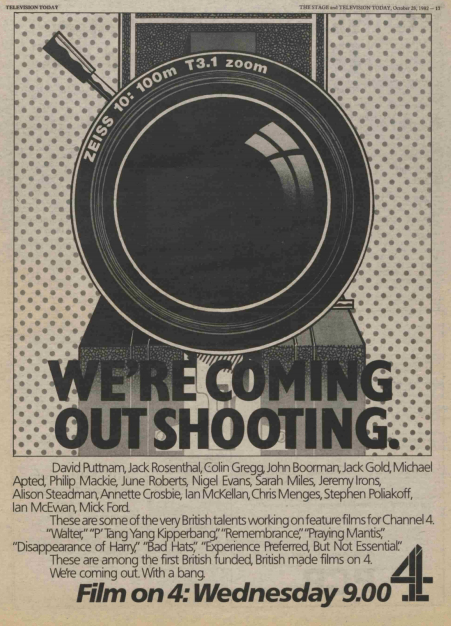
Yes, I know I’m only just over halfway through the list of the 100 Most-Shown Programmes On The BBC, but Channel Four is forty years old on Wednesday 2 November, and that’s an anniversary well worth marking. So, here we go with another ill-considered datagasm.
Like in an instalment of the Terminator franchise directed by John Birt, I’ve used my non-giving-up-guy powers to trek through yet more numbers. This time, picking through BARB’s website, plus online archives of Television Today and The Times, to look at the highest viewing figures ever gleaned by Jeremy Isaac’s controversy machine. All the way from launch day on 1 November 1982, right through to last week. And do I have a list packed with surprises for you? Yes. Yes, I do. At least five of them.
A few quick notes before I start the rundown:
- I’d originally planned to release the whole list in one go, but (a) it’s not quick writing all this, at least not if you’re me, and (b) breaking it up into four parts is quite fitting. Don’t worry, there won’t be long between them:
- Part One: today, i.e. now, i.e. you’re reading it
- Part Two: Monday 31 October
- Part Three: Tuesday 1 November
- Part Four: Wednesday 2 November, which also happens to be Channel 4’s 40th birthday
- Only one entry per programme on the list (the highest-rating episode, obviously), otherwise you’d just be trudging through loads of Brooksides and Bakes Off.
- I’m including airdates, broadcast times, and (because I’m lovely) a peek at what each programme was up against in the listings. Partly because, hey, who doesn’t love more data that they’d been promised? But mainly because seeing the ‘opposition’ sometimes helps confirm why audiences may have been inflated.
- Pretty much every week has been accounted for, but between various archive sources there were still a few I couldn’t source data for. The records given are as complete as possible (seriously, a lot of legwork went into this one), if you know of something that should’ve made the list, and you’ve details of a BARB Top Ten to back it up, let me know (don’t trust any quoted viewing figures in news stories or biographies, as they’re frequently apocryphal).
- I was in two minds whether to include films and sport in the list. After all, a list of The 40 Most Something Programmes Ever is a bit of a misnomer if nineteen of them aren’t actually programmes. In the end, I’ve decided to include both. Channel 4 has done brilliantly in introducing British audiences to sporting events like American Football, Kabaddi and Sumo, and even moved into major sports like F1 and Horse Racing in more recent years. As for films, when it’s a channel that happens to have made some of the best and most successful British films in history, it’d be stupid not to include them. Plus, it’ll be interesting to see whether it’s mass market Hollywood films or homegrown fare that proved a bigger draw.
Okay, all ready? Here we go!
=41: AUF WIEDERSEHEN, PET
(21:00 Saturday 11 Mar 1995, 6.44m viewers)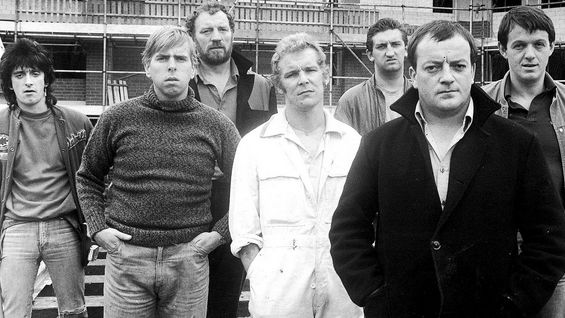
Off to a roaring start with a repeat of an old ITV programme. And that’s more representative than you might think – the first decade of Four saw classic repeat runs employed as a draw quite frequently. Whole new audiences were able to discover past hits like The Prisoner and The Avengers via repeats on Four – heck, in the early stages of compiling this chart it looked like a repeat of Man About The House was going to take a place in the top twenty.
For this particular repeat run, the primo 9pm Saturday night slot was used for a full repeat run of Clement and Le Frenais’ (based on an idea by Franc Roddam) building-site comedy drama. And as repeat runs go, it was a definite success – certainly more successful than ITV’s late-80s repeats that saw hour-long post-watershed episodes chopped in half and put out at 7pm.
This peak audience figure arrived for the repeat of the first episode, where Oz, Dennis and Neville first arrive in Dusseldorf.
WHAT WAS ON THE OTHER SIDE?
BBC1 had the end of the News followed by Saturday night thrills in the shape of Screen One: Down Among the Big Boys, a Glasgow crim-thriller starring Billy Connolly, Douglas Henshall and Maggie Bell. A repeat of The Buccaneers was on BBC2, while ITV offered up Impulse (1990), a cop film that I suspect even stars Theresa Russell and Jeff Fahey have forgotten about.
=41: THE SNOWMAN AND THE SNOWDOG
(20:00 Monday 24 Dec 2012, 6.44m viewers)
Much more traditional Four fare in co-fortieth place. Indeed, its a sequel to one of the channel’s most famous offerings of all-time, with The Snowman and the Snowdog released to mark the 30th anniversary of Dianne Jackson’s animated retelling of the 1978 Raymond Briggs book. The 1982 original has become every bit a Christmas TV staple as Dinner For One on German TV, and in latter years the 2012 sequel has become a similar institution on Christmas Eve telly. It’s the original screening of One Snowman and His Dog that saw the biggest audience.
WHAT WAS ON THE OTHER SIDE?
Last in the then-current series of Merlin on BBC1, a Song and Dance compilation of Morecambe & Wise on BBC2, second-half of an hour-long Corrie on ITV, and A Right Royal Year on Five. That was followed by ‘Eddie Stobart’s Christmas Cracker‘, which would have made this section a bit more interesting.
40: THE NICK
(21:00 Monday 3 Oct 1994, 6.5m viewers)While fly on the wall documentaries were hardly a new thing in 1994, Paul Berriff’s series chronicling events at Gipton Police Station at least achieved the feat of bagsying one of prime titles for such a programme. And that premise was enough to attract a sizeable Monday night audience for this first of five episodes.
WHAT WAS ON THE OTHER SIDE?
BBC1 had the Nine O’Clock News followed by Panorama: Blair’s Britain (“Tony Blair discusses his visions for the future”). BBC2 had the unlikely double-act of Rab C Nesbitt and The X-Files (a crossover we’d all like to see, I’m sure), plus Harry Hill’s Fruit Fancies at 10.15pm. ITV had thrown on a film, but sadly for fans of Young Guns II: Blaze of Glory (1990) the channel was still in the habit of slicing films in two to cram News at Ten in the middle.
39: BRIDGET JONES’S DIARY (2001)
(21:25 Saturday 13 Nov 2004, 6.54m viewers)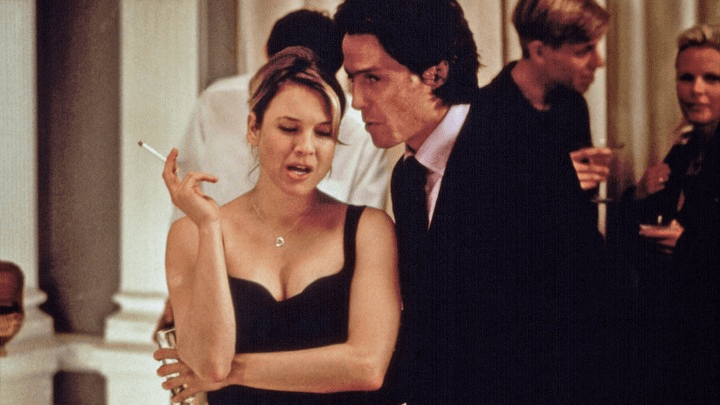
Romantic cinematic retelling of Helen Fielding’s singleton journals, starring Renee Zellweger, Hugh Grant and Colin Firth. I think the time is right for a shot-for-shot remake that remains utterly faithful to the original save for Hugh Grant’s playing his character from Paddington 2.
WHAT WAS ON THE OTHER SIDE?
Peak “aw mam, can’t we have something else on” viewing on BBC1, with The Royal British Legion Festival of Remembrance. Things start off a little more rosily on BBC2, with an hour of Magic (that’s the programme’s name, just to ruin the day of anyone trying to Google it) that promised “some of the world’s most dangerous stunts”. Any excitement would soon evacuate your body on discovering it being followed by The 38th Country Music Association Awards at 10.25pm. ITV offered up The X Factor Result Show between 9pm and 9.45pm, followed by The Great British Pop Test. See, at least ITV realised it was a Saturday night.
38: IT’LL BE ALRIGHT LATE AT NIGHT
(23:10 Thursday 11 Jul 1985, 6.55m viewers)
Look at that – one of the most-watched programmes in the channel’s history, and it aired in a post-11pm slot. On a school night! It’s Four’s equivalent of the Black Ball Final.
Looking into this one, I felt sure there had been a mistake. It seemed like the sort of ITV repeat that would often get an airing on C4, but getting such a large audience this late at night? Turns out, this was the first run of this particular ‘Alright’ episode, and despite that ‘Late at Night’ tag, there was little to separate it from your regular primetime LWT version (well, aside from a slightly naughtier feel to some of the outtakes, such as a bed collapsing during a sex scene, or the occasional boob making an appearance). They didn’t even give in to the temptation of having Denis sitting in his pyjamas by a log fire, or tucked up in a comedy bed, or in tuxedoed up a faux-nightclub. Just your regular mid-80s LWT studio, replete with a mid-80s LWT studio audience.
Not that this would forever be exclusive to Channel Four. The first repeat of the episode arrived on ITV on 28 June 1986, in a plum 9.15pm slot, right after the Maradona versus West Germany World Cup Final. Alright Late at Night did very well there too, picking up 12.35m viewers – a figure higher than ITV’s coverage of the World Cup final itself (a mere 10.75m, though 11.75m watched it on BBC1 – a near-miss ITV Sport would throttle their grandmother for nowadays).
[EDIT] It also made an ITV appearance on Sunday 18 Jan 1992, in a 9.45pm slot, where it picked up a much bigger audience of 16.74m viewers. Not bad for a seven-year-old repeat.
[With thanks to Steve Williams for the heads-up on that broadcast]
WHAT WAS ON THE OTHER SIDE?
On BBC1, a Forty Minutes documentary about Victorian toilets (no, really) followed by Crimewatch Update. BBC2 offers Newsnight followed by Cricket: Third Test Highlights. We’re into the post-News regionalia zone on ITV, but Thames are offering up an episode of Hammer House of Mystery and Suspense called “Last Video and Testament”. In that – because with an episode title like that you’ll be wanting to know – an electronics expert fakes his own death and makes his unfaithful wife believe he’s visiting her from beyond the grave, presumably via VHS.
37: STAND BY YOUR MAN (1981)
(21:00 Tuesday 14 May 1985, 6.6m viewers)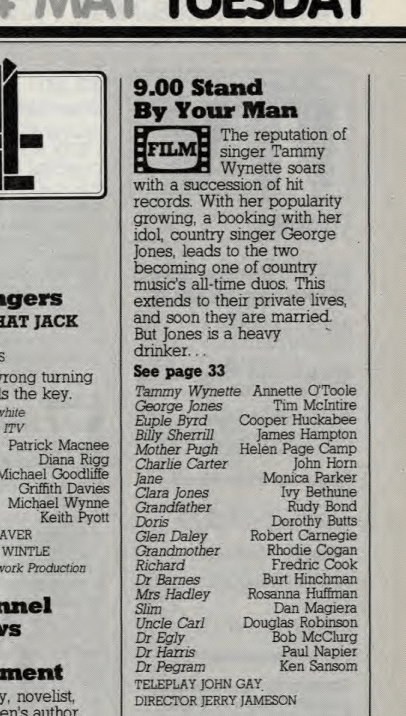
A TVM tracking the rise of Tammy Wynette, starring Annette O’Toole as the famed country chanteuse. Sadly, it being from 1981, suggesting a limited presence at best for the KLF.
WHAT WAS ON THE OTHER SIDE?
BBC2 viewers were treated to a very different piece of Americana in Wim Wenders’ and Francis Ford Coppola’s depression-era neo-noir Hammett (1982). John Humphrys reads the News on BBC1, followed by Crockett and Tubbs reading the Miranda Rights to some hapless perp in Miami Vice. Leslie Philips Spy drama Mr Palfrey of Westminster was entertaining ITV audiences.
36: CASTAWAY (1986)
(21:00 Monday 26 Nov 1990, 6.63m viewers)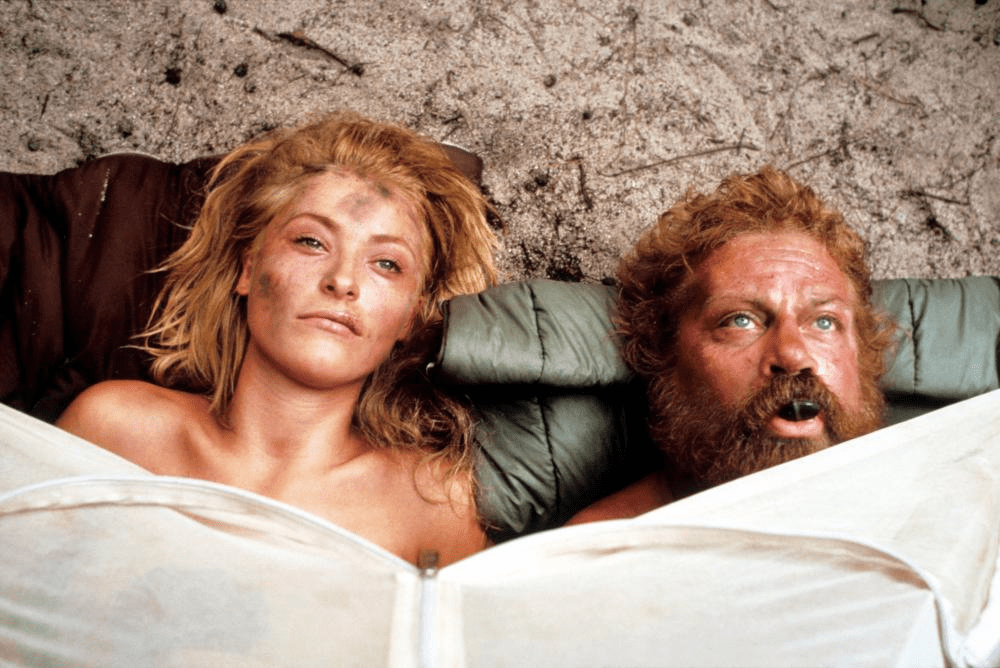
Amanda Donohoe and Oliver Reed star in Nicolas Roeg’s loose adaptation of Lucy Irvine’s autobiographical book of the same name. In the film (as in the book), a middle-aged writer places an advert for a volunteer to live with him for a year on a tropical island, a calling answered by then-25 year old Lucy. The tropical paradise was, as you may expect, far from the promised idyll. Meanwhile, back in Britain, a teenager who’d grow up to become Channel Four’s Head of Reality Programming furiously scribbles down notes.
WHAT WAS ON THE OTHER SIDE?
News and Panorama (“Who Will the Tories Choose?”) on One, Kiwi road movie Shaker Run (1986) on Two, while landmark World in Action Special: Why Lockerbie? aired on ITV. Later that same night on ITV – World Chess Highlights. The past truly was a different country.
35: COAST TO COAST (1980)
(21:00 Tuesday 5 Feb 1985, 6.65m viewers)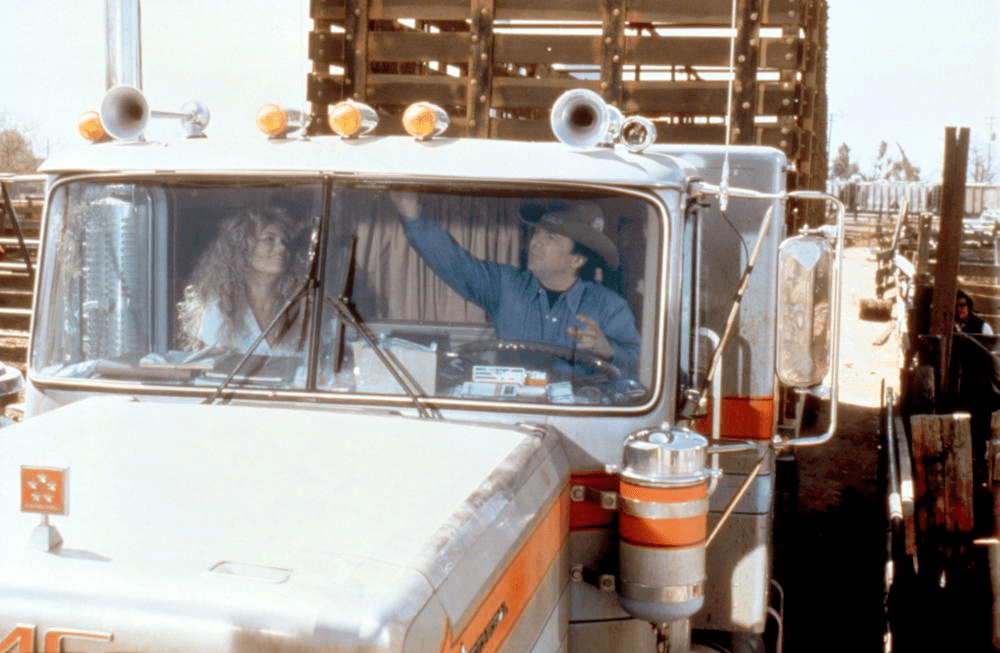
Romantic comedy about madcap couple Madie Levrington and Charles Callahan, who accidentally find themselves in a truckin’ road movie. Madie is on the run after her scheming wealthy scoundrel of a husband had her committed to an New York mental institution to prevent her divorcing him and taking some of his previous, precious Reaganite cash. Charles is on the run from the repo man who wants to seize his previous truck. Will they team up and achieve their real goal? Which is getting rented by people at the video shop who’d found Smokey and the Bandit is already out on loan.
WHAT WAS ON THE OTHER SIDE?
The News followed by Spanish Civil War drama Brigadista on BBC1, Pot Black 85 and Doctor’s Dilemmas on BBC2, and a repeat of the Sweeney on ITV. Not a huge surprise Four’s amiable truckin’ caper comedy attracted such an audience, really.
34: WISH YOU WERE HERE (1987)
(21:30 Thursday 15 Feb 1990, 6.67m viewers)
Not to be confused with, a-ha-ha, the ITV holiday show off the same name. In fact, this premiere airing of David Leland’s comedy-drama film went out on the same day as an episode of the Judith Chalmers sunstravaganza. Wouldn’t be allowed nowadays, Sky Q boxes would go haywire.

See? Not at the same time, thankfully.
WHAT WAS ON THE OTHER SIDE?
Topically enough, given his presence in the anniversary special Friday Night Live the other evening, Ben Elton – The Man From Auntie was going out on BBC1 at the start of the film, followed by Crimewatch and Question Time. ITV offered Regional Programming (such as ’01 for London’, ‘Central Lobby’ and ‘Calendar Commentary’ in ITV franchises you can probably work out from those programme titles, TSW just went straight to Prisoner Cell Block H). BBC2 served up a 40 Minutes film on the lives of exiled black South African musicians living in the UK, followed by a Late Show short and Newsnight.
33: GOGGLEBOX
(22:00 Friday 12 Mar 2021, 6.74m viewers)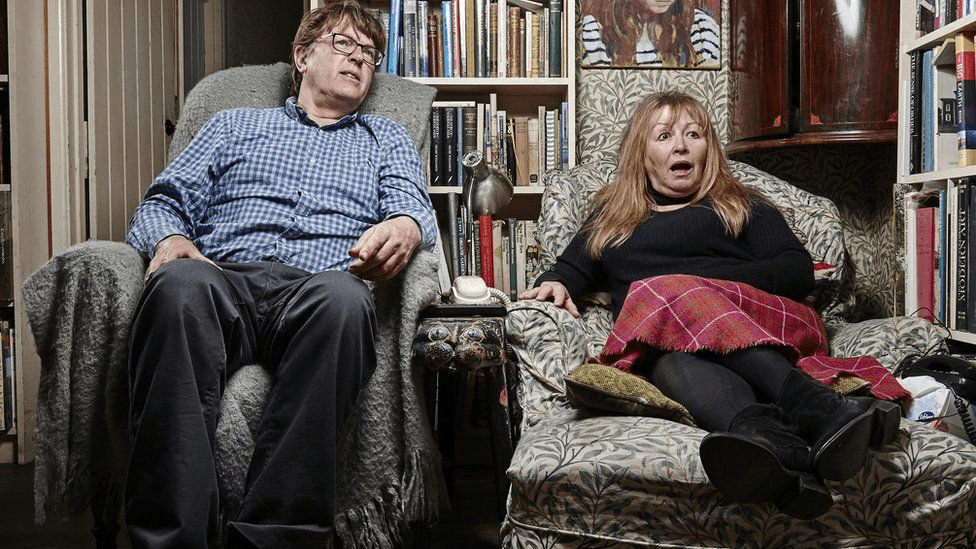
Ever been wrong in a very public way? For a spell in the 2010s, I found myself writing programme previews for The Guardian Guide. Look, I’m as surprised as you, it was probably part of some Trading Places-style bet. Anyway, while I was dutifully providing copy for the publication, I generally steered clear of pouring too much scorn on programmes I wasn’t keen on. Someone loves them, a lot of people went to the trouble of making them, and who was I to pass haughty judgement on their efforts? I was just some twonk staying up late to scribble tosh before getting up early the next morning to shovel spreadsheets for The Man.
But, on being given a copy of the non-broadcast pilot of a new programme called Gogglebox, here was something I could safely have an opinion on. It’s just footage of people watching telly, saying stuff about the things that are on. “Aah, we’re holding up a mirror to the audience!”, the producers were probably thinking, but if I wanted to sit and look at a mirror for an hour I’d sell my telly and buy a bloody mirror. So, I wrote up my true feelings on the programme (either referring to it as “a disappointingly crowdsourced reimagining of TV Burp”, or just wishing I had two hours past the submission deadline. Probably the second one), confidently predicting it won’t be a success.
Gogglebox is currently on its 25th series, and many of the participants have gone on to become celebrities in their own right. I’m at home, writing this when I should probably be popping to Screwfix to buy a new flush mechanism for my toilet.
You win this round, Gogglebox.
WHAT WAS ON THE OTHER SIDE?
The top-rating episode is from 2021, so the answer here is ‘Netflix‘.
And that’s it for now. Two entries share the Number 31 slot, so you’ll get to see those on SUNDAY, when the next part ‘drops’.
- I’d originally planned to release the whole list in one go, but (a) it’s not quick writing all this, at least not if you’re me, and (b) breaking it up into four parts is quite fitting. Don’t worry, there won’t be long between them:
-
BBC100: The 100 Most-Broadcast BBC Programmes Of All Time (50-46)

Into the fifty! And on the BBC’s actual 100th birthday too. Would’ve been nice to have wrapped up the whole list by this point, admittedly. But at least we’re in the top half of the table now. And into the next section of the list we go.
50: Racing
(Shown 1741 times, 1946-2014)
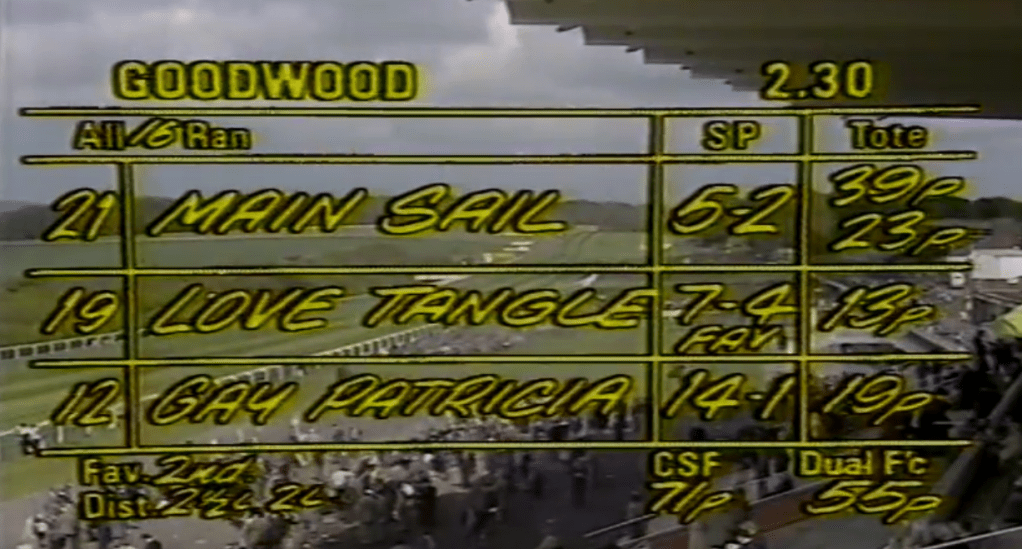
Here’s something that’s easy to sum up in a few paragraphs: all of horse racing on the BBC since 1946.
It’s certainly a little curious that, of all the different types of racing that have been televised since that inaugural broadcast from Ally Pally, it’s horse racing that has become synonymous with the phrase ‘Racing’ on TV. Not motor racing, cycle racing or greyhound racing. It’s the equine kind that the phrase has been reserved for. And this makes it slightly surprising that it took quite a while for horse racing – literally the sport of kings – to start making any appearance within the BBC-tv schedules.
The first programme covering any kind of racing seems to have come on 9 October 1937, with ‘Road Race for the Imperial Trophy’, billed as “the first International Road Race in London (by courtesy of the Road Racing Club), on the Crystal Palace Road Racing Circuit (conditions permitting)”. Such was the clamour for the live news of the motoring event, it resulted in the Television Service opening up earlier than usual, at a still-leisurely 2.25pm rather than the usual 3pm. Britain’s sole TV channel kept tabs on the race through to 5pm that Saturday, occasionally opting out for key programmes such as ‘In Our Garden’, ‘First Time Here’ and ‘Punch and Judy with P. F. Tickner’. One can only hope the conditions were indeed permitting, because any postponement would have required a lot of filling for the nascent service.
The next instance I can find of televised racing of any kind came almost a year later, on 8 October 1938, this time under the more helpful billing of “Motor Racing” (so I don’t have to look up details of an event from 85 years ago to check whether it’s cycles or cars, unlike with the previous paragraph). This came with the promise of getting to see a thrilling encounter between Arthur Dobson and the presumably pseudonymous “B.Bira” in an event big enough to be advertised in national newspapers.
[UPDATE 20 OCT: Reader Jamie Bird adds some more exciting context to the above: “‘B.Bira’ who raced in the 8th October 1938 motor race, was the Prince of Siam, his full name being Prince Birabongse Bhanudej Bhanubandh (no wonder RT used his pseudonym). He raced all the way up to Grand Prix and Le Mans level and after retiring in the mid-fifties, took up competitive sailing, competing in four summer Olympics up to Munich ’72.”. That immediately makes this update at least 17% more interesting, so cheers Jamie!]

(Daily Mirror, 7 Oct 1938) And, at least as far as I’ve been able to find, if you wanted to see any kind of racing action on your screens, motor racing was largely all you were going to see until the post-war years. Not that horse racing wasn’t covered at all, mind. It was, just in a slightly unusual way.
The Television Service listings for 2 June 1937 show The Derby being covered, but the limitations of camera technology at the time certainly wouldn’t have permitting a cameraman to scoot along after the action. So instead, viewers would hear audio-only coverage of the race, as broadcast on the National programme. On top of that, a plan of the racecourse was shown on-screen, along with “still photographs of scenes connected to the race will be accompanied with a commentary”. Lovely stuff. Curiously though, the Radio Times listing for the event claims this approach was “a repetition of the successful experiment carried out on the occasion of the Grand National”, but looking at the Radio Times schedule on the day of that year’s National, there was no such billing. So, presumably, any such coverage was done ‘off the hoof’ (horse reference).
Anyway, fast forward to 1946, and the reopened Television Service is now in a position to start covering horse racing properly. Television had certainly picked a suitably special occasion to cover. The two-mile King George VI Stakes is a racing event at Ascot that continues to this day, and BBC cameras were present for the very first ‘Stakes race in 1946. Or rather, ‘BBC Camera’ – the practice of mounting a camera to a vehicle capable of keeping up with racehorses still hadn’t come to fruition, and so a single BBC camera was affixed to the roof of the main stand, just to the right of the clock tower.
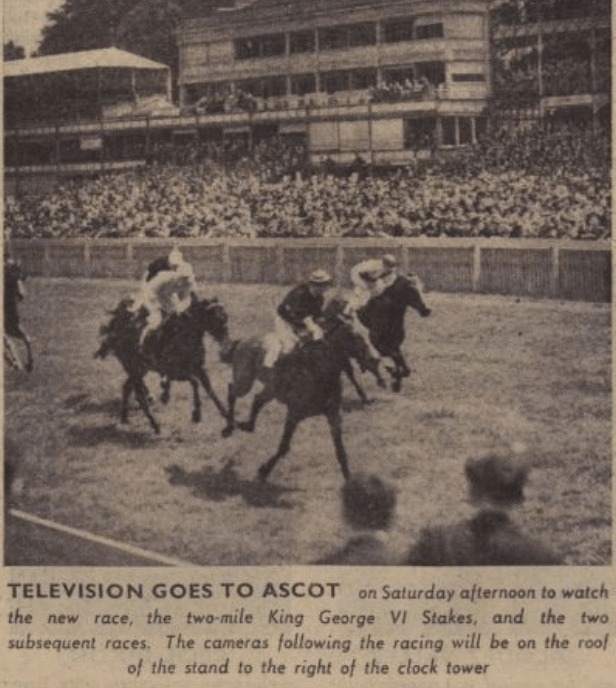
See? With this new practice proving a success, horse racing returned the following spring, with two days of live coverage of the National Hunt at Sandown Park. By 1948, it was a regular practice, offering home viewers a chance to roar on their favourite from the comfort of their own home without needing to decipher the rantings of a radio commentator (though I’ll wager the picture quality on those early sets didn’t make it abundantly clear which horse was which).
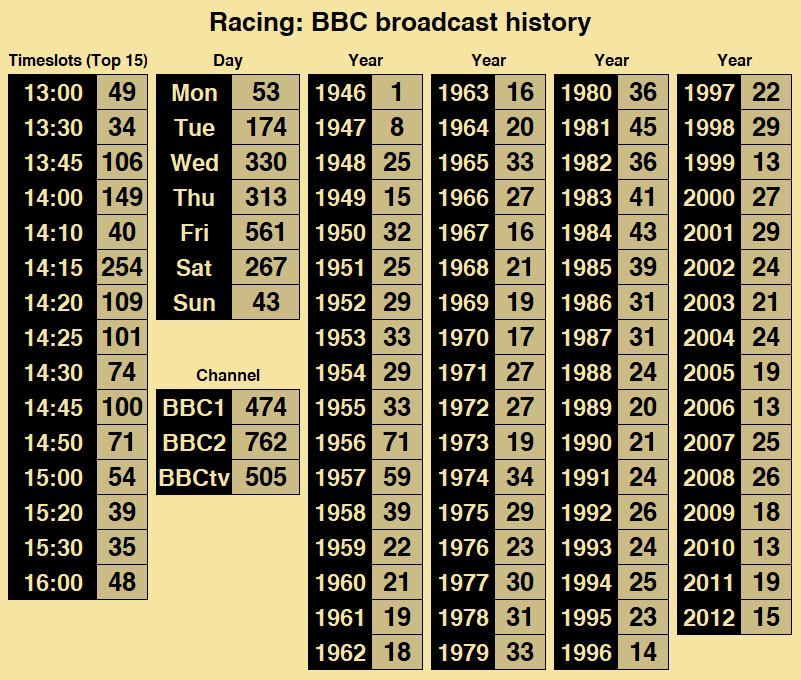
As the broadcast history table below confirms, horse racing would become an absolute mainstay of BBC Sport coverage for several more decades, but the frequency of races covered would fall as the nation entered the second decade of the 21st century. This decline in coverage came to a (horse’s) head in January 2013, when an exclusive contract between Channel 4 and the Racecourse Media Group started, resulting in all terrestrial British horse racing coverage moving to Four.

Radio Times listings, 29 April 1966 The table below doesn’t quite accurately convey the true extent of racing coverage on the Beeb – for many years, a large amount of the BBC’s racing coverage found itself covered within the Grandstand umbrella, and at other times racing shared a billing with up to three other sports in the TV listings. I’ve not included such instances in the totals, as that would only complicate matters. I make it about 237 instances of ‘Racing’ sharing a billing with other sports like this, if you want to amend the total yourself.
49: Points of View
(Shown 1753 times, 1961-2021)

Dear Sir, I object strongly to the letters on your programme. They are clearly not written by the general public and are merely included for a cheap laugh. Yours sincerely etc., William Knickers.
Monty Python’s Flying Circus, episode 1.11 “The Royal Philharmonic Orchestra Goes to the Bathroom”, TX: 28 December 1969A long-running ten-minute (or thereabouts) programme that has managed to clock up a surprising number of tropes for a show situated (for the most part) in a small presentation suite and shown after the end of Something American. If anyone from Panini is reading this and wants to put together a sticker collection of Points Of View tropes, start with the following:
- Why oh why oh why oh why oh*
- Them Upstairs
- Mrs Edna Surname of Dorset Writes
- Terry’s Bulge That Time
Okay, there aren’t that many. Let’s do this properly (unless anyone wants to add any more in the comments).
(*Spells, of course, yoyoyoyo)
In the early days of broadcasting, if you wanted to get your opinion heard about a television programme, your main outlet for viewer dissent (or heck, praise) would be the Radio Times letters page. But wouldn’t it be better if you could have your letter read out loud by a voiceover artiste in the gap between Dynasty and The News? More importantly, wouldn’t it be handy if there was a cheap programme that could be slotted into the ten-minute gap between Dynasty and The News?
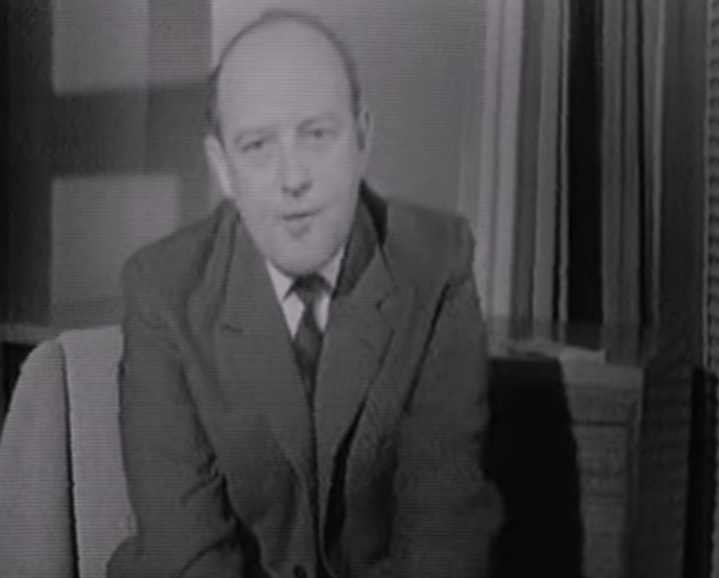
That’s where Points of View came in. Offering a voice to the viewer, and holding the Beeb to at least a little bit of account. Originally hosted by Robert Robinson in 1961, going out in the teatime gap between the end of the regional news and the start of the evening’s entertainment programming.
From there, the programme rapidly became a schedule staple, to the extent that it actually aired twice per week from 1962 – once at teatime on Mondays, then again just before 10pm on Wednesdays. The latter seems to have been at least occasionally billed as “a further look at points from this week’s post”, so it’s tempting to assume that this post-watershed slot contained pure unfettered vitriol about the scheduling of last week’s episode of Play Your Hunch, rather than a straight repeat.
By the early 1970s, either the programme proved much less popular, or there was a national drought of opinion about television (or more likely the schedules threw up fewer likely spots for the series), meaning Points Of View entered an eight-year hiatus. On it’s return however, we definitely entered the imperial phase of Points of View, with comedian, writer and presenter Barry Took taking the hot seat.
The quietly wry Took was no stranger to squeezing the most out of raw materials, having spent much of the 60s and 70s helping shape the British comedy industry having worked closely with Marty Feldman, brought together the Monty Python team, helped set up The Goodies, and became Head of Light Entertainment for LWT. And it was his winsome charm that helped make Points of View something I seldom missed as a child with a fascination of all things television.
Following Took’s departure in 1986 (and PoV having a brief flirtation with guest presenters), Anne Robinson took the reins. Then a world away from the fairly annoying Ice Maiden character she’d adopt for The Weakest Link, Robinson took on the role of people’s champion as host of the programme, on the side of the viewers against those fusty suits upstairs who just didn’t realise what the people truly wanted to see. Robinson certainly made sense in that role, her early appearances on the Beeb had been as occasional TV reviewer for Breakfast Time, and during her earlier career at the Daily Mirror she’s developed a knack of expressing relatable points in a succinct manner.
Following Anne Robinson’s departure from the series, there were short-term tenures in the presenter’s chair for Carol Vorderman and Des Lynam before Lord Terence of Woganshire took on the role of Viewer’s Champion. By this point, the programme was coming from a much less pokey environment, now in a plusher place replete with flowers and a writing desk.

Amongst other things. Following Tel’s departure, Jeremy Vine took over from 2008 to 2018, with Tina Daheley currently hosting the series, but let’s be honest. With a multitude of other ways to express opinions on #CurrentTelly it’s a programme that seems incredibly anachronistic in this day and age. Sure, you could argue that at least having your views expressed on air (not least now the format is closer to Channel 4’s old Right To Reply) adds legitimacy to the series, but I’m going to counter with the fact that, around the end of the noughties, in an effect to move with the digital cyber-times, the series accepted comments submitted via the programme’s online messageboard. Where, instead of square old ‘names’ and ‘locations’, people could express comments under their wacky online handles, like ‘Pancho Wilkins’, ‘Colonel Geewhizz’ or ‘Alan997’.

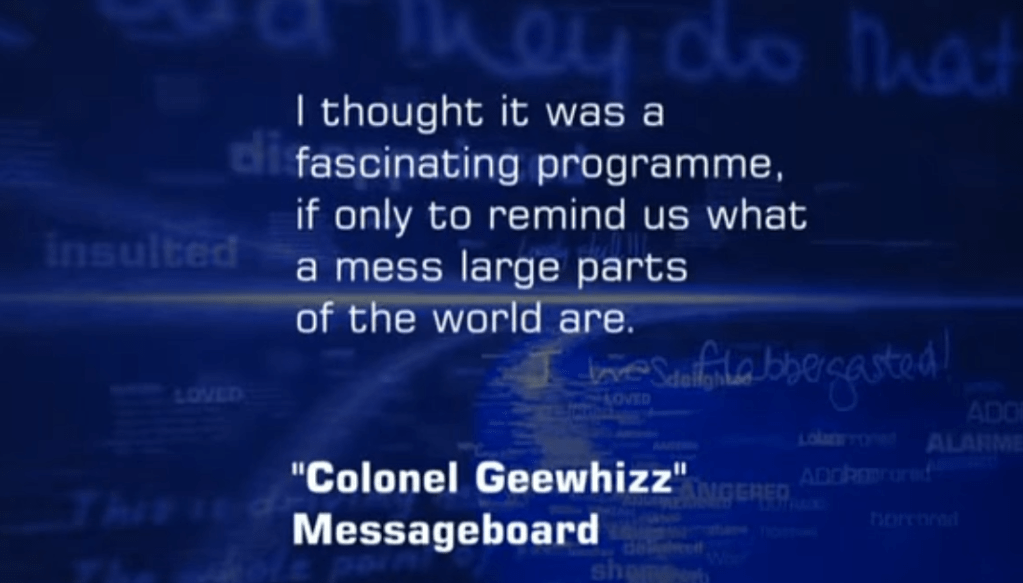
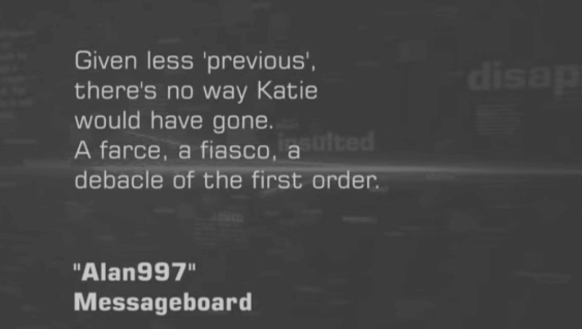
So much for legitimacy, eh?

(Shown 1762 times, 1979-2021)

As we’ve seen at several points on the list thus far, some formats – as popular as they might be – have a very definitive shelf-life. Call My Bluff had a hardy premise, but despite the occasional revamp and recasting, came to a natural end in 2005. Sportsnight seemed to be a never-ending format, midweek sport wasn’t about to go away, but the Beeb’s capacity to cover it faded and it came to an end in 1997. And yet, a similarly simple premise, people bringing antiques to a venue where an expert tells them how much they’re worth, is one that – at least at the time of writing – seems utterly inexhaustible.
It’s a format that has proved hardy enough for a number of slightly surprising pop-culture references. The Smell of Reeves and Mortimer did a memorable pastiche of the series, with experts passing judgement on Prince’s wardrobe, booze f’ baby and host ‘Hugh Scully’ gradually getting nudged out of frame by stuffed monkeys during his links. The Royle Family centred an entire episode on the titular family using a broadcast of ‘Roadshow to place bets on the values of each antique. And, perhaps not quite as fondly remembered, the film adaptation of Tom Clancy novel The Sum of All Fears saw arms dealer and main baddy Olsen (Colm Feore) enjoy some downtime from his nuke-procuring day job by watching the series.
With such a gentle format, it’s slightly surprising to realise that the series didn’t start until as late as 1979. I’d certainly assumed it was something that had been around since much earlier, at least the early 1970s, but no. Arriving in Spring 1979 for a run of eight episodes on early Sunday evenings, it now seems a little odd that the premise even needs to be explained to viewers, such is the familiarity it now has. But, readers of the Radio Times were coaxed toward the new series with the following:
Arthur Negus goes on the road with a team of experts from Britain’s leading auction houses. They meet the public informally and discuss the treasured possessions brought along for their assessment. The result is a programme filled with surprises and excitement as people discover the truth about objects that have, sometimes, been gathering dust for years. Perhaps the biggest surprise is that there are more finds than disappointments.
– Listing for the first episode, Radio Times Issue 2884, 17 February 1979From there, it went on to conquer the world, or at least Sunday evenings on BBC1. The presenters may have changed since those early days – Bruce Parker and Angela Rippon (1979), Arthur Negus (1979–1983), Hugh Scully (1981–2000), Michael Aspel (2000–2007) and Fiona Bruce (since 2008) – but the premise remains as resolute as ever. And to be fair, even for those who couldn’t give a jot about antiques, the Roadshow at least offers up to opportunity to share in the delight of attendees learning the trinkets from their attic are unexpectedly worth a five-figure sum, or even offering a chance to enjoy the schadenfreude of someone learning that Great Uncle Albert’s Victorian military figurines were actually cheap post-war replicas.
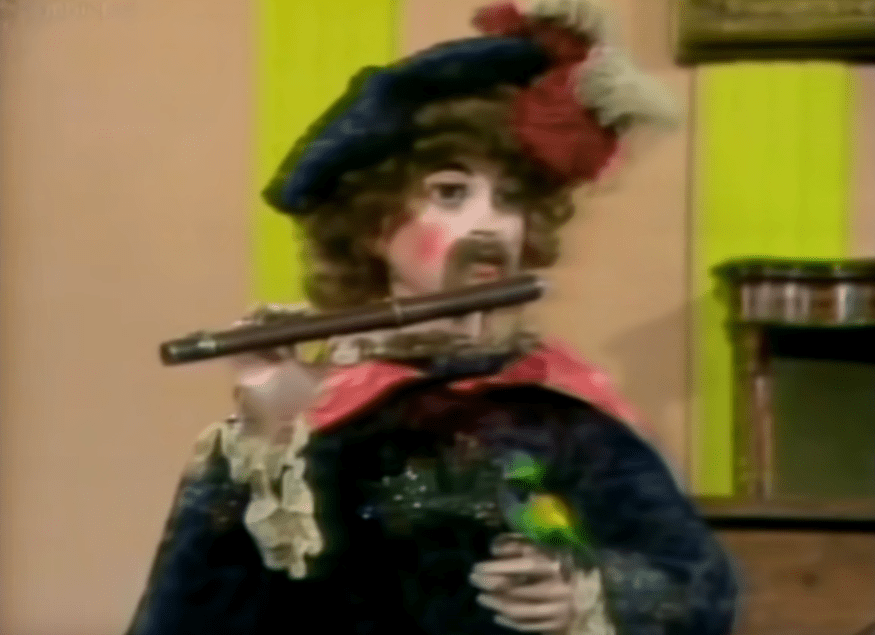
The programme would even lead to a number of spin-offs and specials, including the following:
Antiques Roadshow Gems (broadcast 1990-1992), More Antiques Roadshow Gems (1996-1997)
Hugh Scully introduces repackaged highlights from the programme, each fifteen-minute episode focusing on a particular type of antique.
Priceless Antiques Roadshow (2009-2017)
While the former highlights packages were fairly lightweight daytime filler, Priceless took things to the [puts on Oakley shades and backwards Limp Bizkit hat] extreme. Going out at 6.30pm weeknights on BBC Two, Fiona Bruce recalls some of the most memorable moments from past editions of the show, initially joined by former host Hugh Scully to look at some of the most expensive objects ever seen by the experts.
Antiques Roadshow Detectives (2015)
To the slight disappointment of anyone hoping for a Baywatch Nights-style spin-off, Detectives saw Fiona Bruce join AR experts to explore the oft-interesting backstories behind heirlooms valued by the Roadshow.
Antiques Roadshow Going Live! (1991)
A perhaps unlikely addition to the BBC1 Boxing Day schedule for 1991, this was breathlessly billed as “the first Antiques Roadshow for youngsters”, with Hugh Scully joined by Phillip Schofield, Sarah Greene and (of course) Gordon the Gopher. In this special, the AR experts assembled at Bristol’s Temple Meads Station to pass their judgemental eye over trinkets from train sets to Thunderbirds toys.
The whole affair came after a surprisingly popular appearance on Going Live! by Scully and expert Hilary Kay, with series producer Cathy Gilbey remarking on the deluge of phone calls from viewers asking if their belongings might be worth much.
Antiikkia, Antiikkia (1997-)

Because Britain isn’t the only country containing old things, the Antiques Roadshow format has been adapted around the world. Versions of the series have appeared in Australia, Belgium, Canada, Germany, Netherlands, Sweden and the USA. And also Finland, where YLE TV1’s Antiikkia, Antiikkia has been running since 1997. That version was such an instant success, within a year comedy series Komediateatteri Arenan (Comedy Theatre Arena) was putting out a parody of the series where worthless tat was brought in for valuation, and the sole item of value met a sticky end.

47: Arthur
(Shown 1777 times, 1997-2012)

Well, after four not-a-surprise-to-see-that-here entries, one that’s very much out of left-field. On seeing this name burble out of the BrokenTV dot matrix after barking ‘print results’ into the attached microphone, I genuinely expected it to belong to a number of distinctly different shows. A series of one-man playlets starring Arthur Lowe? Maybe. A long-running CBS sitcom vehicle for Bea Arthur? Very likely. A long-running Saturday evening dance extravaganza in the Wayne Sleep mould starring Arthur Negus? As good a premise as any. I mean, no way on earth can this solely refer to that American-Canadian cartoon about an anthropomorphic aardvark that doesn’t look like an aardvark.
Reader, it does solely refer to that American-Canadian cartoon about an anthropomorphic aardvark that doesn’t look like an aardvark.
Maybe I’m just out of touch, or from the wrong generation, because while I was aware of the animated series Arthur, mainly from adverts for the show on Nickelodeon in the days of pre-digital Sky. In fact, it’s so far off my radar that when it recently started airing on CBeebies, I just assumed it was a rebooted series. It’s only in looking at an episode guide to write this that I learn no, Arthur has been running continuously for 25 years. That’s 253 episodes in total. And, as fate would have it, it has only just wrapped up for good, with the final episode debuting on PBS Kids on 21 February 2022. That’s long enough for the title character to have been voiced by as many as nine different actors, and by the time of that final episode it was considered the longest-running children’s animated show in US TV history.
In short: yes, I am out of touch.
The series itself is based on the ‘Arthur’ series of books by Marc Brown, first published in 1976, and (along with the TV adaptation) helps a young audience understand issues they may experience in their formative years, including weightier topics like dyslexia, cancer, diabetes and autism. The action centres on 8-year-old Elwood City resident Arthur Timothy Read as he makes his way through family life as the oldest of three siblings in the Read household, and through school life as part of Mr Ratburn’s third grade class. Given the sheer number of episodes, it’s not a huge surprise there are practically hundreds of supporting characters, but stand-out regulars include Arthur’s younger sisters DW and Kate, plus pals Buster (a white asthmatic rabbit and Arthur’s bestie), Francine (a sports-obsessed monkey schoolgirl) and Alan (a bear schoolboy of Senegalese descent).
The pilot episode of Arthur, broadcast in 1993, seems to take a decidedly different take on the original books, mind you. In these, the action focuses on what seems to be a much older version of Arthur, he’s suddenly a human being rather than an anthropomorphic aardvark, he’s battling alcoholism and he’s being played by, of all people, Dudley Moore. Oh, hang on. Damn. [SOUND OF FRANTIC DATABASE EDITING]
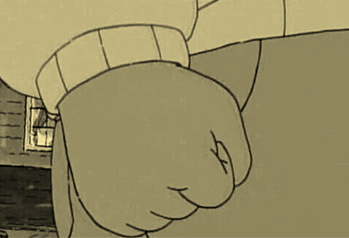
Right, that’s five ‘episodes’ chopped off the total, then. That’ll save people having to tweet me. The real first episode of Arthur to air on British screens arrived in 1997, with the decidedly modest RT summary of “Adventures of a young aardvark”. Initially serving as the buffer between pre-school Playdays at 3:35pm and the not-quite-as-preschool comedy drama ‘Julia Jekyll and Harriet Hyde’ at 4:20pm, Arthur went out each Tuesday at 3:55pm from April to June that year, before returning to the same slot between September and December the same year. And that’s the position it held, with the occasional morning appearance during Christmas holidays. That’s until 2005, when it became a key part of BBC2’s early morning CBBC strand. Indeed, that’s where the bulk of Arthur’s appearances have been between then and CBBC’s big move away from BBCs One and Two in 2012 – accounting for 756 episodes of the show’s total. That’s a very impressive run, but will any other children’s programmes from that spell make it to our list? You’ll have to wait and see.
Personally, I’m just glad I realised in time that Arthur (the film) and Arthur (the series) are two very distinctly different properties.

46: Film [xx] (The Film Programme)
(Shown 1873 times, 1971-2018)

You know, as in Film 88, Film 89, Film 90… I mean, I could go on.
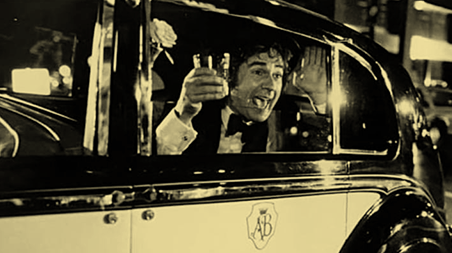
So, who was the first host of Film XX? A few things to note: the programme was originally only shown in the London region, it started in 1971, and if it was the person in the photo above this text it wouldn’t be much of a question.
Indeed, the inaugural host of what would become the BBC’s flagship film programme, was actually journalist-turned-novelist Jacky Gillott.
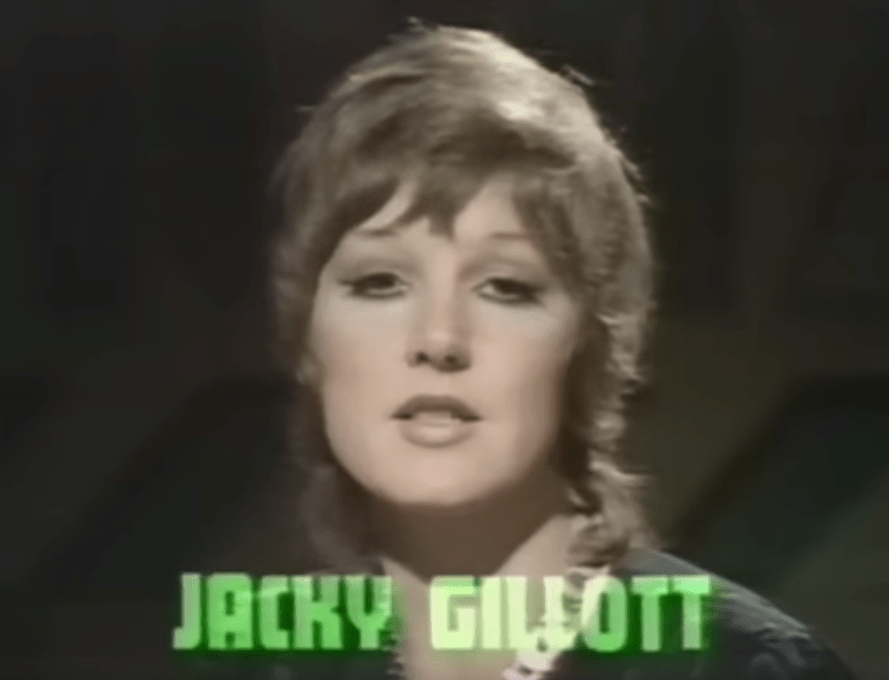
Jacky Gillott’s career started in newspaper journalism, but soon moved toward broadcast journalism, becoming ITN’s first female reporter.
She’d later give up reporting to concentrate on a literary career, with ‘Salvage’, the first of thirty novels to be written by her, published in 1968. Aside from novels, she’d continue to contribute written work to publications such as the Sunday Telegraph, Cosmopolitan and a role as regular book reviewer for The Times. With this in mind, she was chosen to cast her critical eye on cinema for the initial six-episode run of the BBC’s new series, and she would go on to return as host several times throughout the next few years.
In addition to fronting each episode of Film 71, she was a regular on Radio 4 art programme Kaleidoscope, as well as the station’s Any Questions? and Woman’s Hour. She’d also go on to make several appearances in Call My Bluff and book discussion programme Read All About It. Sadly, Gillott’s storied career was offset by back pain, insomnia and deep depression. She went on to take her own life in September 1980, a few days shy of her 41st birthday. After her passing, her former newspapers The Times and Telegraph printed thoughtful eulogies celebrating her warm, thoughtful and witty personality. A story sadly ending many chapters too soon.

Following the programme’s initial run, Film 71 returned in January 1972 (craftily retitled ‘Film 72’), with initial episodes hosted by a rotating line-up of hosts, starting with (a theme developing here) journalist-turned-writer (and subsequent long-time Cosmo agony aunt) Irma Kurtz.
From the sixth episode of the series, a new host took to the Film 72 chair: the one who would be most closely associated with the role for the next 27 years. That episode of the series saw Barry Norman (for it is he) carry out an interview with Peter Bogdanovich, director of the Last Picture Show, and cast his critical eye over Elizabeth Taylor and Michael Caine film Zee and Co. Still only airing in That London, the host’s seat for Film 72 was very much a hot one, with other hosts such as Joan Bakewell and Frederic Raphael also taking a turn, but it was Barry Norman who’d get to host the first edition of the show following an Oscar night, and get to chat with some of the lucky winners.
Before his stint as the BBC’s one-man Rotten Tomatoes, Norman had embarked on a journalism career that led him from The Kensington News through jobs at The Star in South Africa and Rhodesia’s Herald, then back to the UK for roles as gossip columnist for the Daily Sketch, showbusiness editor for the Daily Mail, and penning columns for The Observer and Guardian.

Daily Mail, Friday 17 Feb 1967 Our Barry didn’t just express himself journalistically. In amongst his newspaper endeavours, he found time to write a number of novels, including his third, ‘End Product’, set in a grotesque future dystopia where apartheid spread far beyond South Africa, and where new depths of inhuman cruelty become commonplace. A satire so biting readers should probably check it hasn’t drawn blood, it clearly being inspired by Norman’s spell covering events in South Africa and Rhodesia. More information on the book can be found at Ransom Note. Not a piece to be read while eating lunch, mind.

End Product by Barry Norman, Quartet Books (published June 26, 1975) So, having proved himself to be something of the critical polyglot, Barry Norman joined the rotating line-up for the BBC’s new film review series. It was a good fit. Norman’s father Leslie Norman had worked as a film director, with an oeuvre stretching from social drama (1961’s ‘Spare the Rod’) to B-movie sci-fi (1956’s ‘X the Unknown’) and several points in between. Barry himself had taken to television with appearances on Late Night Line-Up, and proved to be every bit as pithy in person as in print.
Not that he’d be restricted to covering cinema once his feet were under the metaphorical Film XX desk (unless in some years they actually had a literal desk, I’ve not checked). Barry Norman would go on to present episodes of Omnibus, several one-off documentary series for the BBC and ITV, and along with Elton Welsby, serve as main anchor for Channel 4’s coverage of the 1988 Summer Olympic Games.
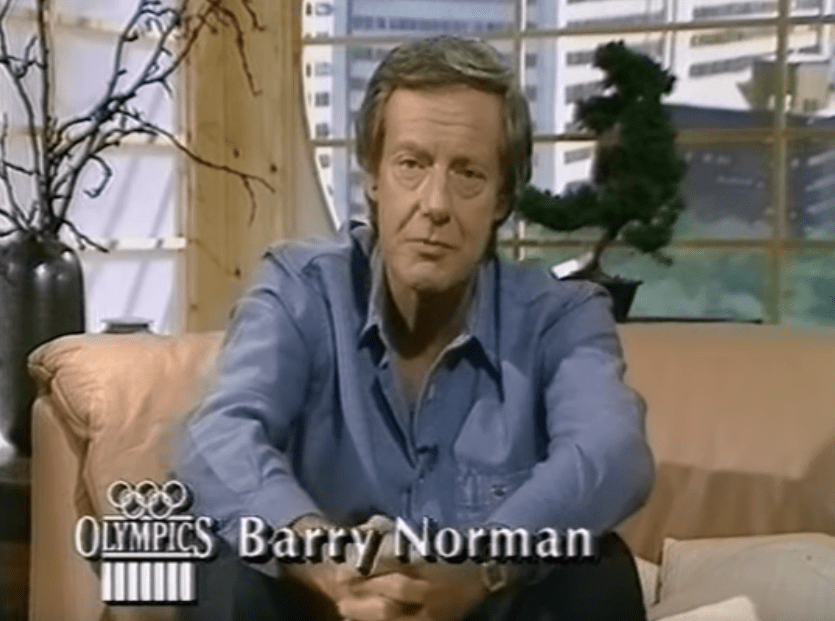
I know that’s a sentence that seems surprising now, but yes, really. Aside from TV work, Norman could also be heard regularly on Radio 4, presenting Today, being the original chairman of The News Quiz, hosting travel series Going Places and even fronting early 1980s home computer series The Chip Shop. But, Film XX would be the programme most closely-associated with him. He would go on to host the series until 1998, when the big bucks of BSkyB finally coaxed him away from the BBC.
As a result, from Film ’99 onwards, Jonathan Ross held the presenting baton. Having previously helmed a number of shows on cult cinema for Channel 4 (including The Incredibly Strange Film Show, Jonathan Ross Presents for One Week Only and Mondo Rosso), having mainstream TV presenter Ross take up the gig was much more sensible than it may initially have seemed. He’d go on to hold the role until 2010.
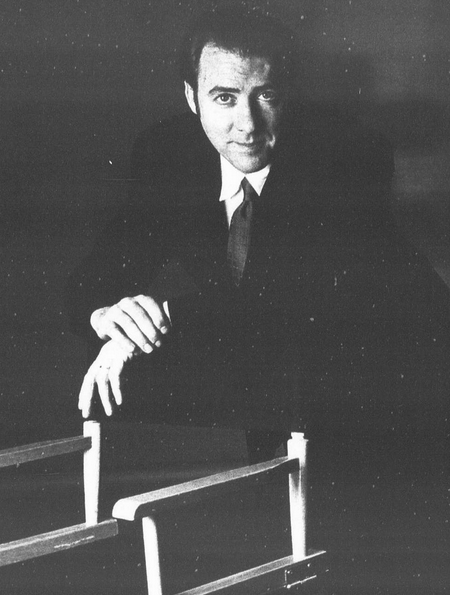
From 2010 onwards, the hosting gig passed to Claudia Winkleman, who had hosted Sky’s live coverage of the Academy Awards for the previous few years. Flanked by film journalist Danny Leigh, Winkleman’s tenure lasted until 2016, after which hosting duties went back to the Film ’72 standard, with a rotating line-up of hosts.
A variety of faces would go on to front the programme during that final flourish (such as Zoe Ball, Edith Bowman, Charlie Brooker and Clara Amfo), but by now the annual helping of episodes had been reduced from the doughy dollops of years past, to mere fun-sized episode orders in the early parts of 2017 and 2018. The final episode saw Al Murray hosting alongside critic Ellen E Jones and writer Deborah Frances-White, as Ready Player One, Isle of Dogs, Journeyman were the final films served up for their consideration.
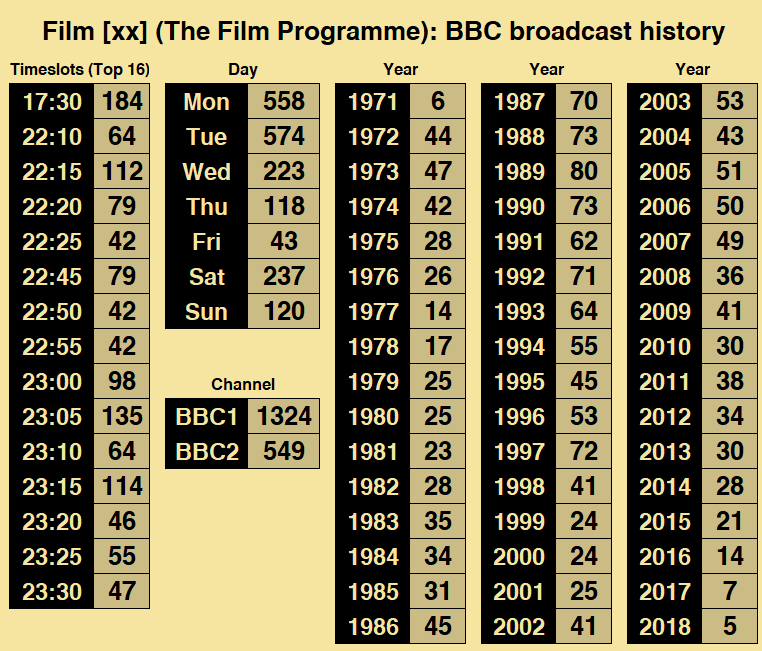
Phew, another update in the bag. I can’t help but wonder which centennial milestone everyone will be marking by the time we reach the top spot on the list. My guess: the hundredth anniversary of me starting this list. Anyway. See you next time, pop pickers!
-
BBC100: The 100 Most-Broadcast BBC Programmes Of All Time (55-51)

So close to the half-century. And it only took me re-extracting ten years’ worth of data to correct a piddling technicality for one of the entries. But more of that later. On we go!
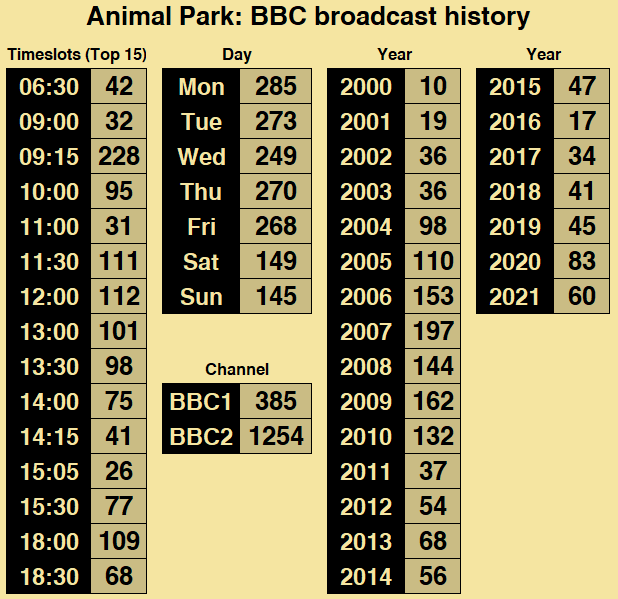
55: Animal Park
(Shown 1639 times, 2000-2021)

If you want an animal-based programme that seems as unstoppable as a rhino-led restaging of the rollerskating scene from Some Mothers Do ‘Ave ‘Em, then Animal Park is the show for you. Running for seventeen series and a total of 221 episodes, this series following the fortunes of keepers and animals at Longleat Safari Park is a definite stayer. Certainly enough for each episode to have been broadcast an average of 7.44 times.
Originally broadcast on weekday summer mornings on BBC One, running from Monday to Friday during the Julys of 2000 and 2001, it also found an appreciative audience for afternoon repeats on BBC Two. And so, from 2004’s fourth series onwards, first-run episodes of the series moved to Two’s afternoon schedule, with repeat showings going out in post-Breakfast slots on BBC One.
The primary phase of Animal Park lasted for a full ten years and nine series before production of new episodes halted in 2009. Not that the programme was particularly cancelled in any way – indeed, the volume of episodes in the BBC’s Tape Vault (sub: check the BBC still has a tape vault) meant it could be stuffed into any wildlife-sized gap in the daytime schedules.
Indeed, it was popular enough to warrant a pair of spin-off series. Animal Park: Wild in Africa saw focus shifted from Longleat to the endeavours of wildlife conservationists in Namibia, airing on BBC Two in 2005. A couple of years later, that was followed by Animal Park: Wild on the West Coast, where the action shifted to California. And with broadcasts of the series proving to be such a mainstay of the daytime schedule, 2016 saw a tenth series, commissioned to mark the 50th anniversary of Longleat Safari Park, and from there, further new series continued to be produced. As they are to this very day.
Indeed, such was the appeal of the series that it moved away from mornings and early afternoons, and became a bit of a fixture in the 6.30pm slot on BBC Two during the lockdown spring and summer months of 2020 and 2021.
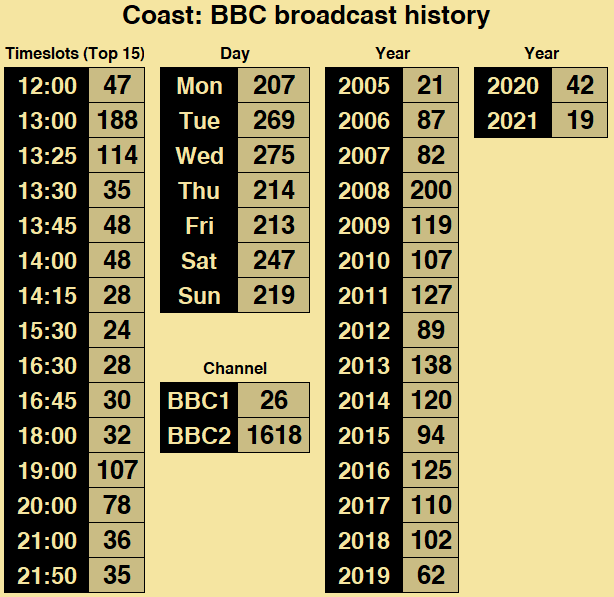
54: Coast
(Shown 1644 times, 2005-2021)
Coast arrived on our screens in 2005 with a simple premise. You know the wiggly bit that runs around the periphery of the UK? Let’s look at that! Picking the most famous bit of Britain’s coastline as the starting square (the White Cliffs of Dover, as well you know), each new episode covered subsequent stretches of coastline in a clockwise manner. So, Dover to Exmouth, Exmouth to Bristol, Bristol to Cardigan Bay, Cardigan Bay to the hip bone, and so on. Innovative, but a formula that you’d expect to have a limited lifespan. Not least as the circuit of mainland Britain, Northern Ireland and Scotland’s Western Isles was completed by the end of the twelfth episode.
Luckily though, there’s so much going on within each stretch of coastline that the programme couldn’t hope to have covered it all in twelve hour-long episodes. And so, for the second series, viewers were off on another journey, this time with the route set to ‘shuffle’. Freed from the clockwise route, there was now scope to take in some new seaside scenarios, including within the Republic of Ireland and the Outer Hebrides. And that formula was repeated for subsequent series, picking out a particularly alluring section of the British Isles’ edge bits and see what was going on there.
By the fourth series, the remit of the series had extended beyond the British Isles, taking in the stretch of France running from Cap Gris-Nez to Mont-Saint-Michel, the far northern waters running from the Inner Hebrides to the Faroe Islands, and from Norway’s Lillesand to Svalbard. With the popularity of the programme showing no sign of slowing, by 2014’s ninth series of the programme, coastlines as far afield as Canada were being explored, but such excursions only lasted a single episode – the main focus was always the coastal regions of the UK.
The soon changed with the launch of spinoff series Coast Australia. Commissioned by Aussie broadcaster Foxtel in co-operation with the BBC, which looked at, well, duh. That also proved to be a success, initially running on Australia’s History Channel in the Antipodes before appearing on BBC Two, and clocking up three series so far. Similarly, TVNZ would go on to commission Coast New Zealand, which has also run for three series thus far.
After all of which, it’s safe to say the programme has been A Success, with full repeats reaching an appreciative audience, and truncated repeats being BBC Two’s go to filler programme for any 10- or 15- minute gaps in the schedule, along with the show being on perma-standby in case of any channel breakdowns. Indeed, the series even generated a set of BBC-sponsored walks along locales visited by the series. I’ve not checked, but I’m sure that’s not something you’ll find with, say, Holby City. Despite the last new episodes being produced in 2015, it has been a regular on our screens ever since.
There were just 75 episodes in total, and yet the series has clocked up an astonishing 1,644 showings on BBCs One and Two. Surely at this point regular viewers will have a familiarity with Britain’s coastline to rival Google Street View.
Phew. Got through all that without mentioning the main presenter’s Weird Facebook Uncle opinions on vaccines. Oops.
53: Twenty-Four Hours / 24 Hours
(Shown 1684 times, 1965-1972)

“I’m Federal Agent Cliff Michelmore, and today is the longest day of my life.”
Okay, while it’s tempting to imagine the avuncular Holiday presenter recast as lead of the real-time CTU drama (just me then?), this was in fact the BBC’s late evening news magazine. Much higher of brow than its teatime counterpart – more ‘a report on the Ulster Defence Regiment’, less ‘man says he can jump on eggs’ – it come with a suitably sober roster of anchors. Initially Cliff Michelmore, but subsequently Kenneth Allsop, Michael Barratt, Robert McKenzie and a tyro David Dimbleby.
Initially starting whenever the schedule had room for it, the success of ITV’s flagship bulletin News at Ten led to 24 Hours going out in a spoiler 9.55pm slot for most of the week (save for Wednesdays, where the space was needed for The Wednesday Play).

Given its penchant for discussions in front of expert-packed studio audiences, confrontational interviews with key policy makers and reports from the likes of Fyfe Robertson, Robin Day and David Jessel, it’s hardly ripe for a runout on UKTV channels any time soon, and there’s very little out there to watch on demand. The episode ‘Yesterday’s Men’, looking at how Harold Wilson’s shadow cabinet were coping with being in opposition after their 1970 election defeat, did appear on BBC Parliament in 2013, but other than a few clips on the BBC’s website (such as ‘Gerry Fitt on the Widgery Tribunal’), this is for the most part a historical resource set to remain in the BBC vaults.
There is however one full episode on the BBC website, and it offers what seems to be a perfect summation of the series. Dating from September 1966, a special episode looks at the shock assassination of South African Prime Minister Hendrik Verwoerd, and is so thoroughly archived you even get a glimpse of the preceding BBC-1 ident and continuity announcement. From Blackpool, there’s also a report from the second day of the TUC Congress and an interview with the Minister of Labour. The way each item is previewed to the sound of a strident brass fanfare is especially notable. The main bulk of the programme gives a great sense of how breaking news was covered at the time – lengthy shots of a studio reporter on a crackly phone line to a journalist at the scene of the event, the on-screen anchor taking a phone call from a producer on-air,
While some very archaic viewpoints are being expressed by participants of the programme, the BBC’s sense of fairness is very much present: Robin Day follows a quoted reference to ‘the coloureds’ by reinterpreting the phrase for less bigoted viewers, and views on the event are sought from various parts of the political spectrum. An instance where an architect of Apartheid is assassinated by a white supremacist’s bullet isn’t the most straightforward of stories, and Twenty-Four Hours does a magnificent job of covering such a breaking international story – it’s worth remembering that at this point, the entire medium of television is only thirty years old.

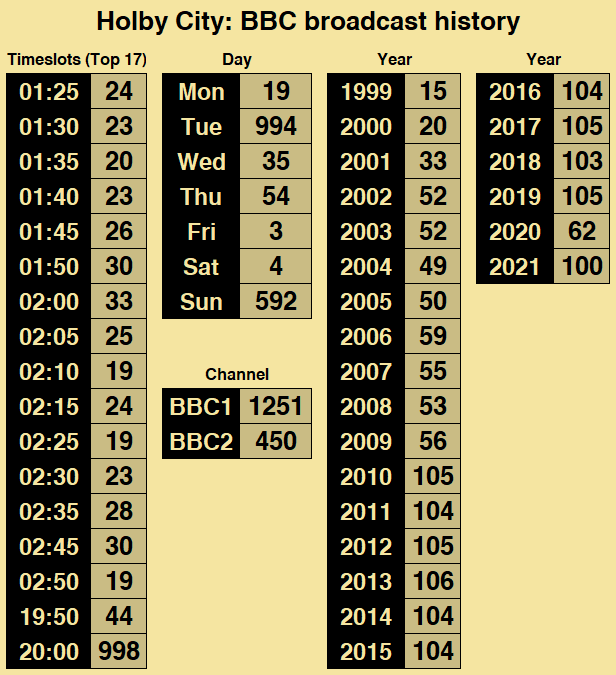
52: Holby City
(Shown 1701 times, 1999-2021)
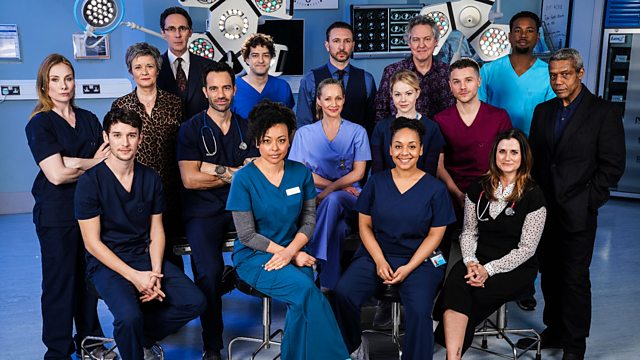
We’ve already seen sister show Casualty on the list, so here’s Casualty’s soapier sister programme. Several spaces higher in the list, despite the original having a thirteen year head start and the benefit of not having been cancelled. Also, I’ve never watched a single second of Holby City, so this might not be a very long entry.
There were even a number of opportunities for Casualty and Holby City to cross over, not least in several episodes specifically titled Casualty@Holby City (which just reminds me of h&p@bbc, if I’m honest). The first of those episodes were in 2004, so it’s hardly as if making programme titles sound like email addresses was fresh and new at the time. They should’ve just gone with ‘Casuolby’ instead. (For the record, there were nine episodes of Casuolby, and I’m not awarding them to either programme in these counts.)
Back to the plot. Holby City was created by Tony McHale and Mal Young as a spin-off from its more established BBC brethren, making its debut appearance on 12 January 1999, and would go on until 29 March 2022 (though, for the purposes of this list, we’re only counting broadcasts up to 31/12/21). The action follows the medical and ancillary staff working at the fictional Holby City Hospital, which also serves as the host location for Casualty, resulting in occasional crossover potential with that programme plus mostly-forgotten police procedural spin-off HolbyBlue.

Casuolby, yesterday. Holby City began with a core cast of main characters that would – as might be expected given its continuing drama remit – be replaced as needed, clocking up a number of memorable names within that time. Indeed, previous cast members include Patsy Kensit, Jane Asher, Robert Powell, Ade Edmondson and Graeme Garden. Beyond that core cast, a number of the show’s guest appearances are equally notable: Leslie Phillips, Anita Dobson, Peter Bowles, Susannah York, Ron Moody, soap royalty Johnny Briggs, Lionel Jeffries, Eric Sykes, plus Antonio Fargas and David Soul from Starsky and Hutch (sadly not in the same episode).
It’s perhaps notable that, despite the series being a soap opera (sorry, continuing drama). Holby City dealt purely in hour-long episodes, clocking up over 1000 episodes in its time. Indeed, that stack-em-high approach led to criticism, with Broadcasting Standards Commission director Paul Bolt accusing the BBC of squandering the television licence fee on the programme.
There’s another notable thing about Holby City too, but possibly only if you’ve tasked yourself with putting together full broadcast histories of a hundred long-running television programmes. And who’d be daft enough to do (etc). A short while after pulling all the data, I noticed a curious thing. Several clearly post-watershed shows were being reported as having early morning repeats. As in, episodes of Twenty-Twelve going out at 7.20am, things like that. It’s not wholly unheard of, of course. One of my favourite pieces of stupid scheduling was when UK Drama (as was) decided to repeat Alan Bleasdale’s GBH on Saturday mornings at 7am. Cut to absolute ribbons, making one wonder if it was worth that time in the edit suite for the sake of surely just a few thousand viewers. But BBC2 doing something similar seemed odd.
A few quick checks revealed something curious: while most programme listings were completely correct, anything airing between midnight and 6am (between 2010 and 2021, the post-Genome era) had the wrong time listed, showing up as anything from 7am to 9am. And that poses a problem for all those Sign Zone repeats of major programmes, which I am counting because standards. The few times this has come up so far, there has been a simple (if inconvenient) solution. Go through the online listing for each programme broadcast date, and fix the times on my list manually. And then I arrived at Holby City. Which has enjoyed overnight signed repeats 617 times. Sigh.
So, I’ve re-pulled all the programme data, so that it’s correct. Meaning the table below is correct, even though it’s staggeringly unlikely anyone but me will care. Oh well, at least it’s inflated the word count for the entry of a programme I’ve never ever watched.
51: Breakfast Time
(Shown 1727 times, 1983-1989)

It feels very strange to think that there was once a time when a nation was gripped by the notion of getting up at 6.30am to watch telly. And yet, there was such a time. From its inauguration in 1936 right until the 1980s, television was something that – thanks to a succession of Postmaster Generals – was rationed out. Fine if you’re someone who has a daily schedule that matches the consensus, not so much if you’re a night owl, early riser, new parent or shift worker. But, if television was by law restricted to just fifty hours per week of airtime, it made sense to use those hours where the most potential viewers were.
Overnight television as standard wouldn’t come to the UK until the late 1980s, where a diet of Prisoner Cell Block H, Married… With Children and Night Network would sate the needs of people who didn’t need to get up early the next day. And preceding that, what would become known as breakfast television arrived on British screens all the way back in 1977, with Yorkshire’s Good Morning Calendar and Tyne Tees’ Good Morning North. Both were only on air for a short trial run, and going by the footage online of Good Morning Calendar, were cheaper than own-brand chips – the budget didn’t even seem to stretch to a pair of scissors for mounting newspaper front pages.

With the lack of a true morning show, British TV was being left behind by international counterparts. Australia had been enjoying full-time breakfast TV since 1978 (10’s Good Morning Sydney), Canada since 1972 (CBC’s Canada AM) and the US since a surprisingly early 1950 (WPTZ’s Three To Get Ready, an entertainment show starring Ernie Kovacs, no less).
The first ‘proper’ attempt at breakfast TV came a few years later, with Breakfast Time opening up BBC1 each morning from Monday 17 January 1983. Beating ITV’s TV-am to the punch by a couple of weeks, it seems BT’s launch was expedited with that very goal in mind. And, let me tell you, for a telly-obsessed youngster, it felt like a huge occasion. While I only troubled myself to wake up at 6.25am to catch the start of it on the first morning (having asked my mum to wake me up especially, as I was still very young at the time. Thanks, Mum!), it would go on to become a key part of my pre-school routine. So much so, I probably spent too much time in early-morning lessons trying to draw the programme’s stylised sun logo in the margins of exercise books (see also: the ==2== BBC2 ident, the Granada logo and using three different colour pens held together to do the LWT logo).
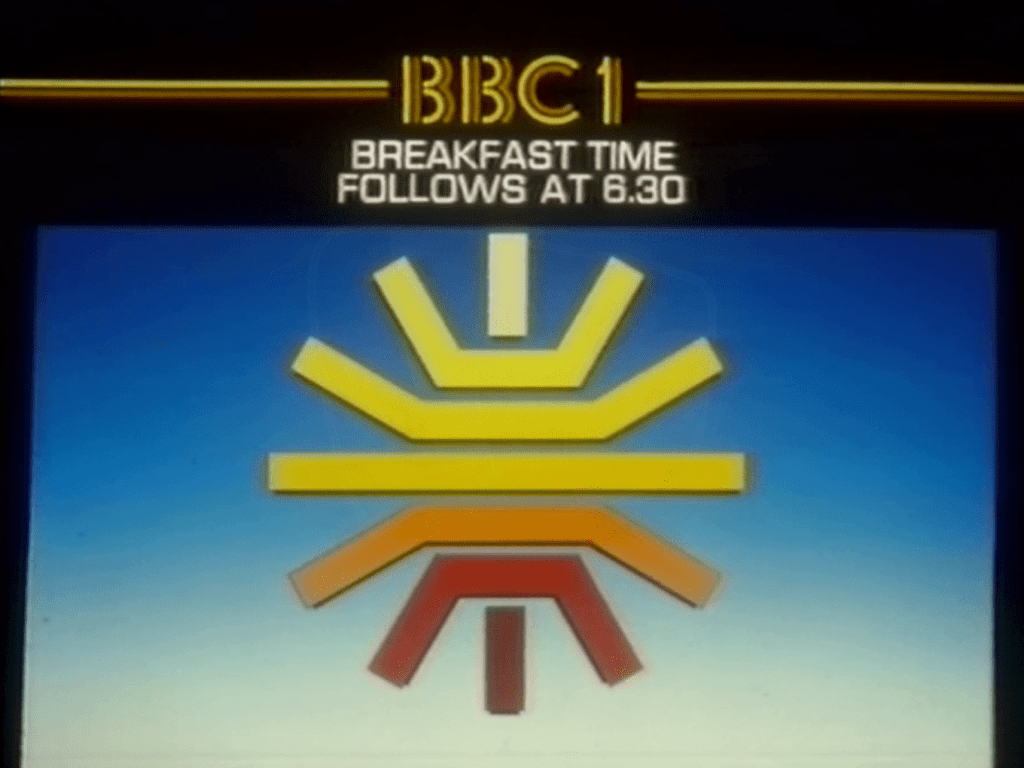
No child would have bothered to attempt the logo for Sixty Minutes, mind. And that’s why it failed. Luckily for a nation of early risers, the new breakfast show gravitated much closer to the orbit of Nationwide than Newsnight. A pastel coloured set strewn with sofas, a breezy theme tune and a bejumpered presenting team headed by Frank Bough, Selina Scott and Nick Ross eased Britain into each new morning, with a warming mixture of chat, interviews, horoscopes and advice. Supplementary fixtures on the show included weatherman Francis Wilson, keep fit guru Diana Moran (aka The Green Goddess) and astrologist Russell Grant, each quickly becoming household names, even amongst those who still preferred radio with their cornflakes.
And yet, trope-laden ITV rivals TV-am would overcome early obstacles to do everything Breakfast Time had been doing but in a much more memorable way (all together now: David Frost, Most Profitable TV Franchise In The World, Strikes, Bingo, Rooftop Eggcups, Rat Joining A Sinking Ship, Rustie Lee, Faith Brown And Rustie Lee, Timmy Mallett, “Ran The Tape Backwards And Drowned The Bugger”). And if you want to doubt that, I challenge you to come up with ten equally memorable aspects of Breakfast Time within a minute. And so, in 1986, Breakfast Time ditched the jumpers and sofas in favour of suits and desks. Bye-bye Nationwide AM, hello Morning Newsnight.
On Friday 15 September 1989, the jig was well and truly up. The last edition of Breakfast Time went to air, with it being replaced the following Monday by BBC Breakfast News. The suits had truly won. (But also lost: I’m not including BBC Breakfast News in this list because it’s primarily a news show. So, yeah. Take that, John Birt.)

Oh, how classy. Well done, you. No child is going to be trying to sketch this in the back of their physics exercise book. BREAKFAST PRE-HISTORY TIME
It wasn’t the first time the BBC had opened up early, of course. Occasionally, major events would necessitate the transmitters fizzling into life hours earlier than normal. Here are some of the occasions where BBC Television got out of bed before 7am.
06:00 Friday 27 May 1955: The General Election
The BBC’s first big tilt at covering a general election saw the transmitters splutter into life at an unearthly hour for the first time. The 1950 General Election (23 February 1950, five seat Labour majority) had merely seen a modest fifteen-minute bulletin at 8:15pm, albeit with the promise of “maps and animated diagrams”. The following year’s election (25 October 1951, 17 seat Conservative majority) saw BBCtv stay up later than ever before, with live Thursday night coverage continuing until 4am, though the results team were then given six hours’ sleep before coverage resumed at 10am.
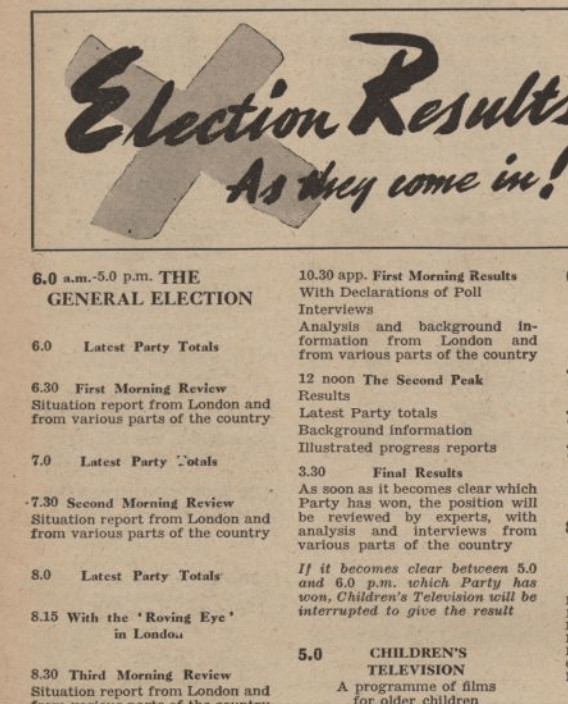
It was the 1955 General Election that saw the Television Service really throw everything at the wall, with coverage beginning on 9.30pm on Election Day and continuing until 4am. After several gallons of strong coffee were fed to the production team, they’d be back on air at 6am, for all the latest results – for eleven solid hours, with an additional caveat that they’ll barge into the 5pm children’s programming if necessary.
From that point on, General Election coverage would go on to be the main reason for the BBC to ‘wake up’ (or even ‘stay up’) at a scheduled time that early.
06:30 Wednesday 9 Nov 1960: The New President

With Nixon taking on JFK for the presidency, BBC-tv were up nice and early (along with ITV) for the latest transatlantic news. Quite the epic morning broadcast it seemed, too. Richard Dimbleby introduced affairs, with Christopher Serpeu reporting from London and Douglas Stuart from New York. Robin Day embarked on the West End, where he chatted to American correspondents, Ludovic Kennedy talked to the man (and presumably woman) in the street, while John Tidmarsh spoke to Americans flying into London Airport.
Best of all, between election developments David Jacobs presented “music from the current American hit parade”. That’s the kind of multimedia experience we want with our Rice Krispies.
06:00 Friday 16 October 1964: General Election Results AND The 1964 Tokyo Olympics (BBC-tv)
Siri, show me an utter headache for a 1960s television backroom staff. Everyone involved must have been sorely wishing more than 376 people had access to BBC-2 at the time, so they could just put one of the programmes on there without interruption.

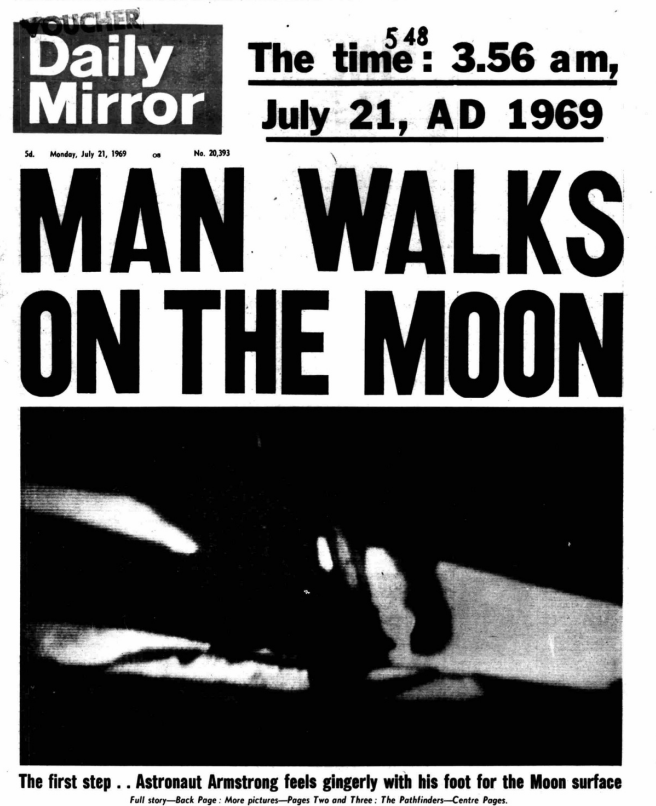
06:00 Monday 21 July 1969: Apollo 11 (BBC1)
Five years on, and for sports and politics haters a much more thrilling reason for the channel to wake up early: MEN ON THE ACTUAL BLOODY MOON. Big news, as all the newspapers reported:


06:30 Thursday 20 November 1969: Apollo 12 (BBC1)
Man sets foot on the actual bloody moon for only the second time in history. Big news, as all the newspapers reported:
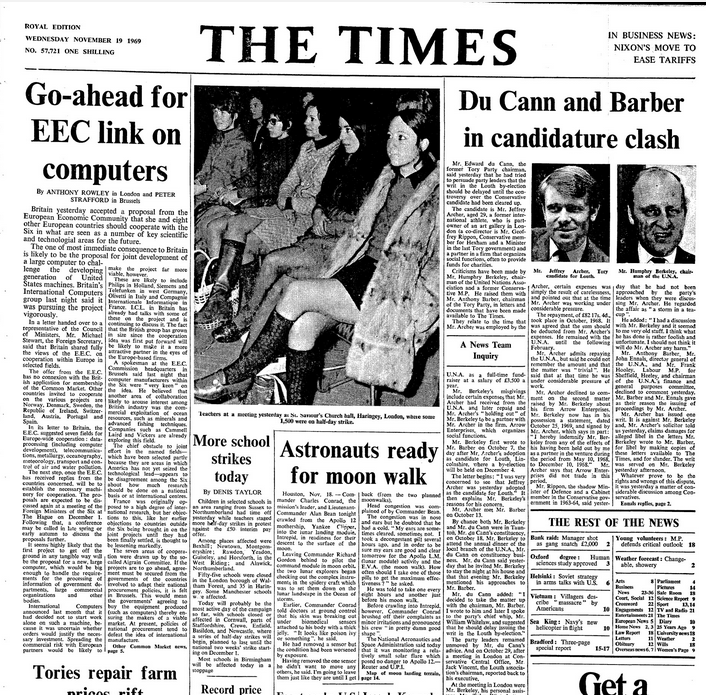


The Moon? Again? Done that. Give us a ring when you’re lolloping around on Mars, yeah? (No wonder they stopped bothering a few years later.)
06:40 Wed 30 January 1974: Open University (BBC2)

Daily Mirror, Monday 4 Jan 1971 Now the UK’s most-populated university, but back in 1971 the OU was a brave new venture. The brainchild of Harold Wilson’s Labour Government, it set out to widen access to the highest standards of scholarship in higher education, and the most efficient way to do that was by employing television to deliver lectures.
Initially going out in any spare off-piste part of the television schedules from 1971, OU programming primarily went out at 11am on weekday morning BBC2. As popularity increased, as possibly did the need to provide a place in the schedules for students juggling a 9-to-5 job alongside studies, early morning TV provided a handy home for Encouraging Regional Development, The Joule-Kelvin Effect and Neural Modelling.
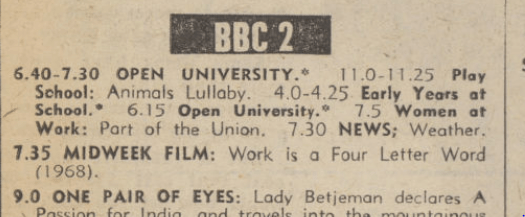
First arriving in a pre-7am slot in January 1974, the Open University (scary ident and all) was the first regularly-scheduled ‘breakfast’ TV in the UK.
06:45 Thursday 7 October 1982: Breakfast with Brisbane (BBC1)

The 1982 Commonwealth Games provided early morning BBC1 viewers with a welcome alternative to the likes of Political Stability in Sweden. While the games started on 30 September, it wasn’t until a week later when sports fans could tune in at 6.45am to see Des Lynam introduce coverage of the 30km Road Walk, Men’s Long Jump, Men’s 5,000m, Women’s Javelin, Women’s 800m and something Genome lists as “10-mile Individual Shooting”, but which I can find no evidence of elsewhere. It’s probably the 10 Metre Individual Shooting, and the Radio Times simply weren’t having any of that metric nonsense.

Once Breakfast Time was in place, any such sporting events were to be incorporated into the BT brand, with the show appearing as ‘Olympic Breakfast Time’ during the 1984 and 1988 Olympiads. While there’s a case for arguing such spells weren’t ‘proper’ Breakfast Time (for sone thing, they represent the only times ‘Breakfast Time’ was scheduled to be broadcast at weekends), it’s the branding that matters. After all, I’ve counted episodes of Sportsnight Special when they’ve been live primetime football matches rather than roundups, and the same applies here.

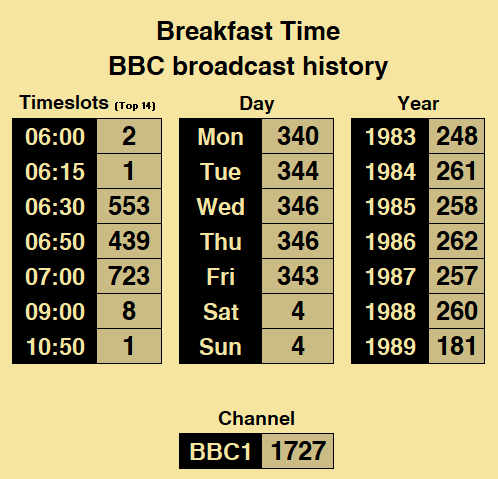
If you’re wondering about those time-of-day outliers:
The first 6am start was on 10 Jun 1983, and was an Election Special, the 6.15am start on 13 Oct 1986 was to provide coverage of The Queen’s visit to China, and the second 6am start came on 9 Nov 1988, which offered live coverage of the Bush Versus Dukakis Presidential Election.
Those 9am ‘starts’ came during a spell in November and December 1986, where Breakfast Time was listed as running from 7-8.40am, before Watchdog operated as a standalone show at 8.40am (at least as far as the Radio Times were concerned), before Breakfast Time ‘returned’ at 9am to wrap things up.

Barely seems worth the bother, but hey. Lastly, that 10.50am billing for Breakfast Time was from 8 May 1985, as part of a special episode where “Frank Bough, Selina Scott, Nick Ross and Sue Cook present[ed] a special programme to mark the 40th anniversary of the Victory in Europe”. That ran all the way to 11.15am, but with the 10.30am slot reserved for Play School, meaning there was a fresh listing for Breakfast Time at 10.50am. Best bit must surely have been at 9.05am, with the ‘Breakfast Time Street Party’, not least as it was billed as including “Humphrey Lyttelton and his Band bring[ing] back memories of that day”.
That’s another one wrapped up. Yes, a few shorter write-ups this time, but shush. We’re at the half-way stage, and my original plan of getting the whole thing wrapped up before the actual centenary itself arrives in… [looks at calendar] oh. Ah. Um.
-
I Challenged Six AI Image Bots To Generate Images For Newspaper Headlines from The Day Today. Here Are The Results (Part Two)

Continuing this occasional series, this time with added Dall-E, which no longer requires people to sit in a waitlist for months before getting access. Hooray! My prediction is that it’s absolutely going to storm it, going by how good the Outpainting feature is. That was able to turn this classic photo:
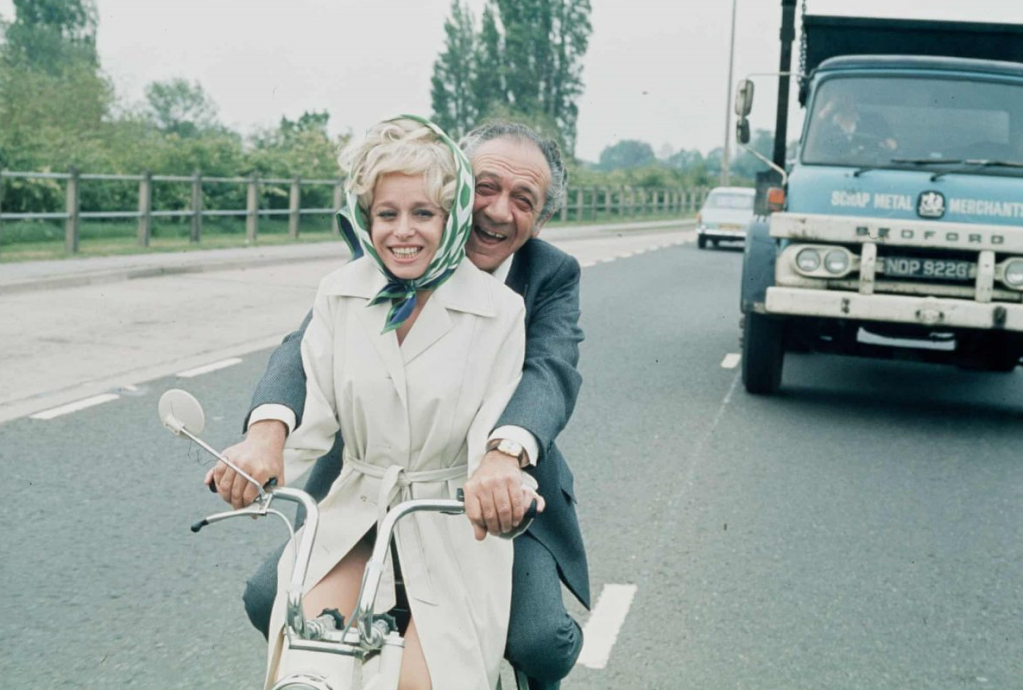
Into this:
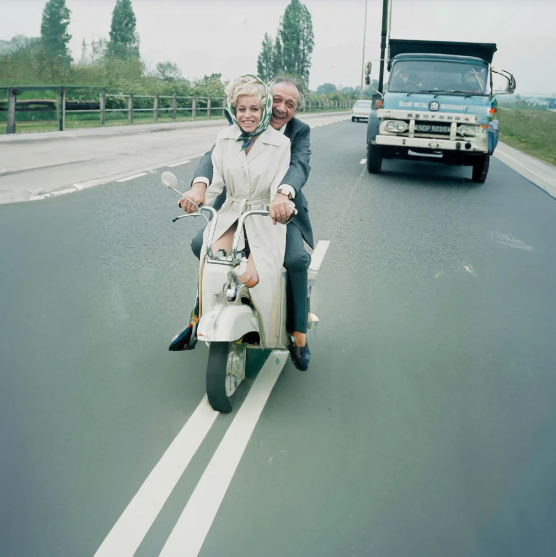
Bodes pretty well, I’m sure you’ll agree. Oh, and I’ll use Dall-E instead of Computer Vision, which was quick to generate images, but… well, here’s ‘Russia Elects Cobweb’.
Bye, Computer Vision. UNLEASH THE NEWSGASM.
EPISODE TWO: The Big Report
“Arafat ablaze in kerosene oyster hell” — The Daily Telegraph
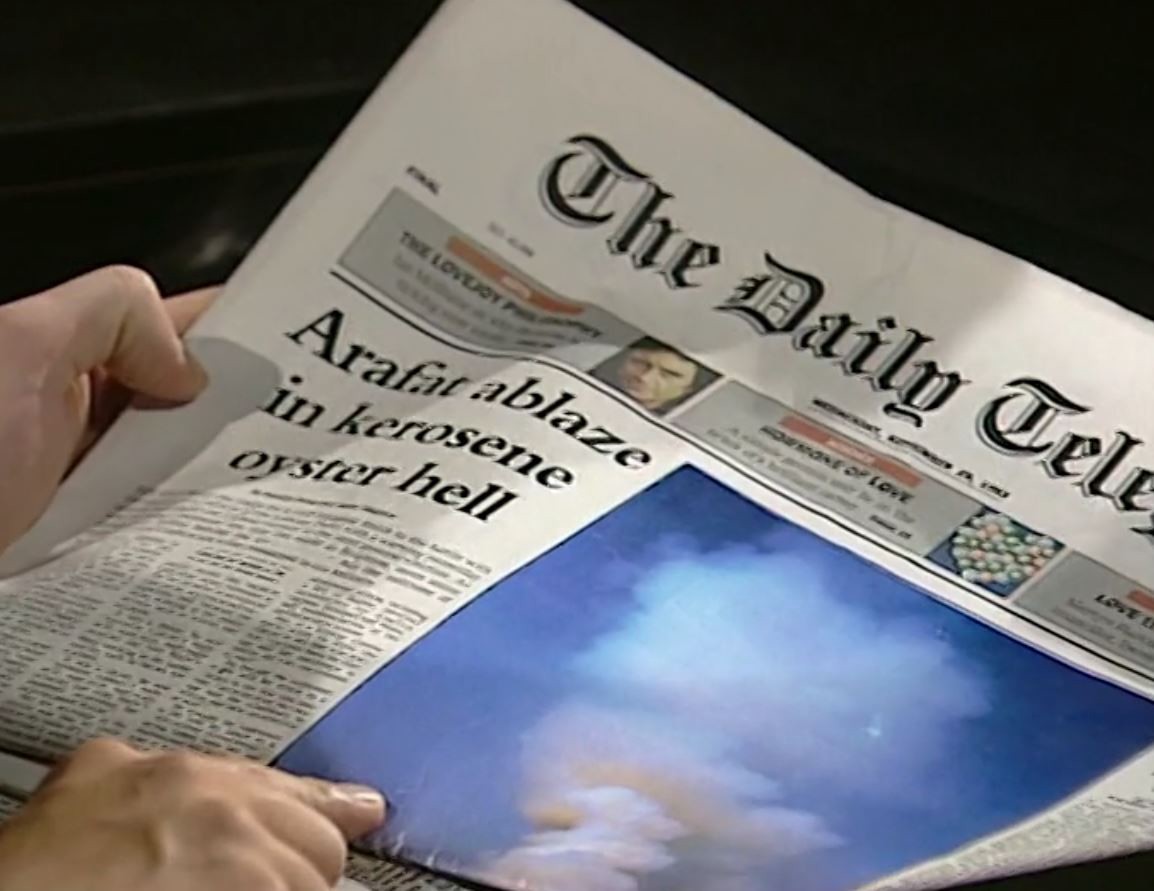
1st Place: Craiyon
Yep, looks like something from that actual news story, can’t fault their work there.
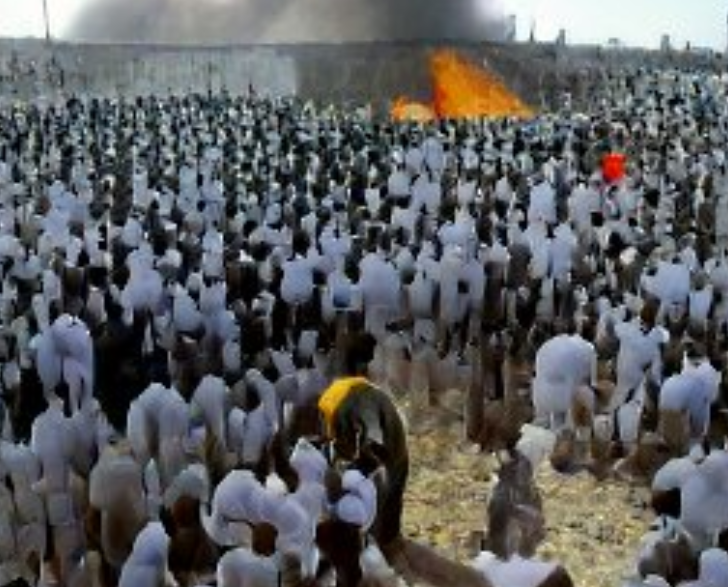
2nd place: Hotpot
A bit like something from a post-apocalyptic film from 1997, but certainly a worthy second place.
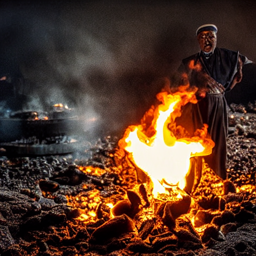
3rd place: Nightcafe
Partly because I’ve used up the last of my free credits making this, so this is the last chance it gets to appear here.
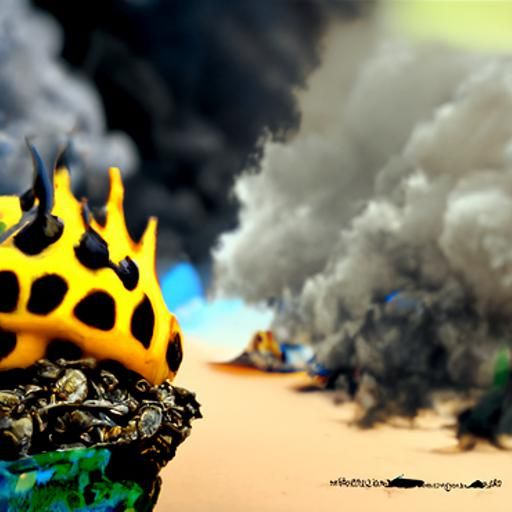
“Peter Collins is not a man.” — Today
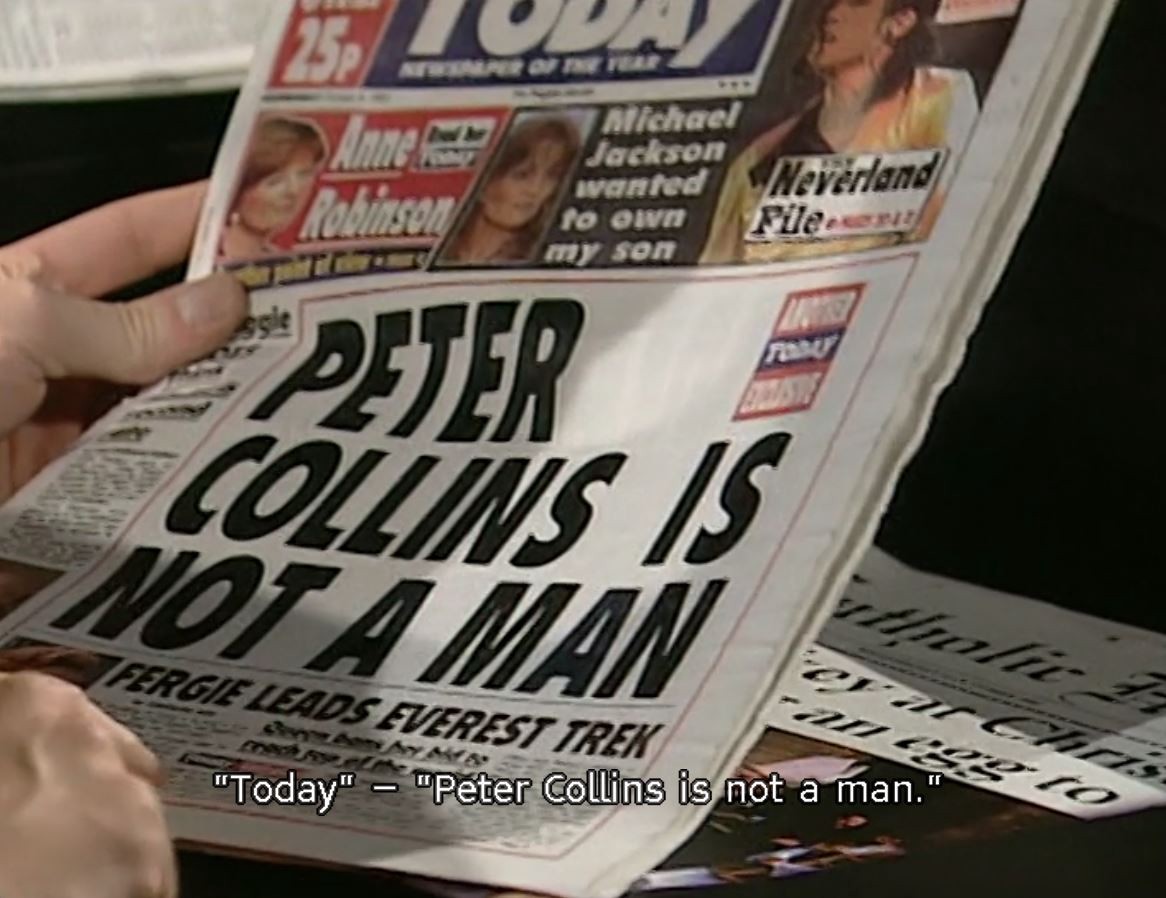
1st place: Dall-E
Not sure if there is a famous rugby league player of that name, but if there is, they certainly ain’t a human man.
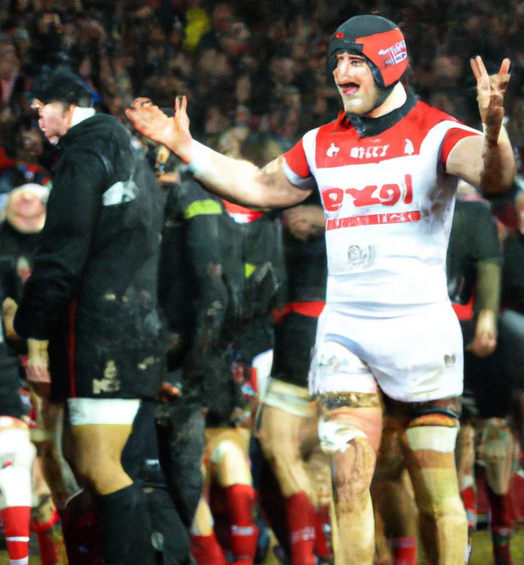
2nd place: HOTPOT
Not sure what’s going on here, either. But the Eastern-Bloc-Propaganda poster look is a welcome interpretation.

3rd place: CRAIYON
Nope, no idea. Not a man, because he’s an effigy stuffed with newspaper, perhaps? It’s certainly a quietly unsettling image.
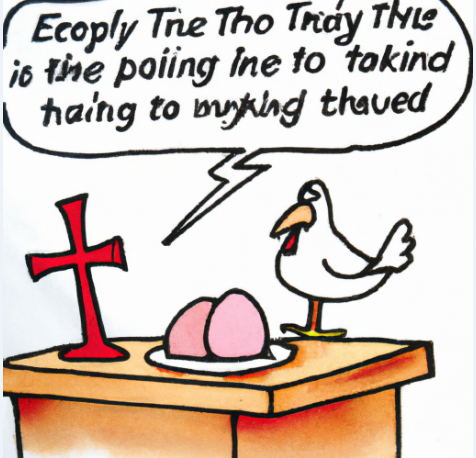
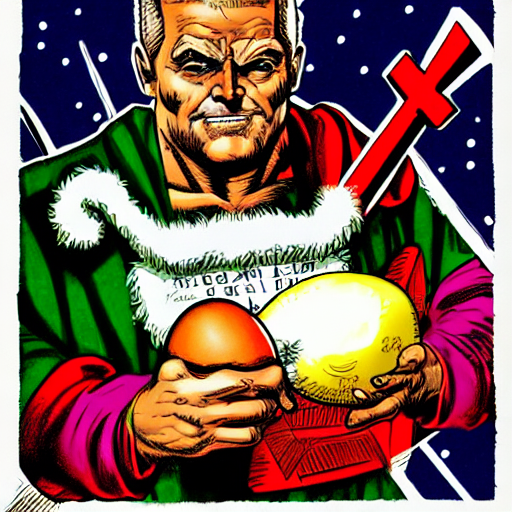
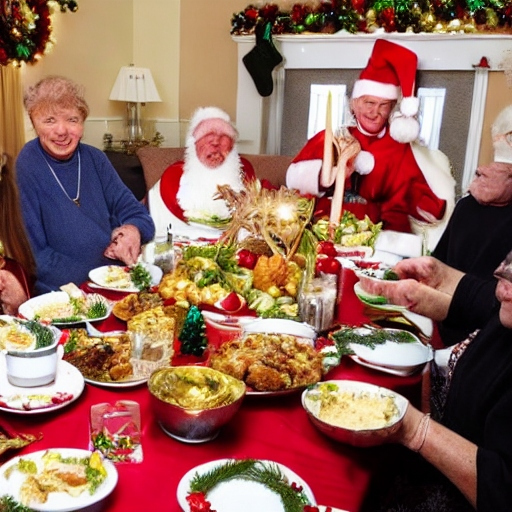
“‘Eating turkey at Christmas is like nailing an egg to the cross’ says Bishop.” — The Catholic Herald.
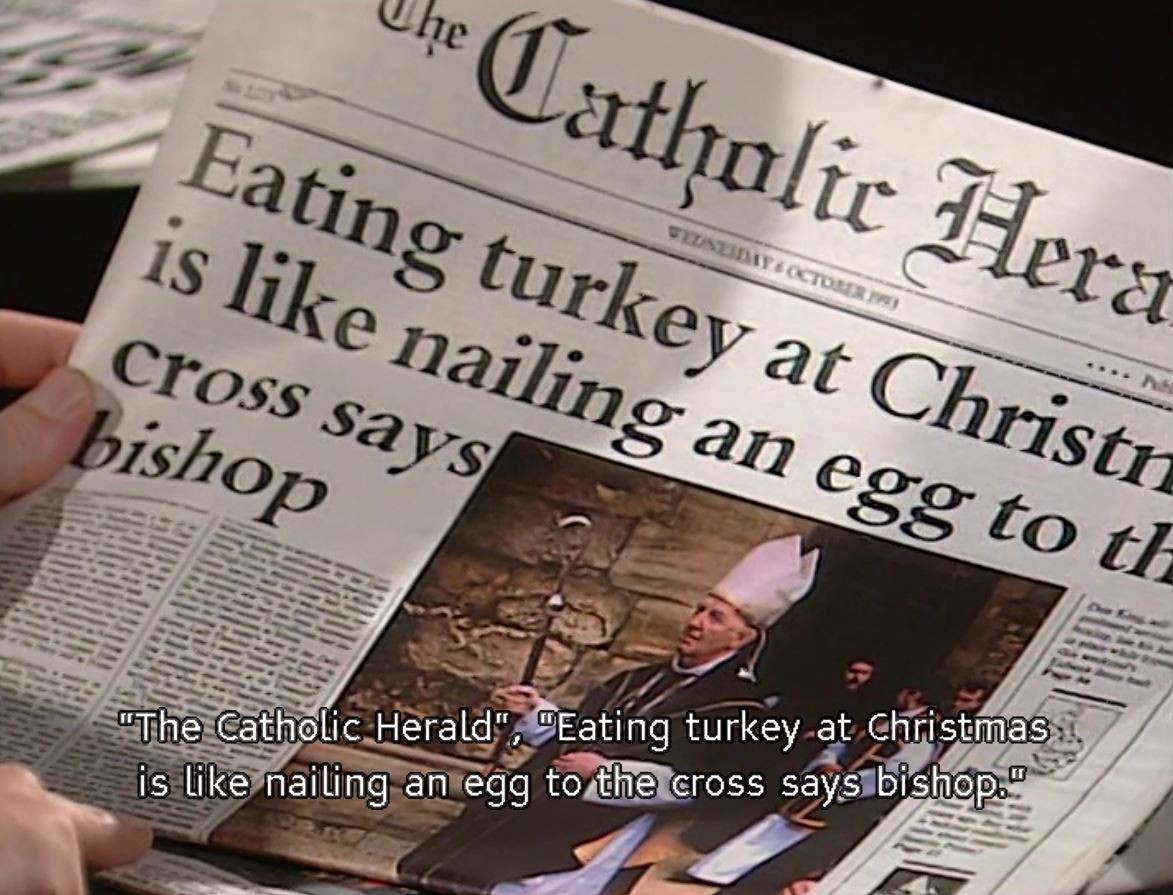
1st place: DALL-E
A very strong effort from the newcomer. If that had been mooted as a topical cartoon of the news story in a foreign-language newspaper, I’d easily believe it. Top marks.
2nd place: HOTPOT
Another strong one, after I’d used the ‘Comic Book’ setting on Hotpot. A very close run thing between the top two. Would work as cover art for a KMFDM album, too.
3rd place: DEEP.AI
A strong showing from the three main contenders for this headline. Well done, all.
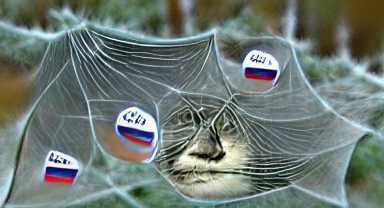
“Russia elects Cobweb.” — The New Zealand Prendergast
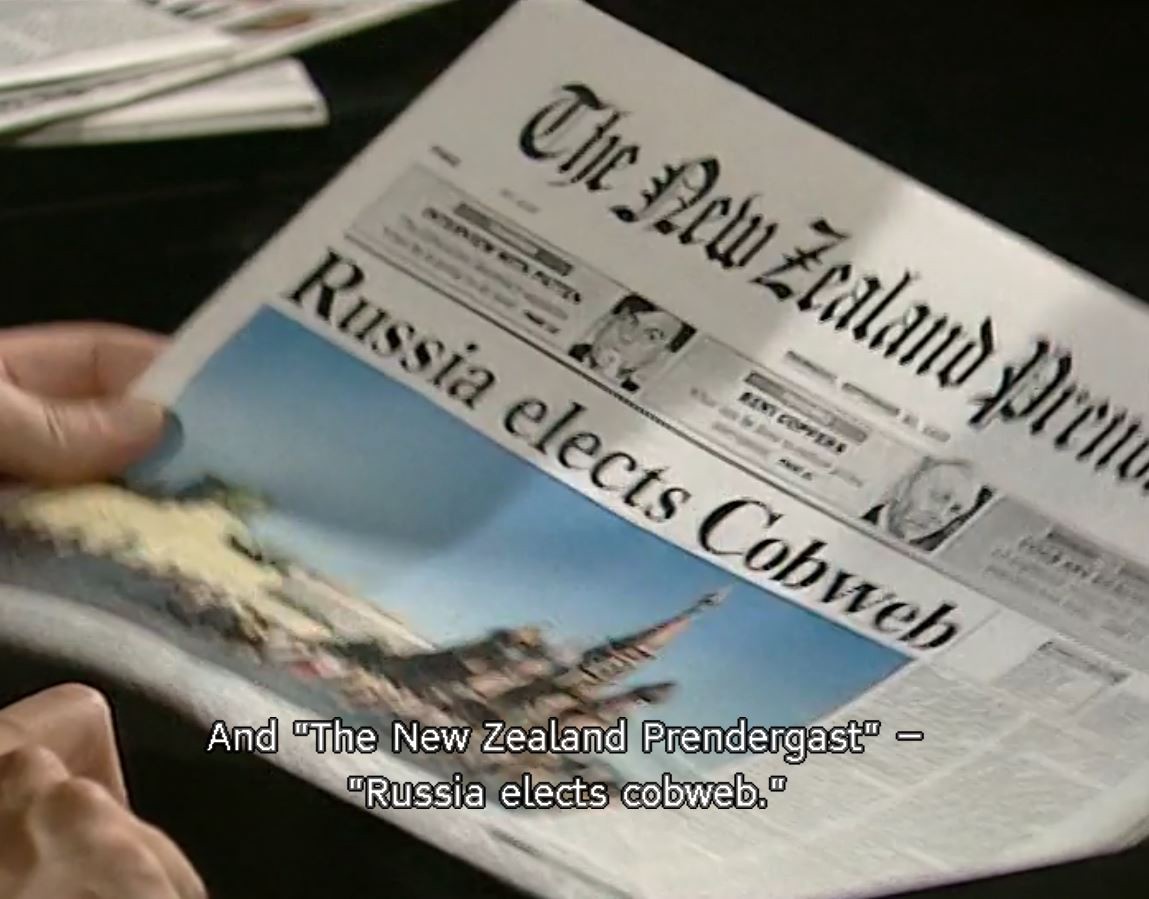
One of the most memorable headlines, and something that we can but wish were true MYNAMESMATTFORDEGOODNIGHT.
1st place: PIXRAY
Dall-E cocks up the land here by generating pictures of cobwebs. Possibly overtly political cobwebs with a plan for ousting Putin, but that doesn’t come across in the picture. So, it’s up for grabs and Pixray takes the prize for this image.
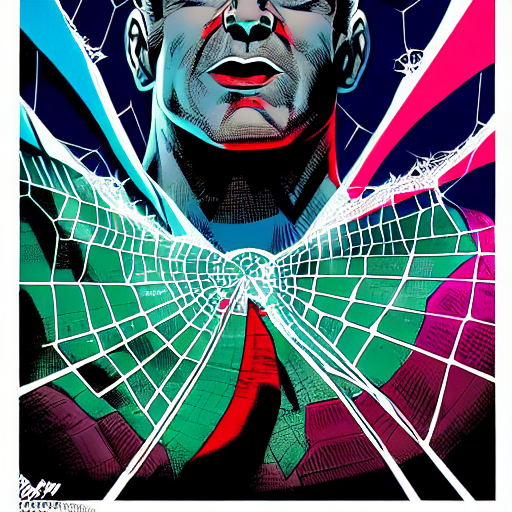
2nd place: HOTPOT
Other results were only on nodding terms with the remit, and best of those was another Comic Book one from Hotpot.
3rd place: NIGHTCAFE
Even less on topic, but a nice piece of art from the Nightcafe crew. And I’ve now got a few more credits now, so I might as well publish the results of them.

Okay, time for a look at that old League Table.
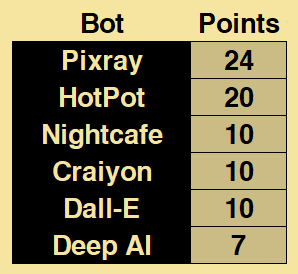
HotPot making up a lot of ground on Pixray, but now Dall-E is part of this, it’ll be interesting to see how it fares after everyone else had a head start. It’s just like the new version of Ninja Warrior, basically. But with a news spoof that basically will never grow tired.
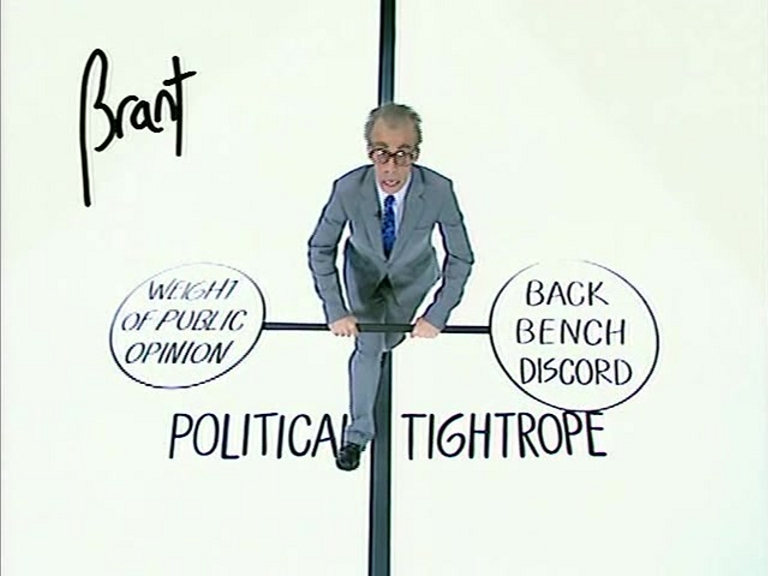
“I see Brant’s nailed it again.” -
SKY (G)ONE: A History of Sky’s Flagship Channel

[NOTE: This article originally appeared on Medium last September. I’ve rewritten some of the following to bring things up to date a little.]
It’s now just over twelve months* since Sky One was filed alongside Bravo, Carlton Select and U>Direct on Wikipedia’s list of defunct UK television channels. This is a suitable opportunity to reflect on what we waved goodbye to (or, at the very least, said ‘what the hell is Sky Showcase?’ around this time last year).
(*Okay, “it’s now thirteen months.”)
Sky themselves didn’t do anything to mark the passing of the channel itself, save for a passing comment by their continuity announcement at the close of Sky One’s last day on-air. On one level that’s understandable — putting together an hour-long tribute about how great the channel was could just make Sky seem like a bunch of heartless sods for killing off this beloved beacon of non-terrestrial broadcasting. Also, if they were to do a compilation of all the Sky One idents, it’d take about an hour as they kept rebranding the channel every other year. But the biggest elephant in the room would have been that for all Sky’s best efforts at producing a homegrown hit, many of the programmes their customers really wanted were Big American Franchises. Many of which were admittedly nabbed from under the noses of the terrestrial channels who’d put in the hard yards of building a loving audience — most notably 24 and The X-Files from the BBC, Lost and Friends from Channel Four.
And, of course, there was The Simpsons. The family that did more than anyone else to draw audiences to Sky One. That’s probably why Sky Showcase, the channel taking One’s old slot and focused on prime picks from Sky’s genre-based channels, retained that scheduling lynchpin (even though – EXCITING FACT! – daily repeats of The Simpsons was a practice that actually began on short-lived analogue satellite channel Sky Two).
Outside of their sporting and news coverage, Sky have never really seemed bothered about marking their own history. Sky Sports’ Premier League Years is happy to splash around in old footage, on-screen graphics and bad-suited punditry of years long gone, and Sky News made a point of celebrating 30 years on air in 2019. But you’ll never see any such hoo-ha from Sky’s entertainment portfolio. With that in mind, here’s a look back at many of the programmes that made Sky One what it was.
Because it’s 2021 and Data Is Important, I’m going to take a look through twenty years of viewing figures for Sky One, and pick out some of the most popular shows — those that stayed popular, and those that audiences soon tired of. But — as those viewing figures are only available for 1998 onwards — here’s a quick scamper through some standout shows of Sky One’s first decade (or thereabouts) on air.
THE DJ KAT SHOW (1986)

After Roland Rat transformed the fortunes of early-morning ITV in the early 1980s, what better way to get your new channel up and running than to try something similar? So, replace a cocksure streetwise rat puppet with… a cocksure streetwise cat puppet. This at a time when the overwhelming majority of (what was then) Sky Channel’s output was affordable imported content, old films and pop videos, so at least having in-vision linking material between cartoons made for some original content. Initially a Dutch character — the show first appearing at a time when Sky Channel was watched much more widely on the continent — by the time a more UK/Ireland-focused Sky Channel became Sky One in 1989, DJ Kat was a much more British beast, with Tower Bridge and similar landmarks looming large in the opening titles, and original host Linda de Mol (sister of media titan John de Mol) replaced with Steffanie Pitt.
JAMESON TONIGHT (1989)

Does a British television channel truly exist unless it’s tried to make its own version of The Tonight Show or Late Night with David Letterman? All the terrestrial channels certainly took their shot at the format, and it was Sky One’s turn in 1989 when Jameson Tonight first stomped into the Astra footprint zone. Each episode being recorded at London’s Windmill Theatre, it made the same mistake as many of the British pretenders to the Carson/Letterman/Leno throne, eschewing the practice of having a quick-witted, well connected and storied stand-up taking the reins of the show, but plumping for Just Someone People Have Heard Of. And so it was that Derek Jameson, former Daily Mirror and News of the World editor, who’d become a well-known face on British TV following BBC2 series Do They Mean Us?, a weekly glance at how Britons are covered by foreign TV networks. His boisterous bluster was certainly something that seemed to stick in the collective psyche, with Jameson swiftly joining the ranks of Spencer, Bruno and Street Porter in The List of People Everyone Thinks They Can Do An Impression Of, which is likely the reason he was chosen for such a role. There’s a full edition of the show on YouTube, and it’s a perfect little time capsule of Early Sky — they’re definitely trying to wring everything they can out of a modest budget, even if (as Channel Five would later find out) all this is likely to be for nothing if you can’t get many famous bums on that guest couch.
SALE OF THE CENTURY (1989)
An early example of Sky blagging the rights to a popular format to lure viewers over with a little brand recognition, it certainly didn’t hurt that the Anglia TV original series from the 1970s came with a reputation as a homely low-cost format. Peter Marshall, a former announcer of the original series, came on board as host, and despite only lasting until 1991, the series clocked up an impressive 458 episodes. Especially impressive work from whoever rustled up the requisite number of contestants for that many shows.
GAMES WORLD (1993)

For something that famously Isn’t Worth Putting On Television, there were quite a lot of TV programmes about videogames in the 1990s*. First and definitely foremost was Channel 4’s Gamesmaster, which won over a nation’s youngsters by letting them finally confirm who was best at Street Racer out of PJ and Duncan. Producers Hewland International took that format and made it a twice-weekly event on Sky One, with MeDinner’s Bob Mills as host, along with (amongst others) a young David Walliams on comedy business duties.
(*If you count ‘the 1990s’ as lasting until 2001 so we can include C4’s Thumb Bandits in the list, making it at least four different ones.)
POLICE STOP! (1994)
Every era seems to have a fleeting straight-to-video fad, be it football blooper videos, hack stand-up sets or those ‘Interactive Quiz’ games based on long-cancelled TV shows. Someone produces an unexpectedly popular offering during a pre-Christmas shopping season, the following year there’s a flood of them, then the number shrinks year on year until the next fad comes along.
In the early 1990s, the big craze was for Car Accident videos. 75 minutes of people slamming motors into trees, hedges, each other — catnip for the kind of person who’ll cause a road accident by staring at someone else’s road accident. But it’s NOT exploitative, because there’s a policeman being interviewed near the end saying that you shouldn’t do that kind of thing yourself. See, educational.
Anyway, one of the leading series of the Berks In Cars genre was ‘Police Stop!’, collating together footage of Berks both British and international from police cars and helicopters. Inspector David Rowland was on hand to provide the requisite amount of finger wagging, but the true inspiration came from picking Graham Cole (aka the stern but avuncular PC Stamp from The Bill) for voiceover duties.
All those video sales soon attracted the attention of Sky, who sealed a deal with producer Bill Rudgard to premiere new feature-length episodes of the series on Sky each year. Not only that, but the rights to screen the existing video releases were also secured — a move that proved popular enough to last until 2001. The strand also attracted the attention of ITV, who’d launch their own take on the topic later in 1994, as the first episode of Police Camera Action! hit a nation’s screens. TV screens, not windscreens. Obviously.
BEAT THE CRUSHER (1998)

The reputation that Sky TV was nothing more than trash for Sun readers hung around the network for a number of years following their 1989 launch. Once that Murdoch stink is on you, it takes a lot to get it off. But any efforts to shake that reputation were shattered by this tawdry piece of late 90s tat. How late 90s was it? It was hosted by Melinda Messenger, who was ‘assisted’ by attention seeking missile Freddie Starr. And the big end game saw two couples purportedly gambling their family car in the hope of winning a new one. The losing couple’s car was duly dropped into a car crusher and… well, crushed. Because cruelty is hilarious, isn’t it? The look of malice in Starr’s eyes in the title sequence — there may as well be a thought bubble above his head saying “stop watching my programmes on ITV will you, The British Public? I’ll fucking show you.”
If you feel the need to learn more about this offering, or even if you don’t, I definitely recommend Stuart Millard’s video covering the show. Because no matter how bad you’re thinking it may have been, it’s much worse.
TOP TEN SKY ONE SHOWS PER YEAR, 1998–2018
Okay, onto the numbers.
Sky Digital launched in 1998, and with the oncoming digital-only future for British television, this was the point where Sky One certainly wanted to stake a claim to a part of the establishment. Could Sky One really become as beloved an institution as Auntie Beeb and Nation’s Favourite Button ITV? Or will that early history simply keep repeating itself? Luckily for us, BARB’s viewing figures go back all the way to 1998, so we can take a look at the top ten Sky One shows per year (at least up until 2018, as I’ll explain later). Let’s take a look:
1998 (29 June — 31 Dec)

Despite the channel having a solid foundation of imported American TV, it’s one of Sky’s homegrown efforts — Greece Uncovered — that proved to be the most popular programme of 2018. The third in the series of ‘Uncovered’ documentaries, following on from Ibiza Uncovered (probably the most infamous of the lot) and Caribbean Uncovered, the Hellenic variant of the booze-n-bonking strand proved as popular as ever with Sky One viewers. Little-remembered fact: the …Uncovered programmes were made for Sky by LWT. How the mighty etc. Mind you, for all the talk of it representing a new low for tacky television, it didn’t stop Channel Four giving Ibiza Uncovered a repeat run in 1999.
HEAVY DISCLAIMER: figures aren’t available (or aren’t available to me, unless anyone reading this has PDFed up a huge trove of Broadcast Magazine) for viewing figures before the end of June, when the first run of Friends’ season four would have aired. It’s very likely that would have beaten the figure for Greece Uncovered.
US imports make up much of the other spaces on the list, with Sky stalwarts The Simpsons, Friends and Deep Space Nine filling out the rest of the top four places. Perhaps unsurprisingly given what British telly was like in the late 90s, British Sex also made the top five (sidebar: the bits of Eurotrash capturing British sexual mores always underlined how everything is just that bit grimmer here, didn’t they?).
1999

As if to underline the contents of that heavy disclaimer above, Friends takes the top spot by miles, with the first run of season five bagging viewing figures around the 2m mark, with that 2.41m highpoint coming from the season premiere on 7 January. And I’ll wager the true figure may have been much higher, with keen Friends fans borrowing E180s from dish-owning pals and relatives rather than wait until the series reached Channel 4 in the summer.
A stateside phenomenon that seemed almost as big at the tail-end of the 90s was definitely South Park, with the foul-mouthed Colorado quartet peeking out from magazine covers, merchandise and VHS boxes taken back to shops by angry parents who’ve little concept of BBFC ratings. Series one of South Park had aired in early 1998 (pre-dating available data for ’98 above), and the second series makes the top ten for 1999 in ninth place. It didn’t get as many viewers as Stargate SG-1, though. Which shows there’s no accounting for taste. There will be a lot of Stargate SG-1 on these lists, and this is the only paragraph where I’m going to mention it.
Aside from the collection of must-see US entertainment up there (The X-Files, ER, DS9, Voyager — Sky really did hoover up everything back then), it’s a farewell to the ‘…Uncovered’ strand as an object of cultural curiosity. While the production team tried to go back to basics with 2000’s Ibiza Uncovered II, the sight of bronzed Brits trying to drink and shag their way through a fortnight somehow fell from favour. Astonishing, isn’t it?
2000
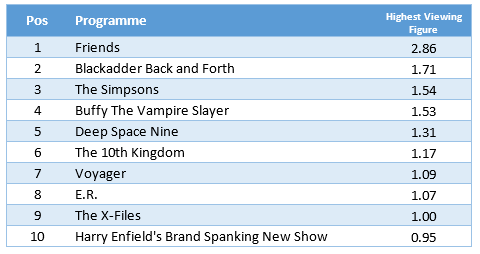
Another year at the top for Coffee Friends, with an episode broadcast on 13 July attracting one of Sky One’s highest ever viewing figures. However, Friends wouldn’t become as glued to the Sky One schedules as The Simpsons — by 2001, first run rights were comfortably back in the pockets of Channel 4 and E4.

A real curio in second spot — Blackadder Back and Forth. Originally commissioned to be shown in the SkyScape Cinema at the Millennium Dome, that’s probably where it should have stayed, where it’s only likely to have troubled the few thousand fools who’d stepped into the risible rotunda. A watered-down version of the best sitcom of the 1980s, this missed the target on all fronts, not least the clumsy inclusion of product placement, Baldrick saying ‘cunning plan’ every thirteen seconds and Shakespeare being punched in the face because, hey, boring. While one can easily imagine that up against the ill-considered edutainments making up the rest of the Millennium Dome, a chance to go ‘yaaaay!’ at a joke about Baldrick’s pants would be a welcome relief when amongst a SkyScape audience. But at home, where you could be doing any of a dozen different things you enjoy, it’s much less welcome.
Speaking of open goals shanked into the car park, this was a year where Sky made a concerted effort to ramp up its comedy output. I’m sure I wasn’t the only person keenly awaiting a Monday night double-bill of a brand new Harry Enfield sketch series, following by a Pub Landlord sitcom written by post-TMWRNJ Richard Herring. Sadly, and perhaps inevitably, both fell way below expectations, with Harry Enfield’s Brand Spanking New Show proving especially disappointing. With Enfield’s attention drawn by post-production work on Kevin and Perry Go Large, and the script packed with “same joke every week” characters (Rodney Bond, 007’s dull brother; a pair of Noel Coward types who subvert expectations by taking about then-new tropes; a footballer more concerned about his hair than football), enthusiasm and viewing figures swiftly declined. From the 12 episodes of the series, only the first two troubled a BARB weekly top ten for the channel.
2001

After their gamble on homegrown comedy in 2000 (which did continue into 2001, with David Baddiel’s stab at a Seinfeld Baddiel’s Syndrome and a Christmas special of Time Gentlemen Please, both of which failed to make a weekly top ten), it seemed like Sky One played it as safely as they could for 2001. Imported programmes make up the majority of the top ten, but they found a surprise hit with the second series of Kirsty’s Home Videos. Nothing more than a tackier copy of You’ve Been Framed (I mean, just look at the title sequence for it – even by 2001 standards, that was awful), and nothing the channel hadn’t tried before — the early years of the channel had seen Chris Tarrant’s Secret Video Show. It certainly helped that the original show on ITV was in the middle of the Riley-fronted doldrums at the time, about which the only positive thing was Davey Jones’ Viz strip Lisa Riley’s Ungainly Dancing Grandma Garrison and nothing else.
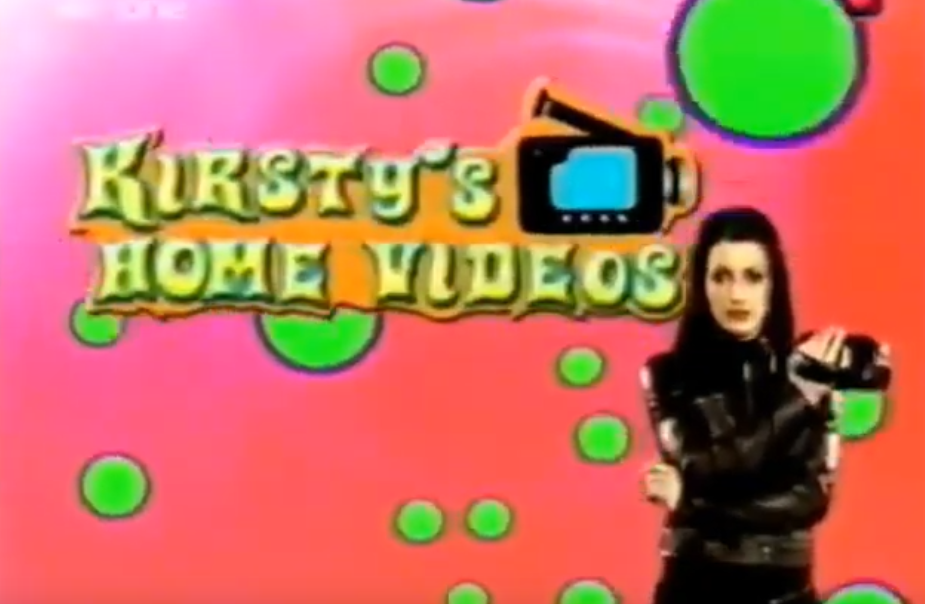
Other than that, it’s all very generic early-2000s Sky One up there. Noteworthy that while the top ten for 2000 contained only one show attracting fewer than a million viewers, for 2001 there are six such programmes. And if you’re wondering The Bombmaker was shown several months before September.
2002
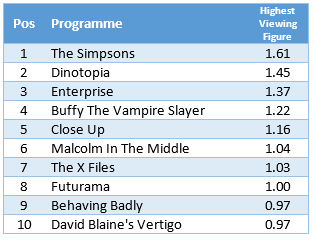
2002 and another year where an episode of The Simpsons is the most-watched thing on Sky One that year. Though for my money, it’s Dinotopia at number two that’s perhaps quintessential Sky One — big bollocks American ‘Event’ Television that got promoted like mad at the time and which pretty much nobody remembers now. For the record (and from the Wikipedia) it was an adaptation of James Gurney’s books about three Americans who’d crash-landed on a remote uncharted island inhabited by people and dinosaurs. Nope, me neither.
2003

Most popular programme of 2003 was an event kind of caught on the rebound from a much more popular event over on ITV. Martin Bashir’s infamous Tonight Special: Living with Michael Jackson was a phenomenon for the World in Action replacement, attracting 15.32m viewers. As a result of the fallout from Bashir’s show, Jackson himself worked with Fox to put forward his own side of the story, including scenes featured in Bashir’s documentary shown from alternate angles filmed by Jackson’s own entourage. Sky won the bidding war for the UK rights to the resultant two-hour documentary, with channel controller Dawn Airey proclaiming it “one of the must-see television events of the year”. It did indeed prove a ratings hit for the channel, with the only 2m-plus audience of the year. It’s notable how quick the turnaround was here — Bashir’s documentary was broadcast on ITV on 3 February 2003, while Jackson’s rebuttal was conceived, planned, filmed, sold and broadcast by Sky on 24 February 2003.
That early noughties fascination with David Blaine reached critical mass this year, with the stupidly titled ‘Above the Below’ (i.e. in a clear box above the Thames) attracting just under two million viewers as the American illusionist emerged from his perspex prison on 19 October. Such was the weird fascination with Blaine’s stunt, Sky even offered live continuous Red Button coverage of the 44-day event. Forty-four days! Channel Four’s delayed coverage of Blaine’s exit, broadcast 24 hours after Sky’s live coverage, attracted a further 2.44 million viewers.

2003 also saw the first (and only) appearance for football-based soap Dream Team in an annual top ten. The Ted Lasso of its day, in many ways. But by that, I only mean the Christmas special of Ted Lasso — i.e. it wasn’t very good.
2004
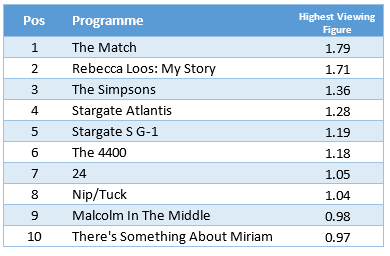
In a rare example of a ‘bigger’ channel seeing something on Sky and making their own version of it, The Match proved to be a winning format that (arguably, except no, I’m definitely correct) begat ITV’s long-running Soccer Aid charity match. It’s a formula that seems so obvious now, it’s a surprise Sky hadn’t done it much sooner — have a top football manager train up a team of celebrity wannabe footballers, film the training sessions, have poor performers voted out of the squad, and have it all culminate in a live match where the Celeb XI take on a team of Premiership legends. The corporate synergy between One and Sports made it a natural fit, and attracting celebrities to such an endeavour was hardly a hard sell. Get to play football, in a full St James’ Park, against the likes of Gazza, Beardsley and Waddle, and all for charity?
A decidedly different kind of Celebrity-Based Programming made the number two spot, with Kay Burley interviewing alleged Beckham tryst participant Rebecca Loos. Going by the Daily Mirror’s review of the interview, one that was very much of the Princess Di school of interview (doleful glances, crash-course PR tutorship still heavy in the air), and very much one that Channel Five would have sown up before Sky One could open their chequebook these days.
More poaching from Sky One saw Jack Bauer migrate from BBC2 in February. Though it didn’t seem to prove quite as popular as Sky presumably hoped — the BBC2 broadcasts of 24 saw nearly four million viewers tune in, but by the time series three debuted on Sky One, that figure was down to just over a million. And that was the high point for the series on Sky One — figures soon dropped to around the 600,000 mark, with only five episodes of S3 making the weekly top ten.
Lastly, with so much going on in that top ten, there’s not much room left to mention There’s Something About Miriam. Probably for the best, eh? Aside from saying: next time Someone Who Used To Do A Famous Programme pops up to say “ooh, you couldn’t make a show like mine these days”, it’s always either (a) untrue, or (b) both true and A Good Thing. This is one of the latter.
2005
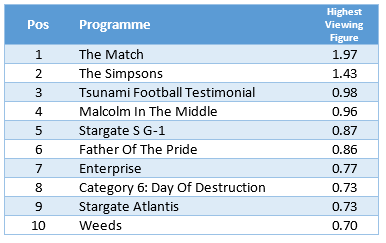
The second series of The Match culminated in another sell-out St James’ Park crowd, where ‘Sir Bobby Robson’s Football Legends XI’ (not easy to turn into a chant, that) beat a Celebrity XI 2–0, with goals from Nigel Winterburn and Ally McCoist. That wasn’t the only pro-celebrity football match to draw a big audience on the channel in 2005 — Easter Sunday saw a charity match where the likes of Ralf Little, Brian McFadden and Shane Richie tackled the likes of Robbie Fowler, Alan Hansen and Ian Rush to help provide aid of the victims of the Asian tsunami.
Now part of the select genre ‘CGI-animated series that precede disaster’, Father Of The Pride followed a family white lions, fitting nicely into the standard template for a family-based sitcom, even down to Quirky Vocation For the Patriarch — on this occasion as star of Siegfried & Roy’s Vegas show. Despite Roy Horn’s near-death following an on-stage mauling by a white tiger, production on the show continued with the blessing of the German-American double act, but perhaps the unhappy coincidence tainted the finished product for NBC viewers, with far-from-magic viewing figures resulting in swift cancellation. The novelty wore off equally quickly on Sky One, with viewing figures dropping week-on-week.
Category 6: Day Of Destruction was — and this will surprise nobody, given the title — an imported miniseries where the environment gets pissed off and decides to give Chicago a good kicking. But! There’s also a hacker-induced power outage hampering the rescue effort. In short, the kind of programme that wouldn’t get made today, but only because dystopian futures aren’t as much fun when you’re living in one.
2006

Perhaps a no-brainer that the first TV adaptation of a Pratchett novel, especially one starring National Treasure David Jason (to use his full name), would be a big hit. And a hit it was — one of the highest viewing figures ever recorded for the channel, in fact. While The Hogfather failed to meet critical expectations (mine if nobody else’s), that large audience ensured a future for Terry Pratchett adaptations on the channel, with later offerings being definite improvements.
After the limp performance of 24 in the ratings battle for 2005 (it was actually 12th on the list for that year, if you’re wondering), it returns to the top ten for 2006, despite being one of the weaker seasons, the show very much in the ‘oh for fuck’s sake’ part of its life at this stage.
Last appearance here for The Match, as despite those high viewing figures (and for the third year running, a sold-out St James’ Park crowd), the programme wasn’t renewed for a fourth year. The Legends XI winning every match hardly helped maintain suspense — in three years of the series, only one goal had been scored by the celebrity side, and that by Jonathan Wilkes, whose Wikipedia entry introduction genuinely contains the phrase “is famous due to being a close friend of Robbie Williams”. Meanwhile, ITV’s Soccer Aid drew much bigger names (the actual Robbie Williams, Diego Maradona and Ruud Gullit for 2006), and crucially had a mixture of celebrity and former professionals on each side, making for more exciting matches.
2007

Lost finds itself top of the list for 2007, with that high point reached just after the mid-season mini-hiatus for S3 (episode: “Flashes Before Your Eyes”, where a flashback showed Desmond’s time living in a version of London so bloody bad, one of the showrunners apologised for it. The one that had a British Army Recruitment office, in London, having a big poster featuring the word ‘Honor’. And Charlie appears as a busker doing ‘Wonderwall’ while someone sells chestnuts in the background. Yep, THAT bad. BUT ANYWAY). That it’s top of the tree here however says more about Sky One’s other offerings throughout 2007.
Elsewhere in the chart, there was an unexpected renaissance for Noel Edmunds, with both Noel’s Christmas Presents and Are You Smarter Than a 10 Year Old. Already back in the big time (Partridge reference, there) thanks to Deal or No Deal, his return to Christmas week TV proved especially popular. A continuation of the BBC1 Christmas Day mainstay that ran from 1989 to 1999, Noel distributed gifts and goodwill to those in need, and it was lapped up by a nation of nans (and I can only assume, several non-nans). If that weren’t enough, Noel also fronted a UK remake of US game show ‘Are You Smarter than a 5th Grader?’. Plus, the following year he made Noel’s HQ, one of the most notorious programmes in the history of Sky. Which I can mention here, as it’s nowhere near the top ten for 2008. Or even any weekly top ten for that year.
Elsewhere in the chart, Ross Kemp’s first series for Sky — Ross Kemp on Gangs — proved to be the start of a long relationship with the channel. Ross Kemp On [A Thing] would be a format so hardy it would attract sizeable audiences for the next eleven years.
2008

Two years after The Hogfather, a second big-budget Pratchett adaptation (this time in two parts) is the most-watched programme of the year, coaxed from the pages of both The Colour of Magic (well, obviously) and The Light Fantastic. Quite a cast — David Jason, Tim Curry, Jeremy Irons and Christopher Lee — and a concerted marketing campaign by Sky, including a premiere screening at London’s Curzon Cinema, helped attract that large audience, and a critical reception much warmer than that received by the Hogfather.
In second spot, an reworking that was perhaps a little less keenly anticipated, as a rebooted Gladiators crashed onto the screen. No Ulrika or John Awooga Fashanu this time, with Kirsty Gallacher and Ian Wright taking on hosting duties, nor did any of the original Gladiators return — original referee John Anderson was the only returning participant from the ITV era. The reboot failed to capture the attention enjoyed by the original series, with viewing figures plummeting like a contestant whacked off a platform with a pugil stick — an opening audience of 1.56m falling to 558k within a month.
Ross Kemp’s second series for the channel, this time spending time alongside British soldiers tackling the Taliban in Helmand Province, proved even more popular that his first. In a more sedate setting, Sky’s UK version of international hit Don’t Forget the Lyrics started in May, with Shane Richie accompanying contestants as they attempt to sing their way towards a £250, 000 jackpot. Hardly Mastermind, admittedly, but a sturdy format compared to Beat The Crusher — Sky are finally starting to engineer a lot of programming that the public are keen on. For the first time, the annual top ten most viewed programmes is split equally between UK-produced content and big name US imports.

2009
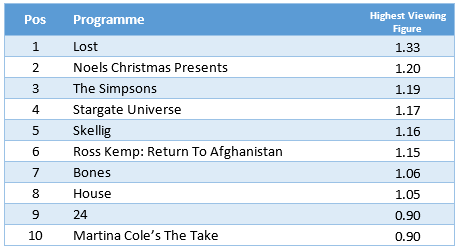
After a successful set of viewing figures for 2008, the following twelve months saw a short-term wobble for Sky One. 2008 had seen an announcement stating Sky’s investment in three major new UK-produced drama series, costing a total north of £10m, but two of the three wouldn’t be ready for air until 2010. The first to be completed was Skellig, an adaptation of David Almond’s children’s novel, which aired in April. Another notable cast were affixed to the production, including Tim Roth in the title role, alongside Kelly Macdonald and John Simm, but viewing figures perhaps fell a little short of expectations, with just over a million viewers.
Another homegrown offering making the list was Martina Cole’s The Take, which followed the activities of sociopathic wrong ‘un Freddie Jackson following his release from prison. The presence of Tom Hardy in the leading role would likely result in viewing figures much higher than 900,000 were is broadcast nowadays.
All things considered, not a landmark year for Sky One. The figure of 1.33m viewers for the most popular programme (episode two of Lost’s penultimate season) is the lowest we’ve seen in the top spot so far.
2010

The figures took a turn in an upwards trajectory in 2010, with debuts for what would become two of the channel’s breakout hits, and for the first time original commissions outnumber US imports in the top ten. An Idiot Abroad was an instant hit for the channel, with mardy-arsed Mancunian Karl Pilkington compelled to travel the world at the behest of cackling handers Ricky Gervais and Stephen Merchant. Whether the audience felt for homebody Pilkington as he complained his way across continents, or whether they just enjoyed seeing him suffer, this is a rare example of a heavily-promoted Sky One series growing an audience as it went on, with that 1.92m high point coming from the penultimate episode. Can’t help but suspect people were drawn to it after word went round that Ricky Gervais featured less heavily than the trailers implied.
Elsewhere on the list, A League of Their Own appears for the first time, the series having started in March. While it’s not something I’ve ever bothered with — every bit of it that I’ve ever seen makes it look like a straight-to-VHS ‘special’ of They Think It’s All Over, which nobody needs more of — there’s no arguing with the longevity of the damn thing. Those viewers can’t all just be people who’d fallen asleep during The Simpsons.
The third Terry Pratchett adaption also made it to air in 2010, with Going Postal the best of the bunch so far. Part of the aforementioned £10m investment into British drama — along with SAS drama Strike Back — ‘Terry Pratchett’s Going Postal’ (to use the full on-screen title, which unfairly suggests the famed author may have gone full D Fens, but then that’s probably the joke) saw Richard Coyle, Claire Foy, David Suchet and Charles Dance appear in the tale of thwarted conman Moist von Lipwig.
2011
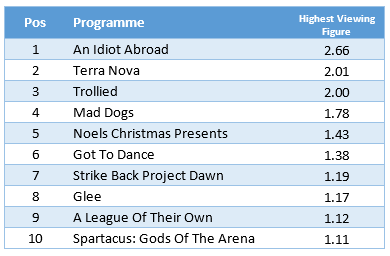
By 2011, An Idiot Abroad was easily the most popular original commission in Sky One’s history — that figure (from 23 September at 9pm) almost a million higher than its competition on both BBC2 and C4 in the same slot (‘Digging For Britain’ and ‘Million Pound Drop’, if you’re wondering).
A slight surprise in second place, with futuristic US import Terra Nova proving to be the first US import in years to become a huge hit for the channel (discounting the big hitters that’d built audiences elsewhere before being poached by Sky). And that’s not just down to a large audience for the series opener that swiftly tailed off, either — of the 13 episodes aired by Sky One, all but a couple were in the top-two most watched shows of the week. Unfortunately for space family Shannon — and Sky One — it didn’t prove quite as popular for stateside parent network Fox, meaning the series was cancelled after a single season.
Domestic programming continued to increase in popularity elsewhere on the list, with supermarket sitcom Trollied and thriller Mad Dogs making their debuts to appreciative audiences. And SAS drama Strike Back returned, which I’m sure pleased the kind of people who enjoy SAS drama series’.

2011 also saw a new threat to Sky One’s position as The Home of the Best US Drama — but this time from within its own Isleworth campus. Sky Atlantic arrived on the EPG of Sky customers, affixed to the tagline “Home of World Class Television”, and with it a promise to get all the prime cuts of HBO’s catalogue, along with top-class British drama and comedy. Might this mean that Sky One in restricted to any unwanted offcuts? Endless broadcasts of League of the Own? Noel’s Second HQ? Eep.
2012
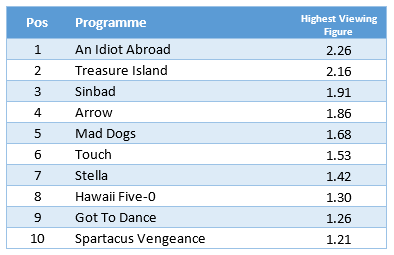
The overseas adventures of K Pilkington continued to prove popular in 2012, with the final series of the travelogue again the most popular programme of the year. And Sky attracted a similarly sizeable audience for their big budget adaptation of Robert Louis Stevenson’s classic novel Treasure Island on New Year’s Day. Elsewhere on the list, south Walian comedy drama Stella made its debut. Co-written by and starring Ruth Jones, this would prove another long-running hit for the channel — it would last for a total of six series, and bow out with a feature length finale in 2017.
First appearance on the list of Arrow, the US series focusing on DC’s costumed crimefighter of the same name. More of which later.
2013
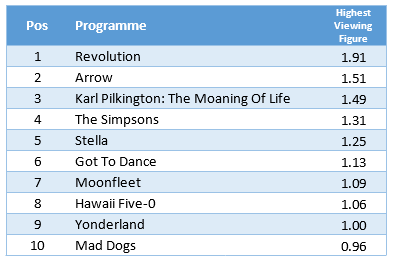
An Idiot Abroad may be no more, but whine exporter Karl Pilkington still wants to traverse the globe, this time to places of his own choosing — a little more Palin than Cleese this time, if you will. Despite the lack of his celebrity handlers — you know, the tall one and the cackling one —The Moaning of Life still proved popular, bringing in a smaller but still sturdy audience each week. Elsewhere, Stella continues to attract viewers, but it’s another homegrown comedy that is the true highlight of the list. Yonderland saw the key players from CBBC’s Horrible Histories attempt a primetime- (and family-) friendly sitcom, and they succeeded splendidly. Especially considering that a successful British pre-watershed sitcom something that — much like the participants of the titular location — isn’t supposed to exist in the real-life 21st century. Indeed, a trick that Baynton, Farnaby, Howe-Douglas et al have managed to pull off again with BBC1’s Ghosts.
Top of the chart for 2013 was — for the first time since 2009 — an American import, with post-apocalyptic sci-fi show Revolution proving an instant smash. Albeit only initially — within a few weeks, figures were half that of the season opener, and half of that by the end of the first season. All of which makes it barely a shock that the programme doesn’t feature at all in the top ten for 2014. Instead, it’s superhero series Arrow that has managed to maintain popularity, with figures slightly down from the previous year, but a placing in the top ten two spaces higher.
2014
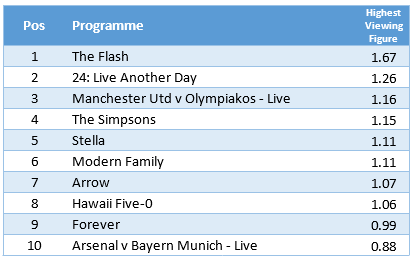
Another DC superhero series proves to be a huge hit — this time it’s The Flash, the American remake of The Beano’s Billy Whizz (presumably, I’m not checking). A slight surprise in second place, the revived 24: Live Another Day returning to our screens. Despite theoretically being hampered by the original series fizzling out to a point where only a fraction of the original audience still cared about it by the end, and (perhaps most pertinently) the season not even being 24 episodes long, this actually brought in higher viewing figures than any of the original series for Sky One.
Modern Family makes its first appearance in an annual top ten, five years after first arriving on the channel, while some Champions League overspill — perhaps Sky trying to score some goodwill by letting non-Sports subscribers enjoy some matches before BT Sport picked up rights to UEFA’s club competitions.
This could be the point where the post-Atlantic focus of Sky One becomes much clearer, as there’s a huge drop-off in UK-produced entertainment on the list. Stella and football aside, it’s imported US network fare all the way — but not the critically acclaimed cable fare, which is all over on Sky Atlantic (such as Game of Thrones, Boardwalk Empire, The Leftovers, Last Week Tonight). So, Sky Atlantic had The Leftovers, while Sky One had the leftovers. Ha.
2015

Yet another DC superhero outing at the top for 2015, with Supergirl the most popular programme of the year. That means there’s a total of three programmes from the DC Comics canon in the list, though at least there’s an upswing in UK-created content, with Raymond Briggs adaptation Fungus the Bogeyman in second place, The Moaning of Life holding steady and Stella clinging on in tenth place. Plus, Sky-NBC co-production You, Me and the Apocalypse, a series which if nothing else, means there has now been a primetime NBC series starring Pauline Quirke.

2016
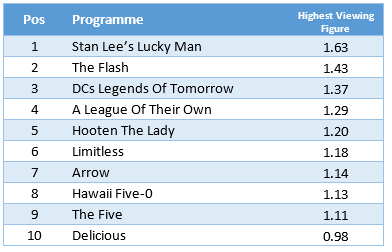
Getting towards the end of our twenty-year trek through the Sky One viewing figures, and a break from the new norm in 2016. Instead of yet another DC superhero series in the top spot, it’s… a Marvel superhero series. Except: no, not quite. Despite being co-created by Marvel’s own Übermensch, Stan Lee’s Lucky Man is actually a concept made for television without the involvement of the comic-book megacorp, and it’s an original British series to boot. James ‘Jimmy’ Nesbitt starred as ‘London Murder Squad’ DI Harry Clayton, a rusty copper suddenly given the power of supernatural luck.
Further down the list, just below the (I may as well just CTRL+C this damn phrase) DC Comic Book Adaptations, A League of Their Own has grown enough in popularity to return to the annual top ten. Cinema spin-off Limitless arrives and joins the throng, but at least there’s something a bit different at the tail end of the list.
The Five was a watchable miniseries mystery thriller from the pen (and brain) of crime author Harlan Coben — if you will, a self-contained Lost-style mystery that had the decency to know when it should wrap things up, while Delicious followed the misfortunes of those left behind by celebrity chef Leo in the wake of his passing.
2017

A second series of Delicious takes the top of the list for 2017, which affords a little more space to write about it. This amiable series made for a welcome break from the other fare on Sky One, which can be filed alongside Sky’s 2016 series Agatha Raisin as a spirited attempt at making drama equally suited to Sunday night ITV. Some great turns by the cast — most notably the two leads, Dawn French and Emilia Fox — make it little surprise why this became appointment viewing for so many.
In second place, another original British drama series. Jamestown followed 17th century settlers they attempting to establish a community in the New World. The arrival of three women from England who are duty bound to marry the men who’d paid for their passage causes more than a little disquiet when it transpires that, hey, maybe they’d rather not do that. Far away from the standard type of UK-produced fare you’d expect to find on Sky One, and all the better for it.
All might be considered to be going well for the channel, but over on Sky Atlantic, Game of Thrones was picking up as many as 3.5m viewers (plus a million more for the same-week repeat), suggesting that bigger audiences can be gathered on the digital diaspora — and that’s without Atlantic being available on as many platforms as Sky One.
2018

The last year under consideration now, and while there’s another new British drama at the top of the list — this time A Discovery of Witches, an adaptation of the All Souls Trilogy by Deborah Harkness — much of the list feels rather formulaic. The rest of that top ten in order: film, military, cops, cops, Jamestown, cops, quiz, cops and Delicious.
2019-2021
That’s where the available data runs out (BARB’s site uses a different format for displaying audience data from late 2018 onwards, and the layout makes it pretty clear they don’t want anyone datamining it). Since then, Sky have continued to commission new programming, such as family drama adaptation Moominvalley, crime drama Temple and comedy series’ such as Brassic, Code 404 and Frayed. But it was a major imported show that would be Sky One’s final big ratings success — Friends: The Reunion attracted a huge number of viewers in March 2021 — a total of 5.3m viewers. For comparison, the most-watched episode of EastEnders on BBC1 the same week drew just 4.3m viewers.

Tellingly however, it seems the bulk of those viewers — 3.8m of them — caught the programme on demand rather than watching the show as it went out on Sky One. The number of viewers waiting until Sky One’s first broadcast of the special at 9pm numbered just 1,096,000.
And perhaps that’s one of the reasons Sky felt emboldened in shuttering Sky One after so long — what’s on which channel when isn’t as much a concern when pullout programmes gain more prominance at the top of every Sky Q homescreen. Sky are now every bit as much about offering competition to Netflix and Prime (albeit a more expensive one) than traditional British broadcasters, and it’s the shows not the channels that really matter. That’s undoubtedly a shame for those of us who share a fascination with the television industry. We fear change. And that’s why it’s impossible to shake the feeling that Sky One’s retirement is a misstep.
Will it return if the viewership for Sky Showcase isn’t as hoped? Hard to say, but for now, a fond farewell to a channel that for many was square one for the world of non-terrestrial TV. Sure, a lot of it wasn’t perfect, but as these annual rundowns show — there’s a lot more UK-produced fare than the channel was given credit for.
Originally at the end of this article, I’d pondered if Sky One might return if viewing figures for Showcase aren’t as hoped, but in reality it’s not about that. As long as the subscriptions keep coming in – and with Sky now focusing on hardware like Sky Glass TV sets and the new Sky Stream box, they want more people than ever locked into their infrastructure – it seems increasingly clear that Sky aren’t massively fussed about how many people are watching their channels, as long as people are paying for them.
-
BBC100: The 100 Most-Broadcast BBC Programmes Of All Time (60-56)
Closing in on the half-century. Ready for another look at five formidable formats, regularly interrupted by ill-considered meanders down distraction avenue? Hopefully the answer is yes, else you’re in the wrong place.
60: Tomorrow’s World
(Shown 1511 times, 1965-2003)

As the trope has it, a series inextricably linked to a nation of pop kids who just want TOTP to start already, Tomorrow’s World spent almost forty years tottering on the tightrope between reporting on scientific breakthroughs and entertaining a primetime BBC1 audience.
As seems to have been the style at the time, this long-running series hardly had a long gestation period, but rather was hasily conceived by producer Glyn Jones after being tasked with finding a way to fill a half-hour hole in BBC-1’s summer schedule. How hastily? Enough for the programme’s now-household name to have been quickly dreamt up by Jones and his wife the night before submitting the programme’s mission statement to the Radio Times:

From such beginnings (slightly tempting to use the word ‘haphazard’, but let’s face it, BBC producers of that era knew how to quickly weave an entire programme format from thin air), it would quickly go on to be a programme of national renown. Indeed, on top of everything else it achieved, Tomorrow’s World would go on to be the genesis of at least two great comedy series. Yes, the second series of Look Around You, but also mostly-forgotten ITV Sunday 10pm sitcom Not With A Bang, the opening scene of which saw Judith Hann wipe out 99.999% of the world’s population by accidentally releasing a hazardous hormone into the wild (“Bugger!”).
Such an accident was likely a nod to a particularly memorable aspect of Tomorrow’s World. As the programme went out live, it wasn’t uncommon that live demonstrations of exciting new technology (many items of which were likely still at a pre-release just-past-concept stage) went wrong. Such as in 1981,where a live demonstration of ‘Sid the snooker-playing robot’ went about as smoothly as a punch-drunk Sam Beckett Quantum-Leaping into the body of Steve Davis during a World Matchplay Final. But it wasn’t all quirky future-meme fodder – far from it. The Wayback Machine’s capture of the programme’s website from 1998 includes an illustrative synopsis of episodes throughout that decade: Picking one episode from November 1994, we see stories on a new breakthough in contraception, improvements to the flea breeding process, the development of heroin-eating bacteria, a new kind of telescope, and early mass market gas-powered motor vehicles.
Even on a technological level, TW offered Britain an early glance of items that would soon become part of many households, from mobile phones (albeit ones coming with a suitcase-sized battery) to the ‘Web, from PVRs to VR.

The Tomorrow’s World website of yesterday. Source: Wayback Machine You might expect that, what with exciting ScienceFutures perpetually just around the corner, the series was one that could conceivably run forever. Never gonna run out of tomorrows. However, the fundamental irony of a programme focused on the world of tomorrow feeling quite old-fashioned finally dawned on Beeb bigwigs, and the series proper came to a close on 19 June 2002, with a special episode looking at the tech behind that year’s Spider-Man movie.
Following on from that finale, there was still time for a few more excursions for the famous brand. 14 August 2002 brought a Commonwealth Games Special of the series, looking at how science is furthering athletic endeavour. 25 September 2002 saw the ‘Tomorrow’s World Awards 2002’, the last of the programme’s annual ceremonies celebrating the best of the previous twelve months of innovation. June and July 2003 saw a short run series of Tomorrow’s World Roadshows, a final hurrah that allowed presenters Katie Knapman and Gareth Jones a look at some VR tennis tech and an update on the Beagle 2 Mars mission.
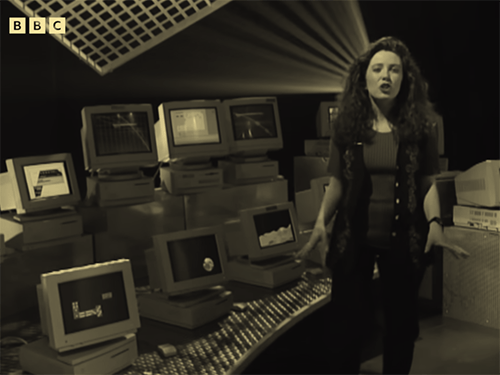
Ultimately, any news from the world of tomorrow would have to be served by other outlets. But, to mark the long-standard programme, let’s do a little experiment of our own, and research the long-held received wisdom (i.e. it got mentioned on Spitting Image at least once) that Tomorrow’s World Was Always On When You Were Waiting For Top Of The Pops To Start. Was that really the case? LET’S EXPLORE SOME DATA.
Okay, taking every episode of TW running on a weekday and broadcast between 6pm and 9pm (1,408 broadcasts in total), and then marking which programmes followed each episode in the schedule, here are the Top Ten contenders. In reverse order, natch.
10. The Likely Lads (1967), Russ Abbot (1990-91), Changing Rooms (1998-2002), Celebrity Ready Steady Cook (2000-02) (17 times each)
What better way to begin our too-much-infoburst with a four-way clamour for fourth place? So, TW was followed by The Likely Lads on Wednesday evenings in 1967, by repeats of series’ four and five of the Chester jester’s sketch comedy on Thursday evenings in 1990 and 1991, by those Changing Rooms on Wednesday evenings in 1999 (plus one-off episodes in 2001 and 2002) and by celebrity chef-offs on Wednesdays between 2000 and 2002.
9. Birds of a Feather (18 times, 1990-1998)
The second series of Sharon and Tracey’s misadventures followed TW on Thursday nights in 1990, a May 1992 repeat of series three opener “Keeping Up Appearances” and a few repeats of series five episodes in April 1998.
8. David Nixon on The Nixon Line (20 times, 1967-1968)
Presenter, magician and Vice President of The Magic Circle David Nixon hosted this programme perhaps now best known for introducing the nation to vociferous vulpes vulpes Basil Brush on Wednesday evenings between 1967 and 1968.

7. Mastermind (21 times, 1988)
The 1988 series of the gestapo-inspired quizzer teamed up with TW to make for an hour-long brain eisteddfod each Thursday night between January and June.
6. The Newcomers (44 times, 1968-1969)
New-build estate soap opera The Newcomers followed epsiodes of TW each Wednesday night between September 1968 and September 1969.
5. A Question of Sport (45 times, 1985-1999)
Imperial-phase Coleman-Beaumont-Hughes QoS followed episodes of TW on Thursdays between December 1985 and December 1987. Their paths would cross again in 1997 (for TW special ‘Megalab 97’), 1998 (for ‘Megalab 98’) and 1999 (for Megal… oh, ‘2000 and Beyond’).
4. Only Fools and Horses (48 times, 1987-1999)
With OFAH repeats peppering the primetime schedules in the late 80s and 90s, it’s no surprise that they appeared together quite often, on Thursdays in 1987, Wednesdays in 1992, Fridays in 1994-96 and Wednesdays between 1996 and 1999. Which also proves how often Tomorrow’s World was shunting around the schedules at the time.
3. The Virginian (51 times, 1968-1971)
Nearly at the top spot and yet to see anything disrupting our TOTP hypothesis, with James Drury’s tales from the frontier of the Great American West appearing after TW on Friday evenings between 1970 and 1971 (plus twice on Wednesdays in 1968). Note how I’m too classy to refer to the series as “The Virgin Ian”.
2. EastEnders (52 times, 1989-2000)
With ‘Stenders rampant throughout the schedules since 1985, it was always likely to crop up here, the only slight surprise being it took until 1989 for it to be scheduled after TW in the listings. Cutting to the raw numbers, EE followed TW on Tuesdays in 1989 (37 times), on Mondays in 1996 (nine times) and on Wednesdays in 1998 (six times). Plus, a special Olympic edition of Tomorrow’s World preceded EastEnders in June 2000.
1. Top of the Pops (477 times, 1965-2000)
Thus, the theory is proven to be true, with TOTP following Tomorrow’s World on far, far more occasions that any other programme. The two came together too many times to comfortably summarise here (I appreciate the even people who’ve come this far have a boredom threshold), but it’s basically lots and lots of weeks between 1972 and 1985, and once in 2000 (following one-off “Tomorrow’s World – the Live Event Special”). Almost always on a Thursday, but once on a Friday (that special in 2000 again). But it’s also worth noting that Top of the Pops wasn’t the programme that followed the first episode of Tomorrow’s World in 1965. That was the magnificently-titled Miss Interflora-G.P.O. 1965, where finalists Mrs Sylvia Williams, Miss Mary Grimmond and Mrs Valerie Bignell came under the gaze of judges Ted Moult, Drusilla Beyfus and Turlough O’Brien. The chairman of the whole affair was Kenneth Horne, and the prizes were presented by then-Postmaster General, The Rt Hon Anthony Wedgwood Benn M.P. I mean, no wonder beauty contests fell from favour. How could they ever hope to top all that?


59: The Money Programme
(Shown 1514 times, 1966-2011)

All together now…
There is nothing quite as wonderful as money.
Eric Idle, The Money Song. But you already knew that.
There is nothing like a newly minted pound.
Everyone must hanker for the butchness of a banker
It’s accountancy that makes the world go round.I’m not going to lie, there have been a few times since I embarked on this endeavour where I wondered if it had really been a good idea. Oh, it was simple enough in principle – grab details of every television programme the BBC has ever broadcast on its main channels, all the way back to 1936, then pick out the programmes that appear most frequently from the 800,000+ records. Stupidly easy. Ahem. But then you get to the gritty bits. Entries on the list that had been OCR’d incorrectly (“Tom & Jeny”). Entries that were buried within But First This, Animal Zone or Daytime on Two strands. And when it comes to the next entry on the list, a programme that wasn’t billed under its own title for ten whole years.

Yep, since 2001 most episodes of The Money Programme were listed under the episode title, with ‘Money Programme’ mentioned in passing within the associated blurb. Quite why that was could be down to one of a few reasons. Having programmes stand out a bit more in the EPG, attracting the attention of people interested in the subject? Very likely. Trying to avoid association with the stuffy reputation The Money Programme had before then? Also likely. Whatever the reasoning, the end result was me going one-by-one through ten years of results for ‘Money Programme’ in the BBC Programme Index to make sure my list was accurate, because I just care too damn much.

That said, I can’t blame the producers for taking that approach. I doubt I would’ve even registered episodes of The Money Programme when scrolling through my PVR’s TV guide looking for something to watch, but billing them as The Money Game: Football’s Cash Crisis (19/11/2003), Dotcoms Bounce Back (23/02/2004), Microsoft’s Big Games Gamble (04/11/2005) or The Chewing Gum War (25/05/2007) was much more likely to prick my curiosity bubble.
This approach almost certainly helped The Money Programme survive for so long as a strand. Starting in April 1966, producer of The Money Programme Terry Hughes explained the show’s mission statement in the Radio Times.

Britain is like the son of a rich man who has inherited the family fortune and is spending the lot, said a Belgian banker who has extensive dealings in the City. With the recurrent tale of lost export orders, balance of payments trouble and pressure on the pound, people abroad now speak of ‘the English sickness’ which has dogged us since the war, rather than any spectacular business achievements. They must wonder what happened to the British flair for business.
This year is bound to see dramatic developments. With a debt of £899 million round our necks to be repaid in four years, and a current balance of payments deficit, we cannot escape the pressure to Improve our efficiency. Things have got to change. Industries have got to be reorganised. Traditional approaches to business problems have got to be questioned. The changes we can expect in this country will reach into the lives and prospects of many people.
The aircraft workers, for example, must see their working lives in a very different light now, and many in our more traditional industries are expecting change. Even without the pressure of our economic difficulties, the impact of automation, and the computer (felt increasingly in America) is bound to raise many painful issues for management, labour, and Government, in this country. We must prepare for a second industrial revolution.
The Money Programme will comment on the issues and broaden the whole field of discussion about our business and economic life.
The argument about how to handle the economy will grow louder with more and more suggestions on how to tackle our basic problems and with a greater readiness to look at the experience of other countries which have similar economic problems; Sweden and Holland on prices and incomes, Italy on industrial reconstruction.
Behind the argument about policy lies the complex business mechanism of the country. Many people want to know more about it. They want to know the background to some of the spectacular happenings they read of in the newspapers, why the pound comes under speculative pressure, how take-overs are mounted, how large companies are run, how fortunes are made, how pay claims are argued through.
The decisions taken in the board rooms of our large companies or In City offices are often as Important as political decisions. Some of our companies are enormously powerful. They have budgets larger than those of many of the countries in the United Nations. They have Planning Departments examining what the world will want in 1990 and complete Foreign Services for handling their diplomatic business.
Where the large corporation Invests its money, what kind of plant it builds, what kind of training it gives its employees, what products It designs and what influence it has on social amenities—these are important decisions.
The Money Programme will look at the way these companies are managed. It will also aim to broaden interest in business, in a year when it matters how well we manage our money.
Terry Hughes, The Money Programme, Radio Times (31 March 1966)Hughes had been handed his mission in a memo from then-BBC Secretary Harman Grisewood, suggesting that it was “time we should do something about the economy for the people”. The suggestion didn’t go down too well with some executives at the Corporation, their reaction reportedly being that money was boring, and “the idea that there might be an audience for a regular TV programme on money struck producers as absurd.” But, as a time when the Pound was in freefall and national debt was ballooning, an attempt had to be made to explain the wider picture to the viewing public.
The initial reaction to the series was… less than enthusiastic, with around half-a-million viewers tuning in, and critics finding little positive to say about the series, save for the theme tune being quite nice (it having been borrowed from 1964 film ‘The Carpetbaggers‘). But, lack of popularity aside, it was certainly seen as An Important Programme, and as Britain’s economy continued to crash about the place like a drunk robot, interest in the series slowly began to grow.
By the 1980s, and the rise of Thatcherite economics, money finally became sexy. Heads of industry became nationally-known figures for (apparently) positive reasons, and every kid in the country excitedly filled in their Times Rich List Panini Sticker Book. Rightly or wrongly, interest in the business sector became much more commonplace, and by the early 1990s The Money Programme was joined in the BBC Two schedules by various other business-centred programmes (such as Troubleshooter and Doing It Right, and they’re just the ones fronted by Sir John Harvey-Jones, former Chairman of ICI).
By the noughties, the BBC had somehow even managed to make business-related TV cool enough for mainstream consumption, with both Dragon’s Den and The Apprentice making the transition from BBC Two to primetime BBC One. And so, perhaps as a result of business- and financial-based programming no longer needing to be ghettoised under the Money Programme umbrella, the strand was gradually phased out in the last few years of the 2000s.

The actual programme’s name floating about briefly at the bottom of the screen, hoping you don’t notice it, there. So, in summary: if you want a programme about business, you’ve got both The Apprentice and Dragon’s Den. Just try to ignore that they’re basically talent contests for people in power suits.

58: Scooby-Doo
(Shown 1522 times, 1970-2012)
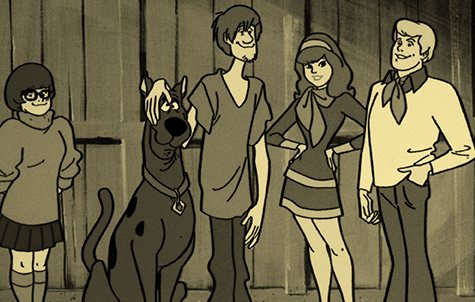
RICK: God, isn’t it all simply enchanting? It’s like one of those wonderful drawings by Roy Hill with lots of working-class people, thrashing about the place with pitchforks.
NEIL: Yeah! They look pretty angry, don’t they?
RICK: Just think. No nuclear power, no pollution, no electric cables ruining the landscape…
MIKE, NEIL, VYVYAN, RICK: [together] No telly!
NEIL: Oh, no! I’ll die if I miss Scooby Doo!
The Young Ones, “Time”, BBC2, 05/06/1984Yeah, everyone already knows about Scooby-Doo, so here are a few things to note about the programme titles here: I’ve treated ‘Scooby-Doo, Where Are You!’ (CBS 1969–76), ‘The Scooby-Doo Show’, ‘Scooby-Doo and Scrappy-Doo’ (ABC 1976–91), ‘What’s New, Scooby-Doo?’ (WB 2002-08) and ‘Scooby Doo! Mystery Incorporated’ (Cartoon Network/Boomerang, 2010-) as being the same entity to reach this total, as they’re all basically the same, even if the latter years are a lot more self-aware than the earlier ones, and some episodes in the middle have that annoying sidekick.
I think it’s probably true to proclaim Scooby-Doo as one of the most instantly recognisable animated series of all time. So recognisable that several other programmes have happily thrown in little nods to it.

Spaced, ‘Beginnings’, Channel 4, 24/09/1999 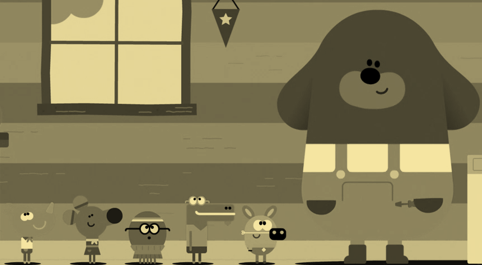
Hey Duggee, ‘The Spooky Badge’, CBeebies, 28/10/2017 
Biffovision (pilot), BBC Three, 05/06/2007 The rise of Scoob can be traced back to 1968, and a time when (and try your best to look surprised here) an American parent-run pressure group were complaining about supposedly violent fare children were seeing on Saturday morning TV. And so, something had to be done. At the time, many of the contentious toons were produced by TV animation powerhouse Hanna-Barbera. As a result, a range of popular Saturday morning cartoons were swiftly cancelled. Bye-bye Birdman and the Galaxy Trio, so long Young Samson and Goliath, g’bye Space Ghost and Dino Boy, farewell Frankenstein Jr and the Impossibles. All canned as a result of pressure from Peggy Charren’s pressure group. Hanna-Barbera’s cartoon production line suddenly found itself with little to do.
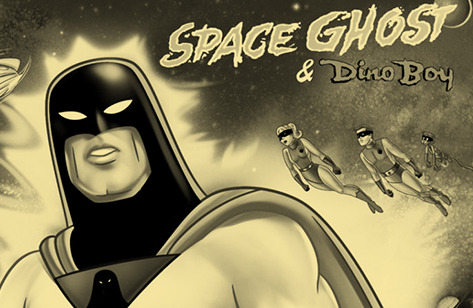
None of this, thanks. And so, in their place came a range of new programmes, several of which would go on to be tremendously popular with kids of a certain generation on both sides of the Atlantic. For starters, there was a pair of Wacky Races spin-off vehicles: Dastardly and Muttley in Their Flying Machines (no, not ‘Catch the Pigeon’) and The Perils of Penelope Pitstop. Alongside those came a wholly new property, which saw a group of relatable teens and their loyal hound travel the land to investigate a variety of spooky happenings. And that programme was, of course, to be called… The Mysteries Five. And that five were: Geoff, Mike, Kelly, Linda and W.W., plus their bongo-playing dog, ‘Too Much‘.
Not a joke. The initial premise was that this new programme would be heavily inspired by then-popular animated series The Archie Show, which wasn’t only a hit on television, in-show band ‘The Archies’ were a recording phenomenon in their own right. Their most popular song – Sugar, Sugar – went on to become a number one hit in the US (for four weeks) and the UK (for eight weeks). Who wouldn’t want a piece of that cross-platform pie?
The twist for The Mysteries Five would be that when not performing sell-out gigs at the hippest joints, they’d spend their downtime investigating ghostly mysteries. During development of the series by writers Joe Ruby and Ken Spears, a number of changes were made. At various points in the process, ‘Too Much’ was small and feisty, then a cowardly sheepdog before finally being changed into a Great Dane (Ruby and Spears having initially been wary that breed would be deemed too similar to comic-strip canine Marmaduke).
As development went on, inspiration for the series changed from The Archie Show to live-action proto-beatnik sitcom The Many Loves of Dobie Gillis (CBS, 1959-1963), which featured a quartet of teens. The mystery element wasn’t present in that show, but the characterisations were – Fred Jones based on clean-cut lead Dobie, Daphne Blake on attractive but calculating Thalia, Velma Dinkley on keen and nerdy Zelda, and Shaggy Rogers on the brilliantly-named Maynard G Kerbs, a jazz-loving beatnik who’d run a mile from hard work and punctuates every statement with at least three ‘likes’.
17 years old. Shaggy is supposed to be 17 years old. Any suspension of disbelief is further stymied by having him voiced by Casey Kasem. This was a combination nailed on to be a surefire smash, it just needed a better name. And so, CBS exec Fred Silverman came up with a new title… ‘Who’s S-S-Scared?‘. Which was deemed s-s-shite by CBS president Frank Stanton, who duly passed on the series.
After frantic re-tooling,the horror element of the series was toned down, the comedy aspect was ramped up, and the focus of the series shifted to the shaggy dropout and his panicky mutt. All that was left to be tidied up was the same of the series. Also, ‘Too Much’ really didn’t work as a name for what was now a central character. Legend has it that Silverman found inspiration for the new name from Frank Sinatra’s famed scattery “doo-be-doo-be-doo”.

Radio Times, 12/09/1970 Scooby-Doo stuck at the next development meeting, and it’s a name that certainly sticks to the memory. With such a memorable character name in place, the show was retitled Scooby-Doo, Where Are You!, and from that point an animated TV legend was born.
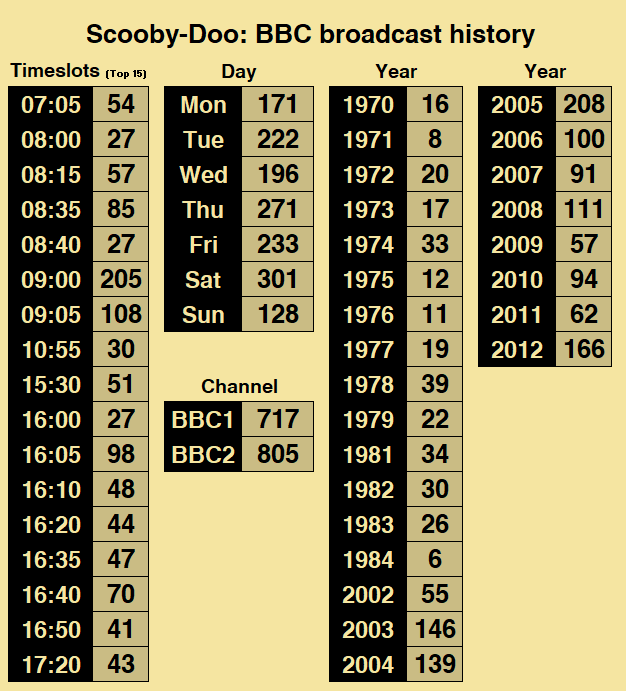
57: Westminster (aka Westminster Daily, Westminster On-Line)
(Shown 1567 times, 1970-2001)

Here’s one that seems unlikely to generate much excitement. But for much of it’s life, a programme that came with the unenviable challenge of not being able to show any footage of the thing they’re talking about.

Originally a weekly programme, when ‘Westminster’ launched in January 1970, it wasn’t just a programme designed to frustrate people trying to Google information about it fifty-two years later, it promised a review of the political week just gone. At that time, TV cameras were almost twenty years away from entering the House of Commons for the first time, and the prospect of dipping into a bespoke BBC Parliament channel would be the fever dream of a madman. So, here was a round-up where events of each day’s business could be discussed, audio could be played of discussions in the Commons chamber (along with a stock slide of the Parliament building and an inset box of the relevant MP), and later offering viewers a chance to quiz any MPs offering themselves up to public scrutiny.
Despite those limitations, it was a programme that would run and run. And yet seems to have left very little footprint on the internet. The original incarnation of Westminster ran until July 1979 (with BBC Political Editor David Holmes at the helm), but political programming under the same name would return to BBC2 in November 1989. Now going out most weekday mornings at 08:15, it still provided a summary of the previous day’s debates, but was now able to provide actual video footage of those debates, with cameras finally permitted in both chambers of Parliament. That’s not to be confused with the afternoon programme ‘Westminster Live’, which provided live coverage of the Commons.
It also doesn’t help that, at least as far the Radio Times were concerned, the programme didn’t even have a consistent title. From that 1989 relaunch all the way up to 12 November 1993, it went by the title of ‘Westminster’. The following week, it started being billed as ‘Westminster Daily’, right up to 4 November 1994. A few months later, it was back – in the same 08:15 slot, but now billed as ‘Westminster On-Line’ (ooh, modern).
On a couple occasions in 1992, the show was referred to under the curious-sounding moniker ‘Sam Westminster’.
What could that be? The name of the reporter giving the Parliamentary update, in a staggering display of nominative determinism? Maybe a politically-themed spin-off of Fireman Sam? Only one way to find out. To the newspaper archives!

Oh, okay. That makes more sense. Anyway, the ‘On-Line’ suffix lasted until July 1995, after which the programme title ‘Westminster’ was adopted for the afternoon slot, covering the current day’s events as they happened rather than those of the previous one. So, basically the same thing the previously-titled ‘Westminster Live’ (which I’m not counting in this entry) was doing, just to make this a bit more confusing.
By February 2000, it rebranded again – this time back to Westminster Live, but with the original name making the occasional cameo in Radio Times listings (presumably in error, rather than a title change reflected on-screen, but I’m including those in the total, so there). On 19 December 2002, the ‘Westminster [&whatever]’ title format was rolled out for the last time, Zeinab Badawi offering a final ten-minute report from Parliament before a repeat of Yes, Minister (Series 3 Episode 5: ‘The Bed of Nails’, if you’re wondering).
From that point on, ‘The Daily Politics’ seized BBC2’s political baton, and run with it. But more about that programme later. Possibly. (Okay, definitely.)
Trying to find any footage of the programme itself on YouTube – a real challenge given YouTube’s infuriating habit of returning a bunch of results you didn’t ask for, coupled with the vagueness of the programme title – results in little more than a second-long glimpse of Zeinab Badawi at the end of a continuity video posted onto YouTube Shorts.

For the record, I’ve combined results for these three programme titles as there’s a clear lineage between them. If you don’t like it, well, why not write to your MP?

56: Have I Got News for You
(Shown 1578 times, 1990-2021)

There’s a case to be made for claiming Have I Got News For You is Britain’s answer to The Simpsons. Both have been putting out new episodes for more than thirty years, both were a definite fresh breath of comedic air when they first arrived, both hit their imperial phase after a few years on-air, during that 1992-97 peak period phrases from each became part of the public lexicon (with ‘…allegedly!’ rivalling ‘…not!’ as the suffix of choice for people who aren’t as funny or clever as they think they are). And indeed, while each once felt cutting-edge and new, they’ve since become part of our TV wallpaper – not truly objectionably bad in their own right, but something that you might as well watch and enjoy seeing as it’s there.
Despite it now being an immovable part of our national TV furniture (yes, I know I just said it was wallpaper, but shush), it once seemed so young, so fresh, so cool. That Paul Merton from Whose Line Is It Anyway?, that Angus Deayton from KYTV, and that Ian Hislop from the writing credits on Carrott’s Lib, Three of a Kind and Comic Asides pilot ‘The Stone Age’.
Originally piloted as John Lloyd’s Newsround, it’s probably for the best that the storied producer stepped aside from hosting duties to make way for the almost dangerously wry Deayton. And so, in a set that now looks claustrophobically close, Have I Got News For You thundered onto our screens at 10pm on Friday 28 September 1990. The main competition in that slot at the time was The Golden Girls on C4, and the Florida quartet initially pummelled the upstart panel show in the ratings, 2.79m to 1.88m.
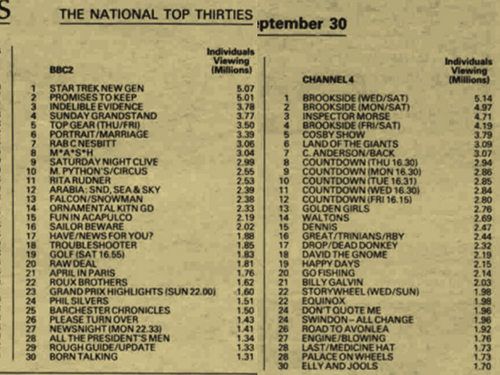
Source: Television Today, 11/10/1990 However, by the end of that first series in November, things were very different. And by ‘very’, I mean ‘not’, with HIGNFY slipping to 1.76m viewers to the Golden Girls’ rising 2.90m.
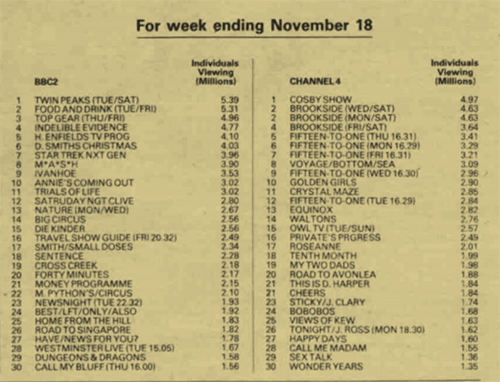
Source: Television Today, 30/11/1990 When it came to the second series of the nascent news quiz (billed in the ever on-the-ball Daily Mirror as “a new TV version of Radio Four’s News Quiz” despite it no longer being new, nor an actual remake of the radio property), the competition on the fourth channel was a little less severe: Friends-before-Friends (but with more swearing and nudity) HBO sitcom Dream On, which never really found an audience in the UK. As a result, an increased 2.23m tuned in to see Angus, Paul and Ian (plus guest panellists Sandi Toksvig and David Thomas) for that opening episode of the series, while Dream On managed to be the only C4 Friday night show to fall outside the channel’s Top 30 for the week.

Source: Television Today, 24/10/1991. Note that “Fall Merton The Series” (sic) grabs over 3m viewers on C4. By the end of that second run, audiences had ballooned to an impressive 4.29m viewers, meaning HIGNFY was now BBC2’s most popular comedy show.

Source: Television Today, 03/01/1992 From that point on, popularity of the series only increased, with viewing figures north of eight million on several occasions. Even today, when viewing figures are much more modest and you’d expect the programme (having recently wrapped series 63) to feel much less of a draw, HIGNFY still performs incredibly well – the closing episode of the sixty-third series in May 2022 drew 4.1m viewers (going by BARB data), behind only Silent Witness, a documentary about The Queen and The Great British Sewing Bee as far as BBC programmes go for that week.
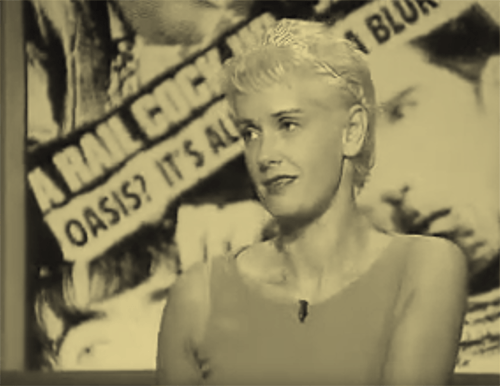
HOT TAKE: Paul Merton shouldn’t have apologised for calling Ian Hislop a “little shit” during that episode, because Ian Hislop was acting like a little shit. But anyway, you all already know about HIGNFY since that point (quick recap: Tub of Lard, Sperm of the Devil, Savile, the spoof-taken-for-real Savile transcript, move to BBC1, Angus sacked, stunt guest hosts, helping to raise the profile of a human cartoon who somehow became PM, then failing to learn from that and start inviting Rees-Mogg onto the programme), so what other info can we wring out of it? How about a Guests With The Longest Periods of HIGNFY Relevance Top Ten? That is to say, people who’ve had the longest spell between their first and most recent appearances in the programme. Figures correct as of the last complete series in Spring 2022.
- Ken Livingstone (12 appearances 02/11/1990-12/04/2013, 8197 days)
Then still a serving MP, once-cuddly Ken first appeared on Paul’s team opposite Ian and Rory McGrath in the programme’s sixth ever episode. He last appeared in series 45, under the umpireship of guest host Brian Blessed, this time on Ian’s team and opposite Paul and Bridget Christie. Probably won’t be back again any time soon, given he’s a bit too ‘divisive’ these days.
- Bill Bailey (8 appearances 30/04/1999-29/10/2021, 8218 days)
First appearing in the show’s late-BBC2 era (and presumably then still donning his Bastard Bunny long-sleeve t-shirt) helping Paul to a 16-11 defeat against Ian and Trevor Phillips. Last seen in the show’s 62nd series, this time in the guest host chair, stewarding guest panellists Fin Taylor and Dawn Butler MP.
- Maureen Lipman (5 appearances 17/12/1993-11/11/2016, 8365 days)
Beattie herself first appeared in series six, joining Ian as they took on Paul and Lesley Abdela (the early years of the programme having no qualms about having two female panellists). She would reappear most recently in series 52, under guest host Charlie Brooker and facing opponents/rhyming couplet Paul and Rich Hall.
- Germaine Greer (10 appearances 16/11/1990-28/11/2014, 8778 days)
Germaine “Fuck You Shoes” Greer first appeared in the final episode of the first series, on Ian’s team versus Paul and late MP Tony Banks. Greer most recently participated in 2014’s 48th series, facing Ian and Josh Widdicombe under the watchful eye of regular guest host Xander Armstrong.
- Janet Street-Porter (15 appearances 26/04/1996-29/05/2020, 8799 days)
80s impersonator go-to Street-Porter has been a regular participant over the years, first appearing in the Paul-hiatus 11th series alongside guest captain Eddie Izzard as they took on Ian and much-missed Dermot Morgan. More recently, she appeared in the lockdowntastic 59th series, Zooming into an episode along with Fin Taylor and host Martin Clunes. (And also in the first episode of the current series, but we’re not counting that here.)
- Frank Skinner (12 appearances 06/11/1992-01/06/2018, 9338 days)
The Midlands mirth merchant probably made a bit of HIGNFY history in 1992’s fourth series, when he became the first guest to appear twice within one series, the first of which saw him appear opposite Jerry Hayes MP. More recently, Frank returned to the show in 2018, where he hosted the finale of series 55, with guests Lucy Prebble and Henning Wehn.
- Martin Clunes (19 appearances 28/10/1994-17/12/2021, 9912 days)
No surprise to see the always-welcome Clunes here, who despite primarily being an actor has always swung effortlessly into the topical comedy panel jungle. First appearing in series eight, Clunes first appeared against stunt-guest James Pickles. Most recently Clunes appeared in the guest host hotseat, invigilating the antics of guests Jon Richardson and Kirsty Wark.
- Jack Dee (17 appearances 13/05/1994-15/04/2022, 10,199 days)
Crumpled curmudgeon Dee first appeared in series seven of the show, facing off against Paul and Tony “Fridge Yes Skateboard No” Hawks. His most recent reappearance came as guest host in 2022’s sixty-third series, refereeing comic Nabil Abdulrashid and Professor Hannah Fry.
- Jo Brand (31 appearances 04/12/1992-29/04/2022, 10,738 days)
A name you might well have expected to see in the top spot, Jo Brand first appeared in series four, helping Ian to victory over Paul and Neil Kinnock. Now one of the go-to guest hosts, Brand was seen most recently in April 2022, keeping a watchful eye on columnist Camilla Long and comedian Susie McCabe.
- Joan Bakewell (6 appearances 01/05/1992-27/05/2022, 10,983 days)
Yeah, here’s a name you may not have expected to see here. Broadcaster, columnist, Governor & Chair of the BFI and future Baroness Bakewell first appeared in 1992, opposite stand-up Donna McPhail. While her appearances on the series would only be sporadic over the years, Bakewell most recently reappeared in the most recent episode under consideration here, the closing episode of series 63, along with host Jon Richardson and fellow guest Phil Wang.
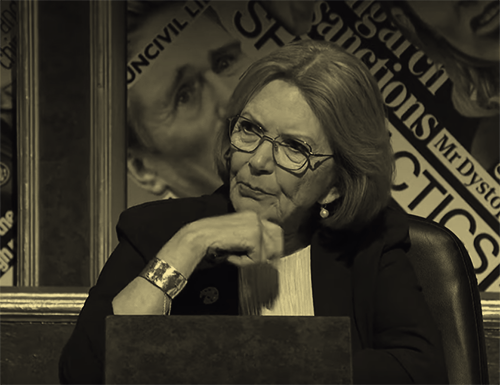
Jeepers, that was a long one. Tune in next time to see if I can reach the halfway point of the hundred before the BBC’s Actual 100th Anniversary on 18 October.
-
BBC100: The 100 Most-Broadcast BBC Programmes Of All Time (65-61)

Here’s the next bit. I appreciate it’s been a while. Back when the last update came out, we had a different Prime Minister, a different Monarch. and a different Chelsea manager. So, that’s enough pre-ambling, on with the list. And it only took one Friday night spent looking through 1920s radio listings to see which region had the first programme about farming.
65: Top Gear
(Shown 1396 times, 1978-2021)
Well, here’s a thing. Something that started out as a regional programme in the Midlands, which would go on to become the most-watched motoring programme [theatrical voice] In The World.
Indeed, one of the most profitable programmes in the BBC’s history started out as a monthly programme restricted to the BBC Midlands region. Producer Derek Smith suggested one of the region’s weekly opt-outs could be used for a look at subjects such as family cars, road safety and the like. It’s a format that Thames has been using for a while, with ‘Drive-In’ first roaring out of London’s ITV outpost in 1974, and it was a topic also likely of interest to BBC viewers. And so, from 22 April 1977, nine monthly episodes of Top Gear were transmitted, to the delight of any motoring enthusiasts not still stuck in traffic on the M6.
By 1978, national BBC bigwigs had been sniffing around the format, and a full ten-episode series of Top Gear was set to roar into life on BBC-2 from July. Main presenters Angela Rippon and Tom Coyne were retained from the BBC Midlands series, with Barrie Gill also added to the presenting team. Despite the petrol-tinged titillation you might expect from a motorsports commentator joining the line-up, topics were largely low-octane throughout the first series. Unless that is holiday driving, MOT tests, traffic jams, treatment of rust or tachographs are enough to send your particular pulse racing.
With the format proving a sizeable hit amongst drivers, the number of episodes per year accelerated from 1980, with two full series hitting the schedules per year (one in spring, one in autumn). The team of presenters was freshened up regularly, with imperial phase Noel Edmonds hosting a couple of series, along with William Woollard of Tomorrow’s World, while Chris Goffey and Sue Baker defected from Gears’ rival programme at Thames. That was before a pair of presenters who’d become more closely associated with the programme joined towards the end of the decade – former F1 driver Tiff Needell and motoring journalist Jeremy Clarkson. By this point, the remit of the show was less Watchdog For Cars and more about how cool and awesome cars could be. And it was an approach that worked – Top Gear was regularly top of the BARB ratings for the channel, and comfortably so.

BARB ratings w/e 16/10/88 (The Stage/Television Today, 27/10/88) But, nothing lasts forever, and by the late 90s the audience figures were beginning to slip. The Beeb decided to wait before deciding whether to recommission the programme, and as a result, several members of the presenting team scarpered off to Channel Five’s new show Fifth Gear.
And that was it for Top Gear, or at least Top Gear V1. Because – as highlighted in the RT listing for the last episode of ‘old’ Top Gear (Mon 04/02/02), “Top Gear is scheduled to start a new series later this year.” And indeed it was, with Clarkson and Hammond and, erm, Dawe (later replaced by May), and in the new guise of Jackass With Cars it would go on to conquer the world.
All this has been written about much more comprehensively (and competently) over on the Creamguide email, so instead of going into the latter history of Top Gear, I’m going to present a Compleat List of BBC2 9pm Comedy Shows That Meant You Saw The Last Bit of Top Gear Even If You Didn’t Want To. All on Thursdays unless stated otherwise. Hey, not really relevant, but it least it’s an honest reflection of what Top Gear meant to me.
- Tuesdays 09/09/80 – 21/10/80: Butterflies
- Tuesdays 21/09/82 – 12/10/82: The Kenny Everett Television Show
- Wednesdays 03/11/82, 16/03/83: MASH
- Tuesdays 17/09/85 – 22/10/85: Lame Ducks
- 15/10/87 – 19/11/87: Alas Smith & Jones
- 13/10/88 – 17/11/88: Alexei Sayle’s Stuff
- 14/09/89 – 12/10/89: Police Squad!
- 19/10/89 – 23/11/89: Alexei Sayle’s Stuff
- 27/09/90 – 01/11/90: Rab C Nesbitt
- 08/11/90 – 29/11/90: Harry Enfield’s Television Programme
- 28/02/91 – 21/03/91: Red Dwarf
- 28/03/91 – 18/04/91: Up Pompeii!
- 03/10/91 – 07/11/91: Alexei Sayle’s Stuff
- 14/11/91 – 19/12/91 (Except 05/12/91): Murder Most Horrid
- 27/02/92 – 26/03/92: Red Dwarf
- 02/04/92 – 07/05/92: Harry Enfield’s Television Programme
- 01/10/92 – 29/10/92: Bottom
- 05/11/92: Blackadder Goes Forth
- 12/11/92 – 17/12/92: Absolutely Fabulous
- 18/02/93 – 01/04/93: French and Saunders
- 22/04/93 – 10/06/93: The Comic Strip Presents….
- 07/10/93 – 11/11/93: Red Dwarf
- 03/03/94 – 07/04/94: Murder Most Horrid
- 14/04/94: Reeves and Mortimer’s Shooting Stars
- 05/05/94 – 12/05/94: Joking Apart
- 17/09/94: Knowing Me, Knowing You… with Alan Partridge
- 23/02/95 – 06/04/95: The Glam Metal Detectives
- 20/04/95, 27/04/95: Steptoe and Son
- 04/05/95: The Fall and Rise of Reginald Perrin
- 16/11/95 – 21/12/95: The Ghostbusters of East Finchley
- 11/04/96 and 02/01/97: Sykes
- 24/10/96 – 27/03/97: Third Rock from the Sun
- 08/05/97, 15/05/97: Absolutely Fabulous
- 04/09/97 – 18/12/97: Third Rock from the Sun
- 26/03/98, 02/04/98: Steptoe and Son
- 23/07/98 – 03/09/98: The Simpsons
- 20/08/98 & 17/09/98 – 17/12/98: Third Rock from the Sun
- 18/03/99 – 01/04/99: Red Dwarf
- 15/04/99: Goodness Gracious Me
- 09/09/99 – 14/10/99: Red Dwarf
- 02/03/00: Not the Nine O’Clock News
- 30/03/00: Dad’s Army
- 13/04/00: Harry Enfield and Chums
- 25/05/00: Steptoe and Son
- 12/10/00: Harry Enfield and Chums
- 28/06/01, 05/07/01: Dad’s Army
- 19/07/01: Morecambe and Wise
- 10/12/01, 17/12/01: The Kumars at No 42
- 04/02/02: Never Mind the Buzzcocks
- 02/01/05 – 30/01/05: Never Mind the Buzzcocks
- 30/12/07: Extras
- 17/07/08 & 31/07/08: Mock the Week
- Sunday 30/12/08: Shooting Stars: the Inside Story
- Sunday 27/12/09: Steve Coogan – Inside Story
- Monday 28/12/09: Not Again: the Not the Nine O’Clock News Story
- 13/07/10 – 03/08/10: That Mitchell and Webb Look
- Sunday 11/05/14: The Comedy Vaults: BBC2’s Hidden Treasures
- Sunday 25/05/14: Harry and Paul’s Story of the Twos
- Wednesday 30/12/15: Charlie Brooker’s 2015 Wipe
- Sunday 16/06/19, 23/06/19: The Ranganation
See, this was relevant to this update Yes, that was a long list. No, I didn’t realise how many there would be until I generated the list. But at least I didn’t mention steak, chips or fisticuffs.
Here’s the broadcast history, which DOES NOT include:Top Gear Rally Report, Top Gear Motorsport and stuff like Top Gear of the Pops. Nor does it include the Midlands-only series of Top Gear. Just imagine if the Dave channel was included in these figures, eh?
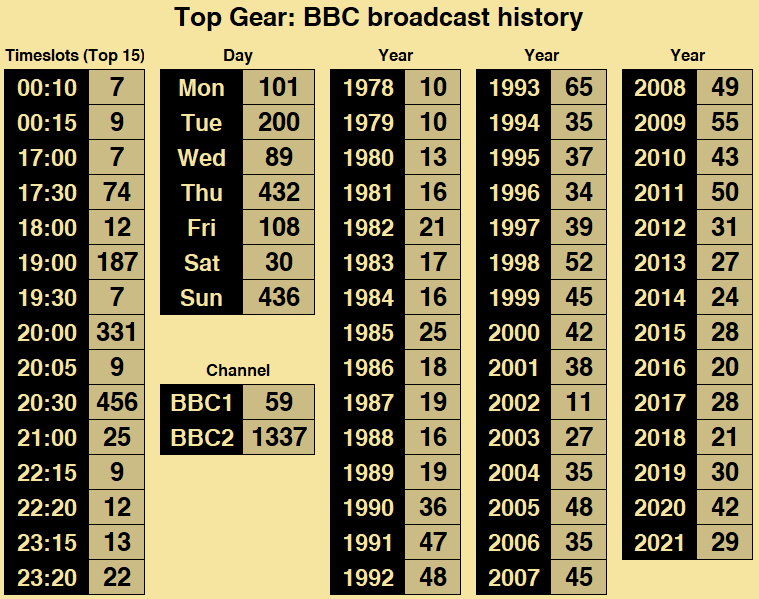
=63: Antiques Road Trip
(Shown 1449 times, 2010-2021)

Despite a programme name that makes it sound like an Aldi version of Antiques Roadshow, Antiques Road Trip is a very different proposition. Well, not that different. It’s still about antiques. But anyway.
The programme pits a pair of antique experts against each other, each armed with a budget of £200. The money is used to purchase antiques and collectibles, which are subsequently sold at auction. After each auction, the amount in each expert’s kitty (after costs) becomes their budget for the next leg of the titular trip. The winner is the expert who makes the greater profit over five legs, with any remaining cash donated to Children in Need.
Each daily programme covers a single leg of a ‘match’, offering a compelling reason for viewers to return each day. And each week, the ‘trip’ aspect of the programme involves the experts zooming between auctions in a different classic car. And that’s the format.
As you may have gleaned from the write-up on other, similar programmes in the list, I’m not going to go all-in on this show. After all, I’ve a history of Farming programmes to get to. But I will say one thing: one thing that has always bugged me about the whole “brilliant antique experts pick up amazing bargains from antique shops” premise.
The owners of antique shops don’t just sit there with a shop full of gems they somehow fail to understand the true value of. Nor do they let any Tom, Dick or Tarquin wander in and start haggling. But they are canny enough to know that giving Johnny TV Expert a twenty quid discount on a Victorian teapot will result in their shop making it into the edit of a popular daytime programme on BBC1, thereby generating a spot of advertising much more valuable than a tatty teapot. Expert gets a bargain that’ll sell for a profit, shop owner gets increased trade, a forty-five minute slot is filled in the daytime schedule. Everyone wins.
Well, everyone except me. I’m just waiting for Pointless to start.

=63: The Natural World
(Shown 1449 times, 1983-2021)

While the BBC is rightly lauded for big-name natural history documentaries like Planet Earth, Blue Planet or Life in Cold Blood, long-running nature strand The Natural World (since 2003, just ‘Natural World’) has long been the less-glamorous midfield workhorse putting in the hard yards. Attracting far fewer column inches than those stablemates of global renown, it’s nonetheless been there almost forty years, bringing an entire global ecosystem to the homes of BBC2 viewers.
The roots of The Natural World actually belong to a different programme. The World About Us (3 December 1967 to 20 July 1986) was created by David Attenborough to make the most of the colour TV sets starting to trickle into British homes, offering sights from all around the world in full living colour. The series would go on to clock up 714 broadcasts on the second channel (and 121st place in the big list, if you’re wondering), and almost as many awards from television societies around the world.
That said, despite being commissioned by (then controller of Two) David Attenborough, the remit for World About Us needed to extend beyond just the world of wildlife, such was the paucity of colour wildlife film available for the new medium. As a result, the remit of the series was expanded to cover geography and anthropology as much as natural history. By 1983, there were enough film-makers capturing wildlife footage in full colour to warrant a tighter remit, and a rebrand to suit.

In contrast to World About Us, The Natural World seems to have initially enjoyed a relatively low status within the BBC. In trying to find out a little more about the genesis of the programme, I looked at BBC Yearbooks from 1983 onwards, and the first reference I can find to the programme comes in the BBC Yearbook for 1985. Even then it’s only a passing reference to George Fenton’s music for the series picking up a Bafta. Yeah, just a Bafta, barely worth writing about, eh?
The BBC’s coquettish attitude to the programme early on certainly didn’t hinder its budget, thankfully. It being a format that could easily be sold to other TV markets, along with it being part of co-production partnership with American broadcaster WNET afforded the series a generous budget, and a prime spot on PBS stations on the other side of the Atlantic.
It also didn’t hurt that a plethora of famous voice-owners lent their vocal chords to narration duties. While – as you’d expect – Sir David Attenborough lent his voice to a fair number or episodes, in those early years it was Barry Paine who took to the microphone most often. As years went on, narration duty took in the likes of (deep breath) Robert Powell, Laurie Emberson, Jane Goodall (in an episode looking at her work with chimpanzees), Andrew Sachs, Hywel Bennett, Siân Phillips, Libby Purves, Tom Conti, Judi Dench, Sally Magnusson, Brian Blessed, Anthony Hopkins, Tony Robinson, Rula Lenska, Tim Pigott-Smith, Robert Lindsay, Ian McShane, John Hurt, Geraldine James, Joss Ackland, Des Lynam, Ian Holm, Bernard Cribbins, Patricia Routledge, Nigel Hawthorne, Tom Baker, Stephen Fry, Eleanor Bron, Bill Oddie, Miranda Richardson, Meera Syal, Richard Briers, Charles Dance, Sanjeev Bhaskar, Charlotte Rampling, John Peel, Steven Berkoff, Lenny Henry, Olivia Colman and Adrian Edmondson.
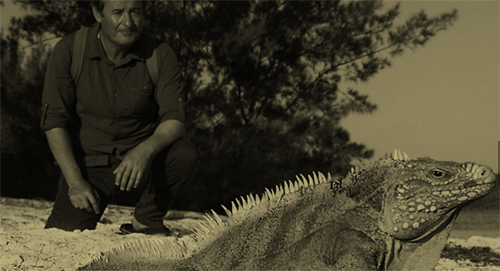
With a reputation as the planet’s go-to broadcaster for high-quality natural history films, it’s little surprise so much talent could be coaxed into working on the series, but the narrator rarely took top billing in a series where wildlife always took centre stage.
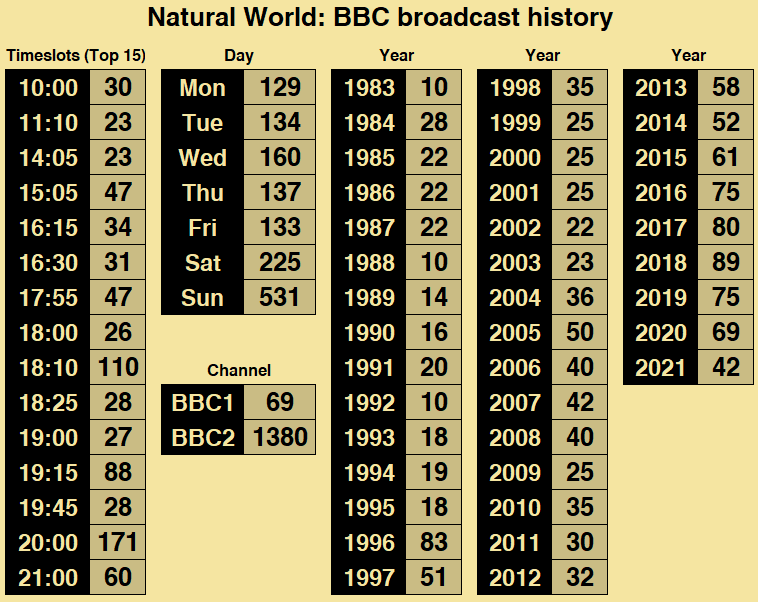
62: Diagnosis Murder
(Shown 1472 times, 1993-2011)

Brought to you by the content warning message

Yes, I am very glad I’d extracted info from all the broadcast years before the Genome redesign and addition of ‘offensive content’ autofilter warnings. Anyway, on with American action-comedy-mystery-medical crime drama Diagnosis Murder, starring D*** Van D***. One day I’ll try and work out a list of most-censored programme listings on the BBC Programme Index.
Anyway, A Diagnosis of Murder, to use the title of the TVM-cum-pilot episode. A kind-of spin-off of US crime series Jake and the Fatman (for which season 4 episode 19 served as a backdoor pilot for Diag Murder), the show featured medical doctor Mark Sloan (played by D-word Van D-word) as he solved crimes in all the bountiful spare time medical doctors have. Aided by son and sidekick Detective Steve Sloan (played by real-life son Barry Van Dyke), the pair frequently team up to solve hospital-adjacent crimes.
Despite the initial series of Diag Murder arriving on CBS in October 1993, it took until 1999 for it to debut on the BBC. For most of the 90s, any viewers seeking some hot Van Dyke action were restricted to numerous airings of the three TV movie outings for Dr Mark Sloan. The first of these came in a prime post-Christmas slot, with original pilot Diagnosis of Murder going out (with a billing of “a quirky murder investigation from the producers of Perry Mason”) in an 8:30pm slot on BBC1, three days into 1993. This was positioned in that day’s schedule at a point where a quirky murder investigation would have been a welcome relief for anyone who’d just seen the preceding programme: a surprising repeat of the darkest ever episode of Last Of The Summer Wine*.
(*Said ‘episode’ was actually a now-infamous feature-length 1983 Christmas special of the series, called ‘Getting Sam Home’. The plot involved Foggy, Compo and Clegg visiting their pal Sam in hospital, and agreeing to his request that he wants to spend one last night with his fancy piece, “Lily-Bless-Her”. The unseen exertions at Lily’s are too much for Sid’s ticker, meaning it’s up to our intrepid trio to get Sam’s corpse (yep, corpse) back home so that his wife Sybil thinks he died in his own bed. Shown at 7pm! Even the original broadcast was mostly post-watershed. If you were previously unaware of that episode and think I’ve made all that up, I honestly didn’t. It was even released as a rental VHS tape, and I know that because I got my mum to rent it when I was nine years old, such was my love of Last of the Summer Wine. All shot on film, as was the style at the time, which added an extra layer of grimness to it. I really enjoyed it, too. Probably the closest I ever got to a video nasty. BONUS FACT: it was the first BBC sitcom to earn a 90-minute Christmas special episode. Anyway, we’re not here for that.)
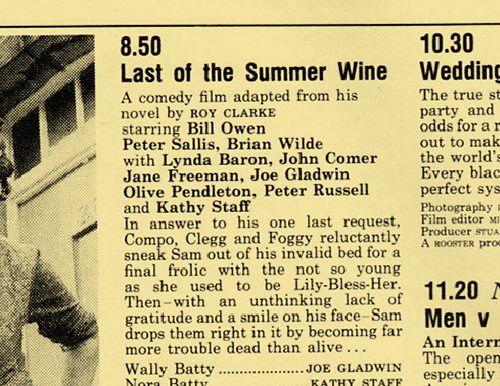
I must admit, until seeing this original RT listing, I was unaware this particular LotSW story is actually a book adaptation, Roy Clarke having first written it as a spin-off novel. It was Bill Owen who’d suggested adapting it for TV. But, as I say, we’re not here for that. So, back to Dr Mark Sloan. As I say, by the time the BBC started showing the series proper, it was well into its seventh season in the USA. That’s usually a sign something has been picked up on the cheap and is being used as schedule-grout until something better comes along, but it proved to be very popular with the daytime audience. A bit more comic than many of its contemporary crime shows, BBC1 schedules for the show’s original broadcasts put it in good company – nestled between the afternoon showing of Neighbours and repeats of To The Manor Born, it serving as a suitably meaty centre in a whimsical TV sandwich. Ten years later, it was still a fixture in a daytime BBC1 line-up, offering a double dose of medical mayhem (alongside Doctors) amongst the forest of Heir Hunters/Homes Under the Hammer/To Buy or Not to Buy/Trash to Cash/Cash in the Attic-style shows.
Clearly, with the BBC1 schedule gorging itself on property and antique programmes, there was no longer any room for a light-hearted hospital-based detective series. And so, from 12 October 2009, Diagnosis Murder moved to BBC2, where it was shown alongside [checks Genome] oh. Property series Open House and best-of repeats of Flog It. Bloody hell, bring back Open Air already. And (save for a brief return to BBC1 in 2010), the second channel was where Diagnosis Murder saw out its days at the Beeb. A flickering lighthouse against the tsunami of property and antique shows.
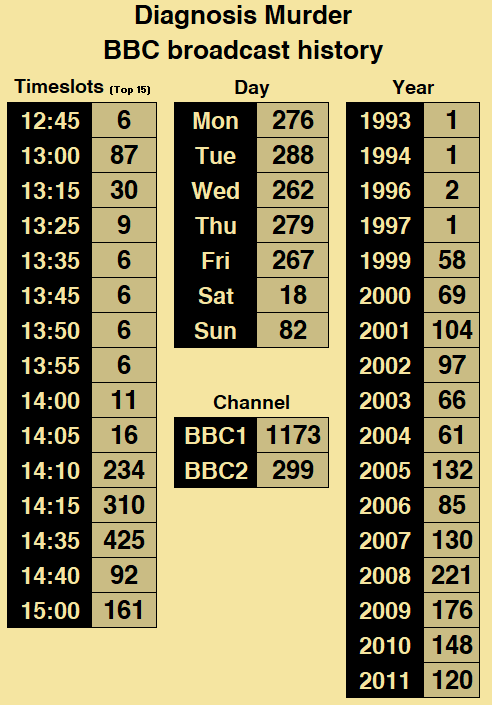
NOTE: With thanks to Steve Williams for Summer Wine novel clarification.
61: Farming
(Shown 1488 times, 1957-1988)
Even accounting for the early years of television roll-out concentrating on viewers in The South, it took a surprisingly long time for the medium to provide any programming for those living off the land. The assumption seems to have been radio programming provided all the information farmers might need (and indeed, not everything needs to translate to television – there’s a reason The Shipping Forecast has never transferred to the small screen). Radio had been serving the agricultural community since January 1924, with the first edition of Farmer’s Corner broadcast on 5NO Newcastle. That was followed by similar programmes serving farmers broadcast from Glasgow, Manchester and Cardiff.
From September 1937, wireless receivers all around the nation were able to receive the latest agricultural goings-on, with ‘Farming Today’ airing on the National Programme. No longer would farmers finding themselves in the wrong region miss out on advice from W. S. Mansfield, Manager of the Cambridge University Farm, on topics such as grassland improvement, High versus Low Farming, or alternate husbandry (saucy).
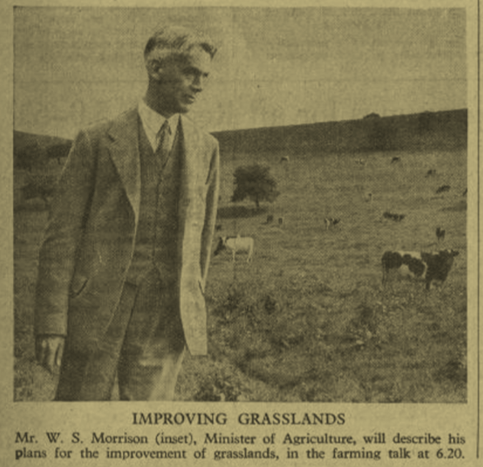
Meanwhile, any glances the nascent BBC Television Service were giving at farmers seemed to have an aim of extracting information from them, to provide knowledge and background for townsfolk with television receivers. 1 February 1939 saw the first episode of ‘This Month on the Farm’ (renamed ‘Down on the Farm’ thereafter), a monthly series where “A. G. Street visits Bulls Cross Farm and surveys with the farmer the work to be done”, which ran until August of that year. All very commendable, but not doing much to serve the rural community itself.
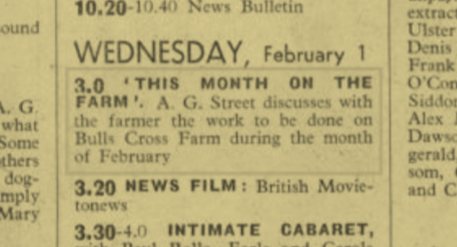
By contrast, any programming actually aimed at the farming community failed to happen until 31 March 1950, when an entire hour of programming for farmers – helpfully titled ‘For Farmers’ – was broadcast. Split into three twenty-minute modules on Fruit, Poultry and Pigs, it seemed things were changing when it came to television serving the needs of farmers.

But – as far as I can find – that was it for the ‘For Farmers’ strand. In the same slot the following week was a similar hour aimed at gardeners, and subsequent weeks saw the 3pm slot reserved for children’s programming. Any similar hopes and dreams were subsequently dashed in February 1951, when a fifteen-minute programme called ‘Farming Review’ aired, offering a look at farm life rather than anything serving the needs of farmers. And again, this was merely a one-off short film, rather than a full series.
It took until 4 October 1957 before anything substantial appeared to serve the farming community.

At last, “a new series of weekly agricultural magazines for those who live by the land”, introduced by farmer, agricultural journalist and broadcaster John Cherrington. The first edition included the current Minister of Agriculture, Fisheries and Food, Derick Heathcoat Amory MP, who provided an outlook for British farming, and a Q&A session on the same with Sir James Turner and EG Gooch (CBE, MP). There was also the promise of a film from the International Potato Harvester Trials, and a visit to the Earl of Bradford at his Tong Norton Farm within his Staffordshire estate.
Heady stuff, and best of all it was followed in the schedule by the magnificently-named ‘The Weather Situation for Farmers and Growers’. Not a bad attempt at making up for lost time, especially given from that point on, Christmas week and special occasions aside, the weekly Farming round-up (not forgetting ‘The Weather Situation’) would be a Sunday lunchtime fixture for just over the next thirty years.
In July 1988, Les Cottington and Philip Wrixon presented the final edition of the programme (the RT listing for that finale suggests I’m missing some episodes from the total I’ve totted here, but on closer inspection it seems they went out under the title ‘Farm Forum‘ which I’ve decided DOES NOT COUNT). Of course, that wasn’t the end of early-afternoon countryside coverage – the final episode included a preview of the programme that would be picking up the Farming mantle, a little series called Country File. More on that… later?
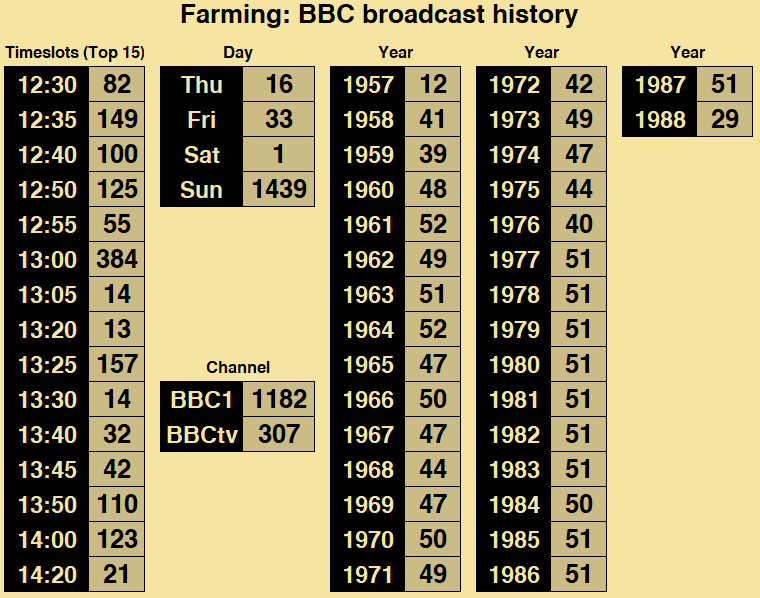
Includes programmes listed as ‘The Weather Situation for farmers and growers; followed by Farming’, ‘Farming and Weather for Farmers’, ‘Farming in 1961’, ‘Farming in the Outer Hebrides’, ‘Farming in Europe’, ‘Farming: Mallingdown Syndicate’, ‘Farming in Britain’, ‘Farming in Westminster’, ‘Farming in the North’, ‘Farming in Wales’ and ‘Farming Special’. All in the regular slot on the regular day containing the regular content. So they count. This is important you know this, and I’m not just showing off how much data I’ve pointlessly gathered.
Okay, that’ll do. Next update sooner than you might expect (because I’ve already written 60% of it, thanks to me adding a further 12,133 individual listings from Daytime on Two to the database like an idiot who doesn’t know when to stop making his own life more difficult). I refuse to ever learn.
-
I Challenged Six AI Image Bots To Generate Images For Newspaper Headlines from The Day Today. Here Are The Results (Part One)
For the uninitiated, The Day Today was a 1994 BBC2 comedy series parodying contemporary news coverage, a programme that has remained resident in the collective consciousness of all British comedy fans ever since. A TV adaptation of Radio 4 series On The Hour, The Day Today would provide terrestrial TV debuts for Chris Morris, Armando Iannucci and Steve Coogan’s Alan Partridge, amongst others.
One regular part of the series — alongside pitch-perfect spoofs of news, current affairs, soaps, fly-on-the-wall documentaries, MTV Europe, CNN, public information films, archive television and pre-empting The Office by seven years — were ‘a look at tomorrow’s headlines’ — a smattering of nonsensical headlines purportedly from early editions of the following morning’s newspapers. A little bit of dark whimsy to see us into the end credits, many of which would lodge themselves into cranial crannies of viewers for years to come.
Back in 2021 (remember that? When we thought things were as bad as they could get? Bless our naive little hearts), I wrote a Medium post where I challenged AI image bot Pixray to create images for Tomorrow’s Headlines from The Day Today. The results were… mixed. So, in a bit of a break from writing about old BBC programmes I’ve mostly never seen, let’s recreate that experiment by setting six different AI bots against each other, and see who can create the best visual interpretation of Chris Morris brain wrongs.
THE COMPETITORS:
- Deep AI’S Text To Image AI Image Generator API
- Hotpot’s AI Art Maker
- Computer Vision Explorer’s Text To Image Generator
- Pixray Text to Image
- Dall.E Mini
- Nightcafe
So, with everyone on the starting grid, let’s go!
WARNING: Maybe don’t read the rest of the entry whilst eating.
EPISODE ONE: Main News Attack
HEADLINE ONE: “Aristocrat’s Dung Saves Village From Flood.” — Daily Mail
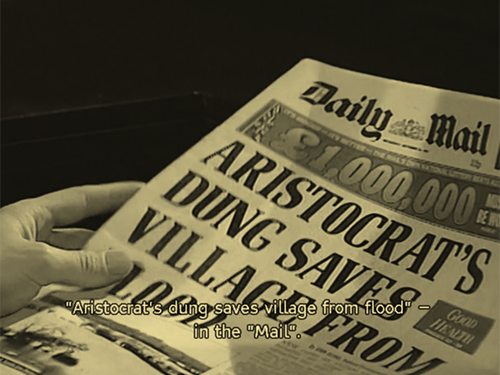
See why I warned you about not eating? Here are the top three results for that less-than-tantalising morsel.
1st Place: PIXRAY
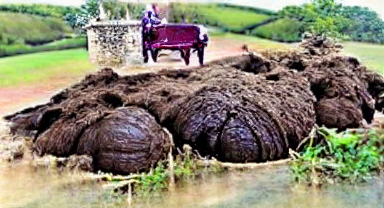
There was always going to be dung, but at least here you can tell it’s especially aristocratic. See the velvet chair and finery in the background? That’s going the extra mile. Plus, the dung is visibly blocking off the flood. Top marks.
2nd Place: NIGHTCAFE
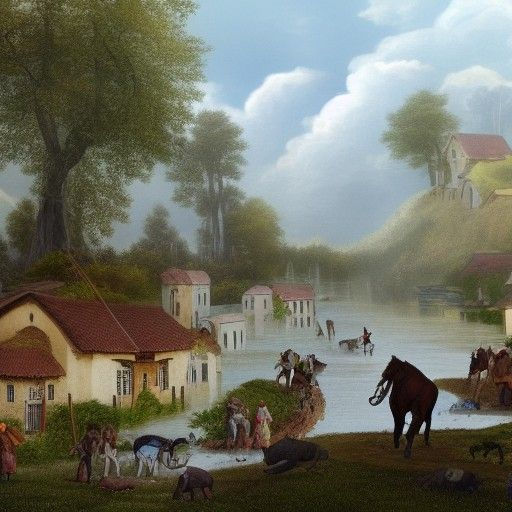
Not as easy to buy into the dung angle here, but there definitely seems to be an effect to have saved the village. Plus, it’s a nice image at a decent resolution. 3rd Place: HOTPOT
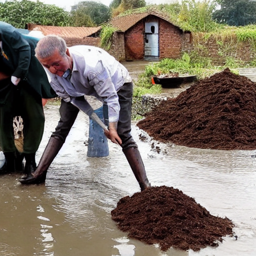
There’s definitely a man trying to save something using a dung-like substance. And, without being too course, we’ve not way of proving it isn’t from an aristo’s arse.
HEADLINE TWO: “Drowned Italian Wins Eurovision.” — Today
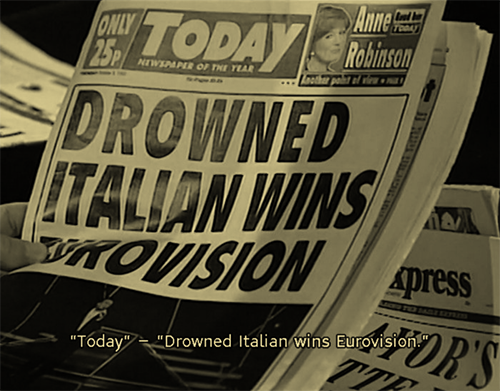
1st Place: NIGHTCAFE
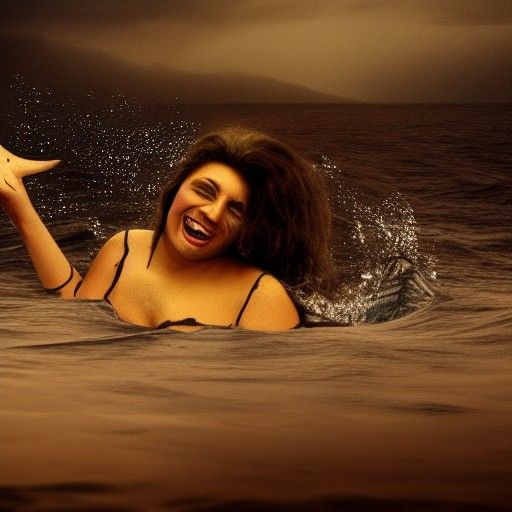
A clear winner, despite the Eurovision angle not being obvious. At least the singer is drowning, which is a sentence that I admit is very wrong out of context.
2nd Place: PIXRAY
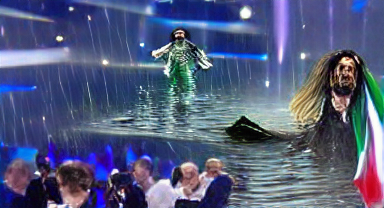
A close second, thanks to looking a bit more like the Eurovision stage, and an Italian flag being present. But that’s not drowning. They’re barely even damp.
3rd Place: HOTPOT
A low bar, because most of these results were rubbish. But this does look most like someone who’d be representing Italy at Eurovision, so bronze medal.
SPECIAL MENTION: COMPUTER VISION EXPLORER
I mean, what the actual fuck?
HEADLINE THREE: “Lord Mayor’s Pirhouette in Fire Chief Decapitation” — Daily Express
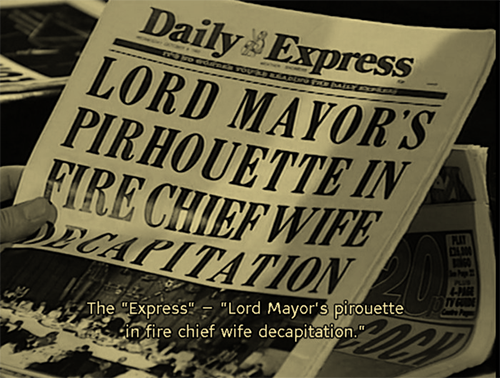
1st Place: HOTPOT
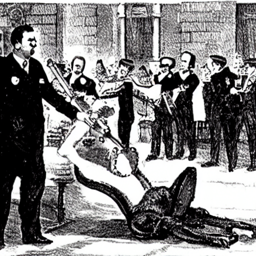
Basically nailing the story had it ran on P1 of the London Illustrated News, there.
2nd Place: DEEP AI
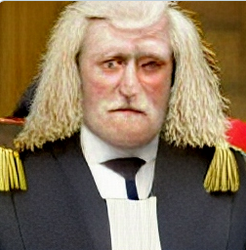
That IS very much the face of a man who’d just seen that happen.
3rd Place: PIXRAY
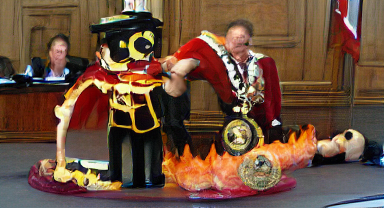
That definitely does look disturbing enough to warrant a front page headline, in fairness.
HEADLINE THREE: “Robin Cock” – The Sun
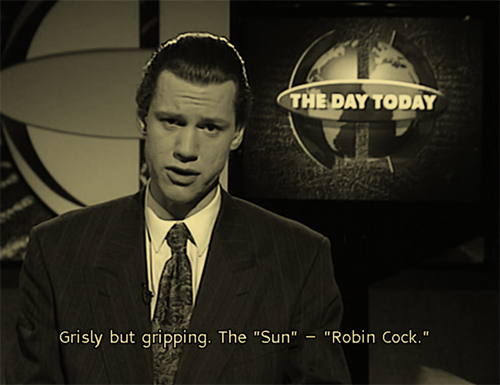
1st Place: PIXRAY
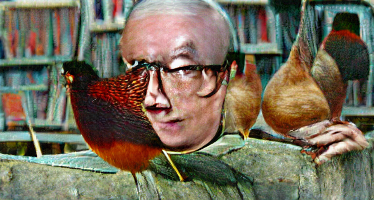
Phew.
2nd Place: DEEP AI
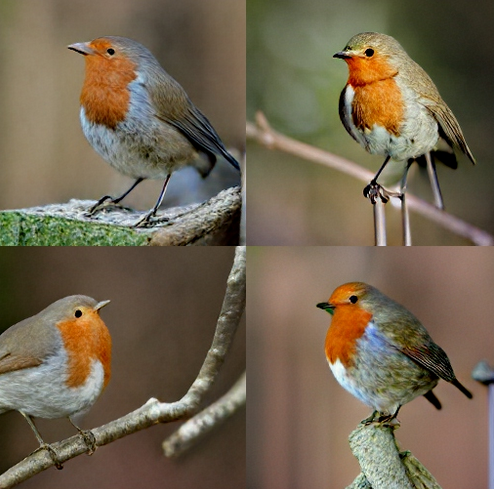
Phew.
3rd Place: DALL.E MINI
PHEW. Safe to say some of them ignore particular key words.
HEADLINE FOUR: “‘Feel My Nose and Put My Specs There’, Roars Drunken Major”
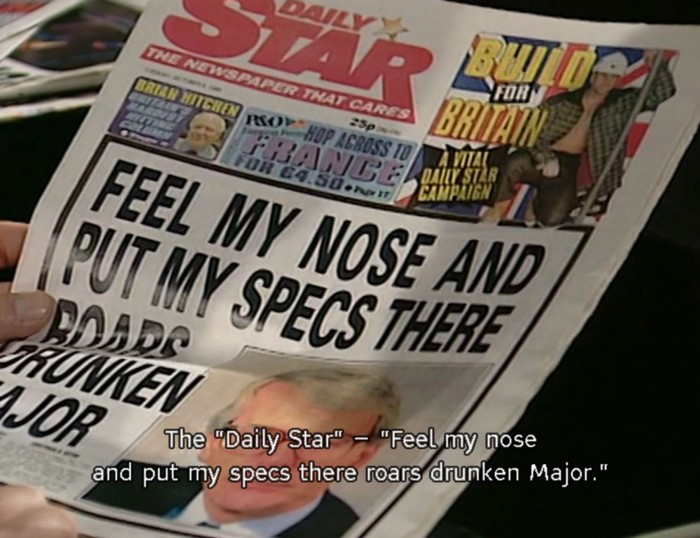
1st Place: PIXRAY
A disappointing haul again, but at least Pixray managed to incorporate all the key elements.
2nd Place: CRAIYON…
…which appears to be the new name for Dall.E Mini. It’s basically the same, anyway. And it brought out a series of disturbing images for the query, some of which are definitely not suitable for human consumption. Here’s one of them, which should brighten your day if you were wondering what Andrew Collins would look like in a Bo Selecta mask.
3rd Place: HOTPOT
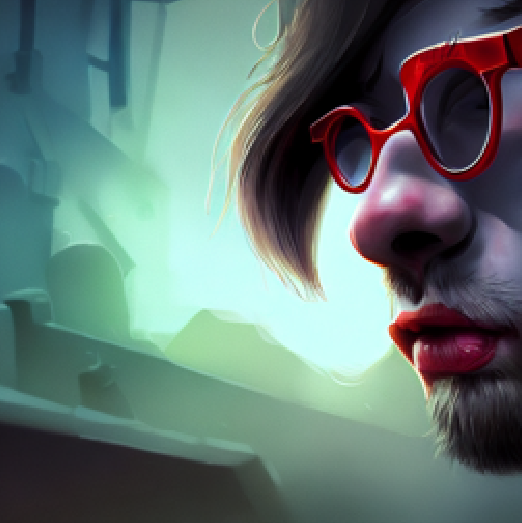
Key elements incorporated: just the glasses, sadly. But, y’know, thin gruel, take what you can get etc.
Yeah, that’s all anyone needs to see for now. So, at the end of episode one, and going by five points for a first place, three for second, one for third, here are the standings.
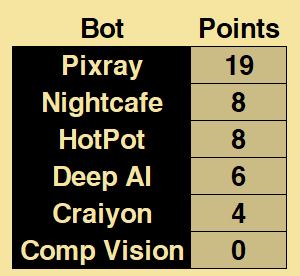
ALL TO PLAY FOR.
J/K, Pixray’s probably going to win at this rate. Next round of hot AI bot action this time next week.
-
BBC100: The 100 Most-Broadcast BBC Programmes Of All Time (70-66)
Welcome back, everybody. Exciting fact! When I started writing this update, three of the five entries were for completely different programmes. It’s only after writing them that, for various reasons, they’ll actually be appearing higher up the list. Still, at least that’ll save me some time later, eh?
Before kicking off the next update, reader ‘Retro71‘ writes in to mention an episode of Tom and Jerry that received complaints about swearing, with the word ‘bloody’ being mild to American ears, less so to British ones. After a little digging, the scene in question is apparently one where a pirate yells “get off my bloody boat”, though the T&J filmography doesn’t include any classic episodes set on a pirate ship – more likely it’s 1952’s Cruise Cat, which sees Tom hired as mouser on a cruise ship. Rather than that particular episode being shown in full, the scene seems to have been aired during an episode of Tony Robinson’s superb toon history show Stay Tooned!, in an episode looking at censored toons. Unfortunately, while Genome has episode descriptions for most BBC One showings of Stay Tooned!, the banned episode isn’t one of them. Anyone know any more about this? Get in touch in the comments or hit me up on the Twitter.
Anyone, on with the list. Starting with a programme where I *know* the format of the programme doesn’t fully align with the write-up, so there’s no need to write in (unless you just want to comment that I’m very handsome or something).
70: Mastermind
(Shown 1265 times, 1972-2021)
“One’s a Trade Union leader, the other’s a member of the Cabinet.”
You know, there can’t be too many quiz programmes based on their creator’s experiences of being interrogated by the Gestapo. But that’s precisely the inspiration television producer Bill Wright has given for the intimidating environment for British television’s longest-running (and most parodied) quiz programme.
As we’ve seen a few times to far, it’s a format that really doesn’t need laying out here. Dark room, Magnus “Iceland’s Answer To Robert Robinson” Magnusson, black chair, specialist subject, I’ve Started So I’ll Finish. Originally airing in 1972, it didn’t became the nation’s favourite Serious Quiz Programme overnight. Initially going out at 10.45pm on Monday nights (with an afternoon repeat each Wednesday), it took the downfall of another series for Mastermind to get a wider audience.
1969 saw upstart London channel LWT broadcast a new series of TV comedy plays by Ray Galton and Alan Simpson, which featured an impressive cast: Harry H Corbett, Stratford Johns, Bob Monkhouse, Pats Coombs and Hayes, plus Leslie Philips. The first episode of The Galton and Simpson Comedy – “The Suit” – saw Phillips play an adulterous scoundrel whose suit is stolen during a night at his mistress’s flat. As a result, he needs to find a way to make his way across London to his marital home sans underwear, dignity and excuses.
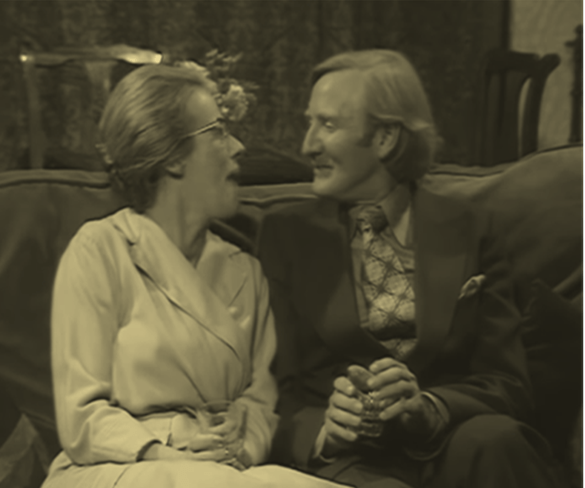
This premise would provide the basis for a new Galton and Simpson sitcom on BBC-1 four years later. Casanova ’73 saw Leslie Phillips play duplicitous PR exec Henry Newhouse, whose happy marriage to wife Carol doesn’t stop him seeking freelance relationships at any given opportunity. While the programme itself wasn’t remotely as smut-packed as the premise might suggest (the first episode focuses on Newhouse repeatedly trying to disrupt postal deliveries to prevent Carol from seeing a love letter addressed to Henry), such pre-watershed displays of infidelity attracted a lot of negative attention for the Corporation, and the series was swiftly shunted to a 9.25pm slot.
That left a gaping hole at 8pm each Thursday evening. What’s something so inoffensive, so sedate, so sober that nobody could complain? Not even Whitehouse? Step forward. Mastermind. By that point, it had been going out in a post-11pm slot each Monday night, and yet here it was – Magnus and his darkened interrogation chamber thrust unexpectedly into the spotlight. The irony.
From there it became a television institution, not only clocking up a huge number of episodes, but also a variety of spinoff series:
Celebrity Mastermind (247 eps, 2002-now, initially as ‘Mastermind Celebrity Special’)
Des Lynam’s Sport Mastermind (18 eps, 2008, initially billed as just ‘Sport Mastermind’)
Doctor Who Mastermind (1 ep, 2005)
Junior Mastermind (24 eps, 2004-2007)
Mastermind Champions (3 eps, 1982)
Mastermind International (6 eps, 1979-1983)
Mastermind Masters (4 eps, 1995)
A note also has to be made of how widely parodied Mastermind is as a format, with everyone from Morecambe & Wise and Hey Duggee featuring scenes centred on the famous chair. But, of course, by far the best-known nod to Mastermind has to be David Renwick’s “Answer the Question Before Last” sketch for the Two Ronnies in 1980. Anyone resident in Britain for more than seven minutes is well aware of this superb routine (it’s playing on a loop on a big screen at Heathrow arrivals, you know), but did you know there’s a longer version of the sketch?
In 1983, the Ronnies had a live residency at the London Palladium, performing many of their favourite routines to thousands of fans. And, as transcribed by the marvellous UK Gameshows website, that included an extended version of the famed Mastermind sketch, Renwick having written additional questions and answers to maximise the merriment. I’m not going to quote any of it here, it’s too lovely a thing to steal any clicks from the UKGS site, if you want to read it go here (and as an even more special super bonus, it also includes a transcript of the original version of the sketch from an episode of Radio 4’s The Burkiss Way).
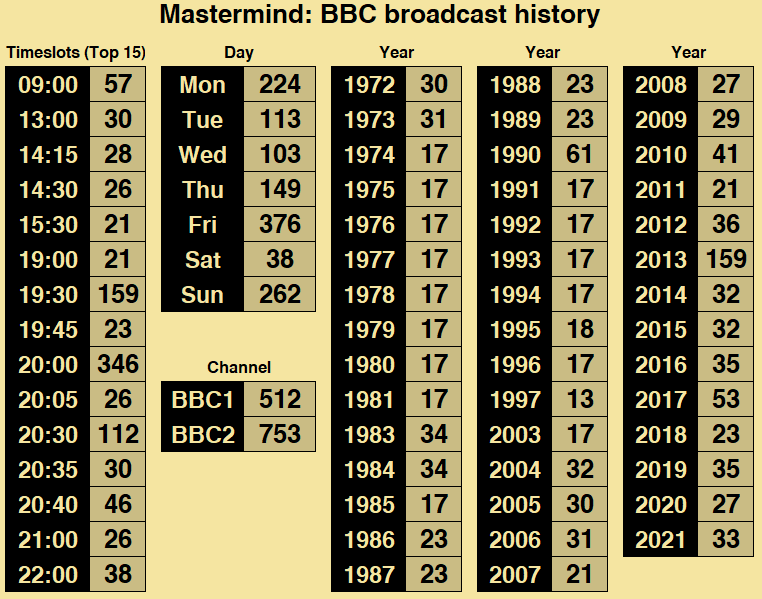
69: Athletics
(Shown 1295 times, 1946-2021)
Here’s the first of (SPOILER) several instances where an entry in the hundred is simply… the name of a sport. Some sports get a marquee programme name most times they appear on the Beeb (mainly ‘Match Of The Day’ – the last time a match was billed in the Radio Times as simply ‘Football’ was the 2005 World Club Cup final between Liverpool and Sao Paulo – but you’ve also got your Rugby Special), but for others the programme title is Name Of That Sport.
Of course, there are a few caveats to that rule. Midweek-evening sporting round-ups would go out under the banner of Sportsnight and Saturday afternoons would see everything covered by the Grandstand umbrella, but outside of those two you’d usually see an uncompromising title for the particular sport you’re about to witness.

A Grandstand umbrella, yesterday. Not that a programme would always be restricted to a particular sport, of course. Perhaps mindful of the British weather’s tendency to disrupt sporting events, more than one sporting discipline would be thrown together under a single listing, meaning the televised action could be batted between them as events dictated.
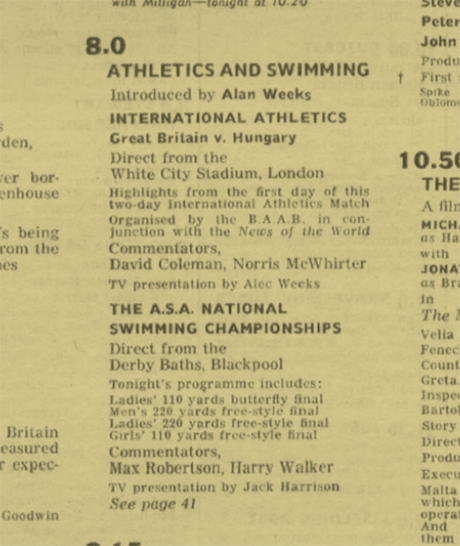
A bit of a let down if you only like track events and you’re about to watch “Wimbledon, Cricket and Athletics” with little idea of how much athletic action you’re likely to see. But, it was a world before individual sporting rights demanded different events be clearly delineated, an era before Premier League highlights had to be stored in a separate programme from FA Cup highlights, even though they’re right next to each other in the Saturday night schedule.
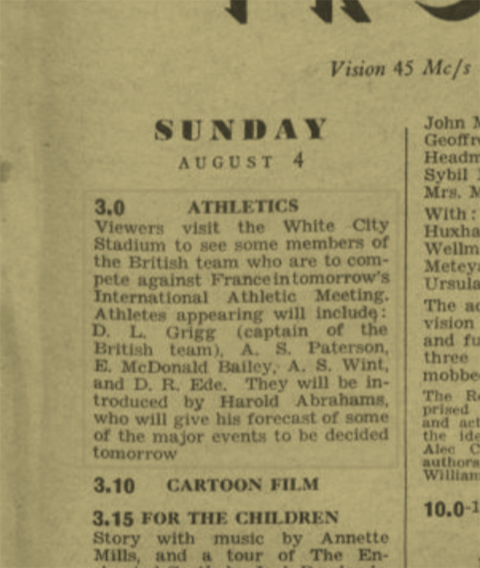
Radio Times, Sun 4th Aug 1946 For the purposes of accuracy and my mental wellbeing, we’re only going to include scheduled instances where Athletics were the sole concern of a scheduled slot. That’s still a heck of a lot of television, mind. But surprisingly, despite it being a premise as simple as pointing a camera at someone running, jumping or throwing stuff, it’s not something that ever featured in pre-war television (at least not using the term ‘athletics’ to describe it*). The earliest instance I can locate is from Sunday 4 August 1946, with the White City Stadium playing host to an international meet between representatives of Britain and France. And as an added attraction, there was also the premise of “Harold Abrahams, who will give his forecast of some of the major events to be decided tomorrow”.
(*Unless you’re including one instance from TV’s pre-history: the listing for 21 November 1934’s “Television For The Baird Process” test schedule included ‘Penslow and Company’ offering ‘art in athletics’.)
From those initial events (for which it’s likely ‘getting used to doing this sort of thing before the 1948 London Olympics’ was a factor), the sport has been pretty much ever-present on the BBC’s two flagship channels. There have been occasional dips in the number of scheduled broadcasts each year, generally coinciding with Olympic years, or spells of athletics having to share billings with cricket, showjumping, swimming or tennis. The BBC even put on a generous amount of athletics coverage in the mid- to late-1980s, a time when the broadcast rights to UK athletics meetings (and many European ones) were held by ITV.
Along the way, all manner of descriptive individual billings have been used to describe the action. Generally nothing more exciting than ‘International Athletics’, but sometimes referring to specific events (such as the Diamond League) and on a few occasions giving special call-out attention to the sport’s most bankable star. So much so, in fact, that I had to search out the full programme details, in case “Usain Bolt Takes on the World” was a documentary rather than live coverage.
As Britain’s Olympic renaissance has continued in the years since 2012, the volume of athletic broadcasting has increased, for several years at an average of more than one broadcast per week. And at a time where such output could easily have been hived off to BBC Three or the Red Button, it only proves how compelling the art of running, jumping and occasionally throwing stuff is to the Britain public.
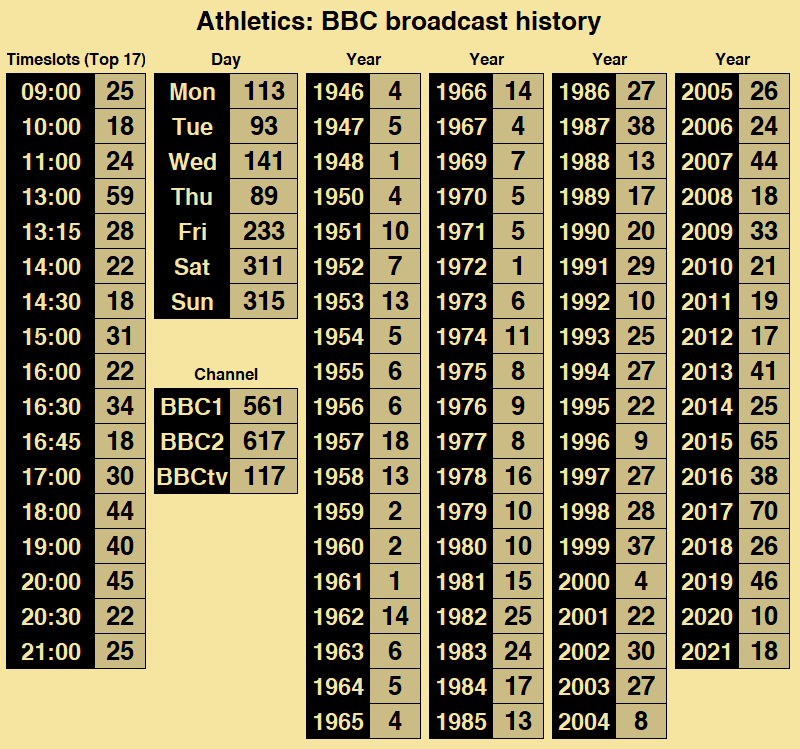
68: To Buy or Not to Buy
(Shown 1313 times, 2003-2012)

TITLE CAPTION: Coverage of People Buying a House and Then Living In it
EXT. OUTSIDE OF A HOUSE. DAY. HOST is standing next to a man, JEFF.
HOST: Hello and welcome back to Coverage of People Buying a House and Then Living In it. So, hello Jeff, you wanna buy a house, here’s a house. What do you think?
JEFF: Yeah.
HOST: D’you like the house?
JEFF: Yeah, it’s fine.
HOST: Will Jeff be able to buy the house that’s fine of his dreams? Yes, he will. It’s in budget, is it Jeff?
JEFF: Yeah.
HOST: That was not a close one.
JEFF: Nah.
HOST: We’ll be catching up with Jeff when he’s bought his house, which is
CUT TO INSIDE OF HOUSE
HOST: …now. Jeff, you’re now living in your house.JEFF: Yeah.
HOST: What’s that like?
JEFF: ‘s all right, doing a bit of DIY, putting some shelves up, but nothing major.
HOST: We’ll be catching up with Jeff’s attempts to live his having things on shelves dream…
CUT TO SAME SHOT BUT HOST IS STANDING ON THE OTHER SIDE OF JEFF. THERE IS ONE SHELF ON THE WALL. IT HAS A JAR ON IT.
HOST: …now. How are the shelves?
JEFF: Useful.
HOST: That’s fascinating. So, to sum up: Jeff, who you don’t know, has bought a house and is now living in it having put up some shelves, and I think we can all agree that’s basically a good thing. Join me next week when I’ll be presenting coverage of people arranging to rent a flat and then going to the shop to buy some food to eat in it.
CREDITS ROLL.
That, times 1,313.
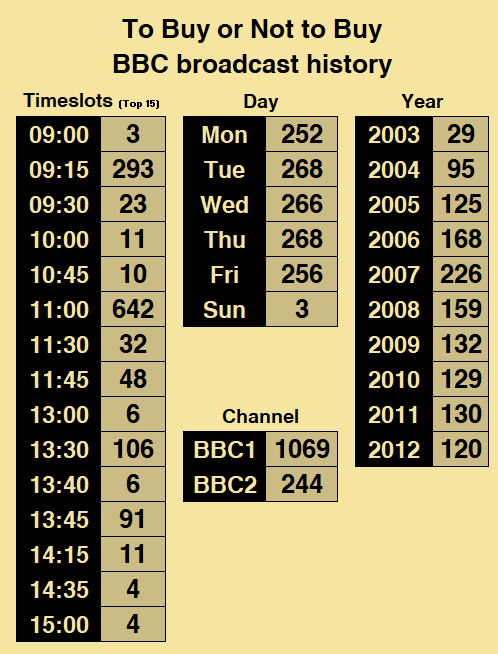
67: Casualty
(Shown 1336 times, 1986-2021)

In the USA, television spin-offs are a Big Thing. Happy Days begat Laverne & Shirley, Mork & Mindy, Joanie Loves Chachi, Out of the Blue and Blansky’s Beauties, Star Trek begat The Next Generation, Deep Space Nine, Voyager, Enterprise, Discovery and others, while The Simpsons begat Wiggum PI, The Love-Matic Grandpa and The Simpson Family Smile-Time Variety Hour.
In the UK, spin-offs are much less of a thing. Doctor Who led to K-9 and Company, Torchwood, The Sarah Jane Adventures, K-9 and Class, and Man About the House led to Robin’s Nest and George & Mildred, but other than those, it’s hard to think of many programmes that span-off into more than one programme. Well, it is for me, anyway. However, one other key example of a British programme spawning several children is very much Casualty. Springing forth from the wards of Holby’s A&E department came Holby City, mash-up Casualty@Holby City, mostly-forgotten cop show HolbyBlue, plus historical dramas Casualty 1906, Casualty 1907 and Casualty 1909 (nothing worthy of broadcast happened there in 1908, clearly).
The original series is undoubtedly the daddy of the lot. Following the professional and personal lives of a constantly evolving line-up of medical and ancillary staff of Holby City Hospital’s emergency department, the series has been a mainstay of Saturday night BBC1 since 1986. That means, chronologically-speaking, the first episode of Casualty was closer to the events of Casualty 1909 than to today.
(Now, that’s not remotely true, but the fact that you had to do some very quick mental arithmetic to confirm my blatant lie proves how old a programme Casualty is. Don’t write in.)
In all that time, the series has notched up a total of 1,257 individual episodes to date. And, perhaps even more remarkably, editors on Wikipedia have written up episode summaries and synopses for the first 1,212 of them. How do I know that? Because I’ve been into them, and copied all the text from those summaries and synopses, and generated a list of every single word used therein. And as such, I’m now in a position to introduce the pilot episode of: Casualty Plot Synopsis Word Runaround.
[Adopts Mike Reid voice]
Oi oi oi, stop that screaming. Right, oo’s ready to play the first raahnd then? Which, from each of the following pairs of words, has been used most frequently when describing episodes of Casualty?
Q1: Charlie, or Hospital?
Q2: Ketamine, or Kettle?
Q3: Duffy, or Dylan?
Q4: Henchman, or Hepatitis?
Q5: Kidney, or Kidnapped?
Q6: Horses, or Hostage?
Q7: Builder, or Businessman?
Q8: Drugs, or Drunk?
Answers after this screengrab from the 1999 Casualty Christmas special, “Peace on Earth”.

Welcome ba… OI, HEADACHE! …welcome back to Casualty Plot Word Runaround. Here are the answers.
Q1: Charlie, or Hospital? The ubiquitous Charlie features more frequently than the thing the whole series is about, winning by 750 instances to 717.
Q2: Ketamine, or Kettle? Both things that might crop up at any time in the series, but which won out? A surprisingly low scoring match sees Ketamine win, four to three.
Q3: Duffy, or Dylan? Two popular characters, but which cropped up most often in plot descriptions? The answer is: Dylan, by 328 to 285.
Q4: Henchman, or Hepatitis? Two words you wouldn’t want to confuse, but which cropped up most commonly? The winner is Hepatitis, by 8 points to 4.
Q5: Kidney, or Kidnapped? One is most often found in the human body, the other most often in long-running dramas that need to recycle ideas every now and then. And the winner is: Kidney, by 22 to 11.
Q6: Horses, or Hostage? A similar take, but with a more equine feel. And the victor is: Hostage, by 47 to 15. Raise your game, horses.
Q7: Builder, or Businessman? Ooh, a tricky shout. Likely to crop up in an early scene, allaying fears of a loved one by insisting that climbing that ladder with too many bricks, or driving their Mondeo to Aberdeen after an hour’s sleep, will be fine and they’re just being silly. Uh-oh. So, which featured more frequently? In a close match, it’s the Builder, by 13 to 12.
Q8: Drugs, or Drunk? Ah, the eternal struggle of how to spend a Saturday night if you’re not going to stay in and watch Casualty (or even if you are). And the winner is: Drugs, shoving drunkenness into the gutter with 214 instances to 98.
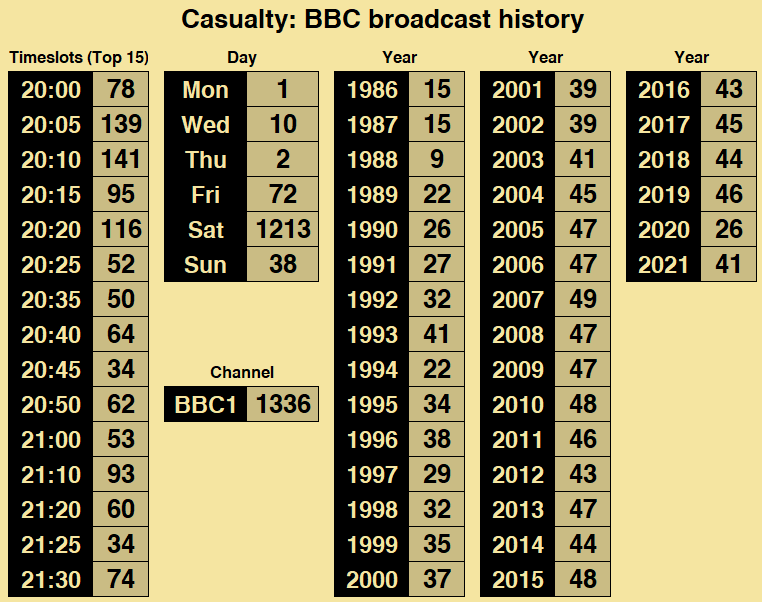
66: Pingu
(Shown 1395 times, 1990-2013)
“NOOT.” Here’s a proper little television curio. A programme tremendously popular in (amongst other places) Switzerland, Britain and Japan, and at various points it was produced in each of those three countries. Plus, it was one of the first characters ever played by Ben Whishaw (okay, that’s a half truth).
The series tells the tale of the titular curious if occasionally short-tempered little penguin fella, and all the Antarctic antics he gets up to amongst all the other little penguin fellas. Generally, escapades would involve events relatable to the target audience – such as Pingu not wanting to eat lunch, acting like a little sod to his infant sibling, or playing so noisily the family’s neighbours get annoyed. So, like Bing, except less preachy and more good. Perhaps that’s one of the main reasons it proved so popular, but the key to Pingu’s success must be that – he’s just so damn charmingly expressive. And fun to impersonate. NOOT.

Despite not appearing on British screens until Monday 12 November 1990, the genesis of Pingu goes back to 1984, when animator Otmar Gutmann pitched a stop-motion animation to snappily-titled Swiss broadcaster Schweizer Fernsehen der Deutschen und Rätoromanischen Schweiz. Initially, the action centred on a family of sea lions who generally flapped around in an amusing way, while other animals in their environment acted as background players. While receptive to the idea, SFDRS’s Erika Brueggemann was more taken with some of those minor characters in the pilot, specifically a family of penguins much more capable of acting in a human-like manner. After an amount of muttering “but I’ve made all these bloody sea lions now” (only in German), Gutmann agreed, and a seven-minute pilot “Pingu: Eine Geschichte Für Kinder Im Vorschulalter” was produced.
The short was a success, picking up the 1987 Kleiner Baer award at the Berlin Film Festival, leading to a full series commissioned for Pingu, with Gutmann and Brueggemann credited as co-creators.
From there, Pingu went on to be broadcast around the world – pretty much everywhere except the USA, it seems. Even a 1993 rap single by David Hasselhoff about Pingu (no, really) didn’t win over the stateside audience. Mainly because it was only released in Switzerland, but still. Over here, the series became especially popular between 2009 and 2011, with Pingu shown as many as three times per day in the BBC2 early morning CBBC slot.
It’s real, and it’s spectacular. As a result of all that success, the rights to the series were picked up in 2001 by animation giants HIT Entertainment (for a reported £15.9 million), and production began on a further 52 episodes. For these new episodes, production of the series was moved to Manchester, with Hot Animation (under the supervision of co-creator Brueggemann) replicating the stop-motion process that made the initial run of the series such a success. Indeed, that’s where cult hero Chris Sievey briefly worked on the series, writing the episode ‘Pingu’s Bedtime Shadows’ under his more famous non-de-plume.
The global popularity of the series even spread as far as Japan, the little penguin fella proving especially popular with teenage girls. As a result of this popularity, a full reboot of the series was announced in 2017, with the first episode (now rechristened ‘Pingu in the City’) airing on NHK-E that October. However, this is strictly NOT part of Pingu canon as it used CGI to simulate stop-motion animation. And also, it’s not called Pingu, but mainly it’s never been screened on BBCs One or Two, so we don’t need to be worrying ourselves about it.
It’s truly impressive how popular a relatively simple character would become, with the name instantly recognisable to a generation of kids-turned-adults. And indeed, it’s a series that still works remarkably well – I recently showed an episode to my eldest son, who enjoyed it hugely for several minutes before asking if he could put videogame longplay videos back on. Hey, for his generation, that’s as high as praise gets.
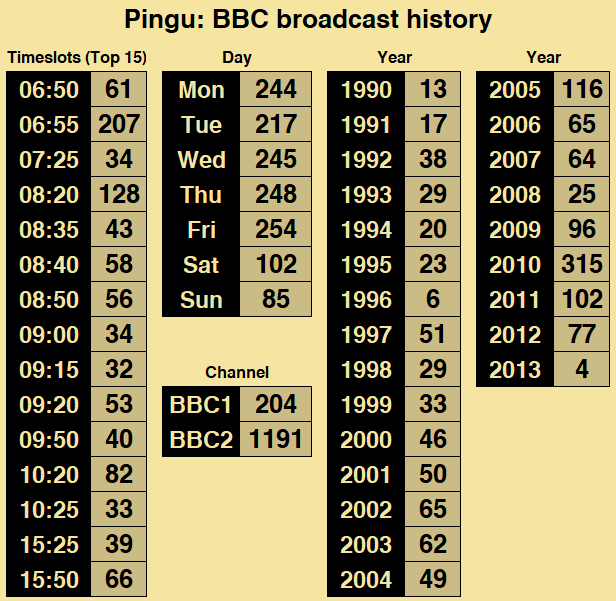
Phew. That’s it for now. Join me next time for the next installment of the series everyone is collectively being too nice to point out should probably be called ‘The 100 Programmes Broadcast Most Often On The Two Main BBC Channels… Of All Time’ instead.
There’ll be an unrelated update on Thursday, y’all.
-
BBC100: The 100 Most-Broadcast BBC Programmes Of All Time (100-71 again, sort of)

Well, damn.
As you may well be aware, I recently embarked on a foolhardy quest to tot up the hundred programmes shown most often on BBCs One, Two and Television Service since it launched in 1936. Taking data from the BBC’s Genome Project (now known as the BBC Programme Index), I scoured through 855,361 individual programme listings to determine which ones have appeared most frequently on Britain’s television screens.
And then… it soon became clear that some programmes were missing from the list. While most programmes in the Programme Index are listed nice and neatly, like this:

Quite a lot are listed like this, with individual programmes appearing within what would normally be a programme description.
This clearly Would Not Do. Capturing all this missing info would be even trickier than the initial data-scrape. The syntax used for each listing-within-a-listing varies quite wildly, an inconsistent method is used to display time (sometimes a show is on at ‘9.05’, sometimes it’s ‘9.5’, sometimes due to OCR quirks it’s ‘g-o5’), often there’s no gap between the programme title and the episode description, it’s all a bit of a mess.
Anyway, I’ve gone and snuffled out an additional 27,002 programme listings (mostly from the 1980s and 1990s), removed a few duplicates that had crept in elsewhere, tidied up a few other bits, dug a bit deeper into listings of Laurel and Hardy films (adding a bunch from the 1940s to the 2010s not specifically billed as L&H), and filled in a number of days wholly missing from the Programme Index (with huge thanks to Steve at The Radio Times archive).
In short, the whole list now encompasses a total of 879,344 programmes, and the list thus far now looks like this:
- =99: Five to Eleven (Shown 883 times, 1986-1990)
- =99: The Flintstones (883 times, 1985-2010)
- 98: Saturday Kitchen (890 times, 2001-2021)
- 97: Final Score (897 times, 1971-2021)
- 96: Postman Pat (911 times, 1981-2012)
- 95: Z Cars (920 times, 1962-1998)
- 94: Put Your Money Where Your Mouth Is (933 times, 2008-2021)
- 93: Sportsnight (934 times, 1968-1997)
- 92: Rugby Special (976 times, 1966-2005)
- 91: For the Children (983 times, 1937-1952)
- 90: Strictly – It Takes Two (1006 times, 2004-2021)
- =87: QI (1010 times, 2003-2021)
- =87: Nai Zindagi – Naya Jeevan (1010 times, 1968-1982)
- =87: The Simpsons (1010 times, 1996-2004)
- 86: ChuckleVision (1055 times, 1987-2012)
- =84: Dad’s Army (1065 times, 1968-2021)
- =84: Murder, She Wrote (1065 times, 2002-2011)
- 83: Laurel and Hardy (1066 times, 1948-2005)
- 82: The Magic Roundabout (1070 times, 1965-1985)
- 81: In the Night Garden (1106 times, 2007-2012)
- 80: The Phil Silvers Show (1107 times, 1957-2004)
- 79: Doctor Who (1138 times, 1963-2021)
- 78: Watchdog (1141 times, 1985-2019)
- 77: Wogan (1142 times, 1982-2010)
- 76: University Challenge (1182 times, 1994-2021)
- 75: Tom and Jerry (1186 times, 1967-2003)
- 74: The Sky at Night (1201 times, 1957-2013)
- 73: Call My Bluff (1208 times, 1965-2005)
- 72: Grange Hill (1243 times, 1978-2008)
- 71: Mastermind (1291 times, 1972-2021)
The eagle-eyed amongst you may have noticed a few programmes there that weren’t there before: Chucklevision, Call My Bluff and Mastermind. That’s because the newly-added Children’s BBC listings sent a few programmes much higher up the list (and in one case, booted a show out of the list entirely. ‘Money For Nothing’, if you’re wondering). And best of all, meant the mighty Chucklevision makes the Top 100 after all.
I’ve now edited the previous parts of the listing on the site to account for these changes, adding entries for Chucklevision, Call My Bluff and Mastermind in the correct positions accordingly. But, to save you from having to go find them, here they are:
86: ChuckleVision
Shown 1055 times, 1987-2012

Here’s an entry that took quite a lot of digging to get some accurate numbers on. But, given the importance and gravitas of the programme in question, I’m sure you’ll agree it was worth the time poring through Genome to pick out individual episodes buried within faux-programme listings for ‘Saturday Starts Here’, ‘Children’s BBC’ and ‘CBBC’, then checking everything against an episode guide for CV to ensure I’d not missed anything. I’m not kidding, either. This one took ages. And I’m not kidding about the importance of the programme, either. A cultural touchstone for entire generations of children (and adults) across a quarter-century on our screens, and two of the absolute nicest people in showbusiness.
Not that the Chuckle Brothers first arrived on our screens fully-formed. Their first appearances on TV in the early 1980s came when Paul and Barry were joined by older brothers Jimmy and Brian Patton to make up a four-man Chuckle Brothers outfit, as can be seen in programmes such as 3-2-1 and The Good Old Days, a bepermed Barry referred to as ‘Legs’ throughout and still the target for most of the slaps from their slapstick act. Despite putting together a thoroughly enjoyable variety turn, the quartet soon span off into a pair of double-acts, Jimmy and Brian becoming The Patton Brothers, Paul and Barry retaining the Chuckle Brothers name. Not that this was an acrimonious parting of the ways – Jimmy and Brian would regularly feature in their younger siblings’ future programmes.
Not that Barry and Paul went straight to the personas we now know them for. Their first programme as a double-act on Children’s BBC seems almost surreal when viewed now (and I recall, pretty weird even at the time). Following a few appearances on 1983’s Roger The Dog Show, The Chucklehounds (“featuring The Chucklehound Brothers”) earned a standalone episode for their antics, The Chucklehounds Christmas airing on Christmas Eve morning BBC1 in 1984. That was followed by a full series, starting in February 1986, with the lead actors now billed as ‘The Chuckle Brothers’.
The programme – a full episode here, if you’re curious – was pretty much a low-budget attempt at a live-action cartoon, with the pair wobbling about in dog costumes and getting up to all manner of slapstick shenanigans. No dialogue, but soundtracked with the zaniest sounds a Yamaha PSS-170 could muster. Problem is, while actual cartoons airing on BBC1 at the time were carefully choreographed chaos from the likes of Chuck Jones, here you had an undoubtedly talented variety act donning great big dog heads that limit mobility and visibility, with a modest budget likely offering little time for retakes. If you’re feeling charitable, it was okay for what it was, and they certainly had few qualms about what they got up to (the episode I’ve linked to includes a Chucklehound on a motorbike. Inside the studio. No, it probably wouldn’t happen nowadays) But they were capable of so much more.
And so, from the morning of Saturday 26 September 1987, Chucklevision first hit our screens as a weekly precursor to Going Live. And watching it now, it still holds up very well. Not that this should be any surprise – they are actual brothers, after all – but the rapport that we’re so familiar with is immediately obvious, you have to wonder why the blazes they’d just spent eighteen months wobbling about in dog costumes and not speaking to each other. Right from the opening episode, Chucklevision is so packed with Tim Vine-grade jokes, you can’t help but grin throughout.
PAUL: Let’s take a look at the latest videos.
[A GRINNING BARRY HOLDS UP SEVERAL VHS TAPES]
PAUL: Very nice, aren’t they?
ChuckleVision, s01e01, BBC1, TX: 08:40 Saturday 26 Sept 1987
As you can see there, the first couple of series combined studio-based humour with outdoor footage – a departure from what most Chucklefans would be used to, but their dynamic works every bit as well in that setup. I think it works so well because despite it being such a traditional double act – the idiot who knows nothing and the idiot who knows everything – they shun the traditional trope of having the Oliver Hardy/Bud Abbott/Tommy Cannon/Stewart Lee one regularly express anger or frustration at the foolery of his counterpart, Paul being (for the most part) relentlessly cheery throughout makes all the difference. And it was a formula that worked tremendously well – as the show’s run of 21 series suggests. TWENTY-ONE SERIES, with new episodes being produced from 1987 to 2009.
It took until 2008’s twentieth series before episodes of Chucklevision debuted anywhere but BBC One, but premiering on the CBBC channel was clearly no demotion. The opening episode of that series (‘Mind Your Manors’) took in guest turns from Harry Hill and Seinfeld’s Guy Siner (oh, okay: Allo Allo’s Guy Siner. He was in Seinfeld once, though), and was later repeated on BBC One.
In short, the brothers Chuckle were and are a true phenomenon in children’s television. At the time of writing, a BBC Programme Index search for ‘Chucklevision’ (it really helps that it has such a unique title) returns details of 2,976 broadcasts of the programme (many of which were on the CBBC channel). But perhaps the greatest legacy they’ve left the world can be found by going into a room containing anyone between the ages of 20 and 45 and saying “To me…”.
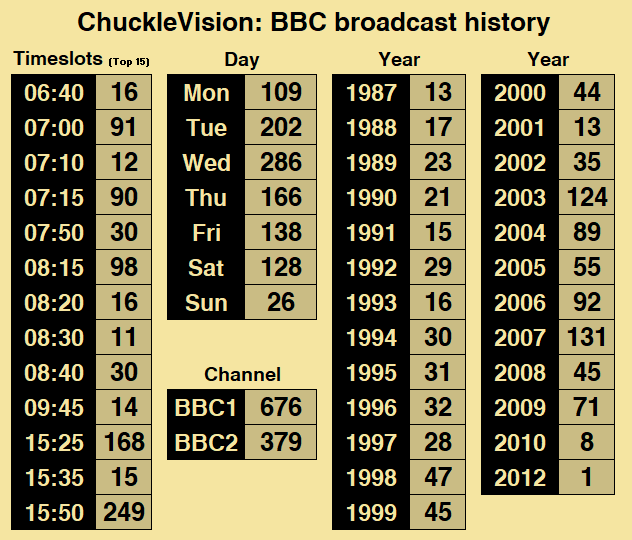
73: Call My Bluff
Shown 1208 times, 1965-2005
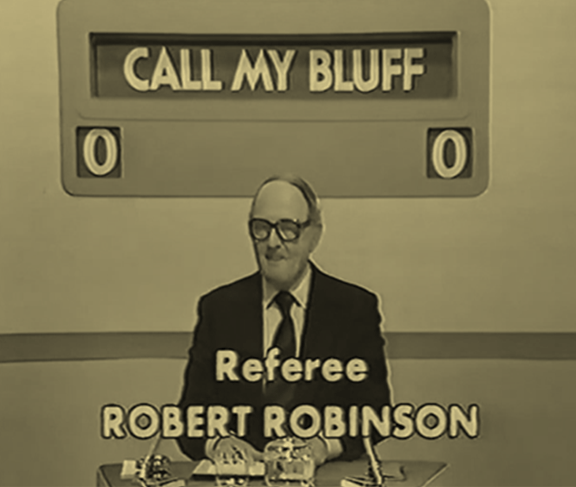
University Challenge isn’t the only programme on the list to have had a slightly surprising origin story from the other side of the Atlantic. Despite feeling like the very epitome of dry early 1980s BBC-2 output (well, it does to me), the programme actually had a much more glamorous birthplace: Studio 6A at NBC Studios in Manhattan’s Rockefeller Center. That was where the original incarnation of the series was recorded in 1965, where host Bill Leyden challenged two teams (each comprising one celebrity and two contestants) to determine the true meaning of various obscure and archaic words. The winners would pocket a jackpot of $100 (rising to a potential $200 in the end-of-show bonus game).
Despite the glitz of a celebrity guest roster (which included Betty White, Lauren Bacall and Abe Burrows), the format wasn’t a success, lasting only a matter of months before being cancelled by NBC. Recordings of the programme were believed to have been destroyed, though the complete premiere episode does survive and is available to view at the show’s Lost Media Wiki page.
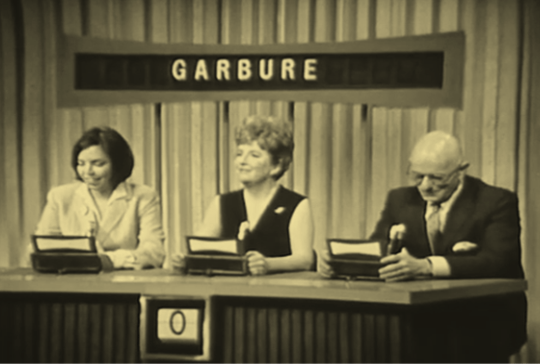
It took no time at all for the BBC to leap upon the format, pausing only to rip out the cash jackpot and replace the four contestants with additional wry celebrities, then shove it onto BBC-2 in October 1965. The quizmaster (or as the show had it, ‘Referee’) gig changed hands a few times at first – actor and musician Robin Ray took the reins for the first series, followed by actor Joe Melia for the next, then Peter Wheeler for a spell before finally landing on the referee most closely associated with the series: Robert “England’s Answer To Magnus Magnusson” Robinson. Cue countless impressions on the likes of Spitting Image, Now… Something Else, End Of Part One, A Bit of Fry and Laurie and many, many more.

The roles of team captain would also become inextricably linked to the series too, especially in the case of comedy writer-cum-raconteur Frank Muir. During a lengthy writing career alongside Denis Norden working for everyone from Jimmy Edwards to The Frost Report, followed by management stints in the LE departments of the BBC and LWT, Muir had built up quite a reputation as a wordsmith (indeed, with Norden he coined the immortal Carry-On phrase “Infamy, infamy, they’ve all got it in for me”, originally used for radio comedy Take It From Here). Call My Bluff offered the loquacious Muir a prime opportunity to put his wordmongery to good use. [EDIT: As reader Paul Jackson points out, credit should also be showered on Muir’s long-term opponents, namely Patrick Campbell (1966-80) and Arthur Marshall (1980-88). You are quite correct, Paul.]
The original run of Bluff, from October 1965 to December 1988, plus a one-off special in 1994 to mark thirty years of BBC2, clocked up 25 series’ and 542 episodes. Quite the innings, but as the channel geared up for a new generation of panel shows (kickstarted by the success of Have I Got News For You), the decidedly old-school Bluff had run its course. But not, it would turn out, for too long.
In 1996, the series was retooled as a daytime BBC1 series, with a suitably brighter, more 90s-friendly set and a new referee, Bob Holness. Alan Coren and Sandi Toksvig took on team captain roles. While it might not be the first line-up you’d think of for Call My Bluff, it was certainly a success – lasting for a further twelve series and a total of 555 episodes before the final Bluff in 2004. By that time, the line-up had changed a bit – 2003 seeing Toksvig replaced by Rod Liddle, and Fiona Bruce had picked up the referee’s baton (yes, I know referees don’t have batons).
In May 2014, Call My Bluff received a further anniversary shout-out in satirical retrospective Harry and Paul’s Story of the Twos. Rechristened ‘Speech Impediment’, an impersonated panel of Bluff mainstays were challenged to determine the meaning behind the word ‘paedophile’ (here I should add: in reference to the BBC of the 1970s failing to recognise the number of absolute dangers working there, rather than in any direct reference to specific Call My Bluff regulars).

EXTRA SUPER BONUS CONTENT UPDATE:
Ever wondered what one of the TRUE/BLUFF cards from Call My Bluff looks like in close-up? Well, with a weighty chunk of thanks to Paul R Jackson, here’s a look at one in more detail. It was sent to Paul in February 1979 by producer Johnny Downes and is signed by the Bluff regulars plus Nigel Havers.
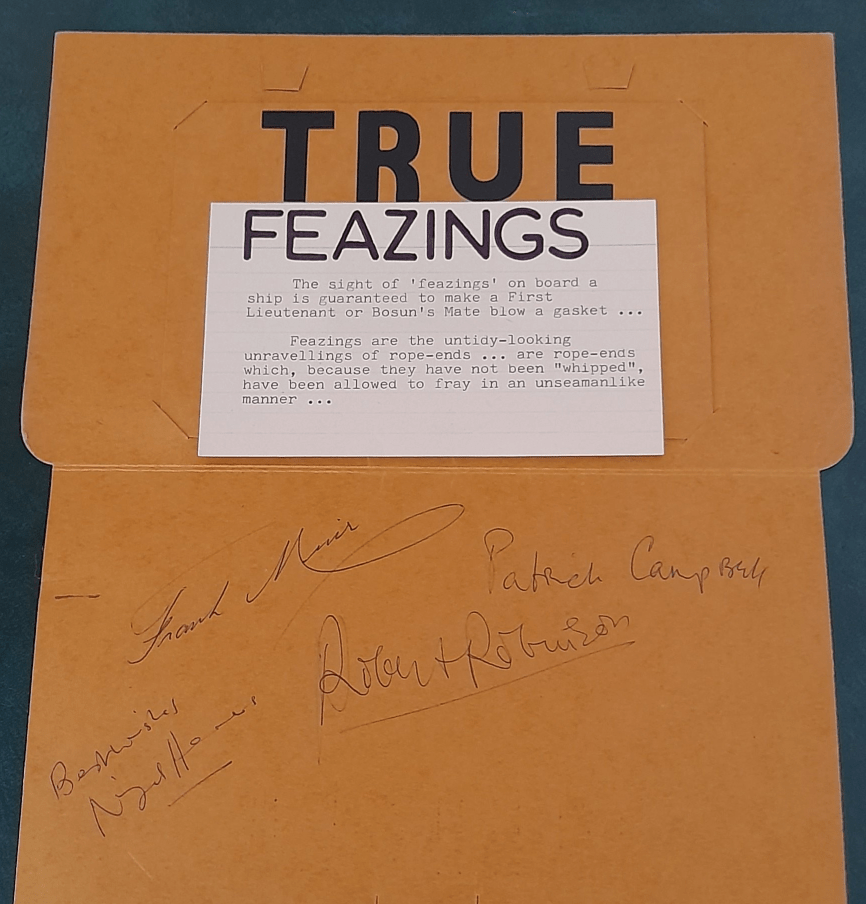
In full colour, because the site’s achingly self-conscious fanzine aesthetic can be damned for something as good as this. 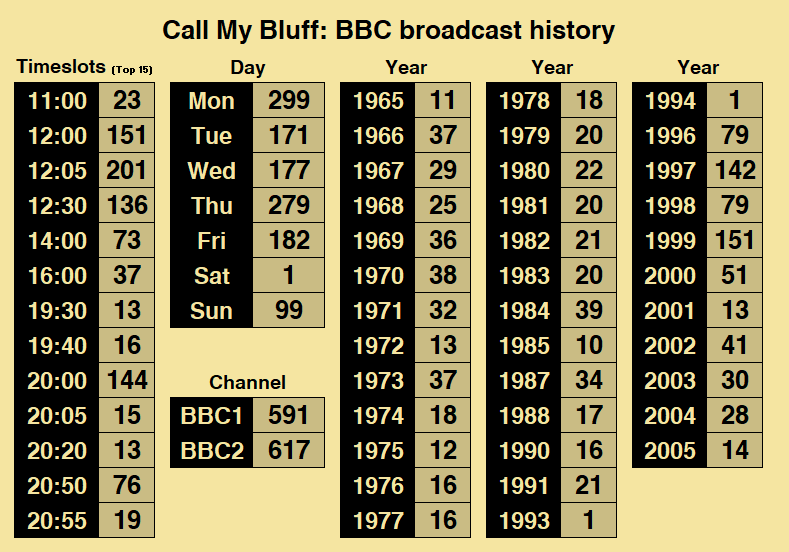
71: Mastermind
Shown 1291 times, 1972-2021
“One’s a Trade Union leader, the other’s a member of the Cabinet.”
You know, there can’t be too many quiz programmes based on their creator’s experiences of being interrogated by the Gestapo. But that’s precisely the inspiration television producer Bill Wright has given for the intimidating environment for British television’s longest-running (and most parodied) quiz programme.
As we’ve seen a few times to far, it’s a format that really doesn’t need laying out here. Dark room, Magnus “Iceland’s Answer To Robert Robinson” Magnusson, black chair, specialist subject, I’ve Started So I’ll Finish. Originally airing in 1972, it didn’t became the nation’s favourite Serious Quiz Programme overnight. Initially going out at 10.45pm on Monday nights (with an afternoon repeat each Wednesday), it took the downfall of another series for Mastermind to get a wider audience.
1969 saw upstart London channel LWT broadcast a new series of TV comedy plays by Ray Galton and Alan Simpson, which featured an impressive cast: Harry H Corbett, Stratford Johns, Bob Monkhouse, Pats Coombs and Hayes, plus Leslie Philips. The first episode of The Galton and Simpson Comedy – “The Suit” – saw Phillips play an adulterous scoundrel whose suit is stolen during a night at his mistress’s flat. As a result, he needs to find a way to make his way across London to his marital home sans underwear, dignity and excuses.
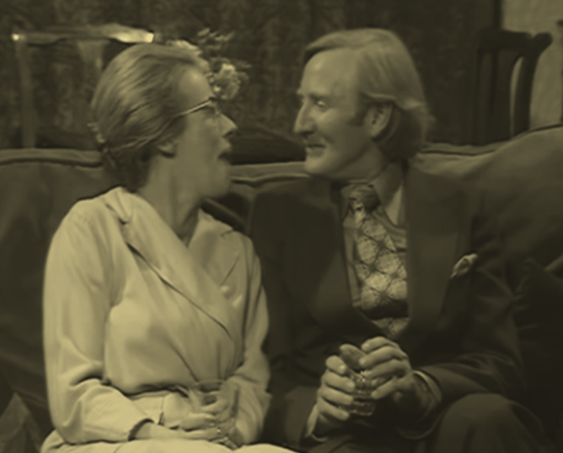
This premise would provide the basis for a new Galton and Simpson sitcom on BBC-1 four years later. Casanova ’73 saw Leslie Phillips play duplicitous PR exec Henry Newhouse, whose happy marriage to wife Carol doesn’t stop him seeking freelance relationships at any given opportunity. While the programme itself wasn’t remotely as smut-packed as the premise might suggest (the first episode focuses on Newhouse repeatedly trying to disrupt postal deliveries to prevent Carol from seeing a love letter addressed to Henry), such pre-watershed displays of infidelity attracted a lot of negative attention for the Corporation, and the series was swiftly shunted to a 9.25pm slot.
That left a gaping hole at 8pm each Thursday evening. What’s something so inoffensive, so sedate, so sober that nobody could complain? Not even Whitehouse? Step forward. Mastermind. By that point, it had been going out in a post-11pm slot each Monday night, and yet here it was – Magnus and his darkened interrogation chamber thrust unexpectedly into the spotlight. The irony.

From there it became a television institution, not only clocking up a huge number of episodes, but also a variety of spinoff series:
- Celebrity Mastermind (247 eps, 2002-now, initially as ‘Mastermind Celebrity Special’)
- Des Lynam’s Sport Mastermind (18 eps, 2008, initially billed as ‘Sport Mastermind’)
- Doctor Who Mastermind (1 ep, 2005)
- Junior Mastermind (24 eps, 2004-2007)
- Mastermind Champions (3 eps, 1982)
- Mastermind International (6 eps, 1979-1983)
- Mastermind Masters (4 eps, 1995)
A note also has to be made of how widely parodied Mastermind is as a format, with everyone from Morecambe & Wise to Hey Duggee featuring scenes centred on the famous chair. But, of course, by far the best-known nod to Mastermind has to be David Renwick’s “Answer the Question Before Last” sketch for the Two Ronnies in 1980. Anyone resident in Britain for more than seven minutes is well aware of this superb routine (it’s playing on a loop on a big screen at Heathrow arrivals, you know), but did you know there’s a longer version of the sketch?
In 1983, the Ronnies had a live residency at the London Palladium, performing many of their favourite routines to thousands of fans. And, as transcribed by the marvellous UK Gameshows website, that included an extended version of the famed Mastermind sketch, Renwick having written additional questions and answers to maximise the merriment. I’m not going to quote any of it here, it’s too lovely a thing to steal any clicks from the UKGS site, if you want to read it go here (and as an even more special super bonus, it also includes a transcript of the original version of the sketch from an episode of Radio 4 comedy show The Burkiss Way).


Phew. There’s an update that took you ten minutes to read and me a lot longer to put together. Tune in again soon for a the next few entries in the countdown, now the damn thing is a bit more stable. Hopefully my sanity can remain stable, at least until I need to error check the broadcast history of Blue Peter.

BrokenTV
Welcome, welcome, welcome home
 BrokenTV