Category: Comedy

  • New Layout! New Shops! The 17-Jewelled Shockproof Swiss-Made Bomb! The All-New Adventures of the Summer Wine!

    New Layout! New Shops! The 17-Jewelled Shockproof Swiss-Made Bomb! The All-New Adventures of the Summer Wine!

    Hi everyone! I have grown weary of the yellow and changed the blog layout. Hopefully this layout works more effectively when pushed out as an email update.

    A big “thank you!” to everyone who’s bought a copy of Auntie’s Favourites so far. And to everyone who has placed it on their Christmas list. And for everyone who is waiting for a non-Amazon place to purchase it, there’s some big news: there is now a non-Amazon place to purchase it.

    For the paper copy, it’s also now available from The Great British Book Shop for just £19.99.
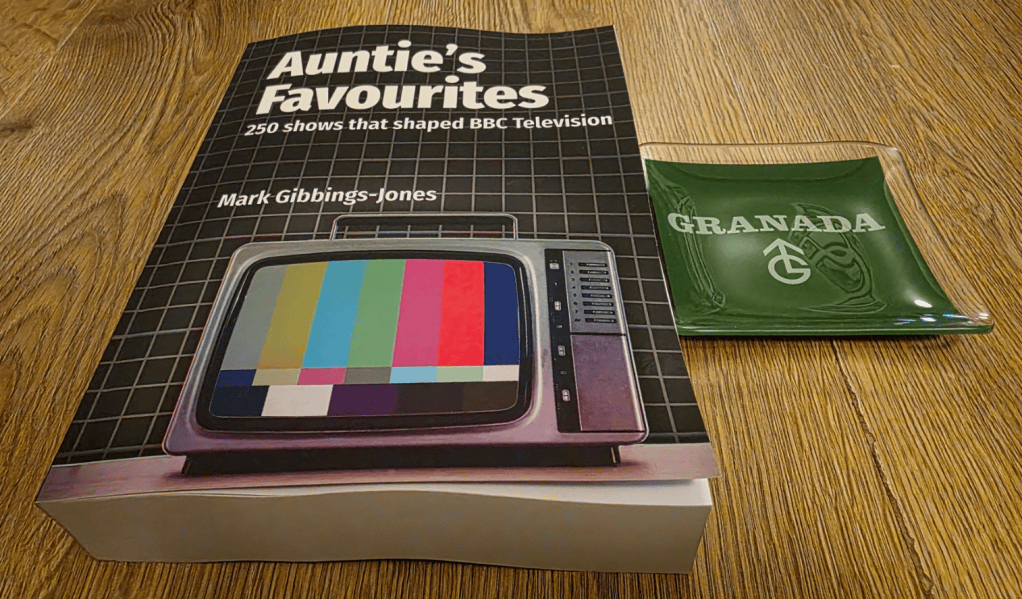
    The big old Auntie's Favourites Book and a Granada TV ashtray
    A copy of the big old book. Granada TV ashtray for scale.

    For those who prefer a digital copy, it’s available at the following places:

    In the UK:

    bookshop.org | Apple Books | Kobo

    Or in the USA:

    Apple Books | Barnes & Noble | bookshop.org

    And while we’re on about that, how about another extract from the book? Push a bath to the top of a steep hill and clamber in, because we’re trundling off to Yorkshire for the programme in 220th place. Fill your glass with the…

    Last of the Summer Wine

    1973-2023, broadcast 559 times

    BBC1 (552 times, 1973-2010)

    BBC4 (7 times, 2010-2023)

    File this one firmly under ‘I Thought This Would Be Much Higher’.

    It’s one of the great paradoxes of sitcom history. As everyone knows, Last of the Summer Wine is about three chaps of advanced age who find ways to fill their days, mostly on the rolling hills of West Yorkshire. And yet, it ran for 37 years, and one of the initial lead characters featured in the series throughout the run. So, what gives? Well, we’ll come to that a little later.

    But, let’s start at the beginning. Or just before it. In 1971, Roy Clarke’s stock was high. Before then, he was a prolific writer in search of success. His big break came with radio play The Big Bite (The Light Programme, 22 June 1966), which drew on Clarke’s experiences as a young police constable. From there, he went on to more radio plays along with splendidly named serials The 17-Jewelled Shockproof Swiss-Made Bomb (Radio Two, 18 January – 5 February 1968) and The Events at Black Tor (Radio Two, 18 April – 6 May 1968), accompanied by his first TV gig.
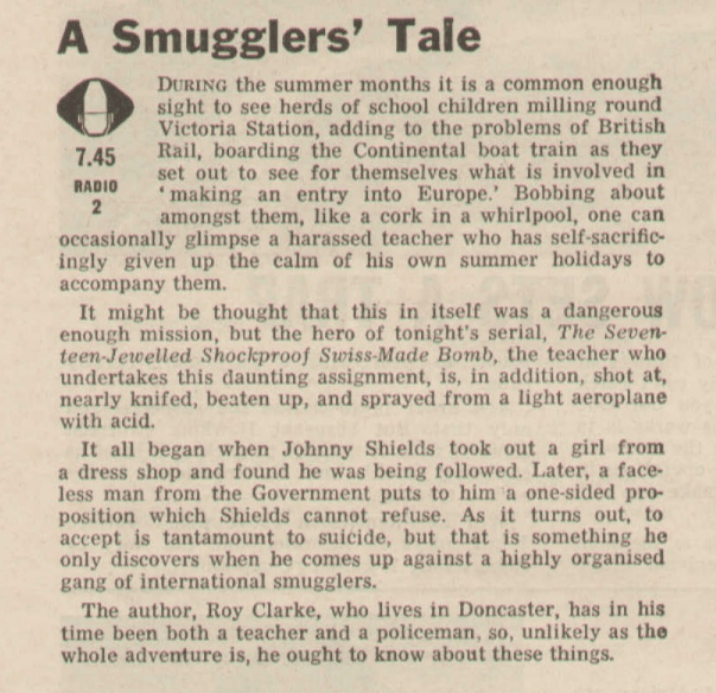
    Original Radio Times preview for The 17-Jewelled Shockproof Swiss-Made Bomb
    Radio Times, 13 January 1968

    This was a big deal. Previously, Clarke had combined writing with his day job as a teacher. This new opportunity – writing for drama series The Troubleshooters – would require his full-time attention. Following his initial four-script contract on The Troubleshooters came more dramatic work for Clarke: a dramatisation of W Somerset Maugham’s The Back of Beyond (BBC2, 10 June 1969), TV play The John Hilarian Salt Exhibition and Numerous Illustrated Slides (Granada, 4 August 1969), plus episodes of crime drama Detective (“The Public School Murder”, BBC1, 21 September 1969) and WWII serial Manhunt (“Only the Dead Survive”, London Weekend, 16 January 1970). His biggest break yet came with The Misfit – a full series for ATV.

    This was a rare example of a channel-hopping spinoff, with blustery-colonel character Basil “Badger” Allenby-Johnson from BBC drama The Troubleshooters (played by the ever-reliable Ronald Fraser) arriving back in early-70s Britain after spending half his life on a rubber plantation in Malaya. The Britain he left behind is long gone, leaving him both back home and in unfamiliar surroundings. The Misfit ran for two well received series (Daily Mirror letters, 16 March 1970: “In many other TV plays I often thought Fraser was a misfit. But in ‘The Misfit’ he really fits. A thoroughly enjoyable series.” – Mrs K Lennard, Sussex), which brought Roy Clarke to the attention of a very big name within TV comedy circles.
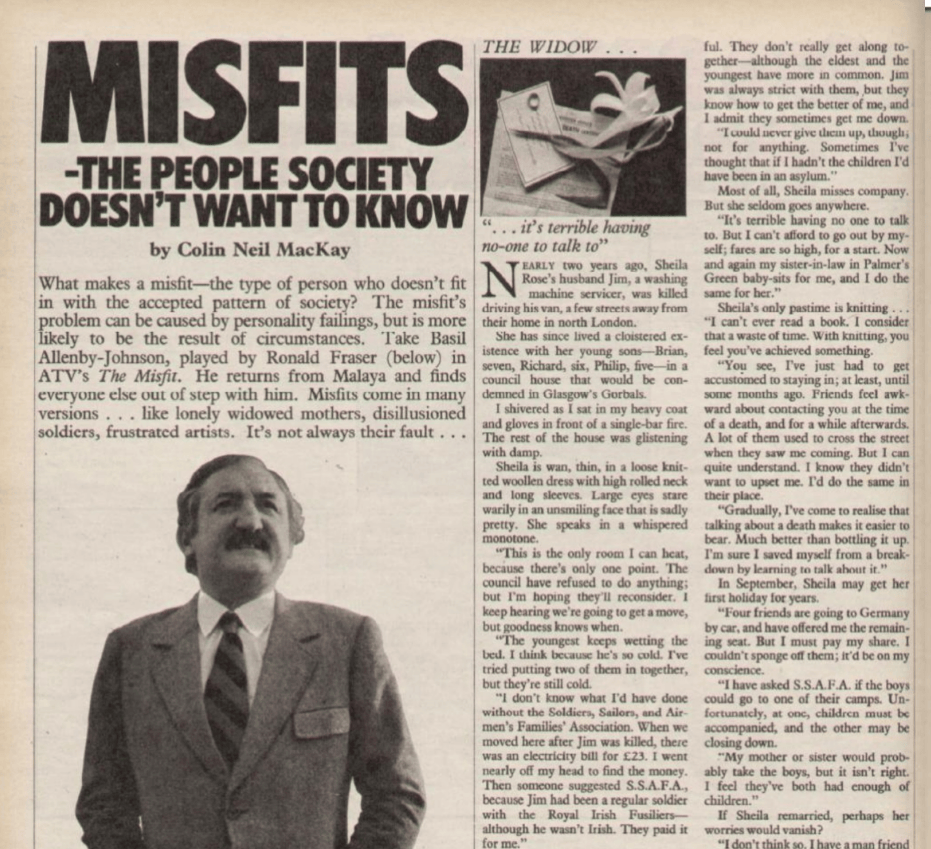
    TV Times article on sitcom The Misfit, along with a photo of Ronald Fraser looking pompous yet winsome
    TV Times, 21 March 1970

    As far as British television sitcoms go, there are few figures more important than Duncan Wood. Starting at the BBC as an outside broadcast engineer, he made the move into producing and presenting radio programmes in the 1950s, including lunch-break variety stalwart Workers’ Playtime (Home Service/Forces Programme/Light Programme, May 1941-October 1964), which put him in close proximity with up-and-coming comedy names like Dick Emery, Benny Hill and Tony Hancock. After a few years on the wireless, Wood moved into television, producing variety series Garrison Theatre, dance-em-up Everybody Swing!, Kenneth Horne panel show Find the Link, and comedy sketch series Great Scott It’s Maynard, starring Terry Scott and Bill Maynard.

    For this move into TV comedy, Wood was more than a little modest, telling the Radio Times “Eventually we hope to make people laugh”. The programme ran for three series, so safe to say it found an appreciative audience. His next few forays into TV comedy certainly needed that level of caution. The first – Strictly T-T – was a vehicle for national treasure Terry-Thomas, with the gap-toothed cad calling out Wood in a piece for the Radio Times: “My producer Duncan Wood has already aged perceptibly since I met him a few weeks ago”. That lasted just six episodes, but Wood’s next project – as producer and director – would go on to set the blueprint for British situation comedy.
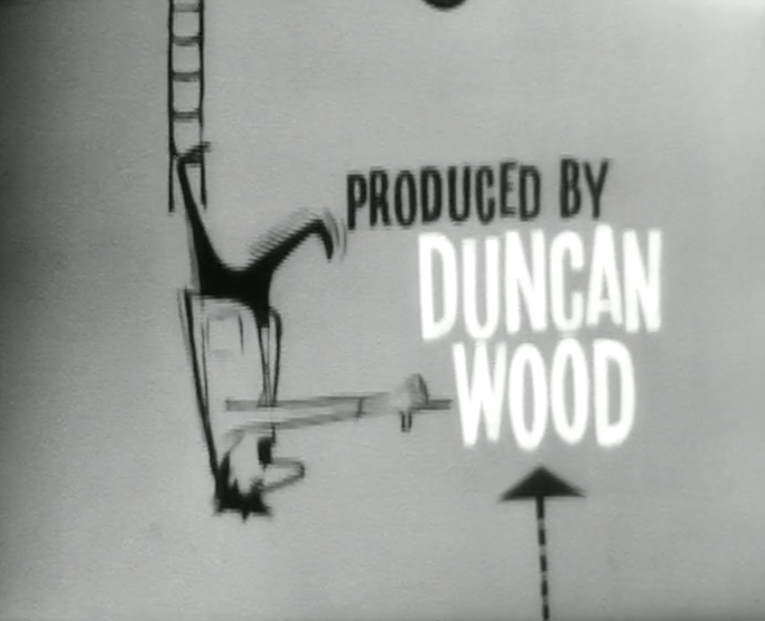
    Caption card for "Produced by Duncan Wood" at the end of a Hancock's Half Hour episode.
    Hancock’s Half Hour, S3E5 “Air Steward Hancock – The Last of the Many” (27 Oct 1957)

    Yep, apologies to any Life with the Lyons fans reading this, but it’s Hancock’s Half Hour we’re talking about here. The TV sitcom that shaped British sitcom as we know it, and which has rarely been bettered almost seventy years from its initial broadcast. From there: Steptoe and Son, Harry Worth, underrated Sid James vehicle Citizen James and long-running sitcom anthology series Comedy Playhouse.

    Playhouse – airing for 137 episodes between 1961 and 1975 – was the incubator for a whole generation of classic British sitcom. Initially a playground for a post-Hancock Galton and Simpson, as they sought out their next hit series (finding it with The Offer, renamed Steptoe and Son when it became a full series), it would go on to involve many golden-era sitcom writers, all the way from partnerships like Esmonde and Larbey or Clement and La Frenais, to solo acts such as Barry Took, Johnny Speight and Kingsley Amis.

    Of course, the BBC being the BBC, of the 137 episodes around 95 of the damn things are now missing, but the run included pilot episodes for what would become Till Death Us Do Part, Up Pompeii!, The Liver Birds and Are You Being Served?. Plus, you know, one edition called The Last of the Summer Wine. (“Bloody hell, finally.” – Everyone.)

    Come 1972, and Duncan Wood – now BBC Head of Comedy – was more than a little impressed by Roy Clarke’s The Misfit. Clarke’s ability to blend comedy and drama, plus a lead character finding himself thrust into a familiar world he no longer feels a part of, could be employed in a more straightforward sitcom format, and would make an ideal addition to Comedy Playhouse’s thirteenth series. Wood invited Clarke to a meeting, so that potential projects could be discussed, with one idea in particular in mind.

    As Clarke would later recall, the writer attended the meeting keen on writing a standard sitcom, only for Wood to state “we want something with three old men”. And that was pretty much the brief in full. It was a suggestion that Clarke recoiled from. Despite having careers of various lengths as policeman, teacher and writer under his belt, Clarke had only recently entered his forties – he didn’t know anything about old men, or didn’t much want to know. The BBC’s rationale was that the idea matched a gap in their audience, but Clarke couldn’t envision the idea having any kind of audience appeal at all.

    With a heavy heart, Clarke tried to conjure up a suitable premise for such a series. A few weeks of batting ideas around led to a revelation: what if the protagonists didn’t actually act their age? After all, being retired, they’d be at an age where they’re unencumbered by jobs, or by raising kids, or by responsibilities. They’d be free to be great big overgrown kids. A bit more work on the overall blueprint, and the leading trio were born: the fastidious Cyril Blamire, workshy waster Compo Simmonite and the midpoint between the two, Norman Clegg. Three overgrown kids killing time on their perpetual summer holiday. Two polar opposites, with Clegg in the middle.

    If the focus of the series on three old men was unusual enough, so was the setting. Much of each episode would be filmed outdoors – definitely a break from the usual studio-set-with-outdoor-filmed-inserts sitcom norm. Wood’s choice of producer for The Last of the Summer Wine, the well-regarded James Gilbert, was fully on board with Clarke’s ideas for the programme, and helped to shape the unique tone and style of the show, with the rolling Yorkshire scenery serving as a fourth main character. But when it came to the three (human) leads, Gilbert had reservations. Having previously worked on series The Walrus and the Carpenter, starring veteran actors Hugh Griffith and Felix Aylmer, he noted that audiences seemed unsure about simply laughing at old men. Dad’s Army at least had a wider spread of ages, but having all the action based on the mishaps of genuine old men seemed to cause uncertainty. There’s a reason Mainwaring did the pratfalls, rather than Godfrey.

    With this in mind, Gilbert suggested to Clarke that the lead characters should have another reason to be kicking around the streets, rather than simply being old. After all, having a seventy-something kicking a tin can down a street might be funny once or twice, but if this is going to go to series, it’s going to get, well, old. The script was duly retooled and the trio were rewritten as three unemployed middle-aged men. With Clegg and Blamire now living off their redundancy packages, they were still free from responsibility, still kicking around a world that no longer held any great purpose for them, but now the audience could safely laugh if one of them fell on their arse. In came an appropriately-aged cast: fiftysomethings Peter Sallis, Bill Owen and Michael Bates.
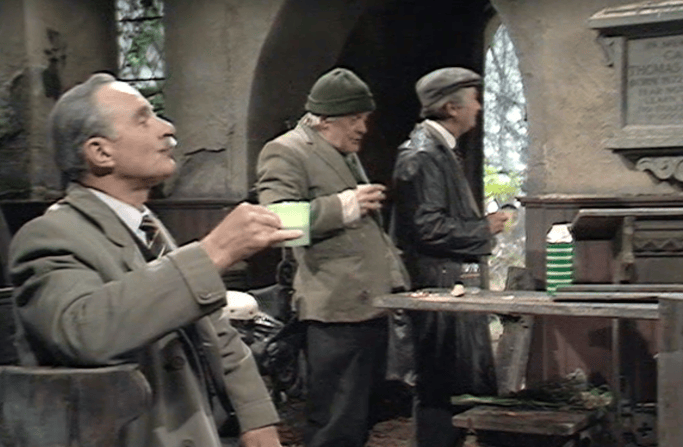
    The original cast for Last of the Summer Wine having a picnic in an old church
    Last of the Summer Wine, pilot episode “Of Funerals and Fish” (4 Jan 1973)

    The pilot episode – “Of Funerals and Fish” – duly opened the next series of Comedy Playhouse on 4 January 1973, and was well-received, even if press reaction at the time was suspicious of it being a bit too parochial. The Daily Mirror’s Mary Malone (5 Jan 1973) described the initial episode as “primitive, provincial [and] hilarious”, but also posited “if it was the kind of comedy to make folk above St Albans smirk, it may well also make those below wonder”. Still, the overall reaction was positive and a full series was commissioned, airing from 5 November of the same year, in the post-watershed slot it would occupy for much of its first decade on air, which is quite the departure from what it would become.

    While the first series passed by without getting much attention, summer 1974 saw Summer Wine given a primetime BBC1 repeat run. This second chance at encountering the series helped draw attention to the debut of the second series in March 1975. Perhaps unexpectedly, it started drawing in a decent audience – 7.5m households for the opening episode (such was the way audiences were measured at the time – putting it level with Coronation Street that week). This lo-fidelity sitcom – the plot of one episode involved Clegg trying to get his bicycle repaired – was building a loyal audience.
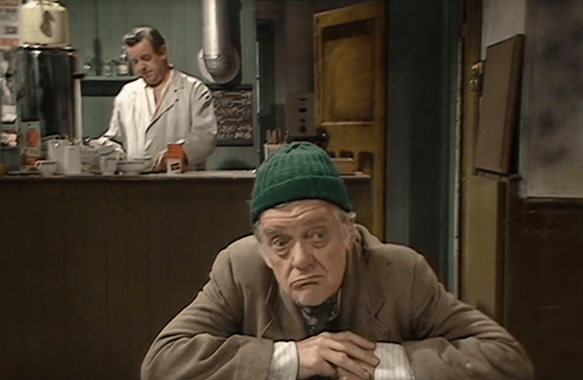
    Compo looking bored in a cafe

    Sadly for the series, one third of the main cast was having trouble with his health and workload. Michael Bates left the series, sticking with the more studio-bound It Ain’t Half Hot Mum before passing away in 1978. As a result, the third series of Summer Wine introduced a new team member. Arriving under the guise of returning to his home village following retirement, Foggy Dewhurst (Brian Wilde) met up with old pals Clegg and Compo, and the Imperial Phase of the Summer Wine could begin.
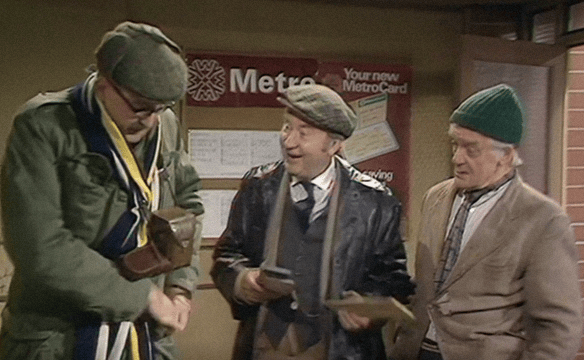
    Foggy meets Clegg and Compo at a bus station
    S3E1 “The Man from Oswestry” (27 Oct 1976)

    And it didn’t only attract the attention of older viewers. Personally I bloody loved it when I was a kid, by this time a Sunday evening fixture slotted in nicely after Songs of Praise. It proved to be the perfect accompaniment to Sunday teatime banana butties and Battenberg. So much so that I pestered my mum to rent the VHS release of feature-length episode Getting Sam Home from the local video rental shop. Despite airing over Christmas in 1983, the plot had the trio sneak the corpse of an adulterer across town and back into his marital bed before his wife wakes up[1]. See, the plots weren’t all about broken bicycles.

    From there, shortly after Wilde’s hiatus from the programme (his spot taken by Michael Aldridge’s crackpot inventor Seymour), much of the focus shifted onto other characters from the village. Sadly, perhaps down to the prolific Roy Clarke working on several other series throughout Summer Wine’s marathon run (most notably Keeping Up Appearances and Open All Hours), most of them pretty much turned up, did their line, then buggered off until the next episode. Wesley traipsed oil everywhere, Edie would get annoyed, Howard and Marina would get caught canoodling in a bush, Pearl would get annoyed, Barry turned up and dithered, while Glenda tutted. Well, they can’t all be Nora Batty.

    Following the Wine’s peak period, circumstances (often but not exclusively due to the demands on the increasingly elderly cast) meant main characters would be replaced – crucially, ill health led to a permanent departure for Brian Wilde’s Foggy in 1998 while Compo actor Bill Owen passed away in 1999. Frank “Mr Peacock” Thornton stepped in to replace the latter, while Bill Owen’s son Tom Owen temporarily took his father’s place in the line-up, before stepping into a more minor role. Keith Clifford’s Billy Hardcastle took on the third place in the lead line-up at the turn of the millennium.

    With a hardy audience still tuning in each Sunday, the series remained a fixture on BBC One – even if the Beeb’s programme commissioners were clearly clamouring for something a bit trendier to boast about at All Bar One – so much so that when the demands of filming meant Peter Sallis’ role in the series had to be reduced to studio scenes, a new leading trio were introduced for the final couple of series. In any other circumstance, a sitcom starring Russ Abbott, Brian Murphy and Burt Kwouk would be one for the ages.
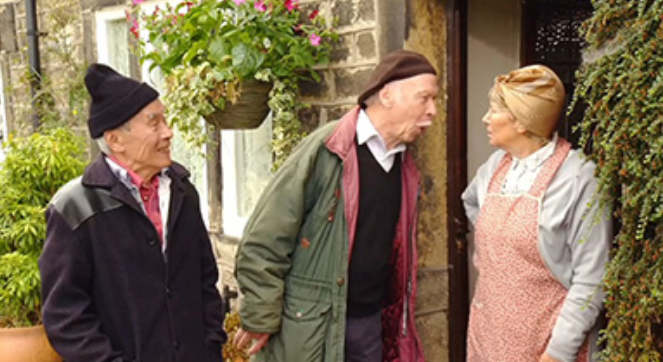
    Hobbo tries to woo Pearl, the fool
    S31E5 “Look Whose Wheel’s Come Off” (22 Aug 2010)

    But, the template for Summer Wine could only take so many amendments, and the All-New Adventures of the Summer Wine failed to connect with audiences. Roy Clarke called time on the series after the programme’s thirtieth series.

    Fittingly, the final word went to Peter Sallis, the programme’s only ever-present actor. In keeping with Clegg’s long-running anxiety over whether his front door had been left unlocked, the last words of the Summer Wine were simply “Did I lock the door?”.


    [1] The plot involved Foggy, Compo and Clegg visiting their pal Sam in hospital, and agreeing to help him spend one last night with his fancy piece, “Lily-Bless-Her” (played by Linda Baron, no less). The unseen exertions at Lily’s are too much for Sam’s ticker, meaning it’s up to our intrepid trio to get Sam’s corpse (yep, corpse) back home so that his wife Sybil thinks he died in his own bed. In 1994, this was repeated at 7pm on BBC1. All shot on film, as was the style at the time, which added an extra layer of grimness to it. I really enjoyed it, too. Probably the closest I ever got to a video nasty. BONUS FACT: it was the first BBC sitcom to earn a 90-minute Christmas special episode. Anyway, we’re not here for that.

    That’s all for now! Buy the book! Bye!
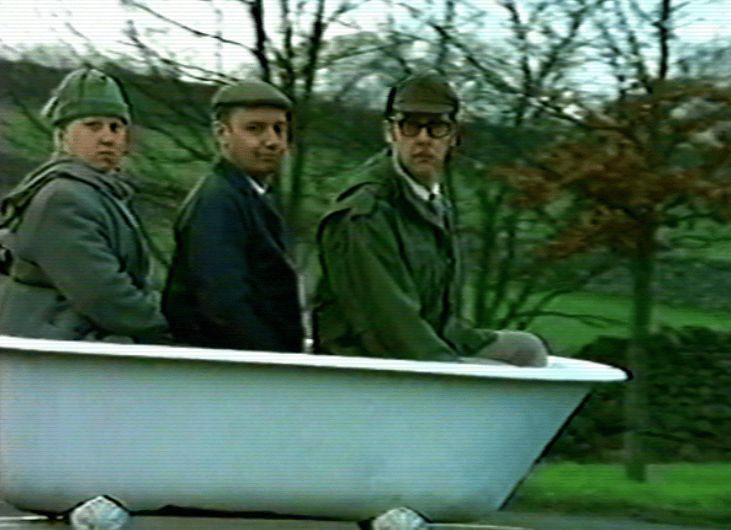
    Matt Lucas, Bob Mortimer and Vic Reeves are Three Men in a Bath
  • BrokenTV’s Sitcom Swingometer Spectacular! Part 2: Drop the Dead Donkey, Peep Show and The Fall and Rise of Reginald Perrin
    BrokenTV’s Sitcom Swingometer Spectacular! Part 2: Drop the Dead Donkey, Peep Show and The Fall and Rise of Reginald Perrin

    So, for anyone who missed yesterday’s Part One of this new series, here’s the premise. What would happen if a load of characters from old British sitcoms were allowed to (a) exist in real life, (b) were all still alive today, and (c) decided to cast a vote in the 2024 UK General Election? Well, without tracking down a bunch of original sitcom writers (or, in several cases, holding a seance), there’s no way to accurately know. It being 2024, there is the option of using generative AI to try and work out the answers, but as we all know AI isn’t actually as clever as a lot of shareholders would like to think.

    Or is it? Maybe it could do a brilliant job at predicting who Private Walker et al would vote for? Or maybe, this kind of grand folly is all AI is actually good for. In any case, that’s what I’m using (using ChatGPT and CoPilot as our ‘polling companies’), and at the end of it all we’ll see which party got the most ‘votes’ in our technological exit poll, and determine just who would go on to lead The Sitcom Government for the next five years.

    Yesterday, we looked at Dad’s Army, Hancock’s Half Hour and Are You Being Served?. Three more constituencies today, and here are the results from the first of them:

    DROP THE DEAD DONKEY

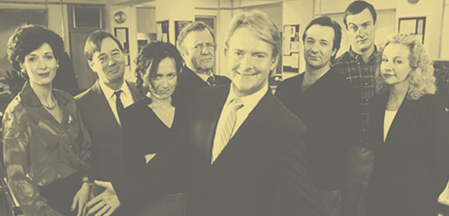
    Another timely offering, the quick-turnaround topical (at the time) events of Globelink News are currently getting an airing on new channel ReplayTV, who I promise I’m not being paid by. Though, y’know, if they want to commission me as Chief Director of Programming, I’m available. Even more interestingly, the entire cast have reunited for a brand new stage show, which I’ve heard good things about.

    Of course, being members of the ELITE MEDIA CLASS, they’ll all be dyed-in-the-wool Starmerites, surely? Nobody working in television news could possibly be right-wing, COULD THEY? Anyway, enough with heavy-handed obvious satire. Over to you ChatGPT.

    –

    “Drop the Dead Donkey,” a satirical British sitcom set in a fictional TV news company, Globelink News, features characters with distinct personalities and backgrounds that could inform their political preferences in the 2024 UK General Election. Here are some speculative guesses:

    Gus Hedges: The bureaucratic and management-obsessed Chief Executive, Gus would likely vote Conservative. His focus on corporate management, efficiency, and maintaining the status quo aligns with Conservative policies.

    George Dent: The neurotic and often indecisive editor, George might lean towards the Liberal Democrats. His concern for fairness and moderate views would resonate with the Lib Dems’ centrist and balanced approach.

    Dave Charnley: The cynical and womanizing reporter, Dave would probably support Labour. His working-class background and disdain for authority and corporate interests align with Labour’s focus on social justice and workers’ rights.

    Henry Davenport: The ageing, pompous newsreader with conservative views on social issues would most likely vote Conservative. His traditional values and resistance to change fit well with the party’s platform.

    Sally Smedley: The vain and self-absorbed co-anchor, Sally might vote Conservative, valuing their stance on individualism and personal success. Alternatively, she could be drawn to whichever party she perceives as offering the most personal advantage.

    Helen Cooper: The intelligent and ambitious assistant editor, Helen would likely support Labour. Her progressive views and focus on social issues such as equality and justice align with Labour’s policies.

    Damien Day: The ruthless and sensationalist reporter, Damien might support the Green Party, not out of genuine concern but for the shock value and emerging trends. Alternatively, he could back any party promising radical changes or controversy, including fringe parties.

    Joy Merryweather: The sharp-tongued and efficient secretary, Joy might lean towards the Green Party. Her no-nonsense attitude and possible concerns about environmental issues align with Green policies.

    The Greens seem to be getting a lot of traction, don’t they? Okay, over to CoPilot:

    In the 2024 UK General Election, the Drop the Dead Donkey characters would likely vote based on their individual personalities and beliefs. However, since the show is a fictional comedy, we can only speculate. Let’s take a look at some of the main characters and make some light-hearted assumptions:

    Joy (played by Susannah Doyle): Joy might lean toward the Labour Party due to her compassionate and empathetic nature. Labour traditionally focuses on social justice and workers’ rights.

    Gus (played by Robert Duncan): Gus, being a Cornishman, could have a strong connection to the environment. He might consider voting for the Green Party, which prioritizes environmental issues.

    Helen (played by Ingrid Lacey): Helen, as the office manager, might be practical and pragmatic. She could lean toward the Conservative Party, which often emphasizes economic stability and business interests.

    Dave (played by Neil Pearson): Dave, the news editor, might be politically savvy. He could vote strategically to prevent the Tories from winning, possibly supporting the Liberal Democrats or another anti-Conservative party.

    George (played by Jeff Rawle): George, the senior reporter, could be a bit rebellious. He might vote for the Reform UK party, which advocates for change and challenges the status quo.

    Damien (played by Stephen Tompkinson): Damien, the ambitious reporter, might align with the Conservative Party due to its focus on individual success and meritocracy.

    Sally Smedley (played by Victoria Wicks): Sally, the foreign correspondent, could be open-minded and progressive. She might consider voting for the Liberal Democrats or the Green Party.

    Well, at least that confirms CoPilot’s training data includes at least one person who hasn’t actually watched an episode of Drop the Dead Donkey. The famously “compassionate and empathetic” Joy, indeed. And I don’t recall anything about Gus bring Cornish. Plus, they forgot about Henry, who’s one of the main characters. Tsk.

    Anyway, onto our next show. Fire up the sound of Harvey Danger, it’s…

    PEEP SHOW

    Over to the ChatGPT jury.

    “Peep Show,” a British sitcom known for its dark humour and exploration of the dysfunctional lives of its main characters, provides a rich basis for speculating on their voting preferences in the 2024 UK General Election. Here’s a guess on how the main characters might vote:

    Mark Corrigan: Mark, the uptight and conservative loan manager with a love for history and structure, would likely vote Conservative. His appreciation for order, traditional values, and career stability aligns with Conservative policies.

    Jeremy “Jez” Usborne: Jez, the laid-back and hedonistic aspiring musician, would probably support the Green Party. His countercultural lifestyle, interest in alternative lifestyles, and occasional flirtations with progressive ideals align with the Greens’ focus on environmental and social justice issues.

    Sophie Chapman: Sophie, Mark’s on-and-off girlfriend and colleague, might lean towards the Liberal Democrats. Her middle-of-the-road, pragmatic approach to life and relationships fits well with the Lib Dems’ centrist and moderate positions.

    Super Hans: Super Hans, the erratic and drug-addled musician, could be a wildcard. He might support an anti-establishment party like the Greens for their radical policies or even a fringe party that promises upheaval and chaos.

    Dobby (Deborah): Dobby, the quirky and geeky IT technician, would likely support Labour. Her progressive views, concern for social issues, and background in the tech industry align with Labour’s emphasis on social justice, public services, and support for workers.

    Johnson: Alan Johnson, the confident and career-driven businessman, would almost certainly vote Conservative. His admiration for Thatcherite principles and his focus on success and individualism fit perfectly with Conservative values.

    Big Suze: Big Suze, the posh and somewhat naive ex-girlfriend of Jeremy, might lean towards the Liberal Democrats or Conservatives. Her upper-class background and generally apolitical, easy-going nature could fit with either party, depending on her social circle and personal influences.

    Nancy: Nancy, the free-spirited American who dates Jeremy, would likely support the Green Party. Her progressive, new-age attitudes and concern for the environment align well with the Greens’ platform.

    Hmm. I personally think Mark would be keener to go with Labour, such is the way he seems determined to ‘seem’ right-on, lacking the self-awareness to realise how selfish and self-serving he actually is. Plus, I suspect Nancy wouldn’t have ever got around to registering to vote (though you can guarantee her parents back home will be Republicans). Anyway – with quite a bit of credibility for it to make up – over to CoPilot:

    In the 2024 UK General Election, the Peep Show characters’ voting preferences would likely be influenced by their personalities and backgrounds. While we can only speculate, let’s imagine how some of the main characters might vote:

    Mark Corrigan: Mark, being a socially awkward and neurotic character, might lean toward the Conservative Party. Their focus on stability and traditional values could resonate with him.

    Jeremy “Jez” Usborne: Jez, the laid-back musician, could be more progressive. He might consider voting for the Green Party, which emphasizes environmental issues and social justice.

    Sophie Chapman: Sophie, Mark’s love interest, could be practical and level-headed. She might vote for the Liberal Democrats, who often advocate for civil liberties and individual rights.

    Super Hans: Super Hans, the wild and unpredictable friend, might not take politics too seriously. He could vote for a fringe party like Reform UK or even joke about writing in his own name.

    Johnson: Johnson, the bumbling office manager, might align with the Conservative Party due to his bureaucratic tendencies and desire for order.

    Dobby: Dobby, the quirky IT girl, could be socially conscious. She might lean toward the Labour Party, which focuses on equality and social welfare.

    A very similar set of choices there, though I can certainly imagine Super Hans going for Reform and misguidedly trying to make out they’re actually the only true liberals on the ballot.

    Anyway, onto our last programme:

    THE FALL AND RISE OF REGINALD PERRIN

    ChatGPT didn’t get where it is today by not knowing about Leonard Rossiter’s finest hour:

    “The Fall and Rise of Reginald Perrin” is a British sitcom that follows the life of Reginald Perrin, a middle-aged sales executive who experiences a mid-life crisis and attempts to escape his mundane existence. Here’s a speculative guess on how the main characters might vote in the 2024 UK General Election:


    Reginald “Reggie” Perrin: Reggie, the disillusioned and increasingly rebellious protagonist, would likely vote for a party promising significant change. Given his disdain for the corporate world and his existential struggles, he might lean towards the Green Party for their radical environmental and social policies or even a more fringe party like the Liberal Democrats if they promise substantial reform. Alternatively, he could support Labour if they present a strong platform for social justice and anti-establishment sentiments.

    Elizabeth Perrin: Reggie’s supportive and understanding wife, Elizabeth, might lean towards the Liberal Democrats. Her calm and reasonable nature aligns with the party’s centrist and balanced approach to politics.

    C.J. (Charles Jefferson): Reggie’s pompous and bureaucratic boss, C.J., would almost certainly vote Conservative. His traditional views, emphasis on hierarchy, and conservative approach to business and management fit well with Conservative policies.

    Joan Greengross: Reggie’s secretary, Joan, might lean towards Labour. Her working-class background and straightforward demeanor align with Labour’s focus on workers’ rights and social equality.

    Tony Webster: Tony, the overly optimistic and somewhat naive colleague, might support the Liberal Democrats. His idealistic nature and desire for progress fit well with their centrist and forward-thinking platform.

    David Harris-Jones: The nervous and sycophantic colleague, David, would likely vote Conservative, mirroring C.J.’s preferences. His desire to fit in and avoid conflict would lead him to follow the more traditional and established path.

    Doc Morrisey: The eccentric company doctor, Doc Morrisey, could be a wildcard. Given his unconventional methods and quirky personality, he might support the Green Party for their progressive and unconventional approach to politics and healthcare.

    Tom and Linda Patterson: Reggie’s daughter and her husband, with their conventional suburban lifestyle, might lean towards the Conservative Party. Their focus on family and stability aligns with Conservative values.

    Right. Over to you, CoPilot. Great. Super.

    In the 2024 UK General Election, the characters from The Fall and Rise of Reginald Perrin would likely vote based on their individual personalities and fictional backgrounds. Let’s imagine how some of the main characters might lean:

    Reginald “Reggie” Perrin: Reggie, the middle-aged middle manager, might be disillusioned with the pointlessness of his job at Sunshine Desserts. He could lean toward the Reform UK party, which advocates for change and challenges the status quo. However, given his existential crisis, he might also consider voting for a more radical party.

    CJ: Reggie’s boorish boss CJ might align with the Conservative Party, emphasizing stability and traditional values. His catchphrase (“I didn’t get where I am today…”) suggests a certain self-interest.

    Tony and David: Reggie’s yes-men colleagues Tony (“Great!”) and David (“Super!”) might follow CJ’s lead and vote for the Conservatives as well.

    Elizabeth: Reggie’s lovely but colourless wife Elizabeth might lean toward the Liberal Democrats, who often advocate for civil liberties and individual rights.

    Linda: Reggie’s annoyingly bouncy daughter Linda could be socially conscious. She might consider voting for the Green Party, which emphasizes environmental issues and social justice.

    Joan: Reggie’s weakly smouldering secretary Joan might be pragmatic. She could vote for the party that promises stability and economic growth.

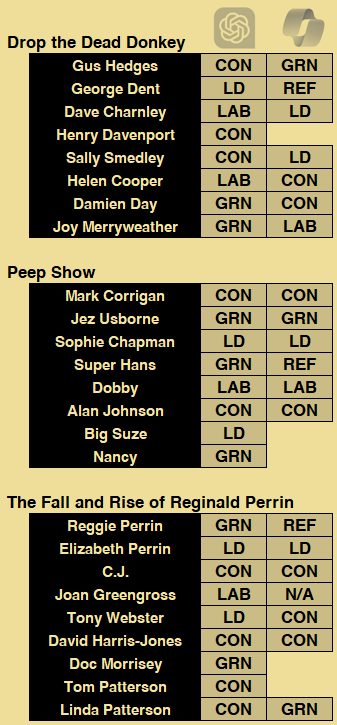
    Okay, time to summarise what we’ve seen today:

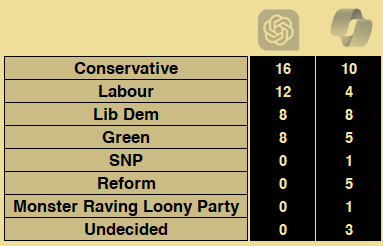
    And, adding these votes to our ongoing table, here how the parties stand after results from six constituencies:

    A surprising lurch to the right so far, then – especially as far as CoPilot seems to think – with even Reform outperforming Labour. That could be down to inherent biases within two AI packages, or it could be down to our notional electorate mainly being easily-lampooned subclasses of various societies that don’t really exist any more. Only one way to find out for sure – I’ll keep shovelling data into it.

    In short: more of this nonsense very soon.

  • BrokenTV’s Sitcom Swingometer Spectacular! Part 1: Dad’s Army, Hancock, Are You Being Served?

    BrokenTV’s Sitcom Swingometer Spectacular! Part 1: Dad’s Army, Hancock, Are You Being Served?

    Or, if you prefer, I Asked Two AI Programs How Classic British Sitcom Characters Would Vote in the 2024 General Election. The results may surprise you. Not going to lie, they surprised me.

    So, there’s a General Election about to happen in the UK (don’t forget to register if you haven’t already, and remember that even if you don’t have photo ID you can still do postal voting).

    A big part of any General Election cycle is seeing all the opinion polls go up and down and wobble about a bit. And, obviously, a similarly sizeable section of the cycle is “passing that long campaigning period by contributing to Britain’s nonsense reserves by trying to find something to say about the whole sorry debacle”.

    Here’s my offering.

    So, what if we tallied up the presumed votes from various classic British sitcom characters to see which of the 2024 Political Parties would fill the majority of Sitcomland’s Parliament? That would be interesting, wouldn’t it? And, in keeping with Britain’s TV Election Night coverage since time immemorial, I’m going to skirt any personal responsibility by blaming my predictions on computers. And as it’s 2024, let’s use AI.

    For the purposes of this grand folly, I’m going to see what both CoPilot and ChatGPT think. I was also going to use Google’s Gemini, but that didn’t even understand the bloody question:

    Hardly a surprise from a piece of tech that recommends using glue to prevent cheese falling off your pizza. So, the big two it is.

    Quick ground rules: I’ll let the software decide who constitutes a main character from each, and if it suggests more than one likely party we’ll use the first suggestion as gospel. Any suggested parties that don’t actually exist, we’ll run with the nearest modern equivalent. And we’ll keep a running total at the end of each update. Sorted.

    We’ll start the batting with three well-known sitcoms containing a good old cross-class mixture of characters. First up to the crease: the Warmington-on-Sea Home Guard.

    DAD’S ARMY

    “Don’t tell him (who you’ll be voting for), Pike.”

    Crossing my fingers that neither chunk of AI tech uses this information to ultimately enslave humanity, over to ChatGPT. So, in the 2024 UK General Election, which parties would the characters from Dad’s Army vote for?

    “Dad’s Army,” a beloved British sitcom set during World War II, features characters who represent a variety of social classes and political views. If they were to vote in the 2024 UK General Election, their choices would likely reflect their personalities and backgrounds. Here are some speculative guesses:

    1. Captain Mainwaring: A staunchly patriotic and conservative bank manager, Mainwaring would likely support the Conservative Party. His traditional values and leadership style align well with conservative principles.
    2. Sergeant Wilson: As an upper-middle-class gentleman with a relaxed demeanour, Wilson might lean towards the Liberal Democrats. His more liberal and inclusive outlook on life fits with the party’s moderate and centrist positions.
    3. Lance Corporal Jones: A patriotic and somewhat old-fashioned butcher, Jones is fiercely loyal to his country. He would probably vote Conservative, valuing their stance on national security and tradition.
    4. Private Frazer: A cynical and often pessimistic undertaker, Frazer might be drawn to a party with a strong stance on social justice and financial responsibility. He could support the Labour Party, particularly if they emphasize economic fairness and public services.
    5. Private Godfrey: The gentle and kind-hearted medic, Godfrey would likely support the Green Party. His caring nature and concern for the well-being of others and the environment align with Green policies.
    6. Private Walker: As a wheeler-dealer with a knack for business, Walker might support whichever party he sees as beneficial for his entrepreneurial interests. This could be the Conservatives for their business-friendly policies or possibly a party like Reform UK, depending on the political landscape and his personal views on Brexit and deregulation.
    7. Private Pike: The youngest member of the platoon, Pike’s vote could go towards Labour. His youth and idealism might draw him to a party promising social progress and opportunities for young people.

    A surprisingly cogent summary, there. It didn’t even suggest any of them have eight fingers or anything, though I personally think Fraser would go SNP. Over to you, CoPilot:

    Ah, the delightful characters from Dad’s Army! Let’s take a look at some of the iconic members of the Walmington-on-Sea Home Guard and speculate on their political leanings:

    1. Captain George Mainwaring (portrayed by Arthur Lowe): As the pompous yet patriotic local bank manager, Captain Mainwaring would likely align with the Conservative Party. His sense of duty and traditional values would resonate with their platform1.
    2. Sergeant Arthur Wilson (portrayed by John Le Mesurier): The mild-mannered bank clerk and Mainwaring’s second-in-command might lean toward the Liberal Democrats. Wilson’s pragmatic approach and desire for compromise would align with their centrist policies.
    3. Lance-Corporal Jack Jones (portrayed by Clive Dunn): The aging butcher and war veteran, Jones, would probably support the UK Independence Party (UKIP). His catchphrase “Don’t panic!” and love for the British Empire reflect a nostalgic view that resonates with UKIP’s stance on sovereignty and independence.
    4. Private Joe Walker (portrayed by James Beck): As the black marketeer and shrewd businessman, Walker would likely vote for whichever party promised economic prosperity. His opportunistic nature might lead him to support the party with the most favourable business policies.
    5. Private Frank Pike (portrayed by Ian Lavender): The young and innocent Pike would likely be drawn to the Green Party. His idealism and concern for the environment align with their focus on sustainability and conservation.
    6. Private James Frazer (portrayed by John Laurie): The dour Scottish undertaker would probably lean toward the Scottish National Party (SNP). Frazer’s scepticism and desire for independence resonate with the SNP’s goals for Scotland.
    7. Private Charles Godfrey (portrayed by Arnold Ridley): The gentle and elderly medic would likely support the Liberal Democrats. His compassionate nature and desire for social welfare align with their policies.

    An interesting convergence, there. While it’s open to interpretation who Walker would go for, and UKIP are basically now Reform, that’s basically just two of the seven main characters the AI bots are in agreement with. Anyway, I can’t stand around pondering if Private Cheeseman would’ve gone for Labour or Plaid, I’m off to East Cheam.

    HANCOCK’S HALF HOUR

    Some topical timing, as this update goes live on the same weekend Tony Hancock’s ATV series gets a first showing on actual telly since 1963 (on Rewind TV, Sky channel 190, which is already full of some lovely stuff. The first episode is accompanied on Sunday night by Dave Allen’s documentary on the Great British Eccentric, which is Peak Telly as far as I’m concerned). But it’s the BBC original we’re looking at here. Over to you, ChatGPT. In the 2024 UK General Election, which parties would the characters from Hancock’s Half Hour vote for?

    “Hancock’s Half Hour,” another classic British sitcom, revolves around the life of Anthony Aloysius St John Hancock and his interactions with his friends. Here’s a speculative guess on how the main characters might vote in the 2024 UK General Election:

    1. Tony Hancock: As the main character, Hancock is often depicted as a frustrated, slightly snobbish, and somewhat self-important figure with a deep sense of irony and social awareness. He might vote for Labour, as he often portrays a common man dealing with the absurdities of life, showing sympathy towards the working class and social justice issues. Alternatively, his occasional pretentiousness and desire for status might push him towards the Conservative Party if he thinks it aligns with his aspirations.
    2. Sidney Balmoral James: Sid James, the roguish, cunning, and often opportunistic character, would likely support the Conservative Party for its business-friendly policies, given his entrepreneurial nature and schemes. However, he might also be pragmatic and vote for any party that promises to benefit him personally, possibly even considering Reform UK or another party with a focus on deregulation.
    3. Bill Kerr: Bill, often depicted as naïve and loyal, might vote for Labour, reflecting his working-class roots and straightforward, everyman attitude. His simplicity and sincerity align with the values of fairness and social support typically championed by Labour.
    4. Miss Griselda Pugh: Miss Pugh, the secretary with a sharp tongue and practical mindset, might lean towards the Liberal Democrats. Her independent and no-nonsense attitude could find a home in a party that emphasizes moderation, pragmatism, and individual rights.
    5. Kenneth Williams (Various Roles): Kenneth Williams played various roles, often with a more flamboyant and intellectual twist. Depending on which character he’s embodying, he might support a range of parties. Generally, his more educated and sometimes elitist personas could lean towards the Liberal Democrats for their intellectual appeal and centrist policies. Alternatively, some of his more conservative roles might support the Conservative Party.

    First, bonus points to ChatGPT for going with the radio series over the TV version. Secondly, I’m confiscating those bonus points for missing that Tony Hancock(‘s character of the same name) states that he’s a Tory in The Blood Donor. Though one could specify that it’s the 2024 versions of each party we’re looking at here, so I’m giving the points back again. Anyway, over to you, CoPilot.

    Ah, Hancock’s Half Hour! A classic radio and television comedy series that left an enduring mark on British humour. Let’s delve into the fictional political preferences of some of its beloved characters:

    1. Tony Hancock (portrayed by himself): As the bumbling and perpetually frustrated comedian, Hancock might find himself torn between various parties. His indecisiveness could lead him to vote for the Monster Raving Loony Party just for the sheer absurdity of it.
    2. Sidney James (portrayed by himself): The unscrupulous landlord and Hancock’s foil would likely lean toward the Conservative Party. James’s cunning and opportunistic nature align with their traditional values.
    3. Hugh Lloyd (portrayed by himself): The good-hearted and somewhat naive Hugh would probably support the Labour Party. His empathy for the common man and desire for social justice resonate with their platform.
    4. Clive Dunn (portrayed by himself): As the lovable and absent-minded Corporal Jones, Dunn might vote for the UK Independence Party (UKIP). His catchphrase “Don’t panic!” could easily translate to “Take back control!”
    5. Kenneth Williams (portrayed as various unnamed characters referred to as “Snide”): The versatile Williams would likely play the field, attending rallies of every party just to gather material for his next witty monologue.

    Okay, just pretending to know it all by starting “Ah, [name of thing]” is much less convincing when you think Corporal Jones was also in Hancock’s Half Hour. So, I’ll ignore that. But interesting answers otherwise. Okay, onto our last programme.

    ARE YOU BEING SERVED?

    Ooh, sounds like the title of a manifesto, doesn’t it? What do our robot overlords think here? Hoi, ChatGPT – in the 2024 UK General Election, which parties would the characters from Are You Being Served vote for?

    “Are You Being Served?” is a British sitcom set in the fictional department store Grace Brothers, featuring a range of colourful characters. Based on their personalities and backgrounds, here are speculative guesses on how the main characters might vote in the 2024 UK General Election:

    1. Mr. Wilberforce Claybourne Humphries: Mr. Humphries, the flamboyant and witty salesman, might lean towards the Liberal Democrats. His progressive and inclusive nature aligns with their policies on social justice, individual freedoms, and LGBTQ+ rights.
    2. Mrs. Betty Slocombe: Mrs. Slocombe, with her working-class background and strong opinions, might support the Labour Party. Her concerns about job security, fair wages, and social equality resonate with Labour’s platform.
    3. Captain Stephen Peacock: Captain Peacock, the dignified floorwalker with a military background, would likely vote Conservative. His conservative demeanour, emphasis on tradition, and respect for authority align well with the party’s values.
    4. Mr. Cuthbert Rumbold: Mr. Rumbold, the somewhat bumbling and bureaucratic manager, might support the Conservative Party, reflecting his managerial role and desire for stability and business-friendly policies.
    5. Miss Shirley Brahms: Miss Brahms, the young and trendy saleswoman with a Cockney accent, might lean towards Labour. Her working-class roots and youthful energy align with Labour’s focus on social mobility, education, and opportunities for young people.
    6. Mr. Dick Lucas: Mr. Lucas, the cheeky junior salesman, might support Labour or potentially the Green Party, given his youthful outlook and likely progressive stance on social issues and the environment.
    7. Mr. Ernest Grainger: Mr. Grainger, the grumpy and traditional senior salesman, would likely vote Conservative. His old-fashioned views and resistance to change fit well with the party’s traditional and conservative policies.
    8. Mr. Beverley Harman: Mr. Harman, the maintenance man with a rough-around-the-edges charm, might support Labour. His working-class background and straightforward nature align with Labour’s focus on workers’ rights and social justice.

    Okay, over to you CoPilot.

    Let’s imagine the political leanings of some of its iconic characters:

    1. Mrs. Slocombe (portrayed by Mollie Sugden): The flamboyant and fashion-conscious head of the ladies’ department would likely lean toward the Liberal Democrats. Her colourful personality and desire for individual expression align with their centrist policies.
    2. Mr. Humphries (portrayed by John Inman): The cheeky and effeminate senior sales assistant might vote for the Green Party. His love for nature, quirky humour, and commitment to equality resonate with their environmental and social justice agenda.
    3. Captain Peacock (portrayed by Frank Thornton): As the pompous floorwalker, Captain Peacock would probably align with the Conservative Party. His adherence to hierarchy, traditional values, and penchant for authority mirror their platform.
    4. Mr. Lucas (portrayed by Trevor Bannister): The cheeky junior sales assistant would likely support the Labour Party. His rebellious streak, desire for fairness, and working-class background resonate with their policies.
    5. Miss Brahms (portrayed by Wendy Richard): The sassy and stylish junior sales assistant might lean toward the Liberal Democrats. Miss Brahms’s modern outlook, ambition, and desire for progress align with their centrist stance.
    6. Mr. Grainger (portrayed by Arthur Brough): The elderly and somewhat grumpy senior sales assistant would probably vote for the UK Independence Party (UKIP). His nostalgia for the past and scepticism about change resonate with their platform.

    Well, more divergence. At least this proves they aren’t both sucking up information from the same source. So, here’s a summary of the results we’ve seen from each, erm, polling company:

    And a rundown of how the parties are looking based on our three constituencies so far:

    A split in the voting, and a surprise lead for the Liberal Democrats according to CoPilot. Still, early days yet. It could all change once we get to the results for… I haven’t decided yet. Fawlty Towers, Sunnyside Farm and Justin’s House?

    Anyway, until next time. I’ve been David Dimbleby and you’ve been marvellous. Goodnight.

  • I Challenged Six AI Image Bots To Generate Images For Newspaper Headlines from The Day Today. Here Are The Results (Part One)

    I Challenged Six AI Image Bots To Generate Images For Newspaper Headlines from The Day Today. Here Are The Results (Part One)

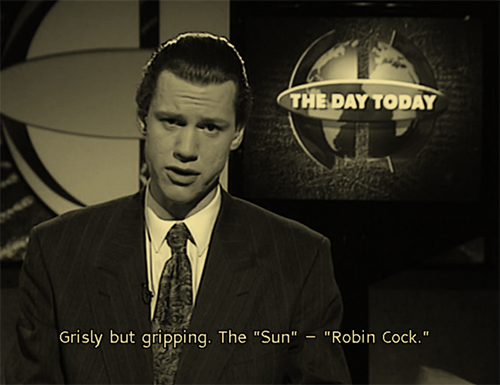
    For the uninitiated, The Day Today was a 1994 BBC2 comedy series parodying contemporary news coverage, a programme that has remained resident in the collective consciousness of all British comedy fans ever since. A TV adaptation of Radio 4 series On The Hour, The Day Today would provide terrestrial TV debuts for Chris Morris, Armando Iannucci and Steve Coogan’s Alan Partridge, amongst others.

    One regular part of the series — alongside pitch-perfect spoofs of news, current affairs, soaps, fly-on-the-wall documentaries, MTV Europe, CNN, public information films, archive television and pre-empting The Office by seven years — were ‘a look at tomorrow’s headlines’ — a smattering of nonsensical headlines purportedly from early editions of the following morning’s newspapers. A little bit of dark whimsy to see us into the end credits, many of which would lodge themselves into cranial crannies of viewers for years to come.

    Back in 2021 (remember that? When we thought things were as bad as they could get? Bless our naive little hearts), I wrote a Medium post where I challenged AI image bot Pixray to create images for Tomorrow’s Headlines from The Day Today. The results were… mixed. So, in a bit of a break from writing about old BBC programmes I’ve mostly never seen, let’s recreate that experiment by setting six different AI bots against each other, and see who can create the best visual interpretation of Chris Morris brain wrongs.

    THE COMPETITORS:

    So, with everyone on the starting grid, let’s go!

    WARNING: Maybe don’t read the rest of the entry whilst eating.


    EPISODE ONE: Main News Attack

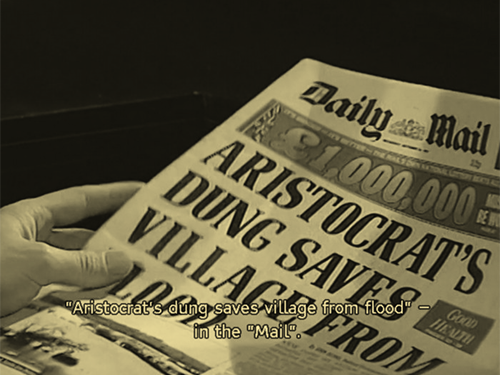
    HEADLINE ONE: “Aristocrat’s Dung Saves Village From Flood.” — Daily Mail

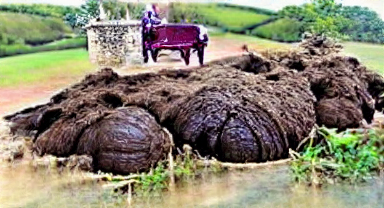
    See why I warned you about not eating? Here are the top three results for that less-than-tantalising morsel.

    1st Place: PIXRAY

    There was always going to be dung, but at least here you can tell it’s especially aristocratic. See the velvet chair and finery in the background? That’s going the extra mile. Plus, the dung is visibly blocking off the flood. Top marks.

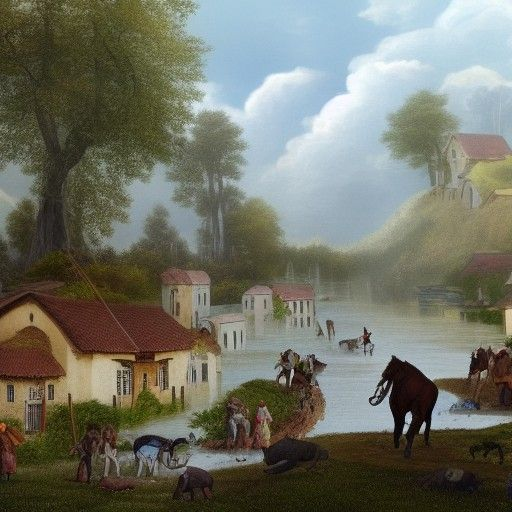
    2nd Place: NIGHTCAFE

    Not as easy to buy into the dung angle here, but there definitely seems to be an effect to have saved the village. Plus, it’s a nice image at a decent resolution.

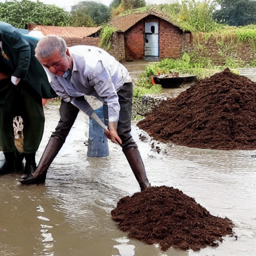
    3rd Place: HOTPOT

    There’s definitely a man trying to save something using a dung-like substance. And, without being too course, we’ve not way of proving it isn’t from an aristo’s arse.


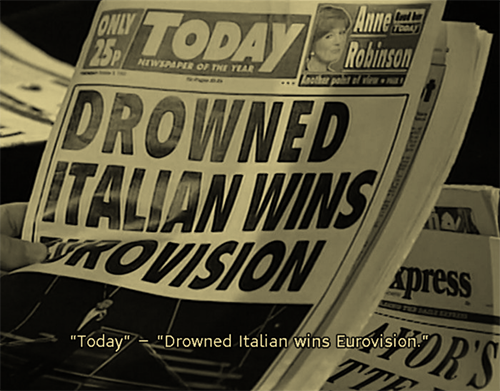
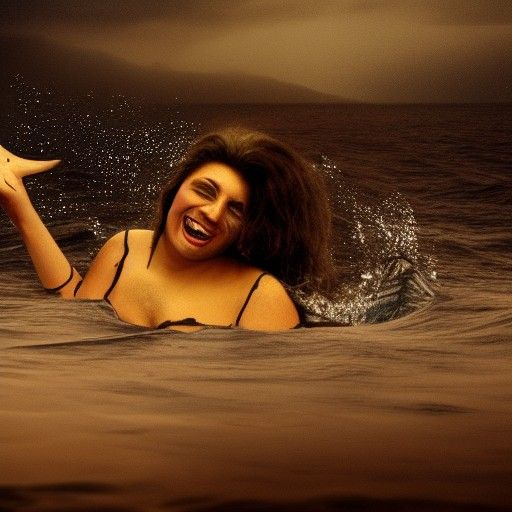
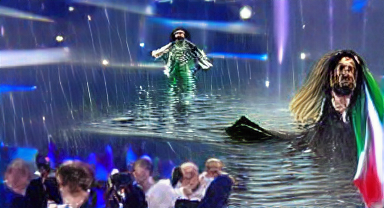
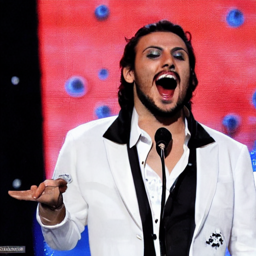
    HEADLINE TWO: “Drowned Italian Wins Eurovision.” — Today

    1st Place: NIGHTCAFE

    A clear winner, despite the Eurovision angle not being obvious. At least the singer is drowning, which is a sentence that I admit is very wrong out of context.

    2nd Place: PIXRAY

    A close second, thanks to looking a bit more like the Eurovision stage, and an Italian flag being present. But that’s not drowning. They’re barely even damp.

    3rd Place: HOTPOT

    A low bar, because most of these results were rubbish. But this does look most like someone who’d be representing Italy at Eurovision, so bronze medal.

    SPECIAL MENTION: COMPUTER VISION EXPLORER

    I mean, what the actual fuck?


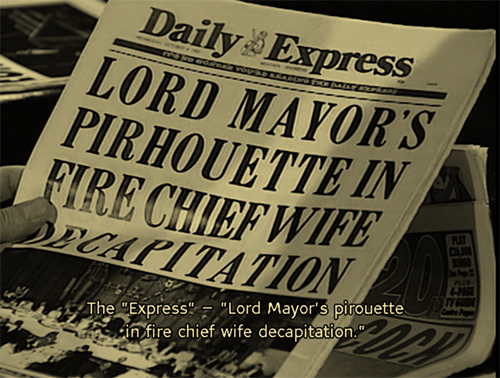
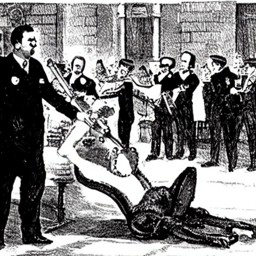
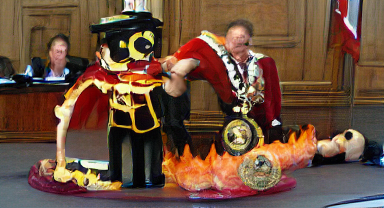
    HEADLINE THREE: “Lord Mayor’s Pirhouette in Fire Chief Decapitation” — Daily Express

    1st Place: HOTPOT

    Basically nailing the story had it ran on P1 of the London Illustrated News, there.

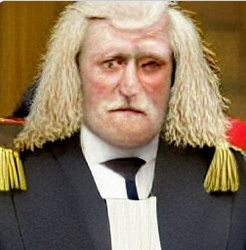
    2nd Place: DEEP AI

    That IS very much the face of a man who’d just seen that happen.

    3rd Place: PIXRAY

    That definitely does look disturbing enough to warrant a front page headline, in fairness.


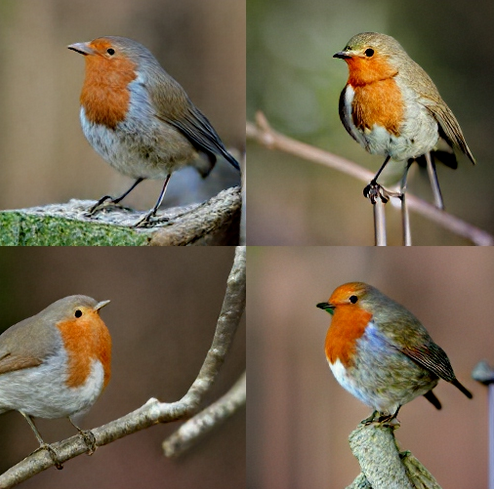
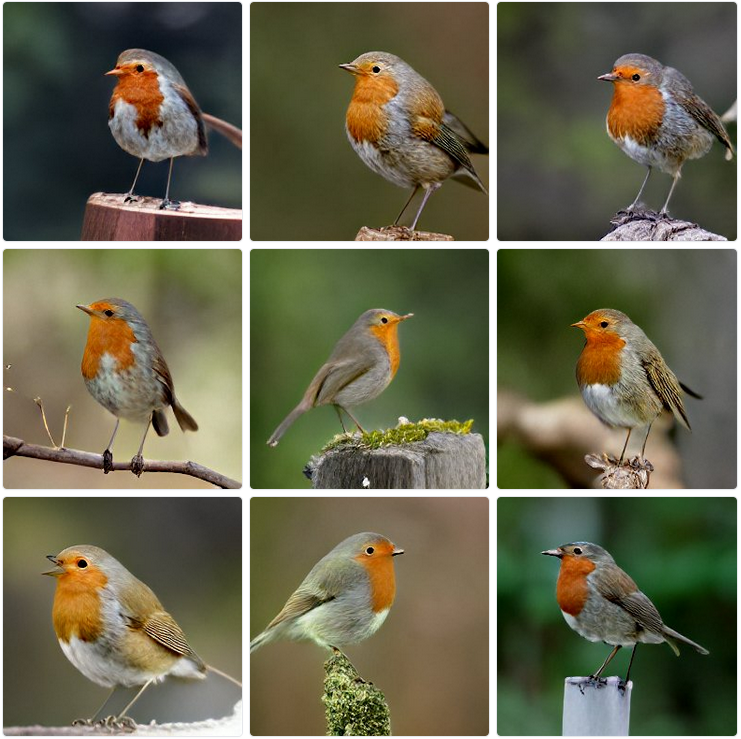
    HEADLINE THREE: “Robin Cock” – The Sun

    1st Place: PIXRAY

    Phew.

    2nd Place: DEEP AI

    Phew.

    3rd Place: DALL.E MINI

    PHEW. Safe to say some of them ignore particular key words.

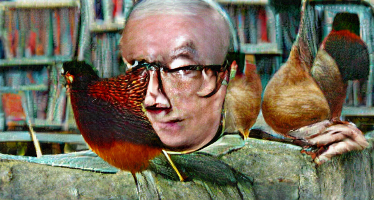
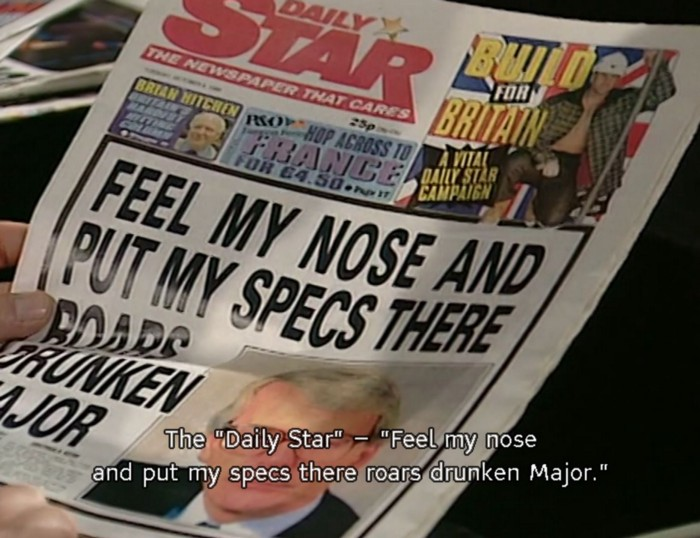
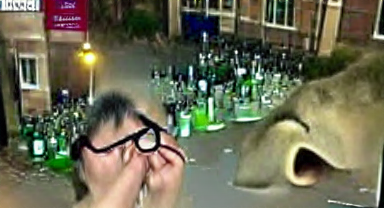
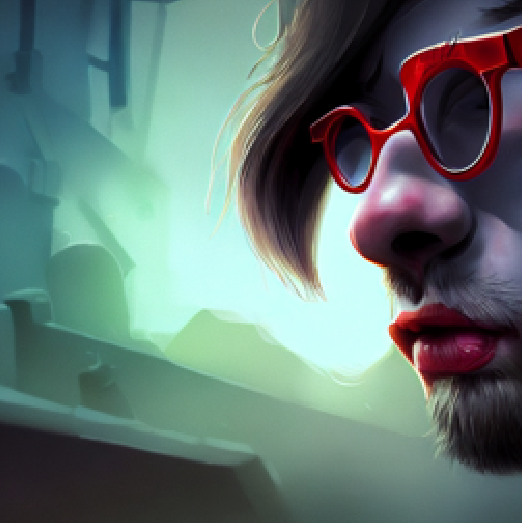
    HEADLINE FOUR: “‘Feel My Nose and Put My Specs There’, Roars Drunken Major”

    1st Place: PIXRAY

    A disappointing haul again, but at least Pixray managed to incorporate all the key elements.

    2nd Place: CRAIYON…

    …which appears to be the new name for Dall.E Mini. It’s basically the same, anyway. And it brought out a series of disturbing images for the query, some of which are definitely not suitable for human consumption. Here’s one of them, which should brighten your day if you were wondering what Andrew Collins would look like in a Bo Selecta mask.

    3rd Place: HOTPOT

    Key elements incorporated: just the glasses, sadly. But, y’know, thin gruel, take what you can get etc.


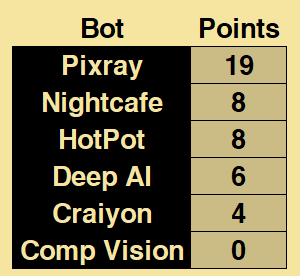
    Yeah, that’s all anyone needs to see for now. So, at the end of episode one, and going by five points for a first place, three for second, one for third, here are the standings.

    ALL TO PLAY FOR.

    J/K, Pixray’s probably going to win at this rate. Next round of hot AI bot action this time next week.