-
20×4: Marking Twenty Years of BBC Four
Hi all, still sorting out some refinements of the 100 Most-Shown BBC Programmes Ever. In short, a total of 25,371 programmes have now been added to the mix (previously buried within other listings such as 90s/00s CBBC – where individual shows were listed in one big programme description on Genome – plus listings from the 1940s and 1950s previously missing from my Big Huge List), which will require rejigging previously listed programmes somewhat.
While I’m continuing to sort all that out, here’s a long read to keep you ticking over. Previously published on unpopular-because-everyone-assumes-everything-is-paywalled-on-there-when-in-reality-only-95%-of-posts-are-paywalled* platform Medium, here’s a scamper through the history of BBC Four, and the most popular programmes therein.
(*My posts were always free, of course. And only partially because nobody would ever want to pay to read them.)
For some reason, many television channels prefer to celebrate their 21st anniversary, not their 20th. But, given the way the BBC is being used as a chew toy by Culture Secretary and Relative You’d Mute on Facebook Nadine Dorries, the odds of BBC Four being around that long seem a little on the slim side, so here’s a celebration of the channel’s first twenty years on air.
Four was borne out of mostly-forgotten digital channel BBC Knowledge. That was launched on 1 July 1999, by Buzz Aldrin and Jamie Theakson, and I am not making that up, as “The first television-based multimedia learning service”, which basically meant that it had a website.
It came with commendably lofty ideals, and (as seen in the channel’s launch programme) serves as a real time capsule of early-era digital TV. Bustling with ideas on how it can get people involved, get people of all ages scrabbling for more information, and generally just be the polar opposite of linear, couch-based TV. Problem was, all those ideals were let down by two things. Firstly, optimism alone can’t power such a project, and secondly, when everyone is still paying for dial-up internet by the minute, throwing a barrage of URLs at the audience during end credits (the ‘interactive’ aspect of the channel) was never going to really work. Plus, that ident was bloody unsettling.

So, BBC Knowledge became BBC Four on 2 March 2002. Originally pitched as a new channel for thinkers, at various points it would become a hub for docudramas about beloved Light Entertainment figures, to a channel willing to put together an hour-long documentary on Tetris, to the UK’s capital of subtitled European drama, to it’s current cash-strapped incarnation as A UKTV Repeats Channel For People Who Play Variants of Wordle. And, of course, where Top Of The Pops repeats live.
Join me now, so together we can celebrate twenty years of the Tristran Fourmile of British Television. Quickly now, before someone on there expresses a preferred pronoun and Dorries has it crushed.
All viewing figures from BARB.co.uk, 28-day figures used where available, 7-day figures used where they weren’t.
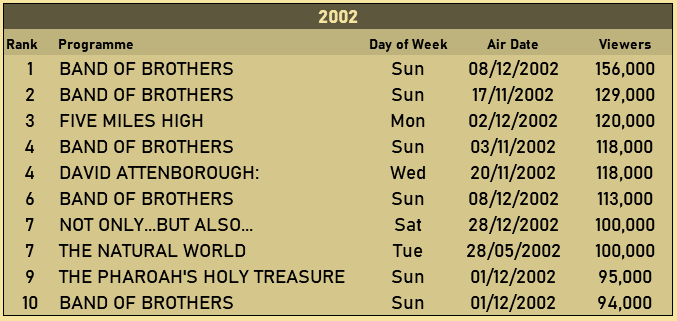
2002, international year of the palindrome and BBC Four’s launch year. Despite an early promotional push for Four, it took a while for viewing figures to grow. In the early months of the channel, a broadcast with viewing figures circa 30,000 could top the weekly chart. It took until a few months for those figures to grow, no doubt helped by an oft-used tactic from the dawn of the digital epoch: take a popular main channel programme, and debut new episodes on your new channel. This is something we’ll see quite a lot here.
Sunday 8 December saw episode eight of Steven Spielberg and Tom Hanks’ ten-part WWII miniseries Band Of Brothers air on BBC2, followed by the final two episodes premiering on BBC4. The tactic proved a success, despite that double-bill finishing just before 1am. On a school night. And it’s the latter of those final two episodes that draws the bigger audience up there, starting at 11:55pm.
Elsewhere on the list, Five Miles High looks at “how scientists are unravelling the mysteries of the jetstream”, a prime example of Peak BBC Four even at this early stage. Joint-fourth place goes to — and don’t worry, BARB’s listing as ‘David Attenborough Colon’ has nothing to do with the image now in your mind — “Life on Air: David Attenborough’s 50 Years in Television”, a landmark that now seems a little quaint now our most valued of National Treasures has clocked up a further two decades on air.
Sharing seventh place are more good examples of Four’s staple diet at the time: in-depth nature documentary The Natural World (in this case, an insight into the life cycle of sperm whales) and Not Only… But Also.., a comedy repeat deemed too unfashionable (or at least, too monochrome) for Gold.
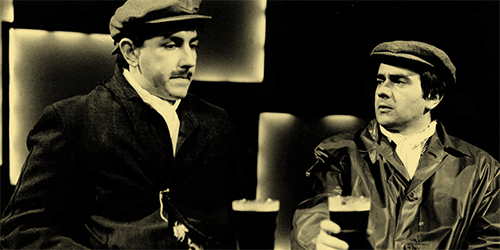
Pete and Dud, enjoying that pint As if to underline the mission statement of the channel, at number 9: Business Secrets Of The Pharaohs (well, practically).

Four’s first full year sees the ‘episode premiere on the new channel’ tactic deployed again for political thriller State of Play and historical drama Charles II: The Power and the Passion, with fresh new episodes given first airing on BBC4 immediately after episodes were broadcast on BBC1. And again, it worked very well for the digital-only outlet, with viewing figures very much growing — little surprise, as this was during the initial transition to digital TV for many people. Indeed, with the disastrous OnDigital project making way for what-they-should-have-been-doing-all-along Freeview in late 2002, it’s likely that keeping in the loop with new must-see shows like these was a key factor in people opting for the subscription-free service.

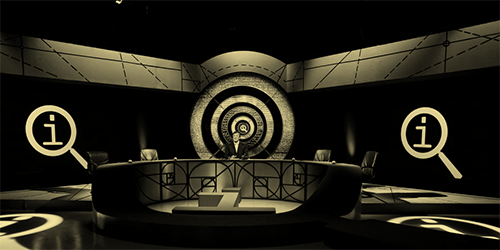
Sneaking into tenth place on the list, a programme that would become an institution for Four before moving onto bigger things. Adopting same ‘see it a week early on BBC Four’ format again, QI’s modest format made it feel every bit at home on BBC Four as on BBC Two. While the sheer volume of QI episodes now makes it feel like acceptable background TV (at least to my mind, perhaps due to it being omnipresent on Dave), at the time each new episode felt like a treat, and certainly felt like a welcome alternative to BBC Two Comedy Zone offerings like Buzzcocks, Two Pints or Catherine Tate.

Onto 2004, and QI is starting to spread throughout the chart, taking up four places on the list. However, the breakout hit of the year is The Alan Clark Diaries, a dramatisation of the late Tory MP starring John Hurt. Rather than using the ‘week early’ scheduling, the full run of the series debuted on Four a few months before finding a place on BBC Two, and it paid off with the first episode of the series attracting the new channel’s largest audience to date.

In fourth place, an Arena special covering the twenty-fifth anniversary of the Secret Policeman’s Ball in aid of Amnesty International. Annoyingly, despite the BBC Programme Guide suggesting that’s currently on iPlayer for another four months at the time of writing, iPlayer says otherwise. Boo.
[UPDATE: Thanks to @BarryHodge18 on The Twitter for pointing out that – at the time of writing this (i.e. 22/8/22), it’s currently on iPlayer for another seven days.]
Making up the remainder of the list, in fifth place is the concluding part of He Knew He Was Right, Andrew Davies ‘s dramatisation of Anthony Trollope ‘s novel being broadcast on BBC One with new episodes a week early on Four, and in ninth place the repeat of Monty Python’s Flying Circus that followed the Arena documentary on the Secret Policeman’s Ball. Genome might well know which Flying Circus episode that was, but it’s not going to tell us.

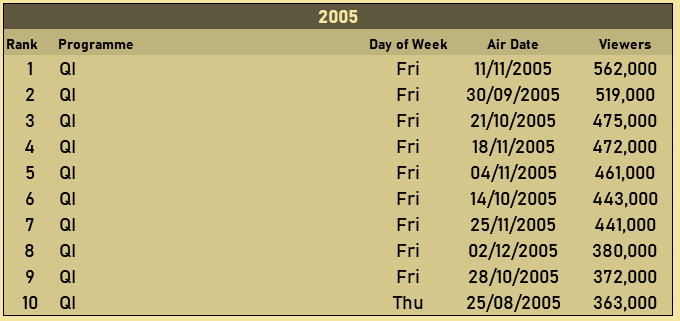
2005. QI’s victory is total.

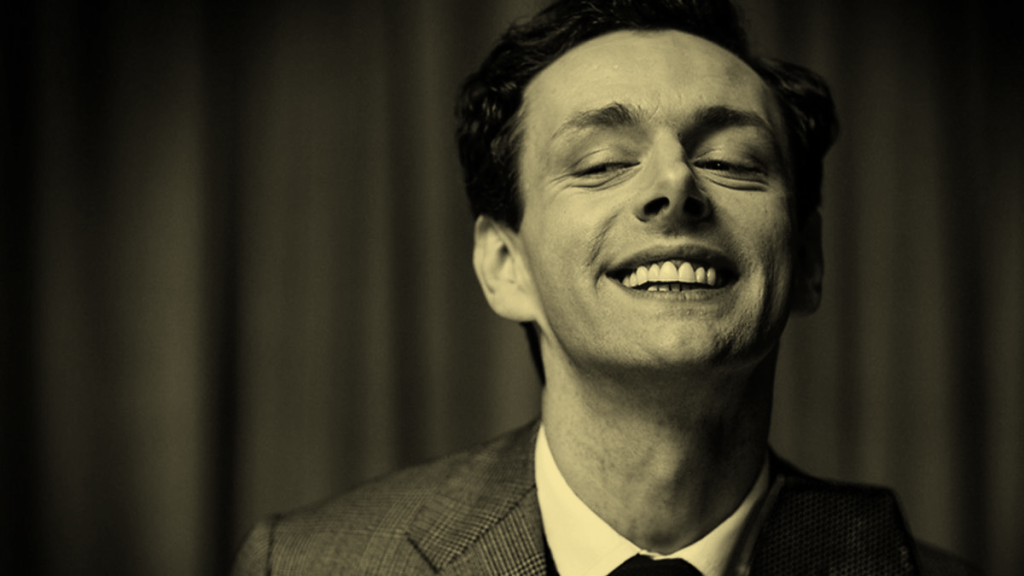
Much the same in 2006, to be quite honest, but at least a couple of shows makes inroads to QI’s dominance. Top of the chart is, in my correct opinion, the peak of BBC Four’s original programming. The centrepiece of a Kenneth Williams Night on the channel, preceded by Round The Horne Revisited and …in His Own Words, Michael Sheen portrayed the tortured actor-cum-diarist in Fantabulosa!, a feature-length docudrama that bagged two BAFTAs, kickstarted Four’s comedy-docudrama subgenre and helped accelerate the ascent of the chameleonic Welsh actor. All that, AND it was followed that evening by a repeat of Jackanory. This is what we want!
Also sneaking into the top ten, The Chatterley Affair saw David Tennant star in Andrew Davies ‘s drama about jurors at the Lady Chatterley trial.
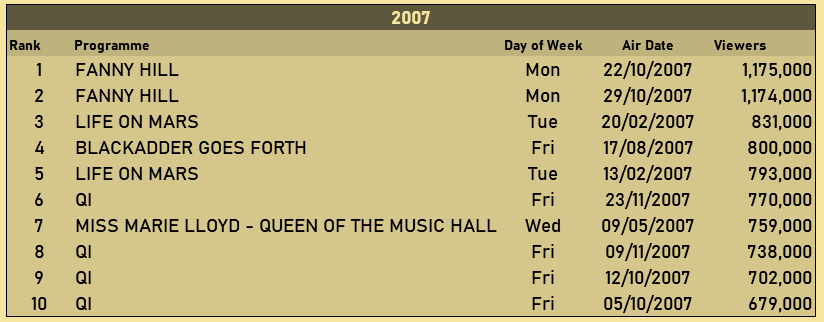
2007 saw the final BBC Four premieres of QI, after which it would become a fully-fledged BBC Two series. Luckily, the growing popularity of other shows on the channel helped lessen that blow. The most notable example clearly being Fanny Hill, Andrew Davies’ two-part adaptation of John Cleland’s 18th-century novel. Starring Rebecca Night, Alison Steadman and Samantha Bond, the well-received miniseries brought in the first million-plus viewing figures for the channel.
Arguably the most populist series to be afforded the ‘see the next episode a week early’ treatment on Four, series two of Life on Mars initially brought some big audiences to the channel, though it seemed by the end of the run many viewers were content to just wait a week for the BBC One broadcasts — by the time episode four hit the channel, the numbers had dropped to just over 300,000.
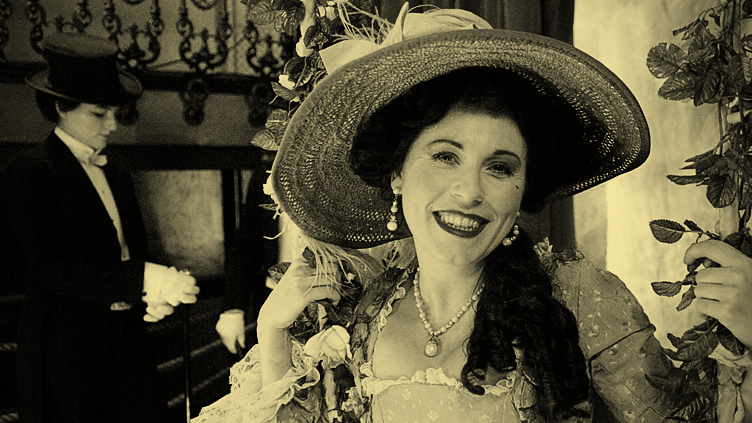
A repeat of Blackadder Goes Forth made it to fourth place on the list. You know which episode. The BARB listing for that week erroneously lists it as ‘Blackadder Back and Forth’, but dear me, no. Seventh place goes to Miss Marie Lloyd: Queen of the Music Hall, a costume drama inspired by the life and loves of London’s East End music hall legend Marie Lloyd.

2008 and a couple of years on from Fantabluosa!, the channel revisits what would rapidly becoming a winning formula for Fouir’s original drama — dramatic retellings of the stories behind British comedy legends. And, with no small irony, The Curse of Steptoe hits the top spot, nabbing BBC Four’s highest audience since launch. And it’s lucky it gathered such a large audience for its original broadcast, as it’s not about to be repeated any time soon, such was the lackadaisical approach to truth-adherence on the part of the programme makers.

A piece of peak BBC Four in second place, Ian Hislop Goes Off The Rails explored the fall-out from 1963’s infamous Beeching Report, which led to a third of the nation’s railway lines being closed, forced thousands of people onto the road, and to the David Croft sitcom nobody talks about. And that wasn’t the only rail-based attraction for the channel that year — viewers cho-cho-chose to put four more documentaries on railways into that top ten.

Gracie! What? Your tea’s ready! Yes, that wasn’t in the script of the feature-length docudrama exploring the life of Rochdale-based national treasure Gracie Fields, but perhaps it should have been. A big year for docudramas on women identifiable by their first names, with Enid and Margot* also proving popular (*Fonteyn rather than From The Good Life, if you were wondering. That one’s ‘Margo’).
A landmark moment for original comedy on BBC Four here, with Jo Brand’s NHS sitcom Getting On taking fourth place on the list. And with good cause — a great series, and perhaps a peg too square for a BBC2 Comedy Zone then populated by Mock The Week and Krod Mandoon and the Flaming Sword of Fire. For the record, while the most well-known BBC Four sitcom was probably The Thick Of It, the highest that ever got in one of the yearly charts was sixteenth place, in 2005.
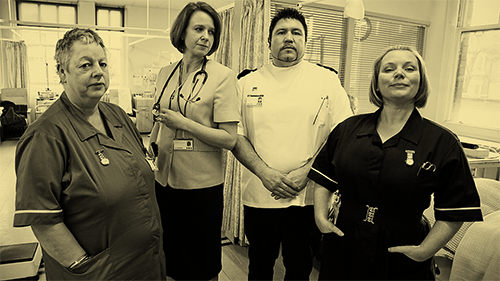

Four’s docudrama juggernaut rumbled on, with the tale of Tony Warren grappling with production difficulties, a mercurial cast and Granada’s Bernstein brothers to bring the twice-weekly happenings of a certain cobbled Weatherfield street to our screens. The Road To Coronation Street is certainly a nice little cross-channel curio, it being an ITV Studios Production for the BBC, being subsequently repeated on… ITV.

As if to underline that the digital diaspora could probably have room for an entire UKTV Trains channel, Indian Hill Railways proved to be a surprise smash, with an episode on the Nilgiri Mountain Railway beating some strong competition in second place. Not that there wasn’t room for original written content (that isn’t based on pre-existing TV properties), with solidly entertaining Douglas Adams adaptation Dirk Gently taking fourth place on the list (much more lo-fi than BBC America’s later remake, but certainly the better of the two) and On Expenses, a drama based on the true story of Heather Brooke’s attempt to expose spurious MP expense claims, in ninth.

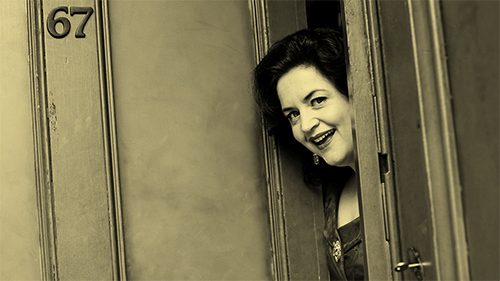
2011 saw a new landmark audience figure for the channel, with Ruth Jones portraying the private life of Hancock, Sykes and Carry On foil Hattie Jacques. Hattie also featured turns from Robert Bathurst as husband John Le Mesurier (a role he’d later reprise for Gold’s remounting of the missing Dad’s Army episodes) and Aidan Turner, then fresh from Being Human, as lover John Schofield. A one-off that proved to be the pinnacle of Four’s comedy docudrama subgenre, attracting more than two million viewers. As you may notice from the table above, it was so popular, the repeat of Jacques’ 1963 appearance on This Is Your Life would be the thirdmost watched thing on BBC Four that year. Which, if you’d like to see it, is currently on iPlayer.
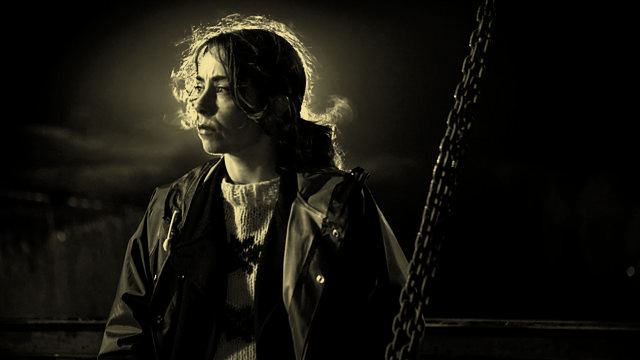
Elsewhere on the list, the start of the channel’s bravest and most brilliant scheduling move — handing over peak-time Saturday nights to subtitled Danish drama. Viewers were first introduced to Detective Sarah Lund in January of 2011, picking up a solid and appreciative audience of around half-a-million viewers as the mystery unfolded. By the time the second series of The Killing was aired in November of 2011, the buzz around the series saw audiences grow towards and beyond the million mark, the high point coming for the series opener as a newly rural Lund is recalled to Copenhagen Police HQ to help investigate the murder of a lawyer.

The growth of the Nordic Noir strand continued into 2012, with the third series of The Killing joined by Hans Rosenfeldt’s cross-nation puzzler The Bridge. The Danish-Swedish series proved every bit as popular for Saturday night audiences, as they strove to decipher the mystery of the Øresund Bridge.
Only Connect helped to break up the Danish duopoly, with the quiz taking third place on the list. Having ran on the channel since 2008, modest audiences of around a quarter-million steadily grew, until it was comfortably topping a million. A place on BBC Two would soon beckon. For the record, this top-rating episode isn’t a celebrity special or anything — a good old standard episode 13 from series six, ‘Footballers vs Draughtsmen’.
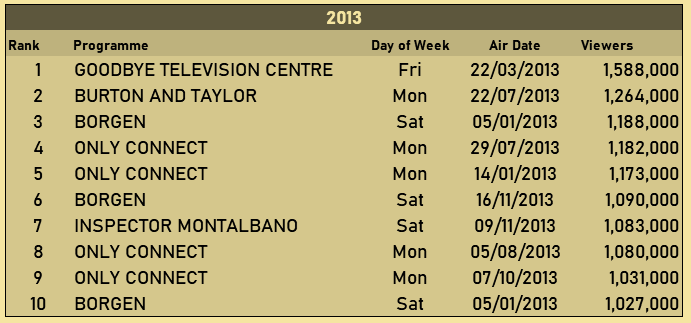
After two years of ubiquity for European crime dramas on the channel, 2013 saw something that couldn’t be more BBC at the top of the viewing charts. As Wood Lane’s most famous building prepared to contribute to London’s unaffordable housing crisis, viewers were treated to a tour of an all-but vacated TVC (with some incongruous and decidedly spurious parkour failing to add much excitement) before a proper send-off, a live performance by Madness in the car park. Goodbye, Television Centre.

“TV-See you later.” With only three appearances in the list from the latest Saturday night Scandi-noir epics, it’s safe to say the cultural obsession with the genre is now fading. People just don’t like having to read telly, and that’s the end of it.

TRICKED YOU. There hadn’t been a series of The Bridge in 2013, and Four’s alternative offerings (Borgen, Spiral, Arne Dahl, Wallander and Young Montalbano) attracted big but not huge audiences (by BBC Four standards, of course). But in 2014 The Bridge was back back back, baby (I readily admit this sentence lacks the gravitas that should be afforded the series).


By 2015, the BBC Four audience was truly transfixed by The Bridge, so much so that Four now had its second ever two-million plus viewing figure — a new record of 2,107,000 viewers for the first episode of series three. Indeed, by the end of 2015, of the channel’s twenty most-matched programmes since launch, sixteen of them were Saturday night subtitled dramas. And if that weren’t remarkable enough, all sixteen of those were episodes of The Bridge.


By 2016, there were no more episodes of The Bridge to be shown on BBC Four. While the series itself would return for one last run in 2018, it was popular enough to move to BBC Two, where it would receive viewing figures largely identical to those it had enjoyed on BBC Four. Putting it out on Friday nights was probably an unwise decision there, in fairness.
Not that this spelled the end of Saturday night subbed dramas, but now it was time to cast the commissioning net a bit wider. Specifically to Iceland, where a gritty drama fitting the post-Bridge gap in the schedules (“a dismembered body is found in the river at the same time a ferry arrives at a small fishing port”) could have been forged especially. Bruce’s Big Night it wasn’t. Trapped because another big hit for Four, and made household names of Olafur Darri Olafsson, Ingvar Eggert Sigurdsson, Nina Dogg Filippusdottir, Ilmur Kristjansdottir, Steinunn Olina Thorsteinsdottir, Thorsteinn Gunnarsson and Baltasar Breki Samper (okay, it didn’t, but it does make you hope whoever compiles the listings for Radio Times can just copy-paste cast lists).

No, not that one. It was back to Nordic normality for the other European crime drama in the top ten, with Sweden’s Modus seeing psychologist and criminal profiler Inger’s autistic daughter Stina attending a wedding reception and returning as witness to a murder.

No, we’ve moved onto the next programme now. Tsk. Taking up other spots on the list, what with BBC Three having ceased trading as a traditional channel earlier that year, it was left to Four to take on any Olympic overspill, the channel being granted the opportunity to open up at lunchtime for the first time ever to do so. Top spot of the year went to the channel’s Rio 2016 coverage from 11 August, and the men’s singles third round tennis clash between Italy’s Fabio Fognini and [checks result of match] Britain’s Andy Murray.
While it’s nice to slap ourselves on the collective back and coo about how cultured we are that foreign-language drama is the most popular thing on one of our main TV channels, spare a thought for all those other shows. Home grown producers, grappling with decreasing budgets as the channel is repeatedly ordered to tighten its belt, trying their damnedest to get another QI or Thick Of It, then some Nordic upstarts waltz in and snaffle up all the viewers. It’s not even a trick that’s been working for other channels — Channel 4 tried to bottle some of that subtitled foreign drama magic for themselves, but it just never quite took off for them. Walter Resents, more like. (I am pleased with that joke. Shut your face.)
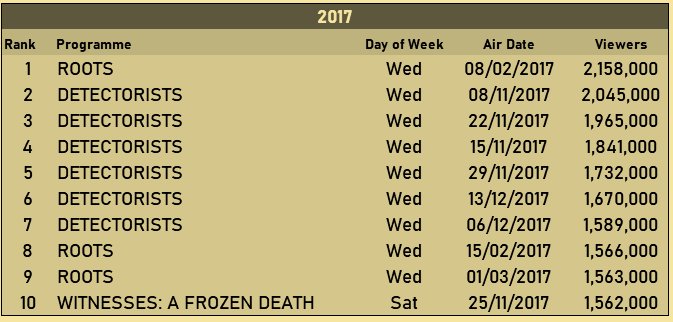
So it’s a bit of a surprise to look at the top ten for 2017. A single solitary Saturday night showing up there — the opening episode of French series Witnesses, an uplifting tale where the spirits of a ragtag bunch of plucky orphans are lifted by the antics of talking poodle Mr Tickles who… nah, it’s about the frozen bodies of 15 men being discovered on an abandoned bus.
The most-watched BBC Four offering of the year proved to be Roots, a retelling of the groundbreaking 1977 miniseries commissioned by USA’s History Channel, this time starring British actor Malachi Kirby as 18th century slave Kunta Kinte and Forest Whitaker as his mentor Fiddler/Henry.
Perhaps to the relief of BBC Four commissioning editors, an actual homegrown series takes up the remaining places on that Top Ten. The third and final series of Detectorists arrived in 2017, following two earlier series on the channel that drew relatively modest audiences. Word of mouth around the series certainly helped build up demand (and those modest figures for previous series’ probably helped avoid it being pinched by BBC Two), meaning the last outings for Andy and Lance would be by far their most popular.


Nothing lasts forever, not least a BBC Four with the budget to invest in new comedy, so it was back to Saturday night foreign drama taking up the lion’s share of the top ten for 2018. That’s except for a documentary that would become the most-watched broadcast to ever hit BBC Four. The Jeremy Thorpe Scandal was an edited and updated version of Tom Mangold’s original 1979 Panorama investigation into the trial of Liberal Party leader Jeremy Thorpe. Made on the assumption that that the trial would result in a guilty verdict, a special post-trial programme was prepared, and — following the trial’s not-guilty outcome — scrapped. The documentary itself remained unseen for almost 40 years, until this airing in June.

That in itself, is fascinating enough to warrant a watch. But the timing of the broadcast was more than a little canny — it following the final episode of Russell T Davies’ smash hit miniseries A Very English Scandal on BBC One, bringing a whole heap of viewers with it.
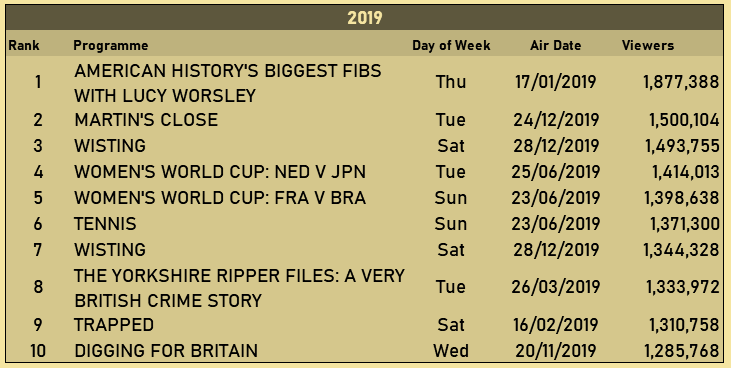
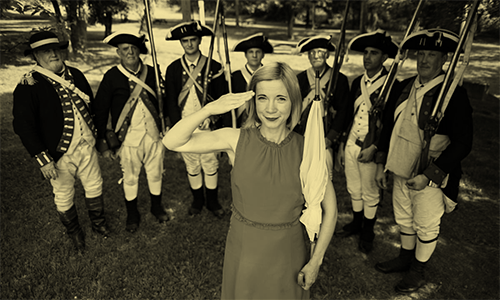
Ah, 2019. The last year of precedented times. So, what was popular with a populace not knowing how much time they’d be spending stuck inside twelve months hence? A slightly surprising cornucopia of content, topped by American History’s Biggest Fibs with Lucy Worsley. Can’t imagine why legendary levels of bullshit and America would be such a big draw? Than you’re more successful at blocking out memory of the Trump presidency than most. This opening episode saw Lucy Worsley question how much of America’s founding story was actually based on fact. Sadly though, not followed by a repeat of The Simpsons episode where Lisa uncovers the truth behind the myth of Jebediah Springfield.
That was followed by 2019’s Gatiss-helmed Ghost Story for Christmas. Martin’s Close saw Peter Capaldi star in the latest adaptation of an MR James festive frightener. As was widely accepted at the time, the well of TV-friendly James’ stories was more than a little shallow by that point, but it certainly drew an audience.
As if to further prove that Christmas telly isn’t quite the same as it used to be, late December also saw new Norwegian drama Wisting arrive on the channel. A premise “in which a body is found in snow underneath a Christmas tree”. And a Hap-py New Yeeeear.
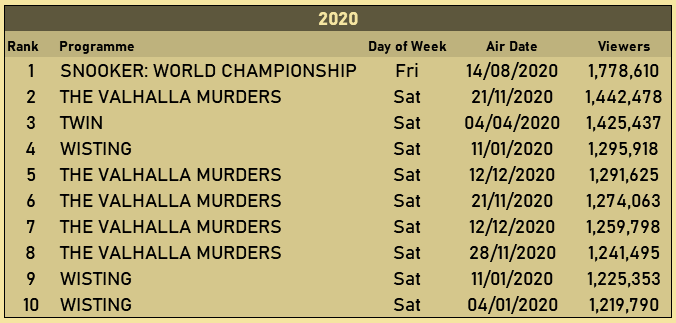
Onto Plague Year 2020, and as if to prove that things just weren’t going to be the same, the most popular thing on BBC Four that year was… Snooker. Not even part of a mid-1980s theme night or anything. Just snooker. Snooker.
A strong roster of imported drama helping entertain a nation needing a little more than coloured balls being knocked around green baize, however. The Valhalla Murders saw “Katrin ‘Kata’ Gunnarsdottir, an ambitious detective with her eye on becoming the head of the Reykjavik police detective department” tackle the labyrinthine case of a murdered ex-drug dealer, Wisting continued to throw blood on the winter snow, while Norwegian drama Twin followed the fortunes of two very different identical twin brothers. I’m going to come out and admit that while I was fortunate enough not to be furloughed during lockdown, if I were ever going to stand a chance of catching up with all the BBC Four foreign dramas I want to see, that would have been my best chance.
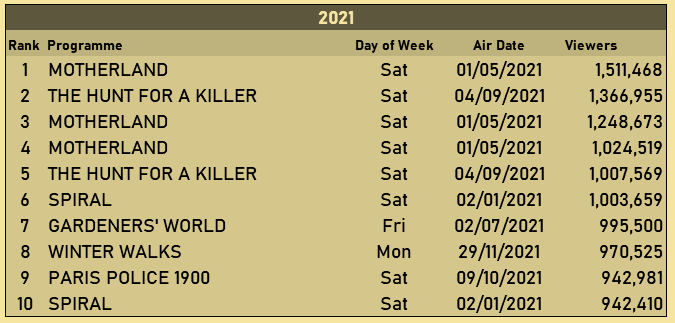
Okay, the last year we’re looking at here, and there’s a curious thing. You’ve got your usual Saturday night drama — Swedish crime drama The Hunt For a Killer — but that isn’t top of the list for the year.
What does top of the chart for 2021 is part of a repeat run for the first series of Sharon Horgan, Holly Walsh, Helen Serafinowicz & Barunka O’Shaughnessy’s* parenting sitcom Motherland. Nothing especially surprising, you might think. After all, it’s a good series, and certainly very popular. But the scheduling of that repeat run… three episodes are on there, in first, third and fourth place on the list, all from the same night. And not in any remotely hospitable time of day — they went out at (going by the BARB listings) 11.50pm, 12.20am and 12.50am respectively. That’s a lot of parents pacing around with a squawking baby at that time of night deciding they might as well put something relatable on.
(*And nobody else) It doesn’t end there — just outside that top ten are repeats of the same series going out even later that same night. 1.20am, 1.50am and 2.20am.
Why? Well, there’s a reason. And it’s one that probably pre-empts what might well be the reason we won’t have a BBC Four for much longer.
You see, as mentioned briefly right at the start, all these figures are from 28-day post-broadcast windows where the data is available. So, traditionally, that would include people watching recordings on VHS or PVR, more lately also including views on iPlayer. And it seems the majority of the views for Motherland up there are iPlayer-based — the figures for a 7-day window that week tell a different story.
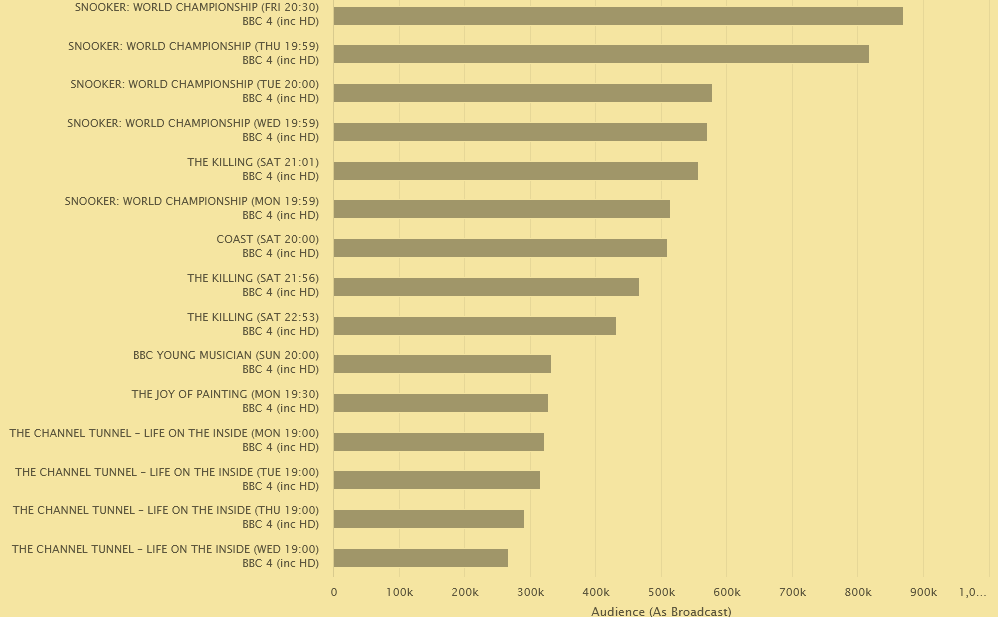
If you’re reading this on mobile and can’t make out the text on the image, it’s basically all snooker. If a mostly-gutted BBC Four is to be positioned as a repeats channel for people who solve a Wordle in three guesses, that job’s currently being fulfilled quite effectively by iPlayer. And as the BBC is being endlessly whittled away by an uncaring government, BBC Four is probably first to find itself under the penknife.
Even factoring in those iPlayer view counts, offerings from BBC Four for 2021 are on the slide. Given the vastly reduced budget for the channel, that’s no surprise, but that doesn’t make it any less of a shame.
We’re going to miss it. Heck, those yearly charts didn’t even have room for Charlie Brooker’s Screenwipe, Mad Men, The Mark Steel Lectures, Vic and Bob’s Big Night Out, Mark Kermode’s Secrets of Cinema, Flight of the Conchords, Rich Hall’s America documentaries, Paul Merton’s silent movie documentaries, The Thick Of It, The Slap, Newswipe, Gameswipe, Pop Britannia, Comics Britannia, The Falklands Play, In Search of Steve Ditko or going to the trouble of recreating the first ever BBC broadcast from 1936, using original 1930s equipment. In short,we’re damn lucky anyone ever thought we deserved it. At times, Four was a channel that might even have won Lord Reith round to the idea of tele-vision.
BUT, this is meant to be a celebration. So, here are a few bonus charts I’ve scooped out of my number stew.

06/01/77 — Sheer Elegance, Tina Charles, Gladys Knight and the Pips, Clodagh Rodgers, Boney M, Smokie, Jethro Tull, the Drifters and Johnny Mathis
TOTP Christmas 1978 — Darts, Abba, Boney M, Brotherhood of Man, Father Abraham, Bee Gees, Brian and Michael, Brighouse and Rastrick Brass Band, Wings, Showaddywaddy, Rose Royce, Olivia Newton-John and John Travolta and Legs and Co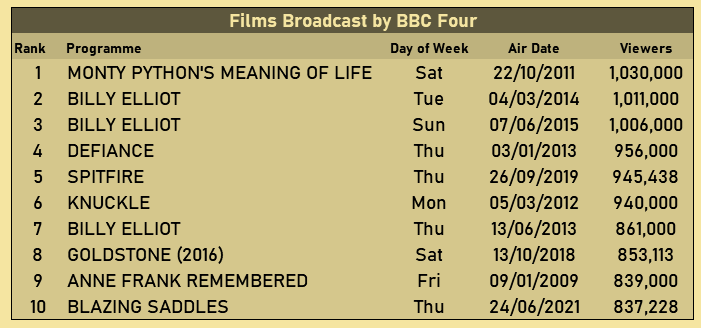
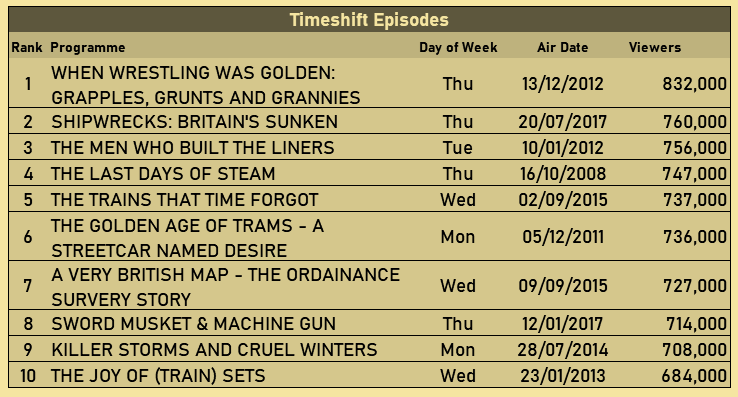
Yes, I know, I’ve formatted the table differently. Don’t blame me, blame Timeshift’s long episode titles. God bless you BBC Four. And all who sailed in you.

-
You Know, For Kids: The 20 Most Popular CBeebies Series’ EVER

A slight detour from the 100 Most-Broadcast Things On The BBC Ever to give another airing for something I posted on Medium earlier this year. Some of you may already have read this, but for any new readers (especially those with kids), I do hope you’re sitting comfortably.
“Shall we put CBeebies on?” is one of the sentences a generation of kids will be used to from an early age. A true godsend to parents of young children, it has comprehensively achieved the mission statement laid out on the channel’s Twitter bio (“Helping parents drink their tea while it’s still hot”), and it marks its 20th anniversary this Friday. The channel itself doesn’t seem to be doing anything special to mark the anniversary, which is probably reasonable enough given its target demographic are too busy enjoying the programmes to care. But it’d be a shame not to mark it somehow. So here, as a thank you from one such parent, is a look at the twenty most popular series ever shown on the channel.
Without taking my cynical sneery internet mask off for too long, it’s easy to see why CBeebies is so damn valuable to families in the UK. The alternate options on broadcast TV are by necessity funded by adverts, which means kids programmes are buffered by parcels of disappointment (“Ooh! Can I have one of those?” “No, they’re too expensive.” “I WISH I’D NEVER BEEN BORN (etc)”).
Ad-funded channels also mean trying to maximise that revenue stream by sourcing hours of cheaply-sourced landfill imports floating on that sea of commercials. Yes, there’s C5’s Milkshake strand, but that’s not a channel. And sure, Netflix or Disney+ have their own troves of kid-friendly programming, but the odd gem aside (shout out to Hilda and Centaurworld on Netflix, and to Disney’s The Owl House), it’s largely much of a muchness. It’s down to CBeebies for the offerings that feel truly inclusive for a UK audience, where characters seem more familiar, where the audience is part of a club, and where any on-screen programme titles don’t need to have ‘™’ superglued to them (Mister Maker excepted).
Oh, and watching CBeebies does dramatically reduce the likelihood of your child thinking the last letter of the alphabet is pronounced ‘zee’.
It’s perhaps this kind of familiarity that has led to a growth in audiences for CBeebies. In a period where viewing figures have dropped dramatically from what they once were (see below), CBeebies have seen their viewing figures grow and grow, helped in no small part by the investment in programming that doesn’t need to correlate to advertising income, along with the ability to revisit favourites on iPlayer at will.
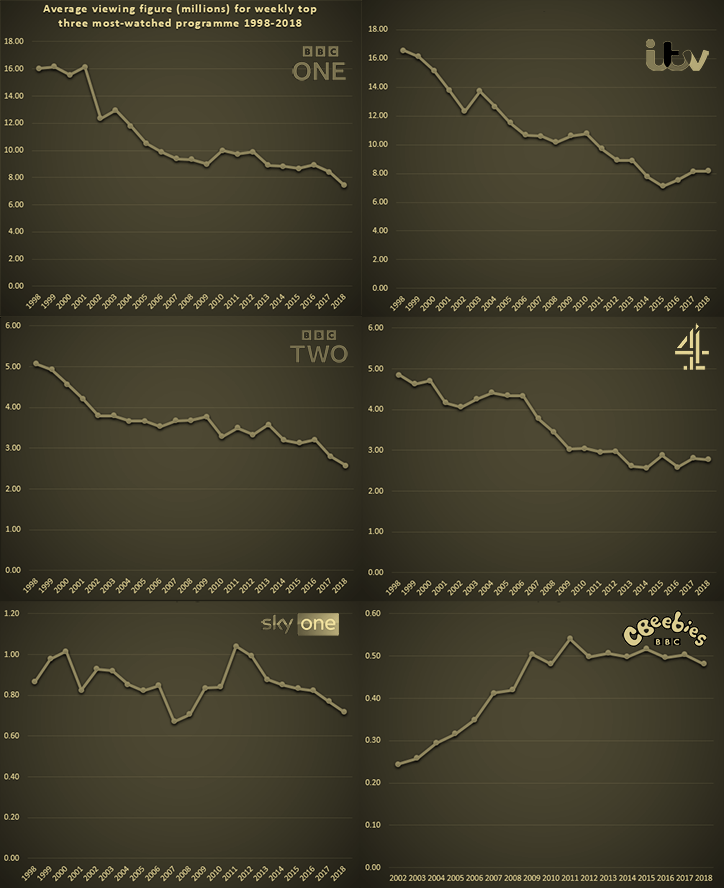
HOW THE METRICS MEASURE UP: While I could just have dumped out a list of programmes by their most-watched episode, that would heavily favour more recent shows, given the ease with which things can be watched on iPlayer across several devices in recent years. Instead, I’ve looked at how often an episode of a programme appears in that week’s BARB Top Ten for the channel, and come up with a total for each series. That should give a greater mix of shows from across the span of CBeebies lifespan. BUT WILL IT? Well, we’ll see. Are you sitting comfortably? Then we’ll begin.
20. FIMBLES
First appearance: 2002
Last appearance: 2006
Highest viewing figure: 418,000
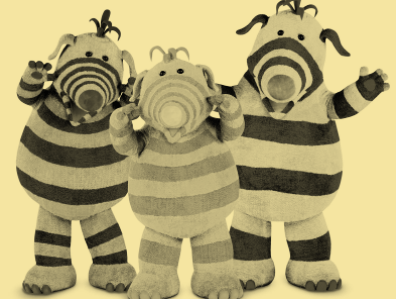
Appearances in weekly Top Ten: 136As if to heavily underline the sheer volume of episodes you need to produce if you want a daily slot on pre-school TV (Bagpuss wouldn’t get away with only ever making three episodes in this day and age), Fimbles ran from September 2002 to September 2004, and in that time clocked up 200 episodes. Two hundred! Even thinking about the person who typed up the end credit text for all those episodes is quite tiring. Still, the antics of Fimbo, Flurrie and Baby Pom proved popular enough, with the programme running on CBeebies for almost the entirety of the channel’s first decade, making the weekly top ten on 136 occasions.
- WAFFLE THE WONDER DOG
First appearance: 2018
Last appearance: 2021
Highest viewing figure: 890,534
Appearances in weekly Top Ten: 160It’s all too tempting to be sniffy about the programmes on CBeebies. Every time a Russell Comedian (or if you’re older, a Norman and Gareth Comedian) starts an extended riff on What Were They Smoking To Come Up With Rainbow/Teletubbies/In The Night Garden, it’s difficult not to pinch the bridge of your nose and mutter “yeah, but it’s not FOR you, mate”. While there are shows for under-7s that can win over a grown-up audience, the main thing is that it brings the youngest viewers stories of learning, of sharing, of kindness, of empathy. That said, every time I watch the tales of The Brooklyn-Bell family and their accident-prone-but-well-meaning-adopted-talking hound, I’m firmly on the side of grumpy neighbour Mrs Hobbs. You’re not Paddington and you never will be, Waffle.
- BALAMORY
First appearance: 2002
Last appearance: 2014
Highest viewing figure: 571,000
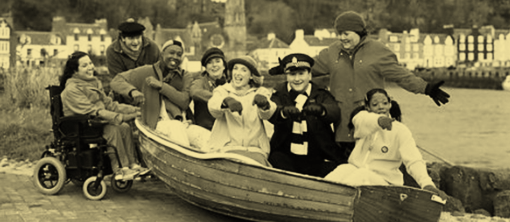
Appearances in weekly Top Ten: 169Positive mode back on. Not too many CBeebies shows have been quoted by Malcolm Tucker in The Thick Of It, but Balamory is definitely part of that elite group. Anyway, the story here was that the residents of a fictional island community off the west coast of Scotland, each resident having a personality as distinctive as their individual colour of clothing, not to mention each person having a signature song. It was popular enough to attract several special guest actors, such as Terry Wogan, Still Game’s Greg Hemphill and… John Altman from EastEnders. Not going to lie, that last one is a surprise. Such was its fame at the time, there was even a DVD-exclusive episode. Remember them? The past is indeed a different country.
- ABNEY AND TEAL
First appearance: 2011
Last appearance: 2017
Highest viewing figure: 717,000
Appearances in weekly Top Ten: 178Hey, fellow children of the 80s! Remember when much of Children’s BBC output was repeats of slightly grim 70s kids programming, where little characters made the best of things in grim surroundings? Well this tale of two forgotten rag doll siblings living on some small islands on a lake in a part was a continuation of that fine tradition. A pre-tea-time slot helped it find an audience and cling onto it.
- BLUEY
First appearance: 2021
Last appearance: 2021
Highest viewing figure: 972,355
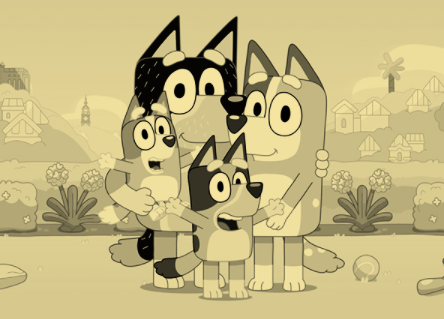
Appearances in weekly Top Ten: 181CBeebies’ most recent runaway hit. Only arriving on the channel in April 2021, and by the end of the year it had made the channel’s Weekly Top Ten 181 times — and that’s despite there being few episodes on iPlayer at any given time (Disney+ have first dibs on the whole run). And it’s not hard to see why — despite the titular character being a Blue Heeler dog from Brisbane, it’s probably the most relatable programme ever screened on the channel. Even more so than Andy’s Dinosaur Adventures.
And it certainly doesn’t hurt that patriarch Bandit Heeler is a standout character, joining the TV Dad Hall Of Fame alongside Homer Simpson, Martin Goodman and Frank Costanza. Not only are his antics (often combined with his willingness to persevere with a ‘bit’ to his own cost, such as the magic xylophone that allows his daughters to freeze him to the spot in the series opener) truly winsome, but his willingness to put aside his own comfort for the sake of his daughters’ entertainment helps off-screen dads realise that maybe we should be raising our own game a little, too.
Of course, for all it’s magnificence one can only wonder what the neighbours must think if they overhear you asking your kids “Shall we put a Bluey on?”. But still, as Bandit memorably states at the denouement of one misadventure, are you not entertained?
- 64 ZOO LANE
First appearance: 2002
Last appearance: 2018
Highest viewing figure: 630,000
Appearances in weekly Top Ten: 210Noisy neighbours when you’ve got little children are, to use an understatement, worse than three Hitlers. However, 7-year-old Lucy isn’t complaining — she lives next door to a zoo at, appropriately enough, 64 Zoo Lane. Each night, the animals tell her a story about their background, ending just in time for some friendly morality and bed. And quite a hit it was, too.
- CHUGGINGTON
First appearance: 2009
Last appearance: 2016
Highest viewing figure: 722,000
Appearances in weekly Top Ten: 225What if Thomas The Tank Engine but Pixar’s Cars? That’s basically the premise here. Clearly designed to be slightly cooler and more relatable than the antics of Thomas and Friends, but did Chuggington never have a toy range crossover with DC Comics? No. No, it did not.
- SARAH & DUCK
First appearance: 2013
Last appearance: 2021
Highest viewing figure: 614,000
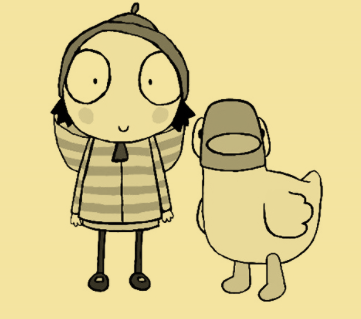
Appearances in weekly Top Ten: 227One of the more charming offerings from the channel, the simple tale of seven-year-old Sarah and her best friend Duck, who is a duck. On the surface, the theme is friendship and coping with minor adversity, but the world inhabited by the duo is so packed with wonder and whimsy it’s easy to see why it’s beloved by so many children.
It’s not without its grown-up fanbase, too. A situation perhaps not hurt by the comforting tones of Roger “The Thick Of It, Cabin Pressure, Endeavour” Allam on narrator duties, plus a great supporting cast in Downton Abbey’s Lesley Nichol, kids TV royalty Derek Griffiths and Andy Nyman who plays a sarcastic bag. And don’t forget the occasional background reference for TV and film nerds.
- THE STORY MAKERS
First appearance: 2002
Last appearance: 2008
Highest viewing figure: 513,000
Appearances in weekly Top Ten: 246An early hit for the channel following its 2002 launch, and it’s one that employs a trusted format — a nice story being read to the audience. Though to make things a bit more interesting, there’s a suitably high concept behind the strand. After the library setting closes for the evening, puppet monsters Jackson and Jelly sneak out and are joined by a (non-puppet) member of the Wordsworth family for a night of storytelling until dawn breaks and the library staff return for another day. A nice enough premise, though one can only wonder how often it led to small children creeping around corners of their local library to try and catch their local felt monsters unawares.
=10. GIGGLEBIZ
First appearance: 2009
Last appearance: 2019
Highest viewing figure: 730,000
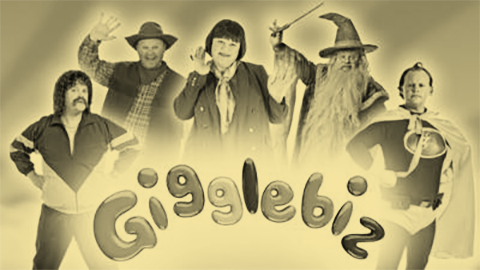
Appearances in weekly Top Ten: 251Not content with playing various members of the extended Tumble family for Something Special, Justin Fletcher wipes away the red nose and freckles to play a variety of other characters in this sketch comedy series. And as introductions to the world of sketch comedy go, it’s a damn good one, with Crackpot inventor Professor Muddles very much from the Ronnie Barker school of comedy monologue, inept dancer Enrique Pasadoble not a world away from the physical antics of Rowan Atkinson, while Captain Adorable shares at least 70% of his DNA with Russ Abbot’s Cooperman. Standout character. The closest thing Gigglebiz has to a host is cheery newsreader Arthur Sleep is as solid a comic creation as any, his 1970s Regional News demeanour simultaneously making no sense at all given the target audience, and being a perfect lynchpin for the show.
The series is such a smash that it earned it’s own spin-off series — panel show GiggleQuiz, where various characters (all played by a Justin in a style similar to the famous funeral scene from Kind Hearts and Coronets) answer questions based on clips from the series. So damn adept is Fletcher at adopting each persona, at the end of each episode where all five participants get up and dance to the closing theme music, each character has a distinct signature dance. Truly he is an übermensch for the under-sevens.
=10. GRANDPA IN MY POCKET
First appearance: 2009
Last appearance: 2014
Highest viewing figure: 707,000
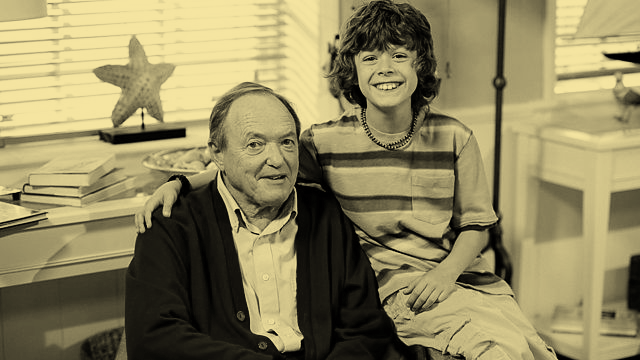
Appearances in weekly Top Ten: 251A role flung far from playing a young chap fighting his way through adulthood in The Likely Lads, James Bolam appeared as the titular Grandfather in a premise based on 70s Dandy strip Peter’s Pocket Grandpa. As, of course, was Mickey’s Miniature Grandpa from Viz, which means I can never take this programme seriously. You know, this programme about the Grandpa who owns a magical shrinking cap that makes him four inches tall.
- SOMETHING SPECIAL

First appearance: 2005
Last appearance: 2020
Highest viewing figure: 706,000
Appearances in weekly Top Ten: 259If you ever need a reason why the BBC is something that should be fought for (and not against, as seems to frequently be the hobby of the deplorable), it’s this. Originally commissioned to help introduce children to Makaton signing, and specifically aimed at kids with delayed learning and communication difficulties, it soon became a favourite of all CBeebies viewers. As a result, it’s still going strong 19 years after first airing, behind only Play School as Britain’s longest running preschool series. One can’t help but think it’s something that would never ever be made by Netflix.
- OCTONAUTS
First appearance: 2010
Last appearance: 2021
Highest viewing figure: 806,000
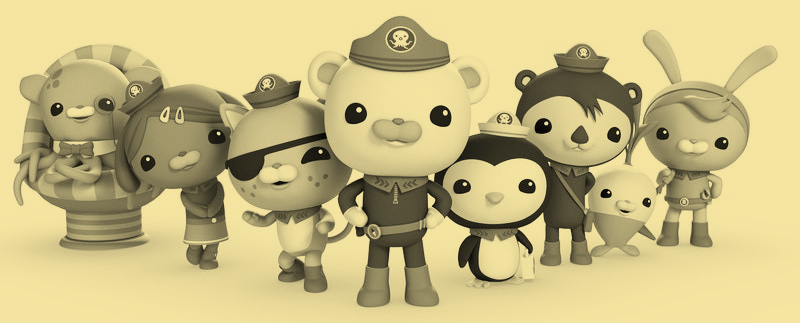
Appearances in weekly Top Ten: 261From something that Netflix would never commission, to something that proved so popular Netflix went and nabbed the rights to it. Based on a series of books by Vicki Wong and Michael C. Murphy, Octonauts follows the adventures of the crew manning an underwater research station. A reimagining of Sealab 2020 but with Michael from I’m Alan Partridge voicing the lead character, if you will. After 116 episodes and a dozen specials (plus minute-long ‘Creature Reports’ to be shown between other programmes, where the crew introduce viewers to various sea-based creatures), spin-off Octonauts: Above & Beyond was snaffled up by the US streaming giant.
- BING
First appearance: 2014
Last appearance: 2021
Highest viewing figure: 1,134,786
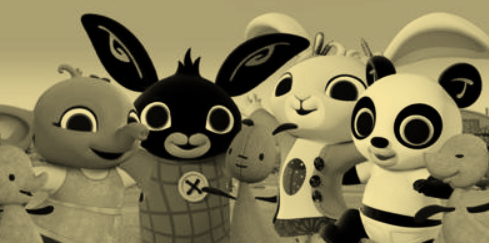
Appearances in weekly Top Ten: 299Talk about a tough start in life. Not only is titular bunny Bing being inexplicably brought up in a world where all adults have been replaced by stuffed toy guardians, who help them learn to cope with their clearly uncertain future, but he’s named after the internet’s most unpopular search engine. Lucky for him then that his journey out of toddlerhood is being guided by his own appointed stuffed toy guardian Flop, containing the authoritative voices of Mark Rylance (for series one) and David Threlfall (for series two).
Yes, it’s tempting to grumble about Bing making a big drama out of everything and muttering about how a spell in the armed forces will sort him out (just me?), but then this has won an International Emmy Kids Award and you haven’t, so shush.
- CHARLIE AND LOLA
First appearance: 2005
Last appearance: 2019
Highest viewing figure: 651,000
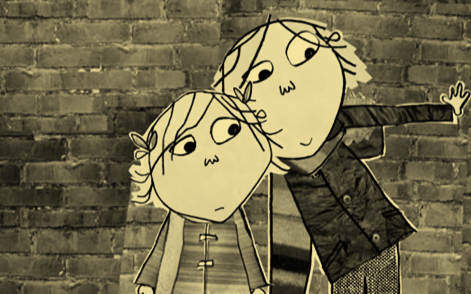
Appearances in weekly Top Ten: 353Adapted from the books by writer and illustrator Lauren Child, this series follows the antics of energetic, imaginative and impetuous little girl Lola and (thankfully) older brother and much-needed voice of reason Charlie, ever ready to help his younger sibling learn and grow from life’s little setbacks. And very popular it has proved too — despite the last episode first being screened in 2008, it remained a ratings warhorse for more than a decade since that point. The lively energy throughout, and fascinating animation style, taking in montage of real-world photography to underlay the original artwork, makes it easy to see why that was the case.
- IN THE NIGHT GARDEN
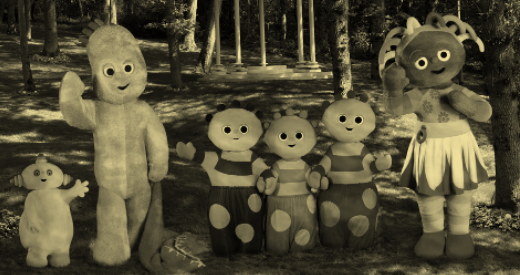
First appearance: 2007
Last appearance: 2021
Highest viewing figure: 580,000
Appearances in weekly Top Ten: 380It seems wrong to describe the gentle tale of some magical creatures cavorting around a fantastical garden in the dreams of children as ‘a juggernaut’, but when it comes to this series, it really does fit. Part of a pre-bedtime routine for a huge number of children, the names of Igglepiggle, Upsy Daisy and Makka Pakka (changed from real name Michael Parkinson to get an Equity card, I believe) are likely to have been amongst the first words uttered by tens of thousands of toddlers since the show first aired in 2007. Of course, it’s all nonsense for anyone over the age of five, but then it’s not for them. So stop trying to get Social Services to do something about the way the Pontipines keep losing their kids.
- PETER RABBIT
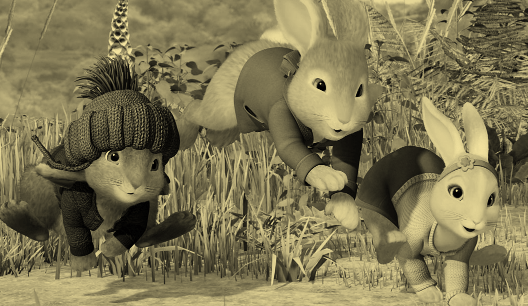
First appearance: 2012
Last appearance: 2021
Highest viewing figure: 699,000
Appearances in weekly Top Ten: 386Some interesting facts about Peter Rabbit:
Surprisingly, this Irish-made adaptation of the classic Beatrix Potter books actually aired first on US kids network Nick Jr (on 14 December 2012), only arriving on CBeebies for the first time a few weeks later.
It’s very popular in the USA, with viewing figures as high as three million. The series has also picked up three daytime Emmys over there.
Aside from also being a hit on CBeebies, translated versions are also screened on BBC Alba as ‘Peadar Kinnen’ and on S4C as ‘’Guto Gwningen‘’.If you’ve not seen it, don’t worry. James Cordon isn’t in the TV version.
- TOPSY AND TIM
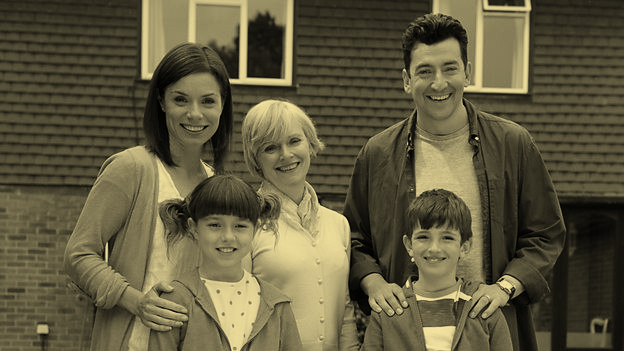
First appearance: 2013
Last appearance: 2020
Highest viewing figure: 1,027,170
Appearances in weekly Top Ten: 396When it comes to live-action kids programming containing child actors, there really is a need to churn out as many episodes as you can before the kids get too old for the audience. It’s why there’s no Champion of Champions episode of Swashbuckle, the original intake of contestants are now busy doing A-Levels and creating NFTs. And that’s why when it came to adapting Jean Adamson and Gareth Adamson’s long-running series of books, they needed to get out the door as quickly as possible, with 71 episodes produced between 2013 and 2015. A run in the Just Before Mum And Dad Put Pointless On 5pm slot helped attract an appreciative audience, at least in our house.
- TWEENIES
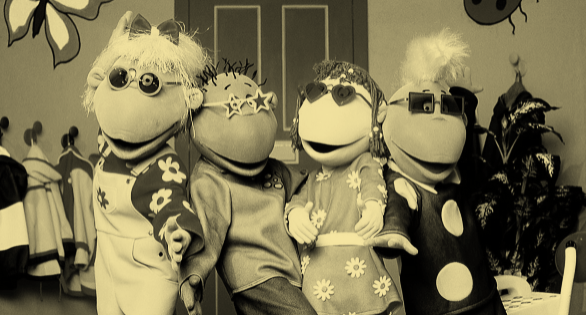
First appearance: 2002
Last appearance: 2015
Highest viewing figure: 540,000
Appearances in weekly Top Ten: 448The first truly big show for the then-new channel. Now most frequently remembered for, y’know, an episode featuring a Tweenied version of The Most Cancelled Of Cancelled Celebrities, but back then it was huge. Even thirteen years after first airing, it remained popular enough to become the thirdmost CBeebies popular programme on a given week. As was the style at the time, it grew an audience away from CBeebies — it originally started on BBC1 and BBC2 in 1999 — but repeats of the shows 390 (crikey) episodes were essential for the fledgling digital channel, and the original digital TV generation of young viewers lapped it up.
The popularity of the show even troubled the pop charts — five spin-off singles reached the UK Top 20 between 2000 and 2002 — leading to inevitable appearances on Top Of The Pops. Look out for those on BBC Four in about 2027.
THE OTHERS
Before that number one spot, here’s a quick run through of some other big CBeebies shows that — slightly surprisingly — didn’t make the top twenty.
Grimbles. Despite being all over the place, GO JETTERS only reaches 26th place in the list. I blame whoever decided to water down the antics of nominal ‘baddy’ Grandmaster Glitch once they realised he was the most likeable character in the whole thing. Hey, if you want the good guys to be popular, give them better catchphrases than ‘geographic!’.
Despite having a brilliant premise that it’s hard to believe hadn’t been done before (anthropomorphised blocks of numbers who get up to arithmetical adventures), NUMBERBLOCKS only lands in 34th place on the list. A pity that it isn’t higher, as it’s a genuinely great format for younger viewers, helping them to easily visualise number sets, coaxing them towards maths and numbers and compiling massive spreadsheets of viewing figures for old telly programmes so I don’t have to do it any more. It’s also a surprise that similarly developmentally-helpful companion show (only for letters and words) Alphablocks (125th place, if you’re wondering) actually preceded it. After all, it’s the numbers one that can more easily be sold to countries daring to speak a language other than Our Queen’s English.
Despite the presence of James Bolam in the top ten, it’s actually OLD JACK’S BOAT (36th place) that really draws in a big name cast. The titular sailor is played by none other than Immortal (in our hearts) National Treasure Sir Bernard Cribbins (to use his full title), and he’s accompanied by Freema Agyeman (officially making this a Doctor Who spin-off, I believe), Helen Lederer and Janine Duvitski. Oh, and Don Gilet from EastEnders. But really, it’s worth tuning in for Cribbins. Nice to just have him around the place, given his long-running association with the Beeb’s children’s output over the decades.
When it comes to one-off antics, the CBeebies Christmas Pantos are as big as anything the channel has ever done. But they’re one-off specials, so I’m not including them here (apart from a footnote in a bit, excitement fans). But if anyone doesn’t want to wait until Christmas for some shouty on-stage action, JUSTIN’S HOUSE (42nd place) is a must. Justin Fletcher —at this points so essential to the channel he should be made Lord Mayor of MediaCityUK — appears as himself in a heavy farce involving a houseshare with a robot butler, a green monster puppet and 56% of the UK’s slapstick reserves. A place in the studio audience must have been something under-7s would trade in any toy for, which makes it a shame that Covid has resulted in the show switching format to a less arresting (and audience-free) stock sitcom. Bah.
Here’s something pretty astonishing. There’s a programme that goes out daily, as close to peak-time as you can possibly get on CBeebies, and has a special guest presenting each episode. Not just any guest presenter — we’re talking the likes of Tom Hardy, Reese Witherspoon, Vicky McClure, Sam Mendes, Rick Astley, Jodie Whittaker, Mark Ronson, Matt Berry, Dolly Parton and Chris ‘Captain America Not TFI Friday’ Evans, and those are just the ones currently on iPlayer. And yet, CBEEBIES BEDTIME STORIES only makes 74th place on the list.
Despite a good old stupid premise for each and every episode (“Oh no! I’ve just made a simple and easily explainable mistake while working as a museum curator. Now, I could apologise, or I could USE A MAGIC CLOCK TO GO BACK TO DINOSAUR TIMES AND GET A NEW ONE AND THEN ALMOST GET KILLED”), ANDY’S PREHISTORIC ADVENTURES only reaches 81st place on this list. Should’ve just fessed up, Andy.
Despite the presence of Adam Buxton in the role of titular blue monster (Under-7’s love The Adam & Joe Show, yeah?) MESSY GOES TO OKIDO only clocks in at joint 90th place.
Despite a lengthy run in the prime 5pm-Okay-Just-This-One-But-Then-We’re-Putting-Pointless-On teatime slot, MOLLY AND MACK meanders into joint 90th place on the list. Am I mentioning this because at the height of kid-related sleep deprivation the plots of this programme and BBC One drama series Shetland morphed together in my drowsy mind so much I half expected a crim in the latter to burst into the “Oops, Oh No” song as they stand over a bloodied victim? Yes, absolutely that.
Okay, onto the most popular show in the history of CBeebies. And luckily, it’s the best of the lot. Isn’t it time for..?
- HEY DUGGEE
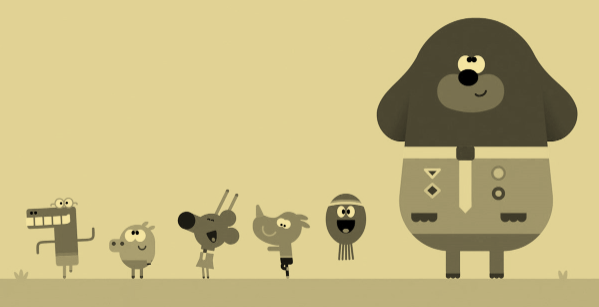
First appearance: 2015
Last appearance: 2021
Highest viewing figure: 1,272,110
Appearances in weekly Top Ten: 706A-woof. The gentle tale of an after-school club ran by a big friendly dog. Each episode sees the eager members of The Squirrel Club learn a valuable lesson, and earn a badge for their endeavours. Just five minutes long, how can it prove so damn rewatchable? If you’re parent to a Duggee-obsessed toddler, you’ll just be pleased that it is. Because you’re going to be seeing a lot of it.
Despite there being 156 episodes (at the time of typing), you can feel the effort put into every moment of it. Each little bounce of the Squirrels as they prance joyfully to the next scene, every walking motion, each wave, each little nod — it’s incredibly easy to imagine there being a big soppy grin on every animator’s face as they get another little moment just right. Every single moment is like a warm cuddle from, well, a big friendly dog.
The majesty doesn’t end with the show’s aesthetic qualities, either. The scripts bounce along just as gleefully as the Squirrels, keeping viewers old and new entertained — and there’s plenty for older viewers in there, too. In some other forms of child entertainment, packing in some gags for grown-ups dilutes the child-friendly tone far too heavily (the oh-so-risque lines in Shrek or That Awful Animated Film About The Royal Corgi With Jack Whitehall In It). In Duggee, they’re slipped in with such delicious subtlety that you might only notice the nod to Apocalypse Now, The Life Aquatic With Steve Zizzou or the BBC Micro on the fifth viewing. In short, it’s a five-minute parcel of splendour.
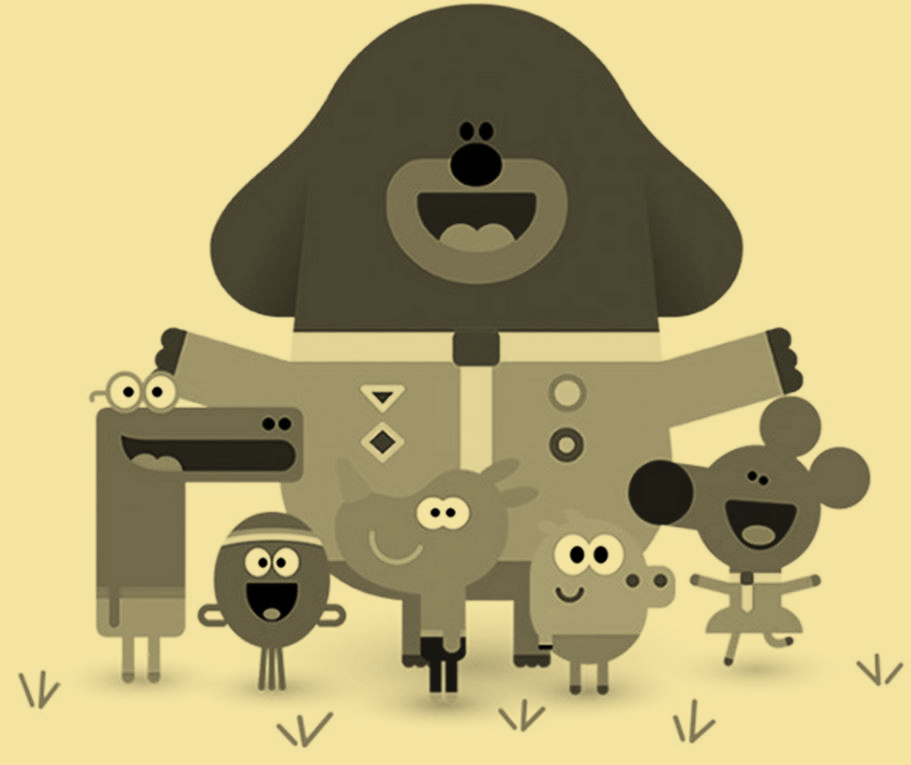
And it’s a huge show for the channel , too —were this a list of most-watched broadcasts on CBeebies, Hey Duggee would take up 16 places in the top 30. It’s one of a handful of CBeebies shows to get viewing figures above a million, and one can only wonder at how often requests to say “Isn’t it time for…” have to be edited out of a certain tea-time BBC1 game show.
Okay, Squirrels. You’ve earned your Most Popular CBeebies Programme In The Channel’s History badge.
BONUS STATS FOR NERDS
Firstly, a quick note: all the data is based on programmes marking the BARB Weekly Top 10 of most-watched programmes on the channel. And, handily, because the public BARB data includes both day of the week and time of day for each qualifying broadcast, we can get a bit more detail on things. So…
NOTE: Apologies for anyone trying to view this on a mobile. I can assure you all those numbers are very interesting, and you’re bloody-minded enough to persevere, you can see them slightly better if you’re in landscape view.
Which is the most popular day of the week for CBeebies shows?
As might be expected, weekdays — when kids are either getting ready for, or just back from school — are more popular than weekends, where they’re off doing other stuff instead, and where the channel often puts on signed repeats or slightly older programming. So, here’s a breakdown of days of the week of shows making a weekly top ten. Including a breakdown by year of broadcast, because I love you:
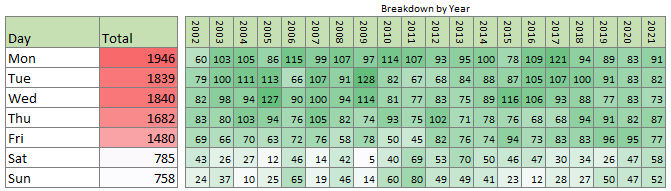
Quite the difference between weekdays and weekends, there. It’s perhaps notable that the difference between weekdays and weekends is much less obvious for 2020 and 2021, when family weekends saw far fewer options for Switching Off The Television Set and Going and Doing Something Less Boring Instead.
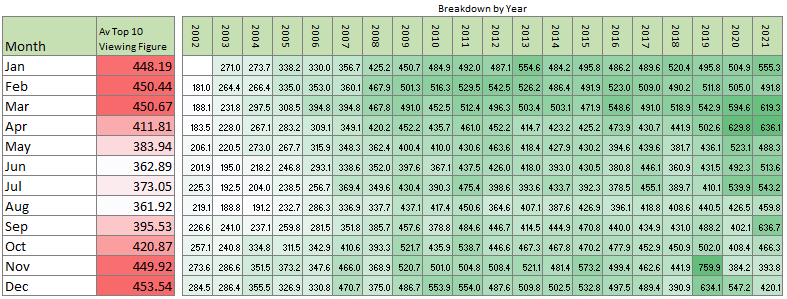
Which is the most popular month for CBeebies shows?
All logic here would suggest it’s the colder winter months that see a larger audience. And you’d be correct. Obviously here, count of programmes in the top 10 each week isn’t going to reveal anything — it’s going to be ten per week, no matter what. So instead, here’s a table broken down by average viewing figure of a Top Ten programme for each given month.
Perhaps unsurprisingly, given the Christmas holiday and reliable ratings smash the annual CBeebies Christmas Panto being aired, December is the winner here.
Which is the most popular hour of the day for CBeebies shows?
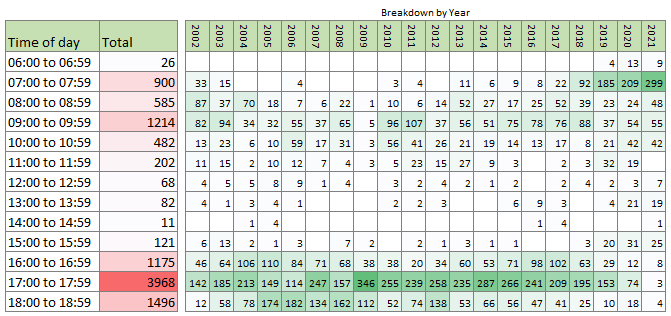
Again, perhaps little surprise here. The teatime 5–6pm slot, where shows like Topsy and Tim, Gigglebiz and Grandpa In My Pocket could be found, just before the Bedtime Hour where programming caters more for pre-schoolers, are the norm, and slightly older kids flip to Channel 4 to watch The Simpsons.
Or at least, that was the case, until 2018, where programmes from 7–8am became increasingly popular. A quick peek at the programmes broadcast in that slot gives a clue as to why:

The channel’s most popular programme, and also Bing, blagging some huge million-plus viewing figures. But why is that? Well, a big factor here will be the way BARB collate the viewing figures. Since September 2018, ‘Four Screen’ viewing has been collated, including programmes watched on iPlayer. And, as the practice of accessing iPlayer has become easier (strange now to think that watching iPlayer on a TV set only came in a few years after the service launched), the change is very noticeable.
Here’s a set of figures from before BARB’s ratings change, where (to the best of my knowledge) only ‘recorded to PVR’ viewings of a show are factored into that ’28 day data’ figure. Very little difference between the two sets of figures.

Following the change to the way data is captured in 2018, there’s a much more notable difference between viewing windows. Here are figures for a comparable period in 2019 — figures already notably higher for the seven-day period as it is, are much higher for that 28-day period, nearly doubling the figures from 2017. For the record, iPlayer’s change from a 7-day catch-up window to a 28-day window came about in 2014, so it’s in place for both sets of figures.
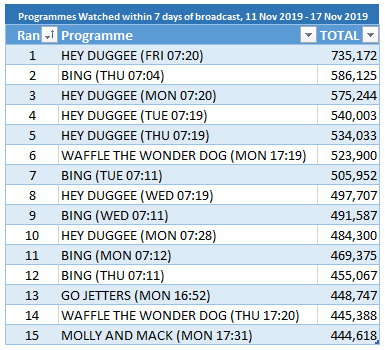

That difference in a shifting of CBeebies ‘prime-time’, then. I’m willing to bet that it’s also down to a vast increase in programmes being (likely binge-)watched via iPlayer, rather than more kids watching TV between 7am and 8am — a suspicion supported by the lack of other 7–8am programmes (Peter Rabbit, Go Jetters) in those viewing figures.
Was CBeebies Much More Popular During Lockdown?
Here’s an interesting one. With the majority of the population ordered to stay at home for much of the last couple of years, it stands to reason that anyone with young children would have put the telly on. Especially when, speaking from experience, in those early lockdown months, there was little schools could initially do to provide under-5s with home-based education.
The advice we were given by our local school was “take this time to do fun activities with your child”, and that’s what we did, at least as far as circumstances (and also trying to work from home) allowed. But, there were only so many things you could do, especially with the likes of Hobbycraft safely shuttered for the duration. So, CBeebies had much more airtime in BrokenTV Towers. But was that the case nationally?
Well, let’s find out. Using a rolling six-week average for your average viewing figure of a BARB Weekly Top 10 CBeebies show (yeah, keep it simple), here’s a summary from the start of the new ratings methodology in late September 2018, until now. Lockdown dates taken from the Institute For Government.
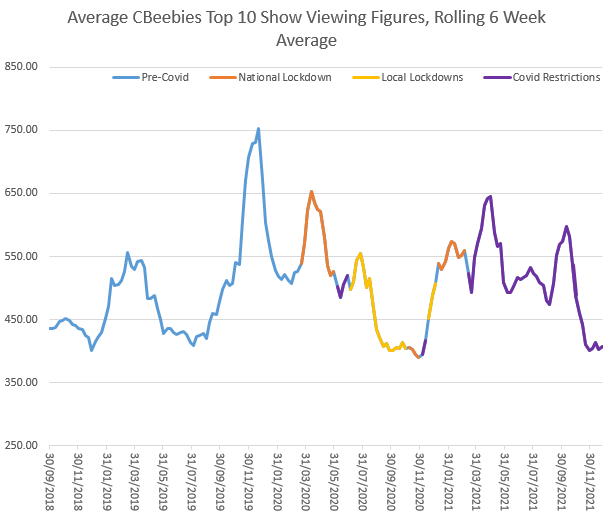
So, not especially. That was worth the time I spent working that out.
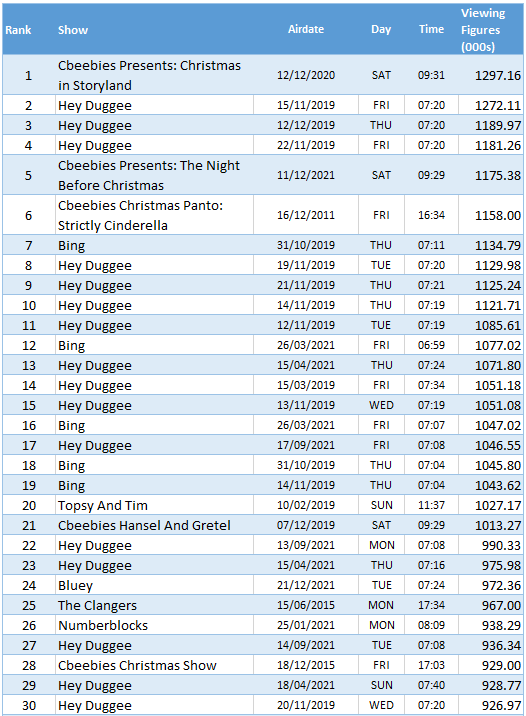
Enough Of All This Nonsense, What Were The Most-Watched Individual CBeebies Programmes Of The Last 20 Years?
Some attitude you’ve got there, mister. Here you go. The top hundred, just for you. Note: a lot of CBeebies Christmas Pantos in there, which weren’t in the list for Top 20 CBeebies Series’. Which is because they aren’t a proper series.
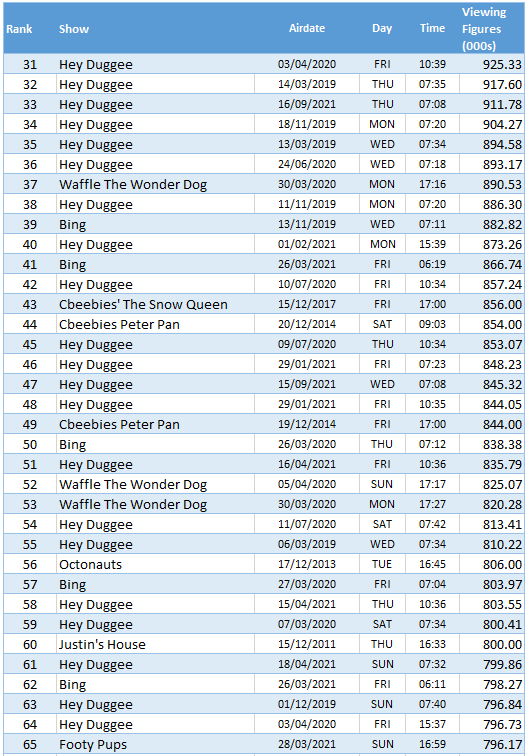
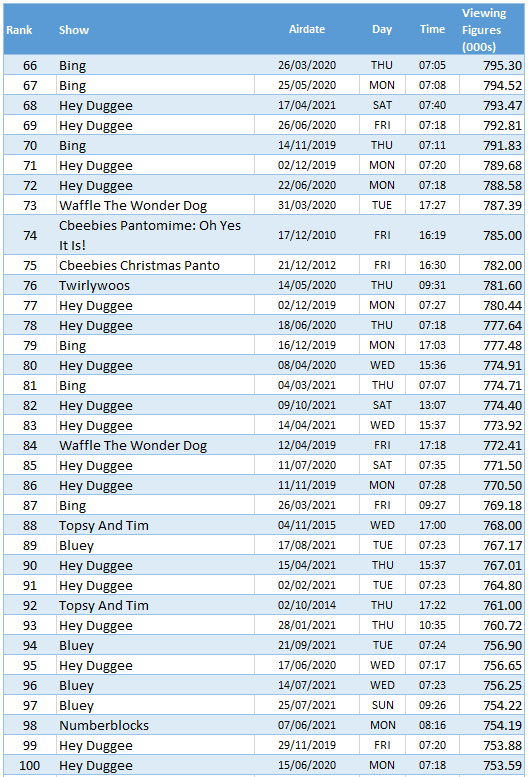
Okay, Fair Enough. What About A Longer Version Of The List From Earlier? The Most Popular CBeebies Series?
Yeah, go on then. You’ve read this far. Here you go. Some surprising positions in the list:

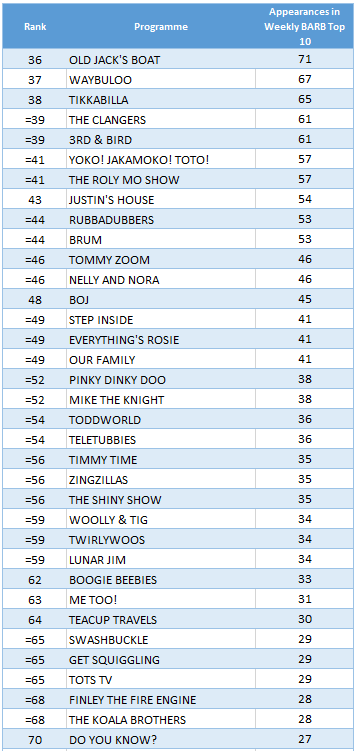

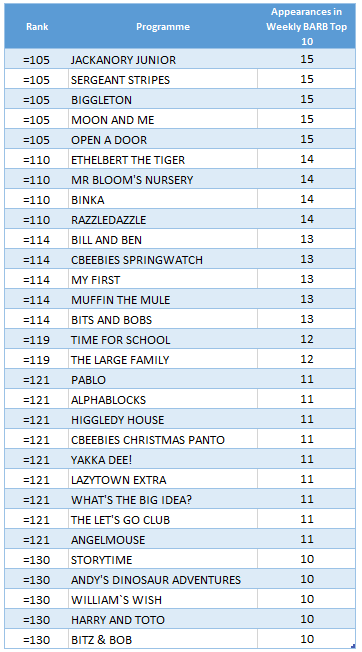
There, everything that has appeared in a weekly top ten more than ten times. And some shows in surprisingly lowly positions. Aside from the ones mentioned yesterday, The Clangers only at 39, despite the presence of Michael Palin and lashings of nostalgia, the Teletubblies reboot not even making the top fifty, and two shows popular enough to get their own spin-off magazines (Twirlywoos and Swashbuckle) only at 59 and 65 respectively.
And to repeat something mentioned yesterday, CBeebies Bedtime Stories — probably the programme even non-viewers know about (even making the BBC One News and front pages of several newspapers this week, due to a famous celebrity guest) — being way down the list.
Perhaps less surprising that Bill & Ben and Muffin the Mule are way down the pecking order, though. Now, if they’d done an animated reboot of Hancock’s Half Hour…
Anyway, that’s where we’ll probably sing the CBeebies bedtime song and leave it there. At least until the thirtieth anniversary. Now, I’d better start working on something similar for BBC Four’s twentieth anniversary in a few weeks’ time. If the channel lasts that long.
Goodnight, children.
-
BBC100: The 100 Most-Broadcast BBC Programmes Of All Time (75-71)
As Ringo Starr famously said, sorry for the lateness of my reply. This is what happens when you spot a suspiciously quiet spell in a broadcast history of a long-running series, look into it and discover it spent two years billed as “Weather, followed by [PROGRAMME NAME]”, meaning I have to recalculate a load of stuff and the show I’ve just written 1500 words on is unceremoniously yeeted up to a part of the league table we won’t get to for ages. Still, if it’s that or a half-arsed dataset, the delays are worthwhile.
Now we’re well into the territory of programmes broadcast more than a thousand times, it’s probably a bit much expecting everyone to read through entire potted histories of each programme, so instead I’m going to – at least in some cases – try and pick out some interesting detail from perhaps under-represented periods of a show’s history (or even pre-history). If only to keep things a bit more brief. So, settle down and look out for flying sausages as we get to…
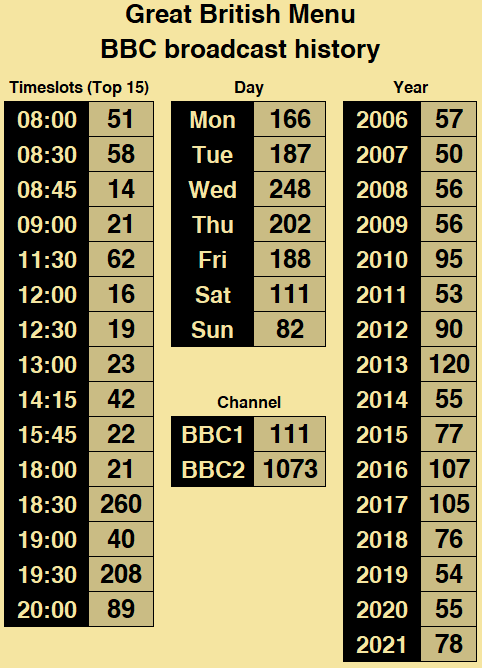
75: Great British Menu
(Shown 1184 times, 2006-2021)

Long before Bake-Off became the default Google autocomplete option for ‘Great British’, another BBC2 cookery contest set a lofty bar for highfalutin haute cuisine. How high is the falutin we’re talking about here? Falutin high enough to require hosting duties from a former BBC Royal correspondent, that’s how high. Indeed, Jennie Bond was the inaugural host of Great British Menu, where a pair of chefs from a region of the UK would compete to create a menu fit for a monarch. And I mean that literally – the goal of 2006’s first series was to concoct a birthday meal for Queen Elizabeth II, along with 300 other guests at a summer banquet.
The first series was a hit, and winning chefs from that first run returned for the second series in 2007. This time the goal was to set a menu for an Ambassadors’ Dinner at the British Embassy in Paris. Yes, yes, spoiling us etc. For 2008’s third series, Jennie Bond was replaced as host by Heston Blumenthal, and the grand finale was a little less continental, with the winning menu served at London’s Gherkin building.
The series would continue to pit top regional chefs against each other for the carrot of providing menus to distinctly British scenarios, ranging from local community groups all the way up to HRH Sir Prince Charles (now, of course, HRH Sir King Prince Charles III). It’s a format that shows no signs of stopping, with the final of 2022’s seventeenth series – themed around the 100th anniversary of the BBC – containing what might possibly be the greatest judging panel in the long history of TV judging panels: Steve Pemberton, Floella Benjamin, Alison Steadman and Huw Edwards. The Beeb in a nutshell? Pretty much.
74: Tom and Jerry
(Shown 1188 times, 1967-2003)
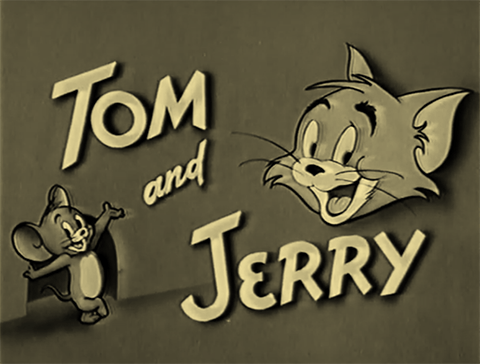
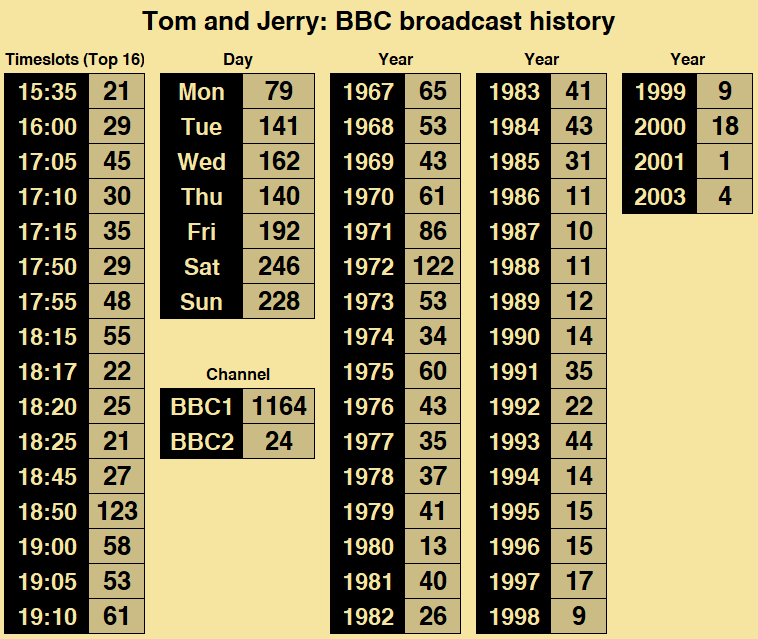
You all know the premise for this programme. They fight, and bite, and such. Here’s one that comes with a caveat: it’s likely to be the case that episodes of T&J have also been broadcast under non-specific ‘cartoon time’ slots, especially prior to 1967. Here, I’m just counting instances where they’ve been billed as such in the Radio Times. The overall broadcast total is actually likely to be higher – I’ve memories from my childhood of seeing ‘bonus’ episodes of Tom and Jerry when the news had to be trimmed down due to industrial action, meaning an unbilled T&J would often be parachuted in to fill the gap. In at least one case, doing so after an abridged 9 O’Clock News. Post-watershed Tom & Jerry. It happened. The total also misses out any episodes of T&J shown wholly within other, longer shows such as Saturday Superstore or Going Live. The former being the first place I ever saw one of the Chuck Jones T&J cartoons, and no, I don’t have a clue why my brain bothered to register that memory.
Anyway, here we’re only looking at empirical, RT-sanctioned evidence of Tom & Jerry being screened on the BBC. The earliest billed example of a T&J outing on the BBC that seems to be on Genome is a BBC-1 broadcast of 1942’s ‘Dog Trouble’, where Tom and Jerry join forces in an attempt to stop Spike the Bulldog mauling both of them. Fun times!
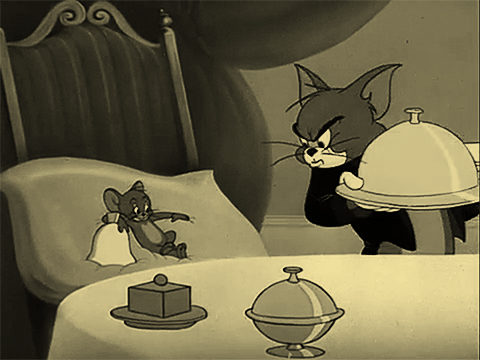
From there, Thomas Jasper “Tom” Cat Sr and Gerald Jinx “Jerry” Mouse would be an early evening fixture on BBC-1, forming a formidable triple-act with Simon Dee on Tuesday and Thursday evenings throughout 1967. By September of that year, Tom, Jerry and Dee were even sharing a Saturday night schedule, joining forces with with Doctor Who (and, erm, The News) to make up an unlikely televisual supergroup. It surely wouldn’t have killed them to have Tom and Jerry hopping into Simon Dee’s convertible motor car in the title sequence of Dee Time, surely? Imagine that.

(Radio Times, 16 Dec 1967) The Tom & Jerry & Dee alliance continued through much of the remainder of the 1960s, until Saturday 13 September 1969 came along and Dee hopped into his convertible for the last time, roaring off to upstart broadcaster LWT (and ultimately, obscurity*). T&J meanwhile went on to gobble up spaces in the BBC-1 schedule like chunks of cheese (or cat food). In 1972 alone, their cartoons aired on 122 different occasions. Most frequently as a buffer between Nationwide and the 7pm starter on an evening’s Light Entertainment menu, but also being deployed as tasty Bank Holiday snack, as post-Who Saturday night dessert, or even right in the middle of prime-time. T&J aired at 7.30pm on Tuesday 11th July 1972 (preceding an airing of a Margaret Rutherford Marple film) and at 7.40pm on Tue 8th Aug 1972 (before a screening of Bob Hope’s The Cat and the Canary). Sure, they were being deployed to avoid an awkward five-minute gap between the end of each film and the Nine O’Clock News, but it shows how much faith the BBC had in the cat-mouse duo in keeping entire families entertained.
(*Topical reference: Simon Dee later did a Victor Lewis-Smith produced final episode of Dee Time for Channel 4 in 2003, as a companion piece to the VLS documentary on Dee. As a result, Dee’s last ever chat show guest was current notoriety’s Jerry Sadowitz.)
From the mid-1980s, Tom and Jerry started to be less frequent visitors to our screens, Michael Grade’s revamped BBC1 seemingly having little room for sociopathic cat-mouse shenanigans. The cartoon found itself largely confined to filler slots on Sunday afternoons, or even (shock) used to fill in space on BBC2. It did still get a few airings where it likely attracted a decent audience – such as a double-bill on BBC1 bridging the gap between Esther Rantzen’s Children of Courage and the evening episode of Neighbours on Good Friday 1989. By 1991 though, Tozza and Jezza were BACK where they belonged, kicking off evening entertainment on Saturday evening BBC1, sharing a slot with ‘Allo ‘Allo, Bergerac and, ugh, let’s refer to it as ‘The Fix-It Programme’.
Alas, everything fades, and by the late 90s those appearances were again becoming as sparse as Good Mouse-Catching Ideas in Tom’s brain. After a final flourish in 2000 (preceding the EastEnders omnibuses each Sunday afternoon on BBC1), and one solitary appearance in 2001 (again, preceding the Sunday repeats of EastEnders, and billed in the RT with the underwhelming summary “Cartoon fun”). And so, Jerry assaulted Tom for the final (RT-listed) time on the Corporation’s flagship channel.
Not that it was a full-stop for the pair on the main BBC channels. The much less uberviolent ‘Tom and Jerry Kids’ was a part of the CBBC rota from 1998 to 2005, except that doesn’t count because it’s not proper Tom and Jerry. And even now, the CBBC channel regularly hosts the newer, longform, less good Tom and Jerry adventures.

Go on, try to kill each other. You’re not even trying. [UPDATE 04/09/2022: Reader ‘Retro71‘ writes in to mention an episode of Tom and Jerry that received complaints about swearing, with the word ‘bloody’ being mild to American ears, less so to British ones. After a little digging, the scene in question is apparently one where a pirate yells “get off my bloody boat”, though the T&J filmography doesn’t include any classic episodes set on a pirate ship – more likely it’s 1952’s Cruise Cat, which sees Tom hired as mouser on a cruise ship. Rather than that particular episode being shown in full, the scene seems to have been aired during an episode of Tony Robinson’s superb toon history show Stay Tooned!, in an episode looking at censored toons. Unfortunately, while Genome has episode descriptions for most BBC One showings of Stay Tooned!, the banned episode isn’t one of them. Anyone know any more about this? Get in touch in the comments or on the Twitter.]
73: The Sky at Night
(Shown 1201 times, 1957-2013)
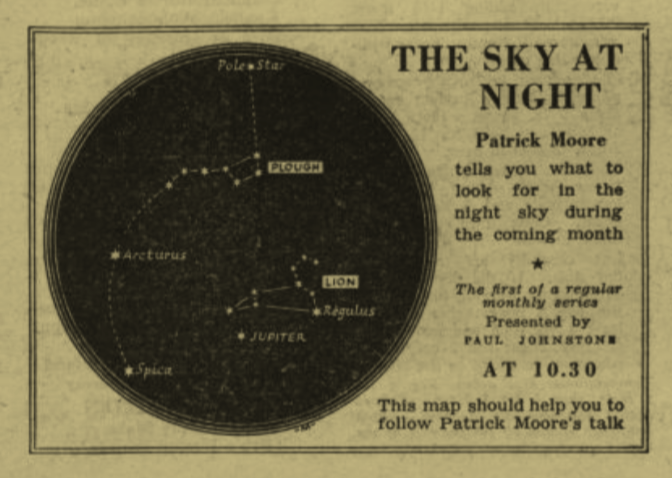
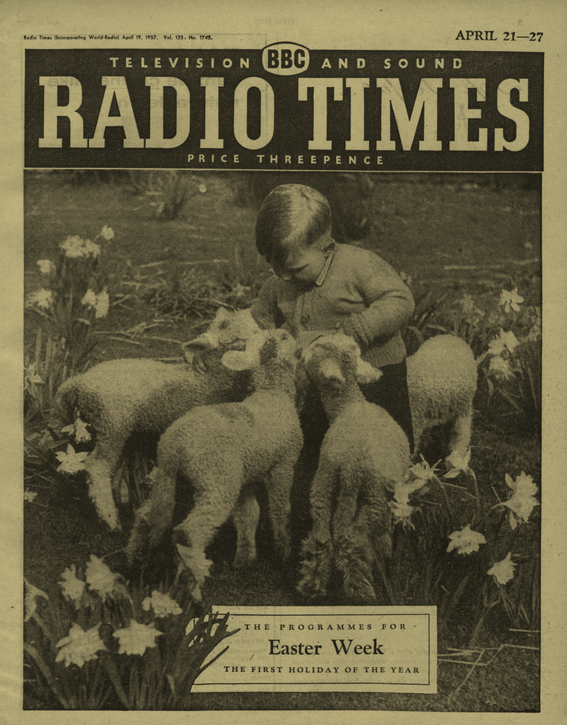
Radio Times, issue 1745, 21-27 April 1957 “Liiiiiive astronomy!”
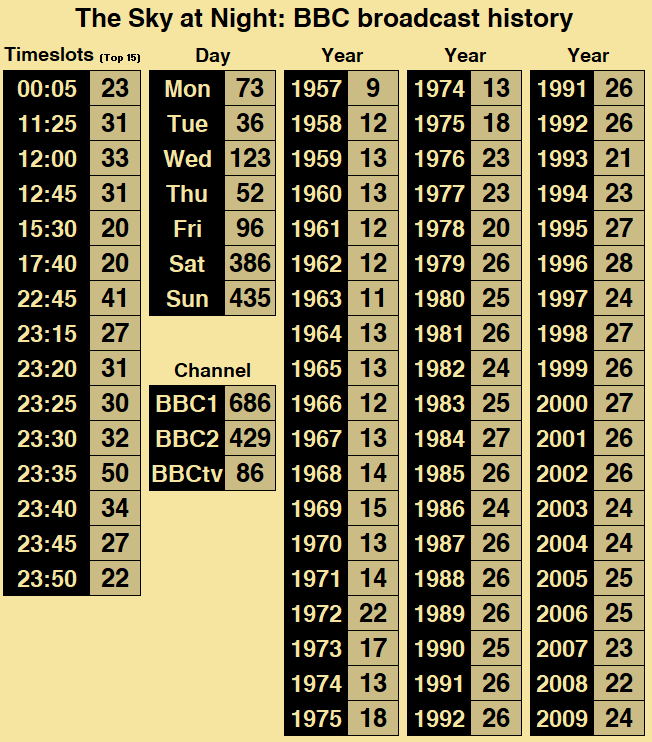
Well, here’s another one that will require some frantic reformatting of the ‘BBC Broadcast History’ table. That’s what happens when you stumble across (or if you prefer, “don’t properly plan for”) a programme that has aired on the main BBC channels for 57 years, meaning you suddenly need to cram in a bunch more broadcast years.
Back when the programme first started, on 24 April 1957, few hobbyist astronomers could have predicted the programme would run for so long. Even fewer could predict that the same host, one Patrick Moore, would still be hosting the series in Space Year 2013 (albeit posthumously – Moore died in December 2012). If nothing else, surely such a programme wouldn’t be needed that far into the 21st Century? We’d all be up there ourselves, popping to Mars for to visit Uncle Alan before nipping into the moon branch of Ikea on the way home. Surely?
Okay, that particular dream didn’t make it to reality, but Sky at Night’s marathon tenure displays an amount of longevity that deserves to be held up against humanity’s expanding understanding of the universe. When that first episode went out, Yuri Gagarin was still four years from being the first man in space, Neil Armstrong was still a test pilot and NASA hadn’t yet been formed. The vast expanse of space was still very much something that could only be explored from Terra Firma, but with the starter’s pistol poised to start the great USA-USSR Space Race, interest in worlds beyond our own was growing.
Issue 1745 of the Radio Times used the following to welcome viewers to this new programme promising to explore all things astronomical:
Star Quest
Stars, in our particular workaday world, tend to be people with agents, and success stories, and temperaments, and talents, and a certain unpredictability that can make then either tiresome or fascinating. But when we talked to Patrick Moore the other day about this month’s stars, we found ourselves in a very different world. “People tend to think,” he told us, “that astronomy is a difficult, expensive, and unrewarding subject that has become the prerogative of old men with long white beards. It is in fact none of those things, and anyone can find interest and excitement in the night sky, if he knows what to look for.”
This is to be the theme of his new series which begins on Wednesday, and which will introduce each month the highlights of the current astronomical news.
Radio Times, issue 1745, 21-27 April 1957As explained by the future GamesMaster there, the remit of the programme wasn’t specifically to monitor humankind’s efforts in reaching the stars, but rather helping the British population carry out their own exploration of space in the most British way possible: treating it as an endeavour best enjoyed at home whilst not spending too much money.
The programme would go on to be an invaluable resource for anyone interested in knowing more about what’s out there, and stuck pretty rigidly to that monthly schedule throughout, with same-week repeats often aired at times of day friendlier to younger astronomers. Of course, it didn’t always go to plan – as highlighted in Sean Lock’s trek through the TV archives ‘TV Believe It or Not’ for BBC Four in 2008 – with Moore embarking on a live episode where high-powered telescopes would roam the night sky and put the enthralling results up on screen, only for a bunch of clouds to get in the way and the whole thing to fizzle out like a damp banger.

Of course, if you were a dedicated viewer of the programme, you’d very likely need access to a similarly powerful radio telescope to spot the series’ ever-changing place in the schedules. The table at the bottom of this entry only accounts for the most commonly-used timeslots. If you want to know the full range of times when The Sky At Night was shown, here you go:
(big inhale….) 00:00, 00:05, 00:10, 00:15, 00:20, 00:25, 00:30, 00:35, 00:40, 00:45, 00:50, 00:55, 02:10, 02:30, 06:30, 06:35, 06:40, 06:55, 07:00, 07:05, 07:15, 08:35, 08:40, 09:20, 09:30, 09:40, 09:45, 09:50, 10:00, 10:20, 10:25, 10:30, 10:40, 10:45, 10:50, 10:55, 11:10, 11:25, 11:30, 11:35, 11:45, 11:50, 11:55, 12:00, 12:05, 12:10, 12:15, 12:20, 12:25, 12:30, 12:35, 12:40, 12:45, 12:50, 12:55, 13:00, 13:05, 13:10, 13:15, 13:25, 13:30, 13:35, 13:40, 13:45, 13:50, 13:55, 14:00, 14:05, 14:10, 14:15, 14:20, 14:30, 14:40, 14:45, 14:50, 14:55, 15:00, 15:05, 15:10, 15:15, 15:20, 15:25, 15:30, 15:35, 15:40, 15:45, 15:50, 15:55, 16:00, 16:05, 16:10, 16:15, 16:20, 16:25, 16:30, 16:35, 16:40, 16:45, 16:50, 16:55, 17:00, 17:05, 17:10, 17:15, 17:20, 17:25, 17:30, 17:35, 17:40, 17:45, 17:50, 18:05, 18:10, 18:15, 18:20, 18:25, 18:30, 18:35, 18:40, 18:45, 18:50, 18:55, 19:15, 19:20, 19:35, 19:40, 21:45, 22:00, 22:15, 22:20, 22:25, 22:30, 22:35, 22:40, 22:45, 22:50, 22:55, 23:00, 23:05, 23:10, 23:13, 23:15, 23:20, 23:22, 23:23, 23:25, 23:28, 23:30, 23:33, 23:35, 23:37, 23:38, 23:40, 23:42, 23:45, 23:47, 23:48, 23:50 and 23:55.
Got all those? Which was your favourite? Mine was ’23:13′. What? No, you’re trying to artificially inflate the word count. (Christ, huge apologies to anyone who might be using a screen reader to get through all that. I’ll put a joke in one of the alt-text boxes for one of the images to try and compensate.)Perhaps that’s a factor in the programme instead drawing viewers in by adopting some brilliantly interest-piquing episode titles, many of which would make equally suitable titles for Doctor Who adventures. In fact, if anyone is running a quiz night and wants to throw in a round on ‘Doctor Who or The Sky At Night Episode Title?’, feel free to throw in some of the following:
- 12/01/1959: Life and Death of the Sun
- 11/04/1960: Visitor from Space
- 23/05/1962: The Space Fog
- 17/10/1962: The Demon Star
- 10/01/1964: The Ghosts of the Universe
- 18/09/1964: Explosion in Space
- 05/11/1965: The Unsteady Universe
- 09/12/1966: The End of the World
- 08/12/1967: Lumps from Outer Space
- 21/06/1968: The Unquiet Sun
- 04/11/1968: The Clocks of Space
- 12/01/1970: Wanderers in Space
No actual episode of anything could ever live up to the title ‘Lumps from Outer Space’, of course. Nothing that could pass compliance, anyway.
In 2013, The Sky at Night’s long association with BBC1 would finally come to an end, with only a handful of first-run episodes ever going out on BBC2 (most of that BBC2 broadcast figure being afternoon repeats). Any fears that the programme was to be cancelled outright were dispelled by the Beeb however – it would be moving over to BBC Four, and there it remains.
BONUS CONTENT UPDATE 17/08/2022: Over on Twitter, Chris Lintott has informed me that for many years, episodes of The Sky at Night were broadcast each new moon. The thinking there was that serious amateur astronomers in the 1950s would likely have been studying it, so scheduling the programme that way made a lot of sense. It switched to monthly in the 1990s, when (as Patrick Moore put it) “The BBC lost track of the moon”. Superb (and thanks, Chris!).
72: Call My Bluff
(Shown 1208 times, 1965-2005)

University Challenge isn’t the only programme on the list to have had a slightly surprising origin story from the other side of the Atlantic. Despite feeling like the very epitome of dry early 1980s BBC-2 output (well, it does to me), the programme actually had a much more glamorous birthplace: Studio 6A at NBC Studios in Manhattan’s Rockefeller Center. That was where the original incarnation of the series was recorded in 1965, where host Bill Leyden challenged two teams (each comprising one celebrity and two contestants) to determine the true meaning of various obscure and archaic words. The winners would pocket a jackpot of $100 (rising to a potential $200 in the end-of-show bonus game).
Despite the glitz of a celebrity guest roster (which included Betty White, Lauren Bacall and Abe Burrows), the format wasn’t a success, lasting only a matter of months before being cancelled by NBC. Recordings of the programme were believed to have been destroyed, though the complete premiere episode does survive and is available to view at the show’s Lost Media Wiki page.
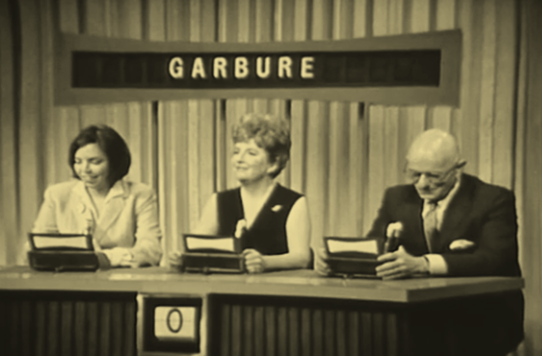
It took no time at all for the BBC to leap upon the format, pausing only to rip out the cash jackpot and replace the four contestants with additional wry celebrities, then shove it onto BBC-2 in October 1965. The quizmaster (or as the show had it, ‘Referee’) gig changed hands a few times at first – actor and musician Robin Ray took the reins for the first series, followed by actor Joe Melia for the next, then Peter Wheeler for a spell before finally landing on the referee most closely associated with the series: Robert “England’s Answer To Magnus Magnusson” Robinson. Cue countless impressions on the likes of Spitting Image, Now… Something Else, End Of Part One, A Bit of Fry and Laurie and many, many more.
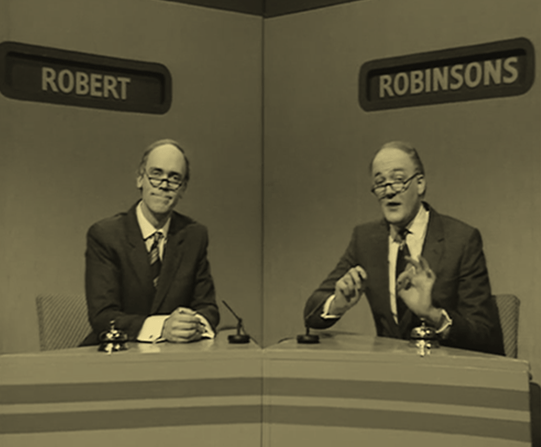
The roles of team captain would also become inextricably linked to the series too, especially in the case of comedy writer-cum-raconteur Frank Muir. During a lengthy writing career alongside Denis Norden working for everyone from Jimmy Edwards to The Frost Report, followed by management stints in the LE departments of the BBC and LWT, Muir had built up quite a reputation as a wordsmith (indeed, with Norden he coined the immortal Carry-On phrase “Infamy, infamy, they’ve all got it in for me”, originally used for radio comedy Take It From Here). Call My Bluff offered the loquacious Muir a prime opportunity to put his wordmongery to good use. [EDIT: As reader Paul R Jackson points out, credit should also be showered on Muir’s long-term opponents, namely Patrick Campbell (1966-80) and Arthur Marshall (1980-88). You are quite correct, Paul.]
The original run of Bluff, from October 1965 to December 1988, plus a one-off special in 1994 to mark thirty years of BBC2, clocked up 25 series’ and 542 episodes. Quite the innings, but as the channel geared up for a new generation of panel shows (kickstarted by the success of Have I Got News For You), the decidedly old-school Bluff had run its course. But not, it would turn out, for too long.
In 1996, the series was retooled as a daytime BBC1 series, with a suitably brighter, more 90s-friendly set and a new referee, Bob Holness. Alan Coren and Sandi Toksvig took on team captain roles. While it might not be the first line-up you’d think of for Call My Bluff, it was certainly a success – lasting for a further twelve series and a total of 555 episodes before the final Bluff in 2004. By that time, the line-up had changed a bit – 2003 seeing Toksvig replaced by Rod Liddle, and Fiona Bruce had picked up the referee’s baton (yes, I know referees don’t have batons).
In May 2014, Call My Bluff received a further anniversary shout-out in satirical retrospective Harry and Paul’s Story of the Twos. Rechristened ‘Speech Impediment’, an impersonated panel of Bluff mainstays were challenged to determine the meaning behind the word ‘paedophile’ (a nod to the BBC of the 1970’s nonchalance about the number of absolute dangers working there than anything to do with individual Bluff regulars, it would appear).

Harry and Paul got an easy ride for chumming it up with the actual real Nigel Farage in that ‘Ricky Gervais’ sketch, didn’t they? Unrelated, but still. EXTRA SUPER BONUS CONTENT UPDATE:
Ever wondered what one of the TRUE/BLUFF cards from Call My Bluff looks like in close-up? Well, with a weighty chunk of thanks to Paul R Jackson, here’s a look at one in more detail. It was sent to Paul in February 1979 by producer Johnny Downes and is signed by the Bluff regulars plus Nigel Havers.
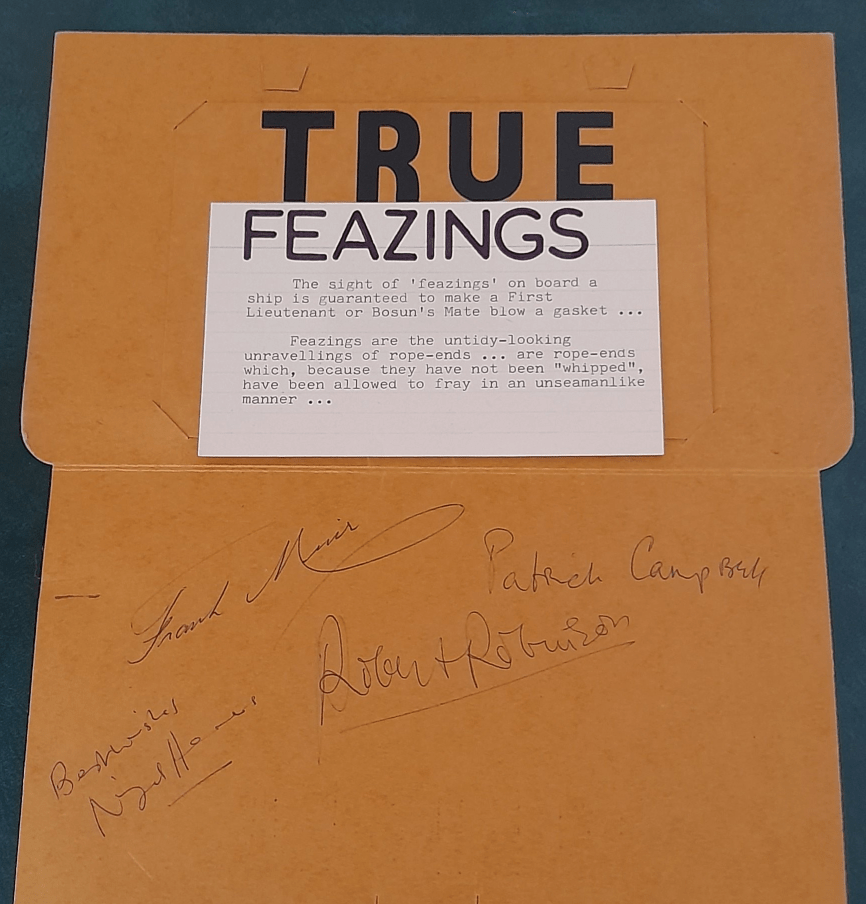
In full colour, because the site’s achingly self-conscious fanzine aesthetic can be damned for something as good as this. 
71: Grange Hill
(Shown 1244 times, 1978-2008)

“Don’t you realise the way you act is influencing millions of children to talk cockney and be insubordinate?”
“Come on sir, don’t be silly. We’re the only kids in Britain who don’t say…”
As previously mentioned in this rundown, Z Cars proved to be a revelation for an audience who’d grown weary of the idealised world of cosy TV coppers like DIxon of Dock Green. While the more uncompromising approach taken by the series attracted criticism from those preferring an idealised version of British life in their living rooms, it was a reflection of gritty reality that went on to become the norm, with Z Cars ultimately becoming the 94th most-shown BBC programme of all-time (as EXCLUSIVELY revealed here).
Welp, the same applied to dramatic portrayal of school life. The 1970s offered little in the way of television reflecting the everyday experiences of pupils, meaning that all a kid was likely to see was sepia-tinged Tom Brown’s Schooldays or the rambunctious ribaldry of Please, Sir. It all seemed to be aimed at keeping parents entertained (and indeed, comforted) rather than accurately reflecting what real-life schoolkids were living through.
Then, along came Phil Redmond.
Redmond first tried to sell the idea of a more realistic look at events in a modern-day school in 1975, and in 1976 he succeeded in convincing the BBC to give it a go. An initial run of nine episodes began on 8 February 1978. That first episode focused on characters such as Trisha Yates (Michelle Herbert), Benny Green (Terry Sue Patt) and misunderstood rogue Peter ‘Tucker’ Jenkins (Todd Carty) as they shared their first day at Grange Hill High School with the BBC1 audience.
Within a few years, the volume of angry tabloid copy about the series was rising as quickly as the viewing figures. This was a topic that needed a little more space than a spare fifty seconds at the end of Points of View. And so, on 4 March 1980, BBC-1 set aside some time in the schedule for a one-off discussion programme, where the future of the series – and presumably whether it should be allowed to have one – would be debated.

It’s little surprise that parents and teachers were taken aback by events at Grange Hill. Early storylines covered topics such as bullying, organised protests and child molestation, presumably much to the surprise of anyone tuning in early for The Magic Roundabout. Not that Redmond was willing to dampen down the programme’s rhetoric. By the mid-1980s, the focus had shifted to topics such as shoplifting, racism, knife crime, suicide, teenage pregnancy and heroin addiction. Much to the surprise of anyone tuning in early for Masterteam, I’ll wager.
Not that it was all doom and/or gloom. Weightier topics were often offset by japes, jokes and scrapes, and school-age viewers had the added fun of comparing their own teachers to those within Grange Hill. Was your PE teacher as much of an arch bastard as Roger Sloman’s Mr ‘Frosty’ Foster? Was your English teacher as good natured as Anna Quayle’s Mrs ‘Marilyn’ Monroe? And were any of your teachers anywhere near as bad as Mr Bronson, played by a Michael Sheard tellingly more used to playing the part of Adolf Hitler?

Daily Mirror, Sat 8 Sept 1979 To say Grange Hill quickly became a huge success feels a bit of an understatement. But, looking through the British Newspaper Archive for stories about the series (see above), there can’t have been too many Children’s BBC dramas that warranted a double-page style spread in the ‘Mirror Woman’ section of the Daily Mirror (27 Feb 1980). The article claims ratings for the series were as high as ten million (which strongly suggests it wasn’t only the kids watching it).

One particularly handy aspect of running a school-based drama is, of course, the natural cast attrition that goes with it. No need to have an endless parade of characters suddenly deciding to move to Manchester – they hit Sixth Form, get to wear their civvies for a year or two, then they’re leaving the series to make their way into the real world (usually a role in EastEnders). As each group of cast members leave at the end of the academic year, a fresh intake of pupils arrive. A process which saw the programme run for a total of thirty years.
Sure, there were changes along the way (such as in 2003, when production of the series moved to Mersey TV’s studios in Liverpool, meaning a new intake of pupils who’d suddenly developed Granadaland accents), but for remaining so popular with generations of British children over three damn decades, Grange Hill deserves a place amongst the hardiest of television programmes in the BBC’s history.

Okay, that’s it for this helping. Expect the next instalment ‘soon’, or your money back. Until then, keep ’em peeled for any suspicious lumps from outer space.

-
BBC100: The 100 Most-Broadcast BBC Programmes Of All Time (80-76)
The ill-advised journey through the papery soup of BBC scheduling history continues, your intrepid reporter wading on with increasingly papier-mâchéd legs to bring you the following five dispatches from television history. Quite a long one, given the sheer bloody amount of history for some of them.
80: The Phil Silvers Show
(Shown 1107 times, 1957-2004)

Here’s an entry with a truly impressive range of broadcast years. Especially so considering it’s an American sitcom, which (a few exceptions aside) generally enjoy a run on British screens not too dissimilar from their original US airdates, or which see broadcast rights batted between the Beeb, ITV and any other channel operators around at the time (cf The Flintstones). But, let’s be honest here, The Phil Silvers Show isn’t just any American sitcom. As far as comfort-viewing sitcoms that transcend age and time go, I’d argue it’s (at least to British eyes) a stateside cousin of Hancock’s Half Hour.
Perhaps like several of you reading this, the name of The Phil Silvers Show is one that always seemed to appear in the long grass of the post-post-bedtime schedules, and as such always held a curious allure along with the likes of Married… With Children or Sledge Hammer! in similar out-of-bounds slots on ITV. And while those latter two proved to be the more immediate draw for me when later bedtimes and earlier scheduling aligned (the bright NTSC colour bleed picture and brassy humour drawing me in like a child character in an unmade sequel to Poltergeist), that Silvers charm would later appeal on a different level. The levels of wit, craft and japery within each episode would easily turn out to be more nourishing in the long-term than gags about Peggy Bundy’s libido or Sledge’s near-erotic penchant for blasting perps.

Not that the antics of Bilko et al are the only classic US sitcom to make it big on the BBC, it’s just by far the longest-running on our screens. By comparison:
The Burns and Allen Show/George Burns and Gracie Allen, 109 showings (24/02/1957 to 09/09/1961 then 14/09/1979-11/01/1980, 291 episodes produced)
The Lucy Show, 146 showings (31/12/1962 to 28/12/1968 plus a one-off showing on 04/01/1980, 156 episodes produced, also shown on ITV)
The Jack Benny Program(me)/The Jack Benny Show, 58 showings (24/02/1957 to 15/02/1980, plus a one-off showing on 20/01/1990, 260 episodes produced)
Bewitched, 188 showings (13/10/1965 to 28/06/1976, 254 episodes produced, also repeated on ITV & C4)
The Mary Tyler Moore Show, 34 showings (13/02/1971 to 29/12/1972, 168 episodes produced, later shown on C4)
By comparison, there are just 144 episodes across four seasons of The Phil Silvers Show, yet episodes featuring Sgt Bilko and his platoon have been on BBC channels more than twice as often as all the above shows combined. Why? Silvers’ fast-talking wiseass character reminding audiences of Max Miller? The BBC having picked up the rights to the series for a bag of buttons? If anyone does know, I’d love to be informed, but whatever the backstory, it’s a safe bet that this is a programme that will always have an appreciative British audience.
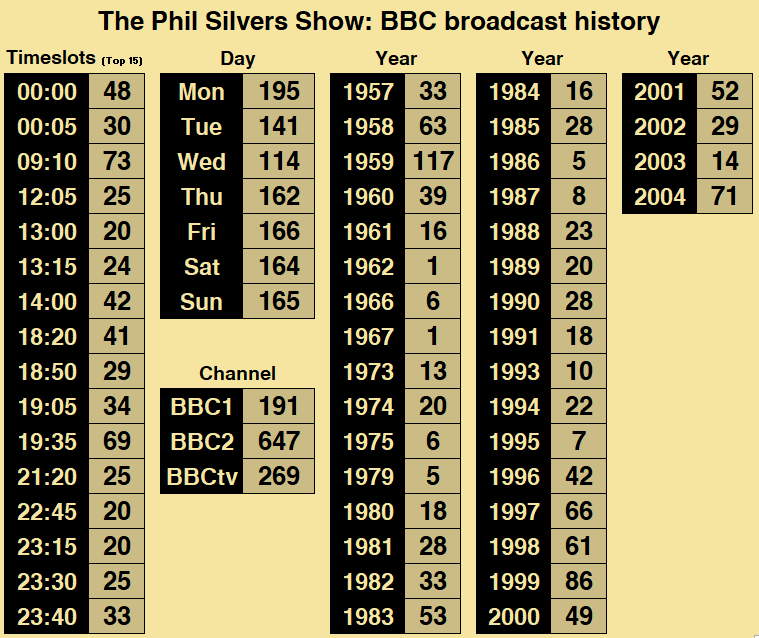
79: Doctor Who
(Shown 1138 times, 1963-2021)
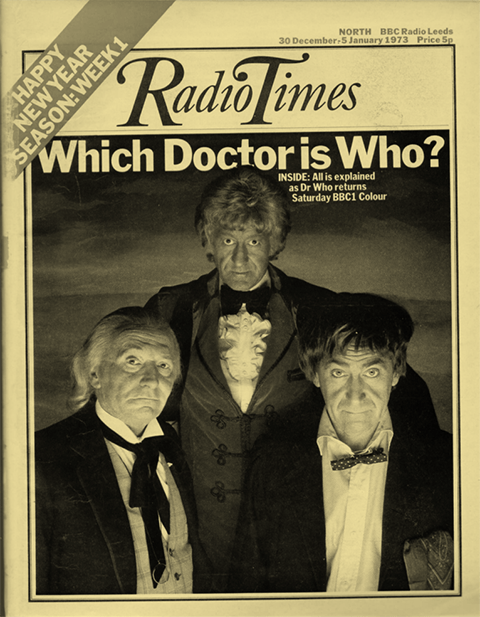
For many of these entries, if a sliver of data manages to sneak through my database without being picked up (a rogue repeat of QI masquerading under the title of ‘Oi’ due to fallibility of Genome’s OCR software, for example), it’s questionable anyone will notice. That’s what I’m banking on anyway. May I reiterate here, this is 855,306 rows of data I’m dealing with here, and that figure is growing as I fill in the occasional gap. When it comes to the next entry on the list, I suspect there will be people who’ll instantly notice whether I’ve missed a signed 4.10am repeat of an episode. So, in advance: trying my best here. I’ve corrected any listings marked ‘Dr Who’ and I’ve done my best to discount the Peter Cushing films.
I’ll admit, I’m not really much of a Whovian. The most impressive bit of Who trivia I know is that David Tennant’s stage surname is a reference-slash-tribute to Pet Shop Boy Neil, and when told this in an interview with Word magazine, Neil Tennant replied that he stopped watching Doctor Who during the William Hartnell years. Typical pop star, eh?
For the majority of its life, Doctor Who was all about Saturday evenings. Starting from that first ever episode, ‘An Unearthly Child’ beaming from the BBC Television Service to the homes of Britain on 23 November 1963, it swiftly became as much of a Saturday fixture as Grandstand or Dad’s pool coupon going in the bin just after the classified results. It took until Wednesday 27 December 1972 for the Tardis to escape the confines of the weekend schedule, by which time Jon P’Twee was playing the dandiest of all Doctors, the post-Christmas schedule enlivened by a feature-length opportunity to see the complete story ‘Dr Who and the Sea Devils’ in one sitting.

The same tactic was employed the next time The Doctor wriggled free of the Saturday evening slot, with 7pm on Monday 3 September 1973 reserved for another “complete adventure in one programme”, this time ‘The Day of the Daleks‘. It was a tactic BBC schedulers were definitely warming to, with a movie-length omnibus of previously screened stories airing on 27 December of the next few years (1973: ‘The Green Death‘, 1974: ‘Planet of the Spiders‘, 1975: ‘Genesis of the Daleks‘).
On Monday 5 July 1976, a run of individual repeat episodes made it onto weekday BBC-1 for the first time, with the story ‘Planet of Evil’ (a four-parter by Louis Marks) repeated on consecutive weekdays, each starting between 6.20 and 6.35pm. It being a four-parter meant that left Friday free. That left room for another “complete adventure in one programme”, with ‘The Sontaran Experiment‘ taking up a fifty-minute slot.

So, that nice little aside, um, aside, The Doctor returned to his regular stomping ground of Saturday evenings. That was until 4 August 1977, where a repeat of Robert Holmes’ four-part story ‘The Deadly Assassin‘ went out on Thursday evenings. That tactic was deployed again on 13 July 1978, with Bob Baker and Dave Martin story ‘The Invisible Enemy‘ going out on four successive Thursdays. That run was immediately followed by Robert Holmes’ ‘The Sun Makers’, brightening up a quartet of Thursdays from 10 August 1978. Not that these midweek departure times for the Tardis were a promotion, of course. If you’re wondering what was keeping The Doctor away from his regular weekend slot during that time, it was the inaugural run of the latest smash hit US import, “a new film series starring Lynda Carter”. For the record, the Sat night offering that shunted Who to midweek slots in August ’77 – the less glamorous offering of ‘some films’. In an era where purportedly ‘mainstream’ channels like Five or ITV2 can cram themselves full of films on any given day and nobody will bat an eyelid, it seems odd that a six-year-old film being shown would be a big deal, but that was the reality of life before video shops. Anyway.
In 1980, there was a return to the daily Doctor, with Terry Nation’s ‘Destiny of the Daleks‘ going out each weekday from Tuesday 5 August. The following Tuesday, the same treatment was almost afforded David Agnew’s ‘City of Death‘, which instead went out on Tuesday-Wednesday-Tuesday-Wednesday. If the goal behind all this was to make sure Who kids were buying the Radio Times to avoid missing an episode, it must surely have worked.
Come 1981, and the long reign of Doctor Who as a show primarily shown on Saturdays was over, meaning the lengthy process of my highlighting all the times it went out on other days is also over. Phew. From ‘Full Circle‘ onwards, weekday Who was very much the norm. November 1981 also saw something else new: a John Nathan-Turner curated season of classic Who stories, going out under the banner of The Five Faces of Doctor Who and designed to mark the debut of The Doctor’s fifth face, the one shared by Peter Davison. As well as offering younger fans a rare glimpse of previous Doctors, this marked the first time Who episodes had aired on BBC-2.

For the remainder of the 1980s, Doctor Who found itself clattering around the schedules like a particularly erratic Tardis. By 1989, even a guest appearance from Hale & Pace couldn’t arrest the inevitable ratings decline that came with being shoved in the opposite-Corrie death slot. And so, Michael Grade had Doctor Who fired from a cannon into the Sun. As a result, on 6 December 1989, with the last part of Rona Munro’s ironically-titled ‘Survival’ (“The Doctor and Ace move towards their final confrontation with the animal inside us all”) it seemed that Doctor Who was finally coming to an end.
But, the Doctor wasn’t going to take such a trifling thing as ‘death’ particularly lightly. August 1991 saw the first of what would become many repeats of classic Doctor Who on BBC2, starting with (appropriately enough) a repeat airing of ‘An Unearthly Child‘, the story that kicked off the whole affair. The following January, the first of a series of Friday evening classic episodes arrived, starting from the very earliest surviving episodes, as part of a weekly cult TV strand – the lead-in to these classic Who repeats was Thunderbirds.
So well-received were these repeats that November 1993 saw a brief run of classic episodes back on BBC1 to mark Who’s Thirtieth anniversary, and in primetime to boot. Admittedly in the Friday night 7.30pm opposite-Corrie slot, but at least it showed someone at TV Centre still cared about the series. And then, in 1996, New Who! The Paul McGann TV movie aired on Monday 27 May 1996, and… well, that was a one-off, as everyone knows.
A few flurries of repeats fell upon the ground (or more accurately, upon BBC2) across the late 1990s and in the first few months of the 21st century, but from that point (specifically the last part of Genesis of the Daleks going out on 29 February 2000) it would be five whole years before Who reappeared in the biggest possible way. And that… is a story you hopefully (really, hopefully, in the interests of keeping this entry to a manageable length) you already know.
Bye, Bernard. The best companion. 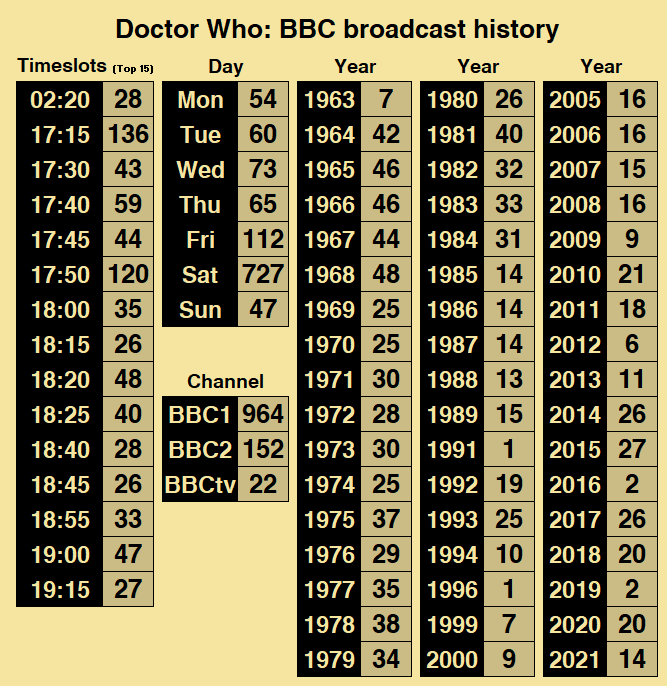
In case you’re curious about that 02:20 up there – signed repeats. NOTE: Entry updated on 7 August to better reflect that weekday episodes I’ve highlighted were repeats rather than first-run episodes. With thanks to Cinema Limbo. And an additional dollop of thanks due to Cinema Limbo for the following corrections:
“There were five other weekday repeats prior to 1972. Spearhead from Space aired at 6.20pm on Fridays 9-30 July 1971, and The Daemons aired as an omnibus at 4.20pm on Tuesday 28 December the same year. You also referred to the 1991 screening of An Unearthly Child as a repeat. It was actually the world premiere of the pilot episode, shot from essentially the same script as the actual first episode was a month later, but which was felt to be too clumsy and weak a production. There were a bunch of other non-Saturday repeats during the 1970s, which I assume you simply decided not to mention [Correct, this entry was long enough as it was – MGJ], but notable was The Robots of Death airing as a two-parter on New Year’s Eve/Day 1977/8, the latter episode being the only time an episode was networked on a Sunday until 1994, and in primetime on a non-Christmas Day until 2009.”
78: Watchdog
(Shown 1141 times, 1985-2019)
All together now: “Potential death trap.”
It really does seem a bit weird that a programme that feels so current (even if it actually ended a few years ago) started off as a segment in Nationwide, but that’s how Watchdog started. In 1980, TV’s beigest current affairs programme introduced a new consumer affairs slot hosted by Hugh Scully, which very swiftly became a fixture. So much so in fact that it was one of the few aspects of the ‘Wide to migrate to Sixty Minutes in 1983 (and if you don’t remember it or are too young to have been around then, Sixty Minutes was the BBC News version of New Coke).
Once Sixty Minutes was Six Feet Under within a year of launch, and the current ‘National News then Regional News’ format was introduced in its wake, there wasn’t really room in the news hour for a consumer affairs programme. And so, in 1985, Watchdog carved itself a place in the programme listings for the very first time as a standalone programme. Initially floating around the 6pm slot on Sunday evenings, the Nick Ross-Lynn Faulds Wood phase of the series lasted for 13 episodes between July and October.
The following November, Watchdog found a new home: on weekday mornings operating as a palate cleanser between the sugary Breakfast Time and Robert Kilroy-Silk’s spicy Day to Day at 8.40am each morning, as part of Michael Grade’s assault on daytime television. Nick Ross departed hosting duties, so Lynn Faulds Wood was joined on screen by husband John Stapleton.

Context not being provided. You’ll have to watch the episode. This second phase didn’t stick around for too long – by May 1987, it was time for something new in that slot (if you count ‘twenty extra minutes of Breakfast Time’ as new), but the ‘Dog had still tucked a further 106 episodes under its collar. Come November 1987, it was back to early Sunday evenings for Faulds Wood and Stapleton, with a Monday afternoon repeat broadcast.
That’s until January 1988 – after just a few weeks back in that Sunday evening slot, it was time for Watchdog to move to a location in the schedules that’ll be a lot more familiar to many, a weekday primetime slot. For the first episode in this new slot, a 7.35pm home nestled comfortably in between Wogan and The Kenny Everett Television Show. I’d wager it’s here where the programme really seeped into the national consciousness, where the likes of Rory Bremner could throw on a wig, adopt a Scottish accent and present a stern warning about, I don’t know, a shady bunch of people selling something that won’t ever be delivered (by which he means the government). Or, more famously and (to be fair) accurately, Hugh Dennis getting indecent about the threat of cancer-pumping pepper grinders in The Mary Whitehouse Experience.
From there, it would ultimately become a vehicle for Anne Robinson, who in 1993 migrated from being The Voice Of The Viewers berating the actions of Them Upstairs in Points of View, to a wider remit as lead representative of the people against shady business practices beyond the confines of TV Centre. After departing for global infamy as host of The Weakest Link, Nicky Campbell took the Watchdog lead for a few years before Robinson returned in 2009, which saw the show extended to an hour. With Watchdog running rampant through the schedules, it’s little wonder that it finds itself amongst the most-shown BBC programmes of all-time.

Of course, all things come to an end, and in 2019 Watchdog was let off the leash for the final time (which is fortunate, as these canine references are getting tiresome). But it wasn’t disappearing entirely – it would be making occasional appearances as a segment on The One Show – the shiny-floored successor to Nationwide, where Watchdog first gave those formative consumer yelps so long ago. Which is nice, isn’t it?
Alongside the ‘regular’ show, there have also been a lot of spin-off series. Like, a lot.
- Junior Watchdog (Weekday mornings, Feb 1987, BBC1) “All this week Lynn Faulds Wood and John Stapleton are bringing You Junior Watchdog – with a bit of help from you in the studio or out sleuthing in the open”
- Watchdog – Value for Money (Summers 1996-2000, 7pm, BBC1) “A series reporting on high street shops and helping shoppers make the best choices.”
- Watchdog Daily (Nov/Dec 2012, Mornings, BBC1) “Sophie Raworth takes on the big household-names and shows viewers how to fight for their consumer rights”
- Watchdog Entertainment Special (Jan 1997, 7pm, BBC1) “Two editions of the consumer programme, revealing the realities of the world of showbusiness.”
- Watchdog Healthcheck (1995-2002, BBC1, 7pm/7.30pm) “a new series delivering stories on the health issues that affect consumers in the 1990s”
- Watchdog Test House (2014-2015, BBC1 repeated BBC2, mornings) “Series in which Sophie Raworth reveals how household products are tested, putting the makers’ claims on trial and showing how to get the best value for money.”
- Watchdog: Face Value (1997 & 1999, 7pm/7,30pm, BBC1) “Alice Beer hosts a new consumer programme which, over the next six weeks, lifts the lid on the beauty and fashion industries.”
- Watchdog: On the House (April-May 1998, 7pm, BBC1) “The consumer affairs team turn their attention to bricks and mortar in a new six-part series, presented by Sankha Guha and Anne McKevitt.”
- Watchdog: the Big Dinner (1998, 7pm, BBC1) “The consumer affairs programme focuses on issues relating to food in a new five-part series presented by Johnathan Maitland”
And they’re only the ones using the Watchdog branding. But, as they’re really standalone programmes, they’re not getting counted in the total for Watchdog. If you don’t like it, well, tough. What are you going to do about it? Write to a consumer affairs programme?

77: Wogan
(Shown 1142 times, 1982-2010)
There can’t be too many people who need to be informed that Terry Wogan was a bit of a master with the old patter. However, it might be a bit of a surprise to learn that his first TV chat show was over on the other side, with ATV commissioning Lunchtime with Wogan in the early 1970s. That ran from 1972 to 1973 as part of ITV’s original daytime TV revolution.

As is so often the case, true beauty can only ever be fleeting, and so Terry left Lunchtime with Wogan to focus on what would become a long-running role at Radio 2, including leading the station’s listeners through Eurovision for much of the 1970s. Not that he’d be ditching television entirely – Tel helmed the BBC’s TV coverage of Eurovision in 1973 and 1978, before making it his own from 1980 (whilst also helming A Song for Europe from 1977 onwards). He also found time to present the original version of Come Dancing, as well as Blankety Blank from 1979 onwards, and Children in Need from 1980.
With so much of the BBC’s output containing Wogan at the time, it was surely inevitable he’d pop up with a chat show format at some point. So, as if to underline what I just said, in 1980 that’s precisely what happened. What’s On Wogan? aired on Saturday evenings in the 6pm hour between May and July, and if nothing else you have to see the memorable trailer for the series, with Terry standing on the corner of Portland Place enthusiastically telling everyone about the promised live spectacular whilst being drowned out by traffic. Hey, when your stated remit is to ‘to banjax your weekend’, that’s the sort of effort you need to make.
The original version of Tel’s actual titular show came along in May 1982, cramming a late-night Tuesday slot with a heady mix of celebrity, japery and light chat. The scene pictured just below (and on YouTube here) features an interview with Nigel Rees, there to promote his latest compendium book of found graffiti (hey, early 80s). As if to prove how different the year 1982 was, the audience aren’t far from rolling in the aisles at hearing the one about there being “only one Monopolies Commission”. Every old joke was new once. (I like one on the cover of the book: “Whither Atrophy?” – it’s certainly a cut above what I’ve seen scrawled on toilet walls. I’m clearly visiting the wrong public toilets.)
This midweek whimsy proved to be a hit with audiences, so for the second series of his weekly chat show, a promotion to Saturday night was given. On at 10pm each Saturday (in a prime slot between Dynasty and The Late Film) the new series promised a “unique combination of Terry in conversation with top stars from home and abroad, people in the headlines and the very best in entertainment”. When you’re taking Michael Parkinson’s old slot, that’s the kind of PR patter you need.
After a few years on Saturday nights, February 1985 saw Terry Wogan became one of two totems in Michael Grade’s relaunched BBC1 line-up. Wogan would air at 7pm each Monday, Wednesday and Friday, while upstart soap EastEnders would go out at that time on Tuesdays and Thursdays. Only one of them was an instant hit. And it wasn’t EastEnders.

Grade’s plan for the move was to “bring a much needed element of surprise and unpredictability to BBC Television”, and it certainly delivered plenty of moments like that, especially given the live, pre-watershed nature of the series. Even the big talk shows on the other side of the Atlantic had the security of being pre-recorded (admittedly as-live) and going out at 11pm. Wogan was talk TV without a safety net. And when there’s no safety net, things become that bit more compelling.
And as such, there are several moments that saw Wogan discussed in playgrounds, cafes and workplaces around the UK the morning after transmission. A worse-for-wear George Best politely asking if he’s allowed to say ‘shit’ before boasting of his fondness for ‘screwing’, a stage-frightened Anne Bancroft only offering monosyllabic replies to questions (luckily fellow guest Ben Elton helped keep things ticking along), Nic Cage pre-empting an internet full of Nic Cage memes, Chevy Chase being an arse, and most famously David Icke declaring himself Son of the Godhead. All moments where, if you’d missed them, you really had felt you’d missed out (I certainly did in the case of Icke’s utterances). Sky Sports have started using the ad slogan ‘It’s Only Live Once’. That was equally applicable to Wogan at its most interesting.
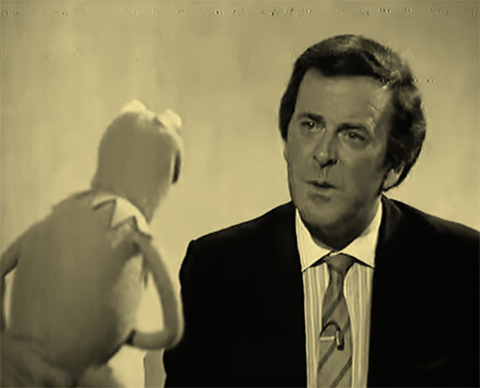
Icke (L), Wogan (R) The hugeness of Wogan (the show) even outgrew the reputation of Wogan (the man). Taking the late-night talk-show approach of keeping everything running when the main host is away on holiday, guest-hosting slots on Wogan helped launch (or re-launch) several careers. The first to stand-in for an absent Tel was Selina Scott, originally a journalist-turned-newsreader by trade, Scott’s time hosting Breakfast Time made her a natural fit for Wogan’s shoes, and brought her to the attention of a wider audience. Later guest hosts would include David Frost, Kenneth Williams, Joanna Lumley and Sue Lawley, the latter even getting her own ‘only live once’ moment in the spotlight following Vivienne Westwood’s ill-advised medically-inspired catwalk show. Yep, the one that inspired a scene in ‘Knowing Me Knowing You’, a scene so shambolic the Coogan version just needed a re-enactment rather than direct parody.
During its imperial phase, Wogan was a truly immovable feast. It seems unfathomable now that the BBC simply wouldn’t bother showing the first half of World Cup finals matches because The One Show is just too damn important. But, during Mexico ’86, events in Shepherd’s Bush were deemed much more important than those taking place in Queretaro or Irapuato, some early matches only being permitted “Highlights of the first half, plus live second-half coverage”. Moving Wogan to a different slot, giving him the night off or asking him to slum it on BBC2 for an evening simply would not do, Havelange or no Havelange. We’re not talking minor matches, either – West Germany v Uruguay, Brazil v Algeria, and (going by the RT listing) “either Argentina v South Korea or USSR v Hungary” – I vaguely remember it being the latter, which meant viewers missed the first three goals in a 6-0 Soviet stampede.
Similarly, BBC1’s live coverage of the previous year’s ill-fated European Cup final at the Heysel Stadium had been preceded by a mini-but-still-live episode of Wogan, billed in the Radio Times with the Partridgesque “a piquant preamble from Terry live at the Terryvision Theatre on picturesque Shepherd’s Bush Green”. Any such mood swiftly dissipated on the night, as the Wogan studio threw to BBC reporters at Heysel.
Eventually, Wogan lost it’s lustre with the viewing public. By the end of 1991, viewers were down, BBC Scotland had shunted the Friday show into a much later slot to make way for its own programming, and Something Had To Be Done. And so, Terry was ultimately made to tread water for several months while replacement programming could be devised, cast and shot. And so, on Friday 3 July 1992, seven years and 1300 shows after roaring into that 7pm weekday slot, Wogan’s grand finale was upon us. But not to worry, the Radio Times assured viewers, “Terry Wogan will be back on screen later this year with a new weekly show”.
Sadly, Terry Wogan’s Friday Night wasn’t anywhere near as successful as its predecessor. Despite trying out some new ideas – including having Frank Skinner in the Hank Kingsley role – it just wasn’t to be, and 5 March 1993 was Wogan’s last Friday Night.
But what of the can’t-miss programme that replaced Wogan’s original thrice-weekly 7pm slot? Well, it was something history was much less kind to.

(If you’re reading this in the year 2078 and the image link is broken: it was Eldorado. That’s right, the show that somehow started the ultimate irreversible decline of Western civilisation.) 
With thanks to Simon Coward for a bit of correction work when it comes to the timing of Tel’s stint at Radio 2.
76: University Challenge
(Shown 1175 times, 1994-2021)

“Up Scumbag!”
Quite a surprising one here, given that it spent the first 25 years of its existence over on ITV. And it goes back even further than that, all the way back to World War II. Despite seeming so quintessentially British, University Challenge is actually a licenced adaptation of long-running American series College Bowl. After starting out at a wartime USO activity created by Canadian Don Reid, College Bowl was subsequently converted into a series for NBC Radio by Reid and John Moses, which debuted in 1953. It proved so popular a TV version was piloted in 1955, and by 1959 a full series was airing on CBS.
The UK adaptation came about after Cecil Bernstein, brother of Granada founder Sidney, spotted the programme on a trip to the USA and decided it was a prime candidate for British consumption. Simple and cost-effective, likely to impress critics of Britain’s commercial network, and an easy tie-in to Granada’s image as ‘the BBC of the North’. Plus, with the British version dispensing with the none-more-American tie-in with programme sponsor General Electric, instantly classier than the original. The ITV version actually went in the opposite direction from College Bowl’s commercial tie-in, UC airing without any ad breaks at all, a luxury only ever afforded to a select few ITV programmes (see also This Is Your Life). In short, Bamber Gascoigne wasn’t about to interrupt proceedings to hold up a box of Omo and tell everyone how great it is.

I do however reckon they should’ve made Paxman do this. His reaction would have been priceless. Sponsorship concerns aside, any differences between the two versions are largely restricted to the faux-sporting format of the US original. Instead of a ‘starter for ten’, open questions are referred to as a ‘toss-up’, each team has a nominated ‘coach’ (i.e. a professor from each college), and the scoreboard is much more similar to an American Football scoreboard, complete with clock.
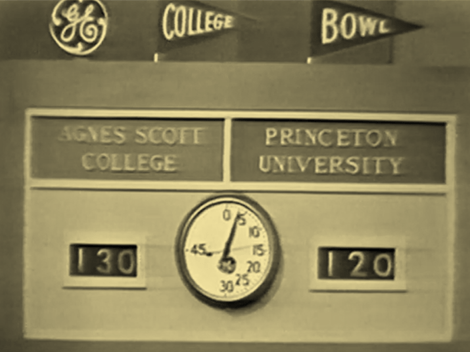
Other than that though, the UK version takes the format of the US version pretty much as-is. Even down to the distinctive way the two teams are shown on screen during open questions.

So, on 21 September 1962, the UK version of College Bowl (afforded a less US-centric title) first arrived on British television. Asking the questions was, as would be the case for the entirety of the show’s tenure on ITV, Bamber Gascoigne. Teams from various universities around the UK would take part (aside from Oxford and Cambridge, from whom individual constituent colleges could provide teams), resulting in an overall annual winner. Starter for ten, no conferring, Bamber’s almost apologetic “I have to hurry you”, all that.
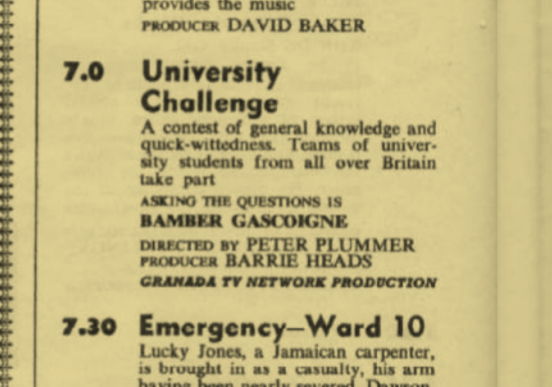
Having started in a plum 7pm weekday slot on ITV (at least in some regions), it bounced around the schedules quite a bit, perhaps influenced by the programme’s lack of commercial interruption, meaning programmes that did more to earn their upkeep were considered a better fit for that prime slot. And so, UC moved to post-News At Ten slots or Friday 5.15pm slots, before settling into a more suitable home on early Sunday afternoons by the late 1970s (again, at least in many regions).
And that’s where it stayed, for the most part. At least until New Year’s Eve 1987, when ITV would broadcast University Challenge for the last time. The final flourish for Bamber’s starters came with the culmination of a three-part ‘test’ between then-current UK UC champions Keble College, Oxford and New Zealand’s University of Otago.

But, as you’ll have guessed by me writing about it here, that wasn’t the end for University Challenge. In 1994, the programme re-emerged on BBC2 (albeit still produced by Granada), this time with arch snarkmeister Jeremy Paxman in the chair. A seat he’s continued to fill since (except: not for much longer). And with the show no longer beholden to the whims of a commercial broadcaster, it has regained and retained a plum, primetime position in the schedules since that point. Indeed, it has proved popular enough with the BBC2 audience to warrant runs of same-week repeats between 2013 and 2017, along with special ‘Christmas series’ mini-tournaments going out daily over the festive period in recent years.
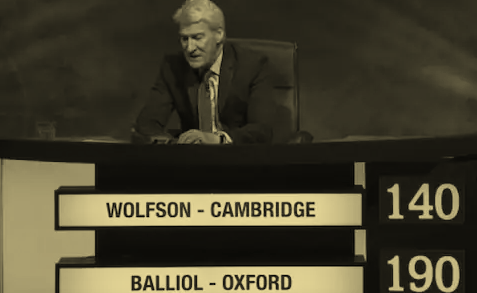
For the last few years, University Challenge has effectively teamed up with Only Connect each Monday evening at 8pm to provide a weekly “feel pleased with yourself if you get more than two questions right” hour of programming. Let’s face it, University Challenge is basically going to outlive every single one of us.
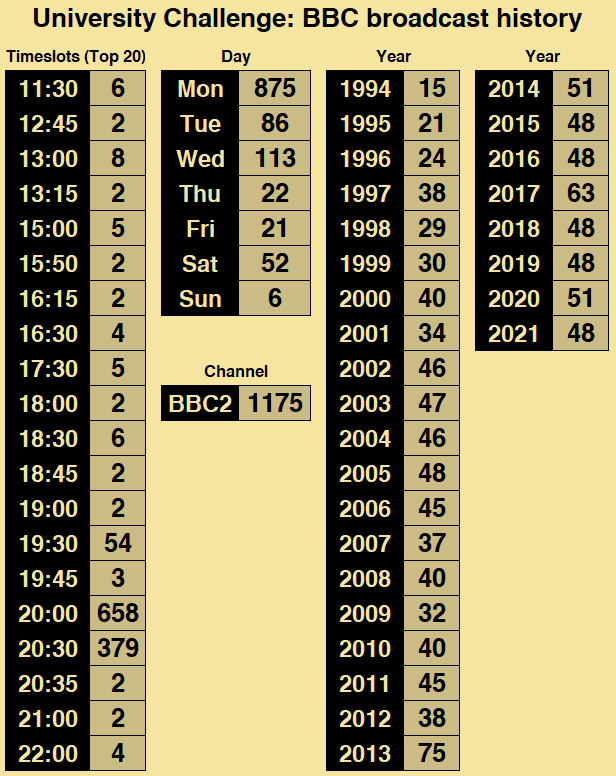
Well. That grab-bag of programmes probably chalked off at least a couple you’d expect to be much higher in the list. And who would’ve thought Arthur would beat Doctor Who in the rundown? Believe me, if it weren’t for signed middle-of-the-night repeats, Doctor Who would’ve been beaten by Igglepiggle and Upsy Daisy. Such is the unpredictable nature of this list, and the reason you daren’t look away from it for a second. (Not literally.)
Tune in next time, for the next quintet of wonder. Two entries from which I’ve currently no bloody idea what I’m going to write about. Get used to that. I’ve seen the full list. I’m tempted to rope in someone from Fiverr to write at least 40% of it.
So, until next time. Ooh, the excitement.
-
BBC100: The 100 Most-Broadcast BBC Programmes Of All Time (85-81)
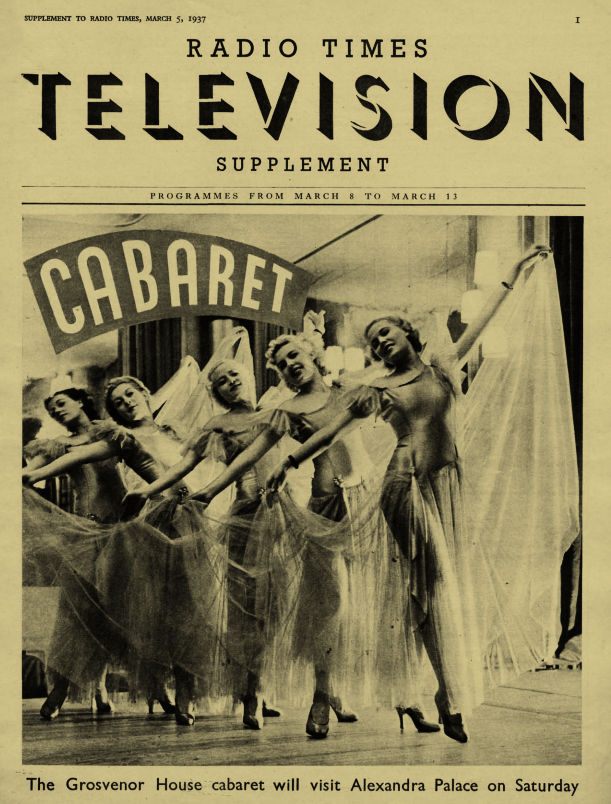
Another five-pack of fun for children of all ages. Especially with the first programme on the list.
85: ChuckleVision
(Shown 1055 times, 1987-2012)
Yes! Here’s an entry that took quite a lot of digging to get some accurate numbers on. But, given the importance and gravitas of the programme in question, I’m sure you’ll agree it was worth the time poring through Genome to pick out individual episodes buried within faux-programme listings for ‘Saturday Starts Here’, ‘Children’s BBC’ and ‘CBBC’, then checking everything against an episode guide for CV to ensure I’d not missed anything. I’m not kidding, either. This one took ages. And I’m not kidding about the importance of the programme, either. A cultural touchstone for entire generations of children (and adults) across a quarter-century on our screens, and two of the absolute nicest people in showbusiness.
Not that the Chuckle Brothers first arrived on our screens fully-formed. Their first appearances on TV in the early 1980s came when Paul and Barry were joined by older brothers Jimmy and Brian Patton to make up a four-man Chuckle Brothers outfit, as can be seen in programmes such as 3-2-1 and The Good Old Days, a bepermed Barry referred to as ‘Legs’ throughout and still the target for most of the slaps from their slapstick act. Despite putting together a thoroughly enjoyable variety turn, the quartet soon span off into a pair of double-acts, Jimmy and Brian becoming The Patton Brothers, Paul and Barry retaining the Chuckle Brothers name. Not that this was an acrimonious parting of the ways – Jimmy and Brian would regularly feature in their younger siblings’ future programmes.
Not that Barry and Paul went straight to the personas we now know them for. Their first programme as a double-act on Children’s BBC seems almost surreal when viewed now (and I recall, pretty weird even at the time). Following a few appearances on 1983’s Roger The Dog Show, The Chucklehounds (“featuring The Chucklehound Brothers”) earned a standalone episode for their antics, The Chucklehounds Christmas airing on Christmas Eve morning BBC1 in 1984. That was followed by a full series, starting in February 1986, with the lead actors now billed as ‘The Chuckle Brothers’.
The programme – a full episode here if you want to experience/re-live it – was pretty much a low-budget attempt at a live-action cartoon, with the pair wobbling about in dog costumes and getting up to all manner of slapstick shenanigans. No dialogue, but soundtracked with the zaniest sounds a Yamaha PSS-170 could muster. Problem is, while actual cartoons airing on BBC1 at the time were carefully choreographed chaos from the likes of Chuck Jones, here you had an undoubtedly talented variety act donning great big dog heads that limit mobility and visibility, with a modest budget likely offering little time for retakes. If you’re feeling charitable, it was okay for what it was, and they certainly had few qualms about what they got up to (the episode I’ve linked to includes a Chucklehound on a motorbike. Inside the studio. No, it probably wouldn’t happen nowadays) But they were capable of so much more.

And so, from the morning of Saturday 26 September 1987, Chucklevision first hit our screens as a weekly precursor to Going Live. And watching it now, it still holds up very well. Not that this should be any surprise – they are actual brothers, after all – but the rapport that we’re so familiar with is immediately obvious, you have to wonder why the blazes they’d just spent eighteen months wobbling about in dog costumes and not speaking to each other. Right from the opening episode, Chucklevision is so packed with Tim Vine-grade jokes, you can’t help but grin throughout.
PAUL: Let’s take a look at the latest videos.
[A GRINNING BARRY HOLDS UP SEVERAL VHS TAPES]
PAUL: Very nice, aren’t they?
The first ever ChuckleVision, BBC-1, TX: 08:40 Saturday 26 September 1987
As you can see there, the first couple of series combined studio-based humour with outdoor footage – a departure from what most Chucklefans would be used to, but their dynamic works every bit as well in that setup. I think it works so well because despite it being such a traditional double act – the idiot who knows nothing and the idiot who knows everything – they shun the traditional trope of having the Oliver Hardy/Bud Abbott/Tommy Cannon/Stewart Lee one regularly express anger or frustration at the foolery of his counterpart, Paul being (for the most part) relentlessly cheery throughout makes all the difference. And it was a formula that worked tremendously well – as the show’s run of 21 series suggests. TWENTY-ONE SERIES, with new episodes being produced from 1987 to 2009.
It took until 2008’s twentieth series before episodes of Chucklevision debuted anywhere but BBC One, but premiering on the CBBC channel was clearly no demotion. The opening episode of that series (‘Mind Your Manors’) took in guest turns from Harry Hill and Seinfeld’s Guy Siner (oh, okay: Allo Allo’s Guy Siner. He was in Seinfeld once, though), and was later repeated on BBC One.
In short, the brothers Chuckle were and are a true phenomenon in children’s television. At the time of writing, a BBC Programme Index search for ‘Chucklevision’ (it really helps that it has such a unique title) returns details of 2,976 broadcasts of the programme (many of which were on the CBBC channel). But perhaps the greatest legacy they’ve left the world can be found by going into a room containing anyone between the ages of 20 and 45 and saying “To me…”.
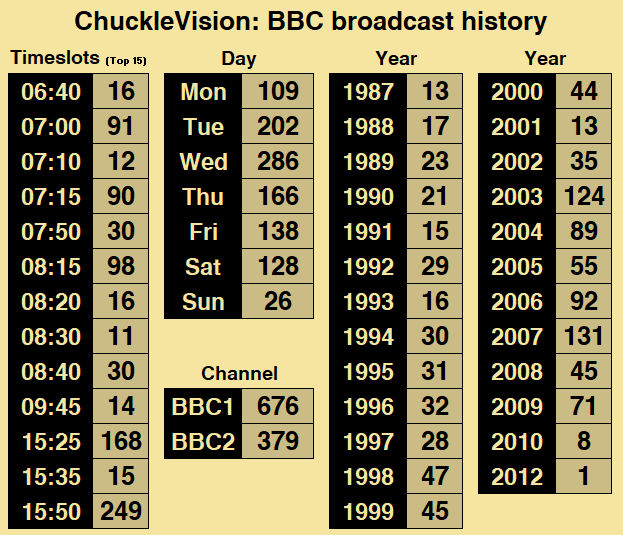
84: Murder, She Wrote
(Shown 1065 times, 2002-2011)
Well, let nobody pretend this isn’t a surprise. A US drama series that, depending on your age, you likely associate more With 1980s Sunday evening ITV or latter day Channel Five. Yet here it is, tied with Dad’s bloody Army on the list. What manner of chicanery is going on here, then?
It might also be a bit of a surprise to see that Ms Jessica Fletcher actually spent as long as ten whole years being broadcast on the Beeb. Possibly slightly under the radar as a daytime staple, which (not for the only time on this list) makes all the difference. But what is perhaps most surprising of all is how Murder, She Wrote appeared so many more times on the BBC than contemporary US shows like Columbo (225 times, 1988-2003, 485th place), Ironside (514 times, 1967-2003, 187th place), or even the always-bloody-on-when-I-was-a-kid Bonanza (somehow only 220 showings between 1978 and 1988, 497th place).
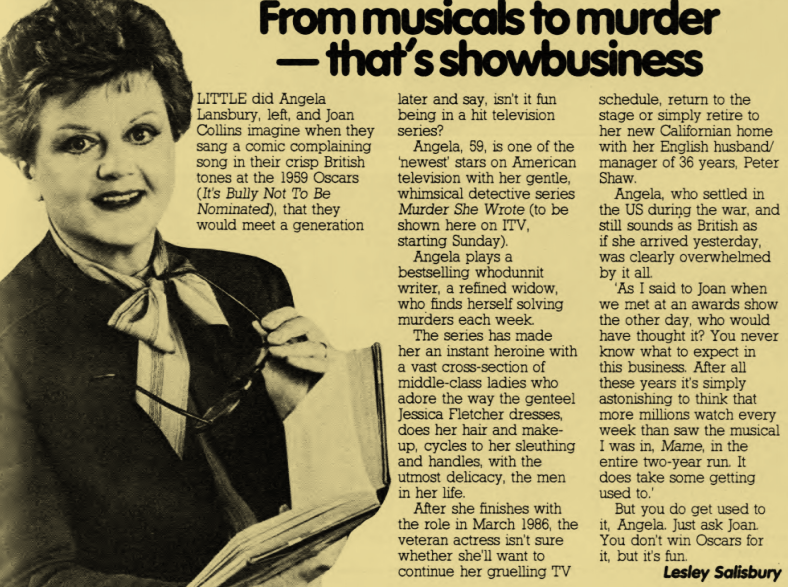
Admittedly, it certainly helps to reach that number of broadcast episodes when there are 264 recorded episodes to choose from (plus a further four TV movies). Seems strange now to see that, going by the TVTimes piece on the series before it debuted on ITV in May 1985, the then 59-year-old Angela Lansbury was unsure about continuing in the role after recording season three. Instead of calling it a day after March 1986, she went on to remain in the role until 2003.
Everyone’s getting to play Half-Life: Alyx except me. And as that meant the world would go on to see Jessica Fletcher join the VR revolution (in the infamous 1993 episode ‘A Virtual Murder’), the whole of society definitely benefited from that decision.

83: Dad’s Army
(Shown 1069 times, 1968-2021)

Well. Here’s a programme that was always going to be On Ze List, but who would’ve thought it would be in as modest a position as joint-83rd?
Not that a sitcom that lasted for a total of 80 episodes (several of which were officially missing for much of the repeat run, though that number’s now down to three) being broadcast over a thousand times is anything to be sniffed at, you understand. But it’s kind of indicative that we’re not going to see Fawlty Towers or Blackadder in this hundred. (I may well compile a separate list of most-shown comedy programmes at some point soon.)
Anyway, onto the Warmington-on-Sea Home Guard. You already know what Dad’s Army is about if you’ve lived in the UK for more than seven minutes, but there are a few things worth considering when it comes to all these broadcasts. Bear in mind, I’ve not scoured the original listings to fully tot up broadcasts of each particular episode, that’s one for a future update. Perhaps. These observations are merely anecdotal.
THING ONE: Of those eighty episodes, the majority of repeat broadcasts for Dad’s Army are from series’ three to six. Series one and two were recorded in black and white, and as such only seem to get very occasional airings (and even then, only ever on BBC Two).
THING TWO: Similarly, series seven, eight and nine generally don’t reach the broadcast schedules quite as regularly, coming as they did after the early death of key cast member James Beck. That said, the Christmas 1974 episode ‘Turkey Dinner’ (s7e6) does seem to crop up quite a lot, due to it being ripe for those Christmas classics slots.
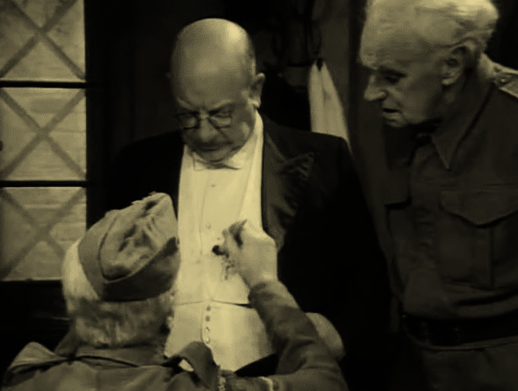
THING THREE: Episodes where Private Cheeseman (Talfryn Thomas) is a main part of the platoon certainly don’t seem to air as regularly. Probably because, let’s face it, he’s really quite annoying. The amount of reputational damage that character has done to the Welsh people is near incalculable. I’m saying it took until the rise of Gareth Bale to see us truly reintegrated into society.
It’s also interesting to see how, once new episodes had stopped being made in 1977, repeats of the series remained very much a BBC1 thing until the late 1990s, after which it became a nailed-on fixture of the BBC2 schedules. Look, here’s an illustrative chart.
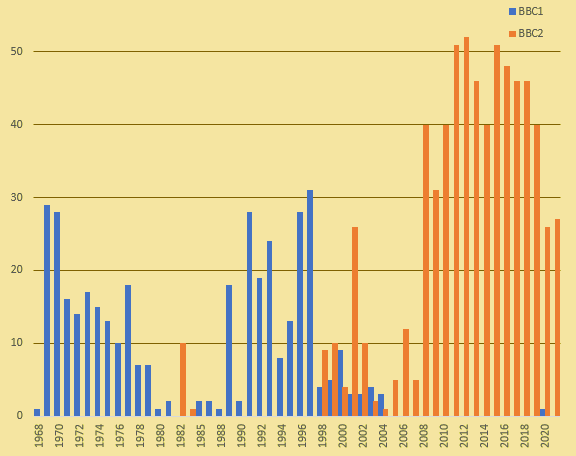
Can’t believe I’ve waited this long to start chucking charts in. If I ever do manage to update this entire project in the future (all together now: “Do you think that’s wise, Mark?”), it’ll be interesting to see how far Dad’s Army climbs up the list. It’s such a safe pair of hands – it’s one of the few ‘grown-up’ non-animated programmes my seven-year-old son enjoys, as an illustrative example – one can easily imagine it retaining a place in the BBC2 schedules for years to come. Can’t see Murder, She Wrote clocking up many showings on the BBC any time soon.
FACTS AMAZING: The entirety of Dad’s Army is technically a flashback – the first episode opens with the old platoon reuniting as part of the then-contemporary ‘”I’m Backing Britain” campaign, before recalling their service years, at which point the series as we know it begins.
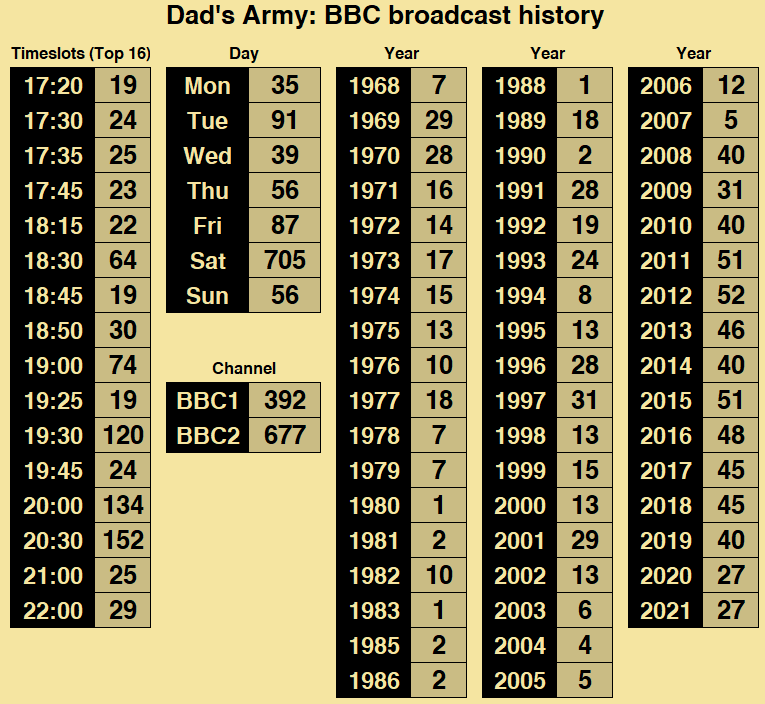
82: The Magic Roundabout
(Shown 1070 times, 1965-1985)
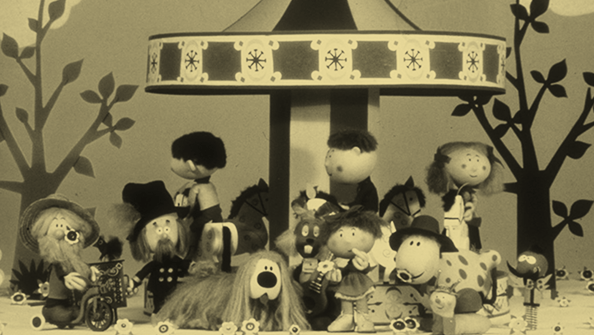
Without even bothering to check through the rest of the list, I’m just going to go out on a limb and state categorically that this is the highest-ranking French programme on the list.
Let’s get all the clichés out of the way first. Emma Thompson’s Dad (or, to be more accurate, actor, scriptwriter and stage director Eric Thompson), ‘Le Manège Enchanté’, not having the original script to work from so just riffing it, stockbrokers dashing home from the office to avoid missing it, hack 90s stand-ups claiming they were all on drugs except they obviously weren’t because there is such a thing as imagination. Oh, and a clip of The Massive Dougal from Goodies Rule OK. There. Got them all? Good. This kind of lore never built up around Henry’s Cat, did it?
When it came to kids’ programming on the BBC at the time, especially animated or stop-motion fare, it was generally the case that less is more. As mentioned previously, Bagpuss only clocked up thirteen episodes during its time on screen, and Postman Pat took nearly fifteen years to get beyond an initial baker’s dozen of episodes. Similarly, both Bod and The Flumps only ever had thirteen episodes each, while Mr Benn enjoyed a comparatively gargantuan total episode order of… fourteen episodes.
By comparison, as the adventures of Dougal, Florence and the Gang had been produced over the channel (for the ‘Office de Radiodiffusion-Télévision Française’, rather than ITV, obviously), there were a few more episodes to pick from. How many? 450 in total. Fortunately, Eric Thompson’s knack for warm and whimsical interpretation – a skill he’d previously displayed as a presenter on Play School, along with his wife Phyllida Law, which led to him being offered the Roundabout gig – was a more than suitable match. That, plus a peak slot in the schedules (bridging children’s programming and the early evening news) helped bring in a cross-generational audience, and ensured the Roundabout would be kept a-spinning on British screens throughout the 1970s.
But every imperial phase must end. On 19 May 1978, the Magic Roundabout aired in the pre-news slot for the last time, and it moved to a weekday morning slot for the remainder of the decade, after which the programme went back to bed for a few years. A Zebedee reference can go here if you like (in your mind, I’m not writing one). From January 1984, the Magic Roundabout returned to BBC1, this time in a 3.50pm slot to open up the Children’s BBC strand each day. It only stayed in that slot until the end of March that year, after which it only made occasional appearances in morning and lunchtime slots for pre-school tots.

After 1985, that was the end of The Magic Roundabout on the main BBC channels. It did however reappear on terrestrial TV (as a series of 52 purportedly ‘not previously broadcast’ episodes) in January 1992, as part of The Channel Four Daily’s initial push for viewers. Eric Thompson was no longer around to provide new narration, so the task was handed to Nigel Planer, who provided a tone not dissimilar to the Thompson original.

There was also a CGI-animated film made of the programme in 2005, featuring a very impressive voice cast (including Tom Baker, Jim Broadbent, Robbie Williams, Joanna Lumley, Ian McKellen and Kylie Minogue for the UK version, Jon Stewart, William H. Macy, Chevy Chase, Whoopi Goldberg, Jimmy Fallon and Judi Dench for the US release). That film isn’t included in the count, but for the curious: it was broadcast five times between 2008 and 2013, generally in the off-piste days of the Christmas schedules.

81: In the Night Garden
(Shown 1106 times, 2007-2012)

And so, direct from The Magic Roundabout to the closest thing there is to it in the modern era, and Russell Howard’s so-damn-lazy routine about this programme presumably exists purely to underline this statement.
For the benefit of readers without children, assuming they’re not too busy spending disposable income or enjoying full nights of sleep to read this, In the Night Garden involves boat-bound castaway Igglepiggle settling down for the night as his little sailboat drifts aimlessly on the ocean. As he sleeps, he dreams of his happy place: The Night Garden. A place where he frolics with friends Upsy Daisy, Makka Pakka and the Tombliboos. A place where the grass is the lushest green, and the Pinky Ponk floats freely in the sky. At the end of each episode, we fade back to Igglepiggle on his boat, still asleep, as his boat drifts into the aquatic wilderness as the end credits roll.

That might seem like a dark retelling of what’s going on, but it’s the actual plot that the narrator – Sir Derek Jacobi (yeah, look impressed) – reads at the start of every episode. I’m far from the only person to have thought about this – Google ‘in the night garden sailor theory’ to see how common it is.
Okay. In short, if you’re a parent who ends up having to watch this programme every evening because it’s more suitable than what you really want to watch at 6.30pm, your mind really can’t help but overanalyse every little facet of the programme. Like: how come the Pontipine children are never taken into care? And why does to relative size of the characters keep shifting around so much in each episode? But hey, there might be someone good on Bedtime Stories in a bit.
Anyway, plots for In the Night Garden rarely make much sense (a thought for the people working on iPlayer charged with summing up each episode in a few sentences, here). But then, it isn’t aimed at an audience expecting a traditional three-act narrative structure. It’s been a fixture in the lives of young children since it first aired in 2007, and there’d likely be a violent toddler uprising if CBeebies tried to shove Moon and Me into that peak 6:30pm slot.
The slightly odd thing is, In the Night Garden is very much an evening, pre-bedtime programme. It’s all about the act of going to bed and getting some shut-eye (and possibly also about Igglepiggle’s knack for lucid dreaming), so it’s a little strange that when it aired on BBC Two (so the show could be enjoyed by families yet to make the switch to digital TV) it was always in a morning slot. Not that these sheer numbers aren’t impressive. Just imagine if I’d added in all the CBeebies broadcasts of the series, where it has aired seven days a week pretty much since it first aired. As it is, a very respectable showing for an incredibly popular kids’ TV programme.

Right, that’s it for now. More soon! A bit more of a mixed bag next time, with at least one more “oh, I thought that would be much higher” entry: GUARANTEED.
-
BBC100: The 100 Most-Broadcast BBC Programmes Of All Time (90-86)

Here are the next five entries from the rundown of Auntie’s All-Time Favourites. As ever, the usual things apply: everything is accurate to the best of my knowledge, but with over 800,000 broadcasts to sift through, I can’t guarantee some individual episodes may have slipped through my datanet. Also, and you’ll never have guessed this, I’ve not watched all hundred programmes on the list (in some cases due to the trifling matter of every episode being wiped long before I was born), so if you’re able to correct any of my glaring inaccuracies, please let me know. Thanks, lovelies.
Okay, into the next picks from the selection box. Oggy Oggy Oggy.
90: Strictly – It Takes Two
(Shown 1006 times, 2004-2021)

“Please, call me ‘It Takes Two’. ‘Strictly Come Dancing It Takes Two’ is my father’s name.”
Personally, I’m still surprised that Come Dancing (a) even made a comeback that would become so popular, it felt like like seeing a peak-time celebrity reboot of One Man and His Dog (b) it would be so damn popular the format would be sold around the world (under a more sensible name, admittedly), and (c) that it did all that with such an unwieldy title. Presumably a play on the firm Strictly Ballroom, it doesn’t even work as a pun. Rubbish!
Well, more fool me. And while the main Strictly series has proved to be incredibly popular, its BBC2 companion series It Takes Two is the one to make the cut here. Running from Monday to Friday on BBC2 during the run of the main show over on BBC1, this show-about-a-show actually started on BBC Three as (appropriately enough) Strictly Come Dancing: On Three. It proved to be popular enough to warrant a move to a 6.30pm slot following Beg, Borrow or Steal as BBC Two’s official alternative to the news. And luckily, the move also saw a change from original BBC Three presenter Justin Lee Collins to the less #problematic Claudia Winkleman.
The format is simple enough. You can expect to see interviews and training footage of couples competing in the current Big Saturday Night series, along with input from the judges and chats with famous Strictly fans. The format even proved sturdy enough to warrant live hour-long episodes each Friday evening.

As might be expected from the sheer longevity of the series – eighteen years and still running – it has retained a loyal audience throughout. With viewing figures north of three million on more than a couple of dozen occasions, it has made the BBC2’s BARB top ten on at least 273 occasions (I keep more than one pointlessly huge database of TV information, you know). And let’s face it, it’s not going to be stopping any time soon.
As for the broadcast history of the programme – well, for anyone who loves uniformity this is a treat. Since 2013, it has been on precisely sixty times per year, aside from in 2020 (for blindingly obvious reasons), when it aired precisely forty times. And it has been on each weekday (or at least, been scheduled to be on each weekday) a tantalisingly almost-identical number of times. If you’re wondering, that rogue Friday gap came in 2006, where the eve of the big final saw the Friday evening BBC2 broadcast listed as just ‘Strictly Come Dancing’ without the ‘It Takes Two’ suffix. A mistake on part of the the RT editorial team? Perhaps, but that’s what it’s been added under in The Big List, resulting in the following table:

=87: The Simpsons
(Shown 1010 times, 1996-2004)
Two things pretty much led directly to the dominance of Sky in today’s television market. One is Premier League football, 104 years of tradition being tossed aside for a new money-led project that went on to dominate the sporting world, and Sky Sports will forever be irrevocably tied to it. The other key factor: a certain five-member family from Springfield.
Now the series seems utterly ubiquitous, where you can easily watch at least four full episodes a day without even thinking about firing up a streaming service (or blowing the dust off your DVD player), it seems unlikely now that watching The Simpsons ever felt to be the sole preserve of a lucky few. While the family had originally been introduced to British audiences in screenings of The Tracey Ullman Show on BBC2 (which aired 46 times between 1988 and 1991, if you’re wondering, though not all episodes featured Homer et al), their spin-off series was Sky-exclusive. And Sky knew how to make the most of it.
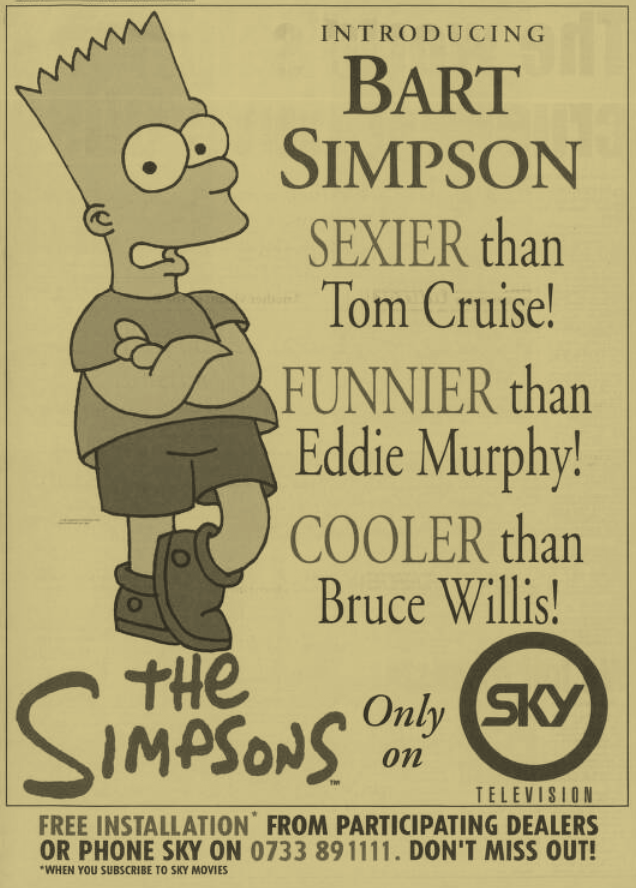
Hang on, ‘Sexier than’? 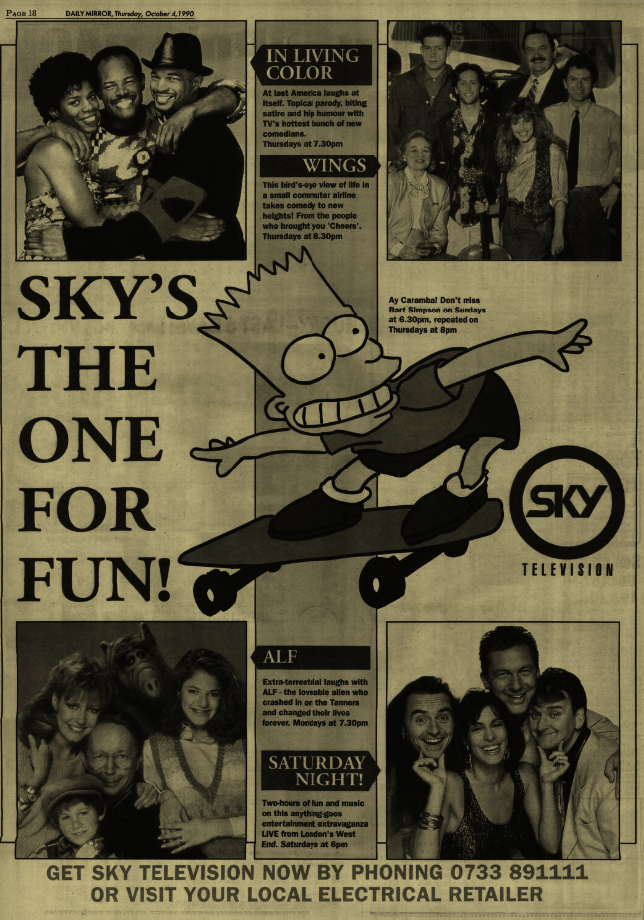
I mean, just look at that line-up. Alf had already been on ITV, In Living Color and Wings really weren’t going to convince anyone to bolt a binlid to their house, nor was a live two-hour Saturday night ‘entertainment extravaganza’ starring Matt Lorenzo, Neil “Heil Honey” McCaul, Jane Alexander and Mickey Hutton. No wonder all hopes for getting football refuseniks onto Sky were pinned on Bart Simpson (Homer being a much lesser beacon in those early years). And that was how it generally panned out. Unless you were willing to make do with buying three-episode VHS tapes of the series from John Menzies, or could convince a dish owner to record a few episodes for you, that was the only way you’d get to see The Simpsons during its Golden Age.
Then in November 1996, everything changed. The programme everyone wanted to see was no longer going to be the exclusive preserve of Pay TV. It was going to be on BBC1. This was big news. They were on the cover of the Radio Times (along with several other magazines, even including Loaded). Saturday nights, kicking off the evening’s entertainment at 5.30pm each week. It couldn’t fail.
And then they used the slot to show early episodes of the series (starting with There’s No Disgrace Like Home, S1E4), from before the show had become the breathless cavalcade of comedy it was known for, and many viewers instead opted for Sabrina the Teenage Witch on ITV instead. By the end of February 1997, The Simpsons had been retired from the pre-6pm slot on Saturday night BBC1, and repeats of Dad’s Army were swiftly parachuted in. Mind Godfrey’s hip.
A piece in The Stage, dated 27 Feb 1997, covered the switch to Two:
SIMPSONS IN CHANNEL SWITCH
BBC Television has denied it is moving The Simpsons to BBC2 because of competition from ITV’s American import Sabrina, the Teenage Witch.
A Corporation spokesman claimed the cartoon as moved from its original Saturday timeslot because it came to the end of a 13 week run.
He said: “We always beat Sabrina in the ratings, but we came to the end of the run and were desperate for another slot. So we decided to capitalise on the show’s popularity by bringing it back twice a week on BBC2.”
However, ITV sources claim that although The Simpsons started off winning viewers from its rival, the tables soon turned and The Simpsons was beaten.
An ITV spokeswoman said: “Presumably the BBC found Sabrina too strong an opponent.”
The Stage, 27 February 1997It seems the Beeb had expected The Simpsons to be facing a declining Baywatch, rather than an increasingly popular newcomer. And indeed, come Monday 10 March 1997, that was where they landed. The Simpsons would go out every Monday and Friday at 6pm, with The Fresh Prince of Bel-Air and Star Treks TNG and DS9 taking the slot on the other weekdays.
And that’s what really made the show a bona BBC hit (averaging a decent 3.4m viewers), and it would stay in that 6pm slot for the rest of it’s stay at the Beeb. Initially going out every Monday and Friday, but rapidly filling in where other weekdays were going spare, and appearing on the channel nine times in the week leading up to Christmas 1998.
From 25 February 2002, Simpsons episodes each weekday on BBC2 finally became a regular occurrence, perhaps not coincidentally that being the week it was reported Channel Four had snaffled up The Simpsons at a cost of £700,000 per episode. This at least meant the BBC would retain the rights until 2004, and they were determined to make the most of them.
And that’s no surprise – the show would make BBC2’s ratings top ten on 669 occasions between 1998 and 2004, reaching a high of 6.42m viewers on 7 Dec 1998 .
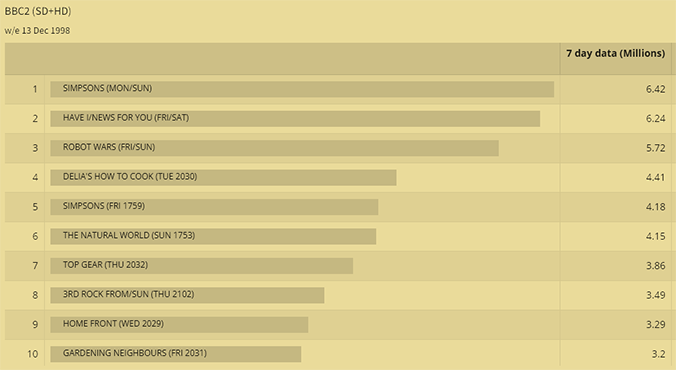
BARB ratings figures for w/e 13 December 1998 (Source: BARB) 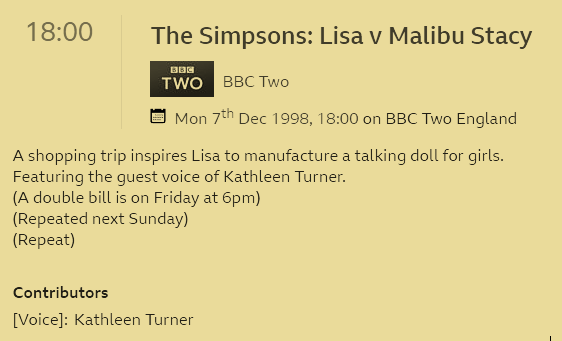
That most popular episode? Lisa vs Malibu Stacey. Why? Don’t ask me, I’m just a girl. Tee-hee-hee.

=87: Nai Zindagi – Naya Jeevan
(Shown 1010 times, 1968-1982)
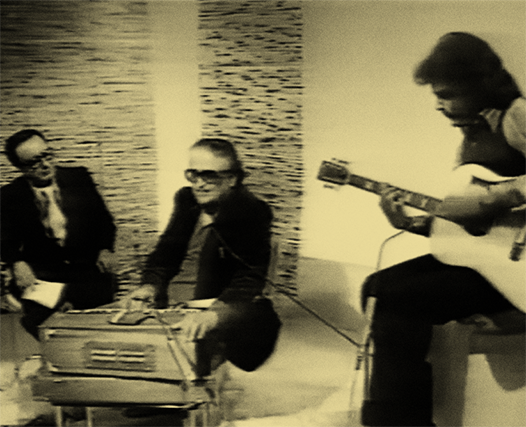
One thing that’s really noticeable with the BBC of the past, is that they really did make an effort to offer something for everyone, even if it wasn’t always during peak viewing hours. Whether the target audience sought religious programming, to improve their French- or Italian-language skill-set, adult literacy assistance, signed programming for the hard of hearing, or all the hot and steamy farming news.
Much of this niche programming went out on Sunday morning BBC1, including the next entry in the rundown. Nai Zindagi – Naya Jeevan (‘New Life (in Urdu) – New Life (in Hindi)’, if you’re wondering) first featured in the Sunday morning schedule on 24 November 1968 . For the first time, there was programming on offer for Hindi- and Urdu-speaking viewers.
With just thirty minutes each week, and quite a lot to cover (you know, music, interviews, a round-up of news from an entire sub-continent), one can only imagine how difficult it must have been to prepare for each show, not least given that the BBC’s previous attempts at catering for a British-Asian audience hadn’t lasted too long.
1965’s ‘In Logon Se Miliye’ ran for just thirteen episodes, airing at 9am on Sunday mornings with a midweek early-afternoon repeat. This followed the weekly BBC Home Service radio programme ‘Apna Hi Ghar Samajhiye’ (‘Make Yourself at Home’), which included news reports from Britain and overseas, combined with “Gramophone records and music from India and Pakistan”, which aired at around 8am each Sunday morning. Indeed, the two programmes were so in tune with each other, the Radio Times listings for In Logon Se Miliye requested that any correspondence to the TV series be addressed to the radio programme. With the two so intertwined, it made sense for In Logon Se Miliye to be renamed ‘Apna Hi Ghar Samajhiye’ in January 1966, so that both programmes shared a name as well as a production team.
The BBC’s official BBC100 pages contain a comprehensive write-up of Apna Hi Ghar Samajhiye by the University of Sussex’s Professor David Hendy, which also includes a variety of clips and interviews: https://www.bbc.com/historyofthebbc/100-voices/people-nation-empire/make-yourself-at-home/ – Well worth a look if you’re interested.
Nai Zindagi – Naya Jeevan wasn’t to be the sole offering aimed at a British-Asian audience during its time on air. 1977 saw the introduction of Gharbar, a companion programme catering for Asian women. Initially scheduled for a single 26-episode series, it would end up lasting until 1987. Indeed, Gharbar outlasted Nai Zindagi – Naya Jeevan, the latter being replaced in 1982 by a new, more news-based programme for Asian viewers, still broadcast in Urdu and Hindi. Asian Magazine first aired in April 1982, running until 1987, where (along with Gharbar) it would represent the BBC1’s final foray into Urdu- and Hindi-language programming.
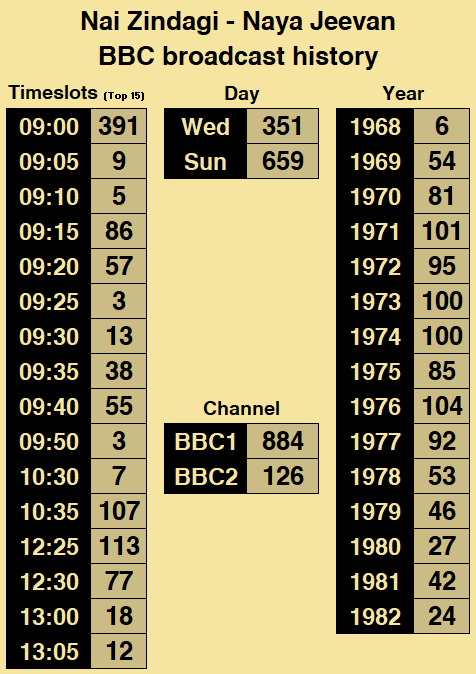
=87: QI
(Shown 1010 times, 2003-2021)
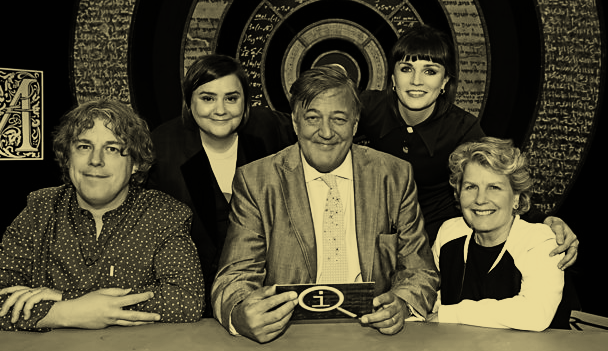
By 2003, it was established fact that no matter where you were in London, you were never more than six feet away from someone recording a comedy panel show. In the same way that both Wales and New Zealand famously contain more sheep than human beings, there were actually more panel-based wry sideways glances at things than scripted works on television and radio at the time.
Now, that’s not actually true, but it makes you think. After all, it was a time when ‘It’s Only TV…but I Like It’ got to four full series on primetime BBC One, despite only seventeen people remembering it nowadays.
It was in that media landscape that John Lloyd, the seemingly unstoppable producer of TV comedy legends like Not the Nine O’Clock News, Hitchhiker’s Guide to the Galaxy, Spitting Image and Blackadder, announced he’s devised a new panel show that everyone would just love.
I must admit, at the time I was more than a little sceptical. By this point, the average flying time of a new panel-based comedy show was akin to a newbie WWI pilot, yet here was John Lloyd of all people with another one. One bullish enough to claim it had been devised for a very specific run of 26 series (VIDIPRINTER: TWENTY-SIX). Involvement of Stephen Fry or not, it seemed unfathomable that it could have such staying power.
Yeah, you know the rest. It ended up proving a huge success. In fact, it’s been so successful, it’s now part of a very exclusive group of programmes to have aired on BBC One, BBC Two, BBC Three and BBC Four. The whole set. Admittedly, you’ll need to allow the QI segment of 2011’s Comic Relief special 24 Hour Panel People (highlights of which appeared on Three) to count, but still. Other than events like Eurovision or The African Nations’ Cup, very few actual programmes can claim to appearing on the full set of modern-day BBC channels, even with such an admittedly wobbly qualifier.
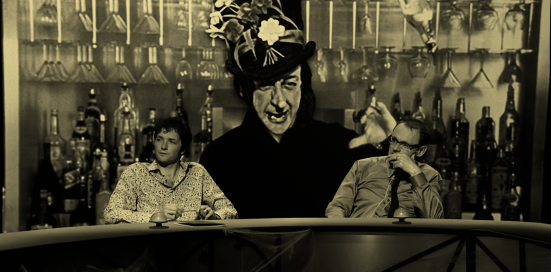
So, once it was on air, QI quickly became a favourite of people seeking something a little more cerebral from their desk-based comedy. No getting big laughs from hilariously pointing out that Eric Pickles was a bit on the portly side, or that Daleks can’t go up stairs. Indeed, at least in the early years, QI actively docked points from participants who’d trot out an obvious gag in response to questions – though I’d say it’s quite notable that they halted that particular practice after certain panellists repeatedly triggered the hack klaxon.
With early episodes debuting on BBC Four (mainly as a digital driver to draw an audience to the fledgling channel, each ep would arrive in a 10pm spot on BBC Two the following week), by January 2009 (Series F) it had proved popular enough to see a HIGNFY-style promotion to the big leagues – a 9pm Friday night slot on BBC One. It never quite felt quite at ease on the channel, and soon found itself being tried out in different places. November 2009’s Series G went out in a 9.30pm Thursday night slot, before switching to a surprising pre-watershed 8.30pm Friday home a few weeks later. That’s where it stayed until May 2011, before moving back to a more suitable home on BBC Two.
That certainly felt about right. While ‘Have I Got News For You’ seemed to readjust itself to a place on BBC One, it never felt quite right for QI. A bit like a Molly Ringwald character feeling pressured to plaster on make-up to fit in with the cool kids rather than just being true to herself.
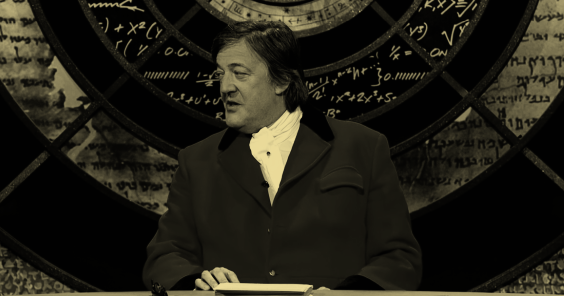
And so, from 2011 onwards, BBC Two has been the home of QI. Despite what some might see as a ‘relegation’ back to the second channel, it hasn’t hampered the programme one bit. Another format tweak also borrowed from HIGNFY – ‘enhanced’ same week repeats featuring a longer edit of each episode – would see QI XL (included in the figures here, as I’m counting repeats of everything else, it’s kind of the point) airing almost as regularly as the vanilla versions of QI. Even the 2015 announcement that host Stephen Fry was leaving the series didn’t dampen enthusiasm for the programme, with new host Sandi Toksvig proving a similarly capable foil for bouncy-haired troublemaker Alan Davies.
Sure, it doesn’t seem quite as essential as it once did – the sheer volume of episodes, most of which seem to be continuously pouring from a tap onto the Dave scheduled, can account for that – but it would be a fool’s errand to suggest QI won’t meet its original mission statement: clocking up a series for each letter of the alphabet before the QI elves are finally released back into the wild.

86: Laurel and Hardy
(Shown 1046 times, 1948-2005)
Okay, here’s a thing. For the most part, if a programme is called something, it’s that something. In the case of beloved comedy duo Laurel and Hardy, it’s either one of their original films, or an episode of the 1966-1967 Hanna-Barbera cartoon of the same name. And quite frankly, one of these things is less than the other.
But I’m going to combine the two anyway, and that’s for a number of reasons. 1) Going into each listing and accurately differentiating the two would be tricky and time-consuming, 2) Even if the cartoon spin-off couldn’t hold a candle to the originals, their popularity on Children’s BBC only confirms how beloved the duo were (and indeed, still are) across generations of young comedy fans, and 3) having Laurel and Hardy in this list is definitely preferable to having Wanted Down Under on there.
Aside from that, there were the expected difficulties in piecing together instances where (live-action) Stan and Ollie were actually broadcast. In many cases, they were billed as ‘Laurel and Hardy in’, which is fine and dandy. But in some instances, that wasn’t the case – it’s only in doing some last-minute fact checking that revealed (for example) nine screenings of A Chump at Oxford (ranging from 1950 to 2002) slipping through the net. And in many cases in the RT listings, there are indistinct billings that may well contain some Laurel and Hardy gold, or may not. Quite a lot of ‘Comedy Classics Double Bill’ or ‘Film Matinee’ in there, let alone the ominous total of one easily-identified L&H film being aired between 1936 and 1964.
Plus, on top of all that, there’s an argument for the Laurel & Hardy cartoon being more of a ‘proper’ programme than the films. After all, the Laurel and Hardy films are… films. I’m not going to include The Marx Brothers in this rundown (their work is more routinely listed as individual film titles, for one thing), so why should Laurel and Hardy warrant inclusion?
So, in short: I’m very much including Laurel and Hardy in here. As you will have noticed. And I’ve tried to pick up all the films of their that aren’t explicitly listed as being Laurel and Hardy films.
They generally only ever played the characters of Stan Laurel and Oliver Hardy in their films anyway, and I’m saying that’s enough to make their live-action antics a TV series that just happens to pre-date the medium of television. And the cartoon is just a continuation of that. Yeah, not an ideal situation, but to try and make up for it, I’ve done my best to put together broadcast histories for both live-action and animated Laurel and Hardy. Here you go! 309 animated episodes, 626 live-action. Try not to be too James Finlayson about it, eh?

[Note: Updated 01/09 to remove two broadcasts from 1946 that turn out to have been something unrelated called ‘Way Out West’] 
If all that has put you in the mood for learning a little bit more about the pair German audiences knew as Dick and Dorf, I definitely recommend this 1974 episode of Omnibus. Intermingled with classic clips from their many films is rare archive footage and contributions from some truly A-List names – Jerry Lewis, Marcel Marceau, Spike Milligan, Bob Monkhouse, Dilys Powell, Hal Roach, Kenneth Tynan and Dick Van Dyke. Plus, on top of all that, it’s narrated by Eric Morecambe and Ernie Wise.
[UPDATE 3 AUG: With many thanks to Steve Arnold for bringing this to my attention, but the BBC showings of the L&H cartoons coincided with the L&H films being picked up by the ITV network. A quick peek at the superb TVRDB website confirms this, with at least 28 instances of Laurel and Hardy films appearing on Thames between 1982 and 1984, with at least three more on LWT during that same period.]

So, there we go. Another five entries ticked off the list, with just the last… Bloody hell, 85 to go.
Come back soon for the next segment of the series, where you’ll get to see how much research I managed to do on a programme that was last broadcast seventy years ago. And a particular programme that will be very familiar to everyone.
Not this. -
BBC100: The 100 Most-Broadcast BBC Programmes Of All Time (95-91)

In which an instantly successful programme takes a sixteen-year run-up to a second series, and a crime drama becomes a BBC staple due to people not liking football enough.

Firstly, huge thanks to everyone who’d shared word of this project on Twitter. Any time I’ve previously embarked any large data-based article, it always came with the suspicion it’d end with a half-dozen retweets and a two-figure view count. This one has massively gone in the opposite direction, and I’ve never been more glad to be wrong.
Secondly, I welcome any and all feedback on this project. As mentioned previously, all the data therein is as accurate as I’m able to glean, but there definitely will be missed episodes somewhere along the way. If you’re able to help remedy any errors, please let me know in the comments box or on The Twitter.
Okay, that’s it. On with the next part of the list. Which eagle-eyed readers may notice is lacking the quote I gave as a teaser in the first update. Because I found another massive clutch of episodes of a particular programme using a very slightly different name, which shoved it about thirty places up the chart. But, at least that’s one future entry I’ve already written.
Hey, the very sense I’m flinging this all together in a disorganised way is what really gives this site a raw energy. That’s what I like to think, anyway. Here comes the next dollop of data.
95: Sportsnight
(Shown 934 times, 1968-1997)
The days when the BBC had a rich sporting portfolio to pick from, eh?
The successor to Sportsview (1954-68), the BBC’s first regular midweek sports roundup, Sportsnight (initially suffixed ‘With Coleman’) arrived in September 1968 and originally aired on Thursday nights. That feels an epoch away from any sporting action taking place on a Tuesday of the same week, but at a time without Ceefax, much less non-stop live action on Sky or BT Sports, waiting seemed less of an ordeal. By 1973, Wednesday nights were now home to Sportsnight, meaning the wait between final whistle and running VT on those midweek international matches or FA Cup replays was the time it took someone to rush the recording to the studio.
Not that football was necessarily the main draw. That first Wednesday night episode focused primarily on The Leading Show Jumper of the Year Competition, Fuji’s rugby union tour of Britain and Boxing. The first set of football highlights came the following week, with England U23 taking on their West German counterparts in Filbert Street.
While primarily a highlights programme, Sportsnight would occasionally broadcast live events if they’d happened to be taking place at the time, such as boxing, darts or greyhound racing (particularly the annual TV Trophy for the latter). But later, football would almost always receive top billing, for much of the audience the only way to experience any of their team’s action if they’d not been standing under the floodlights themselves. Indeed, those who had been on the terraces would often hope to make it home in time to catch footage of any incidents only half-glimpsed, or blocked by a taller spectator in front of them. If nothing else, anyone who’d been at Selhurst Park on 25 January 1995 will surely attest to that.
Sportsnight’s stranglehold on midweek BBC Sport was such that any primetime sporting action, such as live coverage of UEFA cup competitions (football seemingly the sole remit of the show by this point), would go out under the Sportsnight Special banner (though Grandstand’s branding would still be applied to any live World Cup finals matches). And that’s how the brand ultimately went out for the last time, 14 May 1997 seeing a Sportsnight Special of the Barcelona-PSG Cup Winners’ Cup final. Bobby Robson was Barca manager at the time, which hopefully stopped at least a few “But there aren’t even any British teams playing!” letters to Points Of View. After that point, any live football would find affixed to the Match of the Day Live branding.

94: Fimbles
(Shown 937 times, 2002-2010)

As if to heavily underline the sheer volume of episodes you need to produce if you want a daily slot on pre-school TV (Bagpuss wouldn’t get away with only ever making about three episodes in this day and age), Fimbles ran from September 2002 to September 2004, and in that time clocked up 200 episodes. Two hundred! Even thinking about the person who typed up the end credit text for all those episodes is quite tiring. Still, the antics of Fimbo, Flurrie and Baby Pom proved popular enough, with the programme running on CBeebies for almost the entirety of the channel’s first decade, making the nascent channel’s weekly BARB top ten on 136 occasions. And it didn’t fare too badly on the main BBC channels either, becoming a fixture on BBC2 for the best part of a decade.

93: Rugby Special
(Shown 976 times, 1966-2005)

Rugby. Sweat. Mud. Blood. Thunder. The North. Someone getting their ear torn off in a scrum. All soundtracked by Paddy Kingsland’s proto-electropop ‘Spinball’. So utterly marvellous it almost feels like a mistake. It certainly makes you wonder if there’s a pre-schools programme in the BBC archive that unexpectedly found itself with a theme by Dumpy’s Rusty Nuts.
While I’m not sure how ‘special’ a programme can be after it’s aired nearly a thousand editions, but Rugby Special has certainly been doing something right. The eggball-lovers’ answer to Match of the Day started on New Year’s Day 1966 with Keith Macklin introducing highlights of, and here’s a reason why rugby fixtures can often sound so interesting, “England versus The Rest”. Look, here’s the original Radio Times listing for it:
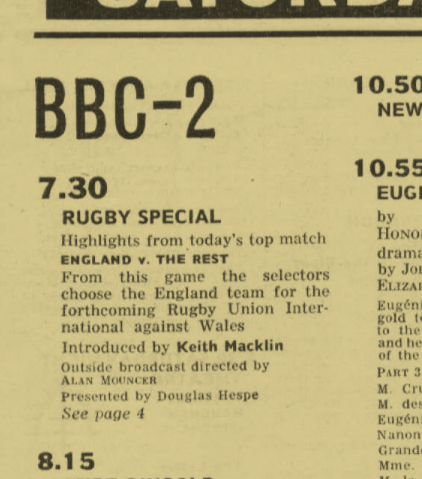
Future presenters of the programme would include David Vine, Chris Rea (not that one), Bill Beaumont and John Inverdale. It was a format that would become a fixture of the weekend schedules until the early years of the new millennium.
Not that this was the first time rugby union had been broadcast on the BBC, of course. It was usually listed under the more uncompromising branding of ‘Rugby Union Football’ or “Floodlit Rugby League”, the latter debuting on BBC-2 on 5 October 1965. I’d really like to know what the viewing figures for the first few episodes of Floodlit Rugby League were, given that BBC-2 didn’t even launch in Northern England (the hub of all things Rugby League) until the last day of October 1965. Though, in fairness, it did make it into the BBC Trade Test Transmissions for the channel up north. Much to the relief of those with UHF sets in Swinton and Oldham, I’m sure.
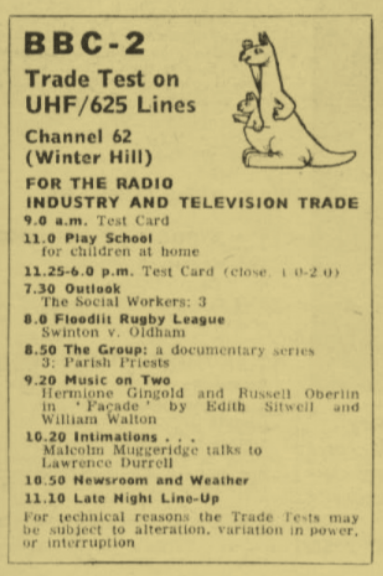
Rugby Special would quickly go on to be a weekend mainstay for BBC-2, offering an antidote to the glittering BBC-1 Saturday evening fare for the next ten years. From September 1976, it made the switch to Sunday afternoons, starting with the Third Test match between South Africa and New Zealand. I’m too classy to make a joke about apartheid South Africa and the All-Blacks, you’ll notice. That was followed a week later by a much more parochial affair, with the first domestic match of the season, West of Scotland v Gosforth.

By May 1997, much of the rights to domestic rugby had been bought up by the unlikely triumvirate of BSkyB, HTV and S4C (Heineken Cup and England home tests to the former, Welsh domestic matches to the latter two), putting the Rugby Special branding on hiatus. For the next few years, live rugby broadcasts continued on the Corporation as before, most notably the Five Nations, as did the occasional documentary on the sport, such as October 1997’s ‘The Rugby Club’, peeking behind the scenes at Bath Rugby Club as it transitioned into a professional outfit, but as far as actual highlights of club rugby, you’d need to look elsewhere.
In 2002, Rugby Special returned, albeit in a different format. Rugby highlights had become the preserve of the now-regular Sunday Grandstand, meaning Rugby Special became a much more magazine-based programme, airing in a late-night Thursday slot, tackling issues such as the now-professional game’s injury crisis, or providing coverage of Bill McLaren’s retirement dinner at the Dorchester. That approach turned out to have been short-lived, and by May 2003 Rugby Special resumed operations as a highlights show, putting out action from the Rugby Premiership. The branding finally faded from view in 2005, when the BBC reverted to referring its various rugby-based offerings as the more modest ‘Rugby Union’ and ‘Rugby League’. It seemed that after 39 years on our screens Rugby was, in the eyes of Them Upstairs, no longer quite as Special.

92: For The Children
(Shown 983 times, 1937-1952)
In the history of television, a number of programmes have acted as kingmaker for acts who would go on to become massive. The most obvious avenue for stardom would be talent shows, such as ATV’s New Faces (Marti Caine, Roger de Courcey, Lenny Henry), the BBC’s Opportunity Knocks (Paul Daniels, Les Dawson, Barry and Paul Elliott), or Sky One’s Sky Star Search (SUB FILL IN LATER). But British television’s first ever household name got his big break on this unassuming little programme, right from the infancy of the medium.
While For the Children first appeared as a regular series in 1946, it actually first appeared nine years earlier, with a pair of irregularly scheduled storytime sessions going out on Saturday afternoons in March and May of 1937. From the information available, it seems akin to an even-more-lo-fi Jackanory, the first episode a telling of “George Queen’s Pantomime Goose” (a broadcast which has an IMDB page despite no information other than the title being available), the second inviting Danish writer and actor Paul Leyssac to read a pair of Hans Christian Andersen stories. A simple premise, but given the BBC had only stopped using the Baird standard a month before that first episode, let’s not get carried away here.
From 1946 onwards, the remit seems to have expanded into something offering a bit more variety to the children of post-blitz London. Early episodes offered “a demonstration organised by the Camping Club of Great Britain and Ireland”, “Commander A. B. Campbell opens a sea chest and shows its treasures to the children”, “Model steam and power boats cruise on the lake at Alexandra Palace” and “Commander A. B. Campbell opens his sea chest again. This time the treasures come from Canada.”
At least going by the RT archive listings, a few different presenters shepherded this flock of fancies onto British screens, but the most commonly seen were actress, dancer and songwriter Annette Mills and puppeteer Ann Hogarth. A growing number of episodes featured the Hogarth Puppet Circus (part of the globe-trotting Hogarth Puppets touring company ran by Hogarth and her husband), and it didn’t take long for one puppet in particular to capture the imagination of the viewing thousands.

Not that one. 20 October 1946 saw the first appearance of Muffin the Mule alongside Annette Mills, but there was no major fanfare. The RT listing for that episode merely states “Annette Mills and friends at the piano”, and by the following episode it was the turn of “Model aeroplanes demonstrated and flown by Squadron-Leader P. H. Hunt” to take top billing. For the next few months, Muffin would only be an occasional treat for the children. That would soon change.
By the summer of 1947 there was still room for other turns (4 May 1947: “Marjorie Clarke shows how to make papier mache puppet dolls and dress them.” – granted: rationing, but also: brr), but it was Annette Mills and Ann Hogarth who featured for the majority of episodes. Indeed, for at least a week in July 1947, a billing for Muffin usurped the For the Children spot in the Radio Times’ TV supplement.

Ultimately, the transition of For the Children from a whimsical hotchpotch of youth-friendly hobbies into a more character-based affair would spell the end of the strand in January 1952. Despite only being a regular series for a few years, the broadcast history below shows how much it did for the concept of Television For Children – going from an occasional treat appearing on a handful of term-time Sundays to a programme title used multiple times per day (appearing 633 times over the course of 1951). Given that frequency, Muffin was just one name amongst many on the programme, meaning it would be harder for children to prepare viewing for their favourites.
Watch With Mother, the new umbrella strand for children’s programming, allowed individual programmes to go out under their own billing, which was certainly more useful to audiences than everything going out under just the one name. And Muffin the Mule would go on to be a large part of Watch With Mother’s success.

Muffin would also go on to entertain a new generation of TV tiddlers in 2005, with a 25-episode animated series made for CBeebies, but which also clocked up 41 appearances on BBC Two between September 2005 and January 2006. That didn’t turn out to have quite the same impact as the original, but there’s another way in which Muffin The Mule proved to be a TV trailblazer. Following his last BBC outing in 1955 (coinciding with the death of Annette Mills), Muffin would be one of the first TV stars to make a big money* move from Auntie to ITV, appearing on the other side from 1956 to 1957.
(*I assume. Maybe he was paid in straw.)
How different might the history of Children’s Television have been had the breakout star been Commander A. B. Campbell And His Sea Chest, eh?
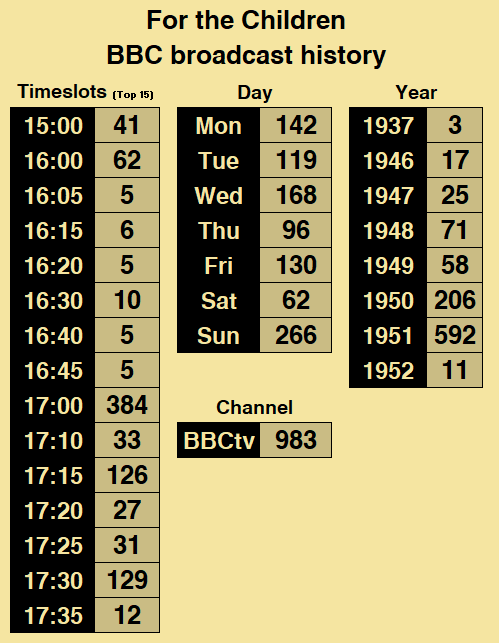
91: Postman Pat
(Shown 998 times, 1981-2012)

Henry Rollins once said “I believe that one defines oneself by reinvention. To not be like your parents. To not be like your friends. To be yourself.” Now, I’ve no idea about the context of that particular utterance, but I feel at least 85% sure he’s talking about Postman Pat. And that’s because dedicated country postman Pat Clifton is very much capable of reinventing himself every few years, whilst remaining very much true to himself throughout.
In Pat’s initial outing – a single series of just thirteen episodes, first airing between September 1981 and September 1982 – Pat seems to find all the companionship he needs in his job and his black and white cat (also his little van). He’s serving his community, he likes the people he meets, and he helps anyone in need, no matter how inconvenient it might be. No wonder Pat feels he’s a very happy man.
By the time of his second series in 1997 – not a typo, that’s a sixteen year gap – we find that Pat has settled into life as a family man, but that hasn’t dampened his dedication to serving his neighbourhood one jot. Then, by 2008, we find that Pat has been promoted to Head of the Special Delivery Service, yet his devotion to delivery remains undimmed. It’s practically Michael Apted’s 7-Up for under-eights.
One of the most remarkable things about Postman Pat (the series rather than the man) is how much of a cultural totem it very quickly became. Only ever airing in a lunchtime weekday slot until 1985, it still somehow seeped into the national consciousness, meaning everybody seemed to know the theme tune and the premise of the series, even if they’d always be at school or work when it’s on. As a child, I recall much debate in the Radio Times letters page about whether the lyrics referred to his black and white cat, or his black and white hat. Now, that’s a conundrum easily resolved by, well, looking at his hat, but it does show how much the series played on the minds of the public.

And Pat knows. He observes the public. From afar. That also explains why each of the thirteen episodes were held in such warm regard. It took until 1991 for a fourteenth episode of Postman Pat to be made, and even that was a one-off Christmas Day special where Pat got on a bus. Up to that point, the preceding thirteen episodes of Pat had been broadcast a total of 211 times. And by the time the second series proper debuted in April 1997, those episodes had registered a total of 274 showings. And yes, Bagpuss famously only ever had 13 episodes, but that’s way down in 342nd place on this list.
Since 2003, at which point production of the series had moved to Cosgrove-Hall Films, things were a lot more prolific. A lot more – by the time of the final episode (thus far) in 2017, a total of 184 episodes have been produced. That’s all the more impressive given they’ve stayed with a stop-motion process throughout (save for the Postman Pat film, but that’s not relevant here, or just in general. It ain’t good), leaving churn-em-out CGI production line episodes to the likes of Fireman Sam. And despite it being ten whole years since Pat has appeared on the main BBC channels (largely along with all children’s programming), it remains a regular on CBeebies.
In summary, then: Postman Pat certainly delivered.
I’m not even sorry.

And there we go, another chunk sliced off the hundred and served on a plate. Come back in a few days for numbers ninety to eighty-six.
-
BBC100: The 100 Most-Broadcast BBC Programmes Of All Time (100-96)

Happy birthday, Auntie.
As you may have noticed this year - or at least during the moments of it where you forget about the collapse of society, the evaporation of peace in Europe and basically everything being on fire – the BBC is (quite modestly) marking a hundred years of broadcasting to the nation. Since 1922 via the medium of radio, and since 1936 via Stooky Bill’s telly box. As everyone knows, that makes it the longest-running television service in the world.
In all that time, they’ve put out a lot of programmes over Britain’s airwaves. How many? Well, by my reckoning, well over 855,000 of them.
And how do I know that?
Because dear reader, I’ve gone and counted the bloody things.
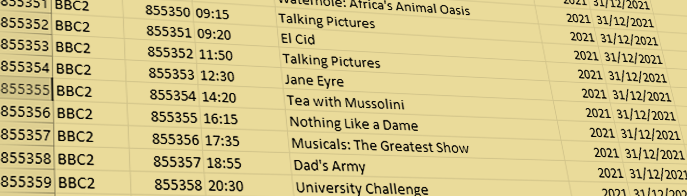
“WhatTheBloodyHellWasIThinking.xlsx” Yes indeed. After extracting a frankly stupid and ill-advised amount of information from the BBC’s marvellous Genome website (and from the BBC website’s programme listings for anything since 2010), I’ve been able to calculate how many times every single(ish) programme has been broadcast since the launch of the BBC Television Service. And in all that time, one programme has been broadcast a lot more than any other. Do you want to know what it is?
It’s ‘The News’. There. That was easy.

Yeah, that was always going to be the case. So instead, I’ve put together a list of the hundred most frequently flung-out programmes between BBC-1, BBC-2 and the original BBC Television Service. And — crucially, to stop this all being an even more monumental waste of time — I’ve discarded a few things.
- The News
- The Weather
- Closedown (It isn’t a programme. It’s the lack of one.)
- ‘The News’ masquerading under another programme title (such as ‘BBC Breakfast News’ or ‘Newyddion’)
- Strands comprised entirely of other individual programmes (such as ‘Children’s BBC’, ‘Children’s Television’ or ‘Watch With Mother’)
- ‘Open University’ or ‘BBC Learning Zone’ when listed as a programme, though individual programmes therein are included where listed in the RT.
- The thousand-plus entries listed as ‘Demonstration Film’ from the early days of the Beeb, which I was very, very close to including. Only on further investigation did I learn that much of each two-hour ‘episode’ was long stretches of the test card.

So, y’know, do your own damn list if you want to see these. It was a bit of a struggle to keep the whole list under a million records as it was.
I have, however, kept in things like sports coverage*, and some other things that might not easily fit into a particular pigeonhole, but deserve inclusion because they were hardy enough to warrant discussion. Not saying what they are yet, to add to the swirling excitement.
*That’s “Sports coverage where a programme is defined as being for a single sport, or under a specific branding” Which often wasn’t the case:

Just look at the state of this lot. Bit annoyed I missed out on ‘International Golf Racing from Ascot’, A few other things to note:
- All information taken from the details published in the Radio Times, with occasional individual missing days filled in using TV listings from The British Newspaper Archive. There are some quite large gaps on Genome for listings pre-1960 — I’ve filled in gaps as best I can where it’s the odd day or two missing. I’m not bloody-minded enough to trawl through the British Newspaper Archive to fill in the April to August 1939 gap on Genome, however. That said, that is the only notable gap in the data set. I’ve even filled in missing data from weeks where the RT was sidelined by strike action.
- As a result of this being a record of published listings, these figures are based on programmes that were scheduled to be shown. So there’s no need to let me know that the episode of Changing Rooms scheduled for 11 September 2001 didn’t actually go to air.
- Only items that got a billing in the Radio Times (or, post-2010, on the BBC website, or in newspaper TV listings for days missing from Genome)
- Only items broadcast on the BBC Television Service (1936–1964), BBC-1 and BBC-2 (1964-) are accounted for. Don’t be expecting to see anything from BBC Choice, BBC Knowledge or CBeebies here. Unless they were also broadcast on one of the proper channels.
- To be quite frank, this entire endeavour has been a colossally misjudged use of my resources and limited free time, thanks to the amount of data cleanse needed. Extracting all the data itself was relatively easy. Going through and tidying up loads of OCR glitches like ‘The Weakest Unk’ was the real time sink. But in many cases, I’ve corrected them on Genome for future generations to enjoy YOU’RE WELCOME. If any have slipped past my tired typo-spotting eyes, I humbly apologise. And I say all this without a drop of cynicism about The BBC Genome Project itself. Truly, it’s one of the best resources ever made available on the Internet.
- I’ve also tried to differentiate between programmes where the same title has been used for more than one thing. For example, in addition to being an antipodean continuing drama, ‘Neighbours’ was also the title of a Anthony Merryn play broadcast in 1948 and 1949, plus a 1981 one-off drama by the Bristol Arts Unit. I’ve separated those entries as they were quite identifiably different. Where the distinction has been trickier, I’ll try to point that out in the listings.
- Programmes included up to and including 31/12/2021. By default, BBC London listings have been used. So don’t expect Sportscene or Only An Excuse to feature heavily.

Still here? Splendid. So, resisting the temptation to rig the data so broadcasts of BBC Select makes the list (FYI, it’s in 164th place, and I totally would have conjured up a rationale for including it), here we go:
=99: Five to Eleven
(Shown 883 times, 1986–1990)

Oh, of course our top hundred has to start with joint-ninety-ninth. Anyway, this is the content you’re all here for. Certainly something you wouldn’t expect to see on the BBC flagship TV channel nowadays, and even then it surely seemed a bit of an anachronism. The format saw various figures giving short readings or poems in a modest studio setting. And that was it —10.55am each weekday morning, just four minutes in length, a celebrity basically pops around to yours during your mid-morning tea break, does a poem and then totters off.
In the example up there, actor, writer and artist Edward Petherbridge reads Cecil Day-Lewis’s poem ‘The Newborn’. A world away from episode six billion of Homes Under the Hammer, I’m sure you’ll agree. The sort of thing seemingly more suited to Radio Four than BBC One, but then (non-schools) daytime broadcasting was still a new thing for the channel at the time, so they hardly had budget to burn. And hey, it’s really quite a nice thing to see.

Stats! Definitely not going to regret including complete broadcast histories when I reach the higher numbers, I’m sure.
99: Saturday Kitchen
Shown 890 times, 2001–2021
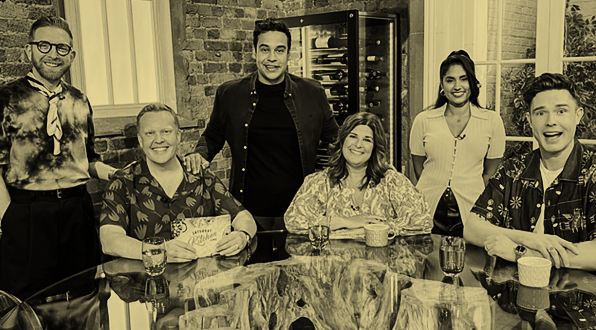
If asked to name the second most frequently shown Open University programme of all time, you’d probably expect the answer to be ‘Geochemical Surveying’ or ‘Public Administration’ or something similarly dry. But nope, it’s Saturday Kitchen. Saturday. Kitchen. At least that’s how the full series was launched in 2002 following a pilot episode the previous year — as a BBC One/Open University co-production. Not that it came with any particularly lofty ideals, of course. If anything, it seems to have been little more than a linking strand, with the first outings containing full episodes of Two Fat Ladies and Australian cooking show Food Source amongst new bespoke recipes and food-based chat. That’s very nearly enough to see it barred from inclusion here, but as it would go on to become the Multi-Coloured Swap Shop for the gastro set we’re more familiar with, that’d be a bit harsh.

98: Final Score
Shown 897 times, 1971–2021

Here’s one you’d expect to be ranking a lot higher up the chart. After all, the Saturday afternoon football results rundown is part of Britain’s modern cultural folklore. Len Martin or Tim Gudgin’s voice going up for the first bit when reading out a home win, the vidiprinter spelling out ‘(SEVEN)’ after a colossal win, an anxious wait for that elusive Forfar Five East Fife Four, being annoyed at not being told the latest score of matches still in progress (nope, ‘L-L’ is all you’re getting). So, shurely it’s been on much more often than this?
Well, dear reader. For most of Final Score’s long life — and it’s been going since 1958 — it was merely a single cog in Grandstand’s sporting charabanc, only picking up a Radio Times billing on occasions where there was no Grandstand for it to be a part of, such as Bank Holidays. Final Score has only been a regular to our EPGs since 2007, what with the BBC’s diminishing amount of sports rights blowing the final whistle for Grandstand as a concept.
And it’s that regular scheduling that has earned it a place here, even if Final Score itself now feels a tad overshadowed by Sky’s Soccer Saturday in the eyes of many football fans. But in general, as is usually the case when it comes to football, The Football Results just seem to contain a little extra sense of gravitas when they’re on the BBC.
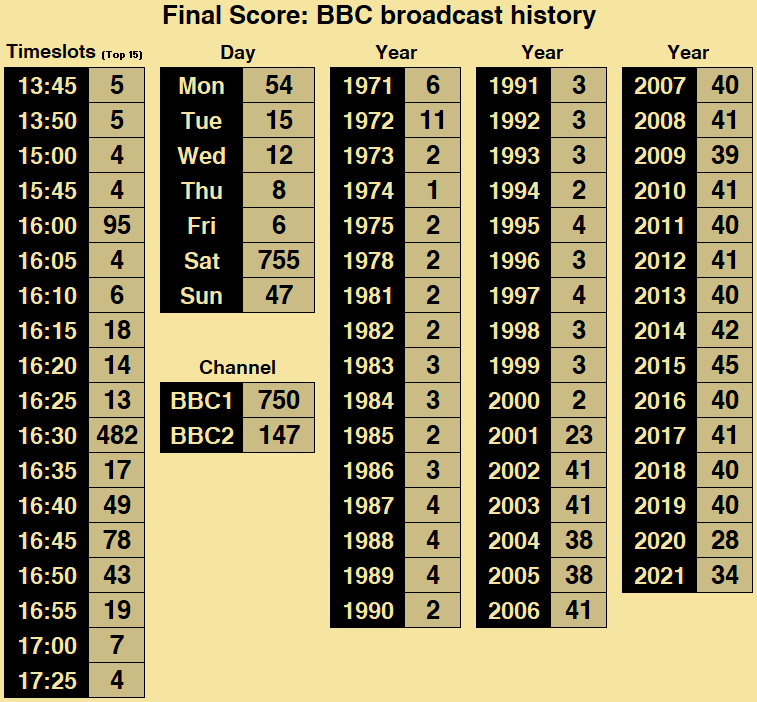
97: Put Your Money Where Your Mouth Is
(Shown 917 times, 2008-2021)
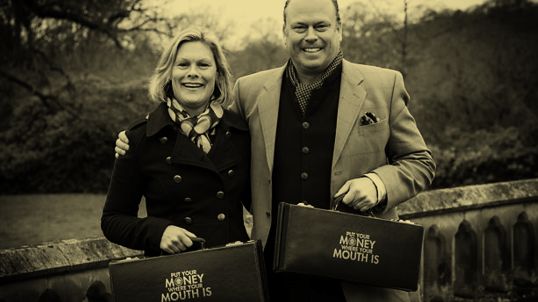
There are two ways to handle things when a new TV format doesn’t quite prove as popular as you’d hoped. The first and most obvious one: write it off as a bad lot and walk away from it hoping nobody noticed you’d been involved. The second: frantically retool everything and pray to the sun god that there’ll be a third series commission at the end of it.
The initial premise for Put Your Money Where Your Mouth Is saw some of television’s top consumer experts (either solo or working as a team) investing sums of their own hard-earned cash (generally investing in bricks and mortar, but occasionally in antiques) at the start of an episode, showing how their top consumer expertise can transform that initial outlay into a larger amount of money by the time the cameras stop rolling. On the one hand, that’s a format sure to work. On the other hand, that’s only because seventeen other programmes were doing practically the same thing.
So, after discovering that the Property Expert Earns A Lot Of Money pool was already full, PYMWYMI soon seemed to reinvent itself as… ripping off Bargain Hunt instead, with duelling experts each investing their own readies on a specified type of item, to see who can turn the quickest buck.
Was it a success? Yeah, you already know the answer to that, because it’s on this list. Despite adopting a fairly well-worn format, PYMWYMI swiftly became a hit with viewers, and the programme would soon see itself spread across the schedules like high-end marmalade.
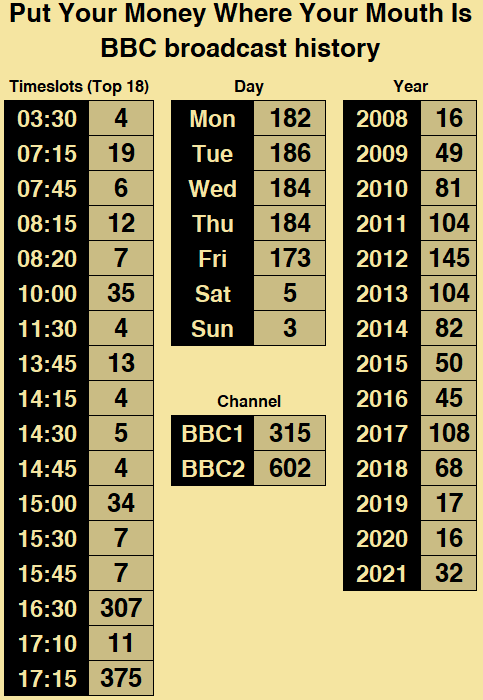
96: Z Cars
(Shown 920 times, 1962-1998)
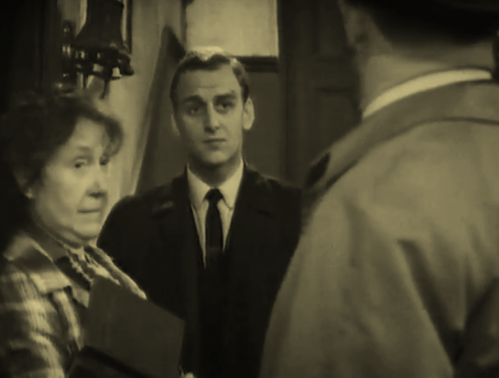
“I thought I was out. But then they dragged me back in” could be a line from any generic 80s cop film, where a grizzled LAPD Detective postpones his retirement to tackle one last case, just like he did in the previous four films in the series. The same could be said of Z Cars, had it been a sentient being capable of independent thought in addition to being a tremendously hardy continuing police procedural.
An antidote to the corduroy constables from Dixon of Dock Green, Z Cars took a grittier, uncompromising look at life on the beat. Much against the norms for drama on the Beeb at the time, it was set in Northern England (more specifically the fictional Merseyside locale of Newtown), and therefore that bit grimier by default. It was a big success, so much so that lead characters Barlow, Watt and Blackitt had been afforded their own spin-off series, Softly, Softly. Z-Cars had enjoyed a good run, and it was time for something different.
In 1965, the BBC had tried to introduce some new continuing dramas to their flagship channel. After all, Coronation Street was doing tremendous business for That Lot Over There, so there was clearly demand. New-build housing estate drama The Newcomers arrived in a twice-weekly 7pm slot, running on Tuesdays and Fridays. Into the same slot each Monday and Wednesday came a new series set to appeal to all members of the family. United! was a drama following the fortunes of fictional second-tier football club Brentwich United, with lives of the players, management and their families all falling under the cathode ray microscope. It couldn’t fail to become a hit.
By 1967, it was abundantly clear that even England winning the World Cup a year earlier couldn’t help United! become a hit, it being considered too soapy for male viewers and not soapy enough for female viewers. Having seen such a gamble fail to come off, BBC bigwigs opted to put something a little more surefooted into the twice-weekly gap in the schedule. And that’s where Z-Cars came back into play. At the end of February 1967, the floodlights fared for Brentwich United, leaving the first week of March for Z-Cars to enjoy the start of a mammoth sixth series.
Not that it had been a short-run success before. Series one to four had each contained between 31 and 43 episodes, while the fifth and purportedly final series had a run of just twelve episodes. The production run for series six, with a new twice-weekly 25-minute episode structure (generally one story spread across two parts), clocked in at 416 episodes. For the record, on the Big BrokenTV List Of Every BBC Broadcast Ever, that alone would slot it in-between Knots Landing and The Travel Show.
Amongst Z Cars’ mammoth time on our screens, it underwent several changes – not just the transition from monochrome to colour, but from the initial standalone episode format, to the twice-weekly pseudo-soap format, through to single full-length episodes later in the run. It also gave roles to a number of names that would become a lot more familiar to the public. Along with the ever-present James Ellis and series regulars Stratford Johns, Frank Windsor and Brian Blessed, Newtown nick played host to the likes of Joss Ackland, Leonard Rossiter and a tyro John Thaw.
Thanks to the BBC’s Tape-wiping policy at the time, fewer than half of those episodes survive today. It certainly didn’t help that the cost of physical storage for those episodes came from the programme’s budget – meaning that budget could be employed elsewhere in production if the tapes were simply re-used. Given the sheer volume of content that needed to be produced, that’s hardly a surprise, but thankfully that does still leave a lot on the BBC Archive shelves, and it has seen the occasional airing since the series called in a day in 1978. Single episodes were aired in 1982 (to mark the 20th anniversary of the programme’s debut), in 1986 (I think as part of the BBC’s TV50 season), in 1992 (as part of the Black and White in Colour season, looking at past attitudes towards race on TV), in 1993 (as part of a ‘Cops On The Box’ theme night) and in 1998 (as a tribute to the late writer John Hopkins). Some episodes were also shown as part of a season on police drama on BBC Four in 2008.
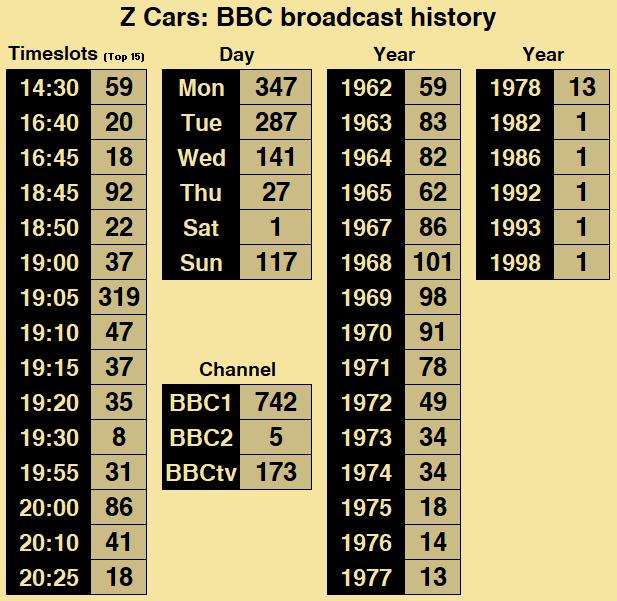
[NOTE: Updated this entry on 3 August to include of the one-off 1993 Cops On The Box showing of Z Cars that had slipped through the net, with thanks to Billy Smart. Also updated body of text to correct my error in conflating three-part documentary ‘The Newcomers’ (BBC2, 1964) and continuing drama ‘The Newcomers’ (BBC1, 1965-69) as being the same programme, with thanks to IanBeard on Roobarb’s.]
Phew. Okay, that’s enough for the first proper post on here. The next part of the rundown will be revealed in a few days, if you can contain your unbridled excitement until then.
-
Hello, all.
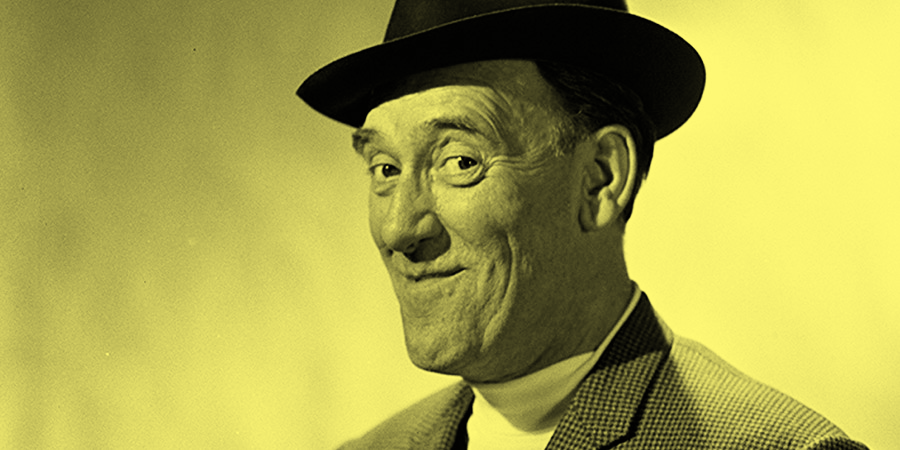
After about fifteen years on Blogspot (remember that?) and a year-and-a-bit on Medium, this right here is now and forever* home to Television Blog That Was Good For A Few Weeks In 2008 BrokenTV.
You lucky people.
(*Until I forget to pay the hosting fee, at least.)

BrokenTV
Welcome, welcome, welcome home
 BrokenTV