-
“Available to Anyo.e” – The 4th Most Broadcast BBC Programme of All-Time

Here we go. After yesterday’s video version, here’s the good old Web 1.0 write-up for…
4: Pages from Ceefax
(Shown 6491 times, 1983-2000)
Source: The Teletext Archive. Well, here’s a controversial one. Partly because you could claim it’s not really a programme, partly because you could claim it should be classed as ‘news’, and partly because pages from Ceefax aired in-vision for a few years before ever being billed. So, in turn, (a) it was billed as such, so I’m counting it as such, (b) for the most part, it was more of a television magazine a la Town and Around, and (c) I know, but it didn’t start getting billed in the Radio Times until 1983. And not as ‘Pages from Ceefax’ until a year after that.
(Side Point: at this point in the list, I do feel a bit torn. I always wanted to include Pages From Ceefax in the rundown, but I’ve seen a few people suggest Newsnight will be in the Top Ten. And perhaps it should be – it leans more towards the likes of Tonight or 24 Hours than a standalone BBC news programme. Personally, on nailing down the 100 programmes being covered in the list, I leant more on the side of “Newsnight is the BBC’s equivalent of Channel Four News” and duly excluded it from the rundown. Perhaps I should have included it. Maybe I should even have given up this place in the list to Newsnight. But: I’m not going to, as Ceefax is (along with associated services Oracle or 4-Tel) a unique part of British TV history, so it’s worth affording it some space. Frankly, you’re just lucky I didn’t engineer a way to include BBC Select somewhere. More of that later.)
And left to my own devices, I probably would. Have. Part of this might just be (okay, definitely is) down to the way Ceefax absolutely fascinated me as a small child. My main two obsessions in those formative years were reading and television. It being the dawn of the 1980s, and my location being a small Welsh village, the tiny local newsagent could only provide so many copies of Nutty, The Beano or, obviously, the Radio- and TV Times. There was no internet (yes, technically there was, but our local buses didn’t go anywhere near Stanford University), but come 12 March 1980 there was something new to read. Not necessarily about telly. But actually on the telly.
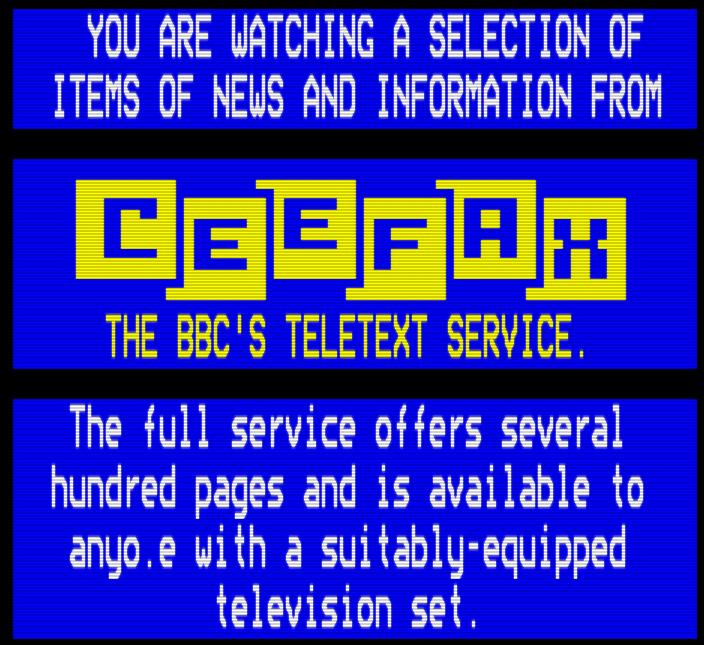
I don’t think I realised that at the time, mind you. It probably would have been at some point in 1981, at which time my parents had won themselves a black-and-white portable TV – one of the really old ones with a dial used to tune into channels instead of buttons – meaning we were now a two-telly family. Yes, you’re right to look impressed. I got to bring it to my bedroom to watch the episode of The Sweeney with Morecambe and Wise in it and everything. And, with it back in its natural home of the kitchen, where I suspect it was partially being used for a musical background to everyday kitchen tasks, on first seeing the captivating sentence “a selection of items of news and information from Ceefax”, I was utterly mesmerised.
Telly was still only on for a limited number of hours each day, and kids’ telly for even fewer hours, but there was something new: ‘secret’ telly, hidden outside the TV listings. And not just the BBC Engineering Information (which I was inexplicably terrified of) – my interest was piqued to the point where after we’d finished our tea, I’d ask to go to the kitchen and watch Ceefax In Vision on my own. It was all reading, so my parents were on board, but I don’t think I was especially keen to see the latest FTSE index, it was more that I was utterly fascinated by the general concept of it.
Apart from the scary sun-face that came up before the weather. I was only six years old at the time, of course.

WHY IS IT SMILING? Its eyes have been plucked out! It’s radiating naught but darkness! Anyway, moving onto matters that aren’t about repressed childhood trauma, what’s the deal with Ceefax? What was poured into that 40 by 24 grid of characters that characterised the one-way pseudo-web of the 1980s?
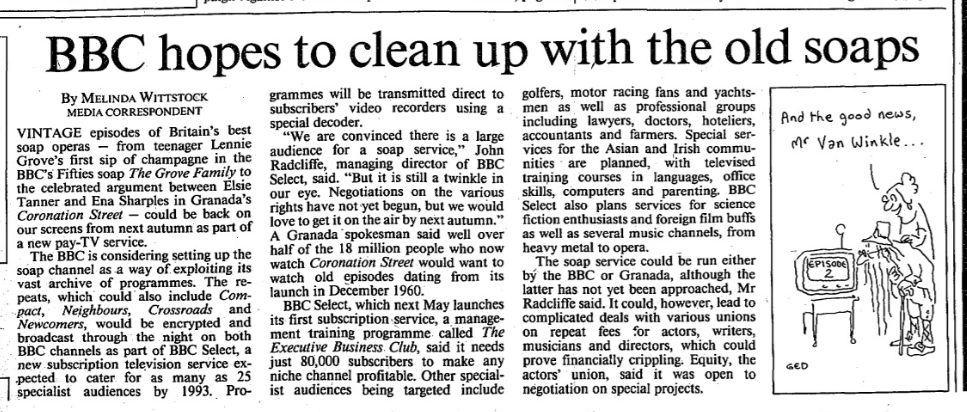
The first rumblings in the national press for the service seem to have been in the Daily Telegraph in October 1972 (“Push-button news for TV invented by BBC”, with reporter Sean Day-Lewis bigging up the potential for instant news summaries, sports results and stock market prices. At this stage, the mooted end product was to be a small box with “a number of push buttons”, behind which would be up to thirty pages ready to be displayed on the television screen. Given it hadn’t yet been three years since colour television first arrived on BBC1, it really showed how the BBC Research Department were keen on earning those salaries. Trials were set to begin in the summer of 1973, with an aim of going into production “within two or three years”, with a mooted cost of between £65 and £85 (that’s £735 to £962 adjusted for inflation) for the set-top box needed to decode those hidden bits.
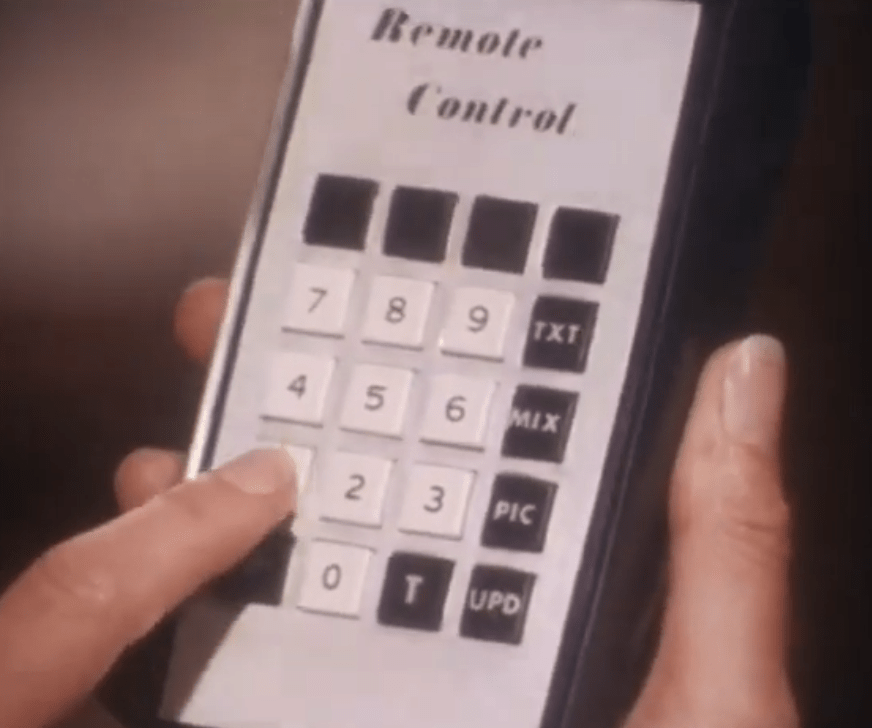
Oh, for an age where remote controls were so new, they actually had to be labelled ‘Remote Control’. With prices like that expected at launch, the BBC’s research team were realistic about their initial target audience. “Ceefax would mean that the farmer can come home from the pub and get a weather forecast on his set at the press of a button (…) the investor could choose the page of stock market prices and see whether he can go to bed with a peaceful mind”.
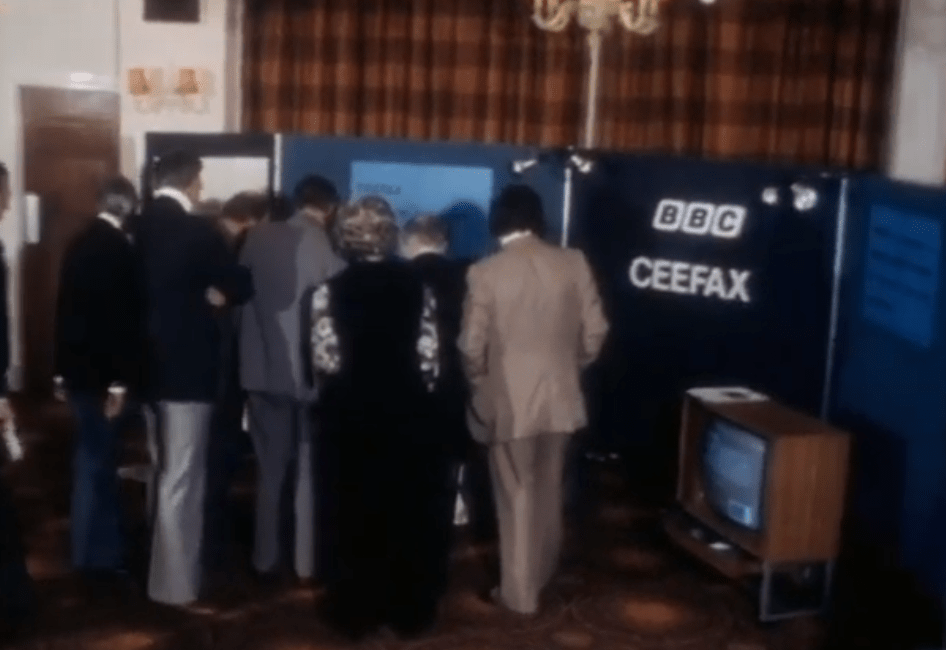
1973 saw an initial test service sneaked onto the airwaves, with the trial running for seven days per week from September 1974. A year later, the service was deemed settled enough to warrant an effective ‘launch programme’, with Tuesday July 15th 1975 seeing the transmission of Angela Rippon-fronted This is Ceefax, airing on BBC-1 at 10:45pm.
Previous to that point, the number of sets in British homes was unlikely to be far into three figures (and even then, mainly in homes belonging to BBC engineers). At the time of the programme, Ceefax had it’s own specially built – if modest – newsroom on the seventh floor of TV Centre. Editor/journalist Colin McIntyre led a small team (comprising four subeditors and four research assistants) in a delightfully 1970s BBC broom cupboard, where a series of machines (likely worth the aggregate annual licence fee tally of Derbyshire) would clatter out yards of teleprint from news agencies, which would then be bashed into a VDU featuring a distinctly unhelpful mid-70s GUI.
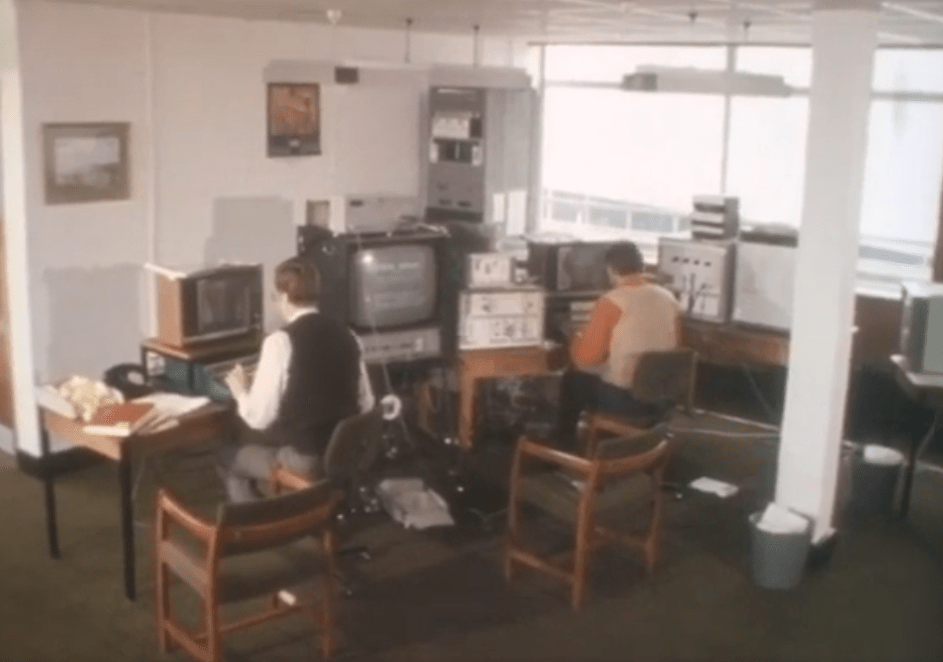
Compare and contrast to the BBC Newsroom in the background on BBC News bulletins today The research assistants on the team also enjoyed the task of seeing what else Ceefax could be used for, aside from the obvious likes of News, Weather and Financial Gubbins. So, at this early stage, beach news, shopping guides (advising on fluctuations in fruit prices and the like), train timetables or – yes! – the latest Canal News all made an appearance.

How many people living on barges could get Ceefax? Source: the Teletext Archive It’s worth noting that This is Ceefax wasn’t the first time the service had been featured on BBC-1. Sunday 8 June 1975 saw an episode of I See What You Mean, a ten-episode series serving hearing-impaired people, with the final episode of the run featuring the subtitling possibilities of Ceefax. This broadcast also led to a brief write-up of the ‘fax in that week’s Sunday Times, which references the presence of a working Ceefax setup in the lobby of BBC-TV Centre, which visitors were encouraged to explore.
And of course, that would be as close as most could get to enjoying the full on-screen magazine. As such, nice as it was to show off the BBC’s latest invention, in those early years there was little point in putting Ceefax on-screen as a marketing ploy. Only the most precious of few people could stand a chance of affording access to it, after all.
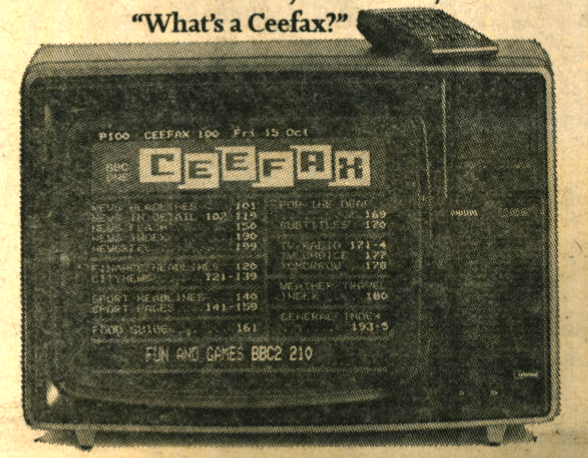
If you need an example to back that up, how about this: one of the few shops you could visit to buy a teletext-equipped set? Harrods. A bargain at just £1,049, a mere £5,890 when adjusted for inflation. For the record, for that adjusted outlay nowadays, you could buy a 98-inch 4K Samsung set from Currys, rather than a modest 22-inch set from 1977. But: does that 98-inch set have teletext? No, it does not.
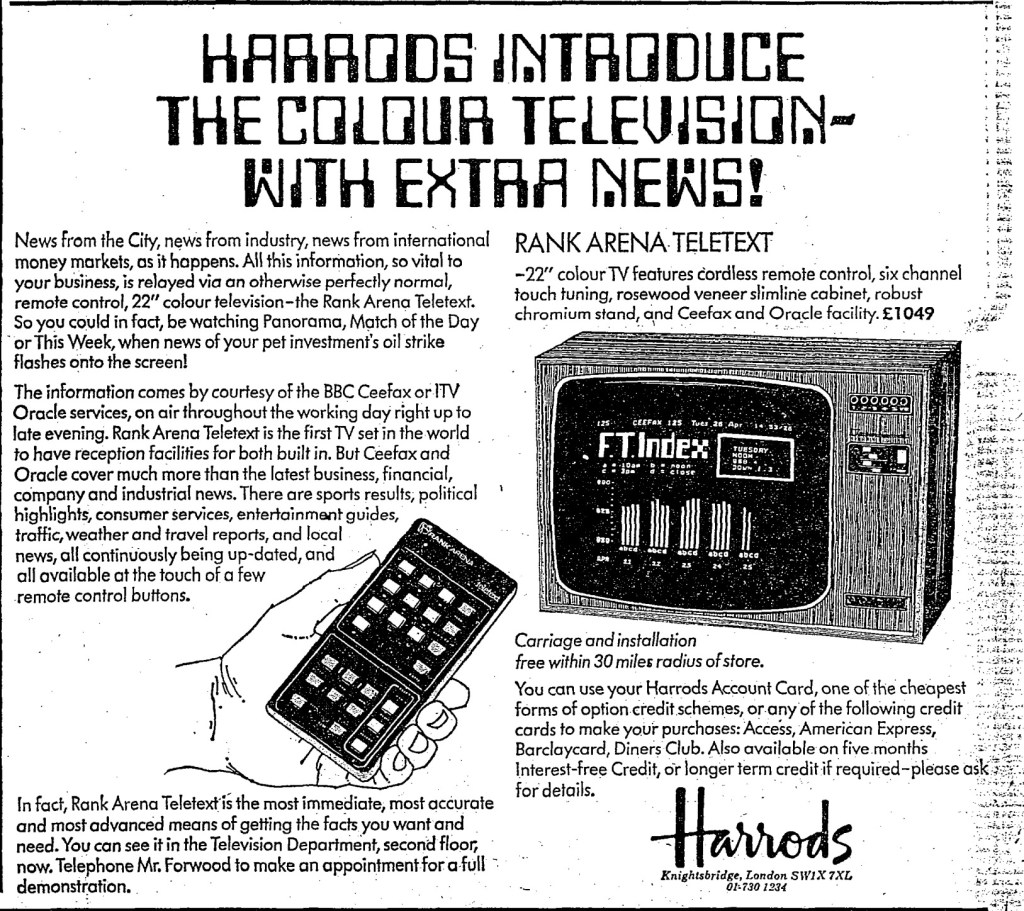
It says a lot when the relatable copy within the advert refers to “your pet investment’s oil strike”. Meanwhile, got to love “Telephone Mr Forwood to make an appointment for a full demonstration”. Ad from the Sunday Times, 24 Apr 1977. Despite the modest number of homes with Ceefax receivers, the BBC weren’t wholly beholden from mentioning where the service came into play. As the service grew, readers of the Radio Times were informed of how Ceefax could provide auxiliary information for then.
The listing for Saturday 11 March 1978 saw the first reference to horse racing results being available on the service in the listing for Grandstand. The same evening saw the billing for Match of the Day casually mentioning it was a good place to dip into full classified football results, along with pools news.
The following Thursday (16 March 1978) saw the billing for Top of the Pops mention that the Top 20 could be dialled up on page 156, while the white-hot heat of technological improvement even reached the garden on Wednesday 22 March 1978, as page 145’s Gardening News was dropped into the listing for the debut of splendidly-titled Mr Smith Propagates Plants. The following evening’s billing for the Evening News (read by early adopter Angela Rippon) even pointed out that weather maps could be found on P111. Saturday 22 April 1978 saw the first Ceefax pages dedicated to that evening’s Eurovision Song Contest (on P156, if you’re a time traveller), while the same month also saw the introduction of a page dedicated to detailing materials needed for each day’s Play School make. The march of technological progress even took in July 1978’s World Chess Championship, with Ceefax playing host to summaries of play throughout the tournament.
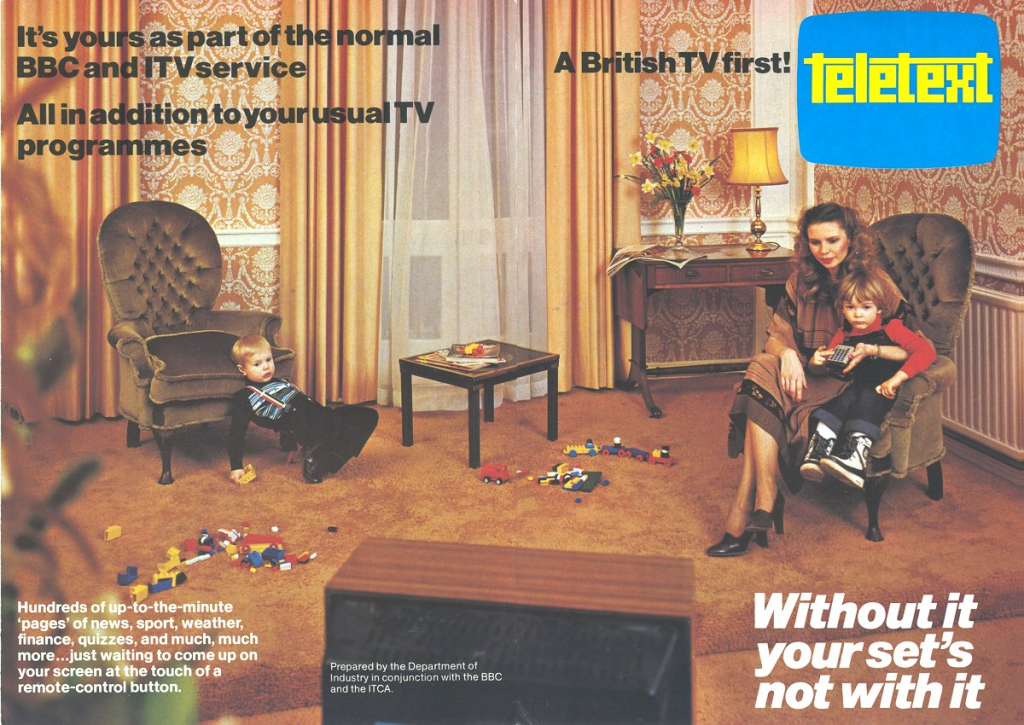
Source: mb21.co.uk By 1980 however, it was decided that the price of teletext receivers was finally within the financial grasp of many more Britons, not least considering many people preferred to rent TV sets, avoiding a major one-off outlay. And so, half-hour chunks of Ceefax started to be transmitted during some of the programme-free intervals that punctuated each day’s broadcasting. They weren’t being billed in the Radio Times or newspaper TV listings, and was referred to by continuity and on-screen as ‘Ceefax In Vision’, but those pages from Ceefax were finally going out to the nation.
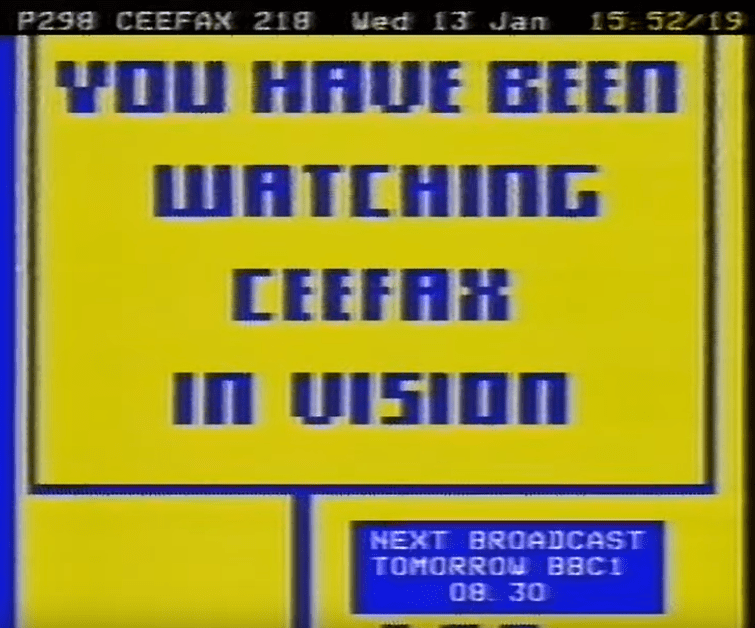
From January 1982 (video link) The following year, the service was promoted even further. October 1981 was declared National Teletext Month, a promotion that saw flyers and posters promoting the service, with cabinet minister Kenneth Baker imploring the British public to take a closer look. A glance through the newspaper archives suggests it barely made a dent in the national newspapers, but it did at least warrant a few mentions in regional publications such as The Scotsman, the Aberdeen Press and Journal, and a rare appearance for teletext in the London Illustrated News:
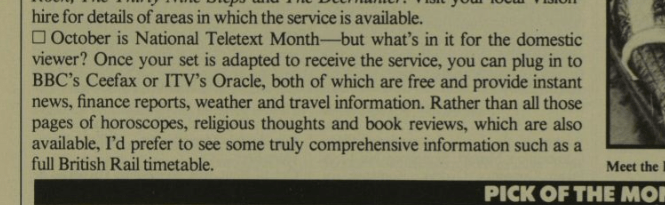
Of course, the good old Radio Times also stepped up to the plate, with Teletext Month even getting a corner strapline on one of the more infamous RT covers of the decade.
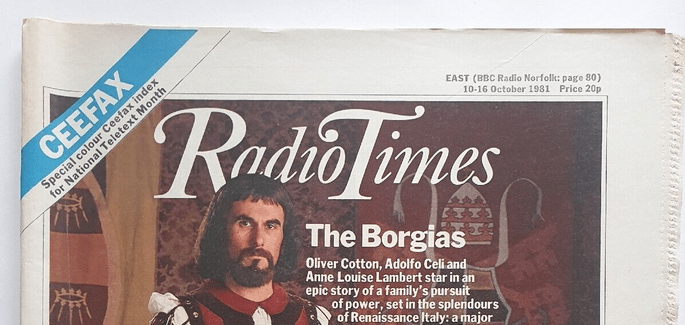
Sadly, that strapline wasn’t referenced in the Not the Nine O’Clock News parody cover. Sadly, National Teletext Month failed to rock the nation. While 1982 and 1983 saw further attempts at the themed month, press coverage seems to have been limited to adverts for companies trying to sell text-equipped sets, rather than any actual column inches. If only they’d given an entire weekend of BBC2’s airtime to Ceefax In Vision. That would have sorted it.
March 1983 saw pages from Ceefax finally being billed in the Radio Times and national press programme listings. BBC1 woke up each morning at 6am with half an hour of news, sport and travel information from the service going out under the guise of Ceefax AM, while the Breakfast Time studio readied itself for broadcasting to the nation at 6.30am. Basically, this was a low-cost rival to TV-am’s Daybreak opener, only with ITN newsreaders substituted with a smattering of BBC Micro Mode 7 magic. So, a cheap version of what TV-am were doing. But still, those pages from Ceefax were finally in the listings.
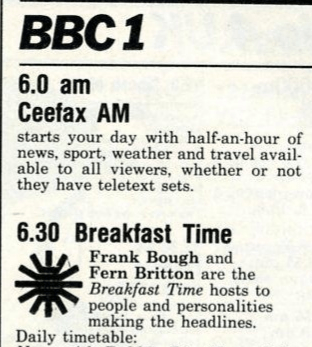

Source: Kaleidoscope Ceefax AM even had cause to break important news to the nation before anyone else. The 1983 Election coverage saw the early morning Ceefax service bridging the gap between a 4am screening of Leslie Philips flick Crooks Anonymous and an earlier-than-normal Breakfast Time, with the teletext stalwart bringing viewers the latest election results at 5.15am that day. Sadly, that’s yet to feature in any BBC Parliament bank holiday rebroadcast of old election coverage. For shame.
Saturday 7 January 1984 was a landmark date in TV history: for the first time, at 9am on BBC2, to fill some time before Open University rolled up the shutters for the morning, there was the first Radio Times and newspaper billing for the now-rechristened Pages From Ceefax. Rejoice! Knocking on for ten years since the first trials of the service, it was now in the big time, rubbing shoulders with the likes of, erm, Daytime on Two, From Petroleum to Polyethylene and Frank Muir’s popular game of musical knowledge My Music.
This was where Pages from Ceefax’s imperial phase truly began, finding itself spread across the schedules like jam on a crumpet for the next few years. It even occasionally served as an eight-minute 3.45pm buffer on several occasions between live weekday afternoon sport and the pre-Children’s BBC regional news bulletin, when surely it would have made more sense to throw on a Tom and Jerry. Such was Ceefax’s role as Official Interval-Filler to the Corporation, not even a mouse with dynamite could shift it.
While Full Fat Ceefax had grown so far as to offer actual software downloads on teletext-equipped sets by this point, the broadcast version was still largely restricted to news, sport, weather and outliers like recipes, TV listings, motoring news and film reviews. In the pre-web age, that was certainly enough to pique the interest of casual viewers, and if nothing else ensured I kept badgering my parents to buy a TV set with built-in teletext every time our existing Grundig started to get a bit wobbly.
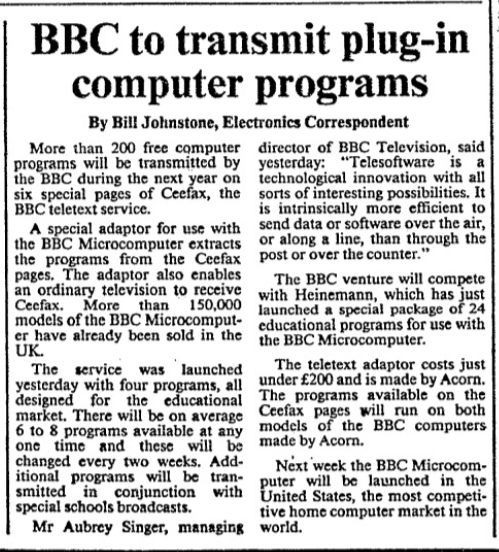
The Times, 21 Sept 1983. To be fair, you were hardly getting Repton 2 for your £200 add-on. 1984 saw another new avenue for Ceefax. With the Summer Olympics taking place in Los Angeles, and as such live Olympic coverage running into the larger of the wee small hours, the BBC transmitters were kept warm between the end of live action from LA and the start of Olympic Breakfast Time by putting out Ceefax Olympics AM, offering even more overnight news from the USA for the hardcore Olympiad ultras.
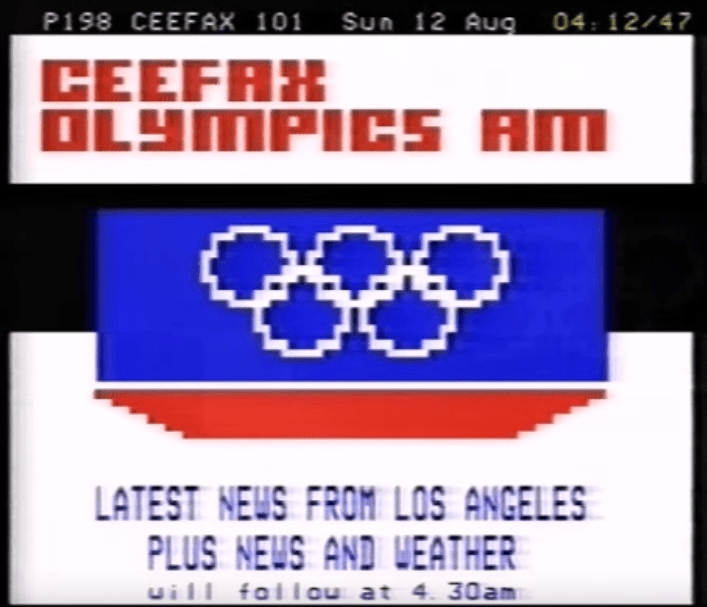
Source: Neil Miles Throughout 1985 and 1986, Ceefax continued to grout the gaps between programming on BBCs One and Two, but changes were afoot. Late 1986 saw the introduction of proper daytime programming on BBC1, meaning that after 24 October 1986, the service would subsequently only appear in Ceefax AM clothing on the Beeb’s flagship channel. Plus, by this point, Channel 4’s equivalent offering – 4-Tel/Oracle On View – was pumping out a much more varied selection of pages, from news to the marvellous Blue Suede Views section (including record reviews packed with character, genre pop charts) to live flight information from British Airways. On top of that, the 4-Tel portion of each broadcast included (limited) animation on interstitial slides. Pages from Ceefax were starting to look a bit stuffy by comparison.

Source: The Teletext Archaeologist It really took until 1988 before the BBC could start the fightback, with the tentative roll-out of Level Two teletext for the broadcast version of Ceefax. More colours! Animation! An attempt at a serif font that was a bit harder to read! This would go on to be used more heavily in the 1990s – and was exclusive to the broadcast version of the service, as Level 2 teletext decoders never took off in the UK – before the service sensibly reeled in the graphical showboating and retained the more traditional Level 1 Ceefax look in 1996.
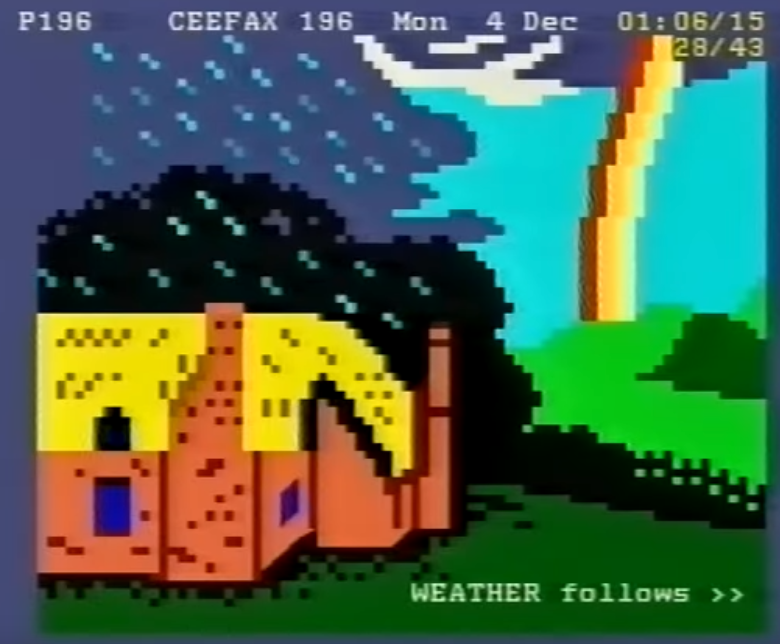
Because while that’s quite fancy… 
…that isn’t. (Source: VHS Video Vault) By the time the 1990s rolled around, there was less room for Pages from Ceefax in the printed schedules. Other than 6am outings on BBC1 each weekday before BBC Breakfast News (by now trading as Pages from Ceefax rather than Ceefax AM), plus filling the 9am gap on BBC2 between Westminster and schools programmes. By 1991, only the pre-Breakfast News broadcasts were being billed, and within a few years of that, Pages from Ceefax were back to being an almost entirely unbilled surprise for viewers with irregular sleep patterns.
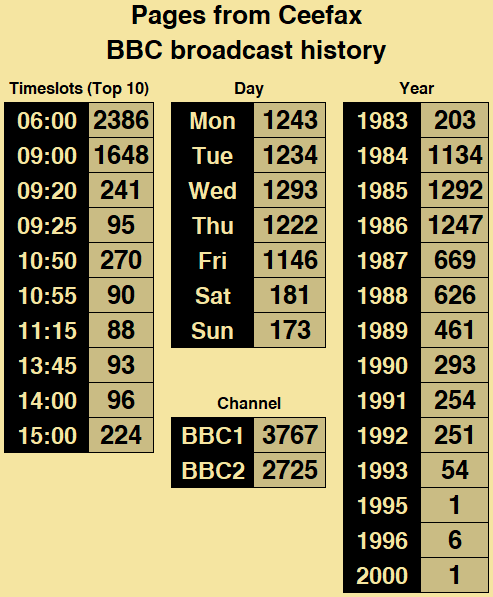
Look, here’s a big table showing a full breakdown of when Pages from Ceefax was listed in the Radio Times.

That solitary showing from 2000 is a curious little fellow, a twenty-minute burst of Mode 7 on an August Bank Holiday morning at 7am, before BBC2 viewers were able to enjoy a cracking double bill of A Day at the Races and The Great Dictator.
Of course, this wasn’t the end of Ceefax, or even Pages From it. They were simply no longer being billed in the Radio Times (or in newspaper TV listings) at this stage. And that makes sense, given by the mid-90s it was hard to buy a television that didn’t already have built-in teletext. Pages from was still airing throughout those years – for example, despite never being billed in the listings during 1995, there are several uploads of it on YouTube – but overnight hours at the time were mainly filled with another, less-remembered BBC pet project, BBC Select.
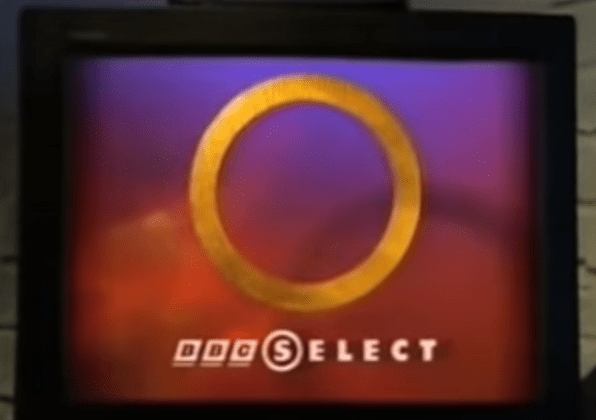
The option of paying for a descrambler to ‘unlock’ broadcasts that absolutely nobody was about to start pirating surprisingly wasn’t that popular (now comprising stuff like training videos for lawyers or recordings of company AGMs, rather than the initially proposed selection of TV classics), and BBC Select faded from view in 1995, replaced with the BBC Learning Zone. Happily, that’s where Pages from Ceefax would step back up to the plate, being employed to bridge the gap between the end of regular BBC Two programming and the start of Learning Zone content.
A greater challenge to Ceefax’s prominence on the nocturnal broadcast spectrum came in November 1997, when the launch of BBC News 24 meant BBC One’s overnight hours were now filled with flag-filled idents and actual newsreaders taking the place of Ceefax news pages. Ceefax still had a place on BBC Two, albeit almost entirely unbilled.
As it would transpire, the last ever example of a billed broadcast of Pages from Ceefax would be an outing on BBC Two Northern Ireland on Thursday 19 February 2009. That’s a regional broadcast, so it’s not being included in our total, but at least it warranted a page on the BBC website.
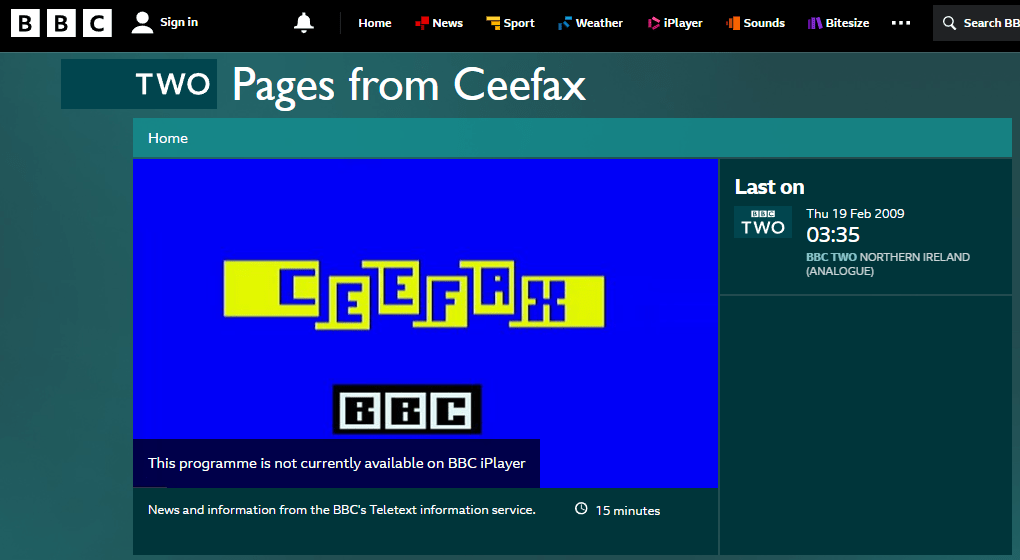
iPlayer link not currently available, but here’s hoping for some BBC Four repeats in 2024 The last ever Pages from Ceefax went out on 22 October 2012, on BBC Two at the appropriately unfriendly time of 4:45am. The end of an era, but it did warrant a proper send off by the continuity announcer, plus a farewell caption card at the end. Plus (and thanks to Chart Update’s James Masterton for this nugget), the final piece of accompanying music (don’t diminish it with the word ‘muzak’) was the fine choice of BART by US outfit Tom Fogerty + Ruby, which will likely be very familiar to anyone who’d grown up with the BBC’s grab-bag of Test Card/Schools/Pages from Ceefax audio over the previous 25 years.
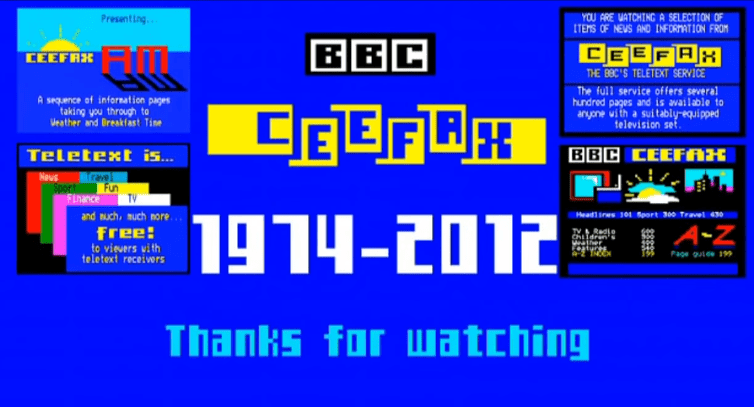
Definitely one to file under ‘things you would never get on ITV’ The following evening, the ‘proper’ Ceefax service finally came to an end. With Northern Ireland switching off its analogue transmitters and completing the transition to a fully-digital UK, there was no longer any analogue signal left for those Ceefax bits to hide in. However, some things are too beautiful to ever truly die, and the spirit of Ceefax lives on through projects such as Nathan Dane’s RSS-based Ceefax reboot, Raspberry Pi teletext tribute Teefax (which got a shout out on The One Show), and an entire online community based around the art of teletext art. There have even been annual teletext art festivals taking place at locations ranging from Berlin to Cambridge.
I’m loathe to use the word ‘iconic’, but the distinctive look and feel of the teletext layout – no matter which country a particular service originates from (and there are, of course, many) – instantly feels welcoming, a throwback to an age where information wasn’t available on tap via the electronic oblong in everyone’s pocket, where those of a certain generation could dial up news, sport, weather and the latest canal news whenever they wanted. This was our very own eight-colour future, and Pages from Ceefax was, for many, the Tardis door to it.
Okay, now that’s out there, here’s a bit more bonus content from Paul R Jackson, with some added information on those Blue Peter reunions. Over to you, Paul!
An update re: the Blue Peter Returns Anniversary info sent in. For the 30th anniversary (17/10/88), I don’t have Sarah G down on film. For the 40th anniversary, Lesley was missing too.
For the 50th anniversary, there was a tea party held at Buckingham Palace, on 15/10/08, with HM The Queen.
Nine former presenters were present: Valerie Singleton, John Noakes, Peter Purves, Lesley Judd, Simon Groom, Diane-Louise Jordan, Katy Hill, Konnie Huq and Matt Baker , plus two current presenters: Helen Skelton & Joel Defries. For this event, presenters had to have served at least five years. The then-current editor had missed Peter Duncan off list as he did his over two stints.
A 50th anniversary party was held at the Science Museum on 16/10/08 – 27 presenters out of a possible 34 attended the 50th Anniversary photo shoot (seven were missing from the shoot – the late Trace, Sundin & Keating, while four weren’t available – Curry, Fielding, D’Annunzio & Bacon).
Paul has also kindly provided some photos from those presenter shoots.
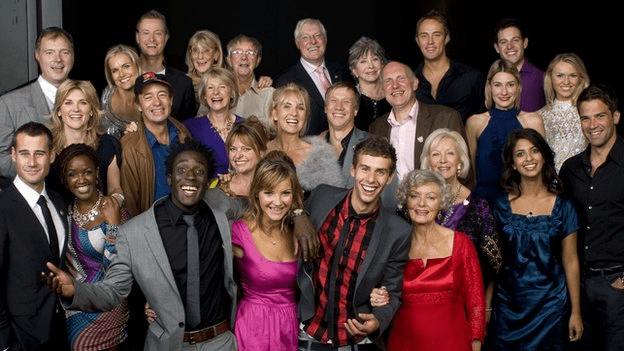
Here’s the 50th anniversary, with 27 former and present presenters, er, present 
And here’s one from the 60th, with just Simon G, Chris W, Tina & Gethin missing from the surviving line-up 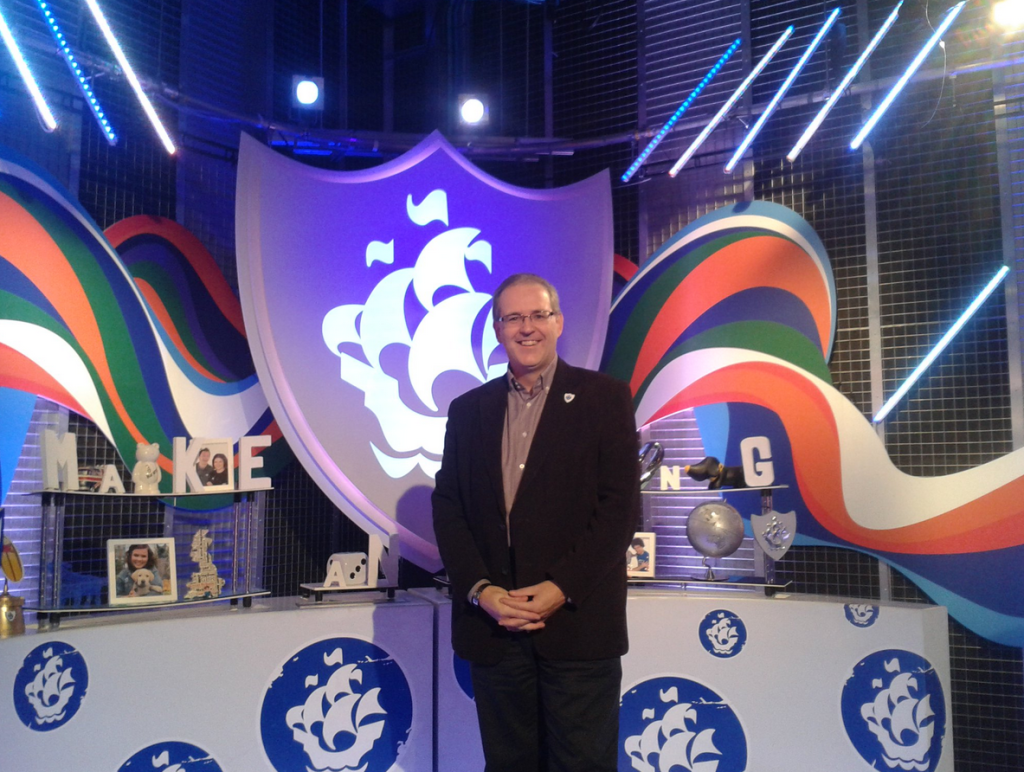
And here’s a shot of Paul himself, present at the studio in Salford in October 2014 (published with permission – thanks Paul!).
Okay, there are just three programmes left, and the savvy amongst you may well have already worked out what they are. But in which order will they come? And what will I find to write about them? Luckily for me, there’s a lot more background info about the next item on the list – expect more soon!
-
The 4th Most-Broadcast BBC Programme of All-Time: Video Special!

Ho, yes. We’re closing in on the top of the list, so I’ve made a video on the programme in fourth place. Everyone likes it when people say “hey, watch this video I’ve made”, don’t they?
For those who don’t (waves to 97% of the population), I’ll put the text version online tomorrow. Which has proper links, pictures and attribution in place, and is generally better. But hey, once I thought of doing this one as a video first I couldn’t resist it. It’s pretty obvious why.
4: Pages from Ceefax
(Shown 6491 times, 1983-2000)
That took aaaages to do, which is why I’m grimly amused that about twelve people will watch it. See you tomorrow for the text version!
-
“Bart, Elvis and The Baby” – The 5th Most Broadcast BBC Programme of All-Time

Into the top five. And where some programmes in the list are hard to find out much information, he’s one where there’s way too much to feasabily include. Still, here’s a good old bash at it – get comfy for over 6,300 words about…
5: Cricket
(Shown 6250 times, 1938-2021)
PROLOGUE: A lot to get through here, but if you’d like even more detail on the history of cricket on BBC TV, take a look at the book “…and welcome to the highlights: 61 years of BBC TV cricket” (by Chris Broad and Daniel Waddell, 1999) which goes into even more detail, and which has been a huge help on writing this update.

By WG Grace’s soupy beard, we’ve reached the last sporting entry on the rundown, and it’s a biggie. Something that has aired on BBC Television in every non-war year between 1938 and 1999. Something that’s was pretty damn ubiquitous throughout TV’s formative years in general. Indeed, for a spell in the late 1950s, it had become so omnipresent the evening BBC News bulletin was usually billed as News and Cricket Scores during the summer months.
Admittedly, when it comes to that overall ‘episode’ count, it doesn’t hurt that given the long-winded nature of the sport, TV coverage of cricket often required dipping in and out of action to make room for other programmes. But hey, it’s billings we’re counting here, and billings are something cricket generates in spades. Or unusually wide cricket bats.
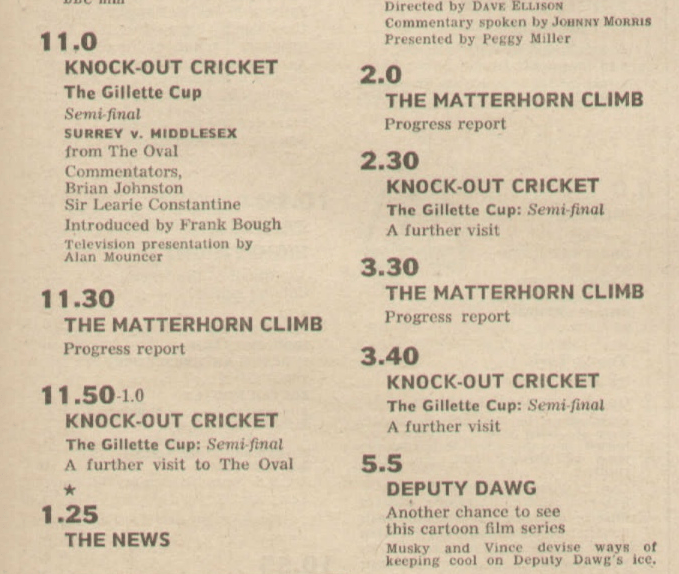
Radio Times listings for 14 July 1965 Anyway, and this won’t be much of a surprise given the popularity of Test Match Special on The Light Programme and Radios Two through Five, cricket first became a broadcasting fixture on the radio1. At a very early stage in the medium’s life, in fact; the first broadcast instances coming in 1923, starting with Men’s Talk: Cricket, by “Mr F.B. Wilson” (most likely Frederic “Freddy” Bonhôte Wilson, a keen batsman and cricket captain for Cambridge University, later sports journalist of high regard) airing on 2LO London at 9.55pm on Thursday 17 May. A mere ten minute natter about the sport it may have been, but the tap had been turned on.
[*UPDATE: Thanks to Guy Barry for writing in with the following (thanks Guy!):
TMS has been on several different networks but not normally, as far as I’m aware, Radio 2. (A check on Programme Index reveals two half-hour broadcasts in 1981, and that’s it.) It would take too long to go through all the various changes in detail but its main homes have been the Light Programme, Network Three, Radio 3 medium wave, the old Radio 5, Radio 3 FM, Radio 4 long wave and Radio 5 Sports Extra (with occasional outings on Radio 5 Live).
Incidentally the last-ever broadcast of TMS on analogue radio was in July this year – separate content on Radio 4 LW is being discontinued next March, in advance of the transmitters being switched off completely. From next year TMS will be a digital-only broadcast on Radio 5 Sports Extra. END OF UPDATE]
2ZY Manchester aired Talk on Cricket, by John Molyneux on 26 May that year, with 25 whole minutes to play with, while the following spring saw a whole (if generally untitled) series looking at the sport in more depth (“No. 4: J.W. Cameron, M.A. on fielding” etc). As far as concentrated cricket programming went, the first regular strands were born in Scotland, with Cricket Corner (hosted by Mr C. H. Webster) starting in June 1925 on 2BD Aberdeen and airing each Friday evening, and Cricket Talk airing on 5SC Glasgow from August of the same year.
Save for the curiously-titled programmes like Around the Clubs – Local Cricket Prospects going out on 5SX Swansea, or Mr John Fleming: Some Cricket Prospects on 2BE Belfast, both in April 1926, it does appear much talk was of the game in general, rather than any specific updates on the sport, and certainly no live match coverage. Curious-sounding outliers like The Annual Ball of the Swansea Football and Cricket Club, Relayed from the Patti Pavilion were more common, in fact.

The changed on 7 May 1927, with 2LO broadcasting the very-much-as-it-says-on-the-tin The Start of Cricket, offering the first day’s play from the Oval between Surrey and Hampshire. The Radio Times of the day billed it thusly:
“This evening all of them who could not enjoy the match from under the shadow of the historic gas-works will be able to hear it described by one of the most famous of living cricketers, who is also one of the most expert critics of the game.”
The expert mouth delivering those descriptions belonged to Middlesex and England batsman Pelham “Plum” Warner, one of just two people to be awarded Wisden Cricketer of the Year on two occasions (1904 and 1921, if you were wondering).

Plum Warner, 1873-1963. All together now: “Not a bad innings.” Once the live coverage of batting had opening, it didn’t take long for the first international cricket match to feature on 2LO – a whole week in fact, with Essex versus New Zealand going out on 14 May 1927. To mark the coverage, Stacy Aumonier penned an article for the Radio Times, and following a story about explaining the rules of cricket to an American (“It is a joy for ever to me to know that he went back to the United States thoroughly convinced that cricket was a far more exciting game than baseball!”), he muses on what took so long.
However, the point is that cricket may be and often is the most thrilling game in the world, and the recollection of that afternoon came back to me just now as I was pondering the question of the broadcasting of cricket. There is no question but that the broadcasting of other sports – football, racing, and the Boat Race, etc. – has been among the most successful efforts of the BBC, and it follows therefore that the national game cannot possibly be ignored. I was ill in bed when England played Scotland at Rugger a few months ago, but I listened, and although I don’t understand the game (we played Soccer at my school), I was nearly sick with excitement! But imagine a cricket match towards the end of the season, with perhaps the championship depending on the result – say Yorkshire and Surrey at the Oval. The last day, a sticky wicket, Surrey with eight wickets to fall, wanting one hundred and thirty-seven runs to win. What a chance for the commentators!
(…)
And at that point old ladies in the Midlands (who have never seen cricket played) begin to die of heart-disease from sheet excitement. There is the sound of the Commentator drinking something out of a flask. We all begin to wish it was all over, or that broadcasting had never been invented, or that we were there, or – What a game!
The Most Thrilling Game in the World, by Stacy Aumonier, Radio Times Issue 188, May 1927.Ten years hence, live commentary on cricket matches had become both popular and commonplace on the wireless, though any related increased death rate of old ladies in the Midlands region remains unrecorded. However, now there was a new game in town: radio with pictures (i.e. telly).
It only took until 24 June 1938 for the BBC’s Outside Broadcast team to experiment with live coverage of the sport, that initial attempt picking a suitably major occasion: The Ashes at Lord’s (sadly, a week not yet included in Genome). Denis Compton and Hedley Verity featured for England, while Bradman and ‘Tiger’ O’Reilly starred for the Aussies. A big occasion for England’s national sport, and one that would surely be shouted from the rooftops in the BBC’s official organ. Surely?
Ah, you know me too well. The Radio Times was reliably coquettish about the broadcasting breakthrough, relegating the coverage to some small print in the corner of a page, casually mentioning that “By kind permission of the MCC, the second Test match between England and Australia will be televised”.
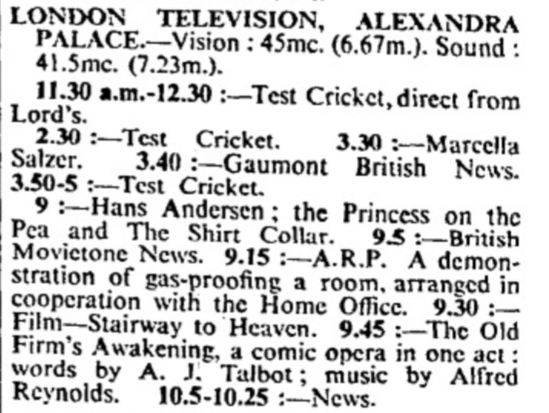
Broadcasting, The Times, Fri 24 June 1938 The press were similarly coy about the coverage. The Daily Mirror’s TV listings for that day happily billed the match – broadcast for an hour at 11:30am, another hour at 2:30pm, and once more between 3:50 and 5pm – but accompanying copy regarding television was instead filled with breathless excitement at the BBC’s announcement of forthcoming footage from the India vs The World Polo match airing in a few weeks time.
The Telegraph were a little more excited about the breakthrough, with a statement that “more than three hours of play will be shown on the screen each day” and that “this is the first time that cricket has been televised”. If you’re thinking that’s hardly effusive, consider that The Times’ Broadcasting page merely mentioning that the match “will be described at intervals in the National and Regional [radio] programmes”, with reference to TV coverage only given to readers eagle-eyed enough to pick out the millimetres afforded the television schedule.

The Telegraph, Fri 24 June 1938 Fortunately those behind the cameras were taking things much more seriously. A lot of the work was carried out by Ian Orr-Ewing, having worked with the suits at Lord’s to procure permission for the match to be televised by a BBC Outside Broadcast team still getting used to broadcasting outside, where the action would be captured by three cameras, each mounted on a turret in a set up described by Orr-Ewing as “so much string and sealing wax”.
Commentary was provided by Captain Henry “Teddy” Wakelam, who generally operated as a rugby commentator (his 1927 comms for England v Wales at Twickenham comprising the first ever running sports commentary on British airwaves), but who was also skilled at lending his tones to other sports. Wakelam’s first foray into running commentary is worth mentioning here: as it had been a thing that simply hadn’t existed before he rolled up at Twickers that January morning in 1927, he’d been unsure how to play the whole thing. His producer Lance Sieveking had a plan in place for this – at the ground, he introduced Wakelam to a man from St Dunstan’s who’d be sitting next to him throughout the match. That man was blind, and Wakelam was tasked with describing the action to him, rather than the home audience. Thus, the long-standing commentary trick of ‘act as if you’re talking to one person rather than millions’ was born.

Before that first televised test match, Wakelam had mused on how styles of commentary style might need to be adapted for the new medium, in his autobiography Half Time: The Mike and Me (London Thomas Nelson & Sons Ltd, 1938). His thinking was that, with live footage of the action being available, the commentator should become more of a compère than mere narrator of all that is happening, adding context where necessary, and not become a “mere talking machine who can tell a good story”.
Harking back to his first-ever radio commentary at Twickenham, on being initially asked to attempt the practice that had recently taken off in the USA, he penned the typically blustery statement “On the principle of ‘try anything once,’ and also with the confined conviction that if an American could do it I could, I agreed.”
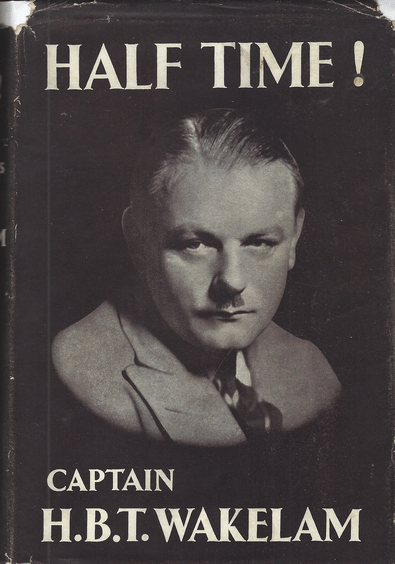
Admittedly, the front cover doesn’t suggest it’ll be a laugh riot, exclamation point or not. It kind of makes you feel you’re going to spend the next few hours being told off. With Wakelam on compère duties (history doesn’t seem to have recorded whether he wore a sparkly jacket), that inaugural broadcast was deemed a success. It certainly helped that the match was one where (to go by the match report from the following day’s Times) “the weather was delightful and the wicket true”, with England closing at 409 for 5, and batsman Wally Hammond grabbing an undefeated 210 (“one of the greatest innings of his career”). In fact, that opening broadcast went so well, permission was swiftly granted to allow an additional hour of broadcast at 6.15pm – though as no television was scheduled to be broadcast between 5pm and 9pm that day, it’s questionable how many viewers would have known to tune in for it.
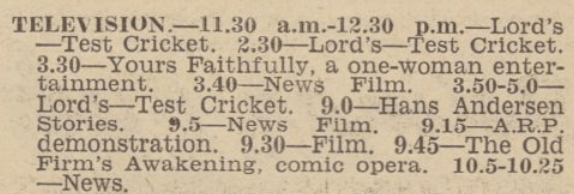
“Aw, I’d hoped to settle down and watch some nice relaxing static.” The press were also enthused by the coverage, that weekend’s Sunday Times printing the following review:
The televising of Saturday’s play in the Test Match allowed viewers to see players more intimately than most of the spectators could have done (writes our Television Correspondent). The ball was clearly visible most of the time, particularly when close-ups were given of Bradman at the wicket. A clever piece of television technique was employed as Bradman hurried back to the pavilion, apparently unconcerned at having scored only eighteen. The applauding crowd was brought in as a background to the retreating Australian, Ames crouching down expectantly behind the wicket, Verity wetting his hands as he walked back with the ball, the way in which Bradman kept his eye on the ball until it met the bat – such details were clearly visible.
“Close-Ups” of Ball and Batsmen – Television Success, Sunday Times 26 June 1938With the coverage widely accepted as a success, the only question that remained was: when could they do it again? This being the very early days of television meant that subsequent Test matches at Headingley and Old Trafford were out, as transmitters weren’t yet in place to beam footage back to London (which contained Britain’s entire TV audience at the time). Luckily, the fifth Test of the series was back in London, at the Oval, meaning London’s televiewers could enjoy more coverage of TV’s latest sport. As quite the treat it was, too – England won by an innings and 579 runs, with Leonard Hutton helping himself to a record-walloping 364 runs.
The following summer saw the BBC concentrate on improving their cricket coverage. The start of the first Test against the West Indies on 24 June 1939 saw coverage airing at 11.30am, 2.30pm, 3.50pm and 6pm, while on-topic light relief was offered by Charles Heslop starring in Reginald Arkell’s comedy play Percy Ponsonby Goes to the Test Match at 3.30pm. But this was no small undertaking. It was soon discovered that none of the gates in place at The Oval were large enough to admit the BBC’s Outside Broadcast van, meaning a team of workmen had to be hired the following month to construct a large gate for future broadcasts. Until that has been put in place, interim solutions such as knocking the roof off the van and deflating the tyres had proved fruitless, and instead a thousand feet of cable had to be laid from the OB van’s location outside the ground. Still, with the new gate in place, there’d surely be no interruption to future cricket coverage on the new Television Service. Hoora… sorry, World War What?
Following the war, the BBC Television Service would resume on 7 June 1946, and only a couple of weeks after that, cricket coverage resumed to lift the spirits of a battered Britain (or at least the bits of it that liked cricket). Lord’s was the location, and India were the opponents. That week’s Radio Times promised that “the television cameras will be exceptionally well-placed for the game”, and a full hour of extra evening coverage was promised each day at 5.30pm. Aiden Crawley was at the lip-mic, accompanied by Brian Johnston (at the start of a commentary career that would last for almost fifty years), the pair promoted by the RT as there to help viewers ‘follow the play’ rather than as mere commentators. Johnston later recalled his decision to move into the ‘play-follower’ box, pointing out that by that point, only four Tests had ever been televised, so the producers, commentators and cameramen were pretty much as new to the broadcasting experience as he was.
Cricket being cricket, and British summers being British summers, 1946 saw the first real instances of something that would become a hallmark of cricket coverage: filling the airtime with something, anything whenever rain stops play. This was a time long before the option of action replays, or even available footage of previous matches. Something needed to be done – as we all know, dead air is a crime – and Crawley and Johnston were the men to do it. Such as the time during the Oval Test of 1946, where viewers were promised ‘a surprise’ during a rain break as the camera slowly panned through the crowd to focus on “the Prime Minister”, who’d been enjoying the match with a small entourage, including “his wife, Mrs Churchill”. Except, of course, it being 1946 and the PM taking time away from Number 10 to attend the match was actually Clement Attlee, along with – crucially – his own wife, Violet Attlee. A correction was duly issued, albeit after the remark had been repeated, and there’s some proof for you that it’s probably better when sports presenters do know at least the basics of politics.
Unless you really want to pretend this was better than a regular Match of the Day. 1947 brought a new foil for Johnston, in the name of Jim Swanton, at the time known for his work at the Telegraph and on the radio. On television, he would also go on to fill the role of prank-recipient at the hands of the mischievous Johnners. Such as the time when, on starting his summary of play, finding his braces grabbed and pulled by Johnston, and left to deliver a five-minute summary wondering if or when his cohort would let them snap back against his body.
Not that Swanton was the only stooge in the commentary booth. 1977 saw veteran Aussie mikesman Alan McGilvray feature in the radio commentary box for Test Match Special. During a brief lull in play, Johnston muted his mic and offered his cohort a large slice of sticky chocolate cake. McGilvray duly accepted, and took a generous mouthful, only to hear the words from next to him “that ball just goes off the edge and drops in front of first slip… let’s ask Alan McGilvray if he thought it was a catch.”
As the 1940s came to a close, live television broadcasts were still largely restricted to London-based grounds, but efforts were ongoing to make the most of the coverage. New camera angles were employed – such as positioning a camera to capture action behind the bowler’s arm, providing a much better view of deadly fast bowlers or devious spins. Johnston and Swanton had settled into a real double-act role, and cricket fans returning from work would ensure they’d tune into coverage just before the 6.35pm news, where Swanton’s colourful summaries of the day’s play beat newspaper reports to the punch by several hours. Swanton summarised his technique for a summary that didn’t have any defined duration – it had to start after the end of the final over and finish thirty seconds before 6.35pm prompt – taking the approach of pretending he was merely letting a friend know what they’d just missed. By all accounts, Swanton mastered this art to perfection – though one time the wild gesticulations of the floor manager that time was running out resulted into Jim snapping, whilst on-air, “WILL YOU KEEP STILL?”
1950 brought a new era in the BBC’s TV coverage of cricket, with the first journey outside the capital to broadcast a match, travelling all the way to… Old Trafford? Trent Bridge? Edgbaston? Well, the complexity involved in setting up camera positions meant that the sojourn into the provinces didn’t reach any further than Ilford for a three-day match between Essex and Warwickshire, with scaffolding erected to offer a slightly precarious home to BBC cameras and cameramen – an internal BBC report at the time noting how the operator of Camera One had to move with special care, what with him standing on the edge of a sheer drop.
With coverage completed from Essex, the next trip was north to Trend Bridge for the third Test, marking the most northerly point a live BBC TV Outside Broadcast had been made at the time. The choice of camera positions allowed for a lens to be trained on West Indies spinner Sonny Ramadhin’s bowling hand, giving viewers an inside track on what England’s batters were facing – an innovation that lacked the close-up finesse one might have nowadays, but which generated gushing column inches in the press of the day.

July 1951 saw another landmark moment, with a women’s Test match between England and Australia getting live coverage throughout the day on a Saturday, Monday, Tuesday and Wednesday. On top of that, the match commentary team was led by Marjorie Pollard, former England hockey international turned cricketer and founder member of the Women’s Cricket Association. The experience wasn’t entirely new for Pollard – she’d first provided radio commentary for a men’s cricket match in 1935 – and she was perfectly clear about her preferred audio-only role, announcing “I’m no glamour girl and I don’t want to face that dreadful TV instrument”.
The construction of a new transmitter at Holme Moss outside Manchester meant that in 1952 cricket’s TV footprint could finally include Old Trafford and Headingley, meaning the BBC could now broadcast pictures from all five Test match grounds. With that year’s Test match visitors being India, an internal BBC memo from veteran radio commentator Rex Alston provided a guide to pronouncing the names of visiting players correctly. Not that Test debutant Fred Trueman was in anywhere near as welcoming a mood, taking three of the first four Indian wickets without a run being scored. The second Test was the commentary box debut of Peter West, a name that would become familiar to TV spectators over the next few decades.
The range of locations from which cricket could be broadcast continued to grow, so much so that provincial regions could now be expected to provide coverage of matches. If STANDARDS were to be maintained, however, guidelines had to be laid down. And laid down they were, with producer Antony Craxton putting out an internal memo on How Things Should Be Done:
Unlike some sports which we cover, cricket on television is, in my opinion, second best to being on the ground. Only one reason is needed to prove this in that it is just not possible to follow the ball often enough, and thus wickets fall unseen. It is therefore most important that the producer of televised cricket should have a pliable plan in his mind as to how best and how faithfully he can reproduce cricket on the screen, realizing that all the action cannot be covered. Above all, he must have a wide knowledge of the game, not only so he can anticipate as far as is possible events on the field, but also to guide his commentators along the best lines of thought.
Then, of course, he ought to be an enthusiastic cricket watcher or player, for any slight relaxation on his part may: result in the missing of a vital catch or an important incident. He must in fact not get bored or feel that cricket produces itself, as has been suggested. There is no doubt that an enthusiastic producer can make a rather dull game into enthralling viewing by clever use of his cameras – not only on the field of play. He must, however, not fall into the major trap of distracting the viewer with off-the-field close-ups at tense moments in the game when all the attention is demanded on the actual play.
Antony Craxton, Internal BBC Memo, 1952Craxton’s dedication to the art extended as far as setting out preferred positions for cameras around any cricket ground, and what they should capture. He also expressed opinions on how commentary should be handled, recommending that commentary during weekday working hours be a bit more descriptive, as the cricket hardcore are less likely to make up the bulk of the audience. Okay, he said at that time of day the audience were “predominantly of the female sex, and I feel they would prefer more commentary”, but at if nothing else he was at least conscious of the time of day each broadcast aired, and considered how best to meet the needs of that audience.
One major problem encountered by cricket coverage was that the bulk of live coverage came during weekday working hours. Outside of those hours – especially in the period where BBC2 didn’t yet exist to offer an alternative channel – there was a lot more competition. Much of the 1950s saw internal conflict at the Beeb between the Children’s Television department who’d want to keep a place for their programming each day, and the Sports department who’d quite like it to move out of the way in case an important wicket was missed. The sports department went as far as offering commentary adapted for children on Test match days if the Children’s department would surrender half of Children’s Hour to cricket coverage. But, unsurprisingly, no dice. Joanna Spicer, Head of Programme Planning put out a BBC memo in 1957 stating that “while Brian Johnston is more than capable of adjusting his commentary to children, other announcers would not be so good at it.”

“Step on my turf again Johnston, I’ll slit yer face.” This would be a longstanding issue until the arrival of BBC-2 in 1964, where at least the two could peacefully co-exist. Well, aside from any bickering over who got the top bunk of BBC-1, anyway.
By the late 1950s, BBC-tv schedulers decided that the general audience might prefer to see other programmes at the close of cricketing action, but Swanson was understandably less than keen on the plan. As a result, he wrote to Head of Outside Broadcasts Peter Dimmock (a regular name in this rundown), pointing out the sacks of mail his summaries generated from a grateful audience. This was backed up by an internal memo from BBC Sports Organiser Jack Oaten, who believed the summaries to be “of greater importance as a service to the viewer than a good deal of the play earlier in the day”. As a result of this campaign, the summaries survived. At least for the time being.
The hip and swinging sixties saw further changes to the way cricket was covered on the BBC. 1963 saw the introduction of one-day cricket, which ushered in a new sense of immediacy to the sport (well, in the sense that taking a whole day to play a match is better than it taking several), and with such changes afoot some of the old voices behind the coverage such as Johnston and Swanton were nudged out of the TV commentary box in favour of former cricketers.
The start of the end for Johnners et al came during the final Test of the 1961 series between England and Australia. As the final match at the Oval meandered towards a draw, Johnston and guest co-commentator Jack Fingleton passed their time sharing gags, quips and anecdotes, along with musings on the wife of scorer Roy Webber. Head of Outside Broadcasts Peter Dimmock was far from amused, and neither were a number of viewers, who wrote to the broadcaster to complain. Within a few years, Johnston made the switch to radio commentary, his whimsical musings feeling much more at home. In his autobiography (It’s Been a Lot of Fun), Johnston mused that “I’ve always maintained that a TV commentator can never hope to please everybody any of the time. He will also be extremely lucky if he can please anybody all the time.”
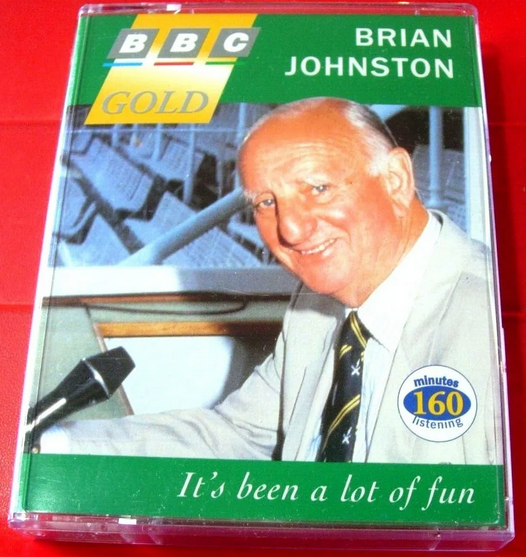
Also available as an audiobook. It’d be a crime if it wasn’t, really. 1964 saw the arrival in the TV commentary box of Richie Benaud, who’d been a part of the Australian team a few years earlier while Johnston and Fingleton controversially waxed jocular. Already familiar with sharing his views in print and broadcast media, he proved a popular addition. This was no coincidence. Whilst still a player, Benaud attended a three week BBC course on covering sport instead of travelling with the rest of his team to Asia, and would routinely appear at the back of commentary boxes to observe the craft at close quarters. By 1960, he was providing occasional radio commentary for the BBC, before becoming a full-time cricket journalist and commentator following the end of his playing career.
Benaud’s sense of preparation went as far as putting together a list of phrases to avoid at all costs, including cliches such as “at this point in time”, “I really must say”, “Of course”, and “to be perfectly honest”. Filler phrases all, that add nothing to the illumination of the viewer, with Benaud keen to avoid talking down to viewers. This thoughtful approach would later be underlined to commentary teams by Controller of Sport Jonathan Martin, who would point out that the Titanic was a tragedy, the Ethiopian drought was a disaster, so a mere dropped catch in a Test match should never be deemed a suitable cause for either word.
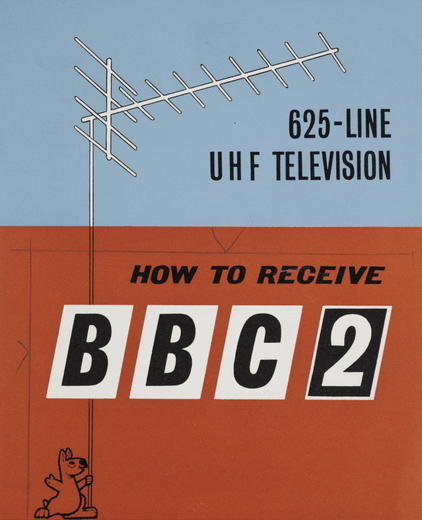
1964 saw another major change for cricket on the BBC. Namely, the introduction of BBC2. This afforded an extra hour of cricket coverage each evening without the need to trample over children’s programming. Similarly, several uninterrupted hours of coverage could be screened on Sundays without needing to break for mandatory religious programming, starting in May 1965 with the first edition of Sunday Cricket, a series of matches played under knock-out rules, starting with the spectacularly-named International Cavaliers XI taking on a Worcestershire XI. This could run from 2pm to 6.30pm, with only occasional intervals, making a treat for cricket fans lucky enough to own 625-line sets and live in a region that received the new channel.
As Johnston started his migration back to radio, John Arlott made the move in the opposite direction. Another radio commentator of the highest regard, Arlott moved to television for occasional Test matches and would become part of the main commentary team for the Sunday Cricket coverage. However, Arlott’s florid commentary style never felt like a suitable accompaniment to television pictures, and he would move back to radio where this true stengths lay. For both Arlott and Johnston, it’s probably fair to say this was no demotion. Cricket enjoys a rare reputation for being a sport a lot of people prefer to experience over the radio airwaves, especially at a time when TV coverage needed to dip in and out of matches to make way for Watch With Mother or the news.
A more successful – if eccentric – addition to the TV commentary team was former England captain Ted Dexter, whose voice was heard on BBC Television for the first time in 1968. After reducing the amount of time spent at the crease, he’d initially moved into the world of business, as well as dipping his toe into politics, contesting Jim Callaghan’s Cardiff South East seat on behalf of the Conservatives in 1964. For the BBC, he’d take on the role of summariser, taking in a few Test matches each summer, and his association with the Beeb would last over twenty years, despite his other interests. One of which was racing. So much so he’d bring his own portable TV to the ground, so he could keep one eye on the latest action. This proved a boon on an occasion at Canterbury when a power failure caused the BBC’s monitors to fail. Dexter offered up his own screen as a workaround, and the broadcast was able to continue.
Not that electricity was always his friend. On one occasion at Edgbaston, rain had stopped play during a test match. On chatting to Peter West atop the pavilion roof – both holding umbrellas to compensate for lack of shelter – dark storm clouds gathered overhead. As Dexter recalls, “We were just going into the interview and felt a crunch and a jolt in my arm. I said: ‘Peter, I think I’ve been struck by lightning.’ He said: ‘Never mind that, what about Boycott’s innings?’.”
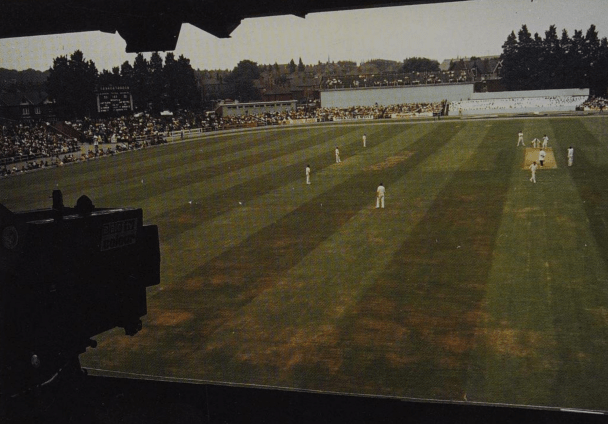
By 1969, the lush greens and cricket, erm, whites could be enjoyed in full colour on the BBC, and a fresh approach was brought to TV coverage. The unflappable Peter West stepped away from the commentary box to became cricket’s first anchorman, a role he would enjoy for the next eighteen years. Former spin rivals Richie Benaud and Jim Laker were now first choice for the commentary box, the latter having moved from ITV in 1968. Ted Bexter and Colin Milburn (and, for a spell, Denis Compton) alternated as summarisers.

In addition to the live cricket coverage the BBC had so rightly been lauded for, highlight programmes were now a feature of the TV schedules. Previously, highlights had been restricted to the closing moments of live coverage, but now they were found to be suitable filling for a Twenty-Four Hours/Late Night News sandwich. With the holy quadrinity of West, Dexter, Laker and Benaud in situ, BBC TV’s cricket team were well equipped to see out the 1970s, able to remain unfazed at the rise of streaking at cricket matches.

Tempted to post of photo of a streaker, but some of you might be at work. The 1980s saw a new spark of popularity for the sport, a particular jolt coming in the 1981 Ashes series, with an unstoppable Ian Botham being the difference between the two sides. Tom Graveney had been added to the commentary line-up following a 1979 appearance as summariser, a stint that would last for fourteen years.
Graveney, a flamboyant batsman who often found himself out of favour by selectors in favour of more workmanlike players, had the humility to dip into his own catalogue of mistakes when passing comment on others. He was far from immune at making occasional gaffes during commentary either – an inadvertent comment about Curtley Amrbose’s bowling style included a remark that “the big fella can get it up any time he likes”, generating a swarm of letters from the amused and the affronted.
With this being the BBC in the 1980s, it shouldn’t be too surprising that the use of computers was introduced around this time, albeit from a slightly unlikely source. While the Beeb’s main computer evangelist Ian McNaught-Davis was promoting all things micro-based as part of the BBC’s Computer Literacy Project, it was Ted Dexter who was determined to introduce a tech-based solution. His goal was for a computer program to store reams of cricket-based info in a database. Dexter’s business connections let him spread the word around the UK’s tech industry, with the UK arm of American outfit Honeywell expressing an interest. As a result, the Beeb’s old system of expressing the score – physical letters and numbers moved into position on a magnetic board that was duly chromakeyed onto the screen – was replaced with a computer-based equivalent. This, along with Dexter’s database, meant much more relevant information could be thrown on screen in a fraction of the time.
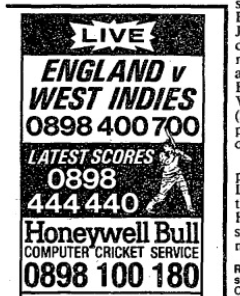
The computerised system could also be used to run up a ruinous phone bill. Further innovations came about as the decade progressed. One major change was the use of double-ended coverage. Previously, one fixed camera would be used for the main angle, so at some points action would be viewed behinds the batsman, at other times behind the bowler, the former coming with the risk of action being obscured by the umpire. With double-ended coverage – an innovation first used by Australia’s Nine network – the view could remain behind the bowler, no matter which side of the field they’re bowling from. Similarly, an in-stump camera was employed, another idea first used by Nine. A clever bit of trickery involving a camera around the size of end-to-end packs of Polos placed inside the middle-stump, with a mirror angled to capture action from between the batter’s legs.

As the digital age of broadcasting beckoned in the 1990s – at which point an arms race between BBC and Sky was in place over sports coverage, super slo-mo cameras were deployed, offering a forensic view of action, especially in the event of contentious calls by the umpire. The rise of technological innovation in broadcast even led the ECB to request the BBC’s help in introducing the third umpire. This proto-VAR system was first used in 1992 for the South Africa versus India series, where Karl Liebenberg adopted the third umpire role, using TV replays to aid on-field umpire Cyril Mitchley regarding a run-out decision that saw Sachin Tendulkar dismissed. Television had now become a part of cricket to an extent that would have seemed unimaginable just a few decades earlier.
The BBC was at the top of its game by the late 1990s, but when you’re at the top, everyone wants to knock you down. Not only was subscription-based TV a challenger to the BBC Sport’s coverage – top-flight football had long fallen into the clutches of Sky – but a sport like cricket, with it’s well-to-do audience and break-heavy nature was pure catnip to commercially-funded broadcasters.
And so, in October 1998 – just over sixty years from BBC-tv’s inaugural cricket coverage – came the announcement that Channel Four had secured the live rights to most England home Test matches, with Sky Sports owning exclusive rights to the remainder. That meant £103m pouring into the ECB coffers, and the BBC left with just the rights to radio coverage. Accompanying the TV rights over to Four was the BBC’s voice of cricket for 35 years, Richie Benaud. The silver-voiced Australian would be sticking at the Beeb for their World Cup coverage, but then he’d be making the move to the commercial broadcaster.
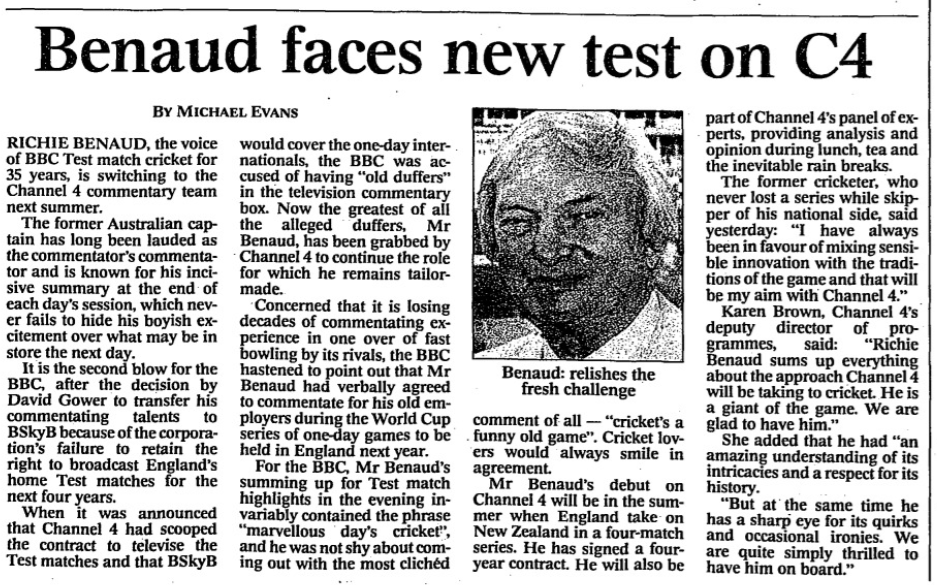
The Times, Sat 31 Oct 1998 And so, with live coverage of the 1999 Cricket World Cup, live TV cricket coverage on the BBC bowed out for a couple of decades. The rights to all live matches within the UK would become exclusive to Sky Sports from 2005, and a year later highlights of England home matches moved to Channel 5. It took until the 2006 Ashes before late-night cricketing highlights reappeared on the BBC.
In 2010, even ITV started riffing on the BBC’s pain by securing live rights to the new Indian Premier League, before adding 2010/11 Ashes highlights to their line-up.
At one point, BBC Studios-owned digital channel Dave had more live cricket rights than the BBC proper come 2016, when it procured live rights to show live coverage of the Caribbean Premier League.
Luckily, even when it comes to high-level live sports rights, what goes around comes around, and in 2020 live cricket coverage finally returned to the BBC. The ECB’s decision to ensure both subscription and free-to-air TV had a share of the pie meant the BBC finally recovered some live rights, and as a result – starting with England’s T20 match against Pakistan on 30 August. Perhaps unsurprisingly, given free-to-air coverage and lockdown preventing a live crowd, the coverage was a ratings hit, the daytime BBC coverage attracting 1.7m viewers compared to Sky Sport’s average of 331,000.
Luckily, for anyone who likes a sense of closure, live cricket is (at the time of writing) once more a fixture on BBC television (and, as programme trails inevitably add, iPlayer). Since 2020 both Men’s and Women’s matches in T20 and The Hundred have been broadcast live on BBCs One and Two, while highlights of One Day Internationals and The Ashes have enjoyed a place on primetime BBC Two.
And long may it continue. Sky may have deep pockets, but money can’t buy history, and the BBC has that in spades. Or unusually wide cricket bats.

EXTRA BONUS CONTENT: With huge thanks to the ever-splendid Paul R Jackson for providing me with a comprehensive list of names throughout the BBC’s cricketing history. Which is handy, because there was no way I could have included everyone in the write-up above. Over to you, Paul!
BBC TV CRICKET (List by Paul R Jackson, October 2023)
Presenters
Peter West 1968-86
Tony Lewis 1987-99 (Tests until 1998)
David Gower 1998
Isha Guha 2020-
Ebony Rainsford-Brent 2022World Cup (1979; 1983; 1999)
Frank Bough 1979
Tony Lewis 1983; 1999
Peter West 1983
Tony Gubba 1983
Jonathan Agnew 1999
Steve Rider 1999
John Inverdale 1999
Dougie Donnelly 1999Cavalier Matches (1966-68)
Frank Bough 1966-68
Peter West 1966Sunday League Matches, BBC Two (1966 & 1969-89; 1993-?)
Corbet Woodall 1966
Frank Bough 1969-73
Peter West 1971
Mike Carey 1972
Peter Walker 1973-89Gillette Cup
Mike Carey 1972
Benson & Hedges Cup
Peter Walker 1976
Commentators (with a tenure spanning three or more years)
Aidan Crawley 1939;1946-48
E.W. (Jim) Swanton 1946;1948-66
R.C. (Raymond) Robertson-Glasgow 1946;1948
Brian Johnston 1946-69
P.G.H. (Percy) Fender 1946-48
W.B.Franklin 1946-48
Robert Hudson 1947-64
Peter West 1947-86
Richie Benaud (Australia) 1964-70; 1972-99
John Arlott 1965-80
Neil Durden-Smith 1966-68
Jim Laker 1968-85
Peter Walker 1974-89
Christopher Martin-Jenkins 1981-86; 1988; 1995
Tony Lewis 1981; 1983; 1986-(94)
Ralph Dellor 1986-89; 1993
Ray Illingworth 1987-93
Jack Bannister 1988-99
David Gower 1994-99
Jonathan Agnew 1994; 1998-99; 2021-
Simon Mann 1999; 2022
Alison Mitchell 2020-
Isha Guha 2020-
Nick Bright 2021-
Summarisers (with a tenure spanning three or more years)Jack Fingleton (Australia) 1956;1961
Denis Compton 1958-75
Richie Benaud (Australia) 1960; 1963
Colin Cowdrey 1963; 1969
Ted Dexter 1965; 1968-87
Geoffrey Boycott 1969; 1977-81; 1990-(99)
Ray Illlingworth 1975; 1984-93
Tony Greig 1975-76; 1983
Everton Weekes (West Indies) 1976; 1979
Ian Chappell (Australia) 1977; 1989; 1993; 1997
M.J.K (Mike) Smith 1978-81Tom Graveney 1979-(93)
Peter Loader 1979; 1983
Ian Botham 1980-81; 1983; 1988
Tony Lewis 1981; 1985-86
Bob Willis 1982-83; 1985-87
Jack Bannister 1983-84; 1987
David Acfield 1987-89?
Mark Nicholas 1989; 1994
Simon Hughes 1992; 1994-99
David Gower 1993; 1998
Colin Croft (West Indies) 1995; 1999
Chris Broad 1995-99
Ravi Shastri (India) 1996; 1999
Dermot Reeve 1997; 1999
Phil Tufnell 2020-Milestones:
24/6/38 1st televised Test match: England v Australia at Lord’s
27/4/69 1st televised Sunday league match: Middlesex v Yorkshire at Lord’s
30/8/98 Fourth days play England v Sri Lanka at the Oval, last test match coverage until 2020
30/8/20 1st live cricket on BBC since 1999 – T20 England v Pakistan, Emirates Old Trafford
Phew. That was quite a long one, wasn’t it? Next update soon: which might not be quite as lengthy.

-
Blue RePeter Returns: Another Fact-Based Addendum
Blimey, you lot.
Following yesterday’s extra batch of Blue Peter information from Paul R Jackson, Daniel James Webb has written in (okay, he posted in the comments, but I’m trying to get a Blue Peter aesthetic going) with the following list of details of presenter reunions for each landmark anniversary. Take it away, Daniel!
20th anniversary (16th Oct 1978): 7 from 9 living ex-presenters present (77.78%)

Anita was missed when they did the research for this programme, and subsequently left out of the show’s official history for the next 20 years. John N was filming Go With Noakes on the day, but sent a pre-recorded message on film.
25th anniversary (17th Oct 1983): 9 from 13 (69.23%)
Anita remained forgotten. John N and Lesley were not there, but clips of them were shown at the appropriate point during the presenter parade. Leila was also not there, and, as far as I can glean from the archive, not mentioned during the presenter parade, presumably as no footage of her time on the show survived.
30th anniversary (17th Oct 1988)

No presenter reunion as such, although Val presented the O.B. during which the Outstanding Endeavour Award was announced, and Simon G, Peter D, Janet and Sarah all sent pre-recorded messages on VT.
35th anniversary (14th Oct 1993): 13 from 18 (72.22%)
Peter P and Janet each appeared on VT introducing their favourite moment on the show. Anita was still forgotten. Christopher W and Yvette were not there and not directly mentioned in the part of the show regarding past presenters, although as Mark’s favourite moment was being deafened by Yvette at Blackpool Pleasure Beach she was at least seen in archive footage.
40th anniversary (16th Oct 1998): 24 from 25 (92.31%)

The only living presenters that weren’t there were Anita West (whose association with the show emerged in the press very soon afterwards, resulting in her being invited to take part in the Blue Peter Panto that Christmas with various other ex-presenters) and the then-recently-departed Romana.
45th anniversary (15th Oct 2003)
No returning presenters this time. Instead viewer Ryan Gilpin became a presenter for one show.
50th anniversary (16th Oct 2008)
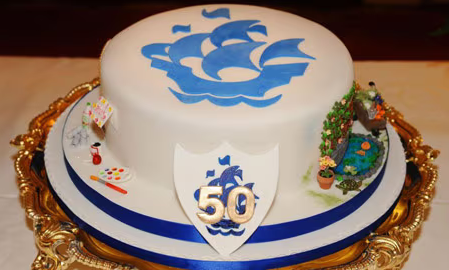
No returning presenters again, but Christopher T’s granddaughter was interviewed.
55th anniversary (17th Oct 2013)
No returning presenters yet again.
60th anniversary (16th Oct 2018): 27 from 33 (81.82%)
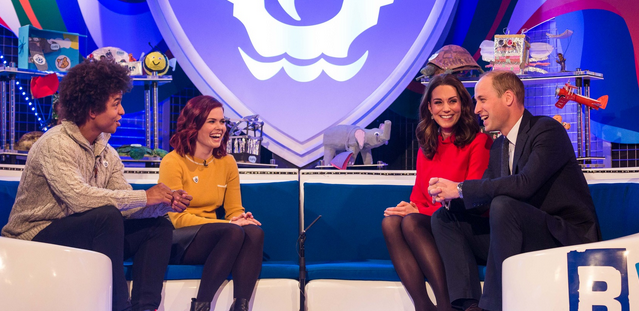
Matt Baker appeared via either pre-record or satellite (not sure which) from Broadcasting House in London, as he was doing The One Show that evening. Mark Curry was explicitly mentioned in the show as having become ill at the last minute. Three consecutive presenters, Simon G, Chris W and Tina were all absent and unmentioned, and the way the other presenters were lined up in consecutive order meant that an obvious space at one end would have been precisely where Simon, Chris and Tina would have gone if they’d been there, which made me suspect they had in fact turned up and something of some sort may have happened before transmission that prevented them being in the live show, although that is entirely speculation on my part. Gethin Jones also seems to have been missing too.
65th anniversary (13th Oct 2023)

No full reunion, but Matt, Radzi and Lindsey returned and took part in the show.
Lovely stuff. A (still solely spiritual) Broken TV Gold Badge to Daniel for all that excellent work. Now, unless someone is able to go even further with, I don’t know, an exact transcript of Christopher Trace’s inner monologue from the first episode, that’s probably where the Blue Peter ship sets sail from this blog, at least for now.
-
Blue RePeter: A Fact-Based Addendum

In a fairly typical example of the blog almost-not-quite timing things properly, the last update (marking the history of Blue Peter after I reveal it as the sixthmost broadcast BBC programme of all-time) happened to appear a few days shy of Blue Peter’s 65th anniversary. Of course, if I’d planned things properly, I would have waited until the day itself. But since when has planning things in a proper and timely fashion ever helped anyone?
Oh. Ah.
ANYWAY, to help mark things a little better, he’s some extra Blue Peter gold to mark the occasion, with huge thanks to Paul R Jackson for providing some extra-excellent knowledge.
WHAT DID THE BBC DO TO MARK BLUE PETER’S SIXTIETH ANNIVERSARY?
There was a special programme. Well, kind of. On 16 October 2018, BBC Four broadcast a special documentary on the history of the programme, going out under the search-term-thwarting title BP Confidential. This aimed to reveal the “true character of those working behind and in front of the camera on Britain’s longest continuously running children’s programme”. The programme blurb suggests it covered much that is already known about the programme (at least if you’re me, and you’ve just spent ages reading through published histories of the series), but it’s nice to see that it took the time to mark the work of Anita Ward, the previously-forgotten BP presenter.
This was just the opening act on a midweek BP tribute night, followed by Blue Peter: It’s a Dog’s Life (“the story of Blue Peter’s fondly remembered canines”), Blue Peter Flies the World: Morocco (a repeat of an international jaunt from 1968) and The Biddy Baxter Story, a profile of BP’s redoubtable editor.

WHAT ABOUT THE FORTIETH ANNIVERSARY?
Now you’re talking. Of course, the BBC being the BBC, BP Confidential wasn’t a new programme put together to mark the 60th – it had originally aired on Saturday 10 October 1998 on BBC Two, to mark the 50th anniversary, before being repeated on 9 December 2017 (also on BBC Two).
The 1998 celebration was part of a much higher-profile Blue Peter retrospective, with an entire evening of BBC Two celebrating the series. Ah, theme nights. I can’t be alone in really wishing BBC Two would run a theme night celebrating theme nights of the 1990s.
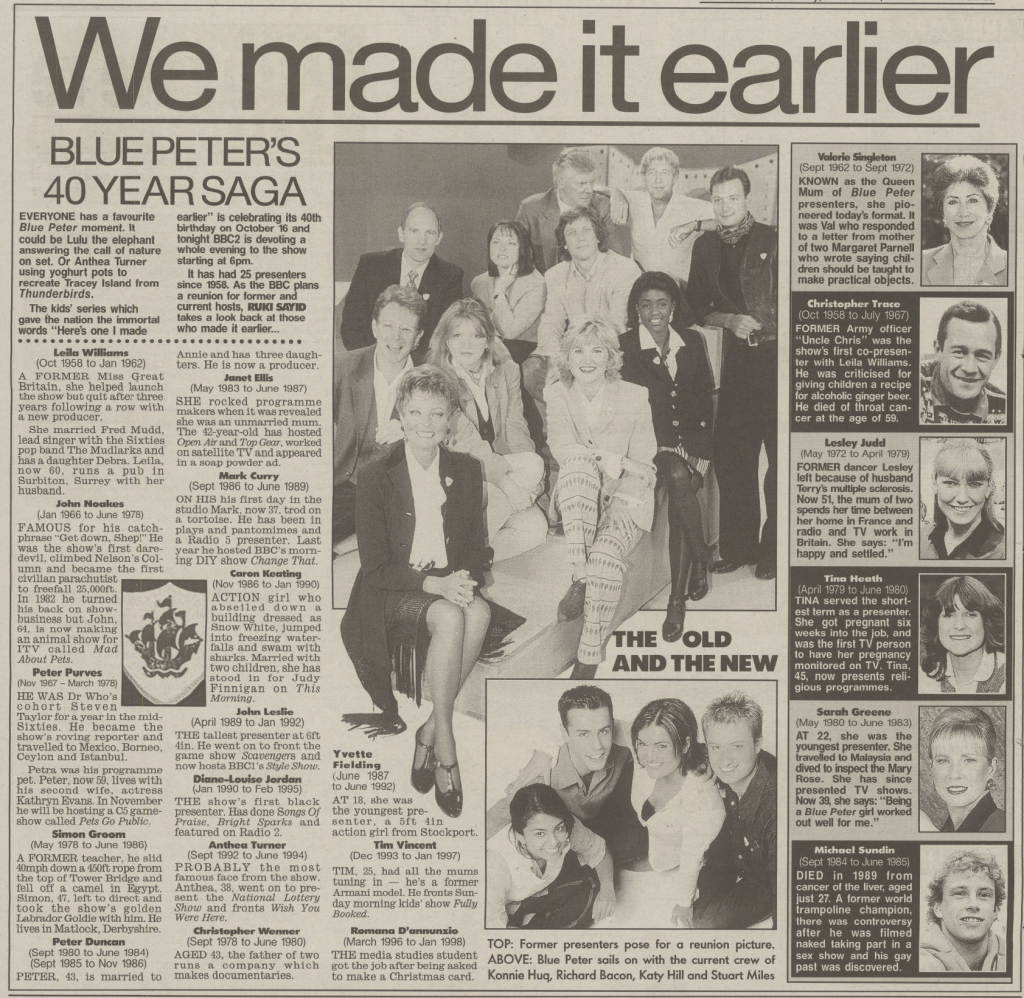
Daily Mirror, Saturday 10 October 1998 This kicked off at 6pm with Hello Again!, where former hosts John Noakes, Peter Purves and Valerie Singleton introduced themselves as our hosts for the evening. This was followed at 6.05pm by Carry On Blue Peter, a compendium of cock-ups from the programme, hosted by Richard Bacon, Katy Hill, Konnie Huq and Stuart Miles.
It being the late-90s, no programme could go long without having a phone poll, and Blue Peter Night was no exception – a poll being ran at around 6.30pm where you could spend 10p a minute voting for your favourite Blue Peter decade: 60s, 70s, 80s or 90s. The first hour was rounded off by It’s a Dog’s Life (as above, “the story of Blue Peter’s fondly remembered canines”).
But, as Brian Butterworth would say, that’s still not all. Following a break for news, sport, Chris Patten’s East and West, What the Papers Say and a documentary about the Cold War called, erm, Cold War, we were back at 8.55pm, with a rare excursion across the watershed for the Blue Peter ship. The late evening saw Spoof Peter at 9pm, a collection of BP pisstakes, featuring (it’s safe to say) Monty Python’s Flying Circus and Not the Nine O’Clock News. That was followed at 9.20pm by BP Confidential (see above), then at 10,15pm A Right Royal Reunion, where Princess Anne (Britain’s rural royal) recalled moments from her 1971 trip to Kenya, as catalogued by the series at the time.
Then, completely and brilliantly unsuitably, the ‘Murder at Tea Time’ episode of Murder Most Horrid that definitely shared a few similarities with the good ship. Then phone poll results, and bedtime.
A cracking evening’s telly, and no doubt.
[EDIT: And only slightly spoiled by the News of the Screws posting a certain exclusive about presenter Richard Bacon just eight days later, leading to an episode of Blue Peter memorable for all the wrong reasons. Thanks to Simon Tyers on BlueSky for reminding me of that near-coincidence.]
WHEN WAS THE FIRST APPEARANCE OF THE BLUE PETER BADGE?
On 17 June 1963, as famously designed by Tony Hart. Hart himself appeared as contributor to the series between 26 March 1959 and 15 July 1963, and presented the programme on at least one occasion (on 13 November 1959).

Thus, a cultural icon was born. WHAT OTHER NON-CANON GUEST BLUE PETER PRESENTERS WERE THERE?
Aside from Tony Hart, there was Ann Taylor (alongside Christopher Trace on 17 September 1959), Sandra Michaels (who replaced a holidaying Val Singleton between 20 and 27 April 1964), 11-year-old competition winner Ryan Gilpin (on 15 October 2003), Angellica Bell as stand-in host for Barney (for three months in 2016), Lauren Layfield on 27 May 2022 and YouTuber/TikTokker Joel Magician in August 2022.
WHICH FORMER BLUE PETER PRESENTERS WERE AWARDED A GOLD BADGE?

Please note: This doesn’t count Twenty of the forty former BP presenters have been handed coveted Blue Peter Gold Badges. And they are, with names in bold where badges were awarded after they left the programme:
Valerie Singleton (in 1994), John Noakes & Peter Purves (on 7 Jan 2000), Simon Thomas (on 25 April 05), Liz Barker (10 April 06), Matt Baker (26 Jun 06), Peter Duncan (20 Feb 07), Konnie Huq (22 Jan 08), Gethin Jones & Zöe Salmon (25 Jun 08), Andy Akinwolere (28 Jun 11), Helen Skelton (26 Sept 13), Barney Harwood (14 Sept 17), Janet Ellis (11 Nov 17, on an episode of BBC Breakfast), Radzi Chinyanganya (18 April 19), Lindsey Russell (15 July 21), Adam Beales (15 July 22), Lesley Judd (19 Oct 22), Richie Driss (3 March 23) & Mwaka Mudenda (29 Sept 23).
AND WHICH ONES WEREN’T?
There are nine notable omissions to the list: Leila Williams, Simon Groom, Sarah Greene, Mark Curry, Yvette Fielding, Diane-Louise Jordan, Tim Vincent, Stuart Miles and Katy Hill
Seven others have yet to be awarded a golden gong: Anita West, Tina Heath, John Leslie, Anthea Turner, Romana D’Annunzio, Richard Bacon and Joel Defries.
Four gold-badgeless Blue Peter presenters have since died: Christopher Trace, Christopher Wenner, Michael Sundin and Caron Keating.
Paul has been in touch with current Blue Peter editor Ellen Evans, who reported that she was aware of those omissions, so hopefully at least Leila Williams might yet get some welcome recognition for spell on the BP gangplank. Fingers crossed, anyway.

Actually, let’s hope it’s in that giftwrapped box.
Again, a (purely notional) Broken TV Gold Badge to one-man fact mine Paul R Jackson for those splendid nuggets of knowledge. Next update to the BBC 100 list soon!
-
“I Don’t Care Where That Tiger Cub Goes, Follow It!” – The 6th Most Broadcast BBC Programme of All-Time
Back again, finally. Following a programme where it was quite honestly a struggle finding a lot to write about (Bargain Hunt, in case you’ve forgotten) to one where I could’ve spent about sixty years writing about it. And did actually spend very nearly that long digging out a complete broadcast history, such is the way Radio Times covered Children’s BBC listings for much of the 80s and 90s. So, non-specific brand of sticky tape to hand, try not to burn your house down with your tinsel, wire hanger and lit candle advent crown, and settle down for…
6: Blue Peter
(Shown 5951 times, 1958-2021)
Okay, let’s get it all out of the way: here’s one I made earlier, sticky-back plastic, get down Shep, Richard Bacon’s nostrils, Joey Deacon, marvellous knockers, tedious edgelord stand-ups on clip shows pretending they laughed when the garden got vandalised, and an elephant doing a big ol’ poo on the studio floor. Me foot!
While it might not exactly have been Tiswas (indeed, on an episode of Room 101, Nick Hancock dismissed it as “Oh no! More school!”), there can be little argument that it’s a quintessentially British piece of kids’ TV that ultimately meant a lot to generations of children. Even if for many, the main thing that it meant was “What’s on Children’s ITV?”.
Everything was so different when Blue Peter was originally piped aboard the HMS Television in October 1958. Sandwiched between a mid-afternoon closedown (preceded by Quick and Easy Dressmaking: 1. Jacket with Hood) and “exciting film series about the Fifth US Cavalry” Boots and Saddles, S1E1 of Blue Peter arrived with the modest descriptor “Toys, model railways, games, stories, cartoons: A new weekly programme for Younger Viewers, with Christopher Trace and Leila Williams”. That seemed to be a lot to pack into the modest fifteen minute slot it was afforded.
A relatively common assumption seems to be that erstwhile BP editor Biddy Baxter created the series (Baxter herself begins her written history of the show dismissing that very notion), but at that time she was still busying herself producing sound effects for radio drama. The original producer of the programme was actually John Hunter Blair, who was given a mission by Head of Children’s Programmes Owen Reed to come up with a format designed to appeal to five- to eight-year-olds. That particular subset of inbetweenies were deemed too old to still be watching With Mother, but too young to find any appeal in proto-yoof magazine programme Studio E.

John Hunter Blair, either taking a photo or closely examining part of the Hornby RS.6 Diesel Goods Train Set On paper, Hunter Blair seemed unsuited to coming up with such a format. Single and childless, the eccentric Hunter Blair preferred loftier pursuits such as composing operas and learning to speak various languages. However, he was armed with a wide range of knowledge on hobbies and interests that had entertained himself during childhood, and as an adult was keen to share his infectious enthusiasm with children. He had a particular affinity for model trains, to the extent that his office at the BBC hosted an intricate layout for his 00-gauge models, which he’d routinely play with while coming up with programme ideas.
Hunter Blair’s fondness for all things Hornby certainly helped when it came to finding half of the original hosting duo. Actor Christopher Trace shared that enthusiasm, and spent the entire interview for the forthcoming hosting role playing model trains with his interviewer. The other hosting role was filled by Leila Williams, former Miss Great Britain, former host of Six-Five Special and who’d once taken advice from Frankie Vaughan to work on disguising her Staffordshire accent if she wanted to break into the world of showbiz. And who, going by the tabloids of 1959, once dumped Robin Day to start going out with Fred Mudd of the Muddlarks instead. Who she’d go on to marry, so fair enough.
Williams (left) was picked as Miss GB in part by Lord Bob Monkhouse, who then went on to denounce the whole enterprise, but who probably didn’t hand back the appearance fee (Mirror, 30 Aug 1957). For a title that would go on to (arguably) become more famous than any other in the history of British kids’ TV, the process of picking out the title ‘Blue Peter’ was similarly relaxed. As Biddy Baxter recounts the events in her book on the series (Blue Peter: The Inside Story), an early meeting between Leila, Chris and John included the editor musing that “Blue Peter would be a good name for the programme”. When asked by Leila what that title meant, John mused that “blue is a child’s favourite colour, isn’t it?”. What about ‘Peter’, asked Chris. “Peter is the name of a child’s friend, of course”, came the reply. Pub? Pub. It didn’t hurt that it happened to share the name of a flag raised by a ship before leaving port, tying in nicely with the programme’s quest to set sail on the sea of adventure.
Of course, all things in moderation. There was only a fifteen minute slot to fill, after all. And as such, the most action-packed part of early editions was the footage of a three-masted schooner running the titular flag up a pole in the title sequence. Once that starter was out of the way, a more sedate studio-based approach comprised the main course, often involving Leila playing with dolls and a besuited Chris mucking about with trains. Not the worst job in the world, of course, but not quite matching the vicarious glamour of Trace’s one-time role as stand-in for Charlton Heston in Ben Hur. Which isn’t a bad thing to have on your CV when you’re acting as surrogate Cool Older Brother to the nation’s children, of course.
Time would change that. Within a few years, the runtime extended from fifteen to twenty minutes, then twenty-five minutes (or occasionally longer if there was a sizeable gap in the schedule). The dolls and model trains were put back on the shelf, and livelier segments were brought in. On such occasion saw a lion cub brought into the studio, which turned out to be far less sedate than planned – the cub’s boisterousness causing lacerations on the arm of its handler while an unflappable Trace kept the interview under control.
While in Chris Trace and Leila Williams, the programme featured a pair of spritely young things, were in front of the camera, that wasn’t quite as true behind it. Showrunner John Hunter Blair suffered from a heart condition, and a couple of years into the show’s run that suffering increased, until one day he was no longer able to make it to his office-slash-playroom. While recuperating away from the BBC, a series of temporary producers stepped in, many armed with fresh ideas for the fledgling series. These weren’t always good ideas – the notion of having the programme alternate between “boy’s week” and “girl’s week” on a weekly basis – just ensured half the audience switched off each week.
Another grand folly led to the departure of original host Leila Williams, due to producer Clive Parkhurst basically failing to come up with anything for her to do. It wasn’t didn’t seem to be down to any lack of adaptability on Williams’ part – she’d proved perfectly adept at the role, and aside from BP was taking on small film roles and had recently featured in early ITV talent show Bid For Fame. And yet, Williams found herself dropped from several editions of the programme, before leaving on a permanent basis in November 1961. Not that this hampered Williams’ career entirely – she would go on to feature in several other programmes across ITV and BBC, such as hosting the BBC’s primetime vaudeville revival special Kindly Leave The Stage, and a judging role in excellently-named ice dancing competition Hot Ice and Cool Music, alongside a series of minor film roles.
By now, Blue Peter was suffering. Remaining host Chris was left to front the programme alone, and a queue of interim producers wasn’t going to improve the situation any time soon. With it eventually becoming clear Hunter Blair was unable to return to save the ailing programme, the call went out for a new permanent programme editor. And, to the surprise of many, the role was given to an aspiring young producer who a few years previously had been producing – yes! – sound effects for radio drama.
Biddy Baxter was tasked with transforming Blue Peter, but before that could begin she had to see out the remaining three months of her contract with BBC Radio, so experienced drama producer Leonard Chase was recruited to steady the ship for a spell. Immediately seeing the potential for improvement, Chase leant heavily on the factual aspect of the series, straying far from the original remit of “toys, model railways, games, stories, cartoons” and focused on a more wide-ranging view of what might interest the young audience. But there was still the problem of relying on Chris Trace to largely manage the on-camera action on his own.
Anita West: The (almost) forgotten BP presenter. The search for a new co-presenter was on. An audition was set up where each of four candidates would accompany Christopher Trace in reading a story, completing a Blue Peter make and interviewing a guest. The winning candidate turned out to be Anita West, actress, wife of Goon Show band leader Ray Ellington and mother to two young children. Her first appearance on the programme was alongside regular guest (and infrequent BP guest-presenter) Tony Hart, who would help settle her anxiety when carrying out her initial on-camera makes, until her confidence grew. It seemed sure that she would be a hit with the audience.
Sadly though, problems with her marriage led to a crisis of confidence – in an age where newspapers were fast becoming scandal sheets, any drops of blood in the water would surely have Fleet Street hacks sniffing around her private life. Despite that, West managed to keep her problems well away from her Blue Peter role, performing so well on screen she would soon be offered a full-time contract (a contrast from Leila Williams, who’d only ever been offered month-to-month contracts), along with the offer of working as an announcer at BBC-tv. The production team found themselves taken aback when the offer instead led to West offering her resignation, her tenure on the programme lasting just four months. A replacement co-presenter was needed, and quickly.
The problem was solved with the introduction of a dark-haired, serious and decidedly striking young new host. Valerie Singleton, had been another of the auditionees a few months earlier, losing out on the role to Anita West, but she immediately proved a more than capable presenter. Indeed, her straight-laced manner proved to be a key ingredient the programme had been missing. Her unflappable, authoritative and direct manner proved a suitable counterweight to Trace. Singleton was the cool teacher to complement Trace’s cool big brother mannerisms.
However, from October 1964 the programme began going out on Thursdays as well as Mondays, doubling the workload of the two-hander presenting team. As a result, with Trace pointing out that he as “bloody knackered” (presumably off-screen), a third member of the presenting line-up was added in 1966. Step forward John Noakes.

Step forward, but very carefully. Trace was still very much the main man, however. The programme’s first two summer assignments – Norway in 1965, Singapore and Borneo in 1966 – focused on the former actor. However, with Trace suffering from vertigo, new boy Noakes soon became the designated action man for the series. Christopher Trace left the programme in 1967 (much to the dismay of Huw Wheldon, who reportedly – if incorrectly – exclaimed “there will be no Blue Peter without Christopher Trace”) to move behind the scenes at feature film production company Spectator. That move failed to work out, but Trace would subsequently make the move to reporting and presenting Nationwide amongst other gigs, plus he’d often take the time to phone the Blue Peter production office whenever he came up with a potential programme idea.
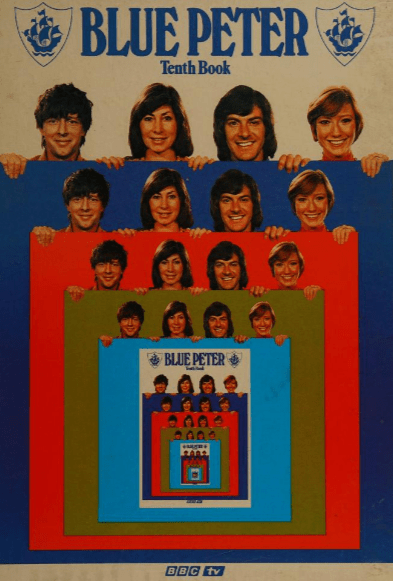
Trace’s departure led to more prominence for John Noakes. His role on the programme had come about almost by chance. Biddy Baxter was flicking through the local newspaper while visiting her parents in Leicester, and happened across a theatre review raving about local rep player Noakes, which mentioned his history working as an engineer on DC7s at BOAC. At ease in front of an audience? A day job that involved mucking about with very real aeroplanes? Someone certainly worth meeting in person, with the need for an addition to the BP hosting roster.
Not that there had just been a handful of candidates. On his arrival at TV Centre, Noakes was fiftieth in the queue to audition for the role. He was more than a little nervous, having only appeared on stage in character before, never having had to appear as himself, nor on national TV. On top of that, he was starting to feel disillusioned with the whole performing lark anyway. Despite all that, the nervous energy displayed by the then-31-year-old won over Baxter, and he was handed a three-month contract to join the series from late December 1965.
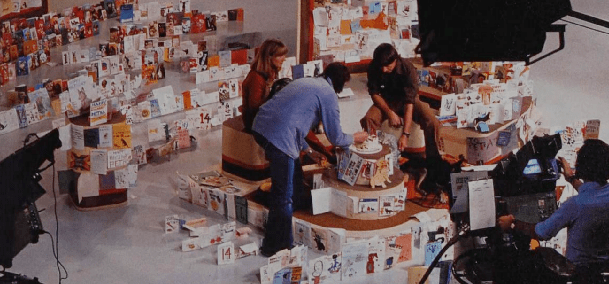
While history seems to have pegged him as the avuncular figure hosting Go With Noakes alongside canine companion Shep (as well as for breaking down when interviewed about Shep’s passing on BBC1’s teatime infoblast Fax! in the 1980s), his tenure was as action-packed as any in his thirteen years on the programme. Clambering up the mast of the HMS Ganges, setting a record for highest civilian free-fall parachute jump, clattering his way down the Cresta Run and (as pictured above) going full Fred Dibnah while climbing Nelson’s Column. He truly was the programme’s first true Man Of Action.
Noakes would be joined a few years later by Peter Purves, a one-time Doctor Who companion (Steven) who was subsequently too typecast to land any decent acting role after stepping out of the Tardis for the last time. His luck changed on being interviewed for the Blue Peter role, and it didn’t take long to decide he was the man for the job. Before he could get into the lift at Television Centre following his audition, Biddy Baxter and Rosemary Gill collared him and offered him the gig on the spot. He initially planned to stay for six months until more offers of acting roles reached his inbox. He ended up staying for almost thirteen years.
With the three saints of Peter on board from 16 November 1967, the programme’s first true imperial phase could begin. Little wonder that, in his marvellous book covering his personal history of the programme, future programme editor Richard Marson referred to the trio as “unquestionably the most famous presenting team in the show’s history”.
14 September 1970 saw another landmark in the history of the programme – the first ever colour edition of Blue Peter. That change could have come about even earlier – Monica Sims, then Head of Children’s Programmes, contacted BBC-1 Controller Paul Fox about getting some extra funds for the series so that the programme’s summer jaunt could be to somewhere a little more exotic than Cornwall, in keeping with the adventurous excursions from previous years, especially now there was the prospect of the film being broadcast in colour. Fox relented to be main request, but denied the request for the expense of shooting in colour. That decision led to disgruntlement from Fox in 1971, when repeated footage of 1969’s trip to Ceylon could only be broadcast in monochrome on the now multicoloured BBC1. The programme had more success with shooting in colour in May 1970, with director John Adcock being permitted to try out colour film for a trip aboard the QEII. That was just a test – the film itself was broadcast in black and white, but it proved that it could work, and that the programme could make the move into full colour.

Imagine only getting to see this in black and white. However, the upgrade came with conditions attached. Only the larger studios within TVC were equipped to cope with broadcasting in colour, and those weren’t always available to the programme. Whenever circumstances dictated Blue Peter move into a smaller studio, it was accompanied by a move back into monochrome. This meant it took until June 1974 before the blues of ‘Peter could be enjoyed on colour receivers on a permanent basis. As a result, those with expensive tellies certainly got to enjoy a much more immersive experience with BP’s summer sojourns, starting with July 1970’s trip to a Mexico still buzzing with excitement from the previous month’s World Cup.
Another new introduction to the programme came about in March 1974, with the official unveiling of the Blue Peter Garden. Up until that point, the programme had been keen to utilise every spare bit of space in Television Centre, the big studio doors often being flung open to permit everything from vehicles to marching bands, but other programmes and occasions often called for use of that space, leaving Blue Peter locked indoors. BP often made use of the TVC car park, or the infamous TVC Doughnut, but those areas couldn’t be guaranteed to be available to a live programme. Far better to have a little bit of space that was very much the programme’s own safe space – specifically a secluded patch of land in front of the BBC restaurant block.
It had previously been pressed into use for programme segments in the past, but only really on an ad-hoc basis. Now, ‘inspired’ by their ITV rivals Magpie having their own smallholding at Teddington Lock, the patch of land was to become to sole preserve of Blue Peter. Now, tower block kids around the UK could be afforded their own surrogate set of flower beds, fish pond and – a little later – an Italian-style sunken garden.
As the programme prepared for the 1980s (aided by a new version of the theme tune composed by Mike Oldfield, above), a new presenting line-up evolved. As the new decade arrived, the team of Simon Groom, Tina Heath and Christopher Wenner didn’t quite enjoy the popularity of the familiar line-up of the previous decade (Lesley Judd having replaced Valerie Singleton in 1972 following the traditional presenter overlap), and the latter two-thirds of the team didn’t hang around for too long. Luckily, a much hardier troupe of presenters was about to provide a sense of solidity to the curved couch. Sarah Greene arrived in May 1980, while Peter Duncan joined the team that September. Each had previously appeared on screen in acting roles – Duncan in the likes of Space:1999 and Play for Today, Greene in ITV’s compelling housing association soap Together – but both slotted into their new presenter roles with ease.
It certainly helped that the series seemed keen to cover technological advancements of the 1980s, which was certainly a boon to any children-of-the-80s who’d pore over the electronic gizmo pages of their mum’s Kay’s Catalogue. Astonishing space-age achievements covered by the series included the first ever transmission of a fax message on British TV (sending a picture over the telephone line? Witchcraft, surely. If memory serves, it was a scribbled drawing of a brolly and some raindrops), plus a departing Tina Heath introducing viewers to the concept of ultrasound technology with a live broadcast of her baby scan.

1988 saw the end of an era for the series, with long-time programme editor Biddy Baxter leaving the series after more than 25 years at the tiller. Baxter wrote about the experience of finally letting go in the introduction to her own Blue Peter: The Inside Story book:
In the gallery, my stomach lurches — just as it had lurched every Monday and Thursday for twenty-six years. That special frisson peculiar to all live broadcasting when it’s the point of no return — no second chances or second thoughts. Will the presenters achieve that peak of perfection we’ve been striving for all day? Will the studio director make a particularly tricky effects sequence work? Will Rodney on Camera One be okay with that difficult tracking shot? He’s a genius, so if anyone can make it work, he will. BUT…
Considering that at least thirty people have the chance to make or break each live Blue Peter transmission, it’s amazing that the disasters are so few. Come the crunch, when it’s live there is that extra adrenalin flowing and an extra camaraderie that, nine times out of ten, creates pretty nearly what you’ve hoped to achieve. When the disasters happen they’re usually mega ones, like a telecine machine playing in an eight minute film breaking down at the beginning of the reel — on a day when there’s no back-up on video. Or a cheerful chap in a brown coat walking into the studio during transmission clutching a large black plastic sack and yelling: “Let’s be having you then, where’s your rubbish?” Or the anonymous engineer deep in the bowels of Television Centre pulling a vital plug that disconnects the large, motorised camera taking the most important shots in the whole programme.
But today the lurch was worse. It was my very last Blue Peter. ‘There was a large chunk of the programme completely unknown to me. I hadn’t written the script, I hadn’t even been allowed to see it. Lewis Bronze, Blue Peter’s talented assistant editor for the past five years, had been quite firm. “It’s your last programme and you’re going to be in it. Don’t worry, leave it all to me, just sit back and enjoy it!”
Biddy Baxter, Blue Peter: The Inside Story (Ringpress Books, 1989)Ultimately, Bronze’s gambit certainly helped to quell any sadness on the part of Baxter as she prepared to leave the show. Any despair was swiftly reduced by the fear of appearing in front of Blue Peter cameras for the first time. By the end of the programme, she’d been coaxed down from the gallery, welcomed on-set, shown with a montage of programme highlights, given a large album of photos from her BBC career and presented with a prized a Gold Blue Peter Badge. The latter award was the very highest honour the programme would go on to bestow, putting Baxter in the same league as Paul McCartney, Steven Spielberg, Madonna, Sir David Attenborough and The actual Queen.
The late 80s and early 90s saw the programme start to make more of an effort to cover environmental issues – quite a change from those early years when anything emitting exciting plumes of diesel would have been deemed a suitably thrilling candidate for coverage. This period even saw the introduction of a green Blue Peter badge for environmentally-adjacent achievements.
From 1995, a third weekly edition of the programme was introduced, albeit a more fun~based edition of the programme airing in Fridays (usually between autumn and early spring months), concentrating more on things like celebrities than sea scouts. Whether the increased demands of an extra show were a factor or not (though by this point some episodes were pre-recorded), the turnover of team members increased during the 1990s. Though despite that, Konnie Huq (having joined in December 1997) would go on to become the third-longest serving BP presenter of all-time, clocking up just over ten years on the series. And, in fairness, it’s not as if presenters from the 1980s had a habit of hanging around for too long, as the following did-it-purely-because-I-could table of data shows:

No, this was a valuable and productive use of my time. Despite a revolving door of presenters during this spell, it wasn’t all grim during this spell for the series. It became one of the first BBC shows to land its own section of the bbc.co.uk website, and the programme warranted a pair of summer prom concerts. However, each spell of sunshine is followed by a little rain. Or, erm, snow. Yes, I do mean Richard Bacon getting the boot for being caught in the midst of nose candy. Don’t think that was mentioned in that year’s Blue Peter book.
One of my favourite follies is the concept of the time capsule, and Blue Peter had been very much a part of this. The 1970s incarnation of the series had buried one back in the day, and with the arrival of space year 2000, it was time to dig it up. It must gave seemed such a distant future at the time, but in the event the BP Dream Team of Singleton, Noakes and Purves were still around to help dig it up. The fact the contents were in a worse condition than if they’d just bought each item off eBay only detracted from the achievement slightly. Honest. And it was fitting that the old team made a reappearance at the time, as with Konnie Huq, Simon Thomas and Matt Baker now on the sofa, the current generation of viewers has their very own stable team of presenters to call their own.
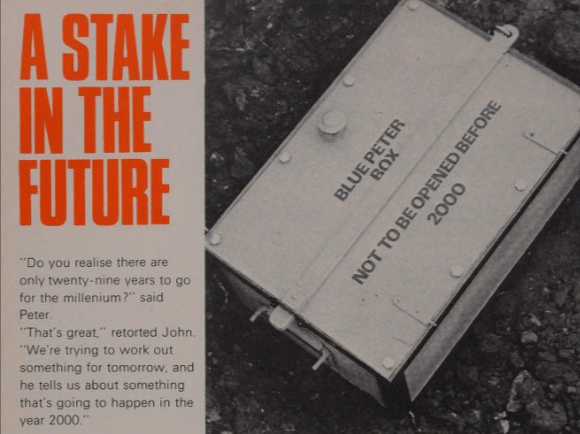
The burial of the Time Capsule was covered in 1972’s Ninth Blue Peter Book. 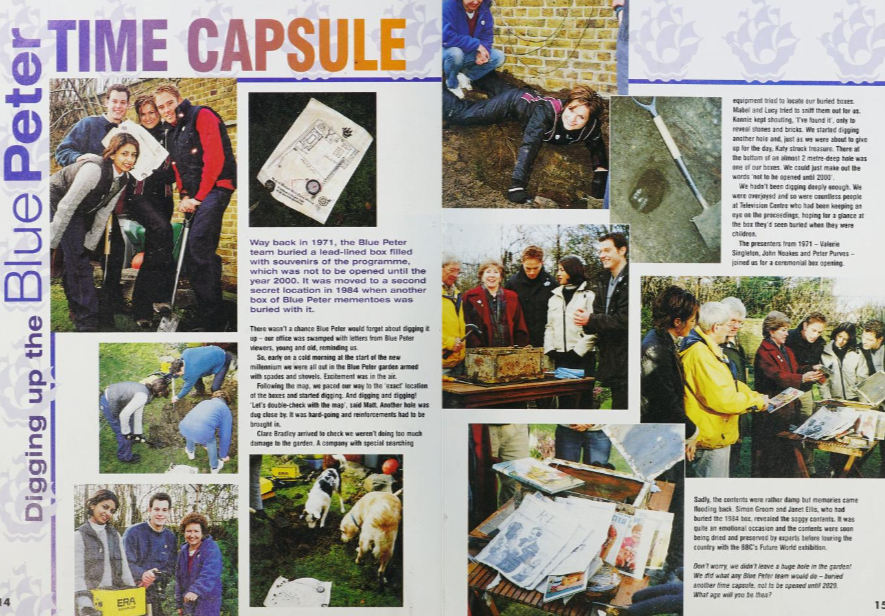
And again in 2000’s Thirtieth Blue Peter Book With Friday editions now commonplace, there was still a summer-sized gap in the programme’s broadcast calendar. That changed in 2001, when the addition of twice-weekly episodes during July and August saw the programming running throughout the year for the first time since 1965. The brand was extended further still following the arrival of Richard Marson as programme editor in 2003. With the something needed to fill the digital bits that made up the new CBBC channel, same week repeats of the regular Blue Peter show were joined in the schedule by spin-off series Blue Peter Unleashed from February 2002, that first episode promising “football with Steven Gerrard, speed boats, stuntmen, billiards and rock climbing”. That was joined later that year by Blue Peter Flies The World, which collected together trans-global reports from the programme.
As viewers gradually migrated to the new CBBC channel, viewing figures for the series on BBC One began to slide. By this point, a reduction in the programme’s budget had already seen it relocate to a smaller studio, and now it was being shimmied into a slightly less glamorous slot in the schedule – bumped back to 4:35pm from February 2008 to free up the post-Newsround slot for The Weakest Link.
A few years later, as 2012 drew to a close and with the UK’s digital switchover having completed in October of that year, it was decided that children’s programming no longer needed to be broadcast on BBC One. After all, any TV set now had access to the CBBC and CBeebies channels, meaning more room for programmes about buying houses and antiques on the Beeb’s flagship channel. And so, on Friday 30 November 2012, a regular episode of Blue Peter aired on BBC One for the last time. By this point, first run episodes of the programme were already going out on CBBC, so it’s hardly a surprise the berth on One was being given to something else. But at least that last regular appearance on the channel was something typically Blue Peter: as part of Children’s Commissioner’s Takeover Day, a quartet of competition winners were afforded the chance to produce the episode.

That wasn’t truly the end of the programme on ‘regular’ BBC channels, however. 20 October 2018 saw a BBC Two airing of Blue Peter’s Big Sixtieth Birthday, an hour-long special where former presenters returned to the studio to help the current team celebrate TV’s most storied children’s programme. Following that, occasional episodes of the series would get repeat broadcasts on BBC Two on Saturday mornings, though one suspects that was down more to needing something to fling into the schedule than anything else.
While the programme has – as one might expect – changed beyond all recognition during six-and-a-half decades on screen, so much so that it’s only been generating one episode per week since 2012, it’s comforting to know it’s still there. Even if at one stage, BBC Children’s Controller Richard Deverell decided that the programme should become “more like Top Gear”. Ew.
However, with the future of the CBBC channel in doubt – at the time of writing it’s due to be given the chop as a standalone channel (alongside BBC Four) in 2025, with all content becoming iPlayer-only from that point on. Will Blue Peter survive the cull? One can only hope, but even if it doesn’t, that’s one hell of an innings.


Phew, that was a long wait. Especially as I’ve hardly scratched the surface of the sixty-five years it’s been running for. Still, I’m sure the next entry on the list will be much easier to write about… oh. Sigh. See you soon!
-
“Bobby Dazzler” – The 7th Most Broadcast BBC Programme of All-Time

Nearly at the last half-dozen!
7: Bargain Hunt
(Shown 5843 times, 2000-2021)

Some game shows try everything they can to ramp up the excitement. ITV seemed to go big on this concept in the 1980s, the network clearly at the zenith of the Licence To Print Money Years. This saw shows such as Ultra Quiz, which would see a group of contestants around the world for a series of themed trivia questions, Run The Gauntlet, which saw teams from each of the home nations battle for supremacy in races using jet skis, quad bikes and the like, or Interceptor, a thrilling concept from the team behind Treasure Hunt that was basically a county-wide game of laser tag. All programmes I loved as a kid, and yet they each had very short shelf lives. After a few years, the Ultra Quiz budget was dropped to the extent David Frost was swapped for Stu Francis and New York swapped for Bournemouth. Interceptor lasted for a single series and despite being deemed popular enough for a spin-off videogame in 1989, Run the Gauntlet nowadays doesn’t even warrant an entry on Wikipedia.

Teams leaping out of helicopters at the start of the first event not exciting enough for you, Wikipedia? Eh? If you want longevity for your game show format, dampen down the excitement quotient a bit. So much so, it’s arguable whether it even warrants a place in the game show genre. Such as the next programme on our list. Recently clocking up its 66th series (vidiprinter: sixty-six) Bargain Hunt tasks a pair of teams (“Red” and “Blue”) with spending a set sum of money on trinkets at an antiques fair, with each having an expert on hand to offer advice. Once the trinkets have been bought, they’re put up for auction, and the team who make the most profit on their original outlay (or the smallest loss) are declared the winners. And… that’s it. No lasers, no helicopters, and any explosions can purely be considered coincidental.
Originally, each team budget was set at £200, and teams could buy as many or as few items as they desired. This was subsequently limited to just three items, presumably to avoid instances of participants buying dozens of items and boring everyone solid at the auction stage. Later on, the budget was upped to £300, and an option of swapping one of their items for an alternative trinket was introduced. This was tweaked further in series 14, allowing for a ‘bonus buy’ to take place with any surplus budget. And that’s pretty much it.
The series came about in 1999, with David Dickinson at the helm. By this point, Dickinson’s TV career had only been a few years old, but his new career trajectory had been much steeper than most. It was something the antiques expert had fallen into following a barbecue at his daughter’s house, where he got chatting to her next door neighbour. That neighbour happened to be Alistair Much, co-owner of a TV production company, who was taken by Dickinson’s resemblance to Ian McShane’s fictional antique roustabout Lovejoy. By happy coincidence, Much was working on pitching a new series on antiques to broadcasters, and thought his brand new pal might just be a perfect participant for it.

In the end, the networks failed to express any interest in that particular series, but Dickinson would go on to feature in an episode of BBC2 documentary strand Modern Times, produced by Much, and looking at – of course – some of the characters within the world of antiques. Dickinson would be the standout figure of the episode – his Lovejoyesque appearance also remarked upon by The Independent’s TV listings – and his personality certainly seemed to resonate with those in the TV industry. Dickinson was plucked to present a Buyer’s Guide segment in BBC Two series The Antiques Show (1997-98), which swiftly led to a pilot of his first solo vehicle (Under Your Nose: a show looking at items “worth a bob or two” lurking in the homes of unsuspecting members of the public, which Dickinson’s autobiog says was broadcast, but which Genome says wasn’t).
[EDIT: Thanks to Daniel Webb for letting me know The Duke did in fact record a different pilot around this time. Swap Until You Drop saw Dickinson team up with A Certain Disgraced Former It’s A Knockout Host and John Fashanu for a competitive swapping roadshow, refereed by Mary Nightingale. This aired once, on Friday 2 April 1999. On top of that, it seems the pilot he was talking about was chopped into bits and used in consumer show pilot Money For Old Rope (BBC One, 7pm 6 Jan 1999), which included a segment where “antiques expert David Dickinson uncovers a few treasures in the homes of three neighbours“.]
His next gig was a little more glamorous, becoming a regular reporter for Holiday in 1998, whisking him off to destinations from Milan to Devon on early evening BBC One. Dickinson’s star was certainly in the ascendancy at that point, with a starring primetime role in C5’s The Antique Hunter. While it made for some memorable segments in early episodes of TV Burp (“I am the Hunter!”), Five honcho Dawn Airey decided a second series wouldn’t be forthcoming. However, a call from the BBC’s Mark Hill soon saw a return to the screen for Dickinson: a new daytime show called Bargain Hunt, airing from March 2000. And it was probably the personality of a man Terry Wogan once introduced as “Peter Stringfellow crossed with a mahogany hatstand” that did more than anything to attract an audience to the programme, with his chipper attitude and occasional asides to camera proving popular.

Before long, that growing attention saw Bargain Hunt moving on up to the big time, and a peak 8pm slot on BBC One in August 2002. While it’s tempting to suggest this was down to a lack of inspiration on the part of the BBC, the ratings don’t lie. The first peaktime episode of Bargain Hunt drew an audience of 6.89m, and the end of that initial primetime run was followed by four episodes of spin-off Celebrity Bargain Hunt Live for that November’s Children in Need week. Stars such as Tony Blackburn, Dermot Murnaghan and Sarah Cawood took part, with any profits going to the charity, and viewing figures rose even further, peaking at 7.88m. That’s two million viewers more than watched Liverpool’s Champions League exit at the hands of FC Basel over on ITV. Take that, UEFA.
However, a daytime show thrust into the big leagues doesn’t often have the stamina to stick to the national consciousness for long, and that was the case for imperial phase Bargain Hunt. The programme slipped out of the BARB Top 30s for BBC One in late 2003, following a move to an Emmerdale-adjacent 7pm slot. A year later, the programme left the primetime schedules, with Dickinson duly leaving for pastures new (mainly reality series Dealing With Dickinson, which lasted for a single series before Dickinson decamped to ITV and his Real Deal). Luckily for Bargain Hunt ultras, the daytime version had remained a going concern throughout the show’s spell in the peak-hour spotlight, with presenter Tim Wonnacott at the controls, and that’s where he would continue.

Himself no slouch when it comes to antiques – before picking up the Bargain Hunt baton, his CV boasted a spell as director of Sotherby’s – the bowtied buff kept the programme on a steady tiller. Well, apart from one episode in 2010 where a musical bed of Mylo’s Drop the Pressure was used, with nobody on the production team noticing the lyric “Motherfuckers gonna drop the pressure” surviving the edit. Whoops. And that coming just a year after a track called “Horny Baby” by Dust Devil stopped being used as the programme’s theme music, too. Pure. Audio. Filth. (Okay, the latter was a light pop-jazz number. But still.)
That mishap aside, little of interest happened in the programme (as far as I’m quite selfishly concerned) until 2015, when an alleged altercation with producers saw Wonnacott initially suspended from the series, and subsequently stepping down. He would continue to serve as narrator for Antiques Road Trip and Celebrity Antiques Road Trip, so it wasn’t the end of the world for him.

Which explains why he’s clearly been too busy to update the design on his own website since 1999. From 2016 onwards, the programme would go on to be hosted by a rotating cast of antique experts, including Danny Sebastian from CBeebies’ Junk Rescue, Antiques Roadshow ceramics guru Eric Knowles and Flog It! alumni Caroline Hawley. Despite the addition of new faces front and centre of the programme, Bargain Hunt remained largely affixed to the formula that had served it so well since the dawn of the third millennium, with innovations like a ‘Big Spend Challenge’ and the ‘Presenter’s Challenge’ adding a mere sprinkle of change to the format.
2016 also saw the programme singled out by the press as an example to underline part of Culture Secretary John Whittingdale’s white paper on the future of the BBC, but it’s unlikely many members of the production team were high-fiving each other with excitement. The programme was being dragged out as an example of the BBC sorely lacking “greater levels of creative ambition”.

SPOILER: None of the above programmes were axed. Of course, it wasn’t remotely cancelled. In fact, Bargain Hunt will probably outlive us all. Hey, each passing year means another year’s worth of stuff becomes antique.
And occasionally, it still has the power to surprise us. Such as an episode in 2018 recruiting hip young indie gunslingers Jarvis Cocker (aged 54 at the time) and Bez (also aged 54), along with respective bandmates Rowetta Idah and Candida Doyle to take part in a pop-themed celebrity episode. What excitement could a quartet of fiftysomething NME darlings really bring to the programme, though?

How it started / How it’s etc. There’s life in the old dog yet, eh?

BONUS FACT! Bargain Hunt has been mentioned three times in the House of Commons, according to Hansard. And yet none of them was worth mentioning in detail here. How’s that for failing to clear a low bar?

There we go. That’s the final daytime property or antiques show on the list ticked off. All gold from hereon in. Or your money back.
-
“I might know someone who works on this and get punched on the nose”: The 8th Most-Broadcast BBC Programme Of All Time

And so, from Snooker, a sport that has had a relatively rich and varied history since the very birth of broadcasting, onto a programme that basically hasn’t changed since it began twenty years ago. Heeeeere’s
8: Homes under the Hammer
(Shown 5166 times, 2003-2021)

One thing that was always going to make an appearance in this list: property shows. Rivalled only by quizzes for the trophy of Genre Representing The Most Gapingly Open Goal In Daytime Programming, it’s a slight surprise we haven’t seen more of them on the BBC.
We’ve had Escape to the Country and To Buy or Not to Buy in the top hundred so far, while Changing Rooms is (slightly surprisingly) well outside the hundred (if anyone was anxiously waiting for it, you may now exhale). Such programmes are much more at home on Channel Four, which is something to ponder every time the channel boasts about how it strives to cater for underserved minorities, suggesting it only seems keen to serve minorities looking to improve their property portfolio by a restoring a château on the cheap.
Despite Four’s stranglehold on the genre, the Daddy of Property Programmes is very much a BBC enterprise. Originally hosted by Lucy Alexander and Martin Roberts, Homes Under the Hammer follows a number of properties bought up on the cheap via auction, and then follows the fortunes of the people who buy them, do them up, and then sell them on for big profits. It’s a staggeringly popular daytime programme. Which is why only seven programmes have been broadcast more often throughout the BBC’s entire history.

Despite that… very little seems to have been written about the programme. The first time it appeared on our screens in November 2003, no newspapers pulled it aside for a preview paragraph or two. Nobody seems to have written an article about it when it arrived. Even the Radio Times, given the programme’s 10am slot, only had room on that day’s listings to offer up “the weekday run starts by following three Devon properties that are up for auction.”
The Wikipedia entry for the programme isn’t even sure when some of the series started or ended, or how many episodes have been made.

As should hopefully be clear, I don’t use Wikipedia for research, but it’s always worth having a nose at. It’s a bit strange, to be honest. Sure, nobody’s starting a change.org petition to have a 4K BluRay remaster of the entire series, but it keeps going. Someone must do more than simply tolerate it? Surely?
I can’t help but suspect there’s a reason nobody seems especially keen to chronicle the history of the programme. And that reason is… in every single home under a hammer, in every single room, the cameras are having to keep the elephant out of shot. But we all know it’s there.
The point of the programme is to show homes being sold in a rush at knockdown prices. Often homes in need of repair, of modernisation, of rapid repairs to the damp course, cracked tiles or a leaky roof. For the purposes of the programme, that’s a good thing. An un-valuable home can be turned into a profitable house. The programme hardly shies away from this – the production company’s website sells the show as “the exciting auction series where potential bargains can bring big return on investment and a carefully planned house makeover can make all the difference”. How could anyone spending a morning off picking Coco Pops out of their beard miss out on something involving a big return on investment?
And yet: there’s generally a reason houses at auction are having to be sold so quickly, and so cheaply. And – SPOILERS – it ain’t due to a spate of benevolent property magnates who’ve just won the lottery and can’t be bothered waiting to dispose of their stock.

Daily Mirror, 7 Sept 1991 – an early use of the phrase “Homes Under the Hammer”. Not sure if that inspired the programme title or not. Given Britain is a place where an entire national identity has been built on Maximising The Value Of Your Property, someone quickly selling a home at auction probably isn’t doing it for the happiest of reasons. It might be that the previous occupant had died, and the grieving family want to sort the estate out quickly, granted. But when it comes to houses in poor states of repair, it’s more likely that someone – yes, very likely a family with children – had been struggling for ages to keep their lives together and finally had to admit they could no longer able to afford the place. It could even be that the decision to sell had little to do with them, and more to do with landlords or mortgage providers. All that’s clear is, in many of the households explored by the HutH experts, people’s lives had been taking place in most of the properties. And now they aren’t.

“And here’s where Susan shared the sad news with John that she’d been laid off from the bakery. Just next to the stairs leading up to the bedrooms.” (Reader’s Voice: “Maybe they moved out because of the elephant you mentioned? I wouldn’t want to live in a house where there’s an elephant!”)
Sigh.
Anyway, moral concerns aside, there’s something else I can’t help but notice about Homes Under the Hammer: it’s programme that offers a very handy grab-bag reference to (a) someone hoovering up cheap property for quick and easy profit, or (b) as far as its audience goes, it’s the epitome of indolent tele-viewing.
How do I know that? Because I’ve been looking to see how often it gets mentioned in works of fiction, that’s how. And so, here comes a rundown of:
THE TOP THIRTY TIMES ‘HOMES UNDER THE HAMMER’ HAS BEEN REFERENCED IN WORKS OF FICTION (AND OCCASIONALLY NON-FICTION)
Oh, we are very much doing this. Here goes. I could easily have made this a top fifty or more, easily. There are a lot out there. And this is just from those I found on the archive.org lending library. And remember, while several of the quotes below might be a bit on the punching-down side, at least they didn’t directly profit from a family’s eviction. Even the fact one of the quotes is from Mrs Brown’s Family Handbook doesn’t change that.

30: Finders Keepers, Belinda Bauer (2012)
“Steven’s mother, Lettie, took pills too. She sat on the sofa next to Nan, crying at Homes under the Hammer, with an old Spiderman pyjama top crumpled in her hands.”
29: Born Gangster, Jimmy Tippett, Nicola Stow (2014)
“There was nothing to do apart from watch crap on television, and I was sick of it. My days were revolving around Loose Women , This Morning, Homes Under the Hammer, Cash in the Attic, Deal or no Deal and The Price is Right.”
28: The Ex Factor, Eva Woods (2016)
“A raincheck meant, Never in a million years, sucker. A raincheck meant, I’ve met someone new but I am too chicken to tell you. Or worse, I just can’t be bothered to leave my sofa and Homes Under the Hammer is more appealing than another night in your company. Ani knew that better than anyone.”
27: Alan Stoob: Nazi Hunter, Saul Wordsworth (2014)
“With no idea what to do I turn on the telly and flick between The Wright Stuff, Homes Under The Hammer, Location Location Location, Antiques Roadshow and a 3-2~1 starring Dusty Bin. Footage of me running naked, tiny penis embedded in my scrotum, plays on ITV2. I switch off and shuffle into the kitchen. There’s a note from Tom.”
26: Our World, Little Mix (2017)
“I’ve got a cinema room with an L-shaped leather sofa and I love being in there, in jogging bottoms and a hoody, thick cosy socks, relaxing with a glass of wine. On TV I love Catchphrase – shouting the answers at the telly! – TOWIE, George Shore, And and Dec’s Saturday Night Takeaway. I’ll watch anything to do with property. Grand Designs, A Place in the Sun, Homes Under the Hammer.”
25: Survive in the Office With a Sense of Humour, Andy B and Jamien Bailey (2014)
“You filled out a really long application form that asked you like, loads of questions and stuff and made you look up the meaning of the word diligent. You dragged yourself away from ‘Homes Under the Hammer’ twice, for both a first and second interview.”

24: Consequences… I’m With the Band, Laurie Depp (2008)
“”Are you OK, Mum?” I asked, without expecting much of a response. She looked up at me slowly, as if trying to recognise who it was that had invaded her silence and the flickering of Homes under the Hammer on the TV screen.”
23: Mrs Brown’s Family Handbook, Brendan O’Carroll (2013)
“If they know you’ve been sitting with your feet up all day watching Homes Under the Hammer and doing the word snake in the back of the paper, they’ll be filling your day with their bollocks and then you’ve no time for telly-shopping.”
22: More Morello Letters, Duncan McNair (2011)
“Hoping you can re-house the old trout for us. She loves bingo and wrestling and a certain amount of horseplay. She also needs to be near a telly that’s showing either Terminator or Die Hard. Or Homes under the Hammer.”
21: Bonkers: My Life in Laughs, Jennifer Saunders (2013)
“Oh, please don’t let me be ill. . . I haven’t got time to be ill! I have no time to sit in hospitals! I have work and children and I want to do stuff and be in control of my own life, even uf that just means watching Homes Under the Hammer.”
20: Single Men, Dave Hill (2005)
“She saw that Lynda had obtained an A-level prospectus from the local sixth-form college and left it meaningfully on the coffee-table. Marie considered reading it but the booklet failed miserably to leap unaided into her hands so she watched Homes under the Hammer instead. She was just drifting, dribbling, gently off to sleep when her mobile rang.”
19: Quick Pint After Work? (and Other Everyday Lies), Luke Lewis (2014)
“Homes Under The Hammer: Daytime TV show that is only ever watched through a veil of tears, by those who are either unemployed, sick or depressed.”
18: How to be a Grown-Up, Daisy Buchanan (2017)
“During dark wallows, I have compared myself negatively to a woman in the middle of a paternity suit on Jeremy Kyle (“Two men are fighting over her! I have no one!’), to someone who’d just bought a house with chronic dry rot and a problem garden on Homes under the Hammer (‘I will never be a homeowner! Not for me the joy and pain of Japanese bindweed!’) and everyone on Loose Women (‘Urggh, I hate myself, they all have better hair than mel’).”
17: The Wish: 99 Things We Think We Want, Bill Griffin (2017)
“It’s so fraught it’s a wonder anyone bothers dating at all, when they could be home alone watching Homes under the Hammer and eating dim sum in their pyjamas, which is obviously preferable to sitting opposite a stranger in Pizza Express and asking them how many siblings they have.”
16: Between a Mother and Her Child, Elizabeth Noble (2012)
“Her life had become a dull routine, punctuated by television programmes. She watched far too much boring television, but their showing times and their theme tunes were the clock of her day. Homes Under the Hammer, Escape to the Country, Come Dine With Me and then Coronation Street.”
15: Hurrah For Gin: The Daily Struggles of Archie Adams (Aged 2¼), Katie Kirby (2017)
“Suits us all fine if I’m honest, as now we can just sit about in our PJs on Monday mornings – Mummy can watch Homes under the Hammer on the TV, I can watch Fireman Sam dubbed in German on her phone and Chase can just lie on her play mat sicking milk up and trying to work out how to roll.”
14: Watching War Films With My Dad, Al Murray (2012)
“Critics will say look at Kenneth Clark’s Civilisation series (which I’ve never seen), that was what used to be on BBC1. Now look at, say – and I have to be careful here, I might know someone who works on this and get punched on the nose – Homes Under The Hammer.”
13: The Unmumsy Mum, Sarah Turner (2016)
“That hour of tea and sympathy outside the house was priceless and gave me the much-needed motivation to get dressed and not stay indoors watching Homes Under the Hammer for the fifth consecutive day.”
12: Her, Harriet Lane (2014)
“I look down at Cecily, whose dark eyelashes are fanned out on her round cheeks, her fists curled on either side of her head. Her chest rises and falls in her moon-patterned sleeping bag: in, out, in. I visualise Peggy on the treadmill in pink velour joggers and a light sweat glaze, eyes locked onto Cash in the Attic or Homes Under the Hammer.”
11: Thinking About it Only Makes it Worse And Other Lessons from Modern Life, David Mitchell (2014)
“There’s my personal favourite, Homes Under the Hammer, where the production company has just set up a video camera at a property auction and sent presenters to stalk the successful buyers.”

10: Recipes for Life, Bernadine O’Connell (2011)
“She wears less lycra than I would dare on the beach. Hope she isn’t coming near me – keep my eyes focused on the monstrously large TV screen above and pretend to be engrossed in ‘Homes Under the Hammer’.”
9: The Pictures Are Better on the Radio, Adam Carroll-Smith (2016)
“At this point, I’m not ruling out the possibility that when Bob gets home, he is actually just watching a different game — Everton vs. Swansea or something — or maybe just episodes of Homes Under The Hammer, and wondering why West Ham aren’t involved and they haven’t shown a single replay of Seiko/Sakho’s goal.”
8: Christmas Kisses, Alison May (2016)
“Liam sat on the sofa. Homes under the Hammer had finished hours ago. He’d sat through the actual news at one o’clock because the remote control was at the other side of the room and moving was beyond his mental effort.”
7: Pea’s Book of Best Friends, Susie Day (2012)
“It was a disappointment, finding out that adulthood didn’t fix that sort of worry all by itself. But then Mum and Dr Paget started talking about films they’d wanted to see but forgotten to, and books everyone else seemed to have read, and the terrifyingly addictive lure of Homes under the Hammer, and Pea knew it would be all right.”
6: The One Memory of Flora Banks, Emily Barr (2017)
“There is a TV on. A man and a woman are on the screen, talking directly to me, saying, “The kitchen renovation.” It suddenly stops and the words Homes Under the Hammer appear on the screen. I don’t know why homes would be under a hammer.”

5: Television Hell by Luke Whiteman – HMP Leicester, Inside Poetry Volume One (2009)
“I’ve never watched so much TV,
Since that judge imprisoned me.
They put me in a prison cell,
With a man from TV hell.
A true original soap queen,
With eyes alive like a TV screen.
9.15 in the morning on BBC 1
He starts with Don’t get Done, get Dom
Next is Homes under the Hammer
This guy’s a human TV planner.”4: The Mirror World of Melody Black, Gavin Extence (2015)
“Except I found Homes Under the Hammer anything but innocuous, and I was willing to bet I was not the only one. Homes Under the Hammer was a programme in which smug, middle-aged idiots bought and sold property, usually generating a huge profit while simultaneously pricing the rest of the population out of the market. These people all owned homes already. Many of them owned multiple homes, which was why they were able to borrow such vast sums of money from the bank.”
3: Reality Television and Class, Heather Nunn (2011)
“In Homes under the Hammer (BBC1, 2003-), the hard-headed business side of buying for investment was emphasised as viewers were invited into frequently shabby, half-renovated or derelict properties that have been put under auction. Here, the underside of the property market was present as cameras entered repossessed homes. But the emphasis on property as financial investment prevailed as the viewer watched punters bidding at the auction house and their subsequent transformation of a cheaply purchased property into a viable rentable or resale property.”

2: Staying Alive: How to Get the Best from the NHS, Dr Phil Hammond (2014)
“‘Homes Under the Hammer’ will ruin your day because it will ruin the day of the people in your care. Unless someone has specifically requested to watch daytime TV, do everything you can to prevent them from languishing in front of that loathsome dross.”

1: Doctor Who: In The Blood, Jenny T Colgan (2017)
“Many people looked unhappy, but then, they were watching Homes Under the Hammer.”

Well, you think of a way to write about Homes Under the Hammer. At least I avoided the one I could’ve used by Jeremy Clarkson. You’re welcome. Back next time with a much more exciting programme!
-
“Perhaps I Ought To Chalk It?”: The 9th Most-Broadcast BBC Programme Of All Time
What’s got eight legs, 22 balls and would kill you if it fell on you from a tree?
9: Snooker
(Shown 4882 times, 1937-2021)

All together now: “For those watching in black and white, the pink’s behind the blue…”. Except, Whisperin’ Ted’s infamous line actually came from Pot Black, which is a distinctly different proposition to the next ‘programme’ on the list.
So: Snooker. Always a contender for the top ten, and perhaps a little surprising to see it as low as ninth.
With the sport lacking a unifying ‘Match of the Day‘-style branding, actual tournament play went out under the title of, well, ‘Snooker’ (or variants thereof), taking it into this top ten position. And that’s because, well, there’s been rather a lot of it on the BBC over the years. More of it than you could shake Len Ganley at. And it goes back a lot further than one might expect.
For a spectator sport where identifying colours such as yellow, green, brown, blue, pink and black is pretty darned integral, you’d reasonably expect it to only become a broadcasting event following the advent of colour television. Except, not only was it first broadcast long before BBC2 started pumping out colour programming, snooker was first beamed to the nation before television was a going concern. On Tuesday 10 December 1935, listeners to the London Regional Service were treated to fifteen minutes of commentary on a match-up between England’s Joe Davis, considered the world’s top player at the time, and Australian Horace Lindrum, then considered the globe’s secondmost snookersmith. As if to underline the challenge of describing the action to an audience who’d largely never seen a snooker table in their lives, the Radio Times printed one alongside that day’s radio listings.
For those reading in black and white, etc etc. This would at least have saved Willie Smith spending fourteen minutes trying to explain the setup. How practical that miserly fifteen minutes may have proved is up for debate, of course. Snooker finals are hardly short affairs in this day and age – for example, the 2023 World Championship final between Luca Brecel and Mark Selby was a best of 35 frames. And that’s a brief clatter around a youth club table compared to this match, a prize match to settle a £100-per-man wager, based on two lots of 61 frames. The following day’s Daily Mirror reported that that day’s session had seen Lindrum come back from 10-5 down at the start of the afternoon’s play to draw level on ten frames all, with an aggregate points total of Davis’ 5,223 versus Lindrum’s 5,244.
The report also included mention of the match’s status as broadcasting first, relating how commentator Willie Smith (himself a billiards champion who’d turned his hand to the increasingly lucrative snooker) told of missed sitters (causing “expressions of amazement from spectators”) during that inaugural summary. That match between the two would go on for several more days – at one point breaking so that cheques for £650 could be awarded to Chelsea footballers George Mills and Harold Miller before play continued – only to end with Joe Davis winning by 32 frames to 29, ending the series at one match apiece, and subsequently nullifying the bet. In short: a lot of snooker, then nobody won.
I mean, I say “nobody won”. Of course, that fifteen-minute fix of audio green baize action would be all that radio listeners received from that particular match, but Willie Smith was back on the lip-mic the following February for the rematch. This time, a generous 25 minutes were given to the coverage, which was won (along with the £200 kitty) by Davis. Moreover, snooker had begun to thrill the nation. And put paid to any claim from DLT that he invented Snooker On The Radio.
11 April 1936 saw live coverage from Dublin of a match between Seamus Fleming and W Lowe, as snooker began to grow in popularity in the Irish Free State, while the end of that month saw running commentary from the final of that year’s British Championship, where… Joe Davis beat Horace Lindrum. Again. Another sporting first occurred during sports roundup Saturday Contrast in December, with live coverage of Women’s World Snooker Champion Ruth Harrison as she took on Women’s World Billiards Champion Joyce Gardener, albeit in the discipline of billiards, with a ‘substantial prize’ on offer to the victor.
By now, television was on the scene, and surely snooker was a prime sporting candidate for the new medium. Admittedly, visual coverage of the sport would lack the verbal colour of radio commentary, but it would be so much easier to see what was going on, and unlike with many sports, a single fixed camera could be employed to relay the action. And so, on 14 April 1937, snooker was introduced to the television audience for the first time, with an offering billed as An Exhibition of Play by Horace Lindrum and Willie Smith.
Even more excitingly for readers of the Daily Telegraph on the morning of broadcast, there was the implication the event would include full orchestral accompaniment:
Sadly, they were two unrelated broadcasts. Luckily that week’s Radio Times went into more detail. The article explained how, from the early 1930s, snooker had gone from a distraction adopted by billiards professionals once they’d got a bit bored with their day job, to a sport that had overtaken its sister game in popularity. Initially, the announcement that a session of billiards was to be followed by some frames of snooker would result in half the audience suddenly realising they’d left the gas on and would leave the exhibition hall.
But, slowly but surely, billiards’ multiball cousin attracted more of an audience. 1933 saw the first national competition, a handicapped event open to amateur players around the UK. Much to the surprise of the organisers, around five thousand applications poured through the letterbox. Probably going to need a bigger hall, then. And yet, professional cuesmiths preferred to stick to billiards, only occasionally racking up the reds, meaning the growth in participants failed to result in much mainstream attention. Until the arrival on these shores of charismatic Canadian Conrad Stanbury.
While not quite as adept at the sport as homegrown players like Joe Davis, Stanbury added a sense of style, humour and colour to the sport, a stark contrast to the relatively austere Brits. Fellow Canadian Clare O’Donnell also arrived in the UK, taking on well-known billiard pros at snooker, his quick-fire approach to play attracting even more interest in the sport. While the style of the North American duo attracted attention, it was the arrival of Australia’s Horace Lindrum that provided a true rival to top British player Joe Davis. The matches between the two being broadcast over the radio proved how the sport was becoming more popular, and by 1937 former billiards pros were spending more time playing snooker than its parent sport.
In a passage that would prove to age particularly badly, the RT article on the Lindrum-Smith match suggests that it may well be that “the present popularity for snooker will turn out to be just a passing fancy, that the players will tire of constant potting, and welcome a return to cannons and long losers”. How wrong they would turn out to be. After all, snooker would go on to be the biggest game on green baize.
Plus, it certainly didn’t hurt that its origin story can be explained in one of the finest sentences ever published:
Now you’re glad you clicked on this post. Sadly, the above isn’t true, and the common understanding is now that it originated from the brain of Neville “Not That One” Chamberlain in 1875. But still, CAPTAIN SNOOKER. Though all that would come later. For now, it was deemed a sport not yet ready for the viewing public, small monochrome 405-line sets of the era perhaps not providing the optimal viewing experience. As such, following that initial pair of TV broadcasts for snooker on 14 and 16 April 1937, the sport wouldn’t return to BBC-tv (at least under a standalone billing) until 1950.
The dawn of the atomic age didn’t do too much to make snooker a fixture on British TV, however. The decade only saw a smattering of matches broadcast, including “Walter Donaldson (Present World Champion) v. Joe Davis (Retired Undefeated World Champion)” in September 1950. Throughout the decade, the not-as-retired-as-you-may-have-thought Davis featured more than any other player, such was the box office (well, TV licence fee) appeal of the sport’s most decorated player. Even where he wasn’t a competitor in the televised game, such as 1952’s John Barrie-Rex Williams match, he would turn up to perform a few trick shots between frames, such was his appeal.
Come January 1955, a special session of snooker was broadcast to mark the final event at snooker’s then spiritual home, London’s Leicester Square Hall, the centrepiece of the event being an exhibition match between Joe Davis and his brother Fred – himself no slouch on the baize, going on to win eight World Championships between 1948 and 1958.
As the decade progressed, most snooker coverage was folded into the weekly Sportsview round-up, which featured a “Sportsview Potting Competition” that allowed keen cuesmiths to challenge a top professional. And not just in any standard game of snooker, but a specific layout that proved a little more exciting (and more suitable for a segment of a programme just thirty minutes long). Another strand that proved popular was a feature where Joe Davis – playing solo – would attempt to score as high a break as possible within two minutes. The sporting spectacle was slightly undone in one edition where the referee, displaying his keenness to replace a coloured ball as swiftly as possible, accidentally scattered the remaining in-play balls as he did so.

The only standalone coverage of this era came from The News of the World Tournament, which pitted the best players against each other in a round-robin “American-style” format that was considered by many to be of greater importance than the ‘real’ World Championships – not least as the latter no longer featured people’s favourite Joe Davis.
By 1958, Saturday sporting action was safely enclosed in a great big Grandstand umbrella, with initial episodes making great play of challenge matches featuring, inevitably, Joe Davis. And Grandstand provided a safe haven for snooker for much of the next decade, the sport providing a perfect alternative to throw to whenever an outdoor event found itself hamstrung by unpredictable British weather. However, acting as the sporting equivalent of a supply teacher was no life for a proud sport, and once the Beeb’s favourite player finally retired from the sport in 1964 (Joe Davis, as you’ll have guessed), it seems the BBC had lost interest in the sport. Basing much of your coverage around a single superstar in the twilight of his career hadn’t been much of a long-term plan, as it turned out. When Grandstand producer (and snooker fan) Lawrie Davies left the corporation for a role at Yorkshire in 1965, snooker coverage would also depart the BBC.

Fred Davis vs Warren Simpson, 1960. See how disconcertingly close the crowd are. Anyone else feel a bit claustrophobic looking at this video? On the other side, ITV had been having a lot of success with tournaments largely based around the amateur snooker scene. In 1961, this had involved putting together a tournament that saw four top amateur players face off against a quartet of players from the then-tiny pool of professional players. The matches were in a much friendlier TV format – just five frames per match, broadcast live and being much more competitive than the BBC’s exhibition-match coverage – but given the nature of the game, an keener desire to win often led to cautious matches concluding off-screen, as ITV’s attention had long drifted to the classified football results.
Still, what was there was more compelling than Grandstand’s coverage of the Joe Davis Globetrotters, especially in 1962 when amateur player Mark Wildman made the first ever televised century break on ITV, but with monochrome sets still in use, even that wasn’t enough to keep viewers queueing up (ignoring the easy snooker pun, there) for live coverage – especially when there’s no guarantee they’d get to see the final black of the final frame being slammed home. Conversely, matches being settled within just three of the five frames meant coverage finished much earlier than schedules anticipated, leaving a production team frantically trying to fill an additional hour and hardly resulted in tense, captivating snooker.
This lack of popularity caused concerns for the Billiards Association & Control Council. If only more matches lasted the full five frames, and also happened to be wrapped up in a way that meant everything was done and dusted before the vidiprinter clicked into life with the football scores.
Then… that started to happen. A lot more often. Wahey! Exciting snooker! This is what the public wants! Great job everybod… hang on, the Sunday Times have rumbled what’s been going on.
The Sunday Times, 8 Sept 1968 The real giveaway came on 28 January 1967. A invitation match on World of Sport between George Humphries and Ray Edmonds was billed as “a five frame thriller”. In the Sunday Times expose the following year, Edmonds came clean: “It was a five-frame thriller because we wangled it that way.”
It hadn’t been easy. At least according to Edmonds, Humphries had been so off his game, Edmonds accidentally won the second frame of the match, and had to put in some concerted cackhandedness to lose the third and fourth frames. By the time the fifth – and only deliberately competitive – frame came around, both players were so full of yips both players struggled to regain any sense of form. And the viewing audience likely reasoned they’d see a more skilled session of snooker down at the local hall at chucking out time.
This was far from a one-off. In the Sunday Times piece, former chair of the Billiards Association and Control Council Harold Phillips admitted that players of televised exhibition matches were given a reminder that “This is entertainment, you’re evenly matched and I do hope it’s all on the final frame”. Perhaps he followed that up by saying “wink wink”, the report doesn’t make it fully clear.
The issue hadn’t been restricted to matches on ITV. Former world champ Fred Davis stating that the BBC would “look on [close matches] favourably, if you understand what I mean”. As a result, Davis began to treat his exhibition matches on the Beeb as “five frames of comedy”, adding that he hated “taking part in something that’s not genuine”. And so, with the scandal scaring ITV away from the sport and the BBC long having given up on it, snooker would be absent from TV screens entirely.
That was, until the advent of colour television on BBC2 and the introduction of a brand new, and very different knockout tournament. One that wouldn’t need thrown frames to manufacture excitement.
“Rarely can any sport, even on television, offer its supporters the top eight exponents of the game in one fifteen-minute appearance. Tonight BBC-2 does just that” boasted the Radio Times listing, and that’s exactly what was on offer here.
Each Wednesday evening, sandwiched between a weighty fifty-minute documentary and an episode of Rowan and Martin’s Laugh-In, a single frame would be played between two of eight top players in a (largely) knockout competition, with one player winning the Pot Black trophy at the end of each series. For those new to the sport, the professionals would be on hand to offer advice (“instead of a pointer, these teachers use a billiard cue”), though given the modest fifteen-minute slot afforded early episodes, any lessons would need to be swiftly delivered.
Despite the popularity of Pot Black, coverage of regular snooker matchplay was still restricted to the BBC’s generic sporting strands. That was to change in the late 1970s, with BBC producer Nick Hunter keen to capitalise on the popularity of the quickfire series. If pre-recorded single frames could attract a BBC-2 audience of four million, Hunter felt that full coverage of snooker tournaments – freed from the shackles of brief Sportsnight highlights – could prove a hit. Players like Ray Reardon and Alex Higgins were helping to forge a new image for the sport within Pot Black, maybe viewers would like to see more of them?
The water was tested with highlights of the semi-final and final of the 1977 Embassy World Professional Championship being broadcast, and proved to be enough of a hit to expand coverage for the following year’s Championship. Late-night fifty-minute highlights packages were broadcast on each of the tournament’s two weeks, with live coverage included on each Saturday’s Grandstand, and live coverage of the final being broadcast on BBC-2. Despite the highlights airing in a slot nudging midnight, an audience of four million grew to seven million by the end of the tournament.

No wonder it was so popular. What could be more romantic than A Review of the 1980 Embassy World Professional Snooker Championship? By 1980, viewing figures for latter stages of the World Snooker Championship topped 14m, increasing to 15.6m for the following year’s final. It didn’t hurt that the big tournaments were slimmed down to provide a more compelling spectacle. While final matches back in the 1940s would feature 145 frames spread across a fortnight (not necessarily all at the same venue), by 1981 it was down to a much friendlier Best of 35.
With the coverage proving to be a hit, the number of hours broadcast from each tournament increased. And so did the viewing figures. Major matches soon found themselves being broadcast live on BBC-1, or passed between BBC-1 and -2 whenever trifles such as the News needed to be broadcast on the main channel, ensuring keen viewers wouldn’t miss any action. There was a junior edition of Pot Black. Ray Reardon appeared on Parkinson. Recaps of each spring’s World Championships were compiled for broadcast over Christmas.

Cats and dogs living together etc. Snooker was conquering the country. At a time when going to a football match could end with you getting a dart in the eye, staying in to watch snooker seemed a much more attractive option. The prize money was growing, top players were becoming household names – at least 78% of Britain’s Dads would routinely put their glasses on upside down and say “look everyone, I’m Dennis Taylor!” throughout the mid-1980s. Even ITV tried to get back on board, but with several regional franchises snootily favouring their own programming in off-peak slots, the BBC was where the competition sponsors preferred their tournaments to be. Though ITV still cheekily snagged another TV snooker first, Steve Davis bagging the first-ever televised 147 during the light channel’s coverage of the Lada Classic.
Cigarette companies couldn’t advertise in ad breaks on ITV, yet their products were being beamed into twenty million sets of eyeballs on the BBC, which helped fund generous tournament sponsorship packages. During actual programmes! It seemed the gravy train would never stop.

Nice to see a world-class sportsman endorsing a product they actually use. The peak came, as every schoolchild knows, in the 1985 World Snooker Championship final, the match between Steve Davis and Dennis Taylor attracting the largest-ever BBC-2 audience, and the UK’s biggest-ever post-midnight audience, with 18.5 million viewers as Taylor’s final black finally went down.
The other peak was, of course, this. Of course, nothing ever lasts forever (apart from Keith Richards and this list of TV programmes), and in 1990 something happened that would start to chip away at the all-conquering snooker mothership. And by ‘something’, I mean someone. And by ‘someone’, I mean Stephen Hendry.
In the 1980s, snooker unquestionably had personality. Whether it was Dennis Taylor’s glasses, Bill Werbeniuk’s ability to claim lager as a business expense or Jimmy Whirlwind White, it just had something about it. Chas and Dave don’t just make records with anyone, you know. Even the player pilloried for being boring, Steve Davis, turned out to be a great guy, writing a comedy book, acting alongside David Cross in a US cable TV sitcom and then becoming an underground electronica artist (all true!). But Stephen Hendry came along and hoovered up most of the big snookering gongs for the next decade. Here was someone truly laser-focused on upping his game, who’d grown up in a world quite different to the fags and sleaze era of the sport. And, at the time of his first title, he was just 21 years old. He was going to be around for a long time to come.
By 1992, snooker had the brand new (football) Premier League to contend with. And so, as one successful-but-dour Scot wowed supporters (and infuriated rival fans) as a refreshed sport wowed a growing TV audience, another started turning people away from his own. The blame didn’t land purely at Hendry’s sensible shoes, of course. Coverage had perhaps reached saturation point, and while the number of hours devoted to snooker on the BBC remained at a similar level for years to come, audiences started to decline. A series of more, well, professional professionals started to take hold, meaning any excitement for the casual viewer was restricted to seeing if Jimmy White could finally win the World Snooker Championship title. SPOILER: He couldn’t.
And yet, as snooker started to wane in popularity in the UK, it began to grow in popularity elsewhere. Thailand’s James Wattana became the first Asian player to reach the semi-finals of the World Snooker Championship in 1993. By 2000, Hong Kong’s Marco Fu was ranked in the world’s top twenty players, soon to be followed by Chinese star Ding Junhui. Other Chinese players such as Liang Wenbo and Liu Song would soon join the list of ranked professionals as the sport grew in popularity throughout Asia, but the biggest name on the millennial snooker scene was very much homegrown.
Ronnie O’Sullivan did more than anyone to bring to sport back to public attention, having bagged his first century break at the age of ten, and his first competitve 147 at the age of just 15. In 1997 he’d bagged the fastest competitive 147 in history, taking just over five minutes to notch a maximum break at the World Championships. Ferocious at the table and refreshingly outspoken away from it, O’Sullivan would go on to be as successful as any player in the modern era. But – crucially – his habit of collecting World Championship gongs was a little more spread out than Hendry’s reign of no-error, allowing others to win them once in a while. So, that’s nice.
And best of all, he provided the sport with a redemption arc – slipping right down the world rankings from the early 2010s, slipping to 28th in the middle of the decade (albeit still picking up world titles in 2012 and 2013), before clambering back to the top in 2019, and regaining his world crown in both 2020 and 2022.
Snooker still isn’t as popular as it once was. While other bar-room sports such as darts have enjoyed a massive rise in popularity since the turn of the century – the game of arrows having its own popular Premier League competition – snooker has never really attempted such a reinvention. And yet, it’s quietly retained a loyal audience, and it’s far less parochial than it once was. While the glitz and glamour of the sport once rose no higher than matches being played at Blackpool Tower, ranking tournaments now routintely take place in Latvia, China, Belgium or Germany, while still retaining a spiritual home at Sheffield’s Crucible. The British TV audiences may have slipped, but the global TV audiences are higher than ever.
And best of all, current players are no longer expected to share a television studio with Jim Davidson. The sport has certainly come a long way.

Blimey, that was an epic journey. Well done if you stayed awake through all that. Tune in again soon for the next update, and until then let’s all hold our collective breath that number eight on the list isn’t Big Break.
-
Forgotten ITV Franchise Spin-Off Products of the 1970s: Number One

It’s true. With each franchise famously having “a licence to print money”, many ITV franchise holders decided to diversify. Many of them failed to capture an audience – ATV’s Celebrity Square Crisps suffered by having the face of Arthur Mullard expensively printed on each individual crisp, and the less said of IBA Engineering Information Porridge the better, but some were more successful. Granada’s Crown Court Family Home Disagreement Trial Kit was a smash during Christmas 1977, while Yorkshire’s controversial Stars on Sunday Ninja Throwing Stars were a must for every schoolkid around the UK, at least until a swift Commons vote ensured they were banned from sale just eight minutes after hitting store shelves.
The most enduring product however was the LWT range of toiletries. Holiday Sweepstakes Sun Cream, Aquarius Mouthwash and an ahead-of-its-time Police Five Quintuple-Blade Razor Kit were all flying off the shelves of Wavy Line stores around the south-east during the mid-1970s. Most popular of all was the following item, as advertised in a 1976 edition of the TV Times.

Sadly, nothing lasts forever.
The 1979 ITV strike, combined with the looming prospect of more franchise auctions for broadcasting into 1982 and beyond meant that most companies concentrated on their day jobs, and the likes of London Weekend Toothpaste disappeared from shop shelves and the national consciousness.
But I remember. And now you do, too!
Oh, also: That’s how fluoride was spelled in the 1970s. But the Thatcher government covered it up in the 1980s, and made everyone forget. And if you claim it was a mistake on my part, you’re just letting Ghost Thatcher win.
[UPDATE 20 AUGUST: Thanks to commentgoer Seb who adds the following additions. Thanks Seb!
There were a few in the 80s too: Anglia Sweethearts condoms were withdrawn prematurely following a complaint from Central (previously ATV) about the strap line “Shut that door on AIDS”. However, Ales of the Unexpected were popular in many East coast resorts for several years until European regulations decreed that they had to be described as “Semi-fermented mixed grain beverages”.]

BrokenTV
Welcome, welcome, welcome home
 BrokenTV