-
The Sitcom General Election/AI: Shit or Not Referendum, Part 4: Nathan Barley, Phoenix Nights and Spaced

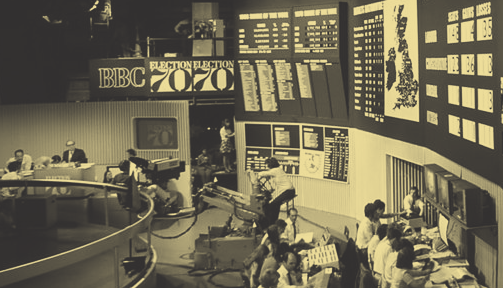
Given the slightly strange results it’s generated so far, I’ve retitled the series to factor in whether AI will come out of this with any credibility or not. It can’t even get a grip on what it would look like if the October 1974 BBC General Election coverage had been anchored by a cartoon moose.

WHERE ARE THEIR LEGS? AND THAT’S CGI, I ASKED FOR A HANNA-BARBERA CARTOON MOOSE But anyway, onto part four of our gallop through the sitcom polls, and a trio of Channel 4 sitcom characters wander into our theoretical (and AI-assisted) polling booth. Will AI start to redeem itself?
Nathan Barley

Charlie Brooker and Chris Morris’ satire of self-obsessed nuMeeja nodes might not be up there with the classic sitcoms from Four, but it has a variety of characters that don’t fit in with standard sitcom tropes. Plus Benedict Cumberbatch was in it (for about twenty seconds). So, how were the Hoxton hacks likely to vote? Over to ChatGPT at the count:
Nathan Barley: The titular character, Nathan is a vapid and self-obsessed media wannabe. He might vote for the Conservative Party if he sees it as beneficial for his business interests and social status. Alternatively, he could support a trendy, image-focused party like the Liberal Democrats, if they appeal to his sense of being progressive and cool.
Dan Ashcroft: The disillusioned journalist who sees through the superficiality around him, Dan would likely support the Labour Party. His disdain for the vacuous culture represented by characters like Nathan aligns with Labour’s focus on social justice, equality, and challenging the status quo.
Claire Ashcroft: Dan’s sister, who is an earnest documentary filmmaker, would probably vote for the Green Party. Her commitment to meaningful, socially-conscious work aligns with the Greens’ emphasis on environmental issues, social justice, and progressive policies.
Pingu: The tech-savvy but somewhat clueless friend of Nathan, Pingu might support the Liberal Democrats. His tech-centric lifestyle and desire to appear progressive fit with the Lib Dems’ focus on innovation and moderate social policies.
Jonatton Yeah?: The pretentious editor of the fictional magazine “Sugar Ape,” Jonatton might support the Conservatives, valuing their pro-business stance and focus on individual success. Alternatively, he might vote for whichever party he believes aligns with the latest trends and keeps him in the social limelight, potentially the Liberal Democrats.
Toby: Another character who thrives on the superficial hipster culture, Toby would likely follow a similar pattern to Nathan Barley. He might vote Conservative if he sees personal gain or lean towards the Liberal Democrats for their trendy, progressive image.
Personally, I reckon Barley would vote for a new unheard-of single-topic party set up by one of his school chums that ultimately gathers a total of 27 votes, but that’s probably not part of the training data. Anyway, what did CoPilot say?
Nathan Barley: As the epitome of the self-absorbed, tech-obsessed hipster, Nathan would likely gravitate toward a party that promises to revolutionize the digital landscape. His vote might go to the Greens, who advocate for environmental sustainability and progressive tech policies.
Dan Ashcroft: The disillusioned journalist and creator of the infamous “Rise of the Idiots” article would probably lean toward Labour. Dan’s disdain for mainstream culture and corporate influence aligns with Labour’s historical focus on social justice and workers’ rights.
Jonatton Yeah?: The absurdly named editor-in-chief of Sugar Ape magazine would likely vote Conservative. His penchant for superficiality, elitism, and corporate interests mirrors the Tory party’s traditional values.
Toby: Nathan’s clueless flatmate Toby might not even bother voting. But if he did, it’d be a random choice based on whichever party had the most colourful campaign posters.
Pingu: Ben Whishaw’s character, Pingu, Nathan’s tech-savvy boy-slave, would likely support the Liberal Democrats. Their focus on civil liberties, individual freedoms, and tech innovation would resonate with him.
Ned Smanks and Rufus Onslatt: The gormless graphic designers at Sugar Ape would probably vote for the Monster Raving Loony Party or some other fringe group. Their lack of critical thinking and penchant for absurdity aligns with such choices.
Sasha: The receptionist at Sugar Ape, Sasha, might lean toward the SNP or Plaid Cymru, given her Welsh heritage. She’d prioritize regional interests and cultural identity.
No idea where that last one has come from, but curious that CoPilot includes Ned Smanks but excludes Chloe Ashcroft, one of the main three characters in the entire series. Tsk. Anyway, what’s next?
Phoenix Nights

Garlic bread? Etc. Briefly Britain’s most popular sitcom, currently unavailable on any streaming service but available in charity shops throughout the land. The first series is brilliant, while the second series… well, the Das Boot fruit machine is quite funny. Or was that series one? Anyway, how would they all vote? ChatGPT, over to you:
Brian Potter: The ambitious and scheming owner of the club, Brian would likely vote Conservative. His entrepreneurial spirit, focus on personal gain, and desire to succeed in business align with the Conservative Party’s pro-business policies.
Jerry “The Saint” St. Clair: The club’s loyal but often frustrated entertainment manager, Jerry might lean towards the Labour Party. His working-class background and dedication to the community fit well with Labour’s focus on social equality and support for public services.
Max Bygraves: One half of the club’s bouncer duo, Max might support the Conservative Party, valuing their stance on law and order. His job as a doorman and his no-nonsense attitude align with conservative values on security and stability.
Paddy O’Shea: The other half of the bouncer duo, Paddy, could lean towards Labour. His more laid-back personality and camaraderie with the club’s patrons suggest a preference for policies that support the working class and community cohesion.
Les Campbell: The club’s handyman and aspiring DJ, Les might vote for the Liberal Democrats. His practical skills and desire for progress and innovation in his DJ career align with the Lib Dems’ focus on personal freedoms and support for the creative industries.
Ray Von: The club’s resident DJ and jack-of-all-trades, Ray Von might support the Green Party. His quirky and inventive nature fits with the Greens’ emphasis on environmental sustainability and progressive social policies.
Young Kenny: The naive and well-meaning club employee, Young Kenny would likely support Labour. His working-class roots and straightforward outlook on life align with Labour’s focus on fairness and social justice.
Spencer: The club’s enthusiastic but inexperienced young worker, Spencer, might also lean towards Labour. His youthful idealism and aspiration for a better future align with Labour’s promises for social mobility and opportunities for young people.
Well, it’s doubtful that Max would really vote Tory given his occasional sad lament of “Thatcher’s Britain” is Road to Nowhere, but I can’t blame ChatGPT for not having watched that. Most people wish they hadn’t, either. Over to CoPilot.
Brian Potter: The club owner and larger-than-life personality. Brian might lean toward the Conservative Party. His entrepreneurial spirit and desire for success align with their values.
Jerry St. Clair: The flamboyant club compère. Jerry would likely vote for the Liberal Democrats. Their focus on civil liberties and individual rights resonates with his colourful personality.
Max and Paddy: The bouncers with hearts of gold. Max and Paddy might support Labour. Their working-class background and loyalty to their friends mirror Labour’s historical focus on social justice.
Ray Von: The dodgy DJ. Ray would probably vote for the Monster Raving Loony Party or some other fringe group. His eccentricity and lack of seriousness align with such choices.
Den Perry: The rival club owner. Den’s shady dealings and disregard for rules might lead him to vote for Reform UK. Their anti-establishment stance could appeal to him.
Kenny Senior: Brian’s father and a club regular. Kenny would likely vote for the Greens. His love for nature and concern for the environment align with their policies.
Holy Mary: The devout Catholic cleaner. Holy Mary might lean toward the Christian Party. Her faith and desire for moral values could guide her choice.
I’ve checked, and there really is a Christian Party in the UK, so credit to CoPilot for factoring that in. And having Den Perry going for The Nastiest Party seems appropriate. You can imagine him standing in the council elections for them.
Onto our last programme for today. Get your eyeballs into a Dutch angle, it’s…
Spaced

Jess and Simon’s influential sitcom (helped, of course, by Edgar Wright) counts as another ‘youth vote’ piece of polling, so what would the residents of 23 Meteor Street go for? ChatGPT to start:
Tim Bisley: The laid-back, comic book-loving slacker, Tim would likely support the Green Party. His creative, alternative lifestyle and interest in environmental issues fit well with the Greens’ progressive policies on sustainability and social justice.
Daisy Steiner: The aspiring writer and free spirit, Daisy might lean towards the Labour Party. Her artistic ambitions, concern for social issues, and working-class background align with Labour’s focus on equality and support for the creative industries.
Mike Watt: The military enthusiast and Tim’s best friend, Mike would probably vote Conservative. His respect for the military, interest in national security, and traditional values align with the Conservative Party’s stance on defense and order.
Marsha Klein: The boozy landlady with a complicated personal life, Marsha might support the Liberal Democrats. Her pragmatic approach to life, combined with a desire for personal freedom and a balanced approach to social issues, fits well with the Lib Dems’ centrist policies.
Brian Topp: The intense and introverted artist, Brian would likely support the Green Party. His commitment to his art and unconventional lifestyle align with the Greens’ emphasis on environmentalism, social justice, and support for the arts.
Twist Morgan: Daisy’s fashion-obsessed friend, Twist, might lean towards the Liberal Democrats. Her focus on trends, personal freedoms, and moderate approach to politics align with the Lib Dems’ appeal to young, urban professionals.
Tyres O’Flaherty: The energetic bike courier and party animal, Tyres might support the Green Party, valuing their emphasis on sustainability and progressive social policies, which resonate with his active lifestyle and countercultural attitude.
A lot of love for the Greens there. Will CoPilot suggest anything different?
Tim Bisley (played by Simon Pegg): Tim, the aspiring comic book artist, would likely lean toward the Labour Party. His creative spirit and desire for social justice align with their values.
Daisy Steiner (played by Jessica Stevenson): Daisy, the aspiring writer, might vote for the Green Party. Her idealism and concern for the environment resonate with their policies.
Marsha Klein (played by Julia Deakin): Marsha, the alcoholic landlady, would probably support the Conservative Party. Her love for wine and desire for stability align with their traditional values.
Brian Topp (played by Mark Heap): Brian, the angst-ridden artist, could vote for the Liberal Democrats. His artistic sensibilities and desire for change might lead him in that direction.
Mike Watt (played by Nick Frost): Mike, the military-obsessed friend, would likely back the Reform UK party. His fascination with order and protocol aligns with their anti-establishment stance.
Twist Morgan (played by Katy Carmichael): Twist, Brian’s love interest, might lean toward the Monster Raving Loony Party. Her quirky personality and unconventional choices fit their profile.
In short: ‘hmm-face emoji’. The Mike of the time of the series would never go Reform. The Mike of 20+ years later when he’s a bitter middle-aged army reject with two ex-wives, yes – but that’s not what we asked for. Mind you, if ever there’s a sitcom character who’d vote for the Bring Back National Service policy…
Ah well, here’s a summary of today’s voting.

And here’s what those votes do to the State of the Parties.

Blimey, eh? Either AI really doesn’t get a grip on the political undercurrent gurgling away beneath the pavements of Britain, or it’s looking a lot like Starmer’s about to go all Kinnock 1992.
What will the next update bring? Find out in a couple of days.

-
BrokenTV’s Sitcom Swingometer Spectacular! Part 3: Hi-De-Hi, Red Dwarf and The Young Ones
Welcome back to day three of our ongoing (and, many might argue, entirely pointless) mission to see how Britain’s sitcom characters of fore might vote in the 2024 General Election (whilst offering a rare non-job-stealing chore to ChatGPT and CoPilot).
So far, we’ve heard from Dad’s Army, Hancock’s Half Hour and Are You Being Served? in part one, then Drop the Dead Donkey, Peep Show and The Fall and Rise of Reginald Perrin in part two. Three more programmes at the polling station today, kicking off with
Hi-De-Hi!
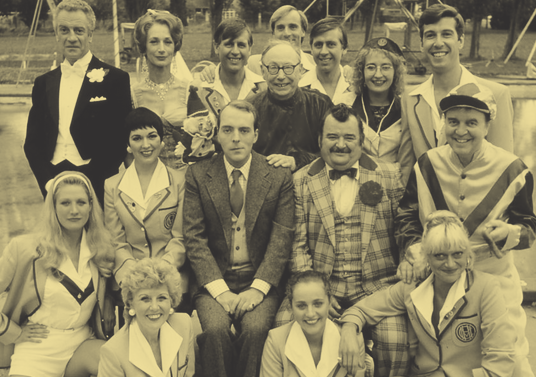
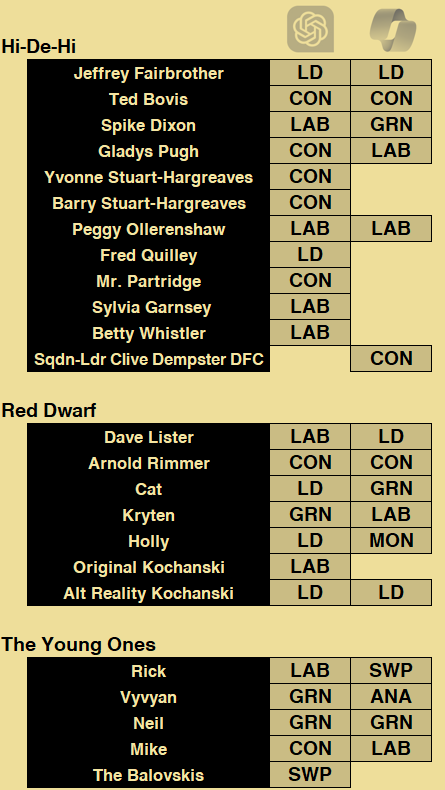
[RUBS EYES, LOOKS AT BOTTLE OF SCOTCH, LOOKS AT BALLOT SHEET, LOOKS AT BOTTLE OF SCOTCH, THROWS BALLOT SHEET OVER SHOULDER] Well, here’s a constituency with a larger than average population. But where would the Maplins massive put their respective exes? Over to you, ChatGPT:
“Hi-De-Hi!” is a British sitcom set in the 1950s at the fictional Maplin’s Holiday Camp, featuring a variety of colourful characters among the camp staff. Here’s a speculative guess on how these characters might vote in the 2024 UK General Election:
Jeffrey Fairbrother: The well-educated and somewhat bumbling entertainment manager, Jeffrey would likely support the Liberal Democrats. His academic background and moderate, thoughtful approach align well with the party’s centrist and intellectual appeal.
Ted Bovis: The camp comedian and schemer, Ted would probably vote Conservative. His pragmatic approach to life and entrepreneurial spirit fit with the party’s business-friendly policies.
Spike Dixon: The young, idealistic camp comic, Spike might lean towards Labour. His youthful enthusiasm and concern for fairness and social issues align with Labour’s progressive stance.
Gladys Pugh: The patriotic and traditional Welsh Chief Yellowcoat, Gladys would likely support the Conservative Party. Her traditional values and emphasis on duty and decorum fit well with conservative principles.
Yvonne and Barry Stuart-Hargreaves: The snobbish ballroom dancing couple, Yvonne and Barry, would almost certainly vote Conservative. Their upper-class pretensions and desire for social status align with the party’s traditional values.
Peggy Ollerenshaw: The ambitious and hard-working chalet maid, Peggy would likely support Labour. Her working-class background and desire for upward mobility align with Labour’s focus on social justice and support for the working class.
Fred Quilley: The former jockey turned riding instructor, Fred might lean towards the Liberal Democrats or Labour. His experiences with the ups and downs of life might make him sympathetic to policies that support social mobility and personal freedom.
Mr. Partridge: The misanthropic Punch and Judy man, Mr. Partridge, might support the Conservative Party, valuing their traditional and perhaps more cynical view of human nature.
Sylvia Garnsey and Betty Whistler: The other Yellowcoats, Sylvia and Betty, might have differing views but could lean towards Labour or the Liberal Democrats. Their roles in the entertainment and service industry align with parties that focus on workers’ rights and social equality.
Right, that’s all them in the computer. Personally, I’d have pegged Ted Bovis as a Labour man, but one who’d immediately switch sides if he ever landed a TV or radio gig. Over to CoPilot:
Ah, the delightful characters from Hi-De-Hi!—a classic British sitcom set in a holiday camp. Let’s imagine how they might cast their votes in the 2024 UK General Election based on their personalities and backgrounds:
Jeffrey Fairbrother (Simon Cadell):
As a former professor of archaeology at Cambridge University, Jeffrey might lean toward the Liberal Democrats. Their focus on education and intellectual pursuits could resonate with him.Ted Bovis (Paul Shane):
Ted, the camp host, is a bit of a schemer. He’d probably vote for a party that promises tax breaks or business-friendly policies. In this case, he might lean toward the Conservatives.Gladys Pugh (Ruth Madoc):
Gladys, with her Welsh charm and love for entertainment, could be a fan of the Labour Party. Their emphasis on social welfare and community support aligns with her caring nature.Spike Dixon (Jeffrey Holland):
Spike, the camp comic, is all about making people laugh. He might appreciate the Green Party for their environmental focus and commitment to a better future.Peggy Ollerenshaw (Su Pollard):
Peggy, the chalet maid, dreams of becoming a Yellowcoat. She’d likely vote for a party that champions equal opportunities and social mobility. The Labour Party fits the bill.Sqdn-Ldr Clive Dempster DFC (David Griffin):
Clive, who takes over as the new Entertainments Manager, could be a traditionalist. He might favour the Conservatives due to their historical association with stability and order.Remember, this is all in good fun, and the characters’ political preferences are purely fictional! 😄 If you want to know the real-world party standings in the 2024 UK General Election, recent polls suggest that the Labour Party is leading, followed by Reform UK, the Liberal Democrats, and the Green Party. However, for our Hi-De-Hi! gang, let’s keep it light-hearted and whimsical!
A lighter sampling of the cast there, but quite interesting that the newly-added disclaimer addendum to the suggestions completely ignores the Conservatives and the SNP, the parties with the first and third largest numbers of MPs in the Commons. Though that likely won’t be the case in a couple of months. Possibly. Long way to go yet. ONTO THE NEXT PROGRAMME.
Red Dwarf
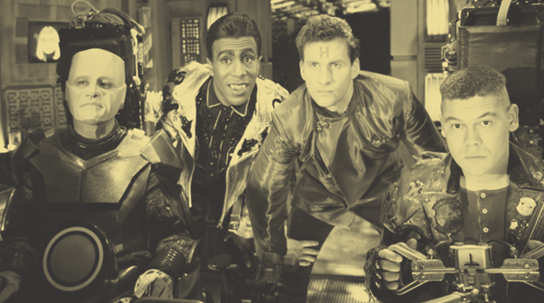
Yep, no reason to discount the boys from the Dwarf yet because they’re marooned in deep space three million years in the future. There’s always postal voting, and a few episodes have shown they’ve been able to travel back in time. So, y’know. Over to you, ChatGPT.
“Red Dwarf,” the British sci-fi sitcom set on the eponymous mining spaceship, features a cast of diverse and eccentric characters. Based on their personalities and backgrounds, here’s a speculative guess on how they might vote in the 2024 UK General Election:
Dave Lister: The laid-back, working-class last human alive, Lister would likely vote for Labour. His background, empathy for the underdog, and desire for a fairer society align with Labour’s focus on social justice and support for the working class.
Arnold Rimmer: The neurotic, status-obsessed hologram, Rimmer would almost certainly vote Conservative. His respect for hierarchy, aspiration for upward mobility, and disdain for what he perceives as laziness fit well with conservative principles.
Cat: The vain and fashion-obsessed humanoid descended from cats, Cat might not be particularly politically engaged. However, if he did vote, he might support the Liberal Democrats for their centrist and balanced approach, focusing on personal freedoms and individualism, which aligns with his self-centred personality.
Kryten: The service-oriented and highly ethical mechanoid, Kryten, would likely support the Green Party. His concern for the well-being of others, environmental awareness, and desire to serve the greater good align with the Green Party’s platform on sustainability and social justice.
Holly: The ship’s computer, Holly, with a sometimes quirky but logical personality, might lean towards the Liberal Democrats. Holly’s focus on logic and practicality fits well with their balanced and rational policies.
Kristine Kochanski: Depending on whether we’re considering the original series’ Kochanski or the alternate reality Kochanski, her vote could differ. The original series’ Kochanski, a competent and ambitious officer, might support Labour, given her practical and down-to-earth nature. The alternate reality Kochanski, who is more polished and sophisticated, might lean towards the Liberal Democrats for their progressive yet balanced stance.
Extra credit for offering responses for both Original Kochanski and Alt Reality Kochanski, there. What say you, CoPilot?
Dave Lister (Craig Charles):
Lister, the last human alive, is a laid-back, guitar-playing slob. He’d probably vote for a party that promises a good time and a relaxed approach to life. In this case, he might lean toward the Liberal Democrats—after all, they’re all about freedom and individuality.Arnold Rimmer (Chris Barrie):
Rimmer, the hologram with a massive ego, would likely vote for a party that aligns with his self-importance. Given his penchant for rules and regulations, he might lean toward the Conservatives. Plus, they’re all about maintaining order, just like Rimmer.The Cat (Danny John-Jules):
The Cat, a flamboyant humanoid feline, is all about style, fashion, and looking good. He’d probably vote for a party that appreciates aesthetics and glamour. The Green Party might catch his eye—they’re into eco-friendly fashion, after all.Kryten (Robert Llewellyn):
Kryten, the neurotic android, is all about efficiency, cleanliness, and following protocols. He’d likely vote for a party that prioritizes technology and progress. The Labour Party could be his choice—they’re all about improving living conditions for everyone.Holly (Norman Lovett):
Holly, the senile ship’s computer, might not even remember to vote. But if he did, he’d probably go for a party that promises a good laugh. Let’s say he’d vote for the Monster Raving Loony Party—because why not?Kristine Kochanski (Alternate Universe):
Kochanski, the alternate universe version of the ship’s officer, is smart, resourceful, and practical. She’d likely vote for a party that focuses on science, exploration, and innovation. The Liberal Democrats or even the Green Party could be her picks.Hmm, Dave Lister voting Lib Dem seems a bit of a stretch. Unless the rationale of it was that he’s desperately trying to impress (Alt Universe) Kochanski, of course. Onto our final programme for today.
The Young Ones
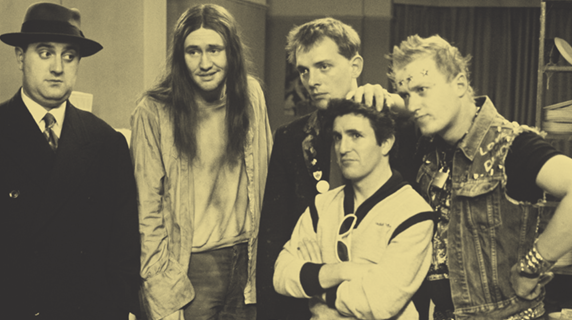
Vegetable rights and peace! Probably fair to say we’ve been ignoring the YOUNG ADULT vote so far, so let’s redress that imbalance a little. But what would the Scumbag students go for? Let’s see. ChatGPT, your starter for ten:
Rick: The self-proclaimed “People’s Poet” and wannabe anarchist, Rick would almost certainly vote for a far-left party. In the context of the 2024 election, he might support the Labour Party, especially if it has a strong socialist wing, or even a more radical left-wing party like the Socialist Workers Party or the Green Party for their progressive policies on social justice and environmental issues.
Vyvyan: The violent and destructive punk medical student, Vyvyan would likely support a party that represents rebellion against the establishment. He might lean towards the Green Party for their radical stance on change, or possibly not vote at all, dismissing the political system entirely.
Neil: The depressed, hippie pacifist, Neil would almost certainly vote for the Green Party. His deep concern for the environment, peace, and social equality aligns perfectly with the Greens’ policies.
Mike: The suave and manipulative “cool person,” Mike might vote for whichever party he believes will benefit him the most personally. Given his opportunistic nature, he could support the Conservatives for their business-friendly policies or potentially the Liberal Democrats if they promise advantageous policies for self-starters and entrepreneurs.
Alexei Sayle’s Characters: Alexei Sayle often played various exaggerated characters in the show, usually with a working-class or extreme left-wing bent. These characters would likely support far-left parties such as the Socialist Workers Party or other radical left groups.
A new addition to the list of parties, there. Not plumping for The Communist Party of Great Britain might seem a bit of a missed open goal regarding the Balowskis, but the SWP is as close as dammit (also the CPoGB dissolved in 1991). Plus, suggesting Rick would go for Starmer-era Labour suggests the data used for the machine learning is a good five years out of date. Anyway, let’s see what CoPilot go for:
Vyvyan Basterd (Adrian Edmondson):
Vyvyan, the punk medical student with an appetite for destruction, would probably vote for a party that promises chaos, rebellion, and smashing things. In this case, he might lean toward the Anarchist Party (if such a thing existed).Rick (Rik Mayall):
Rick, the self-styled “People’s Poet” and faux anarchist, would likely vote for a party that champions radical change and poetic justice. He might lean toward the Socialist Party or the Green Party.Mike (Christopher Ryan):
Mike, the serious and bossy cool person, would probably vote for a party that emphasizes stability and pragmatism. The Labour Party or the Liberal Democrats might appeal to him.Neil (Nigel Planer):
Neil, the permanently depressed, lentil-loving hippie, would likely vote for a party that promotes peace, love, and environmental consciousness. The Green Party or even the Peace and Love Party could be his choice.Skipping the problem of lumping the Balowskis into a single paragraph by just… not mentioning them makes the task a bit easier, I guess. Interesting divergence between the AI systems on this one, and a bit of cred clawed back by CoPilot in suggesting Rick would go for the SWP and that Vyv would vote Anarchist (the closest equivalent probably being the Anarchist Federation, albeit a federation of anarcho-communists rather than a political party). That said, I’ve googled ‘the Peace and Love Party’ and that just brings up a bunch of results for 60s-themed party supplies on Etsy.
So, what are the summaries from today’s polling?
And what does that do to the overall table?
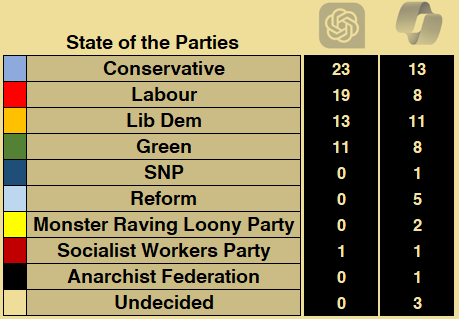
So, good news for the Tories in general, and an update that would see the Green Party rubbing their eyes in disbelief.
What could the next update bring? Time will tell. There are a lot of sitcoms still to account for, after all. Until then: bye.
-
BrokenTV’s Sitcom Swingometer Spectacular! Part 2: Drop the Dead Donkey, Peep Show and The Fall and Rise of Reginald Perrin

So, for anyone who missed yesterday’s Part One of this new series, here’s the premise. What would happen if a load of characters from old British sitcoms were allowed to (a) exist in real life, (b) were all still alive today, and (c) decided to cast a vote in the 2024 UK General Election? Well, without tracking down a bunch of original sitcom writers (or, in several cases, holding a seance), there’s no way to accurately know. It being 2024, there is the option of using generative AI to try and work out the answers, but as we all know AI isn’t actually as clever as a lot of shareholders would like to think.
Or is it? Maybe it could do a brilliant job at predicting who Private Walker et al would vote for? Or maybe, this kind of grand folly is all AI is actually good for. In any case, that’s what I’m using (using ChatGPT and CoPilot as our ‘polling companies’), and at the end of it all we’ll see which party got the most ‘votes’ in our technological exit poll, and determine just who would go on to lead The Sitcom Government for the next five years.
Yesterday, we looked at Dad’s Army, Hancock’s Half Hour and Are You Being Served?. Three more constituencies today, and here are the results from the first of them:
DROP THE DEAD DONKEY
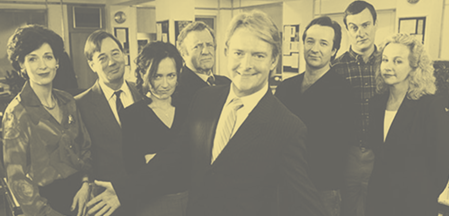
Another timely offering, the quick-turnaround topical (at the time) events of Globelink News are currently getting an airing on new channel ReplayTV, who I promise I’m not being paid by. Though, y’know, if they want to commission me as Chief Director of Programming, I’m available. Even more interestingly, the entire cast have reunited for a brand new stage show, which I’ve heard good things about.
Of course, being members of the ELITE MEDIA CLASS, they’ll all be dyed-in-the-wool Starmerites, surely? Nobody working in television news could possibly be right-wing, COULD THEY? Anyway, enough with heavy-handed obvious satire. Over to you ChatGPT.
–
“Drop the Dead Donkey,” a satirical British sitcom set in a fictional TV news company, Globelink News, features characters with distinct personalities and backgrounds that could inform their political preferences in the 2024 UK General Election. Here are some speculative guesses:
Gus Hedges: The bureaucratic and management-obsessed Chief Executive, Gus would likely vote Conservative. His focus on corporate management, efficiency, and maintaining the status quo aligns with Conservative policies.
George Dent: The neurotic and often indecisive editor, George might lean towards the Liberal Democrats. His concern for fairness and moderate views would resonate with the Lib Dems’ centrist and balanced approach.
Dave Charnley: The cynical and womanizing reporter, Dave would probably support Labour. His working-class background and disdain for authority and corporate interests align with Labour’s focus on social justice and workers’ rights.
Henry Davenport: The ageing, pompous newsreader with conservative views on social issues would most likely vote Conservative. His traditional values and resistance to change fit well with the party’s platform.
Sally Smedley: The vain and self-absorbed co-anchor, Sally might vote Conservative, valuing their stance on individualism and personal success. Alternatively, she could be drawn to whichever party she perceives as offering the most personal advantage.
Helen Cooper: The intelligent and ambitious assistant editor, Helen would likely support Labour. Her progressive views and focus on social issues such as equality and justice align with Labour’s policies.
Damien Day: The ruthless and sensationalist reporter, Damien might support the Green Party, not out of genuine concern but for the shock value and emerging trends. Alternatively, he could back any party promising radical changes or controversy, including fringe parties.
Joy Merryweather: The sharp-tongued and efficient secretary, Joy might lean towards the Green Party. Her no-nonsense attitude and possible concerns about environmental issues align with Green policies.The Greens seem to be getting a lot of traction, don’t they? Okay, over to CoPilot:
In the 2024 UK General Election, the Drop the Dead Donkey characters would likely vote based on their individual personalities and beliefs. However, since the show is a fictional comedy, we can only speculate. Let’s take a look at some of the main characters and make some light-hearted assumptions:
Joy (played by Susannah Doyle): Joy might lean toward the Labour Party due to her compassionate and empathetic nature. Labour traditionally focuses on social justice and workers’ rights.
Gus (played by Robert Duncan): Gus, being a Cornishman, could have a strong connection to the environment. He might consider voting for the Green Party, which prioritizes environmental issues.
Helen (played by Ingrid Lacey): Helen, as the office manager, might be practical and pragmatic. She could lean toward the Conservative Party, which often emphasizes economic stability and business interests.
Dave (played by Neil Pearson): Dave, the news editor, might be politically savvy. He could vote strategically to prevent the Tories from winning, possibly supporting the Liberal Democrats or another anti-Conservative party.
George (played by Jeff Rawle): George, the senior reporter, could be a bit rebellious. He might vote for the Reform UK party, which advocates for change and challenges the status quo.
Damien (played by Stephen Tompkinson): Damien, the ambitious reporter, might align with the Conservative Party due to its focus on individual success and meritocracy.
Sally Smedley (played by Victoria Wicks): Sally, the foreign correspondent, could be open-minded and progressive. She might consider voting for the Liberal Democrats or the Green Party.
Well, at least that confirms CoPilot’s training data includes at least one person who hasn’t actually watched an episode of Drop the Dead Donkey. The famously “compassionate and empathetic” Joy, indeed. And I don’t recall anything about Gus bring Cornish. Plus, they forgot about Henry, who’s one of the main characters. Tsk.
Anyway, onto our next show. Fire up the sound of Harvey Danger, it’s…
PEEP SHOW

Over to the ChatGPT jury.
“Peep Show,” a British sitcom known for its dark humour and exploration of the dysfunctional lives of its main characters, provides a rich basis for speculating on their voting preferences in the 2024 UK General Election. Here’s a guess on how the main characters might vote:
Mark Corrigan: Mark, the uptight and conservative loan manager with a love for history and structure, would likely vote Conservative. His appreciation for order, traditional values, and career stability aligns with Conservative policies.
Jeremy “Jez” Usborne: Jez, the laid-back and hedonistic aspiring musician, would probably support the Green Party. His countercultural lifestyle, interest in alternative lifestyles, and occasional flirtations with progressive ideals align with the Greens’ focus on environmental and social justice issues.
Sophie Chapman: Sophie, Mark’s on-and-off girlfriend and colleague, might lean towards the Liberal Democrats. Her middle-of-the-road, pragmatic approach to life and relationships fits well with the Lib Dems’ centrist and moderate positions.
Super Hans: Super Hans, the erratic and drug-addled musician, could be a wildcard. He might support an anti-establishment party like the Greens for their radical policies or even a fringe party that promises upheaval and chaos.
Dobby (Deborah): Dobby, the quirky and geeky IT technician, would likely support Labour. Her progressive views, concern for social issues, and background in the tech industry align with Labour’s emphasis on social justice, public services, and support for workers.
Johnson: Alan Johnson, the confident and career-driven businessman, would almost certainly vote Conservative. His admiration for Thatcherite principles and his focus on success and individualism fit perfectly with Conservative values.
Big Suze: Big Suze, the posh and somewhat naive ex-girlfriend of Jeremy, might lean towards the Liberal Democrats or Conservatives. Her upper-class background and generally apolitical, easy-going nature could fit with either party, depending on her social circle and personal influences.
Nancy: Nancy, the free-spirited American who dates Jeremy, would likely support the Green Party. Her progressive, new-age attitudes and concern for the environment align well with the Greens’ platform.Hmm. I personally think Mark would be keener to go with Labour, such is the way he seems determined to ‘seem’ right-on, lacking the self-awareness to realise how selfish and self-serving he actually is. Plus, I suspect Nancy wouldn’t have ever got around to registering to vote (though you can guarantee her parents back home will be Republicans). Anyway – with quite a bit of credibility for it to make up – over to CoPilot:
In the 2024 UK General Election, the Peep Show characters’ voting preferences would likely be influenced by their personalities and backgrounds. While we can only speculate, let’s imagine how some of the main characters might vote:
Mark Corrigan: Mark, being a socially awkward and neurotic character, might lean toward the Conservative Party. Their focus on stability and traditional values could resonate with him.
Jeremy “Jez” Usborne: Jez, the laid-back musician, could be more progressive. He might consider voting for the Green Party, which emphasizes environmental issues and social justice.
Sophie Chapman: Sophie, Mark’s love interest, could be practical and level-headed. She might vote for the Liberal Democrats, who often advocate for civil liberties and individual rights.
Super Hans: Super Hans, the wild and unpredictable friend, might not take politics too seriously. He could vote for a fringe party like Reform UK or even joke about writing in his own name.
Johnson: Johnson, the bumbling office manager, might align with the Conservative Party due to his bureaucratic tendencies and desire for order.
Dobby: Dobby, the quirky IT girl, could be socially conscious. She might lean toward the Labour Party, which focuses on equality and social welfare.A very similar set of choices there, though I can certainly imagine Super Hans going for Reform and misguidedly trying to make out they’re actually the only true liberals on the ballot.
Anyway, onto our last programme:
THE FALL AND RISE OF REGINALD PERRIN

ChatGPT didn’t get where it is today by not knowing about Leonard Rossiter’s finest hour:
“The Fall and Rise of Reginald Perrin” is a British sitcom that follows the life of Reginald Perrin, a middle-aged sales executive who experiences a mid-life crisis and attempts to escape his mundane existence. Here’s a speculative guess on how the main characters might vote in the 2024 UK General Election:
Reginald “Reggie” Perrin: Reggie, the disillusioned and increasingly rebellious protagonist, would likely vote for a party promising significant change. Given his disdain for the corporate world and his existential struggles, he might lean towards the Green Party for their radical environmental and social policies or even a more fringe party like the Liberal Democrats if they promise substantial reform. Alternatively, he could support Labour if they present a strong platform for social justice and anti-establishment sentiments.
Elizabeth Perrin: Reggie’s supportive and understanding wife, Elizabeth, might lean towards the Liberal Democrats. Her calm and reasonable nature aligns with the party’s centrist and balanced approach to politics.
C.J. (Charles Jefferson): Reggie’s pompous and bureaucratic boss, C.J., would almost certainly vote Conservative. His traditional views, emphasis on hierarchy, and conservative approach to business and management fit well with Conservative policies.
Joan Greengross: Reggie’s secretary, Joan, might lean towards Labour. Her working-class background and straightforward demeanor align with Labour’s focus on workers’ rights and social equality.
Tony Webster: Tony, the overly optimistic and somewhat naive colleague, might support the Liberal Democrats. His idealistic nature and desire for progress fit well with their centrist and forward-thinking platform.
David Harris-Jones: The nervous and sycophantic colleague, David, would likely vote Conservative, mirroring C.J.’s preferences. His desire to fit in and avoid conflict would lead him to follow the more traditional and established path.
Doc Morrisey: The eccentric company doctor, Doc Morrisey, could be a wildcard. Given his unconventional methods and quirky personality, he might support the Green Party for their progressive and unconventional approach to politics and healthcare.
Tom and Linda Patterson: Reggie’s daughter and her husband, with their conventional suburban lifestyle, might lean towards the Conservative Party. Their focus on family and stability aligns with Conservative values.Right. Over to you, CoPilot. Great. Super.
In the 2024 UK General Election, the characters from The Fall and Rise of Reginald Perrin would likely vote based on their individual personalities and fictional backgrounds. Let’s imagine how some of the main characters might lean:
Reginald “Reggie” Perrin: Reggie, the middle-aged middle manager, might be disillusioned with the pointlessness of his job at Sunshine Desserts. He could lean toward the Reform UK party, which advocates for change and challenges the status quo. However, given his existential crisis, he might also consider voting for a more radical party.
CJ: Reggie’s boorish boss CJ might align with the Conservative Party, emphasizing stability and traditional values. His catchphrase (“I didn’t get where I am today…”) suggests a certain self-interest.
Tony and David: Reggie’s yes-men colleagues Tony (“Great!”) and David (“Super!”) might follow CJ’s lead and vote for the Conservatives as well.
Elizabeth: Reggie’s lovely but colourless wife Elizabeth might lean toward the Liberal Democrats, who often advocate for civil liberties and individual rights.
Linda: Reggie’s annoyingly bouncy daughter Linda could be socially conscious. She might consider voting for the Green Party, which emphasizes environmental issues and social justice.
Joan: Reggie’s weakly smouldering secretary Joan might be pragmatic. She could vote for the party that promises stability and economic growth.Okay, time to summarise what we’ve seen today:
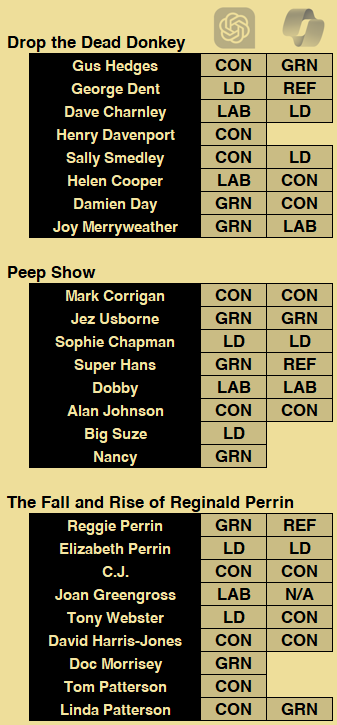
And, adding these votes to our ongoing table, here how the parties stand after results from six constituencies:
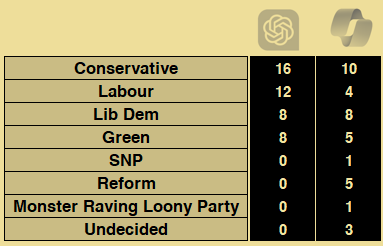
A surprising lurch to the right so far, then – especially as far as CoPilot seems to think – with even Reform outperforming Labour. That could be down to inherent biases within two AI packages, or it could be down to our notional electorate mainly being easily-lampooned subclasses of various societies that don’t really exist any more. Only one way to find out for sure – I’ll keep shovelling data into it.
In short: more of this nonsense very soon.
-
BrokenTV’s Sitcom Swingometer Spectacular! Part 1: Dad’s Army, Hancock, Are You Being Served?

Or, if you prefer, I Asked Two AI Programs How Classic British Sitcom Characters Would Vote in the 2024 General Election. The results may surprise you. Not going to lie, they surprised me.

So, there’s a General Election about to happen in the UK (don’t forget to register if you haven’t already, and remember that even if you don’t have photo ID you can still do postal voting).
A big part of any General Election cycle is seeing all the opinion polls go up and down and wobble about a bit. And, obviously, a similarly sizeable section of the cycle is “passing that long campaigning period by contributing to Britain’s nonsense reserves by trying to find something to say about the whole sorry debacle”.
Here’s my offering.
So, what if we tallied up the presumed votes from various classic British sitcom characters to see which of the 2024 Political Parties would fill the majority of Sitcomland’s Parliament? That would be interesting, wouldn’t it? And, in keeping with Britain’s TV Election Night coverage since time immemorial, I’m going to skirt any personal responsibility by blaming my predictions on computers. And as it’s 2024, let’s use AI.
For the purposes of this grand folly, I’m going to see what both CoPilot and ChatGPT think. I was also going to use Google’s Gemini, but that didn’t even understand the bloody question:

Hardly a surprise from a piece of tech that recommends using glue to prevent cheese falling off your pizza. So, the big two it is.
Quick ground rules: I’ll let the software decide who constitutes a main character from each, and if it suggests more than one likely party we’ll use the first suggestion as gospel. Any suggested parties that don’t actually exist, we’ll run with the nearest modern equivalent. And we’ll keep a running total at the end of each update. Sorted.
We’ll start the batting with three well-known sitcoms containing a good old cross-class mixture of characters. First up to the crease: the Warmington-on-Sea Home Guard.
DAD’S ARMY

“Don’t tell him (who you’ll be voting for), Pike.” Crossing my fingers that neither chunk of AI tech uses this information to ultimately enslave humanity, over to ChatGPT. So, in the 2024 UK General Election, which parties would the characters from Dad’s Army vote for?
“Dad’s Army,” a beloved British sitcom set during World War II, features characters who represent a variety of social classes and political views. If they were to vote in the 2024 UK General Election, their choices would likely reflect their personalities and backgrounds. Here are some speculative guesses:
- Captain Mainwaring: A staunchly patriotic and conservative bank manager, Mainwaring would likely support the Conservative Party. His traditional values and leadership style align well with conservative principles.
- Sergeant Wilson: As an upper-middle-class gentleman with a relaxed demeanour, Wilson might lean towards the Liberal Democrats. His more liberal and inclusive outlook on life fits with the party’s moderate and centrist positions.
- Lance Corporal Jones: A patriotic and somewhat old-fashioned butcher, Jones is fiercely loyal to his country. He would probably vote Conservative, valuing their stance on national security and tradition.
- Private Frazer: A cynical and often pessimistic undertaker, Frazer might be drawn to a party with a strong stance on social justice and financial responsibility. He could support the Labour Party, particularly if they emphasize economic fairness and public services.
- Private Godfrey: The gentle and kind-hearted medic, Godfrey would likely support the Green Party. His caring nature and concern for the well-being of others and the environment align with Green policies.
- Private Walker: As a wheeler-dealer with a knack for business, Walker might support whichever party he sees as beneficial for his entrepreneurial interests. This could be the Conservatives for their business-friendly policies or possibly a party like Reform UK, depending on the political landscape and his personal views on Brexit and deregulation.
- Private Pike: The youngest member of the platoon, Pike’s vote could go towards Labour. His youth and idealism might draw him to a party promising social progress and opportunities for young people.
A surprisingly cogent summary, there. It didn’t even suggest any of them have eight fingers or anything, though I personally think Fraser would go SNP. Over to you, CoPilot:
Ah, the delightful characters from Dad’s Army! Let’s take a look at some of the iconic members of the Walmington-on-Sea Home Guard and speculate on their political leanings:
- Captain George Mainwaring (portrayed by Arthur Lowe): As the pompous yet patriotic local bank manager, Captain Mainwaring would likely align with the Conservative Party. His sense of duty and traditional values would resonate with their platform1.
- Sergeant Arthur Wilson (portrayed by John Le Mesurier): The mild-mannered bank clerk and Mainwaring’s second-in-command might lean toward the Liberal Democrats. Wilson’s pragmatic approach and desire for compromise would align with their centrist policies.
- Lance-Corporal Jack Jones (portrayed by Clive Dunn): The aging butcher and war veteran, Jones, would probably support the UK Independence Party (UKIP). His catchphrase “Don’t panic!” and love for the British Empire reflect a nostalgic view that resonates with UKIP’s stance on sovereignty and independence.
- Private Joe Walker (portrayed by James Beck): As the black marketeer and shrewd businessman, Walker would likely vote for whichever party promised economic prosperity. His opportunistic nature might lead him to support the party with the most favourable business policies.
- Private Frank Pike (portrayed by Ian Lavender): The young and innocent Pike would likely be drawn to the Green Party. His idealism and concern for the environment align with their focus on sustainability and conservation.
- Private James Frazer (portrayed by John Laurie): The dour Scottish undertaker would probably lean toward the Scottish National Party (SNP). Frazer’s scepticism and desire for independence resonate with the SNP’s goals for Scotland.
- Private Charles Godfrey (portrayed by Arnold Ridley): The gentle and elderly medic would likely support the Liberal Democrats. His compassionate nature and desire for social welfare align with their policies.
An interesting convergence, there. While it’s open to interpretation who Walker would go for, and UKIP are basically now Reform, that’s basically just two of the seven main characters the AI bots are in agreement with. Anyway, I can’t stand around pondering if Private Cheeseman would’ve gone for Labour or Plaid, I’m off to East Cheam.
HANCOCK’S HALF HOUR

Some topical timing, as this update goes live on the same weekend Tony Hancock’s ATV series gets a first showing on actual telly since 1963 (on Rewind TV, Sky channel 190, which is already full of some lovely stuff. The first episode is accompanied on Sunday night by Dave Allen’s documentary on the Great British Eccentric, which is Peak Telly as far as I’m concerned). But it’s the BBC original we’re looking at here. Over to you, ChatGPT. In the 2024 UK General Election, which parties would the characters from Hancock’s Half Hour vote for?
“Hancock’s Half Hour,” another classic British sitcom, revolves around the life of Anthony Aloysius St John Hancock and his interactions with his friends. Here’s a speculative guess on how the main characters might vote in the 2024 UK General Election:
- Tony Hancock: As the main character, Hancock is often depicted as a frustrated, slightly snobbish, and somewhat self-important figure with a deep sense of irony and social awareness. He might vote for Labour, as he often portrays a common man dealing with the absurdities of life, showing sympathy towards the working class and social justice issues. Alternatively, his occasional pretentiousness and desire for status might push him towards the Conservative Party if he thinks it aligns with his aspirations.
- Sidney Balmoral James: Sid James, the roguish, cunning, and often opportunistic character, would likely support the Conservative Party for its business-friendly policies, given his entrepreneurial nature and schemes. However, he might also be pragmatic and vote for any party that promises to benefit him personally, possibly even considering Reform UK or another party with a focus on deregulation.
- Bill Kerr: Bill, often depicted as naïve and loyal, might vote for Labour, reflecting his working-class roots and straightforward, everyman attitude. His simplicity and sincerity align with the values of fairness and social support typically championed by Labour.
- Miss Griselda Pugh: Miss Pugh, the secretary with a sharp tongue and practical mindset, might lean towards the Liberal Democrats. Her independent and no-nonsense attitude could find a home in a party that emphasizes moderation, pragmatism, and individual rights.
- Kenneth Williams (Various Roles): Kenneth Williams played various roles, often with a more flamboyant and intellectual twist. Depending on which character he’s embodying, he might support a range of parties. Generally, his more educated and sometimes elitist personas could lean towards the Liberal Democrats for their intellectual appeal and centrist policies. Alternatively, some of his more conservative roles might support the Conservative Party.
First, bonus points to ChatGPT for going with the radio series over the TV version. Secondly, I’m confiscating those bonus points for missing that Tony Hancock(‘s character of the same name) states that he’s a Tory in The Blood Donor. Though one could specify that it’s the 2024 versions of each party we’re looking at here, so I’m giving the points back again. Anyway, over to you, CoPilot.
Ah, Hancock’s Half Hour! A classic radio and television comedy series that left an enduring mark on British humour. Let’s delve into the fictional political preferences of some of its beloved characters:
- Tony Hancock (portrayed by himself): As the bumbling and perpetually frustrated comedian, Hancock might find himself torn between various parties. His indecisiveness could lead him to vote for the Monster Raving Loony Party just for the sheer absurdity of it.
- Sidney James (portrayed by himself): The unscrupulous landlord and Hancock’s foil would likely lean toward the Conservative Party. James’s cunning and opportunistic nature align with their traditional values.
- Hugh Lloyd (portrayed by himself): The good-hearted and somewhat naive Hugh would probably support the Labour Party. His empathy for the common man and desire for social justice resonate with their platform.
- Clive Dunn (portrayed by himself): As the lovable and absent-minded Corporal Jones, Dunn might vote for the UK Independence Party (UKIP). His catchphrase “Don’t panic!” could easily translate to “Take back control!”
- Kenneth Williams (portrayed as various unnamed characters referred to as “Snide”): The versatile Williams would likely play the field, attending rallies of every party just to gather material for his next witty monologue.
Okay, just pretending to know it all by starting “Ah, [name of thing]” is much less convincing when you think Corporal Jones was also in Hancock’s Half Hour. So, I’ll ignore that. But interesting answers otherwise. Okay, onto our last programme.
ARE YOU BEING SERVED?

Ooh, sounds like the title of a manifesto, doesn’t it? What do our robot overlords think here? Hoi, ChatGPT – in the 2024 UK General Election, which parties would the characters from Are You Being Served vote for?
“Are You Being Served?” is a British sitcom set in the fictional department store Grace Brothers, featuring a range of colourful characters. Based on their personalities and backgrounds, here are speculative guesses on how the main characters might vote in the 2024 UK General Election:
- Mr. Wilberforce Claybourne Humphries: Mr. Humphries, the flamboyant and witty salesman, might lean towards the Liberal Democrats. His progressive and inclusive nature aligns with their policies on social justice, individual freedoms, and LGBTQ+ rights.
- Mrs. Betty Slocombe: Mrs. Slocombe, with her working-class background and strong opinions, might support the Labour Party. Her concerns about job security, fair wages, and social equality resonate with Labour’s platform.
- Captain Stephen Peacock: Captain Peacock, the dignified floorwalker with a military background, would likely vote Conservative. His conservative demeanour, emphasis on tradition, and respect for authority align well with the party’s values.
- Mr. Cuthbert Rumbold: Mr. Rumbold, the somewhat bumbling and bureaucratic manager, might support the Conservative Party, reflecting his managerial role and desire for stability and business-friendly policies.
- Miss Shirley Brahms: Miss Brahms, the young and trendy saleswoman with a Cockney accent, might lean towards Labour. Her working-class roots and youthful energy align with Labour’s focus on social mobility, education, and opportunities for young people.
- Mr. Dick Lucas: Mr. Lucas, the cheeky junior salesman, might support Labour or potentially the Green Party, given his youthful outlook and likely progressive stance on social issues and the environment.
- Mr. Ernest Grainger: Mr. Grainger, the grumpy and traditional senior salesman, would likely vote Conservative. His old-fashioned views and resistance to change fit well with the party’s traditional and conservative policies.
- Mr. Beverley Harman: Mr. Harman, the maintenance man with a rough-around-the-edges charm, might support Labour. His working-class background and straightforward nature align with Labour’s focus on workers’ rights and social justice.
Okay, over to you CoPilot.
Let’s imagine the political leanings of some of its iconic characters:
- Mrs. Slocombe (portrayed by Mollie Sugden): The flamboyant and fashion-conscious head of the ladies’ department would likely lean toward the Liberal Democrats. Her colourful personality and desire for individual expression align with their centrist policies.
- Mr. Humphries (portrayed by John Inman): The cheeky and effeminate senior sales assistant might vote for the Green Party. His love for nature, quirky humour, and commitment to equality resonate with their environmental and social justice agenda.
- Captain Peacock (portrayed by Frank Thornton): As the pompous floorwalker, Captain Peacock would probably align with the Conservative Party. His adherence to hierarchy, traditional values, and penchant for authority mirror their platform.
- Mr. Lucas (portrayed by Trevor Bannister): The cheeky junior sales assistant would likely support the Labour Party. His rebellious streak, desire for fairness, and working-class background resonate with their policies.
- Miss Brahms (portrayed by Wendy Richard): The sassy and stylish junior sales assistant might lean toward the Liberal Democrats. Miss Brahms’s modern outlook, ambition, and desire for progress align with their centrist stance.
- Mr. Grainger (portrayed by Arthur Brough): The elderly and somewhat grumpy senior sales assistant would probably vote for the UK Independence Party (UKIP). His nostalgia for the past and scepticism about change resonate with their platform.
Well, more divergence. At least this proves they aren’t both sucking up information from the same source. So, here’s a summary of the results we’ve seen from each, erm, polling company:

And a rundown of how the parties are looking based on our three constituencies so far:

A split in the voting, and a surprise lead for the Liberal Democrats according to CoPilot. Still, early days yet. It could all change once we get to the results for… I haven’t decided yet. Fawlty Towers, Sunnyside Farm and Justin’s House?
Anyway, until next time. I’ve been David Dimbleby and you’ve been marvellous. Goodnight.

-
So, Has the BBC Run Out of Ideas?

Because it does kind of seem that way, doesn’t it? The schedules dominated by the same old programmes that seem to have been kicking around forever. But – is that really the case? Or, with the main BBC channels being the home for as wide an audience as possible, isn’t it just that the BBC’s programme roster has only ever been refreshed at a leisurely pace?
Well, given I’ve got a ton of programme info to play with (now including all of 2022 and 2023), we can try to look a little deeper into that theory.
If you remember back as far as yesterday, I published decade-by-decade breakdowns of programmes broadcast most frequently by the BBC. That revealed a little about the changes – or lack thereof – in programming policies over BBC Television’s history. Here, we’ll break things down into a slightly smaller chunks and see how much carry-over there is between each five-year period.
We’ll use the BBC’s TV programming between 1936-39 and 1946-49 as the foundation of this, then look at five-year chunks from 1950 onwards, looking at the 30 most-broadcast programmes from each period. If a programme was also in the Top 30 for the previous period, it gets highlighted and added to a total. The higher the total for that period, the lower the amount of programme turnover for that particular spell. The lower the total, the most inventive the Beeb were (likely) being during that spell, giving increased schedule space to new programmes.
Okay, here we go. Ready for some info tables?
NOTE: To make things fair for the most recent time period, instead of just calculating “2020-2023” (meaning the churn level would likely be lower, as you’re only looking at a four-year rather than five-year spell), I’ve calculated numbers for 2019-2023, and compared it to a comparable list running from 2014-2018. Oh, and this only accounts for programmes broadcast on the (as was) BBC Television Service, and BBC1 and BBC2 from 1964 onwards.

That was a long list, wasn’t it? Here’s the key info, shorn of programme detail:
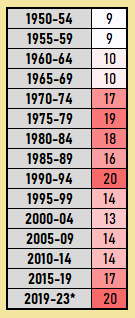
As we can see from the above, the lack of imagination in the BBC schedules really got going from 1970 onwards, and reached a high point (or low point, if you prefer) in the first half of the 1990s. Things got better around the turn of the millennium, but a lack of imagination and risk-taking started to spread as the present day approached. And so, we’re at a point where two-thirds of the BBC’s most-shown programmes were also amongst the most-shown shows from five years earlier.
And so, in conclusion, if we’re pondering the question ‘Has the BBC Run Out of Ideas?’, going by the evidence above, the answer is pretty much “Yeah, but it’s not the first time.” Though, of course, this is pretty telling…

In our next module, T888, we’ll be looking at Social Behaviour of Animals and the History of Wood.

-
The Most-Broadcast BBC Programmes of All-Time: Post-Match Statstravaganza

Okay, now the Big Final Reveal is out of the way, and we’ve identified the two programmes broadcast more than any other on the main BBC channels, let’s get granular. After all, with so much lovely data to build statistical sandcastles with, we can pull that programme information into some other shapes too.
For example, it’s one thing giving all that weight to programmes broadcast as daytime filler, but what about restricting the list to broadcasts going out to audiences sitting down for a proper evening’s televiewing? Or lists of most-shown shows from each decade, helping identify the changing face of BBC Television since 1936? Or just stuff shown on Sundays? And other things, too.
Well, strap in, because here come some ordered lists, without any of that fusty old detail getting in the way. Starting off with a list of:
PRIMETIME BROADCASTS ONLY
Now, it’s arguable what constitutes ‘primetime’, but the most common categorisation I’ve seen suggests 7pm to 11pm. So, that’s what I’ve calculated and come up with the following list. And, despite being shorn of those Sunday omnibuses, the regulars at the Queen Vic still have enough in the tank to roar past all the other contenders.

- EastEnders
Broadcast 6116 times
BBC1 1985-2021, BBC2 2011-2021 - The One Show
3333 times
BBC1 2007-2021, BBC2 2011-2021 - Match of the Day
2563 times
BBC1 1966-2021, BBC2 1964-2020 - Panorama
2124 times
BBC-tv 1953-1964, BBC1 1964-2021, BBC2 2012 - Top of the Pops
2097 times
BBC1 1964-2012, BBC2 1996-2021 - Gardeners’ World
1521 times
BBC2 1968-2021 - Question Time
1383 times
BBC1 1979-2021 - A Question of Sport
1380 times
BBC1 1975-2021, BBC2 2011-2013 - Twenty-Four Hours / 24 Hours
1360 times
BBC1 1965-1972 - Wogan
1107 times
BBC1 1982-1993 - University Challenge
1096 times
BBC2 1994-2021 - Holby City
1075 times
BBC1 1999-2021, BBC2 2012-2021 - Top Gear
1074 times
BBC1 2020-2021, BBC2 1978-2020 - Points of View
1035 times
BBC-tv 1962-1964, BBC1 1964-1999 - Tomorrow’s World
975 times
BBC1 1965-2003 - Casualty
935 times
BBC1 1986-2021 - Watchdog
881 times
BBC1 1988-2019 - Mastermind
881 times
BBC1 1972-1997, BBC2 2003-2021 - The Money Programme
833 times
BBC1 1974-1974, BBC2 1966-2009 - Party Political Broadcast (etc)
832 times
BBC-tv 1950-1963, BBC1 1969-2021, BBC2 1969-2009 - QI
755 times
BBC1 2009-2011, BBC2 2003-2021 - Snooker
728 times
BBC-tv 1950-1955, BBC1 1978-1997, BBC2 1978-2020 - Omnibus
720 times
BBC1 1967-2001, BBC2 1967-2006 - Have I Got News for You
700 times
BBC1 2007-2021, BBC2 1990-2021 - Late Night Line-Up
694 times
BBC2 1964-1972 - The World About Us
677 times
BBC2 1967-1986 - Z Cars
674 times
BBC-tv 1962-1964, BBC1 1964-1978, BBC2 1993-1993 - Dad’s Army
670 times
BBC1 1968-2020, BBC2 1983-2021 - Tonight
653 times
BBC-tv 1957-1964, BBC1 1964-1979 - Sportsnight
533 times
BBC1 1968-1997, BBC2 1995-1995
Onto lists of most broadcast things by decade…
1930s/40s
Starting off with a pseudo-decade collected together due to There Being No Telly Before 1936 and That Bloody War Ruining Things For Everybody. Which, as you’ll see, doesn’t make an especially illuminating list, due to most programme titles at the time being descriptive rather than snappy (“First Aid in the Home” or “In Your Garden: The Construction of a Small Lily Pond“), meaning there are some very low episode counts (often operating under vague titles like ‘Variety‘) making the cut here.
[EDIT: Figures for Picture Page corrected, with thanks to Daniel James Webb for pointing out the lower-than-expected total there. And then corrected some of the other numbers, too.]

- Picture Page | 421 times, 1936-1949
- For the Children | 174 times, 1937-1949
- Starlight | 166 times, 1936-1949
- Cricket | 151 times, 1938-1949
- Music Makers | 144 times, 1936-1949
- Variety | 137 times, 1936-1949
- Cabaret | 123 times, 1936-1946
- Boxing | 92 times, 1936-1949
- In Our Garden | 71 times, 1937-1949
- Friends from the Zoo | 56 times, 1936-1947
- Wimbledon | 52 times, 1937-1949
- Stars in Your Eyes | 49 times, 1946-1949
- Racing | 49 times, 1946-1949
- Forecast of Fashion | 46 times, 1938-1947
- Kaleidoscope | 45 times, 1946-1949
- For the Housewife | 44 times, 1948-1949
- Interval, Time, Weather | 44 times, 1936-1936
- Designed for Women | 42 times, 1947-1949
- Cookery | 42 times, 1946-1948
- Pre-View | 33 times, 1937-1938
- Cartoonists’ Corner | 32 times, 1946-1948
- Gardening | 31 times, 1937-1948
- Theatre Parade | 30 times, 1937-1938
- The Zoo | 29 times, 1938-1949
- Fashion Forecast | 27 times, 1937-1946
- Vanity Fair | 27 times, 1939-1939
- Interval | 27 times, 1937-1939
- Composer at the Piano | 26 times, 1946-1947
- Speaking Personally | 25 times, 1937-1947
- Wrestling | 24 times, 1946-1947
1950s
Onto BBC Television’s first full decade, and things are starting to take shape. with some programmes that would go on to become very familiar to viewers for years to come. Also: “Schools Tuning Signal“.
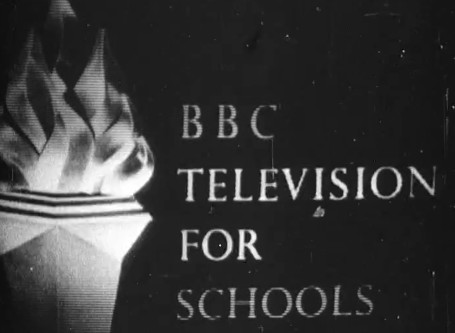
1. Cricket | 859 times, 1950-1959
2. For the Children | 808 times, 1950-1952
3. Mainly for Women | 765 times, 1955-1959
4. Tonight | 624 times, 1957-1959
5. For the Schools | 442 times, 1957-1959
6. Racing | 371 times, 1950-1959
7. Wimbledon | 313 times, 1950-1959
8. For Women | 241 times, 1951-1955
9. What’s My Line? | 227 times, 1951-1959
10. Today’s Sport | 213 times, 1955-1959
11. The Brains Trust | 199 times, 1956-1959
12. Schools Tuning Signal | 193 times, 1957-1959
13. Lunchtime Cricket Scores | 188 times, 1958-1959
14. Gardening Club | 187 times, 1955-1959
15. The Phil Silvers Show | 177 times, 1957-1959
16. The Burns and Allen Show | 175 times, 1955-1959
16. The Epilogue | 175 times, 1952-1959
18. Sportsview | 174 times, 1954-1959
19. Party Political Broadcast (etc) | 173 times, 1950-1959
20. Andy Pandy | 170 times, 1950-1957
21. In Town Tonight | 165 times, 1954-1956
22. Meeting Point | 154 times, 1956-1959
23. Sports Special | 149 times, 1955-1959
24. About the Home | 144 times, 1952-1955
25. Panorama | 142 times, 1953-1959
26. The Grove Family | 141 times, 1954-1957
27. Wells Fargo | 137 times, 1957-1959
28. I Married Joan | 135 times, 1955-1959
29. For the Very Young | 119 times, 1951-1953
30. This Is Your Life | 116 times, 1955-1959
1960s
Onto the decade when London swang like a pendulum, and it’s nice to consider that lots of cool young things were finishing their tea watching Zena Skinner perfecting a bacon, onion and apple roll in that night’s Town and Around before swanning off down the Kings Road.

1. Town and Around | 2044 times, 1960-1969
2. Play School | 1772 times, 1964-1969
3. Late Night Line-Up | 1530 times, 1964-1969
4. Tonight | 1184 times, 1960-1965
5. Cricket | 981 times, 1960-1969
6. Jackanory | 934 times, 1965-1969
7. Twenty-Four Hours / 24 Hours | 786 times, 1965-1969
8. Blue Peter | 696 times, 1960-1969
9. Grandstand | 664 times, 1960-1969
10. Z Cars | 563 times, 1962-1969
11. Meeting Point | 562 times, 1960-1968
12. Farming | 486 times, 1960-1969
13. The Newcomers | 430 times, 1964-1969
14. Panorama | 398 times, 1960-1969
14. Juke Box Jury | 398 times, 1960-1967
16. Compact | 392 times, 1962-1965
17. Songs of Praise | 384 times, 1961-1969
18. The Magic Roundabout | 370 times, 1965-1969
19. Points of View | 358 times, 1961-1969
20. Gardening Club | 338 times, 1960-1967
21. Top of the Pops | 312 times, 1964-1969
22. Spotlight | 307 times, 1960-1965
23. Apna Hi Ghar Samajhiye | 303 times, 1966-1969
24. Seeing and Believing | 297 times, 1960-1969
25. Signpost | 295 times, 1961-1965
26. Junior Points of View | 290 times, 1963-1969
27. Sunday Story | 271 times, 1961-1968
28. Wimbledon | 270 times, 1960-1969
29. Pure Mathematics | 261 times, 1962-1964
30. Doctor Who | 259 times, 1963-1969
1970s

Into the decade where colour TV became a fixture in the brown and beige living rooms of the UK, and it’s good old Humpty & Co that are making the cathode ray tubes their own.
1. Play School | 4998 times, 1970-1979
2. Jackanory | 2140 times, 1970-1979
3. Nationwide | 2037 times, 1970-1979
4. Pebble Mill | 1305 times, 1972-1979
5. Cricket | 1289 times, 1970-1979
6. Nai Zindagi – Naya Jeevan | 857 times, 1970-1979
7. Blue Peter | 843 times, 1970-1979
8. Grandstand | 782 times, 1970-1979
9. Tonight | 771 times, 1975-1979
10. You and Me | 703 times, 1974-1979
11. The Magic Roundabout | 632 times, 1970-1979
12. Twenty-Four Hours / 24 Hours | 605 times, 1970-1972
13. Tom and Jerry | 572 times, 1970-1979
14. Top of the Pops | 524 times, 1970-1979
15. Songs of Praise | 520 times, 1970-1979
16. Farming | 474 times, 1970-1979
17. The Money Programme | 461 times, 1970-1979
18. Late Night Line-Up | 453 times, 1970-1977
19. The World About Us | 452 times, 1970-1979
20. Panorama | 434 times, 1970-1979
21. Tomorrow’s World | 421 times, 1970-1979
22. Match of the Day | 402 times, 1970-1979
23. Golf | 379 times, 1970-1979
24. Open Door | 373 times, 1973-1979
25. The Old Grey Whistle Test | 370 times, 1971-1979
26. On the Move | 355 times, 1975-1978
27. Midweek | 354 times, 1972-1975
28. Wimbledon | 353 times, 1970-1979
29. Z Cars | 343 times, 1970-1978
30. The Wombles | 338 times, 1973-1979
1980s
The 1980s saw the home computer revolution fronted by the homegrown likes of Acorn, Amstrad and Sinclair, making it quite fitting that much of the decade saw BBC Micro Mode 7 beamed into the homes of daytime Britain.

1. Pages from Ceefax | 5634 times, 1983-1989
2. Play School | 3805 times, 1980-1988
3. Breakfast Time | 1727 times, 1983-1989
4. Neighbours | 1633 times, 1986-1989
5. Cricket | 1422 times, 1980-1989
6. You and Me | 1181 times, 1980-1989
7. Snooker | 1176 times, 1980-1989
8. Jackanory | 1123 times, 1980-1989
9. Pebble Mill | 1097 times, 1980-1986
10. Grandstand | 957 times, 1980-1989
11. Blue Peter | 865 times, 1980-1989
12. Nationwide | 845 times, 1980-1983
13. Songs of Praise | 793 times, 1980-1989
14. Wogan | 768 times, 1982-1989
15. EastEnders | 764 times, 1985-1989
16. Five to Eleven | 745 times, 1986-1989
17. Laurel and Hardy | 530 times, 1980-1989
18. Top of the Pops | 526 times, 1980-1989
18. Gardeners’ World | 526 times, 1980-1989
20. Golf | 510 times, 1980-1989
21. Film [xx] (The Film Programme) | 443 times, 1980-1989
22. Farming | 436 times, 1980-1988
23. The Flintstones | 430 times, 1985-1989
24. Points of View | 424 times, 1980-1989
25. Tomorrow’s World | 423 times, 1980-1989
25. Kilroy | 423 times, 1986-1989
27. Playdays | 394 times, 1988-1989
28. See Hear! | 389 times, 1981-1989
28. Grange Hill | 389 times, 1980-1989
30. Dallas | 378 times, 1980-1989
1990s
Here come the nineties, decade of Britpop, Alcopop and antipodean domination of the TV listings, between Home & Away, Prisoner Cell Block H and the show at the top of the pile on BBC1.
1. Neighbours | 5183 times, 1990-1999
2. Playdays | 2989 times, 1990-1999
3. EastEnders | 1981 times, 1990-1999
4. Blue Peter | 1609 times, 1990-1999
5. Kilroy | 1606 times, 1990-1999
6. Westminster | 1236 times, 1990-1999
7. Cricket | 1206 times, 1990-1999
8. Teletubbies | 1180 times, 1997-1999
9. Working Lunch | 1104 times, 1994-1999
10. Grandstand | 1099 times, 1990-1999
11. Snooker | 1048 times, 1990-1999
12. Pages from Ceefax | 859 times, 1990-1996
13. Ready Steady Cook | 774 times, 1994-1999
14. See Hear! | 761 times, 1990-1999
15. Today’s the Day | 741 times, 1993-1999
16. Pebble Mill | 728 times, 1991-1996
17. Can’t Cook Won’t Cook | 689 times, 1995-1999
18. Top of the Pops | 688 times, 1990-1999
19. CountryFile | 681 times, 1990-1999
20. You and Me | 671 times, 1990-1995
21. The Late Show | 643 times, 1990-1995
22. Grange Hill | 638 times, 1990-1999
23. Songs of Praise | 584 times, 1990-1999
23. Good Morning … with Anne and Nick | 584 times, 1992-1996
25. The O Zone | 581 times, 1990-1999
26. BBC Select | 567 times, 1992-1995
27. Match of the Day | 563 times, 1990-1999
28. Film [xx] (The Film Programme) | 560 times, 1990-1999
29. The Weather Show | 550 times, 1996-1999
30. The Learning Zone | 549 times, 1995-1998
2000s
It’s the post-millennial cyberfuture! And the start of Anne Robinson’s rise to global domination.

This is, of course, from Tomorrow’s World reporting on the worldwide web in 1994. But still. 1. Neighbours | 3810 times, 2000-2008
2. EastEnders | 2580 times, 2000-2009
3. Tweenies | 2266 times, 2000-2009
4. The Weakest Link | 2205 times, 2000-2009
5. Working Lunch | 2064 times, 2000-2009
6. Teletubbies | 1797 times, 2000-2009
7. Bargain Hunt | 1761 times, 2000-2009
8. Doctors | 1734 times, 2000-2009
9. Ready Steady Cook | 1631 times, 2000-2009
10. Blue Peter | 1561 times, 2000-2009
11. Arthur | 1453 times, 2000-2009
12. Cash in the Attic | 1375 times, 2002-2009
13. Match of the Day | 1363 times, 2000-2009
14. Flog It! | 1307 times, 2002-2009
15. Snooker | 1305 times, 2000-2009
16. Diagnosis Murder | 1141 times, 2000-2009
17. The Daily Politics | 1134 times, 2003-2009
18. Homes under the Hammer | 1070 times, 2003-2009
19. Kilroy | 977 times, 2000-2004
20. Animal Park | 965 times, 2000-2009
21. To Buy or Not to Buy | 934 times, 2003-2009
22. Murder, She Wrote | 917 times, 2002-2009
23. Scooby-Doo | 908 times, 2002-2009
24. Escape to the Country | 886 times, 2002-2009
25. Grandstand | 879 times, 2000-2007
26. Balamory | 858 times, 2003-2009
27. Fimbles | 839 times, 2002-2009
28. Eggheads | 828 times, 2003-2009
29. Tikkabilla | 765 times, 2003-2009
30. ChuckleVision | 699 times, 2000-2009
2010s
And so, onto the last full decade on the list, and television is drowning in daytime nan-fodder.
1. Homes under the Hammer | 3513 times, 2010-2019
2. Bargain Hunt | 3293 times, 2010-2019
3. Escape to the Country | 2898 times, 2010-2019
4. Flog It! | 2686 times, 2010-2019
5. The ONE Show | 2324 times, 2010-2019
6. EastEnders | 2222 times, 2010-2019
7. Pointless | 2130 times, 2010-2019
8. Doctors | 2078 times, 2010-2019
9. Eggheads | 2022 times, 2010-2019
10. The Daily Politics | 1650 times, 2010-2018
11. Antiques Road Trip | 1229 times, 2010-2019
12. CountryFile | 1195 times, 2010-2019
13. Match of the Day | 1053 times, 2010-2019
14. Holby City | 1043 times, 2010-2019
15. Coast | 1042 times, 2010-2019
16. Cash in the Attic | 856 times, 2010-2017
17. Antiques Roadshow | 847 times, 2010-2019
18. Great British Menu | 832 times, 2010-2019
19. Panorama | 825 times, 2010-2019
20. Put Your Money Where Your Mouth Is | 804 times, 2010-2019
21. Rip Off Britain | 738 times, 2010-2019
22. Heir Hunters | 719 times, 2010-2019
23. Question Time | 710 times, 2010-2019
24. The Weakest Link | 706 times, 2010-2013
25. Gardeners’ World | 693 times, 2010-2019
26. Wanted Down Under | 678 times, 2010-2019
27. Great British Railway Journeys | 675 times, 2010-2019
28. The Graham Norton Show | 658 times, 2010-2019
28. A Question of Sport | 658 times, 2010-2019
30. Waybuloo | 641 times, 2010-2012
What about those weekend days, when telly is a very different beast. The full list was, predictably, dominated by weekday programming. So what went out most frequently at the weekend? And, as Saturday Telly is a distinctly different beast to Sunday Telly, here are lists for each:
SATURDAYS

1. Grandstand | 2627 times, 1958-2007
2. Match of the Day | 1847 times, 1964-2021
3. Cricket | 945 times, 1938-2021
4. Saturday Kitchen | 886 times, 2001-2021
5. Casualty | 869 times, 1986-2021
6. Football Focus | 831 times, 1977-2021
7. Final Score | 755 times, 1971-2021
8. Snooker | 734 times, 1952-2021
9. Doctor Who | 728 times, 1963-2017
10. Dad’s Army | 701 times, 1969-2021
11. Flog It! | 534 times, 2002-2021
12. Top of the Pops | 469 times, 1965-2021
13. Golf | 444 times, 1946-2021
14. Weekend 24 | 414 times, 1998-2006
15. Juke Box Jury | 408 times, 1959-1979
16. Dixon of Dock Green | 395 times, 1955-1976
17. Today’s Sport | 388 times, 1956-1980
18. See Hear! | 387 times, 1998-2014
19. The Sky at Night | 386 times, 1957-2013
19. Rugby Special | 386 times, 1966-2005
21. Pointless Celebrities | 375 times, 2012-2021
22. Tennis | 302 times, 1939-2021
23. Scooby-Doo | 301 times, 1976-2012
24. Parkinson | 300 times, 1971-2021
25. Athletics | 296 times, 1947-2021
26. Escape to the Country | 287 times, 2005-2021
27. Bargain Hunt | 279 times, 2008-2021
28. What the Papers Say | 278 times, 1990-2008
29. Arthur | 274 times, 2000-2011
30. TOTP2 | 270 times, 1994-2021
SUNDAYS

Unsurprisingly, Songs of Praise tops the list. But surprisingly, no place in the thirty for That’s Life – while it aired 442 times, 140 of those broadcasts were on other days of the week (mainly Saturdays). That just doesn’t seem right, does it? 1. Songs of Praise | 2790 times, 1961-2021
2. CountryFile | 2083 times, 1988-2021
3. EastEnders | 1538 times, 1985-2017
4. Farming | 1438 times, 1958-1988
5. Match of the Day | 1385 times, 1980-2021
6. Antiques Roadshow | 1059 times, 1979-2021
7. Grandstand | 1011 times, 1966-2007
8. Meeting Point | 716 times, 1956-1968
8. The Money Programme | 716 times, 1973-2007
10. Nai Zindagi – Naya Jeevan | 659 times, 1968-1982
11. The Andrew Marr Show | 644 times, 2007-2021
12. The World About Us | 640 times, 1967-1986
13. Snooker | 607 times, 1957-2021
14. Holby City | 591 times, 2006-2021
15. See Hear! | 576 times, 1981-2000
16. Breakfast with Frost | 575 times, 1993-2005
17. Rugby Special | 549 times, 1975-2005
18. Natural World | 529 times, 1983-2021
19. Cricket | 485 times, 1953-2021
20. Saturday Kitchen Best Bites | 482 times, 2012-2021
21. Escape to the Country | 479 times, 2005-2021
22. Seeing and Believing | 470 times, 1960-1976
23. Bargain Hunt | 459 times, 2005-2021
24. Points of View | 454 times, 1999-2021
25. Everyman | 450 times, 1977-2000
26. Playdays | 449 times, 1988-1997
27. The Sky at Night | 434 times, 1969-2013
28. Lifeline | 416 times, 1986-2021
29. Top Gear | 415 times, 1981-2021
30. This is the Day | 402 times, 1980-1994
POST-WATERSHED BROADCASTS
Next up, how about a list of hot and steamy late-night programming definitely deemed unsuitable for children. Picking out broadcasts purely between 9pm and 5am, here’s a list of most-seen X-rated telly ethemera. Phwoar!

This image might seem to disprove what I’d just said, but don’t forget the time Jimmy Hill accidentally advised viewers to “put their cocks back” 1. Match of the Day | 2713 times, 1965-2021
2. Late Night Line-Up | 1989 times, 1964-1989
3. Question Time | 1834 times, 1979-2021
4. Snooker | 1539 times, 1977-2021
5. Twenty-Four Hours / 24 Hours | 1390 times, 1965-1972
6. Film [xx] (The Film Programme) | 1335 times, 1971-2018
7. Cricket | 1216 times, 1952-2021
8. Party Political Broadcast (etc) | 891 times, 1950-2021
9. Panorama | 869 times, 1954-2021
10. Have I Got News for You | 856 times, 1990-2021
11. The Graham Norton Show | 837 times, 2001-2021
12. The Late Show | 802 times, 1966-1995
13. Later… with Jools Holland | 794 times, 1992-2021
14. Tonight | 772 times, 1975-1992
15. QI | 734 times, 2003-2021
16. Omnibus | 721 times, 1967-2021
17. The Sky at Night | 717 times, 1957-2013
18. Golf | 613 times, 1953-2021
19. This Week | 610 times, 2003-2019
19. Holby City | 610 times, 2006-2021
21. A Question of Sport | 559 times, 1999-2021
22. Despatch Box | 554 times, 1998-2002
23. The Learning Zone | 547 times, 1995-1998
24. Friday Night with Jonathan Ross | 522 times, 2001-2010
25. Sportsnight | 517 times, 1968-1997
26. BBC Select | 511 times, 1992-1995
27. Mock the Week | 501 times, 2005-2021
28. Top of the Pops | 467 times, 1965-2021
29. Everyman | 466 times, 1977-2001
30. Parkinson | 459 times, 1971-2021
Finally, how about a list of:
Children’s BBC Programmes
Specifically programmes meeting the criteria “weekday BBC1, start time 3:50-5:55, programmes for grown-ups not counted”. Yes, I could have spent ages picking out summer holiday morning CBBC strands and the like, but even I’m not that bloody minded.
1. Blue Peter | 4303 times, 1964-2012
2. Jackanory | 4104 times, 1965-2006
3. Play School | 3831 times, 1968-1985
4. The Magic Roundabout | 904 times, 1965-1984
5. Grange Hill | 830 times, 1978-2008
6. Byker Grove | 502 times, 1989-2005
7. Scooby-Doo | 480 times, 1970-2012
8. ChuckleVision | 385 times, 1988-2009
9. Yogi Bear | 374 times, 1971-1997
10. Popeye | 369 times, 1979-1999
11. Animal Magic | 358 times, 1964-2000
12. The Wombles | 323 times, 1973-1985
13. Laurel and Hardy | 321 times, 1966-1990
14. Rugrats | 315 times, 1994-2004
15. Junior Points of View | 287 times, 1964-1970
16. SuperTed | 259 times, 1983-1995
17. Record Breakers | 257 times, 1983-2001
18. Shaun the Sheep | 251 times, 2007-2012
18. Hector’s House | 251 times, 1968-1975
20. SMart | 250 times, 1994-2010
21. Mona the Vampire | 247 times, 2000-2006
22. Screen Test | 230 times, 1970-1984
23. The Story of Tracy Beaker | 224 times, 2002-2010
23. Crackerjack | 224 times, 1964-1984
25. The Really Wild Show | 217 times, 1986-2004
26. Paddington | 214 times, 1976-1991
26. Deputy Dawg | 214 times, 1964-1980
28. The Cramp Twins | 213 times, 2001-2008
29. The Wild Thornberrys | 204 times, 1999-2004
30. Bananaman | 203 times, 1983-1999
There we go! That probably counts as a fitting epilogue to a very long-winded project. Onto the blog’s next ill-considered escapade – coming soon. Well, soon-ish. It’s going to involve getting a lot more data in place first. But, given the above, you could probably have guessed that.

- EastEnders
-
Play School: A Look Through the Redux Window (Take Two*)
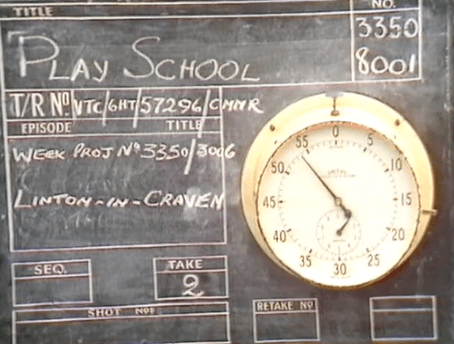
(*Fingers crossed, first attempt to publish resulted in a blank post and WordPress deleting the contents of my draft. So, fingers crossed. Apologies to email subscribers who received a mostly-empty email last night.)
Who wants a bunch more information about Play School? You know you do. But first, a brief aside.
Funny thing, research.
When putting together the write-up on Play School – the most-broadcast BBC programme of all time, of course – I used a variety of sources for background. Old issues of the Radio Times, the British Newspaper Archive’s brilliant archive of The Stage and a number of books came into play, such as Phil Norman’s TV: A History in 100 Programmes, Richard Webber’s That Was the Decade That Was and Ruth Inglis’ The Window in the Corner: A Half Century of Children’s Television. As with a number of entries on the list, Paul R Jackson (no stranger to excellent books about television himself, of course) also provided some brilliant info and clarifications.
And, as with much of the list, contemporary newspaper archives were very handy for finding additional nuggets of information and insight that have rarely resurfaced since original publication. For the most part, that was from a combination of the aforementioned British Newspaper Archive and the Gale Newspaper Archive (which – PROTIP – you can access for free via libraries such as the National Library of Wales). And, in a development which was certainly going to provide some great information, a 1971 Guardian interview with Doreen Stephens, the BBC’s Head of Family Programmes at the time Play School was devised, available on researcher’s pal archive.org.

Using all of this information, I put together the much-abridged history of Play School – as with many programmes on the Top 100 (etc) list, an enjoyable experience on my part, learning a lot I didn’t previously know, and building on lots of information I already-kind-of-sort-of knew from my own childhood. It went online, lots of people read it and hopefully liked it (at least any that didn’t were gratifyingly mute about it). One such person was, as hinted at by the quote at the end of the write-up (and thanks again to Paul R Jackson for sharing the news of it with her) original Play School editor Joy Whitby.
Joy was kind enough to get in touch via email about Play School, and as it turns out, some of the details of that Guardian piece – and my Play School write-up – weren’t quite correct.
For one thing, Play School was entirely Michael Peacock’s idea, rather than just the notion of a pre-school series being his, and passed onto Doreen Stephens to do more work on. In actual fact, Joy was chosen for the Play School role – by a board chaired by Michael Peacock – before Doreen had started her role as Head of Family Programmes. While Doreen was hugely supportive to Joy during her tenure, and remained her friend through to retirement, it was also Michael who went on to commission another daily slot for the Play School team – which ultimately became Jackanory. Joy ran both programmes side by side until, again thanks to Michael’s invitation, she left to join the new London Weekend Television franchise.
That’s not to diminish Doreen Stephen’s hugely impressive time at the BBC, of course. She’d originally turned down various jobs at the BBC before finally agreeing to run Children’s Programmes – but only on the proviso the department’s name be changed to Family Programmes. After her time in that role, the powers that BBC reverted to the old department title: Children’s Programmes.
Joy added that Athene Seyler – Play School’s first ever storyteller, was considered the perfect granny figure, taking the time to reminisce about her childhood. The choice of Zia Mohyeddin as an early Play School storyteller was part of Joy’s decision to give the programme a cosmopolitan feel from the start.
Regarding Doreen Stephens’ tenure heading Family Programmes, when Joy Whitby first met her in her new office, having been told she was a dragon, Stephens welcomed Whitby with something direct and friendly along the lines of: “I didn’t appoint you and you didn’t choose me, but we must get along together…”. Which – as the pair’s long subsequent history of collaboration proved – they evidently did.
Doreen Stephens would later leave her role at LWT in protest at Michael’s dismissal, together with other executives (including Joy Whitby) when he was ousted. This wasn’t due to any particular programme content, it being more likely that commercial pressures being cause of his failure within ITV, especially given the original LWT’s high-falutin’ notions.

As for Joy Whitby’s later series Grasshopper Island, the source of funding was amusingly different. Doreen Stephens initially had nothing to do with the series. Whitby’s secretary at LWT was at a dinner sat next to a young merchant banker, her dining neighbour sharing that there were still people like himself who wanted to finance creative people – in the manner previously seen in the days of Beethoven and Mozart. She told him about the new project, and as a result the banker swiftly got in touch, and raised a consortium who funded Grasshopper Island. Most of the series was shot in Corsica where cast member Frank Muir had a holiday home, Muir being another ex-BBC/LWT executive who had stood by Michael Peacock.
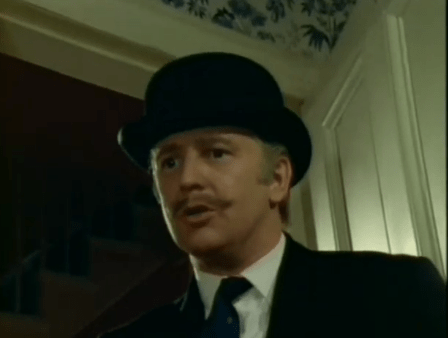
Plus, it’s a boon for people who enjoy seeing Tim Brooke-Taylor playing multiple roles. Which is any right-minded person. Around the same time Brooke-Taylor was doing a similar trick in Orson Welles’ One Man Band, too. Joy Whitby asked Doreen to join the project as general manager, and as a result she ended up not only taking on the task of sorting out contracts and the like, but also in cooking meals for everyone. As Joy points out, “she was a hands-on friend – without any need to pull rank. Much respected and much loved by us all.”
Now, as splendid as screencaps of Tim Brooke-Taylor being frumpy are, how about an extra Play School lists (and if you don’t like lists, what are you doing here?), plus: some camera scripts and a gallery of Play School photos, each courtesy of Paul R Jackson?
Firstly, here’s a list of PLAY SCHOOL PRESENTERS WITH THE GREATEST NUMBER OF APPEARANCES. Broken down into pre- and post-relaunch totals for good measure:
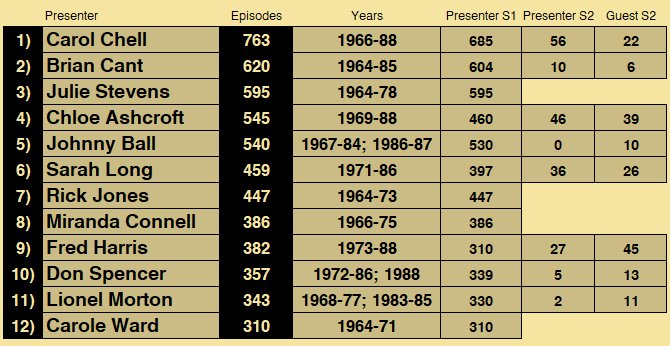
How about some scans? Here’s the front page of the script from Play School’s first episode of Series Two (Recording Tue 6 Sep 1983, TX Mon 19 Sep 1983):
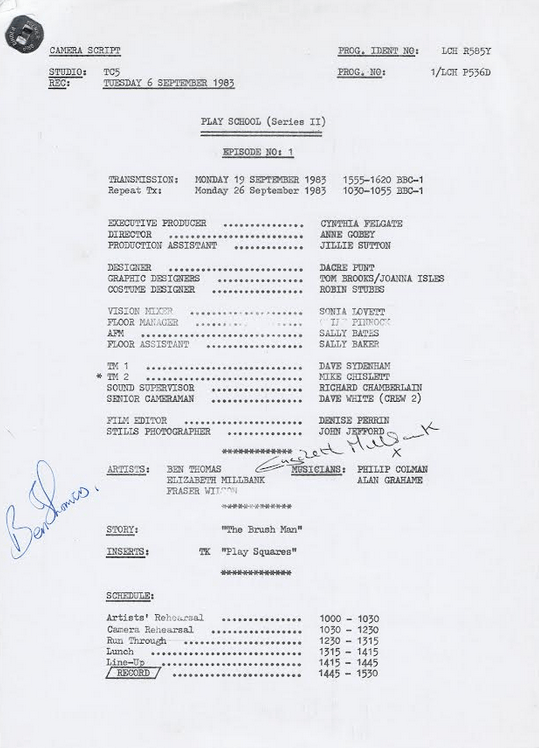
…and the front page of the camera script of the final episode of Series Two (and the series as a whole). Recording Wed 3 Mar 1988, TX Fri 11 Mar 1988

If you prefer Old School Play School, here’s one from the tenth anniversary special (Recording Sun 14 Apr 1974, TX Mon 22 Apr 1974)
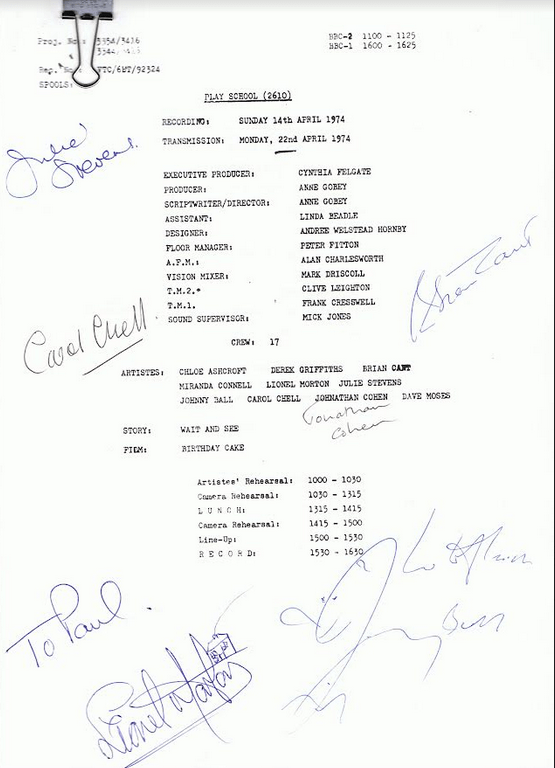
Here’s the front page of the 1000th Play School script (Recording Mon 5 Feb 1968, TX Mon 19 Feb 1968):
And the 300th episode (Recording Thu 9 Oct 1975, TX Mon 20 Oct 1975):
And – go on, then – the 5000th episode (Recording Mon 25 Jul 1983, TX Mon 12 Sep 1983):

Next the photos! And I can’t think of a better introduction than this group shot from the programme’s 15th anniversary in 1979:
Here’s Australian Play School presenter Don Spencer with the programme’s longest-serving pet, Katoo.
A Lesser Sulphur Crested Cockatoo hailing from Indonesia, or ‘cacatua sulphurea’ if you’re being fancy, Katoo first landed on the Play School set on Wednesday 7 September 1966, aged just one, sticking around until the series ended. Perhaps that lengthy tenure is what led to the feathery diva occasionally refusing to talk on cue, while dancing beautifully with resident pet expert Wendy Duggan… when off camera. Following the end of Play School, Katoo lived with Duggan, surviving until the ripe old age 46 before finally passing away in 2009.

Wendy Duggan and Katoo in 1979.
As mentioned in the piece on Play School, the programme would go on to be a fixture on children’s television around the world. And, befitting the show’s inclusive nature, a number of hosts from the international versions were invited to the BBC for presenting stints on the British original.
Diane Dorgan, Australia’s first female presenter, appeared in her local version of the series between 1966 and 1969, before moving to the UK to present the BBC version between October 1969 and March 1974. The antipodes also provided the series with Don Spencer (Australian version 1968-1992), who presented the BBC version between September 1972 and February 1984, returning as a guest presenter in February 1985 and June 1986, plus in February 1988. An even longer journey was undertaken by New Zealand’s Janine Barry (Jan 1975-Dec 1977), who joined Fred Harris for one edition on 14 August 1981.
A more modest number of air miles were accrued by Play School’s continental contingent, with Miguel Vila (Spain’s La Casa Del Reloj 1971-1973, below) popping over to the UK to join Toni Arthur for a week in August 1973. Further north, Norway’s Lekestue sent Jon Skolmen (1971-1973, also below) for a week presenting the ‘School alongside Carol Chell in November 1971, and producer-writer-presenter Vibeke Saether (1971-1981) appearing alongside Don Spencer on 20 December 1976.
Diane Dorgan, 1966 
Miguel Vila 
Norway’s Jon Skolmen and Vibeke Saether, 1971 As a bonus, here’s a lovely shot of the New Zealand Play School team, from the Ross Johnston collection:
And how about one of globetrotting Man-About-‘School Don Spencer with Play School Australia’s not-right-at-all-to-British-eyes Humpty from 1983?

As if to prove that Australians are perfectly fine with their wrong-looking Humpty, here he is at the 2016 Logie Awards with several other Play School Australia alumni:

Not that Humpty always gets the limelight, of course. Here’s a photo taken to mark the 45th anniversary of the Australian version, where then-current and former presenters came together to reunite with the team of toys. Perhaps Humpty was feeling a little camera-shy that day.

Finally, to nicely tie everything in with the programme that actually topped the list, here are a pairing of presenters from 1966 – Kerry Francis (top, 20 episodes) and… Ramsay Street’s very own Anne Haddy (bottom left, 44 episodes).

Helen Daniels wasn’t the only Erinsborough regular to appear on the series, either. Here’s Tom “Lou Carpenter” Oliver in 1969. (Tom’s on the left.)
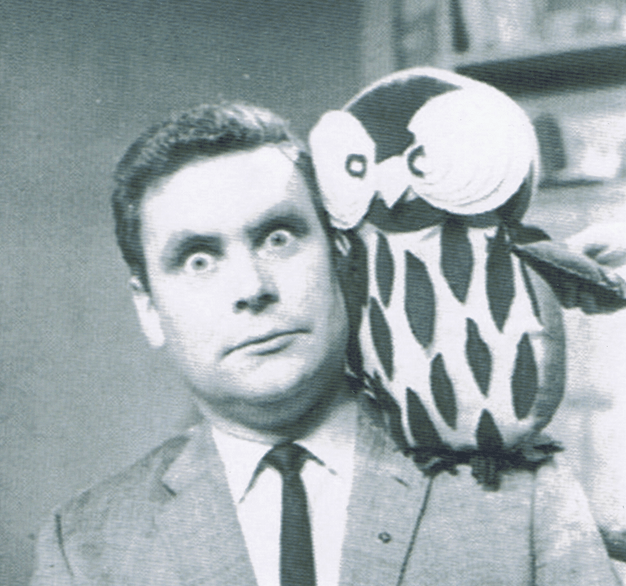
As ever, many thanks to Paul for all the photos and information during the rundown. As mentioned previously, if you want to school yourself to an even great degree in the history of Play School, his Celebration of Play School books one and two are essential texts.
Here he is at ABC Studios along with presenters Alex Papps (2006-) and Rachael Coopes (2011-), from his visit down under in January 2012. Cheers, Paul!

See you again next time with another BBC Broadcasting History InfoBurst!
-
The Two Most-Broadcast BBC Programmes of All-Time: The Grand Final

If this blog has a catchphrase, it must be “that took a lot longer than I’d expected”. And this one did. Not so much as down to getting together a programme history of the show in question, but more to do with checking the broadcast histories of the Top Two programmes. And O! The excitement.
On checking through everything, one programme had a large number of broadcasts missing from the database due to being buried under “Children’s BBC starting with…” billings, with the programme title itself in the RT ‘description’. And so, as we’re talking about a programme broadcast more than 10,000 times, it took a lot of checking to see what hadn’t been picked up. So much so, there was a very real chance this next programme might actually have topped the list.
How close did it come to the top? Well, on my initial recheck, if it had been shown just 26 more times, it would be top of the all-time chart. And then, on checking the other programme left to uncover, it looks like several broadcasts couldn’t be counted (due to actually being an unrelated film of the same name). The gap crept ever closer. After all this time, could it come down to a single figure difference? Or even actually end in a draw?
Then I discovered repeats of The Programme At Number One spent three months going out billed as “NEWS followed by… [Programme Title]”, which increased the gap by a load. Hey ho.
But enough of me explaining why Genome ate my homework, let’s take a look at the programme in second place on the list. Apologies to anyone getting this via email – it’s a long one. It’s time to look through the oblong window at:
2. Play School
(Shown 10,575 times, 1964-1988)

[Many thanks to Paul R Jackson for his help compiling this article, providing a bunch of facts, photos and – marvellously – the quote at the end of the article. Paul is the author of Here’s A House – A Celebration of Play School volumes one and two, so if you’re after a more detailed history of the series, you know where to go. Both are available from the publisher’s website direct: https://www.tvbrain.info/shop] 
When launching a television channel, it’s generally a good idea to pick something really good and important to kick things off. Channel Four had the first episode of Countdown, which everyone remembers. Channel Five had the first episode of Family Affairs, which I needed to look up. ITV, of course, had ‘Inaugural Ceremony at Guildhall‘, which can’t have been that good as it didn’t go on to get a full series.
As the BBC’s first new channel since the launch of the Television Service in 1936, 1964’s plans for BBC-2’s launch night were as fancy as you might expect. Following a brief introduction to the channel, there was the promise of new comedy show The Alberts (featuring, as the RT listing had it, “Ivor Cutler of Y’hup, O.M.P, Professor Bruce Lacey, John Snagge, Sheree Winton, Benito Mussolini, Major John Glenn, Adolf Hitler, David Jacobs, Birma the Elephant (by courtesy of Billy Smart’s Circus) and other celebrities“), followed by a production of Cole Porter’s Kiss Me, Kate. Brilliant. Nothing could possibly go wrong.

Ah.
As fate would transpire, due to a huge fire at Battersea Power Station a mere half-hour before the channel went live, those plans were thrown into candle-lit disarray, and an expectant audience was instead treated to an (initially mute) news bulletin beamed from the nearby but unaffected news studio at Alexandra Palace, as read by Gerald Priestland. That was followed by an evening of captions and apologies. Most British channel launch ever, 10/10, no notes.
And so, as I’m sure you’re already well aware, the first actual programme broadcast on BBC-2 was something commissioned for an audience of under-fives. And, much like Channel Four’s Countdown, it would go on to a very long life on our screens.
Yep, it’s Play School. For a good few generations of young televiewers, a programme that would provide an early introduction into a long fascination with TV. And, personally speaking, the catalyst to one of my earliest distinct memories. On – I think – turning four, in response being told that I’d been born at 11am on my day of birth, I sought confirmation that “I was in time to see that day’s Play School?” Talk about appointment to view television.
The proposal of having a pre-school series in the new channel’s schedules came from BBC2 Head of Programmes Michael Peacock, and by the time of Play School’s launch, the BBC had a new Head of Family Programmes in place to help get those wheels into motion.
Doreen Stephens had been a hugely instrumental figure within 1960s television. Despite only starting her TV career at the age of 40, she’d go on to become Head of Women’s Programmes at the BBC, then (as just mentioned) Head of Family Programmes, before moving to LWT to head up their Children’s, Religious and Adult Education Programming department. Despite initial reluctance in moving away from Women’s Programmes and onto Family Programmes in 1963, she soon revolutionised the department, bringing in fresh faces and minds to help move away from the imperial-era likes of Watch With Mother and introduce programmes like Jackanory, The Magic Roundabout and Play School.
Stephens’ aim was to move away from cotton-wool content like Bill and Ben, instead introducing shows for a generation who’d soon be thrust into the more technical world of the 1970s. Her approach was a success. At a time when the expanding ITV network was bossing the BBC in the ratings, her children’s programmes consistently attracted more viewers than the commercial channel’s own offerings. Indeed, it was that level of success that saw David Frost lure her over to LWT after landing the licence for London’s weekend broadcasting.
A board chaired by Michael Peacock selected Joy Whitby as producer of the new programme. Whitby was duly given a more-than-modest budget of £120 per week (£2,030 in today’s money) to put together five programmes per week, all to be broadcast live. So, in today’s money, that’s a whopping £406 per episode. An unbilled pilot episode of the programme was shown as part of BBC-2’s trade test transmissions on 31 March 1964, presented by Eric Thompson and Judy Kenny. Coincidentally, the script and programme still exist in the BBC’s archives. Y’know, in case anyone working at the BBC Archives is reading this.
All was set for the launch of the full series. The initial working title of Home School had been discarded before this stage, in favour of the friendlier sounding Play School. As programme advisor Nancy Quayle would later explain in the fifteenth anniversary programme Twenty Five Minutes Peace, “play is the child’s first school”.

One suspects that when Virginia Stride had her audition for the role, she didn’t expect to become front page news the day after her debut. Whitby had initially joined the BBC to work in their School Broadcasting Department, but working on Play School would be the first of several projects that would land her name in British television history. After liaising with a variety of experts in the fields of childcare, learning and literature to come up with a suitable blueprint, it would go on to win various accolades, including a Guild of Television Producers and Directors Award, and a place in the hearts of children for decades to come. Whitby later left the programme to devise Jackanory (as covered previously) before joining Doreen Stephens at LWT in 1967, but as leaving presents go, the format for Play School is hard to beat.
To outline what parents (and their children) could expect from the new series, Joy Whitby took to the Radio Times.
Joy Whitby introduces her new BBC-2 series beginning today which provides ‘nursery school’ for the under-fives
ARE you an exhausted parent of a child under the age of five? If so, Play School may be just what you are looking for. Without actually leaving home, for half an hour every day (from Monday to Friday, beginning today, Tuesday), your child can benefit from the advice of leading authorities on nursery education and enjoy the undivided attention of a changing panel of presenters-young and resourceful men and women, most of them with children of their own. Play School will not be a televised nursery school-room. It will use all the advantages of television to do the job of a nursery school in its own exciting way. Every day our story chair will be occupied by a storyteller of out- standing talent-in this first week Athene Seyler, followed by Charles Leno, Eileen Colwell, and David Kossoff. Through our magic windows we shall invite children to explore the real world which they long to discover-the world of buses and elephants, flowers and snails, rain and shadows. There will be a Pets’ Corner, a Play School garden, songs, and surprises, and opportunities for joining in both new and traditional games. We hope to offer not just another half-hour’s viewing a day. We want the children who attend Play School to take away from it ideas and stimulation to last long after their television sets have been switched off.
Joy Whitby, Radio Times, 18 April 1964
Presenters of that first ever episode: Gordon Rollings and Virginia Stride With the demands of five live episodes per week, running almost every weekday of the year, the decision to use a repertory company of hosts was an obvious one, but each needed to be suited to the role, and the process of getting the right presenters for the programme was delightfully fitting. When Brian Cant, at the time a jobbing dramatic actor, applied for a role in the new series, his audition involved Joy Whitby kicking a box out from under a table and asking Cant to “get in there and row out to sea”. One ad-libbed fishing voyage later, a three month contract on the series was his. Eighteen years later, he would still be a regular Play School player.
In the same way a football squad needs to have a variety of skills and disciplines, Play School’s presenters had a good mix of backgrounds, with Joy Whitby selecting thirteen equally valuable squad members from the off: Virginia Stride and Gordon Rollings (as seen in the first ever episode), Carole Ward, cardboard box interviewee Brian Cant, Judy Kenny, Marian Diamond, Julie Stevens, Terry Frisby (then billed as Terence Holland), the international trio of Rick “Fingerbobs” Jones (Canada), Marla Landi (Italy) and splendidly-named Dibbs Mather (Australia), plus husband and wife Eric Thompson and Phyllida Law. Strength in depth, right at the start of the season.
Each episode had a pairing of squad-rotated presenters, each advised to speak to the camera as if addressing an individual child, an inclusive approach that made viewers feel at home. While the presenting line-up would be freshly rotated, a sense of uniformity was applied each day’s episodes. So, each Monday’s episode would focus on ‘The Useful Box’, Tuesdays would be Dressing Up Day, every Wednesday would focus on pets, each Thursday encouraged viewers to use their imagination, while Fridays would be Science Day.
Another integral part of the new series was each episode’s storytelling segment. Rather than have one of the presenters taking to the storytelling chair each day, a variety of guest storytellers would appear, introducing the young audience to a story, often of their own making. Speaking in 2006 BBC Four documentary The Story of Jackanory, Joy Whitby told of the thinking behind this approach.
“It seemed important to get in and attract people of great quality who might not want to spend all their time doing children’s programmes but who would certainly commit themselves to some performances, and in a way that’s what happened with the storytelling element.”
Joy Whitby, The Story of Jackanory (BBC Four, TX 14/02/2006)And so, starting with actress Athene Seyler in that very first episode, the storyteller segment would soon go on to feature names such as Flora Robson, Roy Castle, Richard Baker, Quentin Blake and a pre-Dad’s Army Arnold Ridley, with many Play School storytellers later going on to perform similar roles in Jackanory.

Interesting to note that Ridley first appeared on BBC-tv in 1936. And also that one of the many stage plays he wrote – Meet Mr Lucifer – was a scathing satire on the addictive nature of television Within the first few months of Play School, a decision was made to expand the remit of storytellers beyond the UK, inviting storytellers from other nations to relate children’s tales from other lands. The practice started in July 1964, with British-Pakistani actor and director Zia Mohyeddin taking to the chair to read a selection of traditional Indian fables.

Daily Mirror, 19 April 1965 The formula was a success with those able to receive BBC-2, so much so that a special edition of the programme aired on its first anniversary in April 1965, with several viewers (and a baby lamb called Sooty) invited to a special tea party at the Riverside TV Studios. However, by that point the reach of the second channel still only extended as far as London, the South-East, East Anglia and the Midlands (with the episode shown on Midlands’ launch day – 23 November 1964 – featuring a bespoke welcome from presenters Marla Landi & Brian Cant).
Even then, Play School could only be viewed in homes containing 625-line compatible sets. Viewers elsewhere in the UK were finally able to knock on the Play School door in July 1965, with the first same-day repeat of the programme on BBC-1, initially for a trial period running the length of the summer holidays. Such was the confidence in the trial, the afternoon broadcasts of Watch With Mother were paused to make room for it. A whole new set of children would be getting to see the famous Play School windows.

“Windows ’64.” [Photo courtesy Paul R Jackson] With Play School finally making an appearance in regional copies of the Radio Times that hadn’t been carrying BBC-2 listings, Joy Whitby put together a fresh introduction to the programme, this time being able to include evidence of what they programme had brought to those lucky enough to enjoy it.
For the next six weeks* the afternoon edition of ‘Watch with Mother’ on BBC-1 will be replaced by a repeat of ‘Play School’, the morning programme which is running on BBC-2
Can you remember what it was like to be four years old? Everything you saw was new. But your hands were still uncertain servants. Your feet were not allowed to take you exploring far beyond your own front door. Your mind bubbled with ideas but you did not have enough words to express them. This child you once were is Play School’s target audience.
Turn on your set and you will see – a house. The door opens and lets you into a room which very soon you will feel you know: Humpty Dumpty, Jemima, and Teddy live in the toy cupboard by the blackboard. The shelves are full of books. The picture board might show one of your own paintings one day. There is a corner for pets; a table for scientific experiments; seven pegs carry an ever-changing selection of dressing-up clothes; and a large hamper overflows with useful oddments for making things.
So far Play School offers the standard equipment of any good nursery school. But it also has at its disposal all the imaginative resources of television-lights that can transform a blank wall into an apple orchard, lenses that turn men into giants, film that can show anything from a spider spinning its web to a rocket ship on its way to the moon.
Above all, Play School offers a stream of exciting people-not only experts in the field of nursery education but visitors from the world of adult entertainment. Ted Moult describes his farm. George Melly provides an ABC of jazz. Many accept for the first time the challenge of shaping their material without condescension to the needs of this specialised audience. A team of twelve young men and women present the programmes, pairing up a week at a time with changing partners-a system which keeps the chemistry fresh for viewers and performers.This testimonial from a couple of teachers whose daughter has watched Play School from the start is typical of the many letters we receive from parents: ‘Her imagination has been stimulated, her language enriched and the creative ideas which are a feature of the programme have started her on many an hour of effective learning through play.’
Joy Whitby, Radio Times, 24 July 1965
We hope that this week-with Athene Seyler, Beryl Roques and Brian Cant – what has been true every day for thousands of children on BBC-2 can now be true during the summer holidays for the wider audience on BBC-1.
(*Newspaper reports at the time put the trial run as lasting eight weeks, not six. In the end, the trial ran for a total of eight weeks. Pointing this out doesn’t really add anything of value, but I’ve typed it in now.)Truly, while Open University would go on to become ‘The University of the Air’, Play School was fulfilling a similar remit for pre-schoolers. Avoiding the maternalistic tone of Watch With Mother, this was much closer to speaking to under-fives at their own level – for all that Bill & Ben, The Woodentops or Muffin the Mule had enthralled audiences, there had been a disconnect between the screen and the audience. With Play School, the children were invited to take part, either by sending in pictures in the hope they’d appear on the Play School set, or by playing along with the activities on screen.
Crucially, Play School was honest enough to avoid the assumption the entire audience were on board with the presentation style. As series producer Cynthia Felgate pointed out, “Talking down is really based on the assumption you’re being liked by the child. But if you imagine a tough little boy of four looking in, you soon take the silly smile off your face.”
The high regard that the series was now held in became clear in September 1965. The BBC had made a landmark agreement with the UK’s three main political parties to televise the Labour, Conservative and Liberal Party conferences in full on BBC-2. This was way beyond the scope of any Party Political Broadcast – each day’s coverage was scheduled to run from 9.30am until the close of the day’s play around 5pm. The agreement came with only one caveat from the Beeb: live TV coverage had to be paused at 11am each morning to make way for Play School. Ted Heath nil, Big Ted one.

Play School was back on BBC-1 throughout the summer holidays of 1966, but this time it would be simulcast on both -1 and -2 at 11am each weekday. That’s an impressive feat considering simultaneous broadcasting was an occasion normally reserved for cup finals and royal events, and even then only because BBC-1 and ITV both wanted a piece of the same pie. On top of that, BBC-2 had recently been made available to the majority of the UK, largely meaning only those still using 405-line sets were missing out. Play School was certainly becoming what is known as A Big Deal.

As adoption of BBC-2 increased, Play School was confined to the channel for the next few years, until in November 1968, when Play School started being repeated on a long-term basis on BBC-1 – in the peak post-school time of 4.20pm to boot, albeit only on Tuesdays, Thursdays and Fridays. Tough luck if your home was lumbered with an antique television on the other weekdays, but at least you could spend your Monday and Wednesday afternoons watching vocationally improving fare like Training In Skills or Teaching Maths Today in that same slot. You know, for the really smart under-fives.
By this point, Play School had started going out in full colour on BBC2 (at least on most days, when they were able to use one of the BBC’s colour-capable studios), which helped bring a welcome dash of colour into the worlds of the young audience, and making all that imagination-fuel that bit more vivid.
Many of the cast of presenters would go onto other roles as a result of their time on Play School. Britain’s National Cool Uncle Johnny Ball would move onto a career of winsomely accessible maths, logic and science programmes like Think of a Number, Think Again and the troublingly-titled Johnny Ball Reveals All. The comic chops displayed by Fred Harris led to a brief career change in Marshall and Renwick’s radio comedy The Burkiss Way and LWT’s Burkiss-in-all-but-name sketch comedy End of Part One, before becoming the BBC’s friendly face of computer literacy throughout the 1980s. Meanwhile Brian Cant – long before his memorable stint on This Morning With Richard Not Judy‘s The Organ Gang – moved onto Play School’s first spin-off series, Play Away (broadcast 308 times, 1971-1984).

Play Away was a much, for want of a better word, ‘looser’ affair than Play School, with a heavier emphasis on songs, slapstick and puns than its parent series. As befitting Play Away’s more relaxed aesthetic – a bit like seeing your teacher in the supermarket wearing civvy clothing – it mostly went out on Saturday afternoons, but would get occasional repeats on weekday Children’s BBC, and built up quite a noteworthy cast during its time on air. Regular Play School players were the faces most familiar to the audience, namely Brian Cant (who featured throughout the entire 1971-84 run), Derek Griffiths (1971-73, 1975), Chloe Ashroft (1971-79), Julie Stevens (1971-79), Lionel Morton (1971-77), Carol Chell (1971-80) and Floella (now, of course, Baroness) Benjamin (1977, 1979-84).
There was also room for a fresh intake of Play Away-only players, including (as surely everyone knows by now) a pre-fame Jeremy Irons, but also early gigs for Julie Covington, Anita Dobson, Tony Robinson and Alex Norton. And, despite initially being studio-bound, later series of ‘Away would feature (and heavily involve) an actual studio audience. Plus, the entire run of the series featured Jonathan Cohen heading up the Play Away Band. Quite the ensemble, all in.
Of course, you don’t get anywhere by standing still, and Play School wasn’t afraid to move with the times. For example, the famous title sequence (“Here is a house…”) underwent more regenerations than The Doctor during it’s time on air (well, more or less), the animation often being updated to keep things fresh (if reliably hauntological for much of the run).

And possibly in line with current architectural trends, though I don’t recall a penchant for houses spewing out paint in the mid-1980s. Of course, Play School wouldn’t have been Play School without the involvement of the Play School toys. Inanimate, they may be. Mute, unashamedly so. Integral? Definitely. So, let’s take a moment to mark the input of Humpty (who first appeared in that very first episode on 21 April 1964), Jemima, Big Ted (originally named ‘Teddy’), Little Ted, Dapple the Rocking Horse, Poppy, Bingo the sock dog and Cuckoo. Oh, and not to forget Hamble, terrifying tots since that first ever episode. Co-stars who were at least a little more active were the Play School pets, expertly looked after by Wendy Duggan from 1965 onwards.

Humpty was the best, of course. [Photo courtesy Paul R Jackson] February 1983 saw the introduction of a short-lived companion programme, in the form of Play School Play Ideas. Having originally been a series of spin-off books first published in 1971 (and written by the appropriately-named Ruth Craft), each ten-minute episode ran before regular episodes of the series, but was targeted more at parents who wanted to be ‘one jump ahead’ on some of the ideas from the series. Looking for a choice of recipes for finger paint or play dough? Or a heads-up on the bits and pieces needed to play some of the games at home? Or even some personal feedback from a teacher on the value of the series to nursery attendees? Then this eight-episode series was very much for you.
A larger change came later in 1983, when series editor Cynthia Felgate marked the programme’s move from BBC-2 mornings to BBC-1 mornings (making way for Programmes for Schools and Colleges, which travelled in the opposite direction) by a more literal house move for Play School. A brand new set (sorry, ‘house’), a new theme tune (and accompanying dialogue), plus a switch from two to one main presenter each day, with various guests popping in each week. The new jazzier stylings of the series certainly helped keep things fresh, but time was running out for Play School.
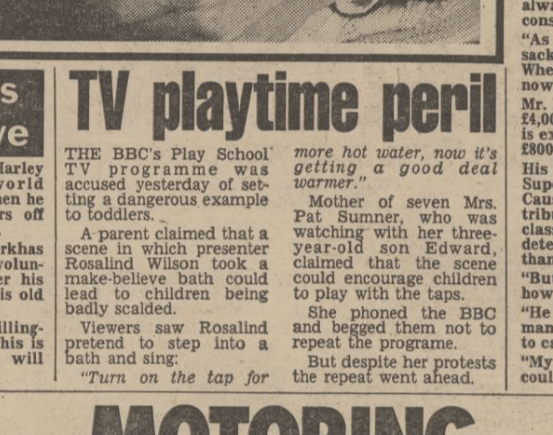
And not just because of EVIL PERILS imposed by the reckless programme (Daily Mirror, Friday 29 Apr 1983) 29 March 1985 saw the last Play School going out as part of the afternoon Children’s BBC schedule, meaning the programme was now a solely morning treat once more, though that was offset by Sunday morning broadcasts of highlights from the previous week. Play School continued in this vein for a few more years (still showing sufficient importance to punch a twenty-minute hole in daily Party Conference coverage each autumn), but there was now an acceptance that slightly older children coming home from school no longer had much interest in the series.

Pretty cool new set, mind. [Photo courtesy Paul R Jackson] When the end came for Play School, it was at the hand of someone who’d been there at the beginning. Anna Home had been a part of the production team right from the very beginning, before moving on to produce Jackanory, plus drama serials such as Carrie’s War, The Canal Children and The Changes. By 1988, Home had become Head of Children’s Programmes, and felt that at the 1990s loomed, Play School was still slightly stuck in the past. Another Play School stalwart delivered the final blow. Cynthia Felgate’s production company Felgate Productions picked up the contract to make the new totem for under-fives: initially called Playbus (later Playdays), which would go on to have quite an impressive run of it’s own. And so, between March and October 1988, a variety of Play School episodes were repeated while energies were concentrated on its successor.
And so, that was the end of Play School. Between 1964 and 1988, it had featured a total of 104 presenters (94 in the original run, 10 in the post-83 reboot), 54 guests, and six clocks. It saw episodes recorded in the Riverside Studios, Television Centre, Lime Grove Studios, Manchester’s Dickenson Road and Oxford Road studios, plus Pebble Mill. It even earned a quartet of repeat broadcasts (all from Christmas 1985) on short-lived digital channel BBC Choice over Christmas 1999 and 2000. Such was the regard the series would still be held in, the Riverside Studios would play host to a Play School reunion in May 2014, marking the fiftieth anniversary of the series. Previous to that, the 2010 Bafta Children’s Awards saw a special award presented to Brian Cant.

Paul R Jackson with presenters Carol Chell, Derek Griffiths and Brian Cant, Riverside Studios, May 2014 [Photo courtesy Paul R Jackson] 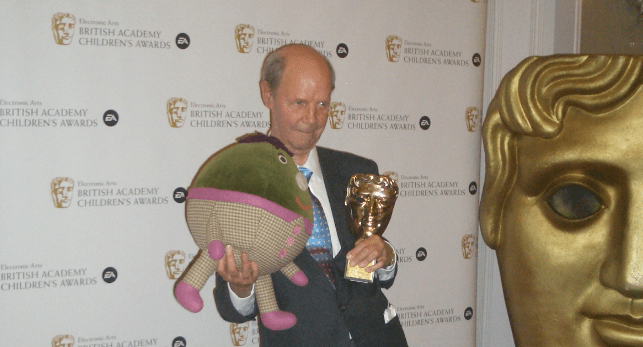
Brian Cant and his Plus One for the evening [Photo courtesy Paul R Jackson] Except: it wasn’t quite the end. Such as the success of the series in the UK, overseas broadcasters had been very keen to bottle some of that magic. The Australian version of the programme first aired in 1966, and is still airing on ABC Kids to this day, making it the longest-running children’s show in Australia (and second-longest in the world, after our very own Blue Peter). New Zealand’s adaptation of the series ran from 1972 to 1990, using the original 1964 UK branding for the series throughout.
In colour! Non-English speaking countries also got in on the act, with Switzerland’s Das Spielhaus running from 1968 to 1994, Austria’s Das Kleine Haus (from 1969-1975) and Spain’s La Casa del Reloj all getting in on the act. While some of the remakes were wearing pretty loose-fitting clothing (the Swiss version had talking puppets throughout, which is all wrong), some adhered a lot more closely to the original. Such as the Norwegian version Lekestue, which stuck very closely to the original Play School formula.

With such a rich legacy, it’s comforting to know that Joy Whitby’s original low-budget formula would go on to nurture young minds not just in the UK, but around the world. In fact, it’s probably fitting to give the final word to Joy herself.
“Great to see Play School at number two in your list and to know that Jackanory has also made the top ten. What a wonderful testament to the original team who set the template in 1964. It’s gratifying that the programme continues to hold a place in viewers’ hearts with fond memories of all those talented people, both in front and behind the camera.” (Joy Whitby, January 2024)

So, that’s it. The TV programme shown almost-most frequently within the BBC’s entire history. But what’s at number one? Let’s find out right now, shall we? It’s time to join those…
1. Neighbours
(Shown 10,626 times, 1986-2008)

Oh, the irony. Despite using the title ‘The Most-Broadcast BBC Programmes of All-Time’, the programme at number one was a show originally made by and shown on… Australia’s Seven Network. Not even a BBC co-production. So, it’s really the case that Play School is the most-broadcast BBC programme of all-time. It was just pipped to the post by Neighbours. Which, er, isn’t a BBC programme.
That said, the top programme on the list isn’t entirely divorced from British television. Reg Watson, the original architect of Ramsay Street, had created an impressive roster of continuing drama in Australia, such as Prisoner (suffixed ‘Cell Block H‘ in the UK), The Young Doctors and Sons and Daughters, single-handedly filling approximately 36% of ITV’s airtime between 1986 and 1994. But long previous to all that, 1955 saw a tyro Watson leave Australian shores for the UK, and a role at the nascent ATV Midlands. After an initial spell behind the camera directing fare like Noele Gordon ad-magazine Fancy That, then producing the likes of chat show Lunchbox and Godfrey Winn Speaking Personally, Watson championed a proposal for a new weekdaily soap opera devised by Hazel Adair and Peter Lingset.
It was set in the Midlands region – always handy when ATV needed to prove it wasn’t wholly fixated on its London weekend franchise – and was called The Midland Road. Unfortunately, this was in 1958, when a combination of limited broadcasting hours and moneyed franchise holders determined to get their content on screen meant there was limited space in the schedules. It would take until November 1964 before The Midland Road finally reached TV screens, initially in the ATV Midlands region. That is, once it had changed its name to Crossroads.

It’ll never catch on. Watson produced Crossroads for just under a decade before returning to Australia for a role as Head of Drama for storied soapmongers Reg Grundy Productions. The person responsible for that move? Bob Monkhouse. Yes, really. Well, kinda.
During Watson’s time working for ATV, a certain Mr Reg Grundy was enjoying his Mayfair honeymoon with his bride, Joy Chambers-Grundy. During that spell, the newlyweds met with expatriate and future TV-am tyrant Bruce Gyngell, then working for ATV. Gungell introduced the couple to current ATV big draw Bob, who invited the Grundies over to his St. John’s Wood home for dinner. Ever the gracious host, Monkhouse followed this up with an invitation to ATV’s studio to attend a recording of his hit series The Golden Shot, but not before treating the couple to dinner at the Albany Hotel. To make them feel at home, he also invited along a couple of Australian expats working at the channel – Golden Shot director Mike Lloyd, and… Reg Watson.
The Regs immediately hit it off, and with Grundy planning the formulation of a drama department within his media empire, Watson gave his new friend a crash course in putting together a successful serial. Subsequent trips to the UK saw Grundy seek out Watson for added guidance and advice. The guidance was even more pressing once Grundy’s first proposed drama serial – Class of ’74 – was being devised, mainly by staff more used to working on game shows. Grundy would collate together scenes from the series and get them over to Birmingham for Watson’s input. While Watson’s long-distance advice was valuable, the communications network of the mid-70s was hardly instant.

It’s like a Zoom call, but you have to draw what you think the other person looks like and it costs £7.56 per minute Ultimately, Grundy flew back to the UK to try and coax Watson back to his motherland, if only for as long as it took to help with a flailing Class of ’74. His mission helped by the fact Lew Grade hadn’t got around to renewing Watson’s contract, Grundy offered Watson a much more generous lifestyle than the notoriously penny-pinching ATV, and an initially sceptical Watson agreed to switch 1970s Birmingham for Sydney’s Bayview.

I mean, there are more difficult dilemmas. By the 1980s, Reg Grundy Productions (or as it now was, ‘The Grundy Organization’) was responsible for around 25 hours per week of content on Australian TV – a remarkable amount for an indie production company. In addition to soaps, Grundy quiz shows – both homegrown and adapted from overseas originals – were peppered throughout the TV listings, with Sale of the Century, Ford Superquiz, The New Price is Right, Family Feud, $100,000 Moneymakers and Wheel of Fortune attracting loyal audiences.

That’s a real car, the hosts are actually huge. The Organization (yes, with a ‘z’) also made the move into foreign markets, setting up offices in New York, LA, Hong Kong and London, producing programming for local networks. Beyond TV, the GO had moved into areas such as travel, restaurants, a record label and radio. Basically, with noses in all manner of businesses, the many-headed Grundy business hydra seemed to be unstoppable.
For the drama-based portion of this success, credit goes to Reg Watson’s uncanny ability to devise winning drama formulas. Albert Moran’s book Images & Industry: Television Drama Production in Australia (Australian Screen, 1985) put Watson’s wizardry into context, with some quotes from an unnamed producer within Grundys:
Take Prisoner, for instance. Grundys were approached by Channel 10: “We’re interested in a show, we’d like something vaguely prestigious, Australian oriented. We want it to run one hour per week for sixteen weeks and then we’ll stop.”
So [Ian] Holmes or Reg Grundy gets on the telephone and rings Reg Watson and says, “I’ve made a deal – quick, think of something.” So Reg with his instinct for the audience goes to work, sweats a lot and tears his hair out, goes even greyer and comes up with three or four ideas that he thinks will work. And he puts them to the channel. The Channel picks one and says: “Yes, we’ll go with this.” They ring up. The whole organisation goes into a panic. “They’ve picked X, what are we going to do?”
It’s at that point that Reg sits down at his typewriter and tries to think up a plot to fill in the concept… he wrote a plot for the first episode that was full of short zappy scenes, zappy to stop you thinking about any of them, seventy zaps in forty-five minutes. And then hacks like me are left to make it credible.
Images & Industry: Television Drama Production in Australia, 1985Watson’s transcontinental transfer to Grundys had certainly been a timely one. With Class of ’74 already on air by the time he arrived, the problems with the series were clear (despite early rushes being flown to Birmingham for input from a Watson working through his three months notice). Despite attracting a lot of initial attention, ’74 (later renamed Class of ’75) would see a swift ratings decline and be axed within 18 months. Conversely, The Young Doctors, the first drama serial to be devised under Watson’s tenure, would run for seven years and 1,397 episodes. That was followed by 1977’s The Restless Years (four years, 780 episodes) and 1979’s Prisoner (seven years, 692 episodes). It soon became clear that the ribbon in Watson’s typewriter had been personally inked by God.
In Reg Grundy’s autobiography, the TV mogul refers to the hiring of Reg Watson as “the most important appointment I ever made”. One example of typical Watson foresight came when Watson floated an idea about a new serial to Grundy: “I’ve got this idea for a drama about three families. The whole concept is about communication between the generations.” From small acorns, eh? And indeed, despite the common conception many held about Neighbours (yes, we’ve got there at last), it was a boundary breaking premise in many ways. Borne of Watson’s time working on Crossroads – and his admiration for Granada’s Coronation Street – this was a programme that would become, at least to British eyes, the quintessential Australian drama series.

And not actually all like this. (The Kenny Everett Television Show, s5e1, 30 November 1987) And while the programme itself would soon evolve, that principle of focusing on Ramsay Street’s three families would remain key. One such family was led by self-employed plumber Max Ramsay, whose grandad gave the street its name; next door is widower Jim Robinson, raising four kids with the help of mother-in-law Helen. And, aside from the feuding Ramsays and Robinsons, the third focal point of Ramsay Street was the home of twentysomething bachelor Des Clarke, who’s just rented a room to Daphne Lawrence, who, it turns out (cover your children’s eyes) is a stripper. The Sullivans it ain’t.
As Watson himself would go on to point out, “it changed the way we thought in serial drama. In one of the opening episodes, the grandmother was painting and the grandson was sitting for her. He casually said to her, “Grandma, when you and Grandpa were dating, did you have sex?” Normally, we would have her throw the paintbrush down and say, “Look, I don’t want to discuss this”, but we went the other way and she discussed it with him very sensibly.”
Having been bought by the Seven Network, the new series started promisingly. At least, it did in Melbourne, the setting for the series and focus of Australia’s TV industry. It fared less well in Sydney, where slipping ratings saw it moved from a 5.30pm slot to an earlier home at 3.30pm – hardly ideal for the multi-generational audience the programme was hoping to attract.

[Photo courtesy Paul R Jackson] Then, something surprising happened, especially for a show devised by Reg Watson: the series was cancelled by Seven, after just 170 episodes. Then, as far as the Australian TV industry was concerned, something even more surprising happened – this supposed flop of a serial drama was picked up by rival network Ten.

Canberra Times, Sun 15 Sept 1985 The move was far from straightforward. Despite supposedly no longer wanting anything to do with the series, Seven threatened to sue Grundys over selling a series the network claimed to own the rights to. On top of all that, an accidental fire had destroyed the permanent sets used for the series. Any legal issues were eventually settled, and the series was given a more youth-focused revamp before arriving on Ten, at a much friendlier time of 7pm.
The revamp saw new characters, new sets and a cast comprised mainly of unknowns, such as Jason Donovan, Guy Pearce and Kylie Minogue. Whoever they are. Plus, it kept key actors from the original incarnation of the series, such as the actors who’d go on to play Vice President Jim Prescott in 24, scheming Yorkshire industrialist Charles Widmore in Lost, Secretary of Commerce Mitch Bryce on The West Wing and the Australian ambassador in Flight of the Conchords. Or, if you prefer, Alan Dale.
And, chronologically speaking, this is where the BBC comes in.
Previously, if there had been anything being shown on daytime BBC1, it would be Programmes for Schools and Colleges, the News, programming for pre-school children, Welsh language content (at least until S4C came along) or Pebble Mill. Occasionally, there’d be live sport, or a political party conference, but aside from that, it would generally be the test card (or Pages from Ceefax by the early 1980s) taking up those afternoon broadcasting hours. That was even the case after broadcasting hours were relaxed to allow for a daytime TV service, meaning ITV franchises were free to put out uninterrupted programming from early morning to late night from October 1972. But, without the increased ad revenue of their rivals, the BBC largely kept away from uninterrupted daytime TV for more than a decade.

It didn’t work out too badly for the commercial channel. A guaranteed 100% audience share for most of each afternoon probably didn’t hurt. By the mid-1980s, BBC1 at least had Breakfast Time to attract an early audience, and gradually, more programmes began to grout the gaps between the end of breakfast TV and the early afternoon Play School repeat, especially now the Schools programming had moved over to BBC2.
For instance, plucking out a random midweek line-up from late 1984 reveals Lyn Marshall’s Everyday Yoga and The Yugoslav Way from 9am, a splash of Ceefax at 9.40am, the day’s first Play School at 10:30, BBC Asian Unit regular Gharbar at 10:50, more Ceefax, the afternoon News and Pebble Mill, pre-school lunchtime distractions Gran and Stop-Go!, followed by the early afternoon coupling of Blizzard’s Wonderful Wooden Toys and Star Movie: Joan Fontaine in Sky Giant to take viewers up to Children’s BBC at 3:50pm. It was certainly a lot of stuff, but not a very clear through-line. Especially when ITV were offering a more consistent line-up, including scripted content for grown-ups like The Sullivans, A Country Practice, Take the High Road and Sons and Daughters. In short: the BBC needed to improve its daytime output. And some of those programmes ITV have got their hands on sound interesting. Hmm.
And so, from 27 October 1986, BBC1’s first true daytime line-up made its debut. This was offered a lot more uniformity than the previous ragtag collection of content, with the daytime dominated by original – if inexpensive – programming.

Part of that first daytime menu. The full-fat daytime line-up wasn’t yet in place, meaning there was still a couple of curios in the 9am hour (Who’s A Pretty Girl Then?, looking at the 1983 Miss Pears competition, followed by magazine programme for disabled people One in Four) before the main daytime schedule kicked off at 10am, with Pamela Armstrong introducing the new daytime service via All in the Day, offering previews of what you might expect to see each morning. After the regularly scheduled children’s programming at 10:25, there was the first episode of long-running thought for the day strand Five to Eleven, with Dora Bryan the inaugural thought-thrower, followed by a special episode of Gardener’s World.
Bob Wellings, Pattie Coldwell and Eamonn Holmes introduced the first episode of Open Air at 11:30 – hard to imagine a daily hour-long programme that talked purely about television nowadays, isn’t it? That was followed by Star Memories, where a top celeb (in this instance Su Pollard) shares their favourite television memories with Nick Ross, new-look bulletin the One O’Clock News and… the first episode of “a new series with all the day-to-day drama of life in a Melbourne suburb”.
While the BBC’s budget didn’t stretch to a homegrown soap along the lines of Take the High Road, it could certainly afford to pick up one imported from Australia. After all, it seemed to be working out pretty well for those lot on ITV, and given this one had been dumped by its original network down under, it was unlikely to have cost a fortune. EastEnders was doing a roaring trade for the channel, proving that viewers would keep coming back for episodes of a soap on BBC1, and the antipodean import provided a superbly sunny counterpoint to the cold concrete of Albert Square.
Talking of cheap, the new daytime schedule could save a few more shillings by repeating the previous day’s episode of Neighbours at 10am each morning. At least it would give people another chance to catch the new acquisition, and it was hardly as if the programme had arrived with any sense of fanfare. On the day of Neighbours’ BBC debut, that day’s Daily Mirror weekly Soap Opera column failed to even mention the series*, while the first column inches spent on the series by the tabloid – a week after the debut episode aired – saw it dismissed as a programme that “could halt emigration to Australia”. In short, certainly not something that would stick around for years, and – say – see a feature-length supercut of early episodes being broadcast on the tenth anniversary of the programme’s channel debut. Heck, no.

(*Was going to post a screencap of that Mirror Soap page, but as the main headline in it is a pretty horrible homophobic one about Colin from EastEnders, I’m not going to. Here’s a picture of Colin and Barry from EastEnders instead.) Much like how unhelpful schedulers helped Neighbours get canned by Seven, some of the programme’s racier content (by 1986 standards, which is basically just people using the word ‘sex’) appearing adjacent to King Rollo attracted a certain amount of criticism, but luckily the See-Saw strand soon moved over to Daytime on Two. Indeed, the very content that some were unhappy with proved to be catnip to a growing audience of teenage viewers, especially once the youth-friendly post-revamp episodes started airing. The problem was, they were only able to enjoy the programme when sick or on school holidays. What could be done?
As fate would have it, while Daytime on One had settled into a nice little routine, the early-evening 5:35pm valley between the end of Children’s BBC and the start of the Six O’Clock News was peppered with a variety of ill-fitting formats. Throughout 1986 and 1987, it had played host to repeats of The Flintstones, mid-table syndicated sitcom Charles in Charge, teen quiz First Class (which I’ll wager many kids only watched for Konami’s HyperSports and Atari’s Paperboy), winsome Bill Oddie fact-fest Fax!, put-you-off-your-sausages documentary Hospital Watch, [Disgraced Entertainer] Cartoon Time, Kickstart-in-canoes Paddles Up, The Horse of the Year Show, Rippon-fronted pseudo pub-quiz Masterteam, Muppet Babies and Roland Rat – The Series.
Basically, you didn’t know what to expect while you were coaxing some ketchup onto your mash, and basically nothing seemed to stick around long enough to build an audience. But what DOES that teenage post-CBBC audience want? Step forward typical British teenager Alison Grade.
Alison and her friends had a favourite programme, but it was inconveniently scheduled right in the middle of the school day. This meant that a little creativity was needed if they were able to catch it. Instead of going out to play at lunchtime, they’d find a classroom containing a television, occupy it and tune in. That is, until their scheme was rumbled and a ticking off was issued. Alison returned home that afternoon and told her parents about the incident, and bemoaned the fact their favourite programme was being put out at such an inconvenient hour.
Which, in fairness, is a good idea if your dad happens to be Controller of BBC1 at the time (me saying ‘typical British teenager’ was all a ruse). Speaking in 2021, Michael (now Lord) Grade remarked on how he went into the office the next day and announced “We’re moving Neighbours to 5.35pm, so the kids can watch it when they come home from school”. To pick Neighbours for that original daytime line-up, Grade’s team had scoured through potential imports from around the world before Grade settled on the Erinsborough-based show. The decision to move it to teatimes had arrived in an instant.
The 5:35pm weekday slot was to be taken by the Australian import from Monday 4 January 1988, where it could attract a whole new audience – not that the daytime audience were being left behind. Each episode continued to air for the first time at 1:30pm, as before, all that was effectively changing was the repeats were moving from 9am to the teatime slot.
This presented a fresh problem. With around 300 episodes of the series already being shown, how would new viewers get up to speed on all things Ramsay Street?
Cue Madge Mitchell. Well, Anne Charleston.

To help wrap up the two years of plotlines the new audience had missed out on, Ramsay Street’s very own Madge made the trip to Television Centre to fill everyone in on what they’d missed. Meet the Neighbours only afforded Madge five minutes in the schedules to get everyone caught up, but had a pretty important place in it. 8:10pm on a Saturday night between Paul Daniels and Bergerac.
From there, Neighbours quickly became a firm favourite for millions. Many millions. By the end of 1988, it was regularly posting ratings around the 18 million mark, effortlessly spending most weeks dominating BARB’s BBC1 top ten.
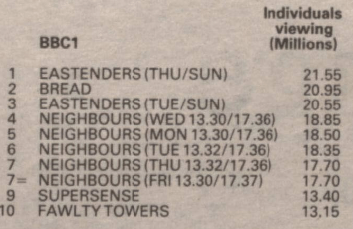
BARB Ratings w/e 11/12/88 (Source: The Stage, 22/12/88) Meanwhile, programme stars Kylie Minogue and Jason Donovan stood astride the world of pop.

Source: 20% Off, Internet Archive To cap all of that, Neighbours would receive one of the highest accolades ever afforded a soap opera: the cast were invited to take part in the 1988 Royal Variety Performance. Does their skit start with someone saying “G’day”? You bloody bet it does.

Here they all are. [photo courtesy Paul R Jackson] In a similar manner to how Play School remained superglued to the schedules during Party Conference season, Neighbours had become so ingrained in the BBC schedules that that the afternoon broadcast even interrupted Bank Holiday Grandstand. Take that, Texaco One-Day International from Lord’s!

(They could have just delayed showing 1949 black-and-white film Madeleine on BBC2 and put Neighbours on there, but they didn’t. Because it’s Neighbours.) For the record, only a few occasions were deemed big enough to knock Neighbours out of its lunchtime showing and force everyone to come back at 5:35pm (or later if you’re in Northern Ireland, of course) – or even tune in early when it’s the evening repeat that’s gone AWOL:
Fri 10 April 1992: Rolling afternoon coverage of the 1992 General Election, meaning viewers had to wait until teatime to see the episode where “Harold and Marge want to have their cake and eat it.”
Fri 25 December 1992: The first of only two occasions where Neighbours was deemed big enough for BBC1’s Christmas Day schedule, but only for the lunchtime showing – the evening slot was taken up by Bruce Forsyth’s Christmas Generation Game.
Mon 6 June 1994: Lunchtime broadcast shoved aside for D-Day Remembered, a live international event of commemoration. Hosted by President Mitterrand (presumably the event, rather than the programme).
Mon 25 December 1995: Christmas Day again, and the last appearance of the programme on December 25th. Just in a 12:25 slot, with the early evening taken up by the premiere of Hook.
Thurs 1 January 1998: Bit of a surprise here. It’s New Year’s Day, and again, Neighbours in only on at lunchtime due to the 5pm hour being dominated by From Grange Hill to Albert Square… and Beyond, a programme marking Grange Hill‘s 21st anniversary. Could Neighbours’ grip on the schedules be slipping? Up to that point, the first day of the year (when it fell on a weekday) was no obstacle to a double visit to Ramsay Street.
Thurs 29 June 2000: Only room for an early afternoon showing here, with Wimbledon 2000 and a Euro 2000 semi-final taking up the bulk of the afternoon and evening.
Thurs 20 June 2002: Royal Ascot tramples over the afternoon visit to Erinsborough.
Wed 16 and Fri 18 June 2004: Euro 2004 matches take priority in the evenings, meaning just the daytime showing is broadcast. By this point, The Weakest Link was airing on BBC2, and was rapidly becoming the Beeb’s latest can’t-cancel offering.
From this point on, the act of Not Showing Neighbours became a lot more commonplace on the BBC. World Cup on? Well, people can just watch the episode that’s on later for a few weeks. Bank Holiday? We’re not waiting an extra half-hour to show 102 Dalmatians at teatime.
By this point, Neighbours was becoming much less of a draw for the British public. Ten years on from the viewing figures regularly topping 18 million, most episodes were being watched by less than half as many. And, tellingly, other BBC1 programmes were clambering above it in the viewing charts. Without going into a load of detail, here’s a chart showing how often Neighbours appeared in the BARB Top 30 programmes on BBC1 each week, from July 1998 (the earliest week where figures are online) to June 2005 (the last week Neighbours would appear in that Top 30).
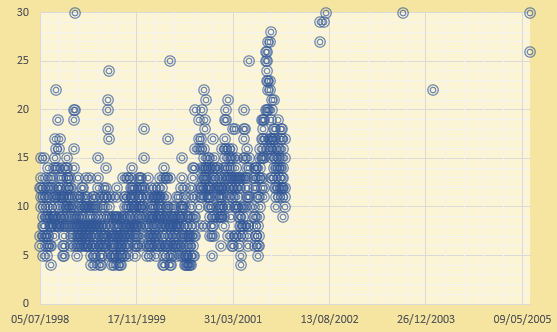
There’s no denying that the programme became much less present in these figures from 2002 onwards, after which it practically disappears from view. While that’s partly down to a change in the way figures were listed (viewer numbers were only counted for individual broadcasts from Jan 2002 onwards, rather than aggregate figures for all broadcasts of an episode), that did little to dampen figures for BBC1 stablemate EastEnders, and more important, those viewing figures were already falling. Even with afternoon and evening figures combined, the daily totals were falling, down to around a combined 5 million per day by 2007, and a number that would only sneak into the bottom rung of the chart were aggregate totals still allowed.
And that makes what else happened in 2007 a bit of a shock for the BBC. FremantleMedia, the company then under the conglomerate RTL umbrella responsible for distributing the programme, was set to renegotiate the Beeb’s contract for the series. With ratings slipping, surely they’d ask for a freeze in the sum involved, at most? Instead, they (reportedly) tripled the asking price: a grand sum of £300m for the next eight years of Neighbours. BBC1 controller Peter Fincham went public about the asking price, and declared that Neighbours would be leaving the BBC the following spring. Who would step up to take on the series? The then RTL-owned Channel Five, where it would ultimately stay for the remainder of its time as a broadcast TV programme in the UK.
[Photo courtesy Paul R Jackson] And so, that was the end of Neighbours on the BBC. It was the channel where the nation – or at least fifteen million-ish inhabitants of it – fell in love with the series. Those who were glued to the series at the time will have their own collection of favourite moments, but here’s my Personal Top 15 Neighbours Moments of All Time. Why not post some of your own in the comments?
15: Seeing someone off Prisoner Cell Block H appear in Neighbours. Of course, it all depends on where your own ITV region was up to in the series. (“It’s Chook!” when Susan Kennedy ( Jackie Woodburne) made her debut)
14: Gayle and Gillian Blakeney (aka the Alessi Twins) appearing in a Pop Will Eat Itself video.
13: Lou Carpenter’s (Tom Oliver) feud with Harold Bishop (Ian Smith)
12: Josh (Jeremy Angerson) tries to win the heart of Beth Brennan (Natalie Imbruglia) by buying her… a copy of military flight simulator F29 Retaliator as she’s ‘into computers’
11: Julie Martin (Julie Mullins) getting killed off. Harsh, but a nation’s common rooms rejoiced.
10: The many regenerations of Lucy Robinson (Kylie Flinker, Sasha Close, Melissa Bell)
9: The times companies paid for product placement in the series knowing their product would eventually reach 15 million viewers on BBC1. Made sense when it was Ocean Software (see 12), not so much when it was Craftmatic Adjustable Beds.
8: The various wizard wheezes of Rick Alessi (Dan Falzan)
7: Seeing someone off Neighbours in Prisoner Cell Block H, normally Harold Bishop (Ian Smith)
6: Finally getting to see Mr Udagawa (Lawrence Mah)
5: The haphazardly-exorcised-on-the-BBC incest storyline
4: Bogan-turned-treasure Joe Mangel (Mark Little) plants marijuana in Mrs Chubb’s (Irene Inescort) garden for a laugh
3: Mrs Mangel’s (Vivean Gray) portrait
2: Chris Lowe (playing himself) roaring into Ramsay Street
1: Bouncer’s dream

WE GOT THERE. Wahey! I’ll be back soon with some post-match analysis – wondering what the chart would look like if I only included primetime broadcasts? And lots more exciting mini-lists? – but for now I need a rest. Cheerio!
-
The 100 Most-Broadcast BBC Programmes Of All Time: Pre-Reveal Recap

Firstly, Merry Christmas!
We’re nearly there, and things are very tight between the top two. How tight? Well, so damn close I’ve actually felt compelled to carry out a full recount of their respective broadcast totals, as there are just seven broadcasts between them. One programme was shown 10,575 times, the other 10,582 times. So, I’ll be revealing all very soon. So to speak.
Until then, here’s a rundown of that hundred in near-full. Some of the totals are revised, as I’d uncovered some additional broadcasts of a few other programmes while verifying the totals of shows near the top of the list. So: the following is – as far as I’m concerned for the time being – the ultimate broadcast totals for everything we’ve covered so far.
Strap in!
100: Saturday Kitchen (Shown 891 times, 2001-2021)
Lifestyle, BBC1 (2006-2021), BBC2 (2001-2021)99: Final Score (Shown 896 times, 1971-2021)
Sport, BBC1 (1971-2021), BBC2 (2003-2021)98: Put Your Money Where Your Mouth Is (Shown 917 times, 2008-2021)
Lifestyle, BBC1 (2008-2017), BBC2 (2008-2021)97: Z Cars (Shown 920 times, 1962-1998)
Drama, BBC Television Service (1962-1964), BBC1 (1964-1982), BBC2 (1976-1998)=95: Five to Eleven (Shown 934 times, 1986-1990)
Other, BBC1 (1986-1990)=95: Sportsnight (Shown 934 times, 1968-1997)
Sport, BBC1 (1968-1997), BBC2 (1995-1997)94: Fimbles (Shown 937 times, 2002-2010)
Children’s Programme, BBC1 (2002-2005), BBC2 (2002-2010)93: Rugby Special (Shown 976 times, 1966-2005)
Sport, BBC2 (1966-2005)92: For the Children (Shown 982 times, 1937-1952)
Children’s Programme, BBC Television Service (1937-1952)
=90: Postman Pat (Shown 1006 times, 1981-2012)
Children’s Programme, BBC1 (1981-2005), BBC2 (1983-2012)=90: Strictly – It Takes Two (Shown 1006 times, 2004-2021)
Other, BBC1 (2019-2019), BBC2 (2004-2021)=87: Nai Zindagi – Naya Jeevan (Shown 1010 times, 1968-1982)
Other, BBC1 (1968-1982), BBC2 (1975-1977)=87: QI (Shown 1010 times, 2003-2021)
Quiz/Panel Show, BBC1 (2009-2011), BBC2 (2003-2021)=87: The Simpsons (Shown 1010 times, 1996-2004)
Comedy, BBC1 (1996-1997), BBC2 (1996-2004)86: ChuckleVision (Shown 1056 times, 1987-2012)
Children’s Programme, BBC1 (1987-2012), BBC2 (1990-2010)85: Murder, She Wrote (Shown 1065 times, 2002-2011)
Drama, BBC1 (2002-2010), BBC2 (2002-2011)84: Dad’s Army (Shown 1066 times, 1968-2021)
Comedy, BBC1 (1968-2020), BBC2 (1982-2021)83: The Magic Roundabout (Shown 1070 times, 1965-1985)
Children’s Programme, BBC1 (1965-1985), BBC2 (1972-1984)82: Laurel and Hardy (Shown 1084 times, 1948-2005)
Comedy, BBC Television Service (1948-1963), BBC1 (1964-1992), BBC2 (1964-2005)81: In the Night Garden (Shown 1106 times, 2007-2012)
Children’s Programme, BBC2 (2007-2012)
80: The Phil Silvers Show (Shown 1107 times, 1957-2004)
Comedy, BBC Television Service (1957-1962), BBC1 (1966-1984), BBC2 (1984-2004)79: Doctor Who (Shown 1138 times, 1963-2021)
Drama, BBC Television Service (1963-1964), BBC1 (1964-2021), BBC2 (1981-2021)78: Watchdog (Shown 1141 times, 1985-2019)
Factual, BBC1 (1985-2019), BBC2 (1989-2015)77: Wogan (Shown 1142 times, 1982-2010)
Talk Show, BBC1 (1982-1993), BBC2 (2010-2010)76: University Challenge (Shown 1167 times, 1994-2021)
Quiz/Panel Show, BBC2 (1994-2021)75: Great British Menu (Shown 1184 times, 2006-2021)
Lifestyle, BBC1 (2006-2012), BBC2 (2006-2021)74: Tom and Jerry (Shown 1194 times, 1967-2003)
Comedy, BBC1 (1967-2003), BBC2 (1980-1999)73: The Sky at Night (Shown 1201 times, 1957-2013)
Factual, BBC Television Service (1957-1964), BBC1 (1964-2013), BBC2 (1978-2013)72: Call My Bluff (Shown 1218 times, 1965-2005)
Quiz/Panel Show, BBC1 (1996-2005), BBC2 (1965-2004)71: Mastermind (Shown 1265 times, 1972-2021)
Quiz/Panel Show, BBC1 (1972-1997), BBC2 (1990-2021)
70: Grange Hill (Shown 1269 times, 1978-2008)
Children’s Programme, BBC1 (1978-2008), BBC2 (1979-2008)69: Athletics (Shown 1295 times, 1946-2021)
Sport, BBC Television Service (1946-1963), BBC1 (1964-2021), BBC2 (1966-2021)68: To Buy or Not to Buy (Shown 1313 times, 2003-2012)
Lifestyle, BBC1 (2003-2011), BBC2 (2010-2012)67: Casualty (Shown 1336 times, 1986-2021)
Drama, BBC1 (1986-2021)66: Top Gear (Shown 1394 times, 1978-2021)
Lifestyle, BBC1 (1981-2021), BBC2 (1978-2021)65: Pingu (Shown 1404 times, 1990-2013)
Children’s Programme, BBC1 (1990-2005), BBC2 (1992-2013)=63: Antiques Road Trip (Shown 1449 times, 2010-2021)
Lifestyle, BBC1 (2011-2021), BBC2 (2010-2021)=63: Natural World (Shown 1449 times, 1983-2021)
Factual, BBC1 (1983-2013), BBC2 (1983-2021)62: Diagnosis Murder (Shown 1472 times, 1993-2011)
Drama, BBC1 (1993-2010), BBC2 (2000-2011)61: Farming (Shown 1488 times, 1957-1988)
Factual, BBC Television Service (1957-1964), BBC1 (1964-1988)
60: Tomorrow’s World (Shown 1510 times, 1965-2003)
Factual, BBC1 (1965-2003), BBC2 (1986-1988)59: The Money Programme (Shown 1515 times, 1966-2011)
Factual, BBC1 (1974-2011), BBC2 (1966-2010)58: Scooby-Doo (Shown 1522 times, 1970-2012)
Children’s Programme, BBC1 (1970-2012), BBC2 (1972-2012)57: Westminster (Shown 1567 times, 1970-2001)
Factual, BBC1 (1996-1999), BBC2 (1970-2001)56: Have I Got News for You (Shown 1577 times, 1990-2021)
Comedy, BBC1 (2000-2021), BBC2 (1990-2021)55: Animal Park (Shown 1638 times, 2000-2021)
Factual, BBC1 (2000-2021), BBC2 (2001-2021)54: Coast (Shown 1644 times, 2005-2021)
Factual, BBC1 (2005-2012), BBC2 (2005-2021)53: Twenty-Four Hours / 24 Hours (Shown 1684 times, 1965-1972)
Factual, BBC1 (1965-1972)52: Holby City (Shown 1700 times, 1999-2021)
Soap, BBC1 (1999-2021), BBC2 (2012-2021)51: Breakfast Time (Shown 1727 times, 1983-1989)
Other, BBC1 (1983-1989)
50: Racing (Shown 1741 times, 1946-2012)
Sport, BBC Television Service (1946-1964), BBC1 (1964-2012), BBC2 (1964-2012)49: Points of View (Shown 1753 times, 1961-2021)
Other, BBC Television Service (1961-1964), BBC1 (1964-2021), BBC2 (2005-2021)48: Antiques Roadshow (Shown 1762 times, 1979-2021)
Lifestyle, BBC1 (1979-2021), BBC2 (1981-2021)47: Arthur (Shown 1777 times, 1997-2012)
Children’s Programme, BBC1 (1997-2009), BBC2 (2001-2012)46: Film [xx] (The Film Programme) (Shown 1873 times, 1971-2018)
Other, BBC1 (1971-2018), BBC2 (1984-2015)45: Question Time (Shown 1910 times, 1979-2021)
Factual, BBC1 (1979-2021), BBC2 (2013-2021)44: A Question of Sport (Shown 1932 times, 1970-2021)
Quiz/Panel Show, BBC1 (1970-2021), BBC2 (1991-2013)43: Late Night Line-Up (Shown 1992 times, 1964-1989)
Talk Show, BBC2 (1964-1989)42: See Hear! (Shown 2013 times, 1981-2021)
Other, BBC1 (1981-2012), BBC2 (1986-2021)41: Town and Around (Shown 2044 times, 1960-1969)
Factual, BBC Television Service (1960-1964), BBC1 (1964-1969)
40: Horizon (Shown 2138 times, 1964-2021)
Factual, BBC1 (1973-2012), BBC2 (1964-2021)39: Cash in the Attic (Shown 2231 times, 2002-2017)
Lifestyle, BBC1 (2002-2012), BBC2 (2006-2017)38: Wimbledon (Shown 2304 times, 1937-2021)
Sport, BBC Television Service (1937-1963), BBC1 (1964-2021), BBC2 (1964-2021)37: Tweenies (Shown 2446 times, 1999-2012)
Children’s Programme, BBC1 (1999-2004), BBC2 (1999-2012)36: Golf (Shown 2488 times, 1938-2021)
Sport, BBC Television Service (1938-1963), BBC1 (1964-2019), BBC2 (1965-2021)35: You and Me (Shown 2555 times, 1974-1995)
Children’s Programme, BBC1 (1974-1994), BBC2 (1977-1995)34: Tonight (Shown 2582 times, 1957-1992)
Factual, BBC Television Service (1957-1964), BBC1 (1964-1982), BBC2 (1992-1992)33: Ready Steady Cook (Shown 2633 times, 1994-2021)
Lifestyle, BBC1 (1996-2021), BBC2 (1994-2021)32: Pointless (Shown 2656 times, 2009-2021)
Quiz/Panel Show, BBC1 (2011-2021), BBC2 (2009-2021)31: Top of the Pops (Shown 2723 times, 1964-2021)
Other, BBC Television Service (1964-1964), BBC1 (1964-2020), BBC2 (1991-2021)
30: Gardeners’ World (Shown 2732 times, 1968-2021)
Lifestyle, BBC1 (1973-2009), BBC2 (1968-2021)29: The Daily Politics (Shown 2793 times, 2003-2018)
Factual, BBC1 (2016-2016), BBC2 (2003-2018)28: CountryFile (Shown 2795 times, 1988-2021)
Factual, BBC1 (1988-2021), BBC2 (1988-2021)27: Party Political Broadcast (etc) (Shown 2804 times, 1950-2021)
Other, BBC Television Service (1950-1964), BBC1 (1964-2021), BBC2 (1964-2019)26: The Weakest Link (Shown 2918 times, 2000-2021)
Quiz/Panel Show, BBC1 (2000-2021), BBC2 (2000-2013)25: Nationwide (Shown 2930 times, 1969-1983)
Factual, BBC1 (1969-1983), BBC2 (1980-1980)24: Teletubbies (Shown 2977 times, 1997-2009)
Children’s Programme, BBC1 (1997-2004), BBC2 (1997-2009)23: Kilroy (Shown 3006 times, 1986-2004)
Lifestyle, BBC1 (1986-2004), BBC2 (1999-2001)22: Eggheads (Shown 3049 times, 2003-2021)
Quiz/Panel Show, BBC1 (2003-2004), BBC2 (2004-2021)21: Pebble Mill (Shown 3137 times, 1972-2004)
Talk Show, BBC1 (1972-2004), BBC2 (1976-1986)
20: Working Lunch (Shown 3296 times, 1994-2010)
Factual, BBC2 (1994-2010)19: Panorama (Shown 3346 times, 1953-2021)
Factual, BBC Television Service (1953-1964), BBC1 (1964-2021), BBC2 (2005-2021)18: The ONE Show (Shown 3400 times, 2006-2021)
Talk Show, BBC1 (2006-2021), BBC2 (2011-2021)17: Songs of Praise (Shown 3428 times, 1961-2021)
Other, BBC Television Service (1961-1964), BBC1 (1964-2021), BBC2 (1983-2021)16: Playdays (Shown 3925 times, 1988-2002)
Children’s Programme, BBC1 (1988-2001), BBC2 (1989-2002)15: Match of the Day (Shown 4052 times, 1964-2021)
Sport, BBC1 (1966-2021), BBC2 (1964-2020)14: Doctors (Shown 4081 times, 2000-2021)
Soap, BBC1 (2000-2021), BBC2 (2015-2020)13: Escape to the Country (Shown 4365 times, 2002-2021)
Lifestyle, BBC1 (2004-2021), BBC2 (2002-2021)12: Snooker (Shown 4487 times, 1937-2021)
Sport, BBC Television Service (1937-1958), BBC1 (1978-2021), BBC2 (1977-2021)11: Grandstand (Shown 4500 times, 1958-2007)
Sport, BBC Television Service (1958-1964), BBC1 (1964-2007), BBC2 (1968-2007)
10: Flog It! (Shown 4531 times, 2002-2021)
Lifestyle, BBC1 (2008-2020), BBC2 (2002-2021)9: Jackanory (Shown 4701 times, 1965-2009)
Children’s Programme, BBC1 (1965-2008), BBC2 (1971-2009)8: Homes under the Hammer (Shown 5164 times, 2003-2021)
Lifestyle, BBC1 (2003-2021), BBC2 (2004-2021)7: Bargain Hunt (Shown 5836 times, 2000-2021)
Lifestyle, BBC1 (2000-2021), BBC2 (2000-2021)6: Blue Peter (Shown 5967 times, 1958-2021)
Children’s Programme, BBC Television Service (1958-1964), BBC1 (1964-2012), BBC2 (1974-2021)5: Cricket (Shown 6250 times, 1938-2021)
Sport, BBC Television Service (1938-1963), BBC1 (1964-2021), BBC2 (1964-2021)4: Pages from Ceefax (Shown 6494 times, 1983-2000)
Other, BBC1 (1983-1993), BBC2 (1984-2000)3: EastEnders (Shown 7902 times, 1985-2021)
Soap, BBC1 (1985-2021), BBC2 (1995-2021)2: TBC (Shown 10,575 times, TBC-TBC)
1: TBC (Shown 10,582 times, TBC-TBC)
“That wasn’t much of an update!”
Bit rude. Just spent a long time putting each programme into a genre classification you can disagree with AND adding channel broadcast summaries. Tsk. BACK SOON.
-
“He Might be Slightly Dodgy, But a Gooner He Ain’t” – The 3rd Most-Broadcast BBC Programme of All-Time
Bronze medal time! But first, here’s something that you may well float your retro TV boat if you’re enjoying this rundown.
Unstoppable word machine Ben Baker’s latest book – The Dreams We Had As Children – is out now, and it’s a bit of a cracker for anyone who grew up (or old) with a fondness for Children’s ITV. With the light channel’s nostalgia engine yanked out of a clapped out Cortina compared to the Beeb’s well-oiled retro roadsters, it’s not a broadcaster that makes much of its archive, so it’s left up to others to pick up the slack. And that’s just what Ben has done here, looking at forty key programmes from CITV’s forty years on air, from Danger Mouse to Dave Spud, and pretty much every point of interest in between. Plus, lots of other fun gubbins relating to those key CITV years.
If, like me, you’re cursed with a mental grasp of the past that requires constant research to confirm that, no, Gilbert’s Fridge actually was a thing that somehow got made and broadcast (something the Children’s BBC would never have dared do), this book doubles at an essential comfort blanket for the brain. And that’s as well as being a thoroughly entertaining read in its own right. Hurrah! If that sounds like something you’d like, go treat yourself. Go on, it’s Christmas.
Okay, on with the list, and a visit to those…
3: EastEnders
(Shown 7902 times, 1985-2021)
Once upon a time, there was a new soap op… sorry, ‘continuing drama series’. Well, ITV’s Coronation Street was huge and Crossroads also had an loyal audience, so it was decided that formula could easily be copied elsewhere. Corrie was about life in the north of England, Crossroads covered the Midlands, so how about setting it in the south of England? Where some of the main characters run market stalls, that should get them all interacting with each other, rather than just sat inside all day. And, as luck would have it, there’s enough spare space at Elstree to build a great big outdoor set for it.
And so, it launched to no small amount of fanfare. And, despite many in the national press getting a bit sniffy about it, it was a hit with the public. Indeed, before long it was top of the TV ratings, and one of the biggest hits of the decade. Before much longer, the scripts were getting tightened up, the more popular characters were being given more airtime, and finally the critics started to applaud the series. It seems like it could do no wrong.
Within two years it was gone from our screens, never to be seen again.
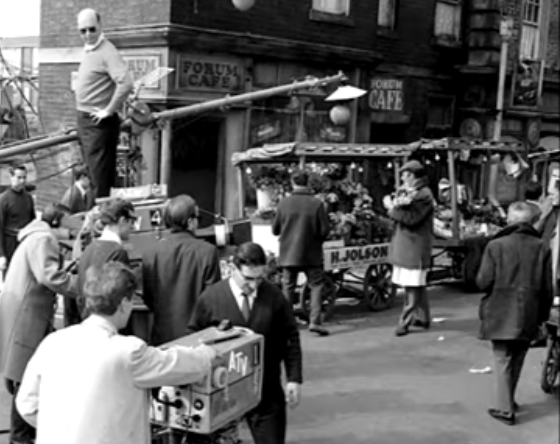
That programme was, of course, ATV’s Market in Honey Lane.
Market in Honey Lane came about after script editor Louis Marks was intrigued by his wife Sonia’s tales of goings on while shopping at London’s Berwick Street market, and set about putting together an idea for a drama series. The idea was pitched to ITV franchise ATV, who picked up the series in 1963 with an aim to use it for the surely-soon-to-launch ITV-2. After the second commercial channel failed to materialise, the idea sat on the shelf for a spell. A few years later production was finally set into motion.
The premise was even grittier than its grimy Manchester stablemate, with the £15,000 set including a betting shop, a strip club and an erotic book shop. That approach backfired somewhat before the first episode had even aired, when thieves broke into the set and stole stock from the “book shop” including titles such as “Fanny Hill”, “Variations in Sexual Behaviour” and “How to Make Love in Five Languages”. There’s a sentence that’ll help the site’s SEO, I’m sure.
ATV’s marketing department sent out the lofty claim that “you can learn more about life by standing in Honey Lane and breathing deeply for five minutes than by travelling around the world”, and waited for everyone to tune in.
Following the debut episode on Monday 3 April 1967, critics weren’t impressed. Writing in the Daily Mirror, TV critic Kenneth Eastaugh decried the opening episode as “even more banal than Crossroads”, dismissing the production as “turned out by folk who have never seen a production more ambitious than a church bazaar”. Readers weren’t much kinder – the Sunday Mirror’s “Be a TV Critic” letters page seeing it described as “The worst programme I’ve ever watched” (Mrs B A Spurr, Langford) and “A real flop, this one” (W Bucknall, Gravesend).
It wasn’t long before the programme improved – just six weeks after the poorly-reviewed debut, the Daily Mirror’s Michael Hellicar declared that Honey Lane was the highlight of each Monday night’s schedules, noting that “no longer are there a dozen or more characters all trying to be the star of the show”, but instead focused on “strong personalities to override the mountain of trivia which pours forth”. A lot of this was down to the introduction of Australian scriptwriter Raymond Bowers, recently lauded for his work on The Power Game, and new character Bluey Trustcott, played by fellow Aussie Kenneth J Warren.
By March 1968, the initial run of the series came to an end, but Lew Grade promised it would be back after a short rest, the single hour-long episode per week set to become two half-hour episodes each week, providing more room for plotlines and fleshing out the characters. The new-style production again suffered a pre-broadcast incident that perhaps should’ve served as a warning. While the original run had been hit by a mucky book theft, the comeback series saw a much more serious incident in September 1968. A scripted explosion at the Boreham Wood set proved to have a bit more bang than expected, the blast ripping through the studio set and sending thirty members of the cast and crew running for cover.
On returning to the screens in September 1968, the rechristened Honey Lane found itself without a suitable home. While some ITV regions scheduled the new series in the peak teatime slot of 6.30pm, Londoners hoping to catch the series would need to tune in at the less-than-peak time of 4.10pm, with new London franchise holders Thames preferring to show films or episodes of The Flying Nun in that half-six slot. For whatever reason, Thames just didn’t seem to feel it deserved an evening audience – while most ITV regions broadcast episodes of Honey Lane on Christmas Eve and Boxing Day 1968, Thames left it wrapped up under the tree. Possibly buried several feet under it.
In early 1969, other ITV franchises had shifted Honey Lane to earlier slots around 4.30pm, putting it up against Play School and Jackanory on BBC-1. By now, Thames had shunted the programme into a post 11pm slot, and it didn’t take too long before other ITV regions followed suit. By March 1969, the programme had disappeared from screens entirely. Even if viewers were initially receptive to the idea of a London-set soap, it looked like it was an idea that didn’t have legs.
Of course, Honey Lane had initially been a success – heck, it was the fifteenth most-watched programme of the entire decade. So, if someone could pull off that trick without messing it up, maaaaybe it could work?
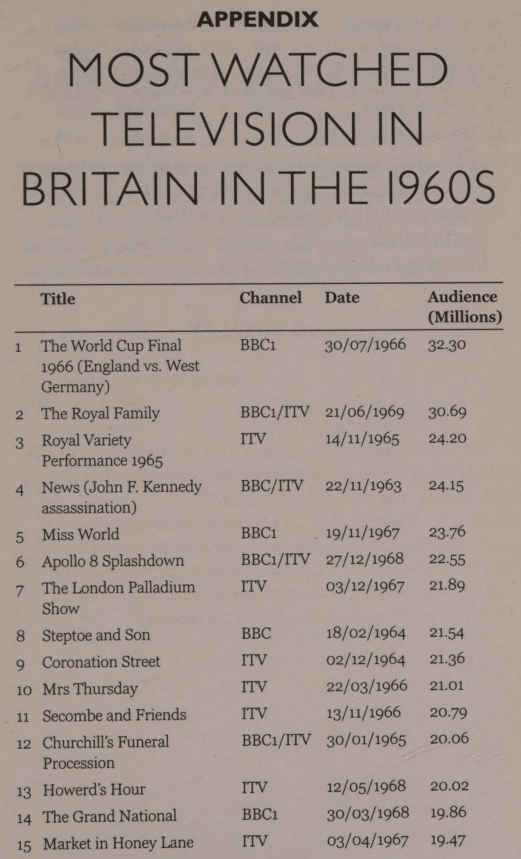
Source: “I am sure I speak for many others…” – Unpublished Letters to the BBC, Colin Shindler, Penguin Books, 2017) Whip-pan to the early 1980s, and BBC1’s weeknight schedule was in a bit of a rut. ITV were regularly pulling in viewers for Coronation Street, Crossroads and (since it moved to primetime in 1977) Emmerdale Farm, while BBC-1 found itself throwing a bunch of things at the 7pm wall hoping enough people might tune in for Ask the Family, Medical Express, Taxi or The Rockford Files to keep coming back.
Sure, some programmes in those weeknight early evening slots were reliable eyeball-grabbers such as Top of the Pops, A Question of Sport and Doctor Who, but they were only ever going to go out once per week. You’re not about to get the pop kids flocking to Middle of the Pops: This Week’s Numbers 41-75 each Tuesday. Simple solution: just do some of those soaps that ITV are doing! Problem: the programme you’ve come up with is Triangle (in joint 1484th place on the most-broadcast list with 78 showings, alongside Young Musician of the Year, Merlin and The Royal International Horse Show, if you’re wondering). Oh, if only the Beeb could find another long-running drama like The Newcomers or Z-Cars.
Step forward former Newcomers director Julia Smith and Z-Cars script editor Tony Holland.
The closest thing BBC1 had to rival ITV’s big guns was hospital drama Angels, which started in 1975, and had been running twice-weekly since September 1979. It wasn’t a bona-fide soap – it initially ran in limited series of fifty-minute episodes before moving to longer runs of 2 x 25 minute episodes each week. And – unlike Honey Lane – it didn’t immediately get dumped into hard-to-find schedule nooks.
Angels came to an end in 1983, but maybe script editor Tony Holland and producer Julia Smith had something else up their sleeves. Something original. Something that hadn’t been tried before.
Hey, how about something set in London, where several major characters ran market stalls, and which could use a standing set in spare space currently available in Elstree? Would that be a hit? Or would the mid-80s see another much-promoted serial drama series kicked to the kerb before its time?
The seeds had been sown in March 1983. Julia Smith and Tony Holland, by then working on Nerys Hughes medical cyclist drama The District Nurse, were invited to London to meet with David Reid, the BBC’s Head of Series and Serials. Beeb bigwigs had decided it was time to have another bash at a proper bi-weekly serial. It was more than a little overdue, the genre being missing from the BBC since The Doctors came to a close in 1971. And, their stock being high at the time, it was hoped that Smith and Holland were just the people to devise it.
It was a canny choice. Both Smith and Holland had been involved in TV drama since the genre was broadcast live by default, so they were well positioned to helm a serial that needed a conveyor belt of content. They were seen as reliable, their programmes delivered on time and within budget, and they’d just been involved with a series that came close to what the BBC now wanted. If everything went well, maybe their new series could even be as big a deal as Angels.
Of course, with any new programme set to run every single week of every single year, any ideas had to have legs as sturdy as Roberto Carlos and kick twice as hard. Even in its twice-weekly serial format, Angels hadn’t put out more than 33 episodes per calendar year. Their new serial would need to pump out more than a hundred. Plus, it would need a cast and crew capable of coping with such a workload.
With episodes of The District Nurse still needing to be completed, Tony Holland went back to Wales to continue writing for that series, while Julia Smith set about exploring how the new project could actually work. The hottest new property on the box at the time was Channel Four’s Brookside, which was shot entirely on location in a bespoke locale. But that was fine for a young upstart channel like Four – would a mainly studio-based approach, like Coronation Street at the time, be the safer option? Or… something in between?
A tour of the BBC regions ensued, to scope out sufficient space for both studio and outside broadcast space. Not only would both of these be needed in spades, but sufficient studio time would also be needed, along with rehearsal rooms, crew facilities, and suitable nearby accommodation for any travelling staff and artists. And could such decisions really be made when it hadn’t yet been decided what the damn thing was going to be about?
Then, fate intervened.
The Stage/Television Today, 23 June 1983. Over on ITV, the ATV franchise had just finished regenerating into Central, which was preparing to move into a new £21m studio complex near Nottingham. That meant the old ATV studios in Elstree in Hertfordshire were to be left doing nothing. Step forward BBC Director of Resources Michael Checkland, who sought to snap up the site for a third of the price Central were paying for their new facility. And quite a bargain it was – only 14 miles from That London, offering four large studios, loads of office space and plenty of room for facilities.
The first BBC production assigned to the new studio space: the new twice-weekly drama serial planned for BBC1. There would be no need to share space with other productions – the new programme could have sets kept permanently in place. One slight issue: there was a reason Central were so keen to leave it behind. Smith and Holland’s book on the birth of ‘Stenders refers to the scene as “like a crumbling fairground at the end of a deserted pier”.
Still, it wasn’t all bad. Several ideas for the new serial had been whittled down to just two. Such was the secrecy behind them, producer (Smith) was forbidden from sharing details of the two pilot scripts with her script editor (Holland), despite them both sharing a Cardiff flat while working on The District Nurse. As a result, she’d had to read through them in secret in bed, then hide them before breakfast each morning.
One of the ideas focused on a shopping arcade. Given the expensive technical considerations involved, that idea was rejected (though I personally like to think the ghost of Market on Honey Lane visited Julia Smith in a dream and told her not to risk it). The other idea… didn’t seem quite right either. A second writer was commissioned to prepare a different version of the script. And still, she was forbidden by bosses from sharing any details with her script editor and long-time collaborator.
They should have set it at the Normid Superstore in Bolton, and incorporated it with a prototype of Sky One’s Dream Team. Something had to give. And eventually, it did. After Tony Holland confronted Julia Smith about the curious radio silence over their huge new serial drama project, Smith insisted that she be allowed to share details with her script editor. The nod finally arriving from Them Upstairs, Smith finally shared the pilot script with Holland. His reaction: “Well, I’m not doing THAT.” Her reaction: “Good. Neither am I.”
The second idea, as it turned out, had been about a caravan park. It was an idea that hadn’t been done before, certainly. It had interesting elements, yes. But where would it go? 104 episodes each year of characters chatting outside the toilet block? Even in winter? That wasn’t going to work. Oh dear.
Then, the fickle finger of Lady Fate flicked the department head responsible for picking those two scripts out of a window (i.e. David Reid moved to a role outside the Series and Serials Department), and in came Jonathan Powell, producer of such fine fare as Tinker, Tailor, Soldier, Spy, Smiley’s People and The Barchester Chronicles. The new serial would be his first major production. But, he was very much a BBC2 type, his dramas regularly hoovering up awards and broadsheet column inches. What would he be looking for from a primetime BBC1 series?
As luck would have it, he was looking for pretty much the same thing that Smith and Holland had decided upon. Something based on contemporary working class London. But first, motions had to be gone through to ditch the caravan park idea. An exploratory visit to a caravan park ensured, and all those suspicions of unsuitability were underlined. No meeting places. Barely anyone under retirement age outside of school holiday weeks. And, in each homestead, rooms too tiny to carry out any convincing filming. All cons, no pro. One memo to Jonathan Powell later, the caravan park idea was toast.
So, on to the new idea. Smith and Holland dived into research about the East End of London, went on field trips and carried out conversations with locals of all ages. While much of the East End had started to undergo gentrification – pubs becoming cocktail bars, Citroen 2CVs parked outside stripped pine doors – their research eventually uncovered enough of the area they were looking for. Proper pubs, street markets, fly posters and residents who’d known each other for generations. But something they’d not expected was also happening – the traditional (or rather stereotypical) East End faces were joined by West Indian, Greek and Turkish Cypriot, Chinese and Indian faces. Yet the sense of community they’d known from their formative years was undimmed. No matter where someone had come from, if they lived in the East End, they were unshakeably ‘one of us’.
A pitch was quickly put together. Very quickly. The duo had returned to TV Centre at 6.15pm on 1 February 1984 only to discover – belatedly, due to the pair being on location and the limitations of 1980s communication technology – that Jonathan Powell was expecting a completed pitch to share with the Controller of BBC1 Alan Hart at 7pm that very evening. Eep.
Forty-five minutes of frenzied typing later, an outline was in place, or at the very least, on a sheet of A4.
The new serial would be in the instantly recognisable East End of London. It would feature a mix of multi-racial, larger-than-life characters. It would explore 1980s life in a disadvantaged corner of a privileged city, but where adversity can’t shake the residents solidarity. The location: a run-down Victorian Square. Some of the homes are privately-owned, some are council-owned, and many of them contain several generations of family under the same roof. There’s a pub, a launderette and a caff and a rigid sense of community spirit that won’t be rattled by whatever life throws at the residents.
While us people of Space Year 2023 know differently, Smith and Holland were downbeat about the reaction to their pitch. They’d been given almost a year to put this particular piece of homework together, and due to a series of missed messages, the impression was now being given they’d just scribbled something down on the school bus. Powell’s initial reaction on seeing the pitch hadn’t seemed especially positive, after all. Maybe they should have given the caravan park or shopping arcade ideas a little bit more credence. Or just tried to buy the rights to Honey Lane.
The following morning, Tony Holland re-typed the series pitch with some changes suggested by Jonathan Powell, to be delivered to his office at noon. But it seemed too little too late. Smith and Holland travelled to Shepherd’s Bush to deliver the revised pitch. It didn’t take long for Powell to get back to them with a decision. Usually, a decision on such a high-profile programme would take weeks, if not months to arrive from the sixth floor bigwigs of TVC. The decision on the new serial had taken just thirty minutes. Gulp.
“OK, team. You’re on!”
Well, better start getting the rest of the programme together then.
Famously, it was quite a while before the name of the programme was finalised. Much like how Monty Python’s Flying Circus could’ve ended up as Owl Stretching Time, ‘stEnders could just as easily ended up as E8, Square Dance, Round the Square or London Pride. But which to pick? All the possibilities were voted on, and a winner was chosen: East 8. Hang on, what?

The Stage/Television Today, Thursday 18 October 1984 A start date was in place for the series, too: January 1985, all part of a completely revamped BBC1 evening line-up. This didn’t go down well with the showrunners – to attract an audience, a new series really needed to debut as cold autumnal evenings started to keep people indoors, not in the middle of winter when people had settled on an evening TV routine. But at least that bought them some extra time. Not least to wrestle with the bureaucracy that was a large part of 1980s broadcasting, with planners, heads of departments and unions all wanting a say in how the new production was being run. Plus, the BBC purse-holders had decreed East 8 shouldn’t cost any more per episode than hospital-set Angels.
Thanks to the work of magnificently-named production associate Christopher d’Oyly John, solutions were found to operate within the BBC’s budget. Solutions were found for other stakeholder concerns, and a plan was put in place to successfully generate a full 2 x 29m30s of BBC-standard drama content every single week.
The next problem to solve was – where to use for the key outdoor set? In theory, the cheapest option was to find a suitable location in the East End of London. The buildings are already there, after all. Plus, what could be more authentic? However, that approach came with a number of issues. London isn’t exactly known for being blessed with oodles of accessible parking space for TV trucks, catering facilities and technical equipment. The travel time needed to get everyone to and from Elstree for location filming would gobble up chunks of valuable production time, and on top of everything else, the team just hadn’t been able to find any suitable real-life location for the series. The most likely contender – Fassett Square in Hackney – happened to have a huge hospital right down one side of it, and for a series trying to avoid comparison with Angels, it’d be a bit weird having characters standing in the shadow of a hospital they never mentioned.

On the other hand, the Elstree studios itself had a lot of empty space. Including a great big vacant lot right behind the studio buildings. Last used for the first series of Central’s Auf Wiedersehen, Pet, the lot appropriately resembled an abandoned building site. But it also looked a hell of a lot like a solution. An bespoke external set could be built, the studio facilities were just a short walk away, and everything could now be controlled by the production team. Even the presence of a tower block in the distance just added more context to the surroundings.
The patch of Elstree wasteland that would become Albert Square, circa early 1984 (source: EastEnders – The Inside Story) Of course, there’s little point in constructing to most marvellous outside set for your programme if you’ve forgotten to add any characters or stories to it (well, unless it’s a particularly high-falutin’ BBC2 series about architecture), and so Julia Smith and Tony Holland swapped the unfolding logistical chaos of southern England for the northern Canaries, decamping to Lanzarote to try and come up with some characters and stories. Not the sunniest of places in March 1984, but far enough away from other distractions to finally focus on scripting, as evidenced by the bulk of their luggage being a typewriter and reams of paper. Their itinerary included the creation of 23 characters for the series, at least twenty storylines and a rough outline for the first few years of events in the Square.
Using Tony Holland’s family history as a template, two large multi-generational families would become the initial focus of the series: the Beales and the Fowlers. Inspiration for others was taken from their reconnaissance missions to the East End – an elderly widow with a personality as colourful as her make-up, always seen with her little be-ribboned dog in tow, an avuncular middle-aged Jewish doctor who residents turned to in times of need, a young single mother from an Irish Catholic background struggling to care for her newborn. Each new character was given layer upon layer of background, personality and a name.
Perhaps the most interesting of the new characters were Jack and Pearl Watts, landlord and -lady of the square’s pub, along with their teenage adopted daughter Tracey. Their marriage is little more than a performance put on for the regulars, the flat above the pub is the venue for the real story of their marriage – unease, duplicity and dishonesty. Jack’s a local lad made good, at least compared to his contemporaries, and runs a tight ship at the pub. He commands respect. However, Pearl’s one of the select few willing to give as good as she gets when it comes to Jack. As for Tracey, her home life is far from happy, the only real positive attention from her adopted parents coming when one of them is showering her with attention to score points over the other.
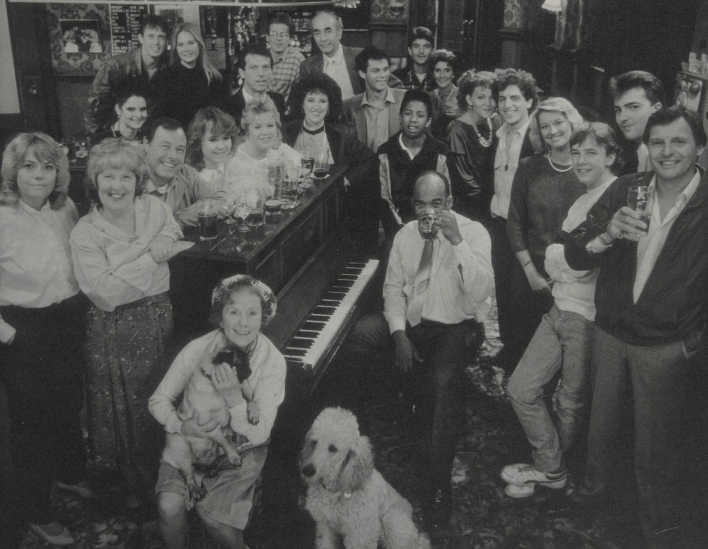
The cast of characters complete, not just a collection of personality types, but a rich interconnected community, whose lives in some cases first intertwined decades before being dreamt up. There were tweaks to be made at a later stage – Jack, Pearl and Tracey would became Den, Angie and Sharon, for example – but each potted biography led Smith and Holland towards storylines for each family, both short- and long-term.
Being able to plan several months, even years ahead even gave the co-creators space to cannily schedule key twists for parts of the year when viewing figures are likely to be higher. The plan, in short, was all coming together. By the end of their trip to the Canary Islands, Smith and Holland had loosely mapped out the first three years of key events within the Square, their initial hurried draft now fleshed out to 30,000 words of detail.
Pondering the incoming series several months later in October 1984, a piece in The Stage queried which of the two approaches for a modern serial drama could choose from. The first method is to try and reflect a range of diversity of opinion on social, political or personal issues, with the ultimate effect of getting such views into more homes than any current affairs programme could dream of. The second – avoid issues, offer some warm, comforting entertainment, offering a break from the social affairs and acting an electronic Horlicks to the audience. In short: Brookside, or Crossroads. It wasn’t hard to guess which side of the coin would be facing up when the new series finally flickered into life.
How soon to make that clear to the audience? Well, no point hanging about, or engineering an exposition-heavy argument at the pub to kickstart the first episode. Go with a bang. Or a boot.
“East 8 starts with a bang, as a size ten boot kicks down a door that’s locked from the inside. The tiny, dirty and foul-smelling council-flat behind the battered door belongs to Reg Cox (known locally as “the-old-boy”, and a cantankerous bastard at the best of times) who hasn’t been seen around the square for days… Once the door’s down, three men rush into the gloomy main-room: Dan, the publican, Arthur and Ali, the Turkish Cypriot – still in his pyjamas or dressing gown. They find the old boy sitting in his favourite armchair beside the gas-fire (which isn’t on) – and he’s very nearly dead.”
Storyline for Episode One, Scene One – EastEnders: The Inside Story, Julia Smith and Tony HollandAs preparations continued, May 1984 brought an unlikely invitation from the ‘rival’ camp – Coronation Street’s Bill Podmore invited Julia Smith over to Manchester to visit the cobbled set of Granada’s long-running serial. Plus, hey, while you’re here, come and see the set of the new twice-weekly drama that we’re developing. It’s set in a market! Hang on, what? Yep, wary of East 8’s tanks on the lawns of Wetherfield, Granada were planning their very own new continuing drama. So, it was a race to air. And East 8 had yet to cast any actors.

New Market. New Danger. That started to change in July, the first of three months in which the entire series would be cast. Some of the cast were sought out by Smith and Holland – first choice being Bill Treacher (following his small role as bus driver in An American Werewolf in London) (oh, and they’d worked with him on Z Cars. Mainly that, yes). Similarly, Shirley Cheriton had worked with the showrunners on Angels, and was chosen to play upwardly mobile Debbie, while writer Bill Lyons had worked with Sandy Ratcliff previously, and suggested her for the role of hardfaced minicab firm co-owner Sue Osman.
Other roles were largely cast from a multitude of auditions following bags of letters, photos and recommendations from agents. And, slowly but surely, real-life faces were finally attached to the characters punched out over that fortnight in the Canary Islands. The next pressing concern was the name of the series. The working title had been ‘East 8’, but that was never really going to stick (not least as it was actually set in the fictional postal district of E20). Eventually, those casting sessions brought about the answer – after both writing countless letters to casting agents pointing out that “only genuine East-enders need apply” for the roles, it finally hit Julia Smith that the title had been staring them in the face all along. One capitalisation-of-the-second-E a little later, thanks to the suggestion of BBC2 controller Graeme McDonald, the programme title was sorted.
September 1984 brought more bumps in the road. Scripts had been written with the aim of the series launching soon, but the programme’s lead director issued an ultimatum on the uncompromising nature of them, demanding that the characters be lightened up, to be at least a little more likeable. Smith and Holland stuck to their guns – no rewrites. Subsequently, EastEnders found itself with just two remaining directors. Another issue came from the phone of newly-installed Controller of BBC1, Michael Grade. The plan had been for the new series to make up part of BBC1’s weekday evening schedule, running for two weeknights each week while the rebooted version of Saturday night chat show Wogan ran for three. The problem was: Wogan wasn’t going to be ready for the proposed start date, so the launch of both programmes would need to be moved back a month. With EastEnders’ scripts being a very much real-time affair, with in-show Valentine’s Day happening on real-life Valentine’s Day and such… they’d have to be rewritten after all.

Yeah, that’s right. Look sorry, Wogan. A key day for the series fell on 10 October 1984, which saw the cast introduced for the first time to the press, and therefore the public. At this stage, the closest many of the cast had come to each other had been when they’d happened to have been in passing where they’d been auditioned on the same day, meaning this was their first real meeting. Some of the casting decision had still to be made, some key actors were otherwise engaged with roles elsewhere, but at least the whole thing now seemed that little bit more real. This was really going to happen.
Though not for everyone.
The part of Angie Watts originally went to Jean Fennell, then mostly known for stage roles, but initially deemed a good fit for the role. However, as rehearsals went on, it was felt that she’d been miscast. Everything they needed to get from Angie just wasn’t coming through in Fennell’s performance. According to Leslie Grantham’s autobiography, the disparity between the character of Angie and Fennell’s take on it was even wider, with the actress determined to play Angie as more of a Bet Lynch figure, but in any case the now ex-Angie was given six months’ full pay, and a car home.
(For the record, the only change Grantham refers to demanding when it came to Den was that he support West Ham rather than Arsenal, resulting in a variety of Highbury-related decor swiftly being replaced in the Old Vic.)
So, with just four days until the first studio recording, one of the programme’s main characters was uncast. As fate would have it, someone who’d previously been considered for the role by Julia Smith came back into play. Initially, Smith had dismissed the idea of offering the role to her former drama school pupil Anita Dobson, feeling she was a little too young for the role. But, on being contacted by Smith, a brief audition proved that those initial concerns were unfounded – she was perfect for the role.
Finally, the time came for the programme to air, and it’s fair to say the BBC had a lot riding on it. Smith and Holland had been given a huge amount of autonomy over the series, with the first episodes being recorded for air without any pilot being shot, and no opportunity was given for management to view the recorded episode footage until the sole edit had been completed. One aspect of the programme that management could control regarded the Radio Times front page promoting the first episode. The wording for the famous RT front cover had initially read “The EastEnders are here… and they’re luverly!”. It took the intervention of department head Jonathan Powell to have those final three, ill-fitting words removed. Otherwise an expectant nation may well have tuned in anticipating an Only Fools and Horses spin-off.
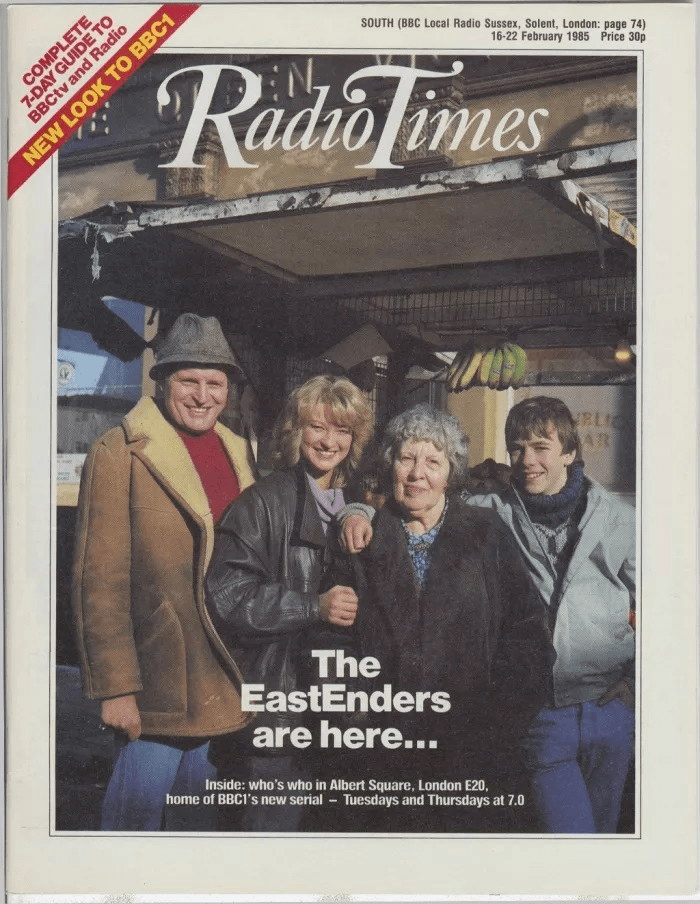
A flurry of EastEnders trailers slid between other programmes in the weeks leading up to episode one, and Michael Grade had given in to Julia Smith’s request that Sunday afternoon BBC1 play host to a weekly omnibus of episodes, so that any fans who’d been otherwise engaged on Tuesday or Thursday evenings would be able to catch-up. British Telecom even offered up an ‘EastEnders line’ number, which provided a three-minute synopsis of the previous episode, written by Tony Holland and read by a cast member.
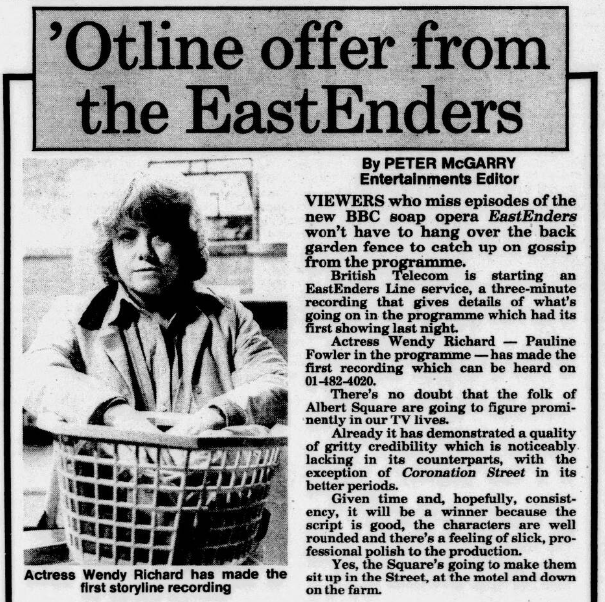
Coventry Evening Telegraph, Wednesday 20 February 1985 Finally, the time had come. On Tuesday 19 February 1985 at 7pm, 17 million people tuned into to watch Den Watts kick in Reg Cox’s front door. The rest is television history.
Oh, as for Granada’s spoiler soap Albion Market – the market-based Friday/Sunday soap failed to find an audience, not helped by London franchise LWT declining to air the programme in a primetime slot. It was cancelled within a year.
Granada should probably have set it in a caravan park.
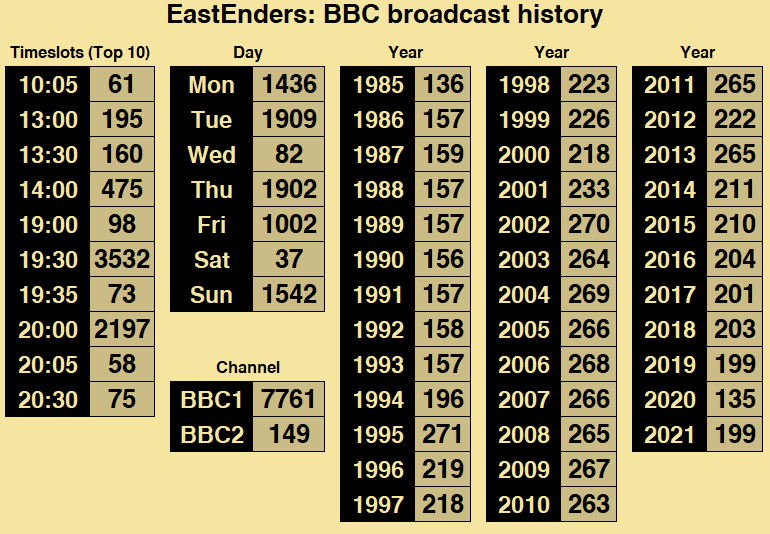
That’s right, I just did mark 36 years of a programme’s history by writing a billion words that cease a few seconds after the first episode airs. I could easily have written a lot more, but I’m keen to get this online before the BBC’s second centennary. So, until next time.
Only two more shows to go!

BrokenTV
Welcome, welcome, welcome home
 BrokenTV