
Hi everyone! I have grown weary of the yellow and changed the blog layout. Hopefully this layout works more effectively when pushed out as an email update.
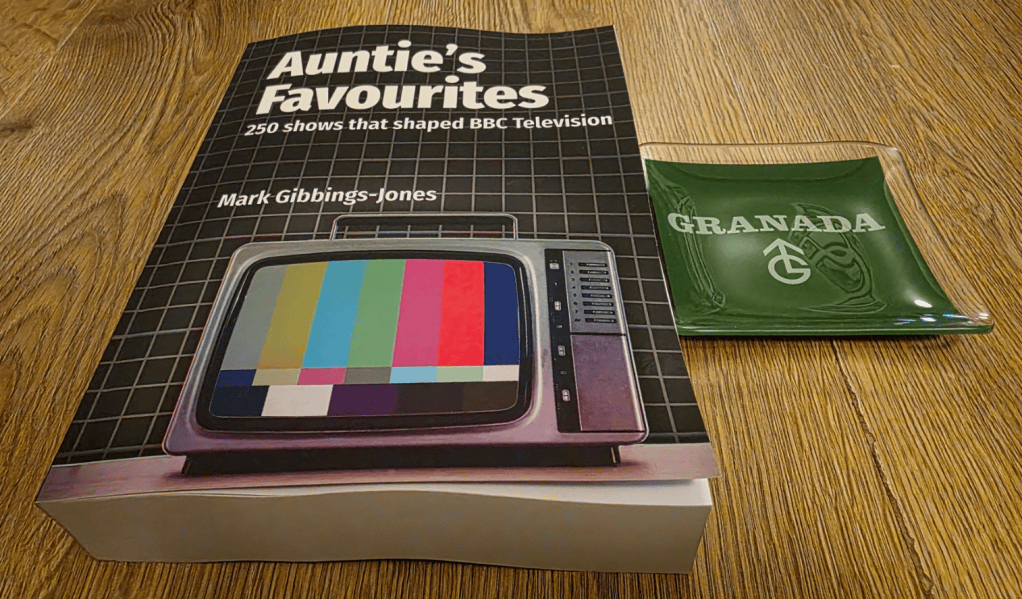
A big “thank you!” to everyone who’s bought a copy of Auntie’s Favourites so far. And to everyone who has placed it on their Christmas list. And for everyone who is waiting for a non-Amazon place to purchase it, there’s some big news: there is now a non-Amazon place to purchase it.
For the paper copy, it’s also now available from The Great British Book Shop for just £19.99.
For those who prefer a digital copy, it’s available at the following places:
In the UK:
bookshop.org | Apple Books | Kobo
Or in the USA:
Apple Books | Barnes & Noble | bookshop.org
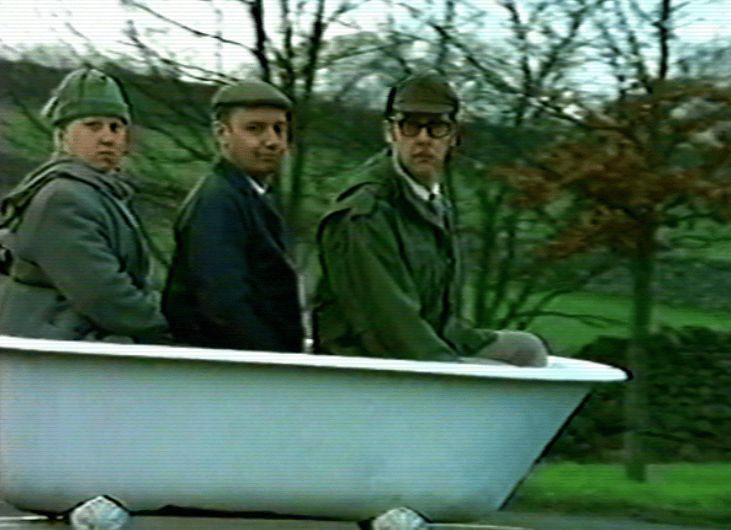
And while we’re on about that, how about another extract from the book? Push a bath to the top of a steep hill and clamber in, because we’re trundling off to Yorkshire for the programme in 220th place. Fill your glass with the…
Last of the Summer Wine
1973-2023, broadcast 559 times
BBC1 (552 times, 1973-2010)
BBC4 (7 times, 2010-2023)
File this one firmly under ‘I Thought This Would Be Much Higher’.
It’s one of the great paradoxes of sitcom history. As everyone knows, Last of the Summer Wine is about three chaps of advanced age who find ways to fill their days, mostly on the rolling hills of West Yorkshire. And yet, it ran for 37 years, and one of the initial lead characters featured in the series throughout the run. So, what gives? Well, we’ll come to that a little later.
But, let’s start at the beginning. Or just before it. In 1971, Roy Clarke’s stock was high. Before then, he was a prolific writer in search of success. His big break came with radio play The Big Bite (The Light Programme, 22 June 1966), which drew on Clarke’s experiences as a young police constable. From there, he went on to more radio plays along with splendidly named serials The 17-Jewelled Shockproof Swiss-Made Bomb (Radio Two, 18 January – 5 February 1968) and The Events at Black Tor (Radio Two, 18 April – 6 May 1968), accompanied by his first TV gig.
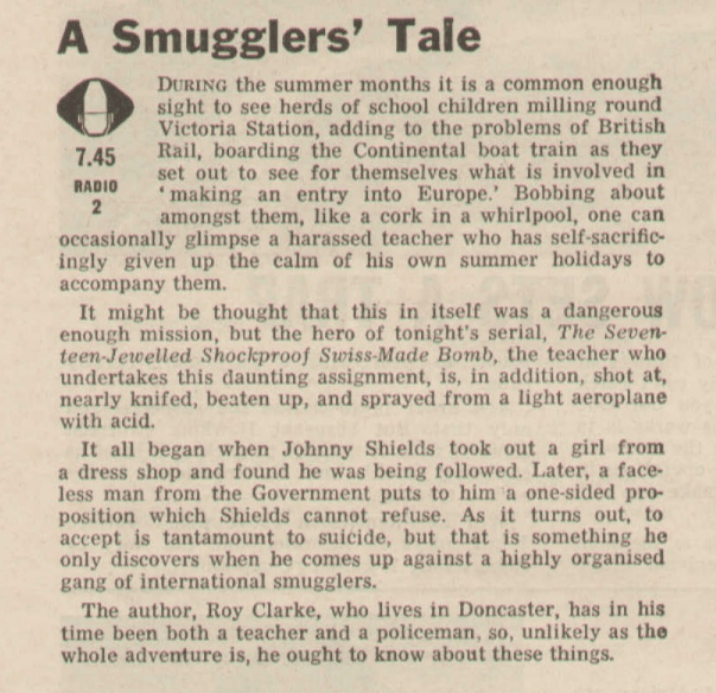
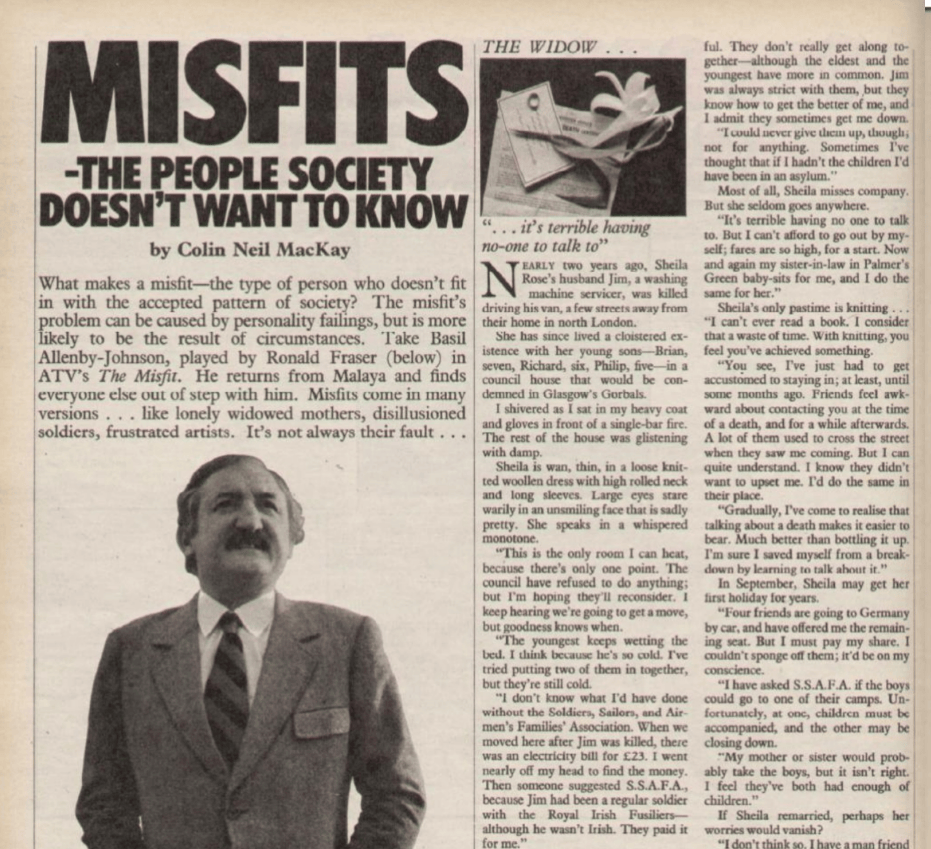
This was a big deal. Previously, Clarke had combined writing with his day job as a teacher. This new opportunity – writing for drama series The Troubleshooters – would require his full-time attention. Following his initial four-script contract on The Troubleshooters came more dramatic work for Clarke: a dramatisation of W Somerset Maugham’s The Back of Beyond (BBC2, 10 June 1969), TV play The John Hilarian Salt Exhibition and Numerous Illustrated Slides (Granada, 4 August 1969), plus episodes of crime drama Detective (“The Public School Murder”, BBC1, 21 September 1969) and WWII serial Manhunt (“Only the Dead Survive”, London Weekend, 16 January 1970). His biggest break yet came with The Misfit – a full series for ATV.
This was a rare example of a channel-hopping spinoff, with blustery-colonel character Basil “Badger” Allenby-Johnson from BBC drama The Troubleshooters (played by the ever-reliable Ronald Fraser) arriving back in early-70s Britain after spending half his life on a rubber plantation in Malaya. The Britain he left behind is long gone, leaving him both back home and in unfamiliar surroundings. The Misfit ran for two well received series (Daily Mirror letters, 16 March 1970: “In many other TV plays I often thought Fraser was a misfit. But in ‘The Misfit’ he really fits. A thoroughly enjoyable series.” – Mrs K Lennard, Sussex), which brought Roy Clarke to the attention of a very big name within TV comedy circles.
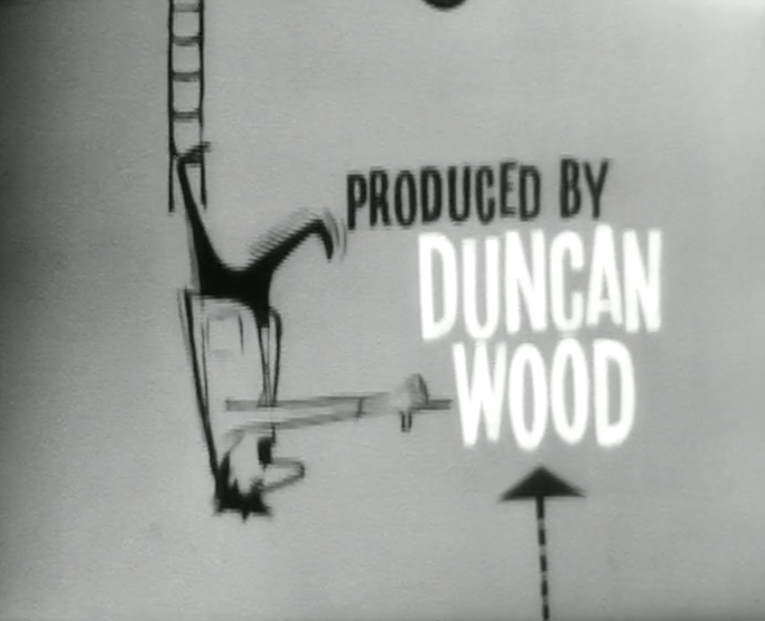
As far as British television sitcoms go, there are few figures more important than Duncan Wood. Starting at the BBC as an outside broadcast engineer, he made the move into producing and presenting radio programmes in the 1950s, including lunch-break variety stalwart Workers’ Playtime (Home Service/Forces Programme/Light Programme, May 1941-October 1964), which put him in close proximity with up-and-coming comedy names like Dick Emery, Benny Hill and Tony Hancock. After a few years on the wireless, Wood moved into television, producing variety series Garrison Theatre, dance-em-up Everybody Swing!, Kenneth Horne panel show Find the Link, and comedy sketch series Great Scott It’s Maynard, starring Terry Scott and Bill Maynard.
For this move into TV comedy, Wood was more than a little modest, telling the Radio Times “Eventually we hope to make people laugh”. The programme ran for three series, so safe to say it found an appreciative audience. His next few forays into TV comedy certainly needed that level of caution. The first – Strictly T-T – was a vehicle for national treasure Terry-Thomas, with the gap-toothed cad calling out Wood in a piece for the Radio Times: “My producer Duncan Wood has already aged perceptibly since I met him a few weeks ago”. That lasted just six episodes, but Wood’s next project – as producer and director – would go on to set the blueprint for British situation comedy.
Yep, apologies to any Life with the Lyons fans reading this, but it’s Hancock’s Half Hour we’re talking about here. The TV sitcom that shaped British sitcom as we know it, and which has rarely been bettered almost seventy years from its initial broadcast. From there: Steptoe and Son, Harry Worth, underrated Sid James vehicle Citizen James and long-running sitcom anthology series Comedy Playhouse.
Playhouse – airing for 137 episodes between 1961 and 1975 – was the incubator for a whole generation of classic British sitcom. Initially a playground for a post-Hancock Galton and Simpson, as they sought out their next hit series (finding it with The Offer, renamed Steptoe and Son when it became a full series), it would go on to involve many golden-era sitcom writers, all the way from partnerships like Esmonde and Larbey or Clement and La Frenais, to solo acts such as Barry Took, Johnny Speight and Kingsley Amis.
Of course, the BBC being the BBC, of the 137 episodes around 95 of the damn things are now missing, but the run included pilot episodes for what would become Till Death Us Do Part, Up Pompeii!, The Liver Birds and Are You Being Served?. Plus, you know, one edition called The Last of the Summer Wine. (“Bloody hell, finally.” – Everyone.)
Come 1972, and Duncan Wood – now BBC Head of Comedy – was more than a little impressed by Roy Clarke’s The Misfit. Clarke’s ability to blend comedy and drama, plus a lead character finding himself thrust into a familiar world he no longer feels a part of, could be employed in a more straightforward sitcom format, and would make an ideal addition to Comedy Playhouse’s thirteenth series. Wood invited Clarke to a meeting, so that potential projects could be discussed, with one idea in particular in mind.
As Clarke would later recall, the writer attended the meeting keen on writing a standard sitcom, only for Wood to state “we want something with three old men”. And that was pretty much the brief in full. It was a suggestion that Clarke recoiled from. Despite having careers of various lengths as policeman, teacher and writer under his belt, Clarke had only recently entered his forties – he didn’t know anything about old men, or didn’t much want to know. The BBC’s rationale was that the idea matched a gap in their audience, but Clarke couldn’t envision the idea having any kind of audience appeal at all.
With a heavy heart, Clarke tried to conjure up a suitable premise for such a series. A few weeks of batting ideas around led to a revelation: what if the protagonists didn’t actually act their age? After all, being retired, they’d be at an age where they’re unencumbered by jobs, or by raising kids, or by responsibilities. They’d be free to be great big overgrown kids. A bit more work on the overall blueprint, and the leading trio were born: the fastidious Cyril Blamire, workshy waster Compo Simmonite and the midpoint between the two, Norman Clegg. Three overgrown kids killing time on their perpetual summer holiday. Two polar opposites, with Clegg in the middle.
If the focus of the series on three old men was unusual enough, so was the setting. Much of each episode would be filmed outdoors – definitely a break from the usual studio-set-with-outdoor-filmed-inserts sitcom norm. Wood’s choice of producer for The Last of the Summer Wine, the well-regarded James Gilbert, was fully on board with Clarke’s ideas for the programme, and helped to shape the unique tone and style of the show, with the rolling Yorkshire scenery serving as a fourth main character. But when it came to the three (human) leads, Gilbert had reservations. Having previously worked on series The Walrus and the Carpenter, starring veteran actors Hugh Griffith and Felix Aylmer, he noted that audiences seemed unsure about simply laughing at old men. Dad’s Army at least had a wider spread of ages, but having all the action based on the mishaps of genuine old men seemed to cause uncertainty. There’s a reason Mainwaring did the pratfalls, rather than Godfrey.
With this in mind, Gilbert suggested to Clarke that the lead characters should have another reason to be kicking around the streets, rather than simply being old. After all, having a seventy-something kicking a tin can down a street might be funny once or twice, but if this is going to go to series, it’s going to get, well, old. The script was duly retooled and the trio were rewritten as three unemployed middle-aged men. With Clegg and Blamire now living off their redundancy packages, they were still free from responsibility, still kicking around a world that no longer held any great purpose for them, but now the audience could safely laugh if one of them fell on their arse. In came an appropriately-aged cast: fiftysomethings Peter Sallis, Bill Owen and Michael Bates.
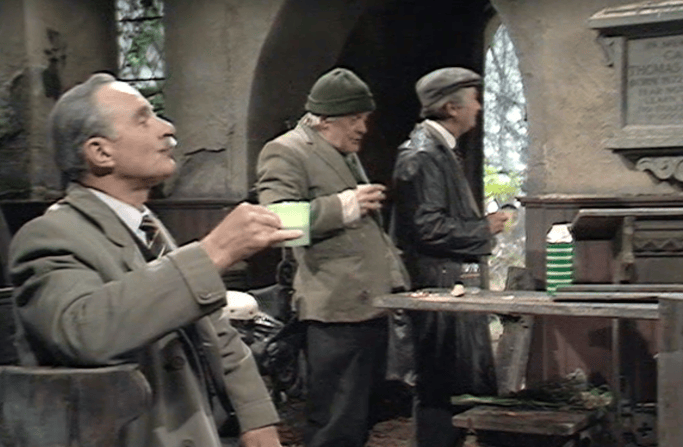
The pilot episode – “Of Funerals and Fish” – duly opened the next series of Comedy Playhouse on 4 January 1973, and was well-received, even if press reaction at the time was suspicious of it being a bit too parochial. The Daily Mirror’s Mary Malone (5 Jan 1973) described the initial episode as “primitive, provincial [and] hilarious”, but also posited “if it was the kind of comedy to make folk above St Albans smirk, it may well also make those below wonder”. Still, the overall reaction was positive and a full series was commissioned, airing from 5 November of the same year, in the post-watershed slot it would occupy for much of its first decade on air, which is quite the departure from what it would become.
While the first series passed by without getting much attention, summer 1974 saw Summer Wine given a primetime BBC1 repeat run. This second chance at encountering the series helped draw attention to the debut of the second series in March 1975. Perhaps unexpectedly, it started drawing in a decent audience – 7.5m households for the opening episode (such was the way audiences were measured at the time – putting it level with Coronation Street that week). This lo-fidelity sitcom – the plot of one episode involved Clegg trying to get his bicycle repaired – was building a loyal audience.
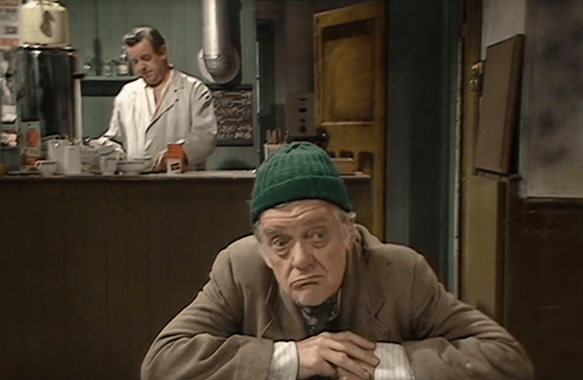
Sadly for the series, one third of the main cast was having trouble with his health and workload. Michael Bates left the series, sticking with the more studio-bound It Ain’t Half Hot Mum before passing away in 1978. As a result, the third series of Summer Wine introduced a new team member. Arriving under the guise of returning to his home village following retirement, Foggy Dewhurst (Brian Wilde) met up with old pals Clegg and Compo, and the Imperial Phase of the Summer Wine could begin.
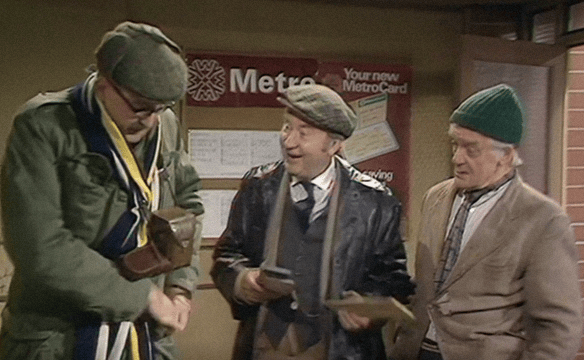
And it didn’t only attract the attention of older viewers. Personally I bloody loved it when I was a kid, by this time a Sunday evening fixture slotted in nicely after Songs of Praise. It proved to be the perfect accompaniment to Sunday teatime banana butties and Battenberg. So much so that I pestered my mum to rent the VHS release of feature-length episode Getting Sam Home from the local video rental shop. Despite airing over Christmas in 1983, the plot had the trio sneak the corpse of an adulterer across town and back into his marital bed before his wife wakes up[1]. See, the plots weren’t all about broken bicycles.
From there, shortly after Wilde’s hiatus from the programme (his spot taken by Michael Aldridge’s crackpot inventor Seymour), much of the focus shifted onto other characters from the village. Sadly, perhaps down to the prolific Roy Clarke working on several other series throughout Summer Wine’s marathon run (most notably Keeping Up Appearances and Open All Hours), most of them pretty much turned up, did their line, then buggered off until the next episode. Wesley traipsed oil everywhere, Edie would get annoyed, Howard and Marina would get caught canoodling in a bush, Pearl would get annoyed, Barry turned up and dithered, while Glenda tutted. Well, they can’t all be Nora Batty.
Following the Wine’s peak period, circumstances (often but not exclusively due to the demands on the increasingly elderly cast) meant main characters would be replaced – crucially, ill health led to a permanent departure for Brian Wilde’s Foggy in 1998 while Compo actor Bill Owen passed away in 1999. Frank “Mr Peacock” Thornton stepped in to replace the latter, while Bill Owen’s son Tom Owen temporarily took his father’s place in the line-up, before stepping into a more minor role. Keith Clifford’s Billy Hardcastle took on the third place in the lead line-up at the turn of the millennium.
With a hardy audience still tuning in each Sunday, the series remained a fixture on BBC One – even if the Beeb’s programme commissioners were clearly clamouring for something a bit trendier to boast about at All Bar One – so much so that when the demands of filming meant Peter Sallis’ role in the series had to be reduced to studio scenes, a new leading trio were introduced for the final couple of series. In any other circumstance, a sitcom starring Russ Abbott, Brian Murphy and Burt Kwouk would be one for the ages.
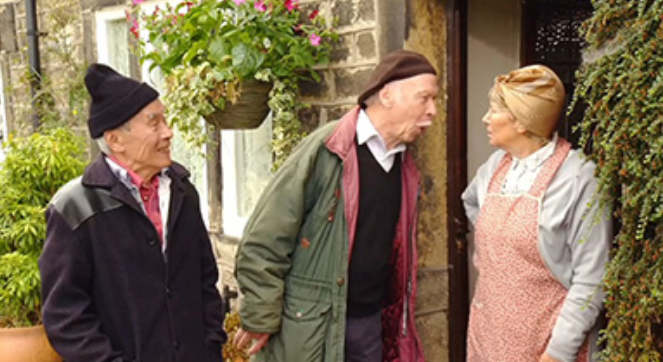
But, the template for Summer Wine could only take so many amendments, and the All-New Adventures of the Summer Wine failed to connect with audiences. Roy Clarke called time on the series after the programme’s thirtieth series.
Fittingly, the final word went to Peter Sallis, the programme’s only ever-present actor. In keeping with Clegg’s long-running anxiety over whether his front door had been left unlocked, the last words of the Summer Wine were simply “Did I lock the door?”.
[1] The plot involved Foggy, Compo and Clegg visiting their pal Sam in hospital, and agreeing to help him spend one last night with his fancy piece, “Lily-Bless-Her” (played by Linda Baron, no less). The unseen exertions at Lily’s are too much for Sam’s ticker, meaning it’s up to our intrepid trio to get Sam’s corpse (yep, corpse) back home so that his wife Sybil thinks he died in his own bed. In 1994, this was repeated at 7pm on BBC1. All shot on film, as was the style at the time, which added an extra layer of grimness to it. I really enjoyed it, too. Probably the closest I ever got to a video nasty. BONUS FACT: it was the first BBC sitcom to earn a 90-minute Christmas special episode. Anyway, we’re not here for that.
That’s all for now! Buy the book! Bye!


Leave a Reply