Tag: BBC

  • New Layout! New Shops! The 17-Jewelled Shockproof Swiss-Made Bomb! The All-New Adventures of the Summer Wine!

    New Layout! New Shops! The 17-Jewelled Shockproof Swiss-Made Bomb! The All-New Adventures of the Summer Wine!

    Hi everyone! I have grown weary of the yellow and changed the blog layout. Hopefully this layout works more effectively when pushed out as an email update.

    A big “thank you!” to everyone who’s bought a copy of Auntie’s Favourites so far. And to everyone who has placed it on their Christmas list. And for everyone who is waiting for a non-Amazon place to purchase it, there’s some big news: there is now a non-Amazon place to purchase it.

    For the paper copy, it’s also now available from The Great British Book Shop for just £19.99.
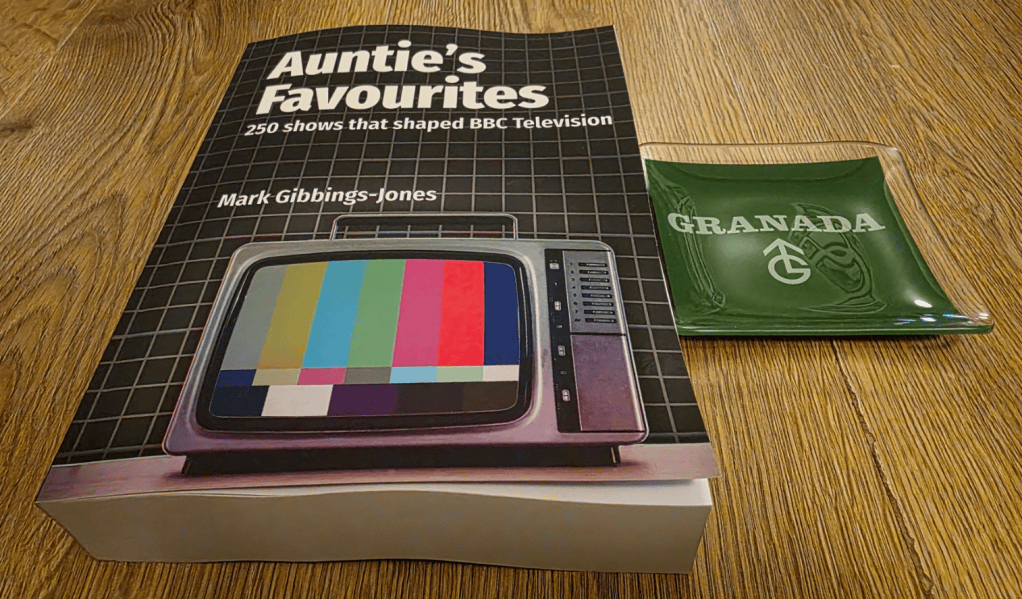
    The big old Auntie's Favourites Book and a Granada TV ashtray
    A copy of the big old book. Granada TV ashtray for scale.

    For those who prefer a digital copy, it’s available at the following places:

    In the UK:

    bookshop.org | Apple Books | Kobo

    Or in the USA:

    Apple Books | Barnes & Noble | bookshop.org

    And while we’re on about that, how about another extract from the book? Push a bath to the top of a steep hill and clamber in, because we’re trundling off to Yorkshire for the programme in 220th place. Fill your glass with the…

    Last of the Summer Wine

    1973-2023, broadcast 559 times

    BBC1 (552 times, 1973-2010)

    BBC4 (7 times, 2010-2023)

    File this one firmly under ‘I Thought This Would Be Much Higher’.

    It’s one of the great paradoxes of sitcom history. As everyone knows, Last of the Summer Wine is about three chaps of advanced age who find ways to fill their days, mostly on the rolling hills of West Yorkshire. And yet, it ran for 37 years, and one of the initial lead characters featured in the series throughout the run. So, what gives? Well, we’ll come to that a little later.

    But, let’s start at the beginning. Or just before it. In 1971, Roy Clarke’s stock was high. Before then, he was a prolific writer in search of success. His big break came with radio play The Big Bite (The Light Programme, 22 June 1966), which drew on Clarke’s experiences as a young police constable. From there, he went on to more radio plays along with splendidly named serials The 17-Jewelled Shockproof Swiss-Made Bomb (Radio Two, 18 January – 5 February 1968) and The Events at Black Tor (Radio Two, 18 April – 6 May 1968), accompanied by his first TV gig.
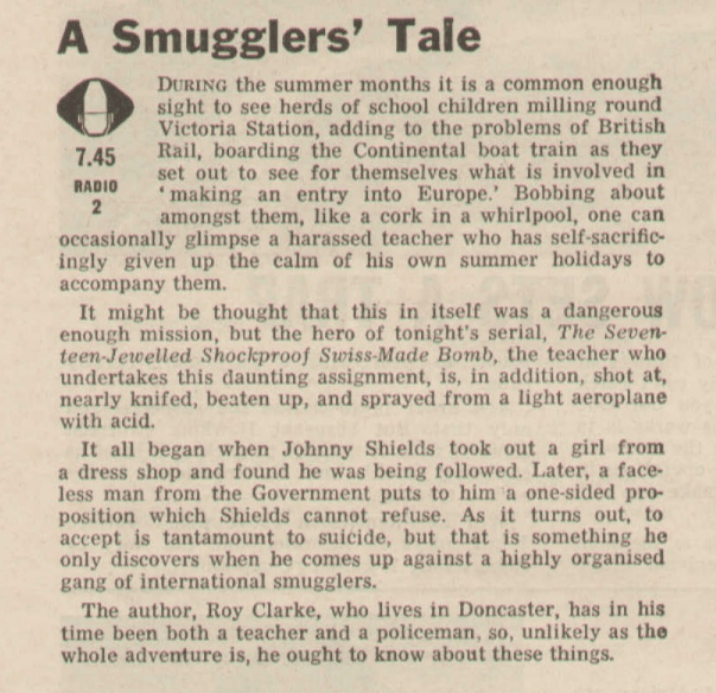
    Original Radio Times preview for The 17-Jewelled Shockproof Swiss-Made Bomb
    Radio Times, 13 January 1968

    This was a big deal. Previously, Clarke had combined writing with his day job as a teacher. This new opportunity – writing for drama series The Troubleshooters – would require his full-time attention. Following his initial four-script contract on The Troubleshooters came more dramatic work for Clarke: a dramatisation of W Somerset Maugham’s The Back of Beyond (BBC2, 10 June 1969), TV play The John Hilarian Salt Exhibition and Numerous Illustrated Slides (Granada, 4 August 1969), plus episodes of crime drama Detective (“The Public School Murder”, BBC1, 21 September 1969) and WWII serial Manhunt (“Only the Dead Survive”, London Weekend, 16 January 1970). His biggest break yet came with The Misfit – a full series for ATV.

    This was a rare example of a channel-hopping spinoff, with blustery-colonel character Basil “Badger” Allenby-Johnson from BBC drama The Troubleshooters (played by the ever-reliable Ronald Fraser) arriving back in early-70s Britain after spending half his life on a rubber plantation in Malaya. The Britain he left behind is long gone, leaving him both back home and in unfamiliar surroundings. The Misfit ran for two well received series (Daily Mirror letters, 16 March 1970: “In many other TV plays I often thought Fraser was a misfit. But in ‘The Misfit’ he really fits. A thoroughly enjoyable series.” – Mrs K Lennard, Sussex), which brought Roy Clarke to the attention of a very big name within TV comedy circles.
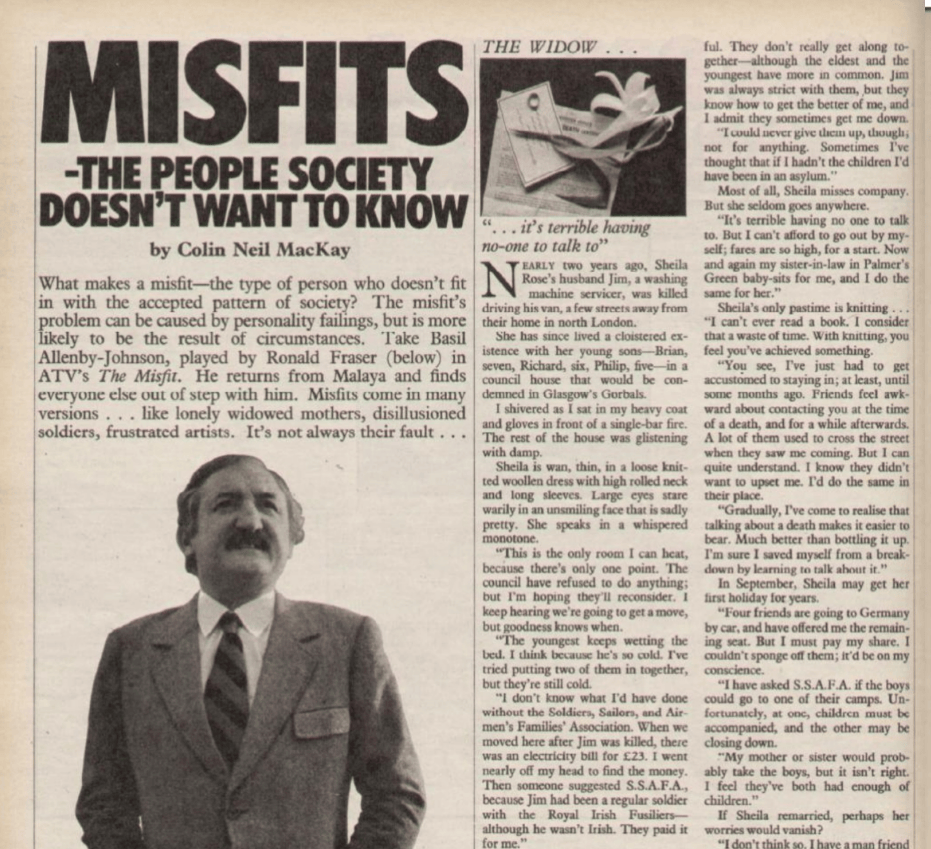
    TV Times article on sitcom The Misfit, along with a photo of Ronald Fraser looking pompous yet winsome
    TV Times, 21 March 1970

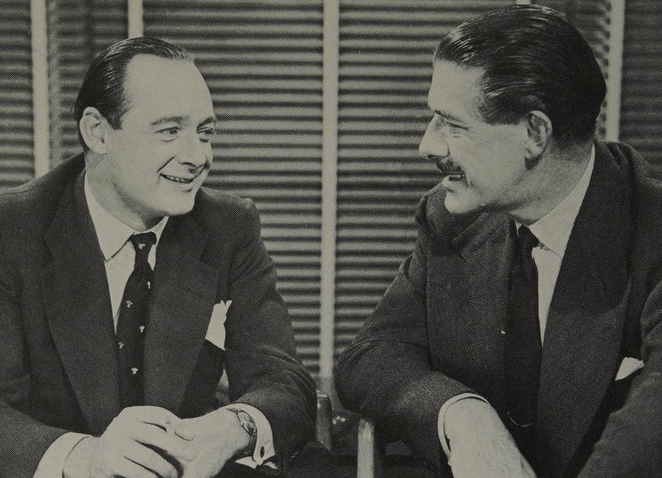
    As far as British television sitcoms go, there are few figures more important than Duncan Wood. Starting at the BBC as an outside broadcast engineer, he made the move into producing and presenting radio programmes in the 1950s, including lunch-break variety stalwart Workers’ Playtime (Home Service/Forces Programme/Light Programme, May 1941-October 1964), which put him in close proximity with up-and-coming comedy names like Dick Emery, Benny Hill and Tony Hancock. After a few years on the wireless, Wood moved into television, producing variety series Garrison Theatre, dance-em-up Everybody Swing!, Kenneth Horne panel show Find the Link, and comedy sketch series Great Scott It’s Maynard, starring Terry Scott and Bill Maynard.

    For this move into TV comedy, Wood was more than a little modest, telling the Radio Times “Eventually we hope to make people laugh”. The programme ran for three series, so safe to say it found an appreciative audience. His next few forays into TV comedy certainly needed that level of caution. The first – Strictly T-T – was a vehicle for national treasure Terry-Thomas, with the gap-toothed cad calling out Wood in a piece for the Radio Times: “My producer Duncan Wood has already aged perceptibly since I met him a few weeks ago”. That lasted just six episodes, but Wood’s next project – as producer and director – would go on to set the blueprint for British situation comedy.
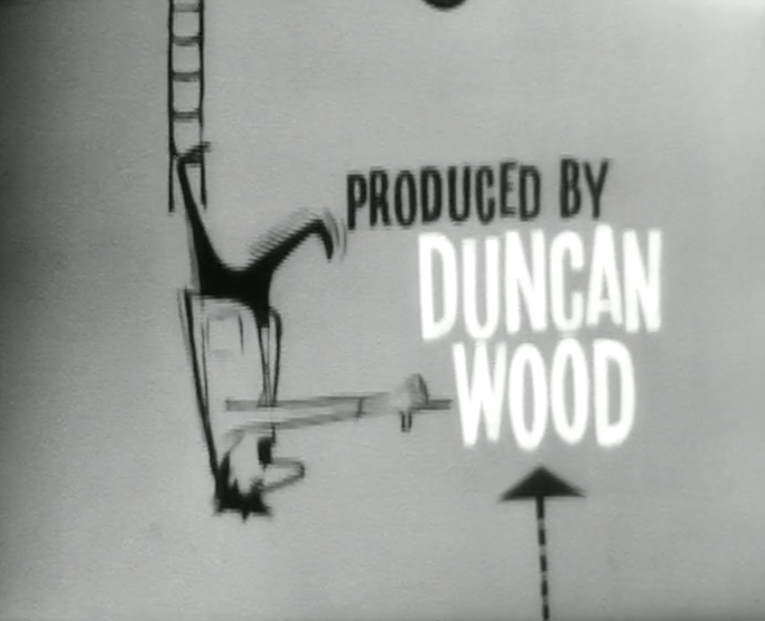
    Caption card for "Produced by Duncan Wood" at the end of a Hancock's Half Hour episode.
    Hancock’s Half Hour, S3E5 “Air Steward Hancock – The Last of the Many” (27 Oct 1957)

    Yep, apologies to any Life with the Lyons fans reading this, but it’s Hancock’s Half Hour we’re talking about here. The TV sitcom that shaped British sitcom as we know it, and which has rarely been bettered almost seventy years from its initial broadcast. From there: Steptoe and Son, Harry Worth, underrated Sid James vehicle Citizen James and long-running sitcom anthology series Comedy Playhouse.

    Playhouse – airing for 137 episodes between 1961 and 1975 – was the incubator for a whole generation of classic British sitcom. Initially a playground for a post-Hancock Galton and Simpson, as they sought out their next hit series (finding it with The Offer, renamed Steptoe and Son when it became a full series), it would go on to involve many golden-era sitcom writers, all the way from partnerships like Esmonde and Larbey or Clement and La Frenais, to solo acts such as Barry Took, Johnny Speight and Kingsley Amis.

    Of course, the BBC being the BBC, of the 137 episodes around 95 of the damn things are now missing, but the run included pilot episodes for what would become Till Death Us Do Part, Up Pompeii!, The Liver Birds and Are You Being Served?. Plus, you know, one edition called The Last of the Summer Wine. (“Bloody hell, finally.” – Everyone.)

    Come 1972, and Duncan Wood – now BBC Head of Comedy – was more than a little impressed by Roy Clarke’s The Misfit. Clarke’s ability to blend comedy and drama, plus a lead character finding himself thrust into a familiar world he no longer feels a part of, could be employed in a more straightforward sitcom format, and would make an ideal addition to Comedy Playhouse’s thirteenth series. Wood invited Clarke to a meeting, so that potential projects could be discussed, with one idea in particular in mind.

    As Clarke would later recall, the writer attended the meeting keen on writing a standard sitcom, only for Wood to state “we want something with three old men”. And that was pretty much the brief in full. It was a suggestion that Clarke recoiled from. Despite having careers of various lengths as policeman, teacher and writer under his belt, Clarke had only recently entered his forties – he didn’t know anything about old men, or didn’t much want to know. The BBC’s rationale was that the idea matched a gap in their audience, but Clarke couldn’t envision the idea having any kind of audience appeal at all.

    With a heavy heart, Clarke tried to conjure up a suitable premise for such a series. A few weeks of batting ideas around led to a revelation: what if the protagonists didn’t actually act their age? After all, being retired, they’d be at an age where they’re unencumbered by jobs, or by raising kids, or by responsibilities. They’d be free to be great big overgrown kids. A bit more work on the overall blueprint, and the leading trio were born: the fastidious Cyril Blamire, workshy waster Compo Simmonite and the midpoint between the two, Norman Clegg. Three overgrown kids killing time on their perpetual summer holiday. Two polar opposites, with Clegg in the middle.

    If the focus of the series on three old men was unusual enough, so was the setting. Much of each episode would be filmed outdoors – definitely a break from the usual studio-set-with-outdoor-filmed-inserts sitcom norm. Wood’s choice of producer for The Last of the Summer Wine, the well-regarded James Gilbert, was fully on board with Clarke’s ideas for the programme, and helped to shape the unique tone and style of the show, with the rolling Yorkshire scenery serving as a fourth main character. But when it came to the three (human) leads, Gilbert had reservations. Having previously worked on series The Walrus and the Carpenter, starring veteran actors Hugh Griffith and Felix Aylmer, he noted that audiences seemed unsure about simply laughing at old men. Dad’s Army at least had a wider spread of ages, but having all the action based on the mishaps of genuine old men seemed to cause uncertainty. There’s a reason Mainwaring did the pratfalls, rather than Godfrey.

    With this in mind, Gilbert suggested to Clarke that the lead characters should have another reason to be kicking around the streets, rather than simply being old. After all, having a seventy-something kicking a tin can down a street might be funny once or twice, but if this is going to go to series, it’s going to get, well, old. The script was duly retooled and the trio were rewritten as three unemployed middle-aged men. With Clegg and Blamire now living off their redundancy packages, they were still free from responsibility, still kicking around a world that no longer held any great purpose for them, but now the audience could safely laugh if one of them fell on their arse. In came an appropriately-aged cast: fiftysomethings Peter Sallis, Bill Owen and Michael Bates.
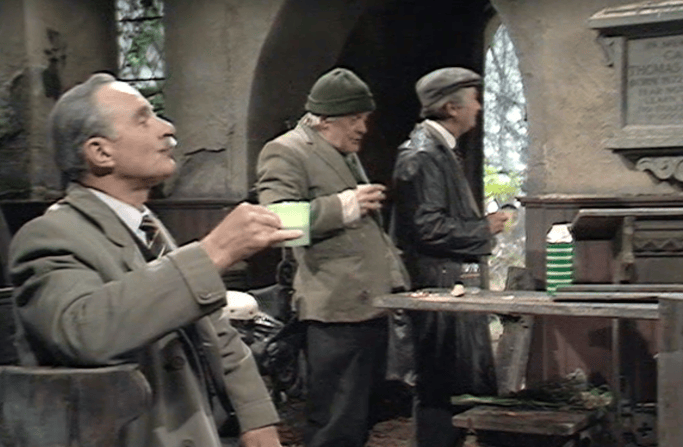
    The original cast for Last of the Summer Wine having a picnic in an old church
    Last of the Summer Wine, pilot episode “Of Funerals and Fish” (4 Jan 1973)

    The pilot episode – “Of Funerals and Fish” – duly opened the next series of Comedy Playhouse on 4 January 1973, and was well-received, even if press reaction at the time was suspicious of it being a bit too parochial. The Daily Mirror’s Mary Malone (5 Jan 1973) described the initial episode as “primitive, provincial [and] hilarious”, but also posited “if it was the kind of comedy to make folk above St Albans smirk, it may well also make those below wonder”. Still, the overall reaction was positive and a full series was commissioned, airing from 5 November of the same year, in the post-watershed slot it would occupy for much of its first decade on air, which is quite the departure from what it would become.

    While the first series passed by without getting much attention, summer 1974 saw Summer Wine given a primetime BBC1 repeat run. This second chance at encountering the series helped draw attention to the debut of the second series in March 1975. Perhaps unexpectedly, it started drawing in a decent audience – 7.5m households for the opening episode (such was the way audiences were measured at the time – putting it level with Coronation Street that week). This lo-fidelity sitcom – the plot of one episode involved Clegg trying to get his bicycle repaired – was building a loyal audience.
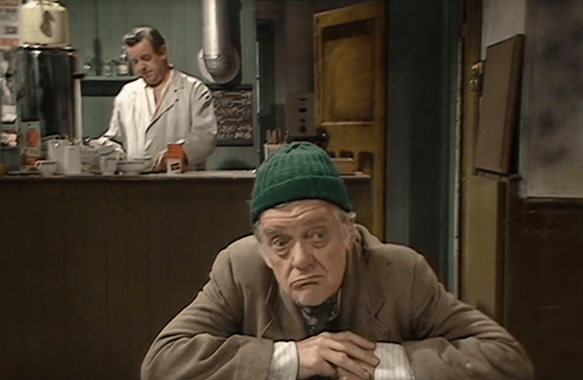
    Compo looking bored in a cafe

    Sadly for the series, one third of the main cast was having trouble with his health and workload. Michael Bates left the series, sticking with the more studio-bound It Ain’t Half Hot Mum before passing away in 1978. As a result, the third series of Summer Wine introduced a new team member. Arriving under the guise of returning to his home village following retirement, Foggy Dewhurst (Brian Wilde) met up with old pals Clegg and Compo, and the Imperial Phase of the Summer Wine could begin.
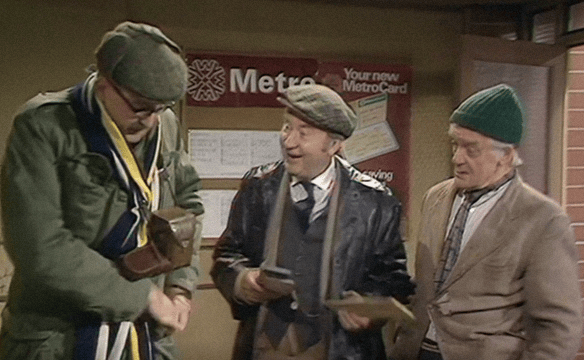
    Foggy meets Clegg and Compo at a bus station
    S3E1 “The Man from Oswestry” (27 Oct 1976)

    And it didn’t only attract the attention of older viewers. Personally I bloody loved it when I was a kid, by this time a Sunday evening fixture slotted in nicely after Songs of Praise. It proved to be the perfect accompaniment to Sunday teatime banana butties and Battenberg. So much so that I pestered my mum to rent the VHS release of feature-length episode Getting Sam Home from the local video rental shop. Despite airing over Christmas in 1983, the plot had the trio sneak the corpse of an adulterer across town and back into his marital bed before his wife wakes up[1]. See, the plots weren’t all about broken bicycles.

    From there, shortly after Wilde’s hiatus from the programme (his spot taken by Michael Aldridge’s crackpot inventor Seymour), much of the focus shifted onto other characters from the village. Sadly, perhaps down to the prolific Roy Clarke working on several other series throughout Summer Wine’s marathon run (most notably Keeping Up Appearances and Open All Hours), most of them pretty much turned up, did their line, then buggered off until the next episode. Wesley traipsed oil everywhere, Edie would get annoyed, Howard and Marina would get caught canoodling in a bush, Pearl would get annoyed, Barry turned up and dithered, while Glenda tutted. Well, they can’t all be Nora Batty.

    Following the Wine’s peak period, circumstances (often but not exclusively due to the demands on the increasingly elderly cast) meant main characters would be replaced – crucially, ill health led to a permanent departure for Brian Wilde’s Foggy in 1998 while Compo actor Bill Owen passed away in 1999. Frank “Mr Peacock” Thornton stepped in to replace the latter, while Bill Owen’s son Tom Owen temporarily took his father’s place in the line-up, before stepping into a more minor role. Keith Clifford’s Billy Hardcastle took on the third place in the lead line-up at the turn of the millennium.

    With a hardy audience still tuning in each Sunday, the series remained a fixture on BBC One – even if the Beeb’s programme commissioners were clearly clamouring for something a bit trendier to boast about at All Bar One – so much so that when the demands of filming meant Peter Sallis’ role in the series had to be reduced to studio scenes, a new leading trio were introduced for the final couple of series. In any other circumstance, a sitcom starring Russ Abbott, Brian Murphy and Burt Kwouk would be one for the ages.
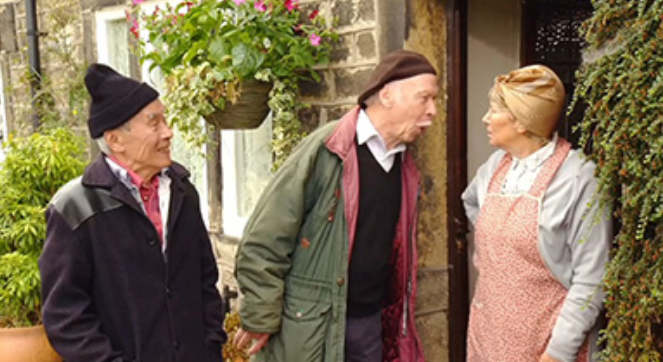
    Hobbo tries to woo Pearl, the fool
    S31E5 “Look Whose Wheel’s Come Off” (22 Aug 2010)

    But, the template for Summer Wine could only take so many amendments, and the All-New Adventures of the Summer Wine failed to connect with audiences. Roy Clarke called time on the series after the programme’s thirtieth series.

    Fittingly, the final word went to Peter Sallis, the programme’s only ever-present actor. In keeping with Clegg’s long-running anxiety over whether his front door had been left unlocked, the last words of the Summer Wine were simply “Did I lock the door?”.


    [1] The plot involved Foggy, Compo and Clegg visiting their pal Sam in hospital, and agreeing to help him spend one last night with his fancy piece, “Lily-Bless-Her” (played by Linda Baron, no less). The unseen exertions at Lily’s are too much for Sam’s ticker, meaning it’s up to our intrepid trio to get Sam’s corpse (yep, corpse) back home so that his wife Sybil thinks he died in his own bed. In 1994, this was repeated at 7pm on BBC1. All shot on film, as was the style at the time, which added an extra layer of grimness to it. I really enjoyed it, too. Probably the closest I ever got to a video nasty. BONUS FACT: it was the first BBC sitcom to earn a 90-minute Christmas special episode. Anyway, we’re not here for that.

    That’s all for now! Buy the book! Bye!
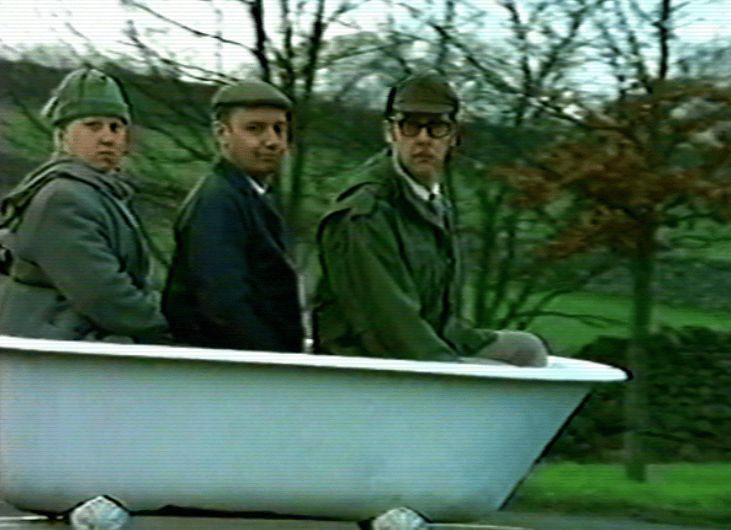
    Matt Lucas, Bob Mortimer and Vic Reeves are Three Men in a Bath
  • Auntie’s Favourites: A New Book, BBC-tv’s 90th Birthday and Picture Page

    Auntie’s Favourites: A New Book, BBC-tv’s 90th Birthday and Picture Page

    After the longest of times, this is complete:

    All being well, it’ll be available to buy in a couple of days as an ebook and shortly after that as a real, physical book you can hug at night. I’ll publish more details when each is available, along with details of the foolishly reasonable pricing.

    What is it? Well, a few years ago this blog (re)launched with a rundown of the hundred television programmes that have been broadcast on the main BBC channels most frequently since that first official television broadcast on 2 November 1936. This book extends the remit (to also cover BBC Three, BBC Four, BBC Choice and BBC Knowledge), the scope (to 250 programmes in total) and the detail (barring any last minute tweaks, it’s a shade under 250,000 words across 626 pages). And this time, I’ve included Newsnight.

    So, why post an update now? Well, it’s very nearly 2 November 2026, which means it’s just about the 90th anniversary of the launch of the BBC Television Service. My original goal was to have the book on sale by then, but found it hard to put the pen down, adding in about a dozen extra pages instead of submitting it in good time for that self-imposed deadline.

    So, in lieu of that, here’s an entry from the book. And a pretty appropriate one – a programme that will also be enjoying its 90th anniversary on the second day of November. At joint-208th place in the list, here’s:

    Picture Page

    1936-1952, broadcast 590 times
    BBC-tv (1936-1952)
    Radio Times Television Supplement, 8 Jan 1937

    Ah, The One Show. The idea of having a daily magazine programme featuring interviews with anyone famous (and willing) enough to visit the studio, along with features, reports and performances, is hardly new. For one thing, Pebble Mill had been doing the same thing for ages. And, as you’ll have guessed by this entry being for neither The One Show or Pebble Mill, so did this programme. And, at least as far as television is concerned, it did just that before anyone else. Mainly because Picture Page came along on the very first day of tele-visual broadcasting – the fourth programme ever broadcast on the BBC Television Service after it officially launched, in fact.

    Such were the limitations of the Baird system; it was hardly the most arresting programme for those nascent televiewers. The broadcasting system in use for that first week of TV demanded the use of Emitron cameras mounted on top of iron pedestals, meaning that the first official episode of Picture Page (on Monday 2 November 1936, which gave an official debut to Joan Miller “who links the show introducing each person by plugging in a telephone switchboard after a few preliminary words of description”) consisted of two basic shots – while the Baird cameras could pan, that was about the limit of their range. There was no chance of moving the camera around otherwise, meaning everything was filmed from pretty much the same angle.

    However, test transmissions had shown how things could be quite different. The rival EMI system had been used for a test transmission on 8 October 1936 – featuring a sort-of-pilot edition of Picture Page – was able to employ three cameras that could be moved much more easily, allowing for different shots from various angles. The test transmission was impressive enough for the Daily Telegraph to trumpet the programme “a brilliant success, [setting] up fresh standards in television entertainment and presentation” which “approached cinema standards of efficiency”. In short, bye-bye Baird.

    The programme itself was however a perfect candidate for the new medium. No scenery, just Joan Miller at an ersatz switchboard, and a selection of guests that could slot into the programme’s remit of providing “a magazine of topical and general interest”. It was personalities that made the programme, and even if that generally promised little progress from radio precursor In Town Tonight, there’d at least be the occasional promise of a performing pooch or circus act to tickle those visual senses.

    The first edition of Picture Page opened with a young bugler from HMS Warspite standing against a Union Flag background while the signature tune – The Jack Hylton Band’s recording of Red, White and Blue – played. Cut to a picture book bearing the show’s title, which opened to show flipping pages, before a cut to Joan Miller seated at her telephone switchboard. Miller’s shtick throughout the initial episodes was to pretend she was speaking to a theoretical caller, taking a request to speak to a passing star. Cue a bit of business along the lines of “You want to see who? Miss Kay Stammers? Miss Stammers is coming into the studio now” before the conversational baton was passed to the seated tennis player.

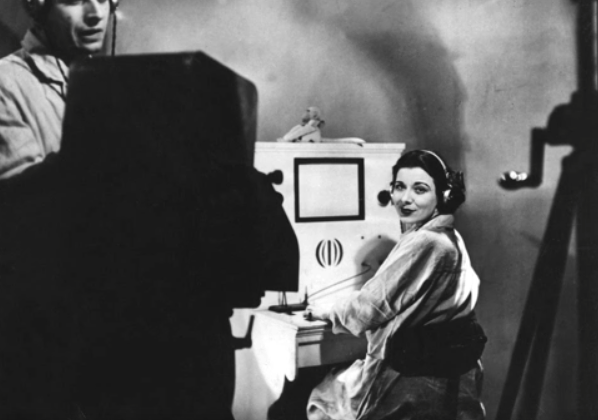
    Joan Miller, ‘The Switchboard Girl’, 1936-1952, via BBC.co.uk (Or, if you prefer, ‘a scene from the original BBC TV fakery scandal’)

    With the concept of recording content for later repeat viewing still many moons away, each edition had to be broadcast live. Meaning, from the following Monday onwards, each early afternoon and each late evening edition of Picture Page would be live. And, as was considered proper at the time, interviewer Leslie Mitchell would be donning a lounge suit for afternoon broadcasts, but would have changed into a dinner suit for each evening episode. After all, to quote 30 Rock’s Jack Donaghy, “It’s after six. What is he, a farmer?”.

    As everyone was still frantically getting their heads around this whole “Tele-vision” fad, there was a veritable conveyor belt of guests in each half-hour edition – as many as eight being introduced by Miller at the switchboard. Yet, the programme provided several tropes that would live on throughout television history:

    • the first ever linking device – Miller’s switchboard was a device that linked interviewees with a smoothness many current hosts would wrestle their floor manager for
    • the first ever TV catchphrase – “You’re through! You’re looking at…”
    • and – given everything on air until its debut edition used merely descriptive titles (“3.0pm The Opening of the BBC Television Service”), television’s first ever identifiable brand
    • heck, if you’re going to count the opening day’s billing of “Variety” at 3pm a description of a genre rather than a programme title (the listings at the time took both approaches), Picture Page is the world’s oldest scheduled television series
    • in young Canadian actress Miller, television’s first true star
    • going by a contemporary memo from the BBC’s Chief Engineer of Radio RTB Wynn – what could have been the first ever TV scandal: aviator Jim Mollison, a guest on the first edition, apparently “having had several”. It’s lucky only a few hundred people were watching.

    With that very sense of “not many people have got TV sets yet” ringing around the subconsciousses of the Picture Page team (one presumes), there was a sense of freedom about putting the programme together that wouldn’t have been the case on the wireless.

    Picture Page was routinely put together on the day of broadcast – very often in the hours leading up to broadcast – which made for a white-knuckle ride for those used to working in radio. Programme editor Cecil Madden used a series of ‘scouts’ who were tasked with procuring the attention of famous faces as soon as they arrived in London, no matter what field they operated in. They would then contact Madden, explain who they were able to get, and be given a simple ‘yes’ or ‘no’ on whether they were a suitable pick for that day’s editions.

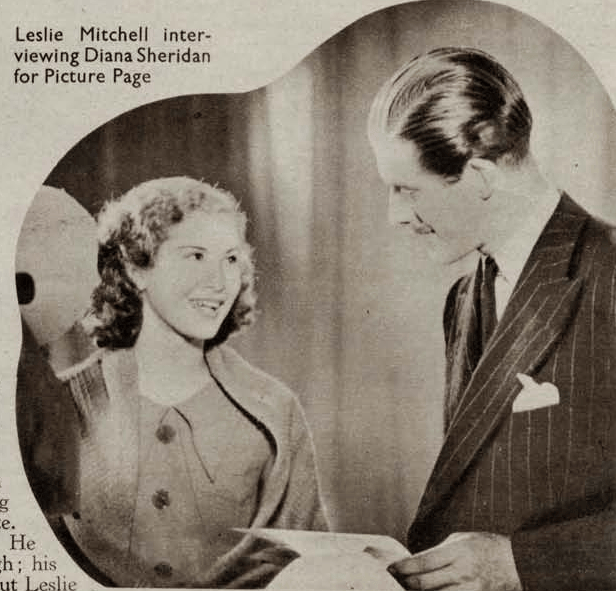
    If a scout’s target was deemed suitable, a script for their segment was hurriedly put together, and scripts handed to interviewers Leslie Mitchell and Jasmine Bligh, each taking a ‘shift’ for a day’s programme. This came with its own challenges. With the notion of televised interviews being as young as the programme itself, there was no previous experience to draw upon. Radio interviews could employ scripts for both participants, but sitting and staring at a script would be a no-no for television. Instead, the interviewers would be given a few key points about each interviewee before going live which they’d duly memorise. But with their targets being largely new to the world of broadcasting, it would be up to Mitchell and Bligh to engender a feeling of naturalness and informality, to keep those guests at ease.

    The limitations of the new format brought fresh challenges. In his 1981 autobiography Leslie Mitchell Reporting, Mitchell recalled how he’d need to keep a watchful eye on the oft-unreliable cameras in the studio, keeping the conversation flowing as he’d guide his subject towards what was often the studio’s remaining functioning camera. The use of rival (and incompatible) broadcast systems – with Baird and Marconi EMI systems alternating between afternoon and morning broadcasts – meant each episode would have different demands for lighting, clothing, cameras and make-up. Furthermore, the harsh lighting required in the early television age caused undue wear-and-tear on Mitchell’s clothing, requiring an advance on his salary to procure a suitable repository of clothing.

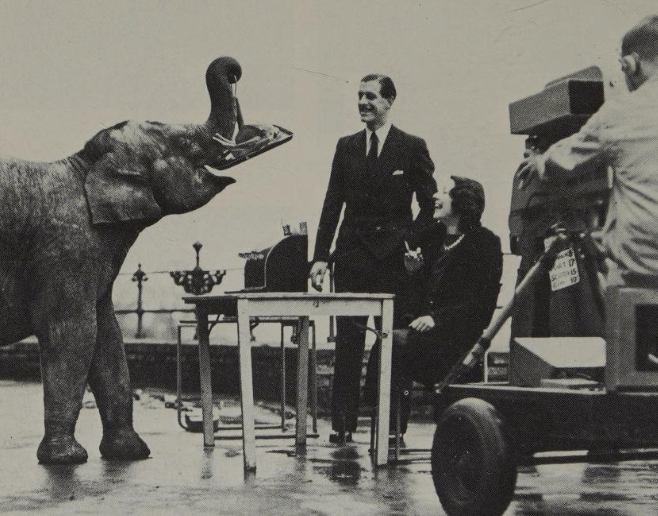
    Leslie Mitchell, Joan Miller and an elephant

    With two episodes going out each week, it didn’t take long for Picture Page to register a number of broadcasting landmarks, with the 200th edition on 15 December 1938 being marked by a great big birthday cake, the programme boasting of having welcomed “over 1,500 men, 660 women, the ghost of Alexandra Palace and a large number of animals of all kinds” by that landmark point. It was certainly easy to keep count, with each episode being billed in the Radio Times as “Picture Page ([n]th edition)”. That would continue right up until the last pre-war episode on 31 August 1939’s “262nd Edition”, broadcast the evening before the end of television broadcasting until 1946.

    The resumption of the Television Service saw the return of Picture Page, albeit with a few changes. The programme had a new editor, Joan Gilbert, who’d worked with predecessor Cecil Madden’s Overseas Entertainment Unit during the war. Gilbert appointed a new ‘Picture Page Girl’, Patricia ‘Paddy’ Bath, the switchboard replaced by a reception desk and a board detailing forthcoming interviewees. Gilbert would present the programme herself, with Leslie Mitchell returning as main interviewer. With hostilities over, the Television Service was starting to expand, as broadcasts started to reach other parts of the UK, and the acquisition of Lime Grove studios provided more capacity than ever to produce programmes. And yet, Picture Page was still central to the BBC’s output – and as TV was starting to take off around the world, it was able to boast of being the oldest television programme in the world. Television announcer Gilbert was a canny choice as presenter – such was the regard for her links, one viewer felt compelled to write in saying how – following an evening where Gilbert appeared to be suffering from a cold – they’d placed a dose of cough mixture on top of their set in an attempt to help.

    However, despite the programme’s continuing popularity – it was frequently singled out for praise by TV critics of the age – the fast-evolving TV business seemed to consider it something of a dinosaur. And so, on 12 March 1952, the final edition of the programme went to air. The decision came as something of a surprise to those working on the series. The BBC brass announced their decision to retire Picture Page just a couple of days before the final edition, a Beeb official positing that the series had been “going on too long and is getting stale”. As the standout star of the show, Joan Gilbert was awarded a standalone interview series – Joan Gilbert at Home, which ran for just seven weeks, with contemporary reports suggesting the all-important debut suffered from a short turnaround time – it aired just a week after the surprise cancellation of Picture Page. A lack of prep time was perhaps evident when Gilbert – usually no slouch at conducting interviews – asked distinguished screen actor Ralph Lynn if his forthcoming film Wild Horses would be his first movie appearance. He’d been appearing in films for over twenty years by that point. A more successful sequel, roving fortnightly topical talk show Joan Gilbert’s Diary, ran from 1953 to 1954. As for Picture Page’s chief inquisitor, Leslie Mitchell would go on to join founding ITV franchise Associated-Rediffusion as senior announcer and Head of “Talks”.

    Leslie Mitchell chatting to Bob Hope for AR-TV

    More of this kind of thing very soon. Happy 90th birthday, television!

  • The Eighty-Three Roads To Wembley: Part Three

    Hooray, my computer’s fixed! Bah, it’s no longer remotely timely writing about the FA Cup. Let’s get to the end of the 1960s anyway, after which I’ll come back to this series when it’s a bit more relevant, tentatively adding in one update for each round of next season’s FA Cup. But at least in this update I get to start keeping a count of how often the FA Cup Final airs on the same day as an episode of Doctor Who, which I’m sure will see the SEO scores for the blog rise sharply. Anyway, time to hop in a sports car driven by Simon Dee, we’re off to…


    ERA FIVE The BBC-1 Years


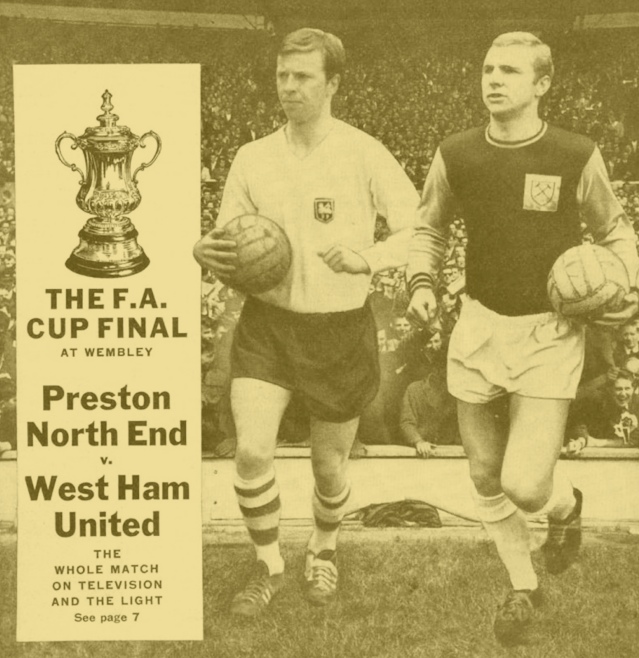
    2 May 1964: West Ham United 3 Preston North End 2

    BBC1
    11:30 to 17:15
    Grandstand

    A five goal thriller ends with Bobby Moore being handed the trophy by the Earl of Harewood, but before then Grandstand viewers are treated to diversions of golf from Wentworth, Boxing from a non-specific location in ‘America’ and Ice Hockey from Brighton.

    Anyone tuning into BBC-1 an hour before the start of Grandstand can find themselves treated to The Fabric of the Atom at 10.35 (“An introduction to Quantum Mechanics”), where Professor Philip Morrison looks at matter waves. The Radio Times pleasingly points out that the programme featured “special equipment loaned by Professor Harry Meiners Troy, USA”. We’re a long way from Saturday Superstore, aren’t we? That was followed at 11.05 by Parliamo Italiano, where “Giulia takes over the packing for their holiday”, and Public Service Announcements at 11.25.

    Some killer content follows the football, Grandstand being followed at 5.15 by The Telegoons (“Lurgi Strikes Britain”), and at 5.30 it’s Dr Who, a programme still new enough for the Daily Mirror TV guide to append it with “(science fiction series)”. Tonight’s episode: The Snows of Terror.

    CUP FINAL DAY DR WHO COUNT: One.

    ATV
    13:24 to 17:15
    Big Afternoon Out

    Over on ITV, we’re still some time away from a World of Sport, so enjoy another Big Afternoon Out at the very specific time of 1.24pm, with Professional Wrestling from Wembley Town Hall offering a grapplin’ support act for the big match.

    There’s nothing more exciting than a 1.15pm News Bulletin before the sporting action, but there’s a good line-up after it. Robert Shaw stars in The Buccaneers at 5.15 (episode: “The Decoy”), but that’s followed by Thank Your Lucky Stars at 5.50, with The Shadows and Roy Orbison. If you’re sticking around until 8.25pm, you can look forward to some Sid ‘n’ Dick era Morecambe and Wise.

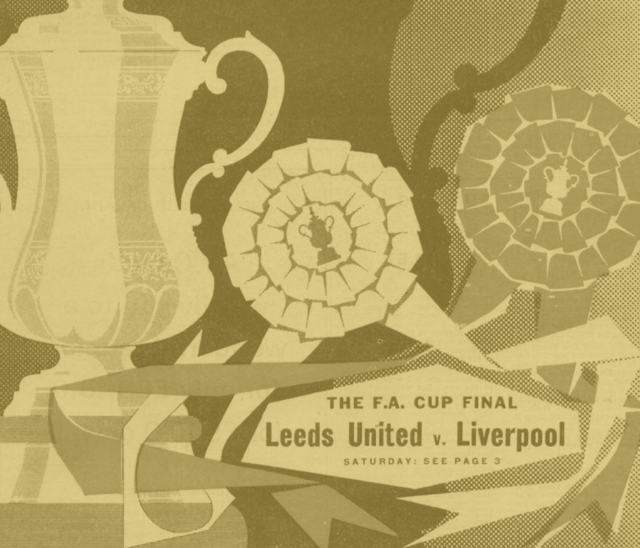
    1 May 1965: Liverpool 2 Leeds United 1

    BBC1
    11:30 to 17:25
    Grandstand

    An all-Northern cup final for 1965, with Bill Shankley’s reds taking the title. Before that, alongside golf from Sandwich, racing from Ascot Heath, swimming from Portsmouth and rugby union from Twickers, there’s a screening of Sir Stanley Matthews’ testimonial match from Stoke, highlights of which are on YouTube. Appropriately enough, given Matthews’ own XI (featuring names such as Stan Mortenson, Nat Lofthouse, Tom Finney, Danny Blanchflower and Jimmy Hill) was taking on a World XI (including Lev Yashin, Aldredo di Stefano, Frerenc Puskas, Eusebio), the match was beamed around Europe via Eurovision, and on radio around the world.

    Before Grandstand, it was time for BBC Educational Broadcasts to shine in a time before the Open University, erm, opened. The Changing World (“an introduction to geology”) started things off at 10.15am, followed by Komm Mit!, the twenty-seventh of thirty lessons in German for beginners at 10.45am.

    Following the presentation of the cup (by The Queen, no less) it was time for Juke Box Jury at 5.25pm, with panellists including Dave Clark and Dora Bryan. That was followed by a new adventure in space and time at 5.50pm, with Dr Who in The Dimensions of Time.

    CUP FINAL DAY DR WHO COUNT: Two.

    ATV
    12:50 to 17:15
    World of Sport

    Over on the light channel, the Big Afternoon Out had been replaced by World of Sport, but little else had changed. Indeed, that coverage of the sporting world only stretched from Wembley Stadium to Wembley Town Hall for live wrestling.

    Anyone not feeling in the mood for geology or German on BBC-1 would have to make do with walking the dog if they were looking for alternative entertainment before World of Sport, with only a News update preceding the action at 12.45. The sporting action was followed at 5.15pm by The Forest Rangers (episode: The Dog) and more Thank Your Lucky Stars at 5.50pm, where Cilla Black, The Merseybeats, Sounds Incorporated and Julie Grant topped the bill.

    14 May 1966: Everton 3 Sheffield Wednesday 2

    BBC1
    11:15 to 17:25
    Grandstand

    A big year for domestic football, as a British team wearing red go on to lift the Jules Rimet trophy later in the summer. Sadly though, it’s not Wales. But that’s many weeks away. A low-scoring defensive cup final looks to be on the menu, as Everton reach the final without having conceded a goal en route to Wembley, and buoyed by the presence of a certain J Lennon and P McCartney amongst the 100,000 spectators, their name is surely on the cup.

    Except! It’s Wednesday the roar into a two-goal lead, only for Everton to roar back to take the cup in a thrilling 3-2 win. In the Radio Times, Kenneth Wolstenholme writes about the Cup now coming with a passport to Europe, with a place in the Cup Winners’ Cup, where “each home gate can mean another £20,000 in the bank”.

    For the audience at home, the build-up to the big kick-off is supported by the MCC taking on the West Indies at Lord’s and racing from Ayr.

    Viewers tuning early for a feast of football can enjoy some brain soup for starters, with the splendidly-titled Laws of Disorder (“An introduction to chemical change and thermodynamics by Professor George Porter FRS”) at 10.15 and Master Builders (“Ten lectures on evolution and change in architectural ideas. 4: The Villa”) at 10.45. Anyone sticking around after the cup presentation by Princess Margaret can look forward to Juke Box Jury at 5.20, with David Jacobs in the big chair and Helen Shapiro, Jimmy Witherspoon, Janice Whiteman and Frank de Vol on jury duty. Then, after the News at 5.45, it’s time for Dr Who at 5.55, today’s story being Donald Cotton’s Johnny Ringo (“The most dreaded killer in all the West, Johnny Ringo, rides into town”).

    CUP FINAL DAY DR WHO COUNT: Three


    ATV
    13:00 to 17:15
    Word of Sport

    Over on the ATV, there’s the usual serving of Professional Wrestling and some Racing Results to supplement the soccer in World of Sport, but at least there’s also some big brain knowledge to grapple with beforehand, with Say it in Russian at 11.50am, Les Trois Coups at 12.15 and The Anatomy of First Aid at 12.35. On the other side of the world (of Sport), there are some more Adventures of Robin Hood at 5.15. Elsewhere in the country, viewers in the Midlands and North instead get to enjoy a bonanza of Bob Monkhouse with Mad Movies, while viewers in Wales and Anglia get to see The Flintstones instead.

    20 May 1967: Tottenham Hotspur 2 Chelsea 1

    BBC1
    11:25 to 17:25
    Grandstand

    We’re just six weeks away from colour television hitting the UK, meaning this inaugural all-London FA Cup Final is the last to be screened exclusively in monochrome. Jimmy Robertson and Frank Saul put Spurs into a two-goal lead that Chelsea fail to match, meaning the trophy is taken back to Tottenham for the fifth time.

    The big match on Grandstand sees David Coleman presenting the now-standard tasters of The Wembley Scene, How They Got There and Meet the Teams, but for footballphobes there’s also the MCC versus India at Lord’s (or Glamorgan vs Gloucestershire for viewers in Wales) and Great Britain versus the USA in golf’s Walker Cup.

    Back to the football though, and the Radio Times have brought in the big guns to provide a preview of the match, with the write-up on Tottenham provided by novelist, playwright, creator of Dixon of Dock Green and socialist firebrand Lord Ted Willis (“Spurs: a team which has given me more thrills and pleasure over the years than almost anything else in my life”). For Chelsea, the summary was penned by actor, director and maniac who brought those dinosaurs back to life, Richard Attenborough (“In the spring of 1942 I first took a girlfriend to a spot called Stamford Bridge. My intentions proved absolutely honourable: without hesitation I married both the girl and Chelsea and no divorces have ever been contemplated”). Lovely stuff.

    Before the match, you’ve got a nice mix of content, with In Your Own Words at 10am, which vows to help you become more confident in your speech (“1. The Language of Social Occasions”), Management Techniques at 10.30 (“2. Control by Budgeting”) and Gardening Club at 11am, with Percy Thrower live at the Gardening Club Garden in Edgbaston. Suddenly the Mitchell and Webb joke about each programme on the BBC having it’s own garden feels a little more real.

    Following the match, 5.25pm has a Juke Box Jury line-up for the ages: Kenny Everett and Leslie Crowther joined by Julie Felix and (replacing Shirley Anne Field, as billed in the Radio Times) Kiki Dee. Then, on the other side of 5.50pm The News, at 6pm it’s Dr Who (Patrick Troughton, that’s Who) tackling the first part of The Evil of the Daleks.

    CUP FINAL DAY DR WHO COUNT: Four

    ATV
    12:30 to 17:15 World of Sport

    A helping of horse racing to accompany the wrestling alongside the cup final over on Your Weekend ITV (if you lived in London, of course). The action was preceded by En Route at 11.25, First Steps in Physics at 11.45 and The Food You Eat at 12.05. Elsewhere, viewers in both Midlands and the South-West of England opened the day with The ABC of Do-It-Yourself.

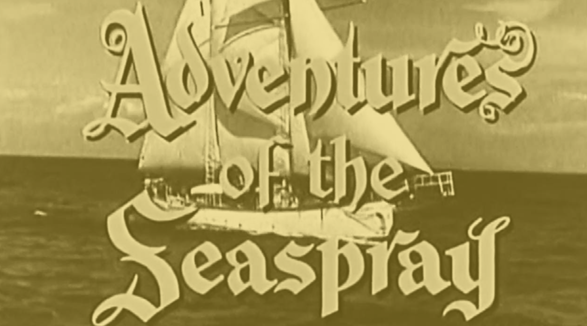
    Following the final whistle, viewers in London got a repeat episode of Adventures of Robin Hood at 5.15, with most other regions getting aquatic action from Adventures of the Seaspray instead.


    ERA SIX The Early Colour Years


    18 May 1968: West Bromwich Albion 1 Everton 0

    BBC1
    11:15 to 17:25
    Grandstand

    Here we go, a whole new landmark in football broadcasting. Not that you’d appreciate that if you were watching on BBC1, with the full colour spectrum on TV being the sole preserve of (a) poshos with brand new colour sets and (b) BBC2. If it’s any consolation, they’d need to be watching the bulk of the build-up in black and white, with The Wembley Scene, People at the Match and Meet the Teams all part of the regular Cup Final Grandstand line-up. And if you’d like a break from all that, you’ve got The MCC versus ‘The Australians’ (as the RT listing had it) from Lord’s for a full two hours near the start of this edition, along with boxing from Manchester.

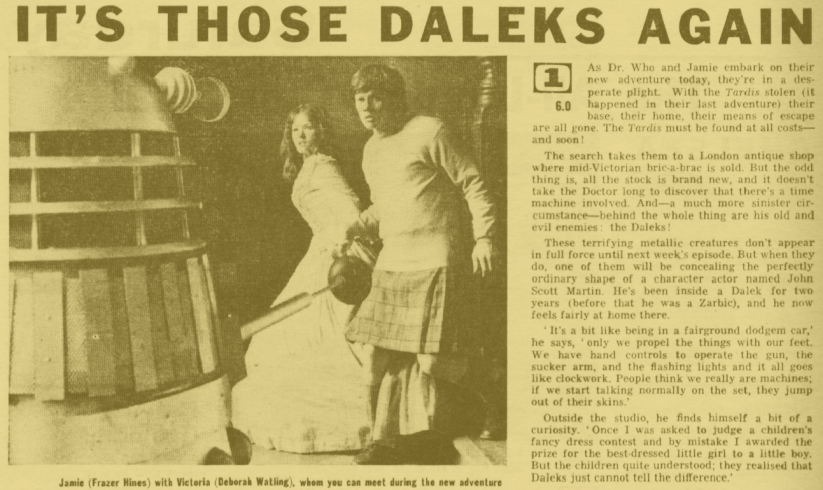
    If you wanted to warm your brain up a bit beforehand, tune in at 9.30am for Komm Mit!, stick around at 10am for Bonjour Francoise and at 10.30am for Teaching Adults. Or stick around at the end of Grandstand to leap straight into Dr Who at a scheduled 5.25pm, with part four of The Wheel of Space (*The Cybermen step up their attack and the Doctor and Jamie are in deadly peril”). That was to be followed by 5.50pm News, at 6pm by Genome content warning favourite The Dick van Dyke Show and – providing we’re truly in the imperial phase of 60s television – Dee Time at 6.25pm.

    However! Jeff Astle’s winner for West Brom only arrived once the match had gone into extra time, pushing subsequent programming back by around 25 minutes. Thanks to the ever-splendid Paul Hayes for pointing out that the Doctor Who PasB details on the BBC website reveal the News remained at 5.50pm, and that episode of Who aired a tadge after 6pm. (It would make sense that the edition of The DvanD Show scheduled for that 6pm slot was postponed for a week, meaning everything else ran on time, but that’s speculation on my part.)

    CUP FINAL DAY DR WHO COUNT: Five

    BBC2
    14:30 to 17:00
    1968 FA Cup Final

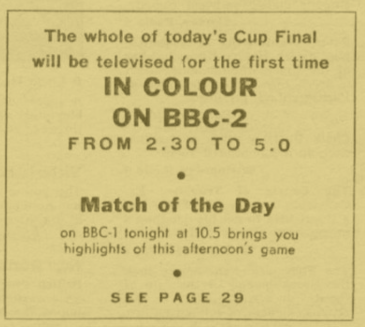
    With colourvision not arriving on the main channels for another 18 months, it was up to BBC2 to broadcast that first ever colour coverage in glorious 625-line RGB.

    ATV
    12:30 to 17:15
    World of Sport

    The final chance for the ATV London weekend franchise to broadcast a Cup Final, and (happily for me) the first time there’s a detailed itinerary in the newspaper TV listings. It’s pretty much a facsimile of the Grandstand feature set, of course, with “How the Teams Got There” the WoS counter to Grandstand’s “How They Got There”, “Meet the Players” the alternative to “Meet the Teams”. Still, not long before we get the Light Entertainment infantry deployed on the light channel’s cup final coverage.

    Tune in early for 11.15 Face of the Earth, 11.40 Accueil and at noon for Working Weather. Stick around after the trophy lift for Sword of Freedom at 5.15 and Time for Blackburn at 5.45.

    26 April 1969: Manchester City 1 Leicester City 0

    Hoo, boy. Things are about to get a bit fisty. And not in the way you might expect. The players were perfectly well behaved during the match, as were the managers (aside from Man City manager Joe Mercer complaining that the Wembley pitch “used to be a bowling green, now it’s a cabbage patch”). The fans were well behaved, too. In the days following the final, the supporters of both teams were praised in the Commons for their good conduct during the final.

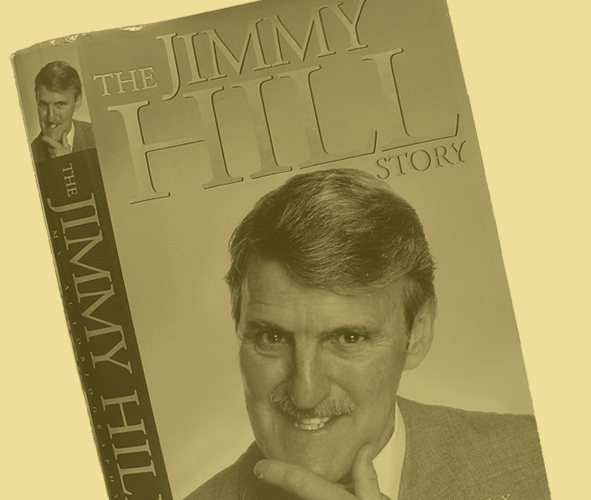
    So, then. What was the big deal? TO PAGE 163 OF JIMMY HILL’S AUTOBIOGRAPHY!

    You could’ve guessed he’d be pulling this pose on the cover, couldn’t you?

    This relates to Hill’s time working for a shiny new LWT franchise, ready to make a big name for themselves. The final was on their patch, and this was one of their first chances to really show the BBC they had some serious competition in the capital. Over to you, Jimmy:

    “Notwithstanding domestic confrontations at LWT, occasionally war broke out in full with the supposed real enemy, the BBC. I say supposed because at times, in endeavouring and often failing to reach an agreed competitive policy, we could be excused for believing we had more in common with the BBC than with other ITV companies. However, there was a distinct lack of any loving feeling at Wembley for the 1969 Cup final between Manchester City and Leicester City. The final was covered by both channels. The players behaved well but, claiming they had an exclusive contract for interviews, BBC staff attempted to break up an ITV interview with Mike Summerbee. An ITV outside broadcast manager, David Yallop, lost a tooth in the sudden switch from football to the noble art of lack of self-defence, and was obviously so disorientated by the whole experience he moved on to become a highly successful author.

    Fortunately for us the war subsided, but not the competition and since that incident the Wembley authorities have made sure that agreed lines of rights and demarcations are upheld.”

    (The Jimmy Hill Story, by Jimmy Hill)

    Oof, eh? For more details on this broadcasting brouhaha, and the subsequent carpeting by the FA, read this excellent Sports Journalists Association article from 2019.

    BBC1
    11:25 to 17:15
    Cup Final Grandstand

    After that, a bit of a comedown, but anyway. The last Cup Final of the decade, and where we’ll draw a line under proceedings for the time being. Another point of note here: the first official use of “Cup Final Grandstand” as the programme title in the Radio Times. That aside, the set menu for the day’s coverage on Grandstand was the same as previous years, with The Wembley Scene, People at the Match, How They Got There and Meet the Teams all present and correct. As was a supporting bill of Cricket (“The Duke of Norfolk’s XI vs The West Indies”) and Boxing (“Johnnie Famechon vs Giovanni Girgenti”).

    Before the final, you had an opportunity to watch Spanish language tutorial Vamos A Ver! (9.30am), Italian language tutorial Si Dice Cosi (10am) and French language tutorial Suivez La Piste (10.30am), before the antics of disappointing superhero (sub please check) The Weather Man at 11am and Deputy Dawg at 11.05am.

    Following the final whistle (and scrap over post-match interviewees) it was time for Dr Who at 5.15pm (The War Games: Part Two, by Terrance Dicks and Malcolm Hulke, “the trio are caught up in the turmoil of war”), the News at 5.40pm followed by Here’s Lucy at 5.50pm. But do stick around for The Dave Allen Show at 7.30pm, with guests Matt Monro, Ray Barrett and The George Mitchell Singers.

    CUP FINAL DAY DR WHO COUNT: Six

    BBC2
    14:30 to 17:00
    FA Cup Final (in colour!)

    Of course, while all the fighting between BBC1 and ITV was going on, the team working for BBC2 all stood aside, looking aloof, smoking French cigarettes and wondering if they should bring back Jazz 625. One can only assume.

    London Weekend
    12:00 to 17:15
    World of Sport

    Over on ITV, a not-yet-rebranded as ‘Dickie’ Richard Davies presented a World of Sport line-up that took in Football Highlights of the Sixties, Footballer of the Year and The Way to Wembley. There was also Racing from Sandown and (predictably) Wrestling.

    Before everything, erm, kicked off, you could enjoy your weekend Weetabix in front of RAC Road Report (10.10am), Discovering London (10.15), Deux Mondes (10.40), All About Riding (11am) and Joe 90 (11.30). The action was followed by Land of the Giants at 5.15pm, but up against Dave Allen at 7.30pm there’s Galton and Simpson Comedy episode Friends in High Places, starring Bob Monkhouse and Patricia Hayes.

    And that’s why the video recorders needed to be invented.


    Right, that’ll do for now. Back with something else – probably not about football – soon.