Tag: TV History

  • New Layout! New Shops! The 17-Jewelled Shockproof Swiss-Made Bomb! The All-New Adventures of the Summer Wine!

    New Layout! New Shops! The 17-Jewelled Shockproof Swiss-Made Bomb! The All-New Adventures of the Summer Wine!

    Hi everyone! I have grown weary of the yellow and changed the blog layout. Hopefully this layout works more effectively when pushed out as an email update.

    A big “thank you!” to everyone who’s bought a copy of Auntie’s Favourites so far. And to everyone who has placed it on their Christmas list. And for everyone who is waiting for a non-Amazon place to purchase it, there’s some big news: there is now a non-Amazon place to purchase it.

    For the paper copy, it’s also now available from The Great British Book Shop for just £19.99.
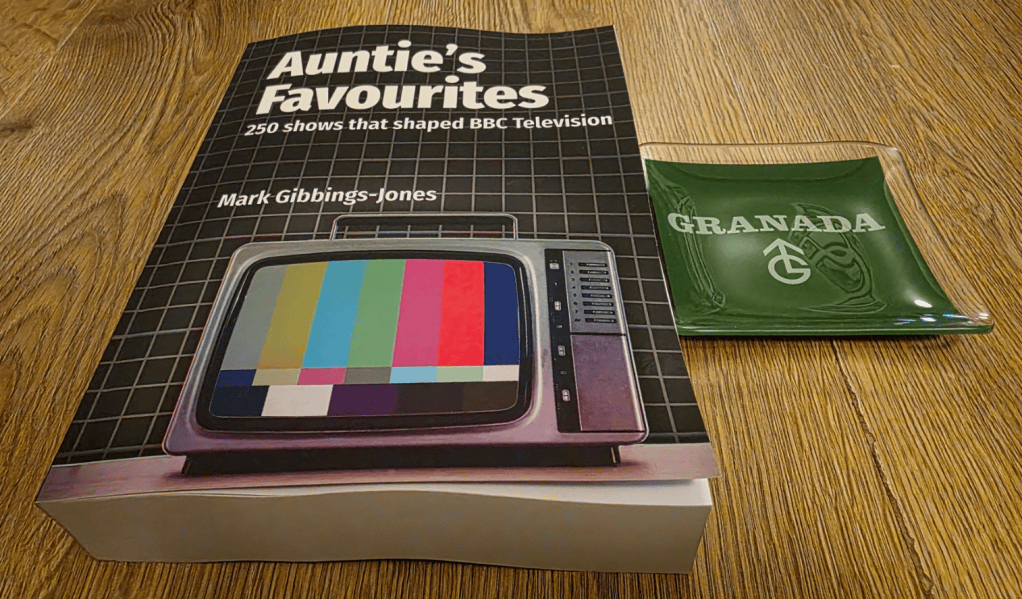
    The big old Auntie's Favourites Book and a Granada TV ashtray
    A copy of the big old book. Granada TV ashtray for scale.

    For those who prefer a digital copy, it’s available at the following places:

    In the UK:

    bookshop.org | Apple Books | Kobo

    Or in the USA:

    Apple Books | Barnes & Noble | bookshop.org

    And while we’re on about that, how about another extract from the book? Push a bath to the top of a steep hill and clamber in, because we’re trundling off to Yorkshire for the programme in 220th place. Fill your glass with the…

    Last of the Summer Wine

    1973-2023, broadcast 559 times

    BBC1 (552 times, 1973-2010)

    BBC4 (7 times, 2010-2023)

    File this one firmly under ‘I Thought This Would Be Much Higher’.

    It’s one of the great paradoxes of sitcom history. As everyone knows, Last of the Summer Wine is about three chaps of advanced age who find ways to fill their days, mostly on the rolling hills of West Yorkshire. And yet, it ran for 37 years, and one of the initial lead characters featured in the series throughout the run. So, what gives? Well, we’ll come to that a little later.

    But, let’s start at the beginning. Or just before it. In 1971, Roy Clarke’s stock was high. Before then, he was a prolific writer in search of success. His big break came with radio play The Big Bite (The Light Programme, 22 June 1966), which drew on Clarke’s experiences as a young police constable. From there, he went on to more radio plays along with splendidly named serials The 17-Jewelled Shockproof Swiss-Made Bomb (Radio Two, 18 January – 5 February 1968) and The Events at Black Tor (Radio Two, 18 April – 6 May 1968), accompanied by his first TV gig.
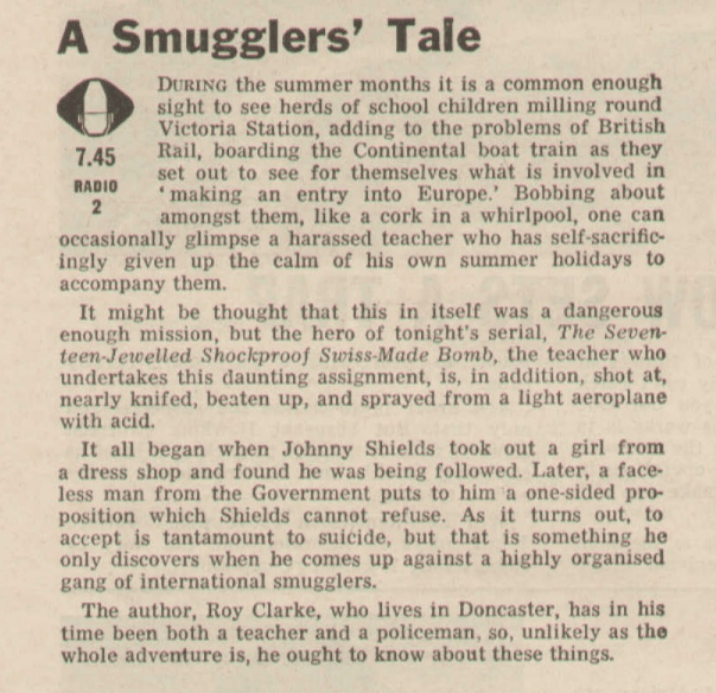
    Original Radio Times preview for The 17-Jewelled Shockproof Swiss-Made Bomb
    Radio Times, 13 January 1968

    This was a big deal. Previously, Clarke had combined writing with his day job as a teacher. This new opportunity – writing for drama series The Troubleshooters – would require his full-time attention. Following his initial four-script contract on The Troubleshooters came more dramatic work for Clarke: a dramatisation of W Somerset Maugham’s The Back of Beyond (BBC2, 10 June 1969), TV play The John Hilarian Salt Exhibition and Numerous Illustrated Slides (Granada, 4 August 1969), plus episodes of crime drama Detective (“The Public School Murder”, BBC1, 21 September 1969) and WWII serial Manhunt (“Only the Dead Survive”, London Weekend, 16 January 1970). His biggest break yet came with The Misfit – a full series for ATV.

    This was a rare example of a channel-hopping spinoff, with blustery-colonel character Basil “Badger” Allenby-Johnson from BBC drama The Troubleshooters (played by the ever-reliable Ronald Fraser) arriving back in early-70s Britain after spending half his life on a rubber plantation in Malaya. The Britain he left behind is long gone, leaving him both back home and in unfamiliar surroundings. The Misfit ran for two well received series (Daily Mirror letters, 16 March 1970: “In many other TV plays I often thought Fraser was a misfit. But in ‘The Misfit’ he really fits. A thoroughly enjoyable series.” – Mrs K Lennard, Sussex), which brought Roy Clarke to the attention of a very big name within TV comedy circles.
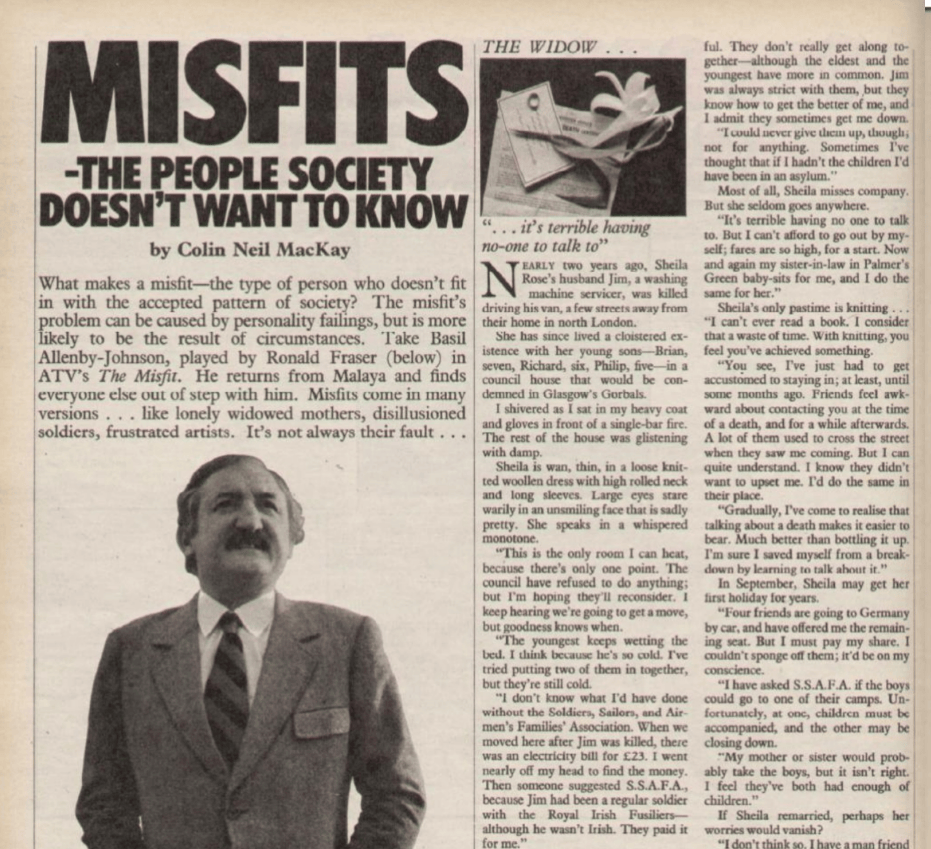
    TV Times article on sitcom The Misfit, along with a photo of Ronald Fraser looking pompous yet winsome
    TV Times, 21 March 1970

    As far as British television sitcoms go, there are few figures more important than Duncan Wood. Starting at the BBC as an outside broadcast engineer, he made the move into producing and presenting radio programmes in the 1950s, including lunch-break variety stalwart Workers’ Playtime (Home Service/Forces Programme/Light Programme, May 1941-October 1964), which put him in close proximity with up-and-coming comedy names like Dick Emery, Benny Hill and Tony Hancock. After a few years on the wireless, Wood moved into television, producing variety series Garrison Theatre, dance-em-up Everybody Swing!, Kenneth Horne panel show Find the Link, and comedy sketch series Great Scott It’s Maynard, starring Terry Scott and Bill Maynard.

    For this move into TV comedy, Wood was more than a little modest, telling the Radio Times “Eventually we hope to make people laugh”. The programme ran for three series, so safe to say it found an appreciative audience. His next few forays into TV comedy certainly needed that level of caution. The first – Strictly T-T – was a vehicle for national treasure Terry-Thomas, with the gap-toothed cad calling out Wood in a piece for the Radio Times: “My producer Duncan Wood has already aged perceptibly since I met him a few weeks ago”. That lasted just six episodes, but Wood’s next project – as producer and director – would go on to set the blueprint for British situation comedy.
    Caption card for "Produced by Duncan Wood" at the end of a Hancock's Half Hour episode.
    Hancock’s Half Hour, S3E5 “Air Steward Hancock – The Last of the Many” (27 Oct 1957)

    Yep, apologies to any Life with the Lyons fans reading this, but it’s Hancock’s Half Hour we’re talking about here. The TV sitcom that shaped British sitcom as we know it, and which has rarely been bettered almost seventy years from its initial broadcast. From there: Steptoe and Son, Harry Worth, underrated Sid James vehicle Citizen James and long-running sitcom anthology series Comedy Playhouse.

    Playhouse – airing for 137 episodes between 1961 and 1975 – was the incubator for a whole generation of classic British sitcom. Initially a playground for a post-Hancock Galton and Simpson, as they sought out their next hit series (finding it with The Offer, renamed Steptoe and Son when it became a full series), it would go on to involve many golden-era sitcom writers, all the way from partnerships like Esmonde and Larbey or Clement and La Frenais, to solo acts such as Barry Took, Johnny Speight and Kingsley Amis.

    Of course, the BBC being the BBC, of the 137 episodes around 95 of the damn things are now missing, but the run included pilot episodes for what would become Till Death Us Do Part, Up Pompeii!, The Liver Birds and Are You Being Served?. Plus, you know, one edition called The Last of the Summer Wine. (“Bloody hell, finally.” – Everyone.)

    Come 1972, and Duncan Wood – now BBC Head of Comedy – was more than a little impressed by Roy Clarke’s The Misfit. Clarke’s ability to blend comedy and drama, plus a lead character finding himself thrust into a familiar world he no longer feels a part of, could be employed in a more straightforward sitcom format, and would make an ideal addition to Comedy Playhouse’s thirteenth series. Wood invited Clarke to a meeting, so that potential projects could be discussed, with one idea in particular in mind.

    As Clarke would later recall, the writer attended the meeting keen on writing a standard sitcom, only for Wood to state “we want something with three old men”. And that was pretty much the brief in full. It was a suggestion that Clarke recoiled from. Despite having careers of various lengths as policeman, teacher and writer under his belt, Clarke had only recently entered his forties – he didn’t know anything about old men, or didn’t much want to know. The BBC’s rationale was that the idea matched a gap in their audience, but Clarke couldn’t envision the idea having any kind of audience appeal at all.

    With a heavy heart, Clarke tried to conjure up a suitable premise for such a series. A few weeks of batting ideas around led to a revelation: what if the protagonists didn’t actually act their age? After all, being retired, they’d be at an age where they’re unencumbered by jobs, or by raising kids, or by responsibilities. They’d be free to be great big overgrown kids. A bit more work on the overall blueprint, and the leading trio were born: the fastidious Cyril Blamire, workshy waster Compo Simmonite and the midpoint between the two, Norman Clegg. Three overgrown kids killing time on their perpetual summer holiday. Two polar opposites, with Clegg in the middle.

    If the focus of the series on three old men was unusual enough, so was the setting. Much of each episode would be filmed outdoors – definitely a break from the usual studio-set-with-outdoor-filmed-inserts sitcom norm. Wood’s choice of producer for The Last of the Summer Wine, the well-regarded James Gilbert, was fully on board with Clarke’s ideas for the programme, and helped to shape the unique tone and style of the show, with the rolling Yorkshire scenery serving as a fourth main character. But when it came to the three (human) leads, Gilbert had reservations. Having previously worked on series The Walrus and the Carpenter, starring veteran actors Hugh Griffith and Felix Aylmer, he noted that audiences seemed unsure about simply laughing at old men. Dad’s Army at least had a wider spread of ages, but having all the action based on the mishaps of genuine old men seemed to cause uncertainty. There’s a reason Mainwaring did the pratfalls, rather than Godfrey.

    With this in mind, Gilbert suggested to Clarke that the lead characters should have another reason to be kicking around the streets, rather than simply being old. After all, having a seventy-something kicking a tin can down a street might be funny once or twice, but if this is going to go to series, it’s going to get, well, old. The script was duly retooled and the trio were rewritten as three unemployed middle-aged men. With Clegg and Blamire now living off their redundancy packages, they were still free from responsibility, still kicking around a world that no longer held any great purpose for them, but now the audience could safely laugh if one of them fell on their arse. In came an appropriately-aged cast: fiftysomethings Peter Sallis, Bill Owen and Michael Bates.
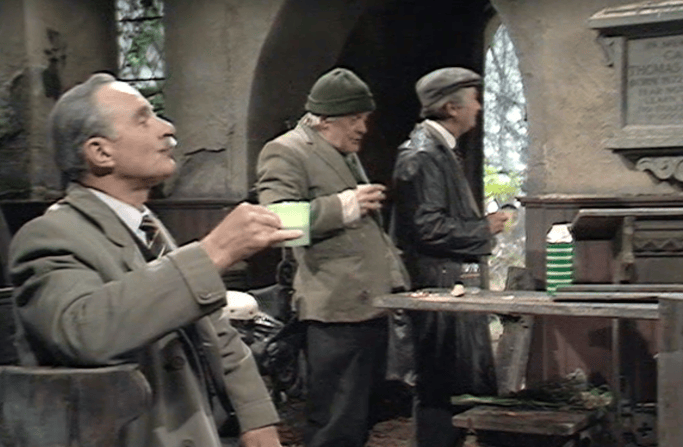
    The original cast for Last of the Summer Wine having a picnic in an old church
    Last of the Summer Wine, pilot episode “Of Funerals and Fish” (4 Jan 1973)

    The pilot episode – “Of Funerals and Fish” – duly opened the next series of Comedy Playhouse on 4 January 1973, and was well-received, even if press reaction at the time was suspicious of it being a bit too parochial. The Daily Mirror’s Mary Malone (5 Jan 1973) described the initial episode as “primitive, provincial [and] hilarious”, but also posited “if it was the kind of comedy to make folk above St Albans smirk, it may well also make those below wonder”. Still, the overall reaction was positive and a full series was commissioned, airing from 5 November of the same year, in the post-watershed slot it would occupy for much of its first decade on air, which is quite the departure from what it would become.

    While the first series passed by without getting much attention, summer 1974 saw Summer Wine given a primetime BBC1 repeat run. This second chance at encountering the series helped draw attention to the debut of the second series in March 1975. Perhaps unexpectedly, it started drawing in a decent audience – 7.5m households for the opening episode (such was the way audiences were measured at the time – putting it level with Coronation Street that week). This lo-fidelity sitcom – the plot of one episode involved Clegg trying to get his bicycle repaired – was building a loyal audience.
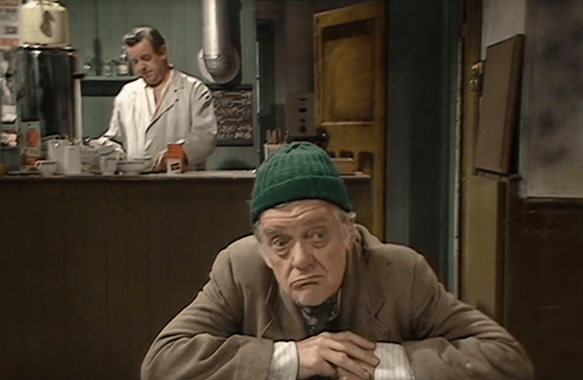
    Compo looking bored in a cafe

    Sadly for the series, one third of the main cast was having trouble with his health and workload. Michael Bates left the series, sticking with the more studio-bound It Ain’t Half Hot Mum before passing away in 1978. As a result, the third series of Summer Wine introduced a new team member. Arriving under the guise of returning to his home village following retirement, Foggy Dewhurst (Brian Wilde) met up with old pals Clegg and Compo, and the Imperial Phase of the Summer Wine could begin.
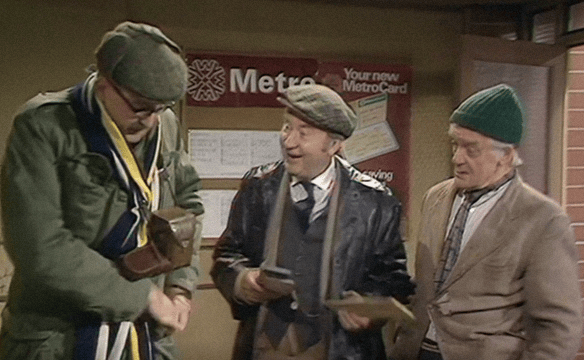
    Foggy meets Clegg and Compo at a bus station
    S3E1 “The Man from Oswestry” (27 Oct 1976)

    And it didn’t only attract the attention of older viewers. Personally I bloody loved it when I was a kid, by this time a Sunday evening fixture slotted in nicely after Songs of Praise. It proved to be the perfect accompaniment to Sunday teatime banana butties and Battenberg. So much so that I pestered my mum to rent the VHS release of feature-length episode Getting Sam Home from the local video rental shop. Despite airing over Christmas in 1983, the plot had the trio sneak the corpse of an adulterer across town and back into his marital bed before his wife wakes up[1]. See, the plots weren’t all about broken bicycles.

    From there, shortly after Wilde’s hiatus from the programme (his spot taken by Michael Aldridge’s crackpot inventor Seymour), much of the focus shifted onto other characters from the village. Sadly, perhaps down to the prolific Roy Clarke working on several other series throughout Summer Wine’s marathon run (most notably Keeping Up Appearances and Open All Hours), most of them pretty much turned up, did their line, then buggered off until the next episode. Wesley traipsed oil everywhere, Edie would get annoyed, Howard and Marina would get caught canoodling in a bush, Pearl would get annoyed, Barry turned up and dithered, while Glenda tutted. Well, they can’t all be Nora Batty.

    Following the Wine’s peak period, circumstances (often but not exclusively due to the demands on the increasingly elderly cast) meant main characters would be replaced – crucially, ill health led to a permanent departure for Brian Wilde’s Foggy in 1998 while Compo actor Bill Owen passed away in 1999. Frank “Mr Peacock” Thornton stepped in to replace the latter, while Bill Owen’s son Tom Owen temporarily took his father’s place in the line-up, before stepping into a more minor role. Keith Clifford’s Billy Hardcastle took on the third place in the lead line-up at the turn of the millennium.

    With a hardy audience still tuning in each Sunday, the series remained a fixture on BBC One – even if the Beeb’s programme commissioners were clearly clamouring for something a bit trendier to boast about at All Bar One – so much so that when the demands of filming meant Peter Sallis’ role in the series had to be reduced to studio scenes, a new leading trio were introduced for the final couple of series. In any other circumstance, a sitcom starring Russ Abbott, Brian Murphy and Burt Kwouk would be one for the ages.
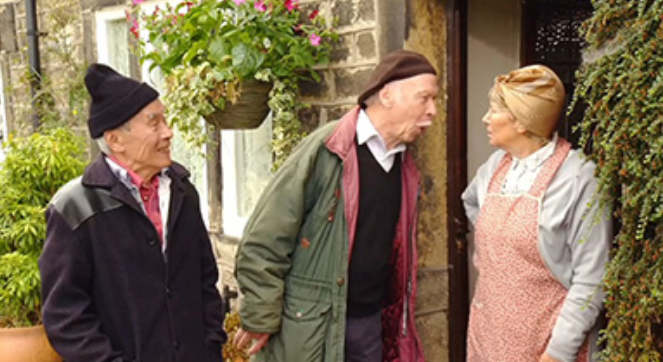
    Hobbo tries to woo Pearl, the fool
    S31E5 “Look Whose Wheel’s Come Off” (22 Aug 2010)

    But, the template for Summer Wine could only take so many amendments, and the All-New Adventures of the Summer Wine failed to connect with audiences. Roy Clarke called time on the series after the programme’s thirtieth series.

    Fittingly, the final word went to Peter Sallis, the programme’s only ever-present actor. In keeping with Clegg’s long-running anxiety over whether his front door had been left unlocked, the last words of the Summer Wine were simply “Did I lock the door?”.


    [1] The plot involved Foggy, Compo and Clegg visiting their pal Sam in hospital, and agreeing to help him spend one last night with his fancy piece, “Lily-Bless-Her” (played by Linda Baron, no less). The unseen exertions at Lily’s are too much for Sam’s ticker, meaning it’s up to our intrepid trio to get Sam’s corpse (yep, corpse) back home so that his wife Sybil thinks he died in his own bed. In 1994, this was repeated at 7pm on BBC1. All shot on film, as was the style at the time, which added an extra layer of grimness to it. I really enjoyed it, too. Probably the closest I ever got to a video nasty. BONUS FACT: it was the first BBC sitcom to earn a 90-minute Christmas special episode. Anyway, we’re not here for that.

    That’s all for now! Buy the book! Bye!
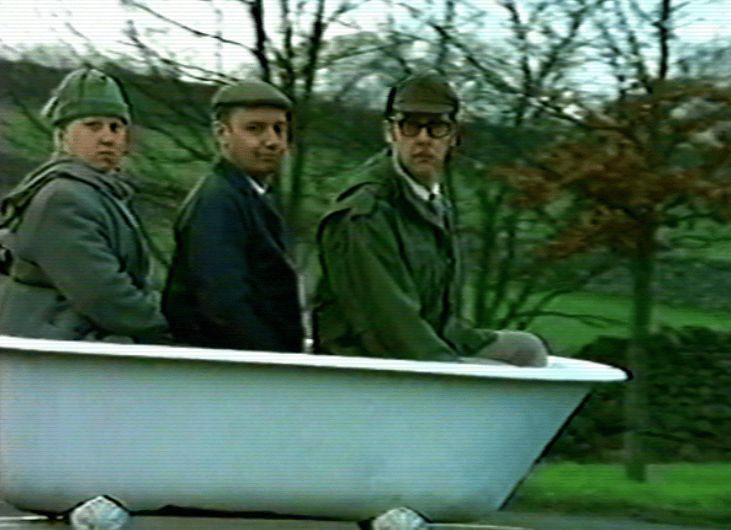
    Matt Lucas, Bob Mortimer and Vic Reeves are Three Men in a Bath
  • Big Book Update, North Korean Hackers, Coronation Street on ABC and Dallas (Mainly Dallas)

    Big Book Update, North Korean Hackers, Coronation Street on ABC and Dallas (Mainly Dallas)

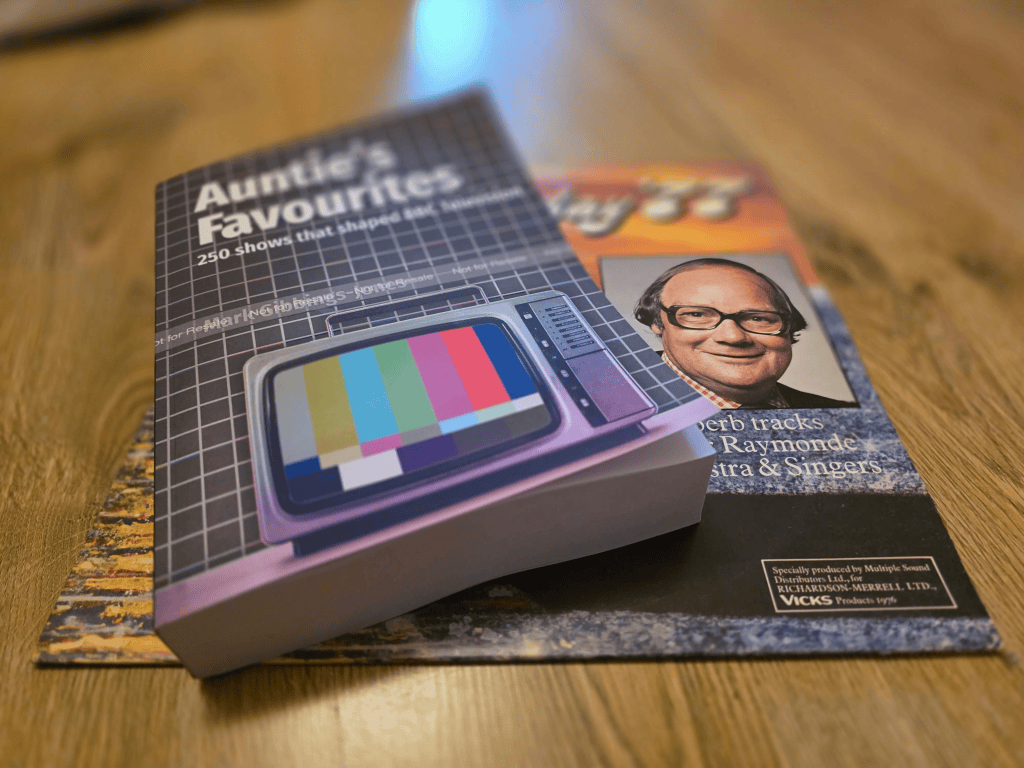
    A copy of the award-winning (citation needed) book Auntie's Favourites, on top of the Holiday '77 album.

    Firstly, big book news. And it’s important to note that both the news and the book are big. The book is the fully featured, 622-page, 10-by-7-inchAuntie’s Favourites, a full rundown of the 250 Most-Broadcast Programmes in the Entire History of BBC Television. This differs from the rundown previously published on this site, as it contains:

    • 150 additional entries compared to the original’s hundred
    • Covers every single broadcast up to 31 December 2025
    • Every broadcast on BBC Three, BBC Four, BBC Choice and BBC Knowledge alongside the main BBC channels
    • Added detail and complete rewrites on many of the original entries
    • Newsnight is now in the list. But where?
    • Definitive confirmation of the most-repeated sitcom in BBC Television history – it’s possibly not the one you’re expecting
    • Precisely one bar chart

    Also, critically, everything has been reviewed and properly proof-read. It’s the strangest thing. When going through the original proof edition of the book (pictured above, with a copy of the Holiday ‘77 vinyl record for scale), there were a lot of weird typos, put there, it seems logical to conclude, by North Korean hackers who had installed a virus on my PC in an attempt to discredit the book. A very clever virus that placed corresponding typos in the original blog entries, almost as if to make me look like a fool.

    All those typographical tykes have now been chased away, meaning the book is finally available to buy on Amazon. In the UK, it’s just £19.99 for the lovely paperback edition or £5.99 for the DRM-free Kindle edition (so you should be able to throw it at anything that’ll handle an .epub file). If you’re in the USA, you’re looking at just $26.99 for the paperback or $7.99 for the ebook, while if you find yourself in Canada it’s $36.99 for the book in paper form or $10.99 for it in digi-bits. If you’re in Australia and you want to see whether Neighbours is still at number one in the rundown (spoilers: it isn’t), it’s the oddly specific price of $41.87 for a copy you can hug at night, or just $11.69 for a copy that lives on your phone (or Kindle, or Kobo or whatever).

    It’s also available in other countries with an Amazon store and will be popping up on various other shopfronts (that don’t have the dread hand of Bezos on them) soon. I’ll post a further update once those have gone live.

    (It’ll be brilliant if you can spread the word about the book. It’s a project that has taken years to complete, so it would be nice to see it in as many hands, bookcases and digital devices as possible.)

    –

    Okay, let’s crack on with a sample entry from the book itself. It’s the programme in 225th place in the list and it’s one with a fun history. Let’s go to…

    Dallas

    1978-1995, broadcast 554 times

    BBC1 (480 times, 1978-1995)
    BBC2 (74 times, 1980-1987)
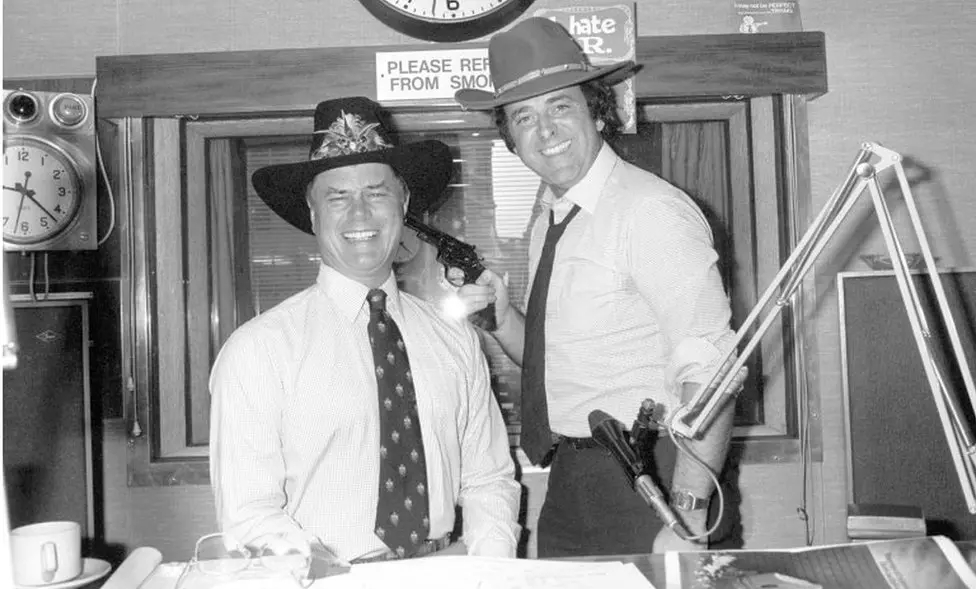
    Terry Wogan holding a gun to Larry Hagman's head in a BBC Radio studio.

    The majority of television programmes are ephemeral. They’re on, then they’re not, and you’re lucky if many people noticed them. But then there are television programmes that reach escape velocity and break free into the national zeitgeist, meaning everyone everywhere knows all about them whether they’d watched the damn thing or not. For most of the 1980s, as remembered by anyone who recalls all the references to ten-gallon hats, an entire season of a TV show turning out to have been a dream, or the joke where J.R. has a drink of water only for the liquid to pour out of bullet holes all over his body, Dallas was the latter. But here’s a thing: Dallas – that most American of American soap operas – may never have existed were it not for Coronation Street.

    Let’s explain by whizzing back to the 1930s. Yes, the 1930s.

    As you may well know, the phrase ‘soap opera’ came about when such serial drama programmes on the radio in 1930s America were commonly sponsored by soap and detergent manufacturers. When television started to grow in popularity in the 1940s, these soap operas would make the transition from radiogram to picturegram, starting with the boarding house-based These Are My Children (NBC, January-March 1949), with short fifteen-minute episodes airing on late weekday afternoons.

    While These Are My Children didn’t prove to be an immediate smash with viewers, it provided a cheap and cheerful way to fill some of those daytime hours, and it was soon joined in the schedules by A Woman to Remember (DuMont, February-July 1949) and The First Hundred Years (CBS, December 1950-June 1952). However, the following year’s Hawkins Falls, Population 6200 (NBC, April 1951-July 1955) could be considered the first truly popular daytime soap – with just a slight caveat, given it’d actually started as an hour-long primetime comedy drama in June 1950, before regenerating into a fifteen-minute daytime soap the following year. From that point on, the floodgates were pretty much flung open by US TV schedulers, with (at least) 27 more daytime soaps bubbling up during the remainder of the decade. For the sake of your sanity and mine, I’m not going to list them all here.

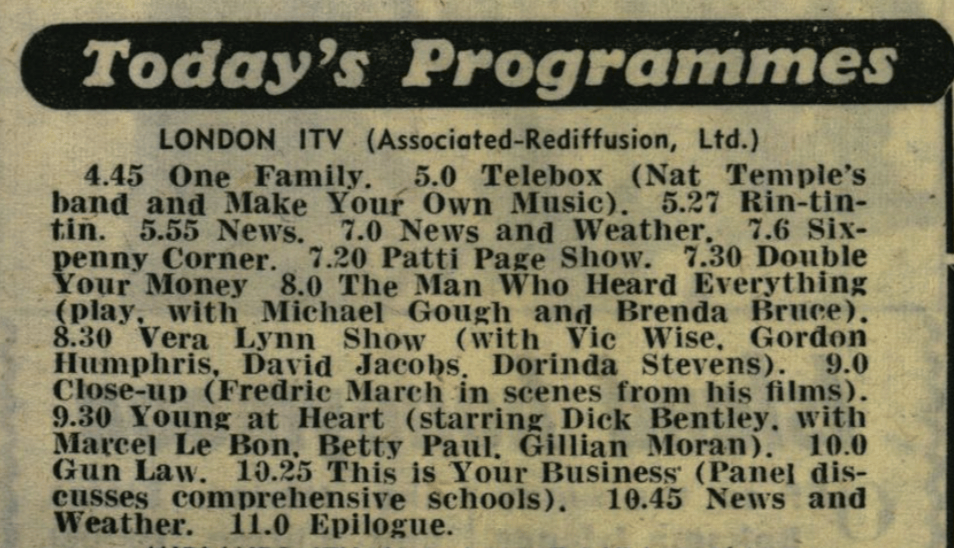
    Whatever American telly does, British TV soon starts sniffing around. Continuing drama serials in the UK had previously been the sole domain of radio, with The Archers airing for the first time on 29 May 1950 (as a pilot episode, going full-time on 1 January 1951), but when television attempted the genre, there weren’t really any daytime hours that needed filling – the short amount of pre-teatime broadcasting hours were reserved for children’s TV and news. And so, when some British TV soaps did appear, like The Grove Family (BBC-tv, April 1954-June 1957) or Emergency Ward 10 (ATV, February 1957-June 1967), they were mainly primetime prospects – ITV’s first attempt to put such a programme in a short afternoon slot – One Family (Associated-Rediffusion, April-May 1956) – all but proved British TV wasn’t really ready for such a series.

    London ITV schedule, 25 April 1956 (Daily Mirror)

    I’m not going to shock anyone here by pointing out that it was Coronation Street (Granada, December 1960 to the end of recorded time) that became soap’s first bona fide smash in the UK. While Emergency Ward 10 had hardly shied away from realism where warranted, Coronation Street became something that a large amount of the viewing public could truly relate to – ordinary working-class folk, in an ordinary working-class street, and a clear focus on lives rather than events. And Tony Warren’s series wasn’t just becoming big in Blighty – it was attracting the interest of television bigwigs in the USA, too.

    Depending on which source you’re looking at, the success of Corrie led to one of the “ABC top brass” (as per LIFE magazine, 25 April 1969), “officials of 20th Century Fox” (according to The Serials: Suspense and Drama by Instalment, Raymond William Stedman, 1977) or TV producer Paul Monash (going by Television Genres, The OU Course Team, 2003) to have the idea of making a primetime soap for the USA in 1963. The latter source claims Monash even considered broadcasting episodes of Coronation Street in the USA, but sensibly decided US audiences would have trouble understanding northern English accents. And so, with Coronation Street in mind, the TV rights were secured to Grace Metalious’ 1956 book Peyton Place – previously the subject of a successful 1957 film for Fox – and the series duly aired in 1964. Dealing with the lives and secrets of people in a small New England town, Peyton Place was a success – attracting tens of millions of viewers at its peak, and helping kickstart the careers of cast members Ryan O’Neal and Mia Farrow.

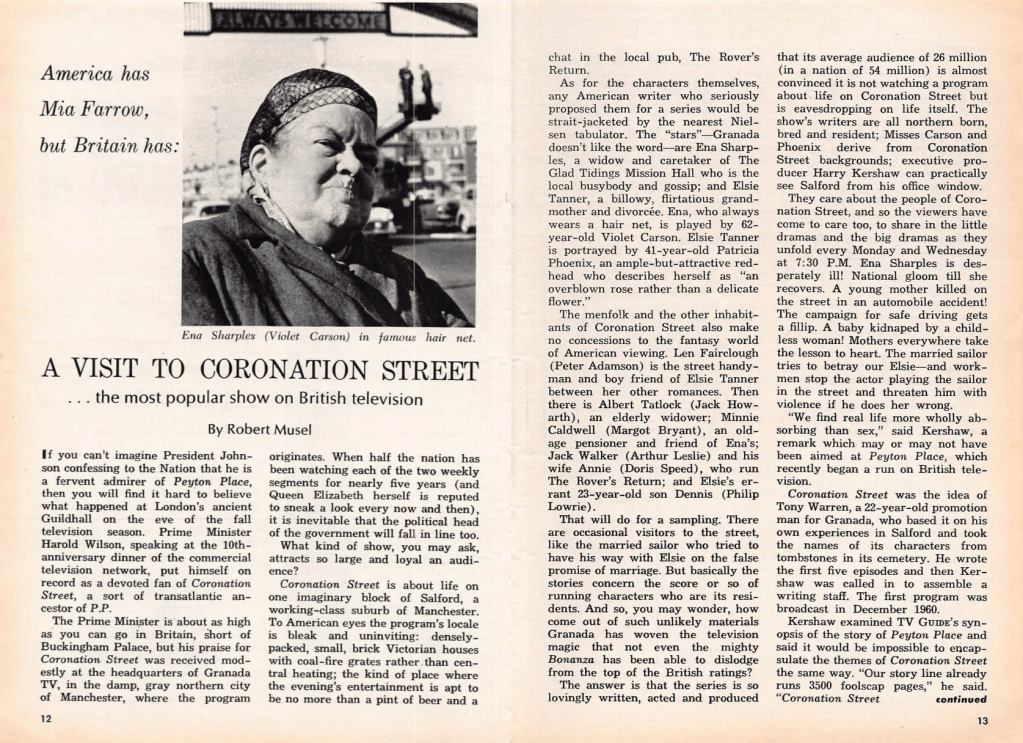
    TV Guide article, "America has Mia Farrow, but Britain has..." [Photo of Ena Sharples] "A Visit to Coronation Street"
    TV Guide, 20 November 1965

    The Weatherfield influence on Peyton Place was certainly recognised in the USA – the 20 November 1965 edition of TV Guide carried a three-page feature on Coronation Street, alongside a nice big photo of Ena Sharples – snappily noting that for all of its qualities, “any American writer who seriously proposed [the Coronation Street characters] for a series would be strait-jacketed by the nearest Nielsen tabulator”. By translating what made Corrie work so well over here into something that worked over there, Monash had proved that American TV could make continuing dramas attractive to huge audiences. As such, from January 1965, some of the smaller ITV regions began broadcasting Peyton Place. In primetime slots, too.

    Then, in 1978, Dallas arrived. But – in a way befitting the long, rambling nature of this entry – not as a primetime soap. Sigh. The original plan by producer Leonard Katzman and writer David Jacobs, when it came to their tale about a family of Dallas oil tycoons, was for it to be a miniseries. Each hour-long episode would, despite some ongoing storylines running throughout the series, be a self-contained narrative that would neatly tie together. And so, that’s how it initially aired – a short season of five episodes airing on CBS throughout April 1978, airing at 10pm on Sunday nights, opening with an episode where “the youngest son in an oil and cattle-rich family shocks the entire clan when he brings home as his bride the daughter of his father’s long-time enemy”.

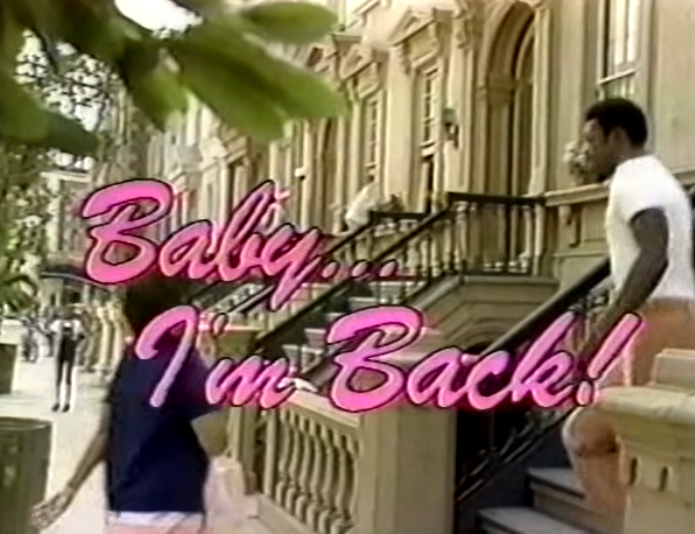
    Viewing figures were modest – Nielsen ratings for that initial series put it in joint-44th place for the 1977-78 season, sharing a position with CBS sitcom Baby, I’m Back. The latter – a vehicle for Desmond “Sanford’s & Son” Wilson, who played a compulsive gambler trying to win his wife back – was duly cancelled. Dallas was given a second shot, with an extended run of 24 episodes set to air from September of the same year, with a greater emphasis on cliffhanger plotlines. It would initially air in a Saturday night slot, but soon moved to Friday nights where it would reign supreme.

    Title card for "Baby, I'm Back", the programme title overlaid on footage of a residential street.

    Once Dallas had been effectively retooled as a grand comeback for the primetime US soap – because that’s what it had become by this point – it wouldn’t be too long before British viewers got to enjoy it. The first episode of the (mini-)series went out on 5 September 1978, in an 8.10pm Tuesday BBC1 evening slot, with the second US season immediately following the first – meaning episodes of Dallas’ second series aired in the UK just ten days after their US debut. Handily for the Beeb, the more self-contained nature of those early episodes afforded them an opportunity to skip the fourth episode, Winds of Vengeance, which contained a pretty uncomfortable plotline involving sexual assault.

    Even then, while Dallas was a familiar presence on Tuesday evening BBC1 throughout 1978 and early 1979, the first two seasons hardly pulled in huge audiences. Even at the start of the third season in November 1979, at a time when ITV were just getting back into operation following almost three months off air due to industrial action, Dallas failed to make the weekly Jictar Top 20 ratings. That means it was officially attracting fewer viewers than Go with Noakes. In January 1980, it made the ratings chart for the first time, in 13th place with 15.1 million viewers. By 12 April of the same year, the viewer count had swelled to 16.7m viewers, making it the most-watched TV series in Britain, as the nation became gripped with the dastardly deeds of arch heel J.R. Ewing. His rampant villainy was coming to a head as the third season neared its conclusion, word reaching the British press that the season finale would see J.R. receive what’s coming to him (Clue: small, metal and is fired from a gun). If the penultimate episode of the season on 12 April topped the ratings, surely the following week’s season finale would attract even more viewers?

    No, it wouldn’t. The BBC schedulers had their own bit of villainy up their sleeves – postponing the broadcast of the season finale for six weeks to maximise the attention it would get. It worked – on the week that episode went out (in May 1980), the only TV broadcast attracting a bigger audience was Brian Clough’s Nottingham Forest beating SV Hamburg in the European Cup Final. The episode concluded with one of television’s most famous cliffhangers, the mystery of just who pulled the trigger that propelled hot lead towards Ewing. Bookmakers William Hill took more than £50,000 in bets on who the culprit would be, while Las Vegas lawmakers had to intervene to prevent the same happening in the USA. As the nation busied itself with Who Shot J.R. discourse, BBC2 broadcast “a special selection of programmes from the series” on six evenings each week from 7 July, allowing newcomers a chance to catch up before the new series aired in November 1980.

    The identity of the would-be murderer was so closely guarded that the broadcast tape of the subsequent series opener was transferred from Heathrow to BBC Television Centre in a bulletproof van, flanked by a motorcycle escort. With the BBC airing the episode just three days after CBS in the States, there was little chance of the secret hitting the press, and the fourth season of Dallas opened with a UK audience figure of 20.25m. The producers of Dallas not being a bunch of mugs, the culprit wouldn’t be revealed in the first episode of the series – or second, or third. To further confound any crew member hoping to leak the big revelation to the press, multiple versions of scenes were shot, with only the ‘real’ reveal being sent out to broadcasters.

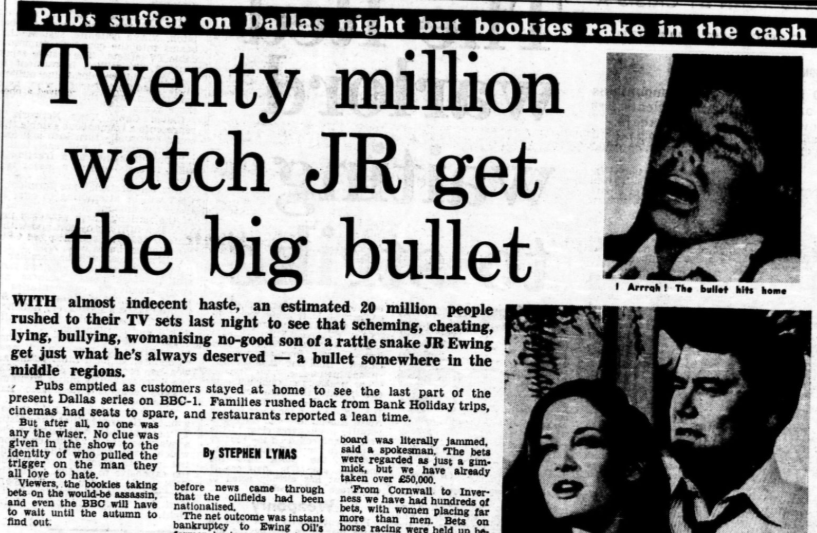
    Newspaper headline: "Twenty Million Wath JR Get the Big Bullet"
    Daily Mail, 27 May 1980

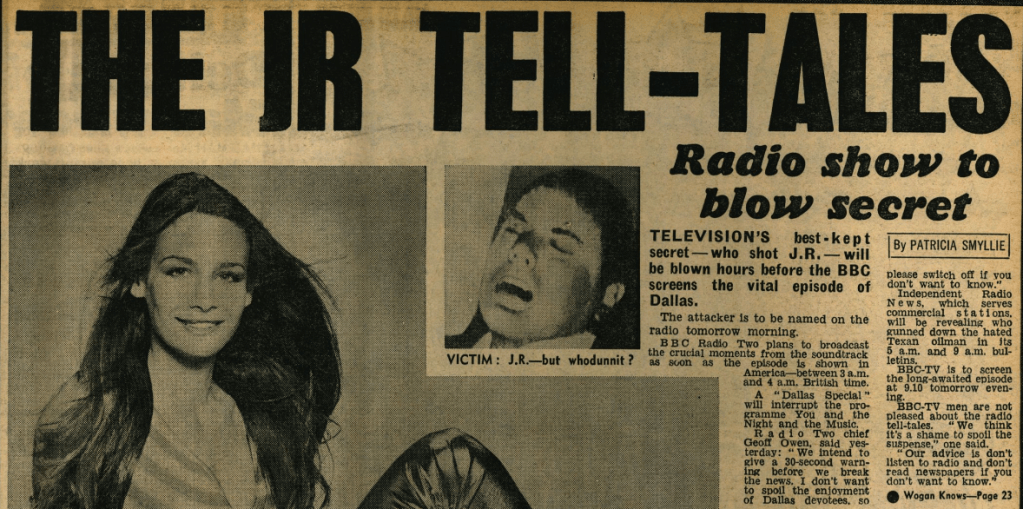
    When it came to the big day – the all-important S04E04 that would finally reveal Who Shot J.R. – BBC Television were taking no chances. The reveal was to air on US TV between 3am and 4am UK time on Saturday 22 November 1980. It would air on BBC1 at 9.10pm that same day (the day after the previous episode on BBC1). That would prevent national newspapers from having time to learn the big news and get it onto Britain’s breakfast tables, but there was an even more surprising culprit at large: BBC Radio. Much to the chagrin of their audiovisual counterparts, BBC Radio 2 interrupted their overnight music programme You and the Night and the Music moments after the reveal on CBS Television, offering thirty seconds of spoiler space before naming the shooter, with Two bigwig Geoff Owen stating “I don’t want to spoil the enjoyment of Dallas devotees”. Despite, you know, doing precisely that.

    Newspaper headline: "The JR Tell-Tales. Radio Show to Blow Secret"
    Daily Mirror, 21 November 1980

    Of course – spoiler alert – the shooter herself was much less of a surprise than that Radio 2 exposé. J.R.’s scorned mistress Kristin owned the finger that pulled the trigger, her position as 4-1 second favourite with William Hill reportedly costing the bookmaker £160,000. More importantly, with that week’s two episodes of Dallas topping the ratings, more than 21 million tuned in for the unmasking. Dallas was very officially A Big Deal. Which would come to a head just over four years later.

    Over the next few years, Dallas would remain a major draw for the BBC. Opening episodes of each season would usually top the viewing figure charts for BBC1, even if numbers weren’t quite at the peak of Who Shot J.R. fever. Even when new episodes weren’t at the top of the BARBs, they were pulling in respectable figures north of 14 million. But, on 17 January 1985 – with the BBC halfway through screening season eight of the series – news hit the nation of a boardroom coup that could’ve been wrestled from the Dallas writers’ room.

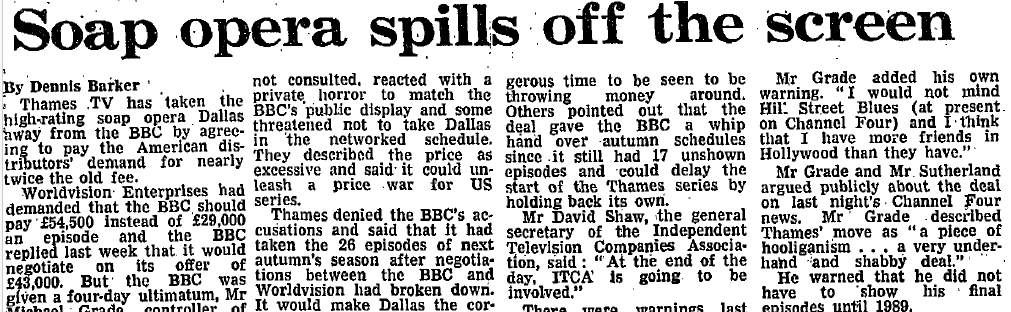
    “ITV GRAB DALLAS” screamed the Daily Mirror. “ITV POACHES DALLAS” roared the Daily Mail. “BBC LOSES DALLAS IN SOAP OPERA WAR” tutted the Daily Telegraph. “SOAP OPERA SPILLS OFF THE SCREEN” intoned The Guardian. “DALLAS POACHED FROM THE BBC” spluttered The Times. In each case, this was front page news (though you can guess which of those afforded it space below the fold).

    Guardian, 17 January 1985

    Indeed, the show’s distributors Worldvision had raised the price-per-episode for the ninth season to a level the BBC weren’t willing to pay. But, while the Beeb – at the time waiting on a consultation about the future of the licence fee – baulked at the idea of paying £1.4m for a 26-episode run of popular television (plus a 10% annual rise, and a commitment to buy every future episode of the series), Thames were more than happy to. ITV’s London weekday franchise gleefully swooped in to meet the higher fee, a fee that seems quaint in an era where Disney-fuelled Doctor Who episodes reportedly cost £10m a pop.

    To modern eyes, such a gazumping doesn’t seem much of a surprise – it’s nothing that didn’t happen when Friends, 24, Lost and the like got snapped up by Sky. But back in the 1980s, a gentleman’s agreement had been in place between the BBC and ITV franchises not to partake in such unseemly bidding wars – mainly to avoid the price of imported shows getting overinflated. To highlight how unpopular a move it was, some of the other ITV franchises (most notably big guns Granada, Central and Yorkshire) criticised the deal, went as far as to announce they would refuse to air Dallas in their own regions when Thames planned to start showing it that autumn. After all, it was one thing waving a fat cheque at Morecambe & Wise or Mike Yarwood to make original programmes for ITV, but this was unseemly. Thames tried to argue that the inflated price of a Dallas episode was still around a quarter the cost of making a new episode of Minder, though nobody in particular was listening.

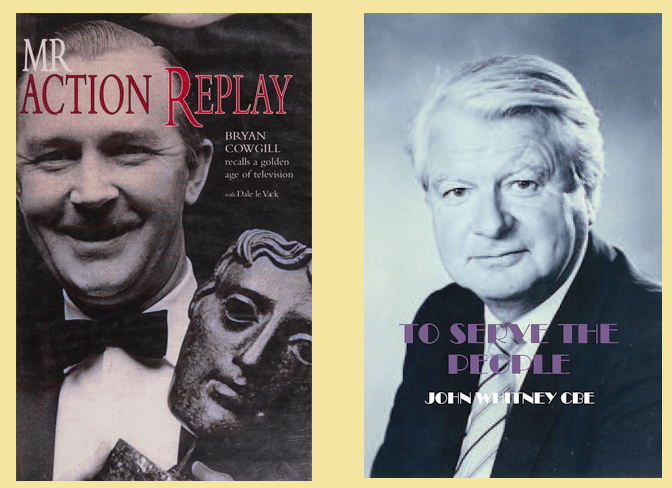
    It didn’t take long for Thames to get a carpeting from the Independent Broadcasting Authority. Thames MD (and former Controller of BBC1) Bryan Cowgill was called in for ‘talks’ at the IBA, though the outcome of those talks differs between the autobiographies of Cowgill (Mr Action Replay, Sports Masters International 2006) and John Whitney, director-general of the IBA (To Serve the People, John Libbey Publishing 2013). Whitney’s telling of the meeting suggests a one-way telling-off, with Cowgill being ‘reminded’ that the IBA can block Dallas from being broadcast if it fell afoul of broadcasting policy guidelines. Cowgill’s telling of the story has it that Worldvision had flatly refused to continue speaking to the Beeb “in light of the treatment they received from the BBC”. Cowgill, a former Head of Sport at the BBC, countered Whitney’s argument that snatching the Beeb’s top US import “just isn’t cricket” with his opinion that he knew a good deal more about cricket than Whitney.

    Book covers for Bryan Cowgill and John Whitney's autobiographies
    Fight! Fight! Fight!

    To compound matters, BBC1 controller Michael Grade announced that the Beeb’s existing Dallas episode reserves would be yanked off the schedules and held in storage until Thames started broadcasting their season nine episodes, at which point BBC1 would run season eight episodes against them. Or, as Grade said at the time “we have 17 episodes of Dallas left to show in the current series, and Thames can’t put on the next series until they’ve finished. But who knows how long it might take us to finish screening them?”, probably whilst twirling a stick-on moustache.

    It was one hell of a power move, and further stoked the media narrative over the row (“These [BBC] executives betray themselves. In reacting thus to the loss of an elderly, mediocre soap opera they demonstrate how, despite assurances to the contrary, BBC television has sunk so low as to be indistinguishable from ITV” – The Daily Telegraph, predictably). And so, on 6 February 1985[1], it seemed the last episode of Dallas to be seen on the BBC for a good long time went to air. The Daily Mirror’s TV listings billed it as “the saga sinks slowly in the West for a while. It’ll be back in the autumn on the BBC – AND on some ITV stations too!”.

    A week later, the slot was filled by the first episode from a new series of The Two Ronnies (“Sandra Dickinson guest-stars in a parody of Sunset Boulevard”). That’s pretty Premier League as filler programmes go. Bryan Cowgill refused to be cowed by Grade’s hardball, stating that “I’ve got it and I’m keeping it – it’s my baby. I’m in business to win. If that upsets other people, it’s hard luck.” But could there be any way of it returning to the Beeb, given many ITV franchises were also miffed by his tactics? “The only way we could return it to the BBC is if they bought it off us for the same price we paid for it.”

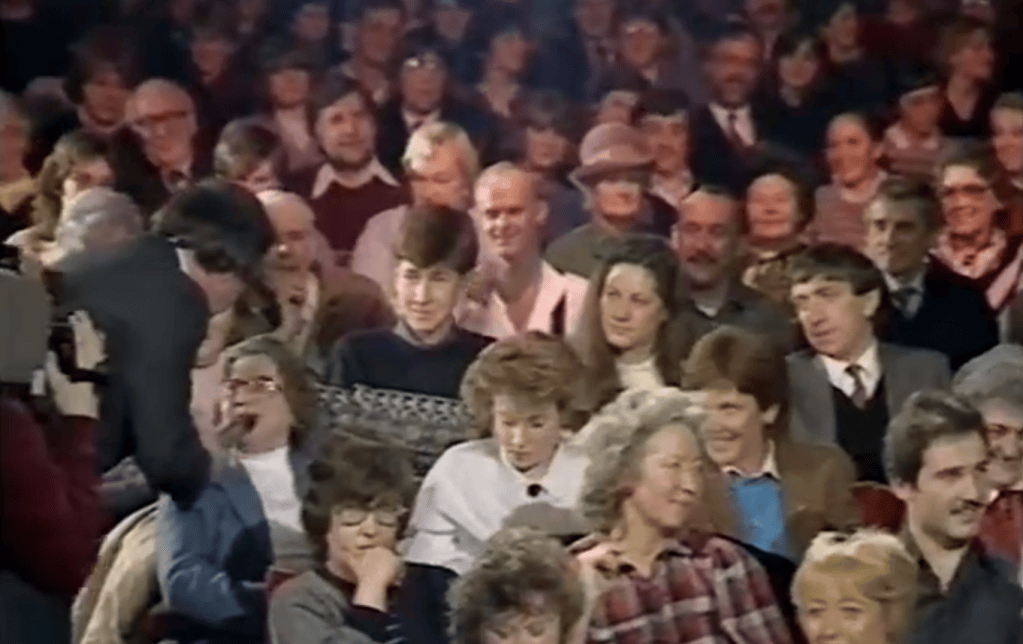
    The impasse lasted until 18 February, when the BBC announced the return of Dallas to BBC1 from 27 March, with managing director Bill Cotton revealing the Corporation was “taken aback by the strength of viewer reaction”. The news itself had been revealed as part of another new era for the BBC – the first weekday episode of Wogan featuring a (soon ditched) audience participation segment where Tel revealed the news to a grateful nation, with the following day seeing the debut of new BBC soap EastEnders. However, the wave of audience demand may not have been the sole reason behind the Beeb backing down – the BBC’s announcement coincided with an announcement from Guild Home Video that the remaining Dallas season eight episodes placed on ice by Grade would be rushed out on VHS, with tapes containing three new episodes arriving at fortnightly intervals.

    Screengrab of the audience participation slot from the first 1985 edition of Wogan
    “Talk to the audience? Oh, God, this is always death.”

    Brighter news was on the horizon for BBC bosses in June. Many ITV franchise holders were still frosty about the whole debacle and unlikely to broadcast any episodes. As a result, the prospect of paying over the odds for what would now be a “regional variation” in the TV listings led the management and legal team of Thames to visit New York for a meeting with programme distributors Worldvision. Their reluctant goal was to sheepishly sell Dallas back to the Beeb at a reduced fee and forget all about the Thames offer. In a move that surprised few, the large American company announced it would rather keep the larger amount of money.

    In an attempt to resolve the matter, Thames sent letters to all other ITV franchise holders inviting them to state categorically whether they’d be willing to transmit Dallas or not – and if not, why not. As per John Whitney’s memoirs, Thames chairman Hugh Dundas claimed this was a ploy to get a bunch of negative responses that could be waved under Worldvision’s nose, as part of a negotiation to give the rights back to the BBC. Whitney’s suspicion was that it may have been a ploy to demonstrate how other ITV regions had softened on their original stance, and that there was now a certain amount of unspoken enthusiasm for putting the ratings smash on ITV. Tellingly, the recipients of the letters included London weekend franchise holders LWT, heavily suggesting the goal was purely collecting as many ‘no’ votes as possible.

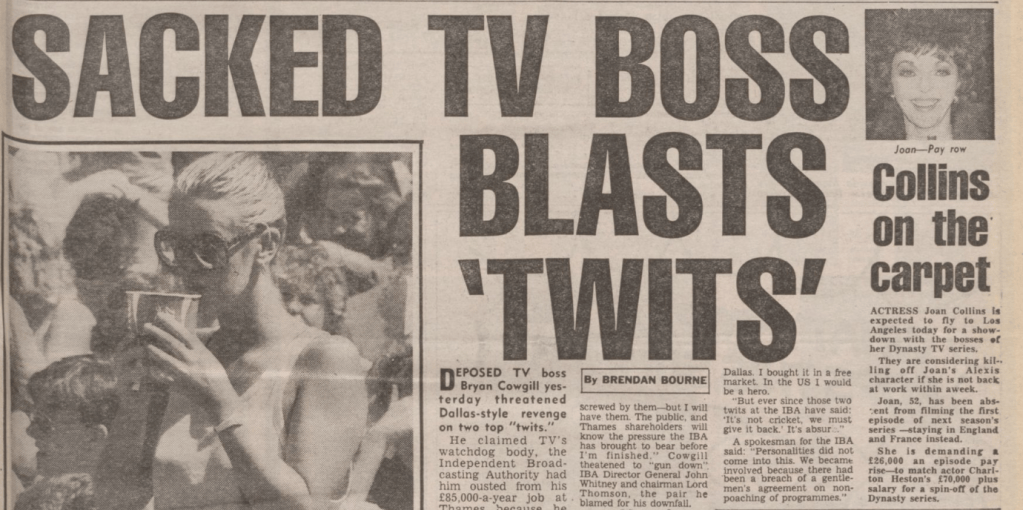
    With all manner of bickering between Thames, the IBA and other ITV franchise holders continuing into the summer, Bryan Cowgill left Thames in July 1985. The mechanics of his departure differ between the Cowgill Version Timeline and the Whitney Version Timeline (“I didn’t wish to spend one more day of my life in the company of such hypocrisy and petty authority … I tendered my resignation” versus “I was telephoned by Hugh Dundas to say that the Board had decided Bryan Cowgill should go”), but either way Cowgill left with a £400,000 handshake. Why, that’s enough to buy 7.4 episodes of Dallas. In his post-job presser, Cowgill railed against the IBA (“I’ve been screwed by them – but I will have them.”), singling out IBA Director General John Whitney and chairman Lord Thomson as the individuals behind his defenestration (“if it goes back, those two damned idiots will have handed it back”). At least according to Thames chairman Hugh Dundas, Cowgill failed to do himself any favours by carrying out the entire deal without notifying the Thames board. It certainly didn’t help that the ‘agreeing-to-pay-a-steadily-rising-price-for-as-long-as-Dallas-is-made’ clause remained in the Thames version of the contract.

    Newspaper headline: "Sacked TV boss blasts 'Twits'"
    Daily Mirror, 14 July 1985

    As it was, Dundas felt compelled to take to the pages of trade newspaper Television Today to address commonly quipped concerns about the whole affair. He shot down suggestions that the future of the Thames franchise might be put in jeopardy by the Dallas affair – it wasn’t, though that reckoning was only a few years away. The most telling part came at the end of Dundas’ piece – “the board had to choose between digging in and holding onto the programmes, or trying to negotiate their disposal. The latter course was adopted and has been pursued ever since”. The fact was that, in the BARB ratings released just after Cowgill’s departure, broadcasts of Dallas were now just 50,000 viewers ahead of Crossroads in the ratings. This declining audience may very well have had an impact on this stance. The ball was back in the BBC’s court, and with nobody else competing for the rights to the series, the next season of the soap could continue where viewers had come to expect it.

    The agreement to hand it back to the Beeb finally came in August 1985. The climbdown from Thames was notable – with Worldvision refusing to budge on the increased price, Thames agreed to pay an undisclosed lump sum to the BBC, allowing the Corporation to re-purchase the series. Where Thames had agreed a fee of $60,000 per episode, the settlement meant the BBC were paying the figure they’d originally offered to retain the series, with Thames picking up the slack – a sum of either $10,000 (according to Whitney) or $12,500 per episode (according to Cowgill). And so, the whole affair would be resolved in time for the publication of the autumn schedules in early September. Wouldn’t it?

    Nope. The whole sorry affair rumbled on well into the autumn, leaving a conspicuous Dallas-sized hole in the TV schedules while US viewers were enjoying a ninth season of Ewing antics. In October, the matter was even raised in the House of Commons, with Junior Minister of Trade and Industry Michael Howard being asked to outline the steps Her Majesty’s Government had taken to sort out the whole sorry oil slick. The Office of Fair Trading even got involved, contacting Worldvision to try and break the impasse.

    Then – finally – in December came a breakthrough: Thames lawyers had finally agreed the small print with the BBC. February 1986 saw the announcement that the matter had finally been resolved, with the new series set to begin on BBC1 on Wednesday 5 March. Bryan Cowgill took time out from his new role as Deputy Chairman of the Mirror Group to comment “I am glad the OFT has confirmed the existence of a no-poaching agreement.” Meow. The belated return to Britain’s screens saw viewing figures for Dallas remain buoyant – season nine attracted 14m viewers, only slightly down from the figure for the end of the previous season (14.95m), though it would soon become evident that even with brand-new episodes – and real-life boardroom battling aside – the British public were starting to lose interest in the Ewings.

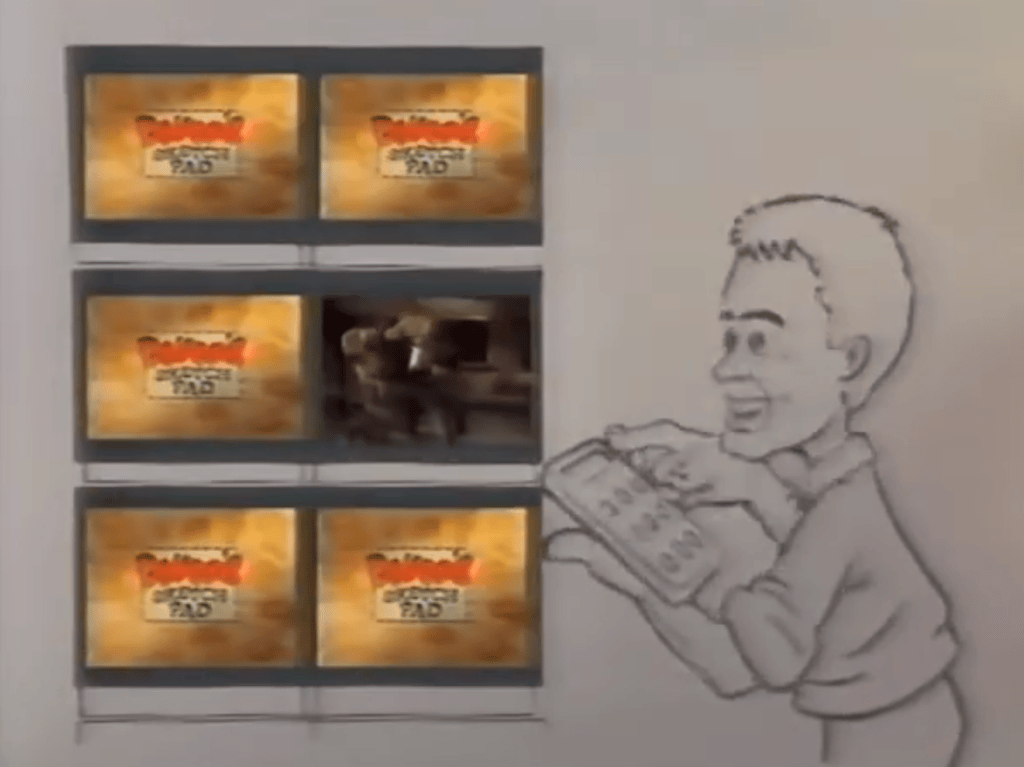
    Audience figures soon started to dip further, with more down-to-earth drama serials like EastEnders and Neighbours becoming the main draw for BBC1. By 1989’s twelfth season, first-run episodes of Dallas on primetime BBC1 – previously the most-watched show on British television – struggled to appear at the scrag-end of the channel’s top thirty programmes. When it did appear, it would be gathering audiences between seven and nine million – not much of an achievement when several million more viewers were tuning into well-worn repeats of The Good Life and Columbo (or, if you’re feeling especially uncharitable, episodes of Davro’s Sketch Pad on ITV). But with the BBC locked into a contract tying them to the series for as long as it was being made, they had to keep showing it.

    Title screen for Davro's Sketch Pad. A cartoon Bobby Davro paws at a remote control and a bank of six televisions
    Davro’s Sketch Pad: Bigger than Dallas

    By the time the final series (of original flavour Dallas, at least) rolled around in May 1991, it was no longer a primetime proposition for the BBC. From this point on, new episodes would air at 3pm on Sunday afternoon, the once-mighty colossus now hanging around to pick up viewers from the EastEnders omnibus. Thankfully for the BBC, ratings had also dipped notably in the USA, from a high point of 33.4m viewers and being US TV’s most-watched show during the (first) outing of a bullet-riddled J.R., down to a low of 12.9m in the final season, failing to make the top sixty programmes. And that – a repeat run of the series on daytime TV in the mid-90s aside – was that.

    Or, was it all a dream?

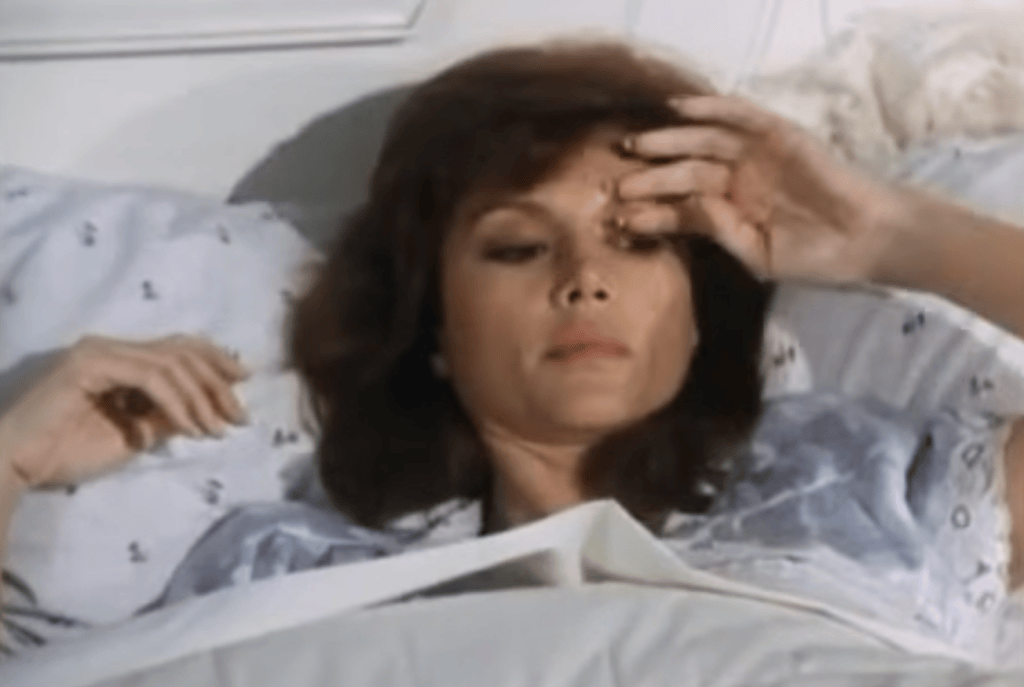
    Screencap: Pam (Victoria Principal) wakes up from her terrible months-long dream

    [1] Blott on the Landscape started on BBC2 that same evening, which I’m saying should be regarded as Britain’s answer to Dallas.

    –

    There we go! Remember, for this and 249 more entries (not all as long as this one, I feel duty-bound to add) buy a copy of Auntie’s Favourites now.

    Or later, if it’s more convenient.

  • Auntie’s Favourites: A New Book, BBC-tv’s 90th Birthday and Picture Page

    Auntie’s Favourites: A New Book, BBC-tv’s 90th Birthday and Picture Page

    After the longest of times, this is complete:

    All being well, it’ll be available to buy in a couple of days as an ebook and shortly after that as a real, physical book you can hug at night. I’ll publish more details when each is available, along with details of the foolishly reasonable pricing.

    What is it? Well, a few years ago this blog (re)launched with a rundown of the hundred television programmes that have been broadcast on the main BBC channels most frequently since that first official television broadcast on 2 November 1936. This book extends the remit (to also cover BBC Three, BBC Four, BBC Choice and BBC Knowledge), the scope (to 250 programmes in total) and the detail (barring any last minute tweaks, it’s a shade under 250,000 words across 626 pages). And this time, I’ve included Newsnight.

    So, why post an update now? Well, it’s very nearly 2 November 2026, which means it’s just about the 90th anniversary of the launch of the BBC Television Service. My original goal was to have the book on sale by then, but found it hard to put the pen down, adding in about a dozen extra pages instead of submitting it in good time for that self-imposed deadline.

    So, in lieu of that, here’s an entry from the book. And a pretty appropriate one – a programme that will also be enjoying its 90th anniversary on the second day of November. At joint-208th place in the list, here’s:

    Picture Page

    1936-1952, broadcast 590 times
    BBC-tv (1936-1952)
    Radio Times Television Supplement, 8 Jan 1937

    Ah, The One Show. The idea of having a daily magazine programme featuring interviews with anyone famous (and willing) enough to visit the studio, along with features, reports and performances, is hardly new. For one thing, Pebble Mill had been doing the same thing for ages. And, as you’ll have guessed by this entry being for neither The One Show or Pebble Mill, so did this programme. And, at least as far as television is concerned, it did just that before anyone else. Mainly because Picture Page came along on the very first day of tele-visual broadcasting – the fourth programme ever broadcast on the BBC Television Service after it officially launched, in fact.

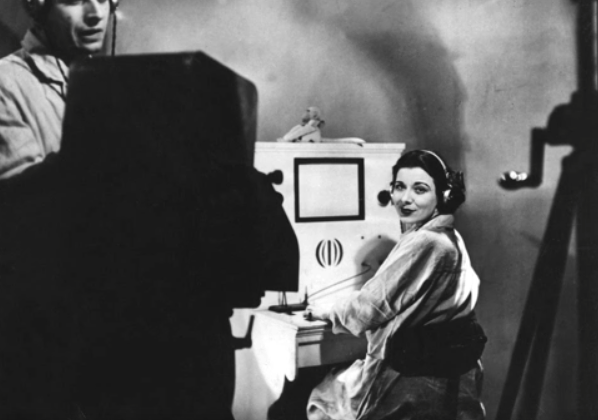
    Such were the limitations of the Baird system; it was hardly the most arresting programme for those nascent televiewers. The broadcasting system in use for that first week of TV demanded the use of Emitron cameras mounted on top of iron pedestals, meaning that the first official episode of Picture Page (on Monday 2 November 1936, which gave an official debut to Joan Miller “who links the show introducing each person by plugging in a telephone switchboard after a few preliminary words of description”) consisted of two basic shots – while the Baird cameras could pan, that was about the limit of their range. There was no chance of moving the camera around otherwise, meaning everything was filmed from pretty much the same angle.

    However, test transmissions had shown how things could be quite different. The rival EMI system had been used for a test transmission on 8 October 1936 – featuring a sort-of-pilot edition of Picture Page – was able to employ three cameras that could be moved much more easily, allowing for different shots from various angles. The test transmission was impressive enough for the Daily Telegraph to trumpet the programme “a brilliant success, [setting] up fresh standards in television entertainment and presentation” which “approached cinema standards of efficiency”. In short, bye-bye Baird.

    The programme itself was however a perfect candidate for the new medium. No scenery, just Joan Miller at an ersatz switchboard, and a selection of guests that could slot into the programme’s remit of providing “a magazine of topical and general interest”. It was personalities that made the programme, and even if that generally promised little progress from radio precursor In Town Tonight, there’d at least be the occasional promise of a performing pooch or circus act to tickle those visual senses.

    The first edition of Picture Page opened with a young bugler from HMS Warspite standing against a Union Flag background while the signature tune – The Jack Hylton Band’s recording of Red, White and Blue – played. Cut to a picture book bearing the show’s title, which opened to show flipping pages, before a cut to Joan Miller seated at her telephone switchboard. Miller’s shtick throughout the initial episodes was to pretend she was speaking to a theoretical caller, taking a request to speak to a passing star. Cue a bit of business along the lines of “You want to see who? Miss Kay Stammers? Miss Stammers is coming into the studio now” before the conversational baton was passed to the seated tennis player.

    Joan Miller, ‘The Switchboard Girl’, 1936-1952, via BBC.co.uk (Or, if you prefer, ‘a scene from the original BBC TV fakery scandal’)

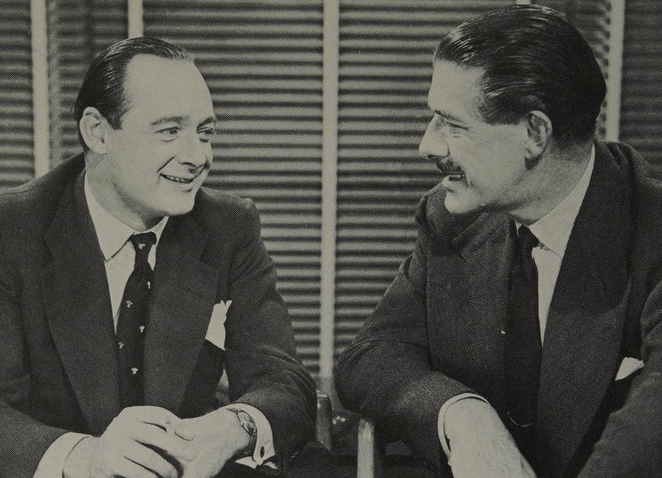
    With the concept of recording content for later repeat viewing still many moons away, each edition had to be broadcast live. Meaning, from the following Monday onwards, each early afternoon and each late evening edition of Picture Page would be live. And, as was considered proper at the time, interviewer Leslie Mitchell would be donning a lounge suit for afternoon broadcasts, but would have changed into a dinner suit for each evening episode. After all, to quote 30 Rock’s Jack Donaghy, “It’s after six. What is he, a farmer?”.

    As everyone was still frantically getting their heads around this whole “Tele-vision” fad, there was a veritable conveyor belt of guests in each half-hour edition – as many as eight being introduced by Miller at the switchboard. Yet, the programme provided several tropes that would live on throughout television history:

    • the first ever linking device – Miller’s switchboard was a device that linked interviewees with a smoothness many current hosts would wrestle their floor manager for
    • the first ever TV catchphrase – “You’re through! You’re looking at…”
    • and – given everything on air until its debut edition used merely descriptive titles (“3.0pm The Opening of the BBC Television Service”), television’s first ever identifiable brand
    • heck, if you’re going to count the opening day’s billing of “Variety” at 3pm a description of a genre rather than a programme title (the listings at the time took both approaches), Picture Page is the world’s oldest scheduled television series
    • in young Canadian actress Miller, television’s first true star
    • going by a contemporary memo from the BBC’s Chief Engineer of Radio RTB Wynn – what could have been the first ever TV scandal: aviator Jim Mollison, a guest on the first edition, apparently “having had several”. It’s lucky only a few hundred people were watching.

    With that very sense of “not many people have got TV sets yet” ringing around the subconsciousses of the Picture Page team (one presumes), there was a sense of freedom about putting the programme together that wouldn’t have been the case on the wireless.

    Picture Page was routinely put together on the day of broadcast – very often in the hours leading up to broadcast – which made for a white-knuckle ride for those used to working in radio. Programme editor Cecil Madden used a series of ‘scouts’ who were tasked with procuring the attention of famous faces as soon as they arrived in London, no matter what field they operated in. They would then contact Madden, explain who they were able to get, and be given a simple ‘yes’ or ‘no’ on whether they were a suitable pick for that day’s editions.

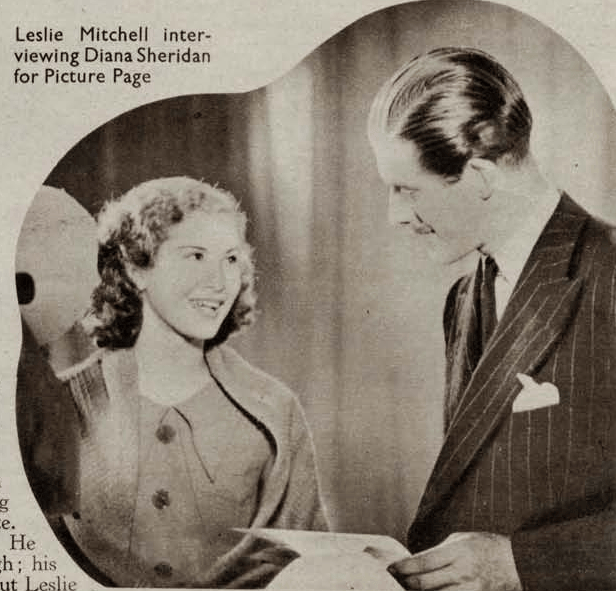
    If a scout’s target was deemed suitable, a script for their segment was hurriedly put together, and scripts handed to interviewers Leslie Mitchell and Jasmine Bligh, each taking a ‘shift’ for a day’s programme. This came with its own challenges. With the notion of televised interviews being as young as the programme itself, there was no previous experience to draw upon. Radio interviews could employ scripts for both participants, but sitting and staring at a script would be a no-no for television. Instead, the interviewers would be given a few key points about each interviewee before going live which they’d duly memorise. But with their targets being largely new to the world of broadcasting, it would be up to Mitchell and Bligh to engender a feeling of naturalness and informality, to keep those guests at ease.

    The limitations of the new format brought fresh challenges. In his 1981 autobiography Leslie Mitchell Reporting, Mitchell recalled how he’d need to keep a watchful eye on the oft-unreliable cameras in the studio, keeping the conversation flowing as he’d guide his subject towards what was often the studio’s remaining functioning camera. The use of rival (and incompatible) broadcast systems – with Baird and Marconi EMI systems alternating between afternoon and morning broadcasts – meant each episode would have different demands for lighting, clothing, cameras and make-up. Furthermore, the harsh lighting required in the early television age caused undue wear-and-tear on Mitchell’s clothing, requiring an advance on his salary to procure a suitable repository of clothing.

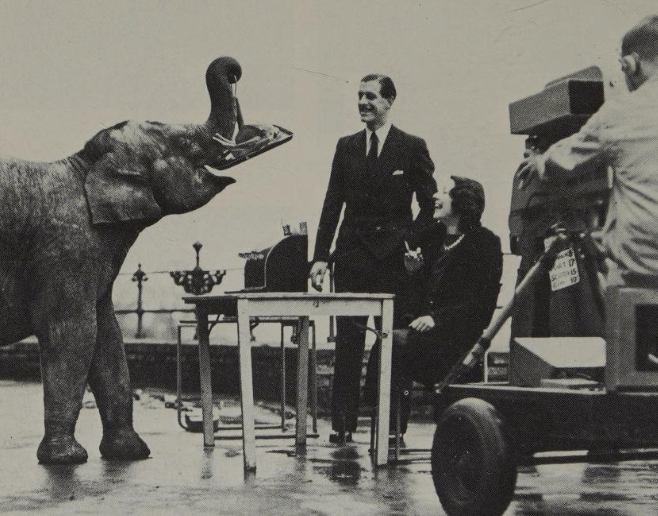
    Leslie Mitchell, Joan Miller and an elephant

    With two episodes going out each week, it didn’t take long for Picture Page to register a number of broadcasting landmarks, with the 200th edition on 15 December 1938 being marked by a great big birthday cake, the programme boasting of having welcomed “over 1,500 men, 660 women, the ghost of Alexandra Palace and a large number of animals of all kinds” by that landmark point. It was certainly easy to keep count, with each episode being billed in the Radio Times as “Picture Page ([n]th edition)”. That would continue right up until the last pre-war episode on 31 August 1939’s “262nd Edition”, broadcast the evening before the end of television broadcasting until 1946.

    The resumption of the Television Service saw the return of Picture Page, albeit with a few changes. The programme had a new editor, Joan Gilbert, who’d worked with predecessor Cecil Madden’s Overseas Entertainment Unit during the war. Gilbert appointed a new ‘Picture Page Girl’, Patricia ‘Paddy’ Bath, the switchboard replaced by a reception desk and a board detailing forthcoming interviewees. Gilbert would present the programme herself, with Leslie Mitchell returning as main interviewer. With hostilities over, the Television Service was starting to expand, as broadcasts started to reach other parts of the UK, and the acquisition of Lime Grove studios provided more capacity than ever to produce programmes. And yet, Picture Page was still central to the BBC’s output – and as TV was starting to take off around the world, it was able to boast of being the oldest television programme in the world. Television announcer Gilbert was a canny choice as presenter – such was the regard for her links, one viewer felt compelled to write in saying how – following an evening where Gilbert appeared to be suffering from a cold – they’d placed a dose of cough mixture on top of their set in an attempt to help.

    However, despite the programme’s continuing popularity – it was frequently singled out for praise by TV critics of the age – the fast-evolving TV business seemed to consider it something of a dinosaur. And so, on 12 March 1952, the final edition of the programme went to air. The decision came as something of a surprise to those working on the series. The BBC brass announced their decision to retire Picture Page just a couple of days before the final edition, a Beeb official positing that the series had been “going on too long and is getting stale”. As the standout star of the show, Joan Gilbert was awarded a standalone interview series – Joan Gilbert at Home, which ran for just seven weeks, with contemporary reports suggesting the all-important debut suffered from a short turnaround time – it aired just a week after the surprise cancellation of Picture Page. A lack of prep time was perhaps evident when Gilbert – usually no slouch at conducting interviews – asked distinguished screen actor Ralph Lynn if his forthcoming film Wild Horses would be his first movie appearance. He’d been appearing in films for over twenty years by that point. A more successful sequel, roving fortnightly topical talk show Joan Gilbert’s Diary, ran from 1953 to 1954. As for Picture Page’s chief inquisitor, Leslie Mitchell would go on to join founding ITV franchise Associated-Rediffusion as senior announcer and Head of “Talks”.

    Leslie Mitchell chatting to Bob Hope for AR-TV

    More of this kind of thing very soon. Happy 90th birthday, television!