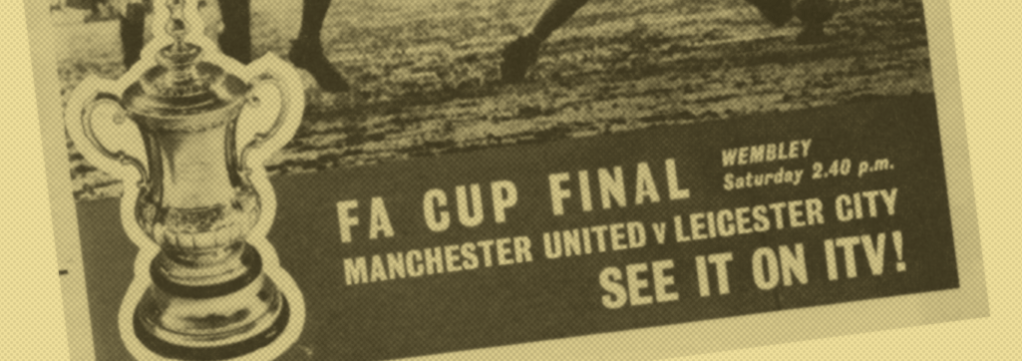
Back with the next stage of our wander down Wembley Way (briefly taking in Westgate Street, Cardiff), but first a quick whip-pan back to the 1940s. In the last part, we looked at how the billing for the first televised post-war Cup Final was advertised as airing from 4.05pm to 4.45pm, the Radio Times promising that “the last part of the match” would be screened live.
Well. Since then, I’ve been contacted by Paul Hayes on BlueSky, who has some more background info on that broadcast, following his research into the life and career of Jimmy Jewell, for a BBC Radio documentary on the former Norwich manager. Jewell was a key figure in those early years of the televised cup, on both sides of the action. A World War I Air Force veteran turned former amateur footballer, Jewell became a Football League referee by 1932 and would be the man in black at the first televised Cup Final in 1938. It was Jewell who blew the whistle for the late penalty that led to Preston’s extra-time winner. The following year, Jewell became manager of Norwich City until the outbreak of war led to him rejoining the RAF.
On returning from active duty, he turned his hand to sport commentary – including providing commentary for that 1947 Cup Final between Charlton and Burnley.
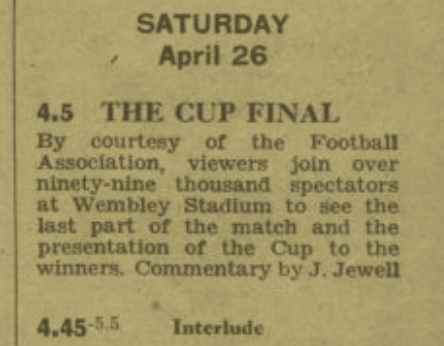
That’s where Paul Hayes’ research comes in. He has been able to confirm, from BBC paperwork of the time, that a late decision was made to broadcast the match in full, with the opening telecine film whirring into life at 2.45pm. To save Jewell from an exhausting two solid hours of solo chatter, former Corinthian footballer Norman Creek was brought in as co-commentator, though Creek’s forthright description of the match as dull didn’t prove popular with the producer.
Tellingly, Jewell was instead joined by England manager Walter Winterbottom in the commentary position for the 1948 final.
For the 1951 Cup Final, billed in the Radio Times as running from 3.45pm to 5pm due to Football Association huffiness, that’s almost exactly what happened, as confirmed by the Programme as Broadcast (PasB) notes for the day. Almost exactly, as coverage ended just over six minutes before 5pm, meaning there was room for Interlude film ‘Angel Fish‘, before Whirligig whirred into motion just after five.
[UPDATE: Courtesy of Paul Hayes again, there’s more on Whirligig here. which was BBC TV’s first Saturday teatime children’s programme, and not – as I’d completely misremembered – 1950s US kids drama series Whirlybirds]
When it came to the 1952 final, which wasn’t broadcast live at all, the BBC’s Head of Outside Broadcasts Peter Dimmock did write to FA Bigwig Sir Stanley Rous asking for a change of heart a week before the match. Dimmock’s proposal was to keep the live broadcast under wraps until the morning of the match, or even not to publicise it at all – secretly broadcasting the biggest sporting occasion of the entire year. With the BBC’s Outside Broadcast base positioned just over from the Empire Stadium (as was), the Corporation were even prepared to secretly set up their camera positions at the last minute, to avoid giving the game away.
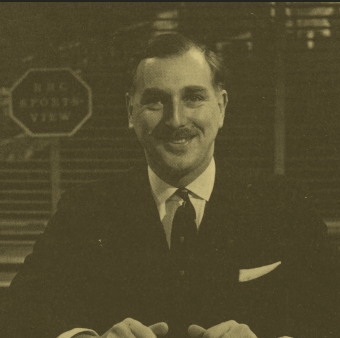
Sadly, that ‘secret’ cup final coverage didn’t come to pass, meaning the 1951 final would be the last live cup final commentary from Jimmy Jewell, who died in Autumn 1952. Though at least his co-commentator for that 1951 final – one Kenneth Wolstenholme – does conjure up the image of a fitting (albeit theoretical) passing-the-baton moment.
Lastly, Paul has shared some PasB details for the 1938 and 1939 finals, confirming that The Three Bears did indeed precede the Cup Final in 1938 – airing at 2.13pm instead of the RT-billed 4.40pm, and noting that the coverage of the 1939 final began slightly ahead of the billed time 2.40pm, before wrapping up at the later-than-billed time of 4.45pm.
Absolutely lovely stuff, there. Many thanks to Paul for that information. His documentary on Jimmy Jewell – a special episode of Radio Norfolk’s Norwich City show The Scrimmage – is still available on BBC Sounds – and I can confirm is a very enjoyable way to spend 57 minutes. If only to learn how Jewell once managed to ruin Adolf Hitler’s day.
Okay, onto the next series of Cup Final Day schedules. Now available with our without commercials, as it’s the start of…
ERA THREE The Early ITV Years
So, double the schedule info from now on. Just to point out at the start – I’ll use the ITV London listings for each year, so don’t expect to see Tiswas appear too soon. This is information overload as it is, I don’t want to make life even more difficult for myself by throwing Westward, Grampian and Tyne-Tees into the mix (when they come into being). Anyway, off to:
5 May 1956: Manchester City 3 Birmingham City 1
The first Cup Final Day where newspaper listings had to specify which channel things were on, instead of just putting listings under the word ‘Television’. This being a time when London weekend television was ran by a region-hopping ATV, here’s how they fared.
BBC-tv
14:30 to 17:00 The Cup Final
Here’s a thought for you – remember The BBC Sports Personality of the Year 2007? Not the winner of the award itself, won by Italian-Welsh boxer Joe Calzaghe, but the furore over the event itself being sponsored for the first time. The deal with soft drink brand Robinsons led to the usual amount of Beeb-bashing in all the usual corners, the BBC Trust duly rapping those responsible on the knuckles and the event was never sponsored again.
Well, that didn’t seem to trouble anyone too much in the 1950s. “Community singing organised by the Daily Express” has been a fixture of the televised cup final coverage since it returned from the brief FA-enforced hiatus in 1953, and in 1956 it seemed especially egregious, with the tabloid sponsoring the Motor Racing immediately preceding the Cup Final at 1.45pm and being inserted into the half-time interval.
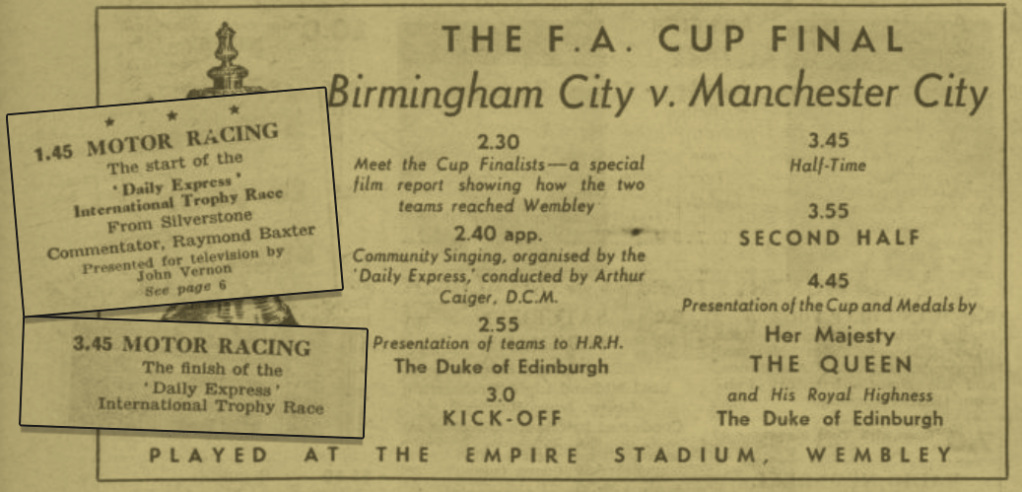
With that in mind, it’s probably lucky to programme airing immediately following the final at 5pm was children’s programme Jack in the Box and not Rupert the Bear or Lord Beaverbrook’s Half Hour.
ATV
14:30 to 16:50 F.A. Cup Final
Over on the Light Channel, quite ironically you wouldn’t get any such sponsorship hi-jinks due to the strict restrictions on advertising. Anyway, the channel’s inaugural Cup Final commentary was provided by Peter Lloyd, who’d previously worked alongside Jimmy Jewell to provide football commentary on the BBC since 1948, including the 1949 and 1950 Cup Finals. He was joined in the commentary box by England captain Billy Wright and former Manchester City stopper Frank Swift. Not a bad line-up for the first ever head-to-head Cup Final. Or, if you prefer, a bit impudent given the BBC are allowing them to broadcast the match and shove nine minutes of commercials around it.
Granted, the actual reason was that it was a listed event, meaning no channel was allowed to have exclusivity to it.
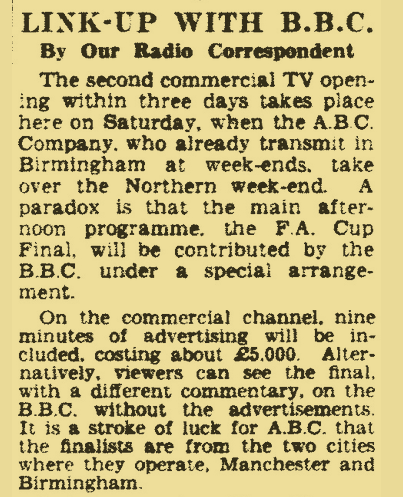
London viewers had no lead-in programme for the final, but Midlands viewers tuning into their own weekend franchise ABC were treated to the pleasantly titled Introducing Ourselves at 2.15pm. The match was followed by a Superman cartoon at 4.50pm, then – joining Peter Lloyd as big name defector from the BBC – Muffin the Mule at 5.05pm. Don’t forget to stick around for Bernard Delfont presents The Winifred Atwell Show at 8.15pm, because regular guests Morecambe and Wise are in it.
[UPDATE: Thanks again to Paul Hayes for noting Introducing Ourselves is most likely present because this was the first day that ABC was broadcasting to the North-West of England, having previously been broadcast only to the Midlands.]
4 May 1957: Aston Villa 2 Manchester United 1
BBC-tv
14:15 to 17:00 The Cup Final
With ITV companies declining the option of showing the match in 1957, it’s BBC all the way. The coverage was supplemented by highlights the previous night of an exhibition match between “Old England and Young England” at Highbury. The former: players over thirty who “have won their England cap” and a ragtag bunch of under-23s. This was the third such match since it had become a fixture in 1954, but the first to be won by Young England, who ran out 2-1 winners. A young chap with the surname ‘Clough’ was amongst their ranks that day. Wonder what became of him.
The final – where Villa won their first final since 1924 – was followed at 5pm The Lone Ranger.
ATV
Viewing tuning in for an alternative view on the final hopefully weren’t confused by Variety Showtime appearing at 3pm, followed by Face the Mike at 4.15pm.
3 May 1958: Bolton Wanderers 2 Manchester United 0
BBC-tv
14:15 to 16:50 The F.A. Cup Final
A match-up that generated mixed feelings for Kenneth Wolstenholme – born in Manchester, schooled in Bolton – but as he wrote in the Radio Times before the match, at least nobody could accuse him of being biased. “But who will win on Saturday? How should I know. I’m supporting both teams!”
Anyone tuning in before the match coverage started would just be treated to the test card, unless they found themselves in the transmission footprints of Wenvoe, Blaen-Plwyf, Holme Moss, or Sutton Coldfield transmitters. Those lucky few could tune in to Beunydd (“Bwrw golwg dros bynclau’r dydd mewn sgwrs a ffilm – a chyfle i gwrdd a rhai sy’n amlwg yn y newyddion”, or “take a look at the topics of the day in conversation and film – and a chance to meet some of the highlights in the news” if you prefer.)
Following the lifting of the FA Cup, fans of motor racing could catch up with the latest new from The International Daily Express Trophy Meeting at Silverstone.
ATV
14:30 to 16:55 F.A. Cup Final
The final returned to ITV in a year that proved to be a big one for football on the network. The following month would see the network broadcast live World Cup football for the first time, hosting seven live matches from Sweden. Then, in September, Scottish Television broadcast live football for the first time, with Hearts’ European Cup tie against Standard Liege.
ITV London’s match coverage was preceded at 2pm by The Fox, an NBC Robin Hood-alike filmed in Britain. The match was followed at 4.55 by advertising magazine Saturday Showcase.
ERA FOUR The Grandstand Years
2 May 1959: Nottingham Forest 2 Luton Town 1
BBC-tv
11:30 to 17:05 Grandstand
Ah, here we go. I’ve covered the history of Grandstand when it was revealed as The 13th Most-Broadcast BBC Series Ever, but here’s where it first appears on cup final day. This was a gamechanger – now all live sport being broadcast on cup final day was listed under the umbrella title, meaning it’s not necessarily football all the way. However, from the programme menu for 2 May 1959, it’s football at least most of the way, with a Cup Final Preview at the start of the programme, highlights of the previous year’s final at 1.30pm and filmed reports from the Luton and Forest camps. Aside from the football there’s live swimming (North v South of England) and – shortly before kick-off – a “Keep Fit Demonstration by members of the Keep Fit Association of England and Wales, directed by Eileen Fowler of BBC Television Women’s programmes.”
And so, the template for the next few decades is set – the variety of sports in an edition of Grandstand is slimmed down to make for as much cup final build-up as possible. This is basically the birth of Cup Final Day as we’d come to know it.
Elsewhere on the BBC-tv schedule, Grandstand is preceded at 11.0 by Beunydd in the relevant regions, and followed at 5.05pm by Wheels and Wings, a Canadian cartoon film about the “Romance of Transportation”.
ATV
14:50 to 16:55 Cup Final
Over on ITV, there are also the first budding signs of Cup Final Worlds of Sport to come, with motor racing coverage (at 12.20 and 2.20pm) interrupted at 1.20pm by an exhibition match between Frankie Vaughan’s Boys’ Clubs versus a team of TV Stars. That was followed by admag Saturday Showcase at 4.55pm and Robin Hood at 5.10pm.
7 May 1960: Wolverhampton Wanderers 3 Blackburn Rovers 0
BBC-tv
12:45 to 16:55 Grandstand
The glorious Grandstand is now in full swing, and it’s football almost all the way. A day packed with filmed highlights of how each team got to the Empire Stadium (in previous rounds of the cup, rather than footage of their bus getting stuck in traffic, you understand), interviews with the players on each team, highlights of the 1959 final and the big match itself. In fact, the only billed diversion to the football in coverage of boxing from the USA, with Harold Johnson taking on Clarence Floyd.
For those finding themselves near Wenvoe, Blaen-Plwyf, Holme Moss or Sutton Coldfield masts, the coverage is preceded by a Cymraeg coupling of Telewele (12.15pm) and Newyddion (12.40pm). Alternatively, stick around after the final whistle for Hide and Seek (5pm), a “film story about the adventures of five children on a Swedish island”, narrated by Frank Duncan.
ATV
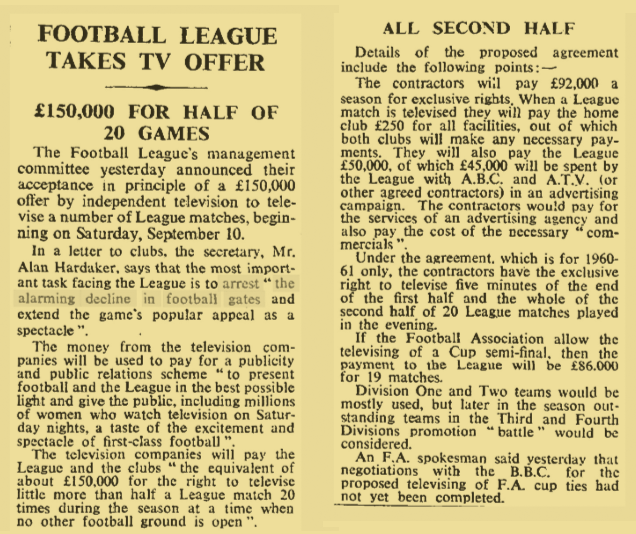
With the light channel presumably keeping their powder dry while working on a deal with the Football League that would give them rights to screen live matches, the schedule for cup final Saturday was instead given to Amateur Boxing, International Wrestling, the Moscow State Circus and (an unspecified) Western, all under the umbrella title of “Let’s Go“.
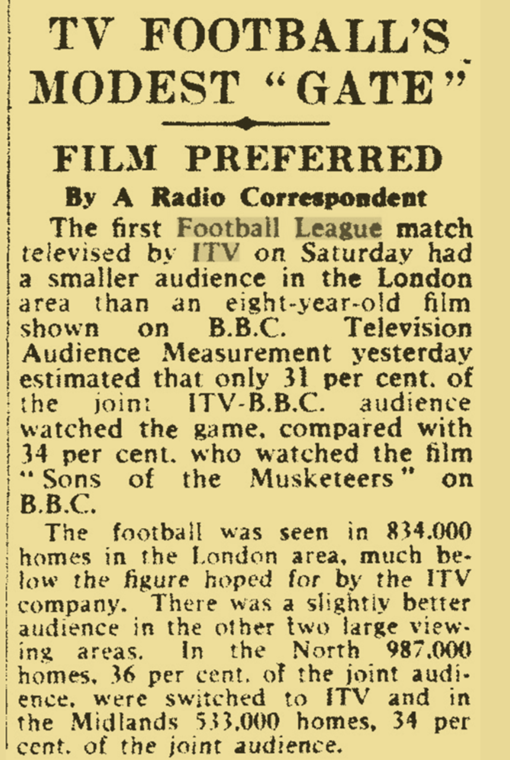
The deal was ultimately signed in August, got off to a wobbly start in September, and was swiftly dropped when clubs refused to let cameras into their grounds and the Football League decided that ITV should do more to compensate players.
6 May 1961: Tottenham Hotspur 2 Leicester City 0
BBC-tv
11.15 to 16:55 Grandstand
A bit more variety to Grandstand this time around, with golf and swimming alongside the cup final fol-de-rol. Excitement elsewhere in the listings, as 9.30am (or 9.45am, depending on which newspaper you’re looking at) includes coverage of US space flight Operation Mercury, with Alan B Shepard Jr becoming the first American (and second person ever) to launch into space.
The live match was followed by western Range Rider at 5pm, for those who just couldn’t wait for another western – Laramie – at 6.30pm. Don’t worry, only a few more years until we get Doctor Who.
ATV
13:05 to 17:00 All-Star Afternoon: Cup Final and Wrestling
Following the grand folly that was their live Football League coverage, ITV are returning to the Cup Final this year, with their afternoon devoted to the final and Live Wrestling.
Following the sporting action at 5pm was Robin Hood starring Richard Greene in ‘The Black Patch’.
5 May 1962: Tottenham Hotspur 3 Burnley 1
BBC-tv
11.15 to 17:00 Grandstand
David Coleman is on the pitch at Wembley Stadium to bring another day of football and sporting action, with the regular segments (Meet the Finalists et al still going strong) sharing space with golf from St Andrews, swimming from Blackpool and Boxing from Miami. For the match itself, the BBC had taken extra effort to upgrade their match coverage, their cameras now able to zoom in on the action where practical, giving viewers a much improved experience.
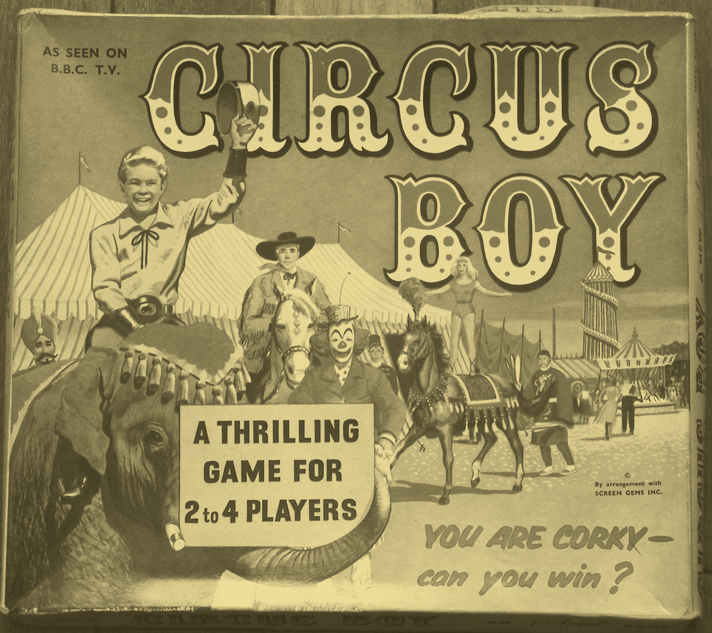
Viewers tuning in before 11.15am could expect to see Telewele (10.40am) and Newyddion (11.05am) if they were in the relevant transmitter areas, or the tuning signal if not. Luckily, everyone would get to enjoy adventure series Circus Boy at 5pm, followed by Mr Pastry’s Progress at 5.25pm.
ATV
14:40 to 17:00 FA Cup Final
Pretty much by the numbers over on ITV this year, with coverage starting twenty minutes before kick-off, and finishing practically before Danny Blanchflower had reached the bottom of the Wembley steps with the cup.
Before the coverage of the final, ITV viewers could enjoy Professional Wrestling from across town, over at Wembley Town Hall. Following the match, they were treated to Robin Hood episode “The Ghost That Failed”.
25 May 1963: Manchester United 3 Leicester City 1
BBC-tv
12:00 to 17:00 Grandstand
A few weeks later in May than had been planned at the start of the season, all thanks to fixture congestion created by The Big Freeze of 1963, at was almost June by the time the 1963 final came around. A Manchester United team that had narrowly avoided relegation from Division One found form at the right time, despatching a theoretically superior Leicester side with a goal from Denis Law and two from David Herd.
Elsewhere, viewers could enjoy Walker Cup golf from Tumberry, boxing from Madison Square Garden and show jumping from Wilmslow.
The regular Telewele and Newyddion preceded the action, now followed by ‘Announcements‘. As was now traditional, Circus Boy followed the final whistle at 5pm.
ATV
13:20 to 17:15 Saturday Sportstime
Having cast an envious glance at Grandstand, ATV tried to bottle that magic by putting a Saturday Sportstime sticker over their Saturday afternoon sporting action. Though with it comprising the same mixture of the FA Cup Final and wrestling, there wasn’t too much of a difference from last year.
For anyone not fancying Circus Boy on the Beeb, there was the option of seeing big budget drama Sir Francis Drake at 5.15pm.
We’ll leave this there for now. Come back next time to see The BBC Television Service regenerate into two separate channels. There’ll be a lot of that going on.