-
Wake Up Mario! It’s the 100 Most-Broadcast BBC Programmes Of All Time (20 and 19)

Here we go. Top twenty. Big leagues. Every programme from this point on an absolute titan of British broadcasting. Starting with…
20: Working Lunch
(Shown 3296 times, 1994-2010)
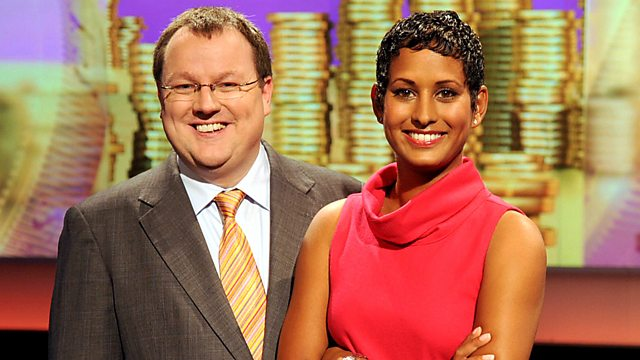
I’m willing to admit, this is a bit of a surprise.
For a programme that would go on to become the 20th most-broadcast programme in the BBC’s history (under the conditions laid out for the purposes of this list), it’s probably fair to say it was a little undersold in the Radio Times for the week of Working Lunch’s first-ever broadcast on Monday 19 September 1994. “A daily look at business and how it affects us.” That’s it. Publish. Done. To be fair, they did have the write-up for ‘1:00pm History File: The World Since 1945’ to crack on with. That one probably needed a bit more research.
So, that tiny informational morsel aside, what was Working Lunch? A cookery show? A documentary exploring the catering industry? William S. Burroughs’ surprisingly tame follow-up to Naked Lunch? Nope, it was – and I appreciate this makes it sounds much worse than it is – a weekdaily topical programme covering business, consumer and personal finance news, the twist being that it was all done in a relatably accessible manner.
Oh dear? No, dear. It certainly helped that the programme was captained by Adam Shaw and early-era Adrian Chiles (coming off the back of hosting Radio 4’s Financial World Tonight), who offered a clear contrast to the Beeb’s other business output, such as World Business Report or Business Edition. This was much a looser affair, where every day is Casual Friday and there aren’t many meetings and someone has brought cakes from home. Look, here’s a bit where Adrian Chiles is playing Super Mario 64.

GET BACK TO WORK, CHILES. Despite it having been originally planned as a vehicle for Jill Dando and George Alagiah, Chiles was considered to have been a boon for the new series, his Black Country burr certainly a lot more welcoming than what you’d expect from your average BBC financial programme. Aside from that, Working Lunch was the first live programme on the Beeb to rely on a virtual set, which certainly helped disguise the fact it was being recorded in the pokiest studio the News and Current Affairs department had to offer. While BBC News had been using a virtual set for opening and closing long shots at the time, close-ups and mid-shots employed an actual set with real furniture. With ‘Lunch, not even the desks were real. Heck, if mid-90s CGI had been up to the task, one wonders if we’d still have had the meatspace version of Adrian Chiles.
One illustrative if surprising signifier of how well-received the programme was become happened in February 1996. Chiles found himself at Heathrow Airport in the midst of screaming teenagers. Not there for him, of course (let’s not go crazy here), they were present as 90s popmonger Robbie Williams was due to arrive at the airport en route to some foreign clime. After working his way through the crowd and onto an escalator toward the departure lounge, the West Bromwich wag was tapped on the shoulder by none other than Williams himself, who took the opportunity to express his enjoyment of Working Lunch. See, he’s not all bad. That almost makes up for Swing When You’re Winning. Almost.
Those early years even offered up a fun little title sequence, where a goldfish finds some gold coins and tries to put them in a bank, only to get chased away by a shark. Granted, it didn’t hold a candle to the Westminster crocodile of On The Record, but this was only weekday daytime BBC2, expectations should be lowered accordingly.
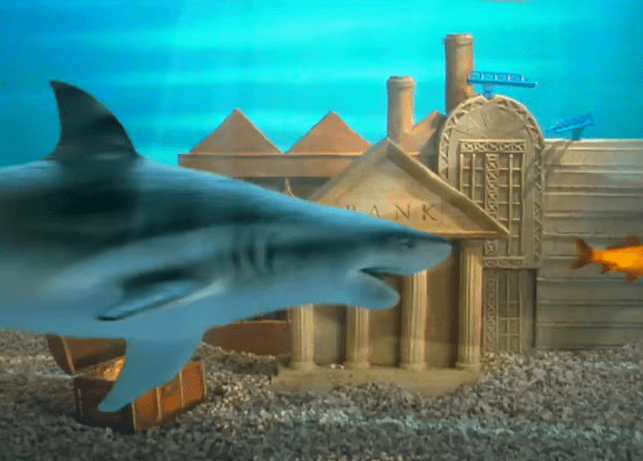
That was replaced a few years later by an even more comic opening sequence to mark the shift to widescreen programming in 1998, with the goldfish and shark careering around a tremendously 90s CGI set. This is certainly not a scene you’d expect from the titles to a daily business news roundup.

For anyone wanting to know, the CGI goldfish is called Lloyd. And for anyone who wants to feel a bit sad, the real Lloyd died the week this new title sequence aired for the first time. Until that point however, he’d lived in a fishtank made out of a vintage 50s television, thereby making him Britain’s Coolest Goldfish. So, a life well-lived.

Bye, Lloyd. In later life, Declan Curry and future Breakfast host Naga Munchetty would join the series, but despite a revamp in 2008 that threw in things like a ‘Tech Shed’ to test out the latest gadgets, it seems the strand just wasn’t the cult hit it once was, and in 2010 the programme aired for the last time.
To be fair, if an episode where Terry Wogan gives a web surfing masterclass isn’t bringing in the viewers, the jig is probably up.

19: Panorama
(Shown 3346 times, 1953-2021)
What am I supposed to tell the Panorama audience?

Let the strident tones of Francis Lai’s Aujourd’hui C’est Toi soundtrack a spinning globe, and let a nation of kids ask if they can put another channel on.
(Aside: of course, the best use of the Panorama title sequence came in Dave Allen’s 1990 stand-up series for BBC1, which came with no sketches, no opening theme, no title sequence or even anything showing the programme’s title. That was apart from episode three of the series, which used the opening titles for Panorama, with Allen claiming “we can’t afford any titles of our own, so we borrowed some”.)
At the time of writing (the year 2023, which makes it increasingly embarrassing this list only covers up to the end of 2021, but shush), Panorama is but months away from clocking up seventy years on British screens, the first ever episode arriving in November 1953. And, while much of Panorama has been of the cracker-dry variety, the Radio Times box-out for that first ever episode really goes gangbusters on the whole austerity aesthetic, with original host (or ‘guide’) Patrick Murphy staring you out in a way that would make you leave a pub immediately.

“I’m going home. Tap on the window when I’m in the car park if he starts trying to follow me, so I can start running.” Originally airing on a fortnightly basis, those original reflections of the contemporary scene did at least include a tantalising “telecartoon of passing events”, which is surely now making you think of The Day Today’s Brant. In short, those very early years were a markedly different beast from the Panorama the nation would become used to in later years, being more of a magazine programme looking at the arts as much as current affairs, but it would soon evolve. In the case of the host, evolve very quickly, with initial host Patrick Murphy replaced in the second edition by Max Robertson.
For the first couple of years, the ‘Rama initially aired every other Wednesday evening, usually between 9pm and 10pm, but from September 1955 changes were afoot. The programme moved to Monday evenings, it moved to an earlier slot around 8pm, and it would become a weekly programme. On top of that, the programme’s tagline was changed to “Television’s Window on the World”. Indeed, the changes were outlined in an accompanying Radio Times article, which promised to comment on world affairs as much as home-based happenings, with co-producer Michael Peacock promising everything from “ships, jazz, people, ploughing, theatre, industry, art, books, buildings or bulldozers”.

To try and take that range of topics, Panorama was afforded access to all the BBC’s resources: outside broadcast cameras, film camera teams, Roving Eye cameras and use of the shiny new Eurovision link to provide live broadcasts from across Europe. While new host Richard Dimbleby would be keeping track of everything from the studio, Max Robertson wasn’t cast aside, but rather given a roving assignment with the outside units, while Malcolm Muggeridge was afforded a similarly roving remit as ‘entrepreneur for theatre, films, music and the arts’.
The choice of Dimbleby Sr as Panorama’s new guide proved to be an inspired one, pretty much forging a template for the current affairs presenter, offering a perfect blend of gravitas, insight, interview skills and background research. Little wonder that he would be chosen to helm BBC TV’s first ever foray into live overnight general election coverage.
It was no huge surprise that Richard Dimbleby had proved so capable in the big Panorama chair. Having initially joined the BBC in 1936, he’d become the Corporation’s first war correspondent, going on to report from the battle of El Alamein, the D-Day landings and the liberation of the Bergen-Belsen concentration camp – Dimbleby threatening to resign over the latter due to the BBC initially declining to broadcast his despatch.
Back on Civvy Street, Dimbleby was the BBC’s choice on commentating on events such as the 1953 Coronation, the first live television broadcast from the Soviet Union and the funeral of George VI. All that experience was put to good use behind the Panorama desk, conducting probing but well-mannered interviews with key figures of the day, plus putting his reporting skills to good use by helming live on-the-spot reports from the UK and overseas. Plus, in a skill that proved invariably useful given the propensity of mid-20th century technology to misbehave, he was more than adept at improvising during problems in running pre-recorded items or live links.

That’s not to say Dimbleby didn’t also have a lighter side. This was most famously displayed on the first of April 1957, when he provided commentary to the infamous spaghetti-harvest hoax. So convincing was his delivery of the report, it’s said that even Director-General Ian Jacob was fooled by the pastariffic prank. All good things, however, must come to an end, and a tragically untimely end occurred in 1965, when Richard Dimbleby died at just 52. In his stead came a series of rotating anchors behind the Panorama desk, including Robin Day, Charles Wheeler and Leonard Parkin, but it would be Richard’s son David that would go on to have the longest association with the Panorama desk.
Indeed, it was at that very desk where the most memorable unplanned moment in Panorama’s long history would occur. With the studio-based portion of the programme broadcast live, in the event of developing news, the anchor’s role at this stage was largely to introduce each filmed report. It also meant there’d be someone to throw back to if there were ever a technical problem with a filmed report, as could sometimes be the case in that pre-digital era of television, but there’s normally be little need to panic in such a situation. There’d be a backup filmed report on standby, ready to run. Just in case.
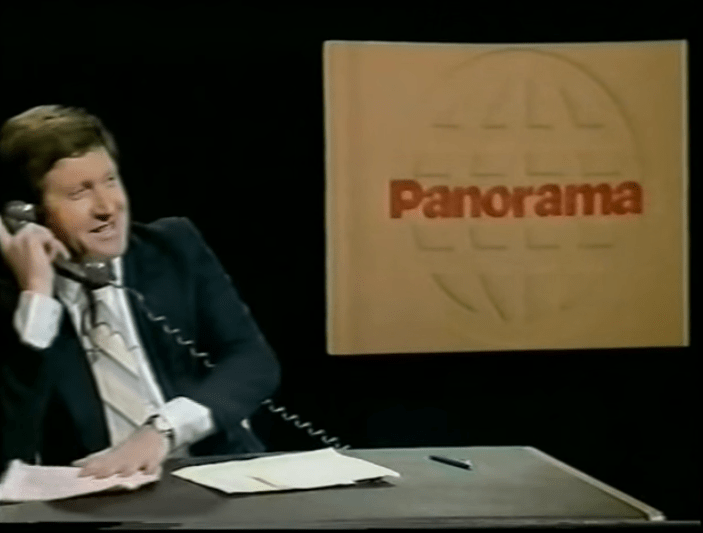
Except for on 8 November 1976, when a there was a problem with film covering events in Rhodesia. Not to worry, thought the elder Dimbleboy (©Bernard Levin), onto the next filmed report looking at the IMF. Except, as a voice on the other end of the Dimblephone informed the presenter, the film on the IMF wasn’t available either. All there was to broadcast to millions of homes was live footage of Dave, the Panorama logo and an otherwise minimalist set. It wasn’t even as if he read out the script of the commentary from the report on Rhodesia, as it didn’t have any commentary, and the situation covered in the film on the IMF was deemed too “complicated” to simply explain. And so, the stricken presenter was left to announce that everyone would just need to sit in silence until something happened. Luckily for our intrepid host, that something was the issue with the Rhodesian report being resolved, and it could now be shown. Suboptimally however, it started playing out before he could introduce it.
Stuff your Succession, THAT is watercooler television.
Of course, for a large chunk of its run, Panorama wasn’t the only heavyweight current affairs strand on British television. Granada’s similarly weighty World in Action began in January 1963 and would run for 35 years. Initially, both aired at different times on Monday evenings, Panorama at 8:25pm, World in Action at 10:30pm, making a mouth-watering evening for anyone really into windows on the world. However, within a few years, both programmes were somehow sharing a slot at 8pm on Monday evenings (starting around July 1967, with World in Action having just returned as ‘World in Action’ after a couple of years under the unpopular – if less borrowed from the National Film Board of Canada – rebranding ‘The World Tonight’ and ‘The World Tomorrow’). Quite why this scheduling clash was suddenly the case is a bit of a mystery – a similar, if less Governmentally-sanctioned situation to God Slot programming going out on Sunday evenings? An admission that neither show would get large audiences unless there was more of the same on the other side? An attempt at encouraging some Whizzer and Chips rivalry? I’m not sure, but it certainly didn’t go unnoticed, and can’t have been popular with people who waited all week for some heavyweight reporting on current affairs before having to pick just one programme to watch.

World in Action arrived on British screens having been, in the words of former producer Gus MacDonald, ‘born brash’. That was an ethos the production team kept to, with early series editor Tim Hewat having declared viewers wouldn’t stick to a half-hour of current affairs unless grabbed by the lapels and “sturdily intimidated into staying with it”. It was an approach that worked, a determined effort to marry film-makers with facts and journalists with moving pictures, and took British film journalism in a new direction. While Panorama had the likes of Dimbleby or Day asking the questions, World in Action would see interviewees converse with unidentified off-screen interrogators, throwing the subject into sharper focus. Series producers soon understood that putting incriminating photographs or documents exposing wrongdoers on screen seldom make for compelling viewing, so instead reporters would use tactics such as posing as Rhodesian sanctions busters or Biafran arms dealers to capture hidden camera footage that would prove more visually arresting. A tactic that Panorama, inexorably tied to Auntie Beeb’s apron, would find hard to emulate.

Still, there was a tactic that Panorama could certainly employ to grab the attention of the audience: scare the living shit out of them. The programme had hardly been incident-free in the past – 1955 saw Christopher Mayhew take mescaline on camera and report on his experiences, though skittish management preventing the footage from airing at the time (it would later air as part of 1992 BBC2 theme night TV Hell, and lead to a fun series of sketches by Limmy). But with nuclear paranoia rising at a time when the threat of World War Three seemed an increasingly likely possibility (plus ca change, eh viewers?), 1980 saw arguably Panorama’s most controversial episode to date. If The Bomb Drops was an investigation fronted by Jeremy Paxman about what would actually happen if, well, the big one went up, along with the UK Government’s preparations for the public in such an event. A pretend spaghetti harvest it wasn’t.

Here is a house. Oops, wrong programme. A similar furore had erupted in 1979, with a film on the Carrickmore incident attracting accusations that the Panorama editorial team were a little too friendly with the IRA. In 1982, a Panorama report on the RSPCA led to complaints (and ultimately, Broadcasting Complaints Commission censure) over the programme’s tactics in covering the society, but it was January 1984 that saw a real storm emerge. Panorama episode Maggie’s Militant Tendency claimed that three Tory MPs (Neil Hamilton, Harvey Proctor and Gerald Howarth) had links to far-right organisations in the UK and Europe. The story originated out of an internal Conservative Party report compiled by the chair of the Young Conservatives, and the programme makers had confirmed the status of the report with a Conservative vice chair, but the party was no less angry with the outcome. The MPs named in the report diligently avoided providing comments to the programme, and two of the MPs (Hamilton and Howarth) subsequently sued the Beeb and the Panorama production team. The trial was to start in October 1986, but within days of opening statements, the decision was made for the BBC to settle out of court. But not before Neil Hamilton’s “I’m very much not a racist” defence involved him doing a Basil Fawlty Hitler impression, so that’s something.
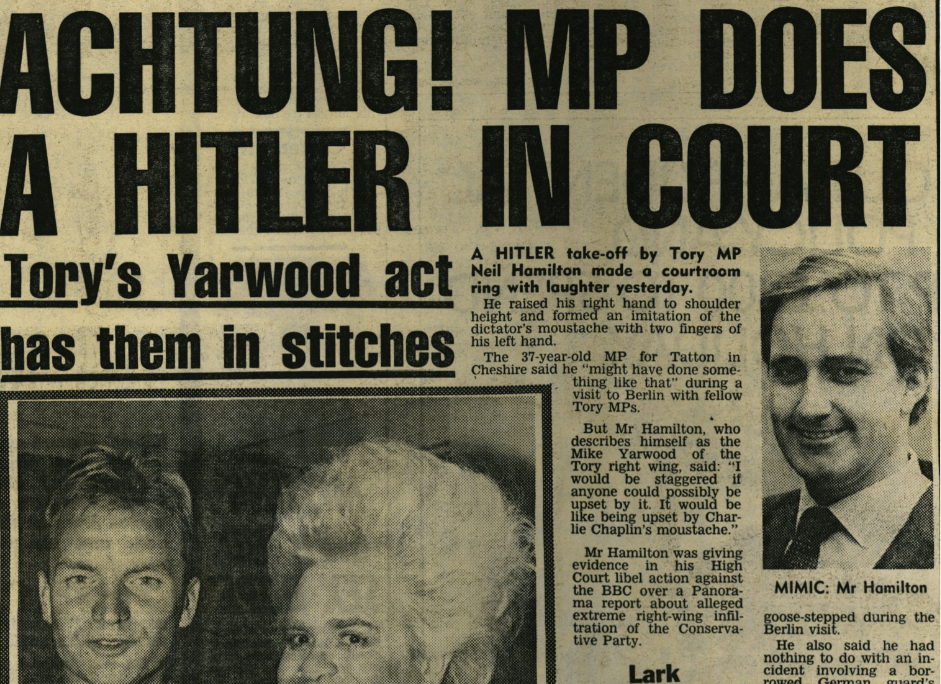
Not even making that up. Daily Mirror, Friday 17 Oct 1986. And yet, despite hundreds of column inches being employed to cover Panorama, it still didn’t mean that viewers were flocking to it. And with World in Action still airing on ITV at the same time, it at least meant BBC-2 had a chance to attract a bumper audience. In the 1970s, this often meant American imports like The Waltons, The High Chaparral or Alias Smith and Jones found an appreciative audience before the slot was handed to popular homegrown offerings like Dave Allen at Large, The Mike Reid Show and Des O’Connor Tonight and the occasional curio I’d love to see, like The Amazing Randi Magic Show.
Perhaps the best current affairs counterweight came in 1983, with the first episode of chat show/international comedy showcase The Bob Monkhouse Show. If you were going to give Lord Bob carte blanche to make any programme, this would undoubtedly have been the result, featuring interviews and live performances from comedy greats of the past, present and future, including the likes of Tommy Cooper, Bob Hope, Joan Rivers, Sid Caesar and Spike Milligan, plus early UK exposure for US-based acts like Steven Wright or The Unknown Comic.

Back at Panorama, and 18 February 1985 saw the programme moved into a post-watershed slot for the first time since the mid-sixties, being shifted into a slot following the Nine O’Clock News. New BBC1 controller Michael Grade couldn’t have helped but notice that BBC2 was clobbering BBC1 in the ratings each Monday while Panorama was on, so the decision was made to afford the slot to something a little more popular with the viewing millions. Indeed, the first week of the Monday 8pm hour being freed up on BBC1 saw the opening episode from the tenth and final series of Are You Being Served? air to an audience of 14.5m viewers. Quite an increase on the 3.5m average figure Panorama had been enjoying in the same slot beforehand.
The new post-news slot also led to a few format changes for the programme. Out went a desk in a dark studio, with the majority of episodes now dedicated to a single filmed report, with no in-vision host at all, and the runtime was reduced from fifty to forty minutes. People may not necessarily been watching in larger numbers – in early 1986, circumstance meant that it was still going out against The Bob Monkhouse Show on BBC2, though the presence of proper competition on ITV meant Bob’s audience had dropped from eight to around four million – but it was deemed worth the ratings hit to have something that weighty on air, and there would generally be a popular The Monday Film on straight afterwards to coax some viewers back over.

Even if the conspiratorially-minded might think you’re heavily hinting at something sinister by having an episode on the NHS followed by Soylent Green. For several years, BBC2 would continue using the Panorama Is On The Other Side slot to put out popular shows – from Moonlighting in 1987 to The X-Files seven years later. But the hardy current affairs strand was certainly sturdy enough to be rolled out into a major slot when something big came along, such as a series of interviews with leaders of the main political parties in the run-up to the 1997 election, plus – famously or infamously – a certain Martin Bashir interview with a certain princess in 1995.

Some classic BBC self-flagellation to come in later years when Panorama ran an episode exposing the tactics used by… Panorama to get the Diana interview. In October 2000, with the Nine O’Clock News being moved to 10pm (it’s okay, they renamed it to fit) and the 9pm hour being afforded to popular comedy series One Foot In The Grave and The Royle Family, there suddenly wasn’t much room in the schedule for Panorama on Monday nights, at least without shunting it into a slot skirting 11pm. And so, for the first time in the programme’s history, it was to start airing on Sunday nights. A slot at 10:15pm was hardly going to attract a lot of new viewers however, and despite the production team’s efforts to cover topics that would appeal to the viewing public (the first couple of Sunday night editions covered working conditions in Nike and Gap factories, and the US election campaign, nothing especially off-putting), it was a slot unlikely to attract many casual viewers.
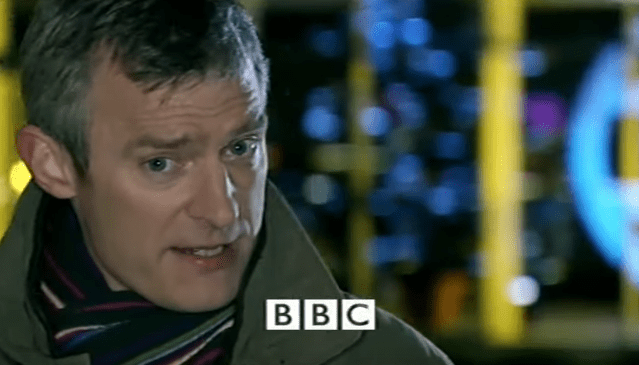
Thankfully, by 2007 BBC1 had a new Controller in Peter Fincham, and he made the decision to move Panorama back where it belonged – Monday evenings, and in a primetime 8:30pm slot to boot. Admittedly, that was the slot opposite ITV’s second Monday helping of Coronation Street, but that slot had worked well for the previous occupants Rogue Traders and DIY SOS, proving that as long as that slot contained a suitable alternative for soap naysayers, there’d be an audience happy to tune in. It certainly didn’t hurt that the new slot demanded the programme be trimmed to a leaner thirty-minute slot, and concentrate on topics likely to draw attention. Plus, of course, there were now dynamic sweeping shots of Jeremy Vine in the introduction for each episode.
It was a tactic that was deemed to be a success, and indeed, Monday nights remains home to Panorama to this very day. The slot has been tweaked a little – it’s now going out at 7:30pm, still opposite Corrie, and occasionally airs on nights other than Monday, but it remains a programme that seems set to remain on our screens for a long time to come.

Another one out of the way. Phew. Hopefully the next installment won’t require as much time-consuming research. Or, at the very least, have more things written about them than Working Lunch.
SEE YOU NEXT TIME ARMCHAIR BRITAIN.
-
BABY BAB-AI! It’s the 100 Most-Broadcast BBC Programmes Of All Time (22 and 21)

So close we can taste that top twenty.
22: Eggheads
(Shown 3049 times, 2003-2021)
Hang on, what’s a Channel 5 programme doing on here?

Admittedly, I really don’t know much about the series. Never watched it, and one time some work colleagues were thinking of taking part, and one suggested to me that they’d like me to become an Egghead with them. Given the person who’d asked me was bald, I was unable to immediately dispel the suspicion I was about to have my head shaved.
Anyway, let’s crack out ChatGPT and see if I can work out where it’s wrong using my own feeble human brain? Over to you, Chatty. If nothing else, it’ll distract it from destroying society for a few minutes.
“Eggheads” is a British television quiz show that first aired on BBC Two in 2003. The show is produced by 12 Yard Productions and is hosted by Jeremy Vine. The format of the show features a team of five contestants, known as the “challengers,” competing against a team of quiz experts known as the “Eggheads.”
Oh dear. Not off to a great start. Eggheads actually started airing on BBC One in November 2003. Look, here’s the Genome entry and everything. Not a bigtime slot or anything, tucked away in lunchtime between a new episode of Cash In the Attic and the 1pm News bulletin. But still, BBC One. Not Two.
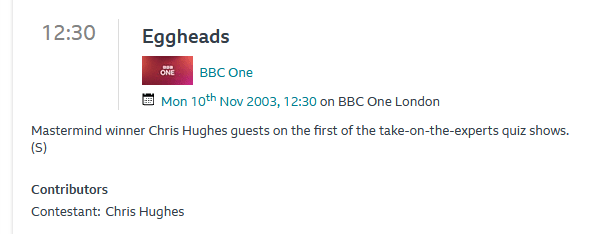
It actually first aired on BBC Two in Monday 10 May 2004, going out at 2.55pm between an airing of 1955 Barbara Stanwyck vehicle Escape to Burma and a Flog It!, if you’re wondering.
My feeble human brain: 1, AI: 0
The original Eggheads team consisted of five members: Chris Hughes, Kevin Ashman, Judith Keppel, Daphne Fowler, and CJ de Mooi. Each member of the Eggheads team is a former quiz show champion, with several holding titles such as Mastermind and University Challenge champions.
Yep, I’ll give you that.
My feeble human brain: 1, AI: 1
The show quickly became popular and was moved to a prime-time slot on BBC One in 2008. The format of the show has remained largely the same over the years, with each episode featuring a series of rounds of general knowledge questions.
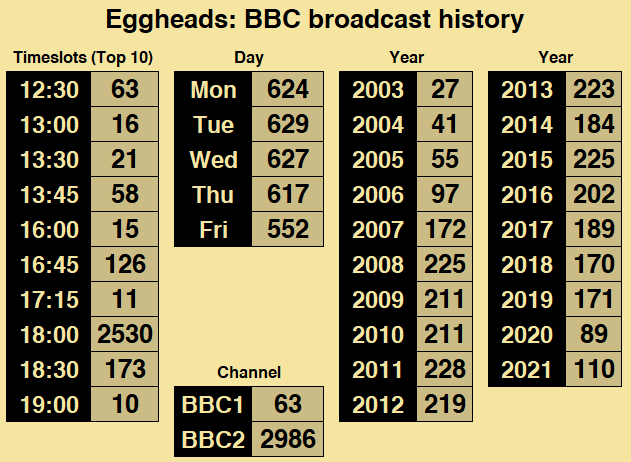
Well, it had mainly been a BBC One programme at first anyway. Of the first 70 broadcasts for Eggheads, 63 of them had been on BBC One. I’ll call for a steward’s enquiry over it quickly becoming popular, though. It took until 23 May 2005 for the ‘Heads to first arrive in the slot it’d be most closely associated with – weekdays at 6pm on BBC2, at which point it made a fleeting appearance in the weekly Barb Top Thirty for the channel – sneaking into the arse-end of the chart for the first couple of weeks in the teatime slot (between 24th and 29th place on the weekly lists for weeks ending 29 May 2005 and 5 June 2005, if you must know), but after that it disappeared from the Beeb ratings for BBC2 until August of that year, when a week of airings at 17:15 – a lead-in for a fresh batch of Weakest Links – saw it reach the BBC Two top ten for the first time. It wouldn’t return to that BBC2 top ten until the following May, and even then only for a single episode.
My feeble human brain: 2, AI: 1
Oh, and it never aired in a prime-time slot on BBC One, either. Don’t know where you picked that up from.
My feeble human brain: 3, AI: 1

The challengers are given the opportunity to select a category for each round, and the Eggheads team must answer questions on that topic. If the challengers answer more questions correctly, they win the round. If the Eggheads answer more questions correctly, they win the round.
I mean, yes that’s technically correct. But you’re not getting a point for saying how a quiz works.
My feeble human brain: 3, AI: 1 (Goal disallowed)
Over the years, the Eggheads team has grown, with several members joining and leaving the team. Some notable former Eggheads include Barry Simmons, Pat Gibson, and Lisa Thiel. The current lineup of Eggheads includes Kevin Ashman, Judith Keppel, Barry Simmons, Chris Hughes, Steve Cooke, and Lisa Thiel.
While the number of eggheads has indeed grown over the years, putting together a list of just three notable ‘former Eggheads’ that includes two people you then say are current Eggheads is poor form. For shame. Also: the current line-up of Eggheads doesn’t include Judith Keppel. She left in October 2022. Pfft.
My feeble human brain: 4, AI: 1
The show has been a success for the BBC, with over 2,000 episodes produced as of 2021. In addition to the main show, several spin-offs have been created, including “Celebrity Eggheads,” “Revenge of the Egghead,” and “Eggheads Jumbo Quiz.”
Not going to knock the claim of ‘over 2,000 episodes’, as that’s the reason it’s here, so well done there. But, (and feel free to correct me in the comments, fellow squashy human brain beings) there’s never been a thing called “Eggheads Jumbo Quiz”. Poor show, ChatGPT.
FINAL SCORE: My feeble human brain: 5, AI: 2
CURRENT AI THREAT TO HUMANITY LEVEL:
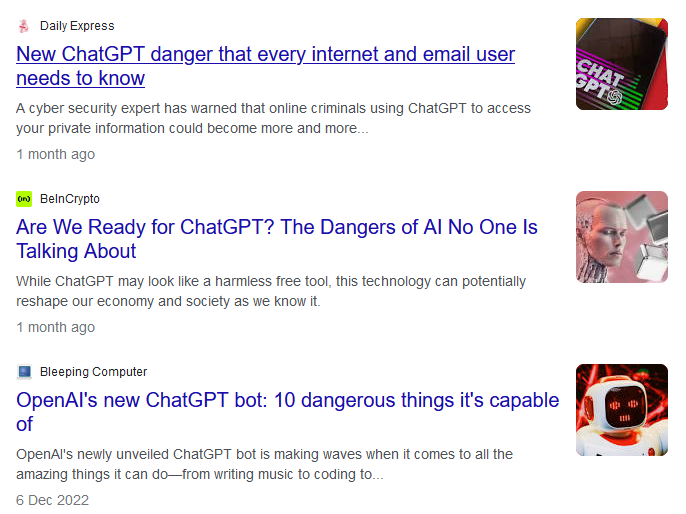
Yeah, right. Hey, Supposed AI Menace That Will Doom Us All, do a picture of you being outwitted by me, a genius.
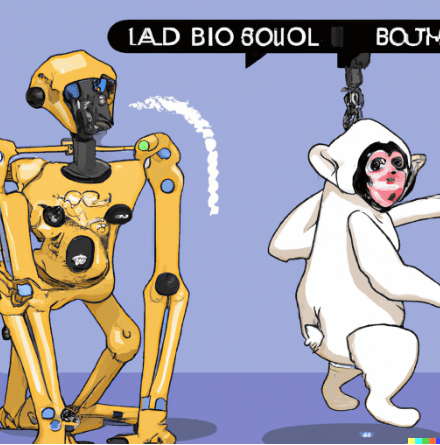
Bah.
21: Pebble Mill
(Shown 3137 times, 1972-2004)
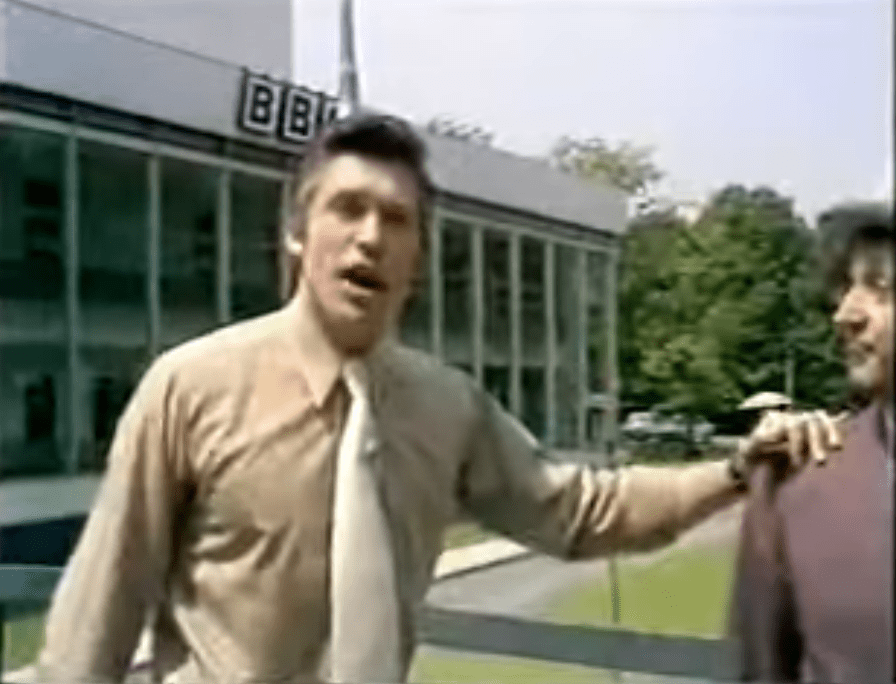
In this age of ENDLESS TELLY, it’s a bit weird to consider that back when Britain just had a tiny handful of channels to keep us entertained, they didn’t even bother broadcasting throughout the daylight hours, let alone overnight. If you’d scored a day off school with some horrible 70s Scarfolk disease (probably mumps), you might settle down on your brown and orange sofa, pull up your warming if scratchy blanket (also brown and/or orange) to watch whatever might be on telly. Except: the daytime TV menu seldom contained anything other than “For Schools comma Colleges”, which was hardly fun. Maybe there’ll be something else on after that… oh it’s an hour of the test card. Or, if you’re lucky, ‘Interval’.
I always felt a bit cheated that I was born too late to see what the difference was between ‘Closedown’ and ‘Interval’. Presumably one of them had different music to the other. Anyway, it was all the fault of that ruddy Postmaster General, limiting the aggregate totals of hours in which TV can broadcast in a given week, meaning Britain’s TV companies sensibly opted to do so during hours where more people would be watching. If you were a daytime viewer, the occasional public service remit broadcast of Nai Zindagi Naya Jeevan (see list passim) or Dechrau Canu Dechrau Canmol (see a small part of a future list-part) might be all you get.
However, October 1972 brought a bit of good news for Sickday Britons – the GPO bigwigs loosened their grip on the broadcasting reins, affording the nation Proper Daytime Telly for the first time. Nothing new before noon during termtime, mind – those hours were still reserved for broadcasting programmes for schools and colleges, but at least the hours between the lunchtime news and the start of children’s programming around 3pm could be filled with something other than Test Card F. And so, from Monday 2 October 1972, BBC-1 viewers got to experience Pebble Mill At One for the first time.
Welcomed to the airwaves by the Daily Telegraph’s Richard Last as “one of the first genuinely new programmes to emerge from unrestricted daytime hours”, Pebble Mill At One offered up at least a couple of new things.
THING ONE: a daily jaunt to plucky upstart regional outpost, um, Birmingham. Hey, it was a novelty at the time.
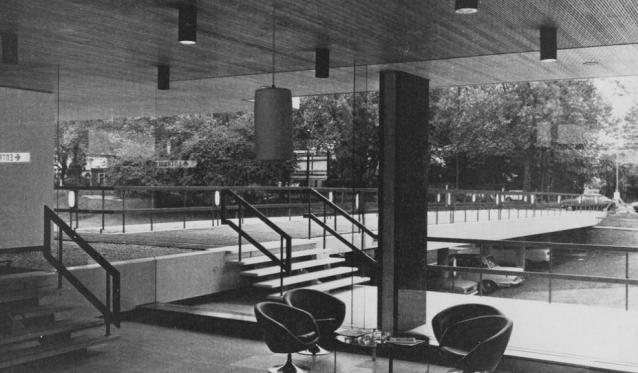
THING TWO: The whole affair coming from the foyer of the titular (and for the period, pretty darned modern) Pebble Mill studios. For a nation used to the hard-hitting likes of Tonight, 24 Hours and Panorama, this was a much gentler affair under the auspices of editor Terry Dobson. No custard creams were in danger of being dropped into cuppas.
If nothing else, it was probably a relief to the BBC that the building was doing something to help earn its upkeep. Constructed at the cost of £6m and initially decried as a white elephant, by the time Pebble Mill at One came along, the studios themselves – all 6500 square feet of them – were often filled to capacity (which might explain the need to fill At One in the foyer), but it took a while to reach that stage, such was the concentration of TV talent in London during those early years.
…At One came about thanks to former manager of BBC Radio Leeds, Phil Sidey. By 1972, he’d found himself in the role of Head of Network Production Centre, Birmingham, and having previously worked on 24 Hours and Nationwide, he certainly knew his way around a daily live production. Using his contemporary Midlands location, he was able to offer viewers what was considered a “non-Metropolitan view” of British life, which certainly helped sell the concept to BBC1 controller Paul Fox. With their moneyed rivals over at ITV busily preparing their own daytime TV schedule, a thrifty Beeb was never going to have the budget to take on an ITV line-up containing the likes of Emmerdale Farm, Lunchtime with Wogan or Crown Court on their own terms. But it did have that innate BBC talent at putting together reliable live programming on a daily basis.
To front the programme, former newsreader Bob Langley was chosen, having been deemed suitably avuncular for the new programme. Throw in a theme tune and title sequence that made the whole thing look like a precursor to Dynasty, and Cup-a-Soup Britain would never be the same again.
As mentioned, it was certainly didn’t hurt that BBC Pebble Mill was finally being used frequently. Theoretically, given its status as a single entity, the BBC should have been freed from the multifranchise bunfight between the big ITV regions trying to get their own shows to a national audience. In reality, the BBC regions were having an equally tough time getting their content shown nationally, with niche shows turned breakout hits like Pot Black or Gardener’s World the kinds of exceptions that found regular audiences.
The hope was that this would change. Pebble Mill became home to an English Regions Drama department, headed by David Rose, original producer of Z Cars, with fare from the department including a series of Thirty-Minute Theatre plays, alongside provincial offerings for the Play For Today strand. Luckily, things soon worked out for the Pebble Mill Studios, with it going on to become home to (at least briefly) Top Gear, Doctors, Telly Addicts, Howards’ Way, Juliet Bravo amongst others.
Back to 1972 and the studio’s daytime mainstay, and the Times didn’t seem particularly enamoured with the new programme, with TV reviewer Stanley Reynolds referring to it as “aggressively lower brow” and (it’s still 1972 there, this wasn’t as much of a cliche then) something that “makes Blue Peter look like Panorama”. He’d waited until December to write that, too.
Despite that stinging broadsheet rebuke, Pebble Mill at One went on to because a resolute rock within BBC-1’s daytime schedule, gradually picking up a fiercely loyal audience. Plus, it didn’t exactly hurt that it saw plenty of Golden Age of Light Entertainment stars popping in for a lunchtime chat.
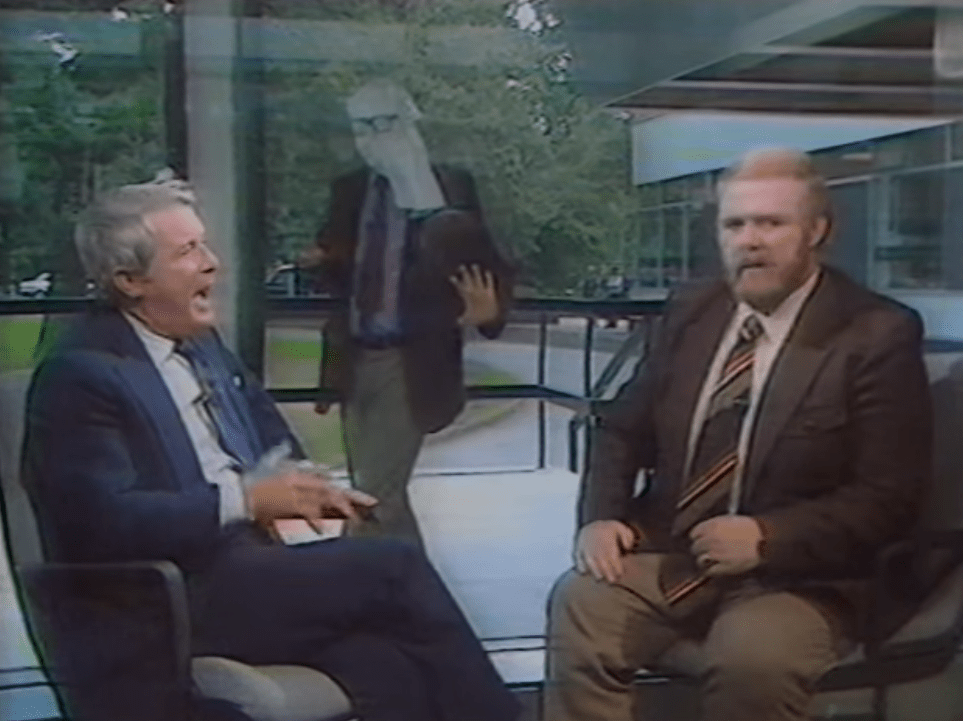
And, this being something I have to mention as it always pleases me, if circumstances led to it going out at a time other than 1pm sharp, the programme title was occasionally amended accordingly:

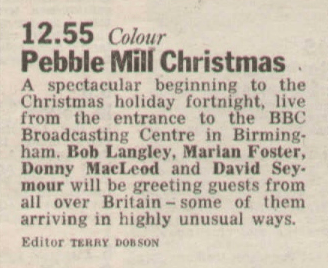
By 1974, the programme was popular enough to warrant its very own Christmas specials. Still in the daytime schedule (on 23 and 24 December, mind), but they’re using the word ‘spectacular’ in the listing, so something big must have been going on. Not big enough to let them borrow an actual studio, but still.
In 1976, Pebble Mill at One was considered such a safe pair of weekday hands, the decision was made to make a Saturday night spin-off of the programme. As such, Saturday Night at the Mill roared into life at 11.30pm on 6 March 1976, pretty much as post-watershed as it was possible to get. So, what debauchery could an audience who’ve just tumbled in from the Dog and Trumpet with a belly full of Watneys expect? Well, the Daily Mirror’s preview of the programme promised a programme every bit as “bland, folksy and fairly predictable” as the daytime counterpart. Indeed, the safe pairs of hands Bob Langley and Donn MacLeod were on hosting duties, with the premiere episode featuring guests Michael Bentine, Elaine Delmar and Buddy Greco. There was also time for “a nostalgic look at British films and television of twenty years ago”.
Not going to lie, that’s probably preferable to The Jonathan Ross Show on ITV.

While it hardly set the TV schedules ablaze at the time, Saturday Night at the Mill certainly proved a sturdy weekend outpost for BBC1, running until July 1981. The final episode saw hosts Bob Langley and Jenny Hanley joined by Honor Blackman, Griff Rhys Jones and Edward Woodward. Not a bad way to bow out. And at least they’d finally settled on a co-host for Langley by that point. Previous co-hosts had included Hayley Mills, Liza Goddard and writer Anrianna Stassinopoulos, none of whom apparently proved a success. The latter reportedly failed as a result of her Greek accent proving impenetrable to the parochial ears of the viewing public – Stassinopoulos lasted just five episodes.
Additionally, if nothing else, Saturday Night… led to one of the great Not Quite The Right Names Of The Programme listings in 1977:

28 Dec 1977 Back at the day job, O.G. Pebble Mill at One would continue all the way through to 1986 (despite having their special ‘Pebble Mill at Ten‘ celebration in 1982 kicking off with the Black and sodding White sodding Minstrels), but by then it was time for BBC1’s shiny new daytime schedule to take over. Out went the old guard (mainly Programmes For Schools and Colleges, which shuffled over to BBC2), and in came the new Daytime UK line-up. At the hand of then-BBC1 Controller Michael Grade, Pebble Mill at One made way for a new One O’Clock News bulletin, and in October 1987 the Pebble Mill at One chat-and-chicken-soup remit was to be fulfilled by brand new early afternoon chat show ‘Daytime Live’. Which came live each lunchtime from… Pebble Mill studios in Birmingham.
By 1990, the fairly bland title of Daytime Live was abandoned for the equally unmemorable ‘Scene Today’, which really sounds more like a regional news bulletin. And so, with no small sense of inevitability, 1991 saw Pebble Mill returned to Britain’s screens, this time shorn of the ‘at One’ suffix. The regular set within the lobby of Pebble Mill Studios was retained, but by now the likes of Bob Langley had been replaced with Alan Titchmarsh, but the regular recipe of light chat and light music was retained.
Then, in 1996, this happened.

Clearly, things had got badly out of control. In March of that year, the final regular edition of Pebble Mill aired on BBC1.
And that was it. Save for a single retrospective programme on Pebble Mill, made to mark the closure of the storied studios in 2004.
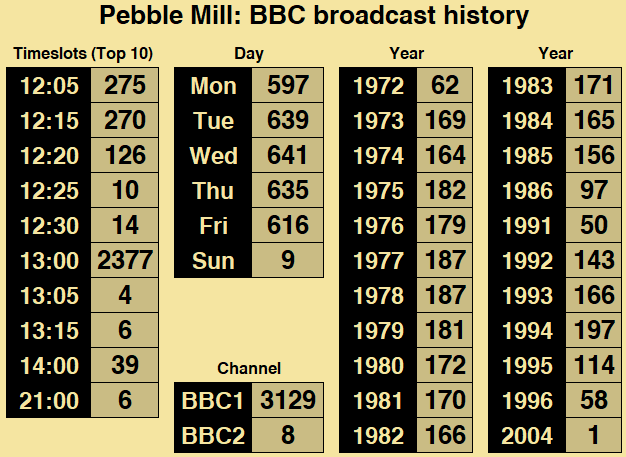
Phew, we got there. Sorry this was a bit of low-energy effort this time. A proper piece of Heavyweight BBC Programming in the next update, however. See you next time, armchair Britain.
-
The 100 Most-Broadcast BBC Programmes Of All Time (24 and 23)

I’m back from holiday. With exhaustion and a cold, which feels unfair. Anyway, back to the chart rundown that’s dragging on so long you’ve lost interest.
24: Teletubbies
(Shown 2977 times, 1997-2009)
Eh? Oh.
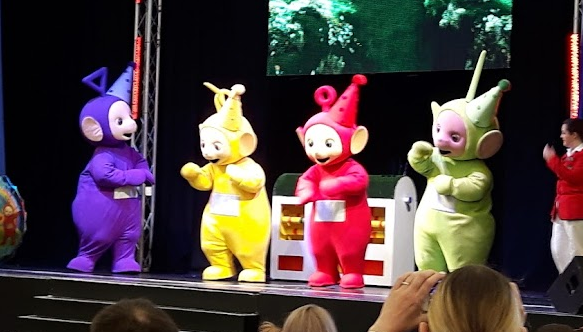
It’s funny how, once a product of a genre becomes truly massive, most people completely forget what had previously seemed to be the go-to example from that genre. For example, before Street Fighter II came along, what was the go-to-reference for a one-on-one fighting game? Yie Ar Kung-Fu? Punch-Out? Frank Bruno’s Boxing? Good as they seemed at the time, nobody’s clamouring to pump out 2023 sequels to those, are they? Meanwhile, Channel Five aren’t about to throw together (and almost immediately shelve) a documentary series on The New Wave of New Wave, are they?

“He’s about to fight Mike Tyson, quick, throw out a re-release!” And, similarly, in the mid-1990s it seemed like TV for pre-schoolers wasn’t about to get any bigger than Tots TV. Produced by Ragdoll Productions and Central, this started in 1993 and the title certainly made no bones about who the target audience was. Despite the generic title that, at least to me, sounds more like a programme strand than something with an actual premise, it had… an actual premise. Basically, following the lives of three puppet housemates: Tilly, a flame-haired French girl (with her nationality changed accordingly when shown in other countries), blue-haired smartarse Tom, and green-haired youngling Tiny.

Tots TV became a major hit, at the time becoming the nation’s most popular pre-school TV programming and shifting VHS compilations by the truckload. Admittedly, at this point, the bar for pre-school telly didn’t seem particularly high. A Sunday Telegraph article on Tots TV form June 1996 mentions that the most popular pre-school video in the USA at the time was called Baby Mugs, and basically featured close-ups of babies’ faces set to music. And, to help market the videos, parents with especially attractive babies were given free copies of the tapes in return for allowing their own children to be taped for a future volume. So, several degrees more disquieting than Kiddystare from The Day Today.
All of which might explain the easy pickings for Ragdoll Productions when it sold Tots TV to the US television market. That wasn’t enough for Ragdoll, however. Around the time Tots TV dominated the under-fives market, Ragdoll carried out research at nurseries and family homes around the UK, filming the reactions of toddlers to their Tots TV follow-up. The company’s producer of programmes Anne Wood stated at the time “we want to make a programme for the under-fives that will make them laugh and increase their thinking skills”. To help secure the attention of the toddler audience, Watch With Mother-style ‘proper’ pronunciation was trimmed back, replaced with the indistinct speech patterns the audience would be familiar with. If you were under three, these weren’t more adults telling you what to do, these were friends you wanted to spend time with.
That research led to a different approach for the new programme. Gone was the manic energy of shows like Pob or Chorlton and the Wheelies, and in came a gentler pace, specifically to give the audience a little more time to stop, listen and consider the action. And, quite crucially, key elements of the programme would be repeated. Nails on a blackboard for parents, but a key tool in understanding for the show’s real audience. Plus, test audiences actually loved the scary baby-face sun, confirming that toddlers really are Very Strange.
DRUM ROLL: and that programme was… you know what it was. A show described in a later Telegraph article as “four technological babies are linked to reality via televisions in their stomachs”. And so, on 31 March 1997, Tinky Winky, Laa Laa, Dipsy and Po arrived on the BBC for the first time. And to show just how much faith the Beeb had placed in the series, it seized the slot then held by pre-school stalwart Playdays. No pressure.
It was something truly at odds with the trend at the time. While Teletubbies was being developed, Sony were churning out videos such as ‘Dirty Diapers Dancing’, ‘Gurgles and Giggles’ and ‘Multiple Madness’, where infants performed an approximation of dancing to cheap-to-licence pop songs. Sure, the adorability quotient will have been high for a certain type of parent (y’know, fellow parents you regret accepting Facebook friend requests from), but that’s really offering little more than a distraction for the audience.
Anne Wood’s different but carefully considered approach soon won over audiences when the programme first appeared in the BBC schedules, but that did little to sway journos looking for an easy way to fill column inches. Hey, it’s popular with a generation different from yours – your instinct will be to immediately distrust it, yeah?

Daily Mail, 20 May 1997 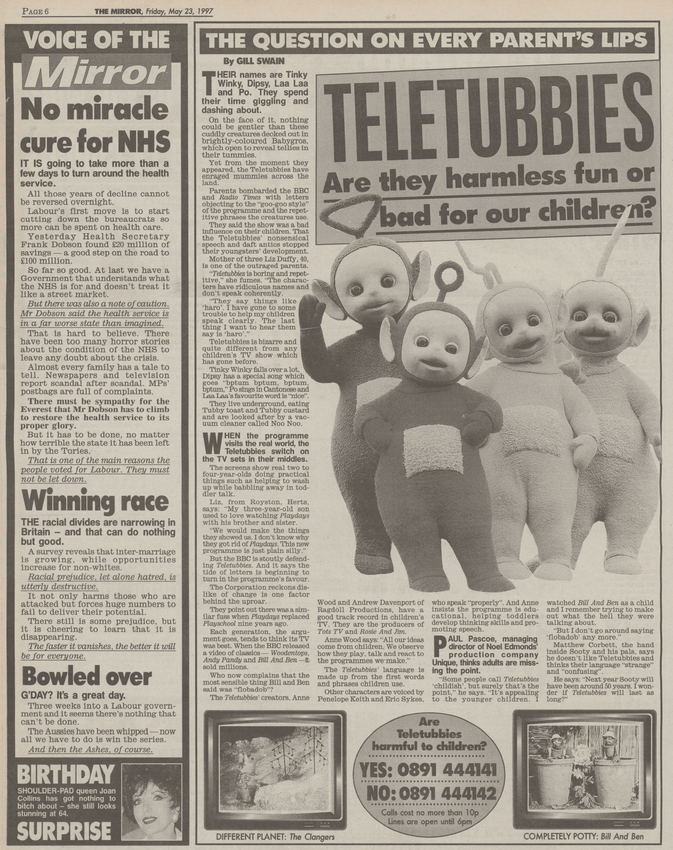
Daily Mirror, 23 May 1997 The big phone vote debate in the following weekday’s Daily Mirror was on abortion, just to you know the level we’re on here.
Tabloid outrage factories put in extra overtime in July 1997 when Tinky Winky actor Dave Thompson was withdrawn from the series, producers citing his ‘interpretation of the role [being] not acceptable’. A frenzied dig into Thompson’s past uncovered (at least according to the Daily Mail, so have a pinch of salt ready) his habit of relaxing in the nude while out of costume on filming days.

Daily Mail, 31 July 1997 
Daily Mirror, 28 July 1997 Even the broadsheets were easily coaxed into the pile-on, with The Times coupling a story on less than healthy licenced ‘Tubbies-branded snacks with a footnote on research from Paris on increased risk of heart attacks for overweight children.
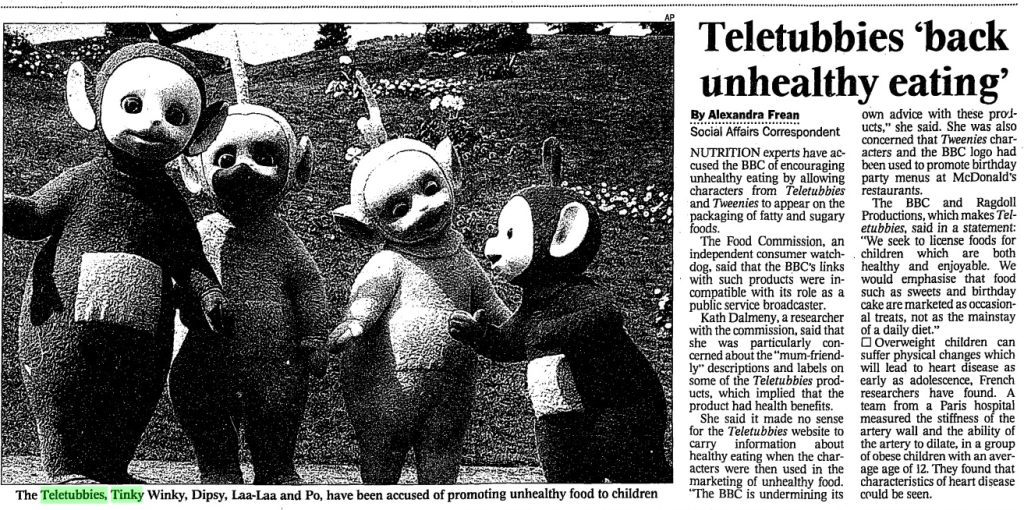
The Times, 26 October 2001 Even the Telegraph, the newspaper that had highlighted the research and reasoning that went into the series months before it launched were happy to jump in.

Daily Telegraph, 20 May 1997 Also in the UK, and even in the USA, right-wing hacks found plenty to cram into their outrage pipes about the notion that Tinky Winky was promoting a gay lifestyle because handbag. Once everyone with an ounce of sense had finished rolling their eyes at the manufactured furore, LGBT activist David Smith offered an assurance to the parents of the world that “your children will not become gay due to the subversive effects of the colour purple, triangles and magic bags.”
And yet, it was Tinky Winky et al who’d have the last laugh. The Fleet Street furore died down, and Teletubbies became one of Britain’s great television exports, going on to air in 120 countries and in 45 different languages. It seeped so far into the public’s consciousness on both sides of the Atlantic, it was go-to reference-fodder for everything from Have I Got News For You to Harry Enfield and Chums over here, and for The Simpsons to Family Guy over there. It was even jostling with the likes of Irvine Welsh, Kathy Lette and J G Ballard in the bestsellers list at one point.
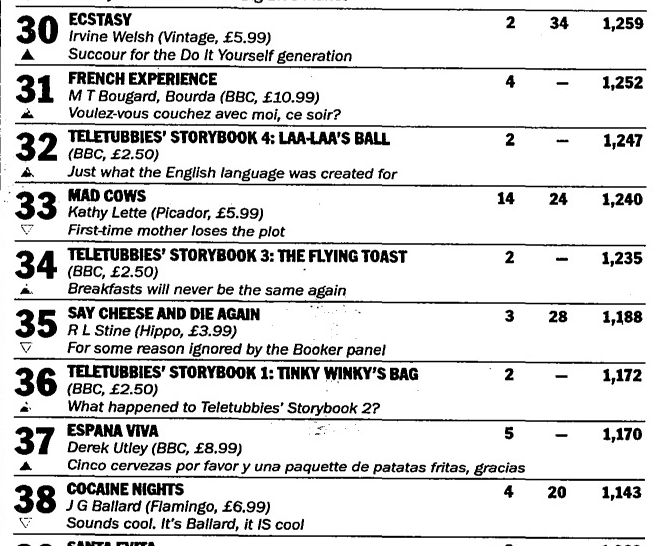
Independent, 27 Sept 1997 The original run of the series only saw new episodes produced between 1997 and 2001, but that didn’t prevent them being aired on a daily basis for years afterwards. And that was far from the end of the saga – in 2015, the series was rebooted for a new generation of tots to enjoy on CBeebies, with episodes still in production in 2022. And they certainly weren’t doing things by halves – the opening theme music is performed by the BBC Philharmonic Orchestra.
On a personal level, this is the first programme on the entire rundown where I’ve personally met the cast.
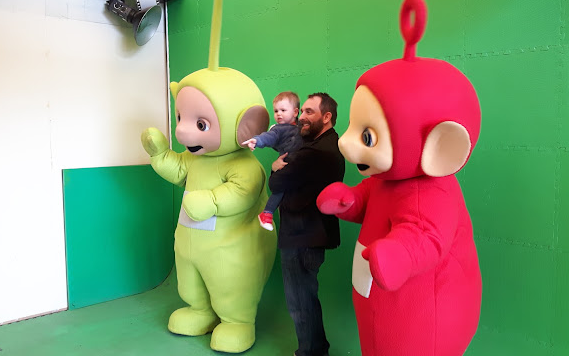
Yeah, you’re right to look impressed.

23: Kilroy
(Shown 3005 times, 1986-2004)

“Your mother’s in a care home? And is being drugged? For the convenience of the staff?”
“No!”
“Your daughter, she’s about to get married. And you just threw black ink all over her dress?”
“I never touched her!”
October 1986 was a real transitional moment in the great timeline of British television. With Programmes For Schools and Colleges now airing over on BBC2, BBC1 stuck an arm down the back of the Breakfast Time sofa and rustled up enough cash to afford a brand new daytime schedule. All they needed was fresh content to fill it with. A lot of fresh content. Eventually, for one of the slots, they’d land on the programme under consideration here. But it took a while to get there.

Daily Mirror, 15 Oct 1986 Nominally, the new daytime schedule started at 10am, the post-Breakfast Time slot had long been enjoying actual programming for the benefit of anyone needing a post-Bough comedown before the white heat of Pages From Ceefax. Indeed, it took a little while for that slot to fully become part of the new Daytime BBC1 line-up, leaving it free to host all manner of filler between 27 October and 24 November 1986. On Day One of the new daytime schedule, the slot was taken by Who’s a Pretty Girl, Then?, a documentary following a beauty pageant for girls aged three-to-nine, and all manner of flotsam soon floated there: Pigeons – Queer Facts, On the Throne, a few early broadcasts of Neighbours, Emergency – Bloomsbury 3 and The Last Day.
Eventually, on 24 November 1986, British television welcomed a long-planned vehicle for a man who, upon being elected as Labour MP for Knowsley North in 1974, confidently predicted he’d be Prime Minister within 15 years. That plan having been scuppered by Militant, Robert Kilroy-Silk made the move to television, but not without lobbing a few bricks over his shoulder as he left – timing his headline-nabbing official resignation from Parliament on the day of Neil Kinnock’s keynote speech at the Labour Party Conference, and releasing his tell-all diary telling of his disillusion with the party being published on the first day of the conference – it also being serialised in Rupert Murdoch’s Times.
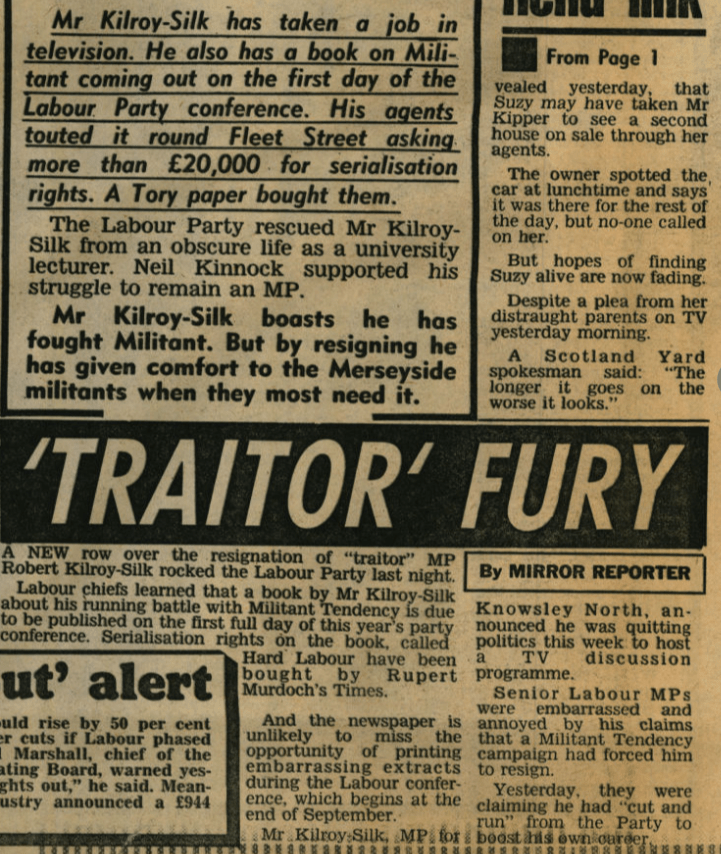
Daily Mirror, 1 Aug 1986 
Daily Mirror, 6 Aug 1986. Yes, it is that Anne Robinson. And so, a television career beckoned for the former lecturer, and as everyone knows, that programme was called… Day to Day.
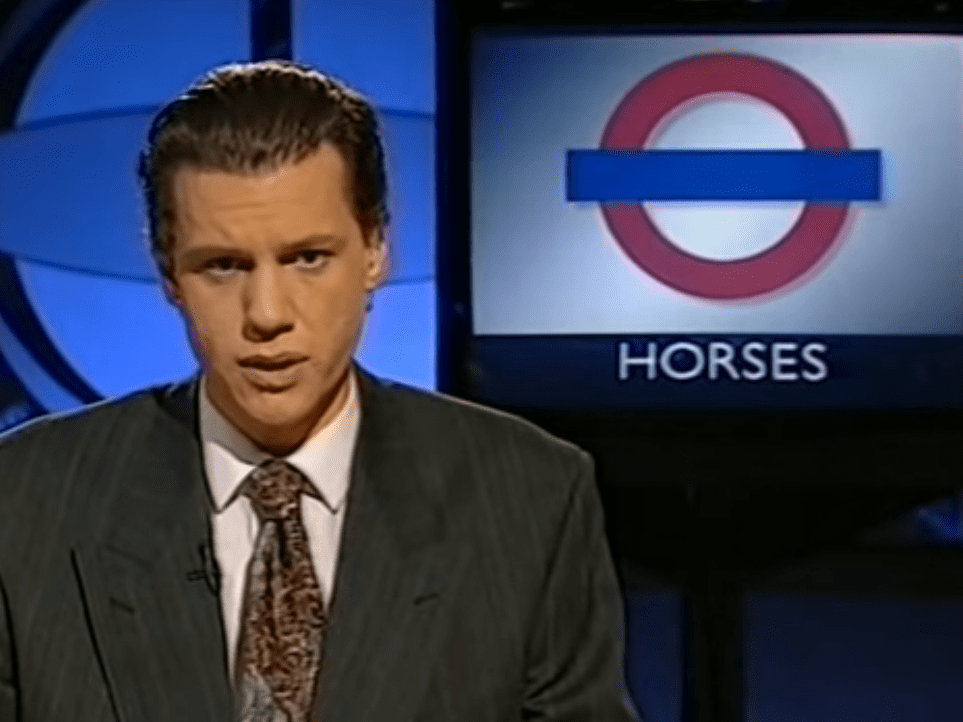
Not that one. Yep, Kilroy-Silk’s original discussion-based programme went by that title, running for 107 episodes between November 1986 and May 1987, mostly with a billing that offered viewers a chance to “join Robert Kilroy-Silk to discuss a topic that touches your life.” Given it’s position on the nascent BBC1 Daytime schedule, you might expect the programme veer away from anything too rabble-rousy. After all, it shared a schedule with Five To Eleven. Looking at some newspaper television listings at random from 1987 may provide some answers.
5 Jan 1987: “Robert Kilroy-Silk, Patric Walker. Jilly Cooper and a studio audience discuss astrology.”
3 February 1987: “Robert Kilroy-Silk is joined by two convicted burglars who confront a studio audience of victims of burglary to explain why burglars rob people.”
19 March 1987: “Robert Kilroy-Silk chairs debate on compulsory sterilisation of the mentally handicapped. With Brian Rix of MENCAP.”
Bloody hell, that escalated quickly.
At the end of the run, half-term children’s programming filed the 9.05am slot, followed by Election Call and repeats of Dallas in subsequent weeks. Bye, Day to Day. But in October 1987, Kilroy-Silk was back. And he meant business.
By that time, ITV had found their own rugged morning discussion show host, with Mike Scott’s The Time… The Place – the first daytime show to be aired throughout the national ITV network – attracting a solid million viewers per day. Time for the BBC to fight back, with their very own “golden-haired hero out of a Barbara Cartland novel” (as the Daily Mirror’s Patricia Smyllie put it) front and centre.
“I never run out of ideas, and I like the challenge of facing a similar programme on the other channel”, roared the silky-smooth one. “You get the sort of publicity you get nowhere else. I once turned down an early morning breakfast show because I refused to get up at 5am. They were amazed because no one had ever refused before. No one has refused to go on my show either.”
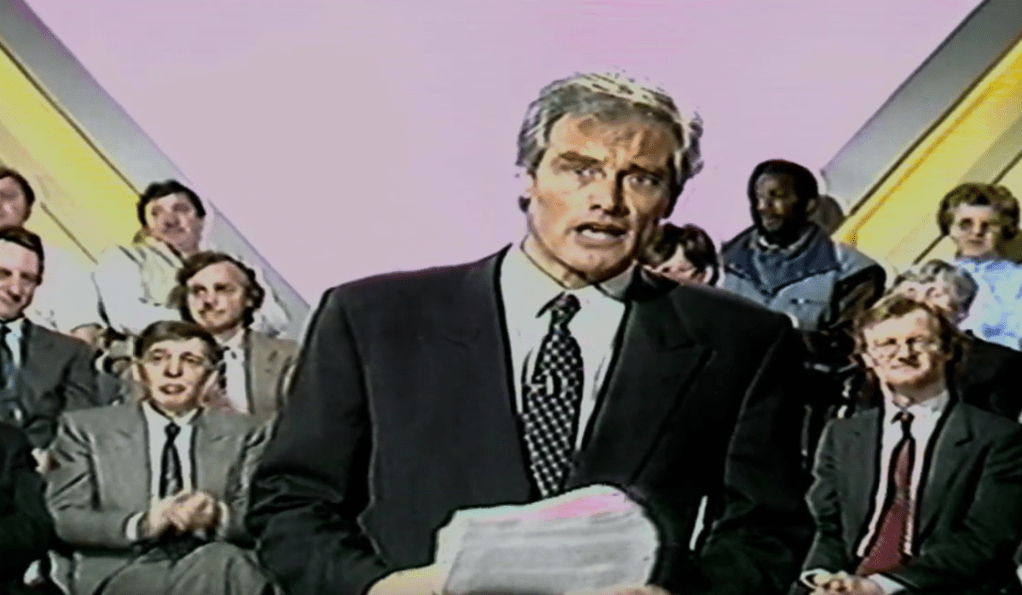
Not that there was much different between Day to Day and the renamed Kilroy!, to be honest, at least during those early programmes. But putting the name of the host in the titles was surely a canny move for a man fast becoming a cult figure amongst daytime viewers. Prior to his debut on daytime TV, the Daily Mirror had little positive to say about the former MP. Within a few months of Day to Day hitting the screens, the same publication would frequently publish puff pieces cooing over Kilroy-Silk:
All over Britain. Hoovers are switched off, dusters put down, Nescafe brewed. legs curled up on sofas. as a sizeable proportion of the female population settle down for a good old-fashioned fawn.
One was moved enough to write a poem to the BBC viewers’ letters show Points Of View which read:
“As Smooth as Silk”, Colin Wills, Sunday Mirror, 1 March 1987
“If you want your day to be honey and milk
“Start each one with Kilroy-Silk.”And that was at a time when Kilroy-Silk was penning opinion pieces for rival rag The Times. So, the same mix of discussion on topical subjects was rechristened with a third of the host’s moniker. The topics certainly remained a consistently inconsistent mix of the controversial and cliched: “Clause 28” (26 January 1988), “Maybe working women make better mums?” (3 March 1988), “Astrology” (again) 13 May 1988.
It was a formula that proved to be a hit with many viewers, and led to a number of special episodes for the permatanned host. 1989 saw a one-off special (and not, as you’d more reasonably expect, a Davey Jones strip for Viz) Kilroy in the Holy Land, where he and his guests “discussed prospects for peace”. That was followed by 1990’s Kilroy in Hong Kong, where Kilroy-Silk listened to the anxieties and hopes of the people of the colony as it inched towards 1997’s transfer of power. 1992 saw Kilroy on the Costa, while 1994 saw Kilroy Down Under.
Those overseas sojourns were accompanied by runs of Kids on Kilroy (1992) and Kids’ Kilroy (1994-1995), where topics were (thankfully) watered down to the likes of “Do brothers and sisters always have to love each other, or is an only child better off?”, “How do Britain’s next generation look at people in authority?” or “Young people talk about the clothes they like wearing and why“. I mean, because they’d get cold otherwise, probably.
As the new millennium whizzed by, Kilroy remained (for the most part) a fixture on the BBC. Surely nothing was about to derail his conversational juggernaut?

Oh, right. Yeah. That’ll probably do it. Still, plenty more channels out there who’ll welcome his no-nonsense approach. Onward and upward.

Oh, right. Yeah.

Phew. Another one down. Will we ever reach number one on the list? Tune in again soon to get a few inches closer to that numerical utopia.
-
The 100 Most-Broadcast BBC Programmes Of All Time (26 and 25)

The next episode of the rundown. And a concerted effort not to bang on about everything for so long. We’ll see. And so, resisting the temptation to pretend Does China Exist? is at number 25 as an April Fool prank, here are the next couple of programmes.
26: The Weakest Link
(Shown 2923 times, 2000-2021)

Now, here’s a programme that seemed to mark a sea change on how popular quiz shows could break out of the confines of telly, and become an entire self-contained industry.
Not that TV quizzes hadn’t led to spin-off merch before, of course.

But The Weakest Link took things to a level never seen before. Alongside compilation tapes, the inevitable board games and question books, there were (equally inevitable) CD-ROMs, games for the PlayStation AND PlayStation 2, a VHS compilation of Anne Robinson put-downs, novelty dance records, collectable action figures of the host’s appearance in an episode of Doctor Who, and a money box.

Truly, the early 2000s were the peak years of TV tie-in tat. All stemming from a quiz programme that quietly arrived on BBC Two’s early evening schedule on Monday 14 August 2000.
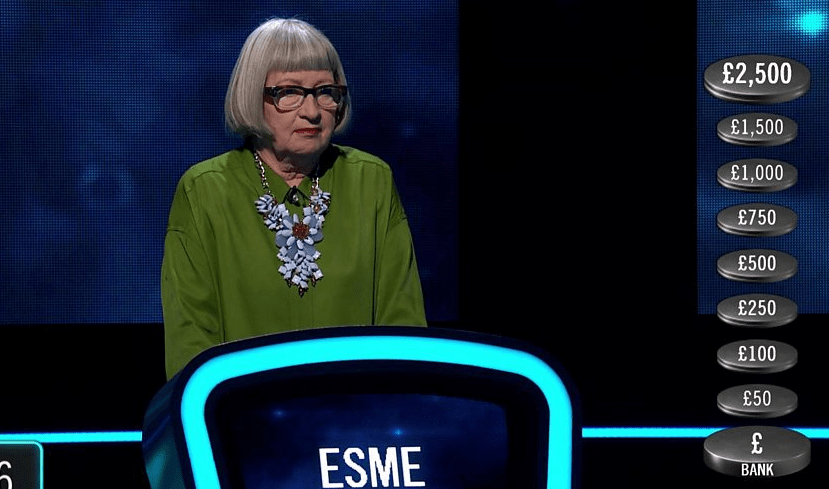
The premise was summed up suitably succinctly by the Radio Times for that week: “Anne Robinson hosts a new series of weekday elimination quiz shows. Contestants face quick-fire, general-knowledge questions to win a top prize of £10,000.” Devised by former South London GP Fintan Coyle and club comedian/actor Cathy Dunning, the format was certainly one that could attract an audience – making contestants work together in each all-contestant round-robin, as they seek to inflate a cash accumulator that rises with each correct answer, but resets to zero after an incorrect answer with the current accumulator total being lost. If a contestant ‘banks’ the current prize pot before their question is asked, it’s reset to zero, but added to the final prize pot – however, you’re also stopping that accumulator climbing any higher. That teamwork is offset by a voting round after each set of questions, a ballot that results in the contestants voting out one of their number. In theory, they’re voting out the titular weak link who’d cost them the most money, but as the field narrows, canny contestants can choose to vote out anyone they deem the biggest threat to their personal success. For anyone too young to remember it, it’s basically Among Us but with trivia. Except that when you’re kicked off the spaceship in Among Us, you’re not expected to go on camera to account for your actions in a post-match interview.

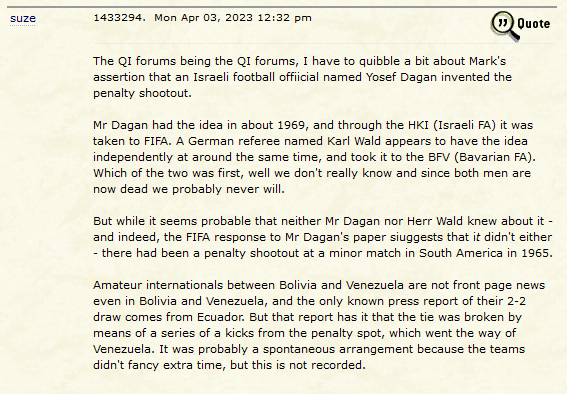
Eventually, the field is whittled down to two contestants, who must then take part in a penalty shoot-out: five questions each, whoever gets the most right out of five scoops the prize pot, and if it’s a draw it’s a sudden death question-by-question shootout. I don’t think that Israel Football Association general secretary Joseph Dagan got a credit at the end of the programme for devising that bit, but he originally invented the penalty shoot-out, so he should probably at least get a cut of those DVD sales. [UPDATE 11/04/23: See footnote 1 below.]
Of course, while the format of the programme was undoubtedly a unique one, the secret spicy sauce behind the success of the programme came from the acerbic nature of host Anne Robinson.

While the original intent was for Robinson to be firm but generally understanding with the contenders under her charge, before too long underperforming players could expect to be gently mocked by Robinson. Before much longer, the mocking retorts became much less gentle, ranging from cutting to downright insulting. I’ll admit here, this is why I never personally took to the programme. Seriously, comments like “Why are you dressed like a lesbian?” and “How many of your three boys have got tags on their ankles?” to people appearing on telly for the first time in their lives? What are you, Jeremy Kyle in a frock? No wonder it led directly to the election of Donald Trump and Boris Johnson. Yes, directly.
(Not directly, I’m exaggerating for comic effort. Smelly.)
Anyway, putting that brief moral aside behind us, it was a programme that was an absolute smash for the BBC. Just a few months after the programme first hit BBC2, show creators Coyle and Dunning were well on the way to becoming millionaires, and the show was soon set to be franchised out to Germany, Italy, Australia, France, the Netherlands, Portugal, South Africa, Israel, Turkey, Spain, Latin America, Sweden, Canada and Ireland, each installing their own Queen (or King) of Mean as host.
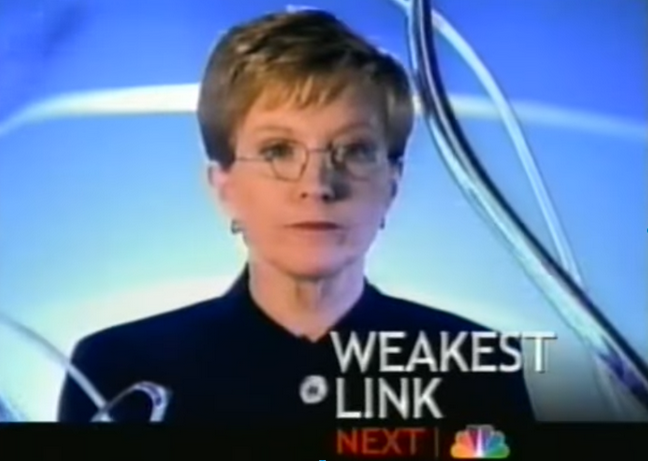
And, biggest of all, from April 2001, a primetime version of the series started airing on America’s very own NBC, with Anne Robinson travelling across the Atlantic to host. The “getting a Briton to play the villain” trope is written in ink, after all. Since the early days of television, well-regarded British TV personalities have made the trip to US only to return to the UK hoping nobody noticed they’d been missing – on one end of the scale, Peter Cook in The Two of Us and Morwenna Banks’ short stint at SNL, and the other Cheryl Cole’s cameo in X Factor USA and ABC’s The Noel Edmonds Show.
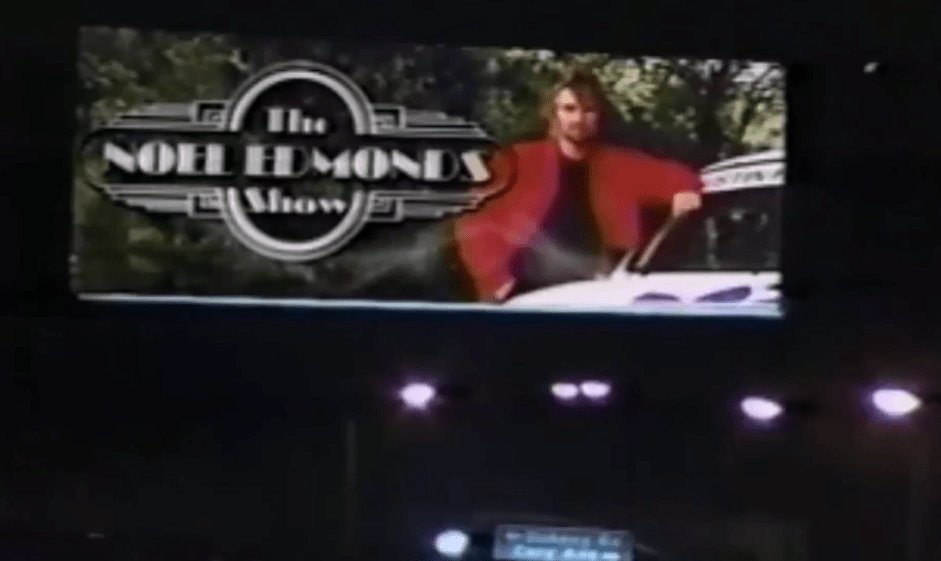
This actually happened. For a week in 1986. At least initially, NBC’s version of The Weakest Link was a success. After launching in April 2001, the series was an immediate hit, the three episodes airing that debut week (on Monday, Tuesday and Wednesday) barged into the Nielsen ratings for the week, attracting audiences as high as 17.4 million viewers, and bettering the likes of Frasier, 60 Minutes and even Friends. Not too shabby.

Source: RatingsRyan However, it wasn’t to last. By 2002, American audiences found a new Briton they could love to hate in American Idol’s Simon Cowell, and by July of that year the Weakest Link was dropped from NBC’s primetime line-up.
That wasn’t the end of the series in the USA, however. Several months before the cancellation of the primetime version, NBC had started work on a syndicated daytime version of the series for local stations, which had started airing in January of that year. This time the host was George Gray, at the time best-known for hosting “an extreme version of The Gong Show”, and the newly-syndicated version ran for 324 episodes. (“Wow! It must have been a success!” – A reader.) Not really, it only lasted for a season and a half. Such is syndication.
Robinson duly returned to the UK, and resumed hosting duties for the OG Weakest Link. Not that they’d been left without their premier quiz show in the interim – BBC Two started airing episodes of Weakest Link USA on weekday evenings from May 2001, just a few weeks after their debut on NBC. There were enough episodes of that to last until April 2003, so not a bad bit of business for the Beeb. Not least at by 2002, as new Celebrity editions of The Weakest Link were going out on primetime BBC1, which really helped the brand to grow even further. And boy, it certainly did grow. The 1 March 2001 episode of The Weakest Link on BBC1 – an EastEnders special, broadcast as the warm-up act for an extended ‘Stenders episode featuring Mel and Steve’s wedding – drew a series-high audience of 11.4m viewers.
(With thanks to Daniel Webb for those details on the EE-special episode.)
Given how well-known the programme was in the early 00s, it’s a bit surprising to consider how the proletariat version of TV’s most caustic quiz didn’t make the move to teatime BBC1 until February 2008. But, to be fair, until that point the 5:15pm slot on the Beeb’s flagship channel was the sole domain of a certain antipodean continuing drama programme, the name of which escapes me right now. Whatever happened to that?

I think it was this one. Sub: please check. Given the reputation Weakest Link held, it was perhaps no surprise that it could easily be jettisoned into that spot in the schedules – by that point it had topped the weekly BARB ratings for BBC2 on at least 82 occasions – and it cemented that timeslot as the BBC1’s go-to location for popular teatime gameshows to this very day.
Of course, all good things etc etc and so on. On 31 March 2012, a new episode of the programme aired for the last time, though repeats of the show would continue on BBC Two throughout 2013. However! In December 2021 – right at the end of the period we’re looking at for the purposes of this rundown, remember (seems a bloody age ago, doesn’t it?) – the Weakest Link returned, hosted by the omnipresent Romesh Ranganathan. It doesn’t look like going anywhere any time soon, even if it’ll never hope to recapture that place in the national psyche.

[footnote one: QI KLAXON.
10 bonus points to Suze on the qi.com forum for the following addendum.]
25: Nationwide
(Shown 2930 times, 1969-1983)
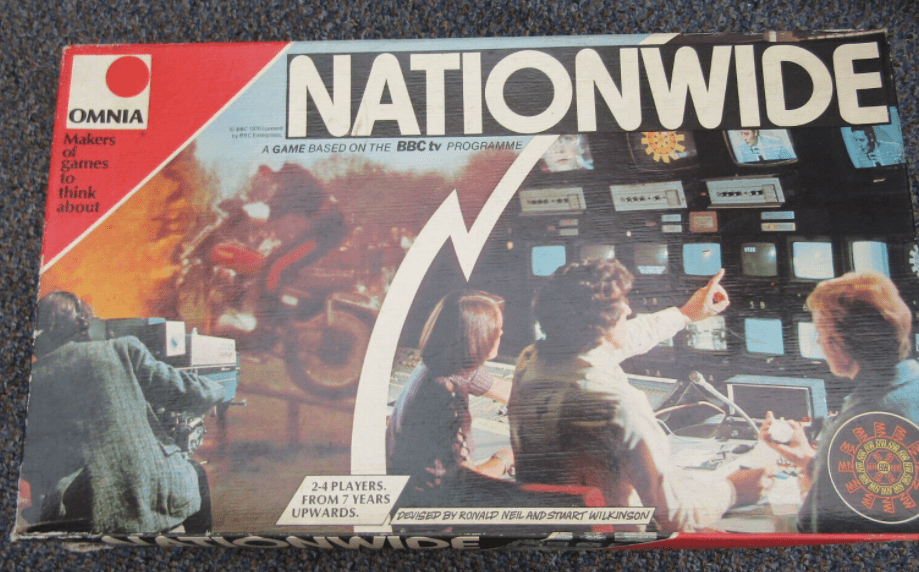
This was always going to make the list, it was just a matter of where.
It feels redundant saying a television programme encapsulated the era when it was aired. After all, which era is it supposed to encapsulate? The middle ages? The year three billion? And yet, it’s a facile phrase that seems to fit especially well with Nationwide, from the “don’t expect to get too much” years of 1969-1983. Yes, there’s a skateboarding duck, but here’s the local news telling you the local coalmine is closing. Ha, a man who claims to jump on eggs, anyway the binman strike is about to enter week twelve. And so on. Give with one hand, knock your Bovril onto the carpet with the other.
Following in the footsteps of acclaimed current affairs show Tonight, and tasked with folding your local news into itself somewhere, Nationwide found itself needing to offer something new. And to do this, it offered something that those upstarts on ITV couldn’t match.
Over on ITV, each regional service was operated by an entirely individual company, so while each region was able to offer a local news service, there’d be no way they could put out a single nightly show that could flit around the regions, seeing what various parts of the UK had to offer. At least not until the ITV Telethon became a thing almost twenty years later.
The BBC, being one single entity offering a largely national service (at least to England) with regional opt-outs, could put everything into one nightly programme. Start off with a national presenter topping the programme and giving a round-up of Things to Come, have each region opt-out of the programme for their own local news bulletin (save for London and the South-East, which had a bulletin broadcast from the main Nationwide studio), then back to the London studio for a mixture of political analysis, consumer affairs, light entertainment and sports. Best of all, where stories of national interest (or at least curiosity value) were located outside London, the national network had the relevant regional studio ready to be thrown to. A unique mixture that their rivals couldn’t hope to match. An easy win.

Going by the words of contemporary critics, any such aims were perhaps a little too lofty, at least at the time of the first edition. Writing in the Daily Mirror, TV reviewer Mary Malone set the BBC’s new evening offering against its Thames counterpart ‘Today’ in an entertaining column that required two television sets to be on at the same time (video recorders? Pah!). Today became the main focus of the column, if only as a suitable target for ire over their sensationalist coverage of contraceptives in use at a secondary school, and using rock music to soundtrack war footage. Malone’s eye was clearly drawn more closely to the unfolding schlock on the light channel, leaving time for just the faintest of praise for Nationwide. “Responsible, incombustible stuff this; no town councillor can afford to miss it.”
Oof. Peter Black of the Daily Mail was able to go into a bit more detail about the lack of pizazz hampering the debut episode of Nationwide: the lack of any topical content that would befit the format. Noting that “technically, it was a good clean professional job. In content it was dullish because as always happens on a first night, there weren’t enough good stories about.”
Indeed, the story falling under the first Nationwide spotlight was one that was happening, well, nationwide. The national teacher shortage may well have been big news that night, but throwing to Glasgow, Newcastle and Birmingham from the London studio only to be met with “yeah, same here” hardly highlighted Britain’s rich regional tapestry. Fortunately, any early jitters don’t seem to have held the programme back, and in 1972 the programme’s scheduling was increased to five days per week.

Before too long, the programme would become a lynchpin of the BBC1 evening schedule, and become a target recognisable enough to be the target of sketches by, among others, Monty Python’s Flying Circus (“Well, everyone is talking about the Third World War which broke out this morning. But here on `Nationwide’ we’re going to get away from that a bit and look instead at the latest theory that sitting down regularly in a comfortable chair can rest your legs”) and the marvellous End Of Part One.

Despite making for quite an easy target, the Nationwide branding was deemed to have enough dignity to be sellotaped to the BBC’s coverage of various then-current events. So, alongside the vanilla version of the programme at teatime, viewers could also expect to see the “Nationwide BBC Election 70 Results Round-up”, the “Nationwide Referendum Result”, assorted “Nationwide Budget Specials”, compilation show “Launch Yourself with Nationwide” where Richard Stilgoe demonstrated building a dinghy.
Perhaps best of all, between 1979 and 1983 there was “The British Rock and Pop Awards: A Nationwide Special”. Imagine the Brits being given a “One Show Special” tagline today, eh? This actually span out of the Daily Mirror’s annual Rock and Pop Awards, which had been running since 1976. But from 1979 onwards, the paper teamed up with the ‘Wide and Radio 1 to let people see and hear the whole shebang.

The march of modernisation must never abate, however. Come 1983, and the programme was deemed a bit old hat, and on 5 August 1983, the nation went Nationwide for the very last time. In its place came a super new replacement programme that BBC bigwigs were sure everyone would love.

Spoiler alert: they didn’t. Despite a more urgent theme tune, flashy (for the time) graphics and a weird Rubik’s Snake logo, Sixty Minutes turned out to have been a bit of a binfire, the bright idea of combining the national news, local news and current affairs into a single entity fell apart when the BBC’s News department failed to play nicely with their Current Affairs counterparts, meaning each part of the programme was effectively a single entity. It lasted less than a year, and the BBC made the switch to individual national and regional news bulletins – a format still in use to this very day.

The BBC still haven’t found anything quite as magnificent as the spinny Nationwide wheel, though. 
POSTSCRIPT: Mary Malone’s TV column looking at Today and Nationwide, as mentioned above, is worth reading in full. So, here it is:
I SUPPOSE you could call it an Indian summer. After the first flush of new autumn programmes, a pause while they get a grip on their generosity, No one was flinging any money away last night.
It was back to an old film, a repeat play and the die-hard favourites.
No doubt you were all worried about me. What could I make of a might like this?Let me tell you now, children, I’ve made bricks without straw before, and I’ll make ’em again. It’s facility that has provoked a number of shrewd inquiries. Those who don’t ask why you do it usually ask how. Do you watch three sets at once? How do you remember it all? Why choose “World in Action” and not “Panorama,” a comedy and not Misery in the slums by Man Alive.
Wonders
Well. here’s how: the first thing to master is mounting anxiety at the sight of the evening’s schedules. When in doubt, polish everything. Waxing the floor does wonders. Anxiety recedes in direct proportion to energy expended and has the added bonus of forcing spiders back to the garden.
Then make a cup of tea, switch on both sets, turn the radio up, and spread the day’s papers on the floor; anything may be useful.
It’s all in aid of that precious and essential moment when something goes “ping”; and an idea docks.
Watching two sets at once is for emergencies only. It is unduly stimulating and can give you the jitters.
But when the only hope is a bolt of lightning, I’ll try anything. I refer, of course, to the news magazines “Today,” ITV and “Nationwide” (BBC-1) — on both sets simultaneously.
“Nationwide” does go on. Its choice of topics is dictated by what is common — to bring in the regions.
Pill
Mention a fire, and you are good for two minutes. Or land preservation. Or housing. Responsible, incombustible stuff this; no town councillor can afford to miss it.
Meanwhile on the other set “Today” was busy coaxing little girls to say whether or not they felt their education on contraceptives was adequate.
The children were registering grave alarm over the lack, in the school curriculum, of clear and forthright instructions on the use of the Pill, the coil and the diaphragm. “It should start at eleven,” said one sweet thing, very firmly. The little darlings!
Clonk
What has happened to the world since I grew up? This was not so much of a ping but more of a clonk. But the insatiable “Today” was not finished.
The Deep Purple group sang “Hallelujah,” backed by agony pictures relating their phonetic mouthings with aspects of war.
Starving Biafra to project a pop image; Vietnam horrors to titillate the viewer; Middle East bombing to sell a magazine item. Cynical and heartless.
The dangers of watching two sets at once are obvious. You are bored and insulted, patronised, indulged and infuriated at double the rate.
Mary Malone’s View, Daily Mirror, 11 Sept 1969
Also, you go cross-eyed.
Phew. We got there, just in time for me to bugger off on holiday for a week. See you soon, armchair Britain.
-
The 100 Most-Broadcast BBC Programmes Of All Time (28 and 27)

Yes, it took a long time to arrive at this next update. You can blame the ‘programme’ at number 27 on the list. Anyway, on with the next couple of entries on the list, which would have undoubtedly appeared much sooner if I’d refused to do commentary on them.
28: CountryFile
(Shown 2798 times, 1988-2021)
Earlier in the list, we found no-nonsense agricultural programme ‘Farming’ just outside the top sixty, airing 1488 times between 1957 and 1988. But what came next? Well, as eagle-brained readers may recall, it was this. But what was ‘this’?
Despite a long and storied history of spending Sunday lunchtimes offering a “weekly agricultural magazine for those who live by the land”, as the 1990s approached it was felt to be time for a wider look at rural affairs. The mission to launch the new programme fell at the muddy wellies of Michael Fitzgerald, Editor of BBC Pebble Mill’s Countryside Unit, who told the Sunday Telegraph how the purview of farmers was evolving. A lot of agricultural land was being set aside for things other than growing crops, and it was time more was done to bring that to the screen, along with covering other aspects of countryside life. Not that Fitzgerald was deserting the farming community with this new offering, vowing that new programme Country File would always keep “at least one wellie in the farmyard”.
That promise didn’t go down to well with a few members of the farming community, some sending angry letters to Pebble Mill – Fitzgerald remarking how one letter referred to the new show as a “bland, insipid programme” – but it seems most of their contemporaries (including the National Farmers Union) were content to wait and see what the new programme would bring.
Indeed, while the smell of pigswill remained in the nostrils of the new programme, early episodes certainly looked a little further afield, covering topics such as open-cast mining in Wales, canoeists campaigning for legal access to British waterways, or the shortage of low-cost village housing. However, not everything went according to plan – a planned film exploring the lives of crofters on the devout Presbyterian Scottish island of Lewis had to be abandoned when they discovered the film was to be aired on The Lord’s Day. Despite being filmed on a weekday (such was the production team’s desire not to cause offence), a pre-interview chat with crofter Neil Mackinnon led to the six-person film being sent packing before a single second of footage was shot, all because the film was to be broadcast on a Sunday.

Sunday Telegraph, 24 July 1988 Despite those early hiccups, the programme proved to be a success, and in July 1989 saw telly stalwart John Craven take over the hosting duties previously shared by Anne Brown and Chris Baines. The very fact that Craven would leave John Craven’s Newsround, a show regularly attracting six million viewers, for a niche lunchtime programme was certainly newsworthy. His name had been right there in the title, after all. And yet, after 17 years and 2,926 editions of the Children’s BBC news roundup, Craven shuffled his papers and bid an avuncular farewell for the last time. The day of Craven’s final Newsround – Thursday 22 June 1989 – was certainly a big day for TV farewells. A few hours after Craven’s Newsround swansong, Robin Day hosted Question Time for the final, erm, time.
At this stage, it certainly didn’t hurt viewing figures for Country File that rival channels offered less than scintillating competition. In 1990, it was usually pitted against Westminster Week, Police 5 and The Waltons on channels Two through Four. By 1992, the alternatives were generally Sunday Grandstand, ITN News/Waldon, and Little House on the Prairie. By 1994, the competing programmes were the same, save for black-and-white repeats of The Fugitive and The Phil Silvers Show on BBC2. Nevertheless, Country File was deemed a hit, and the programme duly received a commendation from the parliamentary Rural and Agricultural Affairs Advisory Committee. It would have been funnier if a bureaucratic error led to the commendation accidentally being awarded to repeats of The Waltons, mind.

By 1995, Country File was certainly popular enough to be lampooned memorably in the final episode of The Smell of Reeves and Mortimer, with John Craven portrayed as a sociopathic pest with a penchant for breaking into Dalek-speak, while Smell regulars Chris Bell, Tom Fun, Whisky and Brandy Bolland causing rural chaos in a series of segments.
The programme continued to attract a stable audience as Britain moved into a new century, and it’s fair to say it served an audience not really catered for away from the BBC. It’s a format hardly likely to pop up on Amazon Prime any time soon, after all. No, Clarkson’s Farm isn’t the same.
The show’s popularity even led to it moving into a Sunday evening slot from April 2009, with new presenters Matt Baker and Julia Bradbury joining Craven for the move. It proved an immediate success in the new 7pm slot, becoming the twelfth-most watched programme on BBC1 that week, with 5.69m viewers.
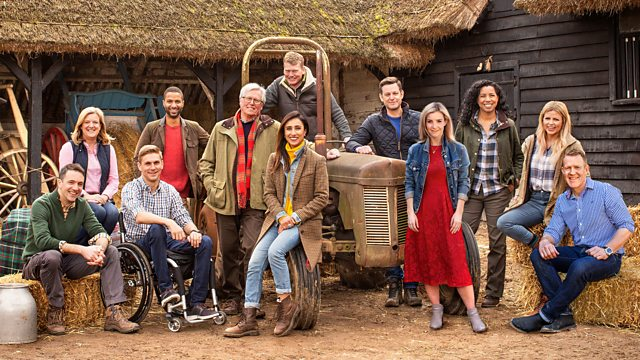
From that point on, CountryFile has continued to attract large audiences, often registering viewing figures north of eight million. The ratings high point for the series came on 7 February 2016, with a total of 8.78 million people watching Matt Baker visit a former Tyneside coalmine transformed into a country park, while Ellie Harrison looked at the restoration of Roker Lighthouse near Sunderland.
Because the BBC doesn’t want to just let a popular brand be, there were also a number of spin-off programmes. 2009 saw the first appearance of Country Tracks, which ran until 2012. 2010 saw a one-off special Secret Britain, which because a full series in 2015. And, from 2016, a series of seasonal Countryfile diaries aired, starting with CountryFile Spring Diaries, going out on weekday mornings.
It might not be the sexiest of television programmes and you’re not about to see it plastered across a digital billboard promoting iPlayer any time soon, but damn does it make for a warming Sunday evening comfort blanket.

27: Party Political Broadcasts (etc)
(Shown 2874 times, 1950-2021)
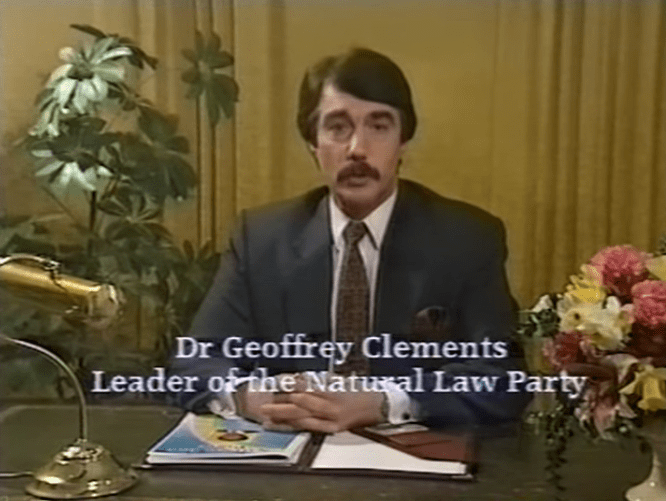
Well, contrary to what many might think, here’s a fun one. The following will help you understand the tone I’m using to express the word ‘fun’ in that sentence.
In theory, it’s a simple one. Look for programmes marked ‘Party Political Broadcast’ in Genome. And for good measure, ‘Party Election Broadcast’ before totting them all up. Sadly, it’s not as easy as that. For example, here’s a Labour local election broadcast from May 2004. Or is it?

Hidden away down there. I’m going to have to bloody well search for ‘party political broadcast’ to pick up all the instances within programme descriptions, aren’t I? Except, of course, that will also throw up a load of false positives, such as:
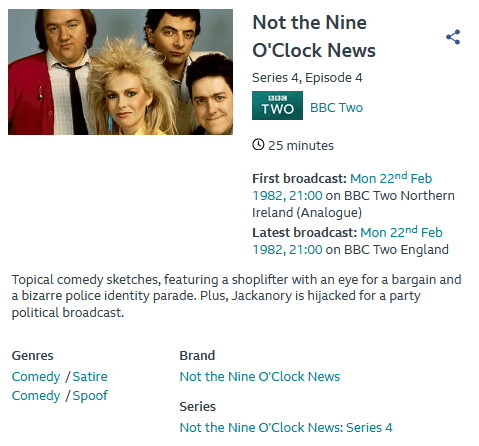
Sigh. So, I’ll need to vet results, to sort programme descriptions that contain (or are followed by) genuine party political broadcasts, from ones that merely refer to them. Fun. And hang on, what about stuff like:

That’s surely similar enough to warrant inclusion, especially in cases where stances on a topic are broadly split between party lines. Then, of course, you’ve got things like Budget Statements. Not a party political broadcast per se, but essentially a representative of a political party getting five minutes to point out how stupid and wrongheaded the other lot are, especially when it comes to what they’d like to do with your money. They’re little more than a PPB in accountant’s clothing. So, that’s added to the pile too.
So, in summary: for this entry I’m including pretty much everything where a politician or party is afforded a short, clearly highlighted programme slot to express an unchallenged opinion about how brilliant they – and everyone who agrees with them, which they hope includes the viewer – are. Hence the ‘(etc)’ right up there.
I’m going to be honest, the figure I’ve carved out here may well be slightly inaccurate, but there’s a point where you have to draw a line in the sand for the sake of your sanity.
Yeah, outside the remit of the 100 as it was only on BBC Wales, but still. This happened. ANYWAY. Some history.
Much as broadcasting didn’t begin with TV, neither did the art of using the airwaves to coax viewers into voting for your lot. 1924 saw the early British Broadcasting Company (as was) putting out the first party election broadcasts over the radio. This only came about due to no small amount of campaigning from Sir John Reith, who’d been lobbying then Postmaster-General Neville Chamberlain to allow politicians on air to make their case to potential voters in person. After initial protestations from Chamberlain that affording airtime to grubby opposition parties would be subversive, the initial proposal was temporarily dropped. However, Reith continued to lobby for their introduction, pointing out that the Post Office was happy to deliver manifestos to homes of Britain without charging for the service, and his proposal was merely a logical progression of that. Chamberlain relented, and in early 1924 the nod was given to allow the first election broadcasts.
There were just a couple of main rules that had to be adhered to. Each broadcast could be no longer than twenty minutes, and broadcasts must be unedited. That’s quite a lot of leeway for an act recently dismissed as subversive. Leaders of the three major parties – Herbert Asquith (Lib), Stanley Baldwin (Con) and Ramsey McDonald (Lab) – seized the opportunity to the max, taking full advantage of their allotted minutes to inform the public why they’d each be Britain’s brightest hope. It would be McDonald who’d win the election, forming Labour’s first-ever government, albeit a decidedly flimsy minority one.
It wasn’t to last – towards the end of that year, a fresh election had been called, and a manufactured political scandal did for the McDonald government. With the election date set for 29 October, Labour hopes of an increased vote share were roundly scuppered by a story published in the Daily Mail just five days before polling day. The gist: THOSE DAMN REDS ARE IN THE PAY OF THE SOVIETS! THEY’RE GOING TO GIVE OUR MONEY TO MOSCOW! IT’S TRUE, WE TELLS YA.
The supposedly smoking gun was a letter penned by Soviet official Grigory Zinoviev, a purported directive sent by the Communist International in Moscow to the Communist Party of Great Britain, the scheming Soviets dead set on installing a Labour government as part of a plan to radicalise Britain’s working classes.
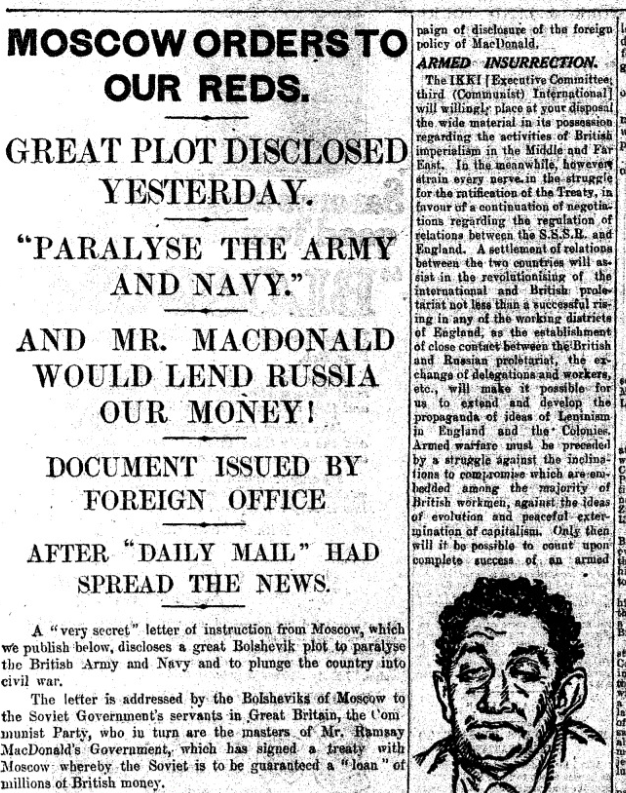
Daily Mail, 25 October 1924 Of course, the letter in question was completely fake, but the damage was done. Stanley Baldwin’s Conservatives duly romped home with a large majority. Newspaper dark arts aside, Political Broadcasts on the radio were now very definitely A Thing, and they were set to be broadcast exclusively over the wireless for quite some time to come.
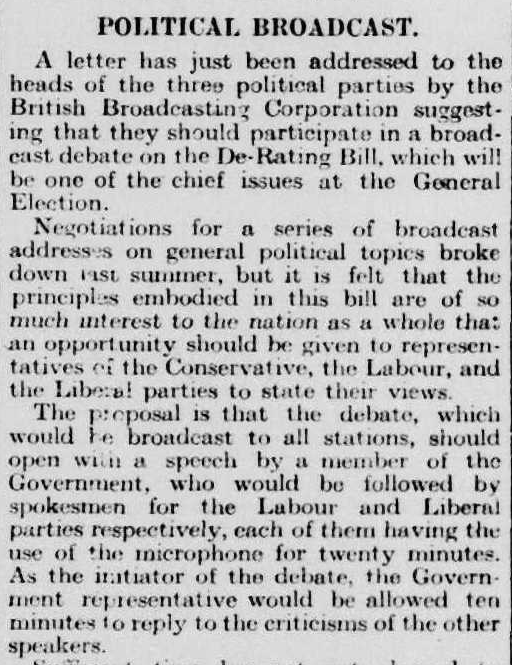
Daily Telegraph, 2 Jan 1929 Despite the monopoly on Election Broadcasts going to the BBC’s radio service, it wasn’t without some severe limitations. In 1947, a new formal agreement was reached between the three main parties and the BBC. The Government of the day would be able to use the wireless from time to time to explain legislation approved by Parliament (under the banner ‘Ministerial Broadcast’), provided it was delivered in a suitably dry and factual manner. Aside from that, twelve broadcasts were permitted each year (referred to in the 1952 BBC Yearbook as “controversial broadcasts”) for the three leading parties, divided up according to the vote shares at the most recent election.
When it came to cross-party broadcasts, MPs could be invited onto the radio to take part in round-table discussions on ‘controversial’ political matters, as long as they weren’t the subject of legislation at the time (i.e. topical, which negates the point somewhat). Furthermore, there was to be no discussion of issues within a fortnight of them being discussed in either House. To get a feel for that, try only listening to current affairs podcasts that are at least a month old. Not YouTube, though. This was still purely a radio-only genre, remember.
However, in the early 1950s they eventually arrived on the screens of televisually-equipped Britons. The very early 1950s, in fact. Now, a number of sources (including the Beeb’s own centenary sub-site) refer to the first televised Party Election Broadcast as airing in October 1951, where Viscount Samuel spoke on behalf of the Liberal Party, but I’m going to argue that they arrived a little earlier than that.
Saturday 4 February 1950 saw the first TV broadcast billed as an Election Broadcast, with a sound-only recording of then-PM Clem Attlee (Lab) giving a ‘talk’ airing after the (also audio-only) late night news broadcast. Subsequent broadcasts followed throughout that week, with a broadcast by Anthony Eden (Con) going out two days later, followed by Viscount Samuel (Lib) the following evening. James Griffiths (Lab), Florence Horsbrugh (Con) and Megan Lloyd George (Lib) were subsequently broadcast throughout the remainder of the week. Indeed, nightly election broadcasts aired right up until 18 February 1950, coming to a close a week before Polling Day for that year’s Election. Close your eyes now if you’re avoiding the result: it resulted in a slim Labour majority.

Now, admittedly, the Liberal Party’s minty Viscount was the first to appear in an in-vision Election Broadcast. The nightly ‘talks’ in 1950 were merely audio-only rebroadcasts of speeches given earlier in the evening on the Home Service. But still: a series of politicians afforded TV airtime to go on about how brilliant their mates all are. That’s a PPB, it was on the telly, so it counts in my book.
Still, everything would change in 1951. Eventually. A sound-only PPB aired on 13 October 1951, with Lord Woolton (Con) speaking to a nation presumably just trying to enjoy their Saturday night. But just two days later, the medium changed forever with the first official Television Election Broadcast (specifically billed as just that), going out in a plum 8pm slot. Sadly, any hardcore politicos hoping for something special to mark the occasion were greeted by… Lord Samuel flatly reciting his script as if he were on the radio, barely moving his gaze from the printed page in front of him. And, to cap it all, accidentally giving the prearranged signal to announce he’d finished, and duly getting cut-off in the middle of a sentence.

It comes to something when the viewers are longing for a film made for the British Iron and Steel Federation to just bloody start already. Of course, a camera being thrust in front of a Minister for Something merely resulted in production values that a YouTuber with a three-figure follower count would baulk at. A desk, a mic, some paper and (more often than not) a bit of nice wood panelling in the background. No wonder generations of kids kept asking if they could just go to bed early. This was purely by design – the filming was initially carried out by the BBC, and any sense that one party’s PPB was a bit livelier than the others would cause all kinds of kerfuffle.
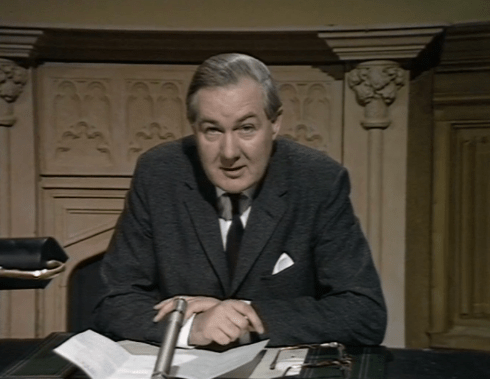
Indeed, the practice would go on for long time beyond the 1950s. Indeed, this approach still wasn’t the default for all political broadcasting. Sound-only recordings of talks given to the Home Service earlier in the evening continued for the next few years due to BBC guidelines (main parties allowed as many as six PPBs per year in audio, but a maximum of just two audiovisual broadcasts), but at least a little invention wasn’t too far away. 19 March 1954 saw the start of Radio Times billings that promised more than just “Lord Cyril Boring P.C. G.S.O.H Q.P.R.”. It’s all relative, of course, but “Meet The Labour Party: A Student’s Journey” sounded a least a little bit more interesting, as did the production credit “produced by the Labour Party Film and Television Unit”. You don’t get that sort of thing these days.

“The Labour Party Film and Television Unit” – there’s a 1986 Spitting Image sketch that practically writes itself. That was followed a week later by a similar attempt by Labour’s blue brethren, ‘Public Questions‘ promising a mass debate between “the Rt. Hon. Anthony Eden. M.C., M.P., Secretary of State for Foreign Affairs, John Nixon Browne, C.B.E., M.P. (Govan, Glasgow), Peter Thomas, M.P. (Conway, Wales), Edith Pitt, M.P. (Edgbaston, Birmingham) and Ray Mawby (prospective Conservative candidate for Totnes)”. Is that your cathode-ray tube overheating, or just the white-hot heat of fiery political discourse? Oh, it’s the former. Turn it off at the wall.
This was a spell where, whatever else they may have been getting up to (and it certainly wasn’t winning elections), Labour had nailed the art of giving great titles for the PPBs. Such as “Conference of the World’s Press” (19 Nov 1957), “Question Time” (11 Feb 1958), “The Britain We Want” (29 Nov 1958) or “The Radical Alternative” (4 May 1960). Come on, you’d be at least ten percent more likely to tune in with a title like that.
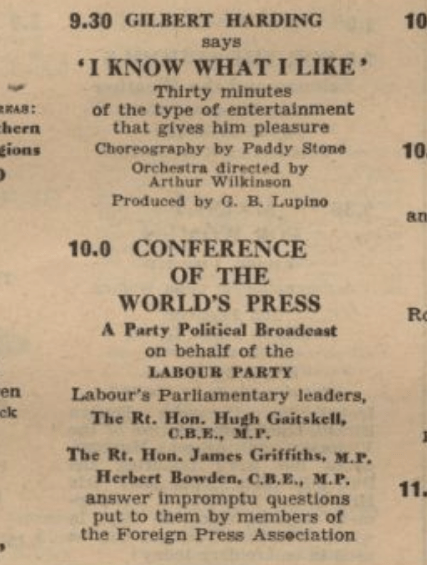
A brilliant programme listing at 9.30, there. The Conservatives later tried to take the same approach, but with less success. Well, unless you’re stirred by titles such as “The Town Hall and You” (4 May 1959), “Factory and Farm” (29 Sep 1959) or “It’s Your Council” (11 May 1960). The Liberal Party eventually had a go too, but “Get Britain Moving with the Liberals” (6 Mar 1963) just sounds like an especially boring exercise video.
As far as progress goes with the format, that was pretty much as far as it would go until Conservative Central Office got on the blower to Saatchi & Saatchi in 1979. The result: a series of five party political broadcasts that bore a closer bearing to television adverts than the staid Politician Behind A Desk format that was previously the inked-in norm. Given the fuel of James Callaghan’s infamous “Crisis? What crisis?” quote-that-he-never-actually-said, it was deemed that there was plenty to pack into those films, with spokesTory Humphrey Atkins only needing a brief cameo in the first ten-minute film, the rest being taken up by a series of strange tableaus, including a coughing planet, money frozen in ice, and a man under Union Flag bedsheets. It was hardly a ratings smash – the same week’s Labour PPB drew a larger audience – but the message seemed to resonate, and Britain was to fall into the iron grip of Conservative rule for the entire 1980s, and beyond.
Similar attention-grabbing tactics would soon ensue from other parties (though in fairness, if you were watching telly at the time you’d have to leave the room to avoid the damn things, as PPBs had to be broadcast simultaneously on all channels), the most notable perhaps being John Cleese’s SDP Broadcasts in 1987, and the most infamous being the same year’s Kinnock: The Movie.

Beardcleese: The last good Cleese Ah, Kinnock: the Movie. The Ronny Rosenthal Miss At Villa Park of Party Political Broadcasts? Or is it? It seemed such a cert to Labour campaign supremos Peter Mandelson and Philip Gould – Neil Kinnock’s personal popularity was faring much better in the opinion polls than Labour’s, so what better to throw focus on? Throw in Chariots of Fire director Hugh Hudson to make the thing, then just sit back and watch those polling numbers rise.
And, as it happens, it actually went down pretty well. Kinnock’s personal poll ratings rose further as a result. And so, Labour decided to use one of their remaining Party Election Broadcast slots to repeat the film. After all, things were going well for the party, as Polling Day drew closer some polls had Labour just a few percentage points behind the Conservatives, and Newsnight even predicted the whole shebang would end in a hung parliament. However, a huge marketing splurge by a panicked Tory party, who’d thrown Tim Bell in to grab the campaign reins late in the race, would ultimately lead to a victory, and a 102 majority, for Margaret Thatcher.
So basically, it’s arguable whether Kinnock: The Movie was really the disaster it was painted as, not least because the Conservatives duly copied the recipe in 1992 for John Major.

“It is! That chippy’s still there!” The cuddly documentary approach was refined yet further for 1997, this time with the ball batted back to Labour. The Conservatives, having pretty much realised the jig was very much up, went into full Nasty Tory mode with the comical New Labour, New Danger (which did at least inspire a great Harry Enfield sketch), while Alistair Campbell and documentary maker Molly Dineen spent months on a carefully crafted ten-minute portrait of Tony Blair. That worked. Trying to repeat the feat with a film on Ed Miliband a decade-and-a-bit later, not so much. Not sure why CCHQ didn’t try making a short film showing the real Boris Johnson in… oh, right.
Of course, your everyday general Party Political Broadcasts (and their higher stake Election Broadcast brethren) aren’t the only thing included in the broadcast total here. There are also local elections (“if elected, we promise more bin days”), Queen’s Speech Responses (“look what you’ve elected, you idiots”), Budget Responses (“look what you’ve elected, you broke idiots”), Mayoral Election Broadcasts (London only for the purposes of this list, the first ever broadcast of which seems to have gone to the Green Party), and Party Election Broadcasts for the European Parliament (in which millions of idiots voted for a party who wanted to abolish it, but whose MEPs happily pocketed their Brussels pay-packets and pensions despite doing very little actual participation in the European Parliament, then pretended that this proved some kind of point). There were also National Assembly broadcasts for the non-England nations, but those aren’t being included here.
And then there were the referenda. The most curious of which – at least to someone writing in the perspective of it all happening long before their time – was the 1975 EEC Membership Referendum. That deserves a longer write-up, but this piece has gone on long enough already, and you’re all keen to move onto the next programme in the list (which is surprisingly, and my database might have got corrupted here, Bobby Davro’s Public Enemy No 1), so I’ll just state that it seems to be a right old curio when viewed through post-Brexit eyes. Nearly the entirety of the national press supporting the ‘Yes’ campaign, with the largest No-backing paper being the Morning Star. The staunchly pro-Labour Daily Mirror pointedly using a front page to dub refusenik Tony Benn as the Minister of Fear. Referendum Campaign Broadcasts reportedly getting audiences of up to 20 million. Cats and dogs living together. All that.
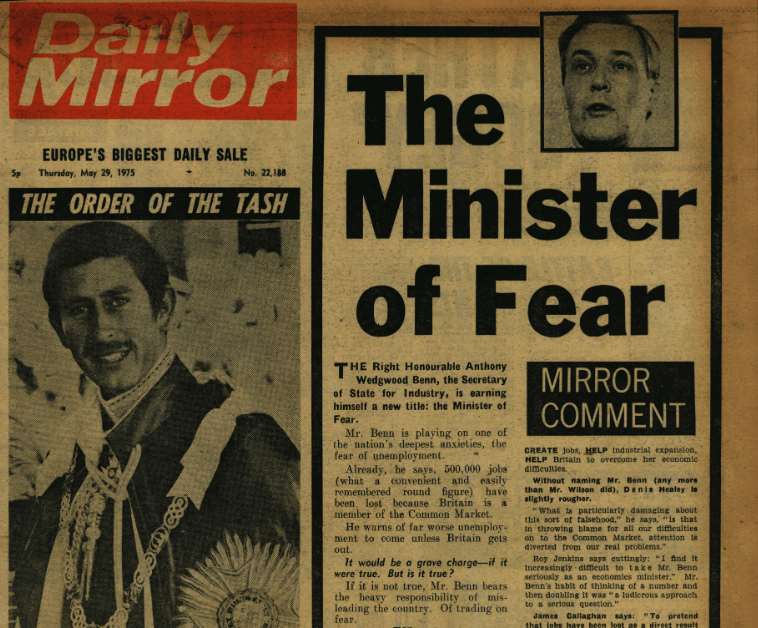
Remember, if you snigger at that dodgy ‘tash now, you can get done for treason and get sent to actual gaol. After that, at least as far as UK-wide referenda go, it would be a long time before another referendum campaign kicked in. Much to the chagrin of The Referendum Party, James Goldsmith’s rabble of hoorays that stood in the 1997 General Election on the basis that if elected they’d hold a referendum on EU membership, act on the outcome, and then immediately dissolve as a political party. And they went all out in their attempts to reach that goal, outspending both Labour and the Conservatives on press advertising. Sadly for them, it all amounted to very little – in seats where the party was standing, they gathered an average vote share of just 3.1%. Though, y’know, lose the battle win the war etc.
The first actual national referendum after 1975 came about in 2011, with the Alternative Vote referendum. Cooked up as a fudge between coalition partners Liberal Democrats (partner in the Syd Little sense) and Conservatives (partner in the Eddie Large sense), with the former having really wanted true proportional representation on the ballot, and the latter just wanting to be left alone to get on with closing libraries, it didn’t really seem to satisfy many. In the end, only 32% of votes went to the Yes campaign, and we’re stuck with First Past the Post until the end of time.
Then there was 2016. But, y’know, ew. Also, due to the list using the default London region listings, the Greater London Authority referendum of 1988 is included. Look, nobody said all this was going to be interesting.
In short, Party Political Broadcasts are a format that will be with us for a long time yet. That’s despite the fact they’re becoming decreasingly effective, given falling audience figures for the channels that show them. With the remaining live TV viewing audience spread across more and more digital channels that have no obligation to show PPBs, and millions more largely ignoring broadcast TV almost entirely, the main focus on getting political messages ‘out there’ is via sponsored online content, which seems to mean (at least in some quarters) going straight for the scaremonger jugular even quicker and harder than ever before. And I say that as someone who remembers Party Election Broadcasts from the late 80s onwards, where a common tactic was shot-on-film dramatisations of Life After You Vote For The Other Lot, which invariably seemed to resemble the first twenty minutes of Threads.

To be fair, my usual reaction to seeing the exit polls at 10pm on Polling Day is generally a dismayed “they’ve only gone and bloody done it”, so it does all fit together.

Phew. It’s all over. It’ll probably be something a bit lighter next update. Or at least something that won’t take so much pesky research. So tune in again soon.
-
The 100 Most-Broadcast BBC Programmes Of All Time (30 and 29)

Into the Top Thirty we go, and a real treat in store for anyone hoping to see a picture of Ken Burras examining a Luffa. Kicking off with a programme promising to make the most out of new-fangled colour television.
30: Gardeners’ World
(Shown 2736 times, 1968-2021)
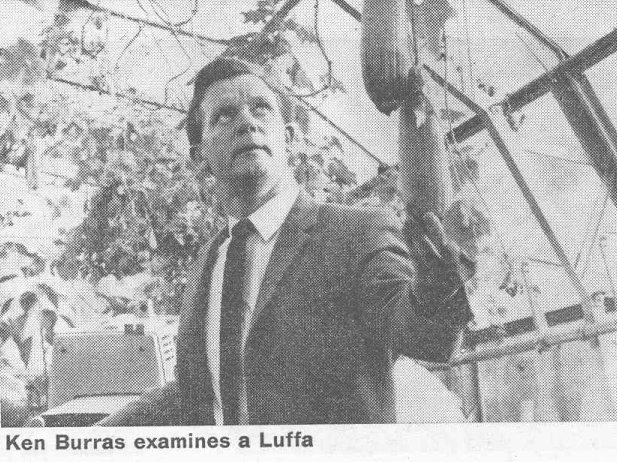
Borne out of Percy Thrower’s Gardening Club (526 episodes, 1955-1967), Gardeners’ World promised a fresh look at gardening for the colour TV era. It’s a format that made for ideal comfort viewing for many, perhaps making it no surprise it’s a programme that’s still with us today.
Gardener’s Club may have offered “a weekly date for enthusiasts to meet Percy Thrower and his gardening friends”, but Gardeners’ World set goals that were a little more lofty. Writing for the Radio Times in advance of the first episode on 5 January 1968, producer Paul Morby set out his stall. For the full effect, you may want to start listening to some Elgar… now.
For twelve years Gardening Club on BBC-1, with Percy Thrower and professional or top amateur guests, has served the nation with its gardening facts, techniques and inspiration. During my eight years’ association as producer, I have opened 100,000 letters which have said ‘thank you’ to the artists concerned.
I realise that we must have exasperated and disappointed, even insulted viewers on many occasions: the connoisseur breeder of orchids has little patience with a programme about polishing onions for the showbench. But our commission has been to serve all levels of gardener in the entire British Isles.
No hobby is practised here with greater devotion and skill than gardening. It is not just a ‘weekend pottering’; it is an Art as well as a Craft. Its exponents, who practise in all sizes and shapes of garden, on allotments, in backyards, patios, or window-boxes, will continue to be the audience we aim at.
After our opening feature from Oxford with Ken Burras, programmes are waiting on garden design and garden history, on carboys, cacti, and houseplants, on chrysanthemums, tomatoes, and dahlias, for the millions who fight every year to achieve ‘their best crop ever.’ Percy Thrower will be there for these programmes, and there will be film visits to some of the great National Trust and private gardens.
The British people have a right to be proud of their gardens, and of the enormous range of plants, introduced by collectors from every corner of the world, that will thrive in our climate. A plant that once grew only in the Himalayas now lives and brightens corners of Wapping, Wakefield, and Wick.
Those splendid amateurs who cultivate the finest vegetables and fruit are served by the professional skills of research stations, trial grounds, and top nurserymen.
There will be no limits to the plants and places covered by Gardeners’ World.
Paul Morby, Radio Times issue 2303, 30th December 1967Stirring stuff. Not that Gardeners’ Club was the first horticultural programme ever put out on the television service, of course. 21 November 1936, only a few weeks into the life of BBCtv, saw the first Gardening Demonstration by broadcaster (and “one of the most popular talkers on the air” according to the Radio Times) C H Middleton, and while the audience will surely have been tiny, the benefit of seeing an actual garden (albeit in 405 lines on a tiny screen) offered an immediate boon over any radio equivalent. And so, with Middleton’s demo of autumn pruning techniques, a distinctly British genre of television broadcasting was born.
(Aside: despite the lack of moving pictures, gardening tips had long been popular on the radio by that point, and had been running since the early days of the BBC. Ever since 2ZY Manchester broadcast Gardening Notes by P. Langford for the first time in November 1922, in fact. And even now, it’s clear Gardeners’ Question Time will outlive us all.)
Following those early Morby-helmed episodes, Gardeners’ World would go on to become a fixture in the BBC2 schedules (and an occasional visitor to the BBC1 daytime schedules in 1973, 1984, 1986, 1987, 1993 and 1994, if you’re wondering). In all that time, while broadcasting norms have evolved, from the days of the early BBC2 Colour service to modern-day HD widescreen, the content has remained the same: amiable presenters chatting about what to do with the things that grow in your garden, things you might like to start growing in your garden, and hey! get a load of these gardens. No attempt to focus on attracting a greater share of the 18-24 demo, no Top Gear-style rebrand, the only changes coming when someone like Alan Titchmarsh regenerates into someone like Monty Don.
We were all talking about this the next day at school. It certainly hasn’t hurt matters that the show has been popular. Very popular, in fact. Looking at the publicly-available BARB viewing figures from 1998-2018, GW has been a hardy performer, being the most-watched BBC2 programme on 44 different weeks throughout that period, during its post-millennial peak posting the kinds of numbers that TV producers would strangle their nan for today. It has featured in BBC2’s weekly top ten no less than 482 occasions during that period. Given there were only (by my reckoning) 600 different episodes during that period, that’s an especially impressive feat.
In fact, who’d like to see a rundown of the ten most-watched Gardeners’ World episodes of the last 25 years? Because that’s what’s about to happen.
- Fri 27th Feb 2004 (4.57m viewers)
With spring around the comer, the team get started on the £20 flower border and meet a novice vegetable gardener, while Monty Don inspects the Berryfields garden after its first winter. With Chris Beardshaw and Sarah Raven.
- Fri 19th Mar 1999 (4.61m)
Gay Search helps viewers to gain inspiration in the first of six features focusing on design. Stephen Lacey visits an Oxfordshire garden rescued from ruin by the late interior designer Nancy Lancaster, while Pippa Greenwood offers advice on sowing vegetable seeds in her organic kitchen garden, and Alan Titchmarsh provides more timely tips from Hampshire.
- Fri 9th Apr 1999 (4.64m)
Gay Search’s garden-design course reaches the stage when she gives a guide to choosing flowers and foliage. Pippa Greenwood picks out tomato seedlings and sows carrots, parsnips and cauliflowers in her organic kitchen garden, while Stephen Lacey explores the garden rooms surrounding a former vicarage near the Norfolk coast. Alan Titchmarsh imparts advice from his Hampshire home.
- Fri 26th Feb 1999 (4.65m)
Stephen Lacey travels to sunny California to find the colourful horticultural antidote to the grey skies of the British winter; Pippa Greenwood plans ahead for a fruitful garden and a bumper harvest by giving her guide to planting fruit trees; and Gay Search visits the peaceful haven of a small cottage-style garden in Buckinghamshire.
- Fri 16th Apr 1999 (4.67m)
Gay Search concludes her Living Space features by looking at garden furniture and accessories. She also visits a spring garden in Clevedon, Somerset. Stephen Lacey takes in the spring bulbs at the public gardens of Highdown in the South Downs, and Alan Titchmarsh gives his weekly tips from his Hampshire garden.

- Fri 14th Aug 1998 (4.69m)
While Alan Titchmarsh offers topical advice on gardening jobs for the weekend, Gay Search visits a national collection of penstemons flourishing in Portland Bill, Dorset. Ceri Thomas views some exotic vegetables growing on Asian-run allotments in Handsworth, Birmingham, and Stephen Lacey visits Ireland to see a classically inspired shady garden in Dublin.
- Fri 26th Mar 1999 (4.72m)
Stephen Lacey explores the garden rooms surrounding a former vicarage near the Norfolk coast, Pippa Greenwood gives advice on sowing vegetable seeds in her organic kitchen garden, and Gay Search continues her guide to garden design with surveying and soil testing.
- Fri 7th May 1999 (4.76m)
Gay Search provides a simple design solution to transform a shady passageway, Pippa Greenwood builds a new compost bin in her organic kitchen garden and Stephen Lacey pays his final visit to Beth Chatto’s garden in Essex, where he explores the lush plants around the water gardens. Alan Titchmarsh provides more advice from his Hampshire garden.
- Fri 21st May 1999 (4.80m)
Dan Pearson shows how the domestic gardener can learn from plants in their natural habitats. Pippa Greenwood introduces pest controls to her test greenhouses and, following an appeal to viewers, the first spectacular small garden is featured. Back in his Hampshire garden, Alan Titchmarsh dispenses more tips and advice.
- Fri 19th Feb 1999 (5.87m viewers)
Alan Titchmarsh returns to present a new series full of horticultural hints. To mark its 30th anniversary there’s a look back at the programme’s history, while Stephen Lacey looks forward to the next millennium with reports from Paris and California on the future of gardening.

29: (The) Daily Politics
(Shown 2793 times, 2003-2018)

Now we’re definitely in an era of Too Much Politics (no? Just me? Should I stop looking at Twitter?), it seems almost quaint that it was once a thing that could be pigeonholed into occasional off-peak broadcasting nooks, generally on Sunday mornings when sensible people were busy sleeping. As we’ve previously established, for a long time the BBC’s main daily outlet for all things Westminster was, well, Westminster (aka Westminster Daily and Westminster On-Line). But come the dawn of the third millennium, politics wasn’t just safely contained within an old building on the bank of the Thames. Devolution had resulted in policy-making totems at Stormont, Holyrood and The Senedd. And so it was time for the BBC’s flagship political programme to broaden it’s horizons to other parts of the UK.
Well, okay. It still focused almost exclusively on Westminster, but it did get itself a new name and a bit of a refresh.
The start of the transition came about in September 2000, when Greg Dyke demanded a review of the Beeb’s political output. As a result of the subsequent review, the axe fell on a number of long running mainstays, such as On The Record (after 14 years), Westminster (after 31 years) and Despatch Box (just four years). The revamp came with an increased budget for political programming, which leapt from £18.5 to £23.5m per year. Think about that while watching BBC World News clumsily dumped on top of the BBC News Channel so they can stop paying half the newsreaders.
A new approach was demanded, and in 2002 some Big Changes were reported in the Guardian as being on the horizon. Changes such as a post-Question Time political roundup on Thursday nights, which became dignity-vacuum This Week with Andrew Neill, while Saturday mornings would see a new show targeted at “under-45s”, with potential presenters named as Rod Liddle, James O’Brien and Fi Glover. That programme seems to have become Weekend with Rod Liddle and Kate Silverton, which lasted for a total of… six episodes before freeing up the Saturday 9am slot for Repeats Of Old Wimbledons. Plus, perhaps inevitably given it was the dawn of digital TV, the promise of brand new interactive BBC service I-Can, reported as offering “direct participation between the public and decision-makers”. That seems to have quietly disappeared before any launch – the only other reference I can find to this on the entire internet is… the BBC press release that the Guardian article was gleaned from. I’m going to assume someone released that they could offer the same service much more affordably by just having an email address. If anyone does have any other details on I-Can, I’d love to know more.
At the centre of all this: a full relaunch and rebrand for Westminster, with a full two hour slot each Wednesday so that in-depth coverage can be provided of PMQs, with hour-long slots running, as before, each Tuesday and Thursday.
And so, on Wednesday 8 January 2003, The Daily Politics (which lost its definitive article somewhere along the way) made its debut on our screens, with Andrew Neil and Daisy Sampson at the controls.
(For the record, as this was billed as “the successor to Westminster”, I’m treating it as an individual programme, and not a continuation of Westminster/Westminster On-Line/Westminster Daily, because it was complicated enough as it was.)
The new approach proved to be a successful one, so much so that the programme moved from three to five episodes per week from April 2005, with hour-long episodes on Tuesdays and Thursdays reduced to half-hours, with new half-hour episodes on Mondays and Fridays. By 2012, these five episodes were complemented by a sister show each Sunday, with the appropriately-named Sunday Politics differentiating itself from the main show by incorporating regional opt-outs allowing for local political affairs to be covered in appropriate depth. (NOTE: I’m treating Sunday Politics as a distinct entity, by the way.)
All good things must etc, and in 2018 – after fifteen years on air – it was time for Daily Politics to be replaced with something fresher, or as the BBC press release at the time had it, “to improve its digital coverage, better serve its audiences, and provide more value for money”. Inspired by the pacier stateside approach of MSNBC’s Morning Joe, and aiming to coax the wider range of people interested in politics via social media and podcasting back onto the legacy medium of TV, Politics Live vowed to be more discursive and conversational, and less beholden to topics MPs would prefer to be discussed. Plus, in a nod to the changing times, studio guests were given reusable branded plastic cups, rather than Daily Politics’ branded mugs.
And so, on Tuesday 24 July 2018, Daily Politics aired for the very last time, the final episodes coming with the promise of “a political jamboree on College Green”. And, following that political par-tay, The Daily Politics was dead, and in came Politics Live, fashionable lower-case lettering and everything.
If only they knew how busy the next few years of politicking would make them.

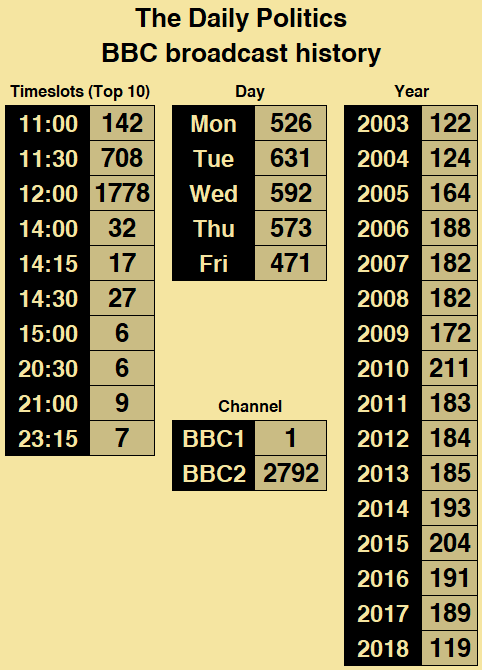
You’ll notice Daily Politics was only ever broadcast once on BBC One. If you’re wondering, that was on 13 July 2016: “Andrew Neil and Jo Coburn present live from Westminster as David Cameron conducts his final Prime Minister’s Questions before handing in his resignation.” Remember him? Seems so long ago, doesn’t it?
That’s that. A pair of programmes a tad less sexy than Top of the Pops (and Pointless), I’ll grant you. But get your hotpants ready for the next thrilling installment. Excitement is on the horizon: guaranteed.
-
The 100 Most-Broadcast BBC Programmes Of All Time (32 and 31)

Ooh, almost within the Top Thirty. And this time around, it includes two examples of Peak Beeb, so that’s nice. Here goes:
32: Pointless
(Shown 2656 times, 2009-2021)

Yes! For the first time in ages, a programme I won’t need to do a lot of research on because I’ve probably watched most of the episodes. Oh, wait, my memory. Okay, I’ll do research as well.
For the uninitiated, the premise of the programme is quite simple. A hundred people have been asked a series of questions beforehand (generally either a standard general knowledge question, or of the ‘can you name a’ variety), and the results of each straw poll logged. During each episode, pairs of contestants are asked those same questions, the goal being to provide correct answers that were given by as few of that hundred as possible – the highest score at the end of each round sees a competing couple eliminated. If a contestant provides an answer that nobody from the hundred had thought of – a pointless answer (hey, like the title of the show!) – during the main part of an episode, £250 is added to the running jackpot. If they do so during the final round, they scoop said jackpot, and it’s reset to £1000.
Simple. Didn’t need do put together a flow-chart or anything. Which isn’t always the case for daytime quiz programmes. Remember Golden Balls? I n case you’re even more uninitiated about Pointless, it’s spent the majority of the last eleven-plus years in BBC One’s prime pre-news weekday 5.15pm slot. And it doesn’t look like shifting from that position any time soon – at the time of writing, the Celebrity spin-off of the series is going out on primetime Saturday night BBC One. It’s hosted by Alexander Armstrong (who, between this, Hey Duggee, Dangermouse and all his other stuff, seemingly features at least once on every BBC channel per day) and originally co-hosted by Richard Osman (a longtime gameshow schemer thrust onto the programme after impressing in a pitch of the show to the BBC), with the show currently co-hosted by a rota of guests while Osman builds his global media empire. Oh, and it was originally going to be called ‘Obviously’, which sounds exactly like a programme title that would run for 20 weeks at 2pm then disappear forever, so it’s probably for the best that it changed.
With Pointless such an integral part of the schedules, it’s strange to think how it was once just another BBC2 quiz programme that aired for a few months, then made way for something else. That first run on weekday afternoon Two ran from 24 August to 6 October 2009, after which it was off our screens until the following March, with that 4:30pm slot going to Ready Steady Cook, Cash in the Celebrity Attic, A Question of Genius and Ben Fogle’s Escape in Time. However, Pointless proved popular enough to see Xander and Richard set up shop on BBC1 in July 2011 – and in the prime pre-news slot just vacated by The Weakest Link. They’ve barely budged since.
It’s not just the host channel that made Pointless such a different beast from what we know now. Despite having the same 45-minute runtime as modern-day Pointless, the format initially found room for a fifth pair of contestants, meaning an entire additional elimination round to cram into each episode. To make room for that, chat between Alexander, Richard and the contestants was stripped back to the barest of essentials, with the whole affair feeling that bit more relentless to the latter-day Pointless enthusiast. The head-to-head round took a decidedly different approach, too. Instead of the now-familiar ‘best of three’, a single open-ended question is asked (such as ‘James Bond films’ or ‘England managers since 1966’), and turns are batted back-and-forth between couples, who must try to keep their accumulative score as low as possible. Once a couple reaches an aggregate score above 100 (at the end of a pass, and the other remains below 100), they’re eliminated.

It’s like a different planet. There are other little differences in the early episodes, too. For one thing, Alexander’s little podium seems a lot more prominent in those initial outings. There are lots of cutaways to the studio audience, which is something we never see nowadays (which at least made it easier to hide where it switched to an audience soundtrack during lockdown). The big screen containing all the answers had a decidedly postmodern ovoid look to it. The list of potential topics for the final round saw unchosen topics roll over to the next episode, though finalists were only given a single criteria on that topic. And – I recognise this might just be me here – the closer shot of contestant’s faces during the countdown sequence feels vaguely intrusive. Plus, at least in early episodes, more minutes are eaten up by Alexander giving illustrative examples of how it all works during his introduction.

Too close. Don’t like it. Other changes to the format would come later. The ‘bonus booster’ round would appear midway through the 23rd series, itself repurposing a previously-retired question format where six possible answers are displayed, leaving contestants to work out which two might be pointless, which two might be correct, and which are completely incorrect. New question formats would appear occasionally throughout the run, such as asking contestants to identify pieces of music, or identify parts of a particular item. A further change to the format was likely influenced by outside events – the 2020 pandemic coinciding with couples now being allowed to appear in three consecutive episodes without winning, rather than the previous two. I can’t help but feel that was partly influenced by the need to have fewer contestants required on set for each day of recording, and while that’s a boon for the show’s contestants, it does dramatically reduce my chances of ever appearing on Pointless. There’s no way I’ve got as many as three personal anecdotes worth broadcasting to the nation.
The BBC1 17:15 weekday slot wasn’t exclusively the domain of Xander and Richard since Pointless arrived on BBC One, however. in July 2018, the Beeb decided to eschew repeats of Pointless and place episodes from the third series of Rick Edwards quizzer Impossible in that slot. That folly lasted until the end of the 2018 summer holiday period, and from the start of September Pointless would return to its rightful place. I’ve checked Hansard and can’t see any record of backbench fury in the Commons about this, but I presume that’s just a filing error in Westminster.
Pointless would also be bumped out of the pre-news slot for a couple of weeks in 2019, where the first few weeks of that year’s Strictly – It Takes Two leapt into the slot, Pointless having been bumped back to a 4.30pm home. Since then, however, the 5.15pm slot has remained Pointless, whether it be repeats or first-run episodes.
One curious thing I’d forgot about Pointless’ move to BBC1: the initial episodes were actually preceded by the first-ever episodes of Pointless Celebrities (which, for the record, had aired 524 times by the end of 2021, and which I’m not including in the broadcast count for regular flavour Pointless). 4 July 2011 saw “episode 1 of 5” of the celeb-based spinoff, with Julia Bradbury and John Craven among the participants. It wasn’t until a week later on 11 July 2011 that the regular Pointless would appear.
There is of course one major mystery about the series. Basically: who are the hundred people they ask all these questions to? Presumably it’s largely the same hundred people each time, rather than some luckless runner being sent out onto the high street with a clipboard the day before filming, but some of the responses do make one wonder how many of them function as a human being. I mean, I can’t bloody stand Private Eye’s ‘Dumb Britain’ column, which mocks members of the public getting general knowledge questions wrong whilst under bright studio lights and on camera, but The Pointless Hundred are presumably in a more relaxed environment. And yet – using an example from a few days ago – when asked ‘[which] anti-apartheid leader and future South African president was jailed for life in the Rivonia Trial[?]’ 67% of them said something other than ‘Nelson Mandela’. I do wish there were some kind of Pointless Patreon people could subscribe to, where you’d be sent a full .csv dataset of responses to each question.

Conversely, I do wonder how often a sole Pointless Hundredee that stops someone winning a final round jackpot by a single point punches the air in celebration. “YESSSS! That’ll teach you to revise all the chemical elements beforehand.” I think part of the appeal of the series is that it really eschews the current trend for throwing large potential payouts at episode winners. Over on ITV, The Chase (which is very good, but must ONLY to be watched when BBC One are showing repeats of Pointless, of course) offers a potential – if tremendously rare – prize purse totalling six figures. With Pointless, the jackpot rarely creeps above £10,000, and only then if competitors in the previous ten episodes had been unable to land a winning answer in the final round. But, it’s not really about the money. It’s about getting that Pointless trophy for winning an episode.
And while I’m comparing the Whizzer of Pointless to the Chips of The Chase, I’ve got to mention the disparity between the two celebrity variants of the programmes. On Pointless Celebrities, the famous contestants are battling amongst themselves to win a pot of cash for their chosen charities. On The Chase: Celebrity Special, the premise of the programme means you’ve got an employee of the programme doing their very best to prevent £20,000 going to a children’s hospice (or whatever). While that is the entire point of the show, it’d quickly get boring if the Chasers clearly weren’t trying, still: ouch.
[UPDATE: With thanks to Guy Barry for pointing this out in the comments, there’s some information on how the “we asked 100” people are chosen on Pointless. Den of Geek has the goods.]

31: Top of the Pops
(Shown 2725 times, 1964-2021)

Another one that was always going to feature, it was just a matter of where. Plus, it’s a programme that may well have the richest history of any programme in this list. And not just because they happened to have Britain’s most notorious sex case hosting the first ever episode in 1964, and then – despite his reputation – asking him back again to co-host the last ever regular episode in 2006.
Anyway, now we’ve addressed the shellsuited elephant in the room, let’s look at Top of the Pops. A programme popular enough to have been broadcast on Christmas Day BBC1 almost every year since the 1960s (well, until 2022), but unpopular enough to have spent at least a decade at the end of its regular life gradually sliding down the dumper.
But, back to happier days for The World’s Longest-Running Weekly Music Show. Everyone (well, everyone over the age of thirty) has ‘their’ own era of TOTP, that period where it all felt a bit more personal to them, where it introduced them to so many songs they’d be straight off to Woolies to buy on Saturday morning. Where the presenters seemed the epitome of cool, and where the most thrilling place on earth to be was amongst the TOTP audience. These people can now be divided by those who still keenly tune into the TOTP repeats on BBC Four each Friday night, and those who’ve long dismissed the repeat run as being ‘past its best’ and who long for the manna of the Edmonds years.

The real cool kids know the Peel/Long years were the best. Of course, anyone who really remembers the early years of ver Pops will be left wanting, as the Beeb famously failed to keep recordings of many episodes, because pop music was clearly A FAD and skiffle is due a comeback any year now. My spec script for a Doctor Who episode where The Doctor travels back to 1964 and strangles the blustery colonel behind that decision has been sent to Russell T Davies and I assume it’s currently in pre-production. As it turned out, the show initially conceived as a short-run series, ultimately ran for way more than 2,000 episodes. Pretty conclusive proof that the pop kids were right all along. Take that, squares.

A square, yesterday. When devising the original programme, Pops creator Johnnie Stewart carved out the long-running commandments that would serve the series so well. RULE ONE: Each episode must end with that week’s number one record, which is the only record permitted to appear two weeks in a row. RULE TWO: Each episode should include that week’s highest new entry, plus (providing it hadn’t featured the previous week) the highest climber. RULE THREE: Any song travelling down the charts will not be played.
For much of ‘Pops lifetime, those rules were to be obeyed. At least most of the time – there were some exceptions, such as a reformed Sex Pistols taking centre stage at the end of an episode in 1996, rather than that week’s number one single. Some of those rules needed to be disregarded later in the run, too: by the mid 1990s, aggressive pricing (CD singles £1.99 or less on the week of release, £3.99 thereafter) and heavy pre-release airplay ensured that most singles’ peak position in the charts would be their debut position. As a result, singles rising up the charts were a true rarity, meaning falling singles would also need to get an airing if they were able to fill a half-hour each week.

From the initial 1964 line-up of hosts (Alan Freeman, Pete Murray, David Jacobs, J**** S******, plus Simon Dee, and Samantha Juste on disc-spinning duty in subsequent years), the host roster was boosted in 1967 following the launch of Radio 1, including familiar names like Tony Blackburn, Kenny Everett and John Peel. The late sixties also saw the first celebrity guest co-hosts, such as Lulu and Alan Price, plus Monkees Micky Dolenz and Davy Jones.
The 1970s saw further new additions to the presenting line-up, including Noel Edmonds (from 1972), Kid Jenson (from 1977), Power Powell (also from 1977) and Dave Ni- I mean Simon Bates (from 1979). Giving my age away a bit here, but the Imperial Phase of TOTP arrived in the 1980s, along with a return to hosting duties for the peerless John “Depech-ay Mode” Peel, along with scouse sidekick Janice Long, Tommy “gravitas-on-legs” Vance, Gary “the mid-80s-on-legs” Davies and Mike “Keep Me Off the BBC4 Repeats” Smith.
During the 1980s, ITV tried to get in on the act with Tyne-Tees’ nationally-networked facsimile The Roxy, which threw everything it could at the screen (such as the first ever TV performance of Pet Shop Boys’ It’s a Sin) the first but TOTP was far too ingrained in the national psyche for it to stand a chance. Any pop-based programming on rival channels needed a different approach to stand a chance, such as C4’s The Chart Show (later ITV, of course) or BBC2’s roaming pop travelogue No Limits.
When it came to the 90s (The Roxy, coincidentally, having been cancelled within about ten minutes of launching), the show decamped to Elstree and saw the production team accidentally leave the Radio 1 hosts behind, so they quickly ushered in a fresh line-up of hosts: Mark Franklin, Tony Dortie, Claudia Simon, Adrian Rose, Steve Anderson and Femi Oke. Viewers weren’t especially impressed by most of the new presenters, and by late 1992 only Dortie and Franklin of the new intake remained. However, this period did see a new wave of Guest Co-Hosts, with Smashie and Nicey, Bob Geldof, Def Leppard’s Joe Elliott and, erm, Mr Blobby getting a go at ‘helping’ Dortie and Franklin. A taste of things to come.
Over at Radio 1, new controller Matthew Bannister was transforming the station, mainly by bringing all his old mates over from GLR, and that meant new R1 faces Lisa I’Anson, Wendy Lloyd, Claire Sturgess and Jo Whiley subsequently got a go at hosting The Pops. BUT, a much bigger change came in 1994 (as BBC Four viewers are set to soon re-live), with The Golden Mic Era – a period where celebrity guest hosts took centre stage, with only the occasional episode hosted by Radio One stalwarts.
That particular era seems to get particularly short shrift from TOTP purists, but I must admit I bloody loved it. Why would anyone in their right mind rather have Simon Bates over Punt & Dennis, Jarvis Cocker, Harry Hill or even a returning John Peel? Even Lee and Herring got to host a couple of episodes, meaning at some point over the next year we’ll all get to see if Stewart Lee does a Mike Smith and blocks the repeat broadcasts of his episodes, probably just to annoy Richard Herring. Unfortunately, there was some absolute cackhandedness when it came to picking a few of the hosts, most obviously Gary Oh For Fuck’s Sake Glitter. But, that aside, it does make for a perfect time capsule of the period: Dennis Pennis, Jas Mann, Julia Carling and Louise Wener. Yep, 1996 in a nutshell. Plus, Hale & Pace hosted an episode in 1995, which I’d like to think was a promotional push for legendary misfire h&p@bbc, but that came years later – h&p were still firmly @itv back then.

Hale (L), Pace (R). No, hang on. Anyone want to see a table of who hosted the most often during that Golden Mic era? Because you know I’m about to drop that information on you.

Ladies and Gentlemen, the mid-1990s. By the year 2000, the idea of the guest presenters had fallen by the post-millennial wayside, and a more rigid roster of hosts took the TOTP reins. The firmest grip on said reins was Richard Blackwood, fresh from Channel Four, along with Jayne Middlemiss, Jamie Theakston and Gail Porter. Theakston would soon become main presenter of the series, but guest hosts would also make occasional appearances alongside the main hosts, including Sophie Ellis-Bextor, Mel B, Ben Elton, Vernon Kay and – oh bloody hell, J**** S******.
At this point, despite the show slipping in the ratings (and being scheduled opposite Coronation Street really didn’t help matters), in 2002 efforts were made to strengthen the brand by launching Saturday morning spin-off Top of the Pops Saturday, a clear attempt to arrest the runaway success of ITV’s hit chart show CD:UK. Even after a rebrand to Top of the Pops: Reloaded, the spin-off failed to find much of a foothold, and it seemed that the only reason it was kept around for four whole years was that nobody could think of anything better.

The main show wasn’t doing much better at this stage. To try and overhaul the programme, former Broom Cupboard resident Andi Peters was given the exec producer gig and tasked with rescuing the show. In came former MTV jock Tim Kash as main host and a more focused approach, but it all counted for little. In November 2004 came the announcement that Pops would be moved to a new slot on BBC Two, and a new night – Sunday nights immediately following the announcement of each week’s Top Forty. While the intent was that it would bring a fresh energy to the show, it would have surely proved a bit awkward for any acts booked to appear who’d just found they’d landed outside the forty that week.
This was clearly TOTP’s death spiral. At the time of Tim Kash’s debut in 2003, viewing figures were at a respectable 5.65m. Within a few weeks of the move to BBC Two, they’d slumped to just 1.5m. New exec producer Mark Cooper gave the guest presenter tactic another airing in 2005. However, a strange mix of guest hosts clearly designed to grab as many eyeballs as possible (Jeremy Clarkson, Richard Hammond, Sharon Osbourne, Peter Kay as Brian Potter) did little to delay the inevitable. And so, 30 July 2006 saw the last ever ‘regular’ episode of TOTP, with a selection of presenters both past and present returning for one last gig. Unhappily, it included – y’know, him. An undignified end to a pop institution.

Not that this was truly the end. Spin-off series TOTP2 would broadcast highlights of previous episodes for several more years, and Top Of The Pops itself would return for annual Christmas episodes each December 25th, along with occasional New Year episodes, with Fearne Cotton on hosting duties for pretty much all of them. However, history appears to be repeating itself, with a festive special of the show missing from BBC One’s Christmas schedule for 2022. Instead, an ‘end-of-year review show’ appeared on BBC Two on Christmas Eve. Is this the end of Ver Pops? I guess we’ll find out in December.
In 2017, a kind-of Pops did return to the BBC One Friday night schedule, perhaps emboldened by the success of music-based programming on BBC Four on that night – the focus of which being week-by-week (Yewtree permitting) Pops repeats – with Sounds Like Friday Night promising to reintroduce live music into the nation’s homes. However, it wasn’t much of a hit, and it disappeared after just two series.
Well, at least we’ve still got the repeats on BBC Four.

I’d expected writing about a pair of programmes I’ve watched hundreds of times to be easy. I was wrong. But which pair of programmes will be next in the rundown? TIME WILL TELL.
-
The 100 Most-Broadcast BBC Programmes Of All Time (34 and 33)

Here comes the next bit. Look out, Britain.
34: Tonight
(Shown 2582 times, 1957-1992)

Heeeeeeeeere’s, um, Cliff Michelmore!
Yeah, so nothing to do with The Tonight Show, but rather billed (repeatedly) in the Radio Times as “a topical programme for all the family”, the initial incarnation of Tonight arrived on the screens of teatime Britain on 18 February 1957. Tonight appeared just a few days after the official abolition of the Toddler’s Truce, a Postmaster General-sanctioned telly-free zone between 6pm and 7pm each night, so that children could be put to bed away from the watchful gaze of the cathode-ray cyclops.
After cries of “we don’t have any children!”, “tellies do have an off-switch, you know” and “we’re only going to spend that time talking about tonight’s telly” from the viewing public (plus “please, our potential revenue” from ITV franchise holders), the Truce was finally done away with on Saturday 16 February 1957. On Saturdays, the spot was filled with the pop-pickin’ Six-Five Special. On Sundays, the blank space remained in the schedules because God. And on Monday to Friday, a brand new current affairs television programme was to air. While the slot would later be associated with cosy old Nationwide, the new programme would go on to be described as something that “helped to shape the national mood in an age of change and growing mistrust of authority”.
It was a commendable commission by the BBC, who’d seemingly been perfectly content with that truce being in place – great, an hour each night that we don’t need to fill with expensive programmes – so to throw a team of experienced producers (such as future BBC1 Controller Donald Baverstock and future DG Alasdair Milne) along with a team of storied reporters such as Alan Whicker, Fyfe Robertson, Kenneth Allsop, Chris Brasher, Julian Pettifer, Brian Redhead and Polly Elwes was a true statement of intent. Plus, placed in the main presenter’s chair, a tyro Michelmore, fresh from two years fronting uncompromising current affairs show Highlight.

In a piece for the Radio Times in December 1957, as Tonight prepared to move from 6:15pm to 6:45pm, producer Donald Baverstock considered some audience feedback on the series, both good and less-good:
“It’s always so topical, isn’t it, so up to the minute.”
Well, not really. Without trained cameramen, and television reporters with fast cars in every world capital, topicality must remain an aim not a claim, Consider two alternatives. This afternoon at 5.0 p.m. a government White Paper on, say, agricultural instruments has been published. Last week there might have been riots in South America. Which would you prefer in the programme tonight-three minutes of someone giving you a précis of the government paper, or an interview with the first man to return to this country after having seen the riots a week ago? The production team faces this kind of choice every day-a wordy but unremarkable reference to an important event, or a human revelation of something already passed over, perhaps, by the newspapers.
We prefer to describe our present aim as relevance rather than topicality. The items we like to see in the programme are on subjects that we can safely assume are already in the viewers’ minds.
This does not mean that they will necessarily be in the headlines of the papers. Health, money, food and great religious issues are always in people’s minds. They are always relevant, but only in a very general sense, topical.“That programme, Tonight, is being controversial again…”
NOBODY on the Tonight programme deliberately sets out to stir people up.’ You won’t see us pacing up and down our offices, pursuing hunches. We never dramatically snap our fingers and say, ‘If we do it this way, it’ll get ’em.’
No staged rows are ever arranged. There’s no point in doing so. Among the large number of people who appear on Tonight, even in the course of a week’s programmes, there are bound to be some who have strong opinions on important subjects. We don’t dissuade them from speaking honestly. Nor do we exhort them to speak with false passion. Perhaps it is this attitude behind the programme which leads people to call it controversial.’
“What we tike about it is that everybody — Cliff Michelmore especially — seems so relaxed.”
RELAXED. yes, but we hope not slovenly. When you appear on television in front of millions of eyes, you would be a fool if you hadn’t prepared yourself first. To do the kind of jobs that Cliff does (and Geoffrey and Derek as well) have to know all the complications so well that coping with them becomes instinctive. In front of those cameras you’ve first got to be competent; only then can you start being confident.
“Tonight, which you can describe as a mosaic of bits and pieces”
How do you define a bore – a person who when asked how he is proceeds to tell you? Night after night our chief problem is to avoid boring you (and incidentally boring ourselves). All the time we have to remember that to you at home. Tonight is a one-way conversation, an endless monologue. Our instinct, therefore, is always to offer too little rather than too much.
“Tonight is based on American models, isn’t it — “the see-it-happen, let’s be-spontaneous-at-all-costs sort of thing”
WE think the programme very British. The Americans, as everybody knows, have been doing regular daily programmes for a long time. But the British viewer, I think, would find them very slow and wordy. The Americans have not aimed, as we have, for compression of ideas, nor for the pace with which a variety of items can follow one another.
I sometimes think ordinary Americans would find the Tonight programme night after night, just a little too fast to comprehend. But so far we’ve had few complaints from Britain.
Radio Times issue 1781, 27 December 1957Proof, were it needed, that even if it found itself needing to fill a programme five nights per week, it was far from flung together. Plus, it’s nice to know the host certainly wasn’t slovenly.
The programme would become such an institution that Michelmore even devised his own snappy sign-off at the end of each episode. “That’s all for tonight, the next ‘Tonight’ will be tomorrow night. Until then… good night!”. Lovely stuff.
The formula was certainly a popular one. The Times’ Radio and TV Supplement was effusive in its praise for the programme, writing in August 1957 that it was “one of the happiest exercises in casual presentation yet to be seen on English television”. The paper wasn’t alone in pouring praise on Tonight – in 1958, the Guild of Television Producers and Directors awarded Michelmore a gong for Personality of the Year and the production team behind the show won the title for Best Factual Presentation.
The programme notably offered a regular outlet for Guyanese actor, musician, writer and poet Cy Grant, who would regularly appear to perform a ‘topical calypso’, likely making Grant the first black person to be featured regularly on British television.

The production team’s dedication in getting the programme to air was tested in April 1961, when an electricians’ strike threatened a broadcast of the show. With no studio lighting on offer, the cast and crew of Tonight made the decision to present that night’s edition from a fire escape at the back of Lime Grove studios, using a combination of evening sunlight and light from the Metropolitan District railway opposite the fire escape. According to the press reports at the time, despite rainy conditions during the broadcast, Cliff Michelmore didn’t even wear a coat. Nails. November 1963 also included an unexpected turn for an edition of Tonight, but in a very different way. It was during the edition airing on Friday 22 November that news broke of the Kennedy assassination, with Michelmore taking on the task of informing BBC viewers about events in Dallas.
Tonight’s popularity even resulted in a weekly ‘highlights’ programme, The World of Tonight (“The world and its events as the Tonight team reported them last week”), which enjoyed a short run on Sunday afternoons between 1964 and 1965. All good things must et cetera, however, and on Friday 18 June 1965, the final edition of Tonight v1.0 would air. That’s despite news of a series refresh coming a month prior to that finale – promising a later slot, more on the-spot reports, plus live satellite link-ups to America and other parts of the world. As it would turn out, that refresh turned out to be a completely different programme – Twenty-Four Hours would launch in October of that year, and run until 1972.

Not the best picture, is it? However, that wasn’t the end of the Tonight brand. It would re-emerge in September 1975, just over ten years after the end of the original version, this time with the hosting triumvirate of Nationwide’s Sue Lawley, Late Night Line-Up’s Denis Tuohy and Newsnight-in-the-future’s Donald MacCormick. This time, the remit was to “listen to the people whose lives are affected and invite your opinions on the events of the moment”, aided by BBC correspondents around the globe, and more locally using the Tonight Outside Broadcast Unit.
As if to cement the update’s Not Like The Old One credentials, the first edition of the programme promised “a correspondence column of the air”, alongside a profile of former-child-star-turned-US-ambassador-to-Ghana Shirley Temple. No, I had no idea, either. Reporters for the series included John Pitman, Richard Kershaw, David Lomax, David Jessel and Michael Delahaye, while Ludovic Kennedy, Robin Day and a young Jeremy Paxman would later appear to man the hosts’ desk.

The revamped version of Tonight proved to be a suitably sturdy format for BBC-1, running for a total of 756 editions between 1975 and 1979, and (unlike OG Tonight) at least received a special send-off billing in the Radio Times, with “Tonight: Goodnight Tonight” airing on 5 July.
However, that wasn’t the last we’d see of Tonight on the BBC. 24 July 1979 – yes, just a few weeks after the purportedly final episode – saw a one-off special hosted by Valerie Singleton for a studio panel discussion on the preceding programme, Rachel Billington’s Play For Today film Don’t Be Silly, which offered an uncompromising portrayal of domestic violence.
February 1982 saw a one-off special to mark 25 years since the original incarnation of Tonight, with Cliff Michelmore returning to help “illustrate what the programme stood for, how it worked and what it led to, with the help of those who worked on it”.
Finally, in 1992, BBC Two’s Black and White in Colour season included a screening of a 1963 edition of Tonight. West Indians, directed by Jack Gold, examined the troubles facing working-class Afro-Caribbeans in Britain at that time, and came with commentary from Barbadian poet and writer George Lamming.

33: Ready Steady Cook
(Shown 2633 times, 1994-2021)

There have been quite a lot of cooking shows on the BBC. In fact, since the Television Service launched in 1936, a total of 5,970 programmes have been broadcast on the Beeb with the word ‘cook’ somewhere in the title. Some of them have introduced new styles of cooking to the nation, such as the very earliest examples Cook’s Night Out (1937) and Foundations of Cookery (1939), both presented by French chef, restaurateur and author Marcel Boulestin. Others have taken a no-nonsense approach to making more from less, like Cookery (1947) introduced as rationing reduced the amount of ingredients on offer and demanding a much less glamorous title. A few others just happen to have the word ‘cook’ in the title, like a documentary on Alistair Cooke – Postcards from America (2003) and thrillingly-titled flick Robin Cook’s Formula for Death (1998), so you can bet I’m not even going to mention those. Bugger.
Out of all the cookery shows ever aired on the Corporation, nothing has aired as frequently as the next item on the menu, taking up 44.1% of all programmes ever aired on the BBC that have the word ‘cook’ in the title. Now, there’s a stat. Ready Steady Cook (sometimes billed with commas, sometimes not) was indicative of the Great Celebrity Chef Surplus of the mid-1990s. By October 1994, the problem had become so grave, the government had to pick one of two options. Option one: a daily cookery show that would see a pair of celebrity chefs compete in a cook-off, cramming double the amount into each episode, and providing the nourishing exposure they so dearly require. Option two: the Ministry of Agriculture, Fisheries and Celebrity Chefs would have to announce a mass cull.
Luckily, John Major chose envelope ‘A’.
The show was based on a cooking competition format, where two professional chefs competed against each other to create the most delicious meals that a £5 ingredient budget could allow. An additional twist was that the ingredients for each dish were chosen by the studio audience, who brought in a selection of items from their own kitchens. Oh, for a time when Britain didn’t need so many food banks, eh?
From 1994 to 2000, Fern Britton hosted the series, before she scarpered off to ITV to seize the controls of This Morning. From 2000, the most well-known of the participating chefs (also actor, half of comedy double act The Calypso Twins and unlikely ‘pop star’ with same) Ainsley Harriott took over hosting duties. Having been the resident chef on the BBC One’s failed-but-lasted-longer-than-you-think This Morning knock-off Good Morning with Anne and Nick, Harriott was certainly no stranger to television, and indeed, before getting the main Can’t Cook gig, he’d hosted a one-off special episode of the series to mark the tenth anniversary of Red Dwarf in 1998. Which came with the depressingly inevitable title Can’t Smeg, Won’t Smeg.

The Wikipedia page for Harriott claims this was a hit single. The Official Charts company website claims otherwise. Under Harriott’s stewardship, the original series would continue to be produced until 2010, though such was the programme’s popularity repeats of existing episodes would continue until 2014.

You can’t keep a good format down (or a food format, for that matter), and as such the series made a return to Britain’s screens in March 2020, this time with Rylan Clark-Neal at the helm. The programme reboot had actually been announced the previous September, but happening to air during a period when the British public suddenly had to stop going out for chef-crafted meals, the option of being able to prepare them at home suddenly became that bit more tempting. Assuming, of course, viewers could get an online shopping delivery slot to avoid the queues at your local Tesco. And not fall foul of the Replacement Item Curse.
It was a very weird time, wasn’t it?
The rebooted series went out in a late afternoon BBC One slot throughout March 2020, with early morning repeats airing on BBC2. The programme was deemed enough of a success to return to the BBC the following March, this time running until mid-April. But, that was to be it for the format, with the September 2021 announcement that the second series of the Rylan-era was to be the last. Though I suspect not too many will fall off their chair with shock were a further reboot to be announced.


That’s all for this edition, see you next time for an edition that DEFINITELY won’t need to be hastily edited a few days later. At least that picture of Kilroy-Silk has gone. For now.
-
BBC100: The 100 Most-Broadcast BBC Programmes Of All Time (36&35)

After a sport and an incredibly popular kids TV programme last time, how about something different? This time we’ve got… oh.
36: Golf
(Shown 2487 times, 1938-2021)

The first piece of actual golf-related TV programming that I can find came in March 1937, with Golfers in Action. A mid-point between a demonstration and an interview, where Bernard Darwin embarked on a series of broadcasts where he would put(t) questions to professional golfers of the day. That chat would be accompanied with a demonstration by each golfer on “the miniature golf links in Alexandra Park”.

Given the programme title, that’s not something I’m going to count here – it’s more of a golf discussion programme, to be fair. The earliest qualifying content I’ve been able to find came on 12 November 1938, with the no-nonsense programme title ‘GOLF‘. This would be a practical demonstration of the sport, carried out by Ernest Bradbeer (“professional to the Calcot Golf Club”) rather than any live tournament coverage, because the prospect of someone lugging huge BBC-tv cameras around an entire golf course wouldn’t have been popular with groundskeepers.
With that very limitation in mind, demonstrations of the sport were the way to go for the next few months, until 1 June 1939. The main focus of that day’s golfing programme was another demonstration (this time by Archie Compston, Bradbeer presumably being lost in the rough somewhere) but this time the tutoring was accompanied by “part of the match between Reg Whitcombe and Bobby Locke”. A grand breakthrough, indeed.
A new era of sporting coverage that was, as we just saw with the history of Wimbledon, disrupted entirely by the war.
It took until 1946 for golfing coverage to return to BBC-tv (along with TV in general, of course), but there was very little in the way of true matchplay action. For the most part, cameras wouldn’t travel any further than the Alexandra Park Golf Course for a series of demonstrations. Archie Compston was still on hand to lead post-war Britain back onto the fairway, before handing tutorship duties to fellow pro Bill Cox.
1948 was a year completely devoid of golfing action on the Television Service, but in 1949 it looked like it might be coming back in a Big Way. BBC-tv teed up a chunk of a Saturday afternoon in January to the sport, with a one-off strand of Saturday Afternoon Golf, combining demonstrations with play at the 15th, 16th and 17th holes of the High Course, Ricksmanworth. Was golfing coverage about to spread across the schedules?

It most certainly was not. Between the remainder of 1949 and the whole of 1950, the closest golfing fans would get was a screening of ten-minute short film Rough But Hopeful starring Bing Crosby, Bob Hope, Red Skelton, Randolph Scott and ‘other Hollywood stars’ as they swipe their way around a golf course in California. It took until June 1951 for any homegrown footage of the sport the reappear under the BBC banner, with a demonstration on how to improve your short game airing as part of Television Sports Magazine.
That state of affairs lasted until June 1952, when the BBC broadcast full tournament coverage for the first time, with action from the awkwardly but accurately named Daks Two Thousand Pounds Tournament at Wentworth. This even warranted a mini-feature in that week’s Radio Times Talk of the Week pages:
Golf from Wentworth
Talk of the Week, Radio Times Issue 1493, 22 Jun – 28 Jun 1952
On Thursday and Friday — and for the first time —television cameras will cover some of the play in the £2,000 golf tournament at Wentworth, an event which attracts a distinguished list of entries. The players taking part in this stroke play competition organised by the Professional Golfers’ Association include John Panton (last year’s winner), Henry Cotton, Frank Stranahan, Dai Rees, and Bobby Locke.
The qualifying rounds will be played on two Wentworth courses, and television cameras will cover the second hole of the West Course, known as the Burma Road because of its great length and jungle-like appearance. On Thursday viewers will able to see a special competition arranged for television in which many leading professional golfers will take part.Big time. This was the third edition of the tournament, where winner Fred Daly was awarded £400 (from a total prize fund of £2000), and was all over the schedules on 26 and 27 June 1952. Admittedly, two half-hour visits to Wentworth on the 26th and a further thirty minutes the following day (and subsequent five-minute update at 6pm “to hear the result of the tournament”) isn’t much, but it was a hell of a lot more than had been seen in previous years. Yet, the coverage only showed action on the second hole of one of the courses – a bit like only showing the second minute of a football match – but at least it showed the there was room for BBC cameras on a golf course during a major tournament.

BBC cameras returned to Wentworth in September 1953, this time for first ever television screening of the Ryder Cup, and coverage was expanded even further. Well, guests were coming over, it was only polite. Monday 28 September saw a special preview programme where “Henry Longhurst introduces members of both teams and discusses with Major Peter Roscow the organisation of this week’s golf match at Wentworth”. That was followed by 30 minutes of live coverage on the opening day of the tournament on Friday 2 October, with a whopping 90 minutes of live coverage on the second and final day.

This time, the BBC aimed for coverage from five of the eight matches taking place in the morning, and from six of the eight from afternoon play. As it turned out, that may have been too lofty an ambition – mist caused a delay of eighty minutes on the morning of day two, likely scuppering the BBC’s live coverage. Oh, and the USA won, because they always did until Britain gave in and asked the rest of Europe to help.
1954 didn’t see a single slice of golf airing on the BBC, but it was back in a big way for 1955. Friday 20 May saw BBC cameras trundle up to a Scottish golf course for the first time, as coverage began of the amateur Walker Cup at St Andrews – another Anglo-American match-up – with the subsequent schedule dominated by golfing action. On the opening day alone, live coverage of the tournament’s foursome matches ran from 10am-1pm, 3.30-5pm, as part of the Children’s Television strand(!) running from 5-5.55pm, then from 5.55-6.15pm. That was followed by highlights of the day’s play at 10.15pm.

With that much time to fill, you’d better hope there’s more than a solitary camera pointing at the second hole. Luckily, BBC engineers’ newfound confidence when it came to covering golf really paid off. Only four cameras were in play, but crucially two of them were mounted on a specially-constructed sixty-foot tower inside the course’s famous ‘Loop’, from which at least eight holes could be caught on camera. In order to power the cameras, 1.5 miles of GPO-supplied cable was permanently put in place, to allow for coverage of future events. To cap it all off, generators were installed to power the lot, having been specially engineered to avoid distracting the golfers.
From that point on, golf would become a major part of the BBC’s sporting portfolio, coverage that continued to expand as technology’s perpetual progress provided smaller and more mobile cameras. Even the figures below don’t tell the full story of how large a part golf played in BBC Sport’s output, with much of the coverage folded into Grandstand, Sportsview other multi-event envelopes. On top of that, midweek coverage was routinely combined with that of other similarly all-day events, such as cricket, snooker, horse racing or tennis. If we were counting those, you can add a further 274 broadcasts to the total.

Further to that, there was a wealth of golf-adjacent programming. The most famous of these is probably Pro-Celebrity Golf (1975-1989, 141 episodes), famously responsible for the brilliant sporting fact that the longest televised putt in British golfing history was by Terry Wogan, but there were other curios like Challenge Golf (1965-66, 26 episodes). This was a filmed series in which Arnold Palmer and Gary Player were challenged by pairs drawn from “the elite of America’s professional tournament circuit”. That led to spin-off show Big Three Golf (1967, 4 episodes), which followed four matches between Arnold Palmer, Jack Nicklaus and Gary Player, where a $25,000 purse was up for grabs. 1975 saw a British adaptation of Challenge Golf, which saw Tony Jacklin take on Peter Oosterhuis in three matches, at three different courses, to try and land the Formica Trophy and £6000. I’m not counting any of those in the overall figure, by the way.
Even in modern times, a point in TV history where all the big sporting events are snaffled up by subscription sport channels, golf still retains a major sporting presence on the Beeb, albeit often just the highlights of tournaments broadcast live elsewhere.

35: You and Me
(Shown 2554 times, 1974-1995)

Sesame Street. A series that practically everyone in the UK has heard of, despite it not being shown on British broadcast TV in the last twenty-plus years*. Indeed, it’s a bit of a televisual anomaly. What with the programme geared heavily toward teaching American-English, lots of bespoke versions of the series have cropped up around the world, but there was never a version of Sesame Street made for (mainland) British audiences. We have our own educational programmes, thank you very much.
(*Except, that’s not quite true. Northern Ireland had its own version – Sesame Tree – in 2008, which aired on BBC Two NI and nationally on CBeebies, running for a considerable forty episodes. On top of that, a Sesame Street film (Sesame Street Presents Follow That Bird, featuring turns by Sandra Bernhard, John Candy, Chevy Chase and Waylon Jennings, aired twice on BBC One, in Jan 1989 and April 1992. Also, lockdown mini-episode ‘Elmo’s Playdate‘ aired on CBeebies and BBC One in May 2020. So, it’s basically never been off the telly. But ignore all that and roll with the narrative I’m trying to present here.)
But Sesame Street was huge here before 2001, right? Well, Sesame Street’s road to UK audiences was actually (but fittingly, because Britain) beset by potholes. The BBC passed on showing the programme, due to its focus on American-English, eschewing the option of having each instance of “Zee” overdubbed with a stern “Zed”. ITV’s interest in the series involved an unusual amount of due diligence, the network first commissioning “A Report from the Independent Television Authority in Association with the National Council for Educational Technology, London Weekend Television, HTV, and Grampian Television” called Reactions to Sesame Street in Britain**. The end result of which was basically: British educators hated it, but test audiences of children and parents loved it. And as a result, it was shown in various ITV regions throughout the 1970s and 1980s.
(**Sadly, the report isn’t online anywhere that I can find, despite a few online academic papers citing it as a reference. However, you can request a physical copy of the report from the National Library of Australia, if you’re a member of that. And are in Australia.)
The BBC preferred to open up its own route to teaching Sesame Street’s target audience, with a concerted Corporation attempt at producing a very similar series. Inspired by research taken by the Children’s Television Workshop to devise Sesame Street, it used academic research papers to determine how best to serve a target audience of British four- and five-year-olds. The programme that resulted from all this research was (yes, I’m about to finally arrive at the point) You and Me.
At this point, it really does become quite clear how hauntology is a distinctly British thing. For example, here’s a reminder of the line-up for Sesame Street in the mid 1970s:

All fine, friendly and cute. Meanwhile, here’s one of the hosting duos for You and Me. Presenting Vicki and Duncan the Dragon.

Duncan the Dragon (left), Vicki (right). Maybe Original Bungle wasn’t so uniquely terrifying after all. If you’re jigging on the pin-tip of the cultural zeitgeist like I am, the above image may remind you of the ‘QTV’ videos put out on YouTube under the same of Quentin Smirhes. If you’re not aware, it’s basically an unsettling fictional television channel located somewhere on the dial between ‘unsettling fever dream’ and ‘the year 1974’, and where you’ll find stuff like this:


It’s brilliant, and considering the “Don’t You Start” spoof educational programme in one video, includes a nicely observed pastiche of BBC Schools educational output of the time, especially You and Me. Not that it’s a parody many people would pick up on, I suspect. At least, the only reason I made the connection is finding the following snippet from a You and Me offcuts compilation on YouTube, which includes a seconds-long clip of one-time framing device for the series Herbert The Handyman, along with puppet robot Mr Bits and Pieces.

But what actually was You and Me? The Wikipedia entry for the series is useful, but hardly packed with information. A lot of people reading this will likely associate the series with puppet characters Cosmo and Dibs, by far the most fondly-remembered characters from the programme, but preceding them were (going by Wiki) the aforementioned Herbert The Handyman (played by Tony Hughes), slightly unsettling stop-motion animal duo Crow and Alice (both voiced by Nigel Lambert, who’d later go on to narrate the first series of Look Around You), and (as pictured above) Vicki and Duncan the Dragon.

Later episodes saw the return of Duncan The Dragon alongside new human companion Sam. I’d wager that making him smaller is an attempt to make him less threatening to the audience of under-sixes, but just look at him. There’s no way of shaking the suspicion that the second the camera stops rolling, he’ll be flapping this way out of the window to try and eat a Smurf.

That information aside – and given the clips I’ve been able to find, the above all seem to be from between 1979 and 1983 – it’s not as easy to find any details on the contents of the programme before then. Not without looking into the BBC Handbook 1974, that is.
From there, we can see that the remit of the programme was as follows:
In response to an increasing recognition of the importance of the early years in a child’s education, the BBC has begun to provide school programmes for the four and five year olds. In television, the series You and Me is designed for children in reception and nursery classes but it is also suitable for viewing at home or in playgroups and it is hoped that it will act as a bridge between home and school. The programmes aim especially – though not only – to help in the development of language skills, and a picture book, with a simple text, has been published to accompany the series. Playtime on radio is planned to meet a need expressed by a great many teachers with reception classes, nursery classes and playgroups, for an active programme of music, movement, rhymes, stories and poetry. It sets out to en- rich the vocabulary and imagination of the 4-5 year old children, to further their physical and emotional development and to help them adjust to the communal life in the classroom.
The off-their-time hosting segments linking constituent parts of the programme aside, it’s easy to see how You and Me did help to paint a picture of the wider world for a target audience stuck in a 1970s living room. Filmed footage of families going off and doing things (often kids off doing something outdoorsy with Dad, or indoorsy with Mum, because it’s the olden times), often in a way that helps illustrate the meanings of key words befitting the theme of each episode, coupled with recitals of nursery rhymes and fairy tales. And, like in Sesame Street, there would often be animated sequences to further illustrate key points. Even if the animation budget wasn’t quite at the same standard as the Children’s Television Workshop.

Indeed, modest BBC budgets were never going to make You and Me a true peer of Sesame Street. For one thing, Sesame Street usually had a whole hour for each episode, and while segments would routinely be re-used, I don’t recall ever complaining about seeing the pinball cartoon about numbers for the thousandth time, because it was a treat. You and Me tended to have a running time of around twelve minutes, but it made up for that discrepancy by offering British kids something Sesame Street never could – a relatable world the recognised and felt comforted by. A world where Lyon’s Maid lollies cost 5p, where School signs adorned pavements not sidewalks, and where nobody would spell ‘colour’ without a ‘u’.

However, in 1983 the gap between You and Me and its illustrious American counterpart closed considerably. The programme was retooled to bring it into the 1980s, and alongside a new version of the theme tune by UB40(!!) came two new lead puppet characters: Cosmo and Dibs. Much friendlier than the likes of Duncan, the pair were created by Lucasfilm and Jim Henson collaborator Timothy Rose, whose career ranged from Admiral Ackbar to Howard the Duck. The new presenters were an instant hit with children, or at least the ones I grew up with. While earlier episodes were still being shown, there was a very distinct feel to the programme following the introduction of Cosmo and Dibs, throwing the earlier episodes with Duncan into pretty sharp relief.
Now, alongside teaching children about words and real-world experiences, there seemed to be more emphasis placed on emotional knowledge. The lead puppets were certainly much friendlier, but the focus of the show wasn’t afraid to handle topics that earlier series of the show may well have shied away from. Topics such as bullying, conflict resolution, sharing, unhappiness or simply just being silly would be covered by the twosome, along with a wider range of human helpers.

Cosmo and Dibs, along with Bill Owen, Jeni Barnett, Gary Wilmot and Indira Joshi Perhaps the most notable of these is the (now infamous) ‘Harry’s Cousin’ episode from 1987. One of five special episodes on the theme of Keeping Safe, this episode saw presenter Harry spot Cosmo telling his address to a stranger. This resulted in a firm warning that while it’s nice to be nice, people aren’t always kind, while reassuring Cosmo that saying no if you don’t feel safe is a perfectly good response. And while you can’t shake the feeling that some may now view that episode with a detached post-Brass Eye Special LOL NONCES smirk, who knows how many kids were helped by that very approach. Far from well-meaning but occasionally hectoring public information films of the era, Cosmo had become someone the audience could truly identify with, and had become someone they learned alongside, rather than learned from.
The range of education offered by You and Me was so comprehensive it now takes several different series to cover the same ground. Alphablocks, Numberblocks and (now) Colourblocks are doing precisely the kind of thing earlier episodes of You and Me would do, Bing helps younger kids come to terms with expressing and acting upon their feelings, while Hey Duggee helps kids find ways to express themselves creatively. In short, it’s a bit like how Radio One needed to hire five DJs focused on new music to replace the late John Peel.
Or, if you prefer, it simply had Lots and Lots For You To See.

UPDATE 21:18 29 JAN: Thanks to Twitter’s UKPRES1 for posting some parts of that “Reactions to Sesame Street in Britain, 1971” mentioned up above. And so, here you go:


[Original Twitter reply here] On top of that, The Guardian also reported on the, erm, report:


[Original Twitter reply here] Thanks again to UKPRES1!
That’s it for now. Next update soon, where there’s actually be a pair of programmes that are neither sport nor children’s TV. I know, wow.
-
BBC100: The 100 Most-Broadcast BBC Programmes Of All Time (38 and 37)

Current status of More Frequent Updates: okay, a bit of a delay while I had to type in a load of listings by hand. But all worth waiting for, especially if you’ve a 1930s tennis coverage-shaped knowledge gap in your brain.
38: Wimbledon
(Shown 2304 times, 1937-2021)

Okay, bit of an arguable one here. If other single-sport coverage is lumped together, shouldn’t this be lumped in with ‘Tennis’? Well, no. It’s all about the programme title, and this particular tennis tournament is billed as Wimbledon. For the record, standalone Tennis coverage places 117th in the list, with a total of 744 broadcasts on BBCs One and Two.
Now, as far as Genome goes, BBC Television coverage of Wimbledon began in 1939. Which to me, felt a bit ‘late’. And indeed, there are a number of weeks of Radio Times missing from Genome for those very early years – including the fortnights of Wimbledon from 1937 and 1938.
Now, of all sporting events, Wimbledon would be an obvious target for the early Television Service. Even one static camera would have done the job, really. Plonk it in place on Centre Court, and capture what’s happening in front of it. Not even a lot of travelling involved. Plus, as mentioned in 1938’s BBC Yearbook, 1937 saw “a new field […] opened up with the purchase by the BBC of a mobile television unit, constructed by the Marconi- E.M.I. Television Company Ltd., which made television possible from practically any point within 20 miles or so of the transmitting station.” Only 20 miles? Well, given the size of London, maybe live coverage from Wimbledon wouldn’t be possib-

Ooh, okay. (Yes, radio signals generally don’t use the A406, but it’s a nice coincidence. So shush, you’re ruining my thing)
But, sadly, with those key issues of the Radio Times missing from Genome, there’s no way of confirming any early airdates.
…Is what a loser would say. To the press archives!
Okay, back in the inter-war years, neither TV listings nor newspapers were what they are now, but here’s a page of The Times from Friday 25 June 1937:

The incredibly eagle-eyed may have spotted something of interest right in the bottom-left corner of the page. And that’s the first ever TV coverage of Wimbledon.

Curiously then, there wasn’t any standalone programme covering the action, but rather viewers would be whisked from any planned programming between 3pm and 4pm in those first few days to enjoy “short relays” from the All-England Lawn Tennis Club Championship Meeting. Even this limited coverage (seemingly) came on the fourth day of that year’s championships, but that was to soon change.
On Friday 2 July, TV listings included the first standalone programme consisting of coverage from Wimbledon:

However, the first televised coverage most likely came about on the first day of the tournament. A report on the history of televised Wimbledon coverage on the Wimbledon website refers to a match between Bunny Austin and George Lyttleton Rogers being the first to be televised, with coverage running to 25 minutes in total. That match certainly took place on the first day of that year’s Wimbledon – Monday 21 June 1937 (as confirmed with a glance at the following morning’s newspapers). And yet, it certainly wasn’t billed in the television listings for that day.

There’s certainly little doubt that the Wimbledon.com report is correct – it adds additional details on the event, and most telling of all, the Lost Media Wiki hosts an off-screen photograph of that very match between Austin and Rogers.

However, as mentioned, the published television listings for that day don’t make any mention of tennis coverage. Here are a couple more listings from that same day.

Nary a mention in the Daily Mail, nor 
…if you can make out any of the detail, The Daily Telegraph on that day. So, what does this mean? Well, while the full issue of the Radio Times from that week is missing from Genome, there is a helpful snippet on the superb History of the BBC subsite. It seems that BBC engineers were still a little wary of how their sporting experiment would fare, and as such their inaugural Wimbledon coverage wasn’t fully featured in the Radio Times. However, there was a little info-box informing viewers of the potential for coverage.

And, as it turned out, the experiment paid off. There’s no great mention of the coverage in the subsequent BBC Handbook, but the image hosted on Lost Media Wiki confirms it was at the very least a partial success.
It’s a bit of a shame that such a landmark didn’t warrant a mention in the Television Service listings for the day. After all, how would viewers have known to tune in for it? The closest viewers of the day without that week’s Radio Times would have had to an EPG was asking their butler to phone Ally Pally to ask for details then scribble down the name of the next programme on a piece of card.
[EDIT: Dr Steve Arnold of the splendid Radio Times Archive has posted a comment below this article with additional information about that very H.W. Austin v G.L. Rodgers match, plus the Radio Times’ treatment of television in general at the time. A very worthwhile detour, I’m sure you’ll find.]
As it was, as far as billed standalone Wimbledon coverage goes, I’m taking 2 July 1937 as the inaugural Wimbledon broadcast. Live coverage was also offered, in the same 2.30pm slot, on the following day, meaning (most likely) viewers were able to enjoy action from both the Women’s and Men’s finals.
For 1938 – again, with coverage falling into a Genome gap, but another one filled by looking at newspaper listings of the time – the television coverage was a little more generous, with action totalling at around two full hours per day – even if it was rationed to a few days at the start and the final three days of the tournament.

For 1939, we’re able to go back to Genome data, which makes it easier to spot the occasional Wimbledon-adjacent curio. Tennis itself had been broadcast on the nascent Television Service from February 1937, albeit the table-based variant of the sport (“An Exhibition Re-Play of the Finals of the English Open Championship (Men’s) as played at the Empire Pool and Sports Arena, Wembley”). Table tennis would receive a few more airings on BBC-tv before appearances of its outdoor cousin became commonplace, but this was hardly the wall-to-wall coverage the Corporation would later become known for. Aside from Wimbledon matches (along with occasional Davis Cup footage from… Wimbledon) tennis fans only had a few other chances to enjoy hot man on court action (and, as far as billed matches go, it seems to have been a Men Only affair). For example, 12 April 1939 saw a single fifteen-minute “Tennis Demonstration” by W. T. Tilden.
To be fair, that wasn’t the worst introduction to the sport for the casual viewer. American “Big Bill” Tilden had been the world’s number one amateur tennis player between 1920 and 1925, and went on to become the top-ranked professional between 1931 and 1933. By the time of that particular demonstration, Big Bill’s star might be been shining a little less brightly, but by then he did have three Wimbledon championships under his belt, putting him joint-tenth in the current all-time list of men’s Wimbledon champions. Not too shabby.

Elsewhere (and away from SW19), tennis offerings appeared such as ‘Indoor Professional Lawn Tennis’ televised direct from the Empire Pool, Wembley, beaming footage of the singles and doubles matches between W. T. Tilden, Ellsworth Vines, Donald Budge and Hans Nusslein.
With 1939’s Wimbledon looming the Corporation prepared to ramp up coverage even further. Not that there wasn’t time for at least one more Tennis Demonstration for the channel, with the schedule for Saturday 3 June promising a demonstration from none other than ‘Dan Maskell, Head Professional to the All-England Lawn Tennis Club, Wimbledon, and coach to the British Davis Cup team’, who would later go on to become the BBC’s very own Voice of Wimbledon.
And so, on 1 July 1939, the main event hit the screens of Britain’s (well, Greater London’s) televiewers, for the last time before concentrations drifted toward mainland Europe. But before that opening match, coverage of, actual tennis was preceded by a tantalising taster to whet the appetite.

Yep: Percy Ponsonby Goes to Wimbledon. A comedy short featuring Charles Heslop’s talkative barber character, written by Reginald Arkell, who’d seemed primed to be television’s first comedy star. The Radio Times promoted the third of his comedy shorts In The Barber’s Chair with the following:
Sound radio has produced any number of ‘characters’, people like Mrs. Feather and Mr. Walker, but until the arrival of Charles Heslop as Percy Ponsonby television could make no claims at all. Percy has been well worth waiting for, however, and it is hoped that he will be in his shop with his lather and brush at regular intervals.
Radio Times, Page 14, Issue 809, 2nd Apr 1939 – 8th Apr 1939It’s that level of popularity that led to a special episode of Percy going into the first round of Wimbledon 1939, itself a sequel to another topical outing for Ponsonby: June 1939’s Percy Ponsonby Goes to the Test Match, which aired just after live coverage of England vs The West Indies, proving the character had a life outside of his barber’s shop. That was followed by a couple of other themed episodes, Percy Ponsonby Packs for Bank Holiday airing in time for the August Bank Holiday, and Percy Ponsonby Catches the 9.15 airing in August 1939.
Sadly, for fans of the character, a few weeks after Percy Ponsonby caught the 9.15, the Television Service was suspended due to the outbreak of war. When television returned in 1946, Ponsonby didn’t. Not that that was the end of the road for the man behind the character – Charles Heslop would continue to appear on television – plus in a variety of film roles – until shortly before his death in 1966, including featuring in Marty Feldman-scripted Comedy Playhouse ‘Nicked at the Bottle’ and Norman Wisdom flick ‘Follow a Star’.

Here he is in 1943’s The Peterville Diamond. Sadly, I’m unable to find any footage – or even a photo – of Percy Ponsonby. I’m guessing and hoping the character was very similar to Arthur Lucan’s Old Mother Riley. This, I’ll admit, is a bit of a distraction from talking about Wimbledon. But after having a nose at the Wikipedia entry for the character, and seeing it close with the faintest of praise on the entire internet, I felt compelled to keep Percy’s spirit alive a little bit more.

Despite that last sentence having been in place for the last three years, after I tweeted a screenshot of the above it was removed (by persons unknown) within hours. I’ve never felt so powerful. Anyway, where were we? Oh yeah, Wimbledon 1939. After those first couple of years, there was vastly increased coverage for the tournament. Pretty much as much coverage as the BBC Television Service could reasonably muster, in fact, promising that the action “will be televised from the Centre Court every day except Sunday”, the Sabbath still being a no-go area as far as the television was concerned at the time.

Even better, an upgrade from the previous two-camera system, with “a new camera position giving an end-on view of the court, instead of the oblique one you can see above, should give even better results than last year.”
And as such, with a camera position still used today, and live coverage (almost) each day, the modern era of Wimbledon TV coverage had truly started.
Just a blasted shame about that whole war thing, really.
As time went on, Wimbledon would be the launchpad for more British TV landmarks. It was one of a select few programmes welcoming (non-test) colour television in the UK in July 1967, which changed the landscape of television forever.

Wimbledon was also chosen to debut the BBC’s first foray into 3D broadcasting in 2011. This changed the landscape of television for about eight months, but well done for trying.


NOTE: You may notice the massive shortage of Wimbledon coverage from 1948 and 1949. That’s because the BBC’s limited outside broadcast capabilities couldn’t cover the Test Match from Lord’s and Wimbledon at the same time, so a compromise had to be found:

Plus, part of the coverage (presumably with tennis highlights captured on film) was billed as “Cricket and Tennis”, which DOES NOT COUNT HERE.
37: Tweenies
(Shown 2433 times, 1999-2012)

The first truly big show for the then-new CBeebies channel, and as proven by the position on this list, also enjoyed a mammoth run on the legacy BBC channels. Now most frequently remembered for, um…

Well, that. At the time though, Will Brenton and Iain Lauchlan’s creation was astonishingly popular with the pre-school audience (if less so with their parents).
Even thirteen years after first airing, it remained popular enough to become the thirdmost CBeebies popular programme on a given week. As was the style at the time, it grew an audience away from CBeebies — it originally started on BBC1 and BBC2 in 1999 — but repeats of the shows 390 (crikey) episodes were essential for the fledgling digital channel, and the original digital TV generation of young viewers lapped it up.
The popularity of the show even troubled the pop charts — five spin-off singles reached the UK Top 20 between 2000 and 2002 — leading to inevitable appearances on Top Of The Pops. Look out for those on BBC Four in about 2027. In fact, there was an entire mini-multimedia empire based around Bella, Milo, Fizz and Jake.
You had several CD-ROM titles (look, it was the dawn of a new millennium),

Way too many VHS tapes:

And even a PlayStation game:

Which didn’t exactly push Sony’s hardware as much as Wip3out or Gran Turismo, let’s say.

For kids with an incredibly high headache threshold, there was even a set of (unofficial) Windows 98 themes

If you’re reading this via the BrokenTV mailing list and can see the above image in full colour, I can only apologise. The programme event warranted a number of spin-off series on the BBC. Tweenies Christmas Countdown was a daily advent calendar airing throughout December 2001, each short episode presenting a daily treat all the way up to the big day. 2002’s Tweenies Songtime ran alongside regular episodes of the series, and saw the loveable characters [citation needed] perform a traditional children’s ditty (think legacy agriculturalist Old McDonald) in front of an animated background for a few minutes. 2003 saw Tweenies Count to Christmas, which was the same as Christmas Countdown but with a different name. Finally, 2005’s Be Safe with the Tweenies saw Bella, Milo, Fizz and Jake offer friendly advice to dangers inside and outside the home, such as matches, roads and canals.
I mean, all credit for that last one, and hopefully it did help save lots of tots from disaster, but an entire generation missed out on being shit-scared by grainy film PIFs, and that’s a shame.

Ah, that’s better. Attempting to watch an entire episode of Tweenies for the first time (I became a parent in 2015, by which time the show had fallen out of the CBeebies schedules), I can probably sum it up with the following phrase: bloody hell, Hey Duggee really needed to happen.

There we go, another installment safely filed. Next up on the list… another sport that has been airing continuously since at least 1938, and another long-running kids TV series.
I might just change my name to Phil Connors.
-
Subscribe
Subscribed
Have a WordPress.com account? Log in now.

