
What? Eh? Weren’t we done with this?
Okay, the blog has been quieter than planned of late, and that’s because I’ve been stupidly doubling the number of entries in the book version of (now) The 200 Most-Broadcast BBC Programmes Ever (which also throws in full broadcast histories for BBCs Three, Four, Choice and Knowledge because why not?). And, who’d have thunk, writing another hundred programme entries while trying to find something interesting to say about each one isn’t quick. You try and dig up a bunch of hidden knowledge about The O-Zone, I dare you. Despite that, it’s currently at 344 pages. Several of which aren’t about The O-Zone.
So, what’s going on here then? Well, on writing one such entry, I couldn’t help but notice we’re right on the 55th anniversary of the first time it was ever broadcast on the BBC. And as it’s a really well-known programme, it’d be nice to share the write-up for it. And so, without any further ado, here’s…

Hang on, not that. This:
=165. Star Trek
1969-2007, broadcast 659 times
BBC1 (329 times, 1969-1985), BBC2 (329 times, 1985-2007), BBC4 (once, 2006)

The secret of getting a TV hit is getting the timing just right. Get your show on air right when people are going to go gangbusters for it, from Ninja Turtles on BBC1 in 1990, to Ninja Air Fryers on Five in 2023. And I’d say the all-time intergalactic champion of peak-interest scheduling is the BBC scheduling the first episode of Star Trek for 12 July 1969, just four days before the launch of the Apollo 11 mission that would soon see Neil Armstrong and Buzz Aldrin stomp about on the moon. Stick that in your air fryer.

Aside: That’s much cleverer scheduling than that of NBC, who’d pseudo-cancelled the underperforming series by shoving season three into the 10pm Friday ‘death slot’, ensuring that ratings would drop further, and the axe could finally be dropped. The last episode of the series set in space, a thing clearly nobody would care about, aired on 3 June 1969. Just a few weeks before the launch of… (checks notes) oh NBC, you idiots.
Not that the moon landing was the BBC’s real impetus for luring Kirk and Co on British screens. With Doctor Who having been such an instant smash for the Beeb, and the sixth series wrapping up (with the last part of The War Games, detail fans) in late June 1969, a nation was hungry for more Saturday evening sci-fi, so it made perfect sense to bring in the big new American series. And the new series certainly drew a lot of attention.
The Daily Mail – hardly a publication you’d expect to get excited about aliens invading Britannia’s living rooms – breathlessly hailed the incoming Trek as “the best science-fiction series produced for television”, while the Daily Mirror, who’d first flagged up the forthcoming series back in January that year, highlighted reports of Trek’s “imagination, technical accuracy and attention to detail”. A little later, the Daily Mail’s TV critic Peter Black would hail the series as “the most intelligent and literate of current fictional imports.”

It’s not going to surprise anyone if I mention that Star Trek was a great big success for BBC1. Within a few months, newspapers could be seen running interviews with Fred Phillips (who, as everyone knows, was The Make-Up Man Who Made Spock’s Ears – “I make them with a rubber cast of Leonard’s real ears”), excited columns about Trek being one of the first programmes to be shown in colour on BBC1 (the day before the first episode of Monty Python’s Flying Circus joined that list – and still six weeks away from the ‘official’ launch of colour on the channel), and plenty of viewer letters (“Now Star Trek has moved to evening viewing, what can we expect next… Dr Who instead of the Wednesday Play?” – K. Barker, Dullardshire).
While Star Trek (eventually) became a big hit through syndication over in America, the programme’s phaser still continued to stun British audiences through the 1970s and beyond. Between 1970 and 1985, it would air on primetime BBC1 a total of 266 times. During that same period, even Doctor Who only hit primetime BBC1 on 258 occasions.

After that, Star Trek became an exclusively BBC2 property, airing on Thursday teatimes throughout 1986 before having a rest until a return to that slot in 1992, offering some companion content for Two’s popular broadcasts of The Next Generation.
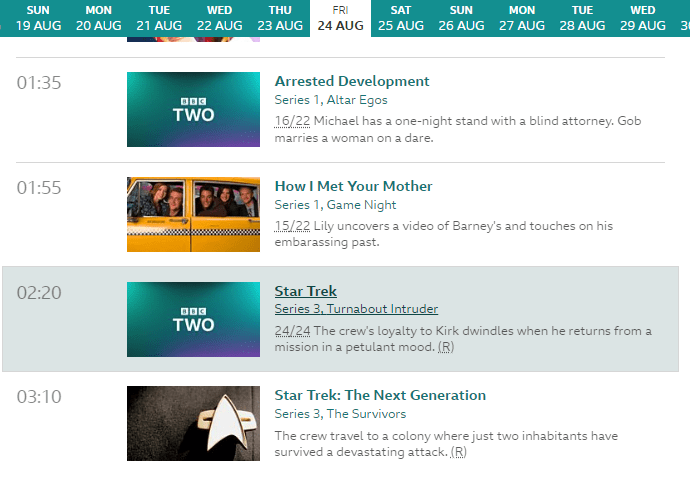
The Starship Enterprise had enough stamina to keep teleporting into the BBC2 schedules all the way until 2007 – though by that point, much as NBC had done to the series back in 1969, it was being relegated to less popular slots. And, as a result, the last episode of The Original Series on a BBC channel was Turnabout Intruder, going out at 2.20am in the wee small hours of Saturday 25 August 2007.
See also: Star Trek Night (1996) from that year’s August Bank Holiday Monday, to mark 30 years of the series. Presented by Craig Charles (Patrick Stewart would return the favour two years later, when he presented BBC2’s Red Dwarf Night), this included one-off quiz To Boldly Go Where No Quiz Has Gone Before, a documentary where the likes of Stephen Hawking, Roger Penrose and Lawrence Krauss explore how plausible all that Trek tech really was, a compilation of Trek spoofs from TV history, a John Peel retrospective on the musical careers of the Enterprise actors, plus the pilot episode of Star Trek: Voyager. All grouted with tributes by celebrity Trek fans, including Josie Lawrence, Paul Boateng MP, Jonathan Ross, Damien Hirst, Patrick Moore and Camille Paglia.
Also see also: another Star Trek Night on 16 September 2001, this time marking the (you guessed it) 35th anniversary of the programme. No mere repeat of last time, this time around Jonathan Ross was in the captain’s chair, hosting: a look at how the series became a huge franchise, a behind-the-scenes look at Trek’s SFX, a look at where the show might go next, a repeat of an episode voted “Captain’s Choice”, with a winning episode plucked from the stewardship of Kirk, Picard, Sisko or Janeway.
SPOILER ALERT: The winning episode was Star Trek: Voyager episode Counterpoint. Recency bias, or a nation forever in love with Captain Kathryn Janeway? You decide.
Additionally, also see also: Star Trek: The Animated Series (unhelpfully for me, also billed as ‘Star Trek’ in the RT), featuring the voices of the original cast, which aired on BBC1 on Saturday evenings for a spell from 31 August 1974, and within Children’s BBC hours through 1975, 1976 and 1977. It would later reappear on BBC2 during summer holiday mornings in 1995 and Easter holiday mornings in 1996.
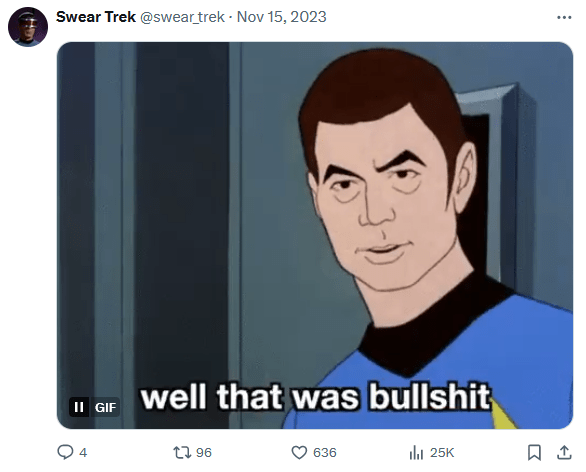
And led to one of the better peak-era Twitter accounts, of course.

And, seeing as we’re here:
200. Star Trek: The Next Generation
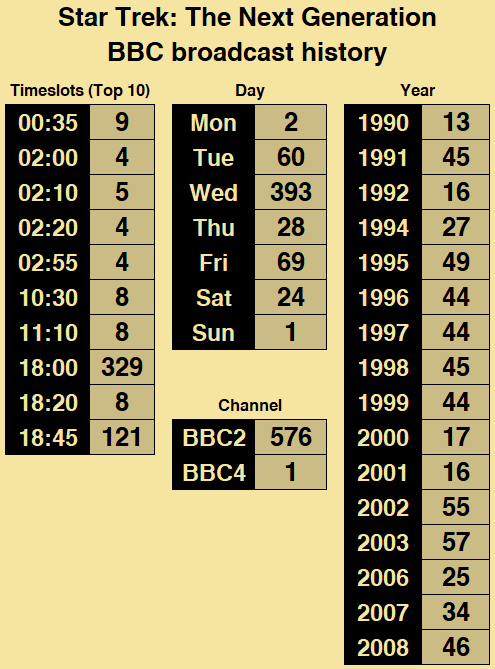
1990-2008, broadcast 577 times
BBC2 (576 times, 1990-2008), BBC4 (once, 2006)
Some American TV programmes seem designed to be snaffled up by Sky before the BBC can even get the padlock off its chequebook, and if it had arrived just a few years later you can guarantee Star Trek: TNG would have been one of them. As luck would have it, by the time the long-awaited follow-up to Trek was being shopped around in the late 1980s, the BBC were able to pounce (though not before the series debuted in the UK as a retail video premiere, helping Paramount claw back some of that sizeable budget).
And so, on 26 September 1990, BBC2 viewers were treated to the programme’s movie-length pilot, as the employees of the Enterprise headed for Deneb IV. The programme immediately skyrocketed to the top of the channel’s BARB ratings, and became a fixture on the channel until 1998. Though not exclusively so – from season four onwards, first-run UK rights had been snaffled up by, yep, Sky One. What’s Klingon for “damn you, Murdoch”?
Okay, back to my desk. More nuggets from the expanded list soon, most likely.
 BrokenTV
2 responses to “The Joint-165th Most-Broadcast Programme on BBC TV (also 200th)”
Worth pointing out that the animated Star Trek was shown as part of Going Live in the early 90s as well, not sure if that counts towards this list though (not that it’s going to come anywhere near the top 200 whether that’s included or not anyway)
LikeLike
And sadly the only way to see the original Star Trek on TV any more is in both the remastered AND cropped to 16:9 form on the various CBS channels- either of which is a travesty, but both together… It’s not even that easy to see the originals any more, as there’s no in-print version of them in the UK any more, only on various streaming services and the DVDs which only have the remastered versions (though at least in 4:3). The Blu-Rays which did offer you the choice of original or remastered are long out of print in the UK- you can only get them on import or second hand now. Slowly becoming an incredibly frustrating George Lucas/Star Wars situation.
LikeLike