

Because it does kind of seem that way, doesn’t it? The schedules dominated by the same old programmes that seem to have been kicking around forever. But – is that really the case? Or, with the main BBC channels being the home for as wide an audience as possible, isn’t it just that the BBC’s programme roster has only ever been refreshed at a leisurely pace?
Well, given I’ve got a ton of programme info to play with (now including all of 2022 and 2023), we can try to look a little deeper into that theory.
If you remember back as far as yesterday, I published decade-by-decade breakdowns of programmes broadcast most frequently by the BBC. That revealed a little about the changes – or lack thereof – in programming policies over BBC Television’s history. Here, we’ll break things down into a slightly smaller chunks and see how much carry-over there is between each five-year period.
We’ll use the BBC’s TV programming between 1936-39 and 1946-49 as the foundation of this, then look at five-year chunks from 1950 onwards, looking at the 30 most-broadcast programmes from each period. If a programme was also in the Top 30 for the previous period, it gets highlighted and added to a total. The higher the total for that period, the lower the amount of programme turnover for that particular spell. The lower the total, the most inventive the Beeb were (likely) being during that spell, giving increased schedule space to new programmes.
Okay, here we go. Ready for some info tables?
NOTE: To make things fair for the most recent time period, instead of just calculating “2020-2023” (meaning the churn level would likely be lower, as you’re only looking at a four-year rather than five-year spell), I’ve calculated numbers for 2019-2023, and compared it to a comparable list running from 2014-2018. Oh, and this only accounts for programmes broadcast on the (as was) BBC Television Service, and BBC1 and BBC2 from 1964 onwards.

That was a long list, wasn’t it? Here’s the key info, shorn of programme detail:
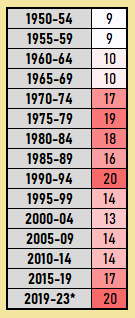
As we can see from the above, the lack of imagination in the BBC schedules really got going from 1970 onwards, and reached a high point (or low point, if you prefer) in the first half of the 1990s. Things got better around the turn of the millennium, but a lack of imagination and risk-taking started to spread as the present day approached. And so, we’re at a point where two-thirds of the BBC’s most-shown programmes were also amongst the most-shown shows from five years earlier.
And so, in conclusion, if we’re pondering the question ‘Has the BBC Run Out of Ideas?’, going by the evidence above, the answer is pretty much “Yeah, but it’s not the first time.” Though, of course, this is pretty telling…

In our next module, T888, we’ll be looking at Social Behaviour of Animals and the History of Wood.

 BrokenTV
2 responses to “So, Has the BBC Run Out of Ideas?”
One might also contend that there may be a political climate involved too – the two main periods when the BBC license fee has been under the most sustained pressure were the fag-end of long Tory governments (1994-97 and 2021-24*) and they also seem to coincide with periods of the BBC ‘playing it safe’…
(*obviously I’m making something of an assumption here!)
LikeLiked by 1 person
The data gets really complicated when you only count ‘first run’ broadcasts. This is made even more confusing when you exclude re-versions, extended versions, shortened versions. The Motion Gallery is helpful for sorting by programme numbers for older shows however, the BBC Programmes database now uses different metadata.
If you send me an email then we can share some more information.
LikeLike